Biofuel Bunkering Market Size, Share, Growth & Forecast by Fuel Type (FAME-Based Marine Biofuel, HVO and Renewable Diesel, and Other Biofuel), Vessel Type (Container Ships, Bulk Carriers, Tankers, General Cargo Vessels, RoRo Vessels, Cruise Ships, Ferries, Offshore Support Vessels), Bunkering Mode (Ship-to-Ship, Truck-to-Ship, Terminal and Pipeline), Contract Type (Spot, Term, Strategic Supply Agreement), and Blend Ratio (B5 and Below, B6–B24, B25–B49, B50–B99, B100) — Global Analysis 2026–2035
Industry: Energy & Power | Publishing Date: June 18, 2026 | Last Updated: September 10, 2026 | No of Pages: N/A | No. of Tables: N/A | No. of Figures: N/A | Format: PDF | Report Code: EP4711
What Is the Biofuel Bunkering Market Size?
The global Biofuel Bunkering Market was valued at USD 5.80 billion in 2025 and is expected to reach USD 6.51 billion in 2026. Driven by tightening International Maritime Organization (IMO) greenhouse gas (GHG) emissions targets, the FuelEU Maritime regulation, and accelerating fleet decarbonization commitments among global shipping majors, the market is projected to reach USD 18.42 billion by 2035, advancing at a CAGR of 11.0% from 2026 to 2035. Key growth catalysts include IMO's 2023 GHG Strategy mandating net-zero emissions by 2050, the rising cost competitiveness of FAME-based and HVO biofuels, growing adoption of Bio-LNG across container and cruise shipping, and port infrastructure expansion enabling diversified bunkering modes across major trade hubs.
|
Parameters |
Details |
|
Market Size in 2025 |
USD 5.80 Billion |
|
Market Size in 2026 |
USD 6.51 Billion |
|
Revenue Forecast in 2035 |
USD 18.42 Billion |
|
Growth Rate |
CAGR of 11.0% from 2026 to 2035 |
|
Analysis Period |
2025–2035 |
|
Base Year Considered |
2025 |
|
Forecast Period |
2026–2035 |
|
Market Size Estimation |
Billion USD |
|
Companies Profiled |
20 |
|
Countries Covered |
33 |
|
Market Share |
Top 10 |
Biofuel Bunkering Market Overview
What Is the Biofuel Bunkering Market?
The Biofuel Bunkering Market encompasses the production, supply chain, and commercial delivery of biofuels used as marine fuels for vessel propulsion and onboard energy generation. Biofuel bunkering includes FAME-based blends, hydrotreated vegetable oil (HVO), renewable diesel, biomethanol, Bio-LNG, and bioethanol marine fuels delivered to vessels via ship-to-ship, truck-to-ship, and terminal and pipeline bunkering modes. The market supports commercial shipping operators, port authorities, fuel distributors, and original equipment manufacturers (OEMs) seeking compliant low-carbon alternatives to conventional marine diesel and heavy fuel oil.
How Has the Biofuel Bunkering Market Evolved?
The Biofuel Bunkering Market has undergone three structural evolution phases. The first phase (pre-2020) was characterized by niche adoption of FAME blends and limited regulatory incentives, primarily in European short-sea shipping and ferries. The second phase (2020–2023), triggered by IMO 2020 sulfur cap enforcement, broadened market awareness and stimulated initial investment in biofuel supply chains. The current phase (2024 onwards) reflects systematic commercialization driven by IMO's 2023 GHG Strategy, FuelEU Maritime, and growing corporate sustainability mandates compelling container lines, bulk carriers, and cruise operators to scale biofuel bunkering contracts.
How Do Regulations Influence the Biofuel Bunkering Market?
Regulatory frameworks represent the most powerful structural driver of the Biofuel Bunkering Market. The IMO 2023 Revised GHG Strategy targets a 20% reduction in GHG emissions from international shipping by 2030 and net-zero by 2050. The European Union's FuelEU Maritime Regulation, effective from January 2025, mandates a 2% reduction in greenhouse gas intensity of marine fuels by 2025, escalating to 80% by 2050, directly creating mandatory demand for biofuel blends and alternative fuels across EU-calling vessels. Additionally, the Carbon Intensity Indicator (CII) rating system, enforced by IMO from 2023, creates commercial urgency for operators to adopt biofuel bunkering solutions to improve fleet ratings and avoid port access restrictions.
How Is Technology Adoption Expanding Across the Biofuel Bunkering Market?
Technology adoption in the Biofuel Bunkering Market is accelerating across the entire value chain. Advanced feedstock processing technologies, including hydrotreating and transesterification, are enabling higher-purity FAME and HVO production with lower lifecycle GHG emissions. Digital mass flow metering systems are improving bunkering accuracy and reducing delivery disputes. Vessel engine compatibility testing for higher-blend biofuels (B25 and above) is expanding, supported by engine manufacturer certifications from Wärtsilä, MAN Energy Solutions, and Winterthur Gas and Diesel. Real-time blockchain-based fuel documentation platforms are also emerging to ensure chain-of-custody transparency and regulatory reporting compliance.
Ecosystem Analysis of the Biofuel Bunkering Market
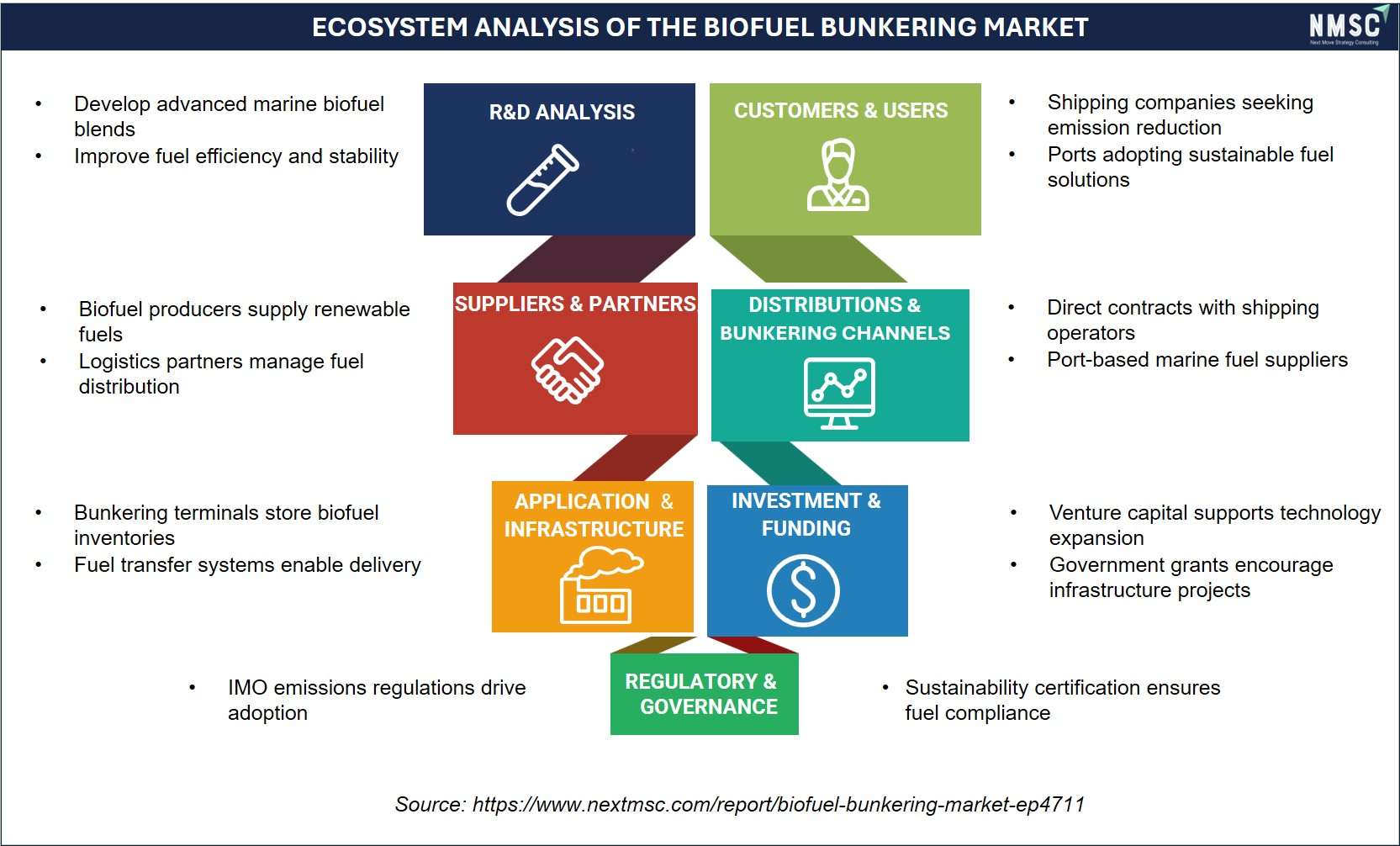
The Biofuel Bunkering Market ecosystem is shaped by strong collaboration among fuel producers, shipping companies, port operators, regulators, and technology developers. Industry growth is supported by continuous investment in sustainable fuel production, expanding bunkering infrastructure, and evolving regulatory frameworks. Increasing demand for low-carbon marine fuels is accelerating partnerships across the value chain, strengthening supply security, innovation, and long-term market adoption while supporting global maritime decarbonization objectives.
|
Key Takeaways |
|
By fuel type, FAME-Based Marine Biofuel dominated the Biofuel Bunkering Market at USD 3.2 billion in 2025, representing approximately 55% of total market revenue. HVO and Renewable Diesel is the fastest-growing fuel type at a CAGR of 14.0% from 2026 to 2035, projected to advance from USD 1.4 billion in 2025 to USD 5.2 billion by 2035, driven by superior energy density, drop-in compatibility, and feedstock diversification. |
|
By vessel type, Container Ships held the largest share at USD 1.6 billion in 2025 within the Biofuel Bunkering Market. Ferries are the fastest-growing vessel segment at a CAGR of 14.8% from 2026 to 2035, supported by short-route predictability, port proximity enabling truck-to-ship delivery, and strong EU-driven regulatory pressure on ferry operators serving intra-European routes. |
|
By bunkering mode, Ship-to-Ship Bunkering led with USD 2.4 billion in 2025, reflecting its operational flexibility across major deep-water ports and offshore anchorages. Terminal and Pipeline Bunkering is the fastest-growing mode at a CAGR of 13.9%, as port authorities across Singapore, Rotterdam, and Houston invest in dedicated biofuel terminal infrastructure. |
|
By contract type, Spot Contracts held the largest revenue at USD 2.6 billion in 2025 in the Biofuel Bunkering Market. Strategic Supply Agreements are the fastest-growing contract type at a CAGR of 14.9%, as large container lines and cruise operators seek fuel price certainty and guaranteed volume commitments aligned with multi-year decarbonization roadmaps. |
|
By blend ratio, B5 and Below accounted for USD 2.2 billion in 2025, reflecting the wide adoption of low-blend mandates as a transitional compliance measure. The B50 to B99 segment is the fastest-growing blend ratio at a CAGR of 16.7% from 2026 to 2035, as vessel engine compatibility certifications expand and the cost premium for high-blend biofuels narrows. |
|
Europe dominated the Biofuel Bunkering Market with USD 2.4 billion in 2025 and is forecast to reach USD 7.6 billion by 2035 at a CAGR of 12.2%, underpinned by FuelEU Maritime enforcement, strong port infrastructure in Rotterdam and Antwerp, and the highest concentration of biofuel bunkering suppliers globally. |
|
Asia-Pacific is the fastest-growing major region in the Biofuel Bunkering Market at a CAGR of 12.4% from 2026 to 2035, advancing from USD 1.8 billion in 2025 to USD 5.80 billion by 2035, driven by Singapore's leadership as a global bunkering hub, China's fleet modernization programs, and South Korea's and Japan's domestic biofuel mandates. |
|
Singapore is the single largest country market in Asia-Pacific for biofuel bunkering and among the top two globally, reflecting its position as the world's largest bunkering port by volume and first-mover policy support for biofuel blends through the Maritime Singapore Decarbonisation Blueprint. |
|
The Netherlands is a dominant European country market in the Biofuel Bunkering Market, underpinned by the Port of Rotterdam's designation as a leading biofuel bunkering hub, robust HVO and FAME production infrastructure, and proximity to major refinery and feedstock processing capacity. |
Key Emerging Trends in the Biofuel Bunkering Market
How Is the IMO 2023 Revised GHG Strategy Reshaping Demand Structures in the Biofuel Bunkering Market?
The IMO 2023 Revised GHG Strategy has fundamentally restructured long-term demand in the Biofuel Bunkering Market by establishing legally binding emissions reduction milestones for international shipping. The strategy targets at least a 20% reduction in total GHG emissions by 2030, with a 70% reduction by 2040 compared to 2008 baseline levels, and net-zero by or around 2050. From our research, we found that this regulatory timeline is compelling fleet operators across container, bulk, and tanker sectors to prioritize biofuel bunkering as a near-term bridge fuel strategy while long-term zero-carbon technologies such as green ammonia and green hydrogen mature commercially. Operators including A.P. Moller-Maersk and CMA CGM have already documented biofuel adoption as an explicit compliance pathway in their decarbonization disclosures. This trend is transforming what was previously opportunistic biofuel procurement into structured, contract-based strategic supply agreements.
How Is HVO and Renewable Diesel Adoption Displacing Conventional FAME Blends in the Biofuel Bunkering Market?
Hydrotreated Vegetable Oil (HVO) and renewable diesel are experiencing accelerating adoption within the Biofuel Bunkering Market, progressively challenging FAME-based blends as the preferred drop-in marine biofuel. Unlike FAME, HVO offers superior oxidation stability, lower cloud point, higher energy density, and direct compatibility with existing marine fuel systems without engine modification requirements. Through our market assessment, we observed that HVO producers including Neste Oyj and UPM Biofuels are actively expanding marine-grade HVO supply, with Neste's Rotterdam terminal positioning as a strategic gateway for European bunkering demand. The lower cold-weather operability threshold of HVO is particularly important for vessels operating in Northern European and Scandinavian routes. Regulatory acceptance of HVO under FuelEU Maritime's lifecycle GHG calculation methodology further validates HVO as a commercially viable and compliance-effective bunkering solution.
How Is Bio-LNG Emerging as a Long-Term Bunkering Strategy Within the Biofuel Bunkering Market?
Bio-LNG is emerging as a strategically important segment within the Biofuel Bunkering Market, particularly among fleet operators that have already invested in LNG-capable vessels. NMSC's analysis indicates that the overlap between the existing LNG-powered fleet and the pipeline of bio-LNG supply infrastructure is creating natural commercialization opportunities without requiring vessel-side capital expenditure. CMA CGM has been among the most active adopters, having secured long-term bio-LNG supply agreements aligned with its fleet of dual-fuel LNG container ships. The biological upgrading of biomethane to liquefied bio-LNG through biomethane liquefaction plants is attracting infrastructure investment in the Netherlands, Germany, and Scandinavia. Bio-LNG's near-zero well-to-wake GHG emissions profile also positions it as a high-priority transition fuel under FuelEU Maritime's multiplier methodology for qualifying bio-fuels of non-biological origin.
How Is Digital Bunkering Infrastructure Transforming Transparency and Compliance in the Biofuel Bunkering Market?
Digital transformation of bunkering operations is reshaping efficiency, accuracy, and regulatory compliance across the Biofuel Bunkering Market. Mass Flow Metering (MFM) systems, now mandated in Singapore and several European ports, are eliminating measurement disputes and improving delivery accuracy for biofuel blends. Our findings suggest that blockchain-based fuel documentation platforms are gaining adoption among major fuel suppliers and shipping companies to provide immutable chain-of-custody records for biofuel origin certification, feedstock traceability, and lifecycle GHG calculations. This digital layer is becoming increasingly important for compliance with the EU Emissions Trading System (ETS), which expanded to cover maritime shipping from January 2024, requiring operators to surrender allowances for verified emissions from EU-calling voyages. Platforms such as Cargill's biofuel tracking systems and proprietary supplier portals are emerging as competitive differentiators within the bunkering market.
What Are the Key Market Drivers, Breakthroughs, and Investment Opportunities that Will Shape the Biofuel Bunkering Industry in the Next Decade?
|
Drivers / Trends / Restraints |
(+/-) % Impact on CAGR Forecast |
Geographic Relevance |
Impact Timeline |
|
IMO 2023 GHG Strategy Enforcement |
+2.2% |
Global (led by Europe, APAC) |
2025–2035 |
|
FuelEU Maritime Regulation |
+1.8% |
Europe, Med, North Sea corridors |
2025–2033 |
|
HVO and Renewable Diesel Adoption |
+1.5% |
Europe, North America, Asia-Pacific |
2025–2032 |
|
Bio-LNG Fleet Integration |
+1.2% |
Europe, APAC, Middle East |
2026–2035 |
|
EU ETS Maritime Expansion |
+1.0% |
Europe, Global Trade Corridors |
2024–2035 |
|
Port Infrastructure Investment for Biofuel Terminals |
+0.9% |
Singapore, Rotterdam, Houston, Fujairah |
2025–2030 |
|
Feedstock Cost Volatility (UCO, Tallow, Palm) |
-1.3% |
All regions |
Ongoing |
|
Blending Wall Limitations at High Blend Ratios |
-0.9% |
Global |
2025–2030 |
|
High Biofuel Price Premium vs. VLSFO |
-0.8% |
Price-sensitive APAC, LATAM markets |
Ongoing |
|
Limited Bio-LNG and Biomethanol Supply Infrastructure |
-0.7% |
Emerging market ports, MEA |
2025–2028 |
|
ISCC and RSB Sustainability Certification Requirements |
+0.6% |
EU, UK, North America |
Ongoing |
|
Corporate Net-Zero Fleet Commitments by Shipping Majors |
+1.4% |
Global |
2025–2035 |
|
Carbon Intensity Indicator (CII) Rating Enforcement |
+1.1% |
Global |
2023–2035 |
|
Green Financing and ESG Bond Issuance for Bunkering Infra |
+0.7% |
Europe, Singapore, UAE |
2026–2035 |
What Are the Growth Drivers of the Biofuel Bunkering Market?
How Is the IMO GHG Strategy Creating Structural and Regulatory Demand for Biofuel Bunkering?
The IMO's Revised GHG Strategy, adopted in July 2023, represents the most consequential regulatory demand driver for the Biofuel Bunkering Market. The strategy mandates a minimum 20% reduction in GHG emissions from international shipping by 2030 and a 70% reduction by 2040 against a 2008 baseline, with net-zero targeted by 2050. Based on our market evaluation, we noticed that the Carbon Intensity Indicator (CII), a mandatory energy efficiency operational framework under MARPOL Annex VI, requires vessels to improve their carbon intensity rating annually or face commercial restrictions, directly incentivizing operators to adopt biofuel bunkering to reduce reported CO2-equivalent emissions. The IMO's Fourth GHG Study projected that under a business-as-usual scenario, shipping emissions could increase by 50% by 2050, intensifying the urgency of transitional fuel substitution. Industry data from the International Chamber of Shipping confirms that biofuels currently represent one of the most commercially deployable pathways to compliance for existing fleet operators, given their compatibility with current engine technologies and port infrastructure.
How Is the European Union's FuelEU Maritime Regulation Accelerating Biofuel Bunkering Adoption?
The FuelEU Maritime Regulation, which entered into force on January 1, 2025, imposes mandatory greenhouse gas intensity limits on the energy used by vessels calling at EU ports, creating direct and binding demand for biofuel bunkering within European trade corridors. The regulation requires a 2% reduction in GHG intensity in 2025, escalating to 6% by 2030 and 80% by 2050, applicable to vessels of 5,000 gross tons and above on voyages to, from, and between EU ports. From our research, we found that an estimated 8,000 to 10,000 vessels are subject to FuelEU Maritime compliance requirements in 2025, directly creating a captive demand pool for certified biofuel bunkering services at major EU ports including Rotterdam, Hamburg, Antwerp, and Piraeus. The European Commission's Joint Research Centre lifecycle analysis framework, which governs GHG intensity calculations under FuelEU, provides favorable methodological treatment for FAME blends, HVO, and Bio-LNG derived from waste and residue feedstocks, further accelerating adoption of these specific fuel categories within the Biofuel Bunkering Market.
How Is Growing Corporate Decarbonization Commitment Among Shipping Majors Driving Biofuel Bunkering Demand?
Beyond regulatory mandates, voluntary corporate sustainability commitments by global shipping majors are generating durable structural demand within the Biofuel Bunkering Market. Our assessment indicates that major container lines, tanker operators, and bulk carriers have embedded biofuel bunkering into their Science Based Targets initiative (SBTi) and net-zero roadmaps, creating predictable multi-year procurement demand. Companies including A.P. Moller-Maersk, CMA CGM, Hapag-Lloyd, and MSC have publicly disclosed biofuel targets and have already executed term contracts and strategic supply agreements with fuel suppliers. The Science Based Targets initiative for Maritime Transport, developed in partnership with the Global Maritime Forum, provides a credible reference framework for vessel emissions reduction ambitions that explicitly quantifies biofuel's contribution. This corporate demand layer is structurally distinct from regulatory compliance demand and provides resilience to the the market even in scenarios where regulatory timelines shift.
What Are the Growth Inhibitors of the Biofuel Bunkering Market?
How Does Feedstock Cost Volatility and Supply Concentration Limit Biofuel Bunkering Market Growth?
Feedstock cost volatility represents the most persistent structural constraint on the Biofuel Bunkering Market, directly impacting the price premium of biofuels versus conventional very-low-sulfur fuel oil (VLSFO). The primary feedstocks for marine biofuels, including used cooking oil (UCO), animal tallow, palm oil, rapeseed methyl ester (RME), and soybean methyl ester (SME), are subject to significant price fluctuations driven by agricultural commodity cycles, geopolitical supply disruptions, and competing demand from road transport biofuels. Based on NMSC's research, we found that UCO prices experienced pronounced volatility between 2022 and 2024, driven in part by post-pandemic foodservice recovery and increasing competition from European renewable diesel producers. The European Commission's Renewable Energy Directive III (RED III) imposes a 1.7% cap on crop-based biofuels toward transport targets, limiting feedstock expansion and concentrating supply risks within the waste and residue feedstock categories most relevant to marine biofuel production.
How Do High-Blend Ratio Compatibility Limitations Constrain Broader Biofuel Adoption in the Bunkering Market?
Engine compatibility limitations at higher biofuel blend ratios represent a technical and commercial barrier constraining the pace of biofuel bunkering adoption beyond low-blend concentrations. While B5 to B24 blends are widely accepted by most marine engine OEMs without modification requirements, blends above B25 require engine manufacturer approval, material compatibility assessment, and in some cases, component upgrades to fuel system elastomers, filters, and heat exchangers. Our analysis shows that the International Standards Organization's ISO 8217 standard for marine distillate and residual fuels does not yet fully accommodate high-blend FAME or pure HVO specifications, creating uncertainty for fuel buyers and potentially exposing operators to warranty risk. The International Chamber of Shipping has flagged the need for updated international standards to support broader biofuel adoption across the commercial fleet. This standards gap disproportionately affects smaller operators lacking dedicated technical compliance functions capable of navigating engine manufacturer approval processes independently.
What Are the Growth Opportunities in the Biofuel Bunkering Market?
How Does Port Infrastructure Investment in Dedicated Biofuel Terminals Create Structural Market Opportunities?
The ongoing and planned investment in dedicated biofuel terminal and storage infrastructure at major global bunkering ports represents a substantial structural opportunity for the Biofuel Bunkering Market. Ports with dedicated biofuel storage capacity and certified blending facilities can significantly reduce supply chain costs, improve delivery reliability, and attract premium-paying corporate sustainability buyers. Through our analysis, we found that the Port of Rotterdam's investment in biofuel blending and storage infrastructure, supported by the Dutch government's national climate agreement, has positioned the Netherlands as Europe's leading biofuel bunkering hub. Singapore's Maritime Port Authority has actively facilitated biofuel bunkering trials under its Biofuel Bunkering Action Plan, with trials conducted across multiple fuel types and bunkering modes. The International Maritime Organization's Global Industry Alliance (GIA) has identified port infrastructure investment as a critical enabler of biofuel scale-up, providing a recognized institutional framework for public-private investment coordination across developing and developed port economies.
How Does the Expansion of the EU ETS to Maritime Shipping Create Commercial Opportunities in the Biofuel Bunkering Market?
The inclusion of maritime shipping in the EU Emissions Trading System (ETS) from January 2024 creates a direct commercial mechanism that enhances the economic case for biofuel bunkering among EU-calling vessel operators. Under the EU ETS maritime provisions, operators must surrender allowances for verified CO2 emissions from all intra-EU voyages, 50% of extra-EU voyages, and vessel energy use at EU berths. Our assessment indicates that biofuels derived from waste and residue feedstocks, classified under Annex IX of the Renewable Energy Directive, are treated as zero-emission under the EU MRV and ETS calculation methodology, allowing operators to avoid purchasing carbon allowances for the biogenic fuel fraction of their reported emissions. As EU carbon allowance prices remain elevated, the avoided ETS cost from biofuel blending materially reduces the effective price premium of biofuels versus fossil fuels. This carbon price mechanism is expected to become an increasingly significant driver of biofuel bunkering economics through the forecast period, particularly for operators with high EU port call frequency.
How Does the Rise of Green Shipping Corridors Present New Growth Pathways for the Biofuel Bunkering Market?
Green shipping corridors, defined as routes between major port pairs where near-zero GHG shipping is jointly facilitated, represent an emerging and significant structural opportunity for the Biofuel Bunkering Market. In our observation, the First Movers Coalition, supported by the World Economic Forum, has identified green corridors as a primary mechanism for scaling alternative marine fuel demand through anchor buyer commitments and coordinated port infrastructure investment. The Clydebank Declaration for Green Shipping Corridors, signed at COP26 and supported by over 22 countries, commits signatory governments to facilitate the establishment of at least six green corridors by 2025 and a significant number by 2030, with biofuels serving as a key transitional fuel alongside methanol and ammonia. These corridors concentrate bunkering demand along specific high-volume trade routes, enabling commercial viability for dedicated biofuel supply infrastructure at corridor-anchor ports, which in turn lowers per-unit delivery costs and supports broader market expansion.
Strategic Framework Impacting the Biofuel Bunkering Market
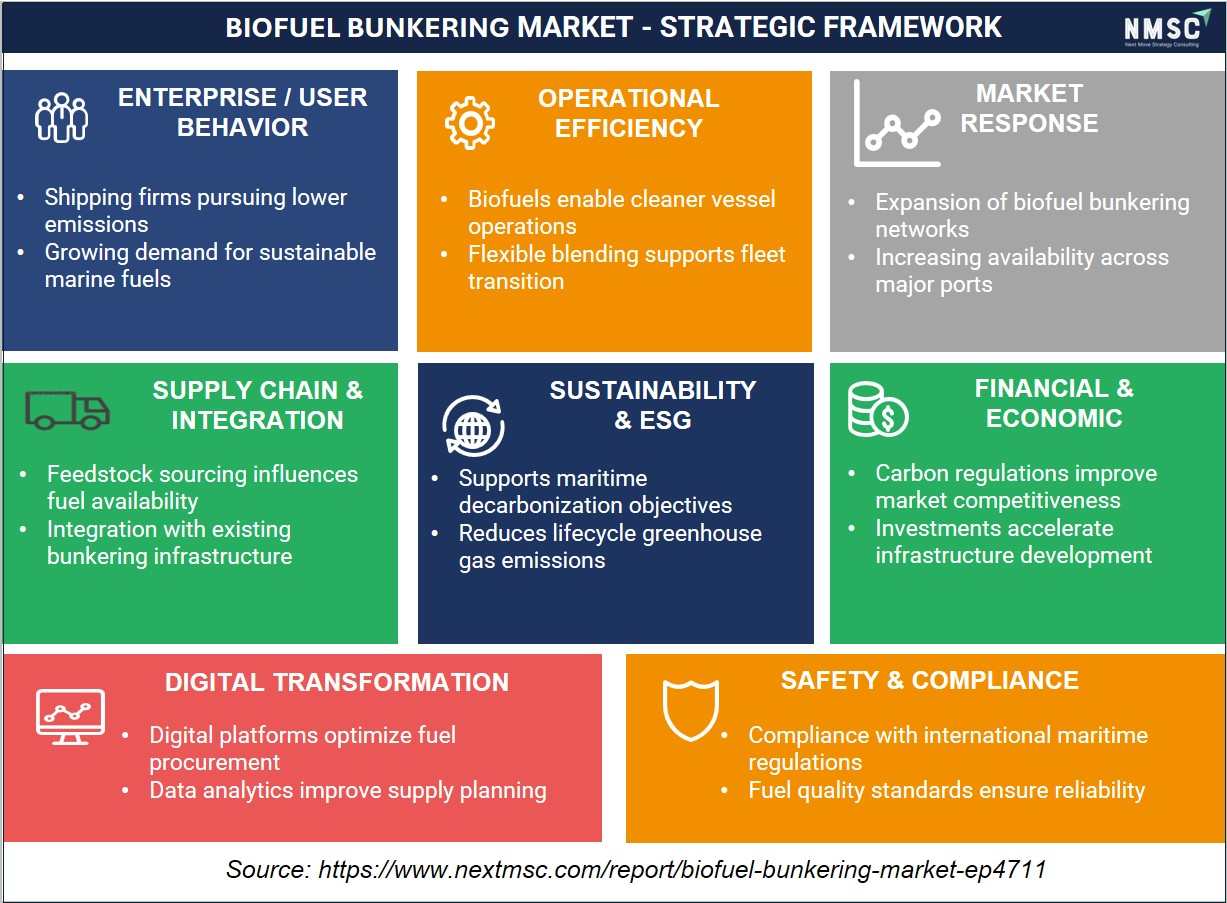
The Biofuel Bunkering Market is driven by the convergence of sustainability goals, operational efficiency requirements, and regulatory compliance mandates. Growing adoption of biofuels among shipping operators reflects the industry's transition toward lower-emission maritime transport solutions. Supported by investments in supply infrastructure, digital fuel management systems, and international decarbonization policies, the market continues to expand as stakeholders prioritize environmental performance, fuel accessibility, and long-term economic competitiveness.
How Is the Biofuel Bunkering Market Segmented in This Report, and What Are the Key Insights from the Segmentation Analysis?
How Does Fuel Type Segmentation Reveal the Composition and Growth Dynamics of the Biofuel Bunkering Market?
|
Fuel Type Segment |
2025 (USD Bn) |
2035 (USD Bn) |
CAGR (%) |
|
FAME-Based Marine Biofuel |
3.2 |
8.6 |
10.4% |
|
HVO and Renewable Diesel |
1.4 |
5.2 |
14.0% |
|
Biomethanol |
0.3 |
1.6 |
18.2% |
|
Bio-LNG |
0.5 |
2.2 |
17.8% |
|
Bioethanol Marine Fuel |
0.2 |
0.5 |
9.6% |
|
Other Biofuel |
0.2 |
0.3 |
4.1% |
Based on our analysis of marine fuel adoption trends and decarbonization procurement patterns, we observed that the Biofuel Bunkering Market is segmented into FAME-Based Marine Biofuel, HVO and Renewable Diesel, Biomethanol, Bio-LNG, Bioethanol Marine Fuel, and Other Biofuel. The FAME-Based Marine Biofuel segment, which includes UCOME, RME, SME, PME, and other FAME variants, dominates the market due to its established supply chains, lower unit cost relative to advanced biofuels, and broad vessel compatibility at B5 to B24 blend ratios. UCOME (used cooking oil methyl ester) holds the largest sub-segment share within FAME due to its waste-feedstock classification qualifying for double-counting under EU sustainability directives. HVO and Renewable Diesel is the fastest-growing fuel type, driven by superior drop-in compatibility and clean-burning properties, with Neste Oyj's NEXBTL and TotalEnergies SE's Oleo-100 among the commercially deployed marine-grade products. Bio-LNG and Biomethanol represent high-growth emerging segments, supported by new dual-fuel vessel orders and long-term supply agreements being established by container and cruise shipping operators.
Which Vessel Segments Are Generating the Highest Biofuel Bunkering Demand and What Drives Their Adoption?
|
Vessel Type Segment |
2025 (USD Bn) |
2035 (USD Bn) |
CAGR (%) |
|
Container Ships |
1.6 |
4.8 |
11.6% |
|
Bulk Carriers |
0.9 |
2.8 |
12.0% |
|
Tankers |
0.9 |
2.6 |
11.2% |
|
General Cargo Vessels |
0.6 |
1.7 |
11.0% |
|
RoRo Vessels |
0.5 |
1.5 |
11.6% |
|
Cruise Ships |
0.5 |
1.5 |
11.6% |
|
Ferries |
0.3 |
1.2 |
14.8% |
|
Offshore Support Vessels |
0.3 |
1.1 |
13.8% |
|
Other Commercial Vessels |
0.2 |
1.2 |
19.6% |
Through NMSC's assessment, we found that the Biofuel Bunkering Market is segmented by vessel type into Container Ships, Bulk Carriers, Tankers, General Cargo Vessels, RoRo Vessels, Cruise Ships, Ferries, Offshore Support Vessels, and Other Commercial Vessels. Container Ships dominate due to the high fuel consumption volumes of ultra-large container vessels (ULCVs), proactive corporate sustainability commitments from major container lines, and concentrated trade route structures enabling systematic biofuel supply planning. Bulk Carriers represent the second-largest segment, with operators increasingly using biofuel blends to improve CII ratings as an operationally straightforward compliance intervention. Ferries are the fastest-growing vessel segment, benefiting from route predictability, proximity to port biofuel infrastructure, strong European regulatory pressure, and public-sector ferry operator net-zero commitments. Offshore Support Vessels are also registering above-average growth as oil and gas majors extend decarbonization requirements to their contracted marine support fleets through charter specifications.
How Do Different Bunkering Delivery Modes Shape Operational Efficiency and Market Penetration in the Biofuel Bunkering Market?
|
Bunkering Mode Segment |
2025 (USD Bn) |
2035 (USD Bn) |
CAGR (%) |
|
Ship-to-Ship Bunkering |
2.4 |
7.2 |
11.6% |
|
Truck-to-Ship Bunkering |
2.2 |
6.8 |
11.9% |
|
Terminal and Pipeline Bunkering |
1.2 |
4.4 |
13.9% |
Our analysis of operational bunkering logistics and port infrastructure capabilities indicates that the Biofuel Bunkering Market is segmented by delivery mode into Ship-to-Ship, Truck-to-Ship, and Terminal and Pipeline Bunkering. Ship-to-Ship Bunkering holds the largest market share, reflecting its operational flexibility at major deep-water ports and offshore anchorage points where dedicated biofuel barges can deliver large volumes efficiently. Truck-to-Ship Bunkering is the second-largest mode and particularly dominant in smaller ports and emerging markets where terminal infrastructure investment is still in early stages. Terminal and Pipeline Bunkering is the fastest-growing mode at a CAGR of 13.9%, driven by port authority investment in dedicated biofuel storage tanks and blending facilities at high-volume hubs including Rotterdam, Singapore, and Fujairah. As biofuel bunkering volumes scale, the economics of terminal and pipeline infrastructure improve substantially, creating a reinforcing adoption cycle where volume growth enables infrastructure investment that in turn lowers per-unit delivery costs.
How Do Contracting Structures Reflect Procurement Maturity and Strategic Intent in the Biofuel Bunkering Market?
|
Contract Type Segment |
2025 (USD Bn) |
2035 (USD Bn) |
CAGR (%) |
|
Spot Contract |
2.6 |
7.2 |
10.7% |
|
Term Contract |
2.1 |
6.8 |
12.5% |
|
Strategic Supply Agreement |
1.1 |
4.4 |
14.9% |
Based on NMSC's research, we found that the Biofuel Bunkering Market is segmented by contract type into Spot Contracts, Term Contracts, and Strategic Supply Agreements. Spot Contracts currently lead the market as many operators continue to procure biofuels opportunistically while building internal compliance frameworks and evaluating fuel performance at vessel level. Term Contracts are gaining traction as compliance urgency under FuelEU Maritime and CII regulations creates predictable annual demand volumes that justify fixed-price forward arrangements with major fuel suppliers. Strategic Supply Agreements represent the fastest-growing contract category at a CAGR of 14.9%, reflecting the emergence of long-duration, multi-port, high-volume procurement arrangements between major shipping companies and global biofuel distributors. These agreements often include sustainability certification guarantees, chain-of-custody documentation, and in some cases, direct feedstock co-investment arrangements that align supplier and buyer decarbonization objectives within this segment.
How Does Blend Ratio Segmentation Illustrate the Commercial Maturity and Transition Trajectory of the Biofuel Bunkering Market?
|
Blend Ratio Segment |
2025 (USD Bn) |
2035 (USD Bn) |
CAGR (%) |
|
B5 and Below |
2.2 |
5.4 |
9.4% |
|
B6 to B24 |
1.8 |
5.6 |
12.0% |
|
B25 to B49 |
0.8 |
3.2 |
14.9% |
|
B50 to B99 |
0.6 |
2.8 |
16.7% |
|
B100 |
0.4 |
1.4 |
13.3% |
Our assessment indicates that the Biofuel Bunkering Market is segmented by blend ratio into B5 and Below, B6 to B24, B25 to B49, B50 to B99, and B100 categories, each reflecting distinct stages of biofuel adoption maturity and regulatory alignment. The B5 and Below segment leads in revenue as the most widely mandated blend level by port authorities and flag states, representing a universal minimum adoption threshold across most vessel operators. The B6 to B24 segment is experiencing healthy growth driven by operators seeking higher CII improvement per tonne of biofuel purchased without triggering full engine compatibility review requirements. B50 to B99 is the fastest-growing blend ratio category at a CAGR of 16.7%, reflecting the expansion of high-blend pilot programs among pioneering operators and the improving cost economics of FAME and HVO at scale. Pure B100 adoption remains concentrated among specialized vessel types operating on short and predictable routes, such as ferries and offshore support vessels, where engine compatibility management and supply chain logistics are operationally controllable.
Regional Outlook
Geographic Performance Snapshot
|
Region |
2025 (USD Bn) |
2035 (USD Bn) |
CAGR (%) |
Key Driver |
|
North America |
0.7 |
2.2 |
12.1% |
EPA biofuel mandates, Gulf Coast bunkering hubs |
|
Europe |
2.4 |
7.6 |
12.2% |
FuelEU Maritime, Rotterdam / Antwerp infrastructure |
|
Asia-Pacific |
1.8 |
5.8 |
12.4% |
Singapore hub, IMO compliance adoption in China, Japan |
|
Middle East & Africa |
0.5 |
1.6 |
12.3% |
Fujairah bunkering hub, UAE sustainability programs |
|
Latin America |
0.4 |
1.2 |
11.6% |
Brazilian biodiesel policy, Panama Canal corridor |
Europe Biofuel Bunkering Market
Based on our engagements with European port operators and maritime fuel distributors, Europe is the dominant region in the Biofuel Bunkering Market, representing USD 2.4 billion in 2025 and forecast to reach USD 7.6 billion by 2035 at a CAGR of 12.2%. The FuelEU Maritime Regulation's January 2025 entry into force creates legally binding compliance demand for biofuels across thousands of EU-calling vessels. The Port of Rotterdam and Port of Antwerp serve as anchor biofuel bunkering hubs with established FAME, HVO, and Bio-LNG supply infrastructure. Regulatory maturity, strong producer presence, and proximity to major refinery feedstock capacity collectively position Europe as the global center of biofuel bunkering commercialization.
Netherlands Biofuel Bunkering Market
Based on our engagements with Rotterdam port stakeholders, the Netherlands leads European biofuel bunkering infrastructure as the gateway hub for FAME and HVO supply to container lines, tankers, and bulk carriers transiting the North Sea and Atlantic corridors. The Port of Rotterdam hosts dedicated biofuel storage terminals and benefits from proximity to Europe's largest biodiesel and HVO production clusters. Dutch government support through the Stimulering Duurzame Energieproductie (SDE++) scheme and alignment with EU RED III sustainability standards reinforce the Netherlands' position as the primary European origination point for marine-grade biofuels within the Biofuel Bunkering Market.
Germany Biofuel Bunkering Market
Through our analysis, Germany represents a significant European market in biofuel bunkering, driven by the Hamburg port's role as Northern Europe's second-largest container hub and Germany's domestic biofuel production base. German shipping companies operating feeder and short-sea routes are among the earliest adopters of mandated biofuel blend requirements under national maritime emissions policy. The Federal Environment Agency (Umweltbundesamt) and Germany's National Hydrogen Strategy both explicitly support bio-LNG and biomethanol as transitional fuels for maritime decarbonization, providing regulatory confidence for infrastructure investment within the Germany Biofuel Bunkering Market.
UK Biofuel Bunkering Market
From our assessment, the UK Biofuel Bunkering Market is advancing steadily, supported by the UK's Clean Maritime Plan and the Department for Transport's pathway to zero-emission shipping by 2050. Post-Brexit, the UK has implemented the UK ETS, which covers domestic maritime emissions and incentivizes biofuel adoption. The Port of Southampton and Port of Tilbury are increasingly accommodating biofuel bunkering services for cruise lines and container feeders. The UK shipowner community, represented by the British Ports Association and UK Chamber of Shipping, has formally supported biofuel adoption as a near-term decarbonization measure under the Maritime 2050 strategy framework.
France Biofuel Bunkering Market
According to evaluation, France's biofuel bunkering activities are concentrated at the Port of Le Havre and Marseille-Fos, the two primary container and bulk handling ports along the Atlantic and Mediterranean trade corridors. France's national energy transition law (Loi Relative à la Transition Energétique) and the national biofuel blending mandate under French transport energy policy support upstream biofuel production and provide the regulatory backdrop for marine biofuel procurement. TotalEnergies SE's active positioning in biofuel production and bunkering supply is particularly relevant to the France Biofuel Bunkering Market, given the company's domestic refinery network and global marine fuel distribution footprint.
Spain Biofuel Bunkering Market
Based on our market evaluation, Spain's biofuel bunkering demand is primarily driven by the Port of Algeciras, one of the Mediterranean's busiest transshipment hubs, and the Port of Valencia. Spain's proximity to the Strait of Gibraltar positions it as a strategic bunkering waypoint for vessels on Europe-Asia and Atlantic trade routes. The Spanish government's National Energy and Climate Plan (PNIEC) allocates support for advanced biofuel production, with implications for marine-grade biofuel supply availability. Spanish shipping operator Baleàries links to the Balearic Islands and ferry operators are among the near-term domestic biofuel bunkering adopters within the Spain Biofuel Bunkering Market.
Italy Biofuel Bunkering Market
Through our market assessment, Italy's biofuel bunkering market is developing around the ports of Genoa, La Spezia, and Taranto, which serve as Mediterranean gateways for container, bulk, and cruise traffic. Italy's PNRR-aligned maritime decarbonization investments are supporting port infrastructure modernization, including preliminary biofuel storage and blending capabilities. Fratelli Cosulich S.p.A., headquartered in Genoa, represents a domestically headquartered major player in the Italy Biofuel Bunkering Market, providing FAME-based blends and HVO to operators calling at Italian and broader Mediterranean ports.
Sweden Biofuel Bunkering Market
From our assessment, Sweden's Biofuel Bunkering Market benefits from one of the world's most advanced domestic biofuel industries and strong government support for maritime decarbonization. Stena Line, headquartered in Sweden, has been among the most proactive ferry operators globally in trialing biofuel blends and publishing fleet-level GHG reduction roadmaps. Sweden's reduction obligation for marine fuels (Reduktionsplikt) creates a mandatory blending requirement that directly supports biofuel bunkering demand in Swedish ports. The Swedish Energy Agency's support programs for advanced biofuel production provide a stable upstream supply base for the Sweden the Swedish market.
Denmark Biofuel Bunkering Market
Based on our engagements, Denmark's Biofuel Bunkering Market is shaped by the country's role as the home of A.P. Moller-Maersk, the world's second-largest container line and one of the most prominent early adopters of marine biofuels globally. The Danish Energy Agency's Green Fuels for Denmark project, one of Europe's largest Power-to-X and biomethanol production initiatives, positions Denmark as a future supplier of advanced marine biofuels. Copenhagen's port and Fredericia's refinery infrastructure serve as domestic bunkering supply points, while Maersk's internal biofuel procurement volumes amplify overall Danish market demand within the Danish market.
Finland Biofuel Bunkering Market
According to evaluation, Finland's Biofuel Bunkering Market is distinguished by the domestic presence of Neste Oyj, one of the world's largest HVO producers and a strategically important supplier of renewable diesel for marine applications globally. Finland's Baltic Sea position and ferry-intensive short-sea shipping network create regular biofuel bunkering demand across Helsinki, Turku, and the Aland archipelago routes. The Finnish Transport and Communications Agency (Traficom) supports maritime fuel transition through research programs and collaboration with ferry operators on biofuel blend trials relevant to the Finland this market.
Rest of Europe Biofuel Bunkering Market
From our assessment, the rest of Europe including Greece, Poland, Belgium, Norway, and Portugal contributes to a growing tier of biofuel bunkering adopters within the European Biofuel Bunkering Market. Greece, home to the world's largest shipowning community by deadweight tonnage, is a strategically significant emerging market as Greek owners face increasing pressure from charterers and finance providers to demonstrate CII compliance and biofuel procurement. The Port of Piraeus is actively developing biofuel supply capabilities to serve the Greek fleet. Norwegian shipping operators, many operating in offshore and coastal sectors, are adopting biofuel blends aligned with Norway's maritime decarbonization commitments under the Paris Agreement framework.
Asia-Pacific Biofuel Bunkering Market
Based on our engagements with Asia-Pacific port authorities and bunkering operators, the Asia-Pacific Biofuel Bunkering Market is the fastest-growing major region, advancing from USD 1.8 billion in 2025 to USD 5.80 billion by 2035 at a CAGR of 12.4%. Singapore's leadership as the world's largest bunkering port by volume and its proactive Maritime Singapore Decarbonisation Blueprint 2030 create a natural hub effect for biofuel bunkering adoption across the region. China, Japan, and South Korea are accelerating domestic biofuel supply chain development as part of their respective national maritime decarbonization strategies. The scale of the Asia-Pacific commercial fleet ensures that even early-stage biofuel adoption generates material market volumes.
China Biofuel Bunkering Market
Based on our engagements, China's Biofuel Bunkering Market is expanding rapidly, driven by state-level maritime emissions targets embedded within the 14th and emerging 15th Five-Year Plans and the ambitions of COSCO Shipping and China Merchants Group to demonstrate decarbonization leadership. The China Classification Society has issued technical guidelines supporting biofuel usage on Chinese-flagged vessels. Major domestic bunkering ports including Shanghai, Ningbo, and Tianjin are integrating biofuel supply capabilities, with Chimbusco Pan Nation Petro-Chemical Co. playing a key distribution role across Chinese ports in the China the Chinese market.
Japan Biofuel Bunkering Market
Through our analysis, Japan's Biofuel Bunkering Market is driven by strong government support through the Ministry of Land, Infrastructure, Transport and Tourism (MLIT) and the Japan Ship Technology Research Association (JSTRA). The Japanese government's GX (Green Transformation) initiative has allocated dedicated funding for alternative marine fuel infrastructure including biofuel supply chains. Japanese shipping companies Nippon Yusen Kaisha (NYK Line), Mitsui O.S.K. Lines (MOL), and Kawasaki Kisen Kaisha (K Line) have each documented biofuel trials and supply agreements, underscoring commercial momentum in the Japan the Japanese market.
South Korea Biofuel Bunkering Market
From our assessment, South Korea's Biofuel Bunkering Market benefits from the country's leading position in global shipbuilding through Hyundai Heavy Industries, Samsung Heavy Industries, and Daewoo Shipbuilding and Marine Engineering, all of which are actively developing dual-fuel and biofuel-capable vessel designs. The Korea Maritime Institute (KMI) has conducted research supporting biofuel adoption roadmaps for the Korean merchant fleet. South Korean ports at Busan and Ulsan are developing biofuel terminal infrastructure, and the Korean Register of Shipping has issued guidelines for biofuel classification and compliance reporting within this market.
Singapore Biofuel Bunkering Market
Based on our engagements with the Maritime and Port Authority of Singapore, Singapore represents the most commercially advanced biofuel bunkering market in Asia-Pacific and among the top two globally. The Singapore Maritime Port Authority's Biofuel Bunkering Action Plan has enabled multiple sanctioned biofuel bunkering trials across FAME, HVO, and B24 blends since 2022. Singapore's MFM-mandated accuracy standards and Bunker Delivery Note regulatory framework apply to biofuels, providing a trusted commercial foundation. Shell plc, BP p.l.c., and TotalEnergies SE all operate biofuel bunkering capabilities in Singapore, reflecting the hub's strategic importance to the global Singapore‘s Market.
Australia Biofuel Bunkering Market
According to evaluation, Australia's Biofuel Bunkering Market is at a development stage, with primary activity centered on coastal shipping routes and offshore oil and gas support operations. The Australian Government's Safeguard Mechanism reforms and national emissions reduction targets are beginning to create indirect demand for alternative marine fuels. The ports of Fremantle and Port Kembla are identified in national port decarbonization studies as early adopters of biofuel supply capabilities. Australia's large agricultural sector provides a domestic feedstock base for FAME production, potentially lowering long-term supply chain costs for the Australia this market.
India Biofuel Bunkering Market
From our assessment, India's Biofuel Bunkering Market is gaining policy momentum through the National Biofuel Policy 2022, which expanded the scope of biofuels eligible for blending mandates and provided a framework for marine application. The Sagarmala Programme, India's national port-led development initiative, is investing in port modernization that includes early provisions for alternative fuel infrastructure. India's large domestic tallow and used cooking oil feedstock base creates upstream supply potential. The Shipping Corporation of India and private operators serving cabotage routes are identified as near-term adopters within the Indian market.
Indonesia Biofuel Bunkering Market
Based on our market evaluation, Indonesia's Biofuel Bunkering Market is uniquely positioned given the country's status as one of the world's largest producers of crude palm oil, providing a readily available feedstock base for PME (palm methyl ester) production. Indonesia's mandatory B35 biodiesel blending policy for domestic transport has supported domestic FAME production capacity that has potential marine application. PT Pertamina's bunkering operations across Indonesian archipelago ports represent the primary domestic distribution network for biofuel blends, serving the growing domestic fleet within the local market.
Vietnam Biofuel Bunkering Market
Through our analysis, Vietnam's Biofuel Bunkering Market is in early development, with primary drivers including the country's growing export-oriented manufacturing economy, expanding commercial fleet, and government commitments under Vietnam's Long-Term Low Emissions Development Strategy (LT-LEDS). Ho Chi Minh City and Hai Phong ports are the primary commercial bunkering locations. Vietnam's Renewable Energy Development Strategy 2021-2030 includes biofuel production targets that could support future marine fuel supply development within this market.
Philippines Biofuel Bunkering Market
Based on our engagements, the Philippines Biofuel Bunkering Market is shaped by the country's archipelagic geography, which creates high domestic inter-island ferry and coastal shipping demand. The Philippine Biofuels Act and its implementing rules require biofuel blending in transport fuels, and the Department of Energy is exploring marine biofuel application extensions. Cebu and Manila ports serve as primary bunkering points for the domestic fleet. Growing tourism and logistics activity is generating steady base demand for ferry and offshore support vessel bunkering within the local market.
Malaysia Biofuel Bunkering Market
From our assessment, Malaysia's position as a major palm oil producer and a significant regional shipping hub at Port Klang and Pasir Gudang creates structural opportunities for the Malaysia Biofuel Bunkering Market. Malaysia's National Bioenergy Policy and biofuel blending mandates for domestic transport provide upstream production infrastructure that has potential marine application. The national refiner PETRONAS has research programs exploring sustainable marine fuel development. Port Klang's designation as a major transshipment hub and its proximity to Singapore's dominant bunkering market create a natural competitive context for biofuel supply development in the Malaysia the Malaysian market.
Rest of Asia-Pacific Biofuel Bunkering Market
According to evaluation, the rest of Asia-Pacific, encompassing Taiwan, Thailand, Bangladesh, New Zealand, and Pacific Island nations, contributes incrementally to the regional market. Taiwan's container shipping industry, dominated by Evergreen Marine and Yang Ming Marine Transport, is engaging with biofuel suppliers as part of broader fleet decarbonization commitments aligned with Taiwan's net-zero 2050 pathway. Thailand's palm oil and sugarcane feedstock base supports domestic FAME and bioethanol production, creating foundational supply conditions for future marine biofuel deployment across Thai ports in the Rest of Asia-Pacific Biofuel Bunkering Market.
North America Biofuel Bunkering Market
Based on our engagements, North America's Biofuel Bunkering Market, valued at USD 0.7 billion in 2025, is advancing at a CAGR of 12.1% toward USD 2.2 billion by 2035. The United States Gulf Coast, particularly the Port of Houston and Port of New Orleans, serves as the primary biofuel bunkering hub, benefiting from proximity to significant soybean methyl ester (SME) and renewable diesel production capacity. The U.S. Renewable Fuel Standard (RFS2) and California's Low Carbon Fuel Standard (LCFS) create favorable economics for biofuel production that indirectly benefits marine biofuel supply. Growing corporate sustainability mandates among U.S.-headquartered cargo owners are encouraging container line operators to procure biofuel bunkering at North American ports.
U.S. Biofuel Bunkering Market
Based on our engagements, the United States represents over 70% of North American biofuel bunkering revenue and is the region's largest national market. The EPA's Renewable Fuel Standard (RFS2) has established a substantial domestic biofuel production base, including biodiesel (B100) and advanced biofuels, with total biodiesel and renewable diesel production in the U.S. exceeding 3 billion gallons annually as reported by the U.S. Energy Information Administration. The California Air Resources Board's LCFS program provides premium credits for marine biofuel usage, creating a material financial incentive for U.S. West Coast vessel operators. Shell plc, BP p.l.c., and World Fuel Services Corporation are the primary biofuel bunkering providers at major U.S. ports within the U.S. Biofuel Bunkering Market.
Canada Biofuel Bunkering Market
Through our analysis, Canada's Biofuel Bunkering Market is emerging primarily around the Port of Vancouver and Port of Montreal, driven by Transport Canada's commitment to the IMO GHG Strategy and Canada's Federal Carbon Pricing system. Canada's Clean Fuel Standard, which sets lifecycle GHG intensity limits for liquid fuels, provides a supply-side incentive framework for biofuel producers with potential marine application. The canola-based SME and HVO production industry in Western Canada represents a strategically proximate feedstock source for the Canada the Canadian market. Port of Vancouver's designation as a key Pacific gateway positions it as a future biofuel bunkering hub for Trans-Pacific trade routes.
Mexico Biofuel Bunkering Market
From our assessment, Mexico's Biofuel Bunkering Market is at an early stage of development, with primary activity concentrated at the Port of Manzanillo, Veracruz, and Lazaro Cardenas. Mexico's national energy policy under SENER and PEMEX's evolving commercial marine fuel strategy are the key determinants of domestic biofuel bunkering supply development. Mexico's proximity to U.S. biodiesel production capacity in the Gulf region provides a supply sourcing pathway for the near term. Growing trade volumes through Mexican Pacific ports, particularly container traffic from Asia, create medium-term demand potential within the local market.
Middle East & Africa Biofuel Bunkering Market
Based on our engagements, the Middle East and Africa Biofuel Bunkering Market is valued at USD 0.5 billion in 2025 and is forecast to grow at a CAGR of 12.3% to USD 1.6 billion by 2035. The UAE's Fujairah Bunkering Zone, one of the world's largest by stored volume, is actively developing biofuel supply capabilities as part of the UAE's Net Zero by 2050 Strategic Initiative. Saudi Arabia's NEOM project and Vision 2030 maritime infrastructure investments are creating new port facilities that could integrate biofuel supply. Nigeria and South Africa represent emerging sub-Saharan demand nodes aligned with growing domestic fleet requirements and sovereign maritime policy development within the Middle East & Africa the regional market.
UAE Biofuel Bunkering Market
Based on our engagements, the UAE represents the most commercially mature biofuel bunkering market in the Middle East, driven by Fujairah's status as a global bunkering hub and the UAE's national sustainability agenda. The Abu Dhabi National Energy Company (TAQA) and ADNOC's Adnatco subsidiary are evaluating biofuel supply integration for UAE ports. The UAE's Net Zero by 2050 Strategic Initiative and the Emirates Maritime Arbitration Centre's growing influence create a governance environment supportive of alternative marine fuel adoption. Several global bunker suppliers operating at Fujairah, including Vitol B.V. and TotalEnergies SE, are developing biofuel bunkering capabilities in the UAE Biofuel Bunkering Market.
Saudi Arabia Biofuel Bunkering Market
Through our analysis, Saudi Arabia's Biofuel Bunkering Market is shaped by Vision 2030's emphasis on maritime industry development and the Kingdom's National Renewable Energy Program. The King Abdullah Port and Jubail Industrial Port are designated under Saudi Ports Authority's modernization agenda. Saudi Aramco's exploration of biofuel and synthetic fuel alternatives for the marine sector represents a strategic development for long-term supply availability. The Saudi Green Initiative's emissions reduction commitments provide regulatory directionality for alternative marine fuel procurement among vessels serving Saudi Arabian ports within the Saudi market.
Egypt Biofuel Bunkering Market
From our assessment, Egypt's Biofuel Bunkering Market is strategically positioned given the Suez Canal's role as one of the world's busiest maritime trade arteries, with over 20,000 vessels transiting annually. The Suez Canal Authority (SCA) has explored alternative fuel bunkering facilities as part of its 2030 Strategy for sustainable canal operations. Egypt's growing domestic agricultural sector provides potential feedstock supply for future FAME production. The establishment of biofuel bunkering capabilities at Port Said or Suez Canal Economic Zone ports could position Egypt as a key refueling waypoint for decarbonization-compliant vessels on the Asia-Europe trade corridor within the Egyptian market.
Israel Biofuel Bunkering Market
According to evaluation, Israel's Biofuel Bunkering Market is a small but developing niche, primarily serving vessels calling at the Port of Haifa and Ashdod. Israel's national energy policy has expanded support for renewable energy and biofuels under the government's Paris Agreement commitments. The Port of Haifa's modernization program under the Israel Ports Company includes provisions for alternative fuel infrastructure. Growing trade volumes with Mediterranean and Eastern Mediterranean counterparts are the primary demand driver for bunkering services at Israeli ports within this local market.
Turkey Biofuel Bunkering Market
Based on our market evaluation, Turkey's Biofuel Bunkering Market benefits from the country's strategic geographic position controlling access to the Black Sea through the Bosphorus and Dardanelles straits. The Port of Iskenderun, Port of Mersin, and Port of Istanbul serve as primary bunkering locations. Turkey has expanded its domestic biodiesel production capacity aligned with EU accession aspirations and the Turkish government's green economy transition plan. Turkish maritime operators serving intra-Mediterranean and Black Sea routes are potential near-term adopters of biofuel blends within the Turkish market.
Nigeria Biofuel Bunkering Market
From our assessment, Nigeria's Biofuel Bunkering Market is in early development, centered on Lagos and the Apapa port complex, which is sub-Saharan Africa's largest by cargo volume. The Nigerian National Petroleum Corporation (NNPC) and emerging private bunker operators are evaluating biofuel supply opportunities aligned with Nigeria's energy transition plan. Nigeria's large sugarcane and cassava feedstock base presents a long-term bioethanol production opportunity relevant to marine fuel development. Growing offshore oil and gas support vessel activity in the Niger Delta creates recurring demand for bunkering services within the Nigerian market.
South Africa Biofuel Bunkering Market
According to evaluation, South Africa's Biofuel Bunkering Market is developing around the Port of Durban and Port of Cape Town, two of sub-Saharan Africa's primary commercial bunkering ports. South Africa's Biofuels Industrial Strategy and the National Energy Regulator of South Africa's (NERSA) framework provide the regulatory foundation for domestic biofuel production. The South African Maritime Safety Authority (SAMSA) has shown engagement with IMO GHG strategy implementation. Growing container transshipment volumes at Durban, particularly for Southern African Development Community (SADC) trade, create baseline demand for biofuel bunkering services within the local market.
Rest of Middle East & Africa Biofuel Bunkering Market
Based on our engagements, the rest of the Middle East and Africa region, encompassing Oman, Kuwait, Bahrain, Kenya, Ghana, Tanzania, and Mozambique, represents an emerging tier of the Biofuel Bunkering Market. Oman's Port of Sohar and Port of Salalah serve as growing regional bunkering hubs with strategic positions on the Indian Ocean trade route. Kenya's Port of Mombasa and Tanzania's Dar es Salaam port are developing as East African bunkering centers aligned with growing intra-African maritime trade under the African Continental Free Trade Area (AfCFTA). These developing markets are expected to contribute incrementally to the Rest of Middle East and Africa the broader regional market growth trajectory through the forecast period.
Latin America Biofuel Bunkering Market
Based on our engagements, the Latin America Biofuel Bunkering Market is valued at USD 0.4 billion in 2025 and is forecast to grow at a CAGR of 11.6% to USD 1.2 billion by 2035. Brazil's advanced biofuel industry, centered on sugarcane ethanol and soybean biodiesel under the RenovaBio policy framework, provides a strong domestic supply foundation. The Panama Canal Zone and the ports of Santos, Buenos Aires, and Valparaiso serve as primary bunkering demand hubs for the region. Colombia's growing Caribbean port activity and Argentina's expanded biofuel blending mandates contribute to the regional growth narrative within the Latin America the regional market.
Brazil Biofuel Bunkering Market
Based on our engagements, Brazil represents the largest and most strategically important market in Latin America for biofuel bunkering. The RenovaBio program, Brazil's National Biofuels Policy managed by the National Agency of Petroleum, Natural Gas and Biofuels (ANP), establishes annual decarbonization targets for fuel distributors that incentivize biofuel production and blending. Brazil is one of the world's top three biodiesel and ethanol producers, generating feedstock supply directly relevant to marine-grade FAME and bioethanol fuel development. The Port of Santos, Latin America's largest port, and the Port of Paranagua are primary Brazil Biofuel Bunkering Market demand nodes.
Argentina Biofuel Bunkering Market
Through our analysis, Argentina's Biofuel Bunkering Market benefits from the country's position as one of the world's largest producers of soybean oil and soybean methyl ester (SME), the primary FAME feedstock for domestic biodiesel production. Argentina's mandatory B12.5 biodiesel blending requirement for domestic diesel supply has sustained a substantial domestic FAME production base. The Port of Rosario and Port of Buenos Aires are the primary maritime and river bunkering locations. Argentina's Ministry of Energy's emerging offshore wind program and maritime decarbonization interest create a future policy environment supportive of biofuel bunkering expansion within this market.
Chile Biofuel Bunkering Market
From our assessment, Chile's Biofuel Bunkering Market is in early development, primarily served by the Port of San Antonio and Valparaiso, Chile's two primary Pacific container ports. Chile's Ministry of Energy has published a Green Hydrogen Strategy and National Climate Change Plan that collectively establish a long-term direction for low-carbon fuels in transport, including maritime applications. Chile's geographic position as a key hub on the South American Pacific trade route and its strong maritime regulatory traditions under DIRECTEMAR create a credible platform for progressive biofuel bunkering adoption within the Chilean market.
Colombia Biofuel Bunkering Market
According to evaluation, Colombia's Biofuel Bunkering Market is primarily driven by the Port of Cartagena, one of the Caribbean's leading transshipment hubs, and the Port of Buenaventura on the Pacific coast. Colombia's domestic biofuel program, which has maintained a biodiesel blending mandate since 2008, provides a domestic production base managed through the Ministry of Mines and Energy. Growing container transshipment volumes at Cartagena, connecting South American trade with North American and European routes, represent a commercially relevant demand base for biofuel bunkering services within the Colombian market.
Rest of Latin America Biofuel Bunkering Market
Based on our engagements, the rest of Latin America, encompassing Ecuador, Peru, Uruguay, Paraguay, and Central American states, contributes incrementally to the regional market. Peru's Port of Callao and Ecuador's Port of Guayaquil are developing maritime economies with growing container and bulk shipping volumes. The Panama Canal Economic Zone represents a concentrated demand point for bunkering services, given the approximately 13,000 to 14,000 vessels transiting the canal annually as reported by the Panama Canal Authority. Future biofuel bunkering facilities in the Canal Zone could serve as strategic waypoints for decarbonization-compliant vessels on trans-isthmus trade routes within the Rest of Latin America Biofuel Bunkering Market.
Competitive Landscape
Competitive Dynamics and M&A Landscape
|
Key Takeaways |
Details |
|
Market Structure |
The Biofuel Bunkering Market features a multi-tiered competitive structure comprising global shipping companies, marine fuel suppliers, energy majors, and port infrastructure operators. Energy companies including Neste, BP, Shell, TotalEnergies, and Chevron compete on feedstock access, production capacity, and global fuel distribution networks, while shipping companies such as Maersk and CMA CGM increasingly participate through long-term fuel procurement partnerships and decarbonization initiatives. |
|
Innovation Focus |
Innovation in the Biofuel Bunkering Market centers on advanced biofuel production technologies, waste-based feedstock utilization, ISCC-certified supply chains, lifecycle carbon accounting systems, and large-scale bunkering infrastructure development. Market participants are also investing in fuel traceability platforms, mass-balance certification mechanisms, and blended fuel optimization technologies to improve sustainability performance and regulatory compliance. |
|
M&A Activity |
Strategic acquisitions, joint ventures, and supply agreements are shaping industry expansion. Major energy companies are pursuing investments in renewable fuel production assets and distribution infrastructure, while port operators and bunker suppliers are forming partnerships to expand biofuel availability across key maritime trade routes. Vertical integration across feedstock sourcing, refining, logistics, and bunkering operations is becoming increasingly common as companies seek supply security and cost competitiveness. |
How Do Companies Compete in the Biofuel Bunkering Market?
The Biofuel Bunkering Market is characterized by competition across the marine fuel value chain, including renewable fuel producers, bunker suppliers, shipping companies, and port infrastructure operators. Market participants compete primarily on fuel availability, feedstock sustainability, carbon reduction performance, supply reliability, certification standards, and geographic bunkering coverage. Large energy companies leverage established refining assets and global distribution networks to secure long-term supply agreements with shipping operators, while specialized renewable fuel producers differentiate through advanced feedstock sourcing strategies and lower lifecycle greenhouse gas emissions. Strategic collaborations between fuel suppliers, ports, and vessel operators have emerged as a key competitive factor, enabling companies to establish early leadership positions in major maritime hubs.
Which Kind of Companies Dominate the Biofuel Bunkering Market?
Three primary categories of companies dominate the Biofuel Bunkering Market. First, global energy and fuel suppliers including Shell, BP, TotalEnergies, Chevron, and ExxonMobil leverage extensive fuel production and distribution capabilities to serve international shipping customers. Second, renewable fuel specialists such as Neste, Renewable Energy Group (Chevron Renewable Energy Group), and UPM Biofuels focus on sustainable biofuel production and supply chain optimization. Third, shipping companies and maritime logistics operators including A.P. Moller–Maersk, CMA CGM, Hapag-Lloyd, MSC, and Wallenius Wilhelmsen actively drive demand through long-term biofuel procurement agreements and decarbonization commitments. Port authorities and bunker operators further support market expansion through infrastructure investments and fuel availability initiatives.
Sustainability Certification and Supply Chain Integration Drive Market Success in the Biofuel Bunkering Market
Innovation across the Biofuel Bunkering Market is concentrated on advanced biofuel production pathways, feedstock diversification, supply chain traceability, and emissions verification systems. Companies are investing in waste-based and residue-derived biofuels to improve sustainability credentials and reduce feedstock-related supply risks. Certification programs such as ISCC and sustainability reporting frameworks have become increasingly important competitive differentiators as shipping companies seek verifiable emissions reductions for compliance with IMO, FuelEU Maritime, and EU ETS requirements. Firms capable of securing stable feedstock supplies, maintaining certified fuel chains, and expanding bunkering infrastructure across major global ports are strengthening their market positions and capturing long-term customer relationships.
Market Players to Opt for Strategic Partnerships and Capacity Expansion to Strengthen Their Presence in the Biofuel Bunkering Market
Strategic partnerships, joint ventures, and renewable fuel capacity expansions are reshaping the competitive landscape of the Biofuel Bunkering Market. Energy companies are expanding renewable diesel and marine biofuel production facilities to meet growing demand from international shipping operators. Partnerships between fuel producers, bunker suppliers, and shipping companies are accelerating commercialization and improving fuel accessibility across major trade corridors. Investments in storage infrastructure, blending facilities, and port-based bunkering operations are increasing as stakeholders prepare for stricter decarbonization regulations. Through the forecast period, vertical integration strategies and long-term offtake agreements are expected to remain key growth mechanisms for market participants seeking to secure supply reliability and strengthen market share.
Key Market Players in the Biofuel Bunkering Market
-
Neste Oyj
-
Shell plc
-
BP p.l.c.
-
TotalEnergies SE
-
Chevron Corporation
-
Exxon Mobil Corporation
-
UPM-Kymmene Corporation
-
GoodNRG B.V.
-
FincoEnergies B.V.
-
Bunker One A/S
-
Monjasa Holding A/S
-
KPI OceanConnect A/S
-
A.P. Møller - Mærsk A/S
-
CMA CGM S.A.
-
Hapag-Lloyd AG
-
Mediterranean Shipping Company S.A.
-
Wallenius Wilhelmsen ASA
-
Mitsui O.S.K. Lines, Ltd.
-
Nippon Yusen Kabushiki Kaisha
-
Bunge Global SA
What Are the Latest Developments in the Biofuel Bunkering Industry?
|
Date |
Development |
|
February 2026 |
The Port of Rotterdam Authority reported that vessels bunkered more than 1 million m³ of LNG during 2025, including 17,644 m³ of bio-LNG, representing a more than sixfold increase compared with 2024. |
|
March 2025 |
The Maritime and Port Authority (MPA) of Singapore issued Port Marine Circular No. 04 of 2025, allowing licensed bunker tankers in Singapore to carry and deliver biofuel blends up to B30 effective from 7 March 2025, supporting wider commercial adoption of marine biofuels. |
|
January 2025 |
The FuelEU Maritime Regulation became fully applicable across the European Union, requiring ships calling at EU ports to reduce the greenhouse-gas intensity of fuels used onboard, accelerating demand for biofuel bunkering and other low-carbon marine fuels. |
Expert Insights
 “Marine biofuels are still in their early stages – about 0.5% of global bunkered fuel and roughly 1.6% in hubs like Singapore, yet the market is set to grow by over 12% annually this decade. The future will be multi-fuel, with many fleets by 2050 running on at least three or four fuel families, including biodiesel, methane, methanol, and ammonia.”
Vikas Trivedi, Co-CEO – Ship Management, Synergy Marine Group
Statement made in Synergy Marine Group's World Biofuel Day 2025 discussion highlighting the role of marine biofuels in the shipping industry's transition toward a multi-fuel future and long-term decarbonization.
Market Interpretation
NMSC analysis indicates that biofuel bunkering is emerging as one of the most practical near-term decarbonization pathways for the maritime industry due to its compatibility with existing vessel engines and fuel supply infrastructure. The statement highlights that despite currently accounting for a relatively small share of global bunker fuel consumption, marine biofuels are positioned for sustained growth as shipowners seek commercially viable solutions to meet tightening emissions regulations. The increasing adoption of biodiesel and other renewable marine fuels across major bunkering hubs is supporting the development of a diversified fuel ecosystem alongside methane, methanol, and ammonia. As the industry advances toward net-zero objectives, biofuel bunkering is expected to play a critical role in enabling fleet operators to reduce carbon intensity while maintaining operational flexibility across global shipping routes.
What Are the Investment Opportunities in the Biofuel Bunkering Market?
Capital Inflows and Infrastructure Investment
The Biofuel Bunkering Market is attracting growing capital inflows across the entire value chain, from feedstock processing and biofuel production to port terminal storage and bunkering delivery infrastructure. Our assessment indicates that the most capital-intensive investment theme involves the development of dedicated biofuel terminal and blending facilities at major bunkering ports, where capital requirements for storage tanks, blending systems, and mass flow metering equipment can range from tens to hundreds of millions of dollars depending on port scale. The Port of Rotterdam's biofuel terminal expansion, partially supported by EU Innovation Fund grants, exemplifies the public-private co-investment model that is likely to be replicated across Singapore, Fujairah, and major U.S. Gulf Coast ports through the forecast period. Infrastructure investments are increasingly supported by green bonds and sustainability-linked loans, as biofuel bunkering projects meet the environmental criteria of major capital market standards including the International Capital Market Association's Green Bond Principles.
ESG Considerations and Green Financing
ESG considerations are becoming a material driver of investment structuring in the Biofuel Bunkering Market, as financial institutions, institutional investors, and development finance bodies align capital deployment with maritime decarbonization objectives. The Poseidon Principles, a global framework for responsible ship finance signed by over 30 leading shipping banks representing more than USD 185 billion in ship finance loans, requires signatory banks to assess and disclose the climate alignment of their portfolios, creating indirect financial incentives for vessel operators to adopt biofuel bunkering to improve their CII ratings and portfolio alignment scores. Our findings suggest that shipping companies with documented biofuel procurement strategies and verified GHG reduction records are accessing preferential financing terms under sustainability-linked loan structures from banks including ABN AMRO, DNB, and Société Générale. Investment in sustainability certification infrastructure, including ISCC and RSB chain-of-custody audit capabilities, is increasingly viewed as an enabler of ESG-linked financing access within the the market.
Digital Transformation and Technology Investment
Digital transformation is emerging as a priority investment theme within the Biofuel Bunkering Market, as operators, suppliers, and regulators converge on the need for accurate, tamper-proof, and standardized fuel documentation systems. Mass flow metering technology, which is already mandated at Singapore and multiple European ports, represents a commercially scaled digital investment priority with measurable delivery accuracy improvements for biofuel blends. Blockchain-based chain-of-custody platforms for biofuel sustainability documentation are attracting venture and strategic investment from major fuel suppliers. Our analysis shows that automated MRV reporting systems capable of integrating biofuel lifecycle GHG data into EU ETS, FuelEU Maritime, and IMO DCS reporting streams are in active commercial development by companies including Greenship, Bureau Veritas, and several marine software providers. These digital infrastructure investments are transforming compliance from a manual documentation burden into an automated, real-time reporting capability within the the market.
PE/VC Activity and Emerging Opportunities
Private equity and venture capital interest in the Biofuel Bunkering Market ecosystem is increasing, driven by the alignment between biofuel supply chain assets and ESG-mandated investment mandates. PE activity has been particularly active in the advanced biofuel feedstock processing segment, with investments in used cooking oil collection networks, tallow processing facilities, and agricultural residue-to-biofuel conversion plants directly relevant to marine-grade biofuel supply security. Venture capital is flowing into technology platforms supporting the the market, including digital MRV compliance tools, biofuel quality testing systems, and maritime fuel advisory platforms. Based on our market evaluation, we noticed that the Global Maritime Forum's Mærsk Mc-Kinney Møller Center for Zero Carbon Shipping, supported by contributions from major shipping companies, is funding applied research into biofuel supply chain optimization that is creating commercially relevant knowledge assets for future market participants. Dedicated maritime decarbonization funds, including those structured under the Lloyd's Register Foundation's research portfolio, are also channeling capital toward biofuel and alternative fuel infrastructure development.
Key Benefits for Stakeholders
For Shipping Companies and Fleet Operators
Shipping companies and fleet operators gain a comprehensive understanding of regulatory, operational, and commercial developments shaping the Biofuel Bunkering Market. The report provides detailed insights into biofuel adoption trends, fuel availability, pricing dynamics, and regional bunkering infrastructure development, enabling stakeholders to formulate effective fuel procurement and fleet decarbonization strategies. Analysis of IMO Carbon Intensity Indicator (CII) requirements, FuelEU Maritime regulations, EU ETS obligations, and emerging sustainability frameworks supports compliance planning while reducing exposure to regulatory penalties, port access restrictions, and carbon-related operating costs. The report also highlights opportunities to improve ESG performance and access sustainability-linked financing as biofuel adoption accelerates across global shipping markets.
For Port Authorities and Terminal Operators
Port authorities and terminal operators gain strategic intelligence on biofuel bunkering demand, infrastructure investment priorities, and regional market growth opportunities. The report provides evidence-based insights into evolving vessel fueling preferences, enabling ports to evaluate investments in storage facilities, blending capabilities, and dedicated biofuel bunkering infrastructure. Stakeholders can identify opportunities to attract sustainability-focused shipping companies, participate in emerging green shipping corridors, and strengthen competitive positioning within increasingly decarbonized maritime supply chains. The analysis also supports applications for public funding, green infrastructure programs, and maritime sustainability initiatives designed to accelerate alternative fuel adoption.
For Biofuel Producers and Fuel Suppliers
Biofuel producers, refiners, traders, and marine fuel suppliers gain actionable intelligence regarding demand outlook, market structure, regulatory drivers, and emerging commercial opportunities across the global Biofuel Bunkering Market. The report identifies the fastest-growing fuel categories, regional demand hotspots, and key customer segments adopting biofuel blends to meet emissions reduction targets. Stakeholders benefit from visibility into long-term supply agreement opportunities, certification requirements, feedstock trends, and evolving sustainability standards. The analysis also supports strategic planning related to production expansion, distribution network development, and premium product positioning within the rapidly growing marine biofuel ecosystem.
For Investors and Financial Institutions
Investors, infrastructure funds, private equity firms, and financial institutions gain a structured assessment of the Biofuel Bunkering Market's growth potential, competitive landscape, and long-term investment opportunities. Market sizing, segment-level forecasts, and regional outlook analysis support investment thesis development across biofuel production facilities, bunkering infrastructure, supply chain assets, and maritime decarbonization technologies. The report also provides insights into ESG-driven market expansion, sustainability-linked financing opportunities, and emerging regulatory catalysts that are expected to influence capital deployment decisions. Stakeholders can identify high-growth segments and evaluate opportunities aligned with evolving climate-finance and maritime sustainability objectives.
For Regulators and Government Bodies
Government agencies, maritime regulators, and policymakers gain evidence-based analysis of how biofuel adoption contributes to maritime decarbonization objectives and broader energy transition goals. The report evaluates the role of biofuels as a practical near-term pathway for reducing greenhouse gas emissions while supporting compliance with international climate commitments and shipping regulations. Regional and country-level assessments help policymakers understand infrastructure requirements, investment barriers, feedstock availability considerations, and regulatory best practices. The findings support informed policy development aimed at accelerating low-carbon fuel adoption, strengthening domestic biofuel industries, improving energy security, and creating sustainable employment opportunities.
For Cargo Owners and Freight Forwarders
Cargo owners, logistics providers, and freight forwarders gain valuable insights into how biofuel adoption supports supply chain decarbonization and corporate sustainability objectives. The report highlights opportunities to reduce Scope 3 emissions through the use of biofuel-powered shipping services while maintaining operational continuity and global trade efficiency. Analysis of regulatory developments, customer expectations, and sustainability reporting requirements helps stakeholders evaluate low-carbon shipping options and strengthen ESG performance. The report also provides strategic guidance on supplier engagement and emissions reduction initiatives that support long-term environmental commitments.
For Engine Manufacturers and OEMs
Engine manufacturers, marine technology providers, and original equipment manufacturers gain insights into evolving fuel compatibility requirements, retrofit opportunities, and technology development trends associated with growing biofuel adoption. The report assesses demand for engine modifications, certification programs, performance optimization solutions, and technical support services required for higher biofuel blend utilization. Stakeholders can identify emerging collaboration opportunities with shipowners, fuel suppliers, classification societies, and research organizations while evaluating future product development priorities aligned with maritime decarbonization pathways.
For Research Institutions and Classification Societies
Research institutions, testing organizations, and classification societies gain a comprehensive understanding of technological, regulatory, and operational challenges shaping the Biofuel Bunkering Market. The report highlights emerging research opportunities related to advanced feedstocks, lifecycle greenhouse gas methodologies, fuel quality standards, engine compatibility, and emissions performance. Classification societies benefit from insights into evolving certification requirements, fuel assurance programs, and compliance verification needs as biofuel adoption expands globally. The analysis supports the development of technical standards, advisory services, and industry collaboration initiatives required to facilitate safe and scalable deployment of marine biofuels.
Key Market Segments
By Fuel Type
-
FAME-Based Marine Biofuel
-
UCOME
-
RME
-
SME
-
PME
-
Other FAME-Based Marine Biofuel
-
-
HVO and Renewable Diesel
-
Biomethanol
-
Bio-LNG
-
Bioethanol Marine Fuel
-
Other Biofuel
By Vessel Type
-
Container Ships
-
Bulk Carriers
-
Tankers
-
General Cargo Vessels
-
RoRo Vessels
-
Cruise Ships
-
Ferries
-
Offshore Support Vessels
-
Other Commercial Vessels
By Bunkering Mode
-
Ship-to-Ship Bunkering
-
Truck-to-Ship Bunkering
-
Terminal and Pipeline Bunkering
By Contract Type
-
Spot Contract
-
Term Contract
-
Strategic Supply Agreement
By Blend Ratio
-
B5 and Below
-
B6 to B24
-
B25 to B49
-
B50 to B99
-
B100
By Region
-
North America: U.S., Canada, and Mexico.
-
Europe: UK, Germany, France, Italy, Spain, Sweden, Denmark, Finland, the Netherlands, and the rest of Europe.
-
Asia Pacific: China, India, Japan, South Korea, Taiwan, Indonesia, Vietnam, Australia, Philippines, Malaysia and the rest of APAC.
-
Middle East & Africa (MEA): Saudi Arabia, UAE, Egypt, Israel, Turkey, Nigeria, South Africa, and the rest of MEA.
-
Latin America: Brazil, Argentina, Chile, Colombia, and the rest of LATAM.
Conclusion and Recommendations
Long-Term Outlook
The Biofuel Bunkering Market is entering a period of structurally supported and regulatory-enforced growth, advancing from USD 6.51 billion in 2026 to USD 18.42 Billion by 2035 at a CAGR of 11.0%. NMSC's analysis indicates that this trajectory reflects the convergence of IMO GHG Strategy mandates, FuelEU Maritime compliance requirements, EU ETS expansion to maritime, and voluntary corporate net-zero commitments from global shipping majors. Biofuels will remain the primary commercially deployable transitional decarbonization tool for existing fleet operators through 2035, given the absence of a sufficiently scaled alternative and the operational compatibility of biofuels with current vessel engine technologies and port infrastructure. The long-term market outlook is further reinforced by the deepening integration of biofuel procurement into ship financing, chartering, and ESG investment frameworks across the global maritime economy.
Strategic Positioning Recommendations
Fuel suppliers and bunkering operators should prioritize investment in ISCC and RSB-certified supply chains, as sustainability certification is becoming a non-negotiable procurement prerequisite for tier-one shipping company buyers. Developing dedicated biofuel terminal infrastructure at Singapore, Rotterdam, and Fujairah should be the primary geographic focus for capacity expansion through 2028. Building digital MRV compliance and chain-of-custody documentation capabilities is a near-term competitive differentiator that will increasingly define supplier selection by compliance-driven shipping company procurement teams. Longer-term, suppliers should develop Bio-LNG and biomethanol supply capabilities to serve the growing dual-fuel fleet segment, ensuring commercial relevance through the 2030s as higher-energy biofuels and zero-carbon fuels compete for fleet adoption.
Investment Attractiveness
The Biofuel Bunkering Market represents an attractive investment environment underpinned by regulatory enforcement timelines, large and growing compliance-driven demand, and the absence of a commercially deployable near-term alternative for the existing global fleet. Our assessment indicates that the highest-conviction investment themes include HVO and Renewable Diesel supply infrastructure (CAGR of 14.0%), Bio-LNG supply chain development (CAGR of 17.8%), Biomethanol production and marine fuel infrastructure (CAGR of 18.2%), Terminal and Pipeline Bunkering capacity expansion (CAGR of 13.9%), and Strategic Supply Agreement contract structuring (CAGR of 14.9%). The the market's alignment with ESG mandates, green bond eligibility, and Poseidon Principles compliance frameworks provides additional financial structuring advantages for infrastructure and supply chain investments.
Market Shifts and Key Risks
The most significant market shift underway is the transition from low-blend spot procurement toward high-blend strategic supply agreements, which fundamentally changes the commercial relationship between shipping operators and biofuel suppliers. This shift benefits large integrated suppliers with certified supply chain depth and penalizes smaller operators lacking multi-port delivery capability and sustainability documentation infrastructure. Key risks include feedstock price volatility constraining biofuel cost competitiveness versus VLSFO, delays in international ISO standards updates for high-blend biofuels limiting fleet adoption above B24, regulatory enforcement uncertainties in non-EU jurisdictions dampening investment in emerging market port infrastructure, and accelerated commercialization of zero-emission fuels potentially compressing the biofuel transition window beyond 2032.
Growth Pathways
Organizations seeking to maximize value from the Biofuel Bunkering Market should pursue a three-horizon strategy. In the near term (2025–2027), prioritize FAME and HVO supply chain certification, MFM-compliant delivery infrastructure, and FuelEU Maritime compliance service capabilities to capture immediate regulatory compliance demand. In the mid-term (2027–2031), invest in Bio-LNG and biomethanol supply infrastructure to serve the growing dual-fuel vessel fleet, expand into green shipping corridor anchor ports, and develop advanced digital MRV platforms. In the long term (2031–2035), position biofuel supply capabilities as a complementary offering alongside green hydrogen, ammonia, and methanol distribution, ensuring commercial relevance as the maritime fuel transition progresses toward deeper decarbonization and the the market matures into a diversified alternative marine fuels marketplace.


About the Author

About the Reviewer

At Next Move Strategy Consulting, we understand that insightful market research is the cornerstone of successful business decisions. That's why we employ a robust and multifaceted approach, combining various methodologies to deliver the most accurate and actionable data for our clients.

Research Landscape
We navigate the world of research with two primary approaches:
Qualitative Approach
Our qualitative research methodologies involve immersive techniques such as in-depth interviews, focus groups, and observational studies. By engaging directly with individuals and stakeholders, we uncover valuable insights that quantitative data alone may overlook.

Quantitative Research
In tandem with qualitative methodologies, NMSC leverages the power of Quantitative Research to provide a robust foundation of numerical insights. Through systematic data collection and analysis, we quantify patterns, preferences, and market trends, offering a comprehensive view of the business landscape.
Our quantitative research approach employs diverse tools, including surveys, experiments, and statistical modelling. These methodologies enable us to gather data from a large and representative sample, ensuring the statistical significance of our findings. By employing structured questionnaires and standardized data collection methods, we guarantee the reliability and validity of the information we present to our clients.
Quantitative research is particularly effective in measuring the prevalence of trends, assessing market size, and gauging the impact of various factors on consumer behavior. The numerical precision attained through this approach equips our clients with actionable insights, facilitating data-driven decision-making and strategy formulation.


Our Specialized Toolbox for Industry-Specific Market Research
We deploy a specialized arsenal of techniques tailored to meet your unique requirements. Here's a glimpse into our comprehensive toolbox:

Information Procurement
The stage entails acquiring market data or relevant information through various sources and methodologies.


Market Research Approach
We utilize both top-down and bottom-up approaches in market research analysis to achieve a comprehensive understanding of the market dynamics, leveraging the broad perspective of industry trends and macroeconomic factors alongside detailed insights from specific segments and individual companies.

Porters Five Forces Analysis
We conduct Porter's Five Forces analysis to evaluate the competitive landscape of an industry, providing us with insights into factors that affect profitability and strategic positioning.

SWOT Analysis

Forecasting
We utilize a forecasting model to predict future consumption by considering parameters like population, economics, regulations, market competition, drivers, constraints, technology, and pricing. We also employ statistical techniques such as multilinear regression, exponential smoothing, moving average, ARIMA, and Monte Carlo simulations for accurate predictions. In econometric forecasting, we analyzed short-term and long-term event impacts, attributing values based on regulatory frameworks, economic factors, and market events.





 Speak to Our Analyst