Wind Turbine Generator Market Size, Share, Trends and Growth Analysis, By Generator Type (Doubly Fed Induction Generator, Synchronous Generator, Permanent Magnet Generator, and Electrically Excited Synchronous Generator), By Drivetrain (Geared, Hybrid Drive, and Direct Drive), By Rated Power, By Installation Model, By Sales Channel, By Application (Onshore, Offshore, and Small Wind), By Buyer Type, and By Region — Global Industry Report and Forecast, 2026–2035
Industry: Energy & Power | Publishing Date: July 28, 2026 | Last Updated: September 30, 2026 | No of Pages: N/A | No. of Tables: N/A | No. of Figures: N/A | Format: PDF | Report Code: EP5435
What Is the Wind Turbine Generator Market Size?
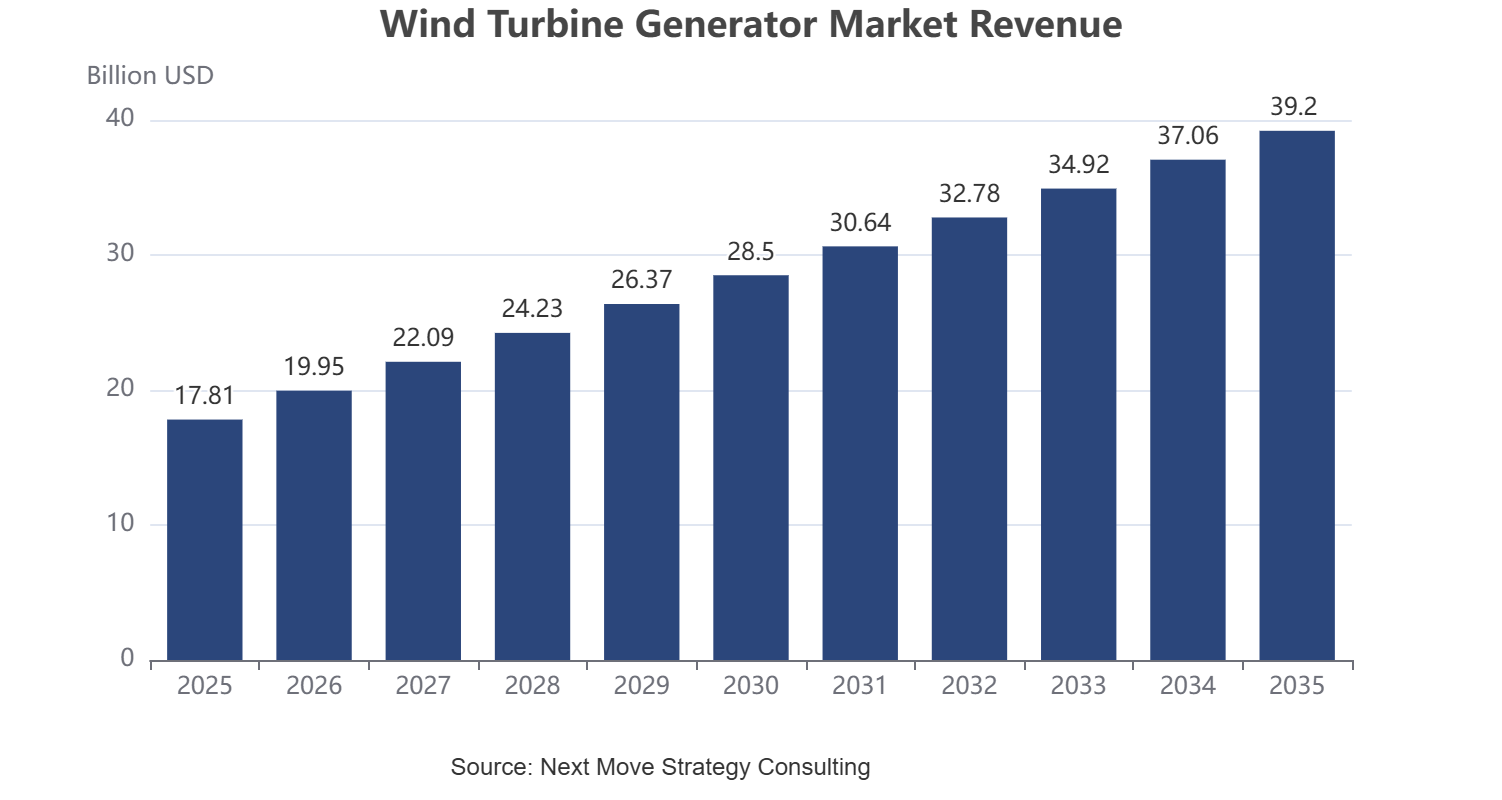
The Wind Turbine Generator Market size was valued at USD 17.81 Billion in 2025 and is estimated at USD 19.27 Billion in 2026, forecast to reach USD 39.2 Billion by 2035, expanding at an 8.21% CAGR between 2026 and 2035. Asia-Pacific leads with approximately a 52% share, while Permanent Magnet Generator dominates all generator types with approximately a 36% share.
We observed that growth is concentrated in direct drive, permanent magnet architectures suited to larger rated power classes, with offshore and floating installations gaining disproportionate share against conventional onshore geared systems through 2035.
|
Key Takeaways |
|
By Generator Type: Permanent Magnet Generator held the largest share of approximately 36% (USD 6.41 Billion) in 2025; Permanent Magnet Generator is also the fastest-growing sub-segment at 11.73% CAGR from 2026–2035. |
|
By Drivetrain: Geared held the largest share of approximately 52% (USD 9.26 Billion) in 2025; Direct Drive is the fastest-growing sub-segment at 13.07% CAGR from 2026–2035. |
|
By Rated Power: 4 MW to Under 6 MW held the largest share of approximately 31% (USD 5.52 Billion) in 2025; 10 MW and Above is the fastest-growing sub-segment at 14.76% CAGR from 2026–2035. |
|
By Installation Model: New Installation held the largest share of approximately 83% (USD 14.78 Billion) in 2025; Replacement Installation is the fastest-growing sub-segment at 10.76% CAGR from 2026–2035. |
|
By Sales Channel: Direct OEM Sales held the largest share of approximately 47% (USD 8.37 Billion) in 2025; EPC Bundled Sales is the fastest-growing sub-segment at 12.71% CAGR from 2026–2035. |
|
By Application: Onshore held the largest share of approximately 74% (USD 13.18 Billion) in 2025; Offshore is the fastest-growing sub-segment at 13.21% CAGR from 2026–2035. |
|
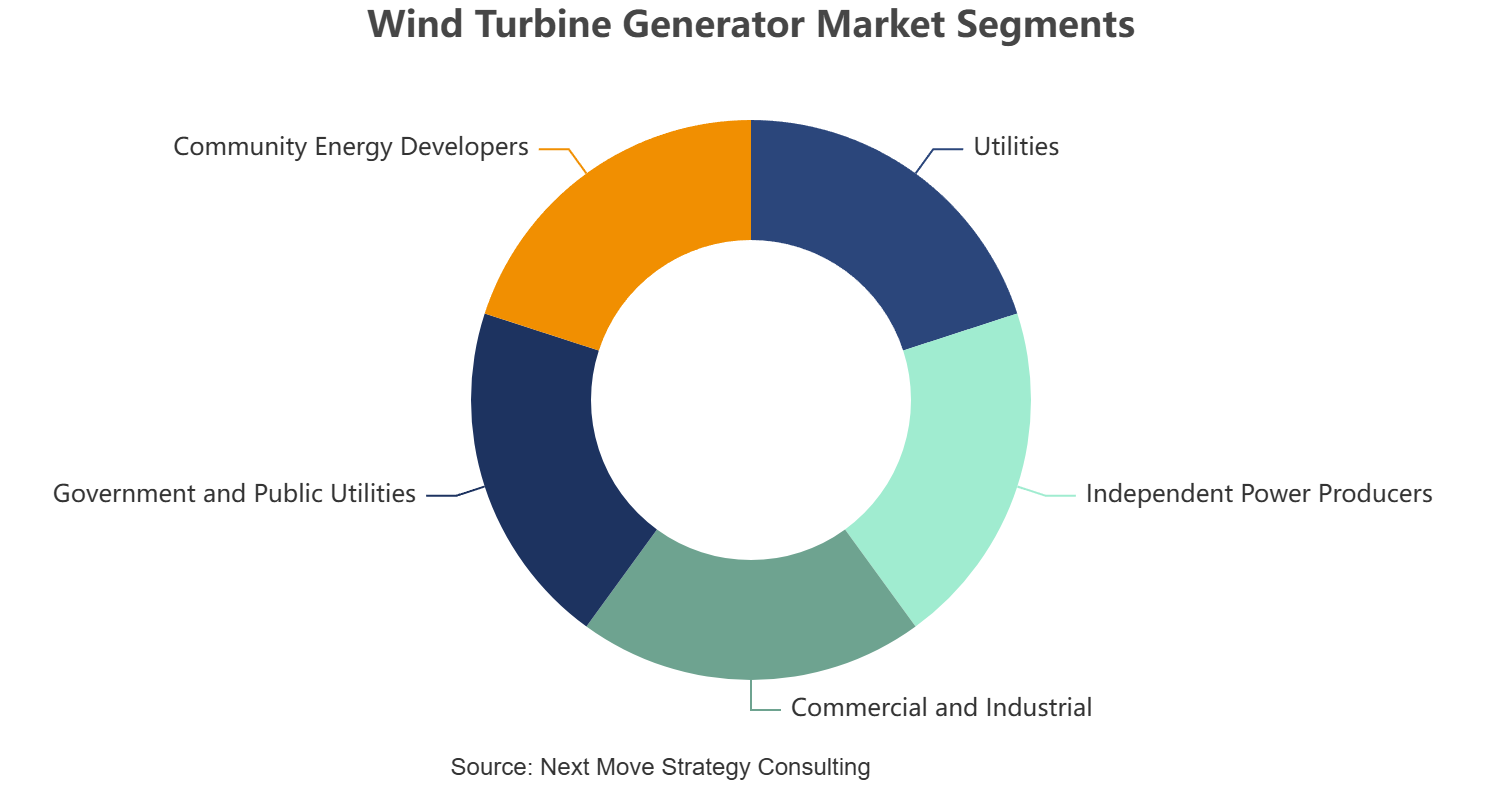
By Buyer Type: Utilities held the largest share of approximately 44% (USD 7.84 Billion) in 2025; Independent Power Producers is the fastest-growing sub-segment at 10.84% CAGR from 2026–2035. |
|
Dominant Region: Asia-Pacific dominated with approximately 52% revenue share (USD 9.26 Billion) in 2025. |
|
Fastest-Growing Region: Middle East & Africa is expected to register the highest CAGR of 11.71% during 2026–2035. |
|
Dominant Country: China led the market with approximately USD 4.90 Billion in 2025. |
|
Fastest-Growing Country: India is expected to register the highest CAGR of approximately 12.4% during 2026–2035. |
Market Opportunity: The Wind Turbine Generator market is expected to create an absolute dollar opportunity of USD 19.93 Billion between 2026 and 2035, presenting significant investment potential across offshore, high-capacity, and direct drive generator technologies.
According to NMSC analysis, developers are increasingly specifying direct drive permanent magnet generators on offshore and high-capacity onshore projects to reduce maintenance visits and improve uptime, a shift that favors OEMs with proven large-turbine platforms over manufacturers focused solely on legacy geared architectures as project sizes scale through 2035.
What Does the Wind Turbine Generator Market Encompass?
The Wind Turbine Generator market encompasses the electromechanical generator systems, including doubly fed induction, synchronous, and permanent magnet architectures, that convert rotor mechanical energy into electrical power within onshore and offshore wind turbines. Our assessment indicates that the scope covers geared, hybrid drive, and direct drive configurations supplied to utilities, independent power producers, and commercial and industrial buyers across new installation and replacement projects, reflecting rising integration with broader renewable energy capacity expansion.
Regulatory frameworks including national renewable portfolio standards and offshore wind auction programs increasingly shape generator technology selection and grid interconnection requirements for turbine OEMs. We observed that technology adoption is shifting from geared, doubly fed induction designs toward direct drive, permanent magnet architectures that reduce mechanical complexity in larger rated power classes. NMSC's analysis indicates that this structural shift, combined with rising offshore and floating installation activity, is redefining component sourcing criteria across the wind turbine generator value chain.
|
Parameters |
Details |
|
Market Size in 2025 |
USD 17.81 Billion |
|
Market Size in 2026 |
USD 19.27 Billion |
|
Revenue Forecast in 2035 |
USD 39.2 Billion |
|
Growth Rate |
CAGR of 8.21% from 2026 to 2035 |
|
Analysis Period |
2025–2035 |
|
Base Year Considered |
2025 |
|
Forecast Period |
2026–2035 |
|
Market Size Estimation |
USD Billion |
|
Companies Profiled |
19 |
|
Countries Covered |
38 |
|
Market Share |
Available for Top 10 Companies |
Key Emerging Trends
Based on research conducted by NMSC, we found that four structural trends are reshaping generator architecture, project scale, and stakeholder engagement across the Wind Turbine Generator market.
How Is Direct Drive Adoption Transforming Offshore Turbine Design?
Direct drive permanent magnet generators are replacing geared doubly fed induction designs on large offshore turbines to reduce gearbox-related maintenance visits. We observed that Vestas' V236-15.0 MW platform, which has secured firm orders across Germany, South Korea, and Taiwan, illustrates how direct drive architecture is becoming the default choice for utility-scale offshore projects. This trend is transforming maintenance economics for developers operating far-offshore wind farms.
Why Is Floating Offshore Wind Gaining Commercial Momentum?
Floating offshore platforms are expanding the addressable installation base beyond fixed bottom foundations into deeper waters. We observed that China's rollout of a 17 MW floating wind turbine prototype in 2025 reflects accelerating commercialization of floating generator technology. This trend is elevating demand for compact, lightweight generator designs optimized for floating platform stability and reduced nacelle weight.
How Is Rising Rated Power Reshaping Generator Component Demand?
Turbine rated power continues to climb toward 15 MW and above, requiring generators engineered for higher torque density and larger permanent magnet content. Our findings suggest that Vestas' record 2025 order backlog, driven substantially by its 15 MW-class offshore platform, reflects developer preference for fewer, larger turbines per project. This trend is elevating the strategic importance of the 10 MW and Above rated power segment within OEM product roadmaps.
What Role Does Repowering Play in Generator Replacement Demand?
Aging onshore wind fleets approaching the end of their operational life are creating a distinct replacement installation demand pool. Our analysis shows that developers are increasingly repowering older sites with fewer, higher-capacity turbines rather than direct like-for-like replacement. Companies such as Nordex and Suzlon Energy are scaling replacement-focused product lines, reflecting how aging fleet economics are reshaping demand across mature onshore markets.
Growth Drivers and Restraints
|
Factors |
Type |
(+/−) % Impact on CAGR |
Geographic Relevance |
Impact Timeline |
|
Expansion of offshore wind auction programs |
Driver |
+2.4% |
Europe, Asia-Pacific |
2026-2035 |
|
Rising national renewable portfolio and emissions targets |
Driver |
+1.9% |
Global |
2026-2035 |
|
Growth of direct drive, high-capacity turbine platforms |
Driver |
+1.6% |
Global |
2026-2032 |
|
Expanding onshore repowering and replacement demand |
Driver |
+1.2% |
Europe, North America |
2026-2035 |
|
Growth of floating offshore wind commercialization |
Driver |
+0.9% |
Asia-Pacific, Europe |
2028-2035 |
|
Rising grid interconnection and transmission investment |
Driver |
+0.7% |
Global |
2026-2035 |
|
Volatility in steel and rare earth magnet material prices |
Restraint |
-1.4% |
Global |
2026-2035 |
|
Permitting and grid connection delays for new projects |
Restraint |
-1.0% |
North America, Europe |
2026-2032 |
|
Policy uncertainty around offshore wind subsidy support |
Restraint |
-0.8% |
North America |
2026-2030 |
What Is the Primary Growth Driver of the Wind Turbine Generator Market?
Expansion of offshore wind auction programs is the primary driver of the market. National governments continue to schedule multi-gigawatt offshore leasing rounds to meet renewable energy targets set under national energy policy frameworks. We observed that this auction pipeline, reinforced by rising developer confidence in direct drive turbine platforms, continues to anchor baseline demand for high-capacity generators across regulated offshore markets.
How Is Rising Turbine Capacity Driving Market Growth?
Growing adoption of 15 MW-class offshore turbine platforms is accelerating market expansion as developers prioritize fewer, higher-output installations per project. Vestas reported an all-time high 2025 revenue of EUR 18.8 billion alongside a EUR 10.1 billion offshore order backlog, reflecting sustained demand for its flagship large-capacity platform. Our assessment indicates that this capacity escalation is compressing per-project generator unit counts while increasing average generator value.
What Is Restraining Wind Turbine Generator Market Expansion?
Volatility in steel and rare earth magnet material prices restrains margin stability across generator manufacturers. The U.S. Geological Survey tracks recurring rare earth element price fluctuations that compress fabrication margins and delay capital investment in new manufacturing tooling. We found that this input cost exposure disproportionately affects manufacturers of permanent magnet generators, which depend heavily on rare earth magnet content compared with induction-based designs.
Segmentation Analysis
Segment Sizing: By Generator Type
|
Segment |
2025 (USD Billion) |
2035 (USD Billion) |
CAGR% (2026-2035) |
|
Doubly Fed Induction Generator |
6.06 |
9.41 |
4.10% |
|
Synchronous Generator |
2.85 |
5.10 |
5.76% |
|
Permanent Magnet Generator |
6.41 |
18.82 |
11.73% |
|
Electrically Excited Synchronous Generator |
1.78 |
4.31 |
9.34% |
|
Other Generator Types |
0.71 |
1.56 |
8.16% |
|
Total |
17.81 |
39.20 |
8.21% |
Which Generator Type Segment Dominates the Wind Turbine Generator Market?
Permanent Magnet Generator led the market with USD 6.41 Billion in 2025, supported by its widespread adoption across direct drive offshore platforms requiring high torque density and rare earth magnet content. We observed that Permanent Magnet Generator is also the fastest-growing generator type, expanding at an 11.73% CAGR from 2026 to 2035, as OEMs increasingly favor this architecture for large-capacity offshore turbine platforms.
Segment Sizing: By Rated Power
|
Segment |
2025 (USD Billion) |
2035 (USD Billion) |
CAGR% (2026-2035) |
|
Under 2 MW |
1.60 |
1.57 |
-1.07% |
|
2 MW to Under 4 MW |
4.99 |
6.27 |
1.67% |
|
4 MW to Under 6 MW |
5.52 |
11.37 |
7.42% |
|
6 MW to Under 10 MW |
3.92 |
13.33 |
13.58% |
|
10 MW and Above |
1.78 |
6.66 |
14.76% |
|
Total |
17.81 |
39.20 |
8.21% |
Which Rated Power Segment Leads the Wind Turbine Generator Market?
4 MW to Under 6 MW led the market with USD 5.52 Billion in 2025, supported by its widespread use across mainstream onshore utility-scale projects. 10 MW and Above is the fastest-growing rated power segment, expanding at a 14.76% CAGR from 2026 to 2035, as offshore developers increasingly adopt 15 MW-class turbine platforms to maximize energy capture per installed foundation.
Segment Sizing: By Application
|
Segment |
2025 (USD Billion) |
2035 (USD Billion) |
CAGR% (2026-2035) |
|
Onshore |
13.18 |
24.30 |
6.10% |
|
Offshore |
4.27 |
14.11 |
13.21% |
|
Small Wind |
0.36 |
0.79 |
8.17% |
|
Total |
17.81 |
39.20 |
8.21% |
Which Application Segment Leads Wind Turbine Generator Demand?
Onshore applications remained the leading segment, valued at USD 13.18 Billion in 2025 on sustained global utility-scale wind capacity additions. Our findings suggest that Offshore is the fastest-growing application, registering a 13.21% CAGR from 2026 to 2035, as fixed-bottom and floating installations expand alongside broader smart grid-linked transmission investment supporting far-offshore project interconnection.
Supply Chain Analysis of the Wind Turbine Generator Industry

The above infographic presents the supply chain structure of the wind turbine generator market, segmented into upstream and downstream activities. Upstream begins with high-strength steel and rare earth magnets, moving into blade manufacturing, gearbox production, and generator technology development. Smart control systems and grid compliance standards ensure performance and regulatory adherence. Moving downstream, specialized logistics and heavy-lift installation enable project delivery to onshore and offshore wind farms, with utility-scale partnerships and corporate procurement driving demand. Looking ahead, we observed that predictive maintenance and remote performance monitoring ensure long-term operational reliability and efficiency across the market.
Growth Opportunities
We found that three forward-looking whitespace opportunities stand out for stakeholders positioning within the Wind Turbine Generator Industry over the coming decade.
How Can OEMs Capture Demand from Floating Offshore Commercialization?
Expanding floating offshore wind pilot and early-commercial projects create a mechanism for generator manufacturers to secure early-mover positioning in deep-water markets unsuited to fixed-bottom foundations. OEMs offering lightweight, compact direct drive generators stand to benefit most, as floating platform stability requirements favor reduced nacelle weight over conventional geared designs.
What Opportunity Does Onshore Repowering Present for Generator Suppliers?
A large installed base of aging onshore turbines approaching end of operational life creates a mechanism for generator suppliers to secure replacement contracts as developers repower sites with fewer, higher-capacity units. Suppliers with proven 4 MW to 6 MW class platforms stand to benefit most, capturing repowering demand across mature European and North American wind fleets.
How Can Manufacturers Unlock Hybrid Wind-Storage Project Contracts?
Rising co-location of wind projects with energy storage systems creates a mechanism for generator manufacturers to participate in integrated hybrid renewable project tenders. Independent power producers developing combined wind-storage assets stand to benefit from generator platforms optimized for variable output smoothing and grid-firming applications.
Regional Outlook
|
Region |
2025 (USD Billion) |
2035 (USD Billion) |
CAGR% (2026-2035) |
Key Driver |
|
North America |
2.86 |
5.10 |
5.76% |
Onshore repowering demand |
|
Europe |
4.27 |
8.23 |
6.63% |
Offshore auction programs |
|
Asia-Pacific |
9.26 |
22.74 |
9.54% |
Utility-scale capacity expansion |
|
Middle East & Africa |
0.53 |
1.57 |
11.71% |
Emerging renewable energy investment |
|
Latin America |
0.89 |
1.56 |
5.54% |
Growing onshore wind pipeline |
|
Total |
17.81 |
39.20 |
8.21% |
— |
North America
North America's wind turbine generator market reflects a maturing onshore fleet increasingly entering the repowering cycle. We observed that policy uncertainty around offshore wind subsidy support has slowed new offshore project sanctioning in recent periods. Technology adoption favors direct drive replacement units for aging onshore sites, and the region's strategic outlook remains anchored to sustained repowering investment through 2035.
Europe
Europe's market is shaped by sustained offshore wind auction programs across the North Sea and Baltic Sea. Our assessment indicates that regional developers are advancing 15 MW-class direct drive platforms to meet ambitious national offshore capacity targets. The region's strategic outlook favors OEMs with proven large-turbine offshore track records serving multinational utility and developer customers.
Asia-Pacific
Asia-Pacific's market benefits from the world's largest onshore and offshore installation pipeline, led by sustained domestic capacity additions. We found that regional manufacturers are advancing floating offshore prototype commercialization faster than other regions, reflecting strong government-backed renewable energy investment. The region's strategic outlook remains the strongest globally, anchored by sustained utility-scale capacity expansion.
Middle East & Africa
The Middle East & Africa wind turbine generator market is expanding from a small base, supported by emerging national renewable energy diversification programs. Our analysis shows that regional demand is concentrated in early-stage utility-scale onshore projects rather than offshore development. The region's strategic outlook depends on continued government-backed renewable energy investment and grid interconnection expansion through 2035.
Latin America
Latin America's market is growing steadily, supported by an expanding onshore wind project pipeline and growing cross-border transmission investment. We observed that Brazil's onshore order growth reflects rising developer confidence in the region's wind resource quality. The region's strategic outlook favors OEMs able to serve multiple national markets with standardized onshore platforms.
U.S.
Based on our estimates, the U.S. market was valued at approximately USD 1.86 Billion in 2025 and is projected to reach USD 3.32 Billion by 2035 at a 5.7% CAGR. Demand structure favors direct drive replacement units for aging onshore fleets, supported by moderate regulatory influence amid offshore subsidy uncertainty and rising technology penetration of repowering-focused generator platforms across established wind corridors.
Canada
The market in Canada was valued at approximately USD 0.57 Billion in 2025 and is projected to reach USD 1.02 Billion by 2035 at a 5.8% CAGR. Demand structure reflects growing onshore capacity additions in wind-rich provinces, moderate regulatory influence from provincial renewable procurement programs, and rising competitive intensity as OEMs expand coverage of remote grid-constrained wind corridors.
UK
As per our estimate, the UK wind turbine generator market was valued at approximately USD 1.15 Billion in 2025 and is projected to reach USD 2.22 Billion by 2035 at a 6.8% CAGR. Demand structure centers on large-scale North Sea offshore projects, with strong regulatory influence from national offshore leasing rounds and rising technology penetration of 15 MW-class direct drive platforms.
Germany
According to our analysis, the Germany market was valued at approximately USD 1.28 Billion in 2025 and is projected to reach USD 2.47 Billion by 2035 at a 6.7% CAGR. Demand structure reflects the country's sustained offshore auction pipeline exemplified by projects such as Nordlicht 1, high regulatory influence from national energy transition policy, and strong competitive intensity among established offshore OEMs.
France
Based on our estimates, the France market was valued at approximately USD 0.64 Billion in 2025 and is projected to reach USD 1.23 Billion by 2035 at a 6.7% CAGR. Demand structure favors offshore fixed-bottom projects along the Atlantic coast, supported by national renewable energy programs and growing technology penetration of direct-drive generator platforms.
China
The market in China was valued at approximately USD 4.90 Billion in 2025 and is projected to reach USD 12.51 Billion by 2035 at a 9.7% CAGR. Demand structure benefits from the world's largest domestic onshore and offshore installation base, strong regulatory influence from national renewable capacity targets, and the fastest technology penetration of floating offshore prototypes among leading domestic turbine manufacturers.
India
As per our estimate, the India wind turbine generator market was valued at approximately USD 0.83 Billion in 2025 and is projected to reach USD 2.62 Billion by 2035 at a 12.4% CAGR, the fastest among all countries covered. Demand structure reflects rapidly expanding onshore utility-scale capacity auctions, growing regulatory influence from national renewable energy targets, and rising adoption among domestic manufacturers such as Suzlon Energy and Inox Wind.
Japan
According to our analysis, the Japan market was valued at approximately USD 0.65 Billion in 2025 and is projected to reach USD 1.59 Billion by 2035 at an 8.8% CAGR. Demand structure favors offshore fixed-bottom and early floating pilot projects, supported by national maritime spatial planning reforms and steady technology penetration of direct-drive generator platforms.
South Korea
Based on our estimates, the South Korea market was valued at approximately USD 0.56 Billion in 2025 and is projected to reach USD 1.53 Billion by 2035 at a 10.0% CAGR. Demand structure benefits from newly sanctioned utility-scale offshore projects such as the Shinan-Ui development, strong regulatory influence from national offshore wind roadmaps, and rising strategic outlook tied to expanding domestic supply chain localization.
Australia
The market in Australia was valued at approximately USD 0.46 Billion in 2025 and is projected to reach USD 1.11 Billion by 2035 at an 8.4% CAGR. Demand structure reflects growing offshore wind zone development alongside sustained onshore capacity additions, with moderate regulatory influence from state-level renewable energy targets and gradually rising technology penetration of larger rated power platforms.
UAE
As per our estimate, the UAE wind turbine generator market was valued at approximately USD 0.11 Billion in 2025 and is projected to reach USD 0.36 Billion by 2035 at a 12.0% CAGR. Demand structure reflects early-stage utility-scale onshore pilot projects, growing regulatory influence from national clean energy diversification strategies, and rising technology penetration as renewable capacity auctions expand.
Saudi Arabia
According to our analysis, the Saudi Arabia wind turbine generator market was valued at approximately USD 0.13 Billion in 2025 and is projected to reach USD 0.42 Billion by 2035 at a 12.2% CAGR. Demand structure benefits from large-scale utility onshore wind auctions supporting Vision 2030 diversification targets, with strong regulatory influence and rising strategic outlook tied to state-backed renewable energy investment.
South Africa
Based on our estimates, the South Africa wind turbine generator market was valued at approximately USD 0.16 Billion in 2025 and is projected to reach USD 0.44 Billion by 2035 at a 10.6% CAGR. Demand structure remains concentrated in established onshore wind corridors, with moderate regulatory influence from national renewable energy procurement programs and gradually rising competitive intensity among regional developers.
Brazil
The market in Brazil was valued at approximately USD 0.50 Billion in 2025 and is projected to reach USD 0.90 Billion by 2035 at a 5.9% CAGR. Demand structure reflects the country's large established onshore wind corridor base, with growing regulatory influence from national auction programs and rising technology penetration of higher-rated power turbine platforms among domestic developers.
Argentina
As per our estimate, the Argentina wind turbine generator market was valued at approximately USD 0.14 Billion in 2025 and is projected to reach USD 0.25 Billion by 2035 at a 5.7% CAGR. Demand structure remains at a developing stage, supported by gradually expanding onshore wind auction activity, limited regulatory influence from national renewable incentive programs, and modest but rising competitive intensity among regional developers.
PESTEL Analysis of the Wind Turbine Generator Industry

The above infographic presents a PESTEL analysis of the wind turbine generator market, where government renewable incentives and energy security policies are encouraging investments and accelerating deployment. At the same time, stable financing and infrastructure investments are supporting project expansion and economic growth. Rising demand for clean electricity and growing renewable energy awareness are shaping social acceptance, while advanced turbine designs and digital monitoring are improving efficiency and asset performance. Environmental benefits such as carbon emission reductions and sustainable manufacturing practices are further driving adoption, all within a legal framework of environmental permitting and compliance requirements. Looking ahead, we observed that these interconnected factors collectively shape the market's evolution across the renewable energy sector.
Competitive Landscape
We observed that the Wind Turbine Generator market features a moderately consolidated competitive landscape, with established global OEMs competing alongside large domestic Chinese manufacturers on turbine platform scale, offshore track record, and regional manufacturing footprint.
|
Dimension |
Description |
|
Market Structure |
Moderately consolidated; leading global and Chinese domestic turbine OEMs profiled in this report collectively account for a significant share of branded generator revenue, while regional manufacturers serve smaller onshore project demand. |
|
Innovation Focus |
Direct drive permanent magnet architecture, rising rated power classes, and floating offshore platform compatibility dominate current innovation pipelines across leading OEMs. |
|
M&A Activity |
Selective order backlog expansion and technology partnerships, exemplified by Vestas' record 2025 offshore order intake across Germany, South Korea, and Taiwan. |
How Do Companies Compete in the Wind Turbine Generator Market?
Companies compete primarily on turbine platform scale, offshore project track record, and manufacturing capacity across the industry. Global OEMs such as Vestas Wind Systems and Siemens Gamesa Renewable Energy leverage proven large-capacity offshore platforms to secure multi-gigawatt orders, while Chinese manufacturers such as Goldwind Science & Technology and Envision Energy compete on domestic scale and increasingly on export-oriented pricing for onshore and offshore projects.
Which Competitive Archetypes Dominate the Wind Turbine Generator Industry?
Two archetypes dominate the market: global offshore-focused OEMs with proven large-turbine platforms, and domestic Chinese manufacturers competing on onshore volume and manufacturing scale. Vestas Wind Systems and Siemens Gamesa Renewable Energy exemplify the offshore-focused archetype through flagship 15 MW-class platforms, while Goldwind Science & Technology and Ming Yang Smart Energy exemplify the domestic volume archetype supplying China's large onshore and coastal offshore installation base.
How Are Companies Differentiating Through Innovation in Wind Turbine Generators?
Innovation and differentiation strategy increasingly center on direct drive architecture and rising rated power capability. Vestas' V236-15.0 MW platform and China's 17 MW floating turbine prototype both reflect efforts to secure differentiated positioning in the highest-capacity project segments. Our analysis shows that OEMs unable to demonstrate proven large-turbine offshore references risk exclusion from major utility and developer shortlists.
What M&A and Expansion Activity Is Shaping the Wind Turbine Generator Market?
Order backlog expansion and platform development continue to reshape competitive positioning within the industry. Vestas closed 2025 with a EUR 10.1 billion offshore order backlog following major wins in Germany, South Korea, and Taiwan, while Siemens Gamesa's German offshore order illustrates how established OEMs continue to secure large multi-year commitments rather than pursuing acquisitions to expand capacity.
Key Market Players
Our assessment indicates that the following 19 companies are actively shaping generator technology innovation, platform capacity, and manufacturing capability within the Wind Turbine Generator market.
-
Vestas Wind Systems A/S
-
Goldwind Science & Technology Co., Ltd.
-
GE Vernova Inc.
-
Siemens Gamesa Renewable Energy, S.A.U.
-
Envision Energy Co., Ltd.
-
Ming Yang Smart Energy Group Co., Ltd.
-
Windey Energy Technology Group Co., Ltd.
-
Dongfang Electric Wind Power Co., Ltd.
-
Shanghai Electric Wind Power Group Co., Ltd.
-
SANY Renewable Energy Co., Ltd.
-
Suzlon Energy Limited
-
CSSC Haizhuang Wind Power Co., Ltd.
-
CRRC Zhuzhou Institute Co., Ltd.
-
Guodian United Power Technology Company Limited
-
WEG S.A.
-
Doosan Enerbility Co., Ltd.
-
Inox Wind Limited
Latest Developments
We found that recent order wins and technology milestones within the wind turbine generator supply chain are concentrated on offshore capacity expansion and floating platform commercialization.
|
Date |
Event |
|
July 2025 |
Siemens Gamesa secured a 63-turbine order for a German offshore wind farm, expanding its regional offshore order backlog. |
Investment Opportunities
What Capital Inflows Are Supporting the Wind Turbine Generator Market?
Turbine OEMs are directing capital toward large-capacity platform development and offshore manufacturing capacity across Europe and Asia-Pacific. Vestas' record EUR 10.1 billion offshore order backlog and sustained power generation infrastructure investment illustrate sustained capital inflows supporting generator manufacturing capacity expansion.
How Is Infrastructure Investment Shaping Wind Turbine Generator Demand?
Government transmission and grid interconnection investment continues to expand the addressable base for offshore wind capacity additions. Our assessment indicates that national offshore leasing programs in Europe and Asia-Pacific are creating multi-year procurement pipelines for OEMs offering proven large-turbine platforms suited to far-offshore interconnection requirements.
What ESG Considerations Are Influencing Wind Turbine Generator Investment Decisions?
Environmental, social, and governance considerations are increasingly influencing capital allocation toward low-emission manufacturing and recyclable generator materials. Vestas' commitment to deliver low-emission steel for its Nordlicht 1 project reflects this shift toward sustainability-linked manufacturing credentials. We observed that investors are favoring OEMs with documented emissions-reduction manufacturing practices as sustainability-linked financing gains traction across the wind energy supply chain.
Key Benefits for Stakeholders
How Does This Report Benefit Industry Leaders and Project Developers?
Industry leaders and project developers gain granular segmentation data across generator type, rated power, and application axes, enabling informed turbine specification decisions for new onshore and offshore projects. Our analysis, data, and forecasts help developers benchmark procurement strategies against verified 2025–2035 market trajectories and evolving generator technology trends.
How Does This Report Benefit Investors and Financial Analysts?
Investors and financial analysts gain a validated 2025 base-year market size, a fundamentals-supported 2026–2035 CAGR, and segment-level growth trajectories that support capital allocation and competitive benchmarking decisions. The report's strategic insights into OEM order backlogs and offshore capacity expansion help analysts assess relative positioning across the wind turbine generator value chain.
How Does This Report Benefit Technology Vendors and Product Teams?
Technology vendors and product teams gain visibility into the fastest-growing sub-segments, including Direct Drive architectures, 10 MW and Above rated power, and Independent Power Producer buyers, informing product roadmap and go-to-market prioritization aligned with documented buyer and application demand shifts through 2035.
Key Market Segments
By Generator Type
-
Doubly Fed Induction Generator
-
Synchronous Generator
-
Permanent Magnet Generator
-
Electrically Excited Synchronous Generator
-
Other Generator Types
By Drivetrain
-
Geared
-
High Speed DFIG
-
High Speed SCIG
-
-
Hybrid Drive
-
Medium Speed Permanent Magnet
-
Medium Speed Electrically Excited
-
-
Direct Drive
-
Permanent Magnet Direct Drive
-
Electrically Excited Direct Drive
-
-
Other Drivetrains
By Rated Power
-
Under 2 MW
-
2 MW to Under 4 MW
-
4 MW to Under 6 MW
-
6 MW to Under 10 MW
-
10 MW and Above
By Installation Model
-
New Installation
-
Replacement Installation
By Sales Channel
-
Direct OEM Sales
-
Framework Agreement
-
EPC Bundled Sales
-
Distributor and Agent Sales
By Application
-
Onshore
-
Utility Scale
-
Commercial and Industrial
-
Community and Distributed
-
-
Offshore
-
Fixed Bottom
-
Floating
-
-
Small Wind
-
Grid Connected
-
Off Grid
-
By Buyer Type
-
Utilities
-
Independent Power Producers
-
Commercial and Industrial
-
Government and Public Utilities
-
Community Energy Developers
By Region
-
North America: U.S., Canada, Mexico.
-
Europe: UK, Germany, France, Italy, Spain, Sweden, Denmark, Finland, Netherlands, Rest of Europe.
-
Asia-Pacific: China, India, Japan, South Korea, Taiwan, Indonesia, Vietnam, Australia, Philippines, Malaysia, Rest of APAC.
-
Middle East & Africa: Saudi Arabia, UAE, Egypt, Israel, Turkey, Nigeria, South Africa, Rest of MEA.
-
Latin America: Brazil, Argentina, Chile, Colombia, Rest of LATAM.
Conclusion and Recommendations
What Is the Long-Term Outlook for the Wind Turbine Generator Market?
The Wind Turbine Generator market is positioned for sustained growth through 2035, underpinned by offshore auction expansion and rising turbine rated power. We expect Direct Drive architectures and Offshore applications to gain structural share as developers prioritize larger, more efficient platforms, while Permanent Magnet Generator and Onshore applications retain their position as significant revenue contributors across the forecast period.
What Strategic Positioning Should Manufacturers Pursue?
OEMs should prioritize direct drive platform scale-up and offshore project track record to align with developer procurement preferences. Our assessment indicates that manufacturers investing in proven large-capacity offshore platforms, following the pattern established by Vestas' V236-15.0 MW order momentum, are best positioned to capture floating offshore and repowering opportunities through 2035.
How Attractive Is the Wind Turbine Generator Market for Investment?
The market presents an attractive investment case, supported by a validated USD 19.93 Billion absolute dollar opportunity between 2026 and 2035 and a fundamentals-backed 8.21% CAGR. Sustained order backlog growth, as demonstrated by Vestas' record 2025 revenue and offshore order intake, signals sustained developer and investor confidence in the segment's growth trajectory.
What Market Shifts and Key Risks Should Stakeholders Monitor?
Stakeholders should monitor steel and rare earth magnet material price volatility, which restrains margin stability across permanent magnet generator manufacturers. We found that permitting and grid connection delays also pose a risk to near-term project timelines, particularly for offshore developers dependent on lengthy interconnection approval processes.
What Are the Key Growth Pathways Through 2035?
Key growth pathways include expanding floating offshore commercialization, scaling repowering-focused generator platforms for aging onshore fleets, and deepening hybrid wind-storage project partnerships. Our findings suggest that manufacturers combining direct drive scale with proven offshore references are best positioned to capture disproportionate share of the market's projected USD 39.2 Billion 2035 revenue base.
About the Author
 Mayurima Roy
— Mayurima Roy is Research Analyst at Next Move Strategy Consulting, where she has spent 4 years working across the firm's full industry coverage rather than a single fixed vertical. Her work centers on structured research, ongoing trend tracking, competitive assessment, and insight-led content development, translating complex market data into clear, decision-ready narratives that support informed client decision-making across diverse global industries, market sectors, and world regions every day.
Mayurima Roy
— Mayurima Roy is Research Analyst at Next Move Strategy Consulting, where she has spent 4 years working across the firm's full industry coverage rather than a single fixed vertical. Her work centers on structured research, ongoing trend tracking, competitive assessment, and insight-led content development, translating complex market data into clear, decision-ready narratives that support informed client decision-making across diverse global industries, market sectors, and world regions every day.
About the Reviewer
 Supradip Baul
— Supradip Baul is an accomplished business consultant and strategist with over a decade of rich experience in market intelligence, strategy, technology, and business transformation. His work has included rigorous qualitative and quantitative analysis across multiple industries, helping clients shape investment decisions and long-term roadmaps. Earlier in his career, he was associated with Gartner, where he contributed to industry-leading reports and market share analyses. He has worked with leading global companies and holds an MBA with a dual specialization in Marketing and Finance.
Supradip Baul
— Supradip Baul is an accomplished business consultant and strategist with over a decade of rich experience in market intelligence, strategy, technology, and business transformation. His work has included rigorous qualitative and quantitative analysis across multiple industries, helping clients shape investment decisions and long-term roadmaps. Earlier in his career, he was associated with Gartner, where he contributed to industry-leading reports and market share analyses. He has worked with leading global companies and holds an MBA with a dual specialization in Marketing and Finance.
At Next Move Strategy Consulting, we understand that insightful market research is the cornerstone of successful business decisions. That's why we employ a robust and multifaceted approach, combining various methodologies to deliver the most accurate and actionable data for our clients.

Research Landscape
We navigate the world of research with two primary approaches:
Qualitative Approach
Our qualitative research methodologies involve immersive techniques such as in-depth interviews, focus groups, and observational studies. By engaging directly with individuals and stakeholders, we uncover valuable insights that quantitative data alone may overlook.

Quantitative Research
In tandem with qualitative methodologies, NMSC leverages the power of Quantitative Research to provide a robust foundation of numerical insights. Through systematic data collection and analysis, we quantify patterns, preferences, and market trends, offering a comprehensive view of the business landscape.
Our quantitative research approach employs diverse tools, including surveys, experiments, and statistical modelling. These methodologies enable us to gather data from a large and representative sample, ensuring the statistical significance of our findings. By employing structured questionnaires and standardized data collection methods, we guarantee the reliability and validity of the information we present to our clients.
Quantitative research is particularly effective in measuring the prevalence of trends, assessing market size, and gauging the impact of various factors on consumer behavior. The numerical precision attained through this approach equips our clients with actionable insights, facilitating data-driven decision-making and strategy formulation.


Our Specialized Toolbox for Industry-Specific Market Research
We deploy a specialized arsenal of techniques tailored to meet your unique requirements. Here's a glimpse into our comprehensive toolbox:

Information Procurement
The stage entails acquiring market data or relevant information through various sources and methodologies.


Market Research Approach
We utilize both top-down and bottom-up approaches in market research analysis to achieve a comprehensive understanding of the market dynamics, leveraging the broad perspective of industry trends and macroeconomic factors alongside detailed insights from specific segments and individual companies.

Porters Five Forces Analysis
We conduct Porter's Five Forces analysis to evaluate the competitive landscape of an industry, providing us with insights into factors that affect profitability and strategic positioning.

SWOT Analysis

Forecasting
We utilize a forecasting model to predict future consumption by considering parameters like population, economics, regulations, market competition, drivers, constraints, technology, and pricing. We also employ statistical techniques such as multilinear regression, exponential smoothing, moving average, ARIMA, and Monte Carlo simulations for accurate predictions. In econometric forecasting, we analyzed short-term and long-term event impacts, attributing values based on regulatory frameworks, economic factors, and market events.





 Speak to Our Analyst