Bitters Market By Product Type (Aromatic Bitters, Digestive Bitters, Herbal Bitters and Others), By Form (Liquid Bitters, Powdered Bitters and Others), By Flavor Profile (Bitter-Sweet, Herbal and Others), By Distribution Channel (Online Retail, Supermarkets and Hypermarkets, Specialty Stores and Others), By Application (Cocktails and Mixed Drinks, Culinary Use and Others), By End User (Individual Consumers, Professional Bartenders and Others) – Global Analysis & Forecast, 2025–2030
Industry: Retail and Consumer | Publishing Date: June 10, 2026 | Last Updated: October 16, 2026 | No of Pages: N/A | No. of Tables: N/A | No. of Figures: N/A | Format: PDF | Report Code: RC3870
Industry Outlook
The global Bitters Market size was valued at USD 2.60 billion in 2024, and is expected to be valued at USD 2.77 billion by the end of 2025. The industry is projected to grow, hitting USD 3.78 billion by 2030, with a CAGR of 6.4% between 2025 and 2030.
The global bitters market is being shaped by the increasing consumer emphasis on health, wellness, and functional beverages. As more consumers seek drinks that offer digestive, botanical, or aromatic benefits, bitters are emerging as a versatile ingredient that meets these preferences. Beyond traditional cocktails, bitters are being incorporated into non-alcoholic beverages, mocktails, and culinary applications, creating broader usage occasions. For market participants, this trend underscores the importance of highlighting botanical origins, functional properties, and health-focused positioning in product development and marketing strategies, enabling brands to capture a growing segment of wellness-conscious consumers.
At the same time, the rising interest in specialty and sustainably sourced botanicals is creating new bitters market growth avenues for bitters producers. Consumers increasingly value natural, authentic, and environmentally responsible ingredients, making forest-sourced or specialty botanicals highly appealing. For companies, this provides opportunities to source ingredients sustainably, emphasize botanical provenance in branding, and differentiate products in the premium segment. By aligning product offerings with sustainability and authenticity trends, bitters brands enhance their market positioning, attract health- and eco-conscious consumers, and expand their global footprint in the premium beverage space.
What Are the Key Trends in the Bitters Industry?
How Is the Bitters Market Benefiting from the No- and Low-Alcohol Movement?
The global market is increasingly benefiting from the growing no- and low-alcohol movement, as producers and beverage innovators reposition bitters beyond traditional cocktails. Since 2024, industry reports and flavor trend analyses have highlighted a rising use of bitters in mocktails, non-alcoholic spirits, and functional beverages to replicate the aromatic complexity and bitter notes that alcohol typically provides. This trend is broadening the market’s reach, creating new occasions for bitters in family dining, cafés, and retail-ready chilled drinks, rather than limiting consumption to bars and high-end cocktail settings. For market players, this presents an opportunity to expand penetration by introducing smaller, convenient pack sizes for at-home use, highlighting botanical provenance, and offering low-sugar or functional variants to attract health-conscious consumers. By explicitly marketing SKUs for no- and low-alcohol occasions, supported with recipe ideas and collaborations with non-alcoholic spirit brands, companies capture incremental retail and foodservice share as consumers increasingly prioritize flavor complexity without alcohol. This trend underscores a shift in consumer behavior that is shaping product innovation and bitters market expansion strategies in the bitters segment.
How Is Craft Premiumisation and Culinary Crossover Expanding the Market?
The global market is increasingly benefiting from the premiumization trend seen across craft spirits and specialty food ingredients. Chefs, mixologists, and foodservice operators are incorporating bespoke bitters not only in cocktails but also in culinary applications such as desserts, sauces, and craft sodas, adding layered bitterness, aromatics, and functional claims like digestive benefits. Reports from 2024 to 2025 show that botanical bitters are evolving from a niche bartender tool into a versatile ingredient, driving higher average selling prices and creating new B2B opportunities in restaurants, bakeries, and beverage innovators. For market players, this trend presents a dual opportunity: first, to develop chef-grade or culinary-specific bitters with consistent batch quality and stability for foodservice applications; second, to communicate premium origin stories, botanical sourcing, and craftsmanship to justify higher pricing to discerning buyers. Companies that implement co-branded chef collaborations, offer larger foodservice packs, and provide recipe guidance leverage culinary credibility to expand repeat B2B contracts and strengthen market positioning in the premium segment of the market.
What Are the Key Market Drivers, Breakthroughs, and Investment Opportunities That Will Shape the Bitters Industry in the Next Decade?
The global bitters market is being strongly influenced by the growing consumer focus on wellness and functional beverages. As more consumers seek drinks that offer digestive, botanical, or aromatic benefits, bitters have emerged as a versatile ingredient that aligns with health-conscious lifestyles. Beyond cocktails, bitters are increasingly incorporated into non-alcoholic beverages, mocktails, and culinary applications, allowing brands to appeal to a wider audience. For market participants, this trend emphasizes the importance of highlighting botanical origins, functional benefits, and health-focused positioning in product development and marketing strategies, enabling companies to capture the expanding segment of wellness-oriented consumers.
Simultaneously, there is rising interest in sustainably sourced and specialty botanicals, including forest-derived herbs and plants. Consumers are prioritizing natural, authentic, and environmentally responsible ingredients, making bitters formulated with such botanicals particularly attractive. For producers, this trend provides opportunities to emphasize sustainability credentials, highlight ingredient provenance, and differentiate products in the premium segment. Additionally, expanding digital and e-commerce channels offers brands the chance to reach a broader, global consumer base, engage directly with buyers, and build loyalty through innovative product offerings and convenient online purchasing options. By integrating sustainability, premium quality, and digital strategies, bitters companies strengthen market presence and drive growth worldwide.
Growth Drivers:
How Is the Rising Demand for Functional and Health-Oriented Beverages Driving the Market?
The global market is benefiting from a strong consumer shift toward functional and health-focused beverages. As consumers increasingly prioritize wellness, ingredients that provide perceived digestive, botanical, or aromatic benefits are gaining prominence. The U.S. Department of Agriculture reports that China’s beverage market surpassed USD 170 billion in 2024, growing over six percent year-on-year, with functional drinks showing notable demand growth. This indicates a broader global trend where consumers are looking for beverages that combine flavor complexity with added health benefits. Bitters, with their botanical formulations and functional properties, naturally align with this trend, making them attractive not just in cocktails but also in non-alcoholic beverages, mocktails, and culinary applications. For market participants, this driver emphasizes the importance of highlighting botanical origins, functional benefits, and health-conscious positioning in product development and marketing strategies, enabling brands to capture a growing segment of wellness-oriented consumers.
How Is the Rising Interest in Specialty Forest Botanicals Driving the Global Bitters Market?
The global market is increasingly benefiting from growing consumer and producer interest in specialty forest botanicals. According to the USDA Forest Service’s publication, Income Opportunities in Special Forest Products, a variety of forest-sourced herbs and plants are used in flavorings, medicinal products, and beverages. These botanicals are integral to bitters formulations, offering unique flavor profiles and functional benefits. As consumers prioritize natural, sustainable, and authentic ingredients, demand for bitters made with forest-derived botanicals is on the rise. For market participants, this trend highlights the opportunity to source ingredients sustainably, emphasize botanical provenance in branding, and appeal to environmentally and health-conscious buyers. By integrating forest-sourced botanicals and highlighting sustainability credentials, bitters companies differentiate their products in the premium segment and expand market share globally.
Growth Inhibitors:
How Are Supply Chain Disruptions and Ingredient Sourcing Challenges Affecting the Bitters Market Expansion?
The global bitters market is facing growth constraints due to supply chain disruptions and difficulties in sourcing high-quality botanicals. According to the U.S. Department of Agriculture’s Economic Research Service, agricultural supply chains experienced significant disruptions during and after the COVID-19 pandemic, impacting the availability and cost of raw materials critical for bitters production. These challenges have led to higher production costs and potential shortages of key botanicals, which are essential for maintaining product quality and flavor consistency. For bitters companies, addressing this inhibitor requires strategies such as diversifying suppliers, sourcing botanicals locally where possible, and building resilient supply chain networks. By mitigating these risks, producers ensure steady production, maintain product quality, and protect profitability, even in the face of global supply uncertainties.
How Is the Projected Growth of Global E-Commerce Influencing the Global Market?
The global e-commerce sector is experiencing significant growth, which presents a substantial opportunity for the global market. According to the U.S. Department of Commerce, global business-to-consumer (B2C) e-commerce revenue is projected to reach USD USD 5.5 trillion by 2027, growing at a compound annual growth rate (CAGR) of 14.4%. This growth is driven by increased consumer preference for online shopping, convenience, and the expansion of digital payment systems. The beverage segment, including bitters, is among the leading categories in this expansion. For bitters producers, this trend offers the opportunity to reach a broader consumer base through online platforms, enabling direct-to-consumer sales, subscription models, and global distribution channels. By leveraging e-commerce, bitters brands enhance brand visibility, engage with consumers directly, and tap into emerging markets where traditional retail channels are limited.
How Is the Bitters Industry Segmented in This Report, and What Are the Key Insights from Segmentation Analysis?
By Product Type Insights
How Is the Bitters Market Shaped by Product Type?
Based on Product type, the bitters market segments are divided into aromatic bitters, digestive bitters and others.
Aromatic Bitters are a category of bitters known for their complex, fragrant flavor profiles, typically made from a blend of herbs, spices, and botanicals. They are primarily used to enhance cocktails and mixed drinks, adding depth and balance to beverages. Beyond drinks, also be incorporated in culinary recipes to impart subtle bitter notes and aromatic nuances. This segment caters to both professional bartenders and home enthusiasts who value flavor complexity and versatility in beverages and food applications.
By Distribution Channel Insights
Which Distribution Channel Is Emerging as the Most Flexible in the Bitters Industry?
Based on distribution channel, the market is segmented into online retail, super markets and hyper markets and others.
Online Retail as a distribution channel refers to the sale of bitters through e-commerce platforms, brand websites, and online marketplaces. This channel allows consumers to conveniently purchase a wide variety of bitters from the comfort of their homes, with access to specialty or niche products that are not available in physical stores. It caters to both individual consumers and professional users, offering the advantage of home delivery, product reviews, and detailed descriptions, making it a growing and influential channel in the market.
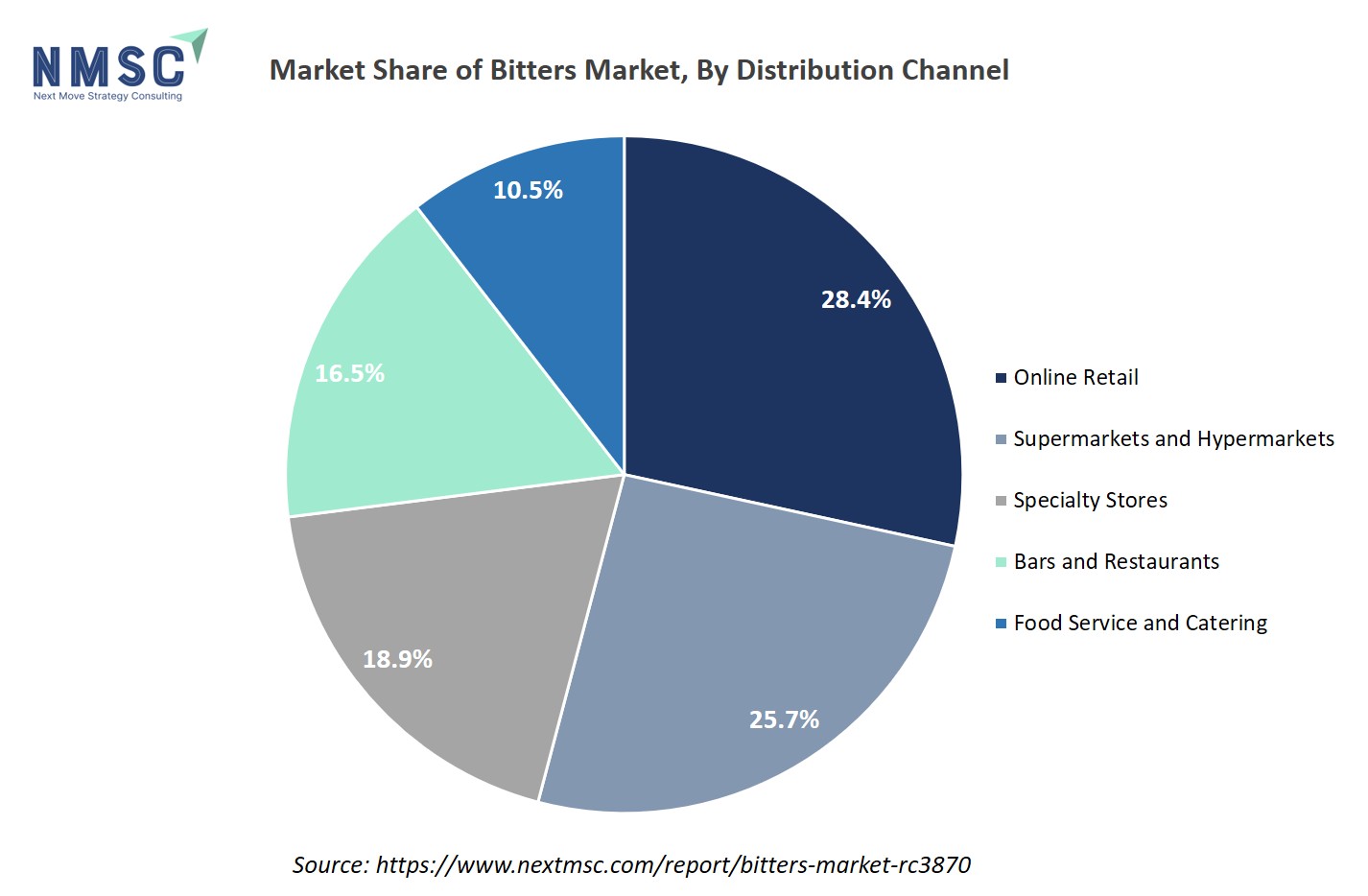
This pie chart illustrates the market share of different distribution channels in the global market, showing how the products reach consumers and businesses. Online Retail holds the largest share, reflecting the rise of e-commerce and direct-to-consumer sales, while Supermarkets and Hypermarkets remain important for mass-market distribution. Specialty Stores serve niche and premium segments, Bars and Restaurants represent on-premise professional usage, and Food Service and Catering accounts for bulk or institutional sales. Overall, the chart highlights the relative importance of each channel and helps identify key opportunities for growth.
By Application Insights
Which Application Is Emerging as the Most Flexible in the Bitters Industry?
Based on application, the bitters market segments are divided into cocktails and mixed drinks, culinary use and others.
Cocktails and Mixed Drinks as an application segment refers to the use of bitters primarily in alcoholic and non-alcoholic beverages to enhance flavor, balance sweetness, and add complexity. Bartenders and mixologists rely on bitters to create signature cocktails, classic drinks, and innovative mixed beverages. This application is a key driver for the market, as it targets both professional bars and individual consumers who enjoy crafting drinks at home, highlighting the role of bitters in the beverage and hospitality industry.
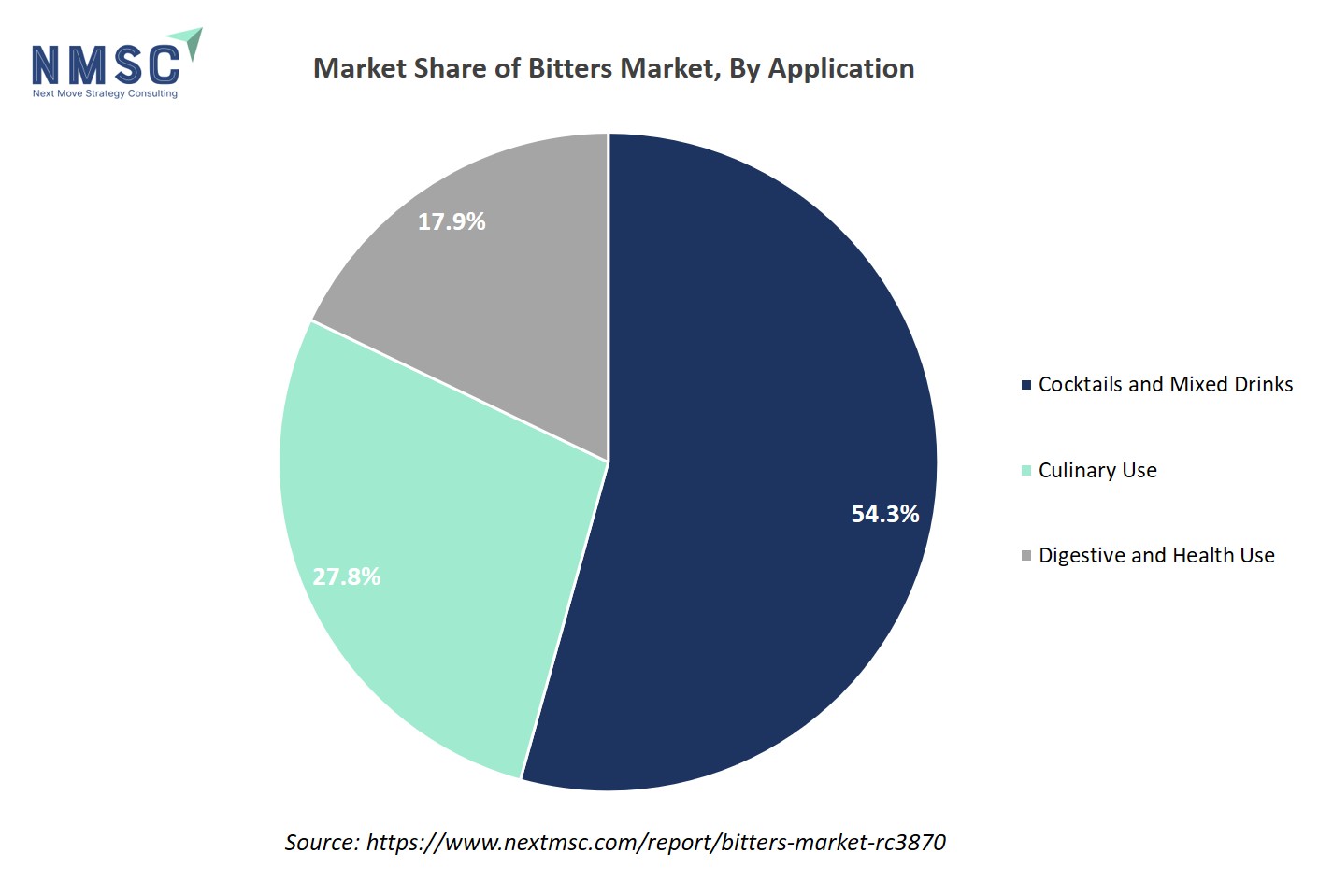
This chart represents the market share of different applications of bitters in the global market. It shows that cocktails and mixed drinks account for the largest portion, highlighting the use of bitters primarily in beverages and bartending. Culinary use captures a significant share, reflecting its role in cooking and flavoring foods. Digestive and health use represents a smaller segment, emphasizing Bitters’ function in promoting digestion and wellness. Overall, the chart illustrates how bitters are utilized across beverages, food, and health applications, helping identify key areas of demand.
By End-User Industry Insights
How Is the Bitters Market Shaped by End-User Industry Segmentation?
Based on end user, the market is segmented into individual consumers and others.
Individual consumers as an end-user segment refers to people who purchase bitters for personal use at home. This includes enthusiasts who enjoy experimenting with cocktails, mixed drinks, or culinary recipes, as well as those who use bitters for digestive or health purposes. The segment reflects the growing interest in home bartending, DIY mixology, and premium beverage experiences, making individual consumers an important driver of demand in the global market.
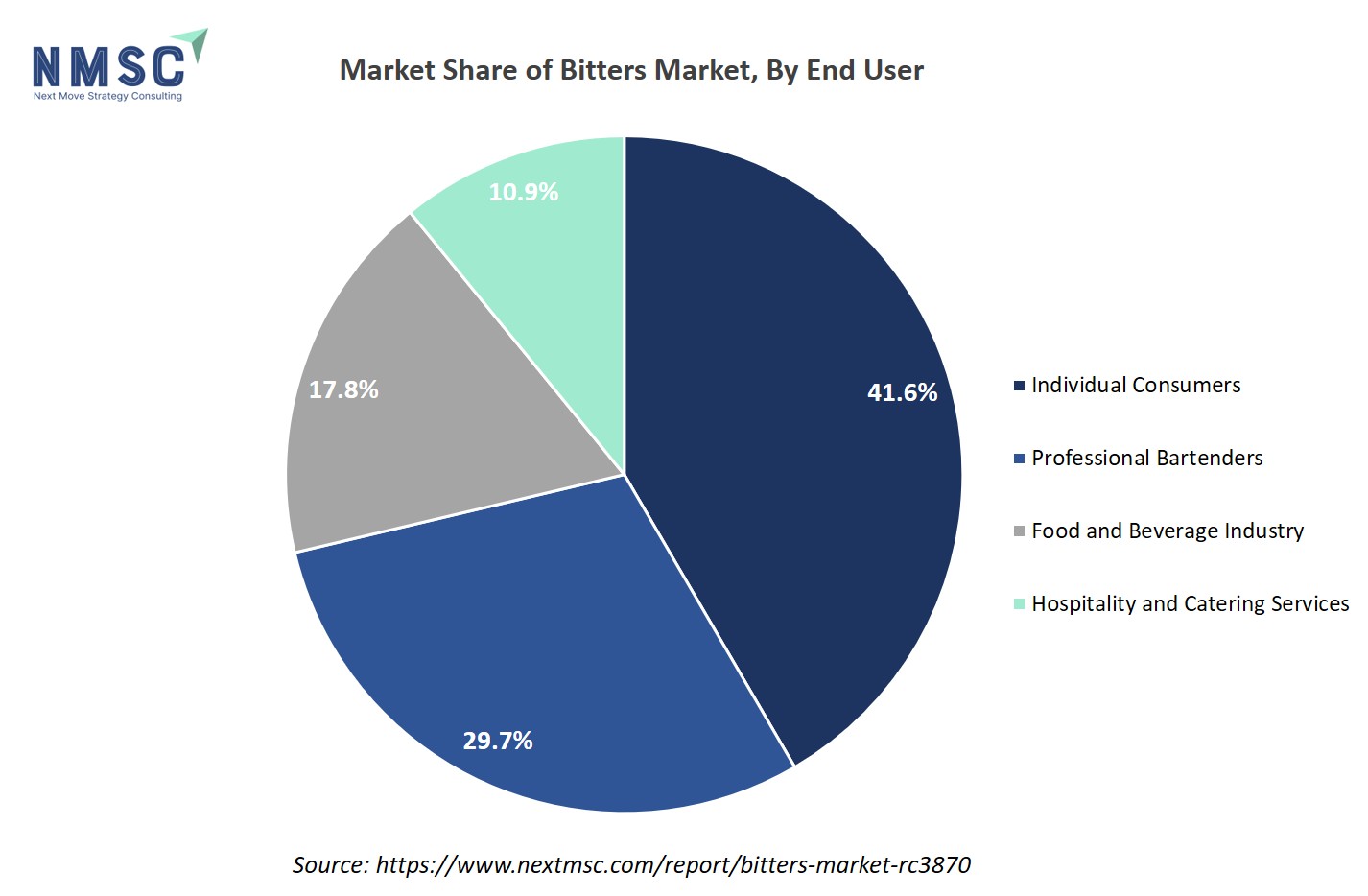
This chart represents the market share of different end users in the global market. Individual Consumers account for the largest portion, indicating strong direct-to-consumer demand. Professional Bartenders hold a significant share, reflecting the importance of Bitters in bars and mixology. The market represent usage in commercial production and flavoring, while Hospitality and Catering Services capture institutional and bulk consumption. Overall, the chart highlights how bitters are distributed among various user groups, providing insights into key demand segments.
Regional Outlook
The market is geographically studied across North America, Europe, Asia Pacific, Latin America and the Middle East & Africa and each region is further studied across countries.
Bitters Market in North America
The North American market is being strongly influenced by the region’s expanding cocktail culture. Mixology has become a mainstream lifestyle trend, with bars, restaurants, and even home enthusiasts experimenting with complex flavors and artisanal beverages. Bitters, with their concentrated botanical flavors, are essential for creating layered and sophisticated drinks, making them a staple ingredient in this evolving cocktail landscape. For producers, this trend creates opportunities to introduce new flavor variants, limited editions, and premium product lines tailored to mixologists and cocktail enthusiasts. By aligning marketing efforts with cocktail trends, hosting tasting events, and collaborating with bar and restaurant chains, bitters companies in North America enhance brand visibility, increase adoption in both on-premise and retail channels, and strengthen their position in a market driven by innovation and consumer experimentation.
Bitters Market in the United States
The U.S. bitters market is being fueled by the growing consumer preference for nonalcoholic and functional beverages. As health-conscious consumers seek alternatives to traditional alcoholic drinks, there is an increasing demand for beverages that combine flavor with wellness benefits. Bitters, with their complex botanical profiles and potential digestive or functional properties, are increasingly being incorporated into nonalcoholic cocktails, mocktails, and other functional drinks. This trend provides an opportunity for bitters producers to develop specialized products tailored for the nonalcoholic segment, including alcohol-free options or variants highlighting digestive or botanical benefits. By aligning product innovation with the evolving preferences of U.S. consumers, bitters brands expand their presence in restaurants, retail, and home consumption channels, tapping into a growing market for flavorful, health-conscious beverage solutions.
Bitters Market in Canada
The Canadian market is being fueled by the growing popularity of craft cocktails and mixology culture across the country. Bars, restaurants, and even home enthusiasts are increasingly experimenting with complex flavors and premium ingredients, making bitters a key component for creating layered and sophisticated drinks. This trend encourages producers to innovate with new flavor profiles, limited-edition blends, and artisanal products that appeal to both professional mixologists and consumers seeking high-quality, unique beverages. By capitalizing on this cultural shift, bitters companies strengthen their presence in the Canadian market, expand distribution in on-premise and retail channels, and align their branding with the premium and artisanal image that craft cocktail enthusiasts value.
Bitters Market in Europe
The European market is increasingly influenced by the growing consumer preference for premium and artisanal products. European consumers are showing a strong interest in high-quality, small-batch, and craft beverages that emphasize unique flavors and authentic ingredients. Bitters, with their complex botanical profiles and heritage-inspired formulations, align perfectly with this premiumization trend. Producers capitalize on this by offering specialty flavors, limited editions, and products that highlight artisanal craftsmanship. By positioning bitters as a premium ingredient for cocktails, culinary uses, and home mixology, companies enhance brand perception, attract discerning consumers, and differentiate themselves in a competitive European market.
Bitters Market in the United Kingdom
The UK market is witnessing growth as consumers increasingly gravitate toward non-alcoholic beverages. With health and wellness becoming key considerations, there is a strong demand for drinks that deliver complex flavors without alcohol. Bitters, with their rich botanical compositions, are now being incorporated into non-alcoholic cocktails, mocktails, and functional beverages, enhancing both taste and perceived health benefits. This trend is reinforced by UK government initiatives promoting low- and no-alcohol drinks, highlighting the shift toward healthier consumption habits. For bitters producers, this creates opportunities to innovate with alcohol-free formulations, expand product offerings, and capture a broader consumer base, positioning bitters as a versatile ingredient for both on-premise and retail channels in the UK market.
Bitters Market in Germany
The German bitters industry is being propelled by the expanding craft cocktail and mixology movement. Bars, restaurants, and home enthusiasts are increasingly experimenting with unique and artisanal beverages, which has created strong demand for high-quality bitters as an essential ingredient. Bitters add complexity, depth, and aromatic nuances to cocktails, making them a staple for mixologists aiming to create sophisticated drinking experiences. For producers, this trend opens opportunities to innovate with new botanical blends, limited-edition flavors, and premium artisanal products tailored for the craft cocktail scene. By aligning with Germany’s vibrant bar culture and the growing interest in home mixology, bitters companies strengthen their brand presence, expand distribution, and capture a market segment that values flavor experimentation and premium quality.
Bitters Market in France
The French market is being influenced by the growing use of bitters in culinary applications. Chefs and food enthusiasts are increasingly incorporating bitters into recipes for desserts, sauces, and gourmet dishes to add depth, balance, and aromatic complexity. This trend transforms bitters from a primarily cocktail-focused ingredient into a versatile component of fine dining and home cooking. For producers, this presents an opportunity to develop specialized culinary formats, such as chef-grade concentrates or flavor-specific blends, and to collaborate with culinary professionals to create signature recipes. By emphasizing the versatility of bitters in both drinks and food, brands strengthen their market positioning, appeal to France’s sophisticated culinary audience, and expand adoption beyond traditional beverage channels.
Bitters Market in Spain
The Spanish bitters market is being influenced by the rising consumer preference for premium and high-quality beverages. As Spanish consumers increasingly seek artisanal, small-batch, and craft drinks, bitters have emerged as a key ingredient to enhance flavor complexity and sophistication. This trend encourages producers to innovate with unique botanical blends, limited-edition flavors, and high-end packaging to meet the expectations of discerning consumers. For bitters companies, aligning with the premiumization trend provides opportunities to position their products as essential components for upscale bars, restaurants, and home mixology, thereby strengthening brand perception and expanding market presence in Spain’s competitive beverage landscape.
Bitters Market in Asia Pacific
The Asia-Pacific market is being positively influenced by the rapid growth of the region’s tourism and hospitality sector. With an increasing number of luxury hotels, resorts, and high-end restaurants catering to both domestic and international tourists, there is a growing demand for sophisticated beverages, including cocktails that feature bitters. This trend encourages producers to innovate with region-specific flavors and premium blends that appeal to diverse consumer palates. For bitters companies, the expanding hospitality sector offers opportunities to establish partnerships with bars, hotels, and resorts, provide mixology training programs, and create signature cocktails that enhance brand visibility. By leveraging the tourism-driven growth in hospitality, bitters brands capture a wider audience and strengthen their market presence across Asia-Pacific.
Bitters Market in China
The Chinese bitters market is benefiting from the rapid growth in inbound tourism, which has heightened demand for premium and diverse beverage offerings. In the first quarter of 2025, China welcomed 35.02 million inbound tourists, a 19.6% increase from the same period the previous year, while Alipay reported a 180% surge in tourist spending during the May Day holiday (State Council of China). This influx of international visitors has created opportunities for bitters producers, as sophisticated cocktails and mocktails featuring complex botanical flavors are increasingly sought after in hotels, bars, and restaurants. By catering to tourists’ preferences for authentic, high-quality drinking experiences, bitters companies expand their presence in the hospitality sector, introduce region-specific flavors, and strengthen brand recognition in the Chinese market.
Bitters Market in Japan
The Japanese market is experiencing growth as home bartending and DIY cocktail culture gain popularity. As more consumers experiment with crafting cocktails at home, there is growing demand for high-quality ingredients like bitters that provide depth, complexity, and aromatic sophistication. This shift encourages producers to develop smaller, versatile packaging suitable for home use and to introduce innovative flavor blends that inspire creativity. By capitalizing on the home mixology trend, bitters companies expand beyond traditional bar and restaurant channels, strengthen brand loyalty through recipe guidance and educational initiatives, and establish bitters as an indispensable component for both casual and aspiring home bartenders in Japan.
Bitters Market in India
The Indian bitters market expansion is poised for growth alongside the rapid expansion of the country’s non-alcoholic beverage sector, which is projected to rise from USD 38.03 billion in 2022 to around USD 88.25 billion by 2027, reflecting a CAGR of 18.3%. Increasing health consciousness and demand for functional beverages are driving this surge, creating opportunities for bitters, which offer complex flavors and potential digestive benefits. Producers leverage this trend by developing non-alcoholic bitters products tailored to health-focused consumers, integrating botanical and functional attributes. By aligning product innovation with India’s evolving beverage preferences, bitters brands capture a growing segment of consumers seeking flavorful, alcohol-free alternatives, while expanding their market presence across retail and hospitality channels.
Bitters Market in South Korea
The South Korean market is being influenced by the growing popularity of craft spirits and premium cocktail culture. Consumers are increasingly seeking unique, artisanal beverages that offer complex flavors and elevated drinking experiences. Bitter ingredients, with their concentrated botanical profiles, have become an essential ingredient for mixologists and cocktail enthusiasts looking to create sophisticated drinks. This trend encourages producers to innovate with distinctive flavor blends and limited-edition offerings that appeal to South Korea’s adventurous and quality-conscious consumers. By aligning with the country’s expanding premium spirits and cocktail scene, bitters companies strengthen brand recognition, enhance adoption in bars and restaurants, and tap into the growing segment of consumers who value craftsmanship and flavor complexity in their beverages.
Bitters Market in Australia
The Australian market is increasingly influenced by consumer demand for sustainable, natural, and ethically sourced ingredients. Consumers are showing greater awareness of environmental impact and ingredient provenance, seeking beverages made from botanicals that are organic, locally sourced, or sustainably harvested. Bitters, with their botanical and plant-based profiles, are well-positioned to meet this preference, allowing producers to highlight natural ingredients, minimal processing, and eco-friendly practices. By aligning with sustainability trends, bitters companies differentiate their products, appeal to environmentally conscious consumers, and strengthen brand loyalty. This focus on natural and sustainable ingredients also opens opportunities for premiumization and educational marketing around botanical sourcing, reinforcing Australia’s market for high-quality, responsible beverage products.
Bitters Market in Latin America
The Latin American market is benefiting from the rapid expansion of the region’s convenience store sector, which reported double-digit growth in countries like Argentina, Peru, and Colombia in the second quarter of 2025 (Convenience). This robust retail environment reflects increasing consumer demand for diverse, convenient, and premium beverage options. Bitters, with their complex flavors and versatility, are increasingly incorporated into cocktails and mocktails to meet evolving consumer tastes. For producers, this trend provides opportunities to introduce region-specific flavors, collaborate with convenience stores on signature offerings, and enhance brand visibility. By aligning with the growing preference for innovative and accessible beverages, bitters companies expand their market presence across Latin America and capture a broader, trend-conscious consumer base.
Bitters Market in the Middle East & Africa
The Middle East & Africa bitters market expansion is being influenced by the region’s expanding premium hospitality and luxury dining sector. Upscale hotels, fine-dining restaurants, and high-end bars are increasingly incorporating sophisticated beverages into their menus, creating demand for high-quality, artisanal ingredients like bitters. These establishments rely on bitters to craft complex cocktails and signature drinks that appeal to affluent consumers seeking unique and memorable experiences. For bitters producers, this trend offers opportunities to develop premium blends, collaborate with luxury venues for exclusive offerings, and position their products as essential components for elite mixology. By aligning with the growth of luxury hospitality, bitters companies enhance brand prestige, expand adoption in high-value channels, and tap into a market segment that prioritizes quality and sophistication in beverage experiences.
Competitive Landscape
Who Are the Leading Companies in the Bitters Market and How are They Competing?
The global bitters market competition is shaped by a combination of well-established beverage conglomerates and nimble, innovation-driven specialists. Leading companies such as Fernet Branca, Stock Spirits Group, Gruppo Campari, Angostura Bitters, Underberg, Gammel Dansk, Kuemmerling, and Unicum maintain their dominance through strong brand heritage, extensive distribution networks, and a diverse portfolio of classic and premium bitters products. Their focus on consistent quality, brand recognition, and legacy recipes allows them to cater to traditional consumers while reinforcing their presence in bars, restaurants, and retail outlets globally. By emphasizing reliability, craftsmanship, and premium positioning, these players continue to anchor the market and set benchmarks for quality and authenticity.
At the same time, innovative and digitally native players such as Scrappy’s Bitters, Pernod Ricard, Fee Brothers, Hella Cocktail Co, Dashfire Bitters, Wild Turkey, and Strongwater LLC drive competition through experimentation, niche flavors, and contemporary branding. These companies focus on small-batch production, artisanal blends, and creative product experiences that appeal to younger and experience-oriented consumers. Their agility in responding to evolving cocktail trends, craft beverage culture, and demand for personalized drinking experiences pressures traditional players to innovate. This dynamic pushes the market toward a more diverse, flavor-forward, and consumer-centric landscape, where both heritage and creativity coexist.
Market Dominated by Bitters Giants and Specialists
The bitters market is increasingly shaped by a blend of established beverage leaders and specialized innovators. Companies like Fernet Branca, Stock Spirits Group, Gruppo Campari, Angostura Bitters, Underberg, Gammel Dansk, Kuemmerling, and Unicum dominate the landscape by offering a wide range of classic and premium bitters, leveraging strong brand heritage, extensive distribution networks, and consistent quality standards to cater to traditional consumers and global markets. Meanwhile, specialized players such as Scrappy’s Bitters, Pernod Ricard, Fee Brothers, Hella Cocktail Co, Dashfire Bitters, Wild Turkey, and Strongwater LLC are introducing niche and artisanal offerings, creative flavor profiles, small-batch production, and contemporary branding strategies. Together, these companies drive innovation, create market differentiation, and fuel growth by responding to evolving consumer preferences, the craft cocktail trend, and the rising demand for unique, experience-driven drinking experiences.
Market Players to Opt for Expansion Strategies to Expand their Presence
In the bitters market, strategic expansions are becoming essential for expanding capabilities and accelerating adoption. For instance, Fernet Branca’s recent initiatives exemplify how market players are leveraging expansion strategies to strengthen their presence. By launching a limited-edition bottle in the U.S. market to celebrate its 180th anniversary, the brand not only reinforced its heritage but also tapped into new consumer segments, blending tradition with modern appeal. Furthermore, receiving the "Best Product of the Year 2024" award at the Lisbon Bar Show in 2025 underscores how such strategic product launches enhance brand visibility, reputation, and market reach, allowing established players to expand their footprint and maintain a competitive edge in the evolving market.
List of Key Bitters Companies
-
Fernet Branca
-
Stock Spirits Group
-
Gruppo Campari
-
Underberg
-
Gammel Dansk
-
Kuemmerling
-
Scrappy’s Bitters
-
Pernod Ricard
-
Fee Brothers
-
Hella Cocktail Co
-
Dashfire Bitters
-
Wild Turkey
-
Strongwater LLC
What Are The Latest Key Industry Developments?
The global bitters market is expanding through the combined efforts of established heritage brands and innovative newcomers. Companies like Fernet Branca, Stock Spirits Group, Gruppo Campari, Angostura Bitters, Underberg, Gammel Dansk, Kuemmerling, and Unicum drive growth by leveraging strong brand recognition, extensive distribution networks, and premium product offerings, including limited-edition launches and geographic expansions, which attract both traditional and new consumers. Meanwhile, agile players such as Scrappy’s Bitters, Pernod Ricard, Fee Brothers, Hella Cocktail Co, Dashfire Bitters, Wild Turkey, and Strongwater LLC contribute by introducing artisanal blends, small-batch products, and creative flavor profiles, while engaging digitally and collaborating with bars and mixologists to tap into the craft cocktail and experience-driven trend. Together, these strategies of heritage, innovation, and market expansion are broadening consumer reach and fueling the overall growth of the market.
What Are The Key Factors Influencing Investment Analysis & Opportunities In The Market?
Investment in the bitters market is increasingly driven by the growing demand for premium, craft, and experience-focused beverage solutions. Funding trends indicate that investors are attracted to companies offering innovative products, artisanal blends, small-batch production, and creative flavor profiles, as well as brands that leverage digital platforms for marketing, consumer engagement, and cocktail education. Valuations are influenced by a company’s ability to scale production, expand into new markets, and build strong brand recognition, while maintaining quality and authenticity. Investors are particularly interested in businesses that combine heritage, craftsmanship, and trend-driven innovation, reflecting the rising consumer preference for unique and personalized drinking experiences.
Geographically, urban centers and regions with vibrant bar and hospitality cultures are emerging as key hotspots for investment opportunities, given the high demand for premium spirits and cocktail ingredients. Startups and niche producers are attracting attention for their agility, creative offerings, and ability to tap into evolving mixology trends, creating opportunities for partnerships, strategic acquisitions, and portfolio diversification. Collectively, these factors are shaping a dynamic investment landscape in the global bitters market.
Key Benefits for Stakeholders:
Next Move Strategy Consulting (NMSC) presents a comprehensive analysis of the bitters market trends, covering historical trends from 2020 through 2024 and offering detailed forecasts through 2030. Our study examines the market at global, regional, and country levels, providing quantitative projections and insights into key growth drivers, challenges, and investment opportunities across all major market segments.
Report Scope:
|
Parameters |
Details |
|
Market Size in 2025 |
USD 2.77 Billion |
|
Revenue Forecast in 2030 |
USD 3.78 Billion |
|
Growth Rate |
CAGR of 6.4% from 2025 to 2030 |
|
Analysis Period |
2024–2030 |
|
Base Year Considered |
2024 |
|
Forecast Period |
2025–2030 |
|
Market Size Estimation |
Billion (USD) |
|
Growth Factors |
|
|
Countries Covered |
33 |
|
Companies Profiled |
15 |
|
Market Share |
Available for 10 companies |
|
Customization Scope |
Free customization (equivalent up to 80 analyst-working hours) after purchase. Addition or alteration to country, regional & segment scope. |
|
Pricing and Purchase Options |
Avail customized purchase options to meet your exact research needs. |
|
Approach |
In-depth primary and secondary research; proprietary databases; rigorous quality control and validation measures. |
|
Analytical Tools |
Porter's Five Forces, SWOT, value chain, and Harvey ball analysis to assess competitive intensity, stakeholder roles, and relative impact of key factors. |
Key Market Segments
By Product Type
-
Aromatic Bitters
-
Digestive Bitters
-
Citrus Bitters
-
Herbal Bitters
-
Spiced Bitters
-
Fruit Bitters
-
Other Specialty Bitters
By Form
-
Liquid Bitters
-
Powdered Bitters
-
Solid/Crystal Bitters
By Flavor Profile
-
Bitter-Sweet
-
Herbal
-
Citrus
-
Spiced
-
Fruity
By Distribution Channel
-
Online Retail
-
Supermarkets and Hypermarkets
-
Specialty Stores
-
Bars and Restaurants
-
Food Service and Catering
By Application
-
Cocktails and Mixed Drinks
-
Culinary Use
-
Digestive and Health Use
By End User
-
Individual Consumers
-
Professional Bartenders
-
Food and Beverage Industry
-
Hospitality and Catering Services
Geographical Breakdown
-
North America: U.S., Canada, and Mexico.
-
Europe: U.K., Germany, France, Italy, Spain, Sweden, Denmark, Finland, Netherlands, and rest of Europe.
-
Asia Pacific: China, India, Japan, South Korea, Taiwan, Indonesia, Vietnam, Australia, Philippines, Malaysia and rest of APAC.
-
Middle East & Africa (MEA): Saudi Arabia, UAE, Egypt, Israel, Turkey, Nigeria, South Africa, and rest of MEA.
-
Latin America: Brazil, Argentina, Chile, Colombia, and rest of LATAM.
Conclusion & Recommendations
Our report equips stakeholders, industry participants, investors, policy-makers, and consultants with actionable intelligence to capitalize on market transformative potential. By combining robust data-driven analysis with strategic frameworks, NMSC’s Bitters Market Report serves as an indispensable resource for navigating the evolving landscape.


About the Author
 Ridip Gogoi
— Ridip Gogoi is a Research Associate at Next Move Strategy Consulting, where he supports cross-vertical market research and analysis across multiple industry sectors, with four years of experience. His work includes market analysis, data validation, secondary research, and insight development, helping structure evidence into clear findings for business and strategy decisions. He contributes to research quality checks and reporting, with a focus on consistency, source review, and clarity accuracy.
Ridip Gogoi
— Ridip Gogoi is a Research Associate at Next Move Strategy Consulting, where he supports cross-vertical market research and analysis across multiple industry sectors, with four years of experience. His work includes market analysis, data validation, secondary research, and insight development, helping structure evidence into clear findings for business and strategy decisions. He contributes to research quality checks and reporting, with a focus on consistency, source review, and clarity accuracy.
About the Reviewer
 Supradip Baul
— Supradip Baul is an accomplished business consultant and strategist with over a decade of rich experience in market intelligence, strategy, technology, and business transformation. His work has included rigorous qualitative and quantitative analysis across multiple industries, helping clients shape investment decisions and long-term roadmaps. Earlier in his career, he was associated with Gartner, where he contributed to industry-leading reports and market share analyses. He has worked with leading global companies and holds an MBA with a dual specialization in Marketing and Finance.
Supradip Baul
— Supradip Baul is an accomplished business consultant and strategist with over a decade of rich experience in market intelligence, strategy, technology, and business transformation. His work has included rigorous qualitative and quantitative analysis across multiple industries, helping clients shape investment decisions and long-term roadmaps. Earlier in his career, he was associated with Gartner, where he contributed to industry-leading reports and market share analyses. He has worked with leading global companies and holds an MBA with a dual specialization in Marketing and Finance.
At Next Move Strategy Consulting, we understand that insightful market research is the cornerstone of successful business decisions. That's why we employ a robust and multifaceted approach, combining various methodologies to deliver the most accurate and actionable data for our clients.

Research Landscape
We navigate the world of research with two primary approaches:
Qualitative Approach
Our qualitative research methodologies involve immersive techniques such as in-depth interviews, focus groups, and observational studies. By engaging directly with individuals and stakeholders, we uncover valuable insights that quantitative data alone may overlook.

Quantitative Research
In tandem with qualitative methodologies, NMSC leverages the power of Quantitative Research to provide a robust foundation of numerical insights. Through systematic data collection and analysis, we quantify patterns, preferences, and market trends, offering a comprehensive view of the business landscape.
Our quantitative research approach employs diverse tools, including surveys, experiments, and statistical modelling. These methodologies enable us to gather data from a large and representative sample, ensuring the statistical significance of our findings. By employing structured questionnaires and standardized data collection methods, we guarantee the reliability and validity of the information we present to our clients.
Quantitative research is particularly effective in measuring the prevalence of trends, assessing market size, and gauging the impact of various factors on consumer behavior. The numerical precision attained through this approach equips our clients with actionable insights, facilitating data-driven decision-making and strategy formulation.


Our Specialized Toolbox for Industry-Specific Market Research
We deploy a specialized arsenal of techniques tailored to meet your unique requirements. Here's a glimpse into our comprehensive toolbox:

Information Procurement
The stage entails acquiring market data or relevant information through various sources and methodologies.


Market Research Approach
We utilize both top-down and bottom-up approaches in market research analysis to achieve a comprehensive understanding of the market dynamics, leveraging the broad perspective of industry trends and macroeconomic factors alongside detailed insights from specific segments and individual companies.

Porters Five Forces Analysis
We conduct Porter's Five Forces analysis to evaluate the competitive landscape of an industry, providing us with insights into factors that affect profitability and strategic positioning.

SWOT Analysis

Forecasting
We utilize a forecasting model to predict future consumption by considering parameters like population, economics, regulations, market competition, drivers, constraints, technology, and pricing. We also employ statistical techniques such as multilinear regression, exponential smoothing, moving average, ARIMA, and Monte Carlo simulations for accurate predictions. In econometric forecasting, we analyzed short-term and long-term event impacts, attributing values based on regulatory frameworks, economic factors, and market events.





 Speak to Our Analyst