Organic and Non-GMO Food Market Size, Share, Trends and Growth Analysis, By Product Category (Fresh Produce, Dairy and Eggs, Meat and Seafood, Bakery Products, Grain Products, Pantry Foods, Frozen Foods, Snacks, Beverages, and more), By Processing State, By Packaging Format, By Brand Positioning, By Certification (Organic Certified, Non-GMO Certified and Others), By Distribution Channel, By Customer Type, and Region — Global Industry Report and Forecast, 2026–2035
What Is the Organic and Non-GMO Food Market Size?
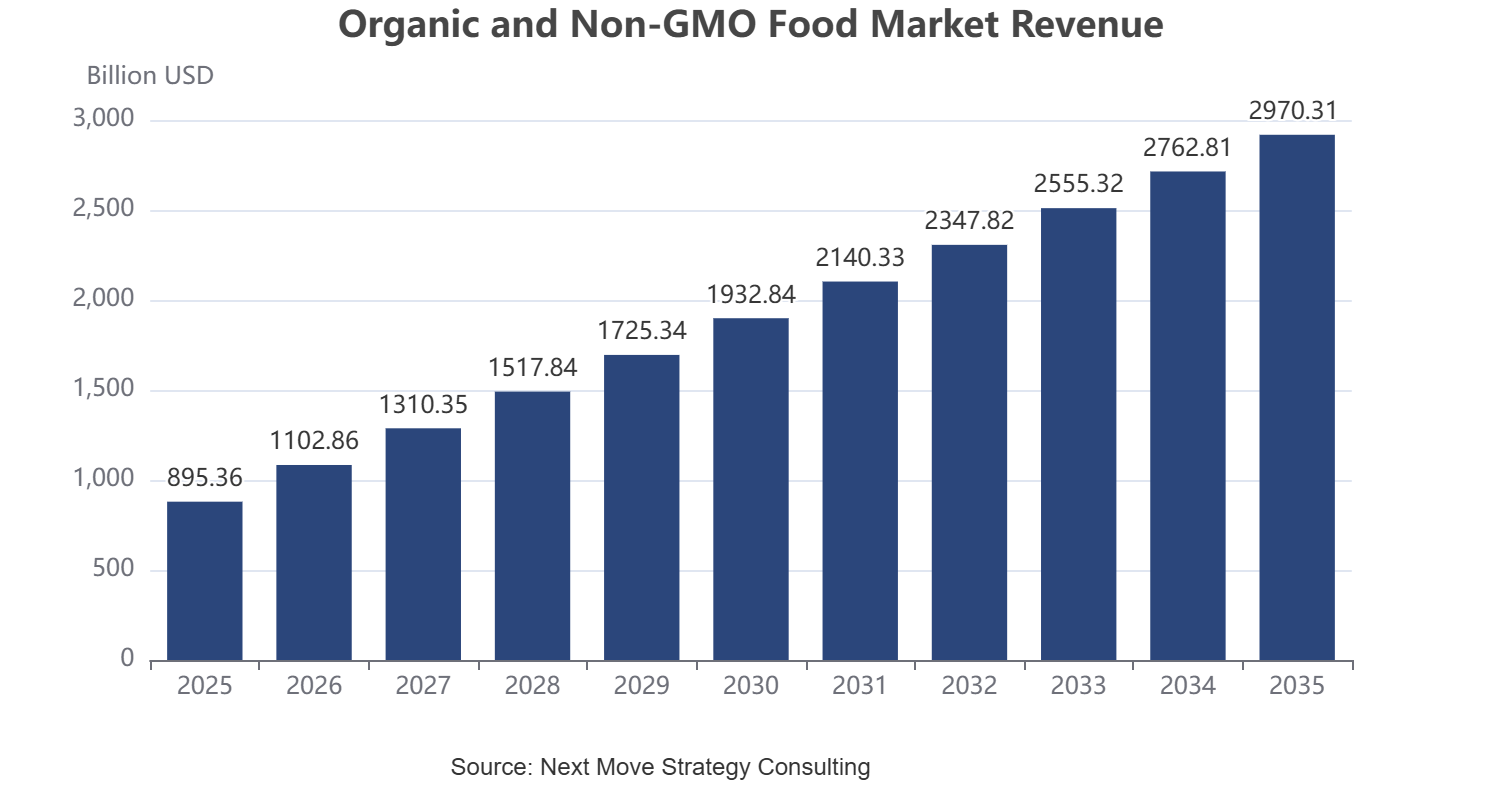
The global Organic and Non-GMO Food Market size was valued at USD 895.36 billion in 2025 and is estimated at USD 991.17 billion in 2026, forecast to reach USD 2,970.31 billion by 2035, expanding at a 12.94% CAGR between 2026 and 2035. North America leads with approximately 38% share, while Fresh Produce dominates all other product categories with approximately 24% share.
We observed that growth is broad-based across every segmentation axis, with dual-certified products and online retail distribution driving the dominant structural shifts through 2035.
|
Key Takeaways |
|
By Product Category: Fresh Produce held the largest share of approximately 24% (USD 214.89 billion) in 2025; Frozen Foods is the fastest-growing sub-segment at 17.3% CAGR from 2026–2035. |
|
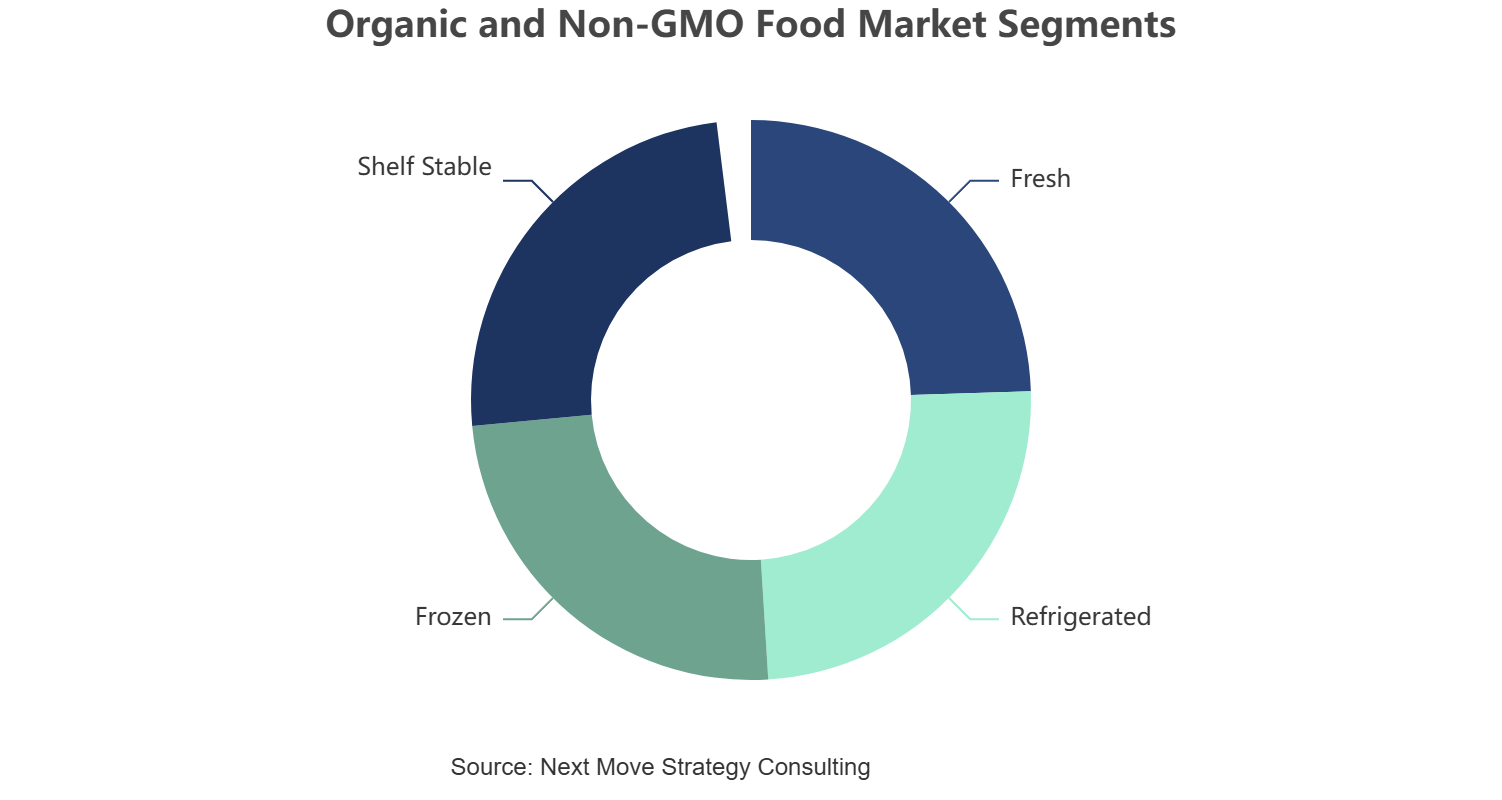
By Processing State: Fresh held the largest share of the processing state category in 2025; Frozen is the fastest-growing sub-segment through 2035 on expanding cold chain and freezer retail space. |
|
By Packaging Format: Flexible Packaging held the largest share of the packaging format category in 2025; Flexible Packaging is also the fastest-growing sub-segment through 2035 on lightweight, cost-efficient conversion. |
|
By Brand Positioning: Mainstream held the largest share of the brand positioning category in 2025; Private Label is the fastest-growing sub-segment through 2035 on retailer-owned organic program expansion. |
|
By Certification: Organic Certified held the largest share of approximately 58% (USD 519.31 billion) in 2025; Dual Organic and Non-GMO Certified is the fastest-growing sub-segment at 20.4% CAGR from 2026–2035. |
|
By Distribution Channel: Supermarkets held the largest share of approximately 34% (USD 304.43 billion) in 2025; Online Retail is the fastest-growing sub-segment at 20.8% CAGR from 2026–2035. |
|
By Customer Type: Household Consumers held the largest share of the customer type category in 2025; Food Manufacturers is the fastest-growing sub-segment through 2035 on rising private label and ingredient sourcing demand. |
|
Dominant Region: North America dominated with approximately 38% revenue share (USD 340.23 billion) in 2025. |
|
Fastest-Growing Region: Asia-Pacific is expected to register the highest CAGR of 16.8% during 2026–2035. |
|
Dominant Country: U.S. led with approximately USD 272.19 billion in 2025. |
|
Fastest-Growing Country: India is the fastest-growing country at approximately 20.8% CAGR from 2026–2035. |
Market Opportunity: The organic and non-GMO food market is expected to create an absolute dollar opportunity of USD 1,979.14 billion between 2026 and 2035, presenting significant investment potential across the fresh produce, dairy, beverage, and packaged food value chain.
According to Next Move Strategy Consulting analysis, packaged food manufacturers are increasingly pursuing dual organic and non-GMO certification rather than single-standard labeling, a shift that favors suppliers with integrated certification management capabilities over single-claim producers as retailer private label programs expand verified sourcing requirements through 2035.
What Does the Organic and Non-GMO Food Market Encompass?
The organic and non-GMO food market encompasses fresh, refrigerated, frozen, and shelf-stable products certified under organic and non-GMO standards across fresh produce, dairy and eggs, meat and seafood, bakery, grain, pantry, snack, beverage, and prepared food categories, forming a certification-defined segment of the broader organic food and beverages market. Our assessment indicates that the scope spans household, foodservice, institutional, and food manufacturer customer types supplied through supermarkets, natural food retailers, club stores, and online retail channels. The category has evolved from niche natural food retailer positioning into mainstream supermarket and private label distribution.
Regulatory frameworks such as the USDA National Organic Program, which completed its 2026 sunset substance review effective July 2026, and the Non-GMO Project Verified standard shape certification and labeling requirements across the industry. We observed that technology adoption is shifting toward blockchain-enabled supply chain traceability and DNA-based verification testing that strengthen certification integrity. Next Move Strategy Consulting's analysis indicates that this structural shift, combined with expanding private label organic programs, is redefining sourcing criteria across the organic and non-GMO food market.
|
Parameters |
Details |
|
Market Size in 2025 |
USD 895.36 Billion |
|
Market Size in 2026 |
USD 991.17 Billion |
|
Revenue Forecast in 2035 |
USD 2,970.31 Billion |
|
Growth Rate |
CAGR of 12.94% from 2026 to 2035 |
|
Analysis Period |
2025–2035 |
|
Base Year Considered |
2025 |
|
Forecast Period |
2026–2035 |
|
Market Size Estimation |
USD Billion |
|
Companies Profiled |
20 |
|
Countries Covered |
33 |
|
Market Share |
Available for Top 10 Companies |
Key Emerging Trends
Based on research conducted by Next Move Strategy Consulting, we found that four structural trends are reshaping certification practice, product innovation, and stakeholder engagement across the organic and non-GMO food market.
How Is Dual Certification Reshaping Product Labeling Strategy?
Dual organic and non-GMO certification is gaining adoption as manufacturers seek to satisfy both regulatory and consumer-trust expectations simultaneously. We observed that Nature's Path Foods markets its cereal and snack portfolio under combined USDA Organic and Non-GMO Project Verified labeling to reinforce credibility. This trend is reshaping stakeholder labeling strategy, pushing brand owners to pursue dual certification rather than relying on organic status alone to convey non-GMO assurance to increasingly label-literate consumers.
Why Is Portfolio Rationalization Reshaping Organic Food Manufacturer Strategy?
Portfolio rationalization toward higher-margin core categories is gaining momentum among diversified organic food manufacturers facing margin pressure. Our findings suggest that Hain Celestial completed the sale of its North American snacks business in March 2026, sharpening its focus on yogurt, tea, and baby and kids food brands including Earth's Best Organic. This trend is reshaping stakeholder capital allocation, pushing manufacturers to concentrate investment in categories with the strongest organic premium retention.
How Is Frozen Format Adoption Expanding Organic Food Accessibility?
Frozen format adoption is expanding organic food accessibility as retailers allocate additional freezer space to reduce spoilage-related waste, a shift closely tracked within the broader frozen food market. This trend is elevating stakeholder demand for cold-chain-compatible organic supply agreements, particularly among fresh produce and prepared meal manufacturers seeking longer shelf life without compromising organic and non-GMO certification integrity.
What Role Does Blockchain Traceability Play in Certification Integrity?
Blockchain-enabled supply chain traceability is gaining adoption as manufacturers and retailers seek to verify organic and non-GMO claims from farm to shelf. We observed that supply chain transparency initiatives are increasingly paired with DNA-based verification testing to counter fraudulent labeling risk. This trend is elevating the strategic importance of digital traceability infrastructure among suppliers serving private label retailers and institutional buyers requiring verified certification documentation.
Consumer Behavior Analysis of the Organic and Non-GMO Food Market
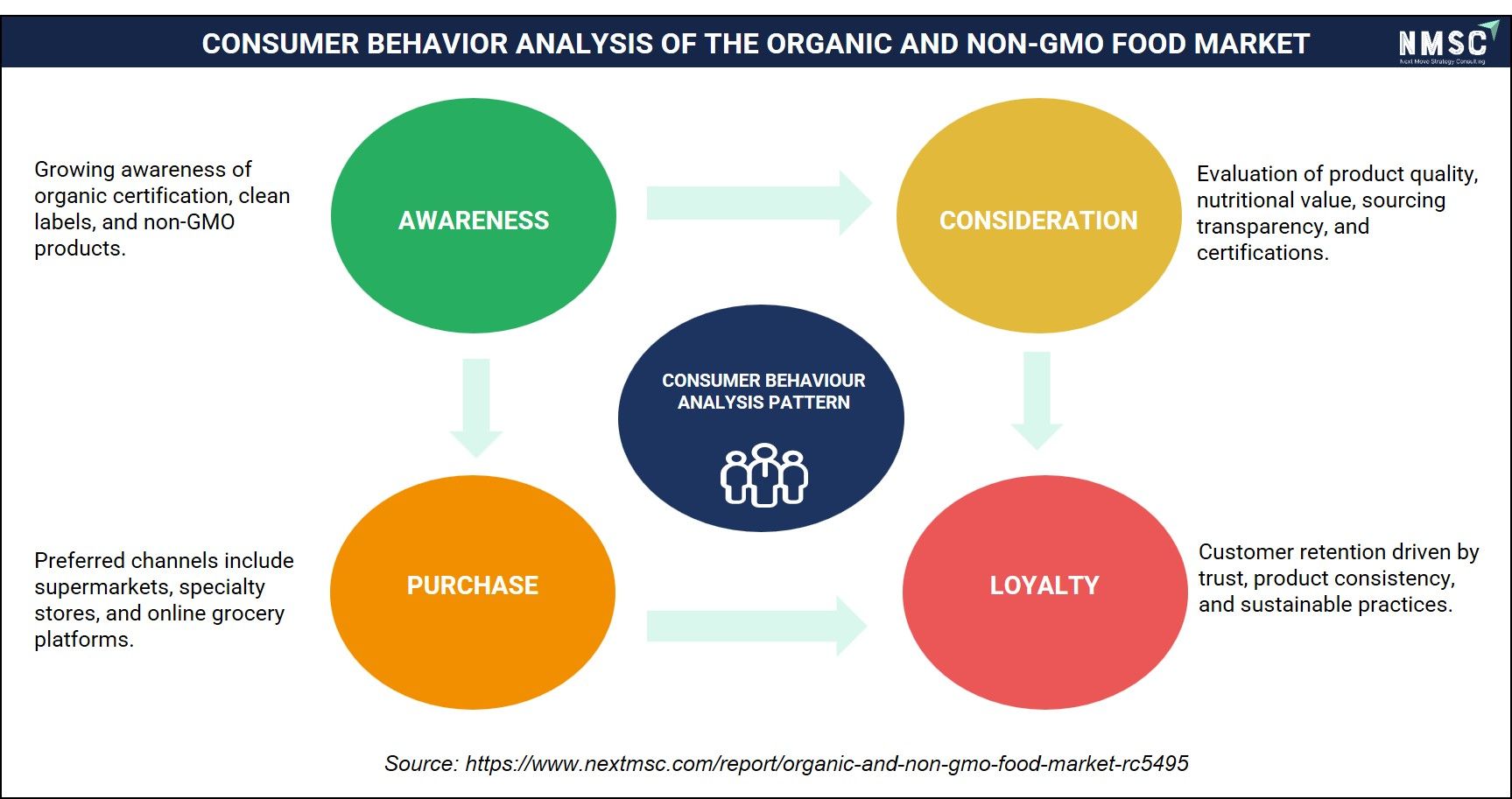
The consumer behaviour analysis illustrates the purchasing journey in the organic and non-GMO food market. Consumers first develop awareness through organic certifications, clean-label claims, and non-GMO verification. During the consideration stage, they assess product quality, nutritional value, ingredient transparency, and sourcing practices. Purchase decisions are primarily made through supermarkets, specialty retailers, and online grocery platforms, while long-term loyalty is driven by consistent product quality, brand trust, and sustainable business practices.
Growth Drivers and Restraints
Growth Catalyst and Risk Assessment Matrix
|
Factors |
Type |
(+/−) % Impact on CAGR |
Geographic Relevance |
Impact Timeline |
|
USDA National Organic Program certification support and cost-share funding |
Driver |
+1.8% |
North America |
2026–2035 |
|
Expanding private label organic programs among supermarkets |
Driver |
+1.6% |
North America, Europe |
2026–2035 |
|
Rising middle-class demand for clean-label food in Asia-Pacific |
Driver |
+2.1% |
Asia-Pacific |
2026–2035 |
|
Growing online retail and direct-to-consumer organic distribution |
Driver |
+1.4% |
Global |
2026–2033 |
|
Increasing dual organic and non-GMO certification adoption |
Driver |
+1.1% |
Global |
2026–2035 |
|
Expanding organic dairy and baby food category innovation |
Driver |
+0.7% |
North America, Europe |
2027–2035 |
|
Price premium versus conventional food limiting mass adoption |
Restraint |
−1.4% |
Global |
2026–2035 |
|
Certification cost and administrative burden for small producers |
Restraint |
−0.8% |
Asia-Pacific, Latin America |
2026–2032 |
|
Supply chain fraud and mislabeling risk undermining consumer trust |
Restraint |
−0.6% |
Global |
2026–2035 |
What Is the Primary Growth Driver of the Organic and Non-GMO Food Market?
Rising middle-class demand for clean-label food in Asia-Pacific is the primary driver of the market. Government support for organic certification, exemplified by the USDA's release of 2025 and 2026 Organic Certification Cost Share Program funding in July 2026, continues to lower entry barriers for producers globally. We observed that this regulatory and financial support, reinforced by expanding private label organic programs, continues to anchor baseline demand across supermarkets and natural food retailers.
How Is Private Label Expansion Driving Organic and Non-GMO Food Market Growth?
Expansion of private label organic programs among supermarkets and hypermarkets is accelerating market growth toward mainstream distribution channels. The USDA's completion of its 2026 National Organic Program sunset substance review, effective July 26, 2026, provides continued regulatory clarity supporting retailer private label investment. Our assessment indicates that this shift, combined with dual certification adoption, is compressing the price gap between branded and private label organic products.
What Is Restraining Organic and Non-GMO Food Market Expansion?
Price premium versus conventional food restrains broader adoption among price-sensitive consumer segments, particularly in emerging economies. Certification cost and administrative burden further limit participation among small and mid-scale producers seeking USDA Organic or Non-GMO Project Verified status. We found that this cost barrier is concentrating premium organic and non-GMO demand into higher-income markets, though expanding cost-share support programs are gradually easing certification barriers for smaller producers.
Segmentation Analysis
Segment Sizing: By Product Category
|
Segment |
2025 (USD) |
2035 (USD) |
CAGR% (2026–2035) |
|
Fresh Produce |
USD 214.89 Billion |
USD 579.22 Billion |
10.4% |
|
Dairy and Eggs |
USD 125.35 Billion |
USD 386.14 Billion |
12.0% |
|
Beverages |
USD 107.44 Billion |
USD 415.84 Billion |
14.9% |
|
Pantry Foods |
USD 80.58 Billion |
USD 237.62 Billion |
11.5% |
|
Snacks |
USD 71.63 Billion |
USD 311.88 Billion |
16.4% |
|
Bakery Products |
USD 62.68 Billion |
USD 178.22 Billion |
11.1% |
|
Grain Products |
USD 53.72 Billion |
USD 148.52 Billion |
10.7% |
|
Meat and Seafood |
USD 53.72 Billion |
USD 178.22 Billion |
13.0% |
|
Frozen Foods |
USD 44.77 Billion |
USD 207.92 Billion |
17.3% |
|
Baby and Toddler Foods |
USD 26.86 Billion |
USD 118.81 Billion |
16.6% |
|
Shelf-Stable Prepared Foods |
USD 17.91 Billion |
USD 74.26 Billion |
15.8% |
|
Refrigerated Prepared Foods |
USD 17.91 Billion |
USD 74.26 Billion |
15.8% |
|
Confectionery |
USD 8.95 Billion |
USD 29.70 Billion |
13.0% |
|
Oils and Fats |
USD 8.95 Billion |
USD 29.70 Billion |
13.0% |
|
Total |
USD 895.36 Billion |
USD 2,970.31 Billion |
12.94% |
Which Product Category Dominates the Organic and Non-GMO Food Market?
Fresh Produce led the market with USD 214.89 billion in 2025, supported by fresh fruits and vegetables remaining the most widely recognized and purchased organic category among household consumers. We observed that Frozen Foods is the fastest-growing product category, expanding at a 17.3% CAGR from 2026 to 2035, as expanding cold-chain infrastructure and retailer freezer space allocation improve accessibility for organic and non-GMO frozen fruits, vegetables, and prepared meals.
Segment Sizing: By Certification
Certified dairy products, tracked alongside the broader organic dairy food and drinks market, illustrate how certification standards intersect with product category performance across the industry.
|
Segment |
2025 (USD) |
2035 (USD) |
CAGR% (2026–2035) |
|
Organic Certified |
USD 519.31 Billion |
USD 1,544.56 Billion |
11.6% |
|
Non-GMO Certified |
USD 268.61 Billion |
USD 831.69 Billion |
12.1% |
|
Dual Organic and Non-GMO Certified |
USD 80.58 Billion |
USD 475.25 Billion |
20.4% |
|
Other Claims |
USD 26.86 Billion |
USD 118.81 Billion |
16.6% |
|
Total |
USD 895.36 Billion |
USD 2,970.31 Billion |
12.94% |
Which Certification Segment Leads Organic and Non-GMO Food Market Demand?
Organic Certified products remained the leading certification segment within the market, valued at USD 519.31 billion in 2025 given the established recognition of USDA Organic, EU Organic, and comparable national standards. Our findings suggest that Dual Organic and Non-GMO Certified is the fastest-growing certification segment, registering a 20.4% CAGR from 2026 to 2035, as manufacturers including Nature's Path Foods pursue combined labeling to reinforce consumer trust.
Segment Sizing: By Distribution Channel
|
Segment |
2025 (USD) |
2035 (USD) |
CAGR% (2026–2035) |
|
Supermarkets |
USD 304.43 Billion |
USD 831.69 Billion |
10.6% |
|
Natural Food Retailers |
USD 161.16 Billion |
USD 504.95 Billion |
12.3% |
|
Hypermarkets |
USD 125.35 Billion |
USD 356.44 Billion |
11.1% |
|
Online Retail |
USD 107.44 Billion |
USD 653.47 Billion |
20.8% |
|
Club Stores |
USD 71.63 Billion |
USD 237.62 Billion |
13.0% |
|
Convenience Stores |
USD 44.77 Billion |
USD 118.81 Billion |
10.2% |
|
Direct to Consumer |
USD 35.81 Billion |
USD 148.52 Billion |
15.8% |
|
Foodservice Distributors |
USD 26.86 Billion |
USD 74.26 Billion |
10.7% |
|
Direct Institutional Sales |
USD 17.91 Billion |
USD 44.55 Billion |
9.4% |
|
Total |
USD 895.36 Billion |
USD 2,970.31 Billion |
12.94% |
Which Distribution Channel Leads Organic and Non-GMO Food Sales?
Supermarkets remained the leading distribution channel within the market, valued at USD 304.43 billion in 2025 given their role as the primary shopping destination for mainstream organic and non-GMO purchases. Our analysis shows that Online Retail is the fastest-growing distribution channel, registering a 20.8% CAGR from 2026 to 2035, as consumers increasingly source organic and non-GMO groceries through e-commerce platforms offering subscription and direct-to-door delivery.
Growth Opportunities
Our analysis shows that three forward-looking opportunities stand out for stakeholders positioning within the organic and non-GMO food market over the 2026–2035 forecast period.
How Can Private Label Partnership Unlock Value for Organic Producers?
Private label partnership presents a whitespace opportunity for organic producers seeking to scale volume beyond branded retail channels. Suppliers that secure retailer private label manufacturing agreements stand to capture recurring, volume-based revenue as supermarkets expand organic private label programs, particularly benefiting mid-scale producers with certified capacity but limited branded market visibility.
Where Does Meal Kit and Prepared Food Format Expansion Create New Revenue?
Refrigerated and shelf-stable prepared food manufacturers represent an underpenetrated opportunity as convenience-seeking consumers adopt organic and non-GMO meal solutions, an activity closely tracked within the broader meal kit market. Suppliers that develop certified, ready-to-eat formats can secure long-term retail and foodservice distributor contracts as convenience-driven demand accelerates.
How Can Blockchain Traceability Benefit Institutional Buyers and Food Manufacturers?
Institutional buyers and food manufacturers seeking verified supply chain integrity create an opportunity for suppliers offering blockchain-enabled traceability documentation. Early movers that secure farm-to-shelf verification capability can differentiate with institutional buyers and food manufacturers pursuing audit-ready certification records ahead of tightening organic fraud prevention expectations across major distribution markets.
Supply Chain Structure of the Organic and Non-GMO Food Market
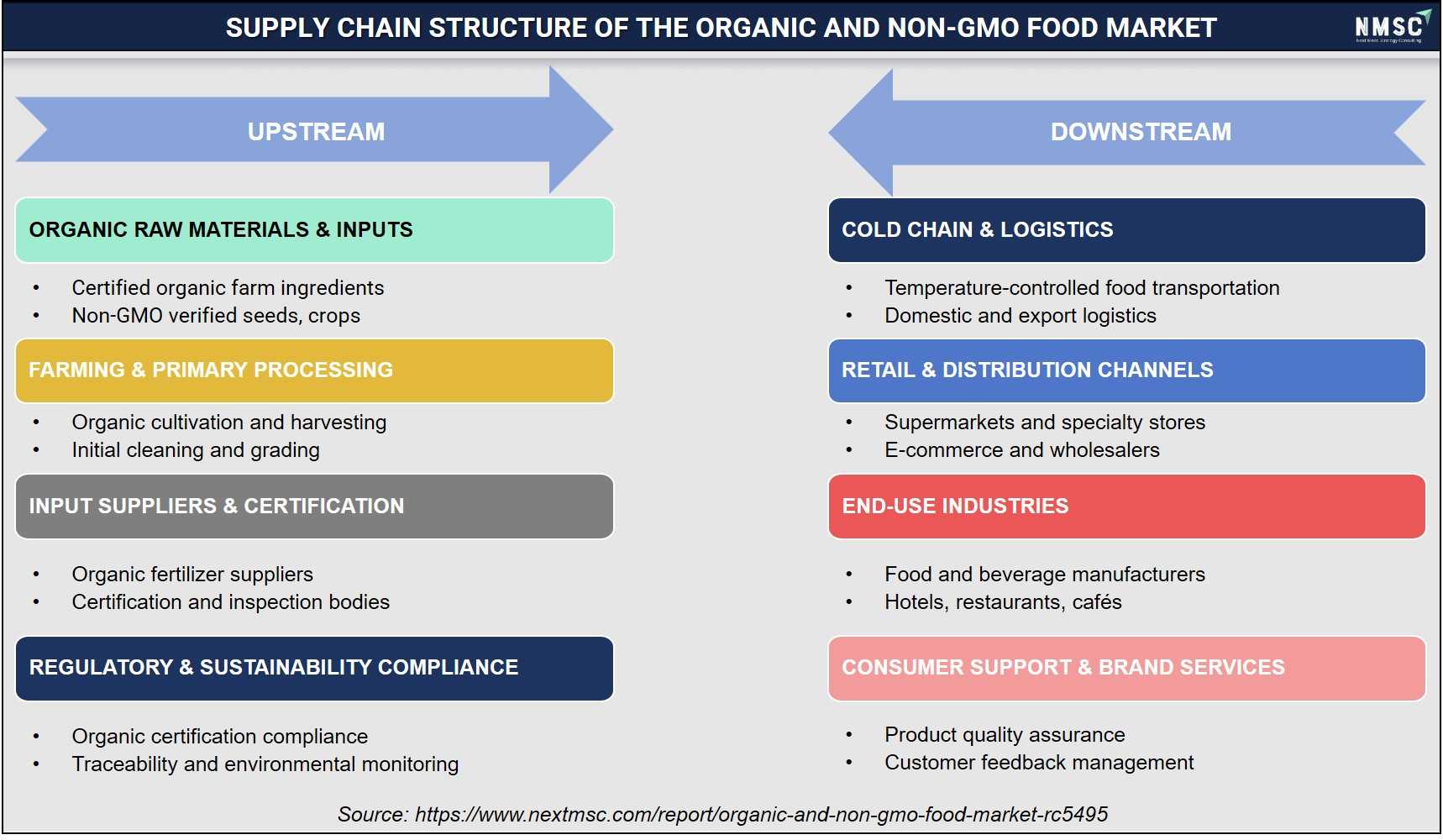
The supply chain structure of the organic and non-GMO food market illustrates the end-to-end flow from certified raw material sourcing to consumer support. Upstream activities include organic farming, non-GMO seed procurement, certification, and regulatory compliance to ensure product integrity. Downstream operations encompass cold-chain logistics, retail distribution, food service applications, and quality assurance. Strong traceability, sustainability compliance, and efficient logistics enable manufacturers to deliver safe, certified, and transparent products while meeting evolving consumer expectations.
Regional Outlook
Geographic Performance Snapshot
|
Region |
2025 (USD) |
2035 (USD) |
CAGR% (2026–2035) |
Key Driver |
|
North America |
USD 340.23 Billion |
USD 950.50 Billion |
10.8% |
USDA organic certification support and mainstream supermarket adoption |
|
Europe |
USD 268.61 Billion |
USD 772.28 Billion |
11.2% |
EU Organic regulation and established natural food retail networks |
|
Asia-Pacific |
USD 179.07 Billion |
USD 801.98 Billion |
16.8% |
Rising middle-class demand for clean-label food in China and India |
|
Latin America |
USD 62.68 Billion |
USD 267.33 Billion |
16.2% |
Expanding organic export agriculture and urban retail penetration |
|
Middle East & Africa |
USD 44.77 Billion |
USD 178.22 Billion |
15.3% |
Growing health-conscious retail demand and import diversification |
|
Total |
USD 895.36 Billion |
USD 2,970.31 Billion |
12.94% |
– |
North America Organic and Non-GMO Food Market Outlook
North America leads the organic and non-GMO food market with an established USDA National Organic Program certification framework and mainstream supermarket distribution. We observed that the USDA's release of 2025 and 2026 Organic Certification Cost Share Program funding in July 2026 continues to support producer participation. Technology adoption remains advanced, with private label organic programs and online retail gaining share among regional supermarkets and natural food retailers.
Europe Organic and Non-GMO Food Market Outlook
Europe's organic and non-GMO food market reflects a mature, regulation-intensive landscape shaped by the EU Organic regulation and established natural food retail networks. Our findings suggest that Germany, France, and the UK anchor regional demand through deep organic dairy and bakery category penetration. Technology adoption favors certified traceability systems, supported by regulatory frameworks that increasingly reward verified, transparent supply chains.
Asia-Pacific Organic and Non-GMO Food Market Outlook
Asia-Pacific is the fastest-growing organic and non-GMO food market region, propelled by rising middle-class demand for clean-label food in China and India. We found that regional retailers are rapidly expanding organic and non-GMO product assortments to meet growing consumer health awareness. Technology adoption is accelerating as regional producers pursue export-oriented certification, while regulatory frameworks remain less harmonized than in North America or Europe.
Middle East & Africa Organic and Non-GMO Food Market Outlook
The organic and non-GMO food market in Middle East & Africa is expanding as Gulf Cooperation Council economies diversify retail assortments to meet growing health-conscious consumer demand. Our analysis shows that the UAE and Saudi Arabia are attracting organic import and distribution investment tied to premium retail expansion. Regulatory influence remains developing, while technology adoption is gradually shifting toward internationally certified imported products.
Latin America Organic and Non-GMO Food Market Outlook
Latin America's organic and non-GMO food market is supported by Brazil's expanding organic export agriculture base and growing urban retail penetration. We observed that regional demand remains concentrated in fresh produce and beverage categories, with packaged food categories gaining traction. Technology adoption remains centered on export-certified fresh produce, with competitive intensity moderate given reliance on both regional producers and imported branded products.
U.S. Organic and Non-GMO Food Market
Based on our estimates, the U.S. market was valued at approximately USD 272.19 billion in 2025 and is projected to reach USD 741.39 billion by 2035, growing at a 10.5% CAGR. Demand is anchored by USDA organic certification infrastructure, mainstream supermarket adoption, and an established natural food retailer base. Technology penetration favors online retail and traceability systems, and competitive intensity remains high among established organic food manufacturers.
Canada Organic and Non-GMO Food Market
The market in Canada reached roughly USD 47.63 billion in 2025 and is forecast to hit USD 133.07 billion by 2035 at a 10.8% CAGR. Demand structure mirrors U.S. supermarket and natural food retailer consumption patterns, supported by Canada Organic certification standards. Technology penetration is rising as domestic retailers expand private label organic programs, with competitive intensity moderate given cross-border integration with U.S. suppliers.
UK Organic and Non-GMO Food Market
As per our estimate, the UK market stood at about USD 42.98 billion in 2025, advancing toward USD 123.56 billion by 2035 at an 11.2% CAGR. Demand is driven by strong household consumer preference for organic dairy and bakery products alongside expanding online grocery adoption. Regulatory influence from UK organic standards is significant, technology penetration favors online retail, and competitive intensity remains steady among domestic and international suppliers.
Germany Organic and Non-GMO Food Market
According to our analysis, Germany's market was valued near USD 64.47 billion in 2025 and is set to reach USD 177.62 billion by 2035, expanding at a 10.7% CAGR. Demand structure benefits from Germany's position as Europe's largest organic food consumer base and dense natural food retailer network. Germany's EU Organic regulation compliance drives certified sourcing, while technology penetration favors traceability systems among leading organic food manufacturers.
France Organic and Non-GMO Food Market
Based on our estimates, France's market reached approximately USD 48.35 billion in 2025, projected to climb to USD 139.01 billion by 2035 at an 11.2% CAGR. Demand is supported by France's strong culinary culture and established organic bakery and dairy production base. Regulatory influence from EU Organic standards is notable, and competitive intensity remains high given the concentration of domestic and multinational suppliers serving French retailers.
China Organic and Non-GMO Food Market
The market in China stood at roughly USD 57.30 billion in 2025 and is forecast to reach USD 224.55 billion by 2035, registering a 15.1% CAGR. Demand is fueled by rising urban middle-class health consciousness and expanding modern retail infrastructure. Regulatory influence is increasing gradually, technology penetration is accelerating through e-commerce grocery platforms, and competitive intensity remains elevated among numerous domestic and international suppliers.
India Organic and Non-GMO Food Market
As per our estimate, India's market was valued at about USD 35.81 billion in 2025, projected to reach USD 216.53 billion by 2035 at a 20.8% CAGR, the fastest among covered countries. Demand structure reflects rapidly expanding urban health-conscious consumption alongside government support for organic farming exports. Regulatory influence remains developing, while technology penetration is rising quickly as domestic suppliers including Organic India expand branded product distribution.
Japan Organic and Non-GMO Food Market
According to our analysis, Japan's market reached close to USD 26.86 billion in 2025 and is expected to hit USD 80.20 billion by 2035, growing at an 11.7% CAGR. Demand is supported by Japan's JAS Organic certification framework and health-conscious consumer base. Regulatory influence is well established, technology penetration is advanced, and competitive intensity remains high among long-standing domestic and international suppliers serving Japanese retailers.
South Korea Organic and Non-GMO Food Market
Based on our estimates, South Korea's market stood at approximately USD 14.33 billion in 2025, forecast to reach USD 56.14 billion by 2035 at a 15.1% CAGR. Demand structure benefits from the country's growing health and wellness food consumption trend. Technology penetration is rising, with domestic retailers expanding organic assortments, and competitive intensity remains moderate amid growing regional supply relationships.
Australia Organic and Non-GMO Food Market
The organic and non-GMO food market in Australia reached about USD 12.53 billion in 2025 and is projected to reach USD 48.12 billion by 2035, expanding at a 14.8% CAGR. Demand is supported by Australia Certified Organic standards and strong consumer preference for clean-label products. Regulatory influence stems from national organic certification frameworks, while technology penetration favors online retail amid moderate competitive intensity.
UAE Organic and Non-GMO Food Market
As per our estimate, the UAE market was valued near USD 11.64 billion in 2025, projected to reach USD 44.55 billion by 2035 at a 14.8% CAGR. Demand structure is shaped by the UAE's role as a regional premium retail and import distribution hub. Regulatory influence remains moderate, technology penetration is improving through internationally certified imports, and competitive intensity is rising as distributors expand regional presence.
Saudi Arabia Organic and Non-GMO Food Market
According to our analysis, Saudi Arabia's market reached roughly USD 10.74 billion in 2025 and is expected to hit USD 44.55 billion by 2035, growing at a 15.8% CAGR. Demand is driven by Vision 2030-linked retail modernization and rising health-conscious consumer spending. Regulatory influence is developing under national food safety guidelines, and technology penetration is advancing as domestic retailers scale organic product assortments.
South Africa Organic and Non-GMO Food Market
Based on our estimates, South Africa's market stood at about USD 7.16 billion in 2025, forecast to reach USD 26.73 billion by 2035 at a 14.5% CAGR. Demand structure reflects a developing organic retail base serving regional Southern African markets. Regulatory influence remains moderate, technology penetration is gradually improving, and competitive intensity is limited given reliance on established international brands and regional distributors.
Brazil Organic and Non-GMO Food Market
The market in Brazil reached approximately USD 33.85 billion in 2025 and is projected to reach USD 139.01 billion by 2035, registering a 15.7% CAGR. Demand is underpinned by Brazil's expanding organic export agriculture base and growing urban retail penetration. Regulatory influence stems from national organic certification standards, technology penetration favors export-certified fresh produce, and competitive intensity remains moderate among regional and international suppliers.
Argentina Organic and Non-GMO Food Market
As per our estimate, Argentina's market was valued near USD 10.03 billion in 2025, projected to reach USD 45.45 billion by 2035 at a 17.0% CAGR. Demand structure is supported by steady organic export agriculture demand despite macroeconomic volatility. Regulatory influence remains limited, technology penetration is modest, and competitive intensity is centered on a small number of regional producers serving domestic and export-oriented buyers.
Competitive Landscape
We observed that the organic and non-GMO food market features a fragmented competitive landscape, with diversified health and wellness food companies competing alongside category-focused organic specialists on brand trust and category depth.
|
Key Takeaways |
|
Market Structure – Fragmented; the top companies profiled in this report collectively account for a meaningful share of global organic and non-GMO food market revenue, while numerous regional and category-specific producers serve niche fresh produce, dairy, and specialty demand. |
|
Innovation Focus – Dual certification labeling, blockchain traceability, and category-focused portfolio innovation dominate current strategic priorities across leading suppliers. |
|
M&A Activity – Selective portfolio rationalization, exemplified by Hain Celestial's March 2026 divestiture of its North American snacks business to sharpen focus on core organic categories including baby and kids food and beverages. |
How Do Companies Compete in the Organic and Non-GMO Food Market?
Companies compete primarily on brand trust, category depth, and certification credibility across the industry. Diversified health and wellness food companies such as The Hain Celestial Group leverage multi-category portfolios spanning beverages, snacks, and baby food to serve broad supermarket distribution, while category-focused specialists such as Vital Farms and Lundberg Family Farms compete on deep category expertise and direct farmer relationships within eggs and grain products respectively.
Which Competitive Archetypes Dominate the Organic and Non-GMO Food Market?
Two archetypes dominate the market: diversified multi-category health and wellness food companies offering broad organic and non-GMO portfolios, and category-focused specialists building deep trust within a single product category. The Hain Celestial Group and SunOpta exemplify the diversified archetype through combined beverage, snack, and baby food portfolios, while Vital Farms and Nature's Path Foods exemplify the specialist archetype through category-specific brand authority.
How Are Companies Differentiating Through Innovation in Organic and Non-GMO Food?
Innovation and differentiation strategy increasingly center on dual certification labeling and supply chain transparency. Nature's Path Foods' combined USDA Organic and Non-GMO Project Verified labeling across its cereal and snack portfolio illustrates how suppliers differentiate through layered certification credibility. Our analysis shows that suppliers unable to demonstrate verified, traceable sourcing risk exclusion from private label and institutional buyer shortlists as fraud-prevention scrutiny increases.
What M&A and Expansion Activity Is Shaping the Organic and Non-GMO Food Market?
Portfolio rationalization and category-focused expansion continue to shape competitive positioning within the industry. Hain Celestial's March 2026 divestiture of its North American snacks business to Snackruptors Inc., redirecting focus toward yogurt, tea, and baby and kids food brands, illustrates how diversified manufacturers are concentrating investment in categories with the strongest organic premium retention rather than pursuing broad category presence.
Key Market Players
Our assessment indicates that the following 20 companies are actively shaping brand innovation, certification strategy, and category focus within the global organic and non-GMO food market.
-
The Hain Celestial Group, Inc.
-
SunOpta Inc.
-
Nature's Path Foods Inc.
-
Bob's Red Mill Natural Foods, Inc.
-
Vital Farms, Inc.
-
Lundberg Family Farms
-
Eden Foods, Inc.
-
Traditional Medicinals, Inc.
-
Sambazon, Inc.
-
Once Upon a Farm, PBC
-
Organic India Pvt. Ltd.
-
Lifeway Foods, Inc.
-
Yeo Valley Organic Limited
-
Alce Nero S.p.A.
-
Equal Exchange Cooperative
-
Lakewood Juices, Inc.
-
Nature's Bakery, LLC
Latest Developments
We found that recent developments within the organic and non-GMO food market are concentrated on regulatory renewal and portfolio rationalization, reflecting the industry's response to shifting consumer demand and margin pressure.
|
Date |
Event |
|
July 2026 |
USDA's Farm Service Agency released 2025 and 2026 Organic Certification Cost Share Program funding, helping producers offset organic certification costs. |
Expert Insights
 “The Food Integrity Collective represents a paradigm shift in our approach to food and our relationship with our Earth. It encourages everyone, from producers to shoppers, to participate in creating a renewed food system.”
— Megan Westgate, Founder & CEO, Non-GMO Project
Statement made in Official Non-GMO Project press release announcing the launch of the Food Integrity Collective (August 20, 2024), which introduced a broader initiative to unite organic, non-GMO, regenerative, and sustainable food systems under a common framework for improving food transparency and environmental stewardship.
Market Interpretation:
The statement highlights the increasing convergence of organic, non-GMO, regenerative agriculture, and sustainability initiatives across the global food industry. As consumers increasingly value transparency, environmental responsibility, and ethically produced food, manufacturers and retailers are expanding certified organic and non-GMO product portfolios while investing in regenerative sourcing practices. This integrated approach is expected to accelerate innovation, strengthen consumer trust, and create long-term growth opportunities for the organic and non-GMO food market.
Investment Opportunities
What Capital Inflows Are Targeting the Organic and Non-GMO Food Market?
Capital inflows into the organic and non-GMO food market are increasingly directed toward core category concentration and certification infrastructure rather than broad portfolio expansion. Hain Celestial's use of divestiture proceeds to reduce debt and strengthen its balance sheet in 2026 illustrates this capital discipline trend. We observed that investors favor suppliers demonstrating focused category leadership, viewing brand concentration as a proxy for long-term margin retention.
How Is Infrastructure Investment Supporting Organic and Non-GMO Food Supply Chains?
Public and private infrastructure investment is directly supporting organic and non-GMO food supply chains, with the USDA's July 2026 release of Organic Certification Cost Share Program funding easing certification costs for producers. Our findings suggest that suppliers are investing in cold-chain and blockchain traceability infrastructure to serve expanding frozen and private label distribution channels across North America, Europe, and Asia-Pacific.
What ESG Considerations Are Shaping Organic and Non-GMO Food Investment Decisions?
Environmental and governance considerations are increasingly central to investment decisions across the industry, with certification integrity and supply chain traceability as key criteria. USDA's 2026 National Organic Program sunset substance review illustrates ongoing regulatory scrutiny of permitted organic inputs. We found that investors increasingly favor suppliers with verified, fraud-resistant certification documentation, treating it as a governance indicator alongside labor and sourcing compliance.
Key Benefits for Stakeholders
How Does This Report Benefit Enterprise and Industry Leaders?
Enterprise and industry leaders gain access to validated segmentation, competitive benchmarking, and regional demand forecasts that support sourcing and portfolio decisions across the organic and non-GMO food industry. Our analysis shows that detailed product category, certification, and distribution channel breakdowns help procurement teams align specifications with regulatory and consumer trust requirements while identifying underserved segments for portfolio expansion.
How Does This Report Benefit Investors and Financial Analysts?
Investors and financial analysts benefit from consistent, single-point market size and CAGR estimates that support valuation and capital-allocation decisions across the organic and non-GMO food supply chain. We observed that the report's regional and segment-level growth differentials help identify which suppliers are best positioned to capture above-market growth in Asia-Pacific and dual-certification categories through 2035.
How Does This Report Benefit Technology Vendors and Product Teams?
Technology vendors and product teams gain insight into emerging requirements, including blockchain traceability, DNA-based verification, and dual certification management, that are reshaping the industry. Our findings suggest that this analysis helps R&D teams prioritize development roadmaps around certification integrity and supply chain transparency that are increasingly required by retailer, institutional buyer, and food manufacturer specifications.
Key Market Segments
By Product Category
-
Fresh Produce
-
Fresh Fruits
-
Citrus Fruits
-
Berries
-
Pome Fruits
-
Stone Fruits
-
Tropical Fruits
-
Other Fresh Fruits
-
-
Fresh Vegetables
-
Leafy Vegetables
-
Root Vegetables
-
Brassicas
-
Fruiting Vegetables
-
Other Fresh Vegetables
-
-
Fresh Herbs
-
Fresh Mushrooms
-
-
Dairy and Eggs
-
Milk
-
Cream
-
Yogurt
-
Kefir
-
Cheese
-
Butter
-
Cultured Dairy
-
Eggs
-
-
Meat and Seafood
-
Beef
-
Pork
-
Poultry
-
Seafood
-
Processed Meat
-
-
Bakery Products
-
Bread
-
Rolls
-
Tortillas
-
Flatbreads
-
Cookies
-
Biscuits
-
Baking Mixes
-
Other Bakery Products
-
-
Grain Products
-
Breakfast Cereals
-
Rice
-
Ancient Grains
-
Flour
-
Pasta
-
Noodles
-
Beans
-
Pulses
-
Other Grain Products
-
-
Pantry Foods
-
Canned Foods
-
Pasta Sauces
-
Cooking Sauces
-
Condiments
-
Dressings
-
Spices
-
Seasonings
-
Sweeteners
-
Syrups
-
Nut Butters
-
Jams
-
Preserves
-
Other Pantry Foods
-
-
Frozen Foods
-
Frozen Fruits
-
Frozen Vegetables
-
Frozen Meals
-
Frozen Pizza
-
Frozen Breakfast Foods
-
Other Frozen Foods
-
-
Shelf-Stable Prepared Foods
-
Soups
-
Broths
-
Ready Meals
-
Meal Kits
-
Other Shelf-Stable Prepared Foods
-
-
Refrigerated Prepared Foods
-
Ready Meals
-
Soups
-
Meal Kits
-
Other Refrigerated Prepared Foods
-
-
Baby and Toddler Foods
-
Infant Formula
-
Purees
-
Toddler Meals
-
Toddler Snacks
-
Other Baby Foods
-
-
Snacks
-
Nutrition Bars
-
Fruit Snacks
-
Nuts
-
Seeds
-
Chips
-
Crackers
-
Other Snacks
-
-
Confectionery
-
Chocolate
-
Sugar Confectionery
-
Other Confectionery
-
-
Beverages
-
Plant-Based Beverages
-
Juice
-
Coffee
-
Tea
-
Functional Beverages
-
Fermented Beverages
-
Other Non-Alcoholic Beverages
-
-
Oils and Fats
-
Olive Oil
-
Coconut Oil
-
Avocado Oil
-
Seed Oils
-
Other Oils and Fats
-
By Processing State
-
Fresh
-
Refrigerated
-
Frozen
-
Shelf Stable
By Packaging Format
-
Cartons
-
Bottles
-
Jars
-
Cans
-
Boxes
-
Flexible Packaging
-
Bulk Packaging
By Brand Positioning
-
Premium
-
Mainstream
-
Value
-
Private Label
By Certification
-
Organic Certified
-
USDA Organic
-
EU Organic
-
Canada Organic
-
JAS Organic
-
Australia Certified Organic
-
Other Organic Standards
-
-
Non-GMO Certified
-
Non-GMO Project Verified
-
Other Third-Party Certification
-
-
Dual Organic and Non-GMO Certified
-
Other Claims
By Distribution Channel
-
Supermarkets
-
Hypermarkets
-
Natural Food Retailers
-
Club Stores
-
Convenience Stores
-
Online Retail
-
Direct to Consumer
-
Foodservice Distributors
-
Direct Institutional Sales
By Customer Type
-
Household Consumers
-
Foodservice Operators
-
Institutional Buyers
-
Food Manufacturers
-
Private Label Retailers
By Region
-
North America: (U.S., Canada, Mexico)
-
Europe: (UK, Germany, France, Italy, Spain, Sweden, Denmark, Finland, Netherlands, Rest of Europe)
-
Asia-Pacific: (China, India, Japan, South Korea, Taiwan, Indonesia, Vietnam,Australia, Philippines, Malaysia, Rest of APAC)
-
Middle East & Africa: (Saudi Arabia, UAE, Egypt, Israel, Turkey, Nigeria, South Africa, Rest of MEA)
-
Latin America: (Brazil, Argentina, Chile, Colombia, Rest of LATAM)
Conclusion & Recommendations
What Is the Long-Term Outlook for the Organic and Non-GMO Food Market?
The long-term outlook remains highly favorable, with the market expected to grow more than threefold from USD 991.17 billion in 2026 to USD 2,970.31 billion by 2035 at a 12.94% CAGR. We observed that this trajectory rests on rising Asia-Pacific middle-class demand, expanding private label organic programs, and growing dual certification adoption that together sustain demand across the forecast period.
What Strategic Positioning Should Stakeholders Pursue?
Stakeholders should pursue focused category leadership combined with dual certification credibility to defend premium positioning against private label competition. Our assessment indicates that suppliers concentrating investment in core categories, following the pattern of Hain Celestial's 2026 portfolio rationalization, are best positioned to secure long-term retailer and consumer trust across the organic and non-GMO food market.
How Attractive Is the Organic and Non-GMO Food Market for New Investment?
The organic and non-GMO food industry presents a highly attractive investment case, supported by a USD 1,979.14 billion absolute dollar opportunity between 2026 and 2035 and above-average growth in Asia-Pacific and frozen food categories. We found that investment attractiveness is highest for suppliers combining certified category leadership with online retail distribution capability, positioning them to serve both premium and mainstream buyer segments simultaneously.
What Market Shifts and Key Risks Should Stakeholders Monitor?
Stakeholders should monitor price premium sensitivity, certification cost burden for small producers, and supply chain fraud risk as key risks to the organic and non-GMO food market. Our analysis shows that suppliers unable to demonstrate verified, traceable sourcing risk losing consumer trust and private label contracts to competitors with stronger certification documentation, particularly as fraud-prevention scrutiny intensifies across major distribution markets.
What Are the Key Growth Pathways for the Organic and Non-GMO Food Market?
Key growth pathways include scaling dual certification adoption, expanding online retail and direct-to-consumer distribution, and deepening frozen and prepared food category penetration. Next Move Strategy Consulting's analysis indicates that suppliers pursuing these pathways while maintaining core fresh produce and dairy category strength will be best positioned to capture the organic and non-GMO food market's projected growth through 2035.
About the Author
 Liza Phukan is Research Associate at Next Move Strategy Consulting, where she has covered emerging industries and market research across sectors for 3.5 years. Her work includes analyzing industry developments, validating market data, and developing structured business content from research findings. She uses secondary research and data-validation practices to turn complex market information into clear decision-useful market analysis for business audiences and support report development and B2B.
About the Reviewer
 Supradip Baul is an accomplished business consultant and strategist with over a decade of rich experience in market intelligence, strategy, technology, and business transformation. His work has included rigorous qualitative and quantitative analysis across multiple industries, helping clients shape investment decisions and long-term roadmaps. Earlier in his career, he was associated with Gartner, where he contributed to industry-leading reports and market share analyses. He has worked with leading global companies and holds an MBA with a dual specialization in Marketing and Finance.
At Next Move Strategy Consulting, we understand that insightful market research is the cornerstone of successful business decisions. That's why we employ a robust and multifaceted approach, combining various methodologies to deliver the most accurate and actionable data for our clients.

Research Landscape
We navigate the world of research with two primary approaches:
Qualitative Approach
Our qualitative research methodologies involve immersive techniques such as in-depth interviews, focus groups, and observational studies. By engaging directly with individuals and stakeholders, we uncover valuable insights that quantitative data alone may overlook.

Quantitative Research
In tandem with qualitative methodologies, NMSC leverages the power of Quantitative Research to provide a robust foundation of numerical insights. Through systematic data collection and analysis, we quantify patterns, preferences, and market trends, offering a comprehensive view of the business landscape.
Our quantitative research approach employs diverse tools, including surveys, experiments, and statistical modelling. These methodologies enable us to gather data from a large and representative sample, ensuring the statistical significance of our findings. By employing structured questionnaires and standardized data collection methods, we guarantee the reliability and validity of the information we present to our clients.
Quantitative research is particularly effective in measuring the prevalence of trends, assessing market size, and gauging the impact of various factors on consumer behavior. The numerical precision attained through this approach equips our clients with actionable insights, facilitating data-driven decision-making and strategy formulation.


Our Specialized Toolbox for Industry-Specific Market Research
We deploy a specialized arsenal of techniques tailored to meet your unique requirements. Here's a glimpse into our comprehensive toolbox:

Information Procurement
The stage entails acquiring market data or relevant information through various sources and methodologies.


Market Research Approach
We utilize both top-down and bottom-up approaches in market research analysis to achieve a comprehensive understanding of the market dynamics, leveraging the broad perspective of industry trends and macroeconomic factors alongside detailed insights from specific segments and individual companies.

Porters Five Forces Analysis
We conduct Porter's Five Forces analysis to evaluate the competitive landscape of an industry, providing us with insights into factors that affect profitability and strategic positioning.

SWOT Analysis

Forecasting
We utilize a forecasting model to predict future consumption by considering parameters like population, economics, regulations, market competition, drivers, constraints, technology, and pricing. We also employ statistical techniques such as multilinear regression, exponential smoothing, moving average, ARIMA, and Monte Carlo simulations for accurate predictions. In econometric forecasting, we analyzed short-term and long-term event impacts, attributing values based on regulatory frameworks, economic factors, and market events.





 Speak to Our Analyst