
Nutraceuticals & Functional Foods Market Size, Share, Trends and Growth Analysis, By Product Category (Dietary Supplements, Functional Foods & Beverages, Infant & Medical Nutrition), By Distribution Channel, By Consumer Life Stage, By Need State (Wellness, Immunity, Clinical Support), By Delivery Form (Tablet, Powder, Liquid, Gummy, Bar), and Region — Global Industry Report, Analysis and Forecast, 2026-2035
Industry: Retail and Consumer | Publishing Date: July 31, 2026 | Last Updated: September 3, 2026 | No of Pages: N/A | No. of Tables: N/A | No. of Figures: N/A | Format: PDF | Report Code: RC5504
What Is the Nutraceuticals and Functional Foods Market Size?
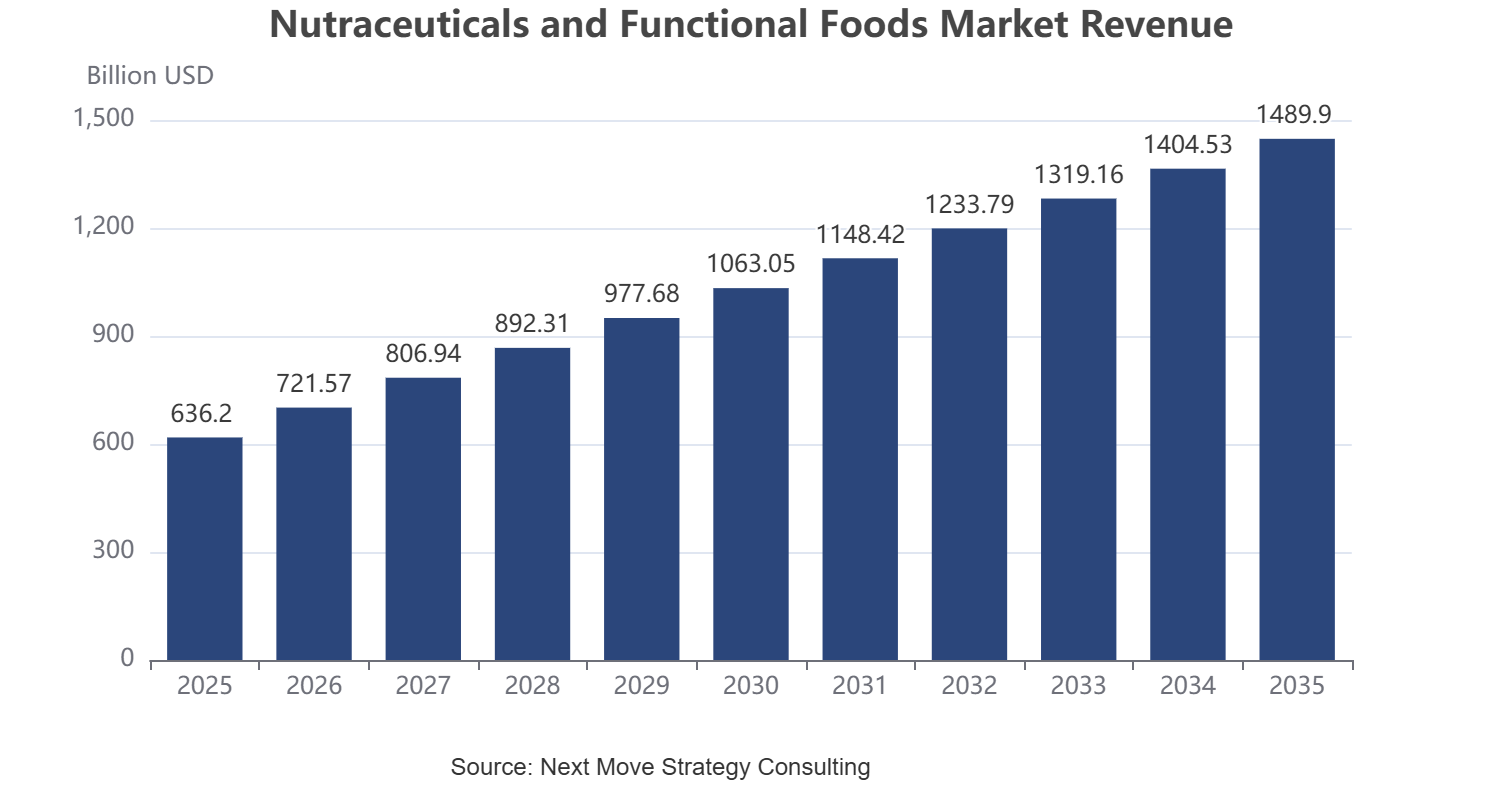
The global Nutraceuticals and Functional Foods Market size was valued at USD 636.2 billion in 2025 and is estimated at USD 683.8 billion in 2026, forecast to reach USD 1,489.9 billion by 2035, expanding at a 9.0% CAGR between 2026 and 2035. Asia-Pacific leads with approximately 37% share, while Dietary Supplements dominates all product categories with approximately 29% share.
We observed that growth is broad-based across every segmentation axis, with online and e-commerce distribution and functional beverages driving the sharpest structural shifts through 2035.
|
Key Takeaways |
|
By Product Category: Dietary Supplements held the largest share of approximately 29% (USD 184.50 billion) in 2025; Functional Beverages is the fastest-growing sub-segment at 11.3% CAGR from 2026–2035. |
|
By Distribution Channel: Mass Retail and Supermarkets held the largest share of approximately 34% (USD 216.31 billion) in 2025; Online and E-commerce is the fastest-growing sub-segment at 14.0% CAGR from 2026–2035. |
|
By Consumer Life Stage: Adult held the largest share of approximately 56% (USD 356.27 billion) in 2025; Senior is the fastest-growing sub-segment at 10.4% CAGR from 2026–2035. |
|
By Need State: General Wellness held the largest share of approximately 22% (USD 139.96 billion) in 2025; Cognitive Health is the fastest-growing sub-segment at 12.8% CAGR from 2026–2035. |
|
By Delivery Form: Tablet held the largest share of approximately 21% (USD 133.60 billion) in 2025; Ready to Drink is the fastest-growing sub-segment at 13.5% CAGR from 2026–2035. |
|
Dominant Region: Asia-Pacific dominated with approximately 37% revenue share (USD 235.39 billion) in 2025. |
|
Fastest-Growing Region: Middle East & Africa is expected to register the highest CAGR of 10.4% during 2026–2035. |
|
Dominant Country: China led with approximately USD 89.45 billion in 2025. |
|
Fastest-Growing Country: India is the fastest-growing country at approximately 13.2% CAGR from 2026–2035. |
Market Opportunity: The nutraceuticals and functional foods market is expected to create an absolute dollar opportunity of USD 806.1 billion between 2026 and 2035, presenting significant investment potential across functional beverage innovation, e-commerce distribution infrastructure, and senior-focused nutrition portfolios.
According to Next Move Strategy Consulting analysis, multinational food, beverage, and consumer health companies are increasingly divesting or acquiring supplement and functional nutrition brands to sharpen portfolio focus, a shift that favors pure-play nutrition specialists able to move quickly on formulation and channel innovation over diversified conglomerates managing broader consumer portfolios through 2035.
|
Field |
Details |
|
Market Size in 2025 |
USD 636.2 Billion |
|
Market Size in 2026 |
USD 683.8 Billion |
|
Revenue Forecast in 2035 |
USD 1,489.9 Billion |
|
Growth Rate |
CAGR of 9.0% from 2026 to 2035 |
|
Analysis Period |
2025–2035 |
|
Base Year Considered |
2025 |
|
Forecast Period |
2026–2035 |
|
Market Size Estimation |
USD Billion |
|
Companies Profiled |
20 |
|
Countries Covered |
33 |
|
Market Share |
Available for Top 10 Companies |
What Does the Nutraceuticals and Functional Foods Market Encompass?
The nutraceuticals and functional foods market encompasses dietary supplements, functional foods, functional beverages, infant and early life nutrition, and medical nutrition products formulated to deliver health benefits beyond basic nutrition. Our assessment indicates that the scope spans vitamins, minerals, botanicals, proteins, and microbiome supplements alongside fortified foods, sports and energy beverages, infant formula, and clinical nutrition products distributed through pharmacy, mass retail, specialty, and online channels. This category sits alongside the broader Health and Wellness Foods market while remaining distinct in its clinically and functionally validated ingredient formulations.
The category has evolved from single-nutrient vitamin and mineral supplementation into a diversified ecosystem spanning microbiome science, condition-specific formulations, and functional beverages. We observed that Nestlé formed a strategic innovation collaboration with biotechnology company Helaina in mid-2026 to advance early-life nutrition research combining gut microbiome and immune system science, while the company separately explored divesting select vitamin, mineral, and supplement brands acquired through its 2021 Bountiful Company transaction. Next Move Strategy Consulting's analysis indicates that this portfolio rationalization, combined with rising consumer demand for condition-specific formulations, is redefining brand strategy across the market.
Regulatory environments vary meaningfully by product category and geography across the industry. Dietary supplements, functional foods, and medical nutrition products face distinct labeling, health claim, and safety requirements under national food and drug authorities, while infant formula remains subject to the most stringent compositional and safety standards globally. We observed that technology adoption is shifting toward single-serve, occasion-specific functional formats, as Suntory Beverage & Food's 2026 launch of drinkable supplement beverages under its Wellness brand illustrates how manufacturers are converting solid supplement formulations into beverage formats to broaden consumption occasions.
Key Emerging Trends
Based on research conducted by Next Move Strategy Consulting, we found that four structural trends are reshaping product formulation, distribution, and portfolio strategy across the industry.
How Is Microbiome Science Reshaping Product Innovation?
Manufacturers are increasingly formulating products around gut microbiome and immune system interactions rather than single-nutrient supplementation alone. We observed that Nestlé's mid-2026 strategic innovation collaboration with biotechnology company Helaina combines Nestlé's early-life nutrition expertise with Helaina's human-identical lactoferrin technology to advance microbiome and immune system research. This trend connects directly to the broader growth of the Personalized Nutrition category, as brands move toward condition-specific and life-stage-specific microbiome formulations.
Why Are Solid Supplements Converting to Beverage Formats?
Manufacturers are converting tablet and capsule supplement formulations into ready-to-drink beverage formats to broaden consumption occasions and appeal to consumers seeking convenient, on-the-go options. Suntory Beverage & Food launched its first drinkable supplement beverages in 2026, carrying the nutrients from its Locomoa and Sesamin flagship supplements into a new beverage series. Our findings suggest that this format conversion, closely tied to the broader Sports Nutrition category's growth, is compressing the distinction between traditional supplement and functional beverage product categories.
How Is Portfolio Rationalization Reshaping Competitive Strategy?
Diversified consumer health and food companies are reassessing supplement and functional nutrition portfolios acquired during the prior decade's acquisition wave. We observed that Nestlé disclosed in mid-2025 that it was weighing the sale of select vitamin, mineral, and supplement brands originally acquired through its USD 5.75 billion Bountiful Company transaction. Our analysis shows that this rationalization trend is creating acquisition opportunities for pure-play nutrition specialists and private equity acquirers seeking focused, high-growth supplement brands.
Why Is Functional Beverage Innovation Accelerating Across Formats?
Functional beverage innovation is expanding rapidly across probiotic sodas, adaptogenic drinks, and targeted functional waters as brands compete for share in a fast-growing category. We found that Suntory's Tokusui functional water, positioned around rice bran-derived HMPA for visceral fat reduction, exemplifies the trend toward increasingly specific, clinically framed functional beverage claims. This trend is elevating functional beverages from a niche category into a mainstream growth driver across the market.
Pestel Analysis Of The Nutraceuticals And Functional Foods Market
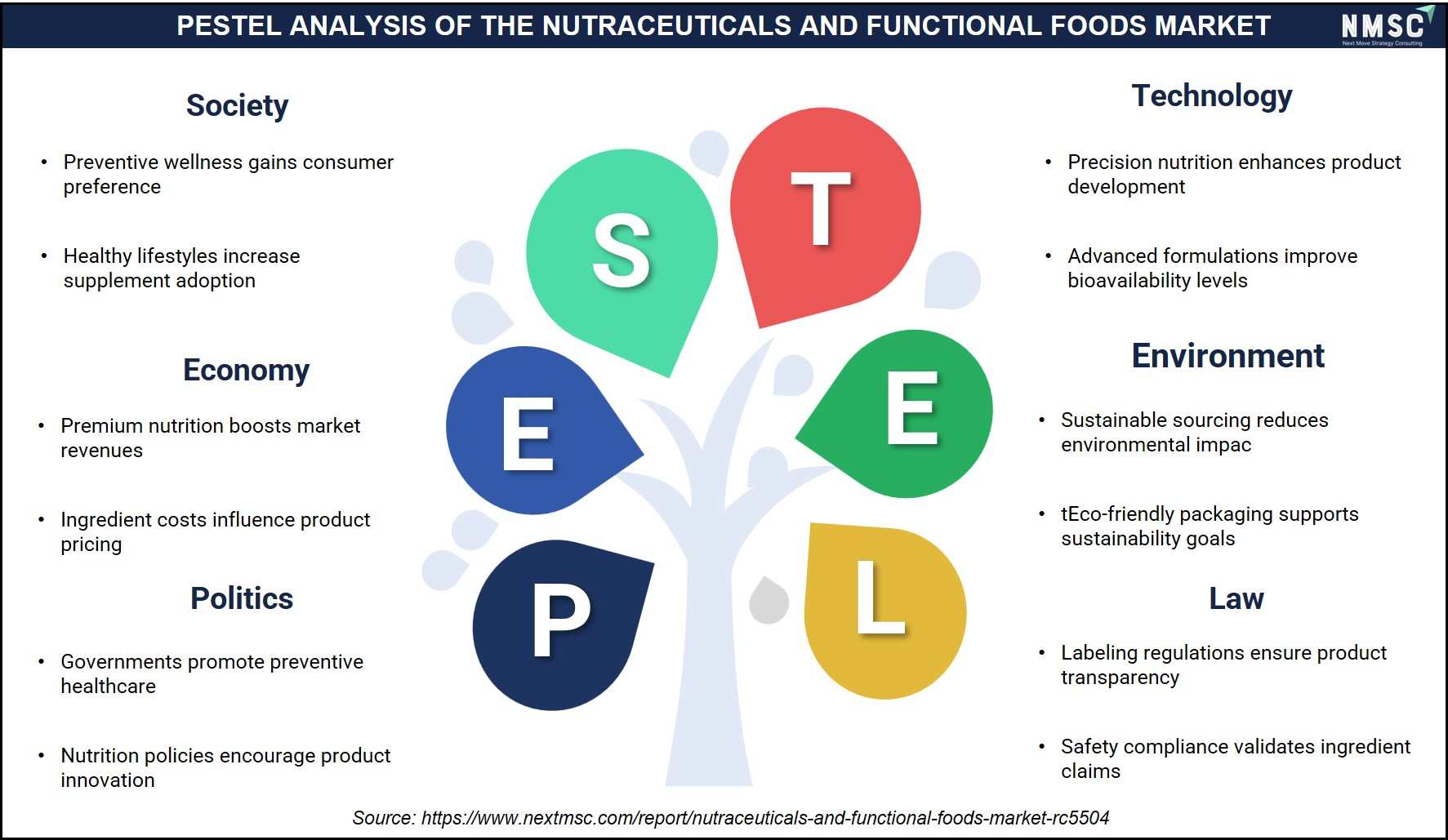
This infographic illustrates a PESTEL analysis of the nutraceuticals and functional foods market by Next Move Strategy Consulting. It highlights key industry drivers across six dimensions. Political and legal factors emphasize government-backed preventive healthcare, stringent labeling regulations, and safety compliance. Economically, premium nutrition drives revenues despite fluctuating ingredient costs. Socially, the shift toward preventive wellness and healthy lifestyles accelerates adoption. Technological advancements focus on precision nutrition and improved bioavailability, while environmental initiatives prioritize sustainable sourcing and eco-friendly packaging to minimize ecological impact.
Growth Drivers and Restraints
Growth Catalyst and Risk Assessment Matrix
|
Factors |
Type |
(+/-) % Impact on CAGR |
Geographic Relevance |
Impact Timeline |
|
Rising consumer demand for condition-specific formulations |
Driver |
+2.0% |
Global |
2026–2035 |
|
Expansion of online and e-commerce distribution channels |
Driver |
+1.7% |
Global |
2026–2032 |
|
Growth of functional beverage innovation across formats |
Driver |
+1.4% |
North America, Asia-Pacific |
2026–2035 |
|
Aging population driving senior-focused nutrition demand |
Driver |
+1.2% |
North America, Europe, Asia-Pacific |
2026–2035 |
|
Microbiome and gut health science adoption in product design |
Driver |
+0.9% |
Global |
2026–2032 |
|
Portfolio rationalization creating acquisition-driven brand growth |
Driver |
+0.6% |
North America, Europe |
2027–2032 |
|
Divergent regulatory and health claim requirements across markets |
Restraint |
-0.8% |
Global |
2026–2032 |
|
Input cost volatility for specialty ingredients and proteins |
Restraint |
-0.5% |
Global |
2026–2029 |
|
Consumer skepticism toward unsubstantiated health claims |
Restraint |
-0.4% |
North America, Europe |
2026–2030 |
What Is the Primary Growth Driver of the Nutraceuticals and Functional Foods Market?
Rising consumer demand for condition-specific formulations is the primary driver of the market. BellRing Brands reported net sales of USD 598.7 million for the three months ended March 31, 2026, up from USD 588.0 million in the prior-year period, reflecting sustained demand for its Premier Protein and Dymatize condition-specific protein brands. We observed that this demand pattern, combined with the Functional Beverages segment's 11.3% CAGR, continues to anchor product innovation investment across the industry.
How Is E-Commerce Expansion Driving Market Growth?
Expansion of online and e-commerce distribution channels is accelerating direct-to-consumer access to nutraceuticals and functional foods brands. Our assessment indicates that online and e-commerce distribution is growing at a 14.0% CAGR from 2026 to 2035, the fastest of any distribution channel, as brands increasingly launch subscription and personalized nutrition offerings that depend on direct digital relationships with consumers. We found that this channel shift is compressing traditional retail brands' time-to-market for new product introductions.
What Is Restraining Nutraceuticals and Functional Foods Market Expansion?
Divergent regulatory and health claim requirements across markets restrain the pace at which manufacturers can launch products globally. Products must satisfy distinct national food, drug, and health claim frameworks that vary significantly between dietary supplements, functional foods, and medical nutrition categories, requiring separate formulation, labeling, and clinical substantiation strategies for each market. We found that this regulatory fragmentation, alongside input cost volatility for specialty proteins and botanicals, particularly affects smaller brands without dedicated regulatory affairs capability.
Segmentation Analysis
Segment Sizing: By Product Category
|
Segment |
2025 (USD) |
2035 (USD) |
CAGR% (2026–2035) |
|
Dietary Supplements |
USD 184.50 Billion |
USD 461.87 Billion |
9.6% |
|
Functional Foods |
USD 139.96 Billion |
USD 283.08 Billion |
7.3% |
|
Functional Beverages |
USD 127.24 Billion |
USD 372.48 Billion |
11.3% |
|
Infant and Early Life Nutrition |
USD 108.15 Billion |
USD 193.69 Billion |
6.0% |
|
Medical Nutrition |
USD 76.35 Billion |
USD 178.78 Billion |
8.9% |
|
Total |
USD 636.20 Billion |
USD 1,489.90 Billion |
9.0% |
Which Product Category Dominates the Nutraceuticals and Functional Foods Market?
Dietary Supplements led the market with USD 184.50 billion in 2025, reflecting the category's broad consumer base spanning vitamins, minerals, botanicals, and specialty formulations across all distribution channels. We observed that Functional Beverages is the fastest-growing product category, expanding at an 11.3% CAGR from 2026 to 2035, as manufacturers convert traditional supplement formulations into ready-to-drink formats and launch increasingly specific, clinically framed functional beverage claims to capture younger, convenience-focused consumers.
Segment Sizing: By Distribution Channel
|
Segment |
2025 (USD) |
2035 (USD) |
CAGR% (2026–2035) |
|
Direct Selling |
USD 57.26 Billion |
USD 89.39 Billion |
4.6% |
|
Pharmacy and Drug Stores |
USD 101.79 Billion |
USD 193.69 Billion |
6.6% |
|
Mass Retail and Supermarkets |
USD 216.31 Billion |
USD 432.07 Billion |
7.2% |
|
Specialty Retail |
USD 69.98 Billion |
USD 148.99 Billion |
7.9% |
|
Online and E-commerce |
USD 120.88 Billion |
USD 446.97 Billion |
14.0% |
|
Institutional and Hospital |
USD 38.17 Billion |
USD 104.29 Billion |
10.6% |
|
Foodservice |
USD 19.09 Billion |
USD 44.70 Billion |
8.9% |
|
Other Channels |
USD 12.72 Billion |
USD 29.80 Billion |
8.9% |
|
Total |
USD 636.20 Billion |
USD 1,489.90 Billion |
9.0% |
Which Distribution Channel Is Growing Fastest in the Nutraceuticals and Functional Foods Market?
Mass Retail and Supermarkets remained the leading distribution channel, valued at USD 216.31 billion in 2025, reflecting the category's broad accessibility through established grocery and retail infrastructure worldwide. Based on research conducted by Next Move Strategy Consulting, we found that Online and E-commerce is the fastest-growing channel, expanding at a 14.0% CAGR from 2026 to 2035, as subscription-based and personalized nutrition brands increasingly rely on direct digital relationships with consumers rather than traditional retail shelf space.
Segment Sizing: By Consumer Life Stage
|
Segment |
2025 (USD) |
2035 (USD) |
CAGR% (2026–2035) |
|
Infant |
USD 76.34 Billion |
USD 148.99 Billion |
6.9% |
|
Child |
USD 57.26 Billion |
USD 134.09 Billion |
8.9% |
|
Adult |
USD 356.27 Billion |
USD 819.45 Billion |
8.7% |
|
Senior |
USD 127.24 Billion |
USD 342.68 Billion |
10.4% |
|
Other Life Stage |
USD 19.09 Billion |
USD 44.69 Billion |
8.9% |
|
Total |
USD 636.20 Billion |
USD 1,489.90 Billion |
9.0% |
Which Consumer Life Stage Leads Nutraceuticals and Functional Foods Market Demand?
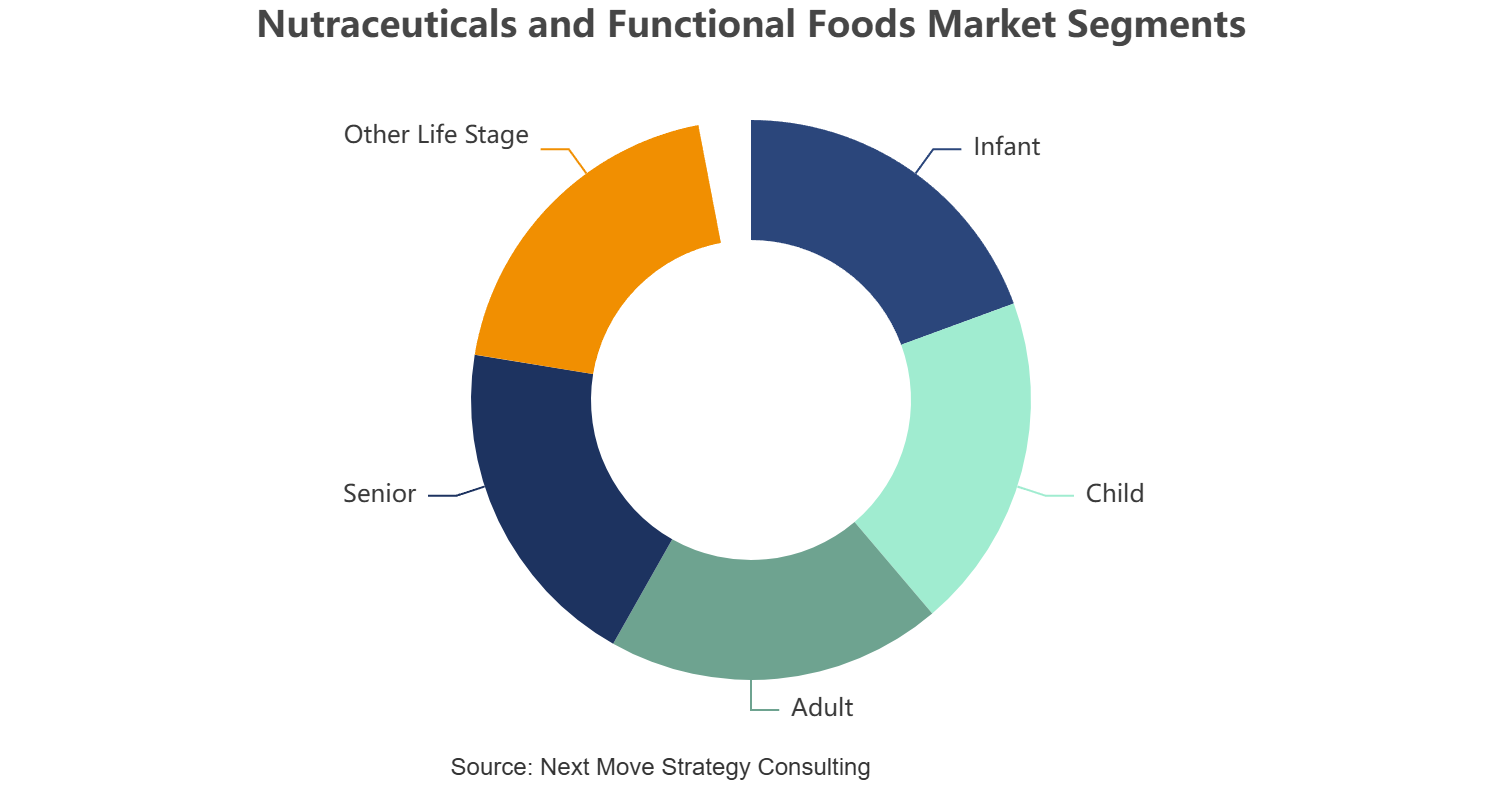
Adult remained the leading consumer life stage, valued at USD 356.27 billion in 2025, reflecting the broadest addressable population across dietary supplements, functional foods, and functional beverages. Our findings suggest that Senior is the fastest-growing life stage, expanding at a 10.4% CAGR from 2026 to 2035, as aging populations across North America, Europe, and Asia-Pacific drive demand for bone and joint health, cognitive health, and heart health formulations, a pattern closely tied to the broader Wellness Supplements category's expansion among older consumers.
Growth Opportunities
Our analysis shows that three forward-looking opportunities stand out for stakeholders positioning within the market over the 2026–2035 forecast period.
How Can Senior-Focused Formulations Unlock Value for Brands?
Senior-focused cognitive, bone, and heart health formulations present a whitespace opportunity as aging populations across major markets scale nutrition spending. Brands that develop clinically substantiated, age-specific formulations stand to capture recurring purchase behavior as the Senior consumer life stage segment expands at a 10.4% CAGR, outpacing every other life stage through 2035.
Where Does Functional Beverage Format Conversion Create New Demand?
Converting solid supplement formulations into ready-to-drink beverage formats represents an underpenetrated opportunity as convenience-focused consumers seek alternatives to tablets and capsules. Brands that successfully translate clinically established supplement ingredients into beverage formats can capture incremental consumption occasions, benefiting from the Functional Beverages category's 11.3% CAGR, the fastest of any product category through 2035.
How Can Direct-to-Consumer Platforms Benefit Personalized Nutrition Brands?
Direct-to-consumer digital platforms create an opportunity for brands offering personalized, subscription-based nutrition programs. Early movers that combine formulation flexibility with direct digital distribution can differentiate with consumers seeking tailored Personalized Nutrition regimens, benefiting from the Online and E-commerce channel's 14.0% CAGR, the fastest-growing distribution channel through 2035.
Price Point Analysis Of The Nutraceuticals And Functional Foods Market
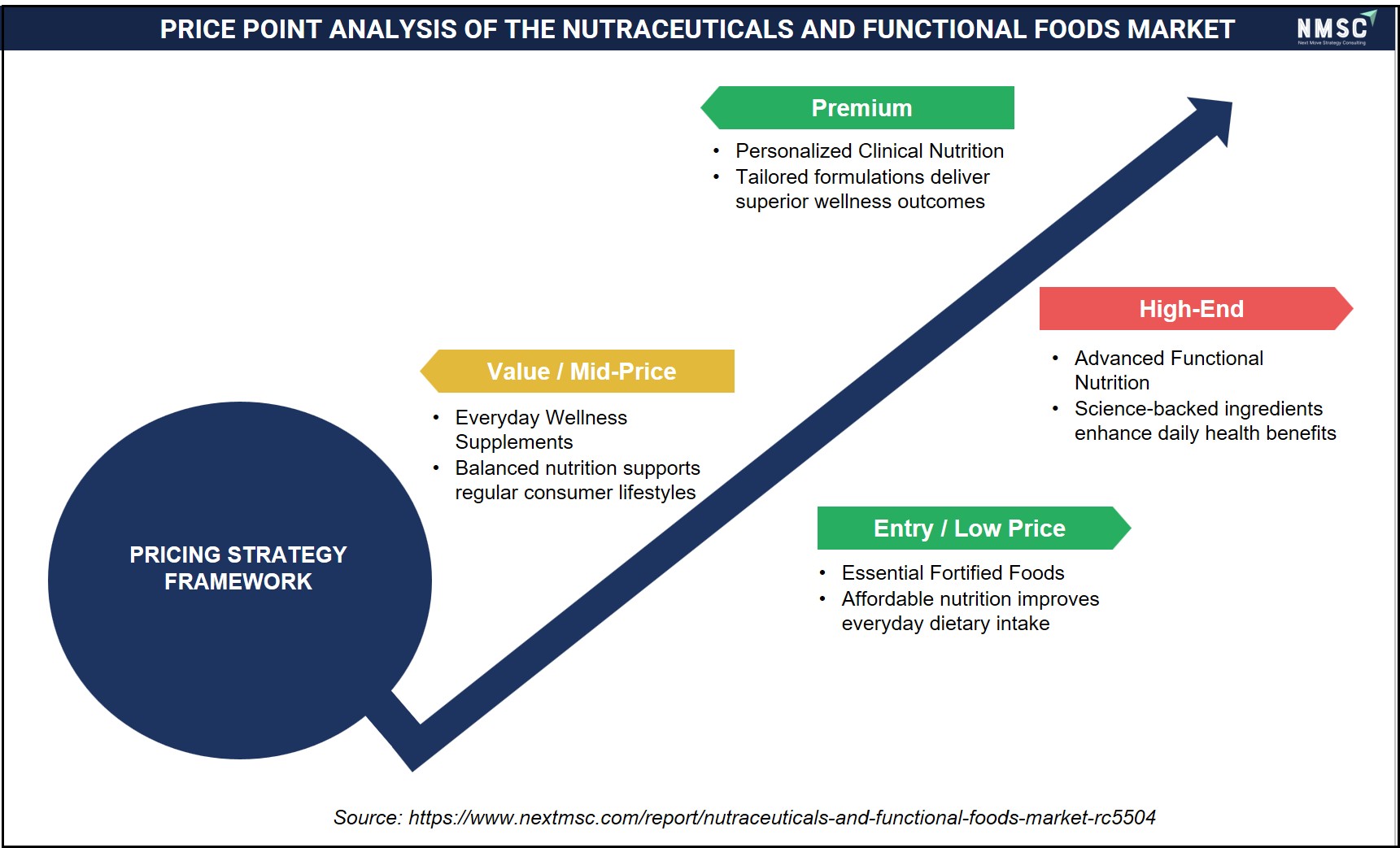
This infographic illustrates a PESTEL analysis of the nutraceuticals and functional foods market by Next Move Strategy Consulting. It highlights key industry drivers across six dimensions. Political and legal factors emphasize government-backed preventive healthcare, stringent labeling regulations, and safety compliance. Economically, premium nutrition drives revenues despite fluctuating ingredient costs. Socially, the shift toward preventive wellness and healthy lifestyles accelerates adoption. Technological advancements focus on precision nutrition and improved bioavailability, while environmental initiatives prioritize sustainable sourcing and eco-friendly packaging to minimize ecological impact.
Regional Outlook
Geographic Performance Snapshot
|
Region |
2025 (USD) |
2035 (USD) |
CAGR% (2026–2035) |
Key Driver |
|
North America |
USD 178.14 Billion |
USD 372.48 Billion |
7.7% |
Mature supplement and functional beverage retail infrastructure |
|
Europe |
USD 139.96 Billion |
USD 283.08 Billion |
7.3% |
Established regulatory frameworks and clean-label consumer demand |
|
Asia-Pacific |
USD 235.39 Billion |
USD 625.76 Billion |
10.3% |
Large consumer base and expanding functional beverage innovation |
|
Middle East & Africa |
USD 44.53 Billion |
USD 119.19 Billion |
10.4% |
Rising disposable income and expanding modern retail infrastructure |
|
Latin America |
USD 38.18 Billion |
USD 89.39 Billion |
8.9% |
Growing middle-class wellness spending and e-commerce adoption |
|
Total |
USD 636.20 Billion |
USD 1,489.90 Billion |
9.0% |
-- |
North America Nutraceuticals and Functional Foods Market Outlook
North America's market benefits from the most mature supplement and functional beverage retail infrastructure globally, anchored by established mass retail, pharmacy, and e-commerce channels. We observed that BellRing Brands' continued net sales growth in its Premier Protein and Dymatize brands through fiscal year 2026 reflects sustained regional demand for condition-specific protein nutrition. Technology adoption remains concentrated among direct-to-consumer and subscription brands, while strategic outlook favors companies that can demonstrate clinical substantiation for condition-specific claims.
Europe Nutraceuticals and Functional Foods Market Outlook
Europe's market benefits from established regulatory frameworks and strong clean-label consumer demand across the region's largest economies. Our assessment indicates that regulatory clarity around health claims is reinforcing consumer trust in condition-specific formulations among UK, German, and French buyers. Strategic outlook favors brands offering strong regulatory affairs capability alongside clean-label, minimally processed formulations for European consumers increasingly skeptical of synthetic ingredients.
Asia-Pacific Nutraceuticals and Functional Foods Market Outlook
Asia-Pacific is the largest and among the fastest-growing regions in the nutraceuticals and functional foods market, propelled by a large consumer base and expanding functional beverage innovation across China, Japan, and India. We found that Japanese functional beverage leaders including Suntory and Otsuka continue to anchor category innovation from the region, launching increasingly targeted, clinically framed formulations. Technology adoption is accelerating fastest among functional beverage and e-commerce channels, with strategic outlook favoring brands that localize formulations to regional health priorities.
Middle East & Africa Nutraceuticals and Functional Foods Market Outlook
The Middle East and Africa nutraceuticals and functional foods market is the fastest-growing region, expanding on rising disposable income and expanding modern retail infrastructure across the Gulf states and broader Africa. Our findings suggest that growing health awareness and expanding pharmacy and mass retail networks are creating first-generation demand for dietary supplements and functional foods among urban consumers. Regulatory influence remains developing, with strategic outlook favoring brands partnering with regional distributors to build category awareness from a low penetration base.
Latin America Nutraceuticals and Functional Foods Market Outlook
Latin America's nutraceuticals and functional foods market is growing alongside expanding middle-class wellness spending and rising e-commerce adoption across Brazil and Argentina. We observed that regional consumers are increasingly adopting functional beverages and protein-fortified products as wellness spending expands beyond traditional dietary supplements. Technology adoption remains concentrated in mass retail and pharmacy channels given still-developing e-commerce logistics infrastructure, with strategic outlook favoring brands offering flexible pricing suited to the region's price-sensitive mid-market consumers.
United States Nutraceuticals and Functional Foods Market Outlook
Based on our estimates, the United States nutraceuticals and functional foods market was valued at approximately USD 127.24 billion in 2025 and is projected to reach USD 264.66 billion by 2035, expanding at a 7.6% CAGR. Demand structure is concentrated among adult and senior consumers purchasing condition-specific supplements and functional beverages through mass retail, pharmacy, and e-commerce channels. Competitive intensity is elevated, with the U.S. hosting a majority of the market's leading protein nutrition and functional beverage brands.
Canada Nutraceuticals and Functional Foods Market Outlook
The market in Canada was valued at approximately USD 26.72 billion in 2025 and is projected to reach USD 55.87 billion by 2035, expanding at a 7.6% CAGR. Demand structure mirrors the broader North American pattern, with adoption concentrated among adult consumers purchasing dietary supplements and functional foods. Regulatory influence remains closely aligned with U.S. frameworks, and strategic outlook favors brands extending U.S. distribution relationships into Canadian retail and e-commerce channels.
United Kingdom Nutraceuticals and Functional Foods Market Outlook
As per our estimate, the United Kingdom nutraceuticals and functional foods market was valued at approximately USD 30.79 billion in 2025 and is projected to reach USD 62.28 billion by 2035, expanding at a 7.3% CAGR. Demand structure is led by adult consumers pursuing clean-label dietary supplements and functional foods. Technology penetration remains strong given the UK's mature health and wellness retail sector, and strategic outlook favors vendors with established local regulatory and distribution support.
Germany Nutraceuticals and Functional Foods Market Outlook
According to our analysis, the German nutraceuticals and functional foods market was valued at approximately USD 25.19 billion in 2025 and is projected to reach USD 50.95 billion by 2035, expanding at a 7.3% CAGR. Demand structure is concentrated among adult and senior consumers pursuing pharmacy-distributed dietary supplements. Regulatory influence from German and EU health claim requirements shapes vendor selection, and strategic outlook favors brands with established pharmacy channel relationships.
France Nutraceuticals and Functional Foods Market Outlook
Based on our estimates, the French nutraceuticals and functional foods market was valued at approximately USD 17.75 billion in 2025 and is projected to reach USD 35.90 billion by 2035, expanding at a 7.3% CAGR. Demand structure spans adult consumers navigating national health claim regulations for functional foods and supplements. Technology adoption is growing steadily among specialty retail buyers, and strategic outlook favors vendors partnering with regional pharmacy and specialty distribution networks.
China Nutraceuticals and Functional Foods Market Outlook
The market in China was valued at approximately USD 89.45 billion in 2025 and is projected to reach USD 231.53 billion by 2035, expanding at a 10.0% CAGR. Demand structure is dominated by adult and senior consumers purchasing dietary supplements and functional beverages through both traditional retail and rapidly expanding e-commerce channels. Competitive intensity features strong domestic brand competition alongside multinational players, and strategic outlook favors vendors capable of navigating China's distinct health claim regulatory environment.
India Nutraceuticals and Functional Foods Market Outlook
As per our estimate, the Indian nutraceuticals and functional foods market was valued at approximately USD 30.60 billion in 2025 and is projected to reach USD 105.19 billion by 2035, the fastest-growing country in this report at a 13.2% CAGR. Demand structure is led by adult consumers as rising health awareness and disposable income drive first-time dietary supplement and functional food adoption. Technology adoption is accelerating rapidly as e-commerce platforms expand access beyond traditional pharmacy and retail channels.
Japan Nutraceuticals and Functional Foods Market Outlook
According to our analysis, the Japanese nutraceuticals and functional foods market was valued at approximately USD 42.37 billion in 2025 and is projected to reach USD 87.32 billion by 2035, expanding at a 7.5% CAGR. Demand structure is concentrated among senior consumers purchasing functional beverages and specialty supplements from category leaders including Suntory and Otsuka. Regulatory influence remains well-established given Japan's Foods for Specified Health Uses framework, and strategic outlook favors brands with clinically validated health claims.
South Korea Nutraceuticals and Functional Foods Market Outlook
Based on our estimates, the South Korean nutraceuticals and functional foods market was valued at approximately USD 21.19 billion in 2025 and is projected to reach USD 48.76 billion by 2035, expanding at an 8.7% CAGR. Demand structure is led by adult consumers scaling beauty and skin health, immunity, and cognitive health supplement purchases. Competitive intensity is rising as domestic beauty-nutrition brands expand alongside multinational players, and strategic outlook favors vendors supporting both dietary supplement and functional beverage categories.
Australia Nutraceuticals and Functional Foods Market Outlook
The market in Australia was valued at approximately USD 14.12 billion in 2025 and is projected to reach USD 29.20 billion by 2035, expanding at a 7.5% CAGR. Demand structure spans adult and senior consumers with mature dietary supplement purchasing habits across pharmacy and mass retail channels. Technology penetration is high relative to other Asia-Pacific markets, and strategic outlook favors vendors with established local distribution and regulatory compliance support.
UAE Nutraceuticals and Functional Foods Market Outlook
As per our estimate, the UAE nutraceuticals and functional foods market was valued at approximately USD 13.36 billion in 2025 and is projected to reach USD 35.76 billion by 2035, expanding at a 10.3% CAGR. Demand structure is concentrated among adult consumers driving rising wellness spending across the region's expanding modern retail sector. Competitive intensity is rising as global brands establish regional distribution partnerships, and strategic outlook favors platforms supporting Arabic-language labeling and regional compliance requirements.
Saudi Arabia Nutraceuticals and Functional Foods Market Outlook
According to our analysis, the Saudi Arabian nutraceuticals and functional foods market was valued at approximately USD 11.58 billion in 2025 and is projected to reach USD 32.19 billion by 2035, expanding at an 10.8% CAGR. Demand structure is driven by Vision 2030-linked wellness initiatives across government and private health sectors. Technology adoption is accelerating as modern retail and e-commerce infrastructure expands, and strategic outlook favors vendors partnering with domestic distributors for large-scale retail deployment.
South Africa Nutraceuticals and Functional Foods Market Outlook
Based on our estimates, the South African nutraceuticals and functional foods market was valued at approximately USD 5.79 billion in 2025 and is projected to reach USD 15.49 billion by 2035, expanding at a 10.3% CAGR. Demand structure is led by adult consumers in urban centers serving as the region's wellness adoption leaders. Regulatory influence remains developing, and strategic outlook favors vendors extending European distribution relationships to support South African retail partners.
Brazil Nutraceuticals and Functional Foods Market Outlook
The market in Brazil was valued at approximately USD 17.65 billion in 2025 and is projected to reach USD 40.32 billion by 2035, expanding at a 8.6% CAGR. Demand structure is concentrated among adult consumers scaling functional beverage and protein-fortified product purchases. Technology penetration continues to rise as domestic e-commerce infrastructure expands, and strategic outlook favors vendors offering Portuguese-language support and flexible pricing suited to mid-market consumers.
Argentina Nutraceuticals and Functional Foods Market Outlook
As per our estimate, the Argentine nutraceuticals and functional foods market was valued at approximately USD 7.25 billion in 2025 and is projected to reach USD 15.63 billion by 2035, expanding at a 8.0% CAGR. Demand structure spans adult consumers adopting dietary supplements and functional foods amid a gradually recovering consumer spending environment. Competitive intensity remains modest relative to Brazil, and strategic outlook favors vendors entering through regional distributor partnerships and multi-country Latin American sales motions.
Competitive Landscape
We observed that the nutraceuticals and functional foods market features a diverse competitive landscape, with diversified multinational food and beverage companies, consumer health specialists, and pure-play nutrition brands competing across distinct product categories.
|
Key Takeaways |
|
Market Structure: Fragmented across product categories; the top companies profiled in this report collectively account for a significant share of global nutraceuticals and functional foods revenue, while numerous regional and category-specific brands serve local consumer preferences. |
|
Innovation Focus: Microbiome science, condition-specific formulations, and beverage format conversion of traditional supplement ingredients dominate current innovation pipelines across leading vendors. |
|
M&A Activity: Active portfolio rationalization, exemplified by Nestlé's evaluation of select vitamin, mineral, and supplement brand divestitures, alongside continued strategic collaborations such as Nestlé's 2026 partnership with Helaina. |
How Do Companies Compete in the Nutraceuticals and Functional Foods Market?
Companies compete primarily on clinical substantiation, brand trust, and channel breadth across the industry. Diversified multinationals including Nestlé, Danone, and Abbott Laboratories leverage broad research and development infrastructure to serve multiple product categories and life stages, while pure-play brands such as BellRing Brands compete on focused, condition-specific innovation and direct consumer relationships within protein and functional nutrition categories.
Which Competitive Archetypes Dominate the Nutraceuticals and Functional Foods Market?
Two archetypes dominate the market: diversified multinational food, beverage, and consumer health companies offering broad nutrition portfolios, and focused pure-play brands specializing in a single product category or need state. Nestlé, Abbott Laboratories, and Danone exemplify the diversified archetype through multi-category research and manufacturing infrastructure, while BellRing Brands and Herbalife exemplify the focused archetype serving specific protein nutrition and direct-selling wellness segments.
How Are Companies Differentiating Through Innovation in Nutraceuticals and Functional Foods?
Innovation and differentiation strategy increasingly center on microbiome science and beverage format conversion. Nestlé's 2026 collaboration with Helaina and Suntory's drinkable supplement beverage launch both illustrate how leading brands are moving beyond traditional formulation approaches to capture emerging consumer preferences. Our analysis shows that vendors unable to demonstrate credible clinical substantiation and format innovation risk losing shelf and digital visibility as condition-specific claims become a primary purchasing criterion.
What M&A and Expansion Activity Is Shaping the Nutraceuticals and Functional Foods Market?
Portfolio rationalization and strategic collaboration continue to reshape the industry more than large-scale consolidation. Nestlé's mid-2025 disclosure that it was weighing divestiture of select vitamin, mineral, and supplement brands from its Bountiful Company acquisition, alongside its 2026 innovation collaboration with Helaina, both reflect a broader industry pattern of sharpening portfolio focus while pursuing targeted science partnerships. Our findings suggest that this activity reflects growing investor and consumer demand for evidence-based, focused nutrition brands over broad, undifferentiated portfolios.
Key Market Players
Our assessment indicates that the following 20 companies are actively shaping product innovation, portfolio strategy, and channel expansion within the global nutraceuticals and functional foods market.
-
Nestlé S.A.
-
Danone S.A.
-
Abbott Laboratories
-
PepsiCo, Inc.
-
Haleon plc
-
Amway Corporation
-
Herbalife Ltd.
-
Otsuka Holdings Co., Ltd.
-
Yakult Honsha Co., Ltd.
-
Unilever PLC
-
Bayer AG
-
General Mills, Inc.
-
Glanbia plc
-
Reckitt plc
-
Suntory Holdings Limited
-
BellRing Brands, Inc.
-
Post Holdings, Inc.
-
Nu Skin Enterprises, Inc.
Latest Developments
We found that recent product launches and strategic collaborations within the nutraceuticals and functional foods market are concentrated on microbiome science and functional beverage innovation, reflecting the industry's broader shift toward evidence-based, format-diverse nutrition.
|
Date |
Event |
|
April 2026 |
Suntory Beverage & Food launched its first drinkable supplement beverage series, carrying the nutrients from its Locomoa and Sesamin flagship supplements into a new ready-to-drink format. |
Expert Insights
 “Plant-based proteins have become mainstream, even beyond the burger…it's more about lifestyle and overall health and wellness. That's bringing on a new era of transformation in food and beverage.”
— Juan Luciano, Chairman and CEO, ADM (Archer Daniels Midland Company)
Statement made during an interview discussing the future of food, changing consumer priorities toward nutrition, and supply chain evolution.
Market Interpretation
This comment highlights the transition of functional foods and plant-based ingredients from niche dietary alternatives into mainstream lifestyle choices. Consumers are increasingly focusing on how their nutrition directly impacts their holistic wellness. As a result, the nutraceuticals market is expanding beyond traditional supplements into everyday functional foods and beverages, driving a massive transformation in food formulation technologies and ingredient innovation to meet demand for preventive health solutions.
Investment Opportunities
What Capital Inflows Are Targeting the Nutraceuticals and Functional Foods Market?
Capital inflows into the nutraceuticals and functional foods market are increasingly directed toward focused, science-backed nutrition brands as diversified companies rationalize broader portfolios. Nestlé's evaluation of select supplement brand divestitures illustrates the scale of portfolio realignment underway among diversified consumer health companies. We observed that investors favor brands demonstrating durable sales growth, consistent with BellRing Brands' continued net sales expansion through fiscal year 2026, viewing this as a proxy for sustained condition-specific demand.
How Is Infrastructure Investment Supporting Nutraceuticals and Functional Foods Market Scaling?
Infrastructure investment is expanding manufacturing and distribution capacity to support growing functional beverage and e-commerce demand. Suntory's expansion into drinkable supplement formats required new beverage manufacturing capability alongside its existing supplement production infrastructure. Our findings suggest that this cross-format infrastructure investment increasingly extends into Collagen and other specialty ingredient supply chains as brands scale condition-specific formulations across both solid and beverage product lines.
What ESG Considerations Are Shaping Nutraceuticals and Functional Foods Investment Decisions?
Environmental, social, and governance considerations are gaining relevance across the industry as ingredient sourcing transparency and packaging sustainability become differentiating criteria. We found that consumers increasingly expect verified sourcing for botanical, marine, and dairy-derived ingredients alongside recyclable packaging commitments, positioning supply chain transparency as both a governance indicator and a competitive differentiator that aligns brand credibility with broader corporate ESG disclosure commitments.
Key Benefits for Stakeholders
How Does This Report Benefit Enterprise and Industry Leaders?
Enterprise and industry leaders gain access to validated segmentation, competitive benchmarking, and regional demand forecasts that support product and portfolio decisions across the nutraceuticals and functional foods industry. Our analysis shows that detailed product category, distribution channel, and life stage breakdowns help brand and innovation leaders align formulation strategy with consumer demand while identifying underserved categories, such as functional beverages, for near-term investment.
How Does This Report Benefit Investors and Financial Analysts?
Investors and financial analysts benefit from consistent, single-point market size and CAGR estimates that support valuation and capital-allocation decisions across the nutraceuticals and functional foods market's brand landscape. We observed that the report's regional and segment-level growth differentials help identify which product categories, including functional beverages and senior-focused nutrition, are best positioned to capture above-market growth through 2035.
How Does This Report Benefit Technology Vendors and Product Teams?
Technology vendors and product teams gain insight into emerging consumer requirements, including microbiome-informed formulation, beverage format conversion, and personalized nutrition delivery, that are reshaping the industry. Our findings suggest that this analysis helps product teams prioritize development roadmaps around condition-specific and life-stage-specific formulations that are increasingly decisive in consumer purchasing decisions.
Key Market Segments
By Product Category
Dietary Supplements
Vitamins
-
Single Vitamins
-
Multivitamins
Minerals
-
Single Minerals
-
Mineral Blends
Botanicals
-
Single Botanicals
-
Botanical Blends
Proteins and Amino Acids
-
Protein Powders and Concentrates
-
Amino Acid Blends
-
Creatine
-
Other Protein and Amino Acid Supplements
Microbiome Supplements
-
Probiotics
-
Prebiotics
-
Synbiotics
-
Other Microbiome Supplements
Lipids and Fatty Acids
-
Omega 3
-
Fish Oil
-
Algal Oil
-
Other Lipid Supplements
Specialty Supplements
-
Joint Health Supplements
-
Heart Health Supplements
-
Cognitive Health Supplements
-
Sleep and Stress Health Supplements
-
Digestive Enzymes and Fiber
-
Eye and Beauty Nutrition
-
Weight Management Supplements
-
Other Specialty Supplements
Meal Replacement Supplements
-
Powder Shakes
-
Ready to Mix Meal Systems
-
Other Meal Replacement Supplements
Functional Foods
Dairy and Cultured Foods
-
Fortified Yogurt
-
Fermented Milk
-
Fortified Milk and Alternatives
-
Other Dairy and Cultured Foods
Bakery and Cereals
-
Breakfast Cereals
-
Bread and Bakery
-
Other Bakery and Cereals
Bars and Snacks
-
Nutrition and Protein Bars
-
Fiber Bars
-
Fortified Savoury Snacks
-
Other Bars and Snacks
Spreads and Oils
-
Margarines and Spreads
-
Fortified Cooking Oils
-
Other Spreads and Oils
Savoury and Meal Aids
-
Soups and Sauces
-
Pasta and Noodles
-
Other Savoury and Meal Aids
Other Functional Foods
-
Fortified Confectionery
-
Other Functional Food Products
Functional Beverages
Sports and Energy Beverages
-
Sports Drinks
-
Energy Drinks
-
Electrolyte Drinks
-
Other Sports and Energy Beverages
Protein Beverages
-
Ready to Drink Protein Beverages
-
Protein Shakes
-
Other Protein Beverages
Microbiome Drinks
-
Kombucha
-
Kefir Drinks
-
Other Probiotic Drinks
Hydration and Fortified Waters
-
Vitamin Water
-
Mineral Water
-
Other Functional Waters
Juices and Smoothies
-
Fortified Juices
-
Functional Smoothies
-
Other Juices and Smoothies
Tea and Coffee
-
Functional Tea
-
Functional Coffee
-
Other Tea and Coffee
Wellness Shots
-
Immunity Shots
-
Energy Shots
-
Other Shots
Other Functional Beverages
Infant and Early Life Nutrition
Infant Formula
-
Standard Infant Formula
-
Specialty Infant Formula
-
Other Infant Formula
Toddler Nutrition
-
Toddler Formula
-
Growing Up Milk
-
Other Toddler Nutrition
Baby Food
-
Baby Meals
-
Baby Snacks
-
Other Baby Food
Other Early Life Nutrition
Medical Nutrition
Oral Nutritional Supplements
-
Standard Oral Nutrition
-
Disease Specific Oral Nutrition
-
Pediatric Oral Nutrition
-
Other Oral Nutrition
Enteral Nutrition
-
Standard Enteral Formula
-
Disease Specific Enteral Formula
-
Pediatric Enteral Formula
-
Other Enteral Nutrition
Disease Specific Nutrition
-
Metabolic and Oncology Nutrition
-
Renal and Diabetes Nutrition
-
Other Disease Specific Nutrition
Other Medical Nutrition
By Distribution Channel
-
Direct Selling
-
Pharmacy and Drug Stores
-
Mass Retail and Supermarkets
-
Specialty Retail
-
Online and E-commerce
-
Institutional and Hospital
-
Foodservice
-
Other Channels
By Consumer Life Stage
-
Infant
-
Child
-
Adult
-
Senior
-
Other Life Stage
By Need State
-
General Wellness
-
Immunity Support
-
Digestive Health
-
Sports Performance
-
Weight Management
-
Bone and Joint Health
-
Heart Health
-
Cognitive Health
-
Sleep and Stress Management
-
Beauty and Skin Health
-
Clinical Support
-
Other Need State
By Delivery Form
-
Tablet
-
Capsule
-
Softgel
-
Powder
-
Sachet
-
Gummy
-
Liquid
-
Ready to Drink
-
Bar
-
Drop
-
Spray
-
Other Form
By Region
-
North America: (U.S., Canada, Mexico)
-
Europe: (UK, Germany, France, Italy, Spain, Sweden, Denmark, Finland, Netherlands, Rest of Europe)
-
Asia-Pacific: (China, India, Japan, South Korea, Taiwan, Indonesia, Vietnam, Australia, Philippines, Malaysia, Rest of APAC)
-
Middle East & Africa: (Saudi Arabia, UAE, Egypt, Israel, Turkey, Nigeria, South Africa, Rest of MEA)
-
Latin America: (Brazil, Argentina, Chile, Colombia, Rest of LATAM)
Conclusion & Recommendations
What Is the Long-Term Outlook for the Nutraceuticals and Functional Foods Market?
The long-term outlook for the nutraceuticals and functional foods market is strongly positive, with the industry forecast to more than double from USD 683.8 billion in 2026 to USD 1,489.9 billion by 2035. Our assessment indicates that this growth will be driven by rising demand for condition-specific formulations and accelerating functional beverage innovation. Brands that scale evidence-based, life-stage-specific portfolios are best positioned to capture the market's long-term trajectory.
What Strategic Positioning Should Vendors Pursue?
Vendors should pursue strategic positioning around clinical substantiation and format innovation rather than broad, undifferentiated portfolios. Next Move Strategy Consulting's analysis indicates that brands combining microbiome-informed formulation, beverage format flexibility, and direct-to-consumer digital distribution will differentiate most clearly as diversified competitors rationalize supplement portfolios. Strategic science partnerships, following Nestlé's collaboration model with Helaina, will further strengthen brand credibility.
How Attractive Is the Nutraceuticals and Functional Foods Market for New Investment?
The nutraceuticals and functional foods industry presents an attractive investment case, supported by a USD 806.1 billion absolute dollar opportunity between 2026 and 2035 and above-average growth in Middle East & Africa and Functional Beverages categories. We found that investment attractiveness is highest for brands combining condition-specific formulation credibility with direct-to-consumer digital distribution, positioning them to serve both established mass retail and fast-growing e-commerce channels simultaneously.
What Market Shifts and Key Risks Should Stakeholders Monitor?
Stakeholders should monitor divergent regulatory and health claim requirements, input cost volatility, and consumer skepticism toward unsubstantiated claims as key risks to the nutraceuticals and functional foods market. Our analysis shows that brands unable to demonstrate clear clinical substantiation risk losing consumer trust and shelf visibility, particularly as regulators across major markets tighten scrutiny of health and wellness marketing claims.
What Are the Key Growth Pathways for the Nutraceuticals and Functional Foods Market?
Key growth pathways include expanding functional beverage portfolios, scaling senior-focused and condition-specific formulations, and deepening direct-to-consumer e-commerce distribution. Next Move Strategy Consulting's analysis indicates that brands pursuing these pathways while maintaining pricing accessibility in core dietary supplement categories will be best positioned to capture the nutraceuticals and functional foods market's projected growth through 2035.
About the Author
 Liza Phukan
— Liza Phukan is Research Associate at Next Move Strategy Consulting, where she has covered emerging industries and market research across sectors for 3.5 years. Her work includes analyzing industry developments, validating market data, and developing structured business content from research findings. She uses secondary research and data-validation practices to turn complex market information into clear decision-useful market analysis for business audiences and support report development and B2B.
Liza Phukan
— Liza Phukan is Research Associate at Next Move Strategy Consulting, where she has covered emerging industries and market research across sectors for 3.5 years. Her work includes analyzing industry developments, validating market data, and developing structured business content from research findings. She uses secondary research and data-validation practices to turn complex market information into clear decision-useful market analysis for business audiences and support report development and B2B.
About the Reviewer
 Supradip Baul
— Supradip Baul is an accomplished business consultant and strategist with over a decade of rich experience in market intelligence, strategy, technology, and business transformation. His work has included rigorous qualitative and quantitative analysis across multiple industries, helping clients shape investment decisions and long-term roadmaps. Earlier in his career, he was associated with Gartner, where he contributed to industry-leading reports and market share analyses. He has worked with leading global companies and holds an MBA with a dual specialization in Marketing and Finance.
Supradip Baul
— Supradip Baul is an accomplished business consultant and strategist with over a decade of rich experience in market intelligence, strategy, technology, and business transformation. His work has included rigorous qualitative and quantitative analysis across multiple industries, helping clients shape investment decisions and long-term roadmaps. Earlier in his career, he was associated with Gartner, where he contributed to industry-leading reports and market share analyses. He has worked with leading global companies and holds an MBA with a dual specialization in Marketing and Finance.
At Next Move Strategy Consulting, we understand that insightful market research is the cornerstone of successful business decisions. That's why we employ a robust and multifaceted approach, combining various methodologies to deliver the most accurate and actionable data for our clients.

Research Landscape
We navigate the world of research with two primary approaches:
Qualitative Approach
Our qualitative research methodologies involve immersive techniques such as in-depth interviews, focus groups, and observational studies. By engaging directly with individuals and stakeholders, we uncover valuable insights that quantitative data alone may overlook.

Quantitative Research
In tandem with qualitative methodologies, NMSC leverages the power of Quantitative Research to provide a robust foundation of numerical insights. Through systematic data collection and analysis, we quantify patterns, preferences, and market trends, offering a comprehensive view of the business landscape.
Our quantitative research approach employs diverse tools, including surveys, experiments, and statistical modelling. These methodologies enable us to gather data from a large and representative sample, ensuring the statistical significance of our findings. By employing structured questionnaires and standardized data collection methods, we guarantee the reliability and validity of the information we present to our clients.
Quantitative research is particularly effective in measuring the prevalence of trends, assessing market size, and gauging the impact of various factors on consumer behavior. The numerical precision attained through this approach equips our clients with actionable insights, facilitating data-driven decision-making and strategy formulation.


Our Specialized Toolbox for Industry-Specific Market Research
We deploy a specialized arsenal of techniques tailored to meet your unique requirements. Here's a glimpse into our comprehensive toolbox:

Information Procurement
The stage entails acquiring market data or relevant information through various sources and methodologies.


Market Research Approach
We utilize both top-down and bottom-up approaches in market research analysis to achieve a comprehensive understanding of the market dynamics, leveraging the broad perspective of industry trends and macroeconomic factors alongside detailed insights from specific segments and individual companies.

Porters Five Forces Analysis
We conduct Porter's Five Forces analysis to evaluate the competitive landscape of an industry, providing us with insights into factors that affect profitability and strategic positioning.

SWOT Analysis

Forecasting
We utilize a forecasting model to predict future consumption by considering parameters like population, economics, regulations, market competition, drivers, constraints, technology, and pricing. We also employ statistical techniques such as multilinear regression, exponential smoothing, moving average, ARIMA, and Monte Carlo simulations for accurate predictions. In econometric forecasting, we analyzed short-term and long-term event impacts, attributing values based on regulatory frameworks, economic factors, and market events.





 Speak to Our Analyst