Carbapenem-Based Antibiotics Market

The Carbapenem-Based Antibiotics Market size was USD 5.85 billion in 2025, and is projected to reach USD 8.85 billion by 2035 at a 4.23% CAGR from 2026 to 2035.

Download Free Sample PDF
Base Year (2025)
$5.9 Billion
Forecast (2035)
$8.9 Billion
CAGR (2026-2035)
4.23% CAGR from 2026 to 2035
Top Region
North America

Market Size & Forecast - Carbapenem-Based Antibiotics Market
Global Revenue Forecast

Values in USD Billion

2025 $5.9 Billion
2025
2026 $6.1 Billion
2026
2027 $6.4 Billion
2027
2028 $6.6 Billion
2028
2029 $6.9 Billion
2029
2030 $7.2 Billion
2030
2031 $7.5 Billion
2031
2032 $7.8 Billion
2032
2033 $8.2 Billion
2033
2034 $8.5 Billion
2034
2035 $8.9 Billion
2035

Market Overview - Carbapenem-Based Antibiotics Market

The global Carbapenem-Based Antibiotics Market size was valued at USD 5.85 Billion in 2025 and is estimated at USD 6.10 Billion in 2026, forecast to reach USD 8.85 Billion by 2035, expanding at a 4.23% CAGR between 2026 and 2035. North America leads with approximately a 36% share, while Meropenem dominates all other product type categories with approximately a 44% share.
We observed that growth remains steady and hospital-demand-driven, with rising carbapenem-resistant Enterobacterales prevalence and the 2026 approval of the first oral carbapenem shaping the dominant structural shifts through 2035 across a mature, largely genericized therapeutic category.

The Carbapenem-Based Antibiotics Market is expected to create an absolute dollar opportunity of USD 2.75 Billion between 2026 and 2035, presenting investment potential across novel beta-lactamase inhibitor combinations, oral carbapenem formulations, and expanded hospital-to-home infusion pathways.

According to NMSC analysis, hospital antimicrobial stewardship committees are increasingly favoring carbapenem-beta-lactamase inhibitor combinations over standalone agents for carbapenem-resistant pathogens, a shift that rewards innovator and branded generic manufacturers with combination portfolios as the 2026 approval of the first oral carbapenem opens new outpatient and step-down care pathways through 2035.

The Carbapenem-Based Antibiotics Market encompasses broad-spectrum beta-lactam antibacterial agents, including meropenem, imipenem, ertapenem, doripenem , biapenem, and tebipenem, used to treat serious Gram-negative bacterial infections in hospitalized and, increasingly, outpatient settings. Our assessment indicates that the scope spans innovator brands, branded generics, and commodity generics across injectable and, following recent regulatory approval, oral dosage forms, serving inpatient wards, intensive care units, and expanding ambulatory infusion and home infusion care settings.
Regulatory frameworks such as the FDA's Qualified Infectious Disease Product designation and the World Health Organization's revised treatment protocols for carbapenem-resistant Enterobacteriaceae continue to shape product development priorities. We observed that technology adoption is shifting toward combination products pairing carbapenems with novel beta-lactamase inhibitors capable of restoring efficacy against resistant pathogens. NMSC's analysis indicates that this structural shift, combined with the 2026 approval of the first oral carbapenem , is redefining care-setting flexibility across the Carbapenem-Based Antibiotics Market.

Key Takeaways

By Product Type: Meropenem held the largest share of approximately 44% (USD 2.5740 billion) in 2025; Tebipenem is the fastest-growing sub-segment at 9.8% CAGR from 2026–2035.

By Dosage Form: Lyophilized Powder for Injection held the largest share of approximately 48% (USD 2.8080 billion) in 2025; Tablet is the fastest-growing sub-segment at approximately 8.9% CAGR from 2026–2035.

By Administration: Intravenous held the largest share of approximately 84% (USD 4.9140 billion) in 2025; Oral is the fastest-growing sub-segment at approximately 9.2% CAGR from 2026–2035.

By Indication: Complicated Intra-Abdominal Infection held the largest share of approximately 21% (USD 1.2285 billion) in 2025; Hospital-Acquired Pneumonia is the fastest-growing sub-segment at approximately 6.1% CAGR from 2026–2035.

By Care Type: Inpatient Ward held the largest share of approximately 34% (USD 1.9890 billion) in 2025; Home Infusion is the fastest-growing sub-segment at approximately 7.5% CAGR from 2026–2035.

By Type: Commodity Generic held the largest share of approximately 47% (USD 2.7495 billion) in 2025; Innovator Brand is the fastest-growing sub-segment at approximately 6.4% CAGR from 2026–2035.

By Distribution Channel: Direct Hospital Procurement held the largest share of approximately 39% (USD 2.2815 billion) in 2025; Ambulatory Infusion Center is the fastest-growing sub-segment at approximately 7.2% CAGR from 2026–2035.

Dominant Region: North America dominated with approximately 36% revenue share (USD 2.1060 billion) in 2025.

Fastest-Growing Region: Asia-Pacific is expected to register the highest CAGR of 6.2% during 2026–2035.

Dominant Country: The U.S. led with approximately USD 1.7745 billion in 2025.

Fastest-Growing Country: India is the fastest-growing country at approximately 7.8% CAGR from 2026–2035.

Ecosystem Analysis of the Carbapenem-Based Antibiotics Market

The Carbapenem-Based Antibiotics Market ecosystem is built on coordinated value chains across technology developers, component manufacturers, software integrators, investors, and end users to scale commercial adoption.

Ecosystem Analysis of the Carbapenem-Based Antibiotics Market

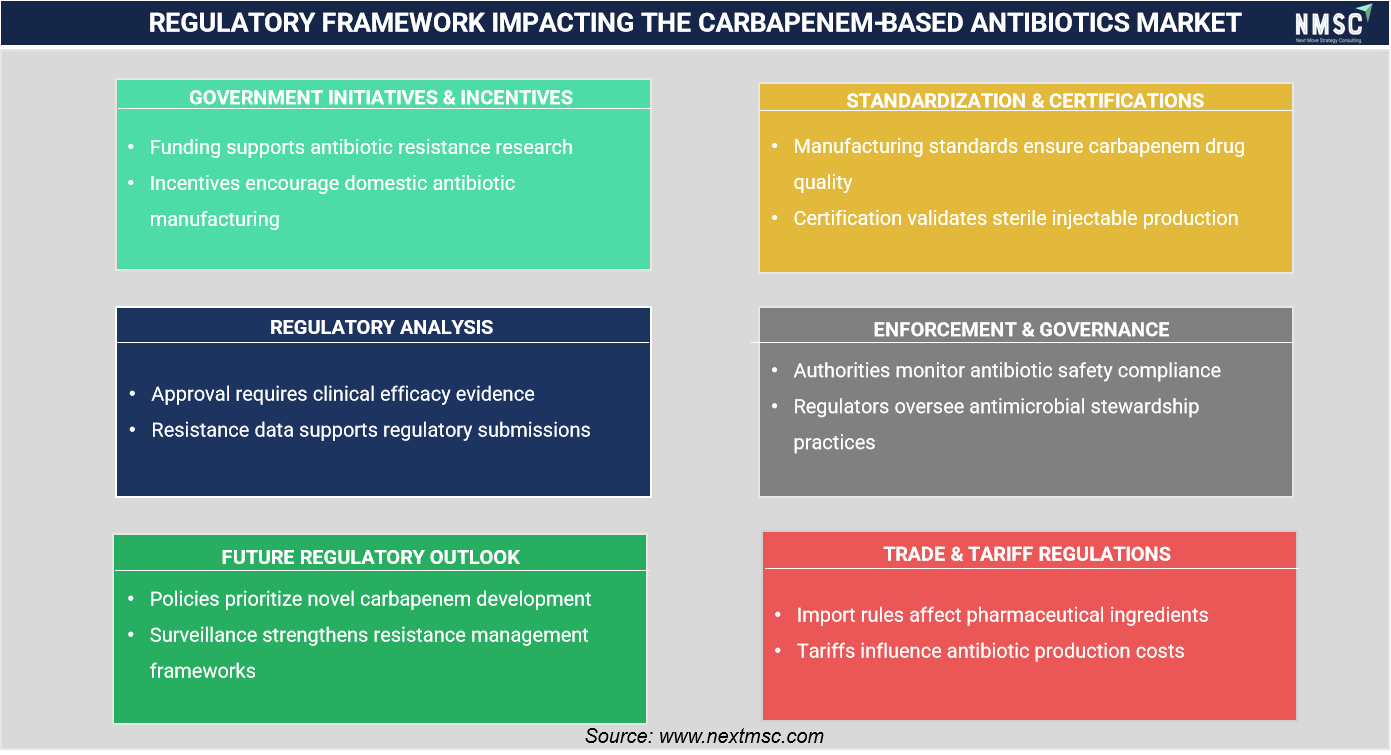
Regulatory Framework Impacting the Carbapenem-Based Antibiotics Industry

Regulatory Framework Impacting the Carbapenem-Based Antibiotics Industry

The above regulatory framework analysis maps the key regulatory components, such as government initiatives and incentives, regulatory analysis, future regulatory outlook, standardization and certifications, enforcement and governance, and trade and tariff regulations, shaping the carbapenem-based antibiotics market. From our analysis, we observed that funding supports antibiotic resistance research and incentives encourage domestic manufacturing, while clinical efficacy evidence and resistance data guide regulatory approvals. Manufacturing standards ensure drug quality and certification validates sterile production, whereas authorities monitor safety compliance and regulators oversee antimicrobial stewardship practices.

Market Drivers & Dynamics - Carbapenem-Based Antibiotics Market

Interactive Dataset
Rising carbapenem-resistant Enterobacterales prevalence driver +1.8% Global
Approval of first oral carbapenem expanding care settings driver +1.2% North America, Europe
Growth of carbapenem-beta-lactamase inhibitor combinations driver +1.0% North America, Europe
Rising hospital-acquired and ventilator-associated pneumonia incidence driver +0.8% Global
Expanding home and ambulatory infusion infrastructure driver +0.6% North America, Europe
Antimicrobial stewardship programs restricting carbapenem use restraint -1.1% North America, Europe
Generic price erosion in mature carbapenem molecules restraint -0.9% Global
Development of carbapenem-sparing alternative antibiotics restraint -0.7% North America, Europe
Rising bacterial resistance reducing carbapenem efficacy restraint -0.5% Global
Limited antibiotic development pipeline investment industry-wide restraint -0.4% Global
Source: Next Move Strategy Consulting

What Is the Primary Growth Driver of the Carbapenem-Based Antibiotics Market?

Rising carbapenem-resistant Enterobacterales prevalence

Rising carbapenem-resistant Enterobacterales prevalence is the primary driver of the market. The Centers for Disease Control and Prevention continue to classify carbapenem-resistant Enterobacterales among the highest-priority urgent antibiotic resistance threats in the United States. We observed that this sustained institutional threat classification continues to anchor hospital demand for both standalone carbapenems and newer carbapenem-beta-lactamase inhibitor combinations capable of addressing resistant infections.

How Is the First Approved Oral Carbapenem Approval Driving Market Growth?

The June 2026 FDA approval of tebipenem pivoxil , the first oral carbapenem , is accelerating market growth by expanding treatment beyond intravenous-only settings. The phase 3 PIVOT-PO trial demonstrated noninferiority against intravenous imipenem- cilastatin across 1,690 hospitalized patients with complicated urinary tract infections. Our assessment indicates that this approval is compressing hospital length-of-stay requirements for eligible patients, creating new outpatient and step-down care revenue opportunities for the category.

What Is Restraining Carbapenem-Based Antibiotics Market Expansion?

Antimicrobial stewardship programs restricting carbapenem use

Antimicrobial stewardship programs restricting carbapenem use restrain the pace of overall category volume growth, as hospitals increasingly reserve carbapenems for confirmed resistant infections rather than empiric broad-spectrum therapy. The World Health Organization's revised treatment protocols favoring targeted beta-lactamase inhibitor combinations over standalone antibiotics reflect this stewardship-driven prescribing discipline. We found that generic price erosion in mature molecules such as meropenem and imipenem further compresses overall category revenue growth despite steady volume demand.

Growth Opportunities

How Can Oral Carbapenem Expansion Unlock Value for Outpatient Providers?

The 2026 approval of tebipenem pivoxil as the first oral carbapenem presents a whitespace opportunity for outpatient clinics and ambulatory infusion centers to capture treatment volume previously confined to inpatient intravenous therapy. Providers that build care pathways around oral step-down protocols stand to capture recurring prescription revenue across the Outpatient Clinic and Ambulatory Infusion Center segments as hospitals seek to reduce length of stay.

Where Does Beta-Lactamase Inhibitor Combination Development Create New Demand?

Manufacturers developing next-generation carbapenem-beta-lactamase inhibitor combinations represent an underpenetrated opportunity as carbapenem-resistant Enterobacterales prevalence continues rising globally. Companies that secure validated efficacy against KPC and metallo-beta-lactamase-producing organisms can capture long-term hospital formulary contracts within the beta-lactamase inhibitor combination category as WHO treatment protocols increasingly favor these agents over standalone carbapenems.

How Can Home Infusion Infrastructure Benefit Long-Term Care Providers?

Long-term care facilities and home infusion providers represent an opportunity for manufacturers offering stable, ready-to-use injectable formulations suited to outpatient parenteral antimicrobial therapy programs. Early movers that secure validated stability and administration protocols can differentiate with the Home Infusion and Long-Term Care Facility segments pursuing reduced hospital readmission rates through the forecast period.

Segmentation Analysis - Carbapenem-Based Antibiotics Market

Which Product Type Segment Dominates the Carbapenem-Based Antibiotics Market?

2025 (USD Billion)
2035 (USD Billion)
Meropenem 2025: $2.6 Billion | 2035: $3.8 Billion
Meropenem
Imipenem 2025: $1.5 Billion | 2035: $2.4 Billion
Imipenem
Ertapenem 2025: $0.6 Billion | 2035: $0.9 Billion
Ertapenem
Doripenem 2025: $0.4 Billion | 2035: $0.6 Billion
Doripenem
Biapenem 2025: $0.3 Billion | 2035: $0.4 Billion
Biapenem
Panipenem and Betamipron 2025: $0.2 Billion | 2035: $0.2 Billion
Panipenem an
Tebipenem 2025: $0.2 Billion | 2035: $0.4 Billion
Tebipenem
Other Carbapenems 2025: $0.1 Billion | 2035: $0.1 Billion
Other Carbap
Total 2025: $5.9 Billion | 2035: $8.9 Billion
Total
Meropenem $2.6 Billion $3.8 Billion 4.00%
Imipenem $1.5 Billion $2.4 Billion 4.80%
Ertapenem $0.6 Billion $0.9 Billion 4.00%
Doripenem $0.4 Billion $0.6 Billion 3.40%
Biapenem $0.3 Billion $0.4 Billion 3.70%
Panipenem and Betamipron $0.2 Billion $0.2 Billion 2.30%
Tebipenem $0.2 Billion $0.4 Billion 9.80%
Other Carbapenems $0.1 Billion $0.1 Billion 9.50%
Total $5.9 Billion $8.9 Billion 4.23%

Meropenem dominated the Carbapenem-Based Antibiotics market, generating USD 2.57 billion in 2025, supported by its broad-spectrum antibacterial activity and extensive use across hospital formularies worldwide. Tebipenem is the fastest-growing product type, projected to expand at a 9.8% CAGR from 2026 to 2035, driven by growing interest in oral carbapenem treatment options and their potential to support outpatient and step-down therapy for selected bacterial infections .

2025 (USD Billion)
2035 (USD Billion)
Category A
Category B
Category C
Category D
Segment Item 2025 (USD Billion) 2035 (USD Billion) CAGR
Category A $10.0 USD Billion $40.0 USD Billion 23.0%
Category B $17.1 USD Billion $51.1 USD Billion 25.0%
Category C $24.2 USD Billion $62.2 USD Billion 11.0%
Category D $31.3 USD Billion $73.3 USD Billion 13.0%

Segment-wise data not detailed in this view

Unlock complete segment-wise numbers for By Dosage Form.

Unlock Full Data

Lyophilized Powder for Injection held the largest share of approximately 48% (USD 2.8080 billion) in 2025; Tablet is the fastest-growing sub-segment at approximately 8.9% CAGR from 2026–2035.

2025 (USD Billion)
2035 (USD Billion)
Category A
Category B
Category C
Category D
Segment Item 2025 (USD Billion) 2035 (USD Billion) CAGR
Category A $10.0 USD Billion $40.0 USD Billion 17.0%
Category B $17.1 USD Billion $51.1 USD Billion 19.0%
Category C $24.2 USD Billion $62.2 USD Billion 21.0%
Category D $31.3 USD Billion $73.3 USD Billion 19.0%

Segment-wise data not detailed in this view

Unlock complete segment-wise numbers for By Administration.

Unlock Full Data

Intravenous held the largest share of approximately 84% (USD 4.9140 billion) in 2025; Oral is the fastest-growing sub-segment at approximately 9.2% CAGR from 2026–2035.

Which Indication Segment Leads Carbapenem-Based Antibiotics Market Demand?

2025 (USD Billion)
2035 (USD Billion)
Complicated Intra-Abdominal Infection 2025: $1.2 Billion | 2035: $1.6 Billion
Complicated
Complicated Urinary Tract Infection 2025: $0.9 Billion | 2035: $1.5 Billion
Complicated
Hospital-Acquired Pneumonia 2025: $0.8 Billion | 2035: $1.4 Billion
Hospital-Acq
Ventilator-Associated Pneumonia 2025: $0.6 Billion | 2035: $1.1 Billion
Ventilator-A
Sepsis and Bloodstream Infection 2025: $0.6 Billion | 2035: $0.9 Billion
Sepsis and B
Community-Acquired Pneumonia 2025: $0.5 Billion | 2035: $0.8 Billion
Community-Ac
Skin and Soft Tissue Infection 2025: $0.5 Billion | 2035: $0.7 Billion
Skin and Sof
Febrile Neutropenia 2025: $0.3 Billion | 2035: $0.4 Billion
Febrile Neut
Central Nervous System Infection 2025: $0.2 Billion | 2035: $0.2 Billion
Central Nerv
Gynecologic Infection 2025: $0.1 Billion | 2035: $0.2 Billion
Gynecologic
Other Bacterial Infections 2025: $0.1 Billion | 2035: $0.2 Billion
Other Bacter
Total 2025: $5.9 Billion | 2035: $8.9 Billion
Total
Complicated Intra-Abdominal Infection $1.2 Billion $1.6 Billion 2.75%
Complicated Urinary Tract Infection $0.9 Billion $1.5 Billion 5.10%
Hospital-Acquired Pneumonia $0.8 Billion $1.4 Billion 6.10%
Ventilator-Associated Pneumonia $0.6 Billion $1.1 Billion 5.70%
Sepsis and Bloodstream Infection $0.6 Billion $0.9 Billion 4.70%
Community-Acquired Pneumonia $0.5 Billion $0.8 Billion 3.90%
Skin and Soft Tissue Infection $0.5 Billion $0.7 Billion 3.70%
Febrile Neutropenia $0.3 Billion $0.4 Billion 3.80%
Central Nervous System Infection $0.2 Billion $0.2 Billion 3.00%
Gynecologic Infection $0.1 Billion $0.2 Billion 2.80%
Other Bacterial Infections $0.1 Billion $0.2 Billion 4.00%
Total $5.9 Billion $8.9 Billion 4.23%

Complicated Intra-Abdominal Infection remained the leading indication in the Carbapenem-Based Antibiotics market, valued at USD 1.23 billion in 2025, supported by the broad Gram-negative and anaerobic coverage of carbapenems in the management of severe polymicrobial abdominal infections. Hospital-Acquired Pneumonia is the fastest-growing indication, projected to expand at a 6.1% CAGR from 2026 to 2035, supported by continued demand for effective treatments for serious hospital-acquired bacterial infections, particularly in intensive care settings .

Which Care Type Setting Is Most Widely Served in Carbapenem-Based Antibiotics?

2025 (USD Billion)
2035 (USD Billion)
Inpatient Ward 2025: $2.0 Billion | 2035: $2.7 Billion
Inpatient Wa
Intensive Care Unit 2025: $1.6 Billion | 2035: $2.5 Billion
Intensive Ca
Emergency Department 2025: $0.8 Billion | 2035: $1.1 Billion
Emergency De
Ambulatory Infusion Center 2025: $0.5 Billion | 2035: $1.1 Billion
Ambulatory I
Outpatient Clinic 2025: $0.5 Billion | 2035: $0.8 Billion
Outpatient C
Long-Term Care Facility 2025: $0.3 Billion | 2035: $0.4 Billion
Long-Term Ca
Home Infusion 2025: $0.2 Billion | 2035: $0.4 Billion
Home Infusio
Total 2025: $5.9 Billion | 2035: $8.9 Billion
Total
Inpatient Ward $2.0 Billion $2.7 Billion 3.00%
Intensive Care Unit $1.6 Billion $2.5 Billion 4.60%
Emergency Department $0.8 Billion $1.1 Billion 4.10%
Ambulatory Infusion Center $0.5 Billion $1.1 Billion 7.20%
Outpatient Clinic $0.5 Billion $0.8 Billion 5.90%
Long-Term Care Facility $0.3 Billion $0.4 Billion 4.10%
Home Infusion $0.2 Billion $0.4 Billion 7.50%
Total $5.9 Billion $8.9 Billion 4.23%

Inpatient Ward remained the dominant care type in the Carbapenem-Based Antibiotics market, valued at USD 1.99 billion in 2025, supported by the widespread use of carbapenems as broad-spectrum empiric and targeted therapies for serious bacterial infections requiring hospital-based care. Home Infusion is the fastest-growing care type, projected to expand at a 7.5% CAGR from 2026 to 2035, driven by the expansion of outpatient parenteral antimicrobial therapy infrastructure and increasing adoption of home-based treatment pathways for clinically appropriate patients .

2025 (USD Billion)
2035 (USD Billion)
Category A
Category B
Category C
Category D
Segment Item 2025 (USD Billion) 2035 (USD Billion) CAGR
Category A $10.0 USD Billion $40.0 USD Billion 23.0%
Category B $17.1 USD Billion $51.1 USD Billion 9.0%
Category C $24.2 USD Billion $62.2 USD Billion 23.0%
Category D $31.3 USD Billion $73.3 USD Billion 13.0%

Segment-wise data not detailed in this view

Unlock complete segment-wise numbers for By Type.

Unlock Full Data

Commodity Generic held the largest share of approximately 47% (USD 2.7495 billion) in 2025; Innovator Brand is the fastest-growing sub-segment at approximately 6.4% CAGR from 2026–2035.

2025 (USD Billion)
2035 (USD Billion)
Category A
Category B
Category C
Category D
Segment Item 2025 (USD Billion) 2035 (USD Billion) CAGR
Category A $10.0 USD Billion $40.0 USD Billion 25.0%
Category B $17.1 USD Billion $51.1 USD Billion 19.0%
Category C $24.2 USD Billion $62.2 USD Billion 25.0%
Category D $31.3 USD Billion $73.3 USD Billion 19.0%

Segment-wise data not detailed in this view

Unlock complete segment-wise numbers for By Distribution Channel.

Unlock Full Data

Direct Hospital Procurement held the largest share of approximately 39% (USD 2.2815 billion) in 2025; Ambulatory Infusion Center is the fastest-growing sub-segment at approximately 7.2% CAGR from 2026–2035.

Regional Outlook - Carbapenem-Based Antibiotics Market

North America $2.1 Billion $2.9 Billion 3.30%
Asia-Pacific $1.6 Billion $3.0 Billion 6.20%
Europe $1.4 Billion $2.0 Billion 4.00%
Middle East & Africa $0.4 Billion $0.5 Billion 2.90%
Latin America $0.3 Billion $0.4 Billion 4.10%

Competitive Landscape - Carbapenem-Based Antibiotics Market

How Do Companies Compete in the Carbapenem-Based Antibiotics Market?

Companies compete primarily on regulatory approval breadth, supply chain reliability, and price competitiveness across the industry. Innovator companies such as Merck leverage FDA-approved combination products with premium pricing for resistant infections, while generic manufacturers including Aurobindo Pharma and Dr. Reddy's Laboratories compete on manufacturing scale and consistent supply for mature, off-patent molecules such as meropenem and imipenem- cilastatin .

Which Competitive Archetypes Dominate the Carbapenem-Based Antibiotics Market?

Two archetypes dominate the market: innovator companies holding branded combination products for resistant infections, and high-volume generic manufacturers competing on price for mature molecules. Merck exemplifies the innovator archetype through RECARBRIO's multiple FDA-approved indications, while Sandoz and Aurobindo Pharma exemplify the generic archetype through broad, cost-competitive meropenem and imipenem- cilastatin portfolios serving global hospital formularies.

How Are Companies Differentiating Through Innovation in Carbapenem-Based Antibiotics?

Innovation and differentiation strategy increasingly center on combination product breadth and formulation flexibility. Merck's RECARBRIO holds FDA approval across multiple serious infection indications, while the 2026 approval of tebipenem pivoxil demonstrates how oral formulation innovation is opening new competitive dimensions beyond traditional injectable-only antibiotic products. Our analysis shows that generic manufacturers unable to expand into combination or novel formulation categories risk being confined to increasingly price-compressed commodity segments.

What M&A and Expansion Activity Is Shaping the Carbapenem-Based Antibiotics Market?

Targeted portfolio consolidation, rather than broad industry-wide M&A, characterizes recent market activity. CorMedix's August 2025 acquisition of Melinta Therapeutics, adding meropenem- vaborbactam alongside five other hospital-focused anti-infective products, illustrates how specialty pharmaceutical acquirers are consolidating complementary hospital antibiotic portfolios, while generic manufacturers continue expanding geographic manufacturing and distribution footprint to serve growing hospital demand across Asia-Pacific and other emerging markets.

Competitive Dynamics and M&A Landscape

Recent strategic moves, partnerships, and acquisitions shaping the Carbapenem-Based Antibiotics Market.

April 2026 Shionogi U.S. government contract Shionogi received an initial USD 119 million U.S. government contract through BARDA's Project BioShield related to Fetroja ( cefiderocol ), including establishing a U.S. drug-product manufacturing site, supporting procurement, and advancing the drug for difficult-to-treat bacterial infections.
January 2025 Hikma Product Launch Hikma launched Meropenem for Injection, USP in the United States in 500 mg and 1 g doses, expanding its generic injectable carbapenem portfolio and strengthening its position in the U.S. hospital antibiotics market.

Key Market Players

Merck & Co., Inc. Pfizer Inc. Sumitomo Pharma Co., Ltd. Sandoz Group AG Fresenius Kabi AG Teva Pharmaceutical Industries Ltd. Hikma Pharmaceuticals PLC Aurobindo Pharma Limited Dr. Reddy's Laboratories Limited Gland Pharma Limited Sun Pharmaceutical Industries Limited Cipla Limited Lupin Limited Zydus Lifesciences Limited JW Pharmaceutical Corporation ACS Dobfar S.p.A. Meiji Seika Pharma Co., Ltd. Shionogi & Co., Ltd. Daewoong Pharmaceutical Co., Ltd. Shenzhen Haibin Pharmaceutical Co., Ltd.

Conclusion & Recommendations - Carbapenem-Based Antibiotics Market

The long-term outlook for the market remains steady, with global revenue projected to expand from USD 5.85 Billion in 2025 to USD 8.85 Billion by 2035 at a 4.23% CAGR. We observed that sustained carbapenem-resistant Enterobacterales prevalence, expanding combination therapy adoption, and the 2026 approval of the first oral carbapenem will continue underpinning demand across Meropenem and Tebipenem categories through the forecast period.

What Strategic Positioning Should Carbapenem-Based Antibiotics Manufacturers Pursue?

Manufacturers should prioritize combination beta-lactamase inhibitor product development and oral formulation expansion to secure long-term hospital formulary contracts. Our assessment indicates that companies investing early in validated efficacy against resistant organisms and expanded care-setting flexibility will be best positioned to capture premium pricing within the Carbapenem-Based Antibiotics Market as stewardship programs increasingly favor targeted, evidence-based therapy.

How Attractive Is the Carbapenem-Based Antibiotics Industry for New Investment?

The Carbapenem-Based Antibiotics industry presents a moderately attractive, steady-growth investment case, supported by a USD 2.75 Billion absolute dollar opportunity between 2026 and 2035 and above-average growth in Asia-Pacific and Tebipenem categories. We found that investment attractiveness is highest for companies combining validated combination therapy portfolios with manufacturing scale, positioning them to serve both innovator and generic segments of hospital demand.

What Market Shifts and Key Risks Should Stakeholders Monitor?

Stakeholders should monitor antimicrobial stewardship programs restricting carbapenem use, generic price erosion in mature molecules, and rising bacterial resistance reducing carbapenem efficacy as key risks to the Carbapenem-Based Antibiotics Industry. Our analysis shows that manufacturers unable to demonstrate validated efficacy against evolving resistance patterns risk losing formulary share to carbapenem-sparing alternatives as institutional prescribing guidance continues evolving.

What Are the Key Growth Pathways for the Carbapenem-Based Antibiotics Industry?

Key growth pathways include expanding combination beta-lactamase inhibitor portfolios, scaling oral carbapenem formulation adoption, and deepening penetration into home infusion and ambulatory care settings. NMSC's analysis indicates that manufacturers pursuing these pathways while maintaining manufacturing scale and regulatory compliance will be best positioned to capture the Carbapenem-Based Antibiotics Industry projected growth through 2035.

Expert Insights - Carbapenem-Based Antibiotics Market

Danielle Rankin

Danielle Rankin

Epidemiologist | CDC Division of Healthcare Quality Promotion

"“This sharp rise in NDM-CRE means we face a growing threat that limits our ability to treat some of the most serious bacterial infections. Selecting the right treatment has never been more complicated, so it is vitally important that healthcare providers have access to testing to help them select the proper targeted therapies.”"

Analyst Interpretation

The statement highlights growing treatment challenges from carbapenem-resistant infections. Rising NDM-CRE prevalence is reducing effective antibiotic options and increasing demand for targeted therapies and advanced diagnostics. The need for rapid resistance testing is also becoming more important for treatment selection. These developments are encouraging pharmaceutical companies to invest in novel carbapenem-based combinations, β-lactamase inhibitors, and other therapies addressing multidrug-resistant bacterial infections.

About the Author

Author

Mayurima Roy is a research analyst delivering data-driven insights that support strategic planning and market understanding. She combines analytical rigor with strong content development skills, translating complex information into clear, actionable narratives for diverse audiences. Her work includes structured research, trend tracking, competitive assessment, and insight-led content creation that supports informed decision-making. Curious and detail-oriented by nature, she continually deepens her understanding of evolving markets while pursuing creative interests such as crafting and video creation.

About the Reviewer

Reviewer

Supradip Baul is an accomplished business consultant and strategist with over a decade of rich experience in market intelligence, strategy, technology, and business transformation. His work has included rigorous qualitative and quantitative analysis across multiple industries, helping clients shape investment decisions and long-term roadmaps. Earlier in his career, he was associated with Gartner, where he contributed to industry-leading reports and market share analyses. He has worked with leading global companies and holds an MBA with a dual specialization in Marketing and Finance.

Download Free Sample

FAQs - Carbapenem-Based Antibiotics Market

Rishabh Jogani

RISHABH JOGANI

Strategy Analyst

Accenture Japan

We are incredibly impressed with the market report on the real estate market in India provided by Next Move Strategy Consulting. The report was thorough, insightful, and well-structured, offering deep analysis and actionable recommendations. It not only captured the current trends and dynamics but also provided a forward-looking perspective that has been invaluable for our strategic planning. Their team demonstrated exceptional professionalism, attention to detail, and a profound understanding of the industry. The data-driven insights and clarity of presentation exceeded our expectations, making complex market trends easy to understand. We highly recommend Next Move Strategy Consulting to anyone looking for reliable and comprehensive market research services. Their expertise has given us the confidence to navigate the complexities of the Indian real estate market with clarity and foresight.

Nishant Awate

NISHANT AWATE

Business Development Global Sales

Zehnder Group Deutschland GmbH

Our experience working with Next Move Strategy Consulting was positive. The team was responsive, professional, and open to incorporating our specific requirements throughout the project. The India AHU market study was comprehensive and well structured, covering market value and volume forecasts, product and application segments, and key industry trends. The inclusion of both AHU and residential MVHR market insights made the study particularly relevant for our strategic market assessment. Overall, the report provides a solid foundation for evaluating market potential, identifying priority segments, and supporting business-development decisions in India.

Kishu Kanda

KISHU KANDA

Strategy Analyst

Accenture

We purchased the AI Consumer Market Report from this company. Not only did they customize the report to meet our specific requirements, but they also showed great flexibility in accommodating our budget. The report we received fully met our expectations. Additionally, they provided prompt and thorough responses to both our pre-purchase and follow-up questions. We look forward to working with this company again in the future.

Diana Trejo

DIANA TREJO

Assistant Manager

Sumitomo Corporation de Mexico, S.A. de C.V.

Recently, we purchased a report on the Mexico Data Center Market from Next Move Strategy Consulting. The service has been excellent, with support that is always timely and thoroughly professional. The information provided is interesting, highly useful, and delivered with clarity. I would highly recommend NextMSC for anyone seeking insightful and dependable analysis.

Pratyush Kumar Das

PRATYUSH KUMAR DAS

Assistant Manager

Polycab India Limited

We would like to express our appreciation for the data and insights provided by nextmsc. We are very pleased with the quality and depth of the information, which has proven to be highly valuable and beneficial for our business decision-making.

Custom Market Research Services - Carbapenem-Based Antibiotics Market

We will customize the research for you if the listed report does not fully match your requirements.

Get 30% Free Customization

Select License

This website uses cookies to ensure you get the best experience on our website. Learn more