Insect-Based Protein Market Size, Share, Trends and Growth Analysis, By Product Category (Ingredient Products, and Finished Foods), By Species (Black Soldier Fly, Mealworm, Cricket, Grasshopper, and Other Insects), By Product Form, By Distribution Channel, By End Users (Feed Manufacturers, Pet Food Manufacturers, Food and Beverage Manufacturers, Nutraceutical Manufacturers, Foodservice Operators & Others), and Region — Global Industry Report and Forecast, 2026–2035
What Is the Insect-Based Protein Market Size?
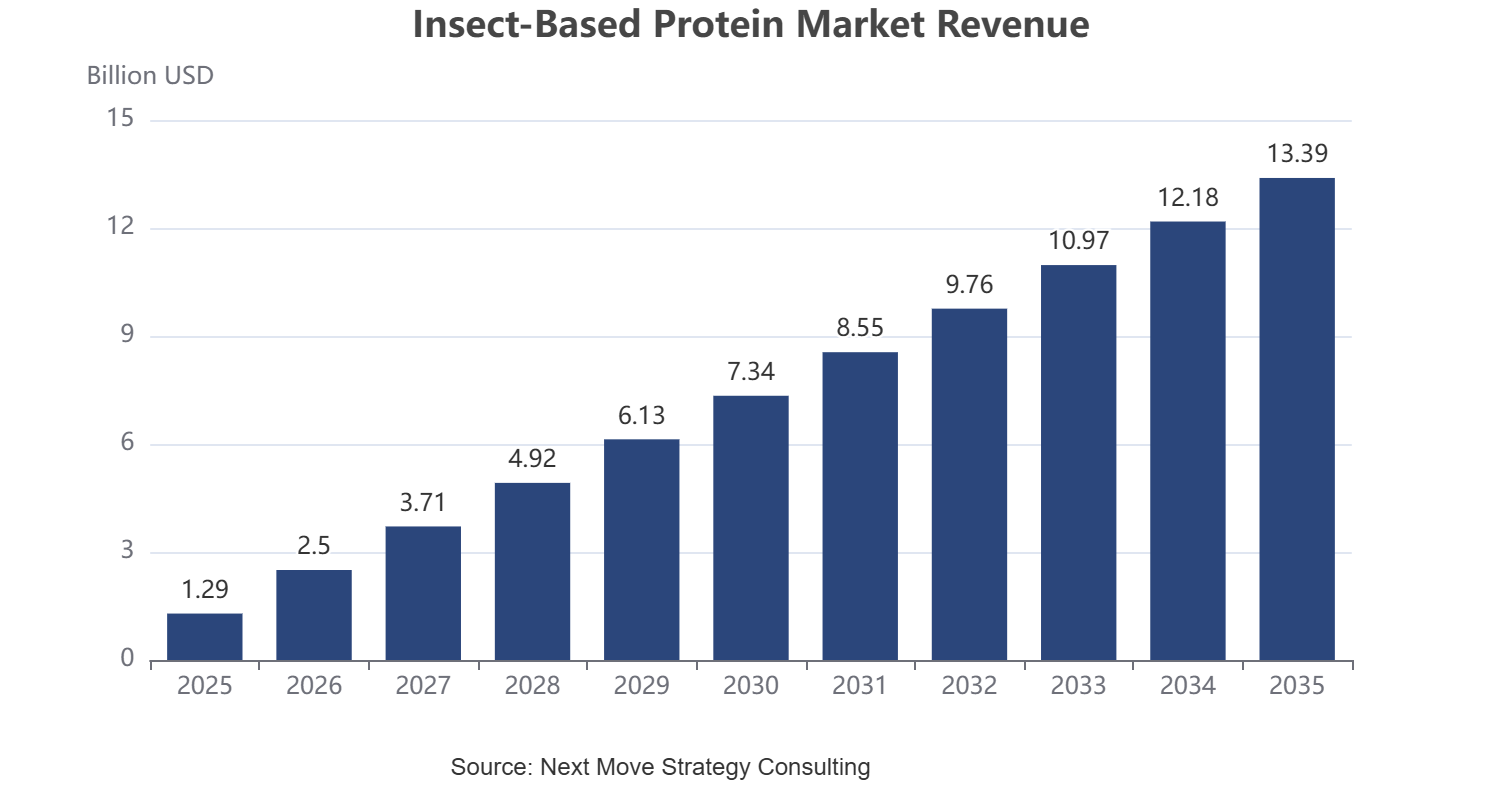
The global insect-based protein market size was valued at USD 1.29 billion in 2025 and is estimated at USD 1.63 billion in 2026, forecast to reach USD 13.39 billion by 2035, expanding at a 26.4% CAGR between 2026 and 2035. Europe leads with approximately 38% share, while Ingredient Products dominate all other product categories with approximately 82% share.
We observed that growth is broad-based across every segmentation axis, with pet food adoption and cricket-based finished foods driving the dominant structural shifts through 2035.
|
Key Takeaways |
|
By Product Category: Ingredient Products held the largest share of approximately 82% (USD 1.06 billion) in 2025; Finished Foods is the fastest-growing sub-segment at 34.8% CAGR from 2026–2035. |
|
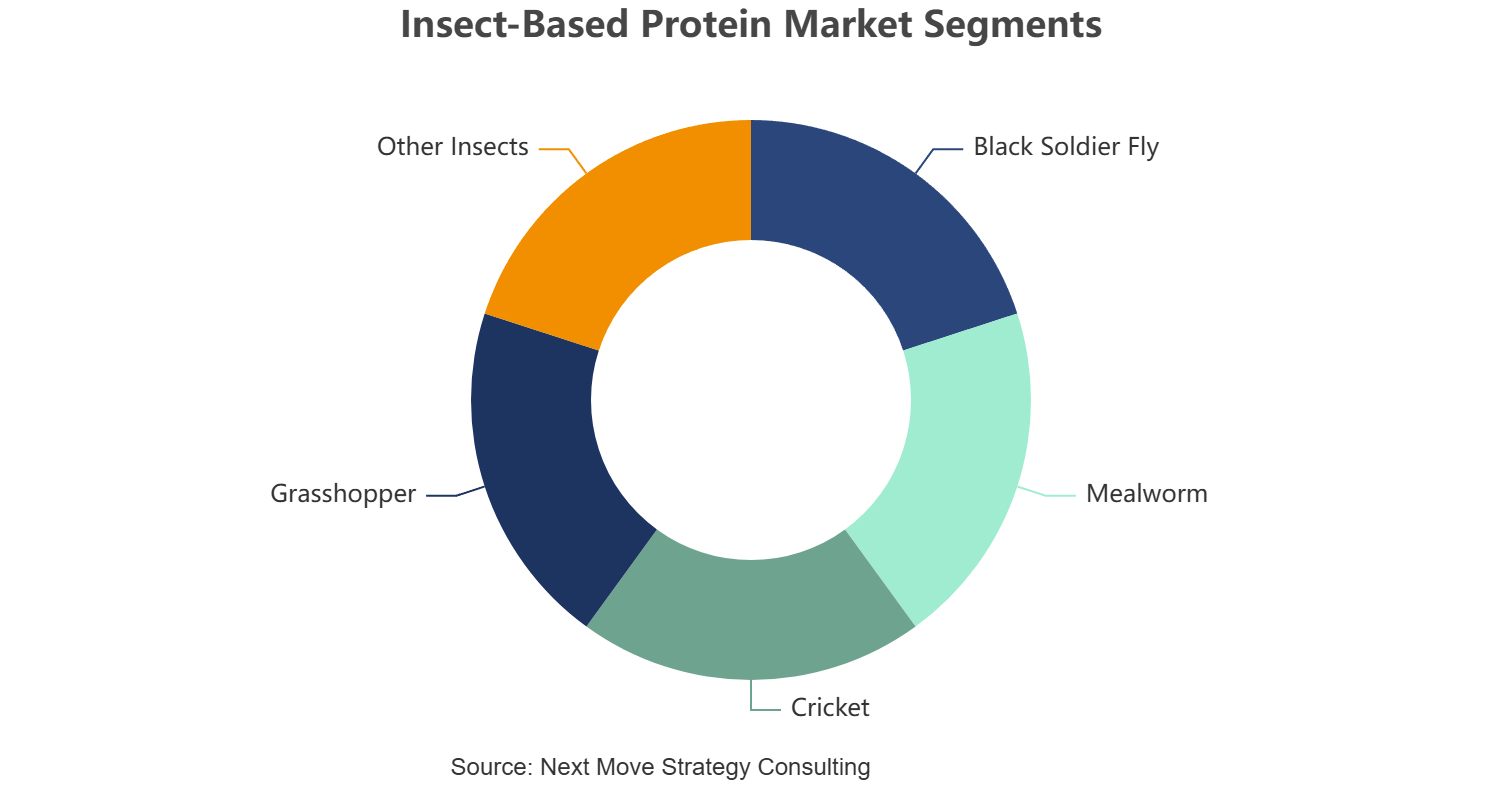
By Species: Black Soldier Fly held the largest share of approximately 52% (USD 0.67 billion) in 2025; Cricket is the fastest-growing sub-segment at 30.0% CAGR from 2026–2035. |
|
By Product Form: Meal and Flour held the largest share of the product form category in 2025; Concentrate and Isolate is the fastest-growing sub-segment through 2035 on rising human food and nutraceutical demand. |
|
By Distribution Channel: Direct B2B held the largest share of the distribution channel category in 2025; E-commerce is the fastest-growing sub-segment through 2035 on expanding direct-to-consumer finished food sales. |
|
By End Users: Feed Manufacturers held the largest share of approximately 40% (USD 0.51 billion) in 2025; Pet Food Manufacturers is the fastest-growing sub-segment at 28.9% CAGR from 2026–2035. |
|
Dominant Region: Europe dominated with approximately 38% revenue share (USD 0.49 billion) in 2025. |
|
Fastest-Growing Region: Asia-Pacific is expected to register the highest CAGR of 30.0% during 2026–2035. |
|
Dominant Country: U.S. led with approximately USD 0.27 billion in 2025. |
|
Fastest-Growing Country: India is the fastest-growing country at approximately 35.0% CAGR from 2026–2035. |
Market Opportunity: The insect-based protein market is expected to create an absolute dollar opportunity of USD 11.76 billion between 2026 and 2035, presenting significant investment potential across the animal feed, pet food, and human nutrition value chain.
According to Next Move Strategy Consulting analysis, feed and pet food manufacturers are increasingly securing multi-year offtake agreements directly with black soldier fly producers rather than relying on spot purchasing, a shift that favors vertically integrated producers with industrial-scale breeding capacity over smaller regional farms as aquaculture and pet food qualification volumes scale through 2035.
What Does the Insect-Based Protein Market Encompass?
The market encompasses black soldier fly, mealworm, cricket, and grasshopper-derived ingredients and finished foods supplied as whole dried insects, meal, defatted meal, powder, concentrate, isolate, and hydrolysate to feed manufacturers, pet food manufacturers, food and beverage manufacturers, nutraceutical manufacturers, and retail consumers. Our assessment indicates that the scope spans animal feed applications across aquaculture, pet food, poultry, and swine nutrition, alongside human food ingredients and supplements. The category has evolved from experimental animal feed applications into commercial-scale industrial production supplying both feed and human food markets.
Regulatory frameworks such as the European Commission's novel food authorization process, which approved UV-treated yellow mealworm powder for human consumption in January 2025, shape product launch timelines across Europe. We observed that technology adoption is shifting toward automated, sensor-monitored breeding facilities that improve feed conversion consistency at industrial scale. Next Move Strategy Consulting's analysis indicates that this structural shift, combined with expanding aquaculture and pet food qualification, is redefining production economics across the insect-based protein market.
|
Parameter |
Details |
|
Market Size in 2025 |
USD 1.29 Billion |
|
Market Size in 2026 |
USD 1.63 Billion |
|
Revenue Forecast in 2035 |
USD 13.39 Billion |
|
Growth Rate |
CAGR of 26.4% from 2026 to 2035 |
|
Analysis Period |
2025–2035 |
|
Base Year Considered |
2025 |
|
Forecast Period |
2026–2035 |
|
Market Size Estimation |
USD Billion |
|
Companies Profiled |
20 |
|
Countries Covered |
33 |
|
Market Share |
Available for Top 10 Companies |
Key Emerging Trends
Based on research conducted by Next Move Strategy Consulting, we found that four structural trends are reshaping production technology, species diversification, and stakeholder engagement across the insect-based protein market.
How Is Aquaculture Qualification Accelerating Black Soldier Fly Adoption?
Aquaculture feed formulators are increasingly qualifying black soldier fly meal as a fishmeal replacement to reduce dependence on wild-caught forage fish. We observed that Innovafeed partnered with BioMar and Auchan in September 2025 to commercialize insect meal in shrimp feed at scale in Ecuador, illustrating how aquaculture qualification is translating into commercial-volume offtake. This trend is reshaping stakeholder feed formulation practice, pushing aquafeed producers to treat insect meal as a mainstream ingredient rather than a niche substitute.
Why Is Human Food Qualification Expanding Beyond Animal Feed Applications?
Human food qualification is expanding as regulators progressively authorize insect ingredients for direct consumption alongside established animal feed uses. Our findings suggest that the European Commission approved UV-treated yellow mealworm powder as a novel food for human consumption in January 2025, extending prior authorizations for house cricket and other mealworm products. This trend is elevating stakeholder demand for food-grade processing infrastructure distinct from feed-grade production lines.
How Is Industrial-Scale Automation Transforming Production Economics?
Automated, sensor-monitored breeding facilities are transforming production economics as producers scale beyond pilot capacity. We observed that Innovafeed completed the industrialization phase of its Nesle, France production facility in 2026, securing EUR 51 million in funding to accelerate commercial deployment. This trend is elevating the strategic importance of automated breeding and processing infrastructure among producers competing on cost parity with conventional protein meal sources.
What Role Does Species Diversification Play in Market Expansion?
Species diversification beyond black soldier fly is gaining momentum as producers target cricket and mealworm for human food and premium pet food applications, distinguishing insect protein from competing sources such as the pea protein market. This trend is reshaping stakeholder product development roadmaps as manufacturers pursue species-specific functional and sensory properties for finished food applications beyond commodity feed ingredients.
Supply Chain Structure of the Insect-Based Protein Market
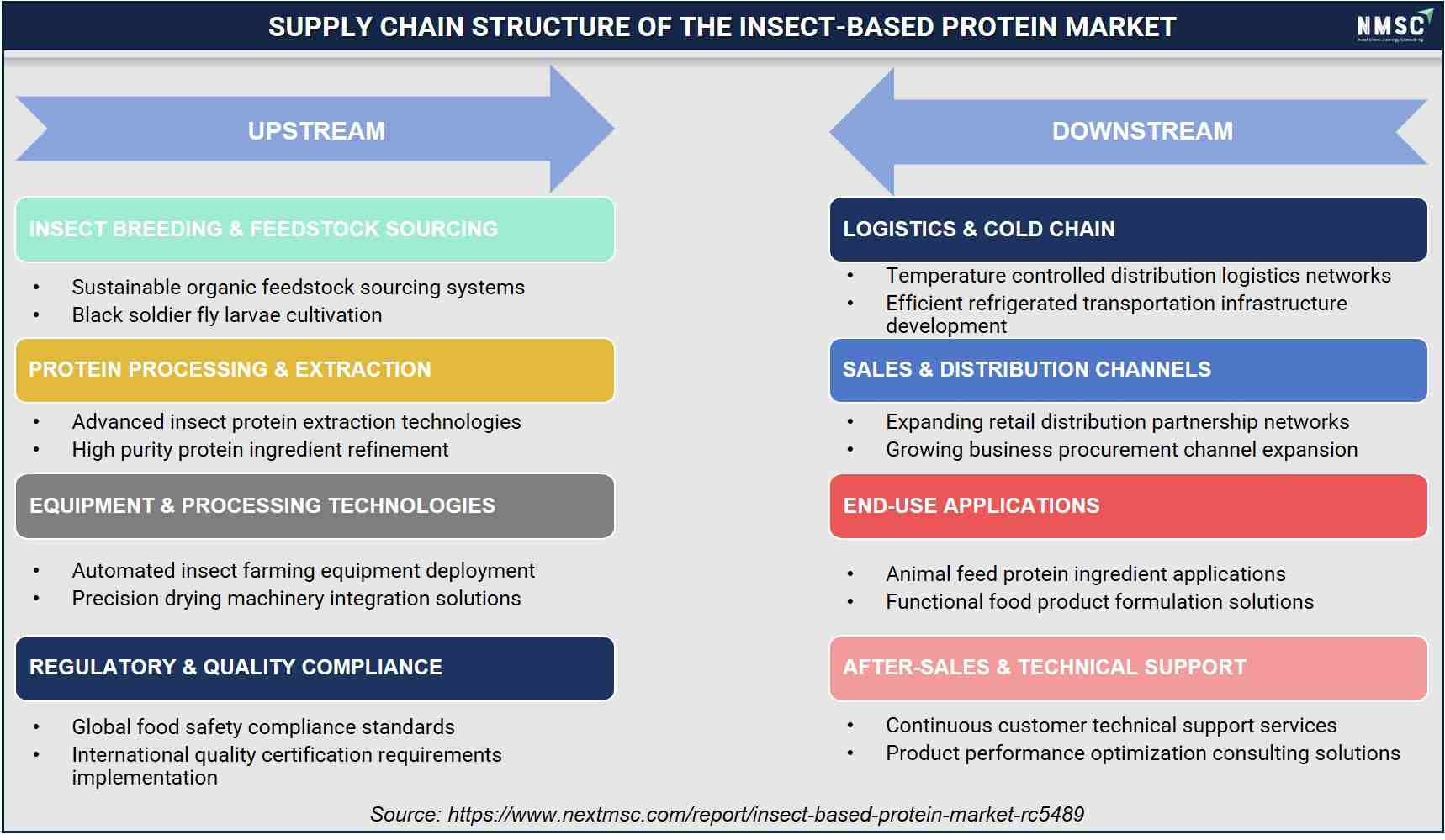
The infographic illustrates the end-to-end supply chain structure of the insect-based protein market, divided into upstream and downstream operations. Upstream processes encompass organic feedstock sourcing, black soldier fly larvae cultivation, advanced protein extraction, automated farming equipment, and international quality and regulatory compliance. Downstream processes focus on temperature-controlled cold chain logistics, expanding retail and B2B distribution channels, end-use applications in animal feed and functional foods, and continuous after-sales technical support. Together, these integrated segments highlight the complete commercial workflow required to convert insect biomass into refined protein products.
Growth Drivers and Restraints
Growth Catalyst and Risk Assessment Matrix
|
Factors |
Type |
(+/−) % Impact on CAGR |
Geographic Relevance |
Impact Timeline |
|
Expanding EU novel food authorizations for human consumption |
Driver |
+3.8% |
Europe |
2026–2035 |
|
Rising aquaculture feed qualification for black soldier fly meal |
Driver |
+3.4% |
Europe, Latin America |
2026–2035 |
|
Growing pet food manufacturer adoption of insect protein |
Driver |
+2.9% |
North America, Europe |
2026–2035 |
|
Increasing industrial-scale automated production capacity |
Driver |
+2.1% |
Global |
2026–2033 |
|
Government sustainability funding for circular economy protein production |
Driver |
+1.6% |
Europe |
2026–2035 |
|
Rising Asia-Pacific aquaculture and livestock feed demand |
Driver |
+1.9% |
Asia-Pacific |
2027–2035 |
|
Consumer acceptance barriers for direct human consumption |
Restraint |
−2.1% |
North America, Europe |
2026–2035 |
|
High capital cost of industrial-scale breeding infrastructure |
Restraint |
−1.3% |
Global |
2026–2032 |
|
Regulatory fragmentation across regions limiting cross-border trade |
Restraint |
−0.9% |
Asia-Pacific, Middle East & Africa |
2026–2035 |
What Is the Primary Growth Driver of the Insect-Based Protein Market?
Expanding EU novel food authorizations for human consumption is the primary driver of the market. The European Commission's approval of UV-treated yellow mealworm powder as a novel food in January 2025 extends a series of authorizations covering house cricket and other mealworm products dating to 2022 and 2023. We observed that this regulatory clarity, reinforced by rising aquaculture feed qualification, continues to anchor baseline demand across both human food and animal feed applications.
How Is Aquaculture Feed Qualification Driving Insect-Based Protein Market Growth?
Aquaculture feed qualification is accelerating market growth toward commercial-volume offtake agreements. Innovafeed's September 2025 partnership with BioMar and Auchan to commercialize insect meal in shrimp feed in Ecuador illustrates the scale of aquafeed demand entering the market. Our assessment indicates that this shift, combined with Innovafeed's 2026 industrialization milestone at its Nesle facility, is compressing the cost gap between insect meal and conventional fishmeal and soymeal.
What Is Restraining Insect-Based Protein Market Expansion?
Consumer acceptance barriers for direct human consumption restrain broader adoption of finished insect foods outside early-adopter markets. High capital cost of industrial-scale breeding infrastructure further limits new entrant participation, concentrating production among well-funded producers. We found that this combination of acceptance and capital barriers is channeling near-term growth toward animal feed and pet food applications, where regulatory clarity and buyer acceptance remain further advanced than in direct human food categories.
Segmentation Analysis
Segment Sizing: By Product Category
|
Segment |
2025 (USD) |
2035 (USD) |
CAGR% (2026–2035) |
|
Ingredient Products |
USD 1.06 Billion |
USD 9.11 Billion |
23.7% |
|
Finished Foods |
USD 0.23 Billion |
USD 4.28 Billion |
34.8% |
|
Total |
USD 1.29 Billion |
USD 13.39 Billion |
26.4% |
Which Product Category Dominates the Insect-Based Protein Market?
Ingredient Products led the market with USD 1.06 billion in 2025, supported by entrenched demand from feed manufacturers formulating aquaculture, poultry, and pet food rations with black soldier fly and mealworm meal. We observed that Finished Foods is the fastest-growing product category, expanding at a 34.8% CAGR from 2026 to 2035, as protein powders, bars, and whole insect snack products gain distribution following expanding human food novel food authorizations across Europe.
Segment Sizing: By End Users
Pet food demand is closely tracked alongside the broader pet food ingredients market, where insect protein is gaining share as a novel, sustainable protein source for premium pet food formulations.
|
Segment |
2025 (USD) |
2035 (USD) |
CAGR% (2026–2035) |
|
Feed Manufacturers |
USD 0.51 Billion |
USD 4.28 Billion |
23.4% |
|
Pet Food Manufacturers |
USD 0.28 Billion |
USD 3.48 Billion |
28.9% |
|
Food and Beverage Manufacturers |
USD 0.21 Billion |
USD 2.41 Billion |
27.8% |
|
Nutraceutical Manufacturers |
USD 0.13 Billion |
USD 1.61 Billion |
28.9% |
|
Foodservice Operators |
USD 0.08 Billion |
USD 0.80 Billion |
25.8% |
|
Retail Consumers |
USD 0.05 Billion |
USD 0.54 Billion |
26.9% |
|
Research Institutions |
USD 0.03 Billion |
USD 0.27 Billion |
24.4% |
|
Total |
USD 1.29 Billion |
USD 13.39 Billion |
26.4% |
Which End User Segment Leads Insect-Based Protein Market Demand?
Feed Manufacturers remained the leading end user within the market, valued at USD 0.51 billion in 2025 given their central role formulating aquaculture and livestock rations with insect meal. Our findings suggest that Pet Food Manufacturers are the fastest-growing end user, registering a 28.9% CAGR from 2026 to 2035, as premium pet food brands increasingly market insect protein for its sustainability credentials and novel allergen-friendly positioning.
Segment Sizing: By Species
|
Segment |
2025 (USD) |
2035 (USD) |
CAGR% (2026–2035) |
|
Black Soldier Fly |
USD 0.67 Billion |
USD 6.43 Billion |
25.3% |
|
Mealworm |
USD 0.31 Billion |
USD 2.95 Billion |
25.1% |
|
Cricket |
USD 0.21 Billion |
USD 2.81 Billion |
30.0% |
|
Grasshopper |
USD 0.06 Billion |
USD 0.80 Billion |
29.9% |
|
Other Insects |
USD 0.04 Billion |
USD 0.40 Billion |
25.8% |
|
Total |
USD 1.29 Billion |
USD 13.39 Billion |
26.4% |
Which Species Segment Leads Insect-Based Protein Production?
Black Soldier Fly remained the leading species segment within the market, valued at USD 0.67 billion in 2025 given its established role as the preferred commercial feedstock for animal nutrition applications. Our analysis shows that Cricket is the fastest-growing species segment, registering a 30.0% CAGR from 2026 to 2035, as expanding human food novel food authorizations favor cricket's established sensory and functional profile for finished food applications.
Growth Opportunities
Our analysis shows that three forward-looking opportunities stand out for stakeholders positioning within the insect-based protein market over the 2026–2035 forecast period.
How Can Aquafeed Offtake Agreements Unlock Value for Black Soldier Fly Producers?
Long-term aquafeed offtake agreements present a whitespace opportunity for black soldier fly producers seeking to secure volume commitments beyond spot sales. Producers that replicate Innovafeed's 2025 BioMar and Auchan shrimp feed partnership model stand to capture recurring, contracted revenue as aquafeed formulators pursue fishmeal replacement at commercial scale across major aquaculture-producing regions.
Where Does Premium Pet Food Formulation Create New Revenue for Insect Protein Suppliers?
Premium pet food brands represent an underpenetrated opportunity as novel-protein positioning gains traction among allergy-conscious and sustainability-focused pet owners. Suppliers that secure branded ingredient partnerships with pet food manufacturers can differentiate with formulators pursuing single-source novel protein claims, capturing premium pricing relative to conventional rendered animal protein meal.
How Can Food-Grade Processing Investment Benefit Human Food Manufacturers?
Food and beverage manufacturers represent an underpenetrated opportunity as expanding novel food authorizations open new finished food categories beyond early-adopter protein bars and snacks. Suppliers that invest in dedicated food-grade cricket and mealworm processing capacity can secure long-term ingredient supply contracts with manufacturers pursuing sustainable protein claims across bakery, snack, and beverage product lines.
Consumer Behavior Analysis of the Insect-Based Protein Market
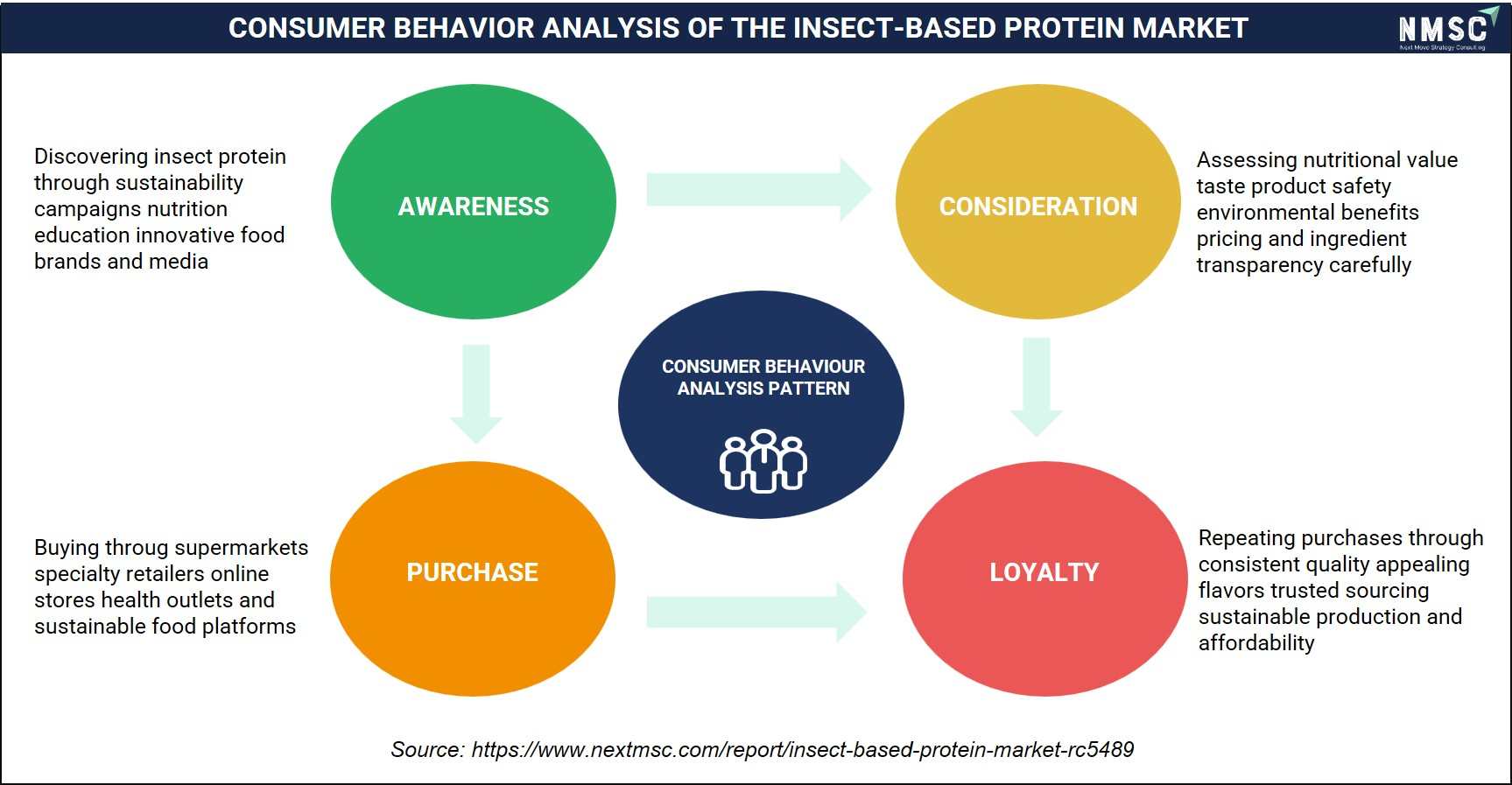
The infographic illustrates the consumer behavior analysis pattern in the insect-based protein market across four key stages: Awareness, Consideration, Purchase, and Loyalty. Initial consumer awareness is driven by sustainability campaigns, nutrition education, innovative food brands, and media exposure. Buyers then enter the consideration stage, where they carefully evaluate nutritional value, taste, product safety, environmental benefits, pricing, and ingredient transparency. Actual purchases take place through supermarkets, specialty retailers, online platforms, health outlets, and sustainable food channels. Finally, brand loyalty is sustained through consistent quality, appealing flavors, trusted sourcing, sustainable production methods, and price affordability.
Regional Outlook
Geographic Performance Snapshot
|
Region |
2025 (USD) |
2035 (USD) |
CAGR% (2026–2035) |
Key Driver |
|
Europe |
USD 0.49 Billion |
USD 4.28 Billion |
24.0% |
EU novel food authorizations and established production infrastructure |
|
North America |
USD 0.34 Billion |
USD 3.21 Billion |
25.0% |
Pet food manufacturer adoption and expanding industrial production capacity |
|
Asia-Pacific |
USD 0.28 Billion |
USD 3.75 Billion |
30.0% |
Rapid aquaculture and livestock feed demand growth in China and India |
|
Latin America |
USD 0.10 Billion |
USD 1.21 Billion |
28.5% |
Expanding aquaculture feed qualification and export-oriented production |
|
Middle East & Africa |
USD 0.08 Billion |
USD 0.94 Billion |
28.1% |
Growing food security investment and livestock feed diversification |
|
Total |
USD 1.29 Billion |
USD 13.39 Billion |
26.4% |
– |
Europe Insect-Based Protein Market Outlook
Europe leads the market with established production infrastructure and a progressive novel food regulatory framework. We observed that the European Commission's January 2025 approval of UV-treated yellow mealworm powder extends prior human food authorizations, while producers including Innovafeed and Protix maintain substantial regional manufacturing capacity. Technology adoption remains advanced, with automated breeding facilities supporting both feed and human food production lines.
North America Insect-Based Protein Market Outlook
North America's insect-based protein market reflects growing pet food manufacturer adoption and expanding industrial production capacity. Our findings suggest that Innovafeed's North American production footprint, established in collaboration with ADM, anchors regional supply for animal nutrition applications. Technology adoption is accelerating as regional pet food and feed manufacturers qualify insect protein, though regulatory clarity for human food applications remains less advanced than in Europe.
Asia-Pacific Insect-Based Protein Market Outlook
Asia-Pacific is the fastest-growing insect-based protein market region, propelled by rapid aquaculture and livestock feed demand growth in China and India. We found that regional feed manufacturers are increasingly qualifying insect meal to reduce dependence on imported fishmeal and soymeal. Technology adoption is accelerating as regional producers scale production, while regulatory frameworks remain less harmonized than in Europe or North America.
Middle East & Africa Insect-Based Protein Market Outlook
The market in Middle East & Africa is expanding as governments prioritize food security investment and livestock feed diversification. Our analysis shows that the UAE and Saudi Arabia are attracting insect protein production investment tied to national food security and agricultural diversification strategies. Regulatory influence remains developing, while technology adoption is gradually shifting toward imported production technology and licensed processing capability.
Latin America Insect-Based Protein Market Outlook
Latin America's insect-based protein market is supported by expanding aquaculture feed qualification and export-oriented production, exemplified by Innovafeed's 2025 shrimp feed partnership in Ecuador. We observed that regional demand remains concentrated in animal feed applications serving the region's large aquaculture and livestock sectors. Technology adoption remains centered on black soldier fly production, with competitive intensity moderate given reliance on both regional producers and international partnerships.
U.S. Insect-Based Protein Market
Based on our estimates, the U.S. market was valued at approximately USD 0.27 billion in 2025 and is projected to reach USD 2.44 billion by 2035, growing at a 24.4% CAGR. Demand is anchored by expanding pet food manufacturer adoption and Innovafeed's domestic production footprint developed in collaboration with ADM. Technology penetration favors automated black soldier fly breeding, and competitive intensity remains high among established feed and pet food ingredient suppliers.
Canada Insect-Based Protein Market
The market in Canada reached roughly USD 0.05 billion in 2025 and is forecast to hit USD 0.50 billion by 2035 at a 25.8% CAGR. Demand structure mirrors U.S. pet food and animal feed consumption patterns, supported by Enterra Feed Corporation's domestic production base. Technology penetration is rising as domestic feed manufacturers adopt insect meal, with competitive intensity moderate given established local producer relationships.
UK Insect-Based Protein Market
As per our estimate, the UK market stood at about USD 0.07 billion in 2025, advancing toward USD 0.62 billion by 2035 at a 24.2% CAGR. Demand is driven by rising pet food manufacturer interest in sustainable novel protein sourcing. Regulatory influence from UK novel food authorization processes is significant, technology penetration favors imported EU-produced ingredients, and competitive intensity remains steady among domestic and European suppliers.
Germany Insect-Based Protein Market
According to our analysis, Germany's market was valued near USD 0.12 billion in 2025 and is set to reach USD 0.94 billion by 2035, expanding at a 22.5% CAGR. Demand structure benefits from Germany's strong animal feed and pet food manufacturing base. Germany's EU novel food regulation compliance drives certified sourcing, while technology penetration favors industrial-scale black soldier fly production among leading regional feed manufacturers.
France Insect-Based Protein Market
Based on our estimates, France's market reached approximately USD 0.10 billion in 2025, projected to climb to USD 0.83 billion by 2035 at a 23.3% CAGR. Demand is supported by France's position as home to Innovafeed's flagship Nesle production facility and broader domestic insect protein production cluster. Regulatory influence from EU novel food standards is notable, and competitive intensity remains high given the concentration of leading producers headquartered domestically.
China Insect-Based Protein Market
The market in China stood at roughly USD 0.08 billion in 2025 and is forecast to reach USD 0.98 billion by 2035, registering a 28.7% CAGR. Demand is fueled by extensive aquaculture and livestock feed consumption alongside growing domestic production capacity. Regulatory influence is increasing gradually, technology penetration is accelerating through industrial-scale production upgrades, and competitive intensity remains elevated among numerous domestic feed ingredient producers.
India Insect-Based Protein Market
As per our estimate, India's market was valued at about USD 0.05 billion in 2025, projected to reach USD 0.94 billion by 2035 at a 35.0% CAGR, the fastest among covered countries. Demand structure reflects rapidly expanding aquaculture and poultry feed consumption alongside growing government interest in sustainable protein production. Regulatory influence remains developing, while technology penetration is rising quickly as domestic and international producers establish local production capacity.
Japan Insect-Based Protein Market
According to our analysis, Japan's market reached close to USD 0.04 billion in 2025 and is expected to hit USD 0.41 billion by 2035, growing at a 26.2% CAGR. Demand is supported by Japan's growing interest in sustainable aquaculture feed and premium pet food formulations. Regulatory influence is well established, technology penetration is advanced, and competitive intensity remains high among domestic and international suppliers serving Japanese feed and pet food manufacturers.
South Korea Insect-Based Protein Market
Based on our estimates, South Korea's market stood at approximately USD 0.03 billion in 2025, forecast to reach USD 0.30 billion by 2035 at a 25.8% CAGR. Demand structure benefits from the country's growing aquaculture sector and government support for sustainable feed alternatives. Technology penetration is rising, with domestic producers adopting industrial-scale breeding, and competitive intensity remains moderate amid growing regional supply relationships.
Australia Insect-Based Protein Market
The insect-based protein market in Australia reached about USD 0.02 billion in 2025 and is projected to reach USD 0.22 billion by 2035, expanding at a 27.2% CAGR. Demand is supported by growing livestock and aquaculture feed diversification and rising consumer interest in sustainable pet food. Regulatory influence stems from national food safety authorities, while technology penetration favors imported production technology amid moderate competitive intensity.
UAE Insect-Based Protein Market
As per our estimate, the UAE market was valued near USD 0.02 billion in 2025, projected to reach USD 0.25 billion by 2035 at a 29.0% CAGR. Demand structure is shaped by the UAE's national food security investment and growing aquaculture feed diversification. Regulatory influence remains moderate, technology penetration is improving through imported production technology, and competitive intensity is rising as distributors expand regional presence.
Saudi Arabia Insect-Based Protein Market
According to our analysis, Saudi Arabia's market reached roughly USD 0.02 billion in 2025 and is expected to hit USD 0.24 billion by 2035, growing at a 28.4% CAGR. Demand is driven by Vision 2030-linked food security and agricultural diversification investment. Regulatory influence is developing under national food safety guidelines, and technology penetration is advancing as domestic entities scale early-stage insect protein production.
South Africa Insect-Based Protein Market
Based on our estimates, South Africa's market stood at about USD 0.01 billion in 2025, forecast to reach USD 0.14 billion by 2035 at a 30.6% CAGR. Demand structure reflects a developing animal feed production base serving regional Southern African markets. Regulatory influence remains moderate, technology penetration is gradually improving, and competitive intensity is limited given reliance on established international producers.
Brazil Insect-Based Protein Market
The market in Brazil reached approximately USD 0.05 billion in 2025 and is projected to reach USD 0.63 billion by 2035, registering a 29.1% CAGR. Demand is underpinned by Brazil's large aquaculture and livestock feed sector and growing export-oriented production. Regulatory influence stems from national agricultural policy, technology penetration favors black soldier fly production, and competitive intensity remains moderate among regional and international producers.
Argentina Insect-Based Protein Market
As per our estimate, Argentina's market was valued near USD 0.02 billion in 2025, projected to reach USD 0.21 billion by 2035 at a 26.5% CAGR. Demand structure is supported by steady livestock and aquaculture feed demand despite macroeconomic volatility. Regulatory influence remains limited, technology penetration is modest, and competitive intensity is centered on a small number of regional producers serving domestic feed manufacturers.
Competitive Landscape
We observed that the insect-based protein market features a fragmented, emerging competitive landscape, with vertically integrated European pioneers competing alongside regional producers on production scale and species specialization.
|
Key Takeaways |
|
Market Structure: Fragmented; the top companies profiled in this report collectively account for a meaningful share of global insect-based protein market revenue, while numerous regional producers serve niche species and application demand. |
|
Innovation Focus: Automated breeding technology, aquaculture feed qualification, and human food novel food authorization dominate current innovation pipelines across leading producers. |
|
M&A Activity: Selective capital raises and strategic partnerships, exemplified by Innovafeed's EUR 51 million funding round in June 2026, reflecting continued investment-driven scaling rather than large-scale consolidation. |
How Do Companies Compete in the Insect-Based Protein Market?
Companies compete primarily on production scale, species specialization, and regulatory qualification breadth across the industry. Vertically integrated European pioneers such as Innovafeed and Protix leverage industrial-scale black soldier fly breeding to serve multinational feed and pet food manufacturers, while specialized producers such as Entomo Farms and Hargol FoodTech compete on cricket and grasshopper species expertise for human food and nutraceutical applications.
Which Competitive Archetypes Dominate the Insect-Based Protein Market?
Two archetypes dominate the market: vertically integrated industrial-scale black soldier fly producers offering multi-application ingredient portfolios, and specialized regional producers focused on specific species or geographic niches. Innovafeed and Protix exemplify the integrated archetype through combined breeding, processing, and multi-market distribution capability, while Entomo Farms and Essento exemplify the specialist archetype through cricket and human food-focused product lines.
How Are Companies Differentiating Through Innovation in Insect-Based Protein?
Innovation and differentiation strategy increasingly center on automated breeding technology and aquaculture qualification depth. Innovafeed's completed industrialization phase at its Nesle facility and its 2025 aquafeed partnership with BioMar and Auchan illustrate how leading producers differentiate through demonstrated commercial-scale qualification. Our analysis shows that producers unable to demonstrate industrial-scale, cost-competitive production risk exclusion from large feed and pet food manufacturer procurement shortlists.
What M&A and Expansion Activity Is Shaping the Insect-Based Protein Market?
Capital raises and strategic partnerships continue to shape competitive positioning within the industry more than large-scale consolidation. Innovafeed's EUR 51 million funding round in June 2026, backed by existing shareholders including Temasek and ADM, illustrates continued investor confidence in industrial-scale production. Regional producers across Asia-Pacific and Latin America continue to expand capacity through partnerships with feed manufacturers and aquaculture operators.
Key Market Players
Our assessment indicates that the following 20 companies are actively shaping production scale, species specialization, and application qualification within the global insect-based protein market.
-
Innovafeed
-
Protix
-
Hexafly
-
Entobel
-
Enterra Feed Corporation
-
Protenga
-
nextProtein
-
EntoGreen
-
Grinsect
-
BioflyTech
-
Ento Proteins
-
Entomo Farms
-
Inseco
-
All Things Bugs
-
Hargol FoodTech
-
Flying Spark
-
Nutrinsect
-
Essento
-
SWARMProtein
Latest Developments
We found that recent developments within the insect-based protein market are concentrated on regulatory authorization and industrial-scale capital investment, reflecting the industry's transition from pilot to commercial-scale production.
|
Date |
Event |
|
January 2025 |
The European Commission approved UV-treated yellow mealworm powder as a novel food for human consumption, extending prior authorizations for insect ingredients across European food markets. |
Expert Insight
 “A primary goal during the upcoming term will be to position insect farming not only as the fastest-growing sustainable protein production industry, but also as one that empowers farmers and nurtures regional development. Europe's over-reliance on imported protein is an issue for businesses, farmers, and end-consumers, and our industry is a critical component of the solution to that.”
— Adriana Casillas, CEO of Tebrio and President of IPIFF
Statement made during the July 2024 IPIFF General Assembly meeting, outlining the association's strategic roadmap.
Market Interpretation:
This insight highlights insect-based protein as a geopolitical and supply-chain solution, moving beyond just environmental sustainability. By framing insect farming as a tool for regional development and domestic supply chain security, industry leaders are positioning alternative proteins as a necessary strategy to insulate local agricultural markets from global supply shocks related to traditional imported proteins.
Investment Opportunities
What Capital Inflows Are Targeting the Insect-Based Protein Market?
Capital inflows into the insect-based protein market are increasingly directed toward industrial-scale production capacity and aquafeed qualification programs. Innovafeed's EUR 51 million funding round in June 2026, backed by institutional investors including Temasek and QIA, illustrates continued investor confidence in commercial-scale black soldier fly production. We observed that investors favor producers demonstrating industrial-scale, cost-competitive breeding capacity, viewing production efficiency as a proxy for long-term feed and pet food manufacturer contract retention.
How Is Infrastructure Investment Supporting Insect-Based Protein Production?
Infrastructure investment is expanding automated breeding and processing capacity to support rising feed, pet food, and human food demand. Innovafeed's completed industrialization phase at its Nesle, France facility exemplifies the scale of capital committed to production automation. Our findings suggest that producers are investing in sensor-monitored breeding systems to improve feed conversion consistency and reduce production costs across Europe, North America, and Asia-Pacific.
What ESG Considerations Are Shaping Insect-Based Protein Investment Decisions?
Environmental considerations are central to investment decisions across the industry, with circular economy waste valorization and land-use efficiency as key criteria. Black soldier fly production's ability to convert organic byproducts into protein while generating frass-based soil amendment illustrates the sector's circular economy positioning. We found that investors increasingly favor producers with verified waste-stream sourcing and low land and water footprint credentials relative to conventional protein production.
Key Benefits for Stakeholders
How Does This Report Benefit Enterprise and Industry Leaders?
Enterprise and industry leaders gain access to validated segmentation, competitive benchmarking, and regional demand forecasts that support sourcing and portfolio decisions across the insect-based protein industry. Our analysis shows that detailed product category, species, and end-user breakdowns help procurement teams align specifications with regulatory and application requirements while identifying underserved segments for portfolio expansion.
How Does This Report Benefit Investors and Financial Analysts?
Investors and financial analysts benefit from consistent, single-point market size and CAGR estimates that support valuation and capital-allocation decisions across the insect-based protein supply chain. We observed that the report's regional and segment-level growth differentials help identify which producers are best positioned to capture above-market growth in Asia-Pacific and finished foods categories through 2035.
How Does This Report Benefit Technology Vendors and Product Teams?
Technology vendors and product teams gain insight into emerging production requirements, including automated breeding systems, aquafeed formulation compatibility, and food-grade processing, that are reshaping the industry. Our findings suggest that this analysis helps R&D teams prioritize development roadmaps around production automation and species-specific functional properties that are increasingly required by feed manufacturer and food and beverage manufacturer specifications.
Key Market Segments
By Product Category
-
Ingredient Products
-
Animal Feed
-
Aquaculture
-
Pet Food
-
Poultry
-
Swine
-
Other Livestock
-
-
Human Food
-
Ingredients
-
Supplements
-
-
-
Finished Foods
-
Protein Powders
-
Bars and Snacks
-
Whole Insect Foods
-
By Species
-
Black Soldier Fly
-
Mealworm
-
Cricket
-
Grasshopper
-
Other Insects
By Product Form
-
Whole Dried Insects
-
Meal and Flour
-
Defatted Meal
-
Powder
-
Concentrate and Isolate
-
Hydrolysate
By Distribution Channel
-
Direct B2B
-
Distributor
-
Wholesale
-
Retail
-
E-commerce
-
Private Label
By End Users
-
Feed Manufacturers
-
Pet Food Manufacturers
-
Food and Beverage Manufacturers
-
Nutraceutical Manufacturers
-
Foodservice Operators
-
Retail Consumers
-
Research Institutions
By Region
-
North America: U.S., Canada, Mexico
-
Europe: UK, Germany, France, Italy, Spain, Sweden, Denmark, Finland, Netherlands, Rest of Europe
-
Asia-Pacific: China, India, Japan, South Korea, Taiwan, Indonesia, Vietnam, Australia, Philippines, Malaysia, Rest of APAC
-
Middle East & Africa: Saudi Arabia, UAE, Egypt, Israel, Turkey, Nigeria, South Africa, Rest of MEA
-
Latin America: Brazil, Argentina, Chile, Colombia, Rest of LATAM
Conclusion & Recommendations
What Is the Long-Term Outlook for the Insect-Based Protein Market?
The long-term outlook remains highly favorable, with the market expected to grow more than eightfold from USD 1.63 billion in 2026 to USD 13.39 billion by 2035 at a 26.4% CAGR. We observed that this trajectory rests on expanding EU novel food authorizations, accelerating aquafeed qualification, and rising pet food manufacturer adoption that together sustain demand across the forecast period.
What Strategic Positioning Should Stakeholders Pursue?
Stakeholders should pursue industrial-scale, cost-competitive production strategies combined with multi-application qualification breadth to compete against conventional protein sources. Our assessment indicates that producers integrating automated breeding with demonstrated commercial offtake, following the pattern of Innovafeed's Nesle industrialization and aquafeed partnerships, are best positioned to secure long-term feed and pet food manufacturer contracts across the insect-based protein market.
How Attractive Is the Insect-Based Protein Market for New Investment?
The insect-based protein industry presents a highly attractive investment case, supported by a USD 11.76 billion absolute dollar opportunity between 2026 and 2035 and above-average growth in Asia-Pacific and Finished Foods categories. We found that investment attractiveness is highest for producers combining industrial-scale black soldier fly capacity with human food qualification breadth, positioning them to serve both feed and premium human food buyer segments simultaneously.
What Market Shifts and Key Risks Should Stakeholders Monitor?
Stakeholders should monitor consumer acceptance barriers for human consumption, high capital cost of breeding infrastructure, and regulatory fragmentation across regions as key risks to the insect-based protein market. Our analysis shows that producers unable to demonstrate cost parity with conventional protein sources risk losing feed manufacturer contracts to established fishmeal and soymeal suppliers, particularly as capital-intensive expansion pressures margins across early-stage producers.
What Are the Key Growth Pathways for the Insect-Based Protein Market?
Key growth pathways include scaling aquafeed offtake agreements, expanding pet food manufacturer partnerships, and deepening human food novel food qualification. Next Move Strategy Consulting's analysis indicates that producers pursuing these pathways while maintaining core animal feed production efficiency will be best positioned to capture the insect-based protein market's projected growth through 2035.
About the Author
 Liza Phukan is Research Associate at Next Move Strategy Consulting, where she has covered emerging industries and market research across sectors for 3.5 years. Her work includes analyzing industry developments, validating market data, and developing structured business content from research findings. She uses secondary research and data-validation practices to turn complex market information into clear decision-useful market analysis for business audiences and support report development and B2B.
About the Reviewer
 Supradip Baul is an accomplished business consultant and strategist with over a decade of rich experience in market intelligence, strategy, technology, and business transformation. His work has included rigorous qualitative and quantitative analysis across multiple industries, helping clients shape investment decisions and long-term roadmaps. Earlier in his career, he was associated with Gartner, where he contributed to industry-leading reports and market share analyses. He has worked with leading global companies and holds an MBA with a dual specialization in Marketing and Finance.
At Next Move Strategy Consulting, we understand that insightful market research is the cornerstone of successful business decisions. That's why we employ a robust and multifaceted approach, combining various methodologies to deliver the most accurate and actionable data for our clients.

Research Landscape
We navigate the world of research with two primary approaches:
Qualitative Approach
Our qualitative research methodologies involve immersive techniques such as in-depth interviews, focus groups, and observational studies. By engaging directly with individuals and stakeholders, we uncover valuable insights that quantitative data alone may overlook.

Quantitative Research
In tandem with qualitative methodologies, NMSC leverages the power of Quantitative Research to provide a robust foundation of numerical insights. Through systematic data collection and analysis, we quantify patterns, preferences, and market trends, offering a comprehensive view of the business landscape.
Our quantitative research approach employs diverse tools, including surveys, experiments, and statistical modelling. These methodologies enable us to gather data from a large and representative sample, ensuring the statistical significance of our findings. By employing structured questionnaires and standardized data collection methods, we guarantee the reliability and validity of the information we present to our clients.
Quantitative research is particularly effective in measuring the prevalence of trends, assessing market size, and gauging the impact of various factors on consumer behavior. The numerical precision attained through this approach equips our clients with actionable insights, facilitating data-driven decision-making and strategy formulation.


Our Specialized Toolbox for Industry-Specific Market Research
We deploy a specialized arsenal of techniques tailored to meet your unique requirements. Here's a glimpse into our comprehensive toolbox:

Information Procurement
The stage entails acquiring market data or relevant information through various sources and methodologies.


Market Research Approach
We utilize both top-down and bottom-up approaches in market research analysis to achieve a comprehensive understanding of the market dynamics, leveraging the broad perspective of industry trends and macroeconomic factors alongside detailed insights from specific segments and individual companies.

Porters Five Forces Analysis
We conduct Porter's Five Forces analysis to evaluate the competitive landscape of an industry, providing us with insights into factors that affect profitability and strategic positioning.

SWOT Analysis

Forecasting
We utilize a forecasting model to predict future consumption by considering parameters like population, economics, regulations, market competition, drivers, constraints, technology, and pricing. We also employ statistical techniques such as multilinear regression, exponential smoothing, moving average, ARIMA, and Monte Carlo simulations for accurate predictions. In econometric forecasting, we analyzed short-term and long-term event impacts, attributing values based on regulatory frameworks, economic factors, and market events.





 Speak to Our Analyst