Carpet Yarn Market Global Industry Analysis and Forecast (2026–2035)

The market size was USD 21.76 Billion in 2025, projected to reach USD 42.03 Billion by 2035, growing at a CAGR of 7.0% from 2026 to 2035. Key drivers include rising demand for polyester, solution-dyed yarns, and recycled-content yarns, with Asia-Pacific leading the market.

Download Free Sample PDF
Base Year (2025)
$21.76 Billion
Forecast (2035)
$42.03 Billion
CAGR (2026-2035)
7.0%
Top Region
Asia-Pacific

What Is the Carpet Yarn Market Size?

The global carpet yarn market was valued at USD 21.76 Billion in 2025 and is estimated at USD 22.87 Billion in 2026. It is forecast to reach USD 42.03 Billion by 2035, expanding at a 7.0% CAGR from 2026 to 2035. Asia-Pacific held the largest regional market share at approximately 36% in 2026, while nylon dominated the material segment with a 45% share.

Based on our market analysis, we observed that value leadership remains with nylon, while polyester and solution-dyed yarns capture the majority of incremental growth.

Carpet Yarn Market Global Industry Analysis and Forecast (2026–2035) Revenue Forecast

Values in USD Billion

2025 $21.76 Billion
2025
2026 $22.87 Billion
2026
2027 $24.47 Billion
2027
2028 $26.18 Billion
2028
2029 $28.02 Billion
2029
2030 $29.98 Billion
2030
2031 $32.08 Billion
2031
2032 $34.32 Billion
2032
2033 $36.72 Billion
2033
2034 $39.29 Billion
2034
2035 $42.03 Billion
2035

Key Takeaways

By Material: Nylon held the largest share, expanding from USD 9.89 Billion in 2025 to USD 17.70 Billion by 2035; Polyester is the fastest growing at 8.3% CAGR from 2026–2035.

By Application: Residential held the largest share, expanding from USD 10.55 Billion in 2025 to USD 19.10 Billion by 2035; Automotive is the fastest growing at 8.9% CAGR from 2026–2035.

By Coloration: Raw white and dyed yarn held the largest share, expanding from USD 11.99 Billion in 2025 to USD 20.43 Billion by 2035; Solution dyed yarn is the fastest growing at 8.3% CAGR from 2026–2035.

Dominant Region: Asia-Pacific held the largest share at about 36% in 2026, expanding from USD 7.82 Billion in 2025 to USD 16.90 Billion by 2035.

Fastest-Growing Region: Middle East & Africa at 8.5% CAGR from 2026–2035, rising from USD 1.89 Billion in 2025 to USD 4.30 Billion by 2035.

Dominant Country: U.S., at USD 5.00 Billion in 2025 and USD 8.55 Billion by 2035.

Fastest-Growing Country: India at 10.1% CAGR from 2026–2035, rising from USD 0.96 Billion in 2025 to USD 2.50 Billion by 2035.

The carpet yarn market adds USD 19.16 Billion of opportunity between 2026 and 2035, rewarding early capital in recycled and polyester capacity.

According to NMSC analysis, the 2024 decision by Ascend to exit BCF is concentrating nylon 6,6 sourcing among integrated producers.

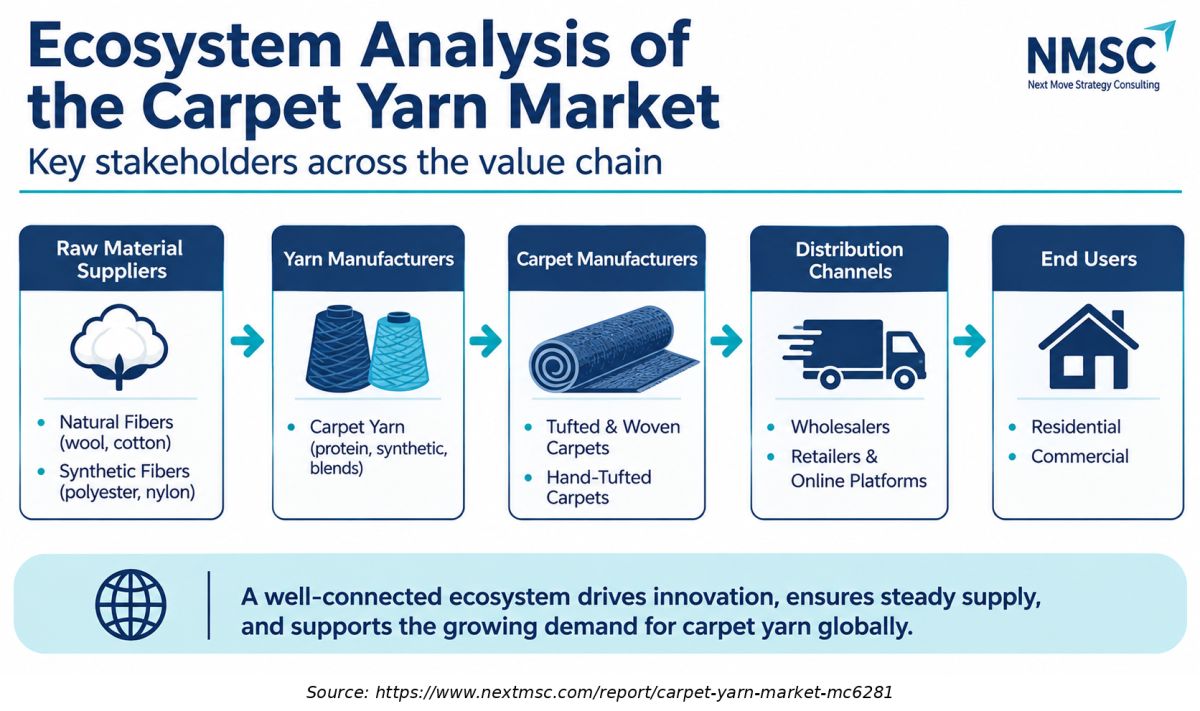
Ecosystem Analysis of the Carpet Yarn Market

The carpet yarn market ecosystem connects raw material suppliers, yarn manufacturers, carpet producers, distribution channels, and end users. Synthetic polymers such as nylon, polyester and polypropylene are converted into carpet yarn, which manufacturers use to produce tufted, woven and other floor-covering products. Yarn manufacturers supply carpet producers directly or through B2B distribution channels, while residential, commercial and automotive carpet production supports downstream demand.

What Does the Carpet Yarn Market Encompass?

The carpet yarn market covers bulked continuous filament and spun yarns made from nylon, polyester and polypropylene that carpet and rug mills tuft, weave or needle into floor coverings. Our scope includes raw white, solution dyed and conventionally dyed yarns sold to residential, commercial and automotive carpet makers. It excludes natural fiber yarns, finished carpet, rugs, backing materials and synthetic turf yarns.
Polyester has gained ground against nylon as extrusion technology improved and recycled PET became widely available, while nylon keeps the premium contract and automotive niches. Producers now offer regenerated nylon and recycled polyester to satisfy stewardship programs such as the California carpet scheme run by CARE, as the circular economy reaches flooring. Single-step, three-ply spinning and flexible colour systems are helping carpet-tile manufacturers shorten production lead times.

Market Drivers & Dynamics

Interactive Dataset
Polyester adoption and recycled PET availability driver +1.2% Asia-Pacific, North America 2026–2030
Recycled and regenerated nylon demand under stewardship rules driver +0.9% North America, Europe 2026–2032
Vehicle production growth and electric vehicle interiors driver +0.8% Asia-Pacific, Europe 2026–2035
Shift to solution dyed yarn in commercial and residential carpet driver +0.7% North America, Europe 2026–2031
Hospitality and commercial renovation cycle driver +0.5% Middle East & Africa, Asia-Pacific 2026–2033
Raw material price volatility in nylon, PET and polypropylene restraint −0.8% Global 2026–2028
Soft housing starts and carpet share loss to hard surface flooring restraint −0.7% North America, Europe 2026–2029
Supplier exits and capacity rationalization restraint −0.4% North America 2026–2027
Source: Next Move Strategy Consulting

Growth Drivers

What Is the Primary Growth Driver in the Carpet Yarn Market?

Recycled content and stewardship requirements are the primary structural driver. California's carpet stewardship program, run through CARE, reached a 38.5% recycling rate in 2024 against a 34% goal. Producers supplying regenerated nylon and recycled polyester may gain specification advantages in commercial tenders where buyers explicitly prioritize verified recycled content and material traceability. NMSC's analysis indicates that wider adoption of carpet collection and recycling initiatives will improve recycled feedstock availability and support demand for recycled-content yarns, although overall margin impacts depend on raw material procurement economics.

How Is Vehicle and Hospitality Demand Driving the Market Growth?

Automotive and hospitality projects add volume beyond housing cycles. Asia-Pacific built 59.2 million vehicles in 2025, over 61% of global output, supporting automotive carpet demand. In our assessment, hospitality renovation in Asia and the Middle East favors solution dyed yarns for corridor and room carpets. We found that these end uses react less to home sales and therefore support the carpet yarn market growth rate of 7.0% from 2026 to 2035.

Growth Inhibitors

What Is Restraining the Carpet Yarn Market?

Weak housing activity and carpet share loss to hard surface flooring restrain demand. U.S. housing starts totaled about 1.36 million in 2025, 0.6% below 2024, and existing home sales were flat. Aquafil reported soft fiber demand across Asia-Pacific in 2025, while Ascend's 2024 exit from the BCF sector reflects broader supplier restructuring across the nylon market. Raw material swings in nylon, polyester and polypropylene add pressure on pricing.

What Are the Growth Opportunities?

Can Chemical Recycling Close the Loop on End-of-Life Carpet?

Chemical recycling of nylon from used carpet turns a disposal cost into feedstock. California collected carpet through 390 sites in 2024, and Aquafil already regenerates nylon waste from fishing nets, fabric scraps and carpet flooring into ECONYL. Nylon yarn producers with regeneration capacity are the main beneficiaries, because commercial buyers increasingly request recycled content. This mechanism strengthens margins while limiting exposure to virgin polymer prices.

Does Polyester Solution Dyed Yarn Offer Volume in Emerging Markets?

Polyester solution dyed yarn offers mills in Asia and the Middle East a lower cost path to colorfast carpet for hotels, offices and apartments. Zhejiang Sitong's 2024 polyester expansion shows Chinese producers positioning for this demand. Growth in travel accommodation, through renovation and new openings, creates repeat orders for commercial carpet yarn. The polyester and commercial segments benefit most from this mechanism.

Can Electric Vehicle Interiors Create a Premium Automotive Niche?

Electric platforms place a premium on cabin quietness, color consistency and recycled content, which favors engineered yarns. B.I.G. Yarns already supplies nylon, polypropylene and polyester solution dyed BCF yarns to automotive carpet makers, and Chinese new energy vehicle output reached 16.63 million units in 2025. Producers offering all three polymers with stable color control can capture premium contracts, benefiting the automotive segment.

Segmentation Analysis

2025 (USD Billion)
2035 (USD Billion)
Nylon 2025: $9.89 Billion | 2035: $17.70 Billion
Nylon
Polyester 2025: $6.99 Billion | 2035: $15.50 Billion
Polyester
Polypropylene 2025: $4.88 Billion | 2035: $8.83 Billion
Polypropylen
Nylon $9.89 Billion $17.70 Billion 6.2%
Polyester $6.99 Billion $15.50 Billion 8.3%
Polypropylene $4.88 Billion $8.83 Billion 6.5%

Which Material Leads the Carpet Yarn Market and Which Is Growing Fastest?

Nylon held the largest share at about 45% of 2026 value, supported by contract, premium residential and automotive specifications that prize resilience. Polyester is the fastest growing material at 8.3% CAGR from 2026 to 2035 as recycled PET, lower cost and improved extrusion lift its volume. Polypropylene grows at 6.5%, anchored by cost sensitive commercial tiles and automotive floors. We observed that nylon polymer integration gives Aquafil and RadiciGroup a cost and traceability edge.

Growth Opportunities

We found that three whitespace opportunities are positioned to generate disproportionate returns for producers and mills.

Can Chemical Recycling Close the Loop on End-of-Life Carpet?

Chemical recycling of nylon from used carpet turns a disposal cost into feedstock. California collected carpet through 390 sites in 2024, and Aquafil already regenerates nylon waste from fishing nets, fabric scraps and carpet flooring into ECONYL. Nylon yarn producers with regeneration capacity are the main beneficiaries, because commercial buyers increasingly request recycled content. This mechanism strengthens margins while limiting exposure to virgin polymer prices.

Does Polyester Solution Dyed Yarn Offer Volume in Emerging Markets?

Polyester solution dyed yarn offers mills in Asia and the Middle East a lower cost path to colorfast carpet for hotels, offices and apartments. Zhejiang Sitong's 2024 polyester expansion shows Chinese producers positioning for this demand. Growth in travel accommodation, through renovation and new openings, creates repeat orders for commercial carpet yarn. The polyester and commercial segments benefit most from this mechanism.

Can Electric Vehicle Interiors Create a Premium Automotive Niche?

Electric platforms place a premium on cabin quietness, color consistency and recycled content, which favors engineered yarns. B.I.G. Yarns already supplies nylon, polypropylene and polyester solution dyed BCF yarns to automotive carpet makers, and Chinese new energy vehicle output reached 16.63 million units in 2025. Producers offering all three polymers with stable color control can capture premium contracts, benefiting the automotive segment.

Regional Outlook

2025 (USD Billion)
2035 (USD Billion)
North Americ
Europe
Asia-Pacific
Middle East
Latin Americ
Region 2025 (USD Billion) 2035 (USD Billion) CAGR (%)
North America $10.0 USD Billion $40.0 USD Billion 9.0%
Europe $17.1 USD Billion $51.1 USD Billion 27.0%
Asia-Pacific $24.2 USD Billion $62.2 USD Billion 25.0%
Middle East & Africa $31.3 USD Billion $73.3 USD Billion 23.0%
Latin America $38.4 USD Billion $84.4 USD Billion 12.0%

Regional data is locked

Unlock complete regional numbers for this market.

Unlock Full Data

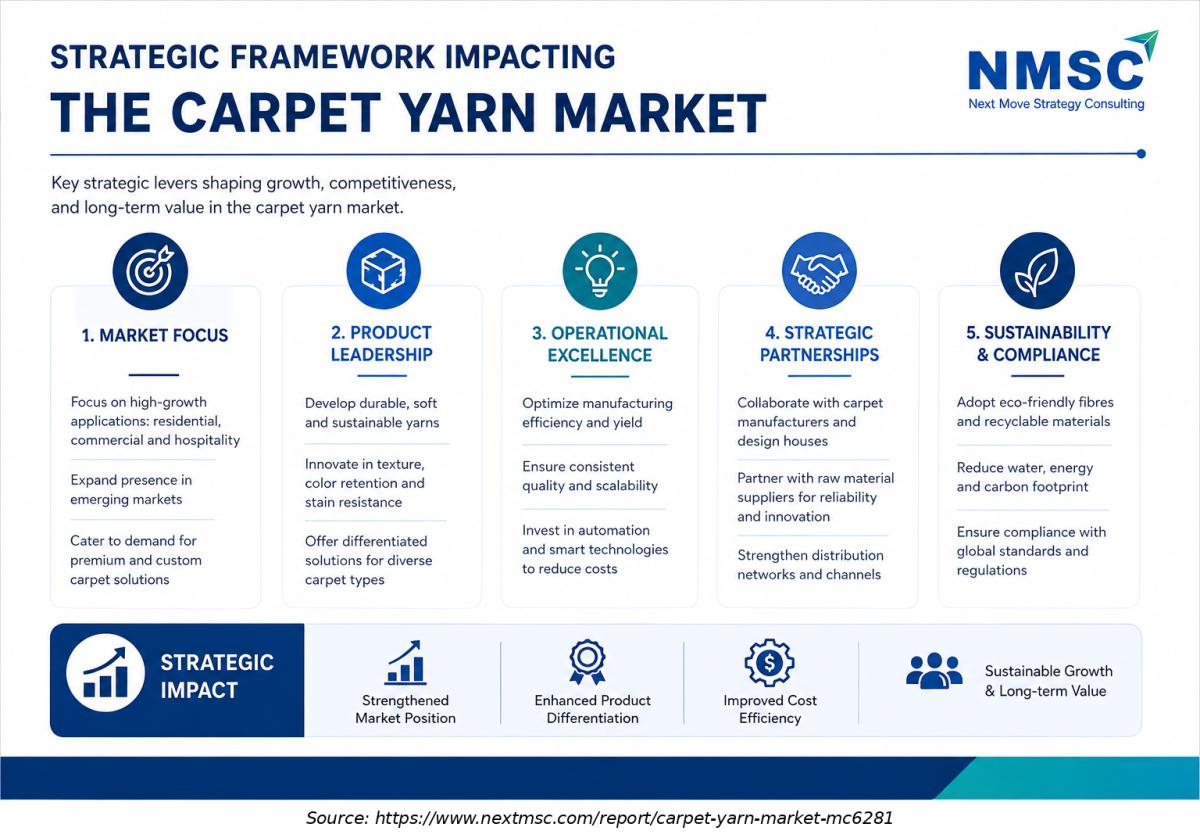
Strategic Framework Impacting the Carpet Yarn Market

Strategic Framework Impacting the Carpet Yarn Market

The infographic presents the key strategic priorities shaping the carpet yarn market, including market focus, product leadership, operational excellence, strategic partnerships, and sustainability. It explains how these priorities strengthen market positioning, encourage product differentiation, improve cost efficiency, and support long-term growth

Competitive Landscape

Our findings suggest that the carpet yarn industry is moderately concentrated among integrated producers, with regional specialists competing on color service and price.

How Do Producers Compete in the Carpet Yarn Industry?

Producers compete on polymer integration, color range, lead time and recycled content rather than on headline price alone. Aquafil, RadiciGroup and Universal Fibers emphasize nylon quality and traceability, while Zhejiang Sitong and AYM Syntex use polyester volume and cost. Capacity additions rely on extrusion machinery, and each new BCF line sharpens competition in a region. During our market evaluation, we noticed that geographic expansion is led by Asian exporters, whose pricing pressures European and Australian buyers.

Which Producer Archetypes Dominate the Carpet Yarn Industry?

Three archetypes dominate. Integrated nylon producers such as Aquafil and RadiciGroup control polymer or regeneration steps and sell to contract and automotive buyers. Diversified groups such as Beaulieu International Group pair yarn with flooring and engineered materials, giving scale across nylon, polypropylene and polyester. Specialists such as Universal Fibers and Asian volume producers differentiate through solution dyed color range, speed and cost. The common differentiation themes are recycled content, color flexibility and supply reliability.

What Innovation and Differentiation Strategies Are Producers Using?

Innovation focuses on recycled and regenerated feedstocks, solution dyed color systems and flexible extrusion. Aquafil lists digitalization, including AI, predictive modelling and automation, as an R&D priority alongside ECONYL regeneration. B.I.G. Yarns offers customized color programs and Eqo yarns, and Sitong runs lines that switch between polyester and polyamide 6. We found that these strategies reduce changeover cost, protect margins and support premium positions with commercial specifiers.

How Active Is M&A in the Carpet Yarn Industry?

M&A has been defensive rather than expansionary. Ascend decided to exit the BCF business in 2024, and Universal Fibers responded by adding nylon 6,6 spinning capacity. Beaulieu International Group sold its European technical textiles business in 2025, while Aquafil launched a cost optimization and reorganization project in August 2025. NMSC's analysis indicates that further rationalization is likelier than large mergers, because capacity is fragmented and margins are thin.

Key Market Players

During our market evaluation, we validated six producers through official company filings, annual reports and press releases.

Aquafil S.p.A. Beaulieu International Group Universal Fiber Systems, LLC RadiciGroup Zhejiang Sitong New Material Technology Co., Ltd. AYM Syntex Limited

Latest Developments

Our assessment indicates that recent developments center on capacity reshaping, recycled content and restructuring.

Date Event
December 2024 Universal Fibers expanded nylon 6,6 spinning capacity after Ascend's decision to exit the BCF business.

Expert Insights

Giulio Bonazzi

Giulio Bonazzi

CEO | Aquafil

"Over the course of our company’s life, we have seen that the market began to demand our products in a more sustainable or circular form, and from that point, we started to develop a new process."

Analyst Interpretation

The statement highlights the growing importance of sustainability and circularity in the synthetic fibre industry. Carpet manufacturers are increasingly exploring recycled and regenerated nylon materials to reduce dependence on virgin raw materials and improve the environmental sustainability of their products. This creates opportunities for carpet yarn manufacturers to expand recycled polyamide production, strengthen material recovery capabilities and develop yarn products that combine durability with environmental benefits.

Investment Opportunities

Where Is Capital Flowing in the Carpet Yarn Industry?

Capital is flowing into capacity that adds color flexibility and recycled content rather than into commodity expansion. B.I.G. Yarns committed EUR 25 million to new BCF lines in France, Zhejiang Sitong added polyester positions, and Universal Fibers invested in nylon 6,6 spinning. We observed that investors favor projects with contracted commercial or automotive volume, because those end uses are less tied to housing cycles and support steadier utilization.

Which Infrastructure Investments Matter Most for Carpet Yarn Producers?

Priority infrastructure includes flexible BCF extrusion lines, solution dyeing and masterbatch systems, twisting and heat setting equipment, and collection and sorting networks for used carpet. Recycling equipment that separates nylon, polyester and polypropylene fibers determines how much regenerated feedstock producers can secure. Our findings suggest that producers combining spinning flexibility with access to post consumer carpet streams will hold the most resilient cost positions through 2035.

How Do ESG Considerations Shape Carpet Yarn Investment?

ESG criteria now influence tenders, financing and specifications. Stewardship programs strengthen carpet collection and recycling infrastructure, while buyers increasingly consider verified recycled content, life-cycle information and waste-recovery partnerships when evaluating carpet yarn suppliers. Energy intensive spinning also faces cost and emissions scrutiny. We found that regenerated nylon and recycled polyester carry the clearest ESG return, which makes them the safest anchors for long dated capital.

Key Benefits for Stakeholders

How Does the Report Benefit Enterprise and Industry Leaders?

Carpet mills, yarn producers and automotive interior suppliers gain segment level forecasts for material, application and coloration, together with regional and country outlooks through 2035. These insights help leaders align capacity, pricing and recycled content programs with demand, and benchmark positioning against six validated producers. A quantified expansion of USD 19.16 Billion between 2026 and 2035 gives planners a firm basis for sourcing and investment decisions.

How Does the Report Support Investors and Financial Analysts?

Investors receive 2025, 2026 and 2035 market estimates and a 7.0% CAGR benchmark, together with the disclosed segment growth rates, including polyester at 8.3% and automotive at 8.9%, to evaluate investment exposure. The competitive analysis and developments table highlight restructuring, capacity additions and portfolio pruning that influence earnings quality. The data also help compare yarn producers within the wider textile value chain.

How Does the Report Help Technology Vendors and Product Teams?

Machinery makers, recyclers, color technology providers and product teams can identify where demand for flexible extrusion, regeneration and solution dyeing is rising fastest. Regional and country tables show where new lines and collection networks are most likely to be commissioned, while the segmentation highlights polymer mixes that product teams should prioritize. We observed that vendors able to support changeovers between polyester and nylon will see strong order flow.

Key Market Segments Evaluated

By Material

  • Nylon
  • Polyester
  • Polypropylene

By Application

  • Residential
  • Commercial
  • Automotive

By Coloration

  • Solution dyed yarn
  • Raw white and dyed yarn

By Region

  • North America 
    • U.S.
    • Canada
    • Mexico
  • Europe 
    • UK
    • Germany
    • France
    • Italy
    • Spain
    • Sweden
    • Denmark
    • Finland
    • Netherlands
    • Rest of Europe
  • Asia-Pacific 
    • China
    • India
    • Japan
    • South Korea
    • Taiwan
    • Indonesia
    • Vietnam
    • Australia
    • Philippines
    • Malaysia
    • Rest of APAC
  • Middle East & Africa 
    • Saudi Arabia
    • UAE
    • Egypt
    • Israel
    • Turkey
    • Nigeria
    • South Africa
    • Rest of MEA
  • Latin America 
    • Brazil
    • Argentina
    • Chile
    • Colombia
    • Rest of LATAM

Conclusion & Recommendations

The market is set to rise from USD 22.87 Billion in 2026 to USD 42.03 Billion in 2035, a gain driven by polyester, solution dyed yarn and automotive carpets. Nylon stays the largest material, yet its share narrows as polyester scales. Asia-Pacific will account for about 40% of 2035 value, and Middle East & Africa will grow fastest. Our assessment indicates that growth is durable but depends on recycled content and cost discipline.

What Are the Strategic Positioning Recommendations?

Producers should combine polymer flexibility with recycled content credentials, because mills increasingly buy both. We recommend securing feedstock access, adding solution dyed capacity near key carpet clusters and building automotive qualification pipelines. Mills should dually source across nylon and polyester to manage price swings, while investors should favor companies with contracted commercial and automotive volumes. During our market evaluation, we noticed that firms combining these steps retained margin through the supplier shifts of 2024 and 2025.

How Strong Is the Investment Attractiveness of the Carpet Yarn Market?

Investment attractiveness is moderate to high and concentrated in polyester, solution dyed yarn and automotive. The 7.0% CAGR is healthy for a maturing industry, yet margins remain thin and capital intensive. Returns improve for producers that control polymer or regeneration processes, serve contract customers and operate flexible extrusion lines. Our findings suggest that selective, contract backed expansion is more attractive than speculative commodity capacity.

What Are the Market Shifts and Key Risks?

Key shifts include polyester gaining share, solution dyed yarn overtaking raw white and dyed yarn by 2035, and supplier exits tightening nylon 6,6 choice. Risks include raw material price swings, soft housing activity, carpet share loss to hard floors and weaker Asian pricing. We found that currency volatility in emerging markets and stewardship compliance costs add execution risk that producers should hedge through diversified polymer portfolios.

What Are the Growth Pathways Through 2035?

Growth pathways run through chemical recycling of end-of-life carpet, polyester solution dyed yarn in hospitality heavy regions and electric vehicle interiors. Asia-Pacific and Middle East & Africa provide the fastest regional expansion, while India and Saudi Arabia lead country growth. NMSC's analysis indicates that producers pursuing two or more of these pathways can outgrow the 7.0% market average.

FAQs

Sources & References

1.

Aquafil Group, FY25 results press release (March 12, 2026)

aquafil.com
2.

Aquafil Group, 1H25 results press release (August 28, 2025)

aquafil.com
3.

Aquafil Group, 1H25 financial results presentation

aquafil.com
4.

Aquafil Group, STAR Conference investor presentation (March 25, 2026)

aquafil.com
5.

Aquafil Group, 2026 guidance presentation (Borsa Italiana regulated storage)

emarketstorage.it
6.

Beaulieu International Group, B.I.G. Yarns investment press release (April 28, 2025)

bintg.com
7.

Beaulieu International Group, B.I.G. Yarns press release (May 16, 2024)

pressreleasefinder.com/amp/BIGPR070/en
8.

Universal Fiber Systems, LLC, portfolio page (HIG Capital)

hig.com
9.

Universal Fibers, press release (December 19, 2024), reproduced by Textile World

textileworld.com
10.

RadiciGroup, Radifloor BCF yarn documentation

radicigroup.com
11.

AYM Syntex Limited, Annual Report FY2024–25

aymsyntex.com
12.

Oerlikon Polymer Processing Solutions, Zhejiang Sitong press release (October 24, 2024)

ngw-live.oerlikon.com
13.

CalRecycle, Carpet Stewardship Program results

calrecycle.ca.gov/carpet/results
14.

OICA, 2025 global vehicle production and sales

oica.net
15.

U.S. Census Bureau and HUD, New Residential Construction, December 2025

census.gov
16.

Mohawk Industries, Inc., Form 10-K for fiscal year 2025 (SEC)

sec.gov

About the Author

Mayurima Roy

Mayurima Roy

Mayurima Roy is Research Analyst at Next Move Strategy Consulting, where she has spent 4 years working across the firm's full industry coverage rather than a single fixed vertical. Her work centers on structured research, ongoing trend tracking, competitive assessment, and insight-led content development, translating complex market data into clear, decision-ready narratives that support informed client decision-making across diverse global industries, market sectors, and world regions every day.

About the Reviewer

Supradip Baul

Supradip Baul

Supradip Baul is an accomplished business consultant and strategist with over a decade of rich experience in market intelligence, strategy, technology, and business transformation. His work has included rigorous qualitative and quantitative analysis across multiple industries, helping clients shape investment decisions and long-term roadmaps. Earlier in his career, he was associated with Gartner, where he contributed to industry-leading reports and market share analyses. He has worked with leading global companies and holds an MBA with a dual specialization in Marketing and Finance.

Download Free Sample

Ross J Mckenzie

ROSS J MCKENZIE

Business Insight Manager

Staysure Group

“Next MSC have been incredibly helpful in providing detailed & robust information on our market, alongside quantifying growth by different segments. The process to procure was simple and easy, with sample reports and regular contact to ensure we had what we needed. Succinct detail on their sources & methodologies is also greatly received, allowing transparency in this respect helps build trust in the detail you pay for. Joseph in particular was fantastic, and helped ensure efficient provision of the insight pack – thank you NMSC!”.

Rishabh Jogani

RISHABH JOGANI

Strategy Analyst

Accenture Japan

We are incredibly impressed with the market report on the real estate market in India provided by Next Move Strategy Consulting. The report was thorough, insightful, and well-structured, offering deep analysis and actionable recommendations. It not only captured the current trends and dynamics but also provided a forward-looking perspective that has been invaluable for our strategic planning. Their team demonstrated exceptional professionalism, attention to detail, and a profound understanding of the industry. The data-driven insights and clarity of presentation exceeded our expectations, making complex market trends easy to understand. We highly recommend Next Move Strategy Consulting to anyone looking for reliable and comprehensive market research services. Their expertise has given us the confidence to navigate the complexities of the Indian real estate market with clarity and foresight.

Gustaf Hummel Burstrom

GUSTAF HUMMEL BURSTROM

Founder

Revline Tools AB

Joseph and the team at Next Move Strategy Consulting have been excellent to work with, in supplying us with relevant market data and forecasts for our specific category. We had some special requirements and they were able to do a custom package to suit our needs. We would definitely recommend them to any other company needing market data and forecasts

Semih Kavaklioglu

SEMIH KAVAKLIOGLU

Co-Founder & Sales Manager

Decortie

I work a lot in the marketing industry and I know that research is an essential part of any campaign. I have used Market research reports for my own products and I found them to be very informative and well-researched. The team here produces insightful reports for a good price

Nishant Awate

NISHANT AWATE

Business Development Global Sales

Zehnder Group Deutschland GmbH

Our experience working with Next Move Strategy Consulting was positive. The team was responsive, professional, and open to incorporating our specific requirements throughout the project. The India AHU market study was comprehensive and well structured, covering market value and volume forecasts, product and application segments, and key industry trends. The inclusion of both AHU and residential MVHR market insights made the study particularly relevant for our strategic market assessment. Overall, the report provides a solid foundation for evaluating market potential, identifying priority segments, and supporting business-development decisions in India.

Custom Market Research Services

We will customize the research for you if the listed report does not fully match your requirements.

Get 30% Free Customization

Select License

This website uses cookies to ensure you get the best experience on our website. Learn more

✖