Chile Warehouse ASRS Market By System Type & Core Technology{Crane-Based ASRS (Unit-Load, Mini-Load), Shuttle-Based ASRS, Carousel Systems, and Others, By Operational Mode (Goods-to-Person, Person-to-Goods, Fully Automated), By Deployment Scenario (Greenfield, Brownfield Expansion, and Others), By Commercial Model (CapEx, Leasing, As-a-Service), and By Payload & Load Carrier (Micro-Load, Mini-Load, and Others),– Opportunity Analysis & Forecast, 2025–2035
Industry: Construction & Manufacturing | Latest Edition: September 30, 2026 | No of Pages: 278 | No. of Tables: 150 | No. of Figures: 136 | Format: PDF | Report Code: CM5756
Chile Warehouse ASRS Market Size & Forecast
|
Parameters |
Details |
|
Market Size in 2026 |
USD 32.9 Million |
|
Revenue Forecast in 2035 |
USD 98.2 Million |
|
Growth Rate |
CAGR of 12.91% from 2026 to 2035 |
|
Market Volume in 2026 |
117 units |
|
Volume Forecast in 2035 |
373 units |
|
Growth Rate |
CAGR of 13.77% from 2026 to 2035 |
|
Analysis Period |
2025–2035 |
|
Base Year Considered |
2025 |
|
Forecast Period |
2026–2035 |
|
Market Size Estimation |
Million (USD) |
|
Companies Profiled |
12 |
|
Market Share |
Available for 10 companies |
Industry Outlook
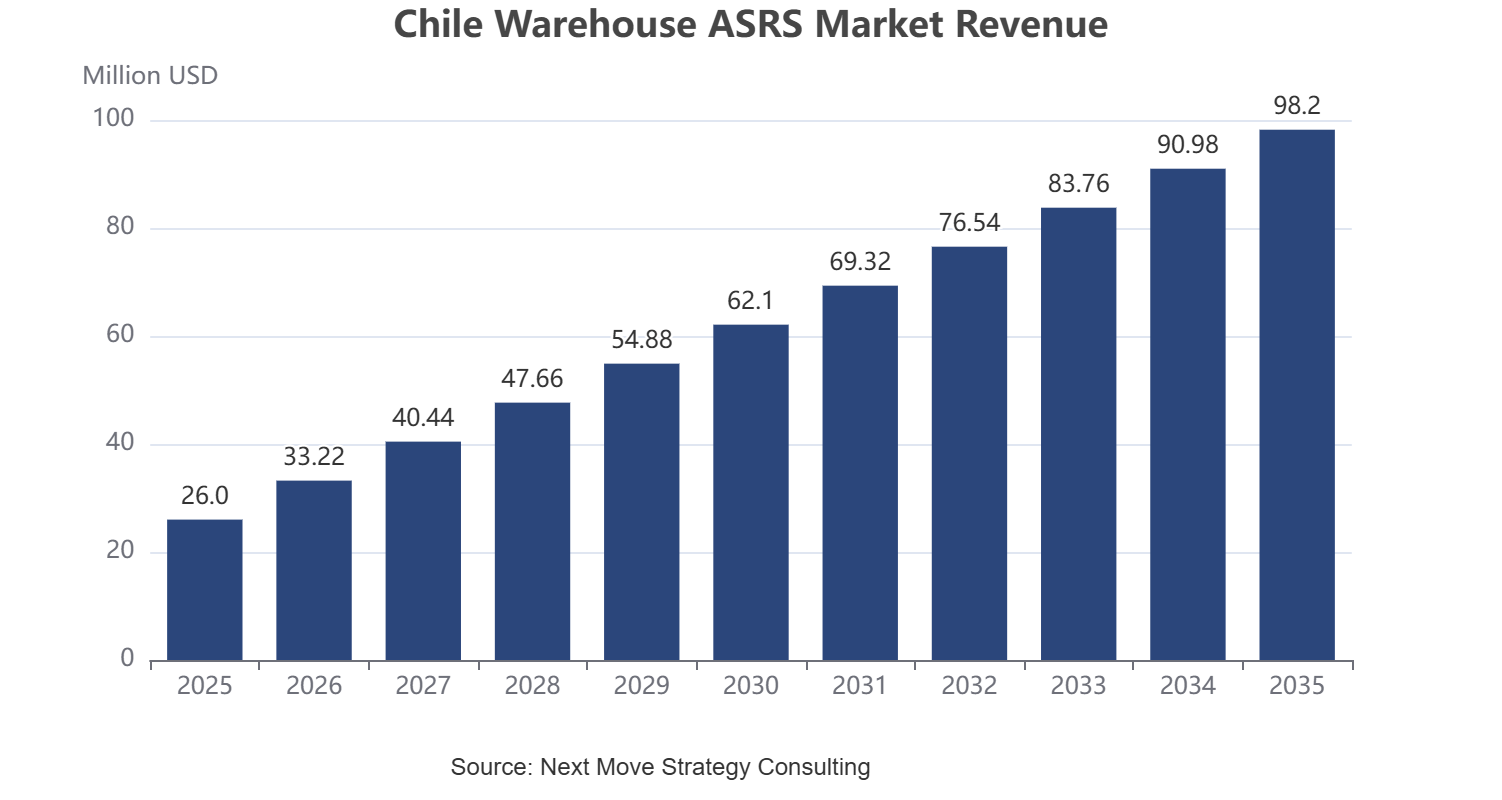
The Chile Warehouse ASRS Market size was valued at USD 26.0 Million in 2025 and reached USD 32.9 Million by 2026. Looking ahead, the industry is projected to expand significantly, reaching USD 98.2 Million by 2035, registering a CAGR of 12.91% from 2026 to 2035. In terms of volume, the market recorded 90 units in 2025, with forecasts indicating growth to 117 units by 2026 and further to 373 units by 2035, reflecting a CAGR of 13.77% over the same period.
Porter’s Five Forces Analysis of Chile Warehouse ASRS Industry
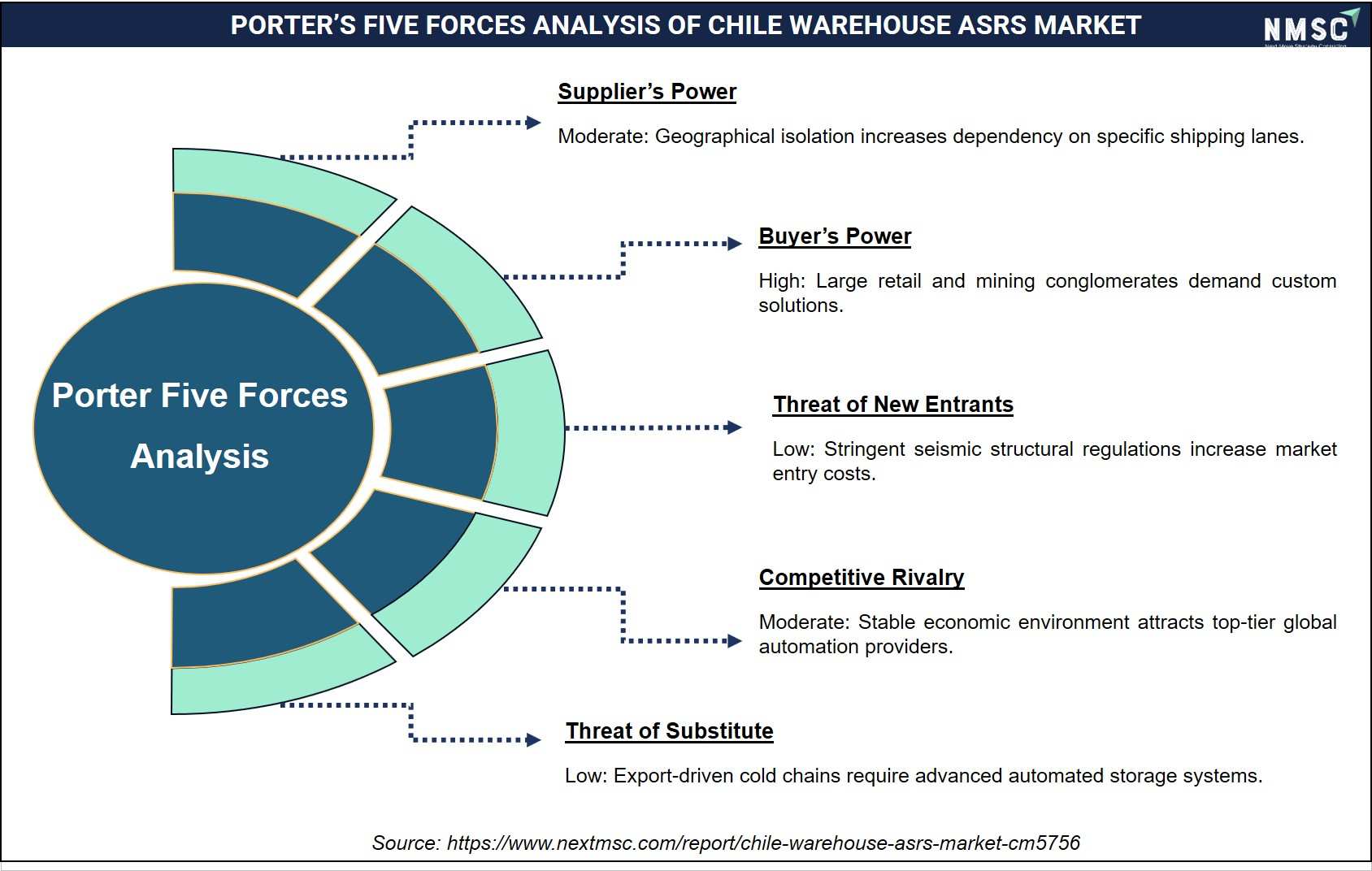
Based on our industry analysis, we found that the Chile Warehouse ASRS Market reflects moderate supplier influence due to geographical isolation and dependence on specialized international shipping routes for automation equipment sourcing. Large retail enterprises and mining conglomerates maintain strong buyer bargaining power by demanding customized warehouse automation solutions. Strict seismic structural regulations increase entry barriers for newer participants, limiting rapid market expansion. Additionally, Chile’s stable economic environment continues attracting global automation providers, intensifying competitive rivalry. However, export-oriented cold chain logistics operations reduce substitution threats by increasing reliance on advanced automated storage infrastructure.
What are the Key Market Drivers, Breakthroughs, and Investment Opportunities that will Shape the Chile Warehouse ASRS Market in the Next Decade?
Growth Catalyst & Risk Assessment Matrix
|
Drivers / Trends / Restraints |
(+/–) % Impact on CAGR Forecast |
Geographic Relevance |
Impact Timeline |
|
Expansion of mining export logistics is accelerating deployment of automated spare-parts and equipment storage infrastructure across industrial distribution environments |
+1.4% |
Antofagasta, Santiago, Northern Chile mining corridors |
Medium term (2–5 years) |
|
Advanced port infrastructure supporting trade-driven logistics development is strengthening demand for automated storage systems across port-linked fulfilment operations |
+1.3% |
Valparaíso, San Antonio Port, Biobío Region |
Medium term (2–5 years) |
|
Expansion of pharmaceutical distribution infrastructure is increasing integration of ASRS technologies across regulated healthcare logistics operations |
+1.2% |
Santiago Metropolitan Region, Valparaíso, Concepción |
Medium term (2–5 years) |
|
Smaller population size and comparatively moderate fulfilment volumes are limiting financial justification for mega-scale ASRS deployment activities |
–1.1% |
Southern Chile, secondary logistics corridors, regional fulfilment hubs |
Medium term (2–5 years) |
|
Deployment of automated cold-chain storage for seafood and perishable exports is creating long-term opportunities for intelligent ASRS deployment |
+1.3% |
Puerto Montt, Valparaíso, Southern export logistics corridors |
Medium to long term (3–7 years) |
Based on our market evaluation, we noticed that the Chile Warehouse ASRS Market is witnessing steady growth driven by expansion of mining export logistics, advanced port infrastructure development, and rising pharmaceutical distribution activities across the country. Increasing movement of industrial equipment, export-linked inventory, and regulated healthcare products is accelerating deployment of automated storage and retrieval systems throughout trade-oriented warehouse environments. Meanwhile, relatively smaller population size and moderate fulfilment volumes continue creating financial challenges for broader ASRS implementation across selected logistics operations. Furthermore, rising deployment of automated cold-chain storage infrastructure for seafood and perishable exports is creating long-term growth opportunities for advanced warehouse automation technologies across Chile.
Growth Drivers:
How Is Expansion of Mining Export Logistics Driving the Chile Warehouse ASRS Market Growth?
Through our Latin American industrial logistics assessment, we observed that Chile’s strong mining export sector is significantly driving market growth by expanding demand for automated spare-parts and equipment storage infrastructure. Rising movement of industrial machinery components, maintenance inventory, and export-linked mining supplies is strengthening demand for intelligent storage systems capable of supporting accurate inventory coordination efficiently. ASRS technologies improve storage organization, retrieval precision, and inventory visibility across mining-linked distribution environments. Consequently, industrial operators are accelerating automation integration to strengthen operational continuity and improve supply chain coordination throughout export-oriented logistics networks.
How Is Advanced Port Infrastructure Fueling the Chile Warehouse ASRS Market Expansion?
Advanced port infrastructure supporting trade-driven logistics development is fueling market expansion across Chile’s warehousing sector. Our findings suggest that rising cargo movement and expanding export distribution operations are increasing demand for automated storage infrastructure capable of supporting synchronized inventory handling efficiently. ASRS technologies improve storage density, retrieval accuracy, and operational visibility across port-linked fulfilment environments. Furthermore, logistics operators are broadening automation implementation to strengthen cargo coordination and improve product movement efficiency throughout regional trade supply chains. This transition is supporting wider integration of advanced warehouse automation systems across logistics ecosystems.
How Is Expansion of Pharmaceutical Distribution Infrastructure Driving the Chile Warehouse ASRS Market Growth?
Based on NMSC’s research, we found that expansion of pharmaceutical distribution infrastructure is substantially driving market growth across Chile’s warehousing sector. Rising movement of regulated healthcare products and temperature-sensitive medicines is growing adoption of automated storage environments capable of supporting precise inventory handling and traceability operations. ASRS technologies improve retrieval precision, storage organization, and inventory visibility across pharmaceutical fulfilment facilities. Additionally, healthcare distributors are accelerating automation integration to strengthen operational compliance and improve fulfilment responsiveness throughout medical supply chains. As a result, healthcare logistics modernization is reinforcing long-term implementation of intelligent storage technologies.
Growth Restraint:
How Is Smaller Population Size Acting as a Constraint on Large-Scale Fulfilment Infrastructure Development in the Market?
Relatively small population size limiting large-scale fulfilment infrastructure continues acting as a constraint for the market across Chile’s logistics sector. In our observation, we found that comparatively moderate fulfilment volumes and lower warehouse throughput reduce immediate financial justification for mega-scale ASRS deployment activities. High implementation expenditure and extended return realization periods further lower investment flexibility among logistics operators managing moderate inventory movement volumes. In addition, several distribution environments continue prioritizing incremental warehouse modernization instead of extensive automation transitions. Consequently, moderate market scale continues restricting broader implementation of advanced ASRS technologies throughout regional logistics ecosystems.
Growth Opportunity:
How Is Deployment of Automated Cold-Chain Storage for Seafood and Perishable Exports Unlocking New Growth Opportunities for the Market?
Through NMSC’s assessment, we found that deployment of automated cold-chain storage for seafood and perishable exports is unlocking new growth opportunities for the market across Chile’s logistics sector. Rising international demand for temperature-sensitive export products is multiplying adoption of intelligent storage systems capable of supporting traceable inventory handling and refrigerated fulfilment operations efficiently. ASRS technologies improve retrieval accuracy, storage optimization, and inventory visibility across cold-chain distribution facilities. Additionally, exporters are accelerating automation integration to strengthen product quality management and improve operational continuity throughout export-oriented supply chains. Consequently, cold-chain logistics modernization is creating long-term implementation opportunities for advanced storage technologies.
How is the Chile Warehouse ASRS Market segmented in this report, and what are the key insights from the segmentation analysis?
By Primary System Application Insights
Is Primary System Application Segmentation Supporting Warehouse Automation Development in the Chile Warehouse ASRS Market?
Based on primary system application, the market is segmented into bulk storage & pallet handling, order fulfillment & piece picking, kitting & assembly line sequencing, work-in-process (WIP) buffering, sortation & consolidation, and automated dispensing & issuing.
Based on our analysis, we observed that bulk storage & pallet handling applications are supporting organized inventory movement across logistics facilities, industrial warehouses, and distribution centers throughout Chile. Order fulfillment & piece picking systems continue assisting retail and e-commerce operations requiring efficient order processing and inventory retrieval coordination. Kitting & assembly line sequencing and work-in-process buffering applications are also contributing to production continuity across manufacturing environments requiring synchronized material flow operations. Furthermore, sortation & consolidation and automated dispensing & issuing systems are strengthening warehouse coordination and inventory accessibility across diverse storage facilities throughout the country.
By Payload & Load Carrier Insights
Is Payload & Load Carrier Segmentation Supporting Material Handling Efficiency in the Chile Warehouse ASRS Market?
Based on payload & load carrier, the market is segmented into micro-load (< 30 kg), mini-load (30 kg – 500 kg), unit-load (500 kg – 2,000 kg), and heavy unit-load (> 2,000 kg).
Based on our evaluation, we identified that micro-load systems are supporting compact inventory storage and precision handling operations across healthcare, electronics, and small-component warehouse facilities throughout Chile. Mini-load systems continue assisting carton handling and medium-capacity inventory movement across retail, wholesale, and distribution environments. Unit-load systems are also being integrated into logistics centers and industrial warehouses requiring palletized storage and organized material flow coordination. Consequently, ongoing warehouse modernization initiatives and focus on inventory efficiency are strengthening adoption of load-specific ASRS configurations across the country.
Competitive Landscape
The Chile Warehouse ASRS Market is characterised by a competitive and steadily evolving structure, supported by the presence of warehouse automation providers, robotics companies, and intralogistics solution developers. Market growth is being driven by boosting logistics infrastructure investments, expanding warehouse digitalisation activities, and rising demand for automated material handling systems across retail, food & beverage, mining, and logistics sectors. In addition, smart warehouse technologies and AI-enabled fulfilment systems are strengthening operational efficiency and supporting broader market expansion.
Strategic Developments:
-
March 2026 – Swisslog launched AgileStore, a 4-way pallet shuttle ASRS system designed for high-density warehouse operations. Developed in partnership with Eurofork, the solution supports multi-directional pallet movement, handles loads up to 1,500 kg, and is optimized for cold-chain food and beverage distribution environments.
-
February 2026 – Alstef Chile Limitada (Alstef Group) expanded its technical innovation roadmap by officially launching an AI-powered Autonomous Industrial Vehicle (AIV). The newly deployed mechatronic solution utilizes mobile robotics and deep machine-learning vision models to navigate dynamic warehouse layouts, designed to improve workplace safety, material routing accuracy, and integration alongside physical ASRS structures.
Key Players of the Chile Warehouse ASRS Market
-
Dematic Chile Limitada
-
Mecalux Chile Limitada
-
KNAPP Chile Limitada
-
Toyota Material Handling Chile Limitada
-
BEUMER Group Chile Limitada
-
Alstef Chile Limitada
-
E80 Group Chile Limitada
-
Jungheinrich Chile Limitada
-
Hänel Chile Limitada
-
SSI Schäfer Chile Limitada
-
Swisslog Chile Limitada
-
Kardex Chile Limitada
Based on NMSC’s research, we found that competitive dynamics are increasingly shaped by automation integration expertise, warehouse optimisation capabilities, and scalable fulfilment technologies. Key companies such as Dematic Chile Limitada, Mecalux Chile Limitada, KNAPP Chile Limitada, Toyota Material Handling Chile Limitada, BEUMER Group Chile Limitada, Alstef Chile Limitada, E80 Group Chile Limitada, Jungheinrich Chile Limitada, Hänel Chile Limitada, SSI Schäfer Chile Limitada, Swisslog Chile Limitada, and Kardex Chile Limitada are strengthening their market presence through robotics integration, advanced storage technologies, and warehouse automation innovations. Consequently, the competitive landscape is advancing toward a more intelligent and automation-focused structure in the Chile Warehouse ASRS Market.
Pain Point Analysis of the Chile Warehouse ASRS Industry
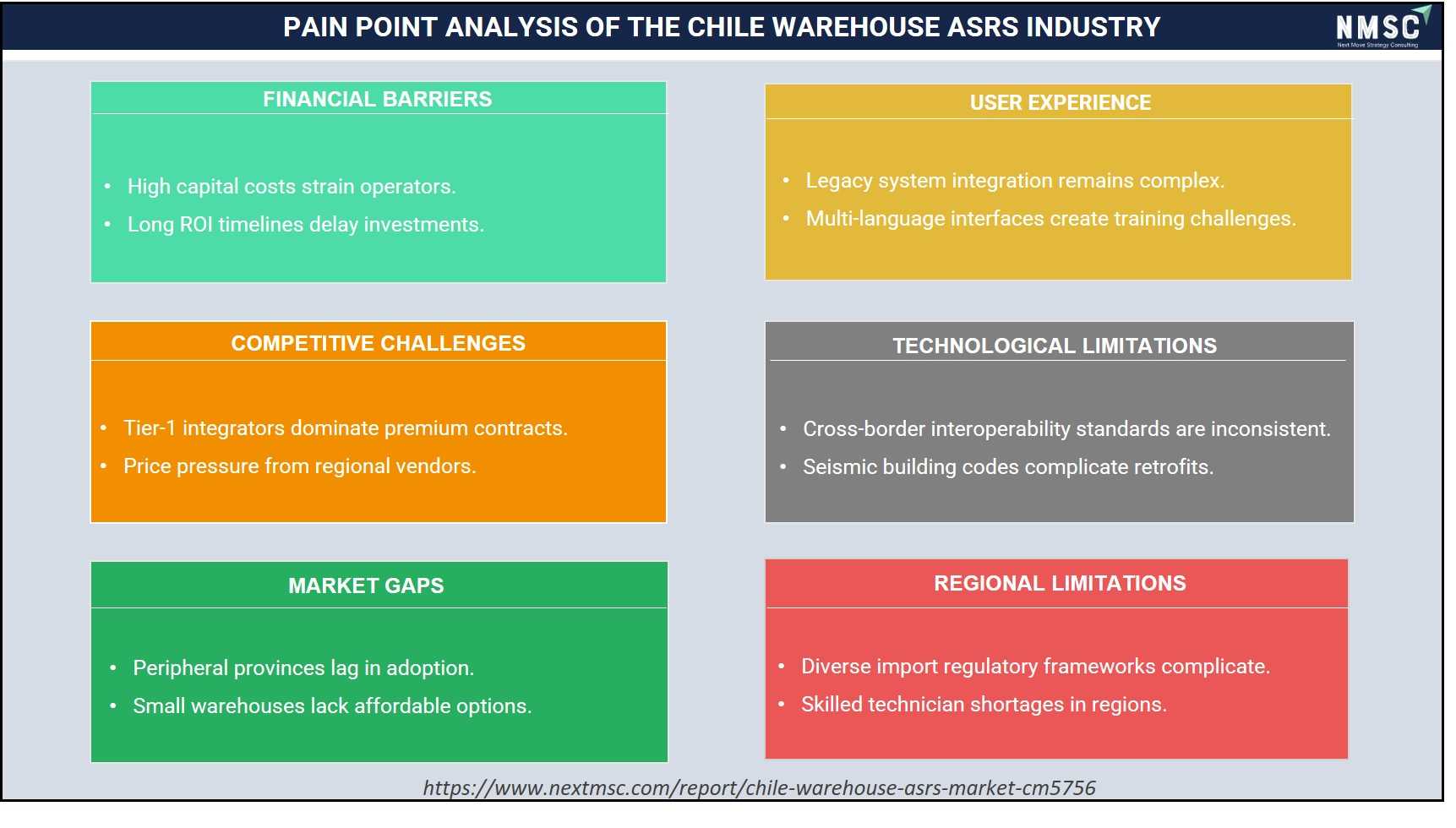
Based on our market assessment, we identified that the Chile Warehouse ASRS Industry experiences several operational and deployment-related challenges affecting broader automation adoption. High implementation costs and extended ROI timelines continue limiting investment flexibility among warehouse operators. Furthermore, seismic building code requirements complicate retrofit projects and increase infrastructure compliance expenses. Tier-1 global integrators dominate premium automation contracts, placing pricing pressure on regional vendors. Peripheral regions continue lagging in automation adoption due to affordability limitations and technician shortages, while diverse import regulations and interoperability inconsistencies create additional deployment complexity throughout Chile’s logistics sector.
Key Segments
By System Type & Core Technology
-
Fixed-Path / Rail-Based Systems
-
Crane-Based ASRS
-
Unit-Load Crane ASRS
-
Mini-Load Crane ASRS
-
-
Shuttle-Based ASRS
-
Tier-to-Tier Shuttle Systems
-
Multi-Level Autonomous Shuttle Systems
-
-
-
Fixed-Location Rotary Systems
-
Vertical Carousel
-
Horizontal Carousel
-
-
Fixed-Path Vertical Systems
-
Cartesian / Gantry-Based Robotic Systems
-
Cube-Based Storage Systems
-
Gantry-Based 3D ASRS
-
-
Free-Path Mobile Systems
-
Micro-Storage & Dispensing Systems
-
Automated Dispensing Cabinets
-
Vertical Buffer Modules / Micro-Part Dispensers
-
By Operational Mode
-
Goods-to-Person (G2P)
-
Person-to-Goods (P2G)
-
Fully Automated (No-Human-in-Loop)
By Primary System Application
-
Bulk Storage & Pallet Handling
-
Order Fulfillment & Piece Picking
-
Kitting & Assembly Line Sequencing
-
Work-in-Process (WIP) Buffering
-
Sortation & Consolidation
-
Automated Dispensing & Issuing
By Deployment Scenario
-
Greenfield Installation
-
Brownfield Expansion
-
Brownfield Modernization
-
Brownfield Replacement
By Commercial Model
-
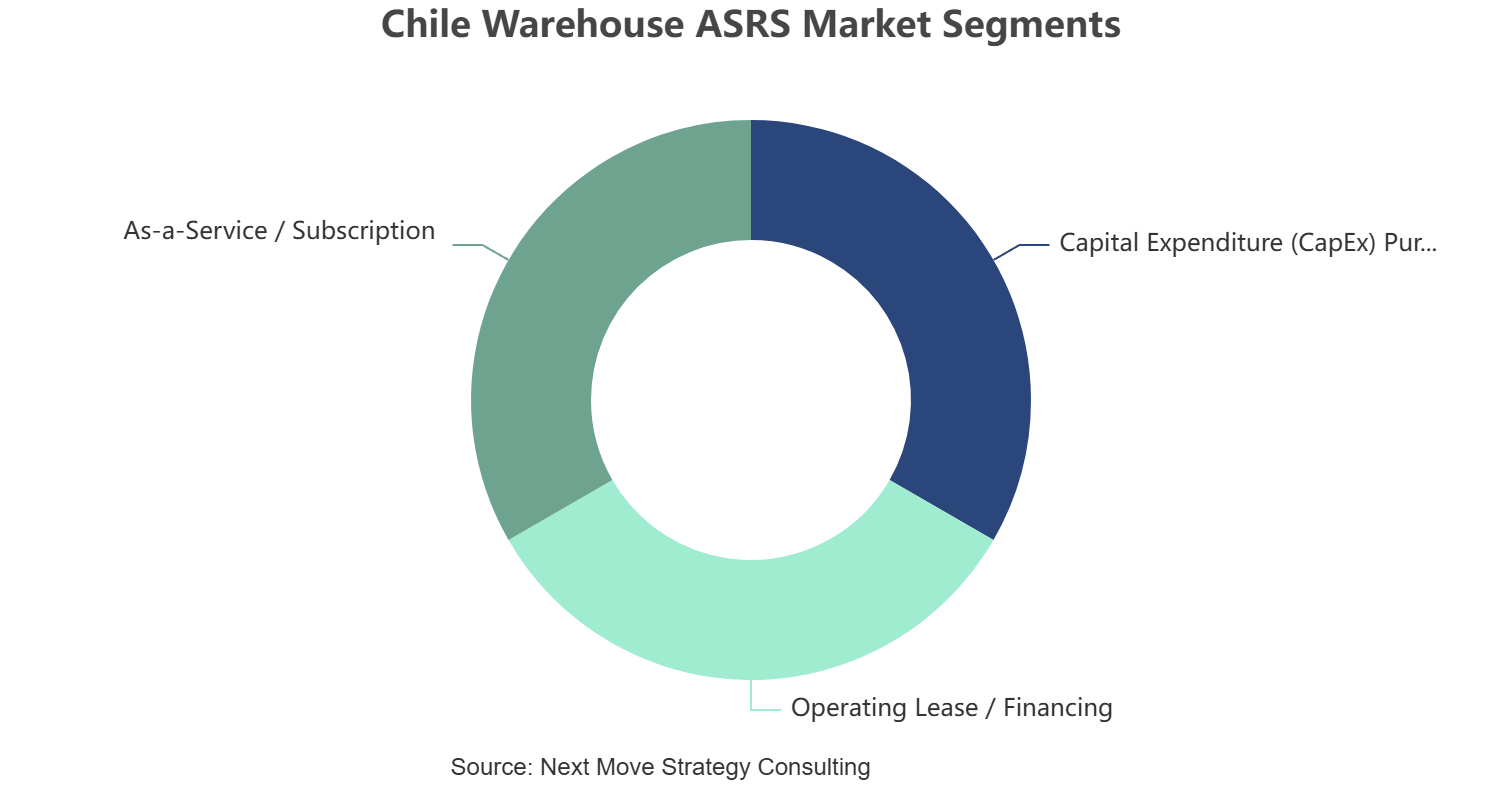
Capital Expenditure (CapEx) Purchase
-
Operating Lease / Financing
-
As-a-Service / Subscription
By Payload & Load Carrier
-
Micro-Load (< 30 kg)
-
Mini-Load (30 kg – 500 kg)
-
Unit-Load (500 kg – 2,000 kg)
-
Heavy Unit-Load (> 2,000 kg)
By End-User Vertical Industry
-
Discrete Manufacturing
-
Automotive & Aerospace
-
Industrial Machinery & Equipment
-
Electronics & Semiconductors
-
-
Process Manufacturing
-
Pharmaceuticals & Biotechnology
-
Food & Beverage
-
Chemicals
-
-
Distribution & Logistics
-
Third-Party Logistics (3PL/4PL)
-
Parcel & Postal
-
Wholesale Distribution
-
-
Retail & E-Commerce
-
Omnichannel Retailer Fulfillment
-
Pure-Play E-Commerce Fulfillment
-
Grocery & Superstore
-
-
Healthcare Delivery
-
Hospitals & Care Facilities
-
Medical Device Distribution
-
-
Other End Users
Key Benefits for Stakeholders:
Next Move Strategy Consulting (NMSC) presents a comprehensive analysis of the Chile Warehouse ASRS Market, covering historical developments from 2020 to 2025 and providing forward-looking forecasts through 2035. Our study evaluates the Chile Warehouse ASRS Market at national and regional levels, delivering quantitative outlooks alongside qualitative insights into warehouse automation adoption, logistics infrastructure modernization, e-commerce fulfilment expansion, and smart inventory management technologies across major industries.
The Chile Warehouse ASRS Market delivers measurable value to a diverse stakeholder ecosystem. Investors benefit from increasing investments in automated warehousing infrastructure, logistics automation technologies, and advanced fulfilment systems supported by expanding retail logistics and regional trade activities. Warehouse operators and third-party logistics providers benefit from improved storage optimization, faster order fulfilment efficiency, labour productivity enhancements, and enhanced inventory visibility through ASRS deployment. Automation technology providers, robotics manufacturers, and software developers benefit from rising demand for automated retrieval systems, warehouse management platforms, and intelligent material handling technologies across retail, food & beverage, healthcare, manufacturing, and e-commerce warehousing facilities.
|
Parameters |
Details |
|
Customization Scope |
Free customization (equivalent to up to 80 analyst-working hours) after purchase. |
|
Pricing and Purchase Options |
Avail customized purchase options to meet your exact research needs. |
|
Approach |
In-depth primary and secondary research; proprietary databases; rigorous quality control and validation measures. |
|
Analytical Tools |
Porter’s Five Forces, SWOT, value chain, and Harvey ball analysis to assess competitive intensity, stakeholder roles, and relative impact of key factors.
|
About the Author
 Saista Faiyaz
— Saista Faiyaz is Research Associate at Next Move Strategy Consulting, where she has covered consumer markets and healthcare technologies for 3 years. Her work includes primary interview review, secondary-source validation, market sizing, and structured analysis of company and industry data. She supports research by comparing evidence across sources, organizing findings into market narratives, and documenting assumptions used in analysis. Her scope includes cross-market benchmarking, and reports.
Saista Faiyaz
— Saista Faiyaz is Research Associate at Next Move Strategy Consulting, where she has covered consumer markets and healthcare technologies for 3 years. Her work includes primary interview review, secondary-source validation, market sizing, and structured analysis of company and industry data. She supports research by comparing evidence across sources, organizing findings into market narratives, and documenting assumptions used in analysis. Her scope includes cross-market benchmarking, and reports.
About the Reviewer
 Supradip Baul
— Supradip Baul is an accomplished business consultant and strategist with over a decade of rich experience in market intelligence, strategy, technology, and business transformation. His work has included rigorous qualitative and quantitative analysis across multiple industries, helping clients shape investment decisions and long-term roadmaps. Earlier in his career, he was associated with Gartner, where he contributed to industry-leading reports and market share analyses. He has worked with leading global companies and holds an MBA with a dual specialization in Marketing and Finance.
Supradip Baul
— Supradip Baul is an accomplished business consultant and strategist with over a decade of rich experience in market intelligence, strategy, technology, and business transformation. His work has included rigorous qualitative and quantitative analysis across multiple industries, helping clients shape investment decisions and long-term roadmaps. Earlier in his career, he was associated with Gartner, where he contributed to industry-leading reports and market share analyses. He has worked with leading global companies and holds an MBA with a dual specialization in Marketing and Finance.
At Next Move Strategy Consulting, we understand that insightful market research is the cornerstone of successful business decisions. That's why we employ a robust and multifaceted approach, combining various methodologies to deliver the most accurate and actionable data for our clients.

Research Landscape
We navigate the world of research with two primary approaches:
Qualitative Approach
Our qualitative research methodologies involve immersive techniques such as in-depth interviews, focus groups, and observational studies. By engaging directly with individuals and stakeholders, we uncover valuable insights that quantitative data alone may overlook.

Quantitative Research
In tandem with qualitative methodologies, NMSC leverages the power of Quantitative Research to provide a robust foundation of numerical insights. Through systematic data collection and analysis, we quantify patterns, preferences, and market trends, offering a comprehensive view of the business landscape.
Our quantitative research approach employs diverse tools, including surveys, experiments, and statistical modelling. These methodologies enable us to gather data from a large and representative sample, ensuring the statistical significance of our findings. By employing structured questionnaires and standardized data collection methods, we guarantee the reliability and validity of the information we present to our clients.
Quantitative research is particularly effective in measuring the prevalence of trends, assessing market size, and gauging the impact of various factors on consumer behavior. The numerical precision attained through this approach equips our clients with actionable insights, facilitating data-driven decision-making and strategy formulation.


Our Specialized Toolbox for Industry-Specific Market Research
We deploy a specialized arsenal of techniques tailored to meet your unique requirements. Here's a glimpse into our comprehensive toolbox:

Information Procurement
The stage entails acquiring market data or relevant information through various sources and methodologies.


Market Research Approach
We utilize both top-down and bottom-up approaches in market research analysis to achieve a comprehensive understanding of the market dynamics, leveraging the broad perspective of industry trends and macroeconomic factors alongside detailed insights from specific segments and individual companies.

Porters Five Forces Analysis
We conduct Porter's Five Forces analysis to evaluate the competitive landscape of an industry, providing us with insights into factors that affect profitability and strategic positioning.

SWOT Analysis

Forecasting
We utilize a forecasting model to predict future consumption by considering parameters like population, economics, regulations, market competition, drivers, constraints, technology, and pricing. We also employ statistical techniques such as multilinear regression, exponential smoothing, moving average, ARIMA, and Monte Carlo simulations for accurate predictions. In econometric forecasting, we analyzed short-term and long-term event impacts, attributing values based on regulatory frameworks, economic factors, and market events.





 Speak to Our Analyst