China Drone Market By Component (Hardware, Software, and Services), By Platform Type (Multi-Rotor, Fixed-Wing, Hybrid VTOL, and Others), By Autonomy Level (Remotely Piloted, Assisted, Advanced, and Fully Autonomous), By Maximum Take-off Weight {Nano (<250 g), Micro (250 g–2 kg), Small (>2 kg–25 kg), and Others}, By End-User (Consumer Drone, Commercial & Industrial Drone, Government & Public Safety Drone, and Military Drone) – Analysis & Forecast, 2025–2035
Industry: Aerospace & Defense | Lastest Edition: August 12, 2026 | No of Pages: 266 | No. of Tables: 140 | No. of Figures: 128 | Format: PDF | Report Code : AD3969
China Drone Market Size & Forecast
|
Parameters |
Details |
|
Market Size in 2025 |
USD 8.31 Billion |
|
Market Size in 2026 |
USD 9.72 Billion |
|
Revenue Forecast in 2035 |
USD 23.56 Billion |
|
Market Size Growth Rate |
CAGR of 10.33% from 2026 to 2035 |
|
Market Volume in 2025 |
475 Thousand Units |
|
Market Volume in 2026 |
580 Thousand Units |
|
Volume Forecast in 2035 |
1,902 Thousand Units |
|
Market Volume Growth Rate |
CAGR of 14.11% from 2026 to 2035 |
|
Analysis Period |
2025–2035 |
|
Base Year Considered |
2025 |
|
Forecast Period |
2026–2035 |
|
Market Size Estimation |
Billion (USD) |
|
Companies Profiled |
15 |
|
Market Share |
Available for 10 companies |
Industry Outlook
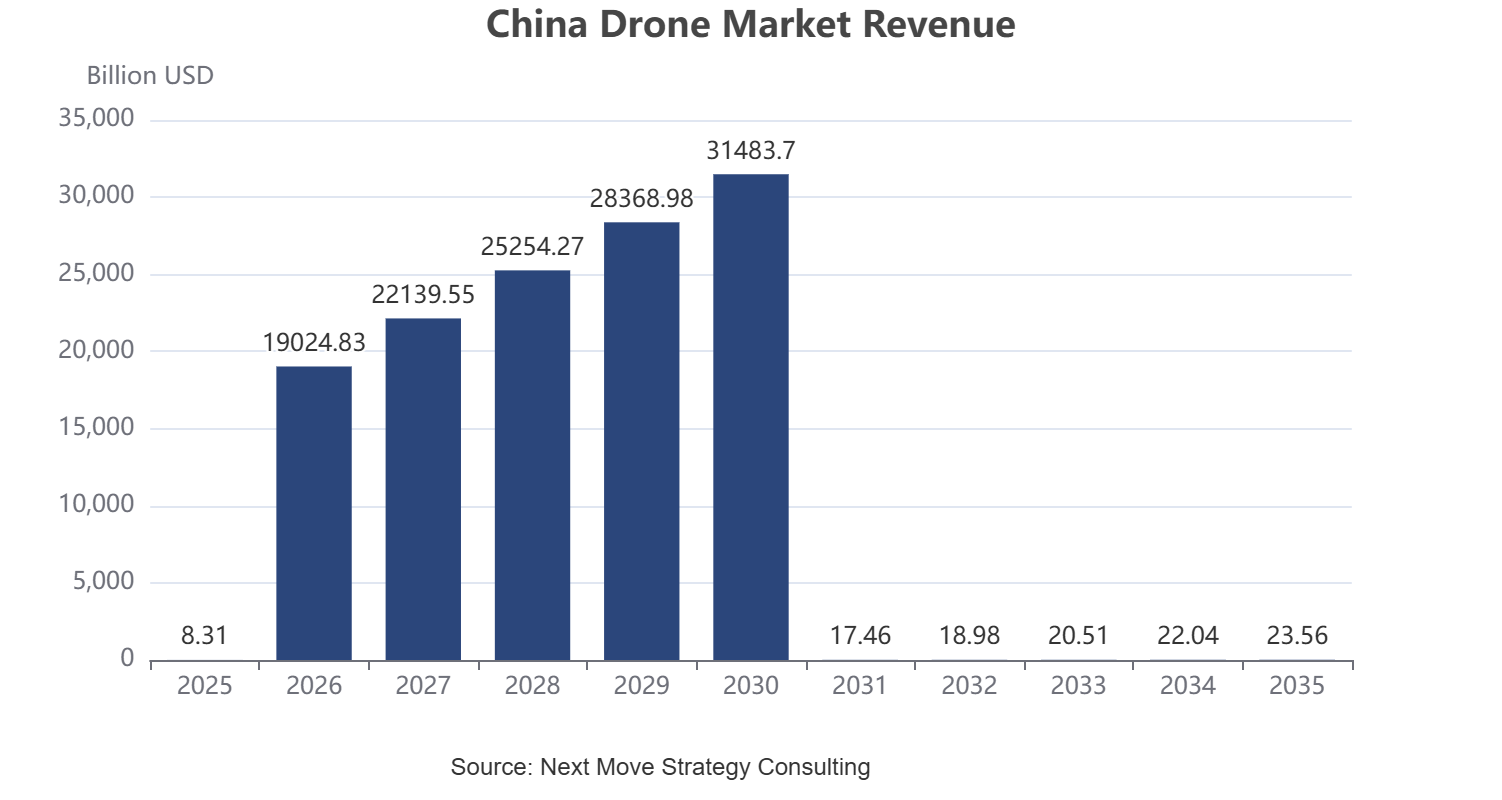
The China drone market was valued at USD 8.31 billion in 2025 and is estimated to reach USD 9.72 billion in 2026, supported by the country's dominant global manufacturing base, the low-altitude economy policy program, and expanding commercial applications in logistics, agriculture, and inspection. Between 2026 and 2035, the market is forecast to expand to USD 23.56 billion, registering a CAGR of 10.33%. In volume terms, unit shipments are estimated to grow from 475 thousand in 2025 to 580 thousand in 2026, reaching 1,902 thousand units by 2035 at a CAGR of 14.11%.
What Are the Key Drivers, Restraints, and Opportunities Shaping the China Drone Market?
|
DRIVERS / RESTRAINTS / OPPORTUNITIES |
(+/-) % IMPACT ON CAGR FORECAST |
GEOGRAPHIC RELEVANCE |
IMPACT TIMELINE |
|
National low-altitude economy policy program targeting a multi-trillion yuan industry by 2035 |
+2.6% |
Nationwide, coordinated under the 15th Five-Year Plan |
Long term (5–8 years) |
|
Expanding commercial drone delivery, agricultural, and inspection applications |
+2.2% |
Shenzhen, Guangzhou, Chengdu, and other major hubs |
Medium term (3–6 years) |
|
Deep domestic component supply chain and manufacturing scale |
+1.9% |
Shenzhen and Pearl River Delta manufacturing clusters |
Long term (5–8 years) |
|
Tightening domestic airspace and registration rules, including Beijing's 2026 consumer sales restrictions |
−1.6% |
Beijing and other major metropolitan airspace zones |
Short to medium term (1–4 years) |
|
Export controls on dual-use components and overseas market access restrictions |
−0.9% |
Export markets, particularly North America |
Short to medium term (1–4 years) |
The China drone market reflects a uniquely dual-track dynamic in which central government policy actively promotes the low-altitude economy as a strategic industrial priority, even as domestic regulators simultaneously tighten airspace, registration, and flight-data rules in politically sensitive cities. China's deep manufacturing base and component supply chain continue to anchor global competitiveness, while rising export controls and overseas market restrictions add complexity to the international side of the business. Commercial applications in logistics and agriculture remain a durable growth pillar through 2035.
Growth Drivers
How Is China's Low-Altitude Economy Policy Program Driving Drone Market Growth?
China's 15th Five-Year Plan has formally designated the low-altitude economy, encompassing drones, eVTOLs, and supporting infrastructure, as a strategic industrial priority, with official projections estimating the sector could exceed several trillion yuan in value by 2035. This sustained policy backing is channeling investment into manufacturing capacity, certification infrastructure, and commercial application development, positioning China's domestic market as the anchor for continued global drone industry leadership.
How Is Commercial Drone Delivery and Agricultural Adoption Expanding China's Drone Market?
Commercial drone delivery operations, agricultural spraying and crop monitoring services, and infrastructure inspection applications continue to scale rapidly across major Chinese cities, supported by a growing base of drone-as-a-service providers. Urban delivery routes in cities such as Shenzhen have demonstrated commercial viability at meaningful volume, while agricultural drone adoption continues to expand across China's farming regions, broadening the market beyond its historically consumer-electronics-driven base.
How Does China's Domestic Manufacturing Base Sustain Its Drone Market Leadership?
China hosts the world's dominant drone manufacturer alongside the deepest and most vertically integrated component supply chain globally, spanning flight controllers, motors, batteries, and imaging payloads. This manufacturing depth, concentrated around Shenzhen and the broader Pearl River Delta, provides significant cost and scale advantages that continue to support both domestic market growth and China's position as the primary global supplier of drone hardware and components.
Growth Inhibitor
How Are Tightening Domestic Regulations Restraining China's Consumer Drone Market?
Beijing's 2026 regulations designating the entire capital as controlled airspace, banning consumer drone sales, and mandating real-name registration and real-time flight-data transmission have measurably reduced consumer purchasing activity and sentiment. Should similar frameworks extend to other major cities such as Shanghai or Shenzhen, the resulting compliance burden and reduced spontaneous recreational use could meaningfully slow consumer-segment growth even as commercial and government applications continue to expand under separate approval pathways.
Growth Opportunity
What Opportunities Does Commercial and Government Application Growth Offer Amid Tightening Rules?
As consumer-segment growth faces new regulatory friction, commercial and government-approved applications, including logistics, agriculture, education, and emergency response, are gaining defined approval pathways under China's evolving regulatory framework. Manufacturers able to shift product focus toward certified commercial and enterprise-grade platforms, along with fleet management and compliance software, are well positioned to capture this reorientation as the low-altitude economy matures toward structured, institutionally managed growth.
Regulatory Framework Impacting the China Drone Market:
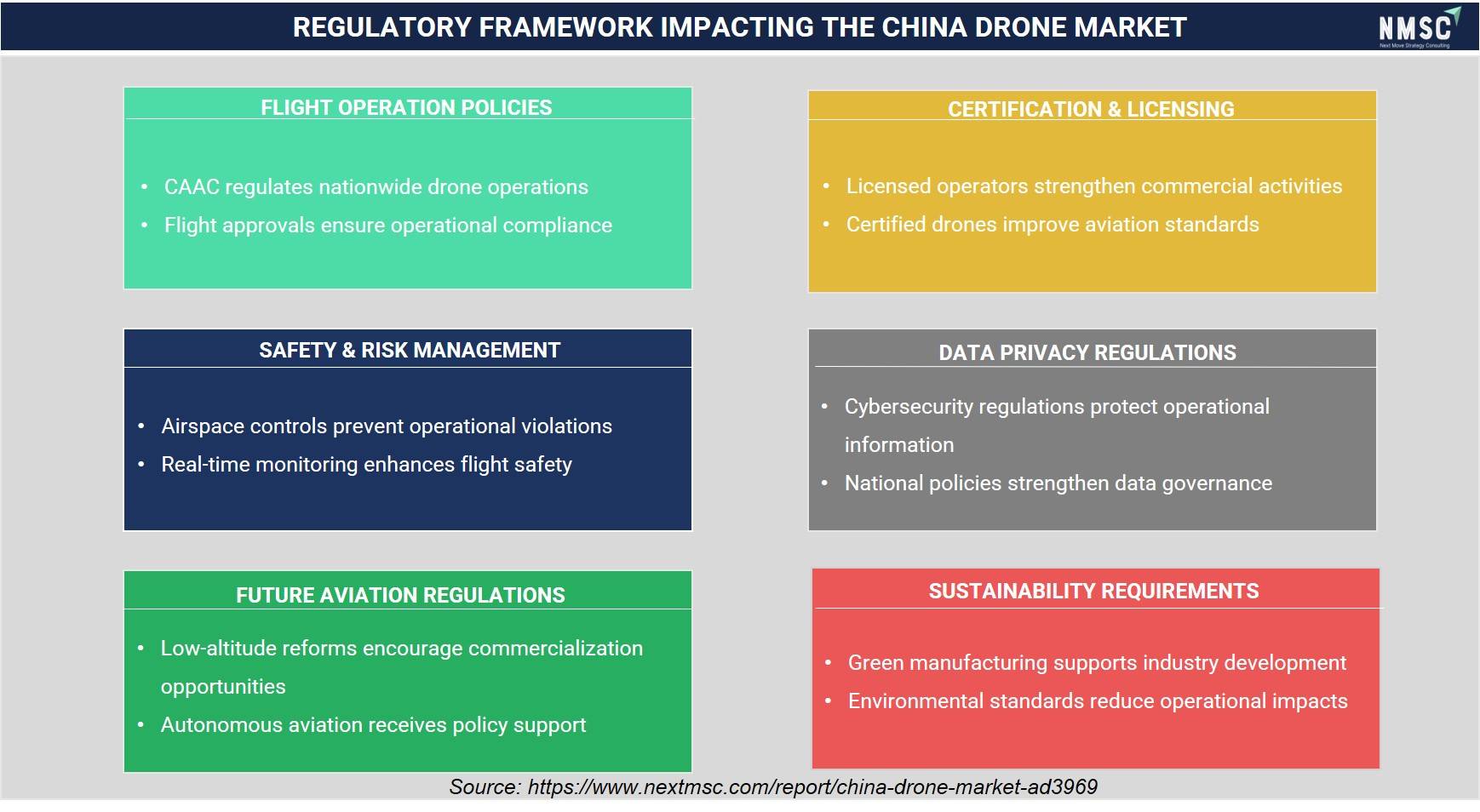
The above regulatory framework analysis maps the key regulatory components, such as flight operation policies, safety and risk management, future aviation regulations, certification and licensing, data privacy regulations, and sustainability requirements, shaping the China drone industry. From our analysis, we observed that CAAC regulates nationwide operations and flight approvals ensure compliance, while airspace controls prevent violations and real-time monitoring enhances safety. Low-altitude reforms encourage commercialization opportunities, and autonomous aviation receives policy support. Licensed operators strengthen commercial activities, while cybersecurity regulations protect operational information and green manufacturing supports industry development.
How Is the China Drone Market Segmented in This Report, and What Are the Key Insights?
By Component Insights
How Is the China Drone Market Segmented by Component?
Based on component, the China Drone Market is segmented into hardware, software, and services.
The market consists of an integrated ecosystem of hardware, software, and service offerings that collectively support drone manufacturing, deployment, and lifecycle management. According to our analysis, we found that hardware components provide the structural and operational foundation for drone platforms, while software solutions enhance autonomous flight, data processing, and fleet optimization capabilities. Complementing these technologies, service offerings enable maintenance, operational support, training, and scalable deployment models, allowing organizations to improve efficiency and maximize long-term operational value.
By Autonomy Level Insights
How Does Autonomy Level Segmentation Reflect Technology Advancement?
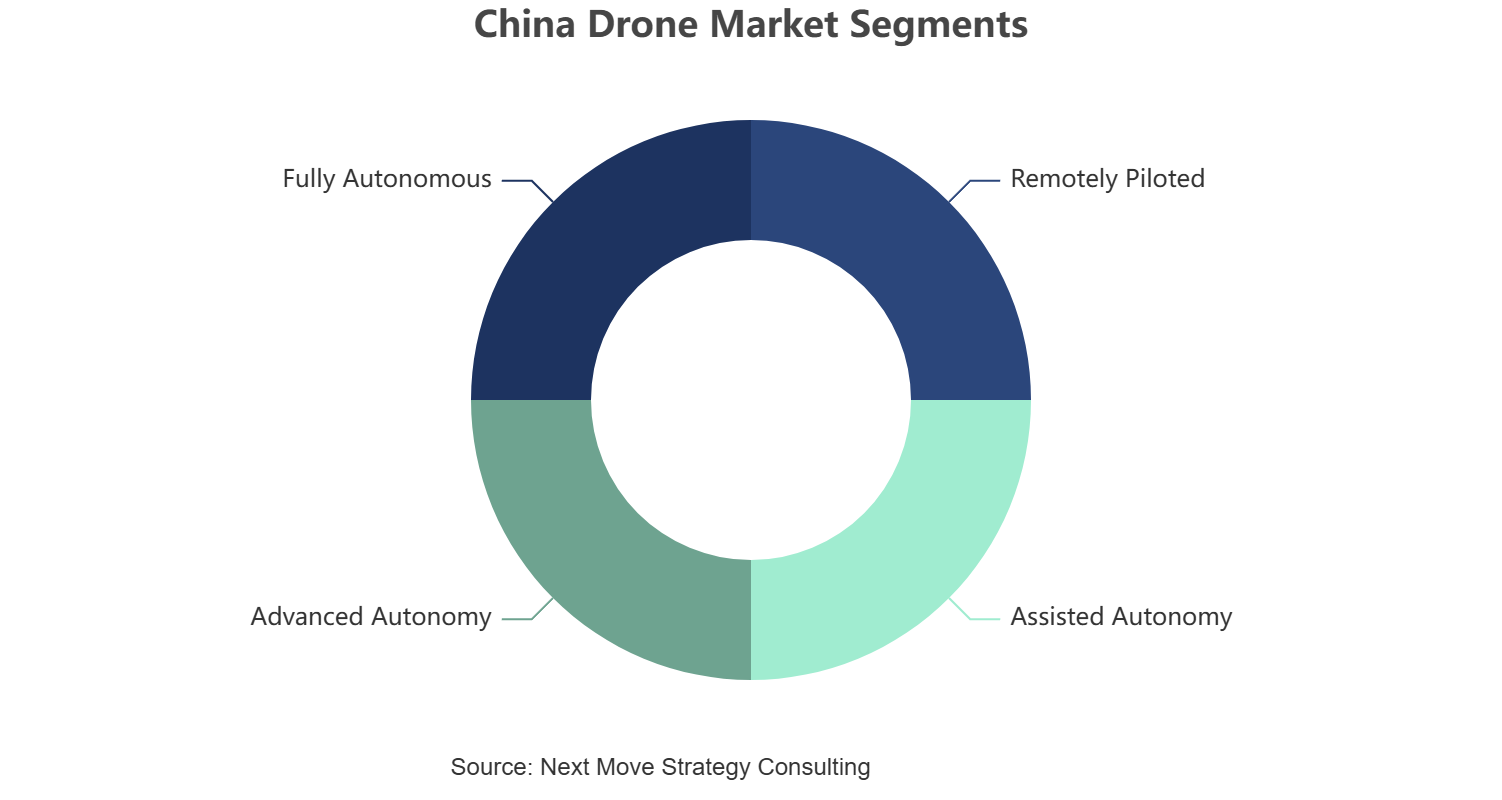
Based on autonomy level, the China Drone Market is segmented into remotely piloted, assisted autonomy, advanced autonomy, and fully autonomous platforms.
The market reflects the rapid evolution of drone technologies as increasing automation enhances operational efficiency, precision, and mission capability across diverse applications. According to our analysis, we found that remotely piloted platforms continue to support a wide range of commercial and recreational operations, while assisted autonomy improves flight safety through automated navigation and obstacle avoidance features. As technological capabilities advance, advanced autonomy and fully autonomous systems are expanding across industrial, logistics, public safety, and defense applications, enabling more intelligent, scalable, and efficient drone operations.
Supply Chain Structure of the China Drone Market:
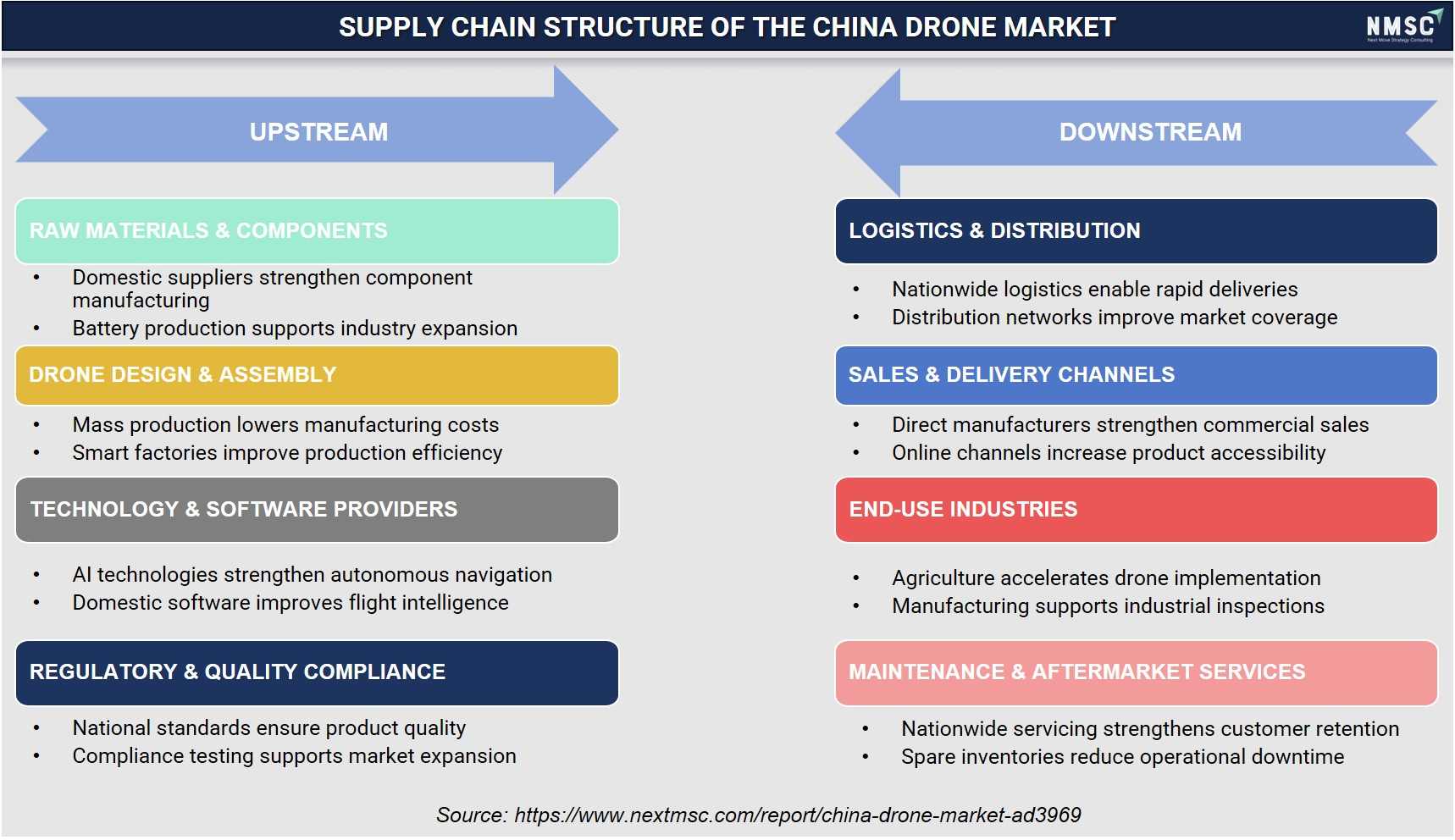
The above supply chain analysis maps the key operational stages, such as upstream and downstream, shaping the China drone industry. From our analysis, we observed that upstream activities include domestic suppliers, battery production, mass production, smart factories, AI technologies, domestic software, and national standards, while downstream activities encompass nationwide logistics, direct manufacturers, online channels, agriculture and manufacturing end-users, and nationwide servicing, reflecting a well-integrated supply chain across the market.
Key Segments
By Component
-
Hardware
-
Airframe
-
Avionics & Core Systems
-
Payloads & Sensors (Cameras, LiDAR, Multispectral, etc.)
-
Communication Systems (C2 Links)
-
-
Software
-
Flight Control & Autonomy
-
Data Processing & Analytics
-
Fleet Management
-
-
Services
-
Drone-as-a-Service (DaaS)
-
Training & Certification
-
Maintenance, Repair & Overhaul (MRO)
-
Data Processing Services
-
By Platform Type
-
Multi-Rotor
-
Fixed-Wing
-
Hybrid VTOL (Vertical Take-Off and Landing)
-
Single-Rotor (Helicopter)
-
Tethered UAV
-
Loitering Munition
-
MALE/HALE/UCAV
By Autonomy Level
-
Remotely Piloted
-
Assisted Autonomy
-
Advanced Autonomy
-
Fully Autonomous
By Maximum Takeoff Weight (MTOW)
-
Nano: < 250 g
-
Micro: 250 g – 2 kg
-
Small: > 2 kg – 25 kg
-
Medium: > 25 kg – 150 kg
-
Large: > 150 kg – 600 kg
-
Very Large/Tactical: > 600 kg
By Price/Performance Grade
-
Consumer Grade (< $1,000)
-
Prosumer Grade ($1,000 – $10,000)
-
Enterprise Grade ($10,000 – $100,000)
-
Military Grade (> $100,000)
By End-User
-
Consumer Drone
-
Commercial & Industrial Drone
-
Aerial Imaging & Cinematography
-
Surveying & Mapping (Geomatics)
-
Agricultural Applications (spraying, crop monitoring)
-
Infrastructure Inspection (energy, utilities, transport)
-
Logistics & Delivery (package transport)
-
Environmental & Scientific Monitoring
-
-
Government & Public Safety Drone
-
Emergency Response & Disaster Management
-
Law Enforcement & Security
-
Firefighting & Public Safety
-
Smart City Management
-
-
Military Drone
-
Intelligence, Surveillance & Reconnaissance (ISR)
-
Combat Operations
-
Electronic Warfare (EW)
-
Target Acquisition & Designation
-
Logistics & Resupply
-
Decoy & Countermeasure Systems
-
Competitive Landscape
The competitive landscape of the China drone market is defined by the global leadership of its largest domestic manufacturer alongside a broad ecosystem of specialized hardware, agricultural, and enterprise drone producers. Competition centers on payload innovation, autonomy software, and manufacturing scale, with domestic firms benefiting from deep component supply chains concentrated in southern China. Increasing export restrictions in key overseas markets are prompting some manufacturers to diversify toward domestic commercial and government applications.
Strategic Developments:
July 2025 – EHang Holdings Limited partnered with Reignwood Aviation Group to deploy EH216-S pilotless eVTOL aircraft for tourism, urban mobility, logistics, and emergency response. The collaboration establishes operational infrastructure and accelerates commercial adoption of autonomous aerial mobility solutions in China.
Key Players of the China Drone Market
-
DJI (SZ DJI Technology Co., Ltd.)
-
EHang (Guangzhou EHang Intelligent Technology Co., Ltd.)
-
Flyability SA
-
HighGreat (Shenzhen HighGreat Innovation Technology Development Co., Ltd.)
-
Autel Robotics (Shenzhen Autel Intelligent Aviation Technology Co., Ltd.)
-
AgEagle Aerial Systems Inc.
-
Freefly Systems Inc.
-
Yuneec (Yuneec International Co., Ltd.)
-
Quantum-Systems GmbH
-
Wingtra AG
-
XAG (Guangzhou XAG Co., Ltd.)
-
JOUAV (Chengdu JOUAV Automation Tech Co., Ltd.)
-
Delair SAS
-
Hubsan (Shenzhen Hubsan Intelligent Co., Ltd.)
-
Jiangxi Xintuo Industrial Co., Ltd.
Key players shaping the China drone industry include DJI (SZ DJI Technology Co., Ltd.), EHang (Guangzhou EHang Intelligent Technology Co., Ltd.), Autel Robotics, and XAG (Guangzhou XAG Co., Ltd.), alongside specialized manufacturers such as HighGreat, and others, all of which compete through manufacturing scale, agricultural and enterprise platform innovation, and domestic supply chain depth.
Key Benefits for Stakeholders
Next Move Strategy Consulting (NMSC) presents a comprehensive analysis of the China drone market, covering the base year 2025 through the forecast period ending 2035. The study provides quantitative projections and insights into key growth drivers, restraints, and opportunities across component, platform, autonomy, weight class, price grade, and end-user segments in detail.
Investors and manufacturers benefit from visibility into the world's largest national drone market, where policy-driven commercial expansion continues even as domestic consumer regulation tightens. Retailers, integrators, and new entrants gain strategic clarity through detailed segmentation and competitive profiling, supporting market entry, product positioning, and channel investment decisions across China's evolving drone landscape.
|
Parameters |
Details |
|
Customization Scope |
Free customization (equivalent to up to 80 analyst-working hours) after purchase. |
|
Pricing and Purchase Options |
Avail customized purchase options to meet your exact research needs. |
|
Approach |
In-depth primary and secondary research; proprietary databases; rigorous quality control and validation measures. |
|
Analytical Tools |
Porter's Five Forces, SWOT, value chain, and Harvey ball analysis to assess competitive intensity, stakeholder roles, and relative impact of key factors. |
Conclusion
The China drone market presents a strong, policy-anchored growth trajectory, combining sustained government backing for the low-altitude economy with an increasingly complex domestic regulatory environment for consumer use. With revenue projected to grow from USD 9.72 billion in 2026 to USD 23.56 billion by 2035 at a CAGR of 10.33%, and unit volumes expanding at 14.11% annually, the market offers substantial opportunities for manufacturers able to pivot toward certified commercial and enterprise applications, amid a competitive landscape led by the world's dominant drone manufacturer.
About the Author
 Mayurima Roy is a research analyst delivering data-driven insights that support strategic planning and market understanding. She combines analytical rigor with strong content development skills, translating complex information into clear, actionable narratives for diverse audiences. Her work includes structured research, trend tracking, competitive assessment, and insight-led content creation that supports informed decision-making. Curious and detail-oriented by nature, she continually deepens her understanding of evolving markets while pursuing creative interests such as crafting and video creation.
About the Reviewer
 Supradip Baul is an accomplished business consultant and strategist with over a decade of rich experience in market intelligence, strategy, technology, and business transformation. His work has included rigorous qualitative and quantitative analysis across multiple industries, helping clients shape investment decisions and long-term roadmaps. Earlier in his career, he was associated with Gartner, where he contributed to industry-leading reports and market share analyses. He has worked with leading global companies and holds an MBA with a dual specialization in Marketing and Finance.
At Next Move Strategy Consulting, we understand that insightful market research is the cornerstone of successful business decisions. That's why we employ a robust and multifaceted approach, combining various methodologies to deliver the most accurate and actionable data for our clients.

Research Landscape
We navigate the world of research with two primary approaches:
Qualitative Approach
Our qualitative research methodologies involve immersive techniques such as in-depth interviews, focus groups, and observational studies. By engaging directly with individuals and stakeholders, we uncover valuable insights that quantitative data alone may overlook.

Quantitative Research
In tandem with qualitative methodologies, NMSC leverages the power of Quantitative Research to provide a robust foundation of numerical insights. Through systematic data collection and analysis, we quantify patterns, preferences, and market trends, offering a comprehensive view of the business landscape.
Our quantitative research approach employs diverse tools, including surveys, experiments, and statistical modelling. These methodologies enable us to gather data from a large and representative sample, ensuring the statistical significance of our findings. By employing structured questionnaires and standardized data collection methods, we guarantee the reliability and validity of the information we present to our clients.
Quantitative research is particularly effective in measuring the prevalence of trends, assessing market size, and gauging the impact of various factors on consumer behavior. The numerical precision attained through this approach equips our clients with actionable insights, facilitating data-driven decision-making and strategy formulation.


Our Specialized Toolbox for Industry-Specific Market Research
We deploy a specialized arsenal of techniques tailored to meet your unique requirements. Here's a glimpse into our comprehensive toolbox:

Information Procurement
The stage entails acquiring market data or relevant information through various sources and methodologies.


Market Research Approach
We utilize both top-down and bottom-up approaches in market research analysis to achieve a comprehensive understanding of the market dynamics, leveraging the broad perspective of industry trends and macroeconomic factors alongside detailed insights from specific segments and individual companies.

Porters Five Forces Analysis
We conduct Porter's Five Forces analysis to evaluate the competitive landscape of an industry, providing us with insights into factors that affect profitability and strategic positioning.

SWOT Analysis

Forecasting
We utilize a forecasting model to predict future consumption by considering parameters like population, economics, regulations, market competition, drivers, constraints, technology, and pricing. We also employ statistical techniques such as multilinear regression, exponential smoothing, moving average, ARIMA, and Monte Carlo simulations for accurate predictions. In econometric forecasting, we analyzed short-term and long-term event impacts, attributing values based on regulatory frameworks, economic factors, and market events.





 Speak to Our Analyst