Cloud Computing in Business Market Global Industry Analysis and Forecast (2026-2035)

Cloud Computing in Business Market size was USD 1.18 Trillion in 2026, projected to reach USD 6.85 Trillion by 2035, growing at a CAGR of 21.4% from 2026 to 2035. Key drivers include rising enterprise AI workload deployment, expanding digital transformation and IT modernization spending, and growing multi-cloud and hybrid cloud adoption, with North America leading the market.

Download Free Sample PDF
Base Year (2025)
$0.98 Trillion
Forecast (2035)
$6.85 Trillion
CAGR (2026-2035)
21.4%
Top Region
North America

What Is the Cloud Computing in Business Market Size?

The global cloud computing in business market size was valued at USD 0.98 trillion in 2025 and is estimated at USD 1.18 trillion in 2026, forecast to reach USD 6.85 trillion by 2035, expanding at a 21.4% CAGR between 2026 and 2035. North America leads with approximately 39% share, while software as a service dominates all other service models with approximately 52% share.

We observed that growth is broad-based across every segmentation axis, with hybrid cloud adoption and data analytics workloads driving the dominant structural shifts through 2035.

Cloud Computing in Business Market Global Industry Analysis and Forecast (2026-2035) Revenue Forecast

Values in USD Trillion

2025 $0.98 Trillion
2025
2026 $1.18 Trillion
2026
2027 $1.43 Trillion
2027
2028 $1.74 Trillion
2028
2029 $2.11 Trillion
2029
2030 $2.56 Trillion
2030
2031 $3.11 Trillion
2031
2032 $3.78 Trillion
2032
2033 $4.59 Trillion
2033
2034 $5.57 Trillion
2034
2035 $6.85 Trillion
2035

Key Takeaways

By Service Model: Software as a Service held the largest share of approximately 52% (USD 0.51 Trillion) in 2025; Platform as a Service is the fastest-growing sub-segment at 24.1% CAGR from 2026–2035.

By Deployment Model: Public Cloud held the largest share of approximately 61% (USD 0.60 Trillion) in 2025; Hybrid Cloud is the fastest-growing sub-segment at 22.9% CAGR from 2026–2035.

By Organization Size: Large Enterprises held the largest share of approximately 67% (USD 0.66 Trillion) in 2025; Small and Medium Enterprises is the fastest-growing sub-segment at 24.9% CAGR from 2026–2035.

By Business Function: Collaboration and Productivity held the largest share of approximately 18% (USD 0.18 Trillion) in 2025; Data Analytics and Business Intelligence is the fastest-growing sub-segment at 27.8% CAGR from 2026–2035.

By End-Use Industry: BFSI held the largest share of approximately 19% (USD 0.19 Trillion) in 2025; Healthcare and Life Sciences is the fastest-growing sub-segment at 26.1% CAGR from 2026–2035.

Dominant Region: North America dominated with approximately 39% revenue share (USD 0.38 trillion) in 2025.

Fastest-Growing Region: Asia-Pacific is expected to register the highest CAGR of 25.6% during 2026–2035.

Dominant Country: U.S. led with approximately USD 0.32 trillion in 2025.

Fastest-Growing Country: India is the fastest-growing country at approximately 27.1% CAGR from 2026–2035.

Market Opportunity: The cloud computing in business market is expected to create an absolute dollar opportunity of USD 5.67 trillion between 2026 and 2035, presenting significant investment potential across the enterprise digital infrastructure value chain.

According to Next Move Strategy Consulting analysis, enterprises are increasingly consolidating multi-cloud spend around a smaller set of strategic hyperscaler and platform vendors to reduce integration overhead, a shift that favors providers with unified AI, data, and infrastructure portfolios over narrow point solutions as agentic AI workloads accelerate compute demand through 2035.

What Does the Cloud Computing in Business Market Encompass?

The cloud computing in business market encompasses infrastructure, platform, and software services delivered over the internet that enterprises use to run applications, store data, and operate core business functions without owning physical computing infrastructure. Our assessment indicates that the scope spans public, private, and hybrid cloud deployment models supplied to large enterprises and small and medium enterprises across BFSI, healthcare, retail, and manufacturing sectors seeking to modernize IT infrastructure, customer relationship management, and enterprise resource planning functions.
Regulatory frameworks such as data residency requirements and sector-specific compliance standards increasingly shape how enterprises select cloud deployment models and geographic hosting locations. We observed that technology adoption is shifting toward AI-integrated cloud platforms as hyperscalers embed large language model access directly into infrastructure and software offerings. Next Move Strategy Consulting's analysis indicates that this structural shift, combined with rising enterprise capital expenditure on AI infrastructure, is redefining procurement criteria across the cloud computing in business market.

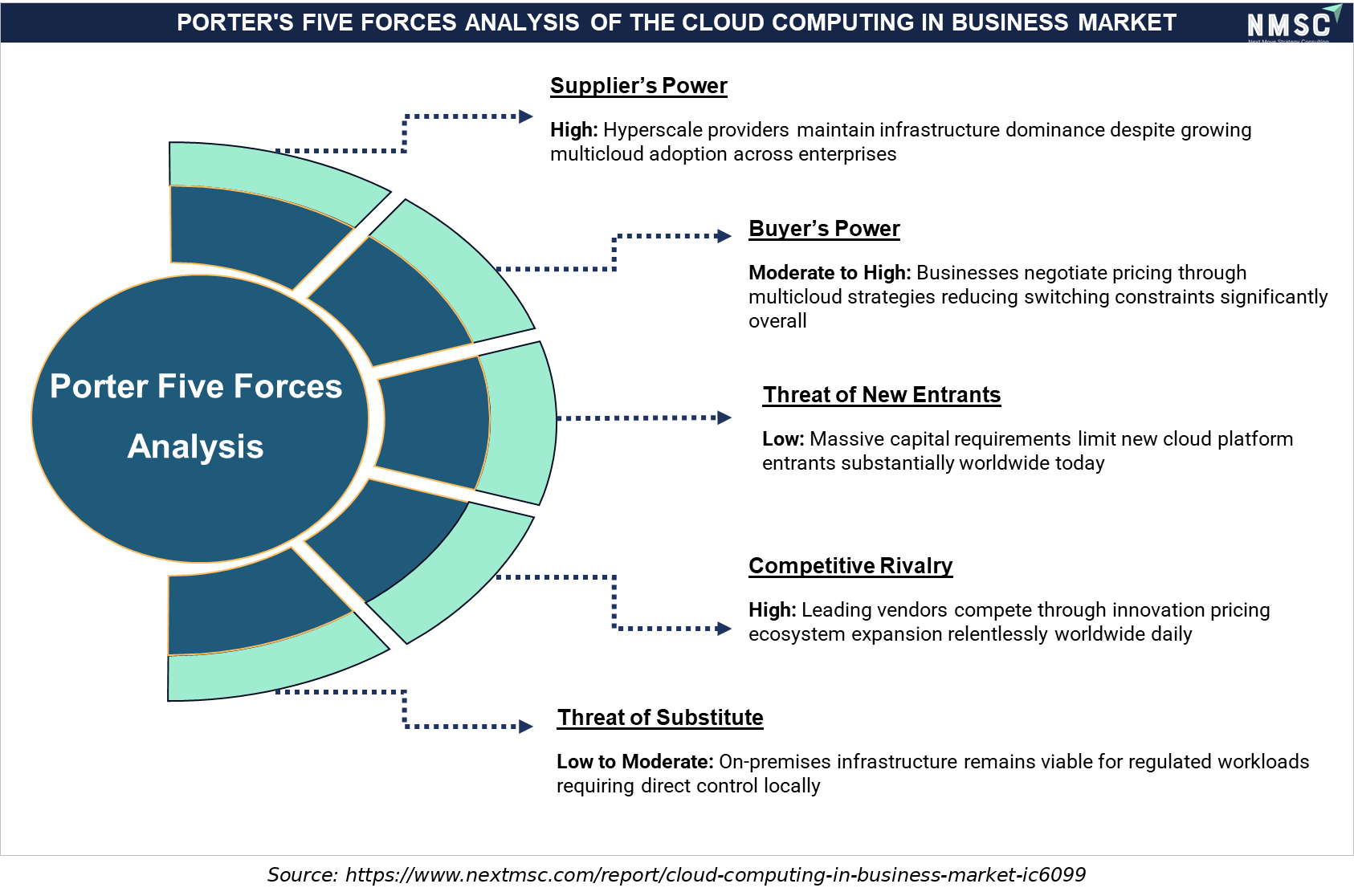
PORTER'S FIVE FORCES ANALYSIS OF THE CLOUD COMPUTING IN BUSINESS MARKET

The Porter’s Five Forces analysis of the Cloud Computing in Business Market evaluates the industry's competitive intensity by examining supplier bargaining power, buyer bargaining power, the threat of new entrants, the threat of substitute technologies, and competitive rivalry. This framework helps businesses assess market attractiveness, identify competitive challenges, and develop effective strategies for sustainable growth and long-term market positioning.

Market Drivers & Dynamics

Interactive Dataset
Rising enterprise AI workload deployment across cloud platforms driver +5.1% Global 2026–2035
Expanding enterprise digital transformation and IT modernization spending driver +4.2% Global 2026–2035
Growing small and medium enterprise cloud adoption via lower pricing driver +3.1% Asia-Pacific, Latin America 2026–2035
Rising multi-cloud and hybrid cloud architecture adoption driver +2.4% North America, Europe 2026–2032
Expanding data center capacity and hyperscaler infrastructure investment driver +1.9% Global 2026–2035
Government digital infrastructure and cloud-first policy programmes driver +1.2% Global 2026–2035
Data residency and cross-border data transfer regulatory complexity restraint −1.8% Europe, Middle East & Africa 2026–2035
High capital expenditure requirements limiting new market entrants restraint −1.1% Global 2026–2032
Cybersecurity and data breach concerns restraining cautious adopters restraint −0.8% Global 2028–2035
Source: Next Move Strategy Consulting

Growth Drivers

What Is the Primary Growth Driver of the Cloud Computing in Business Market?

Rising enterprise AI workload deployment across cloud platforms is the primary driver of the market. Corporate financial disclosures from major cloud providers continue to report AI-related workloads growing from a small share of cloud spending toward a substantially larger share of total enterprise cloud consumption between 2023 and 2026. We observed that this AI-driven demand pace, reinforced by expanding enterprise capital expenditure disclosed in quarterly filings, continues to anchor baseline demand for infrastructure and platform services across developed and emerging economies alike.

How Is Digital Transformation Investment Driving Cloud Computing in Business Market Growth?

Expanding enterprise digital transformation and IT modernization spending is accelerating market growth toward software as a service and platform as a service categories. Government digital economy strategy publications in several developed markets continue to cite cloud-first procurement policies as a stated modernization priority. Our assessment indicates that this modernization pace, combined with expanding enterprise resource planning and customer relationship management cloud migration, is compressing adoption timelines across North America and Europe.

Growth Inhibitors

What Is Restraining Cloud Computing in Business Market Expansion?

Data residency and cross-border data transfer regulatory complexity restrains adoption among enterprises operating across multiple jurisdictions with differing compliance requirements. Regulatory guidance from data protection authorities in several regions continues to require in-country data hosting for certain sectors and data categories. We found that hybrid cloud and regional data center expansion are beginning to offset this restraint, though full standardization across jurisdictions remains gradual.

Segmentation Analysis

2025 (USD Trillion)
2035 (USD Trillion)
Software as a Service 2025: $0.51 Trillion | 2035: $3.25 Trillion
Software as
Infrastructure as a Service 2025: $0.31 Trillion | 2035: $2.28 Trillion
Infrastructu
Platform as a Service 2025: $0.16 Trillion | 2035: $1.32 Trillion
Platform as
Software as a Service $0.51 Trillion $3.25 Trillion 20.4%
Infrastructure as a Service $0.31 Trillion $2.28 Trillion 22.1%
Platform as a Service $0.16 Trillion $1.32 Trillion 24.1%

Which Service Model Segment Dominates the Cloud Computing in Business Market?

Software as a Service led the market with USD 0.51 trillion in 2025, supported by enterprises' preference for ready-to-use applications spanning customer relationship management, collaboration, and enterprise resource planning functions. We observed that Platform as a Service is the fastest-growing service model, expanding at a 24.1% CAGR from 2026 to 2035, as developers increasingly build custom AI-integrated applications on managed platform infrastructure rather than assembling infrastructure components independently.

2025 (USD Trillion)
2035 (USD Trillion)
Public Cloud
Hybrid Cloud
Private Clou
Segment Item 2025 (USD Trillion) 2035 (USD Trillion) CAGR
Public Cloud $10.0 USD Trillion $40.0 USD Trillion 25.0%
Hybrid Cloud $17.1 USD Trillion $51.1 USD Trillion 11.0%
Private Cloud $24.2 USD Trillion $62.2 USD Trillion 25.0%

Segment-wise data is locked

Unlock complete segment-wise numbers for By Deployment Model.

Unlock Full Data

Which Deployment Model Leads Cloud Computing in Business Adoption?

Public Cloud remained dominant, reaching USD 0.60 trillion in 2025 due to its lower upfront cost and rapid scalability relative to private infrastructure. Our findings suggest that Hybrid Cloud is the fastest-growing deployment model at a 22.9% CAGR from 2026 to 2035, reflecting enterprise demand for balancing public cloud scalability with private infrastructure control for sensitive workloads and regulated data categories.

2025 (USD Trillion)
2035 (USD Trillion)
Large Enterp
Small and Me
Segment Item 2025 (USD Trillion) 2035 (USD Trillion) CAGR
Large Enterprises $10.0 USD Trillion $40.0 USD Trillion 27.0%
Small and Medium Enterprises $17.1 USD Trillion $51.1 USD Trillion 9.0%

Segment-wise data is locked

Unlock complete segment-wise numbers for By Organization Size.

Unlock Full Data
2025 (USD Trillion)
2035 (USD Trillion)
Customer Rel
Enterprise R
Human Capita
Supply Chain
Collaboratio
Segment Item 2025 (USD Trillion) 2035 (USD Trillion) CAGR
Customer Relationship Management $10.0 USD Trillion $40.0 USD Trillion 14.0%
Enterprise Resource Planning $17.1 USD Trillion $51.1 USD Trillion 24.0%
Human Capital Management $24.2 USD Trillion $62.2 USD Trillion 22.0%
Supply Chain Management $31.3 USD Trillion $73.3 USD Trillion 12.0%
Collaboration and Productivity $38.4 USD Trillion $84.4 USD Trillion 27.0%

Segment-wise data is locked

Unlock complete segment-wise numbers for By Business Function.

Unlock Full Data
2025 (USD Trillion)
2035 (USD Trillion)
BFSI
IT and Telec
Retail and E
Healthcare a
Manufacturin
Segment Item 2025 (USD Trillion) 2035 (USD Trillion) CAGR
BFSI $10.0 USD Trillion $40.0 USD Trillion 24.0%
IT and Telecommunications $17.1 USD Trillion $51.1 USD Trillion 22.0%
Retail and E-commerce $24.2 USD Trillion $62.2 USD Trillion 20.0%
Healthcare and Life Sciences $31.3 USD Trillion $73.3 USD Trillion 22.0%
Manufacturing $38.4 USD Trillion $84.4 USD Trillion 13.0%

Segment-wise data is locked

Unlock complete segment-wise numbers for By End-Use Industry.

Unlock Full Data

Which End-Use Industry Leads Cloud Computing in Business Market Demand?

BFSI remained the leading end-use industry, valued at USD 0.19 trillion in 2025 as financial institutions accelerate core banking and customer analytics cloud migration. Based on research conducted by Next Move Strategy Consulting, we found that Healthcare and Life Sciences is the fastest-growing end-use industry at a 26.1% CAGR from 2026 to 2035, reflecting rising adoption of cloud-based clinical data platforms and AI-assisted diagnostic infrastructure.

Growth Opportunities

Our analysis shows that three forward-looking opportunities stand out for stakeholders positioning within the cloud computing in business market over the 2026–2035 forecast period.

How Can Vertical-Specific AI Platforms Unlock Value for Healthcare Enterprises?

Vertical-specific AI-integrated cloud platforms present a whitespace opportunity for providers targeting healthcare and life sciences enterprises seeking compliant, clinically validated infrastructure. Suppliers that combine healthcare cloud computing capability with embedded AI diagnostic tooling stand to capture recurring platform revenue as hospitals and life sciences companies accelerate cloud migration for clinical data and research workloads.

Where Does Small and Medium Enterprise Pricing Create New Demand?

Small and medium enterprises seeking enterprise-grade capability at accessible price points represent an underpenetrated opportunity as hyperscalers compete on compute pricing. Suppliers that package simplified, consumption-priced cloud bundles can secure new customer segments as smaller organizations gain access to advanced AI and analytics capabilities previously reserved for large enterprises with dedicated IT budgets.

How Can Data Analytics Platforms Benefit Manufacturing Enterprises?

Manufacturing enterprises seeking to modernize production data infrastructure create an opportunity for vendors offering industrial cloud computing platforms integrated with data analytics and business intelligence tooling. Early movers that combine operational technology data with cloud-based predictive analytics can differentiate with manufacturing buyers pursuing supply chain visibility and production optimization beyond traditional on-premises systems.

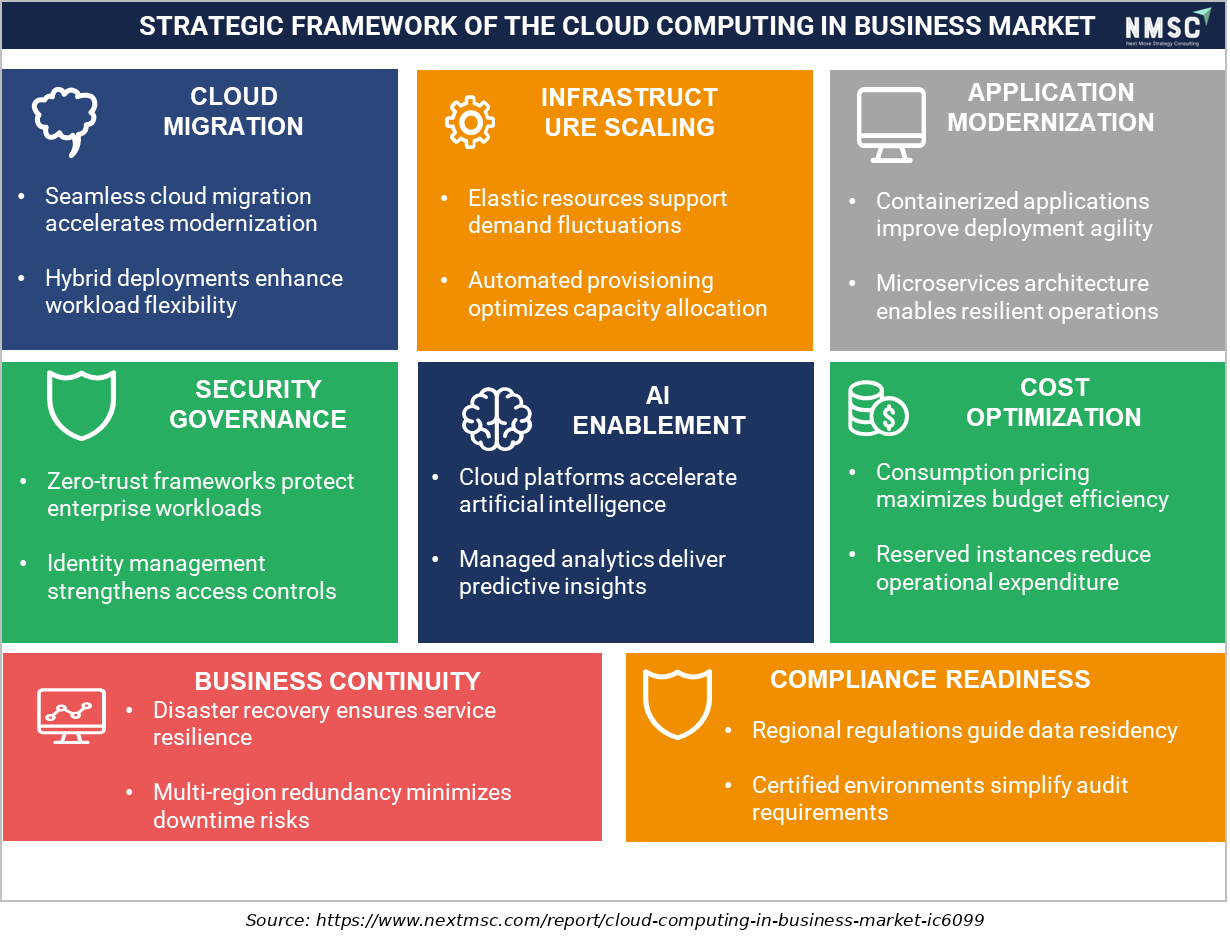
STRATEGIC FRAMEWORK OF THE CLOUD COMPUTING IN BUSINESS MARKET

STRATEGIC FRAMEWORK OF THE CLOUD COMPUTING IN BUSINESS MARKET
The strategic framework of the Cloud Computing in Business Market highlights key priorities driving enterprise cloud adoption, including cloud migration, infrastructure scaling, application modernization, security governance, AI enablement, cost optimization, business continuity, and compliance readiness. Together, these strategic pillars help organizations enhance operational agility, strengthen cybersecurity, optimize IT costs, improve resilience, and accelerate digital transformation while ensuring regulatory compliance and sustainable business growth.

Regional Outlook

2025 (USD Trillion)
2035 (USD Trillion)
North Americ
Europe
Asia-Pacific
Middle East
Latin Americ
Region 2025 (USD Trillion) 2035 (USD Trillion) CAGR (%)
North America $10.0 USD Trillion $40.0 USD Trillion 9.0%
Europe $17.1 USD Trillion $51.1 USD Trillion 27.0%
Asia-Pacific $24.2 USD Trillion $62.2 USD Trillion 25.0%
Middle East & Africa $31.3 USD Trillion $73.3 USD Trillion 23.0%
Latin America $38.4 USD Trillion $84.4 USD Trillion 12.0%

Regional data is locked

Unlock complete regional numbers for this market.

Unlock Full Data

Competitive Landscape

We observed that the cloud computing in business market remains highly consolidated among a small group of hyperscale infrastructure providers, with diversified enterprise software groups competing for application-layer market share.

Dimension Description
Market Structure Highly consolidated at the infrastructure layer, led by three dominant hyperscale providers
Innovation Focus AI model integration, compute pricing competition, and expanded data center capacity
M&A Activity Moderate, concentrated in AI capability acquisition and strategic model provider partnerships

How Do Companies Compete in the Cloud Computing in Business Market?

Companies compete primarily on infrastructure scale, AI model access, and compute pricing across the industry. Hyperscalers such as Amazon.com, Inc. and Microsoft Corporation leverage massive data center infrastructure and strategic AI partnerships to serve enterprise workloads, while diversified software groups such as SAP SE and Oracle Corporation compete on deep enterprise resource planning and business application integration for regulated industries.

Which Competitive Archetypes Dominate the Cloud Computing in Business Market?

Two archetypes dominate the market: hyperscale infrastructure providers offering integrated compute, storage, and AI model access at global scale, and diversified enterprise software groups embedding cloud delivery into established business application suites. Amazon.com, Inc. and Alphabet Inc. exemplify the hyperscaler archetype through infrastructure and AI model partnerships, while SAP SE and Salesforce, Inc. exemplify the software archetype through cloud-delivered business application depth.

How Are Companies Differentiating Through Innovation in Cloud Computing?

Innovation and differentiation strategy increasingly center on embedding frontier AI models directly into infrastructure and compute pricing competitiveness. Amazon Web Services' Bedrock integration with OpenAI models and Microsoft's GPT-5 integration into Azure enterprise services both target reduced friction for enterprises deploying generative AI. Our analysis shows that providers unable to offer competitive AI model access risk losing enterprise workloads to competitors with deeper model partnerships.

What M&A and Expansion Activity Is Shaping the Cloud Computing in Business Market?

Strategic partnerships and infrastructure expansion continue to shape competitive positioning within the industry. The three largest hyperscale providers collectively invested more than USD 260 billion in data centers, networking, and custom silicon during 2025, with continued capital expenditure increases disclosed for 2026, illustrating how providers are racing to secure AI compute capacity ahead of enterprise demand growth.

Key Market Players

Our assessment indicates that the following 20 companies are actively shaping infrastructure innovation, AI integration, and commercial strategy within the global cloud computing in business market.

Amazon.com, Inc. Microsoft Corporation Alphabet Inc. Alibaba Group Holding Limited International Business Machines Corporation Oracle Corporation Salesforce, Inc. SAP SE Tencent Holdings Limited Huawei Technologies Co., Ltd. Broadcom Inc. Dell Technologies Inc. Cisco Systems, Inc. Rackspace Technology, Inc. DigitalOcean Holdings, Inc. Snowflake Inc. ServiceNow, Inc. Workday, Inc. Adobe Inc. Fujitsu Limited

Latest Developments

We found that recent activity within the cloud computing in business market is concentrated on AI model integration and quarterly infrastructure revenue growth, reflecting the industry's rapid AI-driven scaling phase.

Date Event
September 2024 Oracle and Amazon Web Services (AWS) announced Oracle Database@AWS, enabling enterprises to run Oracle Autonomous Database and Oracle Exadata Database Service directly on AWS infrastructure with unified billing, support, and management. This simplifies migration of mission-critical business applications to the cloud and strengthens enterprise multicloud adoption.
May 2024 AWS and SAP expanded their strategic partnership by integrating Amazon Bedrock with SAP AI Core, allowing organizations to build and deploy generative AI applications within SAP's cloud-based business software. The collaboration helps enterprises modernize ERP systems and enhance business productivity using cloud-native AI services.

Expert Insights

Satya Nadella

Chairman & Chief Executive Officer | Microsoft

"AI-driven transformation is changing work, work artifacts, and workflow across every role, function, and business process. We are expanding our opportunity and winning new customers as we help them apply our AI platforms and tools to drive new growth and operating leverage."

Analyst Interpretation

This statement highlights how cloud computing has evolved beyond traditional IT infrastructure to become the foundation for AI-driven business transformation. Enterprises are increasingly adopting cloud-based AI platforms to automate workflows, improve productivity, and modernize business processes across functions. The growing convergence of artificial intelligence and cloud computing is accelerating enterprise cloud adoption, increasing demand for scalable cloud infrastructure, platform services, and industry-specific cloud solutions, thereby strengthening the long-term growth of the Cloud Computing in Business Market.

What Capital Inflows Are Targeting the Cloud Computing in Business Market?

What Capital Inflows Are Targeting the Cloud Computing in Business Market?

Capital inflows into the cloud computing in business market are increasingly directed toward AI compute capacity and custom silicon development. Corporate capital expenditure disclosures from the largest hyperscalers show sustained multibillion-dollar quarterly investment in data center and networking infrastructure. We observed that investors favor providers demonstrating strong cloud segment revenue growth, viewing AI workload capture as a proxy for long-term enterprise infrastructure market share.

How Is Infrastructure Investment Supporting Cloud Computing in Business Market Growth?

Infrastructure investment is expanding data center capacity and custom silicon production to meet enterprise AI compute demand that continues to outpace available supply. Our findings suggest that the largest providers' collective 2025 capital expenditure exceeding USD 260 billion illustrates the scale of investment required to maintain competitive infrastructure capacity as enterprise AI workloads accelerate across regions.

What ESG Considerations Are Shaping Cloud Computing in Business Investment Decisions?

Environmental, social, and governance considerations are increasingly relevant to investment decisions across the industry, with data center energy consumption and renewable energy sourcing as key criteria. Corporate sustainability disclosures from major providers continue to report data center energy use alongside capital expenditure figures. We found that investors increasingly favor providers with validated renewable energy commitments, treating data center efficiency as a governance indicator alongside AI workload capacity planning.

How Does This Report Benefit Enterprise and Industry Leaders?

How Does This Report Benefit Enterprise and Industry Leaders?

Enterprise and industry leaders gain access to validated segmentation, competitive benchmarking, and regional demand forecasts that support sourcing and cloud infrastructure investment decisions across the cloud computing in business industry. Our analysis shows that detailed service model, deployment model, and business function breakdowns help technology procurement teams align cloud investment with workload requirements while identifying underserved end-use industry segments for expansion.

How Does This Report Benefit Investors and Financial Analysts?

Investors and financial analysts benefit from consistent, single-point market size and CAGR estimates that support valuation and capital-allocation decisions across the cloud computing in business market supply chain. We observed that the report's regional and segment-level growth differentials help identify which hyperscalers and software providers are best positioned to capture above-market growth in platform as a service and healthcare categories through 2035.

How Does This Report Benefit Technology Vendors and Product Teams?

Technology vendors and product teams gain insight into emerging design requirements, including AI model integration, hybrid cloud architecture, and compute pricing competitiveness, that are reshaping the industry. Our findings suggest that this analysis helps R&D teams prioritize development roadmaps around data analytics capability and vertical-specific platforms that are increasingly required by enterprise and small and medium enterprise procurement processes.

Key Market Segments Evaluated

By Service Model

  • Software as a Service
  • Infrastructure as a Service
  • Platform as a Service

By Deployment Model

  • Public Cloud
  • Hybrid Cloud
  • Private Cloud

By Organization Size

  • Large Enterprises
  • Small and Medium Enterprises

By Business Function

  • Customer Relationship Management
  • Enterprise Resource Planning
  • Human Capital Management
  • Supply Chain Management
  • Collaboration and Productivity
  • Data Analytics and Business Intelligence
  • IT Infrastructure Management
  • Other Functions

By End-Use Industry

  • BFSI
  • IT and Telecommunications
  • Retail and E-commerce
  • Healthcare and Life Sciences
  • Manufacturing
  • Government and Public Sector
  • Media and Entertainment
  • Energy and Utilities
  • Other Industries

Conclusion & Recommendations

The long-term outlook for the market remains exceptionally strong, with global revenue projected to grow nearly sevenfold from USD 0.98 trillion in 2025 to USD 6.85 trillion by 2035 at a 21.4% CAGR. We observed that sustained AI workload demand, expanding digital transformation investment, and rising multi-cloud adoption will continue underpinning demand across BFSI, healthcare, and technology applications through the forecast period.

What Strategic Positioning Should Cloud Computing in Business Suppliers Pursue?

Suppliers should prioritize AI model integration and expanded compute capacity while pursuing hybrid cloud architecture to secure long-term enterprise contracts. Our assessment indicates that providers investing early in vertical-specific platforms and competitive compute pricing will be best positioned to capture premium market share within the cloud computing in business market.

How Attractive Is the Cloud Computing in Business Market for New Investment?
The cloud computing in business industry presents an exceptionally attractive investment case, supported by a USD 5.67 trillion absolute dollar opportunity between 2026 and 2035 and above-average growth in Asia-Pacific and platform as a service categories. We found that investment attractiveness is highest for providers combining infrastructure scale with AI model access, positioning them to serve both large enterprise and small and medium enterprise customers simultaneously.

What Market Shifts and Key Risks Should Stakeholders Monitor?

Stakeholders should monitor data residency regulation, capital expenditure sustainability, and cybersecurity risk as key factors shaping the cloud computing in business market. Our analysis shows that providers unable to sustain infrastructure investment at competitive scale risk losing enterprise workloads to better-capitalized hyperscalers, particularly within Europe's increasingly compliance-driven procurement environment.

What Are the Key Growth Pathways for the Cloud Computing in Business Market?

Key growth pathways include expanding AI-integrated platform offerings, scaling small and medium enterprise pricing tiers, and deepening penetration into healthcare and manufacturing end-use industries. Next Move Strategy Consulting's analysis indicates that suppliers pursuing these pathways while maintaining infrastructure investment discipline will be best positioned to capture the cloud computing in business market's projected growth through 2035.

FAQs

About the Author

Liza Phukan

Liza Phukan

Liza Phukan is Research Associate at Next Move Strategy Consulting, where she has covered emerging industries and market research across sectors for 3.5 years. Her work includes analyzing industry developments, validating market data, and developing structured business content from research findings. She uses secondary research and data-validation practices to turn complex market information into clear decision-useful market analysis for business audiences and support report development and B2B.

About the Reviewer

Supradip Baul

Supradip Baul

Supradip Baul is an accomplished business consultant and strategist with over a decade of rich experience in market intelligence, strategy, technology, and business transformation. His work has included rigorous qualitative and quantitative analysis across multiple industries, helping clients shape investment decisions and long-term roadmaps. Earlier in his career, he was associated with Gartner, where he contributed to industry-leading reports and market share analyses. He has worked with leading global companies and holds an MBA with a dual specialization in Marketing and Finance.

Download Free Sample

Amos Chang

AMOS CHANG

Strategy Consultant

Kardex Group

I have bought the intralogistics market reports from NMSC two times so far. Joseph and his team are always very helpful and flexible in responding to any customization requirements on the report. Their expertise in market reports really helps us steer the day-to-day business. I will definitely recommend and come back myself whenever there is a need.

Melanie Samko

MELANIE SAMKO

Director of Marketing

TOSOH BIOSCIENCE, INC.

The information provided by NMSC is incredibly valuable, thank you so much for such a excellent work. I really appreciate it. I will make sure to reference all of it, in my summary document.

Nishant Awate

NISHANT AWATE

Business Development Global Sales

Zehnder Group Deutschland GmbH

Our experience working with Next Move Strategy Consulting was positive. The team was responsive, professional, and open to incorporating our specific requirements throughout the project. The India AHU market study was comprehensive and well structured, covering market value and volume forecasts, product and application segments, and key industry trends. The inclusion of both AHU and residential MVHR market insights made the study particularly relevant for our strategic market assessment. Overall, the report provides a solid foundation for evaluating market potential, identifying priority segments, and supporting business-development decisions in India.

Kishu Kanda

KISHU KANDA

Strategy Analyst

Accenture

We purchased the AI Consumer Market Report from this company. Not only did they customize the report to meet our specific requirements, but they also showed great flexibility in accommodating our budget. The report we received fully met our expectations. Additionally, they provided prompt and thorough responses to both our pre-purchase and follow-up questions. We look forward to working with this company again in the future.

Kevin Coker

KEVIN COKER

Founder, CEO and Board Diector

Proxima Clinical Research

I have been using Next MSC reports for product positioning in a new geography for a long time. They have by far the best reports I have found and the price is reasonable too!

Custom Market Research Services

We will customize the research for you if the listed report does not fully match your requirements.

Get 30% Free Customization

Select License

This website uses cookies to ensure you get the best experience on our website. Learn more

✖