Concept Car Market By Revenue Stream (Styling & Design, Engineering & Integration, and Others), By Build Stage (Digital Concept, and Others), By Purpose (Design Study, Tech Demo, and Others), By Vehicle Class (Compact Hatchback, and Others), By Powertrain (ICE, Hybrid, BEV, FCEV, and Other Powertrains), By Sponsor Type (Legacy OEM, New Entrant OEM, Commercial Vehicle OEM, Mobility Operator, Public Sector, and Other Sponsors) – Global Analysis & Forecast, 2025–2030
Industry: Automotive & Transportation | Publishing Date: June 5, 2026 | Last Updated: October 16, 2026 | No of Pages: N/A | No. of Tables: N/A | No. of Figures: N/A | Format: PDF | Report Code: AT3786
Industry Outlook
The global Concept Car Market size was valued at USD 48.38 billion in 2024, and is expected to be valued at USD 51.49 billion by the end of 2025. The industry is projected to grow, hitting USD 70.55 billion by 2030, with a CAGR of 6.5% between 2025 and 2030.
The industry is advancing rapidly, fuelled by the increasing demand for innovation, sustainability, and advanced mobility solutions. Consumers and enthusiasts are drawn to electric drivetrains, autonomous features, and futuristic designs that blend performance with smart technology. Rising awareness about environmental impact, energy efficiency, and smart transportation is shaping preferences, with buyers seeking reduced emissions, connected experiences, and cutting-edge safety systems.
Manufacturers are responding with lightweight materials, renewable energy integration, and AI-driven design tools. By combining sustainability, technological sophistication, and visionary design, the concept car market is meeting evolving consumer expectations while driving innovation and industry expansion.
What Are the Key Trends in the Concept Car Industry?
How Are Concept Cars Accelerating the Transition from Styling Studies to Near-Production Software-Defined Vehicles?
OEM press releases since 2024 indicate a clear shift: concept vehicles increasingly demonstrate production-ready software architectures and upgradeable vehicle platforms rather than only styling cues. Volkswagen’s ID. EVERY1 explicitly previews an entry EV with a new software stack designed for lifelong updates and production plans toward 2027, marking concepts as roadmaps for mass market software strategies.
Analysis shows this reduces market and supplier uncertainty by exposing software supplier interfaces earlier in the program lifecycle. Actionable insight: OEM product planners should convert select concept features into modular software packages and secure supplier commitments during the concept phase to shorten time to production and reduce integration risk.
Will Hydrogen and Alternative Powertrain Concepts Meaningfully De-Risk Non-Battery Production Models?
Hyundai’s INITIUM FCEV, unveiled in October 2024, exemplifies how OEMs leverage concept vehicles to validate hydrogen fuel cell technology, production feasibility, and market positioning. By presenting a near-production hydrogen concept, manufacturers assess materials sourcing, stack integration, cooling systems, and packaging architecture without committing to full-scale production capital.
Concept pilots also help reduce technical and regulatory uncertainty ahead of limited series trials, allowing engineers to iterate rapidly while gathering real-world performance data. For stakeholders aiming to enter the hydrogen passenger vehicle sector, a strategic approach is to collaborate on pilot fleets derived from concept programs, enabling co-funded validation, early supplier engagement, and secured capacity for future production scaling.
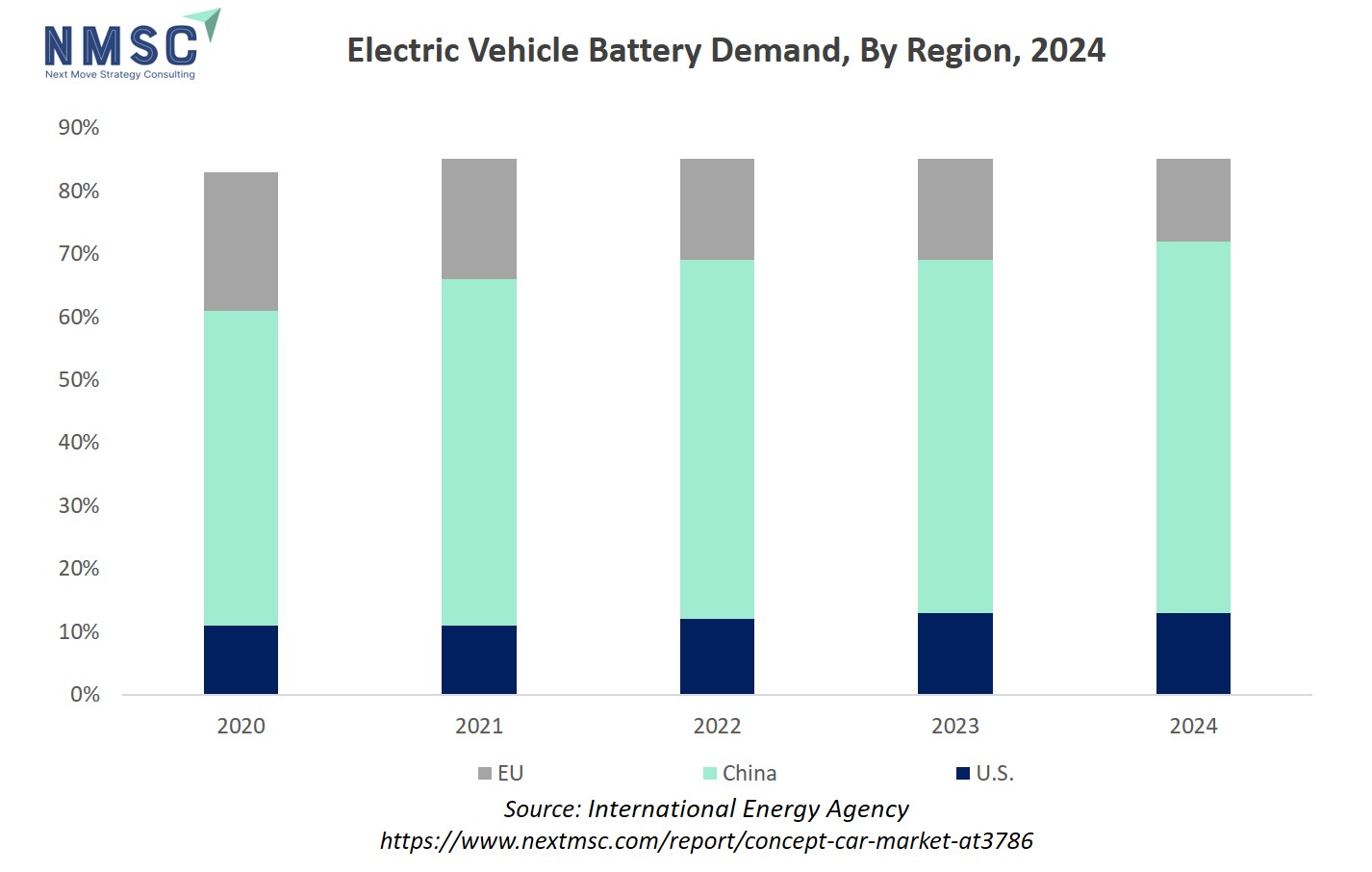
The chart shows a dominant and growing lead for China in EV battery demand over this period. The EU also shows significant and steady demand, while the U.S. started with a smaller share but is projected to see notable growth by 2024. This relates directly to the concept car market demand as it highlights the commercial reality behind the prototypes.
The massive investment in and demand for batteries confirm which regions are leading the EV transition. Automotive concept models from manufacturers in China, Europe, and the U.S. are no longer just design fantasies; they are precursors to the production vehicles that are driving this massive, and geographically concentrated, battery demand.
How Are High-Performance Concepts Driving Advances in Battery and Charging Technology for Mainstream Products?
Mercedes AMG’s CONCEPT AMG GT XX, slated for 2025, highlights how OEMs use high-performance concept vehicles to validate extreme battery cooling and megawatt charging feasibility. By testing aggressive thermal management and high-power architectures in a hypercar, manufacturers generate actionable performance data while pushing engineering limits, which later be scaled to volume vehicles. Such concept testbeds help accelerate the adoption of advanced charging standards, optimize pack designs, and reduce the risk associated with full-scale production.
Analysis suggests that leveraging insights from these programs shortens innovation cycles and enhances component qualification for mass-market EV platforms. Firms that capture and standardize learnings from these pilots gain a competitive edge in efficient and scalable EV deployment.
What Are the Key Market Drivers, Breakthroughs, and Investment Opportunities That Will Shape the Concept Car Market in the Next Decade?
Concept cars are both strategic communications and engineering testbeds. They allow OEMs to demonstrate future product directions while testing supply chain, manufacturability and regulatory fit. Post-2024 concept activity is tightly coupled to electrification roadmaps, software architectures and new energy experiments, amplifying concept commercial relevance.
However, cost and timing pressures imply that concepts must increasingly deliver actionable engineering outcomes rather than solely aspirational designs. Stakeholders must balance marketing value with technical validation to ensure concept investments translate to production optionality and supplier readiness.
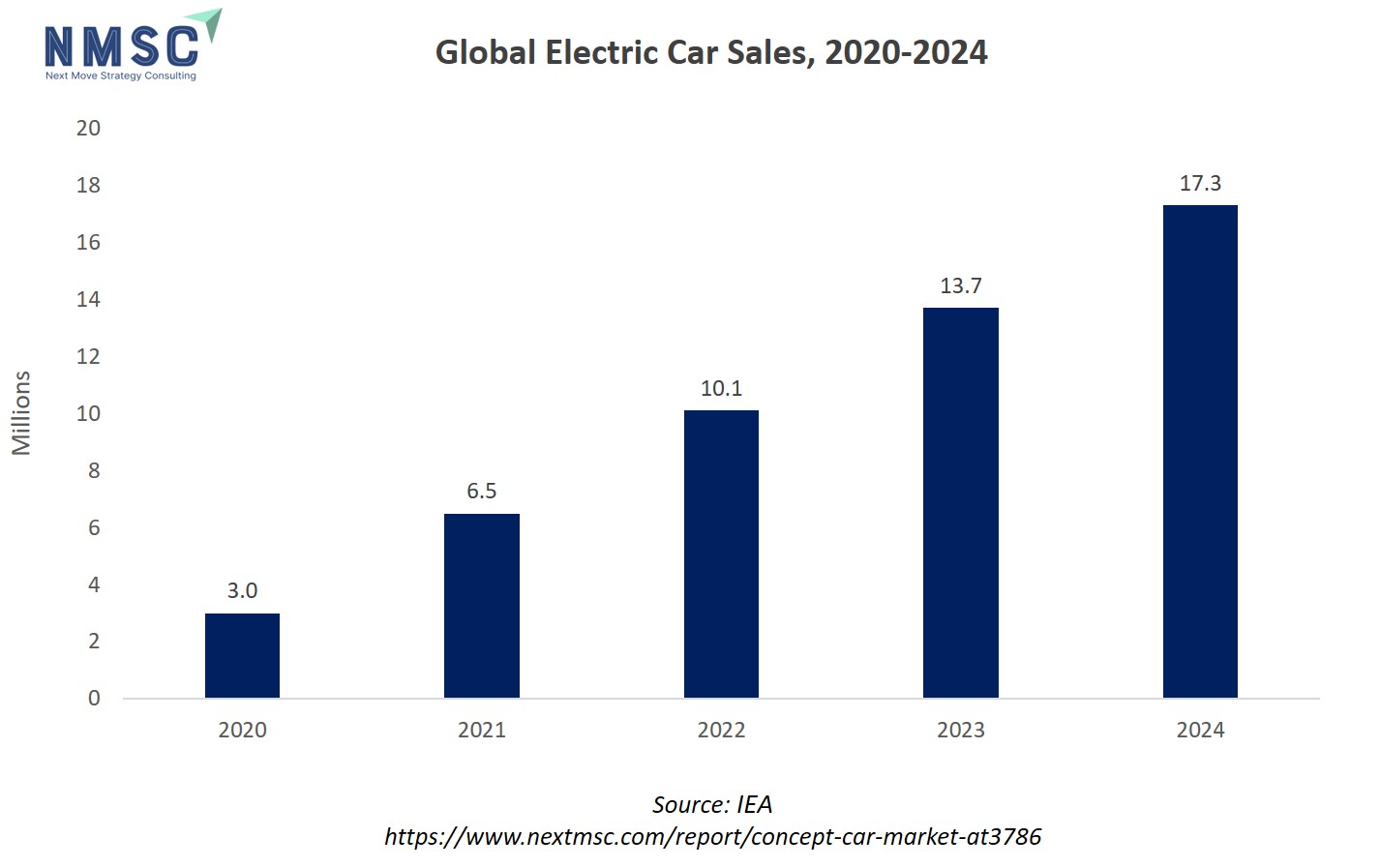
The chart illustrates global electric car sales from 2020 to 2024, highlighting a rapid and consistent growth from 3.0 million units in 2020 to a projected 17.3 million units in 2024. This upward trajectory in electric car adoption underscores robust market momentum fueled by technological innovation, evolving consumer preferences, and regulatory support.
The strong electric vehicle (EV) growth directly influences the concept car market trends, as automakers increasingly use concept cars to showcase advancements in electric mobility, battery technology, and connected vehicle features. Future car concepts act as a testing ground for futuristic design and EV technologies, helping shape the automotive market's transition toward electrification and sustainable mobility solutions.
Growth Drivers:
How Is Technological Innovation and Electrification Driving the Concept Car Market Growth?
The automotive industry is experiencing a profound transformation driven by the rise of electric vehicles, autonomous driving, artificial intelligence, and connected car technologies. In 2024, global EV sales reached 17 million units, representing over 20% of new car sales, with projections for 2025 exceeding 20 million units.
Concept cars are increasingly employed by automakers as experimental platforms to showcase these innovations and test next-generation features under controlled conditions. For example, in 2024, Jaguar’s "Type 00" concept, unveiled at Miami Art Week, integrates advanced technologies such as butterfly doors and deployable interiors.
Beyond demonstrating engineering capability, such concept vehicles generate investor interest and consumer attention, reinforcing brand positioning and signaling strategic direction in the rapidly evolving automotive landscape.
How Is Competitive Branding and Marketing Strategy Fueling Concept Car Development?
In today’s competitive automotive landscape, autonomous concept cars have emerged as key tools for shaping brand identity and driving marketing strategies. Automakers leverage these futuristic prototypes to generate media attention, captivate consumers, and differentiate themselves from rivals.
For instance, Honda showcased two concept vehicles at CES 2024, emphasizing its focus on innovation and sustainability. Beyond physical exhibits, brands are increasingly integrating digital marketing approaches, including AI-driven personalization, influencer collaborations, and immersive experiences such as augmented reality showrooms, to deepen engagement and stimulate sales.
These initiatives not only attract early adopters and tech-savvy consumers but also reinforce the brand’s reputation as a leader in automotive innovation, signaling long-term strategic vision and commitment to next-generation mobility solutions.
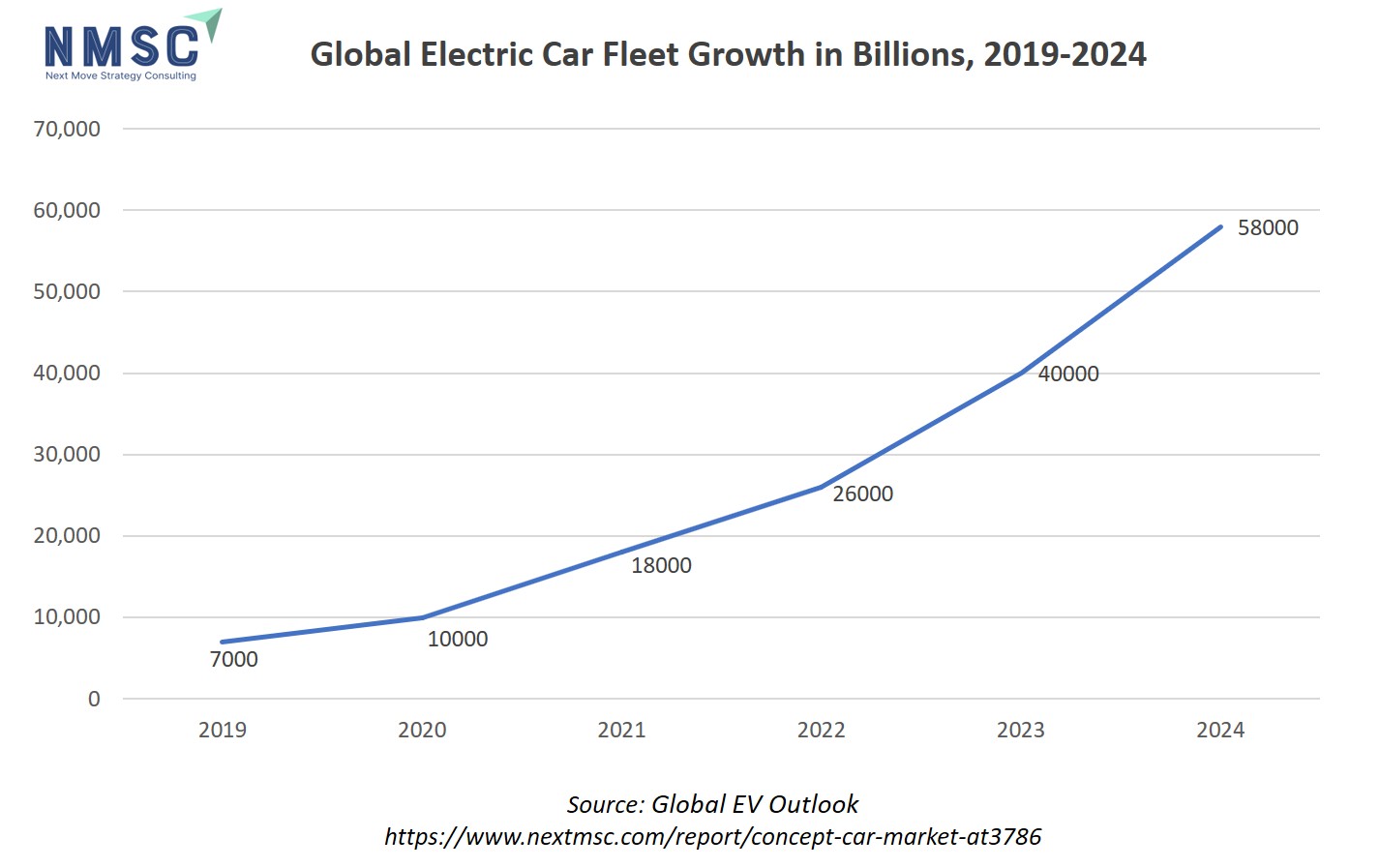
This chart illustrates the rapid global growth of the electric car fleet from 2019 to 2024, with the number of vehicles increasing from 7,000 in 2019 to a projected 58,000 in 2024.This growth is directly connected to the concept car market dynamics. Hybrid concept vehicles act as a critical testing ground and a source of public excitement, showcasing future design philosophies, advanced battery technology, autonomous features, and innovative user interfaces.
Growth Inhibitors:
What Is the Key Inhibitor to Converting Concept Innovations into Production?
Supply chain readiness and component qualification represent key bottlenecks in concept-to-production timelines for advanced automotive technologies. High-novelty components, such as hydrogen fuel cell stacks or next-generation battery chemistries, require extensive qualification cycles and coordinated supplier scale-up.
Without credible commitments from suppliers, the time required to move from concept demonstration to commercial production extend significantly, reducing the potential commercial advantage of early innovation. This challenge is particularly pronounced for emerging technologies with limited manufacturing experience or constrained material availability.
Automakers must therefore invest in supplier partnerships, early validation programs, and standardized testing protocols to mitigate delays, ensure component reliability, and accelerate the commercialization of breakthrough mobility solutions.
Where Is the Emerging Investment Opportunity?
Software platforms, modular validation laboratories, and supplier co-investment initiatives represent high-potential opportunities in the automotive concept vehicle ecosystem. Investing in advanced software toolchains, over-the-air update platforms, and flexible testing facilities significantly reduce component and system validation timelines, enabling OEMs to accelerate the transition from concept to production.
As concept programs increasingly rely on fast, reliable software integration and component qualification, these solutions allow manufacturers to de-risk innovation while maintaining schedule and cost discipline. Co-investment models with suppliers further ensure scalable production readiness and secure critical capacity for high-novelty components. Collectively, these investments offer leverage across hardware, software, and supply chain domains, positioning stakeholders to capitalize on emerging trends in next-generation mobility programs.
How Is the Concept Car Market Report Segmented, and What Are the Key Insights from the Segmentation Analysis?
By OEM Type Insights
Are Premium and EV-First Brands Leading Concept Innovation?
Based on OEM type, the market is segmented into premium luxury automaker, mass market automaker, electric vehicle-focused brand, performance or sports car brand, and commercial or utility vehicle manufacturer.
Premium luxury automakers and EV-focused brands remain disproportionately active in high-visibility concept work because they possess both the margin and brand incentives to showcase radical design and technology. Luxury and performance brands use concepts to trial extreme technologies (e.g., Mercedes AMG GT XX), while EV-first entrants and large volume OEMs use concepts to demonstrate scalable software-first approaches (e.g., Volkswagen ID series). Analysis shows premium and EV-first brands accelerate perception changes and supplier readiness, whereas mass market OEM concepts more signal platform modularity and affordability. Insight: suppliers and investors should align R D and production partnerships to OEM class to maximise relevance and revenue capture.
By Vehicle Class Insights
Are SUVs and Crossovers Dominating Concept Reveals?
Based on vehicle class, the market is segmented into hatchback or compact car, sedan or coupe, sports or performance car, SUV or crossover, pickup or light commercial vehicle, and concept bus or heavy vehicle.
SUVs and crossover concepts dominate recent reveals because these segments carry the highest global sales volumes and therefore justify heavier R&D investment. Volkswagen’s ID. CODE 01 SUV concept exemplifies segment prioritisation for EV architecture rollouts in the Chinese market. Analysis indicates that OEMs prefer to prototype high-volume body types first to maximise platform leverage and supplier amortisation. Insight: concept investments concentrated on SUVs yield greater downstream production optionality and supplier business, suggesting suppliers should prioritise SUV-relevant platforms and components for faster commercialisation.
By Drivetrain Type Insights
Are Battery Electric and Hydrogen Concepts Increasing in Parity?
Based on drivetrain type, the market is segmented into internal combustion engine, hybrid electric, battery electric, hydrogen fuel cell, and autonomous or self-driving.
Battery electric vehicle (BEV) concepts remain the most numerous, but hydrogen fuel cell concepts and hybrid demonstrations are rising as OEMs diversify risk and target niche use cases. Analysis shows hydrogen concepts are used to test infrastructure and packaging for longer range or heavy-duty variants, while BEV concepts stress software and charging improvements. Insight: investors should view hydrogen concepts as early-stage but strategic pilots, while BEV concept learnings on software and charging have near-term production applicability.
By Functionality Level Insights
Are Operational Prototypes Replacing Static Styling Studies?
Based on functionality level, the market is segmented into static display prototype, operational running prototype, and digital or virtual concept.
There is a marked shift from static showcars to operational running prototypes able to demonstrate driveability, charging and software features under real conditions. Mercedes AMG GT XX and other recent performance concepts delivered test results and technical benchmarks rather than only visual statements. Analysis indicates this increases the technical credibility of concepts and shortens integration timelines. Insight: supply chain and test lab investments that support moving concepts from static to operational prototypes will generate higher strategic returns for OEMs and suppliers.
By Purpose Insights
Are Concepts Increasingly Used for Production Previews and Technology Demonstration?
Based on purpose, the market is segmented into design study, technology demonstration, production preview, brand vision showcase, and mobility or sustainability concept.
Concept vehicles are increasingly serving as production previews and technology demonstrators rather than purely design showcases. OEMs are using concept programs to trial specific technologies such as megawatt charging, advanced thermal management, or fuel cell packaging. Analysis indicates that concept programs deliver higher returns when closely aligned with a subsequent production business case. Including measurable technical milestones, validated component supply commitments, and clear performance criteria increases the likelihood that innovations transition from prototype to commercial deployment. Companies that structure concept programs around tangible outcomes accelerate development cycles, reduce commercialization risk, and maximize both technological and commercial impact, ensuring that concept innovations effectively translate into market-ready products.
Regional Outlook
The concept car market share is geographically studied across North America, Europe, Asia Pacific, Latin America and the Middle East & Africa and each region is further studied across countries.
Concept Car Market in North America
The North American market is driven by rapid adoption of electric vehicles, autonomous technologies, and connected mobility solutions. Strong automotive manufacturing in the U.S. and Canada supports development of lightweight aluminum and composite components for concept vehicles. Government incentives promoting zero-emission vehicles, sustainable infrastructure, and R&D in green technologies encourage innovation.
Urbanization, smart city projects, and modernized logistics provide real-world testing environments. Collaborations between OEMs, technology startups, and component suppliers accelerate prototyping and integration of ADAS, battery systems, and high-performance drivetrains, strengthening North America’s position as a hub for concept car innovation.
Concept Car Market in the United States
The U.S. market is witnessing significant growth, fueled by the increasing focus on electric and hybrid vehicles, autonomous driving technologies, and advanced mobility solutions. Automakers are using concept vehicles to showcase cutting-edge innovations, including energy-efficient designs, smart safety systems, and high-performance capabilities, which in turn influence consumer expectations and industry standards.
In August 2025, General Motors unveiled two Chevrolet concept vehicles, the all-electric Corvette CX and hybrid CX.R Vision Gran Turismo, at The Quail automotive event in Carmel, California. These launches reflect the growing emphasis on electrification and performance innovation, highlighting how concept cars serve as testbeds for future automotive technologies.
The market is further supported by consumer demand for sustainable and technologically advanced vehicles, investments in R&D by OEMs, and the increasing integration of connected and autonomous features in new vehicle platforms, positioning the U.S. as a key hub for automotive innovation and concept vehicle development.
Concept Car Market in Canada
Canada’s market is driven primarily by government support for sustainable and energy-efficient transportation. Initiatives such as incentives for electric vehicle adoption and funding for advanced automotive R&D encourage automakers to develop and showcase innovative concept vehicles. Secondly, the country’s growing urbanization and need for smart mobility solutions motivate the testing of autonomous and connected vehicle technologies.
Collaboration between domestic OEMs and technology startups accelerates prototyping of lightweight materials, EV drivetrains, and safety systems. Additionally, Canada’s aerospace and industrial manufacturing sectors adopt concept vehicles to trial advanced aluminum and composite components, positioning the country as a strategic hub for automotive innovation in North America.
Concept Car Market in Europe
Europe’s market is fueled by stringent emissions regulations, rapid EV adoption, and growing consumer demand for sustainable, high-performance vehicles. Countries across the region prioritize R&D in lightweight materials, autonomous driving, and connected vehicle technologies. Government-backed initiatives supporting energy-efficient manufacturing and smart mobility encourage innovation in concept vehicles.
Strong collaboration among OEMs, suppliers, and research institutions enables rapid prototyping of advanced drivetrains, ADAS integration, and lightweight aluminum components. Urbanization, infrastructure modernization, and consumer preference for eco-friendly vehicles further boost the market, positioning Europe as a leading region for next-generation concept car development.
Concept Car Market in the United Kingdom
The UK market is expanding, fueled by rapid electric vehicle (EV) adoption and government incentives supporting zero-emission mobility. Automakers are leveraging concept vehicles to showcase advanced technologies such as lightweight construction, next-generation battery systems, and ADAS features, aligning with both consumer demand and evolving regulatory standards.
In August 2025, a leading automaker “Bentley Motors” launched the EXP 15 Design Vision Concept, reimagining heritage-inspired design for the future while integrating innovative features that highlight the brand’s forward-looking approach. Rising interest in sustainable, high-performance vehicles, coupled with collaborations between OEMs and technology partners, is driving growth and positioning the UK as a key hub for concept vehicle development in Europe.
Concept Car Market in Germany
Germany’s market is primarily driven by its strong automotive manufacturing ecosystem and high demand for electric and autonomous vehicles. Leading OEMs are investing heavily in R&D to develop concept cars that integrate lightweight materials, advanced driver-assistance systems (ADAS), and energy-efficient powertrains.
Hyundai Motor Company has released the first images of its new concept car, set to make its global debut at IAA Mobility 2025 in Munich, Germany, in September. Thus, Germany’s strong automotive ecosystem, combined with cutting-edge R&D and growing consumer interest in sustainable and autonomous vehicles, positions the country as a leading hub for concept car innovation and futuristic mobility solutions in Europe
Concept Car Market in France
France’s market is driven primarily by government-backed initiatives promoting sustainable transportation and green mobility. Programs under the France 2030 plan provide funding for R&D in electric drivetrains, lightweight materials, and autonomous vehicle technologies, encouraging automakers to develop innovative concept vehicles.
Additionally, rising consumer interest in eco-friendly and energy-efficient cars motivates OEMs to integrate advanced battery systems, ADAS, and connected vehicle features in prototypes. Moreover, collaborations between automotive manufacturers, research institutions, and technology startups accelerate development of high-performance aluminum and composite components, positioning France as a strategic hub for automotive innovation in Europe.
Concept Car Market in Spain
Spain’s market is driven by the country’s robust automotive manufacturing ecosystem and the growing adoption of electric vehicles. Leading OEMs are increasingly investing in concept cars that incorporate lightweight materials, advanced battery systems, and ADAS technologies to enhance vehicle performance, efficiency, and safety.
According to the European Commission, battery electric vehicle (BEV) passenger car sales in Spain grew by 7.8% in 2024, reflecting rising consumer demand for sustainable mobility solutions. This upward trend underscores Spain’s position as an emerging hub for automotive innovation and concept car development in Southern Europe.
Concept Car Market in Asia Pacific
The Asia Pacific market is expanding rapidly due to high automotive production, accelerated EV adoption, and industrial growth in China, India, Japan, South Korea, and Australia. Government policies promoting energy-efficient vehicles, smart mobility, and sustainable materials drive innovation in lightweight aluminum, battery systems, and connected technologies.
Collaborations between OEMs, startups, and research institutions accelerate R&D in autonomous driving, ADAS, and electric drivetrains. Urbanization, infrastructure modernization, and rising consumer demand for eco-friendly, high-performance vehicles further strengthen regional growth, making Asia Pacific a key global hub for EV concept models development and advanced automotive technologies.
Concept Car Market in China
China’s market is primarily driven by its massive automotive production capacity and strong government support for electric and autonomous vehicles. The robust growth in vehicle production—reaching 3.226 million units in September 2025, up 14.9% year-on-year following a 16.4% increase in August—further fuels demand for concept vehicles.
Leading OEMs leverage these platforms to showcase innovations in lightweight materials, advanced battery technologies, and autonomous driving systems. This combination of production scale, government incentives, and R&D focus positions China as the largest and fastest-growing market in the Asia-Pacific region.
Concept Car Market in Japan
Japan’s market is driven by the country’s focus on precision engineering, advanced automotive technologies, and sustainable mobility. OEMs prioritize concept vehicles that integrate lightweight aluminum components, energy-efficient drivetrains, and autonomous systems. Rising electric vehicle adoption and consumer demand for high-performance, connected cars further stimulate innovation.
The strong R&D ecosystem, supported by government funding and collaboration with technology startups, enables prototyping of advanced safety systems, battery management technologies, and eco-friendly materials. Additionally, Japanese manufacturers emphasize design aesthetics and functional innovation, positioning the country as a key contributor to the global growth of concept vehicles and the advancement of next-generation automotive technologies.
Concept Car Market in India
India’s market is growing rapidly, fueled by rising vehicle production, government initiatives promoting electric and autonomous mobility, and increasing urbanization. Programs such as “Make in India” and the “FAME II” scheme encourage OEMs to develop concept vehicles featuring lightweight materials, EV drivetrains, and energy-efficient technologies.
Strong consumer demand for sustainable and premium vehicles drives innovation in safety systems, battery management, and connected car features. With EV sales rising 20% in 2025 and India targeting a 30% EV adoption rate by 2030, the country is emerging as a significant concept car market in the Asia-Pacific region, poised for continued expansion.
Concept Car Market in South Korea
South Korea’s market is driven by advanced automotive manufacturing capabilities and a strong emphasis on electric and autonomous vehicles. The rapidly expanding EV market—projected to reach 20% of total vehicle sales by the end of 2025—boosts demand for energy-efficient, safety-compliant, and technologically advanced concept cars.
In 2025, South Korea produced 407,009 EVs, accounting for 11% of total automobile production, while government investments exceeding $448 million in charging infrastructure and updated safety regulations further enhance opportunities for concept car development and innovation.
Concept Car Market in Australia
Australia’s market is driven by growing adoption of electric vehicles and government initiatives promoting sustainable mobility and advanced automotive technologies. OEMs focus on developing concept cars integrating lightweight materials, energy-efficient drivetrains, and ADAS to meet rising consumer demand for high-performance and eco-friendly vehicles. Urbanization and smart city projects facilitate real-world testing of autonomous and connected vehicle technologies.
Additionally, collaborations between local manufacturers and international suppliers enable prototyping of advanced aluminum and composite components. The country’s stable regulatory environment, combined with infrastructure development and logistics modernization, strengthens Australia’s position as a strategic market for automotive concept vehicles in the Asia-Pacific region.
Concept Car Market in Latin America
Latin America’s market is driven by growing automotive production, increasing interest in electric and hybrid vehicles, and expanding industrial capabilities in Brazil, Mexico, and Argentina. Government initiatives promoting green mobility and energy-efficient vehicles encourage adoption of lightweight aluminum and advanced drivetrains in concept vehicles. Urbanization, infrastructure modernization, and industrial development provide real-world testing and production support.
Collaborations with international suppliers and technology partners facilitate R&D in connected and autonomous features, enhancing performance and sustainability. Rising consumer demand for eco-friendly and technologically advanced vehicles positions Latin America as an emerging regional hub for concept car innovation.
Concept Car Market in the Middle East & Africa
The Middle East & Africa market is driven by rapid urbanization, expansion of smart cities, and significant investment in sustainable infrastructure. Government initiatives promoting electric mobility, renewable energy integration, and luxury automotive innovation encourage adoption of lightweight, high-performance materials in concept vehicles.
Harsh climatic conditions and extreme temperatures create demand for durable, corrosion-resistant components such as anodized aluminum. Collaboration between local OEMs, technology providers, and international partners accelerates R&D in advanced drivetrains, connected features, and autonomous technologies. Rising affluent consumer demand for premium, innovative vehicles further strengthens the region’s position in the concept car ecosystem.
Competitive Landscape
Who Are the Leading Companies in the Concept Car Market and How Are They Competing?
Concept car leadership is concentrated among large OEMs and premium marques with substantial R&D budgets and integrated design and engineering capabilities. German and Korean OEMs, such as Mercedes AMG and Hyundai, have showcased engineering-intensive concept vehicles to trial advanced technologies and validate next-generation platforms. These firms leverage concept programs to secure supplier commitments, streamline component qualification, and influence regulatory frameworks, creating significant barriers to entry for smaller competitors.
Without robust supplier networks, software platforms, and validation infrastructure, smaller players face challenges in translating concepts into production-ready vehicles. Consequently, leadership in the concept car space increasingly depends on technical depth, strategic partnerships, and the ability to de-risk high-novelty innovations through structured and well-resourced concept programs.
Innovation and Adaptability Drive Market Success
Companies that successfully translate concept vehicle learnings into modular software platforms, validated battery and thermal systems, or fuel cell assemblies achieve faster transitions from prototype to production. Engineering-intensive programs that generate transferable technical intellectual property provide a clear competitive advantage, as demonstrated by advanced EV and hydrogen prototypes.
Suppliers that rapidly qualify components for both high-performance applications and scalable volume production are particularly well-positioned in this ecosystem. Strategic insight for industry participants is to focus on developing modular, validated sub-systems that integrate across multiple OEM concept and production programs. By doing so, suppliers reduce development risk, accelerate commercialisation, and strengthen their role as essential partners in next-generation mobility initiatives.
Market Players to Opt for Partnership & Collaboration Strategies to Expand their Presence
OEMs are increasingly forming strategic partnerships with tier-1 suppliers, software developers, and energy firms to de-risk the pathway from concept to production. Joint ventures and collaborative initiatives across battery, software, and fuel cell supply chains help mitigate single-point failures and accelerate technology validation. Mergers, acquisitions, and alliances focused on software platforms, charging infrastructure, and hydrogen supply are expected to continue, enabling faster commercialisation of advanced concept programs.
Real-world collaborations, highlighted in OEM announcements, demonstrate how coordinated efforts allow manufacturers to validate innovative technologies, streamline component qualification, and ensure scalable production readiness. Such partnerships enhance both operational resilience and competitive positioning in the rapidly evolving mobility ecosystem.
Key Players
-
Magna International Inc.
-
Italdesign-Giugiaro S.p.A.
-
EDAG Engineering Group AG
-
Pininfarina S.p.A.
-
Mercedes-Benz Group AG
-
Bayerische Motoren Werke Aktiengesellschaft
-
Toyota Motor Corporation
-
Hyundai Motor Company
-
General Motors Company
-
Stellantis N.V.
-
Ford Motor Company
-
Honda Motor Co., Ltd.
-
Nissan Motor Co., Ltd.
-
Renault SAS
-
BYD Company Limited
-
Great Wall Motor Company Limited
-
FEV Group GmbH
-
IAT Automobile Technology Co., Ltd.
-
ZED Milano s.r.l.
-
GFG Progetti s.r.l.
What Are the Latest Key Industry Developments?
-
October 2024 - Hyundai unveiled the INITIUM FCEV concept to preview hydrogen fuel cell packaging and design language, and announced intent to bring related fuel cell models.
-
January 2024 - BYD showcased the e4 intelligence and related concept demos at Dream Day 2024, highlighting integrated vehicle intelligence and advanced ADAS features for scaled BEV rollout.
-
June 2025 - Mercedes-AMG launched the CONCEPT AMG GT XX prototype demonstrating megawatt charging feasibility, advanced battery cooling and performance benchmarks with stated plans to migrate learnings to future AMG platforms.
What Are the Key Factors Influencing Investment Analysis & Opportunities in the Concept Car Market?
Investment decisions in the automotive concept ecosystem should prioritize assets that accelerate the translation of innovations from concept to production. High-value targets include validated software platforms, modular powertrain sub-systems, test laboratories, and supplier capacity for emerging chemistries or fuel cell stacks. Recent industry trends indicate that strategic OEM funding is increasingly directed toward software, charging, and hydrogen pilot programs rather than purely styling-focused concepts.
Companies that enable rapid component qualification and scalable manufacturing paths for concept technologies are likely to capture valuation premiums. Key hotspots include scalable over-the-air software platforms, thermal management solutions for high-power charging, and hydrogen system suppliers. Investors mitigate commercialization risk by co-investing with OEMs or tier-1 partners and evaluating demand scenarios across geographies with differing EV and hydrogen infrastructure adoption.
Key Benefits for Stakeholders:
Next Move Strategy Consulting (NMSC) provides a detailed investment analysis of the global Concept Car Market, covering historical trends from 2020 to 2024 and offering forecasts through 2030. The study provides insights at global, regional, and country levels, analysing market size, growth drivers, investment hotspots, challenges, and opportunities. Stakeholders gain actionable intelligence on emerging trends, strategic partnerships, and high-potential market segments.
This comprehensive coverage enables investors, industry players, and strategic decision-makers to identify optimal entry points, evaluate risk-reward scenarios, and develop informed strategies to maximize returns in the dynamic and rapidly expanding concept car market.
Report Scope:
|
Parameters |
Details |
|
Market Size in 2025 |
USD 51.49 Billion |
|
Revenue Forecast in 2030 |
USD 70.55 Billion |
|
Growth Rate |
CAGR of 6.5% from 2025 to 2030 |
|
Analysis Period |
2024–2030 |
|
Base Year Considered |
2024 |
|
Forecast Period |
2025–2030 |
|
Market Size Estimation |
Billion (USD) |
|
Growth Factors |
|
|
Countries Covered |
33 |
|
Companies Profiled |
15 |
|
Market Share |
Available for 10 companies |
|
Customization Scope |
Free customization (equivalent up to 80 analyst-working hours) after purchase. Addition or alteration to country, regional & segment scope. |
|
Pricing and Purchase Options |
Avail customized purchase options to meet your exact research needs. |
|
Approach |
In-depth primary and secondary research; proprietary databases; rigorous quality control and validation measures. |
|
Analytical Tools |
Porter's Five Forces, SWOT, value chain, and Harvey ball analysis to assess competitive intensity, stakeholder roles, and relative impact of key factors. |
Concept Car Market Key Segments
By Revenue Stream
-
Styling & Design
-
Engineering & Integration
-
Prototype & Show-Car Build
-
Turnkey Programme
-
Other Revenue Stream
By Build Stage
-
Digital Concept
-
Static Display Prototype
-
Running Prototype
-
Other Build Stage
By Purpose
-
Design Study
-
Tech Demo
-
Production Preview
-
Brand Vision
-
Mobility Concept
-
Other Purpose
By Vehicle Class
-
Compact Hatchback
-
Sedan Coupe
-
Sports Car
-
SUV Crossover
-
Pickup LCV
-
Bus Heavy
-
Other Vehicle Class
By Powertrain
-
ICE
-
Hybrid
-
BEV
-
FCEV
-
Other Powertrain
By Sponsor Type
-
Legacy OEM
-
New Entrant OEM
-
Commercial Vehicle OEM
-
Mobility Operator
-
Public Sector
-
Other Sponsor
Geographical Breakdown
-
North America: U.S., Canada, and Mexico.
-
Europe: U.K., Germany, France, Italy, Spain, Sweden, Denmark, Finland, Netherlands, and rest of Europe.
-
Asia Pacific: China, India, Japan, South Korea, Taiwan, Indonesia, Vietnam, Australia, Philippines, Malaysia and rest of APAC.
-
Middle East & Africa (MEA): Saudi Arabia, UAE, Egypt, Israel, Turkey, Nigeria, South Africa, and rest of MEA.
-
Latin America: Brazil, Argentina, Chile, Colombia, and rest of LATAM.
Conclusion & Recommendations
Our report equips stakeholders, industry participants, investors, policy-makers, and consultants with actionable intelligence to capitalize on the transformative concept car market potential. By combining robust data-driven analysis with strategic frameworks, NMSC’s Market Report serves as an indispensable resource for navigating the evolving landscape.


About the Author
 Ridip Gogoi
— Ridip Gogoi is a Research Associate at Next Move Strategy Consulting, where he supports cross-vertical market research and analysis across multiple industry sectors, with four years of experience. His work includes market analysis, data validation, secondary research, and insight development, helping structure evidence into clear findings for business and strategy decisions. He contributes to research quality checks and reporting, with a focus on consistency, source review, and clarity accuracy.
Ridip Gogoi
— Ridip Gogoi is a Research Associate at Next Move Strategy Consulting, where he supports cross-vertical market research and analysis across multiple industry sectors, with four years of experience. His work includes market analysis, data validation, secondary research, and insight development, helping structure evidence into clear findings for business and strategy decisions. He contributes to research quality checks and reporting, with a focus on consistency, source review, and clarity accuracy.
About the Reviewer
 Supradip Baul
— Supradip Baul is an accomplished business consultant and strategist with over a decade of rich experience in market intelligence, strategy, technology, and business transformation. His work has included rigorous qualitative and quantitative analysis across multiple industries, helping clients shape investment decisions and long-term roadmaps. Earlier in his career, he was associated with Gartner, where he contributed to industry-leading reports and market share analyses. He has worked with leading global companies and holds an MBA with a dual specialization in Marketing and Finance.
Supradip Baul
— Supradip Baul is an accomplished business consultant and strategist with over a decade of rich experience in market intelligence, strategy, technology, and business transformation. His work has included rigorous qualitative and quantitative analysis across multiple industries, helping clients shape investment decisions and long-term roadmaps. Earlier in his career, he was associated with Gartner, where he contributed to industry-leading reports and market share analyses. He has worked with leading global companies and holds an MBA with a dual specialization in Marketing and Finance.
At Next Move Strategy Consulting, we understand that insightful market research is the cornerstone of successful business decisions. That's why we employ a robust and multifaceted approach, combining various methodologies to deliver the most accurate and actionable data for our clients.

Research Landscape
We navigate the world of research with two primary approaches:
Qualitative Approach
Our qualitative research methodologies involve immersive techniques such as in-depth interviews, focus groups, and observational studies. By engaging directly with individuals and stakeholders, we uncover valuable insights that quantitative data alone may overlook.

Quantitative Research
In tandem with qualitative methodologies, NMSC leverages the power of Quantitative Research to provide a robust foundation of numerical insights. Through systematic data collection and analysis, we quantify patterns, preferences, and market trends, offering a comprehensive view of the business landscape.
Our quantitative research approach employs diverse tools, including surveys, experiments, and statistical modelling. These methodologies enable us to gather data from a large and representative sample, ensuring the statistical significance of our findings. By employing structured questionnaires and standardized data collection methods, we guarantee the reliability and validity of the information we present to our clients.
Quantitative research is particularly effective in measuring the prevalence of trends, assessing market size, and gauging the impact of various factors on consumer behavior. The numerical precision attained through this approach equips our clients with actionable insights, facilitating data-driven decision-making and strategy formulation.


Our Specialized Toolbox for Industry-Specific Market Research
We deploy a specialized arsenal of techniques tailored to meet your unique requirements. Here's a glimpse into our comprehensive toolbox:

Information Procurement
The stage entails acquiring market data or relevant information through various sources and methodologies.


Market Research Approach
We utilize both top-down and bottom-up approaches in market research analysis to achieve a comprehensive understanding of the market dynamics, leveraging the broad perspective of industry trends and macroeconomic factors alongside detailed insights from specific segments and individual companies.

Porters Five Forces Analysis
We conduct Porter's Five Forces analysis to evaluate the competitive landscape of an industry, providing us with insights into factors that affect profitability and strategic positioning.

SWOT Analysis

Forecasting
We utilize a forecasting model to predict future consumption by considering parameters like population, economics, regulations, market competition, drivers, constraints, technology, and pricing. We also employ statistical techniques such as multilinear regression, exponential smoothing, moving average, ARIMA, and Monte Carlo simulations for accurate predictions. In econometric forecasting, we analyzed short-term and long-term event impacts, attributing values based on regulatory frameworks, economic factors, and market events.





 Speak to Our Analyst