Culinary Tourism Market

The culinary tourism market size was USD 24 billion in 2025, and is forecasted to reach USD 141.75 billion by 2035, growing at a 19.5% CAGR from 2026 to 2035

Download Free Sample PDF
Base Year (2025)
$24.00 Billion
Forecast (2035)
$141.75 Billion
CAGR (2026-2035)
19.5%
Top Region
Europe

What Is the Culinary Tourism Market Size?

The culinary tourism market size was valued at USD 24 billion in 2025 and is estimated at USD 28.50 billion in 2026, forecast to reach USD 141.75 billion by 2035, expanding at a 19.5% CAGR between 2026 and 2035. Europe leads with approximately a 33% share, while Culinary Trails and Food Tours dominate with approximately a 31% share.

We observed that growth is broad-based across every segmentation axis, with farm-to-table experiences and international travel bookings driving the fastest structural shifts as travelers increasingly prioritize authentic, locally sourced dining experiences through 2035.

Culinary Tourism Market Revenue Forecast

Values in USD Billion

2025 $24.00 Billion
2025
2026 $28.68 Billion
2026
2027 $34.27 Billion
2027
2028 $40.96 Billion
2028
2029 $48.94 Billion
2029
2030 $58.49 Billion
2030
2031 $69.89 Billion
2031
2032 $83.52 Billion
2032
2033 $99.81 Billion
2033
2034 $119.27 Billion
2034
2035 $141.75 Billion
2035

Key Takeaways

By Activity Type: Culinary Trails and Food Tours held the largest share of approximately 31% (USD 7.44 billion) in 2025; Farm-to-table Experiences is the fastest-growing sub-segment at 22.5% CAGR from 2026–2035.

By Tour Type: Domestic Culinary Tourism held the largest share of approximately 71% (USD 17.04 billion) in 2025; International Culinary Tourism is the fastest-growing sub-segment at 23.0% CAGR from 2026–2035.

By Booking Mode: Tour Operators and Travel Agencies held the largest share of approximately 48% (USD 11.52 billion) in 2025; Online Travel Agencies is the fastest-growing sub-segment at 22.6% CAGR from 2026–2035.

By Tourist Type: Recreational Tourists held the largest share of approximately 38% (USD 9.12 billion) in 2025; Experimental Tourists is the fastest-growing sub-segment at 22.0% CAGR from 2026–2035.

By Age Group: Millennials held the largest share of approximately 40% (USD 9.60 billion) in 2025; Generation Z is the fastest-growing sub-segment at 25.0% CAGR from 2026–2035.

Dominant Region: Europe dominated with approximately 33% revenue share (USD 7.92 billion) in 2025.

Fastest-Growing Region: Asia-Pacific is expected to register the highest CAGR of 23.0% during 2026–2035.

Dominant Country: The U.S. led with approximately USD 4.68 billion in 2025.

Fastest-Growing Country: India is the fastest-growing country at approximately 28.0% CAGR from 2026–2035.

Market Opportunity: The culinary tourism market is expected to create an absolute dollar opportunity of USD 113.25 billion between 2026 and 2035, presenting significant investment potential across experiential travel and food-led hospitality value chains.

According to NMSC analysis, tour operators are increasingly embedding immersive culinary components into broader small-group and adventure travel itineraries rather than positioning food experiences as standalone add-ons, a shift that is broadening market adoption beyond dedicated food-focused travelers through 2035.

What Does the Culinary Tourism Market Encompass?

The culinary tourism market encompasses travel experiences in which food and beverage discovery serves as the primary motivation or a central component of the trip, spanning culinary trails, cooking classes, food festivals, farm-to-table visits, and wine and beverage tourism. Our assessment indicates that scope covers revenue generated by tour operators, travel agencies, and specialized culinary experience providers rather than broader restaurant or retail food spending unrelated to organized travel. The category has evolved from informal, self-guided food exploration into professionally curated, small-group itineraries built around destination gastronomy.
Government tourism boards increasingly promote gastronomy as a core destination draw, with several national and municipal authorities launching dedicated culinary tourism programs to attract international visitors. We observed that technology adoption is shifting rapidly toward online travel booking platforms that allow travelers to discover and reserve curated food experiences directly. NMSC’s analysis indicates that this booking-channel shift is redefining how tour operators reach culinary-motivated travelers across the market.

Market Drivers & Dynamics

Interactive Dataset
Rising traveler preference for experience-led, food-focused trip planning driver +5.4% Global 2026-2035
Government tourism board promotion of destination gastronomy driver +3.8% Asia-Pacific, Europe 2026-2033
Growth in small-group and immersive local tourism itineraries driver +3.1% Global 2026-2035
Expansion of online travel booking platforms for curated food experiences driver +2.6% North America, Europe 2026-2032
Rising Millennial and Generation Z discretionary spending on travel experiences driver +2.2% Global 2026-2035
Growing farm-to-table and sustainable dining tourism interest driver +1.4% North America, Europe 2026-2033
Global travel disruption risk from geopolitical and health events restraint -2.9% Global 2026-2031
High cost of premium small-group culinary itineraries limiting access restraint -2.1% Global 2026-2032
Fragmented local operator quality and safety standards in emerging destinations restraint -1.5% Asia-Pacific, Middle East & Africa 2026-2030
Seasonal and destination-specific demand concentration restraint -0.9% Europe, North America 2026-2033
Source: Next Move Strategy Consulting

Growth Drivers

What Is the Primary Growth Driver of the Culinary Tourism Market?

Rising traveler preference for experience-led, food-focused trip planning is the primary driver of the market. Tour operators including Abercrombie & Kent report growing demand for transformative travel experiences that forge genuine cultural connections rather than conventional sightseeing. We observed that this shift toward experiential trip design is anchoring itinerary development decisions across small-group, luxury, and adventure travel segments alike.

How Is Government Tourism Promotion Driving Market Growth?

Government-led destination gastronomy promotion is accelerating market growth by directing public investment toward food-focused tourism infrastructure. Ho Chi Minh City’s October 2025 culinary tourism program launch illustrates how municipal authorities are positioning gastronomy as a core visitor draw linking dining, shopping, and sightseeing. NMSC’s analysis indicates that this government promotion is lowering destination discovery costs for tour operators and accelerating traveler awareness of emerging culinary destinations.

Growth Inhibitors

What Is Restraining Culinary Tourism Market Expansion?

Global travel disruption risk from geopolitical and health events restrains consistent market expansion, particularly for international, multi-day culinary itineraries. National tourism authorities continue to monitor travel advisory conditions that can disrupt cross-border tourism flows with limited notice. We found that the high cost of premium small-group culinary itineraries further constrains broader market access, concentrating demand among higher-income travelers capable of absorbing premium per-person pricing for curated food experiences.

What Are the Growth Opportunities?

How Can Farm-to-table Partnerships Unlock Value for Tour Operators?

Direct partnerships with local food producers and farms present a whitespace opportunity for tour operators seeking differentiated, sustainability-linked itineraries. Operators that build exclusive farm-to-table experience networks can capture premium per-traveler pricing, benefiting the Farm-to-table Experiences activity segment as sustainability-conscious travelers increasingly prioritize traceable, locally sourced dining over generic restaurant visits.

Where Does Digital Booking Platform Expansion Create New Demand?

Digital booking platform expansion creates an underpenetrated opportunity for culinary experience providers seeking direct access to independent travelers. Providers that scale discoverability through online travel agencies can capture new demand outside traditional operator-led group tours, benefiting the Online Travel Agencies booking mode segment as younger travelers increasingly plan and book individual culinary experiences digitally.

How Can Government Destination Marketing Benefit Emerging Culinary Markets?

Government-led destination gastronomy marketing presents an opportunity for tour operators entering emerging culinary tourism markets with limited international brand recognition. Operators that align product development with government tourism promotion campaigns can capture early-mover destination positioning, benefiting the International Culinary Tourism tour type segment as emerging destinations invest in gastronomy-led visitor promotion.

Segmentation Analysis

2025 (USD Billion)
2035 (USD Billion)
Culinary Trails and Food Tours 2025: $7.44 Billion | 2035: $50.36 Billion
Culinary Tra
Cooking Classes and Workshops 2025: $4.32 Billion | 2035: $23.58 Billion
Cooking Clas
Food Festivals and Events 2025: $3.84 Billion | 2035: $19.18 Billion
Food Festiva
Wine and Beverage Tourism 2025: $3.36 Billion | 2035: $19.14 Billion
Wine and Bev
Restaurant and Fine Dining Experiences 2025: $2.88 Billion | 2035: $15.07 Billion
Restaurant a
Farm-to-table Experiences 2025: $1.44 Billion | 2035: $10.96 Billion
Farm-to-tabl
Other Activities 2025: $0.72 Billion | 2035: $3.46 Billion
Other Activi
Culinary Trails and Food Tours $7.44 Billion $50.36 Billion 21.1%
Cooking Classes and Workshops $4.32 Billion $23.58 Billion 18.5%
Food Festivals and Events $3.84 Billion $19.18 Billion 17.5%
Wine and Beverage Tourism $3.36 Billion $19.14 Billion 19.0%
Restaurant and Fine Dining Experiences $2.88 Billion $15.07 Billion 18.0%
Farm-to-table Experiences $1.44 Billion $10.96 Billion 22.5%
Other Activities $0.72 Billion $3.46 Billion 17.0%

Which Activity Type Dominates the Culinary Tourism Market?

Culinary Trails and Food Tours led the market with USD 7.44 billion in 2025, reflecting their status as the most accessible and widely offered organized culinary tourism product across established and emerging destinations. Our findings suggest that Farm-to-table Experiences are the fastest-growing activity type, registering a 22.5% CAGR from 2026 to 2035, as travelers increasingly seek direct engagement with local food producers and sustainable, traceable dining experiences.

2025 (USD Billion)
2035 (USD Billion)
Domestic Cul
Internationa
Segment Item 2025 (USD Billion) 2035 (USD Billion) CAGR
Domestic Culinary Tourism $10.0 USD Billion $40.0 USD Billion 11.0%
International Culinary Tourism $17.1 USD Billion $51.1 USD Billion 9.0%

Segment-wise data is locked

Unlock complete segment-wise numbers for By Tour Type.

Unlock Full Data

Which Tour Type Leads Culinary Tourism Market Demand?

Domestic Culinary Tourism remained dominant at USD 17.04 billion in 2025, as most travelers pursue food-focused experiences within their own country or region rather than through international travel. We found that International Culinary Tourism is the fastest-growing tour type at a 23.0% CAGR from 2026 to 2035, as cross-border food trail programs and growing interest in specific regional cuisines drive travelers to plan trips centered on international culinary discovery.

2025 (USD Billion)
2035 (USD Billion)
Online Trave
Tour Operato
Direct Booki
Segment Item 2025 (USD Billion) 2035 (USD Billion) CAGR
Online Travel Agencies $10.0 USD Billion $40.0 USD Billion 9.0%
Tour Operators and Travel Agencies $17.1 USD Billion $51.1 USD Billion 15.0%
Direct Booking $24.2 USD Billion $62.2 USD Billion 21.0%

Segment-wise data is locked

Unlock complete segment-wise numbers for By Booking Mode.

Unlock Full Data

Which Booking Mode Leads Culinary Tourism Market Demand?

Tour Operators and Travel Agencies remained the leading booking mode, valued at USD 11.52 billion in 2025, as curated, multi-day culinary itineraries typically require the destination expertise and logistics coordination that traditional operators provide. Our analysis shows that Online Travel Agencies are the fastest-growing booking mode, expanding at a 22.6% CAGR from 2026 to 2035, as digital platforms increasingly allow travelers to discover and reserve individual culinary experiences directly without full-service operator involvement.

2025 (USD Billion)
2035 (USD Billion)
Recreational
Diversionary
Existential
Experimental
Segment Item 2025 (USD Billion) 2035 (USD Billion) CAGR
Recreational Tourists $10.0 USD Billion $40.0 USD Billion 23.0%
Diversionary Tourists $17.1 USD Billion $51.1 USD Billion 9.0%
Existential Tourists $24.2 USD Billion $62.2 USD Billion 23.0%
Experimental Tourists $31.3 USD Billion $73.3 USD Billion 21.0%

Segment-wise data is locked

Unlock complete segment-wise numbers for By Tourist Type.

Unlock Full Data
2025 (USD Billion)
2035 (USD Billion)
Baby Boomers
Generation X
Millennials
Generation Z
Segment Item 2025 (USD Billion) 2035 (USD Billion) CAGR
Baby Boomers $10.0 USD Billion $40.0 USD Billion 17.0%
Generation X $17.1 USD Billion $51.1 USD Billion 27.0%
Millennials $24.2 USD Billion $62.2 USD Billion 9.0%
Generation Z $31.3 USD Billion $73.3 USD Billion 19.0%

Segment-wise data is locked

Unlock complete segment-wise numbers for By Age Group.

Unlock Full Data

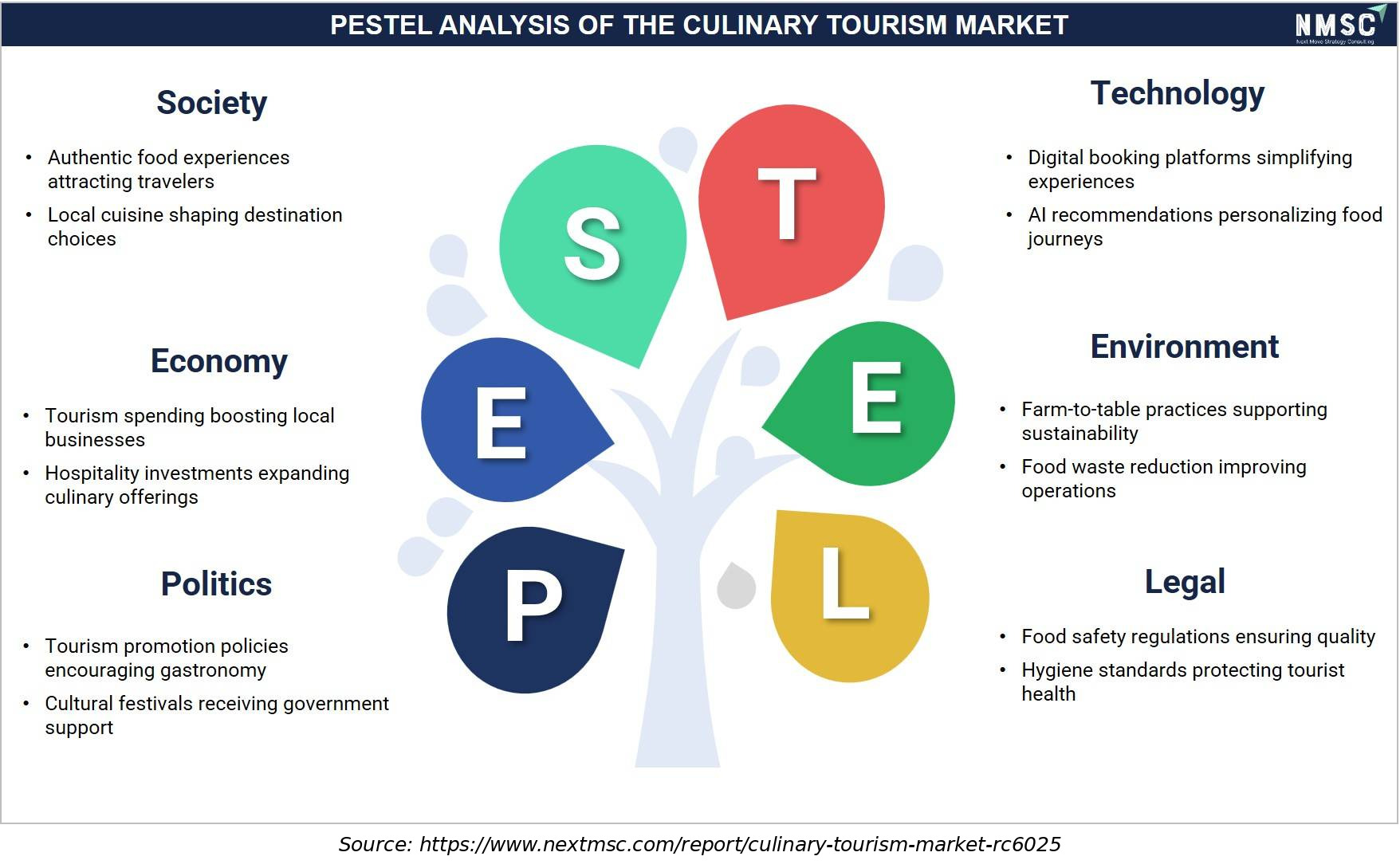
PESTEL Analysis of the Culinary Tourism Market Industry

PESTEL Analysis of the Culinary Tourism Market Industry

The above infographic presents a PESTEL analysis of the culinary tourism market, wherein tourism promotion policies and government support for cultural festivals are enhancing destination appeal and visitor engagement. Digital booking platforms and AI-driven recommendations are simplifying trip planning and personalizing food journeys, while hospitality investments and business expansion are boosting local economies. Furthermore, environmental sustainability efforts, including food waste reduction, are improving operational practices. These developments are reinforced by food safety regulations and hygiene standards that ensure quality and protect tourist health. Looking ahead, we observed that continued investment in gastronomic infrastructure and regulatory compliance will remain key drivers of market growth and traveler confidence.

Which Activity Type Dominates the Culinary Tourism Market?

Culinary Trails and Food Tours led the market with USD 7.44 billion in 2025, reflecting their status as the most accessible and widely offered organized culinary tourism product across established and emerging destinations. Our findings suggest that Farm-to-table Experiences are the fastest-growing activity type, registering a 22.5% CAGR from 2026 to 2035, as travelers increasingly seek direct engagement with local food producers and sustainable, traceable dining experiences.

Segment Sizing: By Tour Type

Segment 2025 (USD) 2035 (USD) CAGR% (2026–2035)
Domestic Culinary Tourism USD 17.04 Billion USD 86.58 Billion 17.65%
International Culinary Tourism USD 6.96 Billion USD 55.17 Billion 23.0%
Total USD 24 Billion USD 141.75 Billion 19.5%
Source: www.nextmsc.com

Which Tour Type Leads Culinary Tourism Market Demand?

Domestic Culinary Tourism remained dominant at USD 17.04 billion in 2025, as most travelers pursue food-focused experiences within their own country or region rather than through international travel. We found that International Culinary Tourism is the fastest-growing tour type at a 23.0% CAGR from 2026 to 2035, as cross-border food trail programs and growing interest in specific regional cuisines drive travelers to plan trips centered on international culinary discovery.

Segment Sizing: By Booking Mode

Segment 2025 (USD) 2035 (USD) CAGR% (2026–2035)
Tour Operators and Travel Agencies USD 11.52 Billion USD 55.39 Billion 17.0%
Online Travel Agencies USD 8.16 Billion USD 62.78 Billion 22.6%
Direct Booking USD 4.32 Billion USD 23.58 Billion 18.5%
Total USD 24 Billion USD 141.75 Billion 19.5%
Source: www.nextmsc.com

Which Booking Mode Leads Culinary Tourism Market Demand?

Tour Operators and Travel Agencies remained the leading booking mode, valued at USD 11.52 billion in 2025, as curated, multi-day culinary itineraries typically require the destination expertise and logistics coordination that traditional operators provide. Our analysis shows that Online Travel Agencies are the fastest-growing booking mode, expanding at a 22.6% CAGR from 2026 to 2035, as digital platforms increasingly allow travelers to discover and reserve individual culinary experiences directly without full-service operator involvement.

Growth Opportunities

Our analysis shows that three forward-looking opportunities stand out for stakeholders positioning within the culinary tourism market over the 2026-2035 forecast period.

How Can Farm-to-table Partnerships Unlock Value for Tour Operators?

Direct partnerships with local food producers and farms present a whitespace opportunity for tour operators seeking differentiated, sustainability-linked itineraries. Operators that build exclusive farm-to-table experience networks can capture premium per-traveler pricing, benefiting the Farm-to-table Experiences activity segment as sustainability-conscious travelers increasingly prioritize traceable, locally sourced dining over generic restaurant visits.

Where Does Digital Booking Platform Expansion Create New Demand?

Digital booking platform expansion creates an underpenetrated opportunity for culinary experience providers seeking direct access to independent travelers. Providers that scale discoverability through online travel agencies can capture new demand outside traditional operator-led group tours, benefiting the Online Travel Agencies booking mode segment as younger travelers increasingly plan and book individual culinary experiences digitally.

How Can Government Destination Marketing Benefit Emerging Culinary Markets?

Government-led destination gastronomy marketing presents an opportunity for tour operators entering emerging culinary tourism markets with limited international brand recognition. Operators that align product development with government tourism promotion campaigns can capture early-mover destination positioning, benefiting the International Culinary Tourism tour type segment as emerging destinations invest in gastronomy-led visitor promotion.

Regional Outlook

2025 (USD Billion)
2035 (USD Billion)
Europe
Asia-Pacific
North Americ
Middle East
Latin Americ
Region 2025 (USD Billion) 2035 (USD Billion) CAGR (%)
Europe $10.0 USD Billion $40.0 USD Billion 9.0%
Asia-Pacific $17.1 USD Billion $51.1 USD Billion 27.0%
North America $24.2 USD Billion $62.2 USD Billion 25.0%
Middle East & Africa $31.3 USD Billion $73.3 USD Billion 23.0%
Latin America $38.4 USD Billion $84.4 USD Billion 12.0%

Regional data is locked

Unlock complete regional numbers for this market.

Unlock Full Data

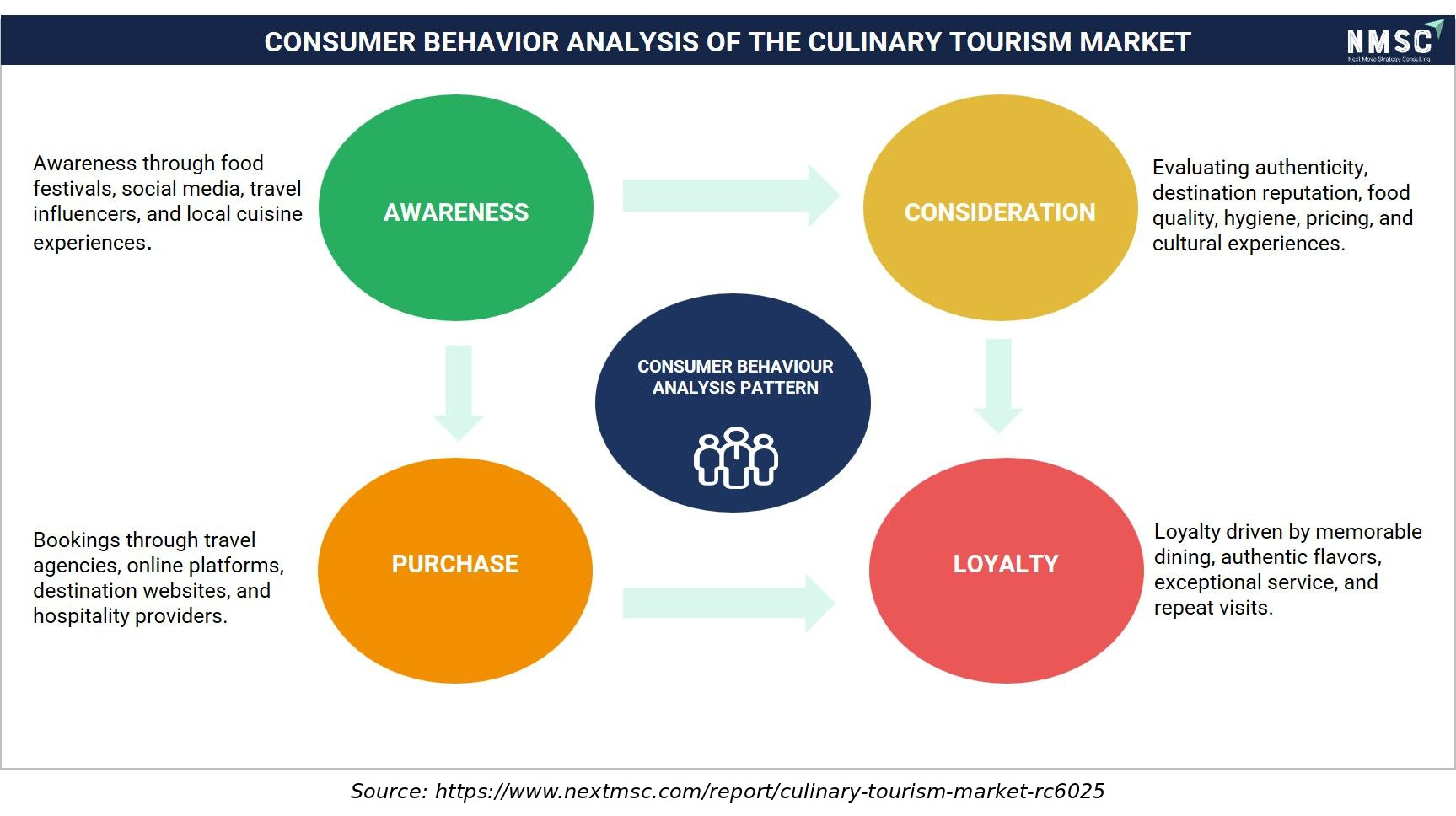
Consumer Behavior Analysis of the Culinary Tourism Industry

Consumer Behavior Analysis of the Culinary Tourism Industry

The above infographic presents a consumer behavior analysis of the culinary tourism market, mapping the journey from awareness to loyalty. Travelers discover destinations through food festivals, social media, and travel influencers, leading them to evaluate authenticity, food quality, and cultural experiences before booking through online platforms or hospitality providers. Loyalty is reinforced by memorable dining, authentic flavors, and exceptional service, encouraging repeat visits. Looking ahead, we observed that destination branding and consistent quality remain essential for sustaining traveler engagement and competitive advantage across the culinary tourism landscape.

Competitive Landscape

We observed that the culinary tourism market features a mix of diversified luxury and adventure travel groups, specialized culinary tour operators, and regional food experience providers competing across itinerary curation depth, destination network breadth, and brand positioning.

Dimension Description
Market Structure Moderately fragmented among diversified travel groups and specialized culinary operators, with regional competition among smaller destination-specific food tour providers.
Innovation Focus Immersive small-group itinerary design, farm-to-table partnership networks, and digital booking platform integration dominate current innovation pipelines across leading operators.
M&A Activity Selective acquisitions and portfolio expansion, exemplified by Intrepid Travel’s 2025 acquisition of JOOB to expand domestic adventure and local tourism operations in Australia.

How Do Companies Compete in the Culinary Tourism Market?

Companies compete primarily on itinerary curation depth, destination network breadth, and brand positioning across the industry. Diversified luxury travel groups such as Abercrombie & Kent and The Travel Corporation leverage broad destination networks and five-star service standards to serve premium travelers, while specialized culinary operators such as Culinary Tours and Gourmet on Tour compete on deep, food-focused itinerary expertise within specific regional cuisines.

Which Competitive Archetypes Dominate the Market?

Two archetypes dominate the culinary tourism market: diversified luxury and adventure travel groups offering culinary components within broader multi-theme itineraries, and specialized culinary-only operators focused exclusively on food and beverage experiences. Abercrombie & Kent and G Adventures exemplify the diversified archetype through small-group journeys spanning multiple travel themes, while Culinary Adventures International and Eating Europe Food Tours exemplify the specialized archetype through dedicated food-focused product lines.

How Are Companies Differentiating Through Innovation in Culinary Tourism?

Innovation and differentiation strategy increasingly center on immersive, small-group itinerary design and inclusive travel programming. Intrepid Travel’s LGBTQIA+ day tours incorporating local food experiences and Abercrombie & Kent’s expanded 2026 small-group journey portfolio both illustrate how operators are pairing cultural inclusion and destination depth with culinary discovery. Our analysis shows that operators unable to differentiate beyond generic food tour formats risk losing share to competitors offering more curated, theme-integrated experiences.

What M&A and Expansion Activity Is Shaping the Market?

Acquisitions and portfolio expansion continue to shape competitive positioning within the industry. Intrepid Travel’s July 2025 acquisition of JOOB strengthened its domestic Australian tourism capability, while Abercrombie & Kent’s continued Sanctuary Retreats lodge renovations and expanded 2026 small-group journey portfolio illustrate how established operators are broadening destination and experience depth to defend market share against smaller specialized competitors.

Key Market Players

Our assessment indicates that the following 20 companies are actively shaping itinerary innovation, destination network expansion, and competitive strategy within the global culinary tourism market.

The Travel Corporation Abercrombie & Kent USA, LLC G Adventures Inc. Intrepid Travel Pty Ltd EF Education First Butterfield & Robinson Inc. Backroads Classic Journeys, LLC Explore Worldwide Ltd Topdeck Travel Pty Ltd ITC Travel Group Limited Context Travel, Inc. Culinary Tours Culinary Adventures International Gourmet on Tour Greaves Travel Ltd India Food Tour Eating Europe Food Tours Cellar Tours Rick Steves' Europe, Inc.

Latest Developments

We found that recent itinerary launches and acquisitions within the culinary tourism market are concentrated on immersive small-group experience design and domestic tourism expansion.

Date Event
July 2026 EF Go Ahead Tours announced two new France itineraries for 2027, including Food & Wine of France: Burgundy, Champagne & Paris.
March 2026 Explore Worldwide announced its first-ever familiarization trip for North American travel advisors, offering a seven-day Morocco itinerary in June 2026.
April 2025 Abercrombie & Kent introduced three new culinary-inspired Small Group Journeys covering France, India, and Vietnam, beginning in August 2025.Abercrombie & Kent introduced three new culinary-inspired Small Group Journeys covering France, India, and Vietnam, beginning in August 2025.

Expert Insights

Lael Kassis

Vice President of Market Innovation and Development | EF Go Ahead Tours

"“France continues to inspire travelers looking for culture, cuisine, history, and unforgettable scenery. With an expanded set of itinerary options across France, we aim to give travelers a wide range of experiences that balance France's iconic landmarks with its lesser-known regions. These new trips showcase the incredible diversity of the country, from the vineyards of Burgundy and Champagne to the storybook villages of Alsace and the dramatic peaks of the French Alps, while making travel seamless through expertly planned guided experiences.”"

Analyst Interpretation

The statement highlights the growing integration of cuisine and food-and-wine experiences into destination-based travel itineraries. NMSC's analysis indicates that culinary tourism is increasingly being positioned alongside culture, heritage, scenery, and regional exploration as a core component of experiential travel. The emphasis on Burgundy and Champagne vineyards demonstrates how destinations are leveraging local food and beverage assets to diversify tourism offerings, encourage regional exploration, and create more immersive travel experiences.

Investment Opportunities

What Capital Inflows Are Targeting the Culinary Tourism Market?

Capital inflows into the culinary tourism market are increasingly directed toward domestic tourism platform acquisitions and immersive itinerary development. Intrepid Travel's acquisition of JOOB illustrates the scale of capital being committed to domestic, locally guided tourism expansion. We observed that investors favor operators demonstrating validated small-group itinerary demand, viewing repeat booking rates as a proxy for durable brand loyalty within the premium travel segment.

How Is Infrastructure Investment Supporting Culinary Tourism Growth?

Infrastructure investment is expanding destination-level tourism capacity to support growing culinary-motivated visitor demand. Ho Chi Minh City's culinary tourism program launch illustrates how municipal authorities are investing in destination marketing infrastructure to support gastronomy-led visitor growth, while Abercrombie & Kent's Sanctuary Retreats lodge renovations reflect continued private investment in destination-level hospitality infrastructure supporting culinary programming.

What ESG Considerations Are Shaping Culinary Tourism Investment Decisions?

Environmental, social, and governance considerations increasingly shape investment decisions, with sustainable sourcing and community conservation impact as key criteria. Abercrombie & Kent's philanthropy program continues to link trip bookings directly to community and conservation initiatives in destination countries. We found that investors increasingly favor operators demonstrating measurable community and environmental impact, treating sustainability commitment as a differentiator alongside growth metrics.

Key Benefits for Stakeholders

How Does This Report Benefit Enterprise and Industry Leaders?

Enterprise and industry leaders gain access to validated segmentation, competitive benchmarking, and regional demand forecasts that support itinerary investment and destination network decisions across the culinary tourism industry. Our analysis shows that detailed activity-type, tour-type, and booking-mode breakdowns help operators align product development planning with the fastest-growing demand areas, including farm-to-table experiences and international culinary travel.

How Does This Report Benefit Investors and Financial Analysts?

Investors and financial analysts benefit from consistent, single-point market size and CAGR estimates that support valuation and capital-allocation decisions across the experiential travel supply chain. We observed that the report's regional and segment-level growth differentials help identify which operators and activity categories are best positioned to capture above-market growth in Asia-Pacific and Farm-to-table Experiences categories through 2035.

How Does This Report Benefit Technology Vendors and Product Teams?

Technology vendors and product teams gain insight into emerging design requirements, including digital booking integration, inclusive itinerary design, and farm-to-table partnership networks, that are reshaping the industry. Our findings suggest that this analysis helps product teams prioritize development roadmaps around direct booking capability and destination discovery tools increasingly required by younger traveler segments.
Key Market Segments Evaluated

By Activity Type

  • Culinary Trails and Food Tours
  • Cooking Classes and Workshops
  • Food Festivals and Events
  • Wine and Beverage Tourism
  • Restaurant and Fine Dining Experiences
  • Farm-to-table Experiences
  • Other Activities

By Tour Type

  • Domestic Culinary Tourism
  • International Culinary Tourism

By Booking Mode

  • Tour Operators and Travel Agencies
  • Online Travel Agencies
  • Direct Booking

By Tourist Type

  • Recreational Tourists
  • Diversionary Tourists
  • Existential Tourists
  • Experimental Tourists

By Age Group

  • Baby Boomers
  • Generation X
  • Millennials
  • Generation Z

Conclusion & Recommendations

The long-term outlook for the market remains strongly positive, with global revenue projected to grow nearly sixfold from USD 24 billion in 2025 to USD 141.75 billion by 2035 at a 19.5% CAGR. We observed that sustained traveler preference for experiential trip design, government gastronomy promotion, and expanding digital booking access will continue underpinning demand across culinary trail, farm-to-table, and international travel categories through the forecast period.

What Strategic Positioning Should Culinary Tourism Suppliers Pursue?

Suppliers should prioritize immersive, small-group itinerary design while expanding farm-to-table and sustainability-linked product lines to capture premium traveler demand. Our assessment indicates that operators investing early in digital booking capability and international destination network breadth will be best positioned to capture above-market growth within the culinary tourism market.

How Attractive Is the Market for New Investment?

The culinary tourism industry presents a highly attractive investment case, supported by a USD 113.25 billion absolute dollar opportunity between 2026 and 2035 and above-average growth in Asia-Pacific and Farm-to-table Experiences categories. We found that investment attractiveness is highest for operators combining validated small-group itinerary demand with expanding digital booking capability, positioning them to serve both premium and independent traveler segments simultaneously.

What Market Shifts and Key Risks Should Stakeholders Monitor?

Stakeholders should monitor global travel disruption risk, premium pricing access barriers, and fragmented local operator quality standards as key risks to the culinary tourism market. Our analysis shows that operators unable to maintain consistent safety and quality standards across emerging destinations risk reputational damage that could disproportionately affect smaller, specialized culinary tour providers relative to diversified travel groups.

What Are the Key Growth Pathways for the Market?

Key growth pathways include expanding farm-to-table experience networks, scaling digital booking platform integration, and deepening penetration into Asia-Pacific and international travel categories. NMSC's analysis indicates that suppliers pursuing these pathways while maintaining destination quality and safety standards will be best positioned to capture the culinary tourism market's projected growth through 2035.

FAQs

About the Author

Mayurima Roy

Mayurima Roy

Mayurima Roy is Research Analyst at Next Move Strategy Consulting, where she has spent 4 years working across the firm's full industry coverage rather than a single fixed vertical. Her work centers on structured research, ongoing trend tracking, competitive assessment, and insight-led content development, translating complex market data into clear, decision-ready narratives that support informed client decision-making across diverse global industries, market sectors, and world regions every day.

About the Reviewer

Supradip Baul

Supradip Baul

Supradip Baul is an accomplished business consultant and strategist with over a decade of rich experience in market intelligence, strategy, technology, and business transformation. His work has included rigorous qualitative and quantitative analysis across multiple industries, helping clients shape investment decisions and long-term roadmaps. Earlier in his career, he was associated with Gartner, where he contributed to industry-leading reports and market share analyses. He has worked with leading global companies and holds an MBA with a dual specialization in Marketing and Finance.

Download Free Sample

Diana Trejo

DIANA TREJO

Assistant Manager

Sumitomo Corporation de Mexico, S.A. de C.V.

Recently, we purchased a report on the Mexico Data Center Market from Next Move Strategy Consulting. The service has been excellent, with support that is always timely and thoroughly professional. The information provided is interesting, highly useful, and delivered with clarity. I would highly recommend NextMSC for anyone seeking insightful and dependable analysis.

Melanie Samko

MELANIE SAMKO

Director of Marketing

TOSOH BIOSCIENCE, INC.

The information provided by NMSC is incredibly valuable, thank you so much for such a excellent work. I really appreciate it. I will make sure to reference all of it, in my summary document.

Kishu Kanda

KISHU KANDA

Strategy Analyst

Accenture

We purchased the AI Consumer Market Report from this company. Not only did they customize the report to meet our specific requirements, but they also showed great flexibility in accommodating our budget. The report we received fully met our expectations. Additionally, they provided prompt and thorough responses to both our pre-purchase and follow-up questions. We look forward to working with this company again in the future.

Pratyush Kumar Das

PRATYUSH KUMAR DAS

Assistant Manager

Polycab India Limited

We would like to express our appreciation for the data and insights provided by nextmsc. We are very pleased with the quality and depth of the information, which has proven to be highly valuable and beneficial for our business decision-making.

Kevin Coker

KEVIN COKER

Founder, CEO and Board Diector

Proxima Clinical Research

I have been using Next MSC reports for product positioning in a new geography for a long time. They have by far the best reports I have found and the price is reasonable too!

Custom Market Research Services

We will customize the research for you if the listed report does not fully match your requirements.
Get 30% Free Customization

Select License

This website uses cookies to ensure you get the best experience on our website. Learn more

✖