Customs Declaration Software Market Global Industry Analysis and Forecast (2026–2035)

Customs Declaration Software Market size was USD 1.62 billion in 2026, projected to reach USD 3.96 billion by 2035, growing at a CAGR of 10.4% from 2026 to 2035. Key drivers include tariff complexity and duty changes, the removal of de minimis exemptions, and rising ecommerce parcel volumes, with Europe leading the market.

Download Free Sample PDF
Base Year (2025)
$1.46 Billion
Forecast (2035)
$3.96 Billion
CAGR (2026-2035)
10.4%
Top Region
Europe

What Is the Customs Declaration Software Market Size?

The global Customs Declaration Software Market was valued at USD 1.46 Billion in 2025 and is estimated at USD 1.62 Billion in 2026. It is forecast to reach USD 3.96 Billion by 2035, expanding at a 10.4% CAGR from 2026–2035. Europe leads with approximately 34% share, while Software is the dominant offering with approximately 81% share.

Our findings suggest that software platforms, import filings and European demand anchor revenue, while APAC supplies the fastest regional growth.

Customs Declaration Software Market Global Industry Analysis and Forecast (2026–2035) Revenue Forecast

Values in USD Billion

2025 $1.46 Billion
2025
2026 $1.62 Billion
2026
2027 $1.79 Billion
2027
2028 $1.97 Billion
2028
2029 $2.18 Billion
2029
2030 $2.41 Billion
2030
2031 $2.66 Billion
2031
2032 $2.93 Billion
2032
2033 $3.24 Billion
2033
2034 $3.57 Billion
2034
2035 $3.96 Billion
2035

Key Takeaways

By Offering: Software held the largest share, expanding from USD 1.19 Billion in 2025 to USD 3.12 Billion by 2035; Services is the fastest-growing at 11.7% CAGR from 2026–2035.

By Application: Import declaration held the largest share, expanding from USD 0.82 Billion in 2025 to USD 2.26 Billion by 2035; Transit and warehouse declaration is the fastest-growing at 10.8% CAGR from 2026–2035.

By End User: Importers and exporters held the largest share, expanding from USD 0.52 Billion in 2025 to USD 1.46 Billion by 2035; Freight forwarders and logistics providers is the fastest-growing at 11.1% CAGR from 2026–2035.

Dominant Region: Europe held the largest share at approximately 34% in 2026, expanding from USD 0.50 Billion in 2025 to USD 1.22 Billion by 2035.

Fastest-Growing Region: Asia-Pacific is the fastest-growing region at 13.4% CAGR from 2026–2035, rising from USD 0.33 Billion in 2025 to USD 1.15 Billion by 2035.

Dominant Country: The U.S. is the largest country market, growing from USD 0.36 Billion in 2025 to USD 0.83 Billion by 2035 at 8.8% CAGR.

Fastest-Growing Country: India is the fastest-growing country at 16.7% CAGR from 2026–2035, rising from USD 0.04 Billion in 2025 to USD 0.20 Billion by 2035.

The Customs Declaration Software Market presents an absolute investment opportunity of approximately USD 2.34 Billion between 2026 and 2035. Capital directed at declaration automation, tariff content and customs authority connectivity is positioned to capture this expansion, because tariff complexity, parcel volumes and customs reform are pushing manual filing into regulated software workflows in every major trading economy.

According to NMSC analysis, the end of duty free de minimis treatment in the United States and the agreed removal of the 150 euro EU parcel duty exemption convert very large volumes of lightly processed parcels into filed declarations. This regulatory shift, more than headline trade growth, is the most underappreciated volume catalyst for software vendors through 2028.

What Does the Customs Declaration Software Market Encompass?

The Customs Declaration Software Market covers digital platforms that prepare, validate, submit and track import, export, transit and warehouse declarations with customs authorities. It also includes the implementation, tariff content and managed services that keep filings compliant. The market excludes customs brokerage fees, freight forwarding revenue and trade compliance screening sold without a declaration module, which keeps the revenue base focused on software and services tied directly to filing.

Structural change is moving the market from country specific desktop clients toward cloud platforms that reach many customs systems through one data model. U.S. filers connect to the Automated Commercial Environment, while the EU applies the Union Customs Code and plans an EU Customs Data Hub for ecommerce from 2028. Integration with supply chain management suites is widening the buyer base from brokers to shippers and carriers.

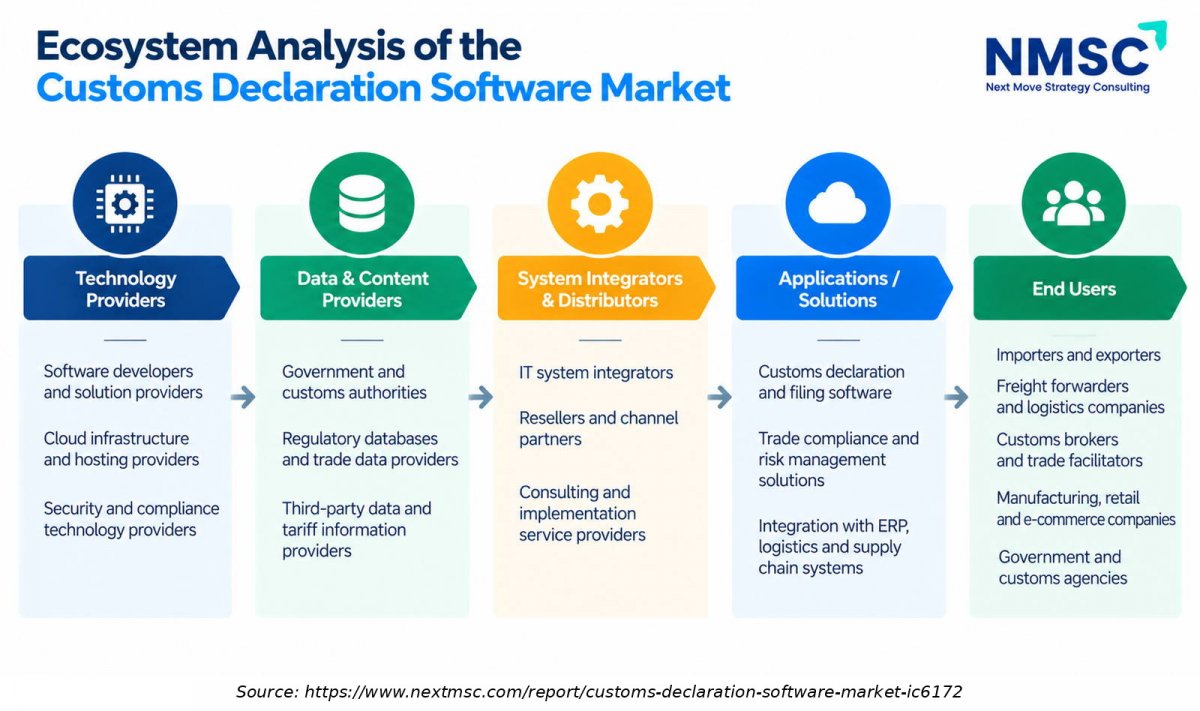
Ecosystem Analysis of the Customs Declaration Software Market

The customs declaration software market ecosystem comprises technology providers, data and content providers, system integrators, software vendors, and end users. Technology providers supply cloud infrastructure, security, and software platforms, while customs authorities and data providers contribute regulatory information and tariff databases. System integrators support implementation and connectivity with enterprise systems. Importers, exporters, customs brokers, freight forwarders, and logistics companies use these solutions to streamline declarations and improve trade compliance.

Market Drivers & Dynamics

Interactive Dataset
Tariff volatility and duty complexity driver +2.1% Global, led by North America 2026–2030
End of de minimis and parcel duty exemptions driver +1.8% U.S., EU 2026–2029
Ecommerce parcel volume growth driver +1.5% Europe, Asia-Pacific 2026–2033
AI document processing and classification driver +1.3% Europe, North America 2026–2032
Customs digitalization programs and data hubs driver +1.0% Europe, Asia-Pacific, Middle East 2027–2035
Free government customs systems restraint −1.2% Africa, Latin America, Pacific 2026–2035
Integration complexity and country specific rules restraint −1.0% Global 2026–2032
Trade volume shocks from regional conflict restraint −0.9% Global 2026–2027
Source: Next Move Strategy Consulting

Growth Drivers

What Is the Primary Growth Driver in the Customs Declaration Software Market?

Tariff complexity is the primary driver of the Customs Declaration Software Market. The World Trade Organization expects world merchandise trade volume to grow 3.9% in 2026, and each additional shipment faces changing duty rates, origin rules and partner agency data requirements. U.S. Customs and Border Protection processed 36.7 million entries in fiscal 2023, and every entry is a declaration that software must prepare accurately. We found that importers now treat automated filing as a margin protection tool rather than an administrative cost.

How Is Ecommerce Parcel Growth Driving the Market?

The European Commission estimates that 5.9 billion low value items entered the EU in 2025, with more than 90% originating from China. The EU agreed in November 2025 to remove the 150 euro duty exemption, and platforms must report sales to customs through the Data Hub once it launches. In the United States, CBP stopped accepting Entry Type 86 on August 29, 2025, so express and parcel filers must submit formal or informal entries in the Automated Commercial Environment.

Growth Inhibitors

What Is Restraining the Customs Declaration Software Market?

Public sector alternatives and integration effort restrain growth. UNCTAD reports that its ASYCUDAWorld system is live in around 100 economies, which gives many customs administrations and local traders a no license route to electronic filing. The European Commission also expects its Data Hub to save member states up to 2 billion euro a year by replacing national customs IT, which reduces national platform demand. Country specific rules and legacy ERP connections still lengthen deployments.

What Are the Growth Opportunities?

Can Managed Customs Filing Services Capture Midsize Importers?

Midsize importers face rising filing volumes after tariff and parcel rule changes but rarely employ licensed customs specialists. Vendors that bundle software with managed filing, classification review and audit support can convert this cohort into recurring contracts. Services is the segment most likely to benefit, and the Customs Declaration Software Market gains a lower friction entry point for smaller buyers that cannot justify a full enterprise implementation.

Does Ecommerce Platform Connectivity Create a New Software Layer?

The EU Customs Data Hub will require online platforms and sellers to inform customs about sales immediately after they happen. Marketplaces, couriers and postal operators will need connectors that translate order data into customs messages at very high volumes. Vendors with certified government interfaces and document extraction engines can sell this layer to platforms, which would extend the buyer base beyond brokers and importers.

Can AI Classification and Audit Modules Become Separate Revenue Lines?

Tariff classification and customs audit review are labor intensive tasks that determine duty accuracy. Digicust offers AI customs audit and classification modules, and MIC has introduced AI assisted tariff classification into its global platform. Vendors can price these modules by volume or by savings delivered, allowing importers with large catalogs to adopt them without replacing their core filing system.

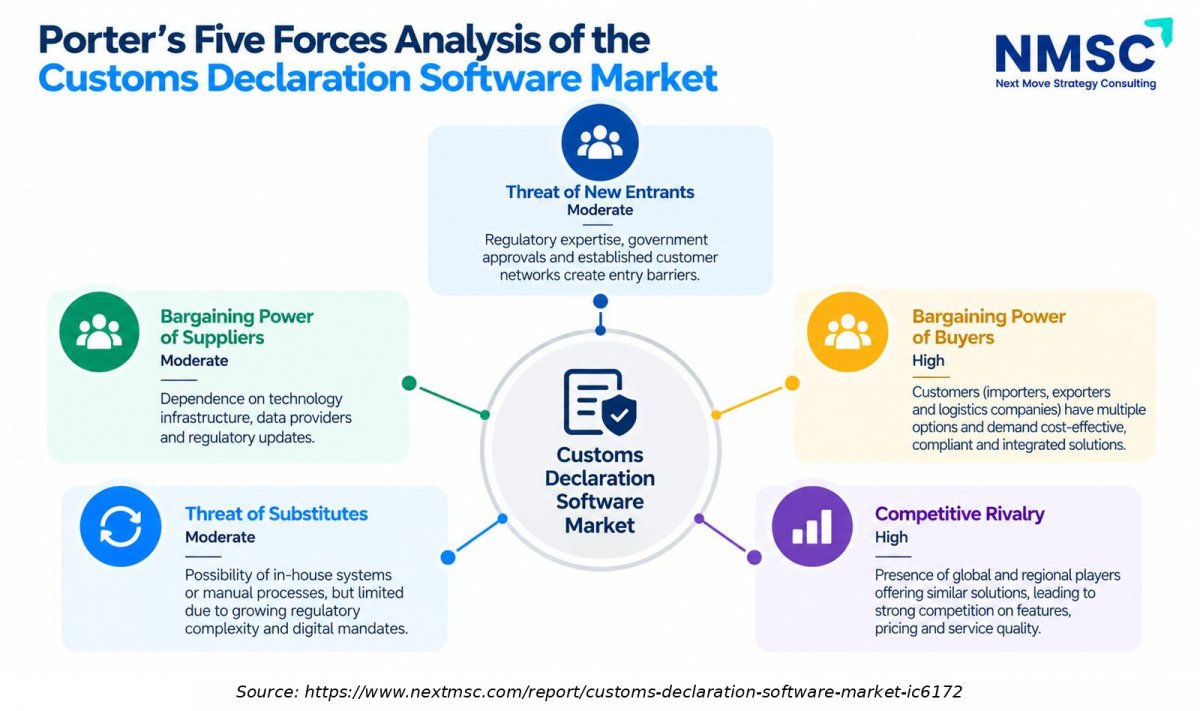
Porter’s Five Forces Analysis of the Customs Declaration Software Market
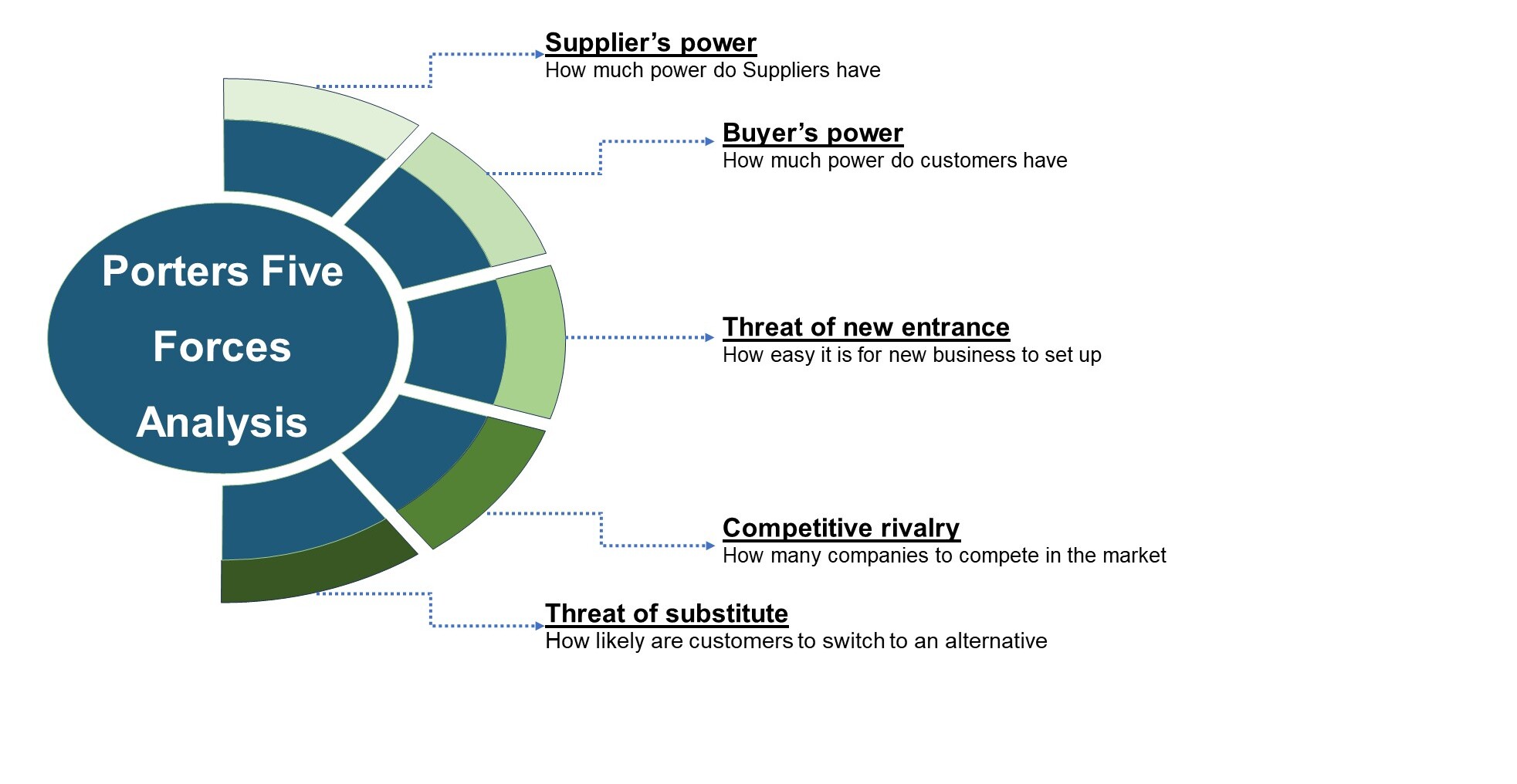
The customs declaration software market experiences strong competitive rivalry as global and regional vendors compete on automation, regulatory coverage, integration, and pricing. Supplier power is moderate due to reliance on cloud infrastructure and specialised trade data. Buyer power is high because businesses can compare multiple solutions and seek cost-effective services. The threat of new entrants is moderate, given regulatory complexity and integration requirements. Substitution pressure is moderate, as manual processes and in-house systems remain alternatives but offer limited scalability.

Segmentation Analysis

2025 (USD Billion)
2035 (USD Billion)
Software 2025: $1.19 Billion | 2035: $3.12 Billion
Software
Services 2025: $0.27 Billion | 2035: $0.84 Billion
Services
Software $1.19 Billion $3.12 Billion 10.1%
Services $0.27 Billion $0.84 Billion 11.7%

Which Offering Segment Leads and Which Is Growing Fastest?

Software dominated the Customs Declaration Software Market in 2026 with USD 1.31 Billion, about 81% of revenue, because subscription filing platforms form the core purchase for brokers, forwarders and importers. Services is the fastest growing offering at 11.7% CAGR from 2026–2035 as managed classification, onboarding and content subscriptions expand. We observed that buyers increasingly bundle implementation and tariff content with the license, which lifts services attachment rates.
2025 (USD Billion)
2035 (USD Billion)
Import decla
Export decla
Transit and
Segment Item 2025 (USD Billion) 2035 (USD Billion) CAGR
Import declaration $10.0 USD Billion $40.0 USD Billion 18.0%
Export declaration $17.1 USD Billion $51.1 USD Billion 16.0%
Transit and warehouse declaration $24.2 USD Billion $62.2 USD Billion 22.0%

Segment-wise data is locked

Unlock complete segment-wise numbers for Application.

Unlock Full Data
2025 (USD Billion)
2035 (USD Billion)
Importers an
Customs brok
Freight forw
Government c
Segment Item 2025 (USD Billion) 2035 (USD Billion) CAGR
Importers and exporters $10.0 USD Billion $40.0 USD Billion 26.0%
Customs brokers $17.1 USD Billion $51.1 USD Billion 16.0%
Freight forwarders and logistics providers $24.2 USD Billion $62.2 USD Billion 18.0%
Government customs authorities $31.3 USD Billion $73.3 USD Billion 8.0%

Segment-wise data is locked

Unlock complete segment-wise numbers for End User.

Unlock Full Data

Growth Opportunities

Our analysis shows that three whitespace opportunities are positioned to generate disproportionate revenue through 2035.

Can Managed Customs Filing Services Capture Midsize Importers?

Midsize importers face rising filing volumes after tariff and parcel rule changes but rarely employ licensed customs specialists. Vendors that bundle software with managed filing, classification review and audit support can convert this cohort into recurring contracts. Services is the segment most likely to benefit, and the Customs Declaration Software Market gains a lower friction entry point for smaller buyers that cannot justify a full enterprise implementation.

Does Ecommerce Platform Connectivity Create a New Software Layer?

The EU Customs Data Hub will require online platforms and sellers to inform customs about sales immediately after they happen. Marketplaces, couriers and postal operators will need connectors that translate order data into customs messages at very high volumes. Vendors with certified government interfaces and document extraction engines can sell this layer to platforms, which would extend the buyer base beyond brokers and importers.

Can AI Classification and Audit Modules Become Separate Revenue Lines?

Tariff classification and customs audit review are labor intensive tasks that determine duty accuracy. Digicust offers AI customs audit and classification modules, and MIC has introduced AI assisted tariff classification into its global platform. Vendors can price these modules by volume or by savings delivered, allowing importers with large catalogs to adopt them without replacing their core filing system.

Regional Outlook

2025 (USD Billion)
2035 (USD Billion)
North Americ
Europe
Asia-Pacific
Middle East
Latin Americ
Region 2025 (USD Billion) 2035 (USD Billion) CAGR (%)
North America $10.0 USD Billion $40.0 USD Billion 9.0%
Europe $17.1 USD Billion $51.1 USD Billion 27.0%
Asia-Pacific $24.2 USD Billion $62.2 USD Billion 25.0%
Middle East & Africa $31.3 USD Billion $73.3 USD Billion 23.0%
Latin America $38.4 USD Billion $84.4 USD Billion 12.0%

Regional data is locked

Unlock complete regional numbers for this market.

Unlock Full Data

Competitive Landscape

Our assessment indicates that this industry blends enterprise suites, logistics platforms and regional specialists competing on filing coverage.

Dimension Description
Market Structure Moderately concentrated, with enterprise suites, logistics platforms and regional specialists sharing a fragmented long tail.
Innovation Focus AI document extraction, tariff content, multi country filing connectivity and platform integrations.
M&A Activity Platform consolidation led by WiseTech Global’s August 2025 e2open acquisition and a steady cadence of Descartes acquisitions.

How Do Companies Compete in the Customs Declaration Software Market?

Companies compete on the number of customs authority connections, the depth of tariff content, integration with ERP and logistics systems, and delivery model. SAP and Oracle sell customs modules into installed enterprise bases, while WiseTech and Descartes bundle filing with forwarding and network services. Regional specialists such as AEB, MIC and DAKOSY compete on local certification and service quality. Pricing is mostly subscription or transaction based, with volume tiers for brokers and ecommerce operators.

Which Competitive Archetypes Dominate the Customs Declaration Software Market?

Four archetypes dominate. Enterprise suite vendors, led by SAP, Oracle and Thomson Reuters, differentiate through ERP integration and content. Logistics platform vendors, led by WiseTech Global and Descartes, differentiate through end to end shipment workflows. Regional specialists, including AEB, MIC and DAKOSY, differentiate through local customs certification. Government system builders such as Netcompany and CrimsonLogic differentiate through national scale implementations for customs authorities.

What Innovation and Differentiation Strategies Are Companies Pursuing?

We observed that vendors invest in AI that reads invoices, proposes tariff codes and checks declarations before submission. Magaya launched a Broker AI Assistant, MIC introduced AI assisted tariff classification, and Digicust markets agentic workflows for customs. WiseTech has also embedded an AI workflow engine in CargoWise. Differentiation is moving from simple connectivity to accuracy, audit readiness and measurable reductions in manual keying time.

What M&A and Partnership Activity Is Shaping the Market?

Our findings suggest that consolidation is accelerating. WiseTech Global completed its USD 2.1 billion acquisition of e2open in August 2025 to reach shippers and manufacturers, and Descartes reported ten acquisitions between the start of fiscal 2024 and the end of fiscal 2026. Smaller players pursue partnerships with ERP vendors, as AEB did with IFS, and with customs authorities. Geographic expansion and pricing bundles are now common deal rationales.

Key Market Players

Based on research conducted by NMSC, we found that the following 12 companies form the verified supplier set.

WiseTech Global Limited The Descartes Systems Group Inc. SAP SE Oracle Corporation Thomson Reuters Corporation Netcompany Group A/S AEB SE MIC Datenverarbeitung GmbH DAKOSY Datenkommunikationssystem AG CrimsonLogic Pte Ltd Magaya Corporation Digicust

Latest Developments

During our market evaluation, we noticed that 2025–2026 developments centered on tariff driven filing demand, platform consolidation and customs reform.

Date Event
September 2026 Quirch Foods went live on Magaya Customs Compliance to support its new Foreign Trade Zone (FTZ) operations. The platform handles electronic CBP Form 214 admissions, Form 7512 in-bond filings, FTZ inventory management and reporting, bringing customs transactions and inventory controls into a connected system.
September 2026 Rosanto Logistics implemented Magaya Customs Compliance to replace its legacy software for Automated Export System (AES) filings. The deployment included configuration, connectivity with U.S. Customs and Border Protection, workflow testing and staff training. The company subsequently began submitting live AES transactions through the platform.

Investment Opportunities

Where Are Capital Inflows Concentrating in the Customs Declaration Software Market?

Capital inflows concentrate in platform consolidation and AI customs automation. WiseTech Global financed its USD 2.1 Billion e2open acquisition with a new syndicated debt facility, and Digicust raised a 2.3 million euro round to scale AI declaration tools. Strategic buyers favor assets with recurring subscription revenue and regulatory content, while venture investors back narrow automation layers. We observed that scale in customs connectivity and tariff data is the most defensible investment thesis.

How Is Infrastructure Investment Shaping Market Capacity?

Infrastructure investment is shifting toward cloud platforms, certified government interfaces and data hubs. The EU Customs Data Hub will take years to build and requires traders, platforms and software vendors to connect their systems. In the United States, CBP continues to modernize its Automated Commercial Environment portal. Vendors invest in resilient cloud hosting, message translation and security certification, which raises entry barriers and improves capacity to process high ecommerce volumes.

What ESG Considerations Are Influencing Market Investment?

Environmental, social and governance considerations center on paperless trade, transparent compliance and responsible data use. UNCTAD describes ASYCUDA as replacing paper based customs methods with digital operations, and electronic declarations reduce manual errors and physical document handling. Investors increasingly screen vendors for data security, governance of AI classification and audit traceability, because customs data now supports origin and sourcing enforcement.

Key Benefits for Stakeholders

How Does This Report Benefit Importers, Exporters and Logistics Leaders?

Importers, exporters, forwarders and brokers gain a reconciled view of software spend by offering, application and end user through 2035. The analysis shows where tariff volatility, de minimis changes and customs reform create filing demand, and which vendor archetypes fit each buyer type. Procurement teams can use the regional and country outlook to prioritize deployments and negotiate subscription terms.

How Does This Report Benefit Investors and Financial Analysts?

Investors and financial analysts gain a model whose 2025, 2026 and 2035 values reconcile across every segment and region, with CAGR calculated consistently from 2026. The report separates software from services growth, identifies APAC as the fastest growing region and quantifies a USD 2.34 Billion opportunity, helping investors compare platform consolidation, AI automation and government project exposure.

How Does This Report Benefit Technology Vendors and Product Teams?

Vendors and product teams gain evidence on which applications, end users and regions are expanding fastest and which competitive archetypes are gaining share. The competitive section highlights innovation themes in AI extraction, tariff content and platform connectivity, while the regional analysis shows where certified government interfaces and local partners are required to win business.

Key Market Segments Evaluated

By Offering

  • Software
  • Services

By Application

  • Import declaration
  • Export declaration
  • Transit and warehouse declaration

By End User

  • Importers and exporters
  • Customs brokers
  • Freight forwarders and logistics providers
  • Government customs authorities

By Region

  • North America 
    • U.S.
    • Canada
    • Mexico
  • Europe 
    • UK
    • Germany
    • France
    • Italy
    • Spain
    • Sweden
    • Denmark
    • Finland
    • Netherlands
    • Rest of Europe
  • Asia-Pacific 
    • China
    • India
    • Japan
    • South Korea
    • Taiwan
    • Indonesia
    • Vietnam
    • Australia
    • Philippines
    • Malaysia
    • Rest of APAC
  • Middle East & Africa 
    • Saudi Arabia
    • UAE
    • Egypt
    • Israel
    • Turkey
    • Nigeria
    • South Africa
    • Rest of MEA
  • Latin America 
    • Brazil
    • Argentina
    • Chile
    • Colombia
    • Rest of LATAM

Conclusion & Recommendations

The long term outlook is positive. The market is forecast to climb from USD 1.62 Billion in 2026 to USD 3.96 Billion by 2035 as tariff regimes, parcel rules and digital customs reforms keep filing complexity high. We expect software to remain roughly four fifths of revenue, with services gaining as managed filing spreads, and APAC to overtake North America by 2035.

What Strategic Positioning Recommendations Does NMSC Offer?

Vendors should prioritize certified connections to the EU Customs Data Hub and the Automated Commercial Environment, embed tariff content in filing workflows and package AI document extraction with human review. Enterprise suite vendors should deepen managed services for midsize importers, while regional specialists should partner with global platforms to scale. Buyers should favor vendors that publish connection coverage, accuracy metrics and audit trails.

What Is the Investment Attractiveness of the Customs Declaration Software Market?

Investment attractiveness is high, supported by the USD 2.34 Billion absolute opportunity between 2026 and 2035 and recurring subscription revenue that follows filing volumes. Software deals offer stable margins, while services and AI modules offer faster growth, with services at 11.7% CAGR. Government project exposure is less attractive because free public systems and the EU Data Hub cap commercial spending at 8.5% CAGR for authorities.

What Are the Market Shifts and Key Risks in the Customs Declaration Software Market?

Key shifts include the move from country specific clients to unified cloud platforms, the rise of ecommerce filing and consolidation around WiseTech Global and Descartes. Key risks include delayed or reversed tariff policy, the EU Data Hub reducing national platform spending, free systems such as ASYCUDAWorld in around 100 economies, and uneven trade gains flagged by the WTO that could slow filing volumes.

What Are the Primary Growth Pathways Through 2035?

Primary growth pathways include import declaration automation, transit and warehouse filing for duty deferral, managed services for midsize importers, AI classification and audit modules, and connectors that link ecommerce platforms to customs data hubs. APAC and India offer the fastest expansion, while Europe offers the largest revenue pool. Vendors that combine certified connectivity, tariff content and AI review can capture a leading share of incremental demand.

FAQs

Sources & References

1.

World Trade Organization, Global Trade Outlook and Statistics (8 October 2026)

wto.org
2.

European Commission, Taxation and Customs Union, EU Customs Reform

taxation-customs.ec.europa.eu
3.

European Commission Representation in Cyprus, Commission welcomes historic agreement to reform EU Customs Union (26 March 2026)

cyprus.representation.ec.europa.eu
4.

U.S. Customs and Border Protection, CSMS 66065494, Suspension of Duty Free De Minimis Treatment for All Countries

content.govdelivery.com
5.

U.S. Customs and Border Protection, FY 2023 Trade Fact Sheet

cbp.gov
6.

UNCTAD, ASYCUDA: Making trade faster, safer and more resilient

unctad.org
7.

The Descartes Systems Group Inc., Fiscal 2026 Fourth Quarter and Annual Financial Results

descartes.com
8.

The Descartes Systems Group Inc., Fiscal 2027 First Quarter Financial Results

descartes.com
9.

The Descartes Systems Group Inc., Form 6-K Exhibit 99.1 (SEC EDGAR, March 2026)

sec.gov
10.

The Descartes Systems Group Inc., Form 40-F FY2026 MD&A (SEC EDGAR)

sec.gov
11.

WiseTech Global Limited, FY26 results ASX announcement 2026/51 (26 August 2026)

announcements.asx.com.au
12.

e2open, WiseTech Global completes strategic acquisition of e2open

e2open.com
13.

SAP SE, SAP Global Trade Services

sap.com
14.

Oracle Corporation, Oracle Global Trade Management

oracle.com
15.

Thomson Reuters, ONESOURCE Global Trade Management

tax.thomsonreuters.com
16.

AEB SE, Customs software platform

aeb.com
17.

MIC Customs Solutions, Company profile

mic-cust.com/about-us/company
18.

DAKOSY Datenkommunikationssystem AG, Swiss Post Cargo press release

dakosy.de
19.

DAKOSY Datenkommunikationssystem AG, DACHSER testimonial

dakosy.de
20.

Magaya Corporation, Customs software for customs brokers

magaya.com
21.

Digicust, Pre Series A financing round

digicust.com
22.

INTRASOFT International, Press release via Athens Stock Exchange (DG TAXUD customs contract)

athexgroup.gr
23.

CrimsonLogic Pte Ltd, Single Windows and Regional Interoperability presentation (CAREC Program)

carecprogram.org

About the Author

Liza Phukan

Liza Phukan

Liza Phukan is Research Associate at Next Move Strategy Consulting, where she has covered emerging industries and market research across sectors for 3.5 years. Her work includes analyzing industry developments, validating market data, and developing structured business content from research findings. She uses secondary research and data-validation practices to turn complex market information into clear decision-useful market analysis for business audiences and support report development and B2B.

About the Reviewer

Supradip Baul

Supradip Baul

Supradip Baul is an accomplished business consultant and strategist with over a decade of rich experience in market intelligence, strategy, technology, and business transformation. His work has included rigorous qualitative and quantitative analysis across multiple industries, helping clients shape investment decisions and long-term roadmaps. Earlier in his career, he was associated with Gartner, where he contributed to industry-leading reports and market share analyses. He has worked with leading global companies and holds an MBA with a dual specialization in Marketing and Finance.

Download Free Sample

Pratyush Kumar Das

PRATYUSH KUMAR DAS

Assistant Manager

Polycab India Limited

We would like to express our appreciation for the data and insights provided by nextmsc. We are very pleased with the quality and depth of the information, which has proven to be highly valuable and beneficial for our business decision-making.

Henri Knyphausen

HENRI KNYPHAUSEN

Partner at Singulier [Ex-BCG]

Singulier

I recently engaged NEXTMSC.com for a commercial due diligence project within the intralogistics sector, and I am pleased to provide a reference based on my experience. In utilizing NEXTMSC.com's services, I found their report to offer valuable insights into market dynamics and key industry players. The initial report provided a solid foundation for our analysis. However, as we were investigating a smaller target in the market, and I had specific customization requests requiring additional research. These requests included detailed information on product portfolios of various players and sub-market sizes, both inclusive and exclusive of certain product categories. NEXTMSC.com demonstrated commendable responsiveness and agility in accommodating these customization requests. Within a timeframe of 1-2 weeks, they delivered a revised report that met our specific needs. Furthermore, they were receptive to my follow-up inquiries, ensuring clarity and understanding of the data provided. The final deliverable significantly contributed to our due diligence efforts. One of NEXTMSC.com's notable strengths lies in their qualitative research capabilities. However, for future engagements, I would recommend the inclusion of a quantified market model in Excel format. Such a model would offer the ability to conduct in-depth analyses and explore various market segments, including country-specific data and subcomponent breakdowns. Based on my positive experience, I would not hesitate to work with NEXTMSC.com again. Their responsiveness, willingness to accommodate customization requests, and commitment to delivering actionable insights make them a reliable partner for commercial research projects.

Gustaf Hummel Burstrom

GUSTAF HUMMEL BURSTROM

Founder

Revline Tools AB

Joseph and the team at Next Move Strategy Consulting have been excellent to work with, in supplying us with relevant market data and forecasts for our specific category. We had some special requirements and they were able to do a custom package to suit our needs. We would definitely recommend them to any other company needing market data and forecasts

Rishabh Jogani

RISHABH JOGANI

Strategy Analyst

Accenture Japan

We are incredibly impressed with the market report on the real estate market in India provided by Next Move Strategy Consulting. The report was thorough, insightful, and well-structured, offering deep analysis and actionable recommendations. It not only captured the current trends and dynamics but also provided a forward-looking perspective that has been invaluable for our strategic planning. Their team demonstrated exceptional professionalism, attention to detail, and a profound understanding of the industry. The data-driven insights and clarity of presentation exceeded our expectations, making complex market trends easy to understand. We highly recommend Next Move Strategy Consulting to anyone looking for reliable and comprehensive market research services. Their expertise has given us the confidence to navigate the complexities of the Indian real estate market with clarity and foresight.

Kevin Coker

KEVIN COKER

Founder, CEO and Board Diector

Proxima Clinical Research

I have been using Next MSC reports for product positioning in a new geography for a long time. They have by far the best reports I have found and the price is reasonable too!

Custom Market Research Services

We will customize the research for you if the listed report does not fully match your requirements.

Get 30% Free Customization

Select License

This website uses cookies to ensure you get the best experience on our website. Learn more

✖