Cybersecurity and Secure Communications Market Global Industry Analysis and Forecast (2026–2035)

Revenue climbs from USD 184.00 Billion in 2025 to USD 479.34 Billion in 2035, a 9.9% CAGR across 2026–2035, as ransomware losses, tighter reporting rules and quantum-safe encryption upgrades keep North America in front

Download Free Sample PDF
Base Year (2025)
$184.00 Billion
Forecast (2035)
$479.34 Billion
CAGR (2026-2035)
9.9%
Top Region
North America

What Is the Cybersecurity and Secure Communications Market Size?

The global Cybersecurity and Secure Communications Market reached USD 184.00 Billion in 2025 and is estimated at USD 204.24 Billion in 2026, rising to USD 479.34 Billion by 2035 at a 9.9% CAGR from 2026 to 2035. North America leads with roughly 40.5% share, while cybersecurity software dominates offerings with about 46.0%.

We observed that spending is concentrating in cloud-delivered platforms and in government-grade encryption, while buyers consolidate vendors to reduce integration effort and operating cost. The table below summarizes the segment, regional and country leaders, together with the fastest growing areas and their growth rates over the forecast period.

Cybersecurity and Secure Communications Market Global Industry Analysis and Forecast (2026–2035) Revenue Forecast

Values in USD Billion

2025 $184.00 Billion
2025
2026 $204.24 Billion
2026
2027 $224.46 Billion
2027
2028 $246.68 Billion
2028
2029 $271.10 Billion
2029
2030 $297.94 Billion
2030
2031 $327.44 Billion
2031
2032 $359.85 Billion
2032
2033 $395.48 Billion
2033
2034 $434.63 Billion
2034
2035 $479.34 Billion
2035

Key Takeaways

By Offering: Cybersecurity software held the largest share, expanding from USD 84.64 Billion in 2025 to USD 227.69 Billion by 2035; Secure communications systems are the fastest growing at 13.6% CAGR from 2026–2035.

By Deployment mode: Cloud-based delivery led with USD 84.64 Billion in 2025 and USD 287.60 Billion by 2035, and it is also the fastest growing at 12.7% CAGR from 2026–2035.

By End user: BFSI was the largest buyer at USD 40.48 Billion in 2025, reaching USD 100.66 Billion by 2035; Healthcare is the fastest growing at 10.8% CAGR from 2026–2035.

Dominant Region: North America accounted for USD 74.52 Billion in 2025, equal to 40.5% of global revenue.

Fastest-Growing Region: Asia-Pacific is advancing at 12.7% CAGR from 2026–2035, reaching USD 139.01 Billion by 2035.

Dominant Country: The U.S. generated USD 64.83 Billion in 2025, the largest national contribution.

Fastest-Growing Country: India is expanding at 16.1% CAGR from 2026–2035, from USD 3.44 Billion in 2026 to USD 13.21 Billion by 2035.

The Cybersecurity and Secure Communications Market presents an absolute investment opportunity of approximately USD 275.10 Billion between 2026 and 2035, which signals sustained capital demand for platform consolidation, quantum-safe encryption and managed detection capacity. Investors who back vendors with recurring revenue and regulated customers capture most of this expansion, and platform vendors, managed service providers and encryption specialists are positioned to take the largest portions.

According to NMSC analysis, vendors that bundle identity, network and encrypted messaging controls under one license are winning multiyear renewals, because buyers want fewer contracts and a single audit trail. This preference also shortens procurement cycles, because one security review covers several controls at once and reduces legal negotiation effort for both sides.

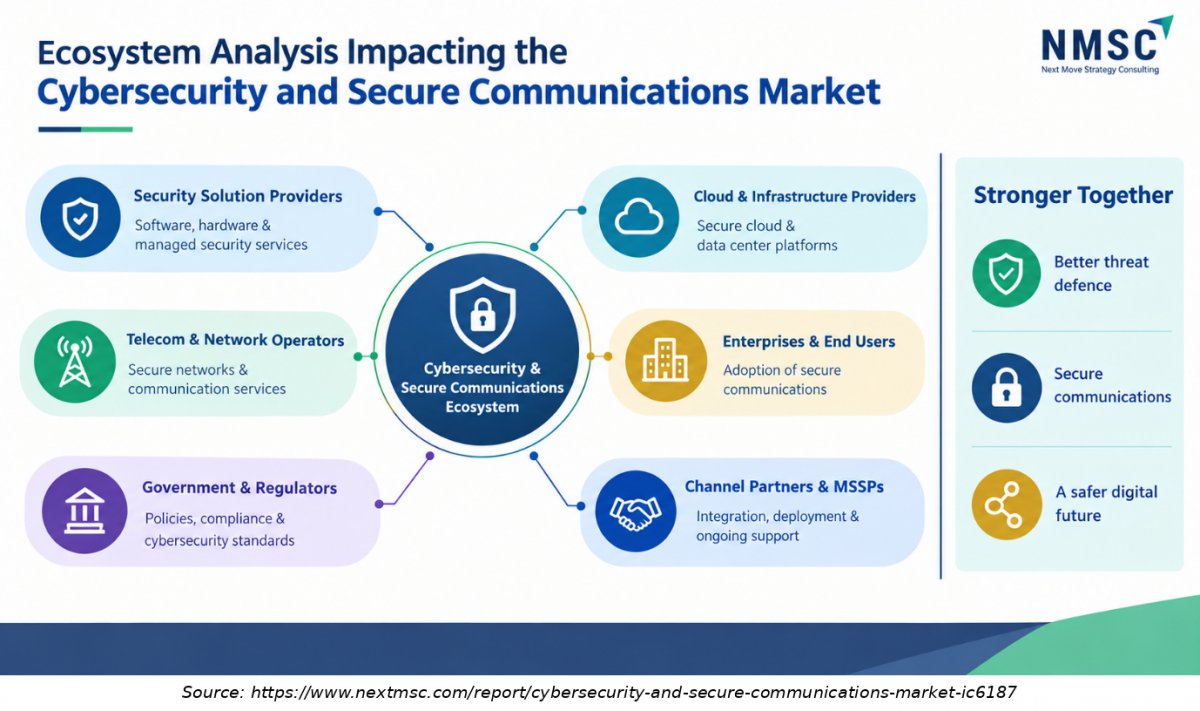
Ecosystem Analysis Impacting the Cybersecurity and Secure Communications Market

The cybersecurity and secure communications ecosystem connect security providers, cloud platforms, telecom operators, enterprises, government bodies, and managed security service providers. These stakeholders collaborate to strengthen digital protection, ensure secure communications, and build a more resilient digital environment.

What Does the Cybersecurity and Secure Communications Market Encompass?

The cybersecurity and secure communications market covers software, hardware appliances and services that protect networks, endpoints, identities, applications and data, together with systems that encrypt voice, messaging, radio and satellite traffic for enterprises and governments. Our findings suggest that the boundary between these two groups is narrowing, as vendors embed encryption and identity controls into every communication path that carries sensitive information.
Regulation and threat volume define purchasing behaviour. The FBI Internet Crime Complaint Center logged 1,008,597 complaints and reported losses of USD 20.88 Billion in 2025, which keeps security budgets protected during wider IT cost reviews. Cloud adoption, AI-assisted attacks and the migration to quantum-resistant algorithms are changing which products buyers shortlist and how long they commit.

Market Drivers & Dynamics

Interactive Dataset
Rising cybercrime losses and ransomware pressure driver +1.6% Global, led by North America 2026–2035
Mandatory incident reporting and resilience rules driver +1.3% Europe, North America 2026–2030
Cloud and AI workload migration driver +1.5% Global 2026–2035
Quantum-safe upgrades for encrypted communications driver +0.9% North America, Europe, Asia-Pacific 2027–2035
Cybersecurity skills shortage restraint −0.8% Global 2026–2032
Vendor sprawl and budget scrutiny restraint −0.7% North America, Europe 2026–2029
Pricing pressure in mature product categories restraint −0.5% Global 2026–2030
Source: Next Move Strategy Consulting

Growth Drivers

What Is the Primary Growth Driver in the Cybersecurity and Secure Communications market?

Escalating cybercrime is the primary driver of the cybersecurity and secure communications market. The FBI Internet Crime Complaint Center received 1,008,597 complaints in 2025 with reported losses of USD 20.88 Billion, including 3,611 ransomware complaints. We found that boards treat these figures as quantifiable risk, so security spending is ring fenced in budget cycles and protected from the cuts that hit other IT categories.

How Is Regulation Driving the cybersecurity and secure communications Market Growth?

Mandatory reporting is turning security from a discretionary purchase into a compliance cost. The US cyber incident reporting rule, which CISA expects to finalize in September 2026, would require critical infrastructure operators to report substantial incidents within 72 hours and ransomware payments within 24 hours. The ITU Global Cybersecurity Index assesses countries across five pillars, and its 2024 edition shows governments continuing to codify legal and technical obligations.

Growth Inhibitors

What Is Restraining the Cybersecurity and Secure Communications Market?

A persistent skills gap and tool fatigue restrain adoption. The ISC2 2025 workforce study, published in December 2025, found that skills shortages inside security teams now matter as much as headcount. Buyers also resist adding products they cannot operate, which explains why Rapid7 guides to a 2% to 3% revenue decline in 2026 while Cisco security product revenue grew only 2% in fiscal 2026.

What Are the Growth Opportunities?

Can Managed Detection Services Unlock the Mid-Market Gap?

Mid-sized organizations face the same attacks as large enterprises but lack analysts to run tools around the clock. Managed detection and response bundles are therefore the most direct route to that demand. Zscaler's purchase of Red Canary and Palo Alto Networks' expansion into identity show incumbents buying capacity. Service providers and platform vendors that package detection with response will capture the Security and managed services segment of the Cybersecurity and Secure Communications Market.

Will Sovereign Secure Communications Programs Create a New Revenue Pool?

Governments are funding national encrypted voice, messaging and satellite networks to reduce reliance on foreign infrastructure. Secure communications systems are forecast to expand from USD 19.00 Billion in 2026 to USD 59.91 Billion by 2035. Defense primes and specialist radio makers in the market benefit most, particularly those offering crypto-agile hardware that can accept post quantum algorithms through software updates.

Does Identity Security for AI Agents Represent an Untapped Category?

Autonomous software agents now request credentials, call interfaces and move data, which creates machine identities that traditional directories were not built to govern. Vendors that extend privileged access, secrets management and authentication to non-human actors will open a new budget line within Cybersecurity software. Palo Alto Networks and Okta are positioned to benefit, because both already control identity workflows across enterprise applications.

Segmentation Analysis

2025 (USD Billion)
2035 (USD Billion)
Cybersecurity software 2025: $84.64 Billion | 2035: $227.69 Billion
Cybersecurit
Security hardware and appliances 2025: $33.12 Billion | 2035: $64.71 Billion
Security har
Security and managed services 2025: $49.68 Billion | 2035: $127.03 Billion
Security and
Secure communications systems 2025: $16.56 Billion | 2035: $59.91 Billion
Secure commu
Cybersecurity software $84.64 Billion $227.69 Billion 10.3%
Security hardware and appliances $33.12 Billion $64.71 Billion 6.9%
Security and managed services $49.68 Billion $127.03 Billion 9.7%
Secure communications systems $16.56 Billion $59.91 Billion 13.6%

Which Offering Dominates the Cybersecurity and Secure Communications Market?

Cybersecurity software dominates, holding about 46.0% of 2025 revenue at USD 84.64 Billion, because detection, identity and cloud controls are bought as subscriptions that renew annually. Secure communications systems segment is the fastest growing offering at 13.6% CAGR from 2026 to 2035, driven by government radio, satellite and messaging upgrades. We observed that hardware appliances grow slowest as buyers shift gateways to cloud services.

2025 (USD Billion)
2035 (USD Billion)
Category A
Category B
Category C
Category D
Segment Item 2025 (USD Billion) 2035 (USD Billion) CAGR
Category A $10.0 USD Billion $40.0 USD Billion 9.0%
Category B $17.1 USD Billion $51.1 USD Billion 23.0%
Category C $24.2 USD Billion $62.2 USD Billion 9.0%
Category D $31.3 USD Billion $73.3 USD Billion 27.0%

Segment-wise data is locked

Unlock complete segment-wise numbers for By Deployment mode.

Unlock Full Data
2025 (USD Billion)
2035 (USD Billion)
Category A
Category B
Category C
Category D
Segment Item 2025 (USD Billion) 2035 (USD Billion) CAGR
Category A $10.0 USD Billion $40.0 USD Billion 26.0%
Category B $17.1 USD Billion $51.1 USD Billion 16.0%
Category C $24.2 USD Billion $62.2 USD Billion 18.0%
Category D $31.3 USD Billion $73.3 USD Billion 8.0%

Segment-wise data is locked

Unlock complete segment-wise numbers for By End user.

Unlock Full Data

Growth Opportunities

Our assessment indicates that three whitespace opportunities will generate disproportionate revenue through 2035.

Can Managed Detection Services Unlock the Mid-Market Gap?

Mid-sized organizations face the same attacks as large enterprises but lack analysts to run tools around the clock. Managed detection and response bundles are therefore the most direct route to that demand. Zscaler's purchase of Red Canary and Palo Alto Networks' expansion into identity show incumbents buying capacity. Service providers and platform vendors that package detection with response will capture the Security and managed services segment of the Cybersecurity and Secure Communications Market.

Will Sovereign Secure Communications Programs Create a New Revenue Pool?

Governments are funding national encrypted voice, messaging and satellite networks to reduce reliance on foreign infrastructure. Secure communications systems are forecast to expand from USD 19.00 Billion in 2026 to USD 59.91 Billion by 2035. Defense primes and specialist radio makers in the market benefit most, particularly those offering crypto-agile hardware that can accept post quantum algorithms through software updates.

Does Identity Security for AI Agents Represent an Untapped Category?

Autonomous software agents now request credentials, call interfaces and move data, which creates machine identities that traditional directories were not built to govern. Vendors that extend privileged access, secrets management and authentication to non-human actors will open a new budget line within Cybersecurity software. Palo Alto Networks and Okta are positioned to benefit, because both already control identity workflows across enterprise applications.

Regional Outlook

2025 (USD Billion)
2035 (USD Billion)
North Americ
Europe
Asia-Pacific
Middle East
Latin Americ
Region 2025 (USD Billion) 2035 (USD Billion) CAGR (%)
North America $10.0 USD Billion $40.0 USD Billion 9.0%
Europe $17.1 USD Billion $51.1 USD Billion 27.0%
Asia-Pacific $24.2 USD Billion $62.2 USD Billion 25.0%
Middle East & Africa $31.3 USD Billion $73.3 USD Billion 23.0%
Latin America $38.4 USD Billion $84.4 USD Billion 12.0%

Regional data is locked

Unlock complete regional numbers for this market.

Unlock Full Data

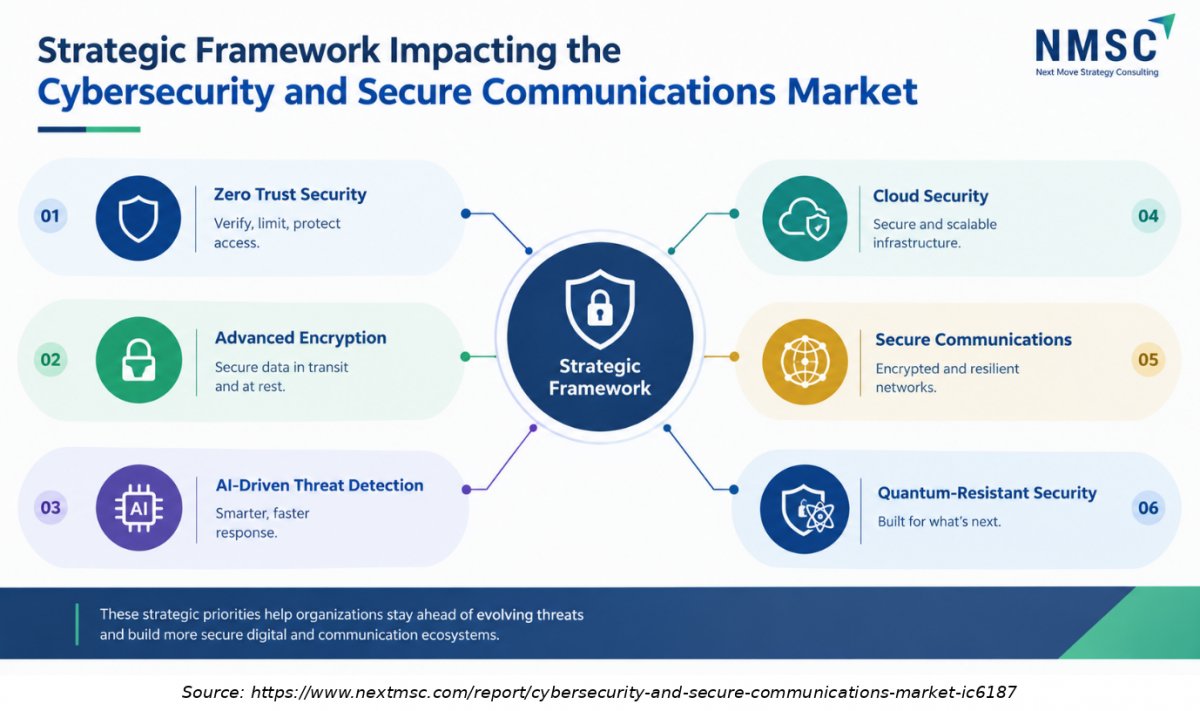
Strategic Framework Impacting the Cybersecurity and Secure Communications Market

Strategic Framework Impacting the Cybersecurity and Secure Communications Market
The strategic framework highlights key priorities such as zero-trust security, advanced encryption, AI-driven threat detection, cloud security, and quantum-resistant protection. These strategies help organizations address evolving cyber threats, safeguard sensitive data, and ensure reliable and secure communications

Competitive Landscape

Based on research conducted by NMSC, we found that the competitive landscape combines a handful of scaled platform vendors with many specialists.

How Do Companies Compete in the Cybersecurity and Secure Communications Market?

Vendors in the market compete on platform breadth, detection quality, price and channel reach. Palo Alto Networks reported fiscal 2026 revenue of USD 11.48 Billion, while Fortinet guides to about USD 8.1 Billion for 2026 on its integrated hardware and software model. Smaller specialists differentiate through depth in one domain, and pricing remains aggressive as buyers consolidate contracts and demand bundled licensing.

Which Company Archetypes Dominate the cybersecurity and secure communications Market?

Three archetypes dominate the market: network and platform leaders, cloud native specialists and defense grade communications providers. Cisco, Fortinet and Check Point lead the first group, CrowdStrike, Zscaler, Okta and Cloudflare the second, and L3Harris and Motorola Solutions the third. Differentiation themes include integrated policy engines, telemetry scale, identity control and certified encryption for government use.

How Do Innovation and Differentiation Strategies Differ Across Vendors?

Innovation spending across the Cybersecurity and Secure Communications Market targets AI-assisted investigation, unified agents and crypto-agile hardware. CrowdStrike and Sentinel One emphasize autonomous response on endpoints, Akamai applies its edge network to application and API protection, and radio makers invest in encryption that accepts algorithm updates. We observed that vendors able to show measurable reductions in response time win renewals even when headline prices are higher.

What Is the Level of M&A Activity in the Market?

M&A is a core growth tool. Palo Alto Networks closed its CyberArk acquisition on February 11, 2026, paying USD 45.00 in cash plus 2.2005 shares per CyberArk share, and Zscaler added Red Canary. Gen Digital crossed USD 5.00 Billion in fiscal 2026 revenue after expanding consumer protection through acquisitions. Buyers of identity and managed detection assets are the most active, and further consolidation is likely.

Key Market Players

During our market evaluation, we identified 17 companies with verified revenue or filings that qualify as key participants in the market.

Palo Alto Networks, Inc. Cisco Systems, Inc. Fortinet, Inc. Gen Digital Inc. CrowdStrike Holdings, Inc. Zscaler, Inc. Okta, Inc. Check Point Software Technologies Ltd. Akamai Technologies, Inc. Cloudflare, Inc. Trend Micro Incorporated L3Harris Technologies, Inc. (ranked qualitatively on tactical communications scale) Motorola Solutions, Inc. (ranked qualitatively on public safety communications scale) SentinelOne, Inc. Tenable Holdings, Inc. Rapid7, Inc. Viasat Inc. (ranked qualitatively on government satellite communications scale)

Latest Developments

Our findings suggest that recent corporate announcements point to continued consolidation and strong cloud security revenue growth.

Date Event
October 2026 Rapid7 introduced Rapid7 Intelligence, a unified engine combining threat intelligence, vulnerability research, and Rapid7 Labs expertise to convert attacker behaviour into AI-powered defensive action
September 2026 TrendAI's private-preview Vision One Autonomous Vulnerability Discovery finds vulnerabilities in source code, identifies exploit paths, and verifies fixes
September 2026 Palo Alto Networks launched Unit 42 Continuous Frontier AI Defense, an offensive-security service using models including Anthropic’s Claude Mythos and OpenAI’s GPT-5.6 to continuously identify, validate, and help remediate exposures
September 2026 Akamai and MuleSoft expanded integration sharing API Security intelligence with Agent Fabric
September 2026 CrowdStrike introduced Falcon Guardian, an AI Detection and Response solution that monitors AI agents where they execute on endpoints and enforces security controls at runtime
April 2026 Viasat launched Tactical Mission Fabric, an edge-to-cloud networking overlay that augments existing military tactical networks with resilient multi-path connectivity, mesh networking, and distributed cloud computing

Expert Insights

Henna Virkkunen

Executive Vice-President for Technological Sovereignty, Security and Democracy | European Commission

"As we enter the quantum era, post-quantum cryptography is essential to ensure a high level of cybersecurity, fortifying our systems against future threats."

Analyst Interpretation

The statement highlights the increasing need for advanced encryption and quantum-resistant security technologies as cyber threats evolve. Organizations and governments are preparing to strengthen their digital infrastructure through post-quantum cryptography, secure communications, and upgraded encryption systems. These developments are creating opportunities for cybersecurity providers offering cryptographic solutions, secure network technologies, and specialized security modernization services

Investment Opportunities

Where Is Capital Flowing in the Cybersecurity and Secure Communications Market?

Capital in the market flows toward platform acquisitions, managed detection capacity and cloud delivery infrastructure. Palo Alto Networks, Zscaler and Gen Digital all expanded through acquisitions in fiscal 2026. Investors should note that fast growers such as Cloudflare and CrowdStrike trade on durable ARR growth, while slower hardware heavy names offer cash generation. We found that identity and detection assets attract the highest strategic premiums.

What Infrastructure Investments Support Cybersecurity and Secure Communications Market Expansion?

Expansion of the market depends on regional data centers, security operations centers and crypto-agile hardware. Vendors are placing local points of presence to meet residency rules in Europe, the Gulf and India. Government programs fund encrypted radio and satellite networks, as shown by the US Army resilient communications award to L3Harris. Our analysis shows that suppliers with in region infrastructure win sovereign contracts more often.

How Do ESG Considerations Influence Investment Decisions?

ESG scrutiny of the Cybersecurity and Secure Communications Market now includes cyber resilience, because investors treat breaches as governance failures with financial consequences. Disclosure rules require public companies to describe their risk management, which links board oversight to security spending. Energy efficiency of data centers and responsible handling of customer data also matter. We observed that vendors publishing transparent incident practices and privacy commitments gain trust with institutional buyers.

Key Benefits for Stakeholders

How Does the Report Benefit Enterprise and Cybersecurity and Secure Communications Market Leaders?

Enterprise leaders gain a segment level view of spending by offering, deployment mode and end user, helping them benchmark security budgets against peers. The analysis shows where managed services close talent gaps and how consolidation affects contract terms. It also helps teams assess third party risk across supply chain management platforms and plan quantum-safe migration of encrypted communication paths over a decade.

How Does the Report Support Investors and Financial Analysts?

Investors receive reconciled forecasts from USD 184.00 Billion in 2025 to USD 479.34 Billion in 2035, with segment and regional growth rates that separate secular winners from mature categories. The evidence on vendor revenue, guidance and acquisitions supports valuation work. Analysts can identify where growth is above the 9.9% market rate, notably cloud delivery and secure communications systems.

How Does the Report Help Technology Vendors and Product Teams?

Vendors can see which buyers, regions and deployment modes offer the fastest growth and which categories face pricing pressure. The competitive analysis clarifies how rivals bundle capabilities and where acquisitions fill gaps. Product teams can prioritize cloud delivery, identity for machine users and crypto-agile designs, aligning roadmaps with the fastest growing portions of demand through 2035.

Key Market Segments Evaluated

By Offering

  • Cybersecurity software
  • Security hardware and appliances
  • Security and managed services
  • Secure communications systems

By Deployment mode

  • Cloud-based
  • On premises
  • Hybrid

By End user

  • BFSI
  • Government and defense
  • IT and telecom
  • Healthcare
  • Energy and industrial
  • Retail and commercial

By Region

  • North America 
    • U.S.
    • Canada
    • Mexico
  • Europe 
    • UK
    • Germany
    • France
    • Italy
    • Spain
    • Sweden
    • Denmark
    • Finland
    • Netherlands
    • Rest of Europe
  • Asia-Pacific 
    • China
    • India
    • Japan
    • South Korea
    • Taiwan
    • Indonesia
    • Vietnam
    • Australia
    • Philippines
    • Malaysia
    • Rest of APAC
  • Middle East & Africa 
    • Saudi Arabia
    • UAE
    • Egypt
    • Israel
    • Turkey
    • Nigeria
    • South Africa
    • Rest of MEA
  • Latin America 
    • Brazil
    • Argentina
    • Chile
    • Colombia
    • Rest of LATAM

Conclusion & Recommendations

The long-term outlook is strong, with revenue rising from USD 204.24 Billion in 2026 to USD 479.34 Billion in 2035. Growth gradually moderates as core categories mature, yet regulation, cloud migration and cloud-delivered upgrades keep demand durable. Our findings suggest that Asia-Pacific and cloud-delivered offerings supply most incremental revenue, while North America remains the largest base.

What Strategic Positioning Recommendations Does NMSC Offer?

NMSC recommends that vendors in the market build integrated platforms, invest in managed detection and secure partner channels in underserved regions. Specialists should deepen domain expertise or become acquisition targets. Communications suppliers should design crypto-agile products that accept algorithm updates. Buyers should consolidate vendors where integration quality is proven and keep an exit path to avoid lock in.

What Is the Investment Attractiveness of the Cybersecurity and Secure Communications Market?

Investment attractiveness of the market is high but selective. Cloud-delivered platforms and identity assets show growth well above the market average, while hardware heavy categories grow slower and face pricing pressure. We found that recurring revenue, retention and demonstrated platform expansion are the best signals of durable returns, and that regulated end users provide stable, ring-fenced demand.

What Are the Market Shifts and Key Risks in the Cybersecurity and Secure Communications Market?

Key shifts include AI-assisted attacks and defenses, platform consolidation and sovereign procurement. Risks include a persistent skills shortage, budget scrutiny, pricing pressure and execution risk from large acquisitions. Concentration of buyers in a few cloud platforms also creates systemic exposure, and a major vendor outage or breach could alter purchasing behaviour quickly.

What Are the Primary Growth Pathways Through 2035?

The primary pathways in the market are cloud-delivered security, managed detection for mid-sized firms, identity for human and machine users and government encrypted communications. Each path is supported by regulation or measurable loss data. Our analysis shows that combining two or more pathways in one contract is the surest way to outgrow the market through 2035.

FAQs

Sources & References

1.

Palo Alto Networks – Fiscal 2026 earnings release (SEC)

sec.gov
2.

Palo Alto Networks – CyberArk acquisition completion

investors.paloaltonetworks.com
3.

CrowdStrike – Fiscal 2026 results

ir.crowdstrike.com
4.

Fortinet – Full year 2025 results

mfn.se
5.

Fortinet – Second quarter 2026 results

mfn.se
6.

Cisco Systems – Fiscal 2026 results (SEC)

sec.gov
7.

Check Point Software – 2025 full year results

checkpoint.com
8.

Zscaler – Fiscal 2026 results (SEC)

sec.gov
9.

Cloudflare – Second quarter 2026 results (SEC)

sec.gov
10.

Cloudflare – Fiscal 2025 results

cloudflare.net
11.

Okta – Fiscal 2026 results

okta.com
12.

Okta – First quarter fiscal 2027 results

okta.com
13.

Gen Digital – Fiscal 2026 results (SEC)

sec.gov
14.

Gen Digital – Fiscal 2026 revenue announcement

newsroom.gendigital.com
15.

Akamai – Second quarter 2026 results (SEC)

sec.gov
16.

Trend Micro – FY2025 earnings results

newsroom.trendmicro.com
17.

SentinelOne – First quarter fiscal 2027 results

s28.q4cdn.com
18.

Tenable – Second quarter 2026 results (SEC)

sec.gov
19.

Rapid7 – Second quarter 2026 results

s29.q4cdn.com
20.

Motorola Solutions – Second quarter 2026 results (SEC)

sec.gov
21.

L3Harris – Second quarter 2026 results (SEC)

sec.gov
22.

L3Harris – US Army resilient communications award

l3harris.com
23.

Viasat – Fiscal 2026 annual report (SEC)

sec.gov
24.

FBI Internet Crime Complaint Center – 2025 Internet Crime Report

ic3.gov
25.

ENISA – European Union Agency for Cybersecurity

enisa.europa.eu
26.

ITU – Global Cybersecurity Index

itu.int
27.

ISC2 – 2025 Cybersecurity Workforce Study

isc2.org
28.

quantum.gov – NIST post quantum encryption standards

quantum.gov
29.

CISA – Cyber Incident Reporting for Critical Infrastructure Act

cisa.gov/circia

About the Author

Mayurima Roy

Mayurima Roy

Mayurima Roy is Research Analyst at Next Move Strategy Consulting, where she has spent 4 years working across the firm's full industry coverage rather than a single fixed vertical. Her work centers on structured research, ongoing trend tracking, competitive assessment, and insight-led content development, translating complex market data into clear, decision-ready narratives that support informed client decision-making across diverse global industries, market sectors, and world regions every day.

About the Reviewer

Supradip Baul

Supradip Baul

Supradip Baul is an accomplished business consultant and strategist with over a decade of rich experience in market intelligence, strategy, technology, and business transformation. His work has included rigorous qualitative and quantitative analysis across multiple industries, helping clients shape investment decisions and long-term roadmaps. Earlier in his career, he was associated with Gartner, where he contributed to industry-leading reports and market share analyses. He has worked with leading global companies and holds an MBA with a dual specialization in Marketing and Finance.

Download Free Sample

Semih Kavaklioglu

SEMIH KAVAKLIOGLU

Co-Founder & Sales Manager

Decortie

I work a lot in the marketing industry and I know that research is an essential part of any campaign. I have used Market research reports for my own products and I found them to be very informative and well-researched. The team here produces insightful reports for a good price

Robert Sean Trevino

ROBERT SEAN TREVINO

Sr. Director, Head of Strategic Insights & Analytics

Foundation Medicine

I realized that it was a reliable source of information. These days, there are many people who are looking for authentic data, and this is one of the only sources that can offer them with what they need;

Nishant Awate

NISHANT AWATE

Business Development Global Sales

Zehnder Group Deutschland GmbH

Our experience working with Next Move Strategy Consulting was positive. The team was responsive, professional, and open to incorporating our specific requirements throughout the project. The India AHU market study was comprehensive and well structured, covering market value and volume forecasts, product and application segments, and key industry trends. The inclusion of both AHU and residential MVHR market insights made the study particularly relevant for our strategic market assessment. Overall, the report provides a solid foundation for evaluating market potential, identifying priority segments, and supporting business-development decisions in India.

Kevin Coker

KEVIN COKER

Founder, CEO and Board Diector

Proxima Clinical Research

I have been using Next MSC reports for product positioning in a new geography for a long time. They have by far the best reports I have found and the price is reasonable too!

Henri Knyphausen

HENRI KNYPHAUSEN

Partner at Singulier [Ex-BCG]

Singulier

I recently engaged NEXTMSC.com for a commercial due diligence project within the intralogistics sector, and I am pleased to provide a reference based on my experience. In utilizing NEXTMSC.com's services, I found their report to offer valuable insights into market dynamics and key industry players. The initial report provided a solid foundation for our analysis. However, as we were investigating a smaller target in the market, and I had specific customization requests requiring additional research. These requests included detailed information on product portfolios of various players and sub-market sizes, both inclusive and exclusive of certain product categories. NEXTMSC.com demonstrated commendable responsiveness and agility in accommodating these customization requests. Within a timeframe of 1-2 weeks, they delivered a revised report that met our specific needs. Furthermore, they were receptive to my follow-up inquiries, ensuring clarity and understanding of the data provided. The final deliverable significantly contributed to our due diligence efforts. One of NEXTMSC.com's notable strengths lies in their qualitative research capabilities. However, for future engagements, I would recommend the inclusion of a quantified market model in Excel format. Such a model would offer the ability to conduct in-depth analyses and explore various market segments, including country-specific data and subcomponent breakdowns. Based on my positive experience, I would not hesitate to work with NEXTMSC.com again. Their responsiveness, willingness to accommodate customization requests, and commitment to delivering actionable insights make them a reliable partner for commercial research projects.

Custom Market Research Services

We will customize the research for you if the listed report does not fully match your requirements.

Get 30% Free Customization

Select License

This website uses cookies to ensure you get the best experience on our website. Learn more

✖