Data Center Storage Market Global Industry Analysis and Forecast (2026–2035)

The global Data Center Storage Market is valued at USD 94.40 Billion in 2026 and is projected to reach USD 242.37 Billion by 2035, growing at a CAGR of 11.05% from 2026 to 2035. Key growth factors include AI and analytics workloads and hyperscale and cloud infrastructure expansion, with North America leading at approximately 37% share and all flash storage holding approximately 40% share.
Download Free Sample PDF
Base Year (2025)
$77.96 Billion
Forecast (2035)
$242.37 Billion
CAGR (2026-2035)
11.1%
Top Region
North America

What Is the Data Center Storage Market Size?
The global Data Center Storage Market size was valued at USD 77.96 Billion in 2025 and is estimated at USD 94.40 Billion in 2026, forecast to reach USD 242.37 Billion by 2035, expanding at an 11.05% CAGR between 2026 and 2035. North America leads with approximately 37% share, while all flash storage dominates other storage technologies with approximately 40% share.
We observed that growth is broad based across every segmentation axis, with AI and analytics workloads, object storage, and hyperscale deployments driving the dominant structural shifts in the Data Center Storage Market through 2035 as buyers consolidate fragmented silos onto flash dense, software defined platforms, while vendors compete on efficiency and resilience.
Data Center Storage Market Global Industry Analysis and Forecast (2026–2035) Revenue Forecast
Values in USD Billion

2025 $77.96 Billion
2025
2026 $94.40 Billion
2026
2027 $104.83 Billion
2027
2028 $116.42 Billion
2028
2029 $129.28 Billion
2029
2030 $143.56 Billion
2030
2031 $159.43 Billion
2031
2032 $177.04 Billion
2032
2033 $196.61 Billion
2033
2034 $218.33 Billion
2034
2035 $242.37 Billion
2035

Key Takeaways

By Storage Technology: All flash storage held the largest share of approximately 40% (USD 31.18 Billion) in 2025 and is projected to reach USD 140.58 Billion by 2035; All flash storage is also the fastest-growing sub-segment at 15.73% CAGR from 2026–2035.

By Storage Architecture: Storage area network held the largest share of approximately 36% (USD 28.07 Billion) in 2025 and is projected to reach USD 67.86 Billion by 2035; Object storage is the fastest-growing sub-segment at 18.38% CAGR from 2026–2035.

By Data Center Type: Hyperscale and cloud held the largest share of approximately 46% (USD 35.86 Billion) in 2025 and is projected to reach USD 126.03 Billion by 2035; Edge is the fastest-growing sub-segment at 13.83% CAGR from 2026–2035.

By Application: Transactional and database held the largest share of approximately 28% (USD 21.83 Billion) in 2025 and is projected to reach USD 46.05 Billion by 2035; AI and analytics is the fastest-growing sub-segment at 19.32% CAGR from 2026–2035.

By End User: IT and telecom held the largest share of approximately 38% (USD 29.62 Billion) in 2025 and is projected to reach USD 106.65 Billion by 2035; Healthcare and life sciences is the fastest-growing sub-segment at 14.05% CAGR from 2026–2035.

Dominant Region: North America dominated with approximately 37% revenue share (USD 28.84 Billion) in 2025.

Fastest-Growing Region: Asia-Pacific is expected to register the highest CAGR of 13.08% during 2026–2035.

Dominant Country: U.S. led with approximately USD 25.10 Billion in 2025.

Fastest-Growing Country: India is the fastest-growing country at approximately 18.40% CAGR from 2026–2035.

What Does the Data Center Storage Market Encompass?
The Data Center Storage Market covers storage systems and software platforms that data center operators buy to hold, protect, and serve block, file, and object data, spanning all flash, hybrid, and HDD based systems across SAN, NAS, DAS, and object architectures. This market report treats finished systems with embedded software as the single point of sale, so drive sales to system vendors are excluded to avoid double counting. The category has evolved from monolithic arrays toward disaggregated, scale out designs built for AI and analytics.
Regulation increasingly shapes purchasing decisions. The European Union Data Act applies from 12 September 2025 and requires providers to remove obstacles to switching data processing services, while the International Energy Agency estimates data centre electricity use at about 415 TWh in 2024, rising toward 945 TWh by 2030. Our assessment indicates that technology adoption now centers on NVMe flash, KV cache and context memory tiers, and policy driven data governance embedded directly in storage software.

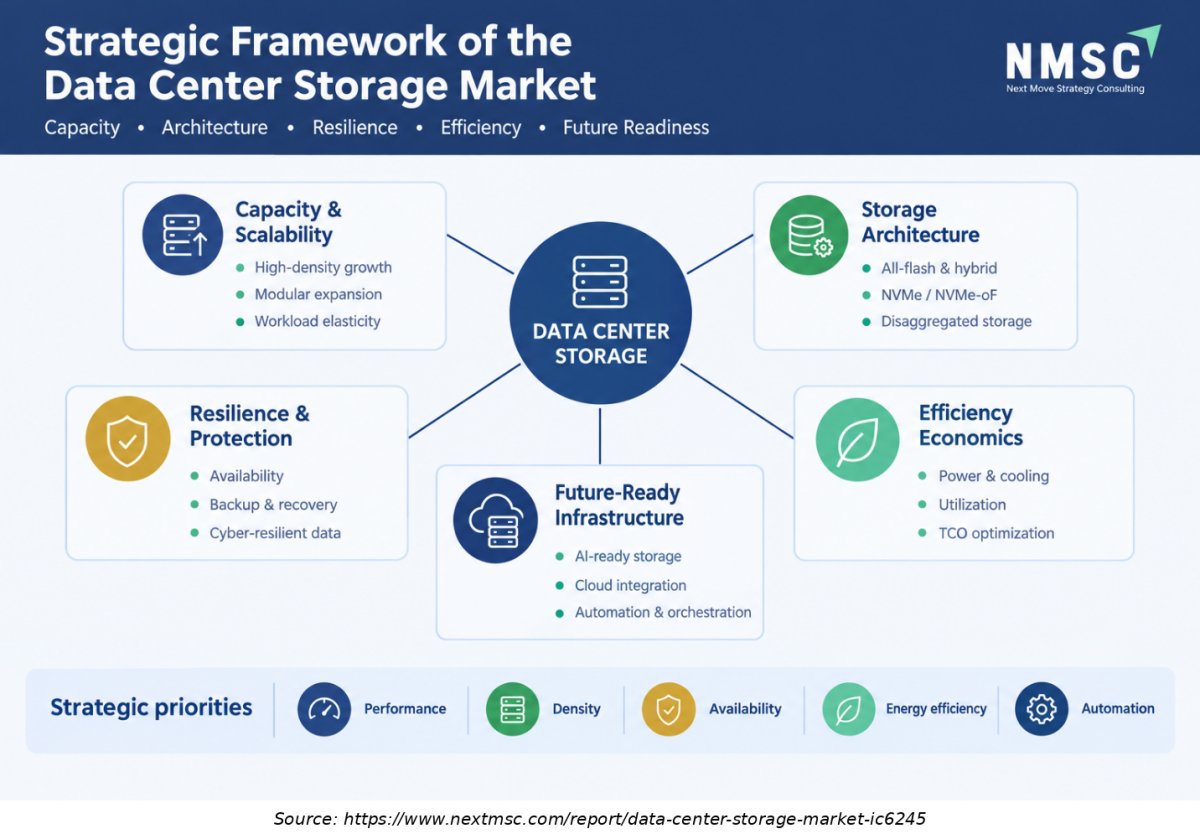
Strategic Framework of the Data Center Storage Market

Strategic Framework of the Data Center Storage Market

The infographic presents the strategic framework shaping the Data Center Storage Market, focusing on capacity and scalability, storage architecture, resilience and protection, efficiency economics, and future-ready infrastructure. It highlights key priorities such as performance, storage density, availability, energy efficiency, and automation, providing a structured view of the factors influencing modern storage infrastructure planning and deployment.

Market Drivers & Dynamics

Interactive Dataset
AI training and inference data pipelines expanding storage throughput requirements driver +3.2% Global 2026–2035
Hyperscale and neocloud capital expenditure on new data center capacity driver +2.4% North America, Asia-Pacific 2026–2032
Flash cost per terabyte narrowing through QLC media and data reduction guarantees driver +1.6% Global 2026–2030
Cloud switching and interoperability rules under the EU Data Act driver +1.1% Europe, Middle East & Africa 2026–2030
Power and rack space efficiency requirements favoring dense flash driver +0.9% Global 2026–2035
Cyber resilience and ransomware recovery requirements in primary storage driver +0.7% Global 2026–2030
Power and grid connection constraints delaying data center energization restraint −1.4% North America, Europe 2026–2030
Flash and HDD supply constraints raising system costs restraint −2.1% Global 2026–2028
Migration complexity and lock in from legacy storage estates restraint −0.8% Global 2026–2032
Source: Next Move Strategy Consulting

Growth Drivers

What Is the Primary Growth Driver of the Data Center Storage Market?

AI workload expansion is the primary growth driver. The International Energy Agency reports that data centre electricity consumption was about 415 TWh in 2024 and projects roughly 945 TWh by 2030, growing about 15% annually, with accelerated servers accounting for almost half of the net increase. Our analysis shows that every accelerated server requires high throughput storage for training data, checkpoints, and inference context, which sustains demand across hyperscale, neocloud, and enterprise buyers within the Data Center Storage Market.

How Is Hyperscale and Sovereign Infrastructure Buildout Driving Market Growth?

Lawrence Berkeley National Laboratory found that US data center electricity use rose from 58 TWh in 2014 to 176 TWh in 2023, a threefold increase that reflects rapid capacity additions. We observed that this buildout, combined with EU Data Act cloud switching rules applicable from 12 September 2025, increases demand for portable, standards based object and file storage that operators can deploy in regional and sovereign facilities, supporting steady revenue growth for vendors across the Data Center Storage Market.

Growth Inhibitors

What Is Restraining Data Center Storage Market Expansion?

Power and component supply constraints restrain expansion. The International Energy Agency notes that a typical AI focused data centre consumes as much electricity as 100,000 households, and the largest facilities under construction will consume 20 times as much, which delays site energization. Dell also referenced supply constrained environments for flash in its May 2026 launch material. We found that these limits extend delivery timelines and raise system costs, tempering near term growth.

Segmentation Analysis

2025 (USD Billion)
2035 (USD Billion)
All flash storage 2025: $31.18 Billion | 2035: $140.58 Billion
All flash st
Hybrid storage 2025: $20.27 Billion | 2035: $60.59 Billion
Hybrid stora
HDD based storage 2025: $26.51 Billion | 2035: $41.20 Billion
HDD based st
All flash storage $31.18 Billion $140.58 Billion 15.73%
Hybrid storage $20.27 Billion $60.59 Billion 10.56%
HDD based storage $26.51 Billion $41.20 Billion 2.81%

Which Storage Technology Dominates the Data Center Storage Market?

Storage technology defines the media class of each system. All flash storage led with USD 31.18 Billion in 2025 because latency sensitive transactional and AI workloads migrated from spinning disk, and hardware compression guarantees such as Dell's 6:1 offer in 2026 lower effective cost per terabyte. All flash storage is also the fastest growing technology at 15.73% CAGR from 2026 to 2035, whereas HDD based storage grows 2.81% as capacity tiers persist in hyperscale and archive environments.

2025 (USD Billion)
2035 (USD Billion)
Direct attac
Network atta
Scale up NAS
Scale out NA
Storage area
Segment Item 2025 (USD Billion) 2035 (USD Billion) CAGR
Direct attached storage $10.0 USD Billion $40.0 USD Billion 10.0%
Network attached storage $17.1 USD Billion $51.1 USD Billion 16.0%
Scale up NAS $24.2 USD Billion $62.2 USD Billion 18.0%
Scale out NAS $31.3 USD Billion $73.3 USD Billion 24.0%
Storage area network $38.4 USD Billion $84.4 USD Billion 11.0%

Segment-wise data is locked

Unlock complete segment-wise numbers for By Storage Architecture.

Unlock Full Data
2025 (USD Billion)
2035 (USD Billion)
Hyperscale a
Enterprise
Colocation
Edge
Segment Item 2025 (USD Billion) 2035 (USD Billion) CAGR
Hyperscale and cloud $10.0 USD Billion $40.0 USD Billion 24.0%
Enterprise $17.1 USD Billion $51.1 USD Billion 18.0%
Colocation $24.2 USD Billion $62.2 USD Billion 8.0%
Edge $31.3 USD Billion $73.3 USD Billion 10.0%

Segment-wise data is locked

Unlock complete segment-wise numbers for By Data Center Type.

Unlock Full Data
2025 (USD Billion)
2035 (USD Billion)
AI and analy
Transactiona
Virtualizati
Backup and a
Segment Item 2025 (USD Billion) 2035 (USD Billion) CAGR
AI and analytics $10.0 USD Billion $40.0 USD Billion 18.0%
Transactional and database $17.1 USD Billion $51.1 USD Billion 16.0%
Virtualization and private cloud $24.2 USD Billion $62.2 USD Billion 22.0%
Backup and archive $31.3 USD Billion $73.3 USD Billion 12.0%

Segment-wise data is locked

Unlock complete segment-wise numbers for By Application.

Unlock Full Data
2025 (USD Billion)
2035 (USD Billion)
IT and telec
Banking and
Healthcare a
Government a
Media and en
Segment Item 2025 (USD Billion) 2035 (USD Billion) CAGR
IT and telecom $10.0 USD Billion $40.0 USD Billion 26.0%
Banking and financial services $17.1 USD Billion $51.1 USD Billion 16.0%
Healthcare and life sciences $24.2 USD Billion $62.2 USD Billion 18.0%
Government and defense $31.3 USD Billion $73.3 USD Billion 8.0%
Media and entertainment $38.4 USD Billion $84.4 USD Billion 23.0%

Segment-wise data is locked

Unlock complete segment-wise numbers for By End User.

Unlock Full Data
2025 (USD Billion)
2035 (USD Billion)
North Americ
Canada
Mexico.
Europe: UK
Germany
Segment Item 2025 (USD Billion) 2035 (USD Billion) CAGR
North America: U.S. $10.0 USD Billion $40.0 USD Billion 10.0%
Canada $17.1 USD Billion $51.1 USD Billion 8.0%
Mexico. $24.2 USD Billion $62.2 USD Billion 18.0%
Europe: UK $31.3 USD Billion $73.3 USD Billion 8.0%
Germany $38.4 USD Billion $84.4 USD Billion 15.0%

Segment-wise data is locked

Unlock complete segment-wise numbers for By Region.

Unlock Full Data

Growth Opportunities

Our analysis shows that three forward looking opportunities stand out for stakeholders positioning within the Data Center Storage Market over the 2026–2035 forecast period, each tied to a concrete buying mechanism, a defined beneficiary segment, and measurable infrastructure constraints in power, latency, and data governance that buyers can evaluate in procurement cycles.

How Can Context Memory Tiers Create Whitespace for AI Inference Operators?

Inference clusters generate KV cache data that exceeds GPU memory and DRAM capacity, creating demand for a persistent context tier between memory and conventional storage. Vendors that sell KV aware flash systems or software licensed to neocloud and hyperscale operators can capture recurring revenue, because operators pay for lower token cost and higher GPU utilization. The AI and analytics application segment, projected to reach USD 101.80 Billion by 2035, is the main beneficiary.

Where Do Sovereign Cloud Programs Create Demand for Object Storage Software?

Governments building regional AI and cloud capacity need portable, S3 compatible storage that avoids dependence on a single provider, a requirement reinforced by the EU Data Act cloud switching provisions. Software defined object platforms licensed to national cloud operators allow local deployment on standard hardware with recurring subscription revenue. The Government and defense end user segment and the object storage architecture, projected to reach USD 77.56 Billion by 2035, benefit most.

How Can Power Efficient Flash Displace Nearline Capacity in Colocation Facilities?

Colocation operators sell power and rack space, so every watt consumed by storage reduces rentable capacity for revenue generating compute. Dense flash systems with high data reduction, such as arrays guaranteeing 6:1 reduction, let operators lower power draw per usable terabyte and free space for GPU tenants. The Colocation data center type, projected to reach USD 38.78 Billion by 2035, is the main beneficiary alongside all flash vendors.

Regional Outlook

2025 (USD Billion)
2035 (USD Billion)
North Americ
Europe
Asia-Pacific
Middle East
Latin Americ
Region 2025 (USD Billion) 2035 (USD Billion) CAGR (%)
North America $10.0 USD Billion $40.0 USD Billion 9.0%
Europe $17.1 USD Billion $51.1 USD Billion 27.0%
Asia-Pacific $24.2 USD Billion $62.2 USD Billion 25.0%
Middle East & Africa $31.3 USD Billion $73.3 USD Billion 23.0%
Latin America $38.4 USD Billion $84.4 USD Billion 12.0%

Regional data is locked

Unlock complete regional numbers for this market.

Unlock Full Data

Competitive Landscape

We found that the Data Center Storage Market features a moderately consolidated competitive landscape, where large infrastructure vendors with global service reach compete alongside focused AI storage specialists, and where industry participants differentiate through efficiency, software intelligence, and architectural scalability while pricing pressure persists from component cost volatility during 2025 and 2026.

Dimension Description
Market Structure Moderately consolidated; global infrastructure vendors hold the largest installed bases, while focused AI storage specialists and Asian suppliers compete in high performance, object, and regional niches.
Innovation Focus KV cache and context memory tiers, disaggregated scale out architectures, hardware assisted data reduction, and policy driven data governance dominate vendor roadmaps.
Corporate Transactions & Financing Lenovo completed its Infinidat acquisition in April 2026, Everpure completed its acquisition of 1touch in May 2026, and VAST Data closed a Series F financing at a USD 30 billion valuation in April 2026.

How Do Companies Compete in the Data Center Storage Market?

Companies compete on efficiency per watt, performance at scale, software intelligence, and service guarantees. Dell advertises a 6:1 data reduction guarantee for PowerStore Elite, while NetApp, HPE, and DDN align products with NVIDIA certified reference designs. Our assessment indicates that pricing strategies increasingly bundle subscription services and guarantees, and that geographic expansion through partners and sovereign deployments is becoming a core go to market lever across the Data Center Storage Market.

Which Competitive Archetypes Dominate the Data Center Storage Market?

Three archetypes dominate: diversified infrastructure vendors such as Dell, HPE, IBM, Hitachi, and Lenovo; storage focused platform vendors such as NetApp and Pure Storage; and AI native specialists such as VAST Data, DDN, and WEKA. Differentiation themes explaining dominance include installed base breadth, global service coverage, disaggregated architecture, and proven integration with GPU platforms, which together lower risk for buyers committing multi year capacity.

How Are Companies Differentiating Through Innovation in Data Center Storage?

Innovation centers on inference economics and governance. Huawei introduced OceanStor M900 for KV cache in September 2026, NetApp announced Novus for AI factories the same month, and DDN released Infinia 2.4 in July 2026 with multi tenancy and security features. We observed that vendors unable to show GPU utilization gains or measurable power savings face longer sales cycles in the Data Center Storage Market.

What M&A and Financing Activity Is Shaping the Data Center Storage Market?

Selective acquisitions and large private financings are reshaping the field. Lenovo completed its acquisition of Infinidat in April 2026 to add high-end enterprise storage, Pure Storage completed its acquisition of 1touch in May 2026 to expand data-intelligence capabilities, and VAST Data closed a Series F financing in April 2026 at a USD 30 billion valuation. Our findings suggest that expansion capital is flowing to AI native platforms and governance capabilities rather than commodity capacity.

Key Market Players

Our assessment indicates that the following 20 companies design, produce, or deliver storage systems and software platforms for data center operators, and they are listed in ranked order by scale of storage operations as of 2026, with one entry per ultimate parent corporate group and excluding distributors, resellers, and integrators without development capability.

Dell Technologies Inc. Huawei Technologies Co., Ltd. NetApp, Inc. Hewlett Packard Enterprise Company Pure Storage, Inc. International Business Machines Corporation Hitachi, Ltd. Lenovo Group Limited IEIT SYSTEMS Co., Ltd. Fujitsu Limited NEC Corporation New H3C Technologies Co., Limited Nutanix, Inc. VAST Data, Inc. DataDirect Networks, Inc. WekaIO, Inc. Super Micro Computer, Inc. Cloudian, Inc. Scality SAS MinIO, Inc.

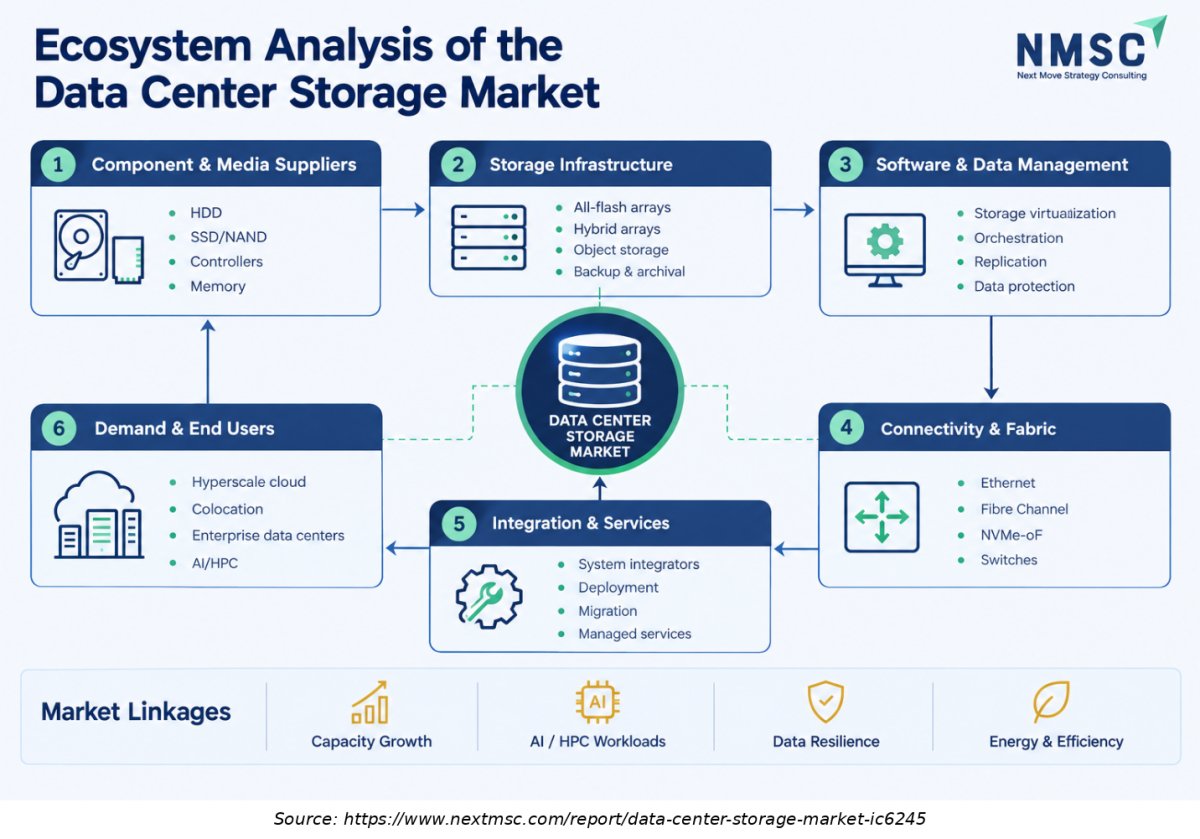
Ecosystem Analysis of the Data Center Storage Market

The infographic illustrates the Data Center Storage Market ecosystem across component and media suppliers, storage infrastructure, software and data management, connectivity, integration services, and end users. It demonstrates the interconnected value chain supporting data center storage deployment, while emphasizing capacity growth, AI/HPC workloads, data resilience, and energy efficiency as important market linkages.

Latest Developments

We found that recent product launches, financings, and regulatory milestones within the Data Center Storage Market are concentrated on AI inference infrastructure, disaggregated architectures, and data governance, with vendors timing announcements around major industry events, regulatory deadlines, and customer refresh cycles during 2025 and 2026 across several regions and buyer groups.
Date Event
September 2026 Huawei introduced OceanStor M900 Context Memory Storage for AI inference in hyperscale data centers. It creates a PB-scale shared KV-cache pool using SSDs, with a single cluster supporting up to 64 PB. The architecture targets ultra-long-context workloads by extending memory capacity and improving data access across SuperPOD environments.
September 2026 Scality announced general availability of Scality Maestro, a fleet-management platform for cloud and managed-service providers operating distributed ARTESCA object-storage environments. It centralizes system health, software and firmware updates, capacity monitoring, and usage data across customer sites, helping providers scale backup-as-a-service deployments without proportionally increasing operational overhead.
August 2026 DDN announced a collaboration with NVIDIA under the Storage-Next initiative to enable GPUs to initiate data operations more directly with DDN Infinia. The work aims to reduce data-access delays, improve GPU utilization, and increase efficiency in large AI environments where high-performance storage must keep accelerated computing continuously supplied with data.
July 2026 WEKA unveiled third-generation WEKApod Nitro, Prime, and Prime Max AI storage appliances with NeuralMesh 6. The systems combine NVMe storage, PCIe Gen 6 connectivity, and NVIDIA networking; WEKA states one rack delivers up to 1.1 exabytes effective capacity and 10.2 TB/s throughput for AI inference.

Investment Opportunities

What Capital Inflows Are Targeting the Data Center Storage Market?

Capital is concentrating on AI native platforms and data intelligence. VAST Data closed a Series F financing in April 2026 at a USD 30 billion valuation, Pure Storage completed its acquisition of 1touch in May 2026, and Lenovo completed its Infinidat acquisition in April 2026. We observed that investors reward vendors showing hyperscale design wins, subscription revenue, and measurable GPU utilization gains across the Data Center Storage Market.

How Is Infrastructure Investment Supporting Data Center Storage Deployment?

Infrastructure spending on AI factories and sovereign cloud capacity underpins storage demand. The International Energy Agency projects data centre electricity consumption rising from about 415 TWh in 2024 to roughly 945 TWh by 2030, which signals sustained capital expenditure on facilities, power, and storage. NetApp, Huawei, and DDN each launched architectures sized for very large GPU clusters in 2026, and operators prioritize platforms that scale performance and capacity independently.

What ESG Considerations Are Shaping Data Center Storage Investment Decisions?

Environmental considerations center on electricity use, since Lawrence Berkeley National Laboratory reported US data centers consumed 176 TWh in 2023, or 4.4% of national electricity. Governance considerations include data sovereignty and switching rights under the EU Data Act, which applies from 12 September 2025. During our market evaluation, we noticed that investors increasingly favor vendors that document efficiency gains and compliance features.

Key Benefits for Stakeholders

How Does This Report Benefit Enterprise and Industry Leaders?

Enterprise and industry leaders gain validated segmentation by storage technology, architecture, data center type, application, and end user, alongside regional forecasts through 2035. These insights support capacity planning, vendor selection, and refresh timing decisions in the Data Center Storage Market, and help procurement teams compare efficiency, resilience, and sovereignty requirements against forecast demand.

How Does This Report Benefit Investors and Financial Analysts?

Investors and financial analysts gain consistent point estimates of market size and CAGR, plus segment and regional growth differentials that identify where above market growth is concentrated, including all flash storage, object storage, and Asia-Pacific deployments. The competitive analysis and M&A review support valuation work and capital allocation across the vendor landscape through 2035.

How Does This Report Benefit Technology Vendors and Product Teams?

Technology vendors and product teams gain insight into the architectural shifts reshaping the Data Center Storage Market, including disaggregation, KV cache tiers, and embedded governance. The analysis helps roadmap owners prioritize features that buyers value, such as power efficiency, data reduction, and interoperability, and benchmark positioning against the 20 profiled competitors.

Key Market Segments Evaluated

By Storage Technology

  • All flash storage 
    • NVMe all flash
    • SAS and SATA all flash
  • Hybrid storage
  • HDD based storage

By Storage Architecture

  • Direct attached storage
  • Network attached storage 
    • Scale up NAS
    • Scale out NAS
  • Storage area network 
    • Fibre channel SAN
    • IP based SAN
  • Object storage

By Data Center Type

  • Hyperscale and cloud
  • Enterprise
  • Colocation
  • Edge

By Application

  • AI and analytics
  • Transactional and database
  • Virtualization and private cloud
  • Backup and archive

By End User

  • IT and telecom
  • Banking and financial services
  • Healthcare and life sciences
  • Government and defense
  • Media and entertainment
  • Retail and manufacturing

By Region

  • North America 
    • U.S.
    • Canada
    • Mexico.
  • Europe 
    • UK
    • Germany
    • France
    • Italy
    • Spain
    • Sweden
    • Denmark
    • Finland
    • Netherlands
    • Rest of Europe.
  • Asia-Pacific 
    • China
    • India
    • Japan
    • South Korea
    • Taiwan
    • Indonesia
    • Vietnam
    • Australia
    • Philippines
    • Malaysia
    • Rest of APAC.
  • Middle East & Africa 
    • Saudi Arabia
    • UAE
    • Egypt
    • Israel
    • Turkey
    • Nigeria
    • South Africa
    • Rest of MEA.
  • Latin America 
    • Brazil
    • Argentina
    • Chile
    • Colombia
    • Rest of LATAM.

Conclusion & Recommendations

The long-term outlook is strongly positive, with global revenue projected to expand from USD 77.96 Billion in 2025 to USD 242.37 Billion by 2035 at an 11.05% CAGR from 2026 to 2035. AI workloads, object storage, and hyperscale deployments will account for the largest incremental revenue, while HDD based storage grows only 2.81%. Our analysis shows that power efficiency and data governance will determine which vendors capture that growth.

What Strategic Positioning Recommendations Should Vendors Follow?

Vendors should prioritize disaggregated architectures, certified integration with leading GPU platforms, and measurable efficiency guarantees, since these attributes shorten evaluation cycles. Our assessment indicates that companies should also invest in KV cache and context memory capabilities, sovereign deployment options, and subscription models that reduce buyer risk, while expanding partner networks in Asia-Pacific and the Middle East.

How Strong Is Investment Attractiveness in the Data Center Storage Market?

The market presents a highly attractive investment case, supported by an absolute dollar opportunity of USD 147.97 Billion between 2026 and 2035 and an Asia-Pacific CAGR of 13.08% from 2026 to 2035. Attractiveness is highest for vendors combining AI workload exposure, subscription revenue, and hyperscale or sovereign design wins, whereas capacity centric offerings face margin pressure in the Data Center Storage Market.

What Market Shifts and Key Risks Should Stakeholders Monitor?

Stakeholders should monitor power and grid constraints, flash and HDD supply volatility, and migration complexity as key risks. The International Energy Agency projects data centre electricity use near 945 TWh by 2030, so delays in energization could defer storage purchases, while component cost swings can compress vendor margins. We found that regulatory shifts such as EU Data Act switching rules may also reshape contract structures.

Which Growth Pathways Should Companies Prioritize?

Priority growth pathways include context memory tiers for AI inference, object storage software for sovereign clouds, and power efficient flash for colocation facilities. Companies pursuing these paths while maintaining interoperability with leading GPU platforms are best positioned to capture the projected expansion of the Data Center Storage Market through 2035, particularly in Asia-Pacific and India.

FAQs

About the Author

Mihul Sharma

Mihul Sharma

Mihul Sharma is Research Associate at Next Move Strategy Consulting, where he has covered technology, industrial, and healthcare markets for 3 years. His work applies structured business research, market analysis, and secondary-source review to assess market trends, competitive developments, and growth opportunities. He supports report development by fully synthesizing industry data, company information, and market signals into concise findings for strategy and investment-focused research teams.

About the Reviewer

Supradip Baul

Supradip Baul

Supradip Baul is an accomplished business consultant and strategist with over a decade of rich experience in market intelligence, strategy, technology, and business transformation. His work has included rigorous qualitative and quantitative analysis across multiple industries, helping clients shape investment decisions and long-term roadmaps. Earlier in his career, he was associated with Gartner, where he contributed to industry-leading reports and market share analyses. He has worked with leading global companies and holds an MBA with a dual specialization in Marketing and Finance.

Download Free Sample

Nishant Awate

NISHANT AWATE

Business Development Global Sales

Zehnder Group Deutschland GmbH

Our experience working with Next Move Strategy Consulting was positive. The team was responsive, professional, and open to incorporating our specific requirements throughout the project. The India AHU market study was comprehensive and well structured, covering market value and volume forecasts, product and application segments, and key industry trends. The inclusion of both AHU and residential MVHR market insights made the study particularly relevant for our strategic market assessment. Overall, the report provides a solid foundation for evaluating market potential, identifying priority segments, and supporting business-development decisions in India.

Kevin Coker

KEVIN COKER

Founder, CEO and Board Diector

Proxima Clinical Research

I have been using Next MSC reports for product positioning in a new geography for a long time. They have by far the best reports I have found and the price is reasonable too!

Gustaf Hummel Burstrom

GUSTAF HUMMEL BURSTROM

Founder

Revline Tools AB

Joseph and the team at Next Move Strategy Consulting have been excellent to work with, in supplying us with relevant market data and forecasts for our specific category. We had some special requirements and they were able to do a custom package to suit our needs. We would definitely recommend them to any other company needing market data and forecasts

Amos Chang

AMOS CHANG

Strategy Consultant

Kardex Group

I have bought the intralogistics market reports from NMSC two times so far. Joseph and his team are always very helpful and flexible in responding to any customization requirements on the report. Their expertise in market reports really helps us steer the day-to-day business. I will definitely recommend and come back myself whenever there is a need.

Ross J Mckenzie

ROSS J MCKENZIE

Business Insight Manager

Staysure Group

“Next MSC have been incredibly helpful in providing detailed & robust information on our market, alongside quantifying growth by different segments. The process to procure was simple and easy, with sample reports and regular contact to ensure we had what we needed. Succinct detail on their sources & methodologies is also greatly received, allowing transparency in this respect helps build trust in the detail you pay for. Joseph in particular was fantastic, and helped ensure efficient provision of the insight pack – thank you NMSC!”.

Custom Market Research Services

We will customize the research for you if the listed report does not fully match your requirements.

Get 30% Free Customization

Select License

This website uses cookies to ensure you get the best experience on our website. Learn more

✖