Denmark Fabric Care Market Size, By Product Type {Fabric Detergents (General Purpose, Baby Laundry Detergent, and Delicate Laundry Detergent), Fabric Softeners/Conditioners, and Others}, By Form (Liquid, Powder, Unit-Dose, Sheet & Wipe, and Spray), By Nature (Conventional and Eco-friendly / Organic), By Price Tier (Value, Mid-range, and Premium), By Distribution Channel (Online and Offline), and By End-User (Residential, Commercial, and Others) – Analysis & Forecast, 2025–2035
Industry: Retail and Consumer | Latest Edition: September 30, 2026 | No of Pages: 154 | No. of Tables: 49 | No. of Figures: 43 | Format: PDF | Report Code: RC4562
Denmark Fabric Care Market Size & Forecast
|
Parameters |
Details |
|
Market Size in 2025 |
USD 1.77 billion |
|
Market Size in 2026 |
USD 1.99 billion |
|
Revenue Forecast in 2035 |
USD 2.95 billion |
|
Growth Rate |
CAGR of 4.47% from 2026 to 2035 |
|
Analysis Period |
2025–2035 |
|
Base Year Considered |
2025 |
|
Forecast Period |
2026–2035 |
|
Country Covered |
Denmark |
|
Companies Profiled |
15 |
|
Market Share |
Available for 10 companies |
Industry Outlook
The Denmark Fabric Care Market was valued at USD 1.77 billion in 2025 and is estimated to reach USD 1.99 billion in 2026, reflecting steady demand across one of Europe's most affluent and environmentally conscious household care markets. Over the forecast period, the market is projected to expand to USD 2.95 billion by 2035, registering a compound annual growth rate of 4.47% between 2026 and 2035. Given Denmark's small population base, growth is expected to be driven primarily by premiumization, Nordic Swan-certified formulations, and enzyme-based innovation rather than new household formation.
Ecosystem Analysis of the Denmark Fabric Care Market:
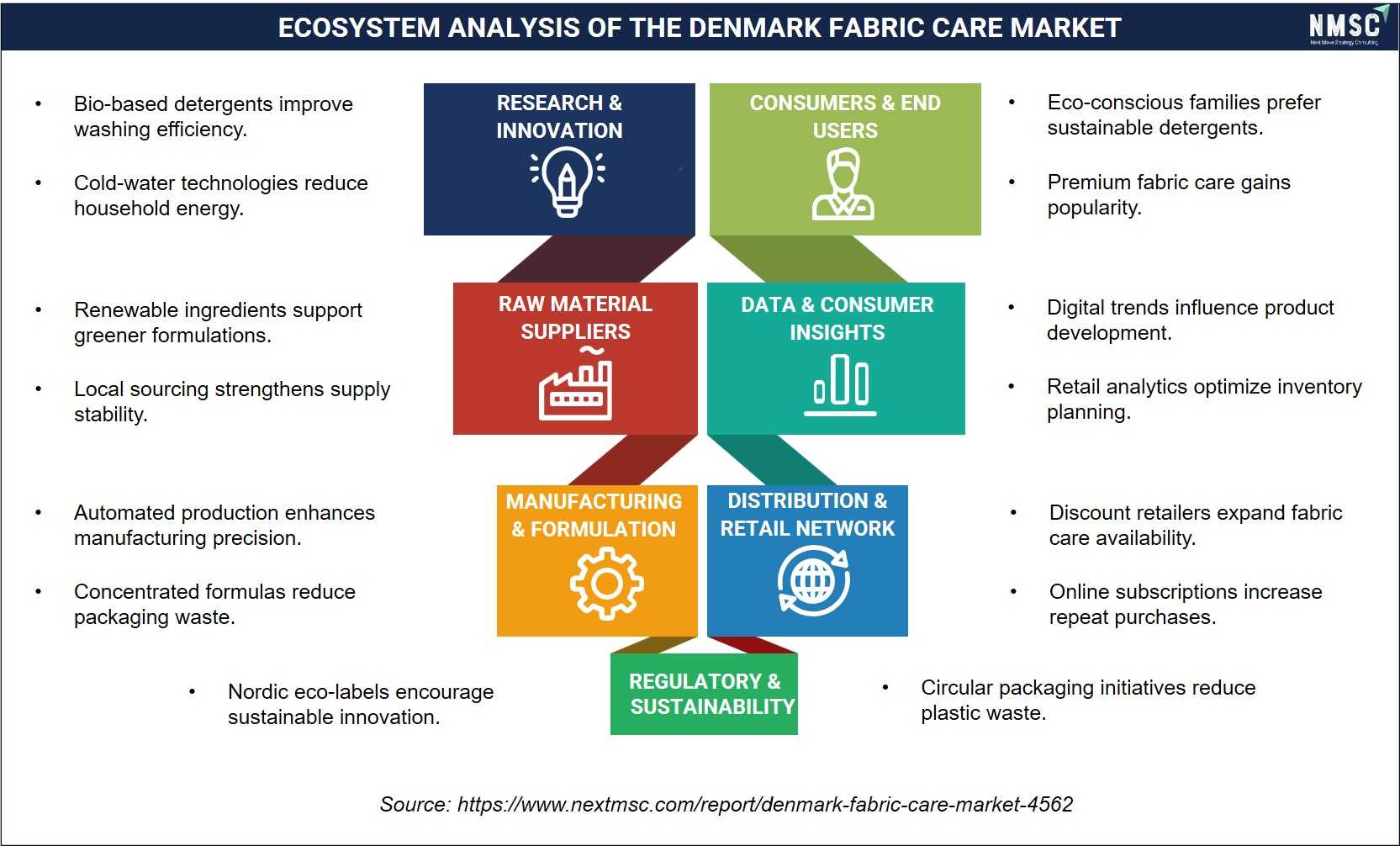
The above ecosystem analysis maps the key operational pillars, such as research and innovation, raw material suppliers, manufacturing and formulation, regulatory and sustainability, distribution and retail network, data and consumer insights, and consumers and end users, shaping the Denmark fabric care industry. From our analysis, we observed that research emphasizes sustainable detergent innovation and enzyme technologies, while raw material suppliers provide bio-based ingredients and recyclable packaging materials. Manufacturing focuses on concentrated, eco-friendly formulations, whereas regulatory frameworks promote circular economy practices and eco-label compliance. Distribution through omnichannel retail and e-commerce strengthens accessibility, while data insights support product personalization. Finally, consumers comprise environmentally conscious households preferring sustainable, premium, and fragrance-efficient fabric care solutions.
What Are the Key Drivers, Restraints, and Opportunities Shaping the Denmark Fabric Care Market?
Growth Catalyst & Risk Assessment Matrix
|
Drivers / Restraints / Opportunities |
(+/-) % Impact on CAGR Forecast |
Geographic Relevance |
Impact Timeline |
|
Rising Nordic Swan Ecolabel adoption driving premium fabric care formulations |
+1.4% |
Copenhagen, Aarhus, Odense |
Long term (4–7 years) |
|
Enzyme-based detergent innovation supporting sustainable, cold-water washing |
+1.2% |
Nationwide, biotechnology clusters |
Medium to long term (4–7 years) |
|
Highly consolidated retail networks improving nationwide product distribution |
+1.0% |
Nationwide, major supermarket chains |
Medium term (3–6 years) |
|
Small, saturated population limiting incremental household volume growth |
-0.9% |
Nationwide |
Long term (4–7 years) |
|
Denmark emerging as Nordic export hub for sustainable fabric care formulations |
+1.1% |
Nationwide |
Long term (4–7 years) |
Denmark's fabric care market is among the most mature and sustainability-driven in Europe, shaped by near-universal household penetration, widespread Nordic Swan Ecolabel adoption, and a small but highly affluent consumer base willing to pay a premium for verified environmental performance. Consolidated retail, dominated by a small number of major grocery groups, gives manufacturers efficient nationwide distribution but limited pricing leverage. Denmark's strength in industrial enzyme technology also supports continuous formulation innovation. The following analysis outlines the primary drivers, restraints, and opportunities expected to influence market performance across the 2026–2035 forecast period.
Growth Drivers
How Is Nordic Swan Ecolabel Adoption Driving Premium Formulations?
The Nordic Swan Ecolabel holds exceptional consumer recognition and trust across Denmark, and products carrying the certification consistently command stronger shelf visibility and pricing power than uncertified alternatives. Manufacturers are increasingly reformulating detergents, softeners, and stain removers to meet Nordic Swan criteria on biodegradability, dosing efficiency, and packaging, positioning certified products as the default premium choice rather than a niche option. Retailers actively promote certified assortments to align with national sustainability targets. This ecolabel-driven premiumization is expected to remain a defining structural growth driver throughout the forecast period.
Why Is Enzyme-Based Innovation a Distinct Danish Growth Advantage?
Denmark's strong domestic base in industrial enzyme and biosolutions research gives local manufacturers a distinct advantage in developing high-performance, low-temperature, and biodegradable detergent formulations. This technological capability supports both premium positioning and compliance with tightening environmental standards, allowing Danish-associated brands to differentiate on functional performance rather than price alone. Enzyme-based formulations also enable effective cold-water washing, which aligns with national energy-saving priorities and consumer sustainability expectations. Continued investment in biotechnology-driven formulation is expected to reinforce Denmark's position as a premium innovation hub within the broader Nordic fabric care market.
How Does Retail Consolidation Support Efficient Nationwide Distribution?
Denmark's grocery retail sector is highly consolidated around a small number of major national groups, giving fabric care manufacturers efficient, low-friction access to nationwide distribution once a listing is secured. This consolidation streamlines logistics and enables consistent product availability across a compact geography, supporting stable volume replenishment even in a market with limited population growth. Online grocery and quick commerce remain smaller relative to Southern European or emerging markets but are expanding steadily in Copenhagen and other urban centers. This efficient distribution structure supports predictable, if moderate, category growth through 2035.
Growth Inhibitor:
What Is Limiting Volume Growth in a Small, Saturated Market?
Denmark's small population base and near-universal household penetration structurally cap volume growth potential, meaning category expansion must come almost entirely from value gains rather than new buyers entering the market. High domestic labor and production costs also compress manufacturer margins relative to larger, lower-cost European markets. Retail consolidation, while efficient for distribution, gives major grocery groups significant negotiating leverage over branded manufacturers, particularly for shelf space and private-label competition. These structural factors are likely to keep Denmark's category growth comparatively modest even as premiumization continues to support value expansion.
Growth Opportunity:
Where Does the Next Wave of Growth Come from in Cross-Border Nordic Positioning?
Denmark's advanced sustainability credentials and enzyme-technology expertise position domestic and Nordic-based manufacturers to use Denmark as a formulation and export hub for the broader Scandinavian and Northern European fabric care market. Products developed and certified to Nordic Swan standards carry credibility that extends well beyond Denmark's borders, supporting export-led revenue growth that is not constrained by the domestic market's small population. Continued investment in biotechnology-based, low-temperature formulations offers manufacturers a differentiated growth path built on technical leadership rather than domestic volume expansion alone through 2035.
How Is the Denmark Fabric Care Market Segmented, and What Are the Key Insights from the Segmentation Analysis?
By Product Type Insights
How Does Product Type Segmentation Reflect Consumer Laundry Preferences?
Based on product type, the Denmark Fabric Care Market is segmented into fabric detergents, general purpose, baby laundry detergent, and delicate laundry detergent, fabric softeners/conditioners, stain removers/bleach, sanitizer, and other products.
The market reflects a well-developed fabric care landscape where consumers seek effective cleaning, fabric protection, and environmentally responsible solutions across different laundry needs. In our observation, fabric detergents are used across general-purpose, baby laundry, and delicate laundry applications to address varying fabric care requirements, while fabric softeners and conditioners enhance softness and fragrance. Stain removers, bleach, and sanitizers support targeted cleaning and hygiene needs, whereas other products cater to specialized fabric care applications and evolving consumer preferences.
By Form Insights
How Does Form Segmentation Reflect Consumer Laundry Habits?
Based on form, the Denmark Fabric Care Market is segmented into liquid, powder, unit-dose pods and sachets, sheet & wipe, and spray formulations.
The market presents a diverse range of product formats that cater to evolving consumer preferences for convenience, efficiency, and sustainability in fabric care. According to our analysis, we found that liquid and powder formulations continue to support everyday laundry requirements across households, while unit-dose formats, including pods and sachets, are increasingly preferred for their convenience and precise dosing. Meanwhile, sheet & wipe and spray formulations address specialized fabric care needs by offering portable, easy-to-use, and application-specific solutions.
Supply Chain Structure the Denmark Fabric Care Market:
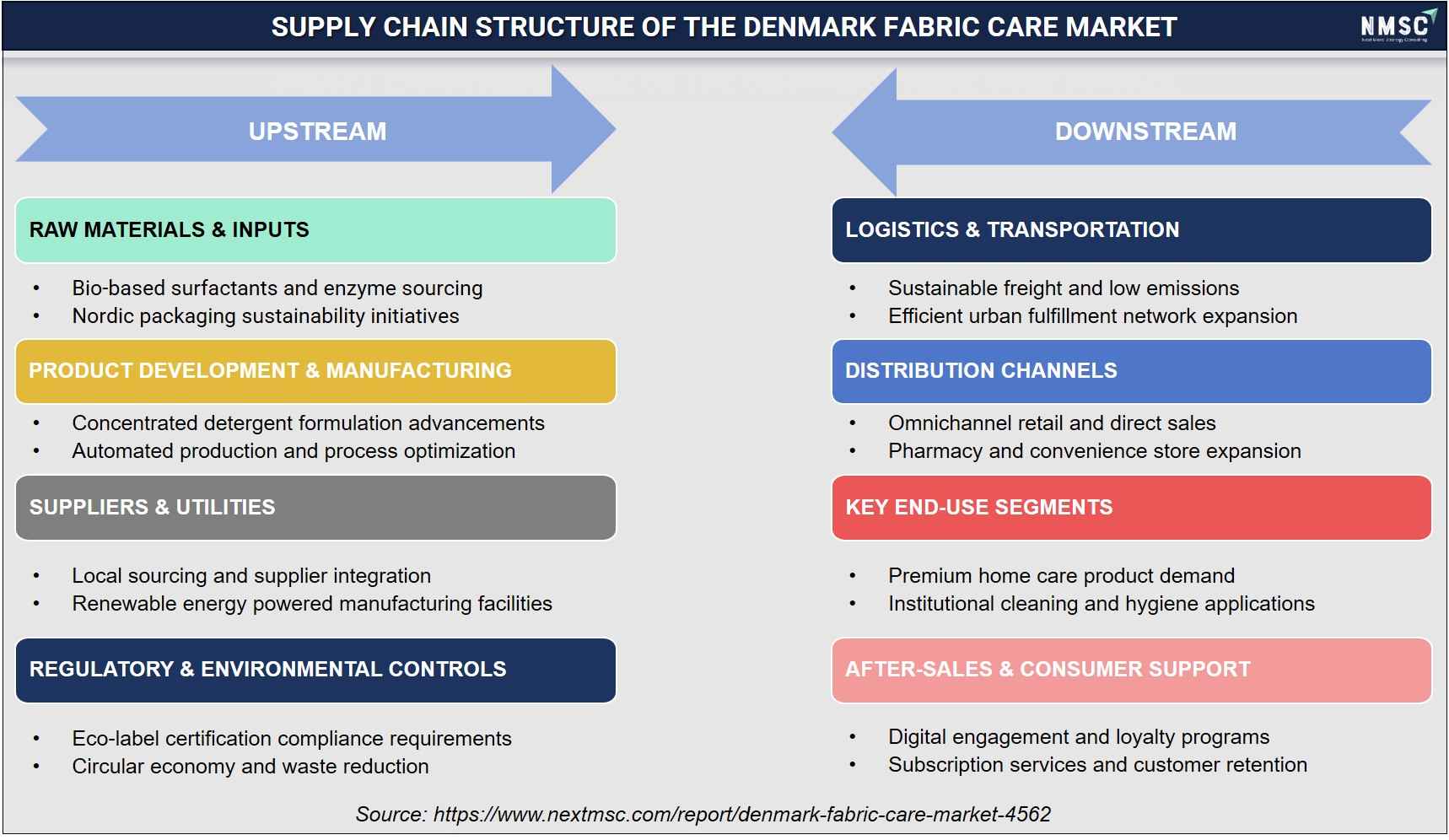
The above supply chain analysis maps the key stages, such as upstream, downstream, raw materials, manufacturing, logistics, distribution, end-use segments, and after-sales support, shaping the Denmark fabric care industry. From our analysis, we observed that upstream focuses on bio-based surfactants and Nordic packaging sustainability, while manufacturing advances concentrated formulations and automated optimization. Regulatory controls enforce eco-label certification and circular economy practices. Downstream, logistics prioritize sustainable freight and urban fulfillment, while distribution expands through omnichannel and pharmacy networks. Key end-users include premium households and institutional hygiene sectors, whereas after-sales support delivers digital engagement and subscription services.
Key Segments
By Product Type
-
Fabric Detergents
-
General Purpose
-
Baby Laundry Detergent
-
Delicate Laundry Detergent
-
-
Fabric Softeners/Conditioners
-
Stain Removers/Bleach
-
Sanitizer
-
Other Products
By Form
-
Liquid
-
Powder
-
Unit-Dose
-
Pods
-
Sachets
-
-
Sheet & Wipe
-
Spray
By Nature
-
Conventional
-
Eco-Friendly/Organic
By Price Tier
-
Value
-
Mid-Range
-
Premium
By Distribution Channel
-
Online
-
Marketplaces
-
Brand E-Com
-
Quick Commerce
-
-
Offline
-
Supermarkets
-
Hypermarkets
-
Department Stores
-
By End-User
-
Residential
-
Commercial
-
Others
Competitive Landscape
The Denmark Fabric Care Market features a competitive landscape shaped by multinational consumer goods companies, specialized Nordic and European hygiene manufacturers, and biotechnology-driven formulation specialists, all competing within a small but affluent and sustainability-focused market. Competition centers on Nordic Swan certification, enzyme-based formulation performance, and retail listing access within a highly consolidated grocery sector, rather than basic price competition. Manufacturers with strong environmental credentials and biotechnology capabilities are increasingly differentiated from conventional, price-driven competitors. Continued investment in certified sustainable formulations is expected to intensify competitive dynamics through the forecast period.
Strategic Developments:
-
March 2025 – Novonesis A/S launched Progress Beyond and Progress Go, two next-generation protease enzymes for liquid laundry detergents, delivering superior protein stain removal across cold and quick wash cycles. The innovation strengthens Novonesis’ leadership in fabric care biosolutions while enabling detergent manufacturers to improve cleaning performance, formulation flexibility, and sustainability.
Key Players of the Denmark Fabric Care Market:
-
Henkel Danmark A/S
-
Reckitt Benckiser Danmark A/S
-
Kao Denmark ApS
-
SC Johnson Denmark ApS
-
Colgate-Palmolive A/S
-
Amway Danmark ApS
-
Croda Denmark A/S
-
Novadan ApS
-
Arkema Danmark A/S
-
Nopa Nordic A/S
-
McBride Denmark A/S
-
Novonesis A/S
-
KiiltoClean A/S
-
Christeyns Danmark ApS
Competition in the Denmark Fabric Care Market spans multinational majors, including Henkel Danmark A/S, Reckitt Benckiser Danmark A/S, Unilever Danmark A/S, and Kao Denmark ApS, alongside specialized Nordic and European manufacturers such as SC Johnson Denmark ApS, Colgate-Palmolive A/S, Amway Danmark ApS, and others, each contributing to a competitive field defined by sustainability certification, formulation innovation, and retail listing strength.
Key Benefits for Stakeholders
This report provides manufacturers, investors, and business planners with a detailed, data-backed view of the Denmark Fabric Care Market, including historical sizing, forecast trajectories, and CAGR estimates through 2035. Granular segmentation across product type, form, price tier, and distribution channel enables stakeholders to identify the fastest-growing categories and align product development, certification, and go-to-market strategies accordingly. The inclusion of both conventional and eco-certified segment analysis supports informed decision-making for companies operating across different points of the market, from mainstream detergent manufacturers to biotechnology-driven and export-focused entrants seeking a foothold in Denmark.
Distributors, retailers, and new market entrants can use the competitive landscape and key player analysis to benchmark positioning, identify white space, and evaluate potential partnership or entry strategies within Denmark's fabric care category. Insight into distribution channel dynamics, including the dominance of consolidated grocery retail alongside gradually expanding online and quick commerce, supports smarter inventory, logistics, and marketing investment decisions. Regulators and industry associations may also draw on the report's sustainability and certification trend analysis to inform policy discussions, while consulting firms and financial analysts gain a structured reference point for valuation and market-entry advisory work.
|
Parameters |
Details |
|
Customization Scope |
Free customization (equivalent to up to 80 analyst-working hours) after purchase. |
|
Pricing and Purchase Options |
Avail customized purchase options to meet your exact research needs. |
|
Approach |
In-depth primary and secondary research; proprietary databases; rigorous quality control and validation measures. |
|
Analytical Tools |
Porter's Five Forces, SWOT, value chain, and Harvey ball analysis to assess competitive intensity, stakeholder roles, and relative impact of key factors. |
Conclusion
The Denmark Fabric Care Market is on a steady, sustainability-led growth path, expanding from an estimated USD 1.99 billion in 2026 to USD 2.95 billion by 2035 at a CAGR of 4.47%. Growth will be underpinned by Nordic Swan Ecolabel adoption, enzyme-based formulation innovation, and export-oriented positioning, even as a small population base and high production costs cap volume expansion and margin growth. Cross-border Nordic and European export potential represents the clearest forward opportunity, while a competitive field spanning multinational and biotechnology-driven manufacturers is expected to sustain continuous certification-led innovation throughout the forecast period.
About the Author
 Mayurima Roy
— Mayurima Roy is Research Analyst at Next Move Strategy Consulting, where she has spent 4 years working across the firm's full industry coverage rather than a single fixed vertical. Her work centers on structured research, ongoing trend tracking, competitive assessment, and insight-led content development, translating complex market data into clear, decision-ready narratives that support informed client decision-making across diverse global industries, market sectors, and world regions every day.
Mayurima Roy
— Mayurima Roy is Research Analyst at Next Move Strategy Consulting, where she has spent 4 years working across the firm's full industry coverage rather than a single fixed vertical. Her work centers on structured research, ongoing trend tracking, competitive assessment, and insight-led content development, translating complex market data into clear, decision-ready narratives that support informed client decision-making across diverse global industries, market sectors, and world regions every day.
About the Reviewer
 Supradip Baul
— Supradip Baul is an accomplished business consultant and strategist with over a decade of rich experience in market intelligence, strategy, technology, and business transformation. His work has included rigorous qualitative and quantitative analysis across multiple industries, helping clients shape investment decisions and long-term roadmaps. Earlier in his career, he was associated with Gartner, where he contributed to industry-leading reports and market share analyses. He has worked with leading global companies and holds an MBA with a dual specialization in Marketing and Finance.
Supradip Baul
— Supradip Baul is an accomplished business consultant and strategist with over a decade of rich experience in market intelligence, strategy, technology, and business transformation. His work has included rigorous qualitative and quantitative analysis across multiple industries, helping clients shape investment decisions and long-term roadmaps. Earlier in his career, he was associated with Gartner, where he contributed to industry-leading reports and market share analyses. He has worked with leading global companies and holds an MBA with a dual specialization in Marketing and Finance.
At Next Move Strategy Consulting, we understand that insightful market research is the cornerstone of successful business decisions. That's why we employ a robust and multifaceted approach, combining various methodologies to deliver the most accurate and actionable data for our clients.

Research Landscape
We navigate the world of research with two primary approaches:
Qualitative Approach
Our qualitative research methodologies involve immersive techniques such as in-depth interviews, focus groups, and observational studies. By engaging directly with individuals and stakeholders, we uncover valuable insights that quantitative data alone may overlook.

Quantitative Research
In tandem with qualitative methodologies, NMSC leverages the power of Quantitative Research to provide a robust foundation of numerical insights. Through systematic data collection and analysis, we quantify patterns, preferences, and market trends, offering a comprehensive view of the business landscape.
Our quantitative research approach employs diverse tools, including surveys, experiments, and statistical modelling. These methodologies enable us to gather data from a large and representative sample, ensuring the statistical significance of our findings. By employing structured questionnaires and standardized data collection methods, we guarantee the reliability and validity of the information we present to our clients.
Quantitative research is particularly effective in measuring the prevalence of trends, assessing market size, and gauging the impact of various factors on consumer behavior. The numerical precision attained through this approach equips our clients with actionable insights, facilitating data-driven decision-making and strategy formulation.


Our Specialized Toolbox for Industry-Specific Market Research
We deploy a specialized arsenal of techniques tailored to meet your unique requirements. Here's a glimpse into our comprehensive toolbox:

Information Procurement
The stage entails acquiring market data or relevant information through various sources and methodologies.


Market Research Approach
We utilize both top-down and bottom-up approaches in market research analysis to achieve a comprehensive understanding of the market dynamics, leveraging the broad perspective of industry trends and macroeconomic factors alongside detailed insights from specific segments and individual companies.

Porters Five Forces Analysis
We conduct Porter's Five Forces analysis to evaluate the competitive landscape of an industry, providing us with insights into factors that affect profitability and strategic positioning.

SWOT Analysis

Forecasting
We utilize a forecasting model to predict future consumption by considering parameters like population, economics, regulations, market competition, drivers, constraints, technology, and pricing. We also employ statistical techniques such as multilinear regression, exponential smoothing, moving average, ARIMA, and Monte Carlo simulations for accurate predictions. In econometric forecasting, we analyzed short-term and long-term event impacts, attributing values based on regulatory frameworks, economic factors, and market events.





 Speak to Our Analyst