Digital Thermometer Market Size, Share, Trends and Growth Analysis, By Product Type (Contact Thermometers, Infrared Thermometers, and Thermometer Consumables and Accessories), By Sensing Technology, By Distribution Channel (Brand Direct, Third-Party Marketplace, Pharmacy Retail, Mass Retail, Specialized Distributor, and Institutional Tender), By End User, By Price Tier, By Connectivity, and Region — Global Industry Report and Forecast, 2026–2035
Industry: Healthcare | Publishing Date: August 8, 2026 | Last Updated: September 30, 2026 | No of Pages: N/A | No. of Tables: N/A | No. of Figures: N/A | Format: PDF | Report Code: HC3410
What Is the Digital Thermometer Market Size?
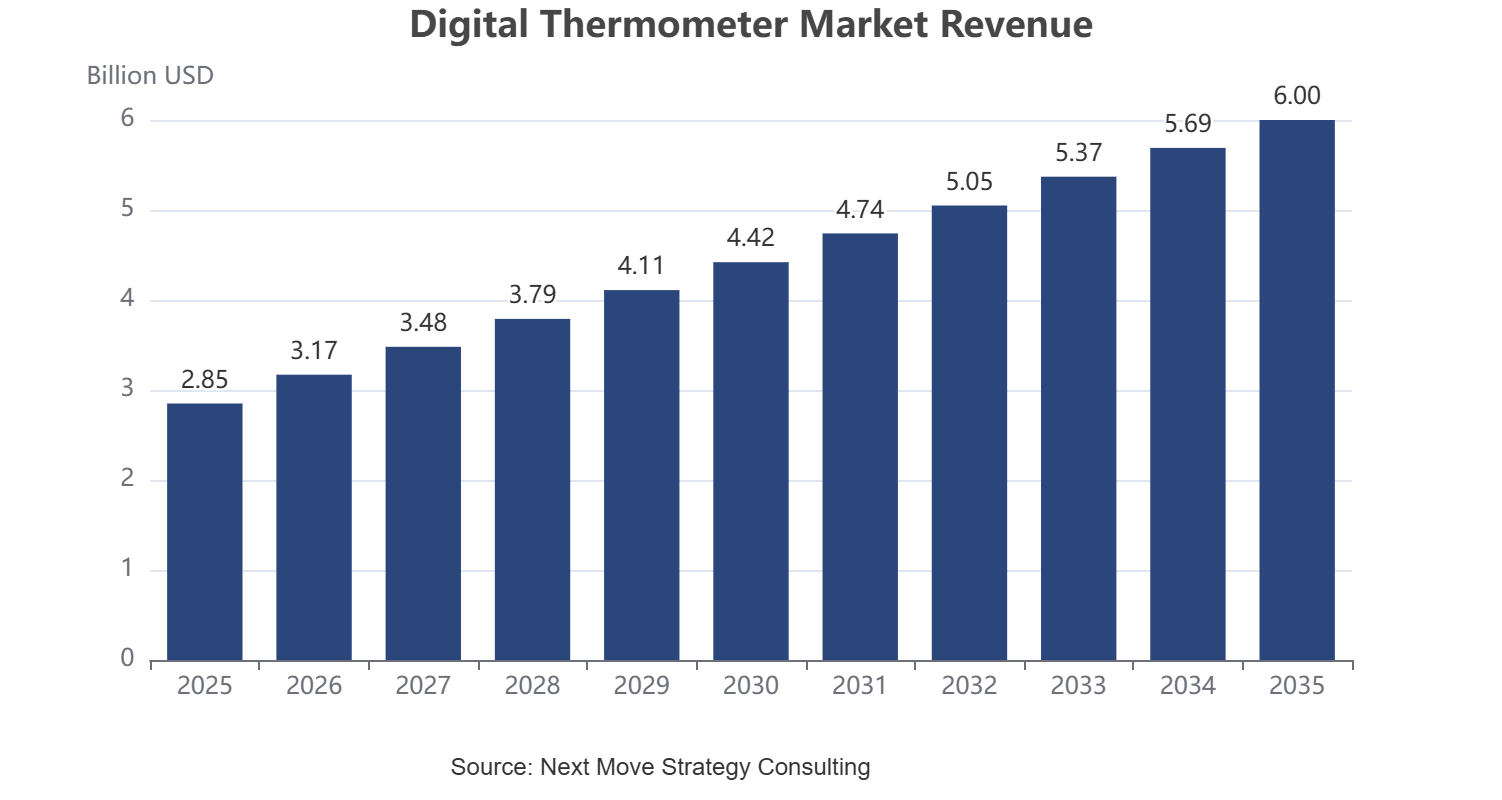
The global Digital Thermometer Market size was valued at USD 2.85 Billion in 2025 and is estimated at USD 3.05 Billion in 2026, forecast to reach USD 6.00 Billion by 2035, expanding at a 7.80% CAGR between 2026 and 2035. North America leads with approximately 33% share, while contact thermometers dominate all other product types with approximately 46% share.
We observed that rising home health monitoring adoption and expanding infrared thermometer usage in institutional settings are driving broad-based revenue growth across every segmentation axis, with infrared thermometers and Asia-Pacific registering the fastest growth through 2035.
|
Key Takeaways |
|
By Product Type: Contact Thermometers held the largest share of approximately 46% (USD 1.31 Billion) in 2025; Infrared Thermometers is the fastest-growing sub-segment at 9.4% CAGR from 2026–2035. |
|
By Sensing Technology: Thermistor held the largest share of approximately 38% (USD 1.08 Billion) in 2025; Semiconductor Junction is the fastest-growing sub-segment at 13.7% CAGR from 2026–2035. |
|
By Distribution Channel: Third Party Marketplace held the largest share of approximately 24% (USD 0.68 Billion) in 2025; Brand Direct is the fastest-growing channel at 11.6% CAGR from 2026–2035. |
|
By End User: Households and Individuals held the largest share of approximately 47% (USD 1.34 Billion) in 2025; Schools, Workplaces and Public Institutions is the fastest-growing sub-segment at 12.2% CAGR from 2026–2035. |
|
By Price Tier: Mid Range held the largest share of approximately 36% (USD 1.03 Billion) in 2025; Professional Grade is the fastest-growing sub-segment at 11.5% CAGR from 2026–2035. |
|
By Connectivity: Standalone held the largest share of approximately 52% (USD 1.48 Billion) in 2025; Cellular and IoT Connected is the fastest-growing sub-segment at 16.6% CAGR from 2026–2035. |
|
Dominant Region: North America dominated with approximately 33% revenue share (USD 0.94 Billion) in 2025. |
|
Fastest-Growing Region: Asia-Pacific is expected to register the highest CAGR of 10.0% during 2026–2035. |
|
Dominant Country: The U.S. led with approximately USD 0.68 Billion in 2025. |
|
Fastest-Growing Country: India is the fastest-growing country at approximately 12.8% CAGR from 2026–2035. |
Market Opportunity: The digital thermometer market is expected to create an absolute dollar opportunity of USD 2.95 Billion between 2026 and 2035, presenting significant investment potential across infrared thermometer innovation, connected device development, and institutional tender channels.
According to Next Move Strategy Consulting analysis, manufacturers are increasingly integrating Bluetooth and Wi-Fi connectivity into consumer-facing thermometers to support digital health record integration, a shift that favors companies with established connected-device software platforms over traditional standalone hardware manufacturers as competitive intensity increases through 2035.
What Does the Digital Thermometer Market Encompass?
The digital thermometer market encompasses contact thermometers, infrared thermometers, and related consumables and accessories used for body temperature measurement across households, hospitals, physician offices, long term care facilities, and public institutions. Our assessment indicates that the market report scope spans thermistor, thermopile infrared, resistance temperature detector, thermocouple, and semiconductor junction sensing technologies distributed through brand direct, marketplace, pharmacy, mass retail, specialized distributor, and institutional tender channels, with demand shaped by measurement accuracy, connectivity, and price tier positioning.
We observed that the market has evolved from basic standalone digital stick thermometers into a differentiated category incorporating wearable continuous monitoring devices and Bluetooth and Wi-Fi connected infrared thermometers. Regulatory frameworks such as U.S. Food and Drug Administration medical device clearance requirements shape product certification for clinical-grade thermometers, while technology adoption is shifting toward app-connected and cellular and IoT connected devices, and Next Move Strategy Consulting's analysis indicates that this convergence of connected-device technology and regulatory clearance is redefining competitive positioning across the digital thermometer market.
|
Parameters |
Details |
|
Market Size in 2025 |
USD 2.85 Billion |
|
Market Size in 2026 |
USD 3.05 Billion |
|
Revenue Forecast in 2035 |
USD 6.00 Billion |
|
Growth Rate |
CAGR of 7.80% from 2026 to 2035 |
|
Analysis Period |
2025–2035 |
|
Base Year Considered |
2025 |
|
Forecast Period |
2026–2035 |
|
Market Size Estimation |
Revenue (USD Billion) |
|
Companies Profiled |
20 |
|
Countries Covered |
33 |
|
Market Share |
Available for Top 10 Companies |
Key Emerging Trends
Based on research conducted by Next Move Strategy Consulting, we found that four structural trends are reshaping product design, distribution, and stakeholder demand across the digital thermometer market.
How Is Wearable Continuous Monitoring Technology Transforming Temperature Tracking?
Manufacturers are developing wearable skin patch and band-based thermometers that provide continuous temperature monitoring rather than single-point readings. We observed that Withings France's connected health device lineup continues to expand its continuous monitoring product portfolio in official company disclosures. This shift is reshaping clinical and consumer use cases alike, as continuous monitoring devices enable trend-based fever detection unavailable from traditional single-reading thermometers.
Why Is Non Contact Infrared Adoption Accelerating in Institutional Settings?
Schools, workplaces, and public institutions are increasingly deploying non contact forehead infrared thermometers for rapid, hygienic temperature screening. Our findings suggest that companies such as OMRON Healthcare are prioritizing non contact infrared product lines in their official institutional distribution strategy. This trend is accelerating adoption of infrared thermometers over contact-based alternatives in high-throughput screening environments where measurement speed and hygiene are priorities.
How Is Connected Device Integration Reshaping Consumer Purchasing?
Manufacturers are integrating Bluetooth and Wi-Fi connectivity into consumer thermometers to enable digital health record synchronization and family health tracking applications. We observed that this shift is expanding fastest within the cellular and IoT connected category, which registers a materially higher growth rate than standalone device sales. Companies with established companion mobile applications are capturing disproportionate share of incremental premium and professional grade segment revenue.
What Role Does Regulatory Clearance Play in Market Evolution?
Regulatory bodies are formalizing clearance pathways for clinical-grade and continuous monitoring thermometers, supporting institutional procurement confidence. The U.S. Food and Drug Administration maintains public medical device classification and clearance databases applicable to clinical thermometers. This is intensifying compliance investment among companies pursuing multi-region regulatory clearance to support expanding distribution into hospital and institutional tender channels.
Price Point Analysis of the Digital Thermometer Market
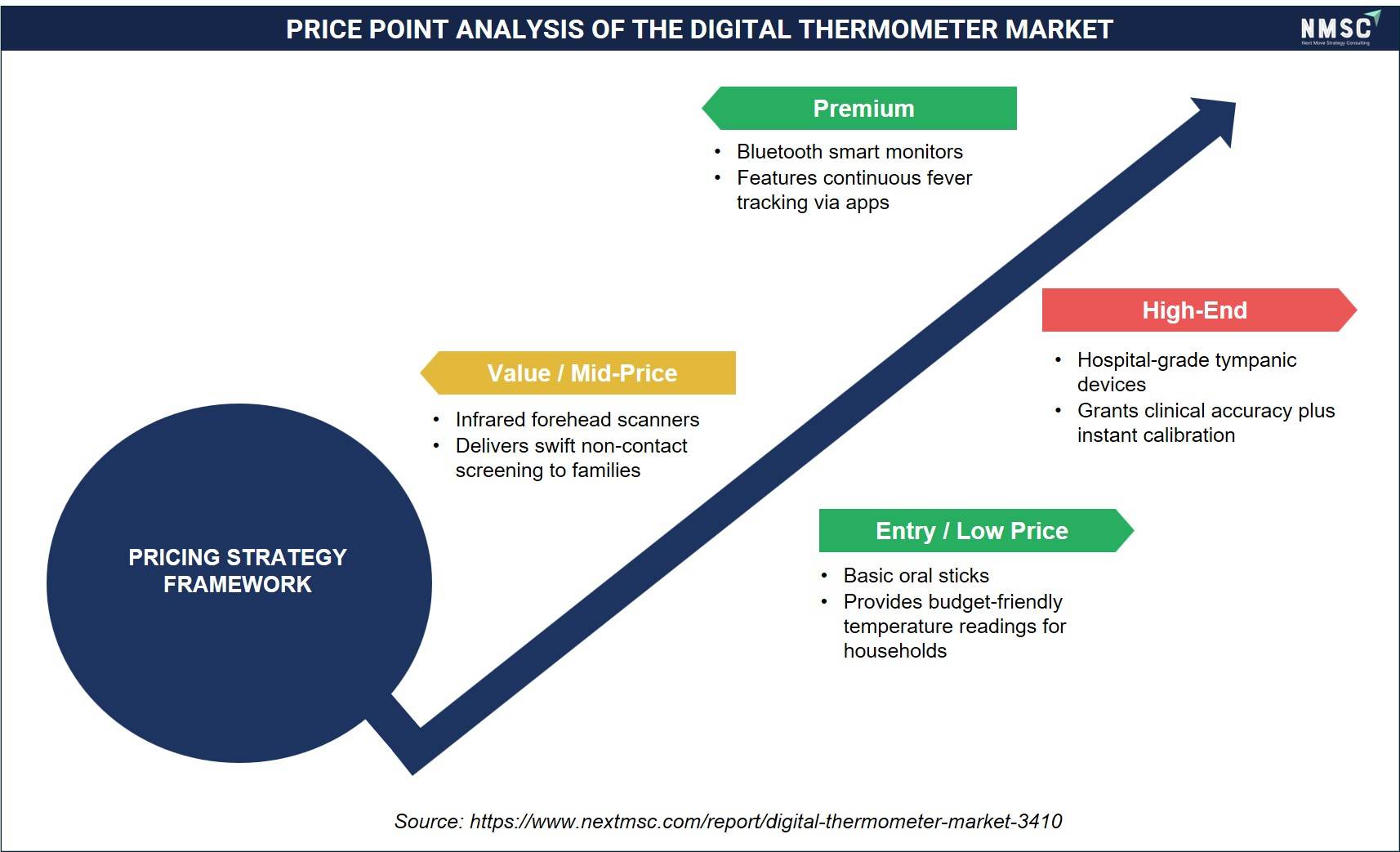
Our analysis indicates that the Digital Thermometer Market adopts a tiered pricing strategy targeting diverse consumer segments. Entry-level products focus on affordability with essential temperature measurement functions, while mid-priced models offer faster response times, memory storage, and improved displays. Premium and high-end thermometers incorporate infrared technology, Bluetooth connectivity, smart health monitoring, and enhanced accuracy. Manufacturers differentiate offerings through technology, product reliability, certifications, and healthcare-focused features to address varying consumer needs and purchasing preferences.
Growth Drivers and Restraints
Growth Catalyst and Risk Assessment Matrix
|
Factors |
Type |
(+/-) % Impact on CAGR |
Geographic Relevance |
Impact Timeline |
|
Rising home health monitoring and self-care adoption |
Driver |
+2.0% |
Global |
2026-2035 |
|
Expanding institutional temperature screening deployment |
Driver |
+1.4% |
Asia-Pacific, North America |
2026-2032 |
|
Growth of connected and app-integrated thermometer devices |
Driver |
+1.1% |
North America, Europe |
2026-2035 |
|
Rising demand for wearable continuous monitoring devices |
Driver |
+0.7% |
North America, Europe, Asia-Pacific |
2026-2033 |
|
Expansion of institutional tender procurement in emerging markets |
Driver |
+0.5% |
Asia-Pacific, Latin America |
2026-2032 |
|
Advances in thermopile infrared sensing accuracy |
Driver |
+0.4% |
Global |
2026-2032 |
|
Price competition from low-cost economy-tier imports |
Restraint |
-0.8% |
Asia-Pacific, Latin America |
2026-2032 |
|
Regulatory clearance delays for clinical-grade devices |
Restraint |
-0.5% |
North America, Europe |
2026-2033 |
|
Consumer preference for bundled multi-function health devices |
Restraint |
-0.3% |
Global |
2026-2030 |
What Is the Primary Growth Driver of the Digital Thermometer Market?
Rising home health monitoring and self-care adoption is the primary driver of the market. The U.S. Centers for Disease Control and Prevention reports sustained consumer engagement with home health monitoring practices following expanded public health guidance on symptom tracking. We observed that this steady shift toward proactive home health management is expanding the addressable consumer base for digital thermometers beyond traditional illness-driven purchasing occasions.
How Is Institutional Screening Deployment Driving Market Growth?
Sustained institutional deployment of non contact infrared thermometers for temperature screening continues to expand demand across schools, workplaces, and public institutions. The U.S. Occupational Safety and Health Administration maintains public workplace health screening guidance referencing temperature monitoring practices. Our assessment indicates that this institutional procurement pattern is sustaining consistent demand for infrared thermometers beyond initial pandemic-era screening deployment.
What Is Restraining Digital Thermometer Market Expansion?
Price competition from low-cost economy-tier imports restrains market expansion by compressing average selling prices, particularly in price-sensitive emerging markets. Government trade and customs authorities in several markets report sustained import volumes of low-cost thermometer products from high-volume manufacturing regions. We found that this pricing pressure disproportionately affects smaller regional manufacturers, reinforcing the advantage held by larger companies with established brand recognition and premium product differentiation.
Segmentation Analysis
Segment Sizing: By Product Type
|
Segment |
2025 (USD) |
2035 (USD) |
CAGR% (2026–2035) |
|
Contact Thermometers |
USD 1.31 Billion |
USD 2.28 Billion |
5.7% |
|
Infrared Thermometers |
USD 1.17 Billion |
USD 2.88 Billion |
9.4% |
|
Thermometer Consumables and Accessories |
USD 0.37 Billion |
USD 0.84 Billion |
8.5% |
|
Total |
USD 2.85 Billion |
USD 6.00 Billion |
7.80% |
What Is Driving Segment Sizing By Product Type in the Digital Thermometer Market?
This axis separates the core product categories that define the market's scope. Contact thermometers dominate on the strength of established household and clinical usage patterns built around digital stick and probe formats. Infrared thermometers register the fastest growth as institutional screening deployment and non contact hygiene preferences drive sustained procurement, while consumables and accessories retain a smaller but steadily growing share anchored by recurring probe cover and replacement part demand.
Segment Sizing: By Distribution Channel
|
Segment |
2025 (USD) |
2035 (USD) |
CAGR% (2026–2035) |
|
Brand Direct |
USD 0.40 Billion |
USD 1.20 Billion |
11.6% |
|
Third Party Marketplace |
USD 0.68 Billion |
USD 1.68 Billion |
9.4% |
|
Pharmacy Retail |
USD 0.63 Billion |
USD 1.02 Billion |
5.0% |
|
Mass Retail |
USD 0.54 Billion |
USD 0.90 Billion |
5.2% |
|
Specialized Distributor |
USD 0.31 Billion |
USD 0.60 Billion |
6.7% |
|
Institutional Tender |
USD 0.29 Billion |
USD 0.60 Billion |
7.7% |
|
Total |
USD 2.85 Billion |
USD 6.00 Billion |
7.80% |
Why Is Brand Direct the Fastest-Growing Distribution Channel?
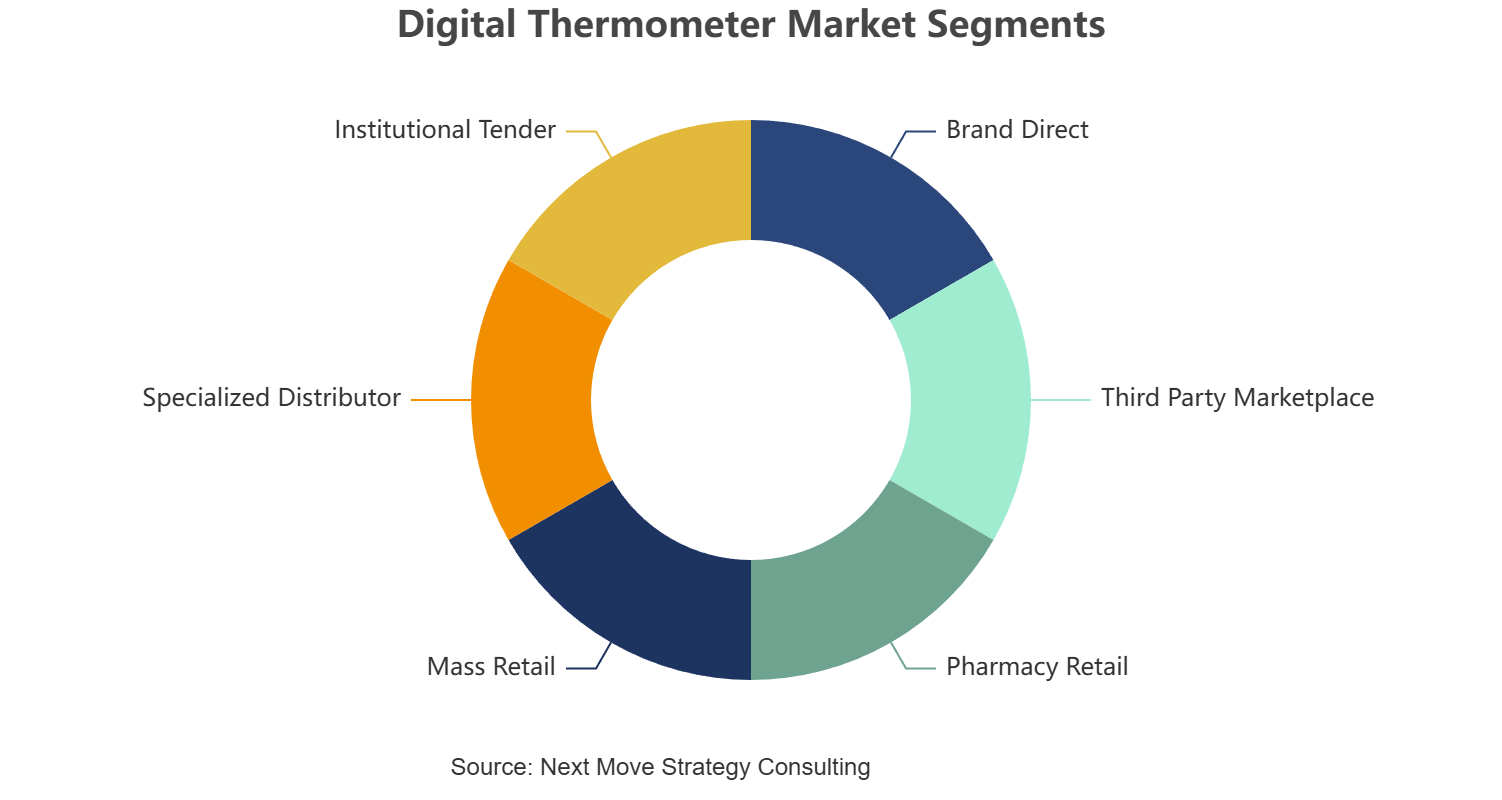
Third party marketplace retains the largest distribution share, reflecting established e-commerce platform reach across mainstream consumer segments. Brand direct channels grow fastest as manufacturers invest in proprietary e-commerce platforms that build direct customer relationships and support connected-device software integration. Pharmacy retail and mass retail remain stable secondary channels anchored by consistent baseline demand among less digitally engaged consumers.
Segment Sizing: By End User
|
Segment |
2025 (USD) |
2035 (USD) |
CAGR% (2026–2035) |
|
Households and Individuals |
USD 1.34 Billion |
USD 2.52 Billion |
6.5% |
|
Hospitals and Health Systems |
USD 0.68 Billion |
USD 1.38 Billion |
7.3% |
|
Physician Offices and Ambulatory Clinics |
USD 0.40 Billion |
USD 0.84 Billion |
7.7% |
|
Long Term Care and Home Health Agencies |
USD 0.26 Billion |
USD 0.72 Billion |
10.9% |
|
Schools, Workplaces and Public Institutions |
USD 0.17 Billion |
USD 0.54 Billion |
12.2% |
|
Total |
USD 2.85 Billion |
USD 6.00 Billion |
7.80% |
Why Is the Schools, Workplaces and Public Institutions End User Segment Growing Fastest?
Households and individuals retain the largest end-user share, anchored by sustained consumer purchasing for personal and family health monitoring. Schools, workplaces, and public institutions register the fastest growth as institutional temperature screening protocols expand across educational and workplace settings. Long term care and home health agencies also grow well above the market average as aging population trends increase demand for continuous monitoring devices in care settings.
Growth Opportunities
Beyond the core growth drivers, three forward-looking whitespace opportunities stand out for stakeholders positioning ahead of 2035 demand.
Why Does Wearable Continuous Monitoring Present a Growth Opportunity?
Manufacturers can capture value by expanding wearable skin patch and band-based continuous monitoring thermometers, benefiting long term care and home health agencies seeking trend-based fever detection beyond single-point readings.
How Can Cellular and IoT Connectivity Unlock New Demand?
Companies can expand cellular and IoT connected thermometer lines with direct health record integration, benefiting households and physician offices seeking seamless digital health data continuity without manual data entry.
What Opportunity Exists in Institutional Tender Expansion?
Manufacturers can pursue formal institutional tender relationships with schools, workplaces, and public health agencies, benefiting public institutions seeking standardized, bulk-procured infrared thermometer deployment for screening programs.
Regional Outlook
|
Region |
2025 (USD) |
2035 (USD) |
CAGR% (2026–2035) |
Key Driver |
|
North America |
USD 0.94 Billion |
USD 1.74 Billion |
6.3% |
Established home health monitoring and connected device adoption |
|
Europe |
USD 0.77 Billion |
USD 1.44 Billion |
6.5% |
Regulatory-driven clinical device clearance and institutional demand |
|
Asia-Pacific |
USD 0.74 Billion |
USD 1.92 Billion |
10.0% |
Expanding institutional screening deployment and manufacturing scale |
|
Latin America |
USD 0.23 Billion |
USD 0.54 Billion |
9.0% |
Growing pharmacy retail and mass retail distribution access |
|
Middle East and Africa |
USD 0.17 Billion |
USD 0.36 Billion |
7.7% |
Government-backed public health screening infrastructure |
|
Total |
USD 2.85 Billion |
USD 6.00 Billion |
7.80% |
|
North America Digital Thermometer Market Outlook
North America represents the most mature digital thermometer market, anchored by established home health monitoring infrastructure and high connected device adoption. We observed that sustained consumer spending on personal health monitoring devices continues to drive brand direct and marketplace channel growth. Regulatory influence remains significant under FDA device clearance rules, and strategic outlook favors continued investment in cellular and IoT connected device development through 2035.
Europe Digital Thermometer Market Outlook
Europe benefits from formalized medical device clearance standards and established pharmacy and institutional distribution across major economies. Technology adoption is advancing through premium infrared and connected device formats, though regulatory compliance requirements shape product certification timelines. Our assessment indicates that regulatory standardization is reinforcing Europe's position as a quality-focused, specification-driven regional market.
Asia-Pacific Digital Thermometer Market Outlook
Asia-Pacific combines expanding institutional screening deployment with concentrated manufacturing scale, positioning it as the fastest-growing region through 2035. We found that government-backed public health screening programs across China and India are accelerating regional infrared thermometer procurement. Strategic outlook favors continued manufacturing capacity expansion and localized product development as regional institutional demand continues to scale.
Latin America Digital Thermometer Market Outlook
Latin America is expanding on the strength of growing pharmacy retail and mass retail distribution access, particularly across Brazil and Argentina. Our findings suggest that expanding retail infrastructure is increasing consumer access to both economy-tier and mid-range digital thermometers. Strategic outlook favors continued growth in pharmacy and mass retail channels across major regional economies.
Middle East and Africa Digital Thermometer Market Outlook
The Middle East and Africa region is expanding through government-backed public health screening infrastructure tied to institutional health preparedness initiatives. We observed that expanding institutional tender procurement is increasing demand for infrared thermometers across schools and public facilities. Strategic outlook favors continued gradual growth concentrated in metropolitan markets with more developed healthcare infrastructure.
U.S. Digital Thermometer Market
Based on our estimates, the U.S. digital thermometer market was valued at approximately USD 0.68 Billion in 2025 and is projected to reach USD 1.22 Billion by 2035, expanding at a 6.0% CAGR. Demand structure centers on established home health monitoring adoption, supported by high brand direct and marketplace channel penetration. Regulatory influence remains significant under FDA device clearance rules, and strategic outlook favors continued connected device investment.
Canada Digital Thermometer Market
The market in Canada was valued at approximately USD 0.16 Billion in 2025 and is projected to reach USD 0.29 Billion by 2035, expanding at a 6.5% CAGR. Adoption levels are supported by expanding pharmacy retail and marketplace access in Ontario and British Columbia, while technology penetration benefits from proximity to U.S. connected device platforms. Strategic outlook favors steady growth in premium and professional grade categories.
UK Digital Thermometer Market
As per our estimate, the UK digital thermometer market was valued at approximately USD 0.21 Billion in 2025 and is projected to reach USD 0.37 Billion by 2035, expanding at a 6.2% CAGR. Demand structure reflects strong pharmacy retail presence alongside growing institutional tender activity, with regulatory influence from UK medical device standards shaping certification requirements. Strategic outlook favors continued infrared thermometer category growth.
Germany Digital Thermometer Market
According to our analysis, the Germany digital thermometer market was valued at approximately USD 0.25 Billion in 2025 and is projected to reach USD 0.46 Billion by 2035, expanding at a 6.4% CAGR. Adoption levels benefit from strong domestic clinical device manufacturing presence and established pharmacy distribution. Competitive intensity is high given the concentration of established medical device companies, and strategic outlook favors continued premium product development.
France Digital Thermometer Market
Based on our estimates, the France digital thermometer market was valued at approximately USD 0.15 Billion in 2025 and is projected to reach USD 0.26 Billion by 2035, expanding at a 6.1% CAGR. Demand structure centers on established pharmacy retail distribution and growing institutional tender procurement across major urban centers. Regulatory influence from French medical device compliance supports specification-grade demand, and strategic outlook favors continued channel diversification.
China Digital Thermometer Market
The market in China was valued at approximately USD 0.25 Billion in 2025 and is projected to reach USD 0.66 Billion by 2035, expanding at a 10.5% CAGR. Adoption levels are rising rapidly as domestic manufacturers expand production capacity and institutional screening deployment accelerates. Regulatory influence remains more concentrated on domestic certification than North America, and strategic outlook favors continued manufacturing capacity expansion.
India Digital Thermometer Market
As per our estimate, the India digital thermometer market was valued at approximately USD 0.14 Billion in 2025 and is projected to reach USD 0.45 Billion by 2035, expanding at a 12.8% CAGR, the fastest among covered countries. Demand structure is driven by expanding institutional screening deployment and rising household purchasing power. Strategic outlook favors accelerated distribution expansion through the forecast period.
Japan Digital Thermometer Market
According to our analysis, the Japan digital thermometer market was valued at approximately USD 0.13 Billion in 2025 and is projected to reach USD 0.24 Billion by 2035, expanding at a 6.7% CAGR. Adoption levels benefit from established domestic manufacturing leadership and high technology penetration, though competitive intensity remains concentrated among established domestic brands. Strategic outlook favors gradual premium device growth.
South Korea Digital Thermometer Market
Based on our estimates, the South Korea digital thermometer market was valued at approximately USD 0.09 Billion in 2025 and is projected to reach USD 0.20 Billion by 2035, expanding at a 9.2% CAGR. Demand structure reflects growing institutional procurement and rising interest in connected device categories. Strategic outlook favors continued adoption growth supported by expanding digital health infrastructure.
Australia Digital Thermometer Market
The market in Australia was valued at approximately USD 0.06 Billion in 2025 and is projected to reach USD 0.12 Billion by 2035, expanding at a 8.4% CAGR. Adoption levels are supported by expanding pharmacy retail and institutional tender access. Strategic outlook favors continued steady growth aligned with regional healthcare infrastructure expansion.
UAE Digital Thermometer Market
As per our estimate, the UAE digital thermometer market was valued at approximately USD 0.04 Billion in 2025 and is projected to reach USD 0.09 Billion by 2035, expanding at a 8.8% CAGR. Demand structure is anchored by government public health screening initiatives and growing institutional procurement. Strategic outlook favors continued growth concentrated in metropolitan healthcare infrastructure hubs.
Saudi Arabia Digital Thermometer Market
According to our analysis, the Saudi Arabia digital thermometer market was valued at approximately USD 0.05 Billion in 2025 and is projected to reach USD 0.11 Billion by 2035, expanding at a 9.5% CAGR. Adoption levels are rising as Vision 2030 healthcare infrastructure initiatives expand institutional procurement capacity. Strategic outlook favors continued growth tied to public health screening programs.
South Africa Digital Thermometer Market
Based on our estimates, the South Africa digital thermometer market was valued at approximately USD 0.04 Billion in 2025 and is projected to reach USD 0.08 Billion by 2035, expanding at a 8.2% CAGR. Demand structure centers on expanding pharmacy retail and institutional tender procurement in major urban centers. Strategic outlook favors continued growth supported by regional distribution partnerships.
Brazil Digital Thermometer Market
The market in Brazil was valued at approximately USD 0.13 Billion in 2025 and is projected to reach USD 0.30 Billion by 2035, expanding at a 9.3% CAGR. Adoption levels benefit from expanding pharmacy retail and mass retail infrastructure investment across major urban regions. Strategic outlook favors continued growth across both household and institutional segments.
Argentina Digital Thermometer Market
As per our estimate, the Argentina digital thermometer market was valued at approximately USD 0.04 Billion in 2025 and is projected to reach USD 0.10 Billion by 2035, expanding at a 8.6% CAGR. Demand structure reflects growing pharmacy retail penetration and expanding institutional procurement. Strategic outlook favors steady growth concentrated in major metropolitan centers.
Consumer Behavior Analysis of the Digital Thermometer Market
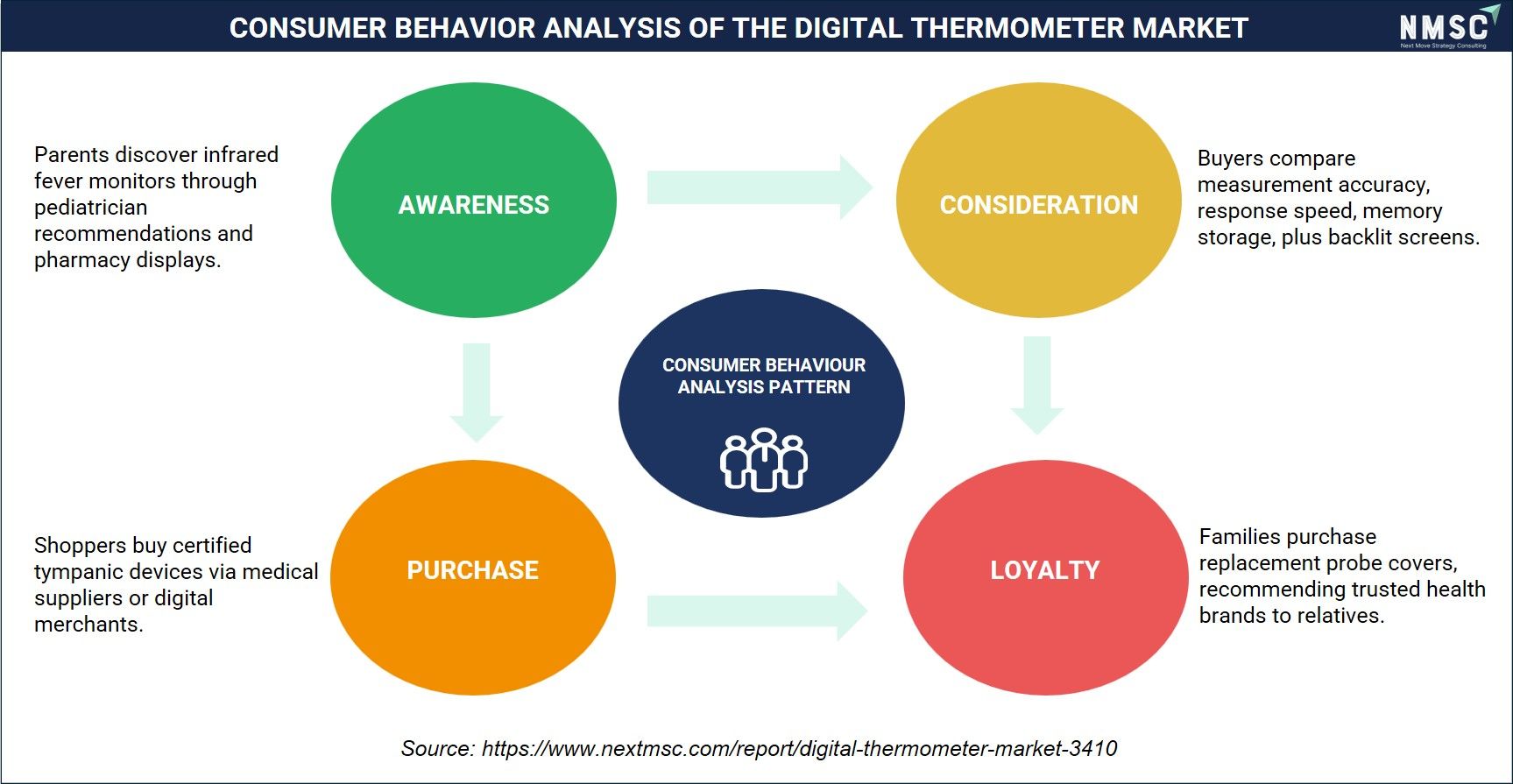
Our analysis indicates that consumer behavior in the Digital Thermometer Market follows a structured journey from awareness to loyalty. Consumers first learn about digital thermometers through healthcare professionals, pharmacies, online platforms, and product advertising. During evaluation, buyers compare measurement accuracy, response time, ease of use, memory functions, and display quality. Purchasing decisions are influenced by brand reputation, certifications, and affordability. Positive user experience, reliability, and consistent performance encourage repeat purchases, accessory replacements, and long-term brand loyalty.
Competitive Landscape
We observed that the digital thermometer market remains moderately fragmented, with competitive intensity concentrated among large diversified consumer health companies and specialized medical device manufacturers.
|
Aspect |
Details |
|
Market Structure |
Moderately fragmented, with the Top 10 companies holding an available market share while a long tail of regional manufacturers serves localized demand. |
|
Innovation Focus |
Connected device integration, wearable continuous monitoring technology, and thermopile infrared sensing accuracy. |
|
M&A Activity |
Selective acquisitions of regional distribution networks and connected health device platforms to expand product and channel coverage. |
How Do Companies Compete in the Digital Thermometer Market?
Companies compete primarily on measurement accuracy credentials and regulatory clearance breadth, since institutional and clinical buyers select products based on documented accuracy testing and device certification. Our analysis shows that companies with established multi-channel distribution spanning brand direct, pharmacy, and institutional tender command stronger customer loyalty than narrow, single-channel manufacturers, while pricing strategies increasingly reflect premium positioning for connected and continuous monitoring functionality.
Which Competitive Archetypes Dominate the Digital Thermometer Market?
Three archetypes dominate: large diversified consumer health companies with extensive brand recognition and retail distribution scale, specialized medical device manufacturers with deep clinical accuracy credentials, and regional manufacturers with cost-competitive economy-tier production. We found that diversified consumer health companies compete on brand trust and retail channel breadth, while specialized medical device manufacturers differentiate through clinical-grade accuracy and institutional tender relationships.
What Innovation and Differentiation Strategies Are Companies Pursuing?
Manufacturers are investing in connected device functionality and wearable continuous monitoring technology to differentiate premium product lines from economy-tier alternatives. Our findings suggest that companies are increasingly publishing official accuracy testing and clinical validation disclosures to build institutional buyer trust, while some companies are piloting subscription-based companion application services to strengthen recurring customer engagement.
What M&A Activity Is Shaping the Digital Thermometer Market?
Mergers and acquisitions activity centers on regional distribution network consolidation, as larger consumer health companies acquire specialized medical device manufacturers and connected health platforms to expand category coverage without ground-up product development. We observed that companies are also pursuing selective partnerships with institutional tender operators to expand geographic reach, reflecting a broader industry shift toward omnichannel distribution strategies.
Key Market Players
We found that the following companies represent the leading manufacturers and providers of digital thermometers globally, ranked by market-specific scale of operations.
-
Helen of Troy Limited
-
OMRON Healthcare Co., Ltd.
-
Microlife Corporation
-
Welch Allyn, Inc.
-
Cardinal Health, Inc.
-
Exergen Corporation
-
Jiangsu Yuyue Medical Equipment & Supply Co., Ltd.
-
PAUL HARTMANN AG
-
Beurer GmbH
-
Andon Health Co., Ltd.
-
Guangdong Berrcom Medical Device Co., Ltd.
-
A&D Company, Limited
-
Citizen Systems Japan Co., Ltd.
-
Rossmax International Ltd.
-
Medline Industries, LP
-
Rudolf Riester GmbH
-
Geratherm Medical AG
-
Withings France SA
-
Nureca Limited
Latest Developments
|
Date |
Event |
|
January 2026 |
Exergen Corporation highlighted that 99% of the hospitals recognized on the U.S. News & World Report's Best Hospitals for Maternity Care list rely on its clinical-grade Temporal Artery Thermometers, reinforcing its leadership in non-invasive pediatric and maternal temperature monitoring workflows. |
|
November 2025 |
Withings France SA announced U.S. FDA clearance for its multi-sensor health device, BeamO, which integrates a contactless infrared thermometer, a 1-lead ECG, and a digital stethoscope to enhance home diagnostics and telehealth monitoring. |
|
September 2025 |
Baxter International Inc. launched the Welch Allyn Connex 360 Vital Signs Monitor, introducing a connected patient monitoring device designed to streamline clinical documentation and support earlier detection of patient deterioration in hospital and health-system settings. |
Investment Opportunities
Where Is Capital Flowing Within the Digital Thermometer Market?
Capital continues to concentrate in connected device software platforms and wearable continuous monitoring hardware development. We observed that Withings France has directed continued investment toward its connected health device ecosystem, per official company disclosures, signaling sustained investor confidence in digitally integrated monitoring platforms.
How Is Infrastructure Investment Shaping the Market?
Infrastructure investment is concentrated in manufacturing capacity for infrared sensing components and companion application development supporting connected device functionality. Our findings suggest that companies operating in Asia-Pacific are directing capital toward automated production infrastructure specifically to support expanding institutional tender procurement volumes.
What ESG Considerations Are Relevant to Digital Thermometer Market Investment?
Environmental, social, and governance considerations center on electronic waste management and battery recyclability for connected and disposable thermometer components. Social considerations include equitable access to accurate temperature monitoring devices in underserved regions, while governance considerations relate to transparent compliance with medical device clearance and clinical accuracy testing standards.
Key Benefits for Stakeholders
How Does This Report Benefit Industry Leaders?
Industry leaders gain a validated market-sizing and segmentation framework to prioritize product investment across product types, sensing technologies, and regions. The report's country-level revenue and CAGR data support capital-allocation decisions for companies evaluating new product-line investment through 2035.
How Does This Report Benefit Investors and Financial Analysts?
Investors and financial analysts gain a fundamentals-based CAGR methodology, competitive landscape mapping, and a Top 20 company benchmark set, supporting valuation and portfolio-allocation decisions across consumer health, medical device, and connected health technology companies.
How Does This Report Benefit Technology Vendors and Product Teams?
Technology vendors and product teams gain segment-level demand signals, including the fastest-growing cellular and IoT connected and institutional end-user categories, to prioritize product roadmaps around connected device functionality and institutional tender-ready product design.
Key Market Segments
By Product Type
-
Contact Thermometers
-
Digital Stick Thermometers
-
Rigid Tip
-
Flexible Tip
-
-
Clinical Probe Thermometers
-
Handheld Predictive Probe
-
Monitor Integrated Probe
-
-
Continuous Monitoring Thermometers
-
Wearable Skin Patch
-
Wearable Band and Clip
-
Ingestible Capsule
-
-
Specialty Contact Thermometers
-
Basal Body
-
Pacifier
-
-
-
Infrared Thermometers
-
Ear Tympanic Thermometers
-
Consumer Tympanic
-
Professional Tympanic
-
-
Temporal Artery Thermometers
-
Non Contact Forehead Thermometers
-
Multi Site Infrared Thermometers
-
-
Thermometer Consumables and Accessories
-
Probe Covers and Sheaths
-
Replacement Probes and Probe Wells
-
Lens Filters and Speculum Covers
-
Mounts, Cradles and Carry Cases
-
By Sensing Technology
-
Thermistor
-
Thermopile Infrared
-
Resistance Temperature Detector
-
Thermocouple
-
Semiconductor Junction
By Distribution Channel
-
Brand Direct
-
Third Party Marketplace
-
Pharmacy Retail
-
Mass Retail
-
Specialized Distributor
-
Institutional Tender
By End User
-
Households and Individuals
-
Hospitals and Health Systems
-
Physician Offices and Ambulatory Clinics
-
Long Term Care and Home Health Agencies
-
Schools, Workplaces and Public Institutions
By Price Tier
-
Economy
-
Mid Range
-
Premium
-
Professional Grade
By Connectivity
-
Standalone
-
Bluetooth Connected
-
Wi-Fi Connected
-
Cellular and IoT Connected
-
Wired and Docked Clinical
By Region
-
North America: U.S., Canada, Mexico
-
Europe: UK, Germany, France, Italy, Spain, Sweden, Denmark, Finland, Netherlands, Rest of Europe
-
Asia-Pacific: China, India, Japan, South Korea, Taiwan, Indonesia, Vietnam, Australia, Philippines, Malaysia, Rest of APAC
-
Middle East & Africa: Saudi Arabia, UAE, Egypt, Israel, Turkey, Nigeria, South Africa, Rest of MEA
-
Latin America: Brazil, Argentina, Chile, Colombia, Rest of LATAM
Conclusion and Recommendations
What Is the Long-Term Outlook for the Digital Thermometer Market?
The long-term outlook remains steadily positive, with the market projected to expand from USD 2.85 Billion in 2025 to USD 6.00 Billion by 2035 at a 7.80% CAGR. We observed that structural drivers, including home health monitoring adoption and connected device integration, are durable rather than cyclical, supporting continued mid-to-high single-digit growth across most segments through the forecast period.
What Strategic Positioning Should Providers Pursue?
Providers should prioritize connected device functionality and clinical accuracy credentials over undifferentiated economy-tier positioning, since institutional and premium consumer retention correlates strongly with documented accuracy and connectivity features. Our assessment indicates that companies integrating brand direct and institutional tender channels alongside traditional pharmacy distribution will differentiate as competitive intensity increases through 2035.
How Attractive Is the Market for New Investment?
Investment attractiveness is high across connected device development and wearable continuous monitoring hardware, given a USD 2.95 Billion absolute dollar opportunity between 2026 and 2035. We found that schools, workplaces and public institutions offer the strongest risk-adjusted entry point given their 12.2% segment CAGR and expanding institutional tender procurement activity.
What Market Shifts and Key Risks Should Stakeholders Monitor?
Stakeholders should monitor price competition from low-cost economy-tier imports, which could compress average selling prices, alongside regulatory clearance delays affecting clinical-grade device launch timelines. Our analysis shows that companies with established brand recognition and diversified price-tier portfolios are better positioned to absorb these pricing and regulatory risks than narrowly focused single-tier manufacturers.
What Are the Primary Growth Pathways Through 2035?
Primary growth pathways include expansion of wearable continuous monitoring technology, deeper integration of cellular and IoT connectivity, and continued institutional tender channel development. We observed that companies combining at least two of these pathways are best positioned to capture disproportionate share of the USD 3.15 Billion in incremental revenue generated between 2025 and 2035.
About the Author
 Saista Faiyaz
— Saista Faiyaz is Research Associate at Next Move Strategy Consulting, where she has covered consumer markets and healthcare technologies for 3 years. Her work includes primary interview review, secondary-source validation, market sizing, and structured analysis of company and industry data. She supports research by comparing evidence across sources, organizing findings into market narratives, and documenting assumptions used in analysis. Her scope includes cross-market benchmarking, and reports.
Saista Faiyaz
— Saista Faiyaz is Research Associate at Next Move Strategy Consulting, where she has covered consumer markets and healthcare technologies for 3 years. Her work includes primary interview review, secondary-source validation, market sizing, and structured analysis of company and industry data. She supports research by comparing evidence across sources, organizing findings into market narratives, and documenting assumptions used in analysis. Her scope includes cross-market benchmarking, and reports.
About the Reviewer
 Supradip Baul
— Supradip Baul is an accomplished business consultant and strategist with over a decade of rich experience in market intelligence, strategy, technology, and business transformation. His work has included rigorous qualitative and quantitative analysis across multiple industries, helping clients shape investment decisions and long-term roadmaps. Earlier in his career, he was associated with Gartner, where he contributed to industry-leading reports and market share analyses. He has worked with leading global companies and holds an MBA with a dual specialization in Marketing and Finance.
Supradip Baul
— Supradip Baul is an accomplished business consultant and strategist with over a decade of rich experience in market intelligence, strategy, technology, and business transformation. His work has included rigorous qualitative and quantitative analysis across multiple industries, helping clients shape investment decisions and long-term roadmaps. Earlier in his career, he was associated with Gartner, where he contributed to industry-leading reports and market share analyses. He has worked with leading global companies and holds an MBA with a dual specialization in Marketing and Finance.
At Next Move Strategy Consulting, we understand that insightful market research is the cornerstone of successful business decisions. That's why we employ a robust and multifaceted approach, combining various methodologies to deliver the most accurate and actionable data for our clients.

Research Landscape
We navigate the world of research with two primary approaches:
Qualitative Approach
Our qualitative research methodologies involve immersive techniques such as in-depth interviews, focus groups, and observational studies. By engaging directly with individuals and stakeholders, we uncover valuable insights that quantitative data alone may overlook.

Quantitative Research
In tandem with qualitative methodologies, NMSC leverages the power of Quantitative Research to provide a robust foundation of numerical insights. Through systematic data collection and analysis, we quantify patterns, preferences, and market trends, offering a comprehensive view of the business landscape.
Our quantitative research approach employs diverse tools, including surveys, experiments, and statistical modelling. These methodologies enable us to gather data from a large and representative sample, ensuring the statistical significance of our findings. By employing structured questionnaires and standardized data collection methods, we guarantee the reliability and validity of the information we present to our clients.
Quantitative research is particularly effective in measuring the prevalence of trends, assessing market size, and gauging the impact of various factors on consumer behavior. The numerical precision attained through this approach equips our clients with actionable insights, facilitating data-driven decision-making and strategy formulation.


Our Specialized Toolbox for Industry-Specific Market Research
We deploy a specialized arsenal of techniques tailored to meet your unique requirements. Here's a glimpse into our comprehensive toolbox:

Information Procurement
The stage entails acquiring market data or relevant information through various sources and methodologies.


Market Research Approach
We utilize both top-down and bottom-up approaches in market research analysis to achieve a comprehensive understanding of the market dynamics, leveraging the broad perspective of industry trends and macroeconomic factors alongside detailed insights from specific segments and individual companies.

Porters Five Forces Analysis
We conduct Porter's Five Forces analysis to evaluate the competitive landscape of an industry, providing us with insights into factors that affect profitability and strategic positioning.

SWOT Analysis

Forecasting
We utilize a forecasting model to predict future consumption by considering parameters like population, economics, regulations, market competition, drivers, constraints, technology, and pricing. We also employ statistical techniques such as multilinear regression, exponential smoothing, moving average, ARIMA, and Monte Carlo simulations for accurate predictions. In econometric forecasting, we analyzed short-term and long-term event impacts, attributing values based on regulatory frameworks, economic factors, and market events.





 Speak to Our Analyst