Transcatheter Mitral Valve Replacement Market Global Industry Analysis and Forecast (2026–2035)

The global Transcatheter Mitral Valve Replacement Market size was valued at USD 0.29 billion in 2025 and is estimated at USD 0.41 billion in 2026, forecast to reach USD 3.85 billion by 2035, expanding at a 28.3% CAGR from 2026 to 2035. Key drivers include the first dedicated replacement device approvals in 2025 and rising mitral regurgitation prevalence in aging populations, with North America leading the global market.

Download Free Sample PDF
Base Year (2025)
$0.29 Billion
Forecast (2035)
$3.85 Billion
CAGR (2026-2035)
28.3%
Top Region
North America

What Is the Transcatheter Mitral Valve Replacement Market Size?

The global transcatheter mitral valve replacement market size was valued at USD 0.29 billion in 2025 and is estimated at USD 0.41 billion in 2026, forecast to reach USD 3.85 billion by 2035, expanding at a 28.3% CAGR between 2026 and 2035. North America leads with approximately 52% share, while Transseptal Access dominates all other access routes with approximately 48% share.

We observed that growth is broad-based across every segmentation axis, with single-step self-anchoring valve systems and Asia-Pacific commercial expansion driving the dominant structural shifts through 2035.

Transcatheter Mitral Valve Replacement Market Global Industry Analysis and Forecast (2026–2035) Revenue Forecast

Values in USD Billion

2025 $0.29 Billion
2025
2026 $0.37 Billion
2026
2027 $0.48 Billion
2027
2028 $0.61 Billion
2028
2029 $0.79 Billion
2029
2030 $1.01 Billion
2030
2031 $1.29 Billion
2031
2032 $1.66 Billion
2032
2033 $2.13 Billion
2033
2034 $2.73 Billion
2034
2035 $3.85 Billion
2035

Key Takeaways

By Access Route: Transseptal Access held the largest share of approximately 48% (USD 0.14 billion) in 2025; Transseptal Access is also the fastest-growing sub-segment at 32.3% CAGR from 2026–2035.

By Device Design: Dock-and-Valve Two-Step Systems held the largest share of approximately 58% (USD 0.17 billion) in 2025; Single-Step Self-Anchoring Systems is the fastest-growing sub-segment at 32.1% CAGR from 2026–2035.

By Indication: Mitral Regurgitation held the largest share of approximately 62% (USD 0.18 billion) in 2025; Mixed Mitral Disease is the fastest-growing sub-segment at 29.0% CAGR from 2026–2035.

By End User: Hospitals held the largest share of approximately 86% (USD 0.25 billion) in 2025; Ambulatory and Specialty Cardiac Centers is the fastest-growing sub-segment at 35.1% CAGR from 2026–2035.

Dominant Region: North America dominated with approximately 52% revenue share (USD 0.15 billion) in 2025.

Fastest-Growing Region: Asia-Pacific is expected to register the highest CAGR of 35.1% during 2026–2035.

Dominant Country: U.S. led with approximately USD 0.13 billion in 2025.

Fastest-Growing Country: China is the fastest-growing country at approximately 40.9% CAGR from 2026–2035.

What Does the Transcatheter Mitral Valve Replacement Market Encompass?

The transcatheter mitral valve replacement market encompasses the catheter-delivered prosthetic valve systems, delivery sheaths, and docking mechanisms used to fully replace a diseased native mitral valve without open-heart surgery, addressing patients with severe mitral regurgitation and mitral annular calcification unsuitable for surgical repair or transcatheter edge-to-edge repair devices. Our assessment indicates that the scope spans device developers commercializing dedicated replacement systems, distinct from the broader mitral repair category, serving hospitals and specialty cardiac centers treating high-surgical-risk structural heart disease patients worldwide.

Regulatory frameworks, including U.S. Food and Drug Administration premarket approval and European Union CE Mark certification, directly shape commercial launch timelines, with the market's two dedicated replacement devices receiving first-time FDA approvals in 2025, with Abbott Tendyne approved in May and Edwards SAPIEN M3 approved in December. We observed that technology adoption is shifting decisively toward transseptal delivery platforms that avoid the surgical incision required by transapical approaches. NMSC's analysis indicates that this structural shift, combined with expanding Centers for Medicare and Medicaid Services coverage determinations, is redefining commercial prioritization across the transcatheter mitral valve replacement market.

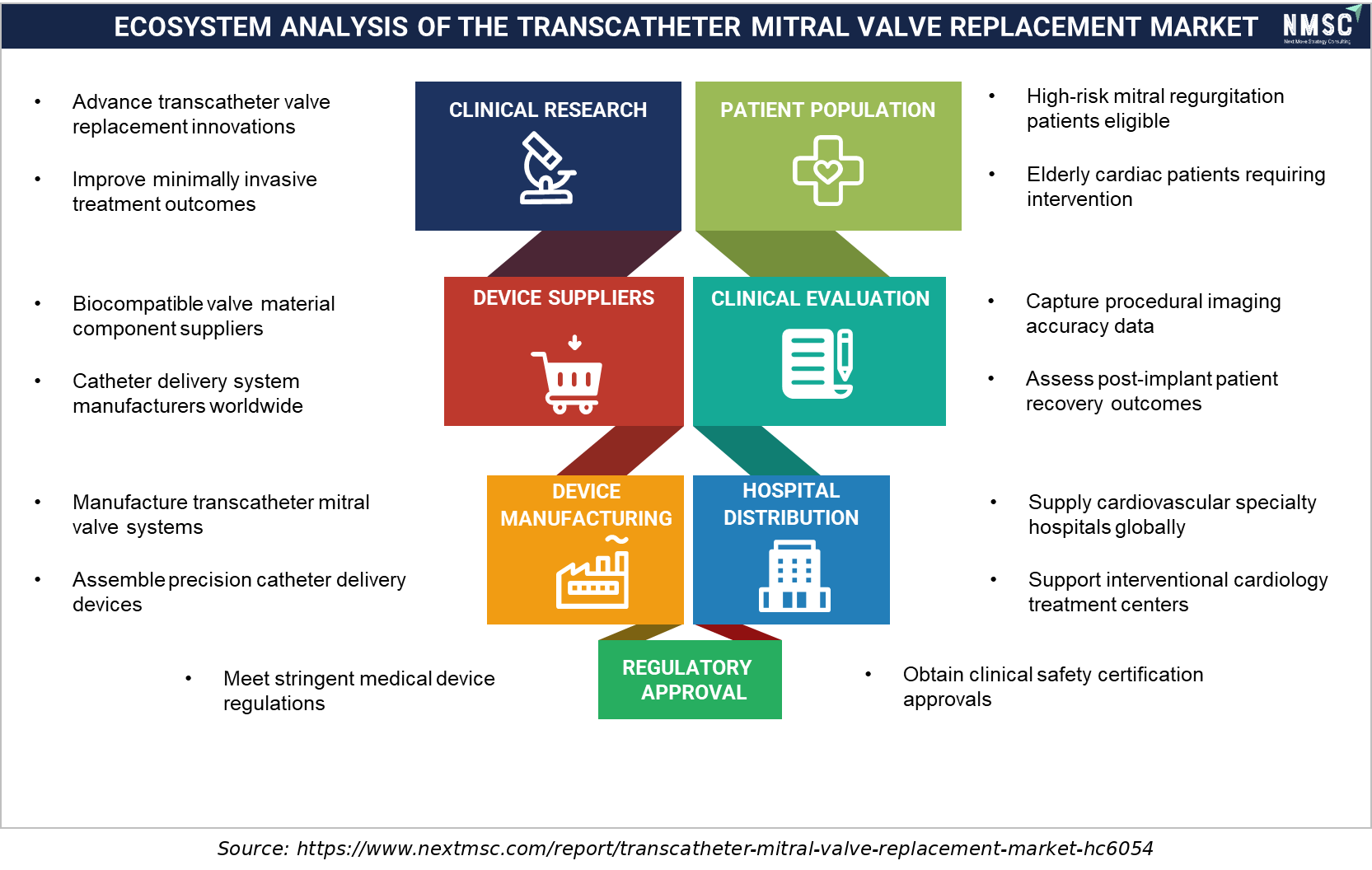
Ecosystem Analysis of the Transcatheter Mitral Valve Replacement Market

The Transcatheter Mitral Valve Replacement (TMVR) ecosystem bridges clinical research, precision manufacturing, and specialized hospital distribution to serve high-risk cardiac patients. Powered by advanced biocompatible materials and innovative catheter systems, device manufacturers collaborate directly with interventional cardiology centers to elevate minimally invasive procedure outcomes through rigorous clinical evaluation and stringent regulatory compliance.

Growth Drivers and Restraints

Segmentation Analysis

2025 (USD Billion)
2035 (USD Billion)
Transseptal access 2025: $0.14 Billion | 2035: $2.46 Billion
Transseptal
Transapical access 2025: $0.11 Billion | 2035: $1.00 Billion
Transapical
Transatrial access 2025: $0.04 Billion | 2035: $0.39 Billion
Transatrial
Transseptal access $0.14 Billion $2.46 Billion 32.3%
Transapical access $0.11 Billion $1.00 Billion 23.0%
Transatrial access $0.04 Billion $0.39 Billion 23.9%

Which Access Route Dominates the Transcatheter Mitral Valve Replacement Market?

Transseptal Access led the market with USD 0.14 billion in 2025, reflecting the clinical and commercial momentum behind Edwards Lifesciences' SAPIEN M3, the first fully percutaneous transseptal replacement therapy approved for surgery-ineligible patients. Our findings suggest that Transseptal Access is also the fastest-growing route, registering a 32.3% CAGR from 2026 to 2035, as manufacturers prioritize incision-free delivery platforms that avoid the surgical access point required by transapical systems.

2025 (USD Billion)
2035 (USD Billion)
Dock-and-val
Single-step
Segment Item 2025 (USD Billion) 2035 (USD Billion) CAGR
Dock-and-valve two-step systems $10.0 USD Billion $40.0 USD Billion 9.0%
Single-step self-anchoring systems $17.1 USD Billion $51.1 USD Billion 15.0%

Segment-wise data is locked

Unlock complete segment-wise numbers for By Device Design.

Unlock Full Data

Which Device Design Leads Transcatheter Mitral Valve Replacement Demand?

Dock-and-Valve Two-Step Systems remained the leading device design within the market, reaching USD 0.17 billion in 2025, reflecting the established clinical track record of systems such as Abbott's Tendyne that separate anchor deployment from valve delivery for precise positioning. Based on research conducted by NMSC, we found that Single-Step Self-Anchoring Systems is the fastest-growing design at a 32.1% CAGR from 2026 to 2035, as newer platforms including SAPIEN M3 demonstrate that streamlined deployment can reduce procedural time without compromising positioning accuracy.

2025 (USD Billion)
2035 (USD Billion)
Mitral regur
Mitral annul
Mixed mitral
Segment Item 2025 (USD Billion) 2035 (USD Billion) CAGR
Mitral regurgitation $10.0 USD Billion $40.0 USD Billion 17.0%
Mitral annular calcification $17.1 USD Billion $51.1 USD Billion 27.0%
Mixed mitral disease $24.2 USD Billion $62.2 USD Billion 25.0%

Segment-wise data is locked

Unlock complete segment-wise numbers for By Indication.

Unlock Full Data

Which Indication Leads Transcatheter Mitral Valve Replacement Market Demand?

Mitral Regurgitation remained the leading indication within the market, valued at USD 0.18 billion in 2025, reflecting the condition's substantially larger diagnosed patient population relative to isolated mitral annular calcification. Our findings suggest that Mixed Mitral Disease is the fastest-growing indication, registering a 29.0% CAGR from 2026 to 2035, as expanding clinical trial data increasingly supports replacement therapy for patients presenting combined regurgitation and calcification pathology previously excluded from single-indication device trials.

2025 (USD Billion)
2035 (USD Billion)
Hospitals
Ambulatory a
Segment Item 2025 (USD Billion) 2035 (USD Billion) CAGR
Hospitals $10.0 USD Billion $40.0 USD Billion 26.0%
Ambulatory and specialty cardiac centers $17.1 USD Billion $51.1 USD Billion 16.0%

Segment-wise data is locked

Unlock complete segment-wise numbers for By End User.

Unlock Full Data

Growth Opportunities

Our analysis shows that three forward-looking opportunities stand out for stakeholders positioning within the transcatheter mitral valve replacement market over the 2026-2035 forecast period.

How Can Mitral Annular Calcification Programs Unlock an Underserved Patient Population?

Dedicated mitral annular calcification therapy presents a whitespace opportunity for device developers serving a patient population historically excluded from surgical replacement. Companies that scale calcification-specific docking technology following Abbott's Tendyne approval stand to capture share from a diagnosed population with few existing treatment alternatives, differentiating from developers focused solely on primary mitral regurgitation.

Where Does Asia-Pacific Structural Heart Program Expansion Create New Demand?

Asia-Pacific structural heart program development represents an underpenetrated opportunity for device manufacturers as regional hospitals build transcatheter valve capability. Companies that establish early regulatory approval and training infrastructure in China, Japan, and India can secure first-mover advantage, differentiating from competitors focused solely on established North American and European markets.

How Can Ambulatory Cardiac Center Partnerships Benefit Device Developers?

Health systems seeking to expand structural heart procedure capacity beyond flagship hospitals create an opportunity for developers offering training and support programs tailored to ambulatory and specialty cardiac centers. Early movers that build scalable physician training pipelines can secure broader procedural volume, differentiating from competitors reliant solely on established academic medical center relationships.

Regional Outlook

2025 (USD Billion)
2035 (USD Billion)
North Americ
Europe
Asia-Pacific
Middle East
Latin Americ
Region 2025 (USD Billion) 2035 (USD Billion) CAGR (%)
North America $10.0 USD Billion $40.0 USD Billion 9.0%
Europe $17.1 USD Billion $51.1 USD Billion 27.0%
Asia-Pacific $24.2 USD Billion $62.2 USD Billion 25.0%
Middle East & Africa $31.3 USD Billion $73.3 USD Billion 23.0%
Latin America $38.4 USD Billion $84.4 USD Billion 12.0%

Regional data is locked

Unlock complete regional numbers for this market.

Unlock Full Data

Competitive Landscape

We observed that the transcatheter mitral valve replacement market features a highly concentrated competitive landscape given its early commercial stage, with two large-cap structural heart leaders holding the only FDA-approved replacement devices while a small number of specialized developers advance later-stage pipeline programs across the industry.

Dimension Description
Market Structure Highly concentrated; Abbott Laboratories and Edwards Lifesciences hold the market's only two FDA-approved dedicated replacement devices as of early 2026, while Medtronic, Boston Scientific, and smaller developers advance pipeline programs toward regulatory submission.
Innovation Focus Transseptal delivery platform development, mitral annular calcification-specific docking technology, and large-scale clinical trial evidence generation dominate current innovation pipelines.
M&A Activity Selective early-stage technology acquisition, exemplified by Edwards Lifesciences' acquisition of Innovalve Bio Medical and Abbott's acquisition of Cephea Valve Technologies in 2019 to build replacement pipeline capability.

How Do Companies Compete in the Transcatheter Mitral Valve Replacement Market?

Companies compete primarily on regulatory approval status, clinical trial evidence depth, and delivery platform sophistication across the industry. Approved-device leaders Abbott and Edwards Lifesciences leverage first-mover commercial positioning and established structural heart sales infrastructure, while pipeline-stage developers such as Medtronic and Boston Scientific compete through large-scale clinical trial enrollment intended to support future regulatory submissions and differentiated device design.

Which Competitive Archetypes Dominate the Transcatheter Mitral Valve Replacement Market?

Two archetypes dominate the market: large-cap structural heart leaders with commercially approved devices and established hospital distribution networks, and specialized or pipeline-stage developers advancing differentiated technology toward regulatory approval. Abbott and Edwards Lifesciences exemplify the approved-device archetype, while HighLife SAS and Cardiovalve Ltd exemplify the specialized pipeline archetype pursuing distinct anchoring or delivery innovations ahead of commercial launch.

How Are Companies Differentiating Through Innovation in Transcatheter Mitral Valve Replacement?

Innovation and differentiation strategy increasingly center on delivery route simplification and indication-specific device design. Edwards Lifesciences' transseptal SAPIEN M3 and Abbott's calcification-focused Tendyne both illustrate how developers pursue distinct clinical niches rather than directly competing head-to-head on identical indications. Our analysis shows that developers unable to demonstrate credible transseptal capability or indication-specific clinical data risk exclusion from the market's fastest-growing access route and disease categories.

What M&A and Expansion Activity Is Shaping the Transcatheter Mitral Valve Replacement Market?

Early-stage technology acquisition continues to shape competitive positioning within the industry as large-cap manufacturers build replacement pipeline depth. Edwards Lifesciences' acquisition of Innovalve Bio Medical and Abbott's acquisition of Cephea Valve Technologies in 2019 both illustrate how established structural heart leaders acquire early-stage replacement technology rather than relying solely on internal development, while Medtronic's continued internal investment in its Intrepid platform demonstrates an alternative organic development strategy.

Key Market Players

Our assessment indicates that the following 8 companies are actively shaping device design, clinical evidence generation, and commercial strategy within the global transcatheter mitral valve replacement market.

Edwards Lifesciences Corporation Abbott Laboratories Medtronic plc Boston Scientific Corporation Johnson & Johnson HighLife SAS Cardiovalve Ltd 4C Medical Technologies, Inc. InnovHeart s.r.l. Neovasc Inc.

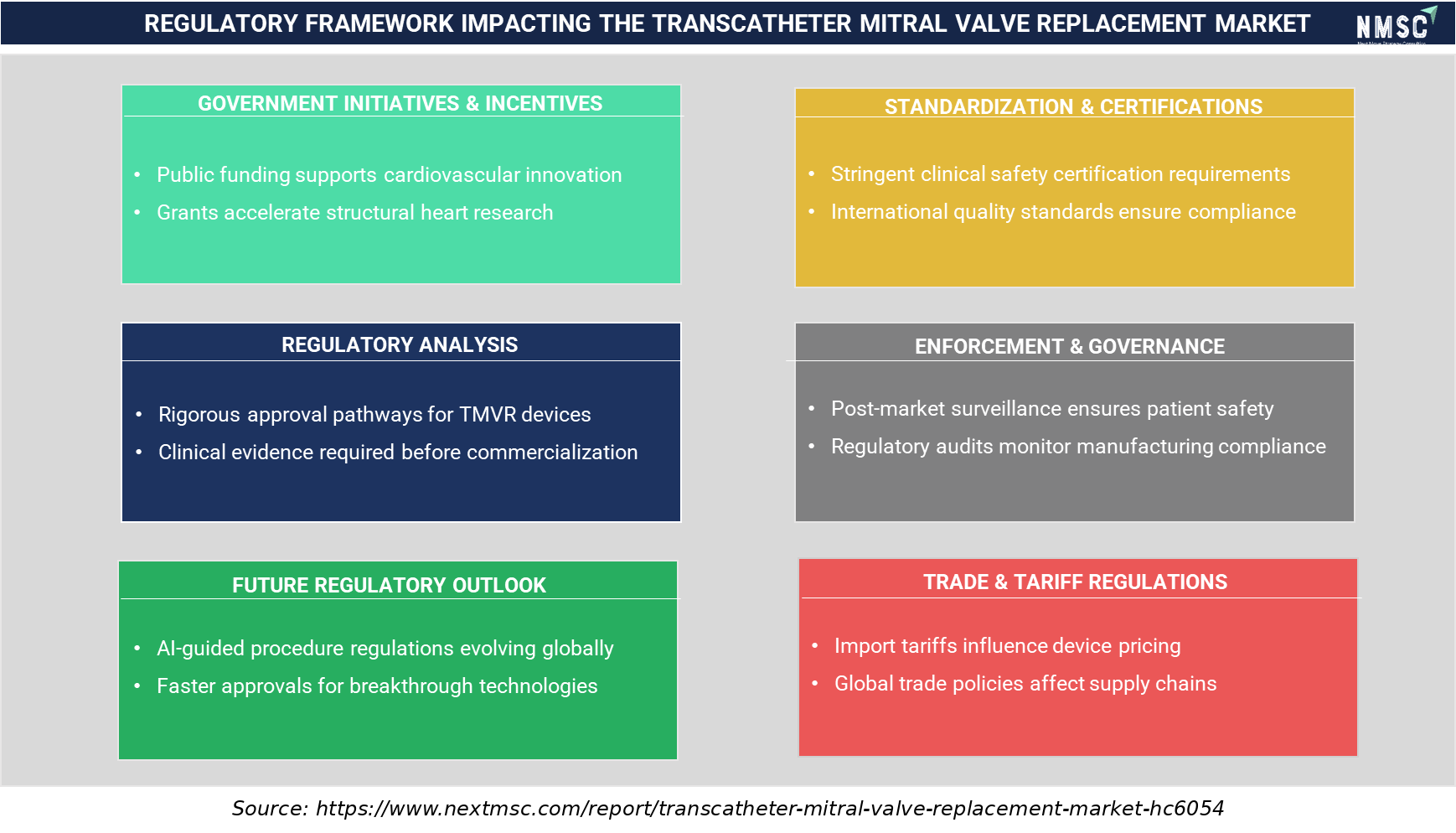
Regulatory Framework Impacting the Transcatheter Mitral Valve Replacement Market

The infographic outlines the regulatory framework impacting the transcatheter mitral valve replacement (TMVR) market, organized into six key areas of governance. It highlights how government incentives and public funding accelerate cardiovascular innovation, while stringent certification and rigorous approval pathways ensure clinical safety before commercialization. The analysis further details the importance of post-market surveillance and trade regulations, noting their influence on device pricing and supply chains. Ultimately, the outlook points toward evolving global regulations for AI-guided procedures and faster approvals for breakthrough technologies.

Latest Developments

We found that recent milestones within the transcatheter mitral valve replacement market are concentrated on the category's first regulatory approvals, reflecting the industry's transition from clinical trial stage to early commercial launch.

Date Event
Jan 2026 HighLife received CE Mark approval for its TMVR system for symptomatic moderate-to-severe or severe MR patients unsuitable for surgery or TEER. The approval enables initial commercial availability of its transfemoral TMVR system in Europe.
Dec 2025 Edwards Lifesciences received U.S. FDA approval for its SAPIEN M3 transcatheter mitral valve replacement (TMVR) system for symptomatic moderate-to-severe or severe mitral regurgitation in patients deemed unsuitable for surgery or TEER. The fully percutaneous, transseptal TMVR system marked the first FDA-approved transseptal transcatheter therapy for mitral regurgitation and expanded Edwards' U.S. portfolio of transcatheter mitral replacement therapies.

Expert Insights

David Daniels, M.D.

David Daniels, M.D.

Chief of Structural Heart | Sutter Health

"Percutaneous transseptal TMVR had a low mortality rate while providing a significant reduction in [MR] severity and providing meaningful and durable improvements in functional status and quality of life."

Analyst Interpretation

The statement highlights the growing clinical potential of TMVR as a minimally invasive alternative for patients who are unsuitable for conventional mitral surgery or TEER. The demonstrated reduction in mitral regurgitation, together with improvements in functional status and quality of life, indicates increasing clinical acceptance of transseptal TMVR. This supports market expansion by addressing a previously underserved high-risk patient population and strengthens the demand for fully percutaneous TMVR technologies and next-generation mitral valve replacement systems.

Investment Opportunities

What Capital Inflows Are Targeting the Transcatheter Mitral Valve Replacement Market?

Capital inflows into the transcatheter mitral valve replacement market are increasingly directed toward late-stage clinical trial programs and technology acquisition ahead of anticipated regulatory approvals. Edwards Lifesciences' acquisition of Innovalve Bio Medical illustrates continued strategic capital deployment toward pipeline expansion. We observed that investors favor developers demonstrating validated large-scale trial enrollment, viewing programs such as Medtronic's 2,500-patient APOLLO trial as a proxy for eventual regulatory and commercial success.

How Significant Is Infrastructure Investment in the Transcatheter Mitral Valve Replacement Market?

Infrastructure investment tied to structural heart center development and physician training programs is a critical enabler of transcatheter mitral valve replacement market scalability. Hospital systems must invest in dedicated imaging, multidisciplinary heart team infrastructure, and specialized training to safely adopt replacement therapy. Our assessment indicates that manufacturers increasingly condition market expansion strategy on health system readiness to support the procedural complexity these devices require.

What ESG Considerations Are Shaping Transcatheter Mitral Valve Replacement Investment?

Environmental, social, and governance considerations shape transcatheter mitral valve replacement investment primarily through healthcare access and patient outcome priorities rather than traditional environmental metrics. Edwards Lifesciences' sponsorship of the American Heart Association's Heart Valve Initiative, targeting improved care for 28 million people worldwide with heart valve disease, exemplifies industry-wide investment in diagnosis and access programs. NMSC's analysis indicates that expanding access to underserved and elderly high-surgical-risk patient populations is increasingly factored into manufacturer corporate responsibility positioning.

Key Benefits for Stakeholders

How Does This Report Benefit Medical Device Industry Leaders?

Medical device industry leaders gain access to validated segmentation, access route benchmarking, and regional regulatory analysis that supports transcatheter mitral valve replacement development strategy decisions. The report's device design and indication breakdowns help executives evaluate transseptal, transapical, and calcification-specific investment priorities against evolving clinical evidence and regulatory pathways, supporting more informed portfolio decisions across this newly commercial category.

How Does This Report Benefit Investors and Financial Analysts?

Investors and financial analysts benefit from consolidated market sizing, regional growth forecasts, and competitive positioning data that inform capital allocation across the transcatheter mitral valve replacement value chain. The report's country-level revenue estimates and growth catalyst matrix support due diligence on approved-device leaders and pipeline-stage developers positioned to capture forecast demand growth through 2035.

How Does This Report Benefit Technology Vendors and Product Teams?

Technology vendors and product teams gain competitive intelligence on delivery platform trends, indication-specific device design, and recent developments among the 8 companies profiled. This supports product roadmap decisions around transseptal access optimization, mitral annular calcification therapy, and clinical trial evidence strategy aligned with the fastest-growing access route and regional segments identified in this report.

Key Market Segments Evaluated

By Access Route

  • Transseptal access
  • Transapical access
  • Transatrial access

By Device Design

  • Dock-and-valve two-step systems
  • Single-step self-anchoring systems

By Indication

  • Mitral regurgitation
  • Mitral annular calcification
  • Mixed mitral disease

By End User

  • Hospitals
  • Ambulatory and specialty cardiac centers

Conclusion & Recommendations

The long-term outlook for the transcatheter mitral valve replacement market remains structurally positive, supported by a USD 3.44 billion absolute dollar opportunity between 2026 and 2035 and the category's first two device approvals establishing a durable commercial foundation. We found that Transseptal Access will continue commanding the largest and fastest-growing revenue share as incision-free delivery platforms broaden the eligible patient population through the forecast period.

What Strategic Positioning Should Stakeholders Pursue?

Stakeholders should pursue strategic positioning that combines validated transseptal delivery technology with indication-specific clinical evidence to differentiate within a still-concentrated competitive field. NMSC's analysis indicates that developers bundling large-scale trial enrollment with targeted mitral annular calcification or mixed disease indications are best positioned to capture durable, first-mover revenue across the transcatheter mitral valve replacement market.

How Attractive Is the Transcatheter Mitral Valve Replacement Market for New Investment?

The transcatheter mitral valve replacement industry presents a highly attractive investment case, supported by a USD 3.44 billion absolute dollar opportunity between 2026 and 2035 and above-average growth in Asia-Pacific and single-step self-anchoring device categories. We found that investment attractiveness is highest for developers combining validated FDA or CE Mark approval with differentiated delivery technology, positioning them to capture disproportionate share as the category's commercial infrastructure matures through 2035.

What Market Shifts and Key Risks Should Stakeholders Monitor?

Stakeholders should monitor limited long-term durability data for newly approved devices, left ventricular outflow tract obstruction risk constraining patient selection, and concentration of trained operators limiting procedural scale-up as key risks to the transcatheter mitral valve replacement market. Our analysis shows that developers unable to generate sustained positive long-term outcome data risk losing physician confidence to competitors with more mature clinical evidence, particularly as the category's earliest approved devices accumulate real-world post-market experience.

What Are the Key Growth Pathways for the Transcatheter Mitral Valve Replacement Market?

Key growth pathways include scaling transseptal delivery platform adoption, expanding mitral annular calcification and mixed disease indication coverage, and deepening physician training infrastructure across Asia-Pacific and ambulatory cardiac centers. NMSC's analysis indicates that developers pursuing these pathways while maintaining rigorous clinical evidence generation will be best positioned to capture the transcatheter mitral valve replacement market's projected growth through 2035.

FAQs

Market Drivers & Dynamics

Interactive Dataset
First dedicated replacement device approvals in 2025 driver +7.8% North America, Europe 2026-2032
Rising prevalence of mitral regurgitation in aging populations driver +5.4% Global 2026-2035
Expanding CMS coverage determinations for structural heart procedures driver +4.1% North America 2026-2033
Growing transseptal platform adoption reducing procedural invasiveness driver +3.2% Global 2026-2035
Large-scale clinical trial evidence generation supporting reimbursement driver +2.1% Global 2026-2032
High device and procedural cost relative to surgical alternatives restraint -2.8% Global 2026-2033
Limited long-term durability data for newly approved devices restraint -2.2% Global 2026-2031
Left ventricular outflow tract obstruction risk constraining patient selection restraint -1.6% Global 2026-2032
Concentration of trained operators limiting procedural volume scale-up restraint -1.1% Asia-Pacific, Latin America 2026-2033
Source: Next Move Strategy Consulting

Growth Drivers

What Is the Primary Growth Driver of the Transcatheter Mitral Valve Replacement Market?

The first dedicated replacement device approvals in 2025 are the primary driver of the market. The U.S. Food and Drug Administration approved Abbott's Tendyne system in May 2025 and Edwards Lifesciences' SAPIEN M3 system in December 2025, marking the category's first two commercially approved replacement-specific devices. We observed that this dual approval milestone, following years of clinical development, continues to anchor payer and hospital system confidence in establishing durable reimbursement and procedural infrastructure across the forecast period.

How Is Rising Mitral Regurgitation Prevalence Driving Market Growth?

Rising mitral regurgitation prevalence in aging populations is accelerating market growth by expanding the addressable patient pool for replacement therapy. Industry-sponsored initiatives, including Edwards Lifesciences' support of the American Heart Association's Heart Valve Initiative, target improved diagnosis and treatment access for the more than 24 million people globally living with mitral regurgitation. NMSC's analysis indicates that this diagnosis-focused public health effort, combined with an aging demographic base, is compressing the gap between disease prevalence and treated patient volume.

Growth Inhibitors

What Is Restraining Transcatheter Mitral Valve Replacement Market Expansion?

High device and procedural cost relative to surgical alternatives restrains adoption among cost-constrained health systems. Complex catheter-delivered replacement systems require specialized imaging, trained multidisciplinary heart teams, and extended procedural time relative to conventional surgical valve replacement. We found that health systems in markets without established structural heart programs face particular exposure, as the capital and training investment required to launch a transcatheter mitral replacement program often exceeds what smaller hospital networks can justify absent clear reimbursement pathways.

What Are the Growth Opportunities?

How Can Mitral Annular Calcification Programs Unlock an Underserved Patient Population?

Dedicated mitral annular calcification therapy presents a whitespace opportunity for device developers serving a patient population historically excluded from surgical replacement. Companies that scale calcification-specific docking technology following Abbott's Tendyne approval stand to capture share from a diagnosed population with few existing treatment alternatives, differentiating from developers focused solely on primary mitral regurgitation.

Where Does Asia-Pacific Structural Heart Program Expansion Create New Demand?

Asia-Pacific structural heart program development represents an underpenetrated opportunity for device manufacturers as regional hospitals build transcatheter valve capability. Companies that establish early regulatory approval and training infrastructure in China, Japan, and India can secure first-mover advantage, differentiating from competitors focused solely on established North American and European markets.

How Can Ambulatory Cardiac Center Partnerships Benefit Device Developers?

Health systems seeking to expand structural heart procedure capacity beyond flagship hospitals create an opportunity for developers offering training and support programs tailored to ambulatory and specialty cardiac centers. Early movers that build scalable physician training pipelines can secure broader procedural volume, differentiating from competitors reliant solely on established academic medical center relationships.

About the Author

Mayurima Roy

Mayurima Roy

Mayurima Roy is Research Analyst at Next Move Strategy Consulting, where she has spent 4 years working across the firm's full industry coverage rather than a single fixed vertical. Her work centers on structured research, ongoing trend tracking, competitive assessment, and insight-led content development, translating complex market data into clear, decision-ready narratives that support informed client decision-making across diverse global industries, market sectors, and world regions every day.

About the Reviewer

Supradip Baul

Supradip Baul

Supradip Baul is an accomplished business consultant and strategist with over a decade of rich experience in market intelligence, strategy, technology, and business transformation. His work has included rigorous qualitative and quantitative analysis across multiple industries, helping clients shape investment decisions and long-term roadmaps. Earlier in his career, he was associated with Gartner, where he contributed to industry-leading reports and market share analyses. He has worked with leading global companies and holds an MBA with a dual specialization in Marketing and Finance.

Download Free Sample

Rishabh Jogani

RISHABH JOGANI

Strategy Analyst

Accenture Japan

We are incredibly impressed with the market report on the real estate market in India provided by Next Move Strategy Consulting. The report was thorough, insightful, and well-structured, offering deep analysis and actionable recommendations. It not only captured the current trends and dynamics but also provided a forward-looking perspective that has been invaluable for our strategic planning. Their team demonstrated exceptional professionalism, attention to detail, and a profound understanding of the industry. The data-driven insights and clarity of presentation exceeded our expectations, making complex market trends easy to understand. We highly recommend Next Move Strategy Consulting to anyone looking for reliable and comprehensive market research services. Their expertise has given us the confidence to navigate the complexities of the Indian real estate market with clarity and foresight.

Ross J Mckenzie

ROSS J MCKENZIE

Business Insight Manager

Staysure Group

“Next MSC have been incredibly helpful in providing detailed & robust information on our market, alongside quantifying growth by different segments. The process to procure was simple and easy, with sample reports and regular contact to ensure we had what we needed. Succinct detail on their sources & methodologies is also greatly received, allowing transparency in this respect helps build trust in the detail you pay for. Joseph in particular was fantastic, and helped ensure efficient provision of the insight pack – thank you NMSC!”.

Kishu Kanda

KISHU KANDA

Strategy Analyst

Accenture

We purchased the AI Consumer Market Report from this company. Not only did they customize the report to meet our specific requirements, but they also showed great flexibility in accommodating our budget. The report we received fully met our expectations. Additionally, they provided prompt and thorough responses to both our pre-purchase and follow-up questions. We look forward to working with this company again in the future.

Mohit Agarwal

MOHIT AGARWAL

Chief Manager

DryChem India Pvt. Ltd.

Next Move Strategy Consulting is an amazing team of consultants. We required a market study report for our investors on top priority and the team went above and beyond our expectations to deliver the same with ample supporting data within a short time span enabling us to secure the investments and keep our project timeline maintained. Their professionalism, attention to detail, and timely delivery of actionable recommendations have left a lasting impression on our organization.

Henri Knyphausen

HENRI KNYPHAUSEN

Partner at Singulier [Ex-BCG]

Singulier

I recently engaged NEXTMSC.com for a commercial due diligence project within the intralogistics sector, and I am pleased to provide a reference based on my experience. In utilizing NEXTMSC.com's services, I found their report to offer valuable insights into market dynamics and key industry players. The initial report provided a solid foundation for our analysis. However, as we were investigating a smaller target in the market, and I had specific customization requests requiring additional research. These requests included detailed information on product portfolios of various players and sub-market sizes, both inclusive and exclusive of certain product categories. NEXTMSC.com demonstrated commendable responsiveness and agility in accommodating these customization requests. Within a timeframe of 1-2 weeks, they delivered a revised report that met our specific needs. Furthermore, they were receptive to my follow-up inquiries, ensuring clarity and understanding of the data provided. The final deliverable significantly contributed to our due diligence efforts. One of NEXTMSC.com's notable strengths lies in their qualitative research capabilities. However, for future engagements, I would recommend the inclusion of a quantified market model in Excel format. Such a model would offer the ability to conduct in-depth analyses and explore various market segments, including country-specific data and subcomponent breakdowns. Based on my positive experience, I would not hesitate to work with NEXTMSC.com again. Their responsiveness, willingness to accommodate customization requests, and commitment to delivering actionable insights make them a reliable partner for commercial research projects.

Custom Market Research Services

We will customize the research for you if the listed report does not fully match your requirements.

Get 30% Free Customization

Select License

This website uses cookies to ensure you get the best experience on our website. Learn more

✖