Edible Cutlery Market Global Industry Analysis and Forecast (2026–2035)

Edible Cutlery Market size was USD 62.27 Billion in 2026, projected to reach USD 145.72 Billion by 2035, growing at a CAGR of 9.91% from 2026 to 2035. Key drivers include single-use plastic restrictions, rising consumer awareness of plastic waste, and increasing foodservice adoption, with Asia-Pacific leading the market.
Download Free Sample PDF
Base Year (2025)
$62.27 Billion
Forecast (2035)
$145.72 Billion
CAGR (2026-2035)
9.9%
Top Region
Asia-Pacific

What Is the Edible Cutlery Market Size?

The Edible Cutlery Market was valued at USD 53.00 Billion in 2025 and reached USD 62.27 Billion in 2026. It is projected to grow to USD 145.72 Billion by 2035, expanding at a CAGR of 9.91% from 2026 to 2035. Growth reflects the steady replacement of single-use plastic spoons, forks and knives with grain-based and seaweed-based alternatives that can be eaten or composted after use.

Demand is anchored in regulation, rising consumer awareness of plastic waste and the willingness of quick-service operators to test premium, low-waste tableware. Asia-Pacific accounts for the largest regional share in 2026, supported by established millet, rice and wheat-based producers, while Europe is the fastest-growing region over the forecast period. This Market analysis from Next Move Strategy Consulting (NMSC) is based on our estimates and primary-source validation.

Edible Cutlery Market Global Industry Analysis and Forecast (2026–2035) Revenue Forecast

Values in USD Billion

2025 $53.00 Billion
2025
2026 $62.27 Billion
2026
2027 $68.44 Billion
2027
2028 $75.22 Billion
2028
2029 $82.68 Billion
2029
2030 $90.87 Billion
2030
2031 $99.88 Billion
2031
2032 $109.77 Billion
2032
2033 $120.65 Billion
2033
2034 $132.61 Billion
2034
2035 $145.72 Billion
2035

Key Takeaways

By Product Type: Spoons held the largest share, expanding from USD 20.14 Billion in 2025 to USD 52.83 Billion by 2035; Sporks and Others is the fastest-growing segment at 11.80% CAGR from 2026–2035.

By Raw Material: Wheat and Bran-Based held the largest share, expanding from USD 17.49 Billion in 2025 to USD 44.96 Billion by 2035; Seaweed-Based is the fastest-growing segment at 12.40% CAGR from 2026–2035.

By Flavor: Unflavored held the largest share, expanding from USD 24.38 Billion in 2025 to USD 60.37 Billion by 2035; Sweet is the fastest-growing segment at 11.40% CAGR from 2026–2035.

By End Use: Foodservice held the largest share, expanding from USD 27.56 Billion in 2025 to USD 76.26 Billion by 2035; Institutional and Events is the fastest-growing segment at 10.90% CAGR from 2026–2035.

By Distribution Channel: Offline held the largest share, expanding from USD 36.04 Billion in 2025 to USD 92.20 Billion by 2035; Online is the fastest-growing channel at 11.60% CAGR from 2026–2035.

Dominant Region: Asia-Pacific dominated with approximately 40.00% revenue share in 2026, valued at USD 24.91 Billion, supported by abundant grain supplies, established edible cutlery producers, plastic restrictions, and growing foodservice demand.

Fastest-Growing Region: Europe is expected to register the highest CAGR of 10.75% during 2026–2035, driven by single-use plastic restrictions, packaging regulations, and increasing demand for sustainable foodservice alternatives.

Dominant Country: The U.S. led the market among the profiled countries, with an estimated USD 11.23 Billion in 2026, supported by state-level plastic restrictions, sustainability initiatives, and demand from restaurant and quick-service chains.

Fastest-Growing Country: India is the fastest-growing profiled country, with an estimated CAGR of 11.80% from 2026–2035, supported by single-use plastic restrictions, abundant millet and sorghum supplies, and expanding domestic edible cutlery production.

The market adds an absolute revenue opportunity of USD 83.45 Billion between 2026 and 2035, measured from the 2026 base to the 2035 forecast.

According to NMSC analysis, the revenue mix remains led by spoons, although their share is expected to moderate as alternative formats gain traction. Sporks and other utensils, alongside seaweed-based and millet-based products, are projected to expand faster as manufacturers respond to demand for sustainable foodservice solutions. These shifts create opportunities for edible cutlery producers, ingredient suppliers, and distribution partners to benefit from product innovation, expanding foodservice adoption, and the growing demand for alternatives to single-use plastic utensils.

What Does the Edible Cutlery Market Encompass?

The Market covers spoons, forks, knives, chopsticks and sporks made from food-grade ingredients such as wheat bran, rice flour, sorghum, millet and seaweed, designed to hold their shape during a meal and then be eaten or composted. These products sit within the wider biodegradable plastic market, but differ because the product itself is edible and carries food-safety obligations.
Producers bake, extrude or mould cereal doughs and gels into rigid utensils, then dry them to a shelf-stable moisture level. Flavored versions, including sweet and savory variants, extend use into dessert, snack and street-food formats. The scope of this Market study excludes compostable-only cutlery that is not intended for consumption, as well as reusable metal and bamboo utensils.

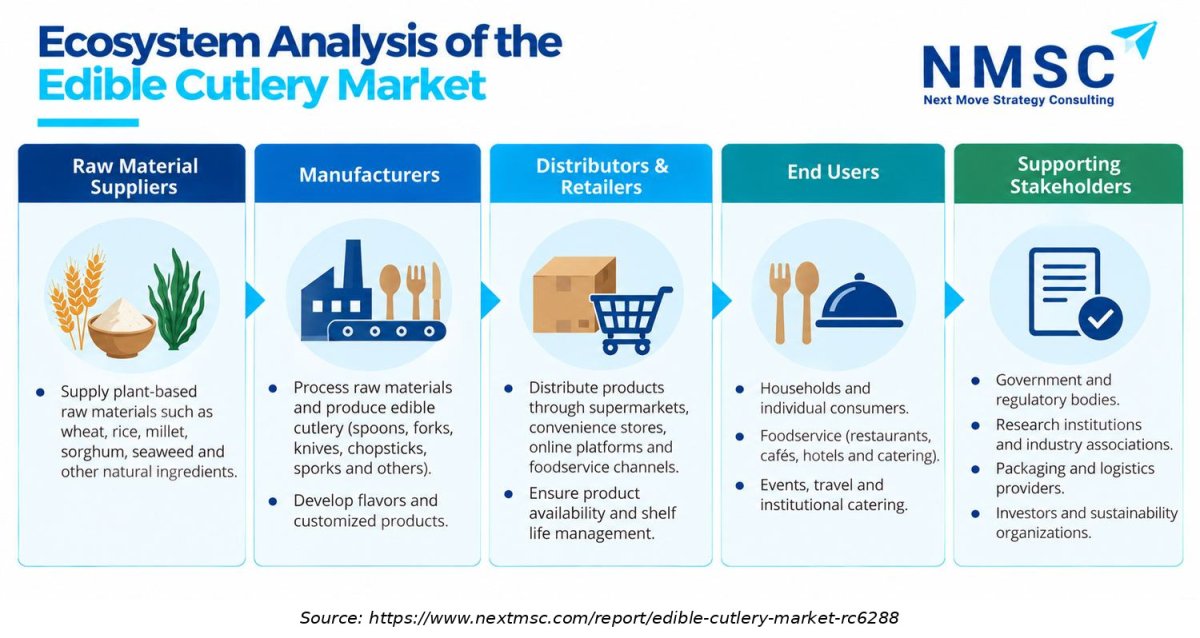
Ecosystem Analysis of the Edible Cutlery Market

The edible cutlery market ecosystem comprises raw material suppliers, manufacturers, distributors, retailers, end users, and supporting stakeholders. Suppliers provide wheat, rice, millet, sorghum, seaweed, and other edible ingredients. Manufacturers process these materials into edible spoons, forks, knives, and chopsticks. Distributors and retailers supply products to supermarkets, online platforms, restaurants, hotels, and catering businesses. Households and foodservice operators drive demand, while regulatory bodies, research institutions, and sustainability organizations support product innovation, food safety, and environmentally responsible practices.

Market Drivers & Dynamics

Interactive Dataset
Single-use plastic restrictions driver High Short to Medium
Consumer waste awareness driver Medium Medium
Quick-service and event adoption driver Medium Medium to Long
Higher unit cost versus plastic restraint High Short to Medium
Shelf life and moisture sensitivity restraint Medium Short to Medium
Limited production scale restraint Medium Medium
Source: Next Move Strategy Consulting

Growth Drivers

What Is the Primary Growth Driver of the Edible Cutlery Market?

Regulation on disposable plastics is the primary driver of the Market. Governments in the EU, India, Canada, England and several Asia-Pacific economies have restricted plastic spoons, forks and knives, and foodservice operators now need compliant substitutes. Edible utensils offer a switch that requires no change in consumer behavior, which is why the broader plastic market shift toward alternatives benefits this category directly.

How Is Sustainability Demand Driving Edible Cutlery Market Growth?

Corporate waste-reduction targets and consumer scrutiny of litter push restaurants, airlines, event organizers and institutional caterers to evaluate edible options. In the market, foodservice generated 52.00% of 2026 revenue. Wider circular-economy programs, discussed in the circular economy market, strengthen procurement preference for products that leave no residual waste.

Growth Inhibitors

What Is Restraining Edible Cutlery Market Expansion?

Cost and performance limit adoption. Grain-based utensils cost more per unit than injection-moulded plastic, can soften in hot liquids and have shorter shelf lives. According to our findings, we identified that market adoption remains largely concentrated in cold, dry, and moderately warm food applications, whereas hot-soup and long-dwell use cases present functional challenges that temporarily limit immediate penetration in high-temperature dining segments.

What Are the Growth Opportunities?

How Can Quick-Service Chains Create Volume Demand?

Quick-service chains buy at a scale that can lower unit costs. Pilot programs in markets with plastic-cutlery bans allow suppliers in the market to prove supply reliability, hygiene standards and customer acceptance. Successful pilots help producers justify capacity additions and negotiate multi-year supply agreements that stabilize pricing for both parties.

Where Do Events, Airlines and Institutional Catering Create New Demand?

Stadiums, festivals, airlines and corporate cafeterias generate concentrated waste and have visible sustainability commitments. Institutional and events buyers are forecast to grow at 10.90% in the market. Edible utensils also simplify cleanup, since leftover pieces can be discarded with food waste rather than sorted from plastic.

How Can Ingredient and Flavor Innovation Unlock Premium Pricing?

Fortified, gluten-free, high-protein and flavored utensils can sell at premiums to health-conscious and gift buyers. Combining nutrition claims with the snack formats tracked in the protein snacks market lets producers in the Market move beyond a purely compliance-led proposition and capture higher margins per unit.

Segmentation Analysis

2025 (USD Billion)
2035 (USD Billion)
Spoons 2025: $20.14 Billion | 2035: $52.83 Billion
Spoons
Forks 2025: $9.01 Billion | 2035: $24.77 Billion
Forks
Knives 2025: $5.83 Billion | 2035: $14.63 Billion
Knives
Chopsticks 2025: $11.66 Billion | 2035: $33.11 Billion
Chopsticks
Sporks and Others 2025: $6.36 Billion | 2035: $20.38 Billion
Sporks and O
Spoons $20.14 Billion $52.83 Billion 9.34%
Forks $9.01 Billion $24.77 Billion 9.90%
Knives $5.83 Billion $14.63 Billion 8.80%
Chopsticks $11.66 Billion $33.11 Billion 10.30%
Sporks and Others $6.36 Billion $20.38 Billion 11.80%

Which Product Type Segment Leads the Edible Cutlery Market?

Based on our market analysis, we observed that the Spoons segment led the market by product type, accounting for 38.00% of global revenue in 2026 (valued at USD 23.66 Billion) due to its widespread adoption across liquid, semi-solid, and dessert food applications. Spoons lead because they serve the widest range of foods, from desserts to rice dishes, and are the product most producers perfected first. Sporks and Others is the fastest-growing segment, advancing at 11.80% CAGR through 2035. Packaged foods and takeaway meals, as covered in the food packaging market, supply the main usage occasions.

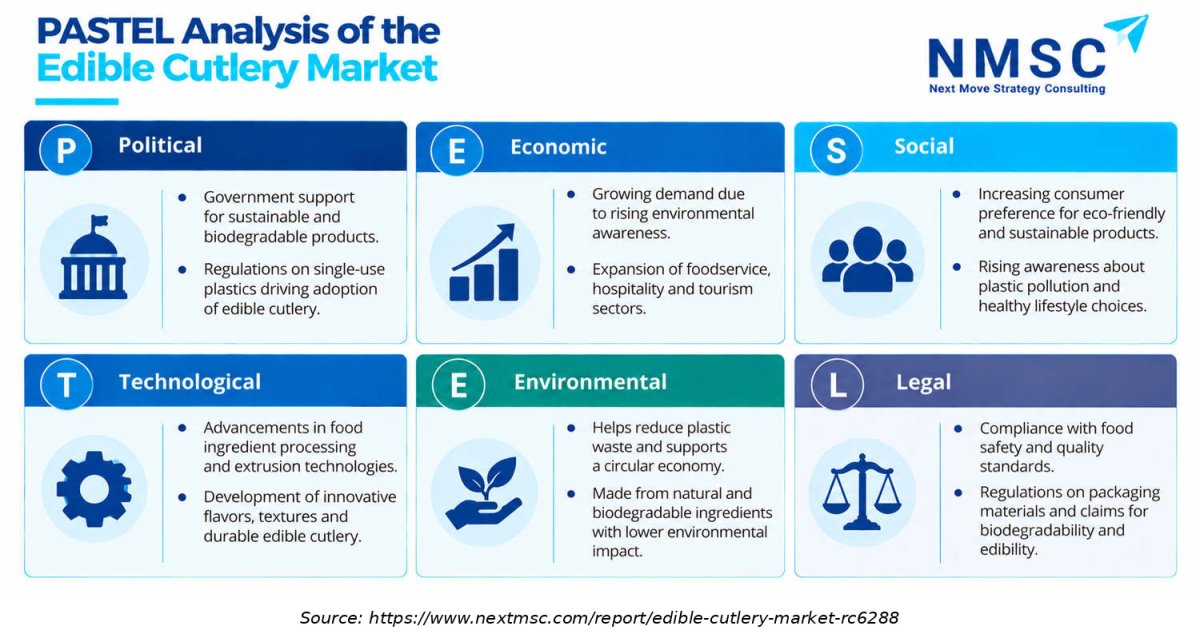
PASTEL Analysis of the Edible Cutlery Market
PASTEL Analysis of the Edible Cutlery Market
The PASTEL analysis of the edible cutlery market examines political, economic, social, technological, environmental, and legal factors influencing market growth. Government initiatives to reduce single-use plastic waste encourage sustainable alternatives, while production costs and foodservice demand affect market expansion. Growing environmental awareness supports consumer interest in edible products. Advances in food processing, ingredient formulation, and manufacturing improve product quality and durability. Edible cutlery can help reduce conventional plastic waste, while food safety requirements, labeling rules, and regulations governing food-contact materials and environmental claims influence market operations.

Growth Opportunities

How Can Quick-Service Chains Create Volume Demand?

Quick-service chains buy at a scale that can lower unit costs. Pilot programs in markets with plastic-cutlery bans allow suppliers in the market to prove supply reliability, hygiene standards and customer acceptance. Successful pilots help producers justify capacity additions and negotiate multi-year supply agreements that stabilize pricing for both parties.

Where Do Events, Airlines and Institutional Catering Create New Demand?

Stadiums, festivals, airlines and corporate cafeterias generate concentrated waste and have visible sustainability commitments. Institutional and events buyers are forecast to grow at 10.90% in the market. Edible utensils also simplify cleanup, since leftover pieces can be discarded with food waste rather than sorted from plastic.

How Can Ingredient and Flavor Innovation Unlock Premium Pricing?

Fortified, gluten-free, high-protein and flavored utensils can sell at premiums to health-conscious and gift buyers. Combining nutrition claims with the snack formats tracked in the protein snacks market lets producers in the Market move beyond a purely compliance-led proposition and capture higher margins per unit.

Regional Outlook

2025 (USD Billion)
2035 (USD Billion)
North Americ
Europe
Asia-Pacific
Middle East
Latin Americ
Region 2025 (USD Billion) 2035 (USD Billion) CAGR (%)
North America $10.0 USD Billion $40.0 USD Billion 9.0%
Europe $17.1 USD Billion $51.1 USD Billion 27.0%
Asia-Pacific $24.2 USD Billion $62.2 USD Billion 25.0%
Middle East & Africa $31.3 USD Billion $73.3 USD Billion 23.0%
Latin America $38.4 USD Billion $84.4 USD Billion 12.0%

Regional data is locked

Unlock complete regional numbers for this market.

Unlock Full Data

Competitive Landscape

How Do Companies Compete in the Edible Cutlery Market?

Companies compete on how well utensils hold shape in warm food, how they taste, how long they last on the shelf and how much they cost compared with plastic. In the market, scale in grain sourcing and baking capacity is a decisive advantage, while smaller firms win on design, branding and novelty in gifting and events.

Which Competitive Archetypes Dominate the Edible Cutlery Market?

Three archetypes shape the market: grain-based specialists that bake utensils at scale, seaweed and gel-based innovators focused on straws and stirrers, and design-led brands selling flavored or novelty products online. Each follows a different cost structure, and partnerships with distributors help specialists reach restaurant chains and retail.

How Are Companies Differentiating Through Innovation in Edible Cutlery?

Innovation concentrates on moisture resistance, heat tolerance and taste. Producers in the market test fortified flours, natural coatings and flavor infusions, and work on longer shelf life without synthetic additives. Process improvements, such as automated baking and drying, aim to cut unit costs and make large foodservice contracts viable.

What Expansion Activity Is Shaping the Edible Cutlery Market?

Expansion in the market mostly takes the form of new production lines, distribution agreements and market entry in regions with plastic-cutlery bans. Based on our industry analysis, we concluded that manufacturers in India and Europe lead regional expansion through production scaling and strategic distribution agreements, driving potential market consolidation as established packaging firms integrate edible tableware portfolios.

Key Market Players

Next Move Strategy Consulting identified and verified ten companies active in the Edible Cutlery Market through company websites and public disclosures. The list is limited to firms for which edible cutlery or closely related edible tableware is verifiably part of the product range.

Bakeys Foods Pvt. Ltd. Biotrem Loliware Evoware Wisefood Do Eat EdiblePRO Stroodles Spoontainable Twinzta.

Latest Developments

Date Event
August 2026 Bakeys Foods Pvt. Ltd. expanded its grain-based edible spoon production capacity in India, increasing commercial output of sorghum- and millet-based tableware to meet bulk quick-service foodservice contracts across Asia-Pacific.

Investment Opportunities

What Capital Inflows Are Targeting the Edible Cutlery Market?

Investment interest centres on production capacity, automation and ingredient processing. For the market, capital is most productive where it lowers unit cost through automated baking and drying lines, since price parity with plastic remains the largest barrier to volume adoption in quick-service and institutional accounts.

How Is Infrastructure Investment Supporting Edible Cutlery Manufacturing?

Edible utensils use food-grade supply chains, so grain milling, baking and packaging infrastructure matters. Regions with existing cereal processing, such as India and parts of Europe, can scale the market faster. Cold-chain and moisture-controlled packaging, supported by developments in the plastic container market, also affect product quality on arrival.

What ESG Considerations Are Shaping Edible Cutlery Investment Decisions?

Investors increasingly screen for waste reduction, responsible sourcing and credible environmental claims. In the Market, claims such as edible, compostable or plastic-free need substantiation, because regulators and retailers scrutinize green marketing. Connected recycling and recovery technologies, tracked in the bioplastic recycling market, form part of the broader ESG context.

Key Benefits for Stakeholders

How Does This Report Benefit Enterprise and Industry Leaders?

Manufacturers, foodservice operators and packaging firms gain a quantified view of the market across product, material, flavor, end-use, channel and regional segments. The report helps leaders judge where to place capacity, which customer groups to pursue first and how regulation changes the addressable base in each country.

How Does This Report Benefit Investors and Financial Analysts?

Investors receive a reconciled forecast of USD 62.27 Billion in 2026 rising to USD 145.72 Billion in 2035, along with segment growth rates and risk factors. The market analysis separates compliance-driven demand from discretionary demand, which supports sharper valuation assumptions and clearer screening of start-ups and producers.

How Does This Report Benefit Technology Vendors and Product Teams?

Product and process teams can see which raw materials, flavors and formats are growing fastest in the market, and which performance gaps, such as heat tolerance and shelf life, limit adoption. Equipment vendors serving commercial kitchen and baking lines can target producers planning capacity expansion.

Key Market Segments Evaluated

By Product Type

  • Spoons
  • Forks
  • Knives
  • Chopsticks
  • Sporks and Others

By Raw Material

  • Wheat and Bran-Based
  • Rice-Based
  • Sorghum and Millet-Based
  • Seaweed-Based
  • Other Plant-Based

By Flavor

  • Unflavored
  • Savory
  • Sweet

By End Use

  • Foodservice
  • Household
  • Institutional and Events

By Distribution Channel

  • Offline
  • Online

By Region

  • North America 
    • U.S.
    • Canada
    • Mexico
  • Europe 
    • UK
    • Germany
    • France
    • Italy
    • Spain
    • Sweden
    • Denmark
    • Finland
    • Netherlands
    • Rest of Europe
  • Asia-Pacific 
    • China
    • India
    • Japan
    • South Korea
    • Taiwan
    • Indonesia
    • Vietnam
    • Australia
    • Philippines
    • Malaysia
    • Rest of APAC
  • Middle East & Africa 
    • Saudi Arabia
    • UAE
    • Egypt
    • Israel
    • Turkey
    • Nigeria
    • South Africa
    • Rest of MEA
  • Latin America 
    • Brazil
    • Argentina
    • Chile
    • Colombia
    • Rest of LATAM

Conclusion & Recommendations

The market is forecast to rise from USD 62.27 Billion in 2026 to USD 145.72 Billion in 2035 at a 9.91% CAGR. Regulation, sustainability commitments and gradual cost improvement should sustain growth, with Asia-Pacific retaining the largest base and Europe growing fastest at 10.75%.

What Strategic Positioning Should Edible Cutlery Suppliers Pursue?

Suppliers should secure local grain sourcing, automate production and prioritize foodservice accounts, where demand is largest. Participants in the Market that build food-safety documentation, offer flavor and format variety, and develop online channels can balance volume contracts with higher-margin direct sales.

How Attractive Is the Edible Cutlery Market for New Investment?

Attractiveness is moderate to high. Policy support and double-digit growth in several segments favor entrants, but cost parity and performance remain hurdles. The market suits investors who can fund capacity and wait for scale economies, and who avoid over-reliance on novelty or single-customer demand.

What Market Shifts and Key Risks Should Stakeholders Monitor?

Stakeholders should watch plastic-policy enforcement, grain price volatility, claims regulation and competing compostable or reusable options. Any weakening of bans, or faster adoption of reusable systems, would slow the market, whereas new coatings or heat-resistant formulations could widen the range of food types that edible utensils serve.

What Are the Key Growth Pathways for the Edible Cutlery Market?

Primary pathways include compliance-led conversion in foodservice, expansion into events and institutional catering, flavored and fortified premium lines, and online retail growth. Together these pathways explain why the market is forecast to more than double over the next decade, led by spoons and supported by seaweed and millet-based innovation.

FAQs

Sources & References

1.

Source

Type | Used For
2.

Official Journal of the European Union, Directive (EU) 2019/904

Regulatory | EU plastic cutlery restrictions
3.

Regulation (EU) 2025/40 on packaging and packaging waste

Regulatory | EU packaging requirements
4.

Ministry of Environment, Forest and Climate Change, Government of India

Government | India single-use plastics ban
5.

Government of Canada, Single-Use Plastics Prohibition Regulations

Government | Canada plastic cutlery restrictions
6.

UK Government (DEFRA), single-use plastic restrictions in England

Government | England cutlery restriction
7.

Ministry of the Environment, Japan, Plastic Resource Circulation Act

Government | Japan spoon and fork reduction rules
8.

Company websites and public product disclosures of profiled players

Company | Product range and positioning
9.

NMSC primary and secondary research, internal models

Proprietary | Market sizing, segmentation and forecasts

About the Author

Liza Phukan

Liza Phukan

Liza Phukan is Research Associate at Next Move Strategy Consulting, where she has covered emerging industries and market research across sectors for 3.5 years. Her work includes analyzing industry developments, validating market data, and developing structured business content from research findings. She uses secondary research and data-validation practices to turn complex market information into clear decision-useful market analysis for business audiences and support report development and B2B.

About the Reviewer

Supradip Baul

Supradip Baul

Supradip Baul is an accomplished business consultant and strategist with over a decade of rich experience in market intelligence, strategy, technology, and business transformation. His work has included rigorous qualitative and quantitative analysis across multiple industries, helping clients shape investment decisions and long-term roadmaps. Earlier in his career, he was associated with Gartner, where he contributed to industry-leading reports and market share analyses. He has worked with leading global companies and holds an MBA with a dual specialization in Marketing and Finance.

Download Free Sample

Diana Trejo

DIANA TREJO

Assistant Manager

Sumitomo Corporation de Mexico, S.A. de C.V.

Recently, we purchased a report on the Mexico Data Center Market from Next Move Strategy Consulting. The service has been excellent, with support that is always timely and thoroughly professional. The information provided is interesting, highly useful, and delivered with clarity. I would highly recommend NextMSC for anyone seeking insightful and dependable analysis.

Gaurav Jaiswal

GAURAV JAISWAL

Founder & CEO

Yano Charge Private Limited

The EV Charging market research report provided by the NextMSC was exceptionally detailed and insightful. It offered a comprehensive analysis that proved to be a game-changer for our strategic planning. Truly a testament to the NextMSC’s expertise and thoroughness in EV market landscape & analysis.

Semih Kavaklioglu

SEMIH KAVAKLIOGLU

Co-Founder & Sales Manager

Decortie

I work a lot in the marketing industry and I know that research is an essential part of any campaign. I have used Market research reports for my own products and I found them to be very informative and well-researched. The team here produces insightful reports for a good price

Ross J Mckenzie

ROSS J MCKENZIE

Business Insight Manager

Staysure Group

“Next MSC have been incredibly helpful in providing detailed & robust information on our market, alongside quantifying growth by different segments. The process to procure was simple and easy, with sample reports and regular contact to ensure we had what we needed. Succinct detail on their sources & methodologies is also greatly received, allowing transparency in this respect helps build trust in the detail you pay for. Joseph in particular was fantastic, and helped ensure efficient provision of the insight pack – thank you NMSC!”.

Henri Knyphausen

HENRI KNYPHAUSEN

Partner at Singulier [Ex-BCG]

Singulier

I recently engaged NEXTMSC.com for a commercial due diligence project within the intralogistics sector, and I am pleased to provide a reference based on my experience. In utilizing NEXTMSC.com's services, I found their report to offer valuable insights into market dynamics and key industry players. The initial report provided a solid foundation for our analysis. However, as we were investigating a smaller target in the market, and I had specific customization requests requiring additional research. These requests included detailed information on product portfolios of various players and sub-market sizes, both inclusive and exclusive of certain product categories. NEXTMSC.com demonstrated commendable responsiveness and agility in accommodating these customization requests. Within a timeframe of 1-2 weeks, they delivered a revised report that met our specific needs. Furthermore, they were receptive to my follow-up inquiries, ensuring clarity and understanding of the data provided. The final deliverable significantly contributed to our due diligence efforts. One of NEXTMSC.com's notable strengths lies in their qualitative research capabilities. However, for future engagements, I would recommend the inclusion of a quantified market model in Excel format. Such a model would offer the ability to conduct in-depth analyses and explore various market segments, including country-specific data and subcomponent breakdowns. Based on my positive experience, I would not hesitate to work with NEXTMSC.com again. Their responsiveness, willingness to accommodate customization requests, and commitment to delivering actionable insights make them a reliable partner for commercial research projects.

Custom Market Research Services

We will customize the research for you if the listed report does not fully match your requirements.

Get 30% Free Customization

Select License

This website uses cookies to ensure you get the best experience on our website. Learn more

✖