Extra Neutral Alcohol Market Size, Share, Growth & Forecast by Raw Material (Grain-Based, Sugarcane-Based, Fruit-Based, Others), Regulatory Status (Non-Denatured, Denatured), Purity Level (95.0–97.9% ABV, 98.0–98.9% ABV, ≥99.0% ABV), and Application (Neutral/Potable Alcohol, Distilled Alcoholic Beverages, Compound/RTD Beverages, Flavors and Fragrances, Pharmaceuticals, Cosmetics and Personal Care, Industrial Applications) — Global Analysis 2025–2035
Industry: Retail and Consumer | Lastest Edition: July 7, 2026 | No of Pages: 694 | No. of Tables: 522 | No. of Figures: 463 | Format: PDF | Report Code : RC517
What Is the Extra Neutral Alcohol Market Size?
The global Extra Neutral Alcohol Market was valued at USD 32.42 billion in 2025 and is expected to reach USD 34.76 billion in 2026. Rising demand from premium spirits distillation, pharmaceutical excipient manufacturing, RTD beverage formulation, and expanding cosmetics production are projected to drive the market to USD 65.04 billion by 2035, advancing at a CAGR of 7.21% from 2026 to 2035. Government ethanol blending mandates, purity specification upgrades across regulated end-use sectors, and geographic demand diversification into Asia Pacific and Latin America are reinforcing positive long-term demand trajectories across the Extra Neutral Alcohol Market.
|
Parameters |
Details |
|
Market Size in 2025 |
USD 32.42 Billion |
|
Market Size in 2026 |
USD 34.76 Billion |
|
Revenue Forecast in 2035 |
USD 65.04 Billion |
|
Growth Rate |
CAGR of 7.21% from 2026 to 2035 |
|
Analysis Period |
2025–2035 |
|
Base Year Considered |
2025 |
|
Forecast Period |
2026–2035 |
|
Market Size Estimation |
USD Billion |
|
Companies Profiled |
20 |
|
Countries Covered |
33 |
|
Market Share |
Top 10 |
Extra Neutral Alcohol Market Overview
What Is Extra Neutral Alcohol and What Does This Market Report Cover?
Extra Neutral Alcohol (ENA) is a highly purified ethanol distilled from fermented agricultural raw materials, primarily sugarcane, grain, and fruit, to a minimum of 95% ABV and often refined to pharmaceutical or ultra-high purity grades exceeding 99% ABV. It serves as the essential base ingredient for premium spirits, RTD beverages, pharmaceutical excipients, flavour and fragrance compounds, and cosmetic formulations. This Extra Neutral Alcohol Market report covers the full value chain from fermentation and distillation through purification, certification, and distribution to end-use industries across 33 countries and five major regions globally.
How Has the Extra Neutral Alcohol Market Evolved Over Time?
The structural evolution of the Extra Neutral Alcohol Market has progressed from regionally fragmented commodity supply chains toward globally integrated trade networks. India and Brazil emerged as dominant ENA-exporting nations through their integrated sugarcane processing industries, while European beet-sugar processors including Tereos and Cristal Union established high-purity production platforms serving pharmaceutical and beverage clients. The post-2020 pharmaceutical ethanol surge from COVID-19 sanitizer demand established a new demand floor for certified-purity ENA. Market structure has shifted decisively toward quality-differentiated supply, where documented purity certifications command commercially durable premiums above commodity-grade ethanol benchmarks.
How Do Regulations Shape the Extra Neutral Alcohol Market Environment?
The regulatory framework governing the Extra Neutral Alcohol Market is multidimensional and application-specific. In the European Union, Regulation (EU) 2019/787 on spirit drinks establishes ENA purity and origin specifications for beverage applications. The U.S. Alcohol and Tobacco Tax and Trade Bureau (TTB) and FDA under 21 CFR regulate food-grade and pharmaceutical-grade ethanol. India's Food Safety and Standards Authority (FSSAI) sets ENA standards under the Food Safety and Standards Regulations 2011. These overlapping frameworks create a layered compliance environment that directly influences production investment decisions, cross-border trade flows, and end-use application market access for all participants in the Extra Neutral Alcohol Market.
How Is Technology Adoption Reshaping the Extra Neutral Alcohol Market?
Technology adoption is advancing rapidly across the Extra Neutral Alcohol Market. Modern multi-pressure distillation column systems, membrane-based dehydration, and energy-efficient rectification technology are enabling higher purity outputs at lower energy intensity per liter. Near-infrared (NIR) spectroscopy and continuous gas chromatography-based monitoring are improving batch consistency and enabling real-time purity verification. Leading producers including ADM, Tereos, and Greenfield Global have deployed IoT-enabled fermentation monitoring platforms that optimize yeast kinetics and reduce waste generation. NMSC's analysis indicates that producers integrating digital production intelligence with pharmacopoeial quality certification are achieving meaningfully superior commercial outcomes across the Extra Neutral Alcohol Market.
|
Key Takeaways |
|
Sugarcane-Based ENA leads the Extra Neutral Alcohol Market, driven by India's and Brazil's integrated sugarcane-to-ethanol processing infrastructure and its preferred use as a feedstock for neutral spirits and potable alcohol production globally. |
|
Fruit-Based ENA is the fastest-growing raw material sub-segment, gaining traction in premium artisan spirits, high-value fragrance formulations, and select pharmaceutical solvent applications across European and North American markets. |
|
Non-Denatured ENA dominates the Extra Neutral Alcohol Market, accounting for USD 22.70 billion in 2025, as it serves the widest range of end applications including beverages, pharmaceuticals, and cosmetics without consumption restrictions. |
|
Denatured ENA is the faster-growing regulatory status segment at a CAGR of 7.6%, driven by rising demand in industrial cleaning agents, biofuels blending, and specialty chemical feedstock applications across Asia Pacific and MEA. |
|
The 98.0–98.9% ABV purity segment dominates the Extra Neutral Alcohol Market at USD 13.20 billion in 2025, representing the commercially preferred purity specification for mainstream spirits distillation, flavors manufacturing, and standard pharmaceutical applications. |
|
Ultra-high purity ENA at ≥99.0% ABV is the fastest-growing purity tier at a CAGR of 8.8%, propelled by pharmaceutical excipient requirements under USP and Ph. Eur. standards, premium cosmetics formulation mandates, and RTD beverage sensory neutrality specifications. |
|
Neutral/Potable Alcohol dominates the application segment at USD 10.50 billion in 2025, driven by its foundational role as the base ingredient for vodka, gin, rum, and neutral spirit blends across all major consumer markets worldwide. |
|
Compound/RTD Beverages and Cosmetics and Personal Care are co-fastest-growing applications at a CAGR of 8.5% each, fueled by the global RTD cocktail and hard seltzer boom and expanding personal care ethanol formulation requirements. |
|
Asia Pacific leads the Extra Neutral Alcohol Market at USD 11.40 billion in 2025, anchored by India's massive sugarcane-based ENA production base and China's grain-based neutral spirit demand for baijiu and vodka manufacturing. |
|
Latin America is the fastest-growing region in the Extra Neutral Alcohol Market at a CAGR of 8.1%, driven by Brazil's sugarcane ethanol export expansion under RenovaBio policy incentives and growing RTD beverage markets in Colombia and Chile. |
|
The United States is the largest single-country Extra Neutral Alcohol Market at USD 4.80 billion in 2025, supported by the world's largest premium spirits market, robust pharmaceutical ethanol demand, and high-capacity grain-based ENA production infrastructure. |
|
Vietnam is the fastest-growing national market in the Extra Neutral Alcohol Market at a CAGR of 9.3%, driven by rapid alcoholic beverage market expansion, growing pharmaceutical manufacturing FDI, and improving domestic ENA production capacity. |
Key Emerging Trends in the Extra Neutral Alcohol Market
How Is Spirits Premiumization Elevating Purity Specifications in the Extra Neutral Alcohol Market?
Global spirits premiumization is fundamentally reshaping quality expectations for ENA used in premium vodka, gin, and RTD products. From our research, we found that premium spirits producers are increasingly mandating ≥99.0% ABV ENA with documented sensory neutrality profiles, rejecting commodity neutral alcohol where off-note contamination risks exist. Premium vodka brands explicitly market feedstock provenance and purity credentials as commercial differentiators. Manufacturers capable of supplying purity-certified ENA with full chromatographic documentation are achieving price premiums above conventional neutral alcohol, directly reshaping competitive dynamics within the Extra Neutral Alcohol Market and creating barriers to entry for undocumented commodity producers.
How Is the Ready-to-Drink Beverage Explosion Reshaping Demand Dynamics in the Extra Neutral Alcohol Market?
The explosive growth of ready-to-drink cocktails, hard seltzers, and functional alcoholic beverages is creating a structurally elevated demand base for consistent, sensory-neutral ENA at commercial scale. Through our market assessment, we observed that major RTD brand owners are sourcing large-volume ENA contracts with stringent purity and taste neutrality specifications. The Distilled Spirits Council of the United States (DISCUS) has reported consecutive years of RTD volume growth, translating directly into growing ENA contract volumes across North American and European supply chains in the Extra Neutral Alcohol Market.
How Are Sustainable Feedstock Transitions Influencing the Extra Neutral Alcohol Market?
Sustainability considerations are increasingly influencing feedstock sourcing and production practices across the Extra Neutral Alcohol Market. The Food and Agriculture Organization (FAO) has documented sugarcane's dual utility as both an energy and food product, prompting producers in Brazil and India to adopt integrated mill configurations that minimize waste. ISCC and Bonsucro sustainability certifications for sugarcane-derived ENA are transitioning from voluntary credentials to commercial procurement prerequisites for supply into EU beverage and pharmaceutical markets. Based on NMSC's research, we found that sustainability-certified ENA producers are securing long-term supply contracts with global spirits and pharmaceutical buyers at premium pricing levels.
How Is Pharmaceutical Sector Expansion Driving Long-Term Demand Growth in the Extra Neutral Alcohol Market?
Pharmaceutical-grade ethanol demand has established itself as one of the most resilient growing end-use segments within the Extra Neutral Alcohol Market. The COVID-19 pandemic elevated pharmaceutical ethanol requirements for hand sanitizer formulations under WHO-recommended protocols, and this baseline has partially sustained as ethanol-based sanitization remains elevated in healthcare settings globally. Structurally, the growing use of pharmaceutical-grade ENA in drug formulation as a solvent, preservative, and extraction medium, governed by USP and European Pharmacopoeia specifications, is creating durable, specification-locked demand that is significantly more price-insensitive than commodity beverage-grade ENA supply relationships.
What Are the Key Market Drivers, Breakthroughs, and Investment Opportunities That Will Shape the Extra Neutral Alcohol Market Industry in the Next Decade?
|
Drivers / Trends / Restraints |
(+/-) % Impact on CAGR |
Geographic Relevance |
Impact Timeline |
|
Spirits Premiumization and Global Volume Growth |
+1.4% |
Global (North America, Europe, APAC) |
2025–2035 |
|
RTD and Hard Seltzer Category Expansion |
+1.2% |
North America, Europe, Australia |
2025–2032 |
|
Pharmaceutical-Grade Ethanol Demand Growth |
+0.9% |
North America, Europe, India |
2025–2035 |
|
Cosmetics and Personal Care Industry Expansion |
+0.7% |
Asia Pacific, Europe, North America |
2025–2035 |
|
Government Ethanol Blending Mandates (RFS, E10/E20) |
+0.8% |
India, Brazil, United States, EU |
2025–2030 |
|
Sustainability Certification Requirements (ISCC, Bonsucro) |
+0.5% |
Europe, Brazil, India |
2025–2033 |
|
Agricultural Raw Material Price Volatility |
-1.0% |
All Regions |
Ongoing |
|
Regulatory Compliance Cost Escalation (MDR, GMP) |
-0.8% |
EU, North America, India |
Ongoing |
|
Emerging Market Ultra-Pure ENA Demand (Pharma, Cosmetics) |
+1.5% |
Asia Pacific, MEA, Latin America |
2026–2035 |
|
Craft Spirits and Artisan Distillery Channel Growth |
+0.6% |
North America, Europe, Australia |
2025–2032 |
What Are the Growth Drivers of the Extra Neutral Alcohol Market?
How Is Global Spirits Production Growth and Beverage Premiumization Driving Extra Neutral Alcohol Market Demand?
The sustained growth of the global spirits industry is the primary commercial demand driver for the Extra Neutral Alcohol Market, as ENA serves as the essential base ingredient for vodka, gin, rum, and neutral spirit blends. DISCUS has reported consecutive years of revenue and volume growth in the U.S. spirits category, with super-premium and above-price segments growing above the overall industry average. The WHO's Global Status Report on Alcohol and Health confirms sustained per-capita alcohol consumption across high-income markets, while FAO data projects continued availability of cereal and sugarcane feedstocks that underpin ENA production capacity globally.
How Does Pharmaceutical Sector Expansion Accelerate Extra Neutral Alcohol Market Growth?
Pharmaceutical-grade ethanol, classified under USP and European Pharmacopoeia standards, represents a high-value, specification-driven demand growth segment within the Extra Neutral Alcohol Market. The WHO Model List of Essential Medicines includes ethanol as an essential medicine and antiseptic, driving consistent public health system procurement globally. India's Production Linked Incentive (PLI) Scheme for Pharmaceuticals, administered by the Department of Pharmaceuticals under the Ministry of Chemicals and Fertilizers, is stimulating domestic API and formulation manufacturing that directly increases certified pharmaceutical-grade ENA consumption and creates durable procurement commitments with domestic ENA producers.
How Do Government Ethanol Blending Mandates Provide Structural Demand Support for the Extra Neutral Alcohol Market?
Government-mandated ethanol blending programs are providing a structural demand floor for the Extra Neutral Alcohol Market by establishing guaranteed consumption volumes for domestically produced fermentation ethanol. India's National Biofuel Policy 2018 and its Ethanol Blended Petrol (EBP) Programme, overseen by the Ministry of Petroleum and Natural Gas, have established progressive blending targets that directly support domestic distillery utilization rates. In the United States, the EPA's Renewable Fuel Standard mandates minimum renewable fuel volumes including conventional ethanol. Brazil's RenovaBio national biofuels policy assigns decarbonization credits to certified producers, incentivizing sugarcane ENA capacity investment that serves both fuel and premium non-fuel applications.
What Are the Growth Inhibitors of the Extra Neutral Alcohol Market?
How Does Agricultural Raw Material Price Volatility Constrain the Extra Neutral Alcohol Market?
Sugarcane and grain price volatility represent the most direct and persistent input cost risk for ENA producers, given that agricultural raw materials account for the majority of variable production costs. The FAO's Food Price Index has demonstrated significant year-to-year volatility in both cereal and sugar prices driven by weather events, geopolitical disruptions, and energy cost pass-through from fertilizer markets. Based on NMSC's research, we found that ENA producers with diversified feedstock access across both grain and sugarcane inputs, or those with vertically integrated agricultural operations, demonstrate meaningfully more stable production cost structures compared to single-feedstock-dependent manufacturers operating within the Extra Neutral Alcohol Market.
How Do Regulatory Complexity and GMP Compliance Costs Inhibit Growth in the Extra Neutral Alcohol Market?
The regulatory compliance burden for ENA producers serving pharmaceutical and cosmetics applications is substantial, encompassing GMP certification under ICHQ7 guidelines, continuous analytical testing, batch documentation, and periodic regulatory body audits. In India, FSSAI's updated standards for food-grade alcohol require compliance with testing and certification protocols that increase operational costs for smaller regional producers. The EU's MDR-adjacent quality standards for pharmaceutical excipient ethanol under the European Pharmacopoeia further elevate capital investment requirements. Our assessment indicates that smaller producers lacking GMP-certified operations face progressive exclusion from the highest-margin application segments, limiting supply diversity and compressing overall competitive intensity within the Extra Neutral Alcohol Market.
What Are the Growth Opportunities in the Extra Neutral Alcohol Market?
How Does the Global RTD and Hard Seltzer Category Create Durable Opportunities in the Extra Neutral Alcohol Market?
The structural growth of the ready-to-drink beverage category is creating one of the most commercially durable demand opportunities in the Extra Neutral Alcohol Market. DISCUS has reported RTD spirits-based beverages as one of the fastest-growing U.S. beverage alcohol segments, with parallel growth patterns emerging in the UK, Australia, Japan, and emerging Asian markets. RTD formulations require consistent, sensory-neutral, ultra-high-purity ENA to prevent off-note formation in low-dilution final products. Our analysis shows that ENA producers capable of certifying sensory neutrality via gas chromatography and providing volume security through long-term supply contracts are capturing premium commercial relationships with leading global RTD conglomerates.
How Does Growing Pharmaceutical-Grade ENA Demand in Emerging Markets Unlock Revenue Potential in the Extra Neutral Alcohol Market?
Emerging market pharmaceutical manufacturing expansion in India, China, Brazil, and Indonesia is generating structurally growing demand for certified pharmaceutical-grade ENA that many regional producers are not yet equipped to supply at regulatory standards. India's PLI Scheme for Pharmaceuticals is stimulating domestic API and formulation manufacturing that directly expands pharmaceutical ethanol consumption. Through our market assessment, we observed that ENA producers achieving WHO-GMP, USP, and Ph. Eur. certifications simultaneously are commanding price premiums of 8 to 15% above commodity ENA benchmarks in multi-year supply contracts with pharmaceutical manufacturers, significantly improving long-term revenue visibility within the Extra Neutral Alcohol Market.
How Are Emerging Consumer Markets in Asia Pacific, MEA, and Latin America Opening Growth Avenues in the Extra Neutral Alcohol Market?
Consumer market development across Asia Pacific, Middle East and Africa, and Latin America is expanding ENA demand in beverages, cosmetics, and personal care sectors that were previously underserved by established global producers. ASEAN Economic Community integration is reducing intra-regional trade barriers for food-grade alcohol, improving market access for regional ENA producers. NMSC's analysis indicates that Vietnam, Indonesia, Philippines, Saudi Arabia, and Colombia are among the highest CAGR national markets for ENA, driven by expanding domestic beverage manufacturing, growing cosmetics production, and rising pharmaceutical consumption. Multinational ENA producers establishing regional distribution partnerships are capturing disproportionate first-mover advantages in these developing markets.
How Is the Extra Neutral Alcohol Market Segmented in This Report, and What Are the Key Insights from the Segmentation Analysis?
Which Raw Material Segment Generates the Largest Revenue Share in the Extra Neutral Alcohol Market?
|
Raw Material Segment |
2025 (USD Bn) |
2035 (USD Bn) |
CAGR 2025–2035 (%) |
|
Sugarcane-Based |
14.20 |
27.50 |
6.8% |
|
Grain-Based |
12.80 |
24.90 |
6.9% |
|
Fruit-Based |
3.10 |
7.20 |
8.8% |
|
Others |
2.32 |
5.44 |
8.9% |
The Extra Neutral Alcohol Market is segmented by raw material into sugarcane-based, grain-based, fruit-based, and other feedstocks. Sugarcane-based ENA dominates at USD 14.20 billion in 2025, driven by Brazil's and India's integrated cane-to-ethanol processing infrastructure and high fermentation yields. Grain-based ENA is the second-largest sub-segment at USD 12.80 billion, anchored by North American and European cereal ethanol producers including ADM, Green Plains, CropEnergies, and Pannonia Bio. Fruit-based ENA is the fastest-growing sub-segment at a CAGR of 8.8%, gaining commercial traction in artisan spirits and high-end fragrance applications across premium market segments globally.
How Does the Non-Denatured versus Denatured Distinction Shape Commercial Positioning in the Extra Neutral Alcohol Market?
|
Regulatory Status |
2025 (USD Bn) |
2035 (USD Bn) |
CAGR 2025–2035 (%) |
|
Non-Denatured |
22.70 |
44.80 |
7.0% |
|
Denatured |
9.72 |
20.24 |
7.6% |
The Extra Neutral Alcohol Market is segmented by regulatory status into non-denatured and denatured ENA, reflecting distinct legal frameworks and end-use eligibility profiles. Non-denatured ENA dominates at USD 22.70 billion in 2025, serving the full spectrum of potable, pharmaceutical, cosmetic, and food-grade applications without consumption restrictions. Denatured ENA, treated with specific agents to render it unfit for human consumption under TTB, EU, and FSSAI regulations, is the faster-growing regulatory segment at a CAGR of 7.6%, driven by expanding demand for industrial solvents, sanitizers, and biofuel blending across Asia Pacific and MEA markets where industrial ethanol demand is accelerating.
How Do Different Purity Tiers Define Application Suitability and Pricing Power in the Extra Neutral Alcohol Market?
|
Purity Level Segment |
2025 (USD Bn) |
2035 (USD Bn) |
CAGR 2025–2035 (%) |
|
95.0–97.9% ABV |
9.80 |
17.50 |
6.0% |
|
98.0–98.9% ABV |
13.20 |
25.60 |
6.9% |
|
≥99.0% ABV |
9.42 |
21.94 |
8.8% |
The Extra Neutral Alcohol Market's purity segmentation reflects the distinct quality thresholds required by different end-use applications and regulatory frameworks. The 98.0–98.9% ABV segment dominates at USD 13.20 billion in 2025, representing the commercially preferred purity specification for mainstream spirits distillation, flavor and fragrance manufacturing, and standard pharmaceutical applications. The 95.0–97.9% ABV tier serves volume-sensitive industrial and compound beverage applications. The ≥99.0% ABV segment is the fastest-growing at a CAGR of 8.8%, driven by pharmaceutical excipient, premium cosmetics, and RTD beverage requirements that mandate ultra-high sensory neutrality and full pharmacopoeial certification for every production batch.
How Does Application Diversity Support Multi-Sector Demand Resilience in the Extra Neutral Alcohol Market?
|
Application Segment |
2025 (USD Bn) |
2035 (USD Bn) |
CAGR 2025–2035 (%) |
|
Neutral/Potable Alcohol |
10.50 |
19.80 |
6.6% |
|
Distilled Alcoholic Beverages |
8.20 |
15.40 |
6.5% |
|
Compound/RTD Beverages |
3.80 |
8.60 |
8.5% |
|
Flavors and Fragrances |
3.20 |
6.50 |
7.4% |
|
Pharmaceuticals |
2.80 |
6.20 |
8.3% |
|
Cosmetics and Personal Care |
2.40 |
5.40 |
8.5% |
|
Industrial Applications |
1.52 |
3.14 |
7.5% |
The Extra Neutral Alcohol Market serves a diversified application base that provides structural demand resilience across multiple complementary end-use sectors. Neutral/Potable Alcohol is the dominant application at USD 10.50 billion in 2025, serving as the base for premium spirit blending. Distilled Alcoholic Beverages is the second-largest segment, encompassing premium vodka, gin, and white rum applications. Compound/RTD Beverages and Cosmetics and Personal Care are co-fastest-growing at a CAGR of 8.5% each, driven by RTD cocktail consumption growth and expanding personal care ethanol formulations. Pharmaceuticals at 8.3% CAGR reflect sustained post-pandemic demand normalization at an elevated structural baseline.
Supply Chain Structure of the Extra Neutral Alcohol Market
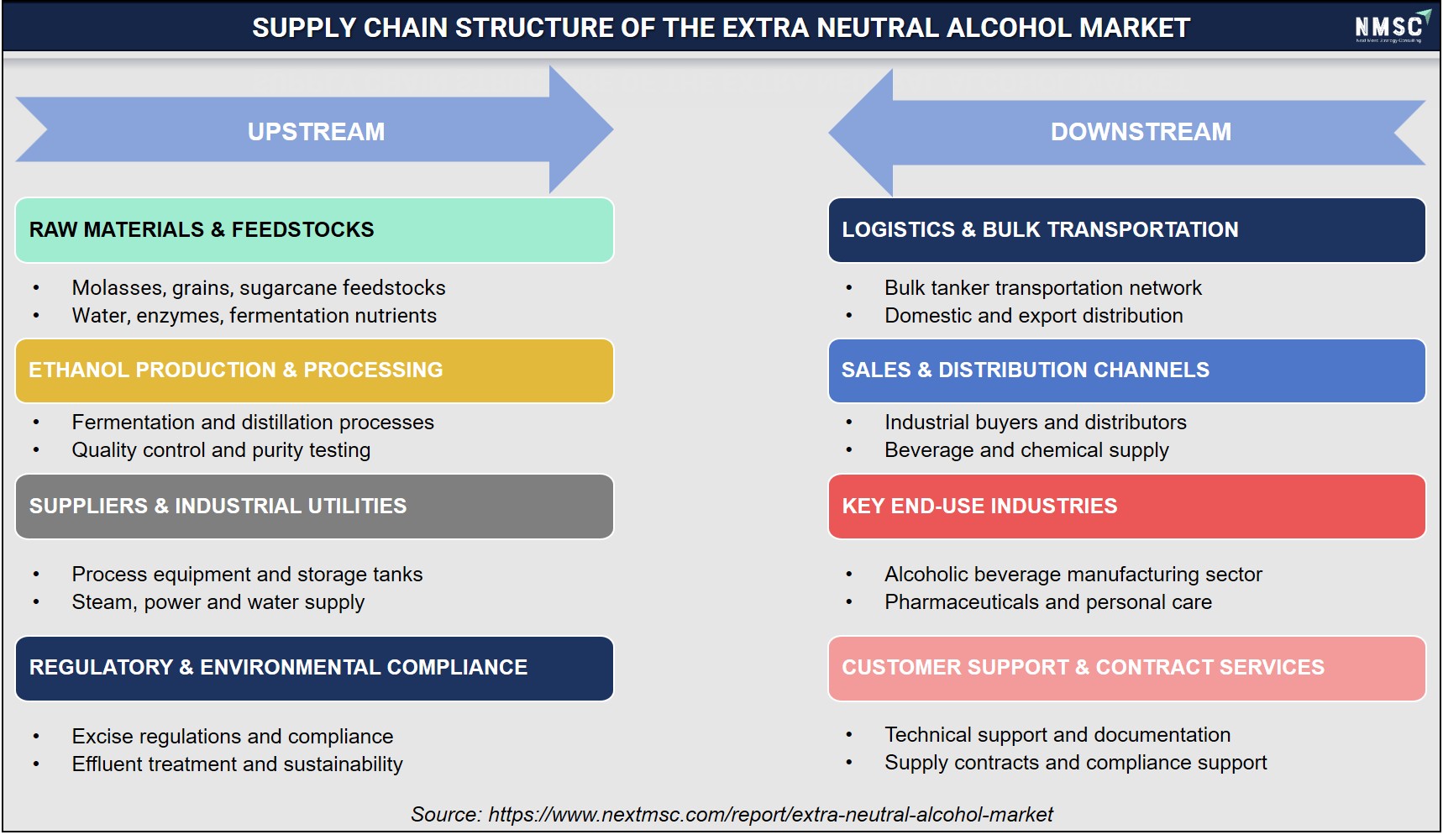
The above framework maps the supply chain structure of the Extra Neutral Alcohol Market across upstream sourcing, production, and downstream distribution. We noticed that molasses, grains, and sugarcane form the primary feedstock base, while fermentation, distillation, and purity testing define production processes, supported by equipment suppliers and industrial utilities. Excise regulations, effluent treatment, and sustainability compliance govern upstream operations, whereas downstream activities encompass bulk tanker transportation, industrial distribution, and supply to beverage, pharmaceutical, and personal care sectors, with technical support and contract services reinforcing long-term customer relationships.
Regional Outlook
Geographic Performance Snapshot
|
Region |
2025 (USD Bn) |
2035 (USD Bn) |
CAGR 2025–2035 (%) |
Primary Growth Driver |
|
North America |
7.80 |
14.60 |
6.5% |
Premium spirits, pharmaceutical ethanol, RTD beverage growth |
|
Europe |
8.20 |
15.20 |
6.4% |
Spirits exports, pharma excipient demand, EU RED III compliance |
|
Asia Pacific |
11.40 |
24.60 |
8.0% |
India/China production scale, ASEAN beverage, pharma expansion |
|
Middle East & Africa |
2.80 |
5.80 |
7.6% |
Industrial ethanol, cosmetics sector, pharmaceutical imports |
|
Latin America |
2.22 |
4.84 |
8.1% |
Brazil sugarcane exports, RTD growth, pharmaceutical manufacturing |
North America Extra Neutral Alcohol Market
North America represents USD 7.80 billion in the Extra Neutral Alcohol Market in 2025, projected to reach USD 14.60 billion by 2035 at a CAGR of 6.5%. The region's demand is anchored by the world's largest premium spirits market, robust pharmaceutical-grade ethanol consumption, and rapidly growing RTD beverage formulation requirements. The TTB and FDA regulatory frameworks govern product specifications, while the EPA's Renewable Fuel Standard provides additional demand support for domestic fermentation ethanol. Leading producers ADM, MGP Ingredients, Green Plains, and Greenfield Global serve both domestic and export demand channels across the region.
United States Extra Neutral Alcohol Market
Based on our engagements with industry participants, the United States represents the largest single-country Extra Neutral Alcohol Market at USD 4.80 billion in 2025, expected to reach USD 8.90 billion by 2035 at a CAGR of 6.4%. TTB regulates ENA specifications for beverage applications under the Federal Alcohol Administration Act, while FDA 21 CFR governs pharmaceutical and food-grade ethanol quality. Domestic demand is driven by premium vodka and gin production, RTD cocktail manufacturing, pharmaceutical excipient procurement, and cosmetics formulations. ADM, MGP Ingredients, and Green Plains maintain substantial production capacities serving national beverage, industrial, and export markets competitively.
Canada Extra Neutral Alcohol Market
Through our analysis, the Canada Extra Neutral Alcohol Market reached USD 1.60 billion in 2025, advancing to USD 2.90 billion by 2035 at a CAGR of 6.1%. Canada Revenue Agency governs duty management on ENA under the Excise Act 2001, while the Food Standards Agency and Health Canada oversee food-grade and pharmaceutical-grade ethanol specifications, respectively. Greenfield Global's Canadian operations are the country's largest certified ENA producer, supplying domestic spirits manufacturers, pharmaceutical companies, and industrial ethanol buyers. A growing domestic craft distillery sector and expanding Canadian pharmaceutical manufacturing base are creating incremental demand within the Canada Extra Neutral Alcohol Market.
Mexico Extra Neutral Alcohol Market
From our assessment, Mexico's Extra Neutral Alcohol Market was valued at USD 1.40 billion in 2025, expected to reach USD 2.80 billion by 2035 at a CAGR of 7.2%. COFEMRIS regulates food and pharmaceutical-grade alcohol in Mexico, with federal agricultural programs supporting sugarcane cultivation for domestic fermentation ethanol. Mexico's established sugarcane industry in Veracruz and Jalisco provides feedstock for domestic ENA production. Growing demand from the country's expanding RTD beverage market, cosmetics manufacturing sector, and pharmaceutical supply chain is driving market maturation. Both domestic production and import channels from India and Brazil serve the Mexico Extra Neutral Alcohol Market.
Europe Extra Neutral Alcohol Market
Europe represents USD 8.20 billion in the Extra Neutral Alcohol Market in 2025, projected to reach USD 15.20 billion by 2035 at a CAGR of 6.4%. The region's demand is anchored by globally significant spirits production heritage, pharmaceutical excipient standards under the European Pharmacopoeia, and cosmetics formulation demand governed by EU Regulation 1223/2009. EU Regulation 2019/787 defines ENA purity and origin specifications required for use in European spirit drink production. Leading producers include Tereos, Cristal Union, CropEnergies, Pannonia Bio, and Alco Group serving a diverse European Extra Neutral Alcohol Market with beet-sugar and grain-derived neutral alcohol.
United Kingdom Extra Neutral Alcohol Market
Based on our engagements, the United Kingdom Extra Neutral Alcohol Market was valued at USD 0.70 billion in 2025, growing to USD 1.30 billion by 2035 at a CAGR of 6.4%. HMRC governs duty management on ENA under the Alcohol Duty framework, while the Food Standards Agency and MHRA oversee food-grade and pharmaceutical-grade ethanol. UK-based Scotch whisky distilling and an expanding domestic gin category drive significant ENA demand for blend preparation and botanical extraction. Greenfield Global UK operations and domestic suppliers service beverage and industrial requirements. Post-Brexit regulatory divergence from EU standards is creating additional compliance navigation requirements for imported ENA in the UK.
Germany Extra Neutral Alcohol Market
Through our analysis, Germany's Extra Neutral Alcohol Market was valued at USD 1.30 billion in 2025, advancing to USD 2.40 billion by 2035 at a CAGR of 6.3%. The Federal Ministry of Food and Agriculture (BMEL) and BLE govern feedstock and biofuel ethanol programs. Germany's pharmaceutical industry, among Europe's largest, drives substantial demand for European Pharmacopoeia-compliant ENA. CropEnergies AG, headquartered in Mannheim, is a major European neutral alcohol producer supplying food and beverage grade ENA across regional markets. Flavors and fragrances producers in the Rhine-Main region represent additional high-value ENA demand within the Germany Extra Neutral Alcohol Market.
France Extra Neutral Alcohol Market
From our assessment, the France Extra Neutral Alcohol Market was valued at USD 1.10 billion in 2025, growing to USD 2.00 billion by 2035 at a CAGR of 6.2%. France's DGDDI regulates ENA duty and classification. Tereos SCA and Cristal Union are major French ENA producers leveraging beet sugar processing capabilities in the Champagne and Picardie regions. The Cognac sector's need for high-quality neutral grape spirit and France's global perfumery and cosmetics industry anchored in Grasse collectively define a sophisticated multi-tier ENA demand structure. Growing pharmaceutical manufacturing in Île-de-France creates additional pharmaceutical-grade ENA procurement requirements within the France Extra Neutral Alcohol Market.
Italy Extra Neutral Alcohol Market
According to evaluation of available market data, Italy's Extra Neutral Alcohol Market reached USD 0.80 billion in 2025, growing to USD 1.50 billion by 2035 at a CAGR of 6.5%. The Italian Ministry of Health and ICQRF regulate food-grade and spirits-grade ENA. Italy's grappa, amaro, and growing gin domestic production industries create a diverse spirits-sector ENA demand base. Pharmaceutical manufacturing in Lombardy and Lazio drives pharmacopoeial ethanol requirements. Italian cosmetics and personal care brands including Davines and Alfaparf create demand for cosmetic-grade ENA. Supply comes from both domestic Italian grape distillate producers and imports from European ENA manufacturers.
Spain Extra Neutral Alcohol Market
In our observation, Spain's Extra Neutral Alcohol Market was valued at USD 0.60 billion in 2025, reaching USD 1.10 billion by 2035 at a CAGR of 6.3%. AESAN governs food-grade alcohol specifications, while AEMPS regulates pharmaceutical ethanol. Spain's Andalusian and Extremaduran wine distillation industries supply base alcohol for brandy and anisado production, providing domestic feedstock. Spain's growing fragrance and personal care industry in Barcelona and Valencia, combined with pharmaceutical manufacturing, creates diversified ENA demand across multiple application segments. Regional health system procurement and private hospital networks in major cities drive pharmaceutical-grade ENA requirements within the Spain Extra Neutral Alcohol Market.
Sweden Extra Neutral Alcohol Market
Based on our market evaluation, Sweden's Extra Neutral Alcohol Market was valued at USD 0.28 billion in 2025, growing to USD 0.52 billion by 2035 at a CAGR of 6.4%. Alkoholinspektionen governs beverage-grade alcohol while the Swedish Food Agency (Livsmedelsverket) sets food-grade ENA standards. Sweden's pharmaceutical industry, including AstraZeneca's domestic production operations, contributes to pharmaceutical-grade ethanol demand. Domestic grain surplus provides feedstock for ENA manufacturing. Sweden's sustainability regulatory environment, aligned with EU RED III, is creating demand for ISCC-certified ENA from domestic and import sources, reinforcing sustainability credentials as a procurement requirement within the Sweden Extra Neutral Alcohol Market.
Denmark Extra Neutral Alcohol Market
Through our analysis, Denmark's Extra Neutral Alcohol Market was valued at USD 0.22 billion in 2025, reaching USD 0.40 billion by 2035 at a CAGR of 6.2%. Fødevarestyrelsen governs food-grade ENA while the Danish Medicines Agency oversees pharmaceutical ethanol. Denmark's craft spirits sector, including Copenhagen Distillery and domestic aquavit producers, creates quality-differentiated ENA demand. Novo Nordisk's pharmaceutical production contributes to pharmaceutical excipient ethanol procurement requirements. Denmark's strong sustainability credentials and EU biofuel standard adherence shape purchasing preferences. Regional collaboration across Nordic pharmaceutical procurement networks further influences supply contract dynamics within the Denmark Extra Neutral Alcohol Market.
Finland Extra Neutral Alcohol Market
From our assessment, Finland's Extra Neutral Alcohol Market reached USD 0.18 billion in 2025, growing to USD 0.33 billion by 2035 at a CAGR of 6.3%. Valvira regulates alcohol manufacturing and distribution, including ENA specifications. Anora Group (formerly Altia), operating from its Rajamäki distillery, is Finland's leading ENA producer serving domestic spirits and Nordic export markets. Finland's pharmaceutical sector and biotech industry create demand for European Pharmacopoeia-grade ethanol. Finland's government bioeconomy strategy supports sustainable grain-based fermentation capacity that serves both domestic demand and regional Nordic export channels within the Finland Extra Neutral Alcohol Market.
Netherlands Extra Neutral Alcohol Market
According to evaluation of regional data, the Netherlands Extra Neutral Alcohol Market was valued at USD 0.37 billion in 2025, expected to reach USD 0.69 billion by 2035 at a CAGR of 6.4%. The NVWA and CBG-MEB govern food-grade and pharmaceutical ENA specifications. Alco Group NV, headquartered in Rotterdam, is a major European ENA trader and distributor leveraging the port of Rotterdam's position as Europe's primary bulk alcohol import and distribution hub. The Netherlands' prominent flavors, fragrances, and cosmetics sector, including DSM-Firmenich and Givaudan Netherlands operations, creates premium-grade ENA procurement demand within the national Extra Neutral Alcohol Market.
Rest of Europe Extra Neutral Alcohol Market
Based on our market evaluation, the Rest of Europe Extra Neutral Alcohol Market, encompassing Poland, Czech Republic, Austria, Belgium, Portugal, Hungary, and other EU and non-EU states, was valued at USD 2.65 billion in 2025, growing to USD 4.96 billion by 2035 at a CAGR of 6.5%. Pannonia Bio Zrt. in Hungary operates one of Europe's most modern grain-to-ethanol facilities, producing high-quality ENA for export across continental Europe. Poland's large spirits industry and Central European pharmaceutical manufacturing clusters create additional ENA demand. Belgium's pharma sector and the Netherlands' distribution role support efficient ENA supply access across this Rest of Europe sub-region.
Asia Pacific Extra Neutral Alcohol Market
Asia Pacific is the largest and fastest-growing region in the Extra Neutral Alcohol Market at USD 11.40 billion in 2025, projected to reach USD 24.60 billion by 2035 at a CAGR of 8.0%. India's massive sugarcane-based ENA production base serving domestic spirits and pharmaceutical exports, and China's grain-based neutral spirit demand for baijiu and vodka manufacturing, collectively define the region's dominant market structure. Government ethanol blending policies, growing pharmaceutical manufacturing investment, and a rapidly evolving RTD beverage sector are creating multi-dimensional demand growth vectors across the Asia Pacific Extra Neutral Alcohol Market.
China Extra Neutral Alcohol Market
Based on our engagements, China's Extra Neutral Alcohol Market was valued at USD 3.20 billion in 2025, growing to USD 7.20 billion by 2035 at a CAGR of 8.5%. NMPA governs pharmaceutical-grade ethanol, while National Standard GB 31640-2016 guides food-grade ethanol compliance. China's grain ethanol industry, supported by the NDRC's bioethanol policies, is expanding production capacity for E10 fuel blending and non-fuel ENA applications. Growing domestic vodka and gin consumption, a rapidly expanding RTD beverage market, and pharmaceutical excipient demand are creating incremental demand within the China Extra Neutral Alcohol Market. MicroPort and domestic distilleries serve local requirements.
India Extra Neutral Alcohol Market
Through our analysis, India is the world's largest single-country ENA producer, with a market valued at USD 2.80 billion in 2025, growing to USD 6.40 billion by 2035 at a CAGR of 8.6%. FSSAI sets ENA specifications under FSSR 2011, while the Ministry of Petroleum and Natural Gas oversees ethanol blending. India's integrated sugar-ethanol mills in Maharashtra, Uttar Pradesh, and Karnataka produce the majority of domestic sugarcane-based ENA. BCL Industries, Triveni Engineering, India Glycols, Dhampur Bio Organics, Shree Renuka Sugars, Balrampur Chini, and Nirani Sugars serve domestic IMFL spirits production and substantial export markets in the India Extra Neutral Alcohol Market.
Japan Extra Neutral Alcohol Market
From our assessment, Japan's Extra Neutral Alcohol Market was valued at USD 1.40 billion in 2025, expected to reach USD 2.60 billion by 2035 at a CAGR of 6.4%. The National Tax Agency (NTA) regulates alcoholic beverage manufacturing under the Liquor Tax Law, while MHLW governs pharmaceutical ethanol under Japanese Pharmacopoeia standards. Japan's whisky, shochu, and chu-hi RTD sectors create a diversified ENA demand base. Japan's pharmaceutical industry, among Asia's most developed, requires substantial pharmaceutical-grade ethanol. Key importers supply bulk ENA from India and Australia to serve domestic spirits blending and pharmaceutical manufacturing needs within the Japan Extra Neutral Alcohol Market.
South Korea Extra Neutral Alcohol Market
According to evaluation of market dynamics, South Korea's Extra Neutral Alcohol Market was valued at USD 0.80 billion in 2025, reaching USD 1.60 billion by 2035 at a CAGR of 7.2%. Korea MFDS regulates food and pharmaceutical ethanol specifications, while the National Tax Service administers the Liquor Tax Act. South Korea's soju industry, the world's largest-volume spirits category by global bottle sales, creates the dominant ENA demand source within the national market. Domestic grain ethanol producers serve major soju manufacturers. Growing Korean pharmaceutical manufacturing under K-pharma export strategies is creating incremental pharmaceutical-grade ENA demand within the South Korea Extra Neutral Alcohol Market.
Taiwan Extra Neutral Alcohol Market
In our observation, Taiwan's Extra Neutral Alcohol Market was valued at USD 0.40 billion in 2025, growing to USD 0.80 billion by 2035 at a CAGR of 7.2%. TFDA under the Ministry of Health and Welfare regulates food-grade and pharmaceutical ENA. Taiwan Tobacco and Liquor Corporation (TTL) manages domestic spirit production with associated ENA requirements. Taiwan's pharmaceutical contract manufacturing sector, servicing global branded drug companies, drives growing pharmaceutical-grade ethanol procurement. Taiwan's advanced semiconductor and electronics manufacturing capabilities provide strategic supply chain integration advantages for active implant device component sourcing that indirectly supports Taiwan's industrial ENA consumption in the Taiwan Extra Neutral Alcohol Market.
Indonesia Extra Neutral Alcohol Market
Based on our market evaluation, Indonesia's Extra Neutral Alcohol Market was valued at USD 0.60 billion in 2025, growing to USD 1.40 billion by 2035 at a CAGR of 8.8%. BPOM governs food and pharmaceutical ethanol in Indonesia. The Ministry of Energy and Mineral Resources' bioethanol blending mandates support fermentation ethanol capacity investment across Java and Sumatra. Pharmaceutical and personal care sector growth in Jakarta is creating growing ENA demand beyond traditional industrial applications. Indonesia's market is served by both domestic production from local sugarcane processors and regional imports from India and Australia within the Indonesia Extra Neutral Alcohol Market.
Vietnam Extra Neutral Alcohol Market
From our assessment, Vietnam's Extra Neutral Alcohol Market was valued at USD 0.45 billion in 2025, expected to reach USD 1.10 billion by 2035 at a CAGR of 9.3%, making it the fastest-growing national market in Asia Pacific. The Ministry of Industry and Trade and Ministry of Health regulate ethanol production and pharmaceutical specifications. Vietnam's rapidly growing beer, spirits, and RTD beverage market is creating expanding ENA demand. Government programs promoting sugarcane cultivation in the Mekong Delta are improving domestic feedstock availability. Growing pharmaceutical FDI is creating pharmaceutical-grade ENA requirements in the Vietnam Extra Neutral Alcohol Market.
Australia Extra Neutral Alcohol Market
According to evaluation of available industry data, Australia's Extra Neutral Alcohol Market was valued at USD 0.60 billion in 2025, growing to USD 1.10 billion by 2035 at a CAGR of 6.2%. FSANZ governs food-grade ethanol standards while TGA regulates pharmaceutical ethanol. Manildra Group Pty Ltd is Australia's dominant ENA producer, manufacturing wheat-based neutral alcohol at its Shoalhaven Starches facility in NSW and serving domestic spirits, pharmaceutical, and industrial sectors. Australia's growing craft gin and premium spirits industry creates demand for locally produced, origin-certified high-purity ENA. Manildra's significant export position supplies Japanese and ASEAN beverage manufacturers within the Australia Extra Neutral Alcohol Market.
Philippines Extra Neutral Alcohol Market
In our observation, the Philippines Extra Neutral Alcohol Market was valued at USD 0.35 billion in 2025, growing to USD 0.80 billion by 2035 at a CAGR of 8.6%. FDA Philippines under the Department of Health regulates food-grade and pharmaceutical ethanol. San Miguel Corporation (Ginebra) and Tanduay Distillers, among the world's largest spirits producers by volume, create substantial sugarcane-based ENA demand. The Philippines' Negros Occidental sugarcane industry provides domestic feedstock. Growing pharmaceutical manufacturing investment and expanding beauty and personal care sector are creating incremental ENA demand channels in the Philippines Extra Neutral Alcohol Market.
Malaysia Extra Neutral Alcohol Market
Based on our engagements, Malaysia's Extra Neutral Alcohol Market was valued at USD 0.30 billion in 2025, projected to reach USD 0.65 billion by 2035 at a CAGR of 8.0%. The Medical Device Authority (MDA) and National Pharmaceutical Regulatory Agency (NPRA) govern pharmaceutical ethanol standards. Malaysia's pharmaceutical manufacturing sector and personal care and cosmetics manufacturing concentrated in the Klang Valley create quality-differentiated ENA requirements. Malaysia's position as a Southeast Asian distribution hub facilitates ENA import and re-export activity. Growing domestic beverage manufacturing investment creates additional demand within the Malaysia Extra Neutral Alcohol Market.
Rest of Asia Pacific Extra Neutral Alcohol Market
Through our market assessment, the Rest of Asia Pacific Extra Neutral Alcohol Market, covering Singapore, Thailand, Bangladesh, Sri Lanka, Myanmar, New Zealand, and other regional markets, was valued at USD 0.50 billion in 2025, growing to USD 0.95 billion by 2035 at a CAGR of 6.6%. Singapore operates as a regional ENA distribution hub through Jurong Island's chemical logistics infrastructure. Thailand's ethanol production program from sugarcane and cassava under the Alternative Energy Development Plan serves domestic industrial and beverage markets. New Zealand's wine-based neutral spirit production and pharmaceutical sector create quality-tier ENA requirements within the Rest of Asia Pacific Extra Neutral Alcohol Market.
Middle East & Africa Extra Neutral Alcohol Market
The Middle East and Africa Extra Neutral Alcohol Market was valued at USD 2.80 billion in 2025, advancing to USD 5.80 billion by 2035 at a CAGR of 7.6%. The region's ENA demand is driven primarily by pharmaceutical excipient requirements, cosmetics and personal care manufacturing, and industrial solvent applications. GCC nations are the primary pharmaceutical and cosmetics ENA importers, sourcing from India, Europe, and Brazil. South Africa's domestic spirits industry and Nigeria's growing pharmaceutical manufacturing represent the primary Sub-Saharan African demand anchors within the MEA Extra Neutral Alcohol Market.
Saudi Arabia Extra Neutral Alcohol Market
Based on our engagements, Saudi Arabia's Extra Neutral Alcohol Market was valued at USD 0.50 billion in 2025, growing to USD 1.10 billion by 2035 at a CAGR of 8.2%. SFDA regulates pharmaceutical and industrial ethanol, while Vision 2030's healthcare modernization programs are creating significant new pharmaceutical-grade ENA demand. Saudi Arabia's pharmaceutical manufacturing sector, supported by the Saudi Commission for Health Specialties and national health strategy investment, is increasing ENA import volumes. Cosmetics and personal care manufacturing under SFDA cosmetic regulations creates additional ENA demand. All ENA consumed in Saudi Arabia enters the market through industrial, pharmaceutical, or cosmetic channels consistent with domestic regulatory frameworks.
UAE Extra Neutral Alcohol Market
Through our analysis, the UAE Extra Neutral Alcohol Market was valued at USD 0.40 billion in 2025, reaching USD 0.85 billion by 2035 at a CAGR of 7.8%. The UAE Ministry of Health and Prevention and Abu Dhabi Quality and Conformity Council govern pharmaceutical ethanol standards. Dubai serves as the primary re-export hub for ENA across the broader Gulf and East African markets. Dubai Industrial City's growing pharmaceutical and personal care manufacturing cluster creates significant industrial ENA procurement. Mandatory health insurance coverage in Abu Dhabi and Dubai is stimulating pharmaceutical manufacturing investment that indirectly increases pharmaceutical-grade ENA demand within the UAE Extra Neutral Alcohol Market.
Egypt Extra Neutral Alcohol Market
From our assessment, Egypt's Extra Neutral Alcohol Market was valued at USD 0.30 billion in 2025, growing to USD 0.60 billion by 2035 at a CAGR of 7.2%. The Egyptian Drug Authority (EDA) and Egyptian Food Safety Authority govern pharmaceutical and food-grade ethanol specifications. Egypt's pharmaceutical manufacturing sector, among Africa's largest, creates pharmaceutical-grade ENA demand supplied primarily through imports. The domestic cosmetics and personal care industry, serving North African and Middle Eastern markets, represents a growing ENA consumption base. Egypt's domestic sugarcane production in the Nile Delta provides some fermentation ethanol capacity, though pharmaceutical-grade requirements are predominantly met through import channels within the Egypt Extra Neutral Alcohol Market.
Israel Extra Neutral Alcohol Market
According to evaluation of available market data, Israel's Extra Neutral Alcohol Market was valued at USD 0.20 billion in 2025, growing to USD 0.40 billion by 2035 at a CAGR of 7.2%. The Ministry of Health's Pharmaceutical Administration and Israel Standards Institute (SII) govern pharmaceutical and food-grade ethanol specifications. Israel's globally significant pharmaceutical and biotech manufacturing sector, including Teva Pharmaceuticals' domestic operations, creates sophisticated pharmaceutical-grade ENA demand. Israel's growing artisan spirits and premium wine sector creates quality-differentiated ENA procurement requirements. The Israel Innovation Authority's life sciences programs support bioprocess innovation relevant to fermentation ethanol in the Israel Extra Neutral Alcohol Market.
Turkey Extra Neutral Alcohol Market
In our observation, Turkey's Extra Neutral Alcohol Market was valued at USD 0.40 billion in 2025, advancing to USD 0.85 billion by 2035 at a CAGR of 7.8%. TITCK governs pharmaceutical ethanol standards, while the Ministry of Agriculture oversees agricultural ethanol. Turkey's regulated domestic spirits market, including domestic raki production by Mey Içki and other producers, creates beverage-grade ENA demand. Turkey's large pharmaceutical manufacturing sector and growing cosmetics industry, particularly in Istanbul's industrial zones, drive pharmaceutical and cosmetic-grade ENA procurement. Agricultural sugarbeet and grain availability in Anatolia provides domestic feedstock for ENA production in the Turkey Extra Neutral Alcohol Market.
Nigeria Extra Neutral Alcohol Market
Based on our market evaluation, Nigeria's Extra Neutral Alcohol Market was valued at USD 0.25 billion in 2025, growing to USD 0.50 billion by 2035 at a CAGR of 7.2%. NAFDAC regulates food-grade and pharmaceutical ethanol in Nigeria. Nigeria's domestic spirits and beer manufacturing sector creates beverage-grade ENA demand, served by domestic cassava and sugarcane fermentation producers. Growing pharmaceutical manufacturing investment, supported by the Federal Ministry of Health development programs, is increasing pharmaceutical-grade ENA import requirements. Nigeria's large population and expanding consumer market make it a strategically important long-term growth market within the Nigeria Extra Neutral Alcohol Market.
South Africa Extra Neutral Alcohol Market
From our assessment, South Africa's Extra Neutral Alcohol Market was valued at USD 0.30 billion in 2025, growing to USD 0.65 billion by 2035 at a CAGR of 8.0%. SAHPRA governs pharmaceutical ethanol while SABS sets food-grade ethanol specifications. South Africa's established wine and spirits industry, including Heineken South Africa (formerly Distell) and KWV Holdings, creates domestic demand for high-quality ENA in fortified wine and brandy production. The pharmaceutical manufacturing sector and growing cosmetics industry create additional quality-differentiated ENA demand. KwaZulu-Natal sugarcane production serves domestic industrial and beverage-grade requirements within the South Africa Extra Neutral Alcohol Market.
Rest of MEA Extra Neutral Alcohol Market
Through our analysis, the Rest of MEA Extra Neutral Alcohol Market, covering Kuwait, Qatar, Bahrain, Oman, Jordan, Morocco, Algeria, Tunisia, Kenya, Ethiopia, and other regional markets, was valued at USD 0.45 billion in 2025, growing to USD 0.85 billion by 2035 at a CAGR of 6.6%. GCC member states Kuwait, Qatar, Bahrain, and Oman source pharmaceutical and industrial ENA primarily through import channels, with Dubai as the regional hub. North African markets including Morocco and Algeria have established domestic alcohol production for industrial applications. Sub-Saharan East African markets are early-stage but growing as pharmaceutical manufacturing investment expands across Kenya and Ethiopia in the Rest of MEA Extra Neutral Alcohol Market.
Latin America Extra Neutral Alcohol Market
The Latin America Extra Neutral Alcohol Market was valued at USD 2.22 billion in 2025, projected to reach USD 4.84 billion by 2035 at a CAGR of 8.1%, making it the fastest-growing region globally. Brazil's position as the world's second-largest sugarcane ethanol producer anchors the regional supply structure. RenovaBio national biofuels policy and CONAB agricultural production monitoring provide the regulatory and feedstock foundations for ENA production. Growing consumer markets for spirits, RTD beverages, and cosmetics across Colombia, Chile, Argentina, and Peru are creating expanding end-market demand for quality-certified ENA across the Latin America Extra Neutral Alcohol Market.
Brazil Extra Neutral Alcohol Market
Based on our engagements, Brazil's Extra Neutral Alcohol Market was valued at USD 1.10 billion in 2025, growing to USD 2.40 billion by 2035 at a CAGR of 8.1%. MAPA and ANVISA jointly govern agricultural ethanol production and food or pharmaceutical-grade ENA specifications. Tereos Brazil, Raízen (Shell and Cosan JV), and São Martinho are among Brazil's largest sugarcane ethanol producers with ENA production capabilities. Brazil's RenovaBio decarbonization credit system incentivizes certified sustainable ENA production, benefiting export-oriented producers serving European and North American premium markets. Supply chain modernization and port logistics improvements at Santos are enhancing export competitiveness within the Brazil Extra Neutral Alcohol Market.
Argentina Extra Neutral Alcohol Market
Through our analysis, Argentina's Extra Neutral Alcohol Market was valued at USD 0.42 billion in 2025, advancing to USD 0.90 billion by 2035 at a CAGR of 7.9%. ANMAT governs pharmaceutical and food-grade ethanol. Argentina's domestic spirits sector, including Fernet Branca, Malbec-based brandy, and growing gin categories, creates domestic ENA demand. The country's pharmaceutical industry in Buenos Aires and Córdoba provinces requires ANMAT-compliant pharmaceutical-grade ENA. Economic volatility and currency risk present structural challenges for Argentina's international ENA trade competitiveness, though domestic demand growth remains positive as consumer market recovery continues in the Argentina Extra Neutral Alcohol Market.
Chile Extra Neutral Alcohol Market
From our assessment, Chile's Extra Neutral Alcohol Market was valued at USD 0.25 billion in 2025, growing to USD 0.54 billion by 2035 at a CAGR of 8.0%. Instituto de Salud Pública de Chile (ISP) and ANAMED regulate food-grade and pharmaceutical ethanol. Chile's wine distillation industry, producing pisco and brandy, creates domestic demand for high-quality ENA. Growing cosmetics manufacturing in Santiago and expanding pharmaceutical operations create additional demand channels. Chile's open trade agreements with Europe, Asia Pacific, and North America facilitate ENA import competitiveness, influencing pricing dynamics and supply diversification choices for buyers within the Chile Extra Neutral Alcohol Market.
Colombia Extra Neutral Alcohol Market
According to the evaluation of regional market data, Colombia's Extra Neutral Alcohol Market was valued at USD 0.22 billion in 2025, expected to reach USD 0.50 billion by 2035 at a CAGR of 8.6%. INVIMA regulates food-grade and pharmaceutical ethanol specifications. Colombia's spirits market, including domestic aguardiente and rum production, creates beverage-grade ENA demand. The Cauca Valley sugarcane industry provides domestic feedstock. Colombia's pharmaceutical manufacturing sector and growing personal care industry are creating incremental ENA demand beyond traditional beverage channels. ANDI represents local producers navigating evolving supply chain and regulatory requirements within the Colombia Extra Neutral Alcohol Market.
Rest of Latin America Extra Neutral Alcohol Market
In our observation, the Rest of Latin America Extra Neutral Alcohol Market, covering Peru, Ecuador, Uruguay, Paraguay, Bolivia, Venezuela, Central American nations, and Caribbean markets, was valued at USD 0.23 billion in 2025, growing to USD 0.50 billion by 2035 at a CAGR of 8.1%. Peru's pisco production industry and growing pharmaceutical manufacturing create beverage and pharmaceutical-grade ENA demand. Uruguay's Ancap state alcohol producer serves domestic spirits and industrial requirements. Central American sugar mills in Guatemala, El Salvador, and Honduras produce industrial ethanol with ENA quality potential. Caribbean rum-producing nations create localized demand for sugarcane-based ENA in the Rest of Latin America Extra Neutral Alcohol Market.
Regulatory Framework Impacting the Extra Neutral Alcohol Market
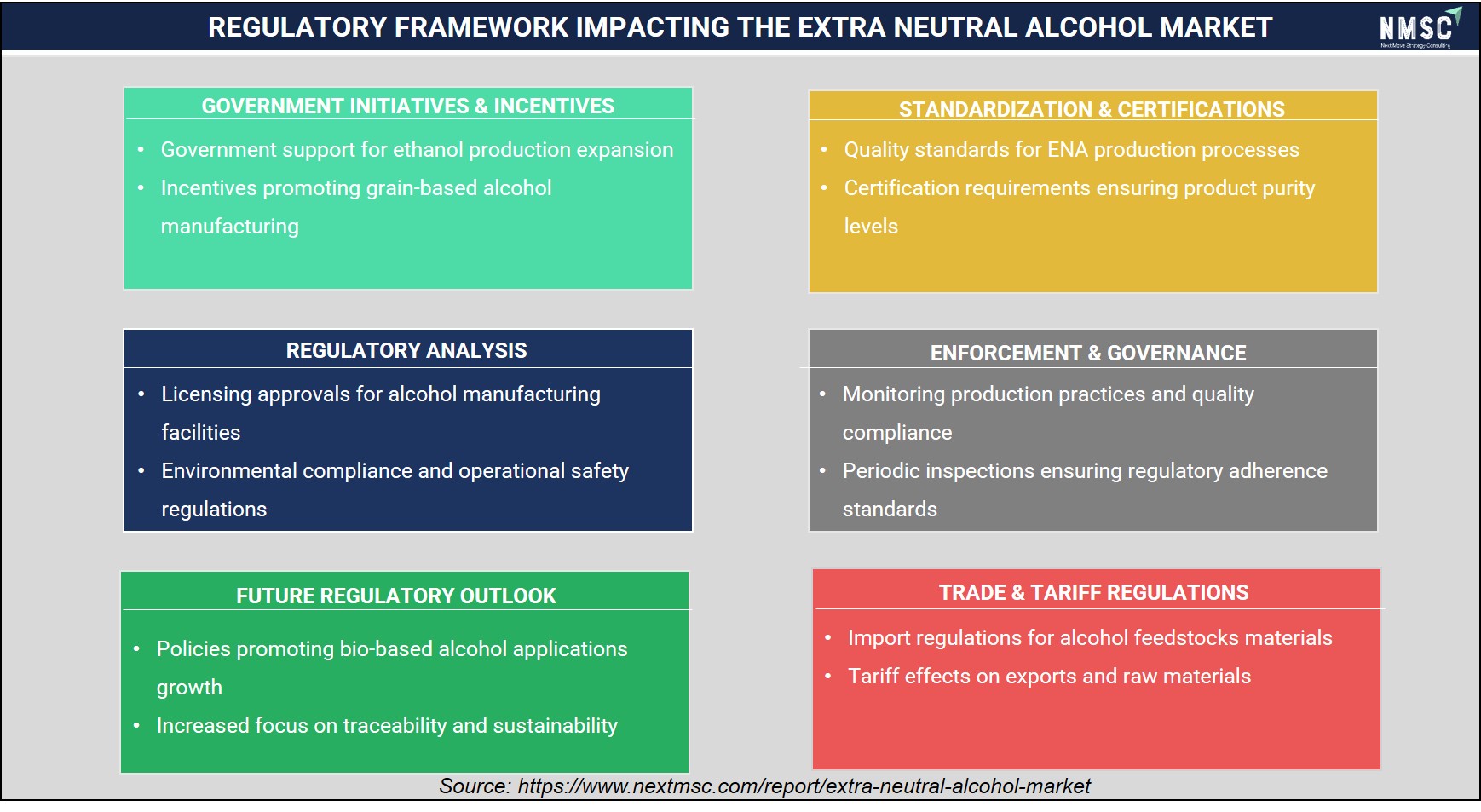
The above framework outlines the regulatory landscape shaping the Extra Neutral Alcohol Market across government initiatives, compliance, enforcement, and trade policies. We observed that government support for ethanol expansion and manufacturing incentives drive growth, while licensing, environmental compliance, and safety regulations define the regulatory environment. Quality standards and purity certifications ensure product integrity, with monitoring enforcing adherence. Future outlook points toward bio-based applications and traceability, while import regulations and tariffs on feedstocks continue to influence raw material costs and global trade dynamics.
Competitive Landscape
Competitive Dynamics and M&A Landscape
|
Key Takeaways |
Details |
|
Market Structure |
The Extra Neutral Alcohol Market exhibits a moderately concentrated structure globally. ADM, Tereos, and MGP Ingredients command leading positions in North American and European markets, while India's fragmented but collectively large domestic industry, BCL Industries, Triveni Engineering, India Glycols, Dhampur Bio Organics, Shree Renuka Sugars, Balrampur Chini, and Nirani Sugars, dominates Asian production volumes. The market combines large commodity-scale producers with specialized high-purity suppliers serving pharmaceutical and premium spirits segments in a tiered competitive architecture. |
|
Innovation Focus |
Innovation is concentrated in fermentation yield optimization through advanced yeast strains, multi-effect distillation efficiency improvements, membrane-based dehydration for ultra-high purity at reduced energy intensity, NIR quality monitoring for real-time purity verification, blockchain-based supply chain traceability for certified organic or sustainably sourced ENA, and carbon footprint reduction per liter produced to meet EU RED III sustainability criteria. Digital fermentation analytics platforms are replacing manual batch monitoring across leading producers globally. |
|
M&A Activity |
Greenfield Global has pursued a multi-country acquisition strategy across Canada, the United States, and the UK to build a global premium ENA supply platform. Tereos has consolidated international capacity across Brazil and Europe. India's domestic consolidation trend, driven by ethanol blending program scale advantages, is expected to produce fewer but significantly larger integrated ENA producers through sugarcane mill mergers. PE-backed aggregation of specialty pharmaceutical-grade ENA producers is accelerating as investors target the higher-margin quality certification tier of the Extra Neutral Alcohol Market. |
How Do Companies Compete in the Extra Neutral Alcohol Market?
Competition in the Extra Neutral Alcohol Market is structured across three primary dimensions: production scale and feedstock cost efficiency, quality certification breadth across pharmaceutical and food-grade specifications, and geographic supply chain reliability. Large commodity producers including ADM and Tereos compete through production cost efficiency and long-term volume agreements. Specialty producers including Greenfield Global and MGP Ingredients compete through premium quality certifications and technical support services. Geographic expansion through facility acquisitions and distribution network development is a key competitive strategy for mid-tier producers seeking to serve international end markets with origin-specific and application-specific ENA requirements at scale and speed.
Which Kind of Companies Dominate the Extra Neutral Alcohol Market?
Three distinct company categories shape the competitive structure of the Extra Neutral Alcohol Market. First, large diversified agri-processing conglomerates including ADM, Tereos, Cristal Union, and Green Plains leverage integrated agricultural supply chains, large-scale fermentation infrastructure, and multi-application product portfolios to compete on cost and volume. Second, specialty premium ENA producers including Greenfield Global, MGP Ingredients, and Manildra Group compete on purity certification, sensory quality, and technical service differentiation. Third, regional producers including BCL Industries, Triveni Engineering, Pannonia Bio, and Nirani Sugars serve geographically concentrated demand bases with competitively priced ENA from local agricultural feedstocks.
Digital Transformation and Quality Standardization Drive Market Success in the Extra Neutral Alcohol Market
Advanced digital monitoring and internationally harmonized quality standards are becoming decisive differentiators in the Extra Neutral Alcohol Market. Leading producers are deploying IoT-enabled fermentation monitoring platforms, AI-driven distillation column optimization algorithms, and real-time NIR spectroscopic analysis that reduce batch variability and improve energy efficiency per liter of ENA produced. Simultaneously, adherence to open international quality standards including USP/NF, European Pharmacopoeia, and Codex Alimentarius food-grade ethanol specifications is creating globally tradeable, documentation-backed ENA. Our findings suggest that producers combining digital production intelligence with international quality certifications are achieving superior customer retention and pricing outcomes within the Extra Neutral Alcohol Market.
Market Players to Opt for Merger and Acquisition Strategies to Expand Their Presence in the Extra Neutral Alcohol Market
Strategic M&A is progressively reshaping market structure and geographic reach across the Extra Neutral Alcohol Market. Greenfield Global's multi-country acquisition strategy exemplifies how premium ENA specialists are building international supply networks to serve global pharmaceutical and spirits manufacturers from multiple certified production locations. India's domestic consolidation, driven by ethanol blending program scale advantages, is expected to produce fewer but significantly larger ENA producers through integrated sugar mill mergers. NMSC's analysis indicates that the next M&A wave will concentrate around Brazilian sugarcane ENA exporters seeking international market access partnerships and European pharmaceutical-grade ENA producers attracting acquisition interest from global life sciences distribution companies.
Who Are the Key Market Players in the Extra Neutral Alcohol Market?
-
Archer-Daniels-Midland Company
-
Tereos SCA
-
MGP Ingredients, Inc.
-
Cristal Union
-
Greenfield Global Inc.
-
Manildra Group Pty Ltd
-
Pannonia Bio Zrt.
-
Alco Group NV
-
BCL Industries Limited
-
Ethanol SA
-
Green Plains Inc.
-
CropEnergies AG
-
India Glycols Limited
-
Triveni Engineering & Industries Limited
-
Dhampur Bio Organics Limited
-
Associated Alcohols & Breweries Limited
-
Shree Renuka Sugars Limited
-
Balrampur Chini Mills Limited
-
Radico Khaitan Limited
-
Nirani Sugars Limited
What Are the Latest Developments in the Extra Neutral Alcohol Industry?
|
Date |
Event |
|
May 2026 |
BCL commissioned the 150 KLPD ethanol plant at Bathinda, taking total installed distillery capacity to 900 KLPD, making it one of the largest grain-based distilleries. |
What Are the Investment Opportunities in the Extra Neutral Alcohol Market?
Capital Inflows and Strategic Production Capacity Investment
The Extra Neutral Alcohol Market is attracting growing strategic capital investment in premium-grade production capacity across North America, Europe, India, and Brazil. Greenfield Global's sustained multi-country capacity expansion program, Pannonia Bio's state-of-the-art Hungarian grain ethanol facility, and India's government-supported distillery capacity additions under the National Biofuel Policy collectively represent substantial capital deployment. India's Production Linked Incentive scheme for pharmaceuticals, as documented by the Department of Pharmaceuticals, is indirectly stimulating pharmaceutical-grade ENA investment by creating forward demand commitments from pharmaceutical manufacturers that justify specialized ENA production infrastructure investment within the Extra Neutral Alcohol Market.
Infrastructure Investment and Multi-Modal Supply Chain Development
Infrastructure investment in bulk liquid ENA storage, loading terminals, and multi-modal transportation networks represents a critical and underserved opportunity in the Extra Neutral Alcohol Market. Rotterdam's bulk alcohol tankage, India's industrial port tank farm development for ENA export, and Brazil's Santos port logistics for sugarcane ethanol export collectively enable global ENA trade. The FAO's agricultural market investment frameworks highlight food-grade ingredient supply chain modernization as a development priority in emerging markets, creating public-private investment models for ENA logistics infrastructure in high-growth markets including Vietnam, Indonesia, Nigeria, and Colombia.
ESG Considerations and Sustainable ENA Production Investment
Environmental, Social, and Governance investment considerations are reshaping capital allocation within the Extra Neutral Alcohol Market. The EU's RED III sustainability criteria create compliance requirements that are driving capital investment in certified sustainable production. Brazil's RenovaBio program assigns decarbonization credits to certified sustainable ethanol producers, incentivizing ESG-aligned investment in sugarcane ENA production efficiency. ISCC and Bonsucro certification requirements are becoming mandatory procurement criteria for major global spirits and pharmaceutical companies, creating durable commercial incentives for producers investing in certified sustainable ENA supply chains that meet the evolving ESG standards of institutional buyers and investor-mandated supply chain transparency requirements.
Digital Transformation and Smart Manufacturing Investment
Digital transformation investment in ENA production facilities, encompassing IoT-enabled fermentation monitoring, AI-driven distillation optimization, predictive maintenance analytics, and blockchain-based quality traceability, represents a high-return investment theme within the Extra Neutral Alcohol Market. Producers implementing Industry 4.0 platforms are achieving measurable improvements in yield efficiency, energy consumption per liter, and product consistency that directly improve competitive cost positioning. The FDA's Process Analytical Technology guidance for pharmaceutical manufacturing and EMA equivalent frameworks validate the commercial case for smart manufacturing investment in fermentation and distillation operations serving certified pharmaceutical-grade ENA demand across North American and European markets.
Private Equity and Venture Capital Activity
Private equity investment in the Extra Neutral Alcohol Market is concentrating on premium ENA platform companies with demonstrated pharmaceutical-grade production, multi-geography supply networks, and defensible quality certification moats. Strategic M&A by large agri-processing conglomerates is focused on acquiring closed-loop quality algorithm capabilities and geographic market access in Asia Pacific and Latin American growth markets. The U.S. Department of Energy's Office of Energy Efficiency and Renewable Energy supports R&D investment in second-generation cellulosic ENA from agricultural residues, which is attracting early-stage venture capital interest in companies developing non-food feedstock fermentation platforms within the Extra Neutral Alcohol Market ecosystem.
Key Benefits for Stakeholders
For ENA Manufacturers and Producers
Extra neutral alcohol (ENA) manufacturers and producers gain access to a comprehensive and vendor-neutral assessment of the Extra Neutral Alcohol Market, including supply-demand analysis, feedstock cost trends, purity segment revenue benchmarks, and competitive positioning across major producing and consuming regions. Segment-level CAGR forecasts and geographic demand analysis provide a robust framework for production capacity planning, application diversification, and market entry prioritization, enabling producers to align investments with evolving consumption patterns and feedstock economics.
For Spirits, Beverage, and RTD Companies
Spirits, beverage, and ready-to-drink (RTD) manufacturers gain detailed insights into end-market growth trends by application and region, along with competitive supplier benchmarking and purity specification developments. The analysis enables procurement and sourcing teams to strengthen supply chain resilience, manage input cost volatility, and establish long-term supplier relationships that meet application-specific quality requirements across global manufacturing operations.
For Pharmaceutical and Cosmetics Manufacturers
Pharmaceutical and cosmetics companies obtain actionable intelligence regarding pharmaceutical-grade ENA availability, supplier capabilities, and evolving regulatory requirements across key geographies. The study provides guidance on excipient ethanol procurement, pharmacopoeial compliance trends, and emerging supply chain developments, helping manufacturers reduce procurement risks and identify strategically positioned suppliers across North America, Europe, and Asia Pacific markets.
For Investors and Financial Analysts
Investors and financial analysts access a structured and data-rich evaluation of the Extra Neutral Alcohol Market's growth trajectory, competitive landscape, and segment-level opportunities through 2035. Market sizing, CAGR analysis, M&A activity assessments, and identification of the fastest-growing applications and regions provide a strong foundation for valuation modelling, portfolio construction, and investment thesis development across publicly listed and privately held companies operating within the ENA value chain.
For Government Bodies and Regulatory Agencies
Government agencies and regulatory authorities gain a comprehensive understanding of country-level demand dynamics, production capacity trends, and the impact of ethanol blending mandates, pharmaceutical regulations, and food safety standards on the Extra Neutral Alcohol Market. Regional and country-specific insights provide evidence-based perspectives that support policymaking related to biofuels, pharmaceuticals, food ingredients, and industrial alcohol production, while facilitating assessments of trade flows and domestic supply security.
For Distributors and Trading Companies
Distributors and trading companies gain visibility into regional trade flows, pricing trends, and demand growth across applications and countries covered within the Extra Neutral Alcohol Market. The analysis identifies high-growth national markets and emerging distribution opportunities, enabling companies to optimize trade finance allocation, strengthen distribution networks, and formulate market entry and expansion strategies aligned with long-term demand growth through 2035.
Key Market Segments
By Raw Material
-
Grain-Based
-
Sugarcane-Based
-
Fruit-Based
-
Others
By Regulatory Status
-
Non-Denatured
-
Denatured
By Purity Level
-
95.0–97.9% ABV
-
98.0–98.9% ABV
-
≥99.0% ABV
By Application
-
Neutral/Potable Alcohol
-
Distilled Alcoholic Beverages
-
Compound/RTD Beverages
-
Flavors and Fragrances
-
Pharmaceuticals
-
Cosmetics and Personal Care
-
Industrial Applications
By Region
-
North America: U.S., Canada, and Mexico.
-
Europe: UK, Germany, France, Italy, Spain, Sweden, Denmark, Finland, the Netherlands, and the rest of Europe.
-
Asia Pacific: China, India, Japan, South Korea, Taiwan, Indonesia, Vietnam, Australia, Philippines, Malaysia and the rest of APAC.
-
Middle East & Africa (MEA): Saudi Arabia, UAE, Egypt, Israel, Turkey, Nigeria, South Africa, and the rest of MEA.
-
Latin America: Brazil, Argentina, Chile, Colombia, and the rest of LATAM.
Conclusion and Recommendations
Long-Term Outlook for the Extra Neutral Alcohol Market
The Extra Neutral Alcohol Market is positioned for sustained decade-long expansion, advancing from USD 34.76 billion in 2026 to USD 65.04 billion by 2035 at a CAGR of 7.21%. This trajectory reflects convergent structural demand from spirits premiumization, RTD beverage category growth, pharmaceutical excipient expansion, and cosmetics sector development across mature and emerging markets. NMSC's analysis confirms that the market's multi-application demand base provides structural resilience against sector-specific slowdowns, with at least three of its seven application segments growing above the headline CAGR throughout the forecast period, ensuring durable revenue diversification for multi-application ENA suppliers globally.
Strategic Positioning Recommendations for Extra Neutral Alcohol Market Participants
Manufacturers competing in the Extra Neutral Alcohol Market should prioritize simultaneous pharmaceutical-grade (USP, Ph. Eur.) and food-grade (Codex Alimentarius) certification as the minimum quality platform for accessing premium pricing tiers. Investment in ultra-high purity (≥99.0% ABV) production capability is critical given this segment's projected 8.8% CAGR through 2035. Sustainability certification (ISCC, Bonsucro) is transitioning from value-add to procurement prerequisite for EU markets. Geographic sales diversification into Asia Pacific RTD and pharmaceutical channels should be prioritized by European and North American ENA producers seeking above-average growth exposure.
Investment Attractiveness Assessment of the Extra Neutral Alcohol Market
The Extra Neutral Alcohol Market presents an attractive long-term investment profile characterized by non-discretionary input demand across multiple end-use industries, durable pricing premiums for certification-differentiated supply, and geographic demand diversification across Asia Pacific, Latin America, and MEA. The highest-return investment themes are ultra-high purity ENA production capacity (8.8% CAGR), RTD beverage application supply contracts (8.5% CAGR), pharmaceutical-grade ENA infrastructure (8.3% CAGR), and cosmetics-grade ENA platform development (8.5% CAGR). Vietnam, Indonesia, Saudi Arabia, and Colombia represent the highest CAGR national investment destinations outside India and China through 2035.
Key Market Shifts Reshaping the Extra Neutral Alcohol Market
The most consequential structural shift in the Extra Neutral Alcohol Market is the bifurcation between certified premium ENA and commodity-grade fermentation alcohol. Pharmaceutical and premium cosmetics procurement requirements are establishing quality documentation standards that effectively exclude non-certified producers from the highest-margin application segments. Simultaneously, the RTD beverage industry's scale and supply security requirements are creating a demand premium for producers capable of multi-geography certified supply in single-source commercial relationships. Digital production monitoring and blockchain traceability are accelerating this premium certification tier's expansion, progressively raising the quality baseline across the entire Extra Neutral Alcohol Market structure.
Key Risks Within the Extra Neutral Alcohol Market
The primary risks to the Extra Neutral Alcohol Market growth trajectory are agricultural commodity input price inflation driven by climate events or geopolitical disruptions, regulatory compliance cost escalation for manufacturers seeking simultaneous pharmaceutical and food-grade certifications across multiple jurisdictions, excess production capacity additions in Asia Pacific that could compress commodity ENA margins, and government policy reversals on ethanol blending mandates in India and Brazil that provide demand floor support for domestic producers. Currency risk across India, Brazil, and EU production regions presents additional supply cost unpredictability for globally trading ENA companies.
Growth Pathways Through 2035 for the Extra Neutral Alcohol Market
Organizations maximizing value from the Extra Neutral Alcohol Market should execute a phased geographic and application expansion strategy. In the near term (2025–2027), focus should be on securing pharmaceutical-grade and sustainability certifications, expanding RTD and cosmetics application sales in North America and Europe, and building direct commercial relationships with Asia Pacific pharmaceutical manufacturers. In the mid-term (2027–2031), expansion into Vietnam, Indonesia, Saudi Arabia, and Colombia, the highest CAGR national markets, should be prioritized through distributor partnerships and local quality certification recognition programs. Long-term (2031–2035), investment in cellulosic ENA and waste-based feedstock capability positions producers for the next generation of sustainability-mandated premium pricing.


About the Author
 Mayurima Roy is a research analyst delivering data-driven insights that support strategic planning and market understanding. She combines analytical rigor with strong content development skills, translating complex information into clear, actionable narratives for diverse audiences. Her work includes structured research, trend tracking, competitive assessment, and insight-led content creation that supports informed decision-making. Curious and detail-oriented by nature, she continually deepens her understanding of evolving markets while pursuing creative interests such as crafting and video creation.
About the Reviewer
 Supradip Baul is an accomplished business consultant and strategist with over a decade of rich experience in market intelligence, strategy, technology, and business transformation. His work has included rigorous qualitative and quantitative analysis across multiple industries, helping clients shape investment decisions and long-term roadmaps. Earlier in his career, he was associated with Gartner, where he contributed to industry-leading reports and market share analyses. He has worked with leading global companies and holds an MBA with a dual specialization in Marketing and Finance.
At Next Move Strategy Consulting, we understand that insightful market research is the cornerstone of successful business decisions. That's why we employ a robust and multifaceted approach, combining various methodologies to deliver the most accurate and actionable data for our clients.

Research Landscape
We navigate the world of research with two primary approaches:
Qualitative Approach
Our qualitative research methodologies involve immersive techniques such as in-depth interviews, focus groups, and observational studies. By engaging directly with individuals and stakeholders, we uncover valuable insights that quantitative data alone may overlook.

Quantitative Research
In tandem with qualitative methodologies, NMSC leverages the power of Quantitative Research to provide a robust foundation of numerical insights. Through systematic data collection and analysis, we quantify patterns, preferences, and market trends, offering a comprehensive view of the business landscape.
Our quantitative research approach employs diverse tools, including surveys, experiments, and statistical modelling. These methodologies enable us to gather data from a large and representative sample, ensuring the statistical significance of our findings. By employing structured questionnaires and standardized data collection methods, we guarantee the reliability and validity of the information we present to our clients.
Quantitative research is particularly effective in measuring the prevalence of trends, assessing market size, and gauging the impact of various factors on consumer behavior. The numerical precision attained through this approach equips our clients with actionable insights, facilitating data-driven decision-making and strategy formulation.


Our Specialized Toolbox for Industry-Specific Market Research
We deploy a specialized arsenal of techniques tailored to meet your unique requirements. Here's a glimpse into our comprehensive toolbox:

Information Procurement
The stage entails acquiring market data or relevant information through various sources and methodologies.


Market Research Approach
We utilize both top-down and bottom-up approaches in market research analysis to achieve a comprehensive understanding of the market dynamics, leveraging the broad perspective of industry trends and macroeconomic factors alongside detailed insights from specific segments and individual companies.

Porters Five Forces Analysis
We conduct Porter's Five Forces analysis to evaluate the competitive landscape of an industry, providing us with insights into factors that affect profitability and strategic positioning.

SWOT Analysis

Forecasting
We utilize a forecasting model to predict future consumption by considering parameters like population, economics, regulations, market competition, drivers, constraints, technology, and pricing. We also employ statistical techniques such as multilinear regression, exponential smoothing, moving average, ARIMA, and Monte Carlo simulations for accurate predictions. In econometric forecasting, we analyzed short-term and long-term event impacts, attributing values based on regulatory frameworks, economic factors, and market events.





 Speak to Our Analyst