Floor Cleaning Robot Market Size, Share, Growth & Forecast By Product Class (Residential: Robot Vacuum, Robot Mop, Vacuum Mop Robot; Commercial: Robotic Scrubber Dryer, Robotic Sweeper, Robotic Vacuum, Multi-Function), By Revenue Stream (Hardware, Software & Connectivity, Service & Maintenance, Robot as a Service), By Distribution Channel, Navigation Technology (LiDAR, Vision, Sensor Fusion, Random), and Customer Type — Global Analysis 2025–2035
Industry: Semiconductor & Electronics | Publishing Date: July 8, 2026 | Last Updated: September 30, 2026 | No of Pages: N/A | No. of Tables: N/A | No. of Figures: N/A | Format: PDF | Report Code: SE5036
What Is the Floor Cleaning Robot Market Size?
The global Floor Cleaning Robot Market was valued at USD 12.4 billion in 2025 and is projected to reach USD 14.2 billion in 2026. Rapid growth in smart home adoption, accelerating commercial facility automation, and continuous improvements in autonomous navigation technology are forecast to propel the market to USD 48.6 billion by 2035, advancing at a CAGR of 14.6% from 2026 to 2035. Key growth catalysts include rising labor costs across commercial cleaning verticals, expanding LiDAR and sensor fusion adoption, growing Robot as a Service (RaaS) business models, and heightened consumer demand for hands-free household hygiene solutions.
|
Parameters |
Details |
|
Market Size in 2025 |
USD 12.4 Billion |
|
Market Size in 2026 |
USD 14.2 Billion |
|
Revenue Forecast in 2035 |
USD 48.6 Billion |
|
Growth Rate |
CAGR of 14.6% from 2026 to 2035 |
|
Analysis Period |
2025–2035 |
|
Base Year Considered |
2025 |
|
Forecast Period |
2026–2035 |
|
Market Size Estimation |
Billion USD |
|
Companies Profiled |
20 |
|
Countries Covered |
33 |
|
Market Share |
Top 10 |
Floor Cleaning Robot Market Overview
What Is the Floor Cleaning Robot Market?
The Floor Cleaning Robot Market encompasses autonomous robotic devices designed to clean floor surfaces across residential and commercial environments without continuous human intervention. These devices integrate hardware components such as motors, brushes, and suction mechanisms with embedded software that governs navigation, path planning, obstacle avoidance, and dirt detection. The market spans standalone vacuum robots, mop robots, combined vacuum-mop robots, and heavy-duty commercial scrubber dryers, sweepers, and multi-function units.
How Has the Floor Cleaning Robot Market Evolved?
The Floor Cleaning Robot Market has undergone distinct transformation phases since iRobot launched the first Roomba in 2002. The initial phase centered on random-navigation vacuum robots for residential use. The second phase introduced systematic navigation using infrared and gyroscope sensors. The current phase is defined by LiDAR-based simultaneous localization and mapping (SLAM), AI-powered dirt detection, multi-floor mapping, voice assistant integration, and cloud connectivity, fundamentally repositioning floor cleaning robots from novelty appliances to essential smart home and facility management tools.
How Do Regulations Influence the Floor Cleaning Robot Market?
Regulatory frameworks exert growing influence on the Floor Cleaning Robot Market across product safety, electromagnetic compatibility, data privacy, and environmental standards. In the European Union, the CE marking requirement mandates conformity with the Low Voltage Directive and the Radio Equipment Directive for connected robot devices. The EU WEEE Directive and Battery Regulation govern end-of-life disposal and lithium battery composition. Data protection regulations, including GDPR, shape how cloud-connected floor cleaning robots collect, store, and process household mapping and behavioral data.
How Is Technology Adoption Expanding Across the Floor Cleaning Robot Market?
Technology adoption across the Floor Cleaning Robot Market is accelerating as consumers and commercial operators seek smarter, more efficient automation solutions. LiDAR sensors, once limited to premium residential products, have become accessible across mid-range price tiers. Vision-based navigation using RGB and depth cameras enables object recognition and selective room cleaning. The integration of AI allows robots to distinguish carpets from hard floors, detect obstacles in real time, and adapt cleaning intensity. Commercial robots increasingly leverage 5G connectivity for remote fleet management and performance analytics.
|
Key Takeaways |
|
By product class, Residential Floor Cleaning Robots held the largest share in the Floor Cleaning Robot Market at USD 9.1 billion in 2025, driven by strong consumer adoption of robotic vacuum cleaners, increasing smart home penetration, and continuous innovation in autonomous cleaning technologies. Commercial Floor Cleaning Robots are the fastest-growing product class at a CAGR of 16.4% from 2026 to 2035, supported by rising labor costs, increasing automation adoption across commercial facilities, and growing demand for autonomous cleaning solutions in large public spaces. |
|
By revenue stream, Hardware generated the largest revenue contribution at USD 8.4 billion in 2025, reflecting continued demand for robotic vacuum cleaners, robotic mops, and commercial cleaning robots. Robot-as-a-Service (RaaS) is the fastest-growing revenue stream at a CAGR of 22.4% from 2026 to 2035, driven by increasing preference for subscription-based automation models, reduced upfront capital requirements, and growing adoption among commercial users. |
|
By distribution channel, Direct-to-Consumer channels held the largest market share at USD 3.8 billion in 2025, supported by manufacturer-owned online platforms, direct brand engagement strategies, and growing consumer preference for purchasing smart home devices directly from vendors. System Integrators represent the fastest-growing distribution channel at a CAGR of 22.7% from 2026 to 2035, reflecting increasing deployment of robotic cleaning solutions across commercial, industrial, healthcare, and institutional environments. |
|
By navigation technology, LiDAR-Based Navigation accounted for the largest share in 2025 at USD 4.8 billion, supported by superior mapping accuracy, obstacle detection capabilities, and efficient route optimization. Sensor Fusion Navigation is the fastest-growing technology segment at a CAGR of 20.3% from 2026 to 2035, driven by advancements in AI-powered navigation systems and increasing demand for highly autonomous cleaning performance. |
|
By customer type, Households represented the largest customer category at USD 9.1 billion in 2025, reflecting widespread adoption of robotic cleaning solutions among residential consumers. Healthcare Facilities are the fastest-growing customer segment at a CAGR of 22.3% from 2026 to 2035, driven by stringent hygiene requirements, infection-control standards, and growing adoption of autonomous cleaning technologies in hospitals and healthcare environments. |
|
Asia-Pacific held the largest regional share in the Floor Cleaning Robot Market at USD 4.4 billion in 2025, projected to reach approximately USD 18.2 billion by 2035 at a CAGR of 15.2%, supported by strong manufacturing capabilities, rapid smart home adoption, rising disposable incomes, and the presence of major robotic cleaning equipment manufacturers. |
|
Middle East & Africa is the fastest-growing region in the Floor Cleaning Robot Market at a CAGR of 19.0% from 2026 to 2035, driven by increasing investments in smart infrastructure, hospitality expansion, commercial real estate development, and rising adoption of automation technologies across public and private sectors. |
|
China is the largest country market in the Floor Cleaning Robot Market, supported by its strong manufacturing ecosystem, large consumer base, rapid adoption of smart home technologies, and the presence of leading robotic cleaning solution providers. |
|
Saudi Arabia is the fastest-growing country market within the Middle East & Africa Floor Cleaning Robot Market, driven by smart city development programs, rapid expansion of hospitality and commercial infrastructure, increasing investments in automation technologies, and growing adoption of autonomous cleaning solutions across public facilities and large commercial properties. |
Key Emerging Trends in the Floor Cleaning Robot Market
How Is AI-Powered Dirt Detection and Adaptive Cleaning Transforming the Floor Cleaning Robot Market?
Artificial intelligence is fundamentally reshaping the Floor Cleaning Robot Market by enabling real-time dirt detection and adaptive cleaning intensity adjustment. NMSC's analysis indicates that leading manufacturers including Beijing Roborock Technology and ECOVACS Robotics have deployed AI algorithms capable of identifying debris type, floor texture, and soiling level, automatically calibrating suction power and mopping pressure. This eliminates manual preset reliance, reduces energy consumption, and significantly improves cleaning thoroughness. Enterprise deployments in commercial healthcare and hospitality environments particularly benefit from AI-driven adaptive cleaning, which ensures hygienic standards without continuous operator supervision.
How Is the Rise of Hybrid Vacuum-Mop Robots Reshaping Consumer Preferences in the Floor Cleaning Robot Market?
Vacuum-mop combination robots represent the fastest-expanding residential product sub-segment within the Floor Cleaning Robot Market, driven by consumer demand for consolidated cleaning functionality. Our analysis shows that manufacturers such as Narwal Robotics and Dreame Technology have introduced self-cleaning mop station technology, where robots automatically wash and dry mopping pads between cleaning cycles. This innovation addresses the key consumer pain point of manual mop maintenance, significantly enhancing user convenience. The segment is particularly gaining traction across urban households in China, South Korea, and Western Europe.
How Are Robot as a Service (RaaS) Business Models Creating New Revenue Streams in the Floor Cleaning Robot Market?
The Robot as a Service (RaaS) model is emerging as a transformative commercial paradigm within the Floor Cleaning Robot Market, enabling commercial operators to access autonomous cleaning technology through subscription contracts rather than capital purchases. Through our market assessment, we observed that companies such as Avidbots Corp. and SoftBank Robotics Group have advanced RaaS offerings that bundle hardware, software updates, remote monitoring, predictive maintenance, and performance reporting. Healthcare networks, airport operators, and retail chains are early adopters, driven by operational cost predictability, reduced maintenance burden, and access to continuously upgraded technology.
How Is Multi-Robot Fleet Management Advancing Commercial Deployment Capabilities in the Floor Cleaning Robot Market?
Commercial deployments of the Floor Cleaning Robot Market are increasingly moving toward coordinated multi-robot fleet operations, supported by cloud-based fleet management platforms. From our research, we found that companies including Tennant Company and Nilfisk have developed IoT-connected fleet management systems enabling facility managers to schedule, monitor, and optimize multiple autonomous scrubber dryers and sweepers from centralized dashboards. Real-time performance analytics, zone-based task assignment, and predictive battery management reduce downtime and maximize cleaning coverage across large commercial and industrial facilities such as warehouses, airports, and convention centers.
Consumer Behavior Analysis of the Floor Cleaning Robot Market
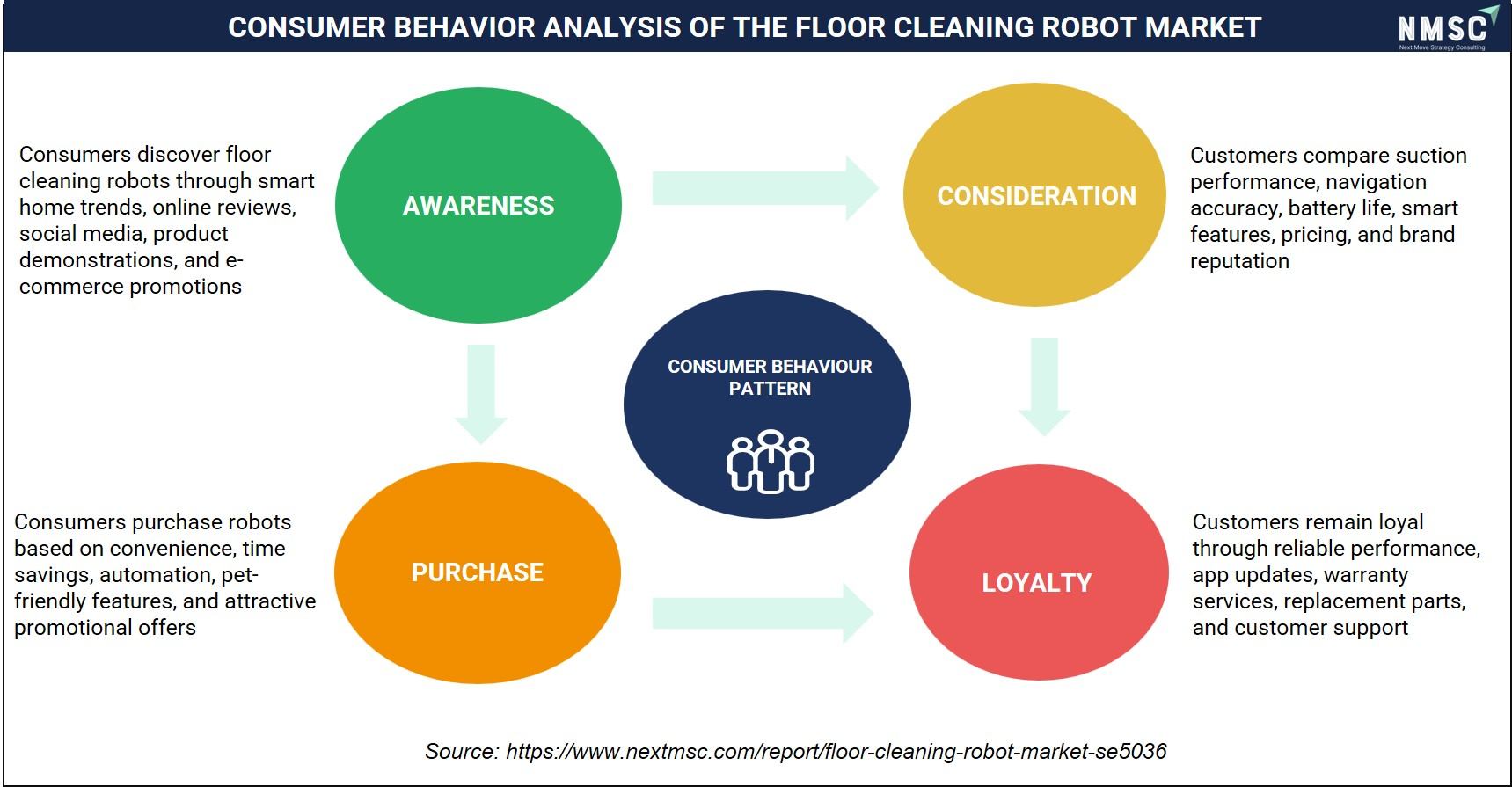
Based on our comprehensive assessment, we found that consumers increasingly adopt floor cleaning robots to improve household convenience, reduce cleaning effort, and save time. Purchase decisions are influenced by navigation accuracy, suction performance, battery life, smart connectivity, and brand reputation. Our analysis indicates that online reviews, product demonstrations, after-sales support, and continuous software updates significantly influence customer loyalty and repeat purchases.
What Are the Key Market Drivers, Breakthroughs, and Investment Opportunities that Will Shape the Floor Cleaning Robot Market in the Next Decade?
|
Drivers / Trends / Restraints |
(+/-) % Impact on CAGR Forecast |
Geographic Relevance |
Impact Timeline |
|
Rising Labor Costs in Commercial Cleaning |
+2.4% |
North America, Europe, APAC |
2025–2030 |
|
Smart Home Ecosystem Expansion |
+1.8% |
Global |
2025–2035 |
|
LiDAR Cost Reduction and Sensor Fusion Adoption |
+1.6% |
APAC, North America, Europe |
2025–2030 |
|
Robot as a Service (RaaS) Business Model Growth |
+1.4% |
North America, Europe |
2026–2035 |
|
Healthcare Hygiene Compliance Requirements |
+1.2% |
North America, Europe, APAC |
2025–2035 |
|
High Upfront Capital Cost for Commercial Systems |
-1.4% |
MEA, Latin America, SMB globally |
2025–2028 |
|
Consumer Skepticism Toward Robot Performance |
-0.8% |
Europe, North America |
Ongoing |
|
AI-Enabled Personalized Cleaning Intelligence |
+1.6% |
Global |
2026–2035 |
|
GCC Smart City and Hospitality Infrastructure Investment |
+1.0% |
Saudi Arabia, UAE, Qatar |
2026–2032 |
|
Emerging Market Household Penetration Growth |
+0.9% |
India, Southeast Asia, Latin America |
2027–2035 |
What Are the Growth Drivers of the Floor Cleaning Robot Market?
How Are Rising Global Labor Costs Accelerating the Adoption of Floor Cleaning Robot Solutions?
Rising labor costs represent one of the most powerful structural drivers propelling investment in the Floor Cleaning Robot Market across commercial segments. Based on NMSC's research, we found that the U.S. Bureau of Labor Statistics has consistently documented year-over-year wage growth in building and grounds cleaning occupations, creating compelling economic incentives for facility operators to evaluate autonomous cleaning technologies. Hospitality groups, retail chains, and airport operators are deploying commercial floor cleaning robots as cost-reduction instruments that deliver consistent cleaning performance across large-area environments while reducing dependence on hourly cleaning staff.
How Is Smart Home Ecosystem Expansion Driving Residential Floor Cleaning Robot Demand?
The rapid global expansion of smart home ecosystems is generating sustained demand for Floor Cleaning Robot solutions at the residential level. Our findings suggest that integration with platforms such as Amazon Alexa, Google Home, and Apple HomeKit has fundamentally transformed consumer expectations, enabling voice-activated scheduling, room-specific cleaning commands, and whole-home automation coordination. According to the Consumer Technology Association, U.S. consumer smart home device spending has grown significantly over consecutive years, with cleaning robots emerging as a top-selling product category in the connected home segment alongside smart speakers and thermostats.
How Are LiDAR Cost Reductions and Sensor Fusion Technologies Reshaping the Floor Cleaning Robot Competitive Landscape?
Rapid cost reductions in LiDAR sensors and the advancement of sensor fusion architectures are structurally expanding the addressable market for the Floor Cleaning Robot industry. Our assessment indicates that the commercialization of solid-state LiDAR chips, originally driven by automotive industry investment, has enabled manufacturers to incorporate precise 360-degree distance sensing at sub-50 USD component costs, democratizing premium navigation capabilities. Sensor fusion combining LiDAR, RGB cameras, ultrasonic sensors, and infrared cliff detection enables robots to navigate complex environments including multi-level apartments, pet-occupied homes, and obstacle-dense commercial facilities.
What Are the Growth Inhibitors of the Floor Cleaning Robot Market?
How Does the High Upfront Capital Cost of Commercial Floor Cleaning Robots Limit Market Penetration in Developing Economies?
Despite long-term cost advantages, high upfront capital expenditure for commercial floor cleaning robots remains a significant barrier constraining market expansion across SMB operators and developing-economy buyers. Through NMSC's assessment, we found that enterprise-grade robotic scrubber dryers and sweepers from manufacturers such as Tennant and Nilfisk are typically priced between USD 30,000 and USD 80,000 per unit, placing them beyond the immediate budget range of many small facility operators in Latin America, Southeast Asia, and Africa. The U.S. Small Business Administration has documented that capital investment barriers disproportionately affect SMB expansion in service industries, a dynamic applicable to commercial floor cleaning robot procurement.
How Does Consumer Skepticism About Robot Cleaning Performance Restrain Household Floor Cleaning Robot Adoption?
Despite technological progress, persistent consumer skepticism about the ability of floor cleaning robots to fully replace manual vacuuming and mopping continues to constrain residential market penetration beyond early adopter segments in certain markets. Our analysis shows that performance concerns are particularly concentrated around deep carpet cleaning effectiveness, corner and edge coverage, and mopping quality on heavily soiled surfaces. Consumer surveys conducted by national consumer protection organizations in Europe and North America have consistently identified cleaning thoroughness and noise levels as primary objections among hesitant buyer groups, highlighting ongoing innovation requirements for manufacturers targeting mainstream household adoption.
What Are the Growth Opportunities in the Floor Cleaning Robot Market?
How Does the Rapid Expansion of Healthcare Facility Automation Create a Structural Opportunity in the Floor Cleaning Robot Market?
The healthcare sector presents a structurally significant growth opportunity for the Floor Cleaning Robot Market, driven by escalating hospital-acquired infection prevention mandates and growing facility management automation investment. Through NMSC's assessment, we found that the U.S. Centers for Disease Control and Prevention (CDC) identifies environmental cleaning as a critical component of infection control protocols in acute care facilities. Autonomous floor cleaning robots capable of programmable disinfection routines, zone-specific cleaning scheduling, and integration with hospital management systems are gaining procurement attention from hospital networks seeking to standardize hygiene delivery while reducing reliance on manual cleaning staff.
How Does Digital Infrastructure Investment in Emerging Markets Generate Demand for Floor Cleaning Robots?
Rapid urban infrastructure development across India, Southeast Asia, and the Gulf Cooperation Council is creating durable demand for Floor Cleaning Robot deployments in newly constructed commercial facilities including airports, hotels, shopping malls, and corporate campuses. Our findings suggest that India's Smart Cities Mission, coordinated by the Ministry of Housing and Urban Affairs, incorporates smart facility management as an integrated component of urban infrastructure planning, generating institutional demand for autonomous cleaning technology within public buildings and transit hubs. Similar infrastructure investment programs across Saudi Arabia, UAE, and Indonesia are embedding commercial cleaning robotics into large-scale facility management contracts.
How Do Advances in Battery Technology and Edge AI Create Product Innovation Opportunities in the Floor Cleaning Robot Market?
Converging advances in lithium battery energy density and edge AI processing are enabling a new generation of Floor Cleaning Robot products with longer operational run times, faster recharge cycles, and substantially enhanced on-device intelligence. Based on our market evaluation, we noticed that the U.S. Department of Energy has documented consistent improvements in lithium-ion cell energy density, with commercial battery production increasingly delivering cells that offer greater capacity at lower weight and cost than previous generations. For floor cleaning robots, these gains translate into extended single-charge cleaning coverage, enabling whole-home or large commercial bay completion within a single operating cycle.
How Is the Floor Cleaning Robot Market Segmented in This Report, and What Are the Key Insights from the Segmentation Analysis?
How Do Residential and Commercial Product Classes Define the Competitive Structure of the Floor Cleaning Robot Market?
|
Product Class Segment |
2025 (USD Bn) |
2035 (USD Bn) |
CAGR (%) |
|
Residential Floor Cleaning Robots |
9.1 |
33.4 |
13.9% |
|
— Robot Vacuum |
4.8 |
17.2 |
13.6% |
|
— Robot Mop |
1.6 |
6.8 |
15.5% |
|
— Vacuum Mop Robot |
2.2 |
8.4 |
14.5% |
|
— Other Residential |
0.5 |
1.0 |
7.2% |
|
Commercial Floor Cleaning Robots |
3.3 |
15.2 |
16.4% |
|
— Robotic Scrubber Dryer |
1.1 |
5.2 |
16.8% |
|
— Robotic Sweeper |
0.6 |
2.8 |
16.7% |
|
— Robotic Vacuum (Commercial) |
0.7 |
3.2 |
16.4% |
|
— Multi-Function Cleaning Robot |
0.5 |
3.1 |
19.9% |
|
— Other Commercial |
0.4 |
0.9 |
8.4% |
Based on NMSC's research, we found that the Floor Cleaning Robot Market is structured into Residential and Commercial product classes, each encompassing distinct sub-segments. The Residential segment, led by the Robot Vacuum sub-category at USD 4.8 billion in 2025, dominates overall market revenue due to widespread household adoption across North America, Europe, and Asia-Pacific. Vacuum Mop combination robots represent the fastest-growing residential sub-segment at a CAGR of 14.5%, reflecting consumer preference for dual-function cleaning. Within Commercial, the Multi-Function Cleaning Robot sub-segment is expanding fastest at 19.9% CAGR, driven by facility managers requiring consolidated scrubbing, sweeping, and vacuuming capabilities in a single deployable unit.
Which Revenue Streams Are Driving Commercial Model Transformation in the Floor Cleaning Robot Market?
|
Revenue Stream |
2025 (USD Bn) |
2035 (USD Bn) |
CAGR (%) |
|
Hardware |
8.4 |
26.2 |
13.5% |
|
Software and Connectivity |
1.8 |
8.6 |
16.9% |
|
Service and Maintenance |
1.4 |
7.8 |
18.7% |
|
Robot as a Service (RaaS) |
0.8 |
6.0 |
22.4% |
From our market assessment, we observed that the Floor Cleaning Robot Market is segmented into Hardware, Software and Connectivity, Service and Maintenance, and Robot as a Service revenue streams. The Hardware segment remains the largest at USD 8.4 billion in 2025, reflecting the primacy of device unit sales across both residential and commercial markets. Software and Connectivity revenue is growing robustly at 16.9% CAGR, driven by subscription-based cleaning management applications, over-the-air update services, and smart home platform integration fees. Robot as a Service (RaaS) is the standout growth segment at 22.4% CAGR, transforming how commercial operators access and fund autonomous cleaning technology.
How Are Evolving Distribution Channels Reshaping Go-to-Market Strategies in the Floor Cleaning Robot Market?
|
Distribution Channel |
2025 (USD Bn) |
2035 (USD Bn) |
CAGR (%) |
|
Direct to Consumer |
3.8 |
11.4 |
13.0% |
|
E-Commerce Marketplace |
3.6 |
14.2 |
14.8% |
|
Retail Store |
2.4 |
7.2 |
12.9% |
|
Direct Enterprise Sales |
1.2 |
7.4 |
20.0% |
|
Distributor and Dealer |
0.8 |
3.8 |
18.9% |
|
System Integrator |
0.6 |
4.6 |
22.7% |
Our analysis shows that the Floor Cleaning Robot Market is served through six distribution channels. E-Commerce Marketplace channels are rapidly approaching parity with direct-to-consumer channels, generating USD 3.6 billion in 2025 and forecast at a 14.8% CAGR, reflecting online retail dominance in Asia-Pacific and North America. Direct Enterprise Sales and System Integrator channels are expanding fastest in the commercial segment, as facility management companies and smart building integrators bundle floor cleaning robots within broader building automation contracts. System Integrators represent the fastest-growing channel overall at 22.7% CAGR, driven by enterprise demand for end-to-end autonomous facility solutions.
How Is Navigation Technology Innovation Defining Product Differentiation in the Floor Cleaning Robot Market?
|
Navigation Technology |
2025 (USD Bn) |
2035 (USD Bn) |
CAGR (%) |
|
Random Navigation |
2.6 |
4.8 |
7.0% |
|
LiDAR Navigation |
4.8 |
18.2 |
14.3% |
|
Vision Navigation |
2.8 |
12.4 |
16.0% |
|
Sensor Fusion Navigation |
1.6 |
10.4 |
20.5% |
|
Other Navigation |
0.6 |
2.8 |
16.7% |
Through NMSC's assessment, we found that navigation technology is a primary dimension of product differentiation across the Floor Cleaning Robot Market. LiDAR Navigation currently dominates at USD 4.8 billion in 2025, benefiting from its established performance reputation and broad adoption across mid-to-premium residential and commercial robots. Random Navigation, the legacy technology of early robot vacuums, is declining in relative market share as consumer expectations shift toward systematic, map-based cleaning. Sensor Fusion Navigation is the fastest-growing technology at 20.5% CAGR, combining multiple sensor modalities to achieve superior mapping precision, dynamic obstacle avoidance, and reliable performance across diverse floor plan complexities.
Which Customer Segments Are Driving Demand Diversification in the Floor Cleaning Robot Market?
|
Customer Type |
2025 (USD Bn) |
2035 (USD Bn) |
CAGR (%) |
|
Household |
9.1 |
30.2 |
12.7% |
|
Hospitality |
0.7 |
3.8 |
18.5% |
|
Retail |
0.4 |
2.4 |
19.6% |
|
Office |
0.6 |
3.2 |
18.3% |
|
Education |
0.2 |
1.2 |
19.6% |
|
Healthcare |
0.4 |
3.0 |
22.3% |
|
Transportation |
0.2 |
1.0 |
17.5% |
|
Manufacturing |
0.3 |
1.6 |
18.3% |
|
Warehousing and Logistics |
0.2 |
1.4 |
21.4% |
|
Government and Public Sector |
0.2 |
0.8 |
14.9% |
|
Other Commercial End Users |
0.1 |
0.6 |
16.5% |
Based on our market evaluation, we noticed that the Floor Cleaning Robot Market serves a broad spectrum of customer segments ranging from individual households to complex commercial environments. The Household segment commands the largest revenue share at USD 9.1 billion in 2025, anchored by consumer adoption of robot vacuums and vacuum-mop combination robots. Healthcare is the fastest-growing commercial customer segment at 22.3% CAGR, driven by rigorous hygiene compliance requirements. Warehousing and Logistics is the second-fastest-growing segment at 21.4% CAGR, reflecting e-commerce distribution center demand for autonomous floor maintenance in high-throughput operational environments.
Regional Outlook
Geographic Performance Snapshot
|
Region |
2025 (USD Bn) |
2035 (USD Bn) |
CAGR (%) |
Key Driver |
|
North America |
4.2 |
14.8 |
13.5% |
Smart home adoption, commercial labor cost optimization |
|
Europe |
2.6 |
8.4 |
12.5% |
CE compliance, sustainability mandates, premium consumer adoption |
|
Asia-Pacific |
4.4 |
18.8 |
15.6% |
China manufacturing dominance, household penetration in emerging APAC |
|
Middle East & Africa |
0.6 |
3.4 |
19.0% |
Vision 2030, smart hospitality, GCC commercial real estate growth |
|
Latin America |
0.6 |
3.2 |
18.3% |
Urban expansion, rising e-commerce, growing middle class |
North America Floor Cleaning Robot Market
North America is a leading region in the Floor Cleaning Robot Market, generating USD 4.2 billion in 2025 and projected to reach USD 14.8 billion by 2035 at a CAGR of 13.5%. The region benefits from high smart home adoption rates, significant e-commerce penetration, and strong institutional investment in commercial facility automation. Regulatory maturity under consumer product safety frameworks and growing interest in sustainable building management practices are reinforcing autonomous floor care adoption across hospitality, healthcare, and corporate real estate sectors throughout the United States, Canada, and Mexico.
U.S. Floor Cleaning Robot Market
Based on our engagements with industry stakeholders, the United States represents the largest single country market in North America for floor cleaning robots, accounting for approximately 78% of regional revenue in 2025. High consumer smart home penetration, a well-developed e-commerce infrastructure led by Amazon's marketplace ecosystem, and rising interest in commercial facility automation underpin strong market demand. The U.S. Consumer Product Safety Commission enforces product safety standards applicable to household robots. Federal and state labor cost increases are accelerating commercial floor cleaning robot ROI calculations across healthcare, hospitality, and logistics sectors.
Canada Floor Cleaning Robot Market
Through our analysis, Canada's floor cleaning robot market is experiencing steady growth at a CAGR aligned with the North American regional average. Canadian consumers demonstrate strong adoption of connected home devices supported by high broadband penetration and urban smart home infrastructure. Retail channel distribution through major electronics retailers and e-commerce platforms is well-established. The Government of Canada's Smart Cities Challenge program and infrastructure modernization investments are generating institutional procurement interest in autonomous cleaning solutions for public facilities, transportation hubs, and government-operated commercial spaces.
Mexico Floor Cleaning Robot Market
From our assessment, Mexico represents the fastest-growing market within North America at a CAGR of 18.0% from 2026 to 2035, driven by urbanization, expanding middle-class disposable incomes, and growing e-commerce infrastructure. Commercial adoption is emerging within luxury hospitality and manufacturing facilities driven by nearshoring activity, where multinational corporations operate large factory floor environments suited to autonomous sweeping and scrubbing deployment. Mexico's Federal Law on Protection of Personal Data is creating initial governance considerations for connected floor cleaning robot data flows.
Europe Floor Cleaning Robot Market
Europe's Floor Cleaning Robot Market generated USD 2.6 billion in 2025 and is projected to reach USD 8.4 billion by 2035 at a CAGR of 12.5%. The region is characterized by premium consumer preferences, strict CE marking and electromagnetic compatibility compliance requirements, and growing regulatory focus on sustainable product design and battery recyclability under the EU Battery Regulation. Commercial adoption within hotels, airports, and healthcare facilities is advancing steadily, with robot-as-a-service models gaining traction among European facility management groups seeking opex-aligned procurement for large-area commercial cleaning technology.
U.K. Floor Cleaning Robot Market
Based on our engagements, the United Kingdom represents Europe's largest individual market for floor cleaning robots, driven by high household broadband penetration, strong consumer electronics spending, and a well-developed online retail ecosystem. Post-Brexit, the UK maintains product safety conformity under UKCA marking requirements equivalent to EU CE standards. British consumers exhibit strong awareness of premium robotic cleaning brands. The UK's National Health Service is an emerging institutional buyer for autonomous floor cleaning solutions within NHS trusts investing in infection control and facility management efficiency programs.
Germany Floor Cleaning Robot Market
Through our analysis, Germany is the second-largest European floor cleaning robot market, supported by a technically sophisticated consumer base, high smart home adoption, and a strong domestic manufacturing and engineering culture. German consumers place significant emphasis on cleaning performance benchmarks, durability, and data privacy, influencing which global brands achieve market traction. The German Federal Office for Information Security (BSI) has issued guidance on IoT product cybersecurity applicable to connected household robots, creating compliance awareness among importers and retailers active in the German market.
France Floor Cleaning Robot Market
According to evaluation, France's floor cleaning robot market is expanding at a steady pace, supported by growing urban household adoption, government smart home energy efficiency incentives, and increasing hospitality sector automation investment. French consumers are increasingly responsive to vacuum-mop combination products that simplify maintenance of parquet and tile flooring prevalent in French residential architecture. Commercial adoption is advancing within the luxury hospitality and retail sectors, where brands prioritize consistent cleaning standards and reduced operational dependencies on manual cleaning staff.
Italy Floor Cleaning Robot Market
Based on our engagements, Italy's floor cleaning robot market is growing consistently, driven by rising consumer demand for smart home appliances and expanding distribution through electronics retailers and e-commerce platforms. The prevalence of tile and stone flooring in Italian households creates specific product requirements for mopping capability and wet surface performance, favoring vacuum-mop robots and dedicated mop robot models. Commercial adoption is emerging in Italian hospitality, healthcare, and airport environments where automation investments align with tourism industry recovery and operational cost management priorities.
Spain Floor Cleaning Robot Market
Through our analysis, Spain's floor cleaning robot market is experiencing healthy growth supported by increasing smart home device adoption, e-commerce channel expansion, and growing commercial facility management interest in autonomous cleaning. Spanish hospitality and retail sectors are active commercial adopters driven by tourism volume and the need for consistent cleaning standards across large-format commercial environments. Spain's implementation of EU WEEE and Battery Directives creates end-of-life compliance requirements relevant to floor cleaning robot retailers and importers.
Sweden Floor Cleaning Robot Market
From our assessment, Sweden represents one of Northern Europe's most advanced floor cleaning robot adoption markets, underpinned by exceptionally high broadband penetration, strong smart home device ownership, and consumer appetite for automation and sustainability-aligned household technology. Swedish consumers demonstrate above-average premium product acceptance, supporting strong revenue per unit. Government procurement programs for autonomous facility management solutions within Swedish public hospitals, schools, and government buildings are contributing to institutional demand growth within the commercial floor cleaning robot segment.
Denmark Floor Cleaning Robot Market
According to evaluation, Denmark's floor cleaning robot market benefits from high consumer technology adoption rates, sustainability-focused purchasing behavior, and a well-connected smart home ecosystem. Danish institutional buyers in the healthcare and education sectors are exploring autonomous cleaning robots as components of broader facility digitalization programs. The Danish government's green transition agenda supports investment in energy-efficient cleaning technologies, positioning low-energy-consumption floor cleaning robots as aligned with national environmental priorities.
Finland Floor Cleaning Robot Market
Based on our engagements, Finland's floor cleaning robot market is driven by technology-positive consumer attitudes, high-income household spending on smart appliances, and growing institutional interest in autonomous facility management. Finnish public sector buyers, including hospital districts and municipal facilities, are exploring autonomous floor cleaning solutions as part of smart building initiatives. Connectivity infrastructure quality in Finland supports the integration of floor cleaning robots within cloud-managed facility operations systems.
Netherlands Floor Cleaning Robot Market
Through our analysis, the Netherlands represents a well-developed European market for floor cleaning robots, supported by high urban household density, strong e-commerce penetration, and active smart home technology adoption. Dutch consumers demonstrate strong interest in premium vacuum-mop combination robots suited to hard floors prevalent in Dutch residential environments. Commercial adoption is driven by the logistics and warehousing sector, where the Netherlands's position as Europe's logistics gateway creates demand for autonomous floor maintenance in large distribution center environments.
Rest of Europe Floor Cleaning Robot Market
From our assessment, the Rest of Europe segment encompasses emerging floor cleaning robot markets across Eastern Europe, including Poland, Czech Republic, Romania, and the Baltics, as well as Southern European markets such as Portugal and Greece. These markets are at earlier technology adoption stages but are experiencing accelerating growth as e-commerce expands distribution access, middle-class incomes grow, and awareness of smart home technology increases. Commercial adoption within the tourism-driven hospitality sectors of Greece and Portugal is contributing incremental commercial floor cleaning robot demand.
Asia-Pacific Floor Cleaning Robot Market
Asia-Pacific is the largest regional market for floor cleaning robots, generating USD 4.4 billion in 2025 and projected to reach USD 18.8 billion by 2035 at a CAGR of 15.6%. The region benefits from the global concentration of floor cleaning robot manufacturing capability in China, exceptionally high household robot penetration in Japan and South Korea, and rapidly growing middle-class consumer demand across Southeast Asia and India. Asia-Pacific also leads in technology innovation, with Chinese manufacturers including Roborock, ECOVACS, and Dreame Technology continuously advancing navigation, AI, and cleaning performance standards.
China Floor Cleaning Robot Market
Based on our engagements, China is the world's largest floor cleaning robot market by both production volume and domestic consumption, with a highly competitive landscape led by Beijing Roborock Technology, ECOVACS Robotics, and Dreame Technology. Chinese consumers demonstrate strong early adopter characteristics, high acceptance of smart home connectivity, and price sensitivity favoring technology-rich mid-range products. The Ministry of Industry and Information Technology's support for intelligent home appliance development provides policy tailwinds. China's extensive e-commerce infrastructure, including JD.com and Tmall, drives rapid product launch cycles and direct consumer reach.
India Floor Cleaning Robot Market
Through our analysis, India is the fastest-growing national floor cleaning robot market at a CAGR of 22.0% from 2026 to 2035, driven by rapid urbanization, rising household income levels, expanding e-commerce penetration, and growing awareness of smart home automation. The Ministry of Housing and Urban Affairs' Smart Cities Mission creates institutional demand for commercial autonomous cleaning within smart public facilities. India's large and youthful consumer base, combined with increasing smartphone adoption supporting app-connected cleaning robots, positions the country as a high-priority growth market for global floor cleaning robot manufacturers.
Japan Floor Cleaning Robot Market
According to evaluation, Japan maintains one of the world's highest household floor cleaning robot penetration rates, supported by a technology-positive consumer culture, high urbanization, and strong domestic brands including Panasonic and Toshiba alongside international competitors. Japan's aging population creates specific demand for autonomous household assistance devices, with floor cleaning robots offering independence maintenance value for elderly consumers. Commercial adoption is well-established across Japanese office, hospitality, and retail environments, where Softbank Robotics' commercial cleaning platforms maintain strong institutional presence.
South Korea Floor Cleaning Robot Market
From our assessment, South Korea is one of Asia-Pacific's most advanced floor cleaning robot adoption markets, characterized by high smartphone ownership, strong smart home ecosystem integration through Samsung SmartThings, and a tech-savvy consumer base with above-average premium robot acceptance. Samsung Electronics is a key domestic manufacturer with strong brand trust. South Korean housing characteristics, predominantly high-rise apartment buildings with hard tile floors, favor robot mop and vacuum-mop combination products. Government investment in service robotics under Korea's K-Robot strategy supports continued market development.
Taiwan Floor Cleaning Robot Market
Based on our engagements, Taiwan's floor cleaning robot market benefits from high consumer technology adoption, compact urban living spaces well-suited to autonomous floor cleaning, and proximity to component supply chains that support competitive product pricing. Taiwan's robust electronics manufacturing ecosystem creates favorable conditions for floor cleaning robot assembly and innovation. Commercial adoption in office buildings, retail centers, and hospitality venues is growing, supported by Taiwan's sophisticated urban infrastructure and facility management professionalism.
Indonesia Floor Cleaning Robot Market
Through our analysis, Indonesia is an emerging floor cleaning robot market experiencing rapid growth driven by urbanization, expanding middle-class household formation, and increasing smartphone-driven e-commerce access. The Indonesian government's Making Indonesia 4.0 initiative and digital economy investment program create a favorable policy environment for smart home technology adoption. Commercial adoption is at an early stage, concentrated within luxury hotels and large retail chains in Jakarta and Surabaya, where operational efficiency and consistent cleaning standards drive investment interest.
Vietnam Floor Cleaning Robot Market
According to evaluation, Vietnam's floor cleaning robot market is at an early but rapidly expanding stage, driven by urban household income growth, rising e-commerce adoption, and growing consumer awareness of smart home technology among young urban demographics. The Vietnamese government's national digital transformation program is stimulating broader technology adoption across Vietnamese households. Chinese-manufactured entry-level floor cleaning robots are gaining rapid traction through Vietnamese e-commerce platforms, establishing initial household penetration that is expected to evolve toward premium product adoption over the forecast period.
Australia Floor Cleaning Robot Market
From our assessment, Australia's floor cleaning robot market demonstrates strong and consistent growth, underpinned by high consumer spending power, broad smart home device awareness, and a well-developed retail and e-commerce distribution ecosystem. Australian consumers are receptive to premium navigation technology including LiDAR and sensor fusion robots. Commercial adoption is active across healthcare, hospitality, and airport facility management environments. Australian consumer electronics retailers and online marketplaces provide effective distribution infrastructure for global floor cleaning robot brands accessing the Australian market.
Philippines Floor Cleaning Robot Market
Based on our engagements, the Philippines represents a growing floor cleaning robot market driven by urban income expansion among Manila's emerging middle class, increasing smartphone adoption, and growing e-commerce infrastructure. Consumer adoption is currently concentrated among upper-income urban households, with mass-market growth expected to accelerate as product price points decline over the forecast period. Commercial deployment in business process outsourcing office environments and luxury hotel properties in Metro Manila represents an emerging institutional demand driver for the Philippine floor cleaning robot sector.
Malaysia Floor Cleaning Robot Market
Through our analysis, Malaysia's floor cleaning robot market is expanding at a healthy growth rate supported by increasing digital literacy, strong e-commerce infrastructure, and government promotion of smart home and Industry 4.0 adoption. Malaysian consumers in urban centers including Kuala Lumpur and Penang are demonstrating growing interest in smart home automation, with floor cleaning robots achieving rising brand recognition. Commercial adoption in the Malaysian hospitality sector, particularly large resort and hotel complexes, is contributing incremental professional cleaning robot demand aligned with Malaysia's tourism development strategy.
Rest of Asia-Pacific Floor Cleaning Robot Market
From our assessment, the Rest of Asia-Pacific segment encompasses developing floor cleaning robot markets in markets including Bangladesh, Sri Lanka, Thailand, Myanmar, Cambodia, New Zealand, and Pacific Island nations. Thailand demonstrates particularly active consumer electronics adoption and commercial hospitality sector demand. New Zealand's high-income consumer base supports premium product adoption. These markets collectively represent meaningful incremental demand growth over the forecast period as e-commerce distribution infrastructure expands and consumer awareness of autonomous floor cleaning technology increases.
Middle East and Africa Floor Cleaning Robot Market
The Middle East and Africa region is the fastest-growing regional market for floor cleaning robots, generating USD 0.6 billion in 2025 and projected to reach USD 3.4 billion by 2035 at a CAGR of 19.0%. Growth is anchored by GCC country investments in smart city infrastructure, luxury hospitality expansion driven by Vision 2030 and UAE tourism ambitions, and rising commercial real estate development across Saudi Arabia, UAE, and Qatar. Africa represents an early-stage market where South Africa and Nigeria are emerging commercial adoption centers, supported by urbanization and growing institutional facility management investment.
Saudi Arabia Floor Cleaning Robot Market
Based on our engagements, Saudi Arabia is the largest floor cleaning robot market within the Middle East and Africa region, driven by Vision 2030 infrastructure investments, luxury hospitality development across NEOM and Red Sea tourism projects, and growing consumer smart home adoption among Saudi's young urban population. The Saudi Standards, Metrology and Quality Organization (SASO) enforces product compliance standards applicable to imported floor cleaning robots. Commercial deployments in airports, shopping malls, and hotels are expanding rapidly as Saudi facility management companies integrate autonomous cleaning into smart building frameworks.
UAE Floor Cleaning Robot Market
Through our analysis, the UAE is a technologically advanced and commercially dynamic floor cleaning robot market, supported by one of the world's highest smart home adoption rates relative to population, world-class hospitality and retail infrastructure, and strong government commitment to AI and automation under the UAE's National Artificial Intelligence Strategy. Dubai International Airport and Abu Dhabi International Airport represent high-profile commercial deployment environments. The UAE's Central Bank digital economy initiatives and smart building standards are embedding autonomous cleaning technology within premium facility management programs.
Egypt Floor Cleaning Robot Market
According to evaluation, Egypt's floor cleaning robot market is at an early adoption stage, with commercial deployment concentrated within luxury hotels, shopping malls, and modern commercial facilities in Cairo, Alexandria, and Sharm el-Sheikh. Egypt's New Administrative Capital development program is creating large-scale facility management opportunities aligned with smart building specifications that increasingly incorporate autonomous cleaning technology. Rising urban middle-class income levels and improving e-commerce infrastructure are beginning to generate initial residential household adoption of entry-level floor cleaning robot models.
Israel Floor Cleaning Robot Market
From our assessment, Israel maintains a technologically sophisticated consumer base with above-average smart home and connected device adoption, supporting strong floor cleaning robot market penetration relative to population size. Israeli consumers demonstrate high acceptance of navigation-advanced LiDAR and sensor fusion robots. Israel's technology ecosystem, anchored by a robust startup innovation culture, also generates demand for commercial cleaning automation R&D partnerships. Commercial adoption is advancing in healthcare facilities, office buildings, and data center environments where consistent automated cleaning is operationally valuable.
Turkey Floor Cleaning Robot Market
Based on our engagements, Turkey represents a growing floor cleaning robot market at the intersection of Europe and the Middle East, supported by a young urban consumer population, expanding middle-class spending power, and active e-commerce market development. Istanbul's large urban population and modern retail and hospitality infrastructure create meaningful commercial adoption opportunities. Turkey's domestic electronics retail sector provides effective brick-and-mortar distribution for floor cleaning robot brands, while cross-border e-commerce platforms are enabling access to Chinese-manufactured competitive products.
Nigeria Floor Cleaning Robot Market
Through our analysis, Nigeria represents Africa's most populous emerging floor cleaning robot market, with commercial adoption led by hospitality, banking, and premium office sectors in Lagos and Abuja. The Nigerian e-commerce ecosystem, anchored by platforms including Jumia, is enabling initial residential product access for high-income urban consumers. Institutional demand for commercial cleaning automation is growing within multinational-operated facilities applying global facility management standards. Nigeria's urban population growth trajectory supports long-term floor cleaning robot market expansion over the forecast period.
South Africa Floor Cleaning Robot Market
According to evaluation, South Africa is sub-Saharan Africa's most developed floor cleaning robot market, supported by relatively higher consumer spending power among urban households, modern retail infrastructure, and established commercial facility management practices. Johannesburg and Cape Town represent primary commercial and consumer adoption centers. South African healthcare facilities, including private hospital networks, are emerging institutional buyers of autonomous floor cleaning solutions aligned with infection control programs. E-commerce growth through retailers including Takealot is improving residential product accessibility across major urban centers.
Rest of MEA Floor Cleaning Robot Market
From our assessment, the Rest of Middle East and Africa segment encompasses developing floor cleaning robot markets across Qatar, Kuwait, Bahrain, Oman, Kenya, Ethiopia, Ghana, and Morocco. GCC nations including Qatar and Kuwait are active commercial adopters within luxury hospitality and infrastructure sectors aligned with ongoing national development programs. Morocco's developing manufacturing base and growing tourism sector create incremental commercial demand. Sub-Saharan African markets including Kenya and Ghana are at earliest-stage adoption, with institutional commercial buyers leading initial procurement activity in international-standard hotels and commercial facilities.
Latin America Floor Cleaning Robot Market
Latin America's Floor Cleaning Robot Market generated USD 0.6 billion in 2025 and is projected to reach USD 3.2 billion by 2035 at a CAGR of 18.3%. The region is experiencing accelerating growth driven by urbanization, expanding internet and e-commerce infrastructure, rising middle-class disposable income, and growing commercial hospitality and retail sector demand. Brazil and Mexico are the dominant markets, while Argentina, Chile, and Colombia represent fast-developing secondary markets where consumer awareness and commercial institutional adoption are increasing steadily over the forecast horizon.
Brazil Floor Cleaning Robot Market
Based on our engagements, Brazil is Latin America's largest floor cleaning robot market, supported by a large urban consumer population, strong e-commerce activity through Mercado Livre and Amazon Brazil, and growing adoption of smart home technology among urban middle-class households. Commercial deployment is advancing within Brazil's large hospitality, retail, and healthcare sectors. Brazil's ANATEL regulatory agency governs radiofrequency compliance requirements applicable to wireless-connected floor cleaning robots, and INMETRO certification is required for consumer electronics product market entry.
Argentina Floor Cleaning Robot Market
Through our analysis, Argentina's floor cleaning robot market is experiencing growth driven by urban consumer technology adoption, despite macroeconomic volatility that periodically constrains discretionary consumer spending. Buenos Aires's tech-savvy urban consumer population represents the primary residential adoption center. Commercial adoption is concentrated in premium hospitality and corporate office environments where international facility management standards drive autonomous cleaning technology investment. E-commerce provides the primary distribution channel as established retail penetration by global floor cleaning robot brands remains limited across Argentine markets.
Chile Floor Cleaning Robot Market
According to evaluation, Chile is one of Latin America's most commercially advanced floor cleaning robot markets, supported by high consumer income levels relative to the regional average, strong e-commerce infrastructure, and active technology adoption within Santiago's urban consumer base. Chile's growing mining and industrial sector creates emerging commercial demand for autonomous floor maintenance in large-facility environments. Government smart city initiatives within Santiago's metropolitan region incorporate facility automation technology that includes commercial floor cleaning robot deployments within public buildings and transport infrastructure.
Colombia Floor Cleaning Robot Market
From our assessment, Colombia's floor cleaning robot market is growing steadily, driven by Bogota and Medellín's expanding urban middle class, increasing smartphone penetration supporting app-connected cleaning robots, and growing e-commerce market maturity. The Colombian commercial real estate sector's continued expansion creates demand for professional cleaning automation in office buildings, shopping centers, and hospitality venues. Colombian consumer electronics retail distribution is improving steadily, enabling global brands greater direct access to Colombian residential consumers interested in smart home cleaning technology.
Rest of Latin America Floor Cleaning Robot Market
Based on our engagements, the Rest of Latin America encompasses developing floor cleaning robot markets across Peru, Ecuador, Uruguay, Paraguay, Bolivia, and Central American nations. Peru and Ecuador demonstrate growing urban middle-class consumer adoption supported by e-commerce platform expansion. Uruguay's relatively high per-capita income and technology adoption rate place it above the regional average for smart home device penetration. Central American markets including Costa Rica and Panama are emerging early-stage commercial adopters within their respective luxury hospitality sectors, driven by tourism industry investment.
Porter’s Five Forces Analysis of the Floor Cleaning Robot Market
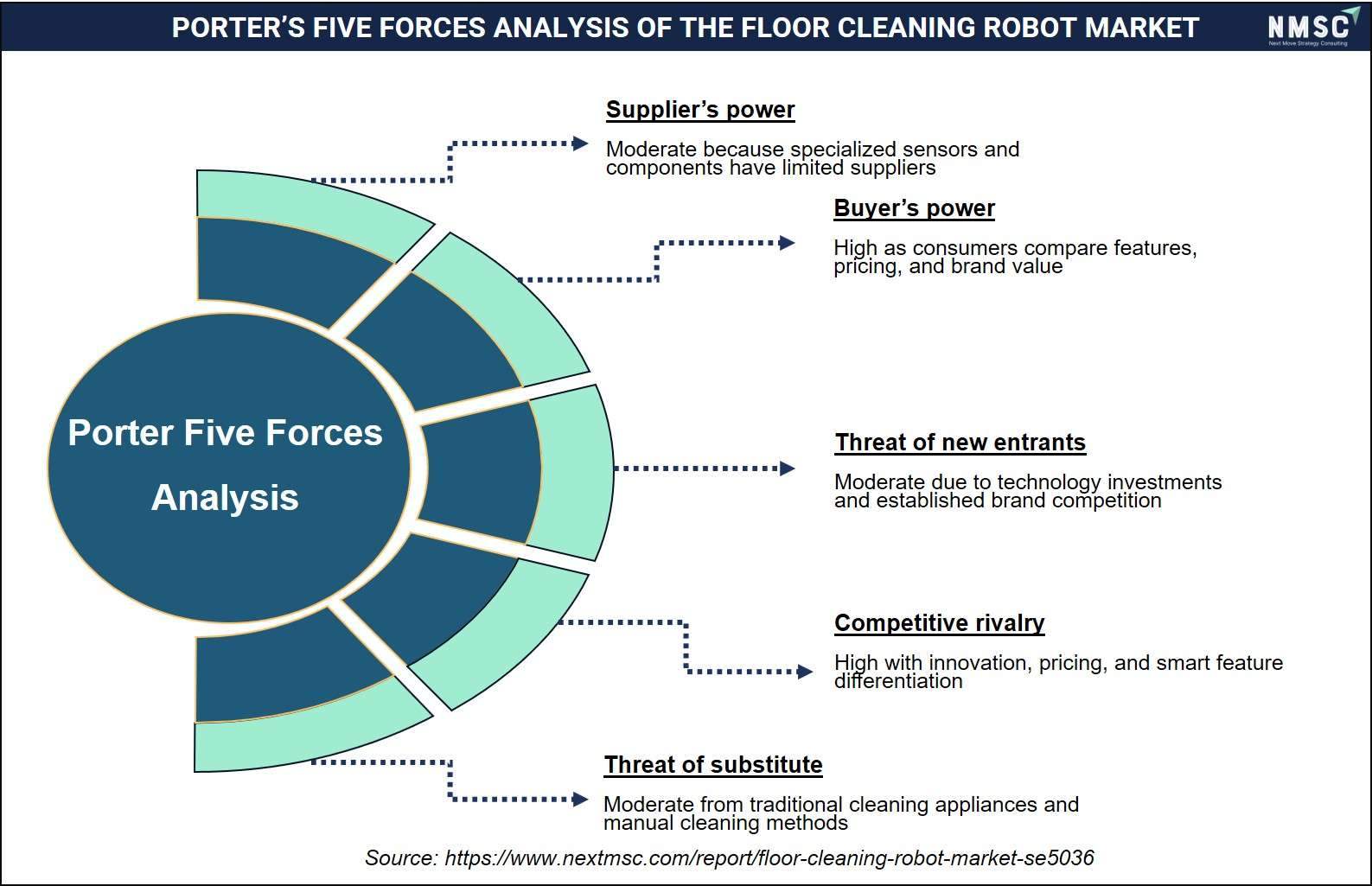
Based on our comprehensive assessment, we found that competitive rivalry remains high due to continuous innovation and numerous global manufacturers. Buyer bargaining power is moderate as consumers compare features and pricing extensively. Supplier power remains moderate because of dependence on sensors, batteries, and semiconductor components. Threat of substitutes is moderate, while barriers related to technology development and brand recognition limit new market entrants.
Competitive Landscape
Competitive Dynamics and M&A Landscape
|
Key Takeaways |
Details |
|
Market Structure |
Fragmented-to-moderately concentrated; dominated by Chinese consumer robot manufacturers in the residential segment and specialized commercial cleaning equipment companies in the professional segment. Top 10 players account for approximately 65% of total market revenue. |
|
Innovation Focus |
AI-powered navigation, self-cleaning mop station technology, sensor fusion, edge AI processing, voice assistant integration, cloud-based fleet management, and RaaS business model development. |
|
M&A Activity |
Strategic acquisitions of navigation software startups, technology licensing agreements, and OEM manufacturing partnerships between consumer robot brands and commercial cleaning equipment manufacturers. Private equity interest in RaaS-enabled commercial cleaning platforms is increasing. |
How Do Companies Compete in the Floor Cleaning Robot Market?
The Floor Cleaning Robot Market features a diverse competitive structure encompassing Chinese consumer robot specialists, legacy commercial cleaning equipment manufacturers, and emerging RaaS-focused startups. NMSC's analysis indicates that the residential segment is dominated by technology-forward Chinese brands including Roborock, ECOVACS, and Dreame, which compete aggressively on AI navigation capability, cleaning performance, app ecosystem richness, and competitive pricing. The commercial segment features a distinct competitive dynamic where Tennant, Nilfisk, and Kärcher leverage established facility management relationships, service networks, and proven industrial-grade equipment standards against newer autonomous robot entrants.
Which Kind of Companies Dominate the Floor Cleaning Robot Market?
The Floor Cleaning Robot Market is dominated by specialized consumer robotics companies and established commercial cleaning equipment manufacturers that have successfully integrated autonomous navigation capabilities. Chinese consumer robot manufacturers including Roborock, ECOVACS, Dreame, Narwal, and Xiaomi lead the residential segment through relentless technology iteration, strong direct-to-consumer and e-commerce distribution, and highly competitive price-performance positioning. In the commercial segment, industrial equipment manufacturers and robotics-focused companies including Tennant, Nilfisk, Kärcher, Avidbots, and SoftBank Robotics dominate through established service infrastructure, enterprise procurement relationships, and compliance with commercial facility management standards.
AI-Native Differentiation and Open Standards Drive Market Success in the Floor Cleaning Robot Market
NMSC's analysis indicates that AI-native product architecture is becoming the primary commercial differentiator across the Floor Cleaning Robot Market. Companies that have embedded on-device machine learning for real-time environment recognition, predictive maintenance, and adaptive cleaning decision-making are achieving superior user satisfaction metrics and faster product adoption. Simultaneously, compatibility with open smart home standards including Matter and Thread is becoming a commercial prerequisite in the residential segment as consumers demand seamless ecosystem integration. Companies investing in open standard compliance and proprietary AI simultaneously are best positioned to capture premium market positioning over the forecast period.
Market Players to Opt for Merger and Acquisition Strategies to Expand Their Presence in the Floor Cleaning Robot Market
Strategic acquisitions are increasingly shaping competitive positioning in the Floor Cleaning Robot Market. From our research, we found that consumer robot brands are acquiring navigation software startups and AI computer vision companies to accelerate in-house capability development. Commercial equipment manufacturers are pursuing technology licensing and joint development agreements with autonomous navigation platform providers to embed smart robotics capabilities within existing product lines. Private equity and strategic investors are funding RaaS-focused commercial cleaning platforms, anticipating that subscription-based revenue models will generate higher multiples and more predictable cash flows than traditional capital equipment sales models.
Who Are the Key Market Players in the Floor Cleaning Robot Market?
-
Beijing Roborock Technology Co., Ltd.
-
ECOVACS Robotics Co., Ltd.
-
Dreame Technology (Tianjin) Co., Ltd.
-
iRobot Corporation
-
Xiaomi Corporation
-
Narwal Robotics Co., Ltd.
-
SharkNinja, Inc.
-
Anker Innovations Technology Co., Ltd.
-
Samsung Electronics Co., Ltd.
-
Dyson Limited
-
Midea Group Co., Ltd.
-
Alfred Kärcher SE & Co. KG
-
Tennant Company
-
Nilfisk A/S
-
Shanghai Gaussian Automation Technology Development Co., Ltd.
-
Shenzhen Pudu Technology Co., Ltd.
-
Avidbots Corp.
-
SoftBank Robotics Group Corp.
-
Bissell Inc.
-
Shenzhen Zhiyi Technology Co., Ltd.
What Are the Latest Developments in the Floor Cleaning Robot Market?
|
Date |
Company / Event |
|
June 2026 |
Dreame Technology launched the L50s Pro Ultra and L50 Ultra CE in the Indian market, setting new standards for suction performance with up to 30,000 Pa capacity. The launch emphasizes Dreame’s focus on Vormax™ suction technology and "dual flex arm" systems designed for edge-to-corner cleaning, as the company seeks to capture market share through aggressive global expansion and premium product differentiation. |
|
May 2026 |
In a strategic move to dominate commercial floor care, Tennant Company announced a 3-year exclusivity extension with Brain Corp. The partnership focuses on accelerating the development of 10 new robotic products over the next 24 months, with an explicit goal to build Tennant's autonomous equipment portfolio into a USD 250 million business by 2028 |
|
January 2026 |
Pudu Robotics celebrated its 10th anniversary, surpassing 120,000 cumulative units shipped across its portfolio. The company highlighted the deployment of its Pudu CC1 Pro, a 4-in-1 "always-on" commercial cleaning robot, which utilizes AI to adjust to specific floor conditions and contamination levels, significantly reducing manual labor hours and chemical detergent waste by up to 90% in hospitality and retail environments. |
Expert Insights
 “These advancements allow us to take a significant technological step forward in how autonomous cleaning robots perceive and interact with their surroundings. With the next generation, we are setting new benchmarks particularly in the areas of safety, object recognition and environmental awareness — capabilities that are essential for reliable operation in complex, real-world environments.”
— Joel Wirth, Head of Marketing Robotics, Cleanfix
Statement made during the announcement of Cleanfix Robotics' next-generation autonomous cleaning robot platform, highlighting advances in perception, safety, and environmental awareness technologies.
Market Interpretation
The comment highlights the increasing focus on intelligent navigation, obstacle detection, and operational safety within the floor cleaning robot industry. Manufacturers are integrating advanced sensing technologies, artificial intelligence, and environmental perception capabilities to improve robot performance in complex indoor environments. Enhanced object recognition and navigation systems enable autonomous cleaning robots to operate more efficiently, minimize collisions, and adapt to dynamic surroundings. As commercial and industrial users increasingly demand reliable, autonomous cleaning solutions, investments in AI-powered perception and safety technologies are expected to accelerate, supporting innovation and growth in the Floor Cleaning Robot Market.
What Are the Investment Opportunities in the Floor Cleaning Robot Market?
Capital Inflows and Venture Activity
The Floor Cleaning Robot Market continues to attract substantial investment from venture capital firms, private equity investors, and strategic corporate stakeholders as demand for intelligent cleaning automation accelerates across residential, commercial, and industrial environments. Major manufacturers including Roborock, Dreame Technology, Ecovacs, and Narwal have expanded investment in artificial intelligence, navigation systems, and product innovation to strengthen competitive positioning and support global market expansion. We noticed that investor interest remains particularly strong in autonomous robotics platforms, AI-powered navigation technologies, and robotics-as-a-service business models that offer recurring revenue opportunities and scalable deployment potential.
Infrastructure Investment
Infrastructure modernization and smart facility development are creating significant investment opportunities across the Floor Cleaning Robot Market. Airports, hospitals, shopping centers, office complexes, educational institutions, and transportation hubs are increasingly investing in autonomous cleaning technologies to improve operational efficiency and address labor shortages. Moreover, we found that government-led smart city initiatives, large-scale commercial construction projects, and intelligent building developments across North America, Europe, Asia-Pacific, and the Middle East are supporting long-term demand for commercial floor cleaning robots. The expansion of Robotics-as-a-Service deployment models is further strengthening investment opportunities by reducing upfront capital requirements for end users while creating predictable revenue streams for vendors.
ESG and Sustainable Facility Management
Environmental, Social, and Governance (ESG) priorities are increasingly influencing investment decisions within the Floor Cleaning Robot Market. Autonomous cleaning solutions support sustainability objectives through optimized water consumption, reduced chemical usage, improved energy efficiency, and enhanced resource management compared to conventional cleaning methods. Based on our assessment, organizations pursuing green building certifications and sustainable facility management programs are increasingly incorporating robotic cleaning systems into operational strategies. Vendors offering energy-efficient platforms, intelligent resource optimization capabilities, and sustainability reporting features are benefiting from growing investor and customer preference for environmentally responsible technologies.
Digital Transformation Enablement
Floor cleaning robots are becoming an integral component of broader facility automation and smart building transformation initiatives. Building operators are increasingly integrating robotic cleaning systems with IoT infrastructure, building management platforms, occupancy monitoring systems, and predictive maintenance solutions to improve operational visibility and efficiency. We further analysed that the operational data generated by floor cleaning robots, including cleaning coverage metrics, asset utilization insights, obstacle detection information, and maintenance performance indicators, creates additional value beyond cleaning automation itself. This convergence of robotics, IoT, and smart building technologies is generating durable investment opportunities across the facility management ecosystem.
Private Equity and Strategic M&A Activity
Private equity firms and strategic investors are actively pursuing opportunities within the Floor Cleaning Robot Market as automation adoption expands across commercial and residential applications. Investment activity is increasingly focused on robotics platform developers, AI navigation software providers, fleet management solution vendors, and Robotics-as-a-Service operators. Strategic acquisitions are accelerating as robotics manufacturers seek to strengthen software capabilities, expand geographic reach, and enhance autonomous navigation performance through inorganic growth initiatives. We assessed that investors should closely monitor consolidation opportunities among commercial cleaning robotics providers, AI-powered navigation technology companies, smart facility management software vendors, and autonomous service robotics developers as attractive acquisition targets throughout the 2025–2028 period within the Floor Cleaning Robot Market.
Key Benefits for Stakeholders
For Investors and Venture Capital Firms
Investors, venture capital firms, and private equity sponsors gain access to a comprehensive assessment of the Floor Cleaning Robot Market’s growth trajectory, competitive dynamics, and long-term revenue opportunities through 2035. Detailed market sizing, CAGR forecasts, segment-level analysis, and regional outlooks support investment screening, valuation modeling, and portfolio development decisions. Company benchmarking, competitive landscape assessments, and strategic development tracking provide visibility into emerging market leaders, acquisition opportunities, and high-growth technology segments across the autonomous cleaning ecosystem.
For Floor Cleaning Robot Manufacturers
Floor cleaning robot manufacturers gain actionable intelligence regarding market size, customer adoption patterns, competitive positioning, and evolving technology trends within the Floor Cleaning Robot Market. Detailed segmentation across product categories, navigation technologies, commercial models, distribution channels, and end-user segments supports product portfolio optimization and strategic planning. Regional market analysis further enables manufacturers to identify expansion opportunities, refine pricing strategies, strengthen channel partnerships, and prioritize investments in next-generation autonomous cleaning technologies.
For Facility Management Companies
Facility management companies benefit from detailed insights into technology adoption trends, commercial deployment models, and operational benefits associated with autonomous cleaning solutions. The report provides visibility into market maturity levels across key regions, enabling facility operators to evaluate automation opportunities and benchmark adoption strategies against industry peers. Analysis of Robotics-as-a-Service models, commercial deployment trends, and technology advancements supports procurement planning, operational efficiency initiatives, and long-term facility modernization programs.
For Channel Partners and Distributors
Channel partners, distributors, and value-added resellers gain structured intelligence regarding distribution trends, customer purchasing behavior, and regional growth opportunities within the Floor Cleaning Robot Market. The analysis highlights the fastest-growing sales channels, emerging geographic markets, and evolving end-user requirements, enabling channel organizations to optimize market coverage and partnership strategies. These insights support revenue growth planning, network expansion initiatives, and the development of targeted go-to-market programs across residential and commercial customer segments.
For Government and Regulatory Bodies
Government agencies, municipal authorities, and regulatory organizations gain a structured understanding of autonomous cleaning technology adoption, market development trends, and the broader impact of robotics on facility operations and urban infrastructure management. The report provides insights into market growth patterns, technology readiness, and deployment trends relevant to smart city initiatives, public infrastructure modernization, and automation policy development. Regional analysis further supports evidence-based procurement planning and technology investment strategies across public-sector facilities.
For Research and Development Teams
Research organizations, engineering teams, and innovation departments gain comprehensive visibility into emerging technology trends shaping the Floor Cleaning Robot Market. The report provides detailed analysis of advancements in artificial intelligence, navigation systems, sensor fusion technologies, battery performance, fleet management software, and autonomous mobility capabilities. These insights support R&D investment prioritization, product innovation planning, technology partnership identification, and long-term development strategies aimed at improving cleaning efficiency, operational intelligence, and autonomous performance.
Floor Cleaning Robot Key Segments
By Product Class
-
Residential Floor Cleaning Robots
-
Robot Vacuum
-
Robot Mop
-
Vacuum Mop Robot
-
Other Residential Floor Cleaning Robots
-
-
Commercial Floor Cleaning Robots
-
Robotic Scrubber Dryer
-
Robotic Sweeper
-
Robotic Vacuum
-
Multi-Function Cleaning Robot
-
Other Commercial Floor Cleaning Robots
-
By Revenue Stream
-
Hardware
-
Software and Connectivity
-
Service and Maintenance
-
Robot as a Service (RaaS)
By Distribution Channel
-
Direct to Consumer
-
E-Commerce Marketplace
-
Retail Store
-
Direct Enterprise Sales
-
Distributor and Dealer
-
System Integrator
By Navigation Technology
-
Random Navigation
-
LiDAR Navigation
-
Vision Navigation
-
Sensor Fusion Navigation
-
Other Navigation
By Customer Type
-
Household
-
Hospitality
-
Retail
-
Office
-
Education
-
Healthcare
-
Transportation
-
Manufacturing
-
Warehousing and Logistics
-
Government and Public Sector
-
Other Commercial End Users
By Region
-
North America: U.S., Canada, and Mexico
-
Europe: UK, Germany, France, Italy, Spain, Sweden, Denmark, Finland, Netherlands, and Rest of Europe
-
Asia-Pacific: China, India, Japan, South Korea, Taiwan, Indonesia, Vietnam, Australia, Philippines, Malaysia, and Rest of APAC
-
Middle East and Africa: Saudi Arabia, UAE, Egypt, Israel, Turkey, Nigeria, South Africa, and Rest of MEA
-
Latin America: Brazil, Argentina, Chile, Colombia, and Rest of LATAM
Conclusion and Recommendations
Long-Term Outlook
The Floor Cleaning Robot Market is positioned for sustained, structurally driven growth throughout the 2025–2035 forecast period. Our analysis shows that market expansion will be underpinned by three converging forces: the continuous democratization of advanced navigation technology making premium-tier products accessible across broader income brackets; accelerating commercial sector adoption driven by labor cost economics and facility management automation investment; and the maturation of RaaS business models that transform floor cleaning robots from capital expenditure purchases into recurring service contracts. The market's progression from USD 12.4 billion in 2025 to USD 48.6 billion by 2035 reflects these deep structural tailwinds.
Strategic Positioning Recommendations
Manufacturers are recommended to prioritize AI navigation capability development, sensor fusion integration, and multi-ecosystem smart home compatibility as primary product differentiation levers for the residential segment. Commercial segment competitors should accelerate fleet management software sophistication, expand RaaS contract vehicles targeting mid-market facility operators, and deepen integration with enterprise building management systems. Geographic expansion strategies should target India, Southeast Asia, GCC nations, and Brazil as priority high-growth markets requiring localized distribution, competitive price-point products, and partnerships with established regional retail and facility management networks.
Investment Attractiveness Assessment
The Floor Cleaning Robot Market presents high investment attractiveness across multiple themes. NMSC's analysis indicates that the commercial cleaning robot segment and RaaS model companies represent compelling investment targets due to recurring revenue profiles, enterprise contract stickiness, and structural demand drivers independent of consumer discretionary cycles. Navigation AI software companies developing sensor fusion and computer vision capabilities for robotic cleaning applications represent early-stage investment opportunities with significant strategic value. Emerging market household penetration in India, Indonesia, and Brazil represents high-growth consumer market investment themes aligned with long-term middle-class formation trends.
Key Risks and Market Shifts
Key risks in the Floor Cleaning Robot Market include intensifying price competition from Chinese manufacturers exporting globally at disruptive price points, potential consumer trust erosion from high-profile product failure or data privacy incidents involving connected floor cleaning robots, and the possibility of macroeconomic downturns dampening discretionary consumer spending in key residential markets. Regulatory risk is increasing across IoT data governance, battery chemical restrictions, and product cybersecurity requirements, particularly in Europe and North America. Competitive convergence between consumer robot brands and commercial cleaning equipment manufacturers may compress margin profiles for companies that fail to establish differentiated AI or service capability.
Growth Pathways
The most significant growth pathways in the Floor Cleaning Robot Market over the forecast period include expansion of healthcare autonomous cleaning adoption driven by infection prevention compliance mandates; scaling of RaaS commercial deployment within hospitality, logistics, and government facility management; penetration of LiDAR and sensor fusion navigation technology into mass-market residential price tiers; growth of vacuum-mop combination robots addressing consumer demand for consolidated floor care; and geographic market development across high-growth emerging economies in Asia-Pacific, Middle East, and Latin America. Companies executing effectively across navigation AI innovation, global distribution expansion, and RaaS commercial model development will achieve the strongest competitive positioning through 2035
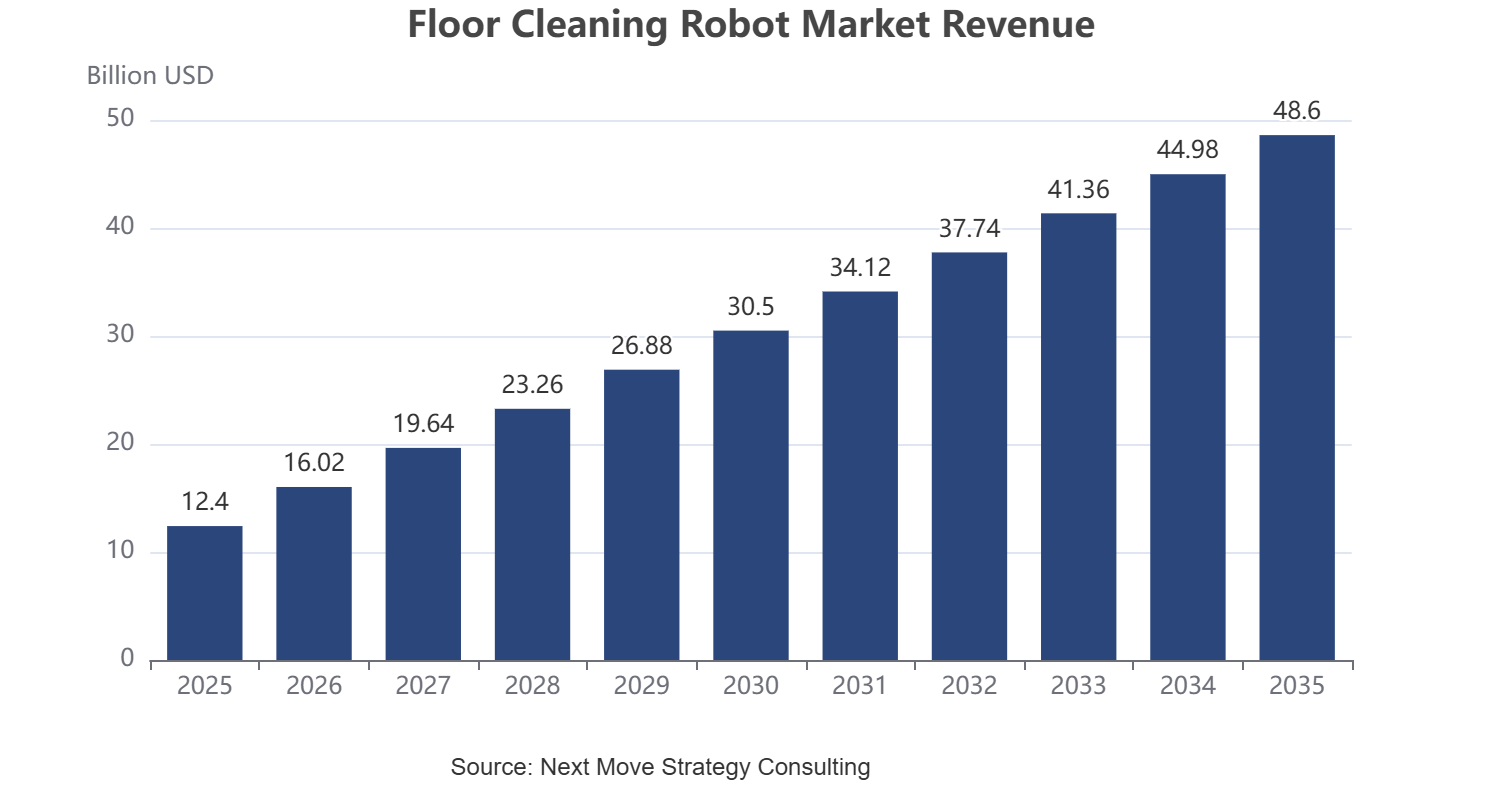
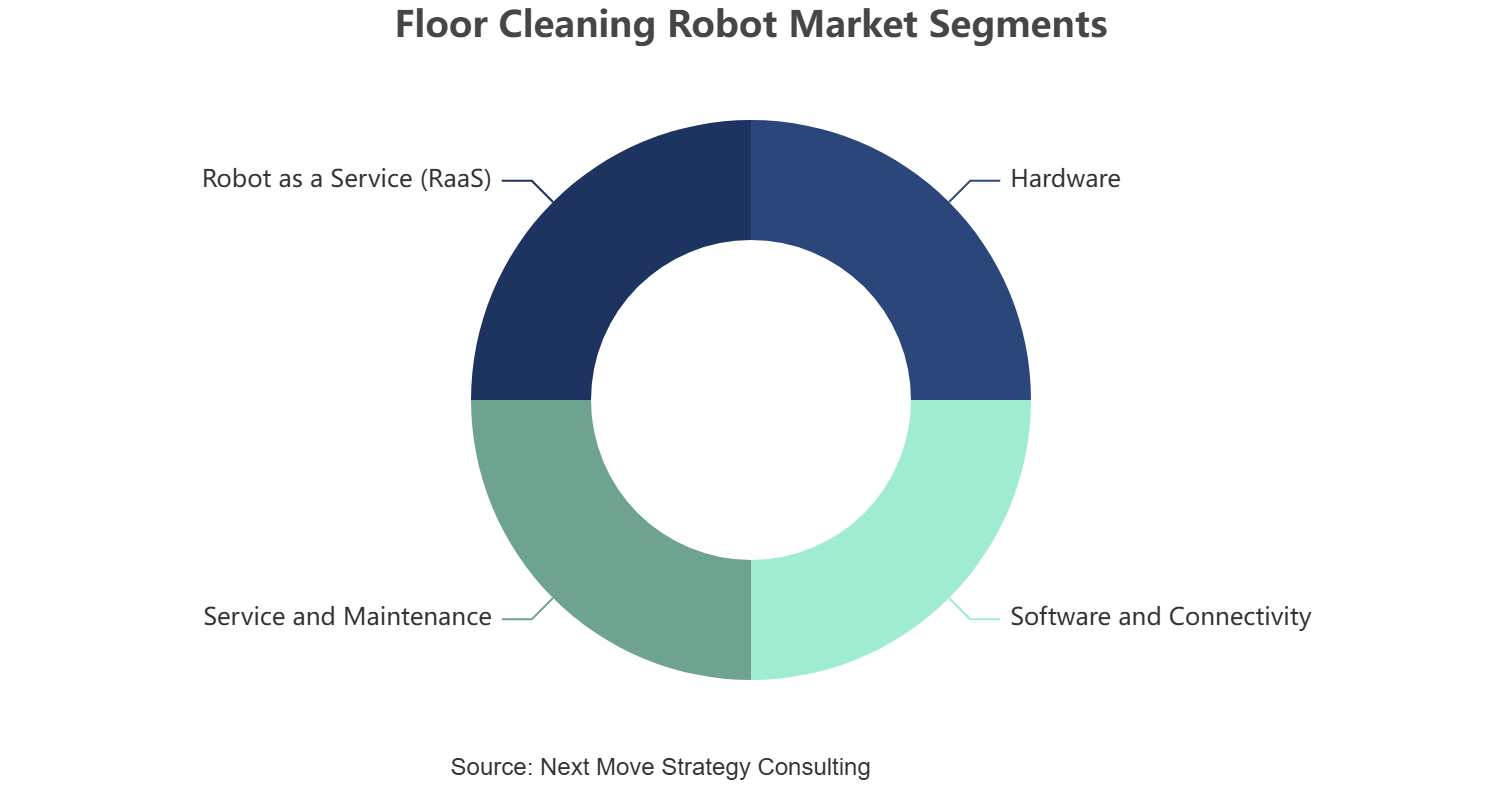
About the Author
 Saista Faiyaz
— Saista Faiyaz is Research Associate at Next Move Strategy Consulting, where she has covered consumer markets and healthcare technologies for 3 years. Her work includes primary interview review, secondary-source validation, market sizing, and structured analysis of company and industry data. She supports research by comparing evidence across sources, organizing findings into market narratives, and documenting assumptions used in analysis. Her scope includes cross-market benchmarking, and reports.
Saista Faiyaz
— Saista Faiyaz is Research Associate at Next Move Strategy Consulting, where she has covered consumer markets and healthcare technologies for 3 years. Her work includes primary interview review, secondary-source validation, market sizing, and structured analysis of company and industry data. She supports research by comparing evidence across sources, organizing findings into market narratives, and documenting assumptions used in analysis. Her scope includes cross-market benchmarking, and reports.
About the Reviewer
 Supradip Baul
— Supradip Baul is an accomplished business consultant and strategist with over a decade of rich experience in market intelligence, strategy, technology, and business transformation. His work has included rigorous qualitative and quantitative analysis across multiple industries, helping clients shape investment decisions and long-term roadmaps. Earlier in his career, he was associated with Gartner, where he contributed to industry-leading reports and market share analyses. He has worked with leading global companies and holds an MBA with a dual specialization in Marketing and Finance.
Supradip Baul
— Supradip Baul is an accomplished business consultant and strategist with over a decade of rich experience in market intelligence, strategy, technology, and business transformation. His work has included rigorous qualitative and quantitative analysis across multiple industries, helping clients shape investment decisions and long-term roadmaps. Earlier in his career, he was associated with Gartner, where he contributed to industry-leading reports and market share analyses. He has worked with leading global companies and holds an MBA with a dual specialization in Marketing and Finance.
At Next Move Strategy Consulting, we understand that insightful market research is the cornerstone of successful business decisions. That's why we employ a robust and multifaceted approach, combining various methodologies to deliver the most accurate and actionable data for our clients.

Research Landscape
We navigate the world of research with two primary approaches:
Qualitative Approach
Our qualitative research methodologies involve immersive techniques such as in-depth interviews, focus groups, and observational studies. By engaging directly with individuals and stakeholders, we uncover valuable insights that quantitative data alone may overlook.

Quantitative Research
In tandem with qualitative methodologies, NMSC leverages the power of Quantitative Research to provide a robust foundation of numerical insights. Through systematic data collection and analysis, we quantify patterns, preferences, and market trends, offering a comprehensive view of the business landscape.
Our quantitative research approach employs diverse tools, including surveys, experiments, and statistical modelling. These methodologies enable us to gather data from a large and representative sample, ensuring the statistical significance of our findings. By employing structured questionnaires and standardized data collection methods, we guarantee the reliability and validity of the information we present to our clients.
Quantitative research is particularly effective in measuring the prevalence of trends, assessing market size, and gauging the impact of various factors on consumer behavior. The numerical precision attained through this approach equips our clients with actionable insights, facilitating data-driven decision-making and strategy formulation.


Our Specialized Toolbox for Industry-Specific Market Research
We deploy a specialized arsenal of techniques tailored to meet your unique requirements. Here's a glimpse into our comprehensive toolbox:

Information Procurement
The stage entails acquiring market data or relevant information through various sources and methodologies.


Market Research Approach
We utilize both top-down and bottom-up approaches in market research analysis to achieve a comprehensive understanding of the market dynamics, leveraging the broad perspective of industry trends and macroeconomic factors alongside detailed insights from specific segments and individual companies.

Porters Five Forces Analysis
We conduct Porter's Five Forces analysis to evaluate the competitive landscape of an industry, providing us with insights into factors that affect profitability and strategic positioning.

SWOT Analysis

Forecasting
We utilize a forecasting model to predict future consumption by considering parameters like population, economics, regulations, market competition, drivers, constraints, technology, and pricing. We also employ statistical techniques such as multilinear regression, exponential smoothing, moving average, ARIMA, and Monte Carlo simulations for accurate predictions. In econometric forecasting, we analyzed short-term and long-term event impacts, attributing values based on regulatory frameworks, economic factors, and market events.





 Speak to Our Analyst