Flower and Ornamental Plants Market

Flower and ornamental plants market size was USD 62.5 billion in 2025, projected to reach USD 116.0 billion by 2035, growing at a 6.3% CAGR from 2026 to 2035

Download Free Sample PDF
Base Year (2025)
$62.50 Billion
Forecast (2035)
$116.00 Billion
CAGR (2026-2035)
6.3%
Top Region
Asia-Pacific

What Is the Flower and Ornamental Plants Market Size?

The global flower and ornamental plants market size was valued at USD 62.5 billion in 2025 and is estimated at USD 66.8 billion in 2026, forecast to reach USD 116.0 billion by 2035, expanding at a 6.3% CAGR between 2026 and 2035. Asia-Pacific leads with approximately 30% share, while Cut Flowers dominates all other product categories with approximately 38% share.

We observed that growth is broadening across every segmentation axis, with online retail expansion and greenhouse cultivation investment driving the dominant structural shifts through 2035.

Flower and Ornamental Plants Market Revenue Forecast

Values in USD Billion

2025 $62.50 Billion
2025
2026 $66.44 Billion
2026
2027 $70.62 Billion
2027
2028 $75.07 Billion
2028
2029 $79.80 Billion
2029
2030 $84.83 Billion
2030
2031 $90.17 Billion
2031
2032 $95.85 Billion
2032
2033 $101.89 Billion
2033
2034 $108.31 Billion
2034
2035 $116.00 Billion
2035

Key Takeaways

By Product Type: Cut Flowers held the largest share of approximately 38% (USD 23.75 billion) in 2025; Cut Foliage is the fastest-growing sub-segment at 9.3% CAGR from 2026–2035.

By Flower and Plant Variety: Rose held the largest share of approximately 27% (USD 16.88 billion) in 2025; Orchid is the fastest-growing sub-segment at 9.1% CAGR from 2026–2035.

By Cultivation Method: Greenhouse Cultivation held the largest share of approximately 52% (USD 32.50 billion) in 2025 and is also the fastest-growing sub-segment at 7.9% CAGR from 2026–2035.

By Distribution Channel: Florists and Specialty Stores held the largest share of approximately 36% (USD 22.50 billion) in 2025; Online Retail is the fastest-growing sub-segment at 11.4% CAGR from 2026–2035.

By Application: Home Decor and Gifting held the largest share of approximately 34% (USD 21.25 billion) in 2025; Commercial Landscaping is the fastest-growing sub-segment at 8.0% CAGR from 2026–2035.

By End User: Residential held the largest share of approximately 47% (USD 29.38 billion) in 2025; Government and Institutional is the fastest-growing sub-segment at 7.8% CAGR from 2026–2035.

Dominant Region: Asia-Pacific dominated with approximately 30% revenue share (USD 18.75 billion) in 2025.

Fastest-Growing Region: Latin America is expected to register the highest CAGR of 9.8% during 2026–2035.

Dominant Country: U.S. led with approximately USD 14.52 billion in 2025.

Fastest-Growing Country: Argentina is the fastest-growing country at approximately 10.5% CAGR from 2026–2035.

Market Opportunity: The flower and ornamental plants market is expected to create an absolute dollar opportunity of USD 49.2 billion between 2026 and 2035, presenting significant investment potential across greenhouse cultivation capacity and online flower retail platforms.

According to NMSC analysis, growers and distributors are increasingly investing in cold-chain logistics and e-commerce fulfillment capability, a shift that favors vertically integrated producers with export-grade greenhouse infrastructure over smallholder open-field operations as retailers and consumers prioritize year-round freshness and reliable delivery through 2035.

What Does the Flower and Ornamental Plants Market Encompass?

The flower and ornamental plants market encompasses cut flowers, potted flowering and foliage plants, bedding plants, and bulbs cultivated for decorative, ceremonial, and landscaping purposes across residential, commercial, and institutional end uses. Our assessment indicates that scope spans greenhouse, open-field, and protected cultivation methods, with output distributed through florists, supermarkets, wholesale auction markets, and online retail channels. The category has evolved from localized, seasonal trade into a globally integrated supply chain, propelled by air-freight export infrastructure connecting major growing regions in Latin America, East Africa, and the Netherlands to consumption centers worldwide.
Phytosanitary regulations enforced by the U.S. Department of Agriculture's Animal and Plant Health Inspection Service and the European Union's plant health framework shape import inspection requirements for fresh-cut flowers and live plants, while the Netherlands' Naktuinbouw certification standards influence breeding and propagation quality benchmarks globally. We observed that technology adoption is accelerating toward precision greenhouse climate control and cold-chain logistics tracking. NMSC's analysis indicates that this structural shift, combined with rising online retail penetration, is redefining competitive positioning across the flower and ornamental plants market.

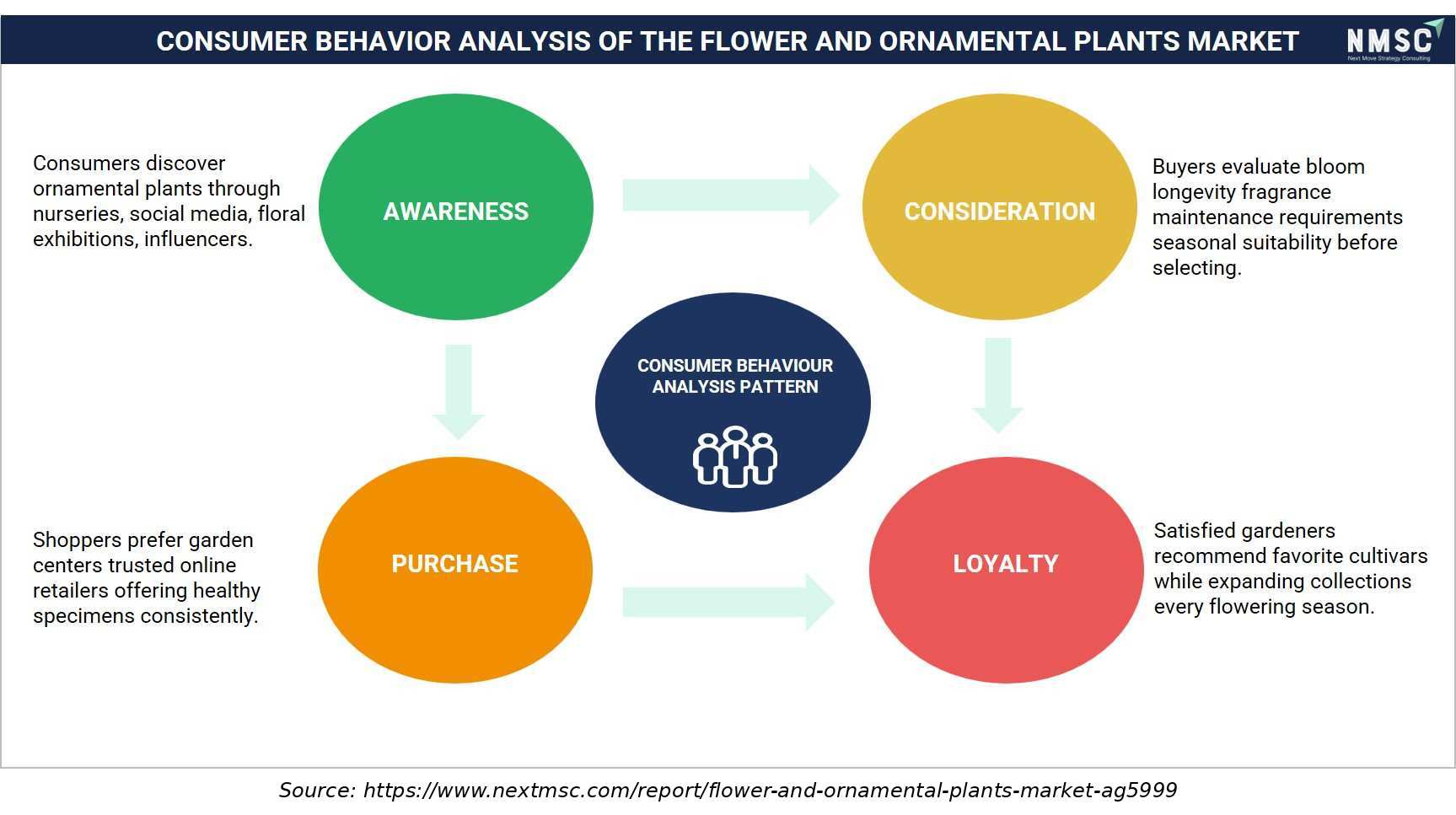
Consumer Behavior Analysis of the Flower and Ornamental Plants Market

The consumer behavior framework outlines the customer journey in the Flower and Ornamental Plants Market across awareness, consideration, purchase, and loyalty. Consumers discover plants through nurseries, social media, exhibitions, and influencers, then assess bloom longevity, fragrance, maintenance, and seasonality. Trusted retailers, healthy specimens, positive experiences, and preferred cultivars strengthen repeat purchases and recommendations.

Market Drivers & Dynamics

Interactive Dataset
Expanding online retail and direct-to-consumer flower delivery driver +1.6% North America, Europe 2026-2035
Rising greenhouse cultivation investment across export regions driver +1.3% Latin America, Middle East & Africa 2026-2035
Growing urban gardening and indoor potted plant demand driver +1.1% Asia-Pacific, North America 2026-2035
Increasing wedding and event decoration spending driver +0.9% Global 2026-2035
Rising commercial landscaping investment in urban development driver +0.8% Asia-Pacific 2026-2032
Expanding cold-chain export infrastructure in growing regions driver +0.6% Latin America, Middle East & Africa 2026-2035
Perishability and cold-chain logistics cost burden restraint -0.8% Global 2026-2035
Phytosanitary and import inspection compliance costs restraint -0.6% North America, Europe 2026-2032
Price volatility tied to energy costs for greenhouse heating restraint -0.5% Europe 2026-2032
Competition from artificial and preserved flower substitutes restraint -0.4% Global 2028-2035
Source: Next Move Strategy Consulting

Growth Drivers

What Is the Primary Growth Driver of the Flower and Ornamental Plants Market?

Expanding online retail and direct-to-consumer flower delivery is the primary driver of the market. The U.S. Department of Agriculture's floriculture statistics continue to show sustained consumer spending on fresh-cut flowers and potted plants for gifting and home decor occasions. We observed that this channel shift, reinforced by retailer investment in last-mile cold-chain logistics, continues to anchor premium pricing for growers supplying direct-to-consumer platforms.

How Is Greenhouse Investment Driving Flower Market Growth?

Rising greenhouse cultivation investment is accelerating market growth toward year-round, climate-controlled production capacity. Growers across the Netherlands, Kenya, and Colombia continue to expand controlled-environment infrastructure to reduce dependence on seasonal field conditions. Our assessment indicates that this investment pattern, combined with rising Asia-Pacific urban gardening demand, is compressing supply variability relative to traditional open-field cultivation.

Growth Inhibitors

What Is Restraining Flower and Ornamental Plants Market Expansion?

Perishability and cold-chain logistics costs restrain market expansion, particularly for long-distance export growers. The U.S. Department of Agriculture's Animal and Plant Health Inspection Service enforces phytosanitary inspection requirements that add compliance costs and transit time for imported cut flowers. We found that smaller growers face particular exposure, as limited capital reduces their ability to invest in the cold-chain infrastructure required to meet export-quality freshness standards.

Segmentation Analysis

2025 (USD Billion)
2035 (USD Billion)
Cut Flowers 2025: $23.75 Billion | 2035: $41.18 Billion
Cut Flowers
Potted Flowering Plants 2025: $11.88 Billion | 2035: $23.20 Billion
Potted Flowe
Potted Foliage Plants 2025: $8.12 Billion | 2035: $16.82 Billion
Potted Folia
Bedding and Garden Plants 2025: $8.75 Billion | 2035: $15.66 Billion
Bedding and
Bulbs Corms and Tubers 2025: $5.00 Billion | 2035: $8.70 Billion
Bulbs Corms
Cut Foliage 2025: $3.12 Billion | 2035: $6.96 Billion
Cut Foliage
Other Ornamental Plants 2025: $1.88 Billion | 2035: $3.48 Billion
Other Orname
Cut Flowers $23.75 Billion $41.18 Billion 6.3%
Potted Flowering Plants $11.88 Billion $23.20 Billion 7.7%
Potted Foliage Plants $8.12 Billion $16.82 Billion 8.4%
Bedding and Garden Plants $8.75 Billion $15.66 Billion 6.7%
Bulbs Corms and Tubers $5.00 Billion $8.70 Billion 6.3%
Cut Foliage $3.12 Billion $6.96 Billion 9.3%
Other Ornamental Plants $1.88 Billion $3.48 Billion 7.1%

Which Product Type Segment Dominates the Flower and Ornamental Plants Market?

Cut Flowers led the market with USD 23.75 billion in 2025, supported by sustained gifting, wedding, and ceremonial demand across major consumption markets. We observed that Cut Foliage is the fastest-growing product segment, expanding at a 9.3% CAGR from 2026 to 2035, as florists increasingly use decorative greenery to complement arrangements while offering longer vase life than flowering stems.

2025 (USD Billion)
2035 (USD Billion)
Rose
Chrysanthemu
Carnation
Orchid
Tulip
Segment Item 2025 (USD Billion) 2035 (USD Billion) CAGR
Rose $10.0 USD Billion $40.0 USD Billion 18.0%
Chrysanthemum $17.1 USD Billion $51.1 USD Billion 8.0%
Carnation $24.2 USD Billion $62.2 USD Billion 26.0%
Orchid $31.3 USD Billion $73.3 USD Billion 16.0%
Tulip $38.4 USD Billion $84.4 USD Billion 19.0%

Segment-wise data is locked

Unlock complete segment-wise numbers for By Flower and Plant Variety.

Unlock Full Data
2025 (USD Billion)
2035 (USD Billion)
Greenhouse C
Open Field C
Protected an
Segment Item 2025 (USD Billion) 2035 (USD Billion) CAGR
Greenhouse Cultivation $10.0 USD Billion $40.0 USD Billion 17.0%
Open Field Cultivation $17.1 USD Billion $51.1 USD Billion 11.0%
Protected and Polyhouse Cultivation $24.2 USD Billion $62.2 USD Billion 21.0%

Segment-wise data is locked

Unlock complete segment-wise numbers for By Cultivation Method.

Unlock Full Data
2025 (USD Billion)
2035 (USD Billion)
Florists and
Supermarkets
Online Retai
Wholesale an
Direct-to-Co
Segment Item 2025 (USD Billion) 2035 (USD Billion) CAGR
Florists and Specialty Stores $10.0 USD Billion $40.0 USD Billion 25.0%
Supermarkets and Hypermarkets $17.1 USD Billion $51.1 USD Billion 19.0%
Online Retail $24.2 USD Billion $62.2 USD Billion 25.0%
Wholesale and Auction Markets $31.3 USD Billion $73.3 USD Billion 19.0%
Direct-to-Consumer $38.4 USD Billion $84.4 USD Billion 20.0%

Segment-wise data is locked

Unlock complete segment-wise numbers for By Distribution Channel.

Unlock Full Data

Which Distribution Channel Leads the Flower and Ornamental Plants Market?

Florists and Specialty Stores remained the dominant distribution channel, reaching USD 22.50 billion in 2025 due to their curated selection and event-oriented service capability. Based on research conducted by NMSC, we found that Online Retail is the fastest-growing distribution channel at an 11.4% CAGR from 2026 to 2035, reflecting rising consumer preference for scheduled and same-day flower delivery.

2025 (USD Billion)
2035 (USD Billion)
Home Decor a
Wedding and
Commercial L
Religious an
Other Applic
Segment Item 2025 (USD Billion) 2035 (USD Billion) CAGR
Home Decor and Gifting $10.0 USD Billion $40.0 USD Billion 18.0%
Wedding and Event Decoration $17.1 USD Billion $51.1 USD Billion 16.0%
Commercial Landscaping $24.2 USD Billion $62.2 USD Billion 22.0%
Religious and Ceremonial Use $31.3 USD Billion $73.3 USD Billion 12.0%
Other Application $38.4 USD Billion $84.4 USD Billion 19.0%

Segment-wise data is locked

Unlock complete segment-wise numbers for By Application.

Unlock Full Data

Which Application Leads Flower and Ornamental Plants Market Demand?

Home Decor and Gifting remained the leading application within the market, valued at USD 21.25 billion in 2025 on sustained consumer demand for everyday and occasion-based floral purchases. Our findings suggest that Commercial Landscaping is the fastest-growing application, registering an 8.0% CAGR from 2026 to 2035, as urban development projects increasingly incorporate ornamental plantings into public and commercial spaces.

2025 (USD Billion)
2035 (USD Billion)
Residential
Commercial
Government a
Segment Item 2025 (USD Billion) 2035 (USD Billion) CAGR
Residential $10.0 USD Billion $40.0 USD Billion 26.0%
Commercial $17.1 USD Billion $51.1 USD Billion 16.0%
Government and Institutional $24.2 USD Billion $62.2 USD Billion 18.0%

Segment-wise data is locked

Unlock complete segment-wise numbers for By End User.

Unlock Full Data

Price Point Analysis of the Flower and Ornamental Plants Market

Price Point Analysis of the Flower and Ornamental Plants Market
The pricing strategy framework segments the Flower and Ornamental Plants Market into entry/low-price, value/mid-price, high-end, and premium tiers. This structure reflects varying consumer willingness to pay based on plant quality, rarity, aesthetics, brand reputation, and overall value. Premium and high-end offerings can capture customers seeking distinctive varieties and superior ornamental appeal, while entry-level products support broader market accessibility.
Growth Opportunities

Our analysis shows that three forward-looking opportunities stand out for stakeholders positioning within the flower and ornamental plants market over the 2026-2035 forecast period.

How Can Direct-to-Consumer Platforms Unlock Growth in Online Flower Delivery?

Direct-to-consumer delivery platforms present a whitespace opportunity for growers and retailers seeking to capture margin currently held by intermediary wholesalers. Companies that build reliable cold-chain last-mile delivery capability stand to capture recurring subscription and gifting revenue as consumers increasingly favor scheduled online flower and plant delivery over in-store purchases.

Where Does Orchid and Specialty Variety Cultivation Create New Demand?

Premium orchid and specialty flower varieties represent an underpenetrated opportunity as Orchid grows at a 9.1% CAGR through 2035, outpacing traditional varieties. Breeders and growers that expand tissue-culture propagation capacity for specialty varieties can capture recurring revenue from premium retail and gifting segments willing to pay for differentiated botanical products.

How Can Commercial Landscaping Contracts Accelerate Institutional Demand?

Urban development and public infrastructure projects create a growing opportunity for ornamental plant suppliers offering large-scale landscaping contracts. Suppliers that build validated, climate-adapted plant portfolios for commercial and government landscaping projects can secure long-term supply agreements, benefiting from recurring replacement and seasonal rotation revenue as cities expand green infrastructure.

Regional Outlook

2025 (USD Billion)
2035 (USD Billion)
North Americ
Europe
Asia-Pacific
Middle East
Latin Americ
Region 2025 (USD Billion) 2035 (USD Billion) CAGR (%)
North America $10.0 USD Billion $40.0 USD Billion 9.0%
Europe $17.1 USD Billion $51.1 USD Billion 27.0%
Asia-Pacific $24.2 USD Billion $62.2 USD Billion 25.0%
Middle East & Africa $31.3 USD Billion $73.3 USD Billion 23.0%
Latin America $38.4 USD Billion $84.4 USD Billion 12.0%

Regional data is locked

Unlock complete regional numbers for this market.

Unlock Full Data

Competitive Landscape

We observed that the flower and ornamental plants market features a highly fragmented competitive landscape, with global breeding companies competing alongside large export growers and numerous regional producers on genetics, certification, and logistics capability. Key Takeaways

Dimension Description
Market Structure Highly fragmented; the top companies profiled in this report collectively account for a modest share of global flower and ornamental plants market revenue, while thousands of small and mid-sized growers serve regional and domestic demand.
Innovation Focus Disease-resistant breeding, tissue-culture propagation, precision greenhouse climate control, and cold-chain logistics tracking dominate current innovation pipelines across leading growers and breeders.
M&A Activity Selective consolidation activity, exemplified by breeding companies expanding licensing networks and export growers investing in additional certified greenhouse capacity to meet retailer procurement standards.

How Do Companies Compete in the Flower and Ornamental Plants Market?

Companies compete primarily on proprietary genetics, certification credentials, and cold-chain logistics capability across the industry. Breeding companies such as Dümmen Orange B.V. and Selecta Klemm GmbH & Co. KG leverage global licensing networks to supply growers with differentiated varieties, while export growers such as The Elite Flower S.A.S. compete on certified production scale and freight reliability to international retail buyers.

Which Competitive Archetypes Dominate the Flower and Ornamental Plants Market?

Two archetypes dominate the market: global breeding and propagation companies that license genetics to growers worldwide, and large export-oriented growers that produce and ship at commercial scale. Dümmen Orange B.V. and Ball Horticultural Company exemplify the breeding archetype, while The Elite Flower S.A.S. and Oserian Development Company Limited exemplify the export-grower archetype serving international retail demand.

How Are Companies Differentiating Through Innovation in Flower and Ornamental Plants?

Innovation and differentiation strategy increasingly center on disease-resistant genetics and certified sustainable production credentials rather than volume alone. Breeders continue to expand trial networks to validate new variety performance across climate zones. Our analysis shows that growers unable to demonstrate credible certification and cold-chain capability risk exclusion from premium European and North American retailer procurement programs.

What M&A and Expansion Activity Is Shaping the Flower and Ornamental Plants Market?

Strategic capacity expansion and licensing partnerships continue to shape competitive positioning within the industry. Breeding companies' expansion of regional trial and propagation facilities illustrates how genetics providers pursue geographic reach, while export growers' continued investment in additional certified greenhouse acreage demonstrates how capacity expansion remains the primary growth lever across the fragmented grower base.

Key Market Players

Our assessment indicates that the following 20 companies are actively shaping breeding innovation, certified production capacity, and export logistics strategy within the global flower and ornamental plants market.

Dümmen Orange B.V. Ball Horticultural Company Selecta Klemm GmbH & Co. KG Danziger "Dan" Flower Farm Florensis B.V. Suntory Flowers Limited Beekenkamp Group B.V. Deliflor Chrysanten B.V. Anthura B.V. Könst Alstroemeria B.V. Hilverda De Boer B.V. Dole Food Company, Inc. The Elite Flower S.A.S. Multiflora S.A. Rosaprima Cia. Ltda. Nevado Ecuador S.A. Oserian Development Company Limited Sian Roses Limited AAA Growers Limited Deroose Plants NV

Latest Developments

We found that recent developments within the flower and ornamental plants market are concentrated on certified capacity expansion and breeding innovation, reflecting the industry's continued emphasis on quality and sustainability credentials.

Date Event
July 2026 Dümmen Orange presented new genetics at Cultivate’26, including Petunia Sweetunia Violet Vortex, Agastache Honeysticks Gold, Begonia I’Conia Valencia Pink, BlooMix combinations and Dahlia Summer Bees Salmon Bicolor. The introductions emphasize early flowering, pollinator appeal, landscape performance, hardiness and strong retail presentation.
January 2026 Danziger released its 2026–2027 Cut Flowers Catalog with nearly 60 new varieties and three new crops, supported by new genetic collaborations. Highlights include new Veronica, Scabiosa, sunflower, rose, chrysanthemum and Achillea introductions emphasizing productivity, uniformity, vase life and commercial versatility.

Investment Opportunities

What Capital Inflows Are Targeting the Flower and Ornamental Plants Market?

Capital inflows into the flower and ornamental plants market are increasingly directed toward certified greenhouse capacity and cold-chain export logistics. Growers continue to fund capacity expansion, as seen in continued Kenyan and Colombian greenhouse investment. We observed that investors favor growers demonstrating certification credentials, viewing sustainability compliance as a proxy for long-term retailer contract retention.

How Is Infrastructure Investment Supporting Flower and Ornamental Plants Delivery?

Infrastructure investment is expanding cold-chain and air-freight export capacity connecting major growing regions to global consumption centers. Our findings suggest that growers are investing in packhouse and refrigerated logistics infrastructure to preserve product freshness across long-distance export routes, supporting the reliability required as retailers demand consistent year-round supply.

What ESG Considerations Are Shaping Flower and Ornamental Plants Investment Decisions?

Environmental, social, and governance considerations increasingly shape investment decisions, with water stewardship, labor standards, and pesticide reduction as key criteria for export growers. Fairtrade and MPS certification programs increasingly inform retailer sourcing decisions. We found that investors increasingly favor growers demonstrating measurable certification outcomes, treating it as a governance indicator alongside production scale.

Key Benefits for Stakeholders

How Does This Report Benefit Enterprise and Industry Leaders?

Enterprise and industry leaders gain access to validated segmentation, competitive benchmarking, and regional demand forecasts that support sourcing and capacity-planning decisions across the flower and ornamental plants industry. Our analysis shows that detailed product, variety, and distribution-channel breakdowns help procurement teams align sourcing strategy with certification requirements while identifying underserved application categories for portfolio expansion.

How Does This Report Benefit Investors and Financial Analysts?

Investors and financial analysts benefit from consistent, single-point market size and CAGR estimates that support valuation and capital-allocation decisions across the flower and ornamental plants supply chain. We observed that the report's regional and segment-level growth differentials help identify which growers are best positioned to capture above-market growth in online retail and specialty variety categories through 2035.

How Does This Report Benefit Technology Vendors and Product Teams?

Technology vendors and product teams gain insight into emerging design requirements, including precision greenhouse climate control, cold-chain tracking systems, and tissue-culture propagation technology, that are reshaping the industry. Our findings suggest that this analysis helps product roadmap teams prioritize investment around certification-compatible technology increasingly required by export-oriented grower customers.

Key Market Segments Evaluated

By Product Type

  • Cut Flowers
  • Potted Flowering Plants
  • Potted Foliage Plants
  • Bedding and Garden Plants
  • Bulbs Corms and Tubers
  • Cut Foliage
  • Other Ornamental Plants

By Flower and Plant Variety

  • Rose
  • Chrysanthemum
  • Carnation
  • Orchid
  • Tulip
  • Lily
  • Other Varieties

By Cultivation Method

  • Greenhouse Cultivation
  • Open Field Cultivation
  • Protected and Polyhouse Cultivation

By Distribution Channel

  • Florists and Specialty Stores
  • Supermarkets and Hypermarkets
  • Online Retail
  • Wholesale and Auction Markets
  • Direct-to-Consumer

By Application

  • Home Decor and Gifting
  • Wedding and Event Decoration
  • Commercial Landscaping
  • Religious and Ceremonial Use
  • Other Application

By End User

  • Residential
  • Commercial
  • Government and Institutional

By Region

  • North America 
    • U.S.
    • Canada
    • Mexico
  • Europe 
    • UK
    • Germany
    • France
    • Italy
    • Spain
    • Sweden
    • Denmark
    • Finland
    • Netherlands
    • Rest of Europe
  • Asia-Pacific 
    • China
    • India
    • Japan
    • South Korea
    • Taiwan
    • Indonesia
    • Vietnam
    • Australia
    • Philippines
    • Malaysia
    • Rest of APAC
  • Middle East & Africa 
    • Saudi Arabia
    • UAE
    • Egypt
    • Israel
    • Turkey
    • Nigeria
    • South Africa
    • Rest of MEA
  • Latin America 
    • Brazil
    • Argentina
    • Chile
    • Colombia
    • Rest of LATAM

Conclusion & Recommendations

The long-term outlook for the market remains positive, with global revenue projected to nearly double from USD 62.5 billion in 2025 to USD 116.0 billion by 2035 at a 6.3% CAGR. We observed that sustained online retail expansion, greenhouse cultivation investment, and Asia-Pacific urban gardening demand will continue underpinning growth across residential, commercial, and institutional end-use categories through the forecast period.

What Strategic Positioning Should Flower and Ornamental Plants Suppliers Pursue?

Suppliers should prioritize certified greenhouse capacity and cold-chain logistics capability while pursuing direct-to-consumer distribution partnerships to secure premium pricing. Our assessment indicates that growers investing early in sustainability certification and specialty variety propagation will be best positioned to capture premium retail contracts within the flower and ornamental plants market.

How Attractive Is the Flower and Ornamental Plants Market for New Investment?
The flower and ornamental plants industry presents an attractive investment case, supported by a USD 49.2 billion absolute dollar opportunity between 2026 and 2035 and above-average growth in Latin America and online retail categories. We found that investment attractiveness is highest for growers combining certified production credentials with cold-chain export capability, positioning them to serve both wholesale and direct-to-consumer channels simultaneously.

What Market Shifts and Key Risks Should Stakeholders Monitor?

Stakeholders should monitor perishability-related logistics costs, phytosanitary compliance burden, and energy-cost exposure for greenhouse operations as key risks to the flower and ornamental plants market. Our analysis shows that growers unable to demonstrate credible cold-chain and certification capability risk losing procurement contracts to competitors with validated export infrastructure, particularly within Europe's increasingly standards-driven retail environment.

What Are the Key Growth Pathways for the Flower and Ornamental Plants Market?

Key growth pathways include expanding certified greenhouse capacity, scaling direct-to-consumer online delivery channels, and deepening penetration into specialty variety and commercial landscaping categories. NMSC's analysis indicates that growers pursuing these pathways while maintaining cost competitiveness in standard cut flower categories will be best positioned to capture the flower and ornamental plants market's projected growth through 2035.

FAQs

About the Author

Mihul Sharma

Mihul Sharma

Mihul Sharma is Research Associate at Next Move Strategy Consulting, where he has covered technology, industrial, and healthcare markets for 3 years. His work applies structured business research, market analysis, and secondary-source review to assess market trends, competitive developments, and growth opportunities. He supports report development by fully synthesizing industry data, company information, and market signals into concise findings for strategy and investment-focused research teams.

About the Reviewer

Supradip Baul

Supradip Baul

Supradip Baul is an accomplished business consultant and strategist with over a decade of rich experience in market intelligence, strategy, technology, and business transformation. His work has included rigorous qualitative and quantitative analysis across multiple industries, helping clients shape investment decisions and long-term roadmaps. Earlier in his career, he was associated with Gartner, where he contributed to industry-leading reports and market share analyses. He has worked with leading global companies and holds an MBA with a dual specialization in Marketing and Finance.

Download Free Sample

Melanie Samko

MELANIE SAMKO

Director of Marketing

TOSOH BIOSCIENCE, INC.

The information provided by NMSC is incredibly valuable, thank you so much for such a excellent work. I really appreciate it. I will make sure to reference all of it, in my summary document.

Semih Kavaklioglu

SEMIH KAVAKLIOGLU

Co-Founder & Sales Manager

Decortie

I work a lot in the marketing industry and I know that research is an essential part of any campaign. I have used Market research reports for my own products and I found them to be very informative and well-researched. The team here produces insightful reports for a good price

Rishabh Jogani

RISHABH JOGANI

Strategy Analyst

Accenture Japan

We are incredibly impressed with the market report on the real estate market in India provided by Next Move Strategy Consulting. The report was thorough, insightful, and well-structured, offering deep analysis and actionable recommendations. It not only captured the current trends and dynamics but also provided a forward-looking perspective that has been invaluable for our strategic planning. Their team demonstrated exceptional professionalism, attention to detail, and a profound understanding of the industry. The data-driven insights and clarity of presentation exceeded our expectations, making complex market trends easy to understand. We highly recommend Next Move Strategy Consulting to anyone looking for reliable and comprehensive market research services. Their expertise has given us the confidence to navigate the complexities of the Indian real estate market with clarity and foresight.

Amos Chang

AMOS CHANG

Strategy Consultant

Kardex Group

I have bought the intralogistics market reports from NMSC two times so far. Joseph and his team are always very helpful and flexible in responding to any customization requirements on the report. Their expertise in market reports really helps us steer the day-to-day business. I will definitely recommend and come back myself whenever there is a need.

Kishu Kanda

KISHU KANDA

Strategy Analyst

Accenture

We purchased the AI Consumer Market Report from this company. Not only did they customize the report to meet our specific requirements, but they also showed great flexibility in accommodating our budget. The report we received fully met our expectations. Additionally, they provided prompt and thorough responses to both our pre-purchase and follow-up questions. We look forward to working with this company again in the future.

Custom Market Research Services

We will customize the research for you if the listed report does not fully match your requirements.

Get 30% Free Customization

Select License

This website uses cookies to ensure you get the best experience on our website. Learn more

✖