Flower & Vegetable Seeds Market

The Flower and vegetable seeds market size was valued at USD 19.20 billion in 2025, projected to reach USD 35.60 billion by 2035 at 6.4% CAGR from 2026 to 2035

Download Free Sample PDF
Base Year (2025)
$19.20 Billion
Forecast (2035)
$35.60 Billion
CAGR (2026-2035)
6.4%
Top Region
Europe

What Is the Flower & Vegetable Seeds Market Size?

The global flower and vegetable seeds market size was valued at USD 19.20 billion in 2025 and is estimated at USD 20.40 billion in 2026, forecast to reach USD 35.60 billion by 2035, expanding at a 6.40% CAGR between 2026 and 2035. Europe leads with approximately 31% share, while vegetable seeds dominate all other crop types with approximately 72% share.

We observed that hybrid seed adoption and rising demand for high-yield, disease-resistant cultivars are driving structural gains across every segmentation axis, with genetically modified and biotech seeds and online distribution channels registering the fastest growth through 2035.

Flower & Vegetable Seeds Market Revenue Forecast

Values in USD Billion

2025 $19.20 Billion
2025
2026 $20.43 Billion
2026
2027 $21.74 Billion
2027
2028 $23.13 Billion
2028
2029 $24.61 Billion
2029
2030 $26.18 Billion
2030
2031 $27.86 Billion
2031
2032 $29.64 Billion
2032
2033 $31.54 Billion
2033
2034 $33.56 Billion
2034
2035 $35.60 Billion
2035

Key Takeaways

By Crop Type: Vegetable Seeds held the largest share of approximately 72% (USD 13.82 Billion) in 2025; Flower Seeds is the fastest-growing sub-segment at 7.1% CAGR from 2026–2035.

By Breeding Technology: Hybrid Seeds held the largest share of approximately 58% (USD 11.14 Billion) in 2025; Genetically Modified and Biotech Seeds is the fastest-growing sub-segment at 8.8% CAGR from 2026–2035.

By Distribution Channel: Retail and Garden Centers held the largest share of approximately 44% (USD 8.45 Billion) in 2025; Online and E-commerce is the fastest-growing channel at 10.3% CAGR from 2026–2035.

By Application: Commercial Farming held the largest share of approximately 52% (USD 9.98 Billion) in 2025; Home and Kitchen Gardening is the fastest-growing sub-segment at 7.1% CAGR from 2026–2035.

Dominant Region: Europe dominated with approximately 31% revenue share (USD 5.95 Billion) in 2025.

Fastest-Growing Region: Asia-Pacific is expected to register the highest CAGR of 7.8% during 2026–2035.

Dominant Country: The U.S. led with approximately USD 3.05 billion in 2025.

Fastest-Growing Country: India is the fastest-growing country at approximately 8.9% CAGR from 2026–2035.

Market Opportunity: The flower and vegetable seeds market is expected to create an absolute dollar opportunity of USD 15.20 billion between 2026 and 2035, presenting significant investment potential across hybrid breeding, biotech trait development, and direct-to-grower distribution.

According to Next Move Strategy Consulting analysis, seed developers are increasingly concentrating breeding investment in hybrid and biotech vegetable cultivars with built-in pest and climate resilience, a shift that favors integrated breeding-to-distribution companies over regional multiplication-only seed houses as competitive intensity increases through 2035.

What Does the Flower & Vegetable Seeds Market Encompass?

The flower and vegetable seeds market encompasses hybrid, open pollinated, and genetically modified seed varieties bred and distributed for commercial farming, home gardening, landscaping, and research applications. Our assessment indicates that the scope spans breeding companies, seed multiplication operations, and distribution networks serving row-crop growers, protected-cultivation operators, and retail garden consumers, with vegetable seeds forming the larger revenue base against a smaller but faster-growing flower seeds category.

We observed that the market has evolved from regional, open pollinated seed saving into a structured global industry anchored by proprietary hybrid breeding programs and, in select geographies, genetically modified trait development. Regulatory frameworks such as the International Union for the Protection of New Varieties of Plants shape variety-protection rights, while technology adoption is shifting toward marker-assisted breeding and precision multiplication, and Next Move Strategy Consulting's analysis indicates that this convergence of intellectual-property protection and breeding technology is redefining competitive positioning across the flower and vegetable seeds market.

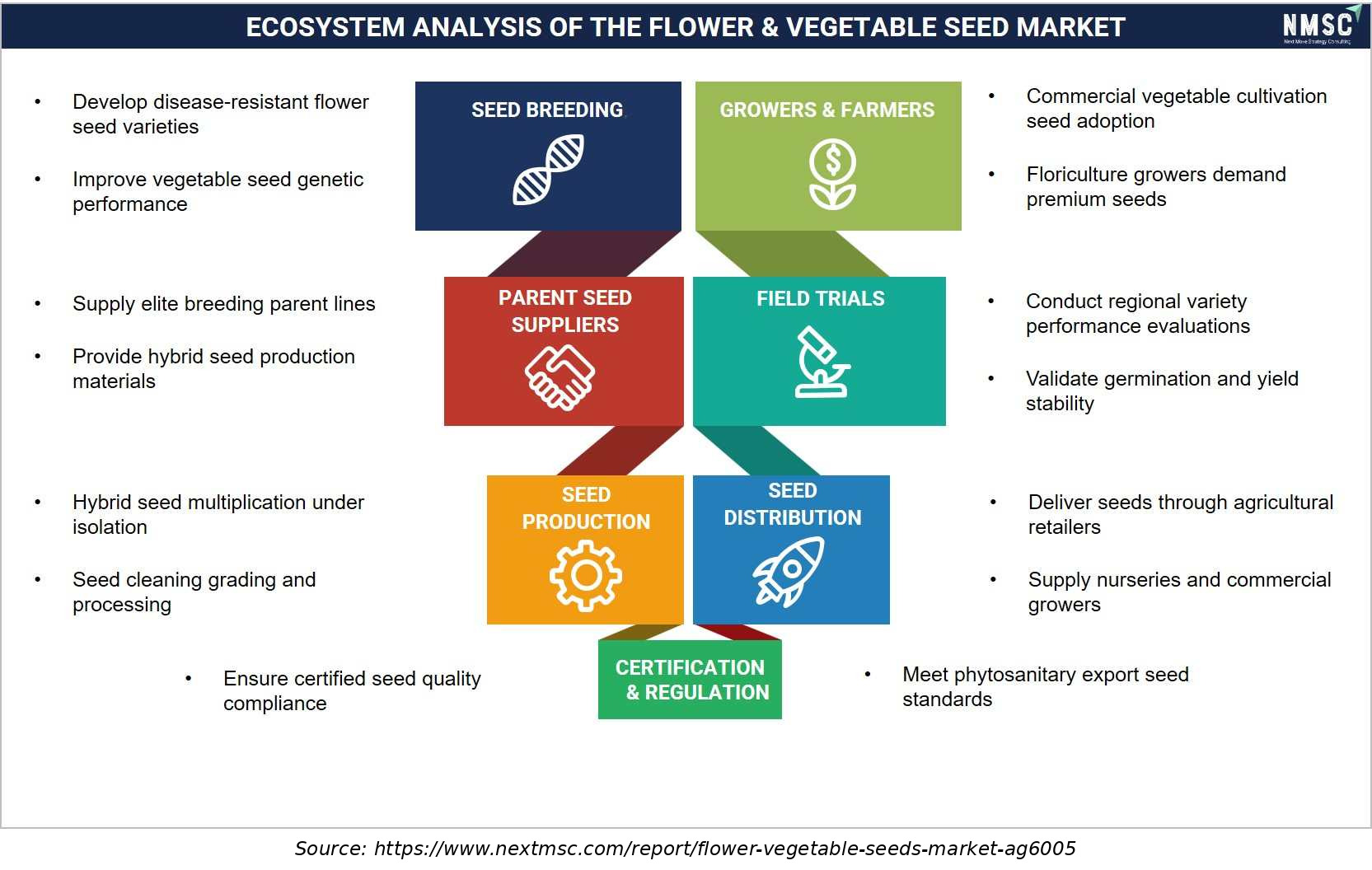
Ecosystem Analysis

Market Drivers & Dynamics

Interactive Dataset
Rising global demand for high-yield hybrid vegetable seeds driver +1.6% Global 2026-2035
Expansion of protected and greenhouse cultivation driver +1.2% Europe, Asia-Pacific 2026-2035
Growth of direct-to-grower digital distribution platforms driver +0.9% Global 2026-2033
Government support for climate-resilient crop varieties driver +0.7% Asia-Pacific, Africa 2026-2035
Rising home and kitchen gardening participation driver +0.6% North America, Europe 2026-2032
Advances in marker-assisted and biotech breeding driver +0.5% North America, Asia-Pacific 2026-2035
Stringent variety-protection and seed-certification requirements restraint -0.6% Europe, North America 2026-2035
High cost of proprietary hybrid and biotech seed development restraint -0.5% Global 2026-2032
Regulatory restrictions on genetically modified seed approval restraint -0.4% Europe, MEA 2026-2035
Source: Next Move Strategy Consulting

Growth Drivers

What Is the Primary Growth Driver of the Flower & Vegetable Seeds Market?

Rising global demand for high-yield, disease-resistant hybrid vegetable seeds is the primary driver of the market. The U.S. Department of Agriculture's National Agricultural Statistics Service reports sustained annual growth in vegetable acreage planted with certified hybrid seed across major production states. We observed that this steady shift from farm-saved and open pollinated seed toward certified hybrid varieties is expanding the addressable revenue base for breeding companies at a faster rate than overall acreage growth.

How Is Protected Cultivation Expansion Driving Market Growth?

Sustained expansion of greenhouse and polytunnel vegetable production continues to increase demand for hybrid seed varieties bred specifically for controlled-environment agriculture. Eurostat data confirms that greenhouse vegetable production area across the European Union has expanded steadily in recent years, sustaining demand for protected-cultivation-optimized seed. Our assessment indicates that this structural shift toward intensive, climate-controlled growing systems is compressing the replacement cycle for premium hybrid seed varieties.

Growth Inhibitors

What Is Restraining Flower & Vegetable Seeds Market Expansion?

Stringent variety-protection and seed-certification requirements restrain market expansion by lengthening the time and cost required to bring new hybrid and biotech varieties to market. The International Union for the Protection of New Varieties of Plants maintains formal registration and testing protocols that breeding companies must satisfy before commercial release. We found that this compliance burden disproportionately affects smaller regional seed houses, reinforcing the scale advantage held by larger, vertically integrated breeding companies.

Segmentation Analysis

2025 (USD Billion)
2035 (USD Billion)
Vegetable Seeds 2025: $13.82 Billion | 2035: $24.92 Billion
Vegetable Se
Flower Seeds 2025: $5.38 Billion | 2035: $10.68 Billion
Flower Seeds
Vegetable Seeds $13.82 Billion $24.92 Billion 6.1%
Flower Seeds $5.38 Billion $10.68 Billion 7.1%

What Is Driving Segment Sizing By Crop Type in the Flower & Vegetable Seeds Market?

This axis separates the two core crop categories that define the market's product scope. Vegetable seeds dominate on the strength of established commercial farming demand across staple crop categories such as tomatoes, peppers, and cucurbits. Flower seeds register faster growth as rising landscaping investment and home-gardening participation expand demand for annual and perennial ornamental varieties, narrowing the revenue gap between the two categories over the forecast period.

2025 (USD Billion)
2035 (USD Billion)
Hybrid Seeds
Open Pollina
Genetically
Segment Item 2025 (USD Billion) 2035 (USD Billion) CAGR
Hybrid Seeds $10.0 USD Billion $40.0 USD Billion 27.0%
Open Pollinated and Conventional Seeds $17.1 USD Billion $51.1 USD Billion 13.0%
Genetically Modified and Biotech Seeds $24.2 USD Billion $62.2 USD Billion 19.0%

Segment-wise data is locked

Unlock complete segment-wise numbers for By Breeding Technology.

Unlock Full Data

Why Are Genetically Modified and Biotech Seeds the Fastest-Growing Technology?

Hybrid seeds retain the largest technology share, reflecting decades of established breeding infrastructure and grower familiarity with hybrid vigor benefits. Genetically modified and biotech seeds grow fastest off a smaller base as regulatory approval pathways mature and pest-resistant traits gain commercial traction in select geographies. Open pollinated and conventional seeds grow slowest, retained primarily by organic-certified growers and regions with limited hybrid seed access.

2025 (USD Billion)
2035 (USD Billion)
Retail and G
Direct and I
Online and E
Segment Item 2025 (USD Billion) 2035 (USD Billion) CAGR
Retail and Garden Centers $10.0 USD Billion $40.0 USD Billion 25.0%
Direct and Institutional Sales $17.1 USD Billion $51.1 USD Billion 19.0%
Online and E-commerce $24.2 USD Billion $62.2 USD Billion 25.0%

Segment-wise data is locked

Unlock complete segment-wise numbers for By Distribution Channel.

Unlock Full Data

Why Is Online and E-commerce the Fastest-Growing Distribution Channel?

Retail and garden centers retain the largest distribution share, supported by established relationships between growers and local agricultural retailers. Online and e-commerce channels grow fastest as breeding companies invest in direct digital ordering platforms that shorten distribution chains for both commercial growers and home-garden consumers. Direct and institutional sales remain a stable secondary channel, anchored by long-term supply agreements between breeding companies and large-scale commercial farming operations.

2025 (USD Billion)
2035 (USD Billion)
Commercial F
Home and Kit
Landscaping
Research and
Segment Item 2025 (USD Billion) 2035 (USD Billion) CAGR
Commercial Farming $10.0 USD Billion $40.0 USD Billion 18.0%
Home and Kitchen Gardening $17.1 USD Billion $51.1 USD Billion 16.0%
Landscaping and Ornamental Horticulture $24.2 USD Billion $62.2 USD Billion 22.0%
Research and Breeding $31.3 USD Billion $73.3 USD Billion 12.0%

Segment-wise data is locked

Unlock complete segment-wise numbers for By Application.

Unlock Full Data

Growth Opportunities

Beyond the core growth drivers, three forward-looking opportunities stand out for stakeholders positioning within the seeds market over the 2026–2035 forecast period.

How Can Climate-Resilient Trait Licensing Expand Revenue Across Regional Seed Markets?

Climate-resilient trait licensing presents a whitespace opportunity for seed developers seeking to commercialize heat-tolerant, drought-resistant, and disease-resistant genetics without expanding production footprints. Companies that license advanced breeding traits to regional seed multipliers can accelerate market penetration while enabling commercial farming operators to improve crop resilience under increasingly volatile climatic conditions. This model creates recurring royalty income while strengthening regional seed portfolios across diverse agro-climatic zones.

Where Do Direct-to-Grower Digital Platforms Create New Commercial Value?

Digital seed procurement platforms represent an underpenetrated opportunity for seed companies aiming to strengthen customer engagement and improve distribution efficiency. Suppliers that establish proprietary e-commerce and digital advisory platforms can capture margins traditionally retained by intermediaries while offering traceable product information, agronomic guidance, and faster delivery. This approach benefits home gardeners, smallholder farmers, and commercial growers seeking convenient and transparent seed purchasing experiences.

How Can Greenhouse-Optimized Hybrid Seed Portfolios Support Controlled-Environment Agriculture?

The expansion of controlled-environment agriculture creates a significant opportunity for seed companies developing greenhouse-optimized hybrid varieties with higher yield potential and improved resistance to pests and diseases. Breeding companies that commercialize specialized hybrid portfolios for protected cultivation can differentiate their offerings while addressing the evolving requirements of commercial greenhouse operators. Early movers stand to strengthen long-term partnerships with protected agriculture producers as investments in high-efficiency food production continue to expand.

Regional Outlook

2025 (USD Billion)
2035 (USD Billion)
Europe
Asia-Pacific
North Americ
Latin Americ
Middle East
Region 2025 (USD Billion) 2035 (USD Billion) CAGR (%)
Europe $10.0 USD Billion $40.0 USD Billion 9.0%
Asia-Pacific $17.1 USD Billion $51.1 USD Billion 27.0%
North America $24.2 USD Billion $62.2 USD Billion 25.0%
Latin America $31.3 USD Billion $73.3 USD Billion 23.0%
Middle East and Africa $38.4 USD Billion $84.4 USD Billion 12.0%

Regional data is locked

Unlock complete regional numbers for this market.

Unlock Full Data

Competitive Landscape

We observed that the flower and vegetable seeds market remains moderately consolidated, with competitive intensity concentrated among large diversified breeding companies and specialized regional seed houses.

Dimension Description
Aspect Details
Market Structure Moderately consolidated, with the Top 10 companies holding an available market share while a long tail of regional multiplication and distribution seed houses serves localized demand.
Innovation Focus Climate-resilient trait breeding, greenhouse-optimized hybrids, and marker-assisted and biotech breeding technology.
M&A Activity Selective acquisitions of regional breeding programs and specialty germplasm portfolios to expand crop and geographic coverage.

How Do Companies Compete in the Flower & Vegetable Seeds Market?

Companies compete primarily on proprietary germplasm breadth and demonstrated yield performance across major crop categories, since growers select seed suppliers based on documented field trial results. Our analysis shows that companies with extensive multi-crop hybrid portfolios and established variety-protection filings command stronger grower loyalty than narrow, single-crop specialists, while pricing strategies increasingly reflect trait-based premiums for disease resistance and climate tolerance.

Which Competitive Archetypes Dominate the Flower & Vegetable Seeds Market?

Three archetypes dominate: large diversified agrochemical-affiliated breeding divisions with extensive global research infrastructure, specialized vegetable and flower seed houses with deep regional germplasm expertise, and family-owned breeding companies with long-standing crop-specific specialization. We found that diversified breeding divisions compete on research scale and geographic reach, while specialized seed houses differentiate through crop-specific technical expertise and grower relationships.

What Innovation and Differentiation Strategies Are Companies Pursuing?

Breeding companies are investing in marker-assisted selection to accelerate development cycles for climate-resilient and disease-resistant varieties. Our findings suggest that companies are increasingly publishing official field-trial performance data to differentiate hybrid varieties on documented yield and resistance metrics, while some companies are piloting digital grower-advisory tools to strengthen post-sale technical support and variety-selection guidance.

What M&A Activity Is Shaping the Flower & Vegetable Seeds Market?

Mergers and acquisitions activity centers on regional breeding-program consolidation, as larger companies acquire specialty germplasm portfolios and regional multiplication capacity to expand crop coverage without ground-up breeding investment. We observed that companies are also pursuing selective partnerships with agricultural technology providers to integrate digital advisory services alongside traditional seed sales, reflecting a broader industry shift toward value-added grower support.

Key Market Players

We found that the following companies represent the leading breeders and providers of flower and vegetable seeds globally, ranked by market-specific scale of operations.

Bayer AG Groupe Limagrain Syngenta Group BASF SE Sakata Seed Corporation Takii & Co., Ltd. Rijk Zwaan Zaadteelt en Zaadhandel B.V. Enza Zaden Beheer B.V. KWS SAAT SE & Co. KGaA Bejo Zaden B.V. East-West Seed Company Namdhari Seeds Pvt. Ltd. Known-You Seed Co., Ltd. Ball Horticultural Company Ernst Benary Samenzucht GmbH Kitano Seed Co., Ltd. Tokita Seed Co., Ltd. Origene Seeds Ltd. Johnny's Selected Seeds W. Atlee Burpee & Company

Latest Developments

We observed several verifiable developments across breeding technology and company expansion that are shaping near-term market direction.

Date Event
May 2026 Syngenta Group announced a strategic agreement to combine its global flowers business into a joint venture with Dümmen Orange, streamlining operations to prioritize R&D investments and growth across its core vegetable seeds and agricultural businesses.
April 2026 Bayer AG partnered with the International Organization for Migration (IOM) to donate more than 225 metric tonnes of vegetable and corn seeds across Nigeria, Zambia, Kenya, and Ukraine, supporting food security, climate-resilient agriculture, and access to quality seeds for vulnerable farming communities.
February 2026 Bayer AG launched newgold seed, its first multi-crop seed brand engineered for low-carbon intensity oilseed crops, including camelina and winter canola, to support the growing biofuels and sustainable aviation fuel (SAF) markets.

Investment Opportunities

Where Is Capital Flowing Within the Flower & Vegetable Seeds Market?

Capital continues to concentrate in climate-resilient trait development and greenhouse-optimized hybrid breeding programs. We observed that KWS SAAT SE & Co. KGaA has directed continued capital expenditure toward vegetable seed breeding capacity following its Pop Vriend Seeds integration, per official annual report disclosures, signaling sustained investor confidence in diversified vegetable seed portfolios.

How Is Infrastructure Investment Shaping the Market?

Infrastructure investment is concentrated in seed multiplication capacity expansion and controlled-environment breeding facilities that support faster variety development cycles. Our findings suggest that companies operating in Europe and Asia-Pacific are directing capital toward greenhouse-based breeding infrastructure specifically to accelerate climate-resilient hybrid development timelines.

What ESG Considerations Are Relevant to Flower & Vegetable Seeds Market Investment?

Environmental, social, and governance considerations center on biodiversity preservation through germplasm conservation programs, alongside smallholder farmer access to certified hybrid seed in emerging markets. Social considerations include fair-trade sourcing practices in seed multiplication regions, while governance considerations relate to transparent variety-protection compliance and certification-standard adherence across breeding operations.

Key Benefits for Stakeholders

How Does This Report Benefit Seed Industry Leaders?

Industry leaders gain a validated market-sizing and segmentation framework to prioritize breeding investment across crop types, breeding technologies, and regions. The report's country-level revenue and CAGR data support capital-allocation decisions for companies evaluating new breeding-capacity investment through 2035.

How Does This Report Benefit Investors and Financial Analysts?

Investors and financial analysts gain a fundamentals-based CAGR methodology, competitive landscape mapping, and a Top 20 company benchmark set, supporting valuation and portfolio-allocation decisions across breeding, distribution, and biotech trait development companies.

How Does This Report Benefit Technology Vendors and Product Teams?

Technology vendors and product teams gain segment-level demand signals, including the fastest-growing genetically modified and biotech seeds category, to prioritize product roadmaps around marker-assisted breeding tools and direct-to-grower digital distribution platforms.

Key Market Segments Evaluated

By Crop Type

  • Vegetable Seeds 
    • Solanaceous vegetable seeds
    • Cucurbit vegetable seeds
    • Brassica vegetable seeds
    • Root and bulb vegetable seeds
    • Leafy vegetable seeds
  • Flower Seeds 
    • Annual flower seeds
    • Perennial flower seeds
    • Bulb flower seeds

By Breeding Technology

  • Hybrid Seeds
  • Open Pollinated and Conventional Seeds
  • Genetically Modified and Biotech Seeds

By Application

  • Commercial Farming
  • Home and Kitchen Gardening
  • Landscaping and Ornamental Horticulture
  • Research and Breeding

By Distribution Channel

  • Retail and Garden Centers
  • Direct and Institutional Sales
  • Online and E-commerce

By Region

  • North America 
    • U.S.
    • Canada
    • Mexico
  • Europe 
    • UK
    • Germany
    • France
    • Italy
    • Spain
    • Sweden
    • Denmark
    • Finland
    • Netherlands
    • Rest of Europe
  • Asia-Pacific 
    • China
    • India
    • Japan
    • South Korea
    • Taiwan
    • Indonesia
    • Vietnam
    • Australia
    • Philippines
    • Malaysia
    • Rest of APAC
  • Middle East & Africa 
    • Saudi Arabia
    • UAE
    • Egypt
    • Israel
    • Turkey
    • Nigeria
    • South Africa
    • Rest of MEA
  • Latin America 
    • Brazil
    • Argentina
    • Chile
    • Colombia
    • Rest of LATAM

Conclusion & Recommendations

The long-term outlook remains steadily positive, with the market projected to expand from USD 19.20 billion in 2025 to USD 35.60 billion by 2035 at a 6.40% CAGR. We observed that structural drivers, including hybrid seed adoption and climate-resilient breeding investment, are durable rather than cyclical, supporting continued mid-to-high single-digit growth across most segments through the forecast period.

What Strategic Positioning Should Providers Pursue?

Providers should prioritize climate-resilient trait development and greenhouse-optimized hybrid portfolios over broad, undifferentiated variety catalogs, since grower retention correlates strongly with documented yield and resistance performance. Our assessment indicates that companies integrating direct-to-grower digital distribution alongside traditional retail channels will differentiate as competitive intensity increases through 2035.

How Attractive Is the Market for New Investment?

Investment attractiveness is high across biotech trait development and direct digital distribution platforms, given a USD 15.20 billion absolute dollar opportunity between 2026 and 2035. We found that genetically modified and biotech seeds offer the strongest risk-adjusted entry point given their 8.8% segment CAGR and comparatively low existing competitive density relative to hybrid seeds.

What Market Shifts and Key Risks Should Stakeholders Monitor?

Stakeholders should monitor stringent variety-protection and genetically modified seed approval requirements, which could lengthen commercialization timelines, alongside climate volatility affecting regional demand patterns. Our analysis shows that companies with established variety-protection filings and diversified geographic breeding footprints are better positioned to absorb these regulatory and climate risks than narrowly focused regional seed houses.

What Are the Primary Growth Pathways Through 2035?

Primary growth pathways include expansion of climate-resilient trait licensing, deeper integration of direct-to-grower digital distribution, and continued development of greenhouse-optimized hybrid portfolios. We observed that companies combining at least two of these pathways are best positioned to capture disproportionate share of the USD 16.40 billion in incremental revenue generated between 2025 and 2035.

FAQs

About the Author

Saista Faiyaz

Saista Faiyaz

Saista Faiyaz is Research Associate at Next Move Strategy Consulting, where she has covered consumer markets and healthcare technologies for 3 years. Her work includes primary interview review, secondary-source validation, market sizing, and structured analysis of company and industry data. She supports research by comparing evidence across sources, organizing findings into market narratives, and documenting assumptions used in analysis. Her scope includes cross-market benchmarking, and reports.

About the Reviewer

Supradip Baul

Supradip Baul

Supradip Baul is an accomplished business consultant and strategist with over a decade of rich experience in market intelligence, strategy, technology, and business transformation. His work has included rigorous qualitative and quantitative analysis across multiple industries, helping clients shape investment decisions and long-term roadmaps. Earlier in his career, he was associated with Gartner, where he contributed to industry-leading reports and market share analyses. He has worked with leading global companies and holds an MBA with a dual specialization in Marketing and Finance.

Download Free Sample

Ross J Mckenzie

ROSS J MCKENZIE

Business Insight Manager

Staysure Group

“Next MSC have been incredibly helpful in providing detailed & robust information on our market, alongside quantifying growth by different segments. The process to procure was simple and easy, with sample reports and regular contact to ensure we had what we needed. Succinct detail on their sources & methodologies is also greatly received, allowing transparency in this respect helps build trust in the detail you pay for. Joseph in particular was fantastic, and helped ensure efficient provision of the insight pack – thank you NMSC!”.

Nishant Awate

NISHANT AWATE

Business Development Global Sales

Zehnder Group Deutschland GmbH

Our experience working with Next Move Strategy Consulting was positive. The team was responsive, professional, and open to incorporating our specific requirements throughout the project. The India AHU market study was comprehensive and well structured, covering market value and volume forecasts, product and application segments, and key industry trends. The inclusion of both AHU and residential MVHR market insights made the study particularly relevant for our strategic market assessment. Overall, the report provides a solid foundation for evaluating market potential, identifying priority segments, and supporting business-development decisions in India.

Henri Knyphausen

HENRI KNYPHAUSEN

Partner at Singulier [Ex-BCG]

Singulier

I recently engaged NEXTMSC.com for a commercial due diligence project within the intralogistics sector, and I am pleased to provide a reference based on my experience. In utilizing NEXTMSC.com's services, I found their report to offer valuable insights into market dynamics and key industry players. The initial report provided a solid foundation for our analysis. However, as we were investigating a smaller target in the market, and I had specific customization requests requiring additional research. These requests included detailed information on product portfolios of various players and sub-market sizes, both inclusive and exclusive of certain product categories. NEXTMSC.com demonstrated commendable responsiveness and agility in accommodating these customization requests. Within a timeframe of 1-2 weeks, they delivered a revised report that met our specific needs. Furthermore, they were receptive to my follow-up inquiries, ensuring clarity and understanding of the data provided. The final deliverable significantly contributed to our due diligence efforts. One of NEXTMSC.com's notable strengths lies in their qualitative research capabilities. However, for future engagements, I would recommend the inclusion of a quantified market model in Excel format. Such a model would offer the ability to conduct in-depth analyses and explore various market segments, including country-specific data and subcomponent breakdowns. Based on my positive experience, I would not hesitate to work with NEXTMSC.com again. Their responsiveness, willingness to accommodate customization requests, and commitment to delivering actionable insights make them a reliable partner for commercial research projects.

Gustaf Hummel Burstrom

GUSTAF HUMMEL BURSTROM

Founder

Revline Tools AB

Joseph and the team at Next Move Strategy Consulting have been excellent to work with, in supplying us with relevant market data and forecasts for our specific category. We had some special requirements and they were able to do a custom package to suit our needs. We would definitely recommend them to any other company needing market data and forecasts

Robert Sean Trevino

ROBERT SEAN TREVINO

Sr. Director, Head of Strategic Insights & Analytics

Foundation Medicine

I realized that it was a reliable source of information. These days, there are many people who are looking for authentic data, and this is one of the only sources that can offer them with what they need;

Custom Market Research Services

We will customize the research for you if the listed report does not fully match your requirements.

Get 30% Free Customization

Select License

This website uses cookies to ensure you get the best experience on our website. Learn more

✖