Microbial Biostimulant Market Size, Share, Trends and Growth Analysis, By Microbial Type (Bacteria, Fungi, Cyanobacteria, Microalgae, Mixed Consortia, and Other Microbials), By Microbial Byproducts, By Product Form, By Application Route, By Crop Type, By End User (Commercial Farms, Greenhouse Operations, Nurseries and others), By Sales Channel (Direct, Distributor, Dealer and Retail and others), and Region — Global Industry Report and Forecast, 2026–2035
Industry: Agriculture | Publishing Date: July 27, 2026 | Last Updated: September 30, 2026 | No of Pages: N/A | No. of Tables: N/A | No. of Figures: N/A | Format: PDF | Report Code: AG5415
What Is the Microbial Biostimulant Market Size?
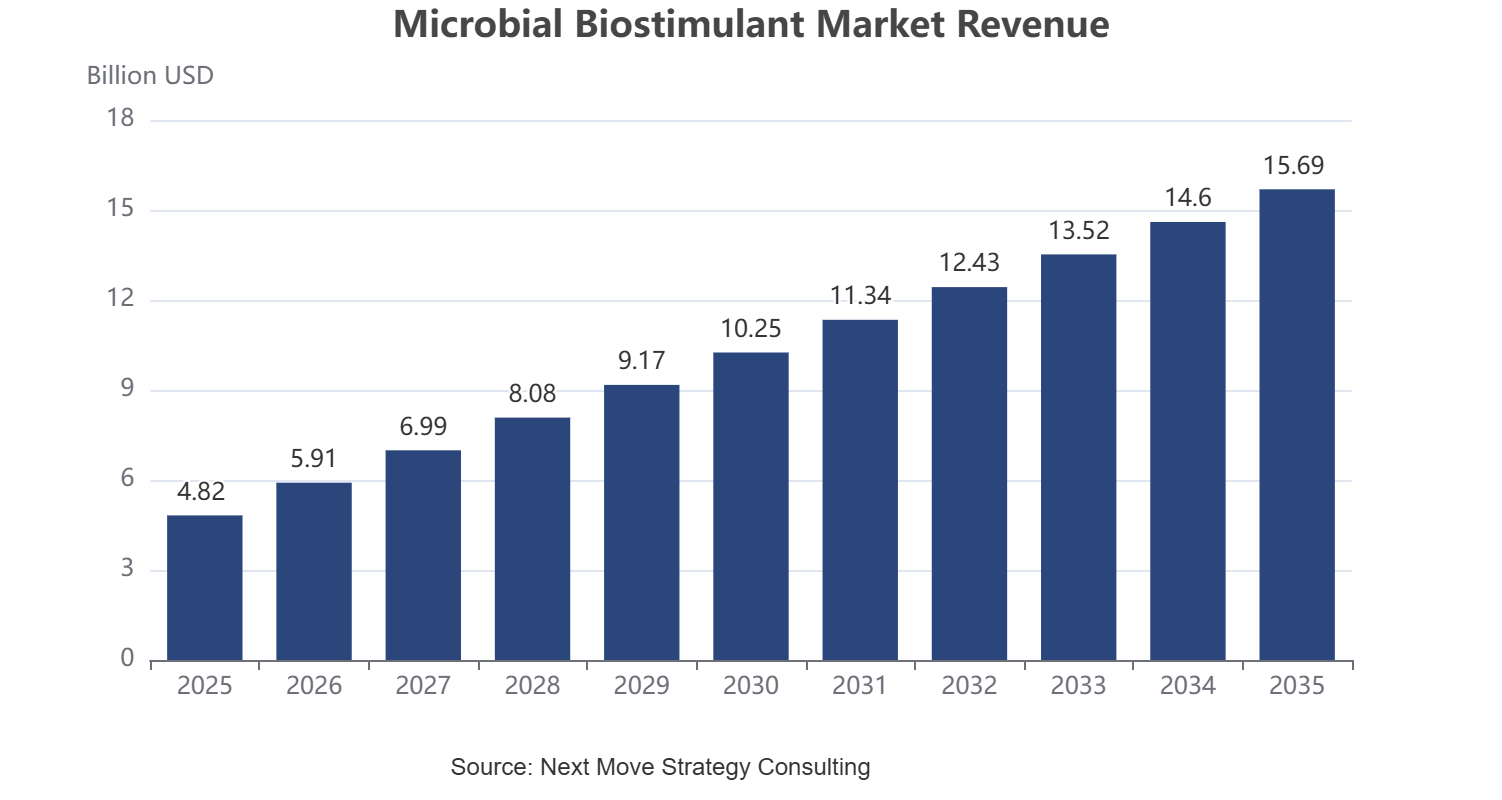
The global Microbial Biostimulant market size was valued at USD 4.82 billion in 2025 and is estimated at USD 5.35 billion in 2026, forecast to reach USD 15.69 billion by 2035, expanding at a 12.7% CAGR between 2026 and 2035. Europe leads with approximately 33% share, while Bacteria dominates all other microbial types with approximately 42% share.
We observed that growth is broad-based across every segmentation axis, with mixed-consortia formulations and precision application routes such as fertigation driving the dominant structural shifts through 2035.
|
Key Takeaways |
|
By Microbial Type: Bacteria held the largest share of approximately 42% (USD 2.02 Billion) in 2025; Mixed Consortia is the fastest-growing sub-segment at 17.1% CAGR from 2026–2035. |
|
By Application Route: Soil Application held the largest share of approximately 38% (USD 1.83 Billion) in 2025; Fertigation is the fastest-growing sub-segment at 17.0% CAGR from 2026–2035. |
|
By End User: Commercial Farms held the largest share of approximately 46% (USD 2.22 Billion) in 2025; Greenhouse Operations is the fastest-growing sub-segment at 16.3% CAGR from 2026–2035. |
|
Dominant Region: Europe dominated with approximately 33% revenue share (USD 1.59 Billion) in 2025. |
|
Fastest-Growing Region: Asia-Pacific is expected to register the highest CAGR of 16.9% during 2026–2035. |
|
Dominant Country: The U.S. led with approximately USD 1,015 million in 2025. |
|
Fastest-Growing Country: India is the fastest-growing country at approximately 19.5% CAGR from 2026–2035. |
Market Opportunity: The Microbial Biostimulant market is expected to create an absolute dollar opportunity of USD 10.34 billion between 2026 and 2035, presenting significant investment potential across the seed treatment, soil application, and precision-agriculture input value chain.
According to Next Move Strategy Consulting analysis, growers are increasingly consolidating microbial input sourcing with fewer, multi-strain suppliers capable of bundling nitrogen-fixing bacteria with mycorrhizal fungi, a shift that favors diversified biologicals portfolios over single-strain specialists as regulatory harmonization advances through 2035.
What Does the Microbial Biostimulant Market Encompass?
The Microbial Biostimulant market encompasses living or dormant microorganisms and their metabolic byproducts, including bacteria, fungi, cyanobacteria, and microalgae, formulated to enhance nutrient uptake, root development, and abiotic stress tolerance in crops without functioning as fertilizers or pesticides. Our assessment indicates that the scope spans liquid, dry, encapsulated, and seed-coating product forms supplied to commercial farms, greenhouse operations, nurseries, and research institutions across cereals, oilseeds, fruits, vegetables, and plantation crops. The category has evolved from a niche organic-farming input into a mainstream component of integrated crop nutrition programs, driven by rising input-cost pressure and grower demand for sustainable agriculture practices worldwide.
Regulatory frameworks such as the European Union's Fertilizing Products Regulation (EU) 2019/1009 and the U.S. Environmental Protection Agency's biopesticide and biostimulant guidance shape product registration and labeling requirements, while national fertilizer control orders in Asia-Pacific increasingly influence microbial strain approval. We observed that technology adoption is shifting toward multi-strain consortia and precision fertigation delivery that improve field efficacy consistency. Next Move Strategy Consulting's analysis indicates that this structural shift, combined with rising interest in the broader agricultural biological category, is redefining sourcing criteria across the Microbial Biostimulant market.
|
Parameter |
Details |
|
Market Size in 2025 |
USD 4.82 Billion |
|
Market Size in 2026 |
USD 5.35 Billion |
|
Revenue Forecast in 2035 |
USD 15.69 Billion |
|
Growth Rate |
CAGR of 12.7% from 2026 to 2035 |
|
Analysis Period |
2025–2035 |
|
Base Year Considered |
2025 |
|
Forecast Period |
2026–2035 |
|
Market Size Estimation |
Revenue (USD Billion) |
|
Companies Profiled |
20 |
|
Countries Covered |
33 |
|
Market Share |
Available for Top 10 Companies |
Key Emerging Trends
Based on research conducted by Next Move Strategy Consulting, we found that four structural trends are reshaping product development, sourcing, and stakeholder engagement across the industry.
How Is Multi-Strain Consortia Formulation Transforming Field Efficacy?
Multi-strain microbial consortia combining nitrogen-fixing bacteria, phosphate mobilizers, and mycorrhizal fungi are replacing single-strain products to improve field-efficacy consistency across variable soil conditions. We observed that Novonesis has expanded its bioyield-enhancement portfolio through its distribution partnership with Rovensa Next, announced in June 2026, bundling nitrogen-fixation and inoculant technologies for U.S. row-crop growers. Manufacturers are retooling fermentation lines to co-formulate compatible strains, while distributors are training agronomists to position consortia products within broader crop-nutrition programs.
Why Are Seaweed-Derived and Fermentation Metabolite Byproducts Gaining Adoption?
Fermentation metabolite and cell-fraction byproducts are gaining share as brand owners seek standardized, quality-controlled alternatives to raw microbial cultures. Our findings suggest that UPL's Hycoxa technology, commercialized within its seaweed-based biostimulant range in November 2025, illustrates how suppliers are concentrating bioactive compounds to improve dosing precision. Manufacturers such as Lallemand and Rizobacter are expanding metabolite-extraction capacity, positioning these formats as a premium, higher-consistency category within the broader market segmentation structure.
How Is Digital Agriculture Reshaping Microbial Biostimulant Application Precision?
Precision application technologies are pushing suppliers toward fertigation-compatible and variable-rate delivery formats that integrate with farm management software. We observed that grower adoption of digital agriculture platforms is increasing demand for liquid and encapsulated microbial formulations calibrated for automated dosing. This trend is elevating requirements for shelf-stable, tank-mix-compatible products among distributors serving commercial farms and research and demonstration operations.
What Role Does Regulatory Registration Play in Microbial Biostimulant Commercialization?
Streamlined national registration pathways are accelerating commercialization timelines for validated microbial strains. Our analysis shows that UPL secured Fertilizer Control Order registration for its Bioclassic biostimulant in India in May 2026, alongside four additional product approvals, exemplifying how regulatory clearance is becoming a competitive differentiator. Suppliers investing early in dossier preparation and efficacy trials are securing first-mover access across regulated Asia-Pacific and Latin American markets.
Ecosystem Analysis of the Microbial Biostimulant Market
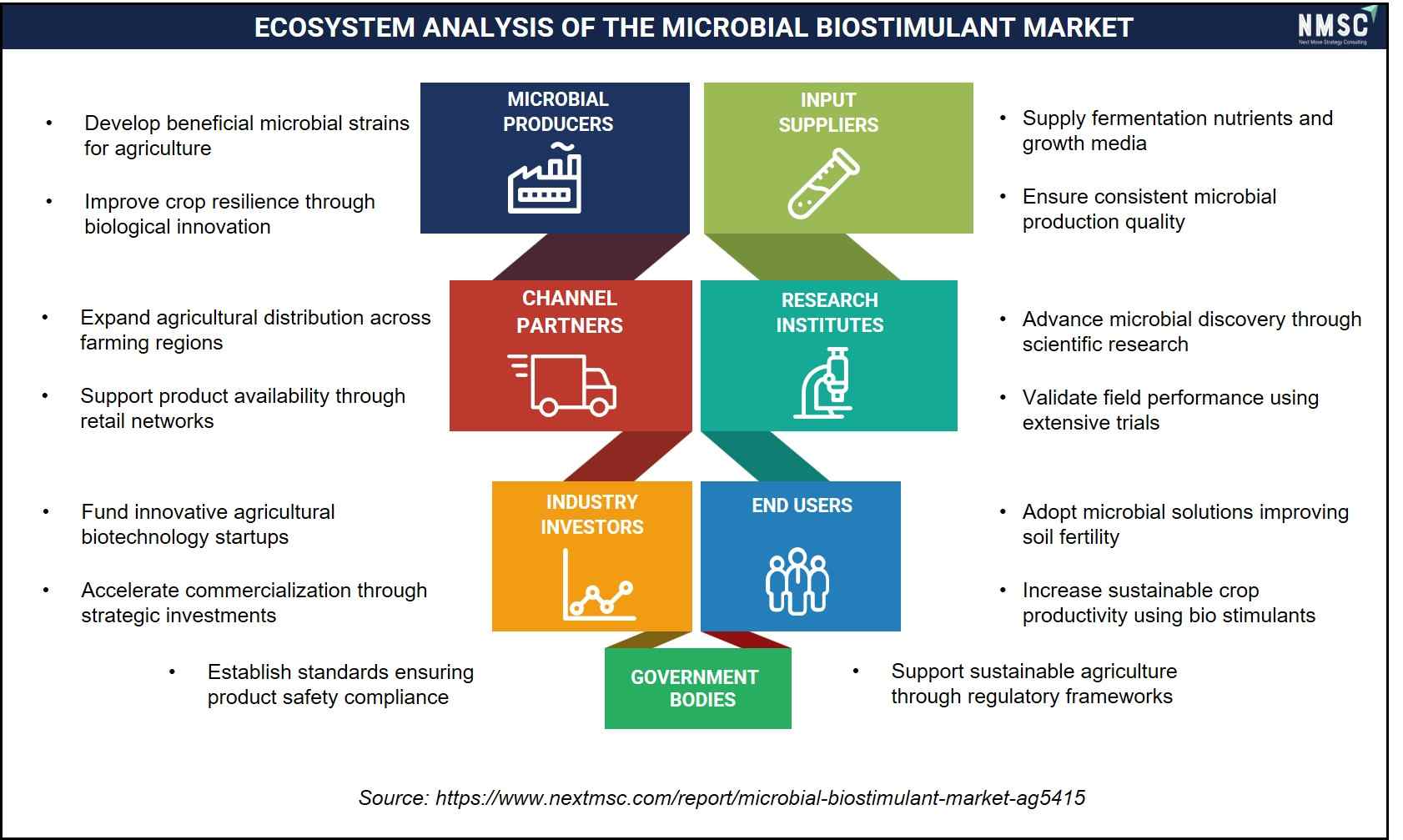
Our analysis indicates that the Microbial Biostimulant Market ecosystem comprises microbial producers, input suppliers, research institutes, channel partners, industry investors, end users, and government bodies working together to advance sustainable agricultural practices. Research institutions drive microbial innovation, manufacturers develop commercial formulations, and input suppliers ensure access to quality raw materials. Channel partners facilitate market distribution, while investors support product development and commercialization. Government agencies establish regulatory standards and sustainability policies, enabling farmers and agricultural enterprises to adopt microbial biostimulants that enhance crop productivity and soil health.
Growth Drivers and Restraints
Growth Catalyst and Risk Assessment Matrix
|
Factors |
Type |
(+/−) % Impact on CAGR |
Geographic Relevance |
Impact Timeline |
|
Rising input-cost pressure favoring biological alternatives |
Driver |
+2.4% |
Global |
2026-2035 |
|
EU Fertilizing Products Regulation harmonization |
Driver |
+1.9% |
Europe |
2026-2035 |
|
Expansion of organized agri-input retail in Asia-Pacific |
Driver |
+1.7% |
Asia-Pacific |
2026-2035 |
|
Government soil-health and subsidy programs |
Driver |
+1.5% |
Asia-Pacific, Latin America |
2026-2035 |
|
Grower shift toward integrated nutrient management |
Driver |
+1.2% |
Global |
2026-2032 |
|
Precision fertigation and digital agriculture adoption |
Driver |
+1.0% |
North America, Europe |
2026-2035 |
|
Strain stability and shelf-life limitations |
Restraint |
-1.3% |
Global |
2026-2035 |
|
Inconsistent regulatory classification across countries |
Restraint |
-0.9% |
Asia-Pacific, Latin America |
2026-2032 |
|
Competition from synthetic and chemical fertilizer inputs |
Restraint |
-0.7% |
Global |
2028-2035 |
What Is the Primary Growth Driver of the Microbial Biostimulant Market?
Rising input-cost pressure on synthetic fertilizers is the primary driver of the market. The U.S. Department of Agriculture continues to report volatile nitrogen and phosphate fertilizer pricing that pushes growers toward complementary biological inputs. We observed that this cost dynamic, reinforced by soil-health stewardship goals, continues to anchor baseline consumption of bacteria-based and fungal biostimulants across developed and emerging agricultural economies alike.
How Is Regulatory Harmonization Driving Microbial Biostimulant Market Growth?
The European Union's Regulation (EU) 2019/1009 on fertilizing products is accelerating market growth by establishing a clear CE-marking pathway for microbial biostimulant products. The European Commission's implementation guidance is pushing manufacturers to standardize strain documentation and efficacy claims. Our assessment indicates that this regulatory clarity, combined with expanding national fertilizer control order approvals in India, is compressing commercialization timelines for new microbial strains across Europe and Asia-Pacific.
What Is Restraining Microbial Biostimulant Market Expansion?
Strain viability and shelf-life limitations restrain broader adoption, as live microbial products remain sensitive to temperature, humidity, and storage duration compared with conventional chemical inputs. The U.S. Environmental Protection Agency's biopesticide registration data indicates recurring efficacy-variability findings tied to formulation stability. We found that smaller regional manufacturers face particular exposure, as limited fermentation and encapsulation infrastructure reduces their ability to guarantee consistent colony-forming-unit counts at the point of application.
Segmentation Analysis
Segment Sizing: By Microbial Type
|
Segment |
2025 (USD) |
2035 (USD) |
CAGR% (2026–2035) |
|
Bacteria |
USD 2.02 Billion |
USD 6.28 Billion |
13.4% |
|
Fungi |
USD 1.16 Billion |
USD 3.71 Billion |
13.8% |
|
Cyanobacteria |
USD 0.43 Billion |
USD 1.47 Billion |
14.5% |
|
Microalgae |
USD 0.53 Billion |
USD 1.82 Billion |
14.7% |
|
Mixed Consortia |
USD 0.39 Billion |
USD 1.60 Billion |
17.1% |
|
Other Microbials |
USD 0.29 Billion |
USD 0.81 Billion |
12.1% |
|
Total |
USD 4.82 Billion |
USD 15.69 Billion |
12.7% |
Which Microbial Type Segment Dominates the Microbial Biostimulant Market?
Bacteria, encompassing nitrogen-fixing, phosphate-mobilizing, and plant growth-promoting rhizobacteria formats, led the market with USD 2.02 billion in 2025, supported by broad crop compatibility and established fermentation manufacturing infrastructure. We observed that Mixed Consortia is the fastest-growing microbial type, expanding at a 17.1% CAGR from 2026 to 2035, as growers increasingly favor multi-strain products that combine complementary modes of action for consistent field performance.
Segment Sizing: By Application Route
|
Segment |
2025 (USD) |
2035 (USD) |
CAGR% (2026–2035) |
|
Seed Treatment |
USD 1.06 Billion |
USD 3.31 Billion |
13.5% |
|
Soil Application |
USD 1.83 Billion |
USD 5.63 Billion |
13.3% |
|
Foliar Spray |
USD 1.31 Billion |
USD 4.40 Billion |
14.4% |
|
Fertigation |
USD 0.43 Billion |
USD 1.79 Billion |
17.0% |
|
Nursery and Transplant |
USD 0.19 Billion |
USD 0.56 Billion |
12.5% |
|
Total |
USD 4.82 Billion |
USD 15.69 Billion |
12.7% |
Which Application Route Leads Microbial Biostimulant Market Demand?
Soil Application remained the leading application route, valued at USD 1.83 billion in 2025 on sustained broad-acre row-crop consumption. Our findings suggest that Fertigation is the fastest-growing application route, registering a 17.0% CAGR from 2026 to 2035, as precision irrigation infrastructure expands and growers seek uniform microbial delivery timed to crop nutrient-uptake windows across high-value fruit and vegetable operations.
Segment Sizing: By End User
|
Segment |
2025 (USD) |
2035 (USD) |
CAGR% (2026–2035) |
|
Commercial Farms |
USD 2.22 Billion |
USD 6.87 Billion |
13.4% |
|
Greenhouse Operations |
USD 0.77 Billion |
USD 3.01 Billion |
16.3% |
|
Nurseries |
USD 0.53 Billion |
USD 1.77 Billion |
14.3% |
|
Orchards and Vineyards |
USD 0.63 Billion |
USD 2.05 Billion |
14.1% |
|
Landscape and Turf Management |
USD 0.34 Billion |
USD 1.06 Billion |
13.6% |
|
Research and Demonstration Farms |
USD 0.19 Billion |
USD 0.55 Billion |
12.3% |
|
Other End Users |
USD 0.14 Billion |
USD 0.38 Billion |
11.5% |
|
Total |
USD 4.82 Billion |
USD 15.69 Billion |
12.7% |
Which End User Segment Leads the Microbial Biostimulant Market?
Commercial Farms remained the dominant end user, valued at USD 2.22 billion in 2025, reflecting broad-acre adoption across cereals, oilseeds, and pulses. Based on research conducted by Next Move Strategy Consulting, we found that Greenhouse Operations is the fastest-growing end user, expanding at a 16.3% CAGR from 2026 to 2035, as controlled-environment growers adopt microbial inoculants to reduce synthetic fertilizer dependence within high-value vegetable and ornamental production.
Growth Opportunities
Our analysis shows that three forward-looking opportunities stand out for stakeholders positioning within the Microbial Biostimulant market over the 2026-2035 forecast period.
How Can Encapsulated Delivery Platforms Unlock Value for Seed Treatment Suppliers?
Encapsulated microbial delivery platforms present a whitespace opportunity for seed-treatment suppliers seeking to extend strain shelf life through the planting window. Suppliers that commercialize polymer-coated, temperature-stable formulations stand to capture recurring component sales as seed companies shift toward pre-inoculated commercial seed across cereals and oilseeds.
Where Do Research and Demonstration Farms Create New Demand for Trial Products?
Research and demonstration farms represent an underpenetrated opportunity for suppliers offering validated, trial-ready microbial formulations. Manufacturers that develop replicated-trial data packages for university and government demonstration plots can secure long-term procurement relationships with research institutions, benefiting from credibility spillover into commercial farm adoption.
How Can Digital Sales Channels Benefit Smallholder-Focused Distributors?
Smallholder-focused distributors seeking direct grower access create an opportunity for suppliers offering digital ordering and agronomic-advisory platforms. Early movers that pair e-commerce ordering with remote soil-testing services can differentiate with commercial farm and nursery end users pursuing simplified procurement across fragmented distribution networks.
Regional Outlook
Geographic Performance Snapshot
|
Region |
2025 (USD) |
2035 (USD) |
CAGR% (2026–2035) |
Key Driver |
|
Europe |
USD 1.59 Billion |
USD 4.69 Billion |
12.8% |
EU Fertilizing Products Regulation and REACH-aligned strain approval |
|
North America |
USD 1.30 Billion |
USD 3.74 Billion |
12.5% |
USDA soil-health programs and integrated nutrient management adoption |
|
Asia-Pacific |
USD 1.16 Billion |
USD 4.72 Billion |
16.9% |
Expanding organized agri-input retail and government subsidy programs |
|
Latin America |
USD 0.43 Billion |
USD 1.42 Billion |
14.1% |
Growing row-crop consumption and expanding modern agri-distribution |
|
Middle East & Africa |
USD 0.34 Billion |
USD 1.12 Billion |
14.3% |
Vision-linked agricultural diversification and soil-restoration programs |
|
Total |
USD 4.82 Billion |
USD 15.69 Billion |
12.7% |
-- |
Europe Microbial Biostimulant Market Outlook
Europe's Microbial Biostimulant market reflects a mature but regulation-intensive landscape shaped by the EU Fertilizing Products Regulation and REACH chemical-safety requirements. Our findings suggest that brand owners across Germany, France, and the UK are accelerating adoption of CE-marked microbial products to satisfy harmonized labeling obligations. Technology adoption favors multi-strain consortia, supported by regional fermentation capacity investments among leading suppliers.
North America Microbial Biostimulant Market Outlook
North America maintains an established biologicals manufacturing base and mature agri-input distribution network. We observed that USDA Process Verified Program recognition sustains grower confidence in microbial nitrogen-fixation products, while distributors increasingly bundle biostimulants with conventional crop nutrition programs. Technology adoption remains advanced, with precision fertigation infrastructure driving demand across the region's row-crop sector.
Asia-Pacific Microbial Biostimulant Market Outlook
Asia-Pacific is the fastest-growing Microbial Biostimulant market region, propelled by expanding organized agri-input retail in China and India and government soil-health subsidy programs. We found that fertilizer control order registration pathways remain less harmonized than in Europe, giving manufacturers flexibility to scale bacteria-based product lines rapidly. Technology adoption is accelerating as regional fermentation capacity expands to serve domestic and export demand.
Middle East & Africa Microbial Biostimulant Market Outlook
The Microbial Biostimulant market in Middle East & Africa is expanding as Gulf Cooperation Council economies diversify into domestic food-security programs and soil-restoration initiatives. Our analysis shows that Saudi Arabia and the UAE are attracting biologicals investment tied to controlled-environment agriculture. Regulatory influence remains moderate, while technology adoption is gradually shifting toward imported multi-strain consortia products.
Latin America Microbial Biostimulant Market Outlook
Latin America's Microbial Biostimulant market is supported by growing row-crop consumption in Brazil and Argentina and expanding modern agri-distribution infrastructure. We observed that regulatory frameworks are less stringent than in North America or Europe, though multinational suppliers operating locally are introducing bundled biological-chemical crop protection programs. Technology adoption remains centered on bacteria-based inoculants, with competitive intensity increasing among regional distributors.
U.S. Microbial Biostimulant Market
Based on our estimates, the U.S. market was valued at approximately USD 1,015 million in 2025 and is projected to reach USD 2,815 million by 2035, growing at a 12.0% CAGR. Demand is anchored by mature integrated nutrient management adoption, extensive fermentation manufacturing capacity, and USDA Process Verified Program recognition of leading nitrogen-fixation biostimulants. Technology penetration favors multi-strain consortia, and competitive intensity remains high among established biologicals suppliers serving national distribution networks.
Canada Microbial Biostimulant Market
The market in Canada the Canada market was valued at approximately USD 143 million in 2025 and is projected to reach USD 423 million by 2035, growing at a 12.8% CAGR. Demand structure mirrors U.S. row-crop consumption patterns, while Health Canada's Pest Management Regulatory Agency guidance shapes product registration. Technology penetration is rising as national distributors request bundled biological-chemical crop programs, with competitive intensity moderate given reliance on cross-border supply from U.S.-based manufacturers.
UK Microbial Biostimulant Market
As per our estimate, the UK market was valued at approximately USD 223 million in 2025 and is projected to reach USD 618 million by 2035, growing at a 12.0% CAGR. Demand is driven by established arable and horticultural operations navigating post-Brexit fertilizing product registration rules. Regulatory influence is significant, technology penetration favors seed-treatment formats, and competitive intensity remains steady among domestic and European suppliers serving UK distribution channels.
Germany Microbial Biostimulant Market
According to our analysis, the Germany market was valued at approximately USD 286 million in 2025 and is projected to reach USD 826 million by 2035, growing at a 12.5% CAGR. Demand structure benefits from a strong domestic arable and specialty-crop farming base. Germany's implementation of the EU Fertilizing Products Regulation drives regulatory influence, while technology penetration favors mixed-consortia and fungal biostimulants among leading fermentation-based suppliers.
France Microbial Biostimulant Market
Based on our estimates, the France market was valued at approximately USD 207 million in 2025 and is projected to reach USD 565 million by 2035, growing at a 11.8% CAGR. Demand is supported by France's prominent viticulture and specialty-crop sector, which shapes fungal and mycorrhizal product adoption. Regulatory influence from French anti-pesticide-reduction legislation is notable, and competitive intensity remains high given the concentration of biologicals suppliers headquartered domestically.
China Microbial Biostimulant Market
The market in China the China market was valued at approximately USD 347 million in 2025 and is projected to reach USD 1,481 million by 2035, growing at a 17.5% CAGR. Demand is fueled by expanding organized agri-input retail and a dense base of regional fermentation manufacturers. Regulatory influence is increasing gradually, technology penetration is accelerating through export-oriented production upgrades, and competitive intensity remains elevated among numerous China-based suppliers.
India Microbial Biostimulant Market
As per our estimate, the India market was valued at approximately USD 255 million in 2025 and is projected to reach USD 1,267 million by 2035, growing at a 19.5% CAGR. Demand structure reflects rising fertilizer control order registrations and expanding organized retail for biological crop inputs. Regulatory influence remains developing, while technology penetration is rising quickly as multinational suppliers such as UPL localize biostimulant sourcing to serve India's growing grower base.
Japan Microbial Biostimulant Market
According to our analysis, the Japan market was valued at approximately USD 116 million in 2025 and is projected to reach USD 348 million by 2035, growing at a 13.0% CAGR. Demand is supported by Japan's precision-engineered agricultural input heritage and established domestic fermentation suppliers. Regulatory influence is well established, technology penetration is advanced, and competitive intensity remains high among long-standing domestic manufacturers.
South Korea Microbial Biostimulant Market
Based on our estimates, the South Korea market was valued at approximately USD 93 million in 2025 and is projected to reach USD 315 million by 2035, growing at a 14.5% CAGR. Demand structure benefits from the country's intensive greenhouse and horticultural production base. Technology penetration is high, with domestic suppliers scaling encapsulated formats, and competitive intensity remains pronounced amid rapid product innovation cycles.
Australia Microbial Biostimulant Market
The Microbial Biostimulant industry in Australia the Australia market was valued at approximately USD 69 million in 2025 and is projected to reach USD 221 million by 2035, growing at a 13.8% CAGR. Demand is supported by a well-established broad-acre farming sector and growing grower preference for integrated nutrient management. Regulatory influence stems from the Australian Pesticides and Veterinary Medicines Authority framework, while technology penetration favors imported multi-strain consortia products amid moderate competitive intensity.
UAE Microbial Biostimulant Market
As per our estimate, the UAE market was valued at approximately USD 67 million in 2025 and is projected to reach USD 218 million by 2035, growing at a 14.0% CAGR. Demand structure is shaped by the UAE's role as a regional agri-input distribution hub and controlled-environment agriculture expansion. Regulatory influence remains moderate, technology penetration is improving through imported multi-strain formats, and competitive intensity is rising as distributors expand product portfolios.
Saudi Arabia Microbial Biostimulant Market
According to our analysis, the Saudi Arabia market was valued at approximately USD 81 million in 2025 and is projected to reach USD 285 million by 2035, growing at a 15.0% CAGR. Demand is driven by Vision 2030-linked food-security diversification and rising domestic agricultural investment. Regulatory influence is developing under Saudi Ministry of Environment, Water and Agriculture guidelines, and technology penetration is advancing as domestic distributors scale imported product lines.
South Africa Microbial Biostimulant Market
Based on our estimates, the South Africa market was valued at approximately USD 47 million in 2025 and is projected to reach USD 136 million by 2035, growing at a 12.5% CAGR. Demand structure reflects a developing commercial farming base serving regional Southern African markets. Regulatory influence remains moderate, technology penetration is gradually improving, and competitive intensity is limited given reliance on imported microbial components from Europe.
Brazil Microbial Biostimulant Market
The market in Brazil the Brazil market was valued at approximately USD 195 million in 2025 and is projected to reach USD 624 million by 2035, growing at a 13.8% CAGR. Demand is underpinned by Brazil's large domestic row-crop industry and expanding organized agri-distribution, with UPL's Pronutiva platform integrating biological and chemical crop protection. Regulatory influence stems from MAPA's normative instruction for fertilizers and soil conditioners, and competitive intensity remains moderate among regional suppliers.
Argentina Microbial Biostimulant Market
As per our estimate, the Argentina market was valued at approximately USD 78 million in 2025 and is projected to reach USD 234 million by 2035, growing at a 13.0% CAGR. Demand structure is supported by steady row-crop consumption despite macroeconomic volatility. Regulatory influence remains limited, technology penetration is modest, and competitive intensity is centered on a small number of regional distributors serving domestic commercial farms.
Regulatory Framework Impacting the Microbial Biostimulant Industry
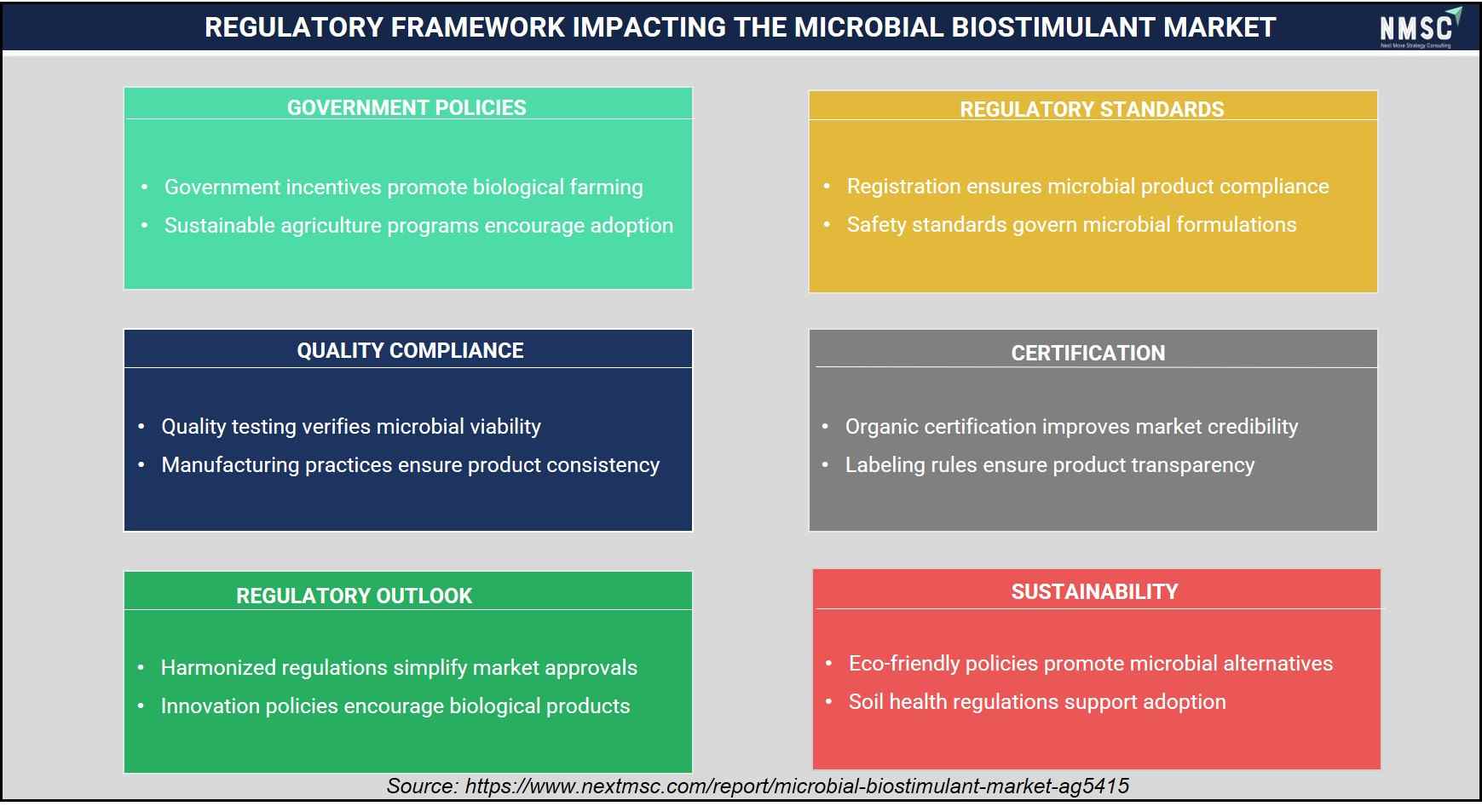
Our analysis indicates that the Microbial Biostimulant industry is shaped by regulatory policies promoting sustainable agriculture, product safety, and quality assurance. Government incentives and biological farming programs encourage adoption, while registration requirements, quality testing, manufacturing standards, and certification frameworks ensure product efficacy and transparency. Harmonized regulations and innovation-focused policies facilitate market expansion, whereas sustainability initiatives and soil health regulations continue to strengthen demand for environmentally friendly microbial biostimulant products.
Competitive Landscape
We observed that the Microbial Biostimulant industry features a moderately fragmented competitive landscape, with diversified crop-input majors competing alongside specialized biologicals developers on strain portfolio breadth, regulatory registration speed, and distribution reach.
Key Takeaways
|
Dimension |
Description |
|
Market Structure |
Moderately fragmented; the top companies profiled in this report collectively account for a significant share of global Microbial Biostimulant market revenue, while numerous regional fermentation specialists serve cost-sensitive segments. |
|
Innovation Focus |
Multi-strain consortia development, fermentation metabolite standardization, and precision fertigation-compatible formulations dominate current innovation pipelines across leading suppliers. |
|
M&A Activity |
Selective consolidation through platform investments, exemplified by Corteva's Series A investment in Symbiomics to accelerate microbial strain discovery capabilities. |
How Do Companies Compete in the Microbial Biostimulant Market?
Companies compete primarily on strain efficacy validation, registration speed, and distribution scale across the industry. Global players such as Syngenta AG and Corteva Agriscience leverage broad crop-compatibility portfolios to serve multinational distributors, while regional specialists such as Rizobacter compete on localized strain adaptation and agronomic advisory support supplied to smaller commercial farms and cooperatives.
Which Competitive Archetypes Dominate the Microbial Biostimulant Market?
Two archetypes dominate the market: diversified global biologicals groups offering integrated crop-nutrition platforms, and specialized regional fermentation companies focused on strain discovery and localized adaptation. Bayer AG and BASF SE exemplify the diversified archetype through integrated chemical-biological portfolios, while Koppert Biological Systems and Andermatt Biocontrol AG exemplify the specialist archetype serving horticultural and greenhouse demand.
How Are Companies Differentiating Through Innovation in Microbial Biostimulant?
Innovation and differentiation strategy increasingly center on multi-strain formulation and fermentation metabolite standardization. UPL's Hycoxa seaweed-extraction platform and Novonesis's bioyield-enhancement portfolio both prioritize concentrated, consistent bioactive delivery to secure differentiated positioning. Our analysis shows that suppliers unable to demonstrate replicated field-trial efficacy risk exclusion from distributor shortlists in regulated markets.
What M&A and Expansion Activity Is Shaping the Microbial Biostimulant Market?
Mergers, acquisitions, and geographic expansion continue to consolidate biologicals capabilities within the industry. Corteva's Series A investment in Symbiomics broadened its microbial genomics discovery pipeline, while Novonesis's distribution agreement with Rovensa Next illustrates how diversified groups pursue geographic expansion and channel leverage across seed treatment, soil application, and foliar biostimulant categories.
Key Market Players
Our assessment indicates that the following 20 companies are actively shaping strain innovation, registration strategy, and distribution expansion within the global Microbial Biostimulant market.
-
Syngenta AG
-
Corteva Agriscience
-
Bayer AG
-
UPL Limited
-
Valent BioSciences LLC
-
Lallemand Inc.
-
Koppert Biological Systems
-
Biobest Group NV
-
Andermatt Biocontrol AG
-
Rizobacter S.A.
-
Verdesian Life Sciences LLC
-
BioConsortia, Inc.
-
Seipasa S.L.
-
Futureco Bioscience S.L.
-
Agricen
-
Groundwork BioAg
-
ProFarm Group, Inc.
-
AMVAC Chemical Corporation
Latest Developments
We found that recent activity within the Microbial Biostimulant market is concentrated on strain commercialization, regulatory registration, and distribution partnerships, reflecting the industry's broader commercialization acceleration.
|
Date |
Event |
|
January 2026 |
Bayer expanded its agricultural biosolutions portfolio with the launch of Yoalo, a seed-applied biostimulant designed for corn to enhance early root development, nutrient availability, and stress tolerance using beneficial soil bacteria. |
|
December 2025 |
BASF Morocco unveiled Elite Sea, its first multi-crop biostimulant developed in strategic partnership with Acadian Plant Health, utilizing seaweed-based technologies to improve crop health, stress tolerance, and yield performance. |
|
October 2025 |
Corteva Agriscience announced a strategic organizational realignment to separate into two independent, publicly traded companies, sharpening its core focus on advanced crop protection, seeds, and integrated biological solutions. |
Investment Opportunities
What Capital Inflows Are Targeting the Microbial Biostimulant Market?
Capital inflows into the Microbial Biostimulant market are increasingly directed toward microbial genomics discovery platforms and fermentation capacity expansion. Strategic acquirers continue to fund strain-discovery start-ups, as seen in Corteva's Series A investment in Symbiomics. We observed that investors favor suppliers demonstrating validated field-trial efficacy, viewing regulatory registration progress as a proxy for long-term distributor contract retention.
How Is Infrastructure Investment Supporting Microbial Biostimulant Manufacturing?
Infrastructure investment is expanding fermentation and encapsulation capacity across Asia-Pacific, particularly in India and China, to serve rising domestic fertilizer control order approvals. Our findings suggest that manufacturers are investing in automated fermentation lines to improve colony-forming-unit consistency, supporting the precision required for seed-treatment and fertigation-compatible product formats.
What ESG Considerations Are Shaping Microbial Biostimulant Investment Decisions?
Environmental, social, and governance considerations are central to investment decisions across the industry, with reduced synthetic fertilizer dependence and soil-microbiome preservation as key criteria. The U.S. Department of Agriculture's soil-health program data continues to inform grower sustainability disclosures. We found that investors increasingly favor manufacturers with third-party efficacy certification, treating it as a governance indicator alongside environmental-impact reporting.
Key Benefits for Stakeholders
How Does This Report Benefit Enterprise and Industry Leaders?
Enterprise and industry leaders gain access to validated segmentation, competitive benchmarking, and regional demand forecasts that support sourcing and product-portfolio decisions across the Microbial Biostimulant industry. Our analysis shows that detailed microbial-type, application-route, and end-user breakdowns help procurement teams align specifications with regulatory and agronomic requirements while identifying underserved segments for portfolio expansion.
How Does This Report Benefit Investors and Financial Analysts?
Investors and financial analysts benefit from consistent, single-point market size and CAGR estimates that support valuation and capital-allocation decisions across the Microbial Biostimulant market supply chain. We observed that the report's regional and segment-level growth differentials help identify which manufacturers and distributors are best positioned to capture above-market growth in mixed-consortia and fertigation-compatible categories through 2035.
How Does This Report Benefit Technology Vendors and Product Teams?
Technology vendors and product teams gain insight into emerging formulation requirements, including encapsulated delivery, fermentation metabolite standardization, and digital fertigation compatibility, that are reshaping the industry. Our findings suggest that this analysis helps R&D teams prioritize development roadmaps around strain stability and registration-ready efficacy data increasingly required by distributor evaluation processes.
Key Market Segments
By Microbial Type
-
Bacteria
-
Nitrogen Fixers
-
Symbiotic
-
Free Living
-
-
Phosphate Mobilizers
-
Potassium Mobilizers
-
Other Nutrient Mobilizers
-
PGPR
-
Other Bacteria
-
-
Fungi
-
Mycorrhizae
-
Trichoderma
-
Other Fungi
-
-
Cyanobacteria
-
Microalgae
-
Mixed Consortia
-
Other Microbials
By Microbial Byproducts
-
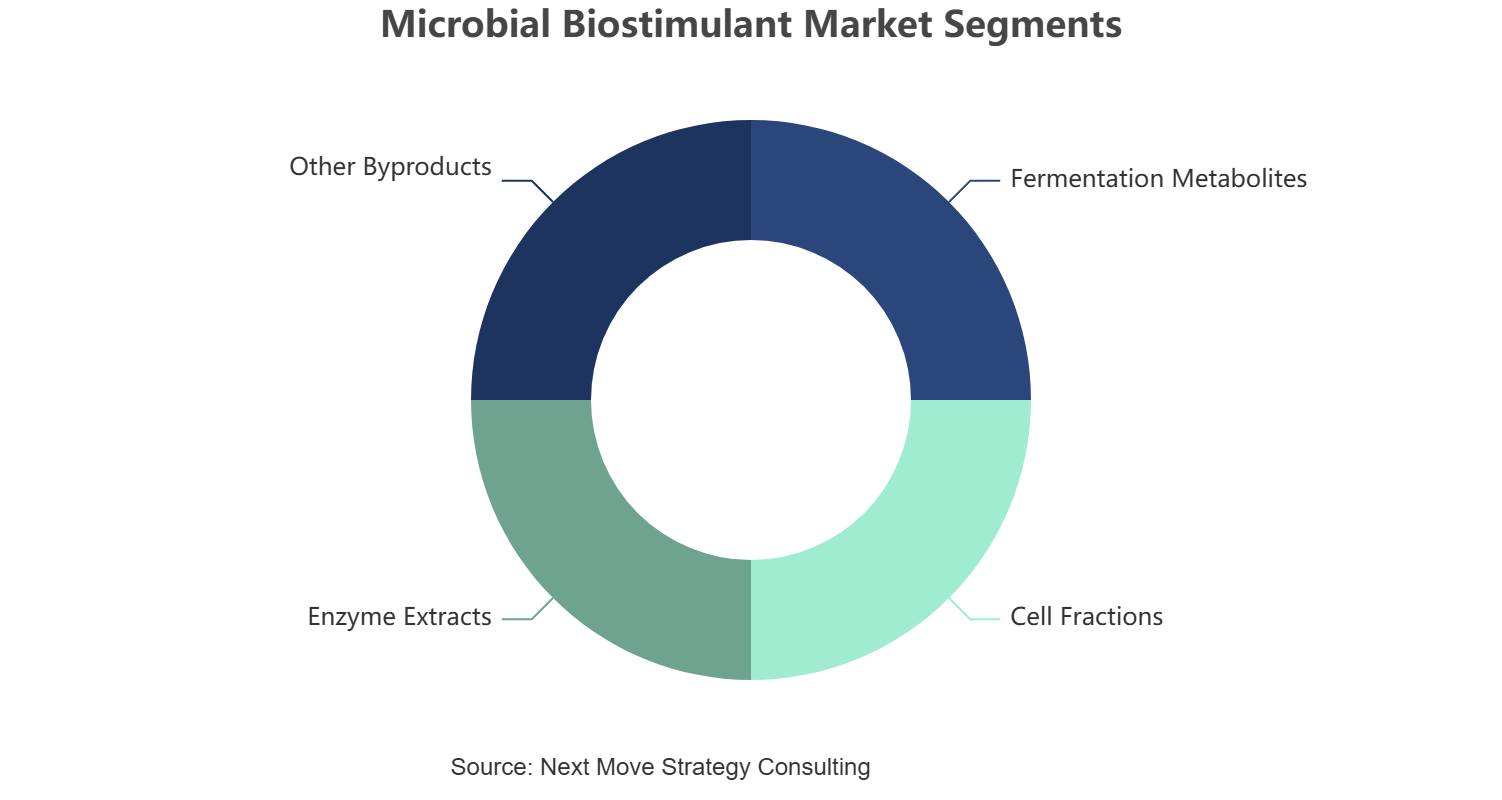
Fermentation Metabolites
-
Cell Fractions
-
Enzyme Extracts
-
Other Byproducts
By Product Form
-
Liquid
-
Dry
-
Powder
-
Granule
-
-
Encapsulated
-
Seed Coating
-
Other
By Application Route
-
Seed Treatment
-
Soil Application
-
Foliar Spray
-
Fertigation
-
Nursery and Transplant
By Crop Type
-
Cereals and Grains
-
Oilseeds and Pulses
-
Fruits and Vegetables
-
Plantation Crops
-
Turf and Ornamentals
-
Other Crops
By End User
-
Commercial Farms
-
Greenhouse Operations
-
Nurseries
-
Orchards and Vineyards
-
Landscape and Turf Management
-
Research and Demonstration Farms
-
Other End Users
By Sales Channel
-
Direct
-
Distributor
-
Dealer and Retail
-
OEM and Private Label
-
Digital
By Region
-
North America: U.S., Canada, Mexico
-
Europe: UK, Germany, France, Italy, Spain, Sweden, Denmark, Finland, Netherlands, Rest of Europe
-
Asia-Pacific: China, India, Japan, South Korea, Taiwan, Indonesia, Vietnam, Australia, Philippines, Malaysia, Rest of APAC
-
Middle East & Africa: Saudi Arabia, UAE, Egypt, Israel, Turkey, Nigeria, South Africa, Rest of MEA
-
Latin America: Brazil, Argentina, Chile, Colombia, Rest of LATAM
Conclusion and Recommendations
What Is the Long-Term Outlook for the Microbial Biostimulant Market?
The long-term outlook for the market remains positive, with global revenue projected to more than triple from USD 4.82 billion in 2025 to USD 15.69 billion by 2035 at a 12.7% CAGR. We observed that sustained input-cost pressure, regulatory harmonization, and mixed-consortia adoption will continue underpinning demand across commercial farm, greenhouse, and orchard applications through the forecast period.
What Strategic Positioning Should Microbial Biostimulant Suppliers Pursue?
Suppliers should prioritize multi-strain consortia platforms while pursuing streamlined regulatory registration to secure long-term distributor contracts. Our assessment indicates that manufacturers investing early in fermentation capacity and fertigation-compatible formulation will be best positioned to capture premium pricing within the Microbial Biostimulant market.
How Attractive Is the Microbial Biostimulant Market for New Investment?
The Microbial Biostimulant industry presents an attractive investment case, supported by a USD 10.34 billion absolute dollar opportunity between 2026 and 2035 and above-average growth in Asia-Pacific and mixed-consortia product categories. We found that investment attractiveness is highest for manufacturers combining strain-efficacy validation with scaled fermentation capacity, positioning them to serve both cost-sensitive and premium distributor segments simultaneously.
What Market Shifts and Key Risks Should Stakeholders Monitor?
Stakeholders should monitor strain shelf-life limitations, inconsistent cross-country regulatory classification, and competitive pressure from conventional fertilizer alternatives as key risks to the Microbial Biostimulant market. Our analysis shows that suppliers unable to adapt to harmonized registration requirements risk losing distributor shelf space to competitors with validated, certified strain portfolios, particularly within Europe's increasingly regulated fertilizing products environment.
What Are the Key Growth Pathways for the Microbial Biostimulant Market?
Key growth pathways include expanding mixed-consortia and encapsulated product portfolios, scaling fermentation capacity, and deepening penetration into greenhouse and research-farm channels. Next Move Strategy Consulting's analysis indicates that suppliers pursuing these pathways while maintaining registration compliance in core bacteria-based categories will be best positioned to capture the Microbial Biostimulant market's projected growth through 2035.
About the Author
 Saista Faiyaz
— Saista Faiyaz is Research Associate at Next Move Strategy Consulting, where she has covered consumer markets and healthcare technologies for 3 years. Her work includes primary interview review, secondary-source validation, market sizing, and structured analysis of company and industry data. She supports research by comparing evidence across sources, organizing findings into market narratives, and documenting assumptions used in analysis. Her scope includes cross-market benchmarking, and reports.
Saista Faiyaz
— Saista Faiyaz is Research Associate at Next Move Strategy Consulting, where she has covered consumer markets and healthcare technologies for 3 years. Her work includes primary interview review, secondary-source validation, market sizing, and structured analysis of company and industry data. She supports research by comparing evidence across sources, organizing findings into market narratives, and documenting assumptions used in analysis. Her scope includes cross-market benchmarking, and reports.
About the Reviewer
 Supradip Baul
— Supradip Baul is an accomplished business consultant and strategist with over a decade of rich experience in market intelligence, strategy, technology, and business transformation. His work has included rigorous qualitative and quantitative analysis across multiple industries, helping clients shape investment decisions and long-term roadmaps. Earlier in his career, he was associated with Gartner, where he contributed to industry-leading reports and market share analyses. He has worked with leading global companies and holds an MBA with a dual specialization in Marketing and Finance.
Supradip Baul
— Supradip Baul is an accomplished business consultant and strategist with over a decade of rich experience in market intelligence, strategy, technology, and business transformation. His work has included rigorous qualitative and quantitative analysis across multiple industries, helping clients shape investment decisions and long-term roadmaps. Earlier in his career, he was associated with Gartner, where he contributed to industry-leading reports and market share analyses. He has worked with leading global companies and holds an MBA with a dual specialization in Marketing and Finance.
At Next Move Strategy Consulting, we understand that insightful market research is the cornerstone of successful business decisions. That's why we employ a robust and multifaceted approach, combining various methodologies to deliver the most accurate and actionable data for our clients.

Research Landscape
We navigate the world of research with two primary approaches:
Qualitative Approach
Our qualitative research methodologies involve immersive techniques such as in-depth interviews, focus groups, and observational studies. By engaging directly with individuals and stakeholders, we uncover valuable insights that quantitative data alone may overlook.

Quantitative Research
In tandem with qualitative methodologies, NMSC leverages the power of Quantitative Research to provide a robust foundation of numerical insights. Through systematic data collection and analysis, we quantify patterns, preferences, and market trends, offering a comprehensive view of the business landscape.
Our quantitative research approach employs diverse tools, including surveys, experiments, and statistical modelling. These methodologies enable us to gather data from a large and representative sample, ensuring the statistical significance of our findings. By employing structured questionnaires and standardized data collection methods, we guarantee the reliability and validity of the information we present to our clients.
Quantitative research is particularly effective in measuring the prevalence of trends, assessing market size, and gauging the impact of various factors on consumer behavior. The numerical precision attained through this approach equips our clients with actionable insights, facilitating data-driven decision-making and strategy formulation.


Our Specialized Toolbox for Industry-Specific Market Research
We deploy a specialized arsenal of techniques tailored to meet your unique requirements. Here's a glimpse into our comprehensive toolbox:

Information Procurement
The stage entails acquiring market data or relevant information through various sources and methodologies.


Market Research Approach
We utilize both top-down and bottom-up approaches in market research analysis to achieve a comprehensive understanding of the market dynamics, leveraging the broad perspective of industry trends and macroeconomic factors alongside detailed insights from specific segments and individual companies.

Porters Five Forces Analysis
We conduct Porter's Five Forces analysis to evaluate the competitive landscape of an industry, providing us with insights into factors that affect profitability and strategic positioning.

SWOT Analysis

Forecasting
We utilize a forecasting model to predict future consumption by considering parameters like population, economics, regulations, market competition, drivers, constraints, technology, and pricing. We also employ statistical techniques such as multilinear regression, exponential smoothing, moving average, ARIMA, and Monte Carlo simulations for accurate predictions. In econometric forecasting, we analyzed short-term and long-term event impacts, attributing values based on regulatory frameworks, economic factors, and market events.





 Speak to Our Analyst