Grass Seed Market Global Industry Analysis and Forecast (2026-2035)

Grass Seed Market size was USD 4.65 Billion in 2025, projected to reach USD 8.18 Billion by 2035, growing at a CAGR of 5.67% from 2026 to 2035. Key drivers include rising residential lawn renovation, expansion of sports and recreational turf infrastructure, demand for drought-tolerant cultivars, and growing forage seed consumption, with North America leading the market.

Download Free Sample PDF
Base Year (2025)
$4.65 Billion
Forecast (2035)
$8.18 Billion
CAGR (2026-2035)
5.7%
Top Region
North America

What Is the Grass Seed Market Size?

The global grass seed market size was valued at USD 4.65 billion in 2025 and is estimated at USD 4.98 billion in 2026, forecast to reach USD 8.18 billion by 2035 at a 5.67% CAGR from 2026 to 2035. North America led with approximately 33% revenue share, while Cool-Season Grass Seed dominated the primary segmentation axis at approximately 63% share in 2025.

We observed that momentum is broad-based across every segmentation axis of the grass seed market, with lawn and turf applications and residential demand driving the dominant structural shifts through 2035.

By Type: Cool-Season Grass Seed held the largest share of approximately 63% (USD 2.91 Billion) in 2025; Warm-Season Grass Seed is the fastest-growing sub-segment at 6.9% CAGR from 2026–2035. By Application: Lawn & Turf held the largest share of approximately 44% (USD 2.06 Billion) in 2025; Sports & Recreational Turf is the fastest-growing sub-segment at 6.8% CAGR from 2026–2035. By End User: Residential held the largest share of approximately 37% (USD 1.72 Billion) in 2025; Commercial & Institutional is the fastest-growing sub-segment at 6.6% CAGR from 2026–2035. Dominant Region: North America dominated with approximately 33% revenue share (USD 1.55 Billion) in 2025. Fastest-Growing Region: Asia Pacific is expected to register the highest CAGR of 7.7% during 2026–2035. Dominant Country: U.S. led with approximately USD 1096.9 million in 2025. Fastest-Growing Country: India is the fastest-growing country at approximately 9.7% CAGR from 2026–2035.

Market Opportunity: The grass seed market is expected to create an absolute dollar opportunity of USD 3.20 billion between 2026 and 2035, presenting significant investment potential across the residential lawn, sports turf, and forage and pasture value chain.

According to NMSC analysis, breeders are increasingly prioritizing drought-tolerant and low-input grass seed varieties to meet tightening municipal water-use regulations, a shift that is accelerating demand for improved cool-season cultivars across mature lawn care markets.

Grass Seed Market Global Industry Analysis and Forecast (2026-2035) Revenue Forecast

Values in USD Billion

2025 $4.65 Billion
2025
2026 $4.91 Billion
2026
2027 $5.19 Billion
2027
2028 $5.49 Billion
2028
2029 $5.80 Billion
2029
2030 $6.13 Billion
2030
2031 $6.47 Billion
2031
2032 $6.84 Billion
2032
2033 $7.23 Billion
2033
2034 $7.64 Billion
2034
2035 $8.18 Billion
2035

What Does the Grass Seed Market Encompass?
The grass seed market encompasses the breeding, production, and commercial sale of cool-season and warm-season grass seed varieties for residential lawns, sports and recreational turf, forage and pasture, and erosion control applications. Our assessment indicates that scope spans breeder royalties, seed multiplication, and branded retail and wholesale distribution across North America, Europe, Asia Pacific, Middle East & Africa, and Latin America, with demand shaped by climate zone, water-use regulation, and land-use patterns.
We found that the market has evolved from commodity forage seed toward higher-value, trait-differentiated turf cultivars bred for drought tolerance, disease resistance, and reduced mowing frequency. Technology adoption is progressing through marker-assisted breeding and seed coating innovations, while regulatory environments governing water restrictions and invasive species controls continue to shape which grass seed varieties gain market share across regions.

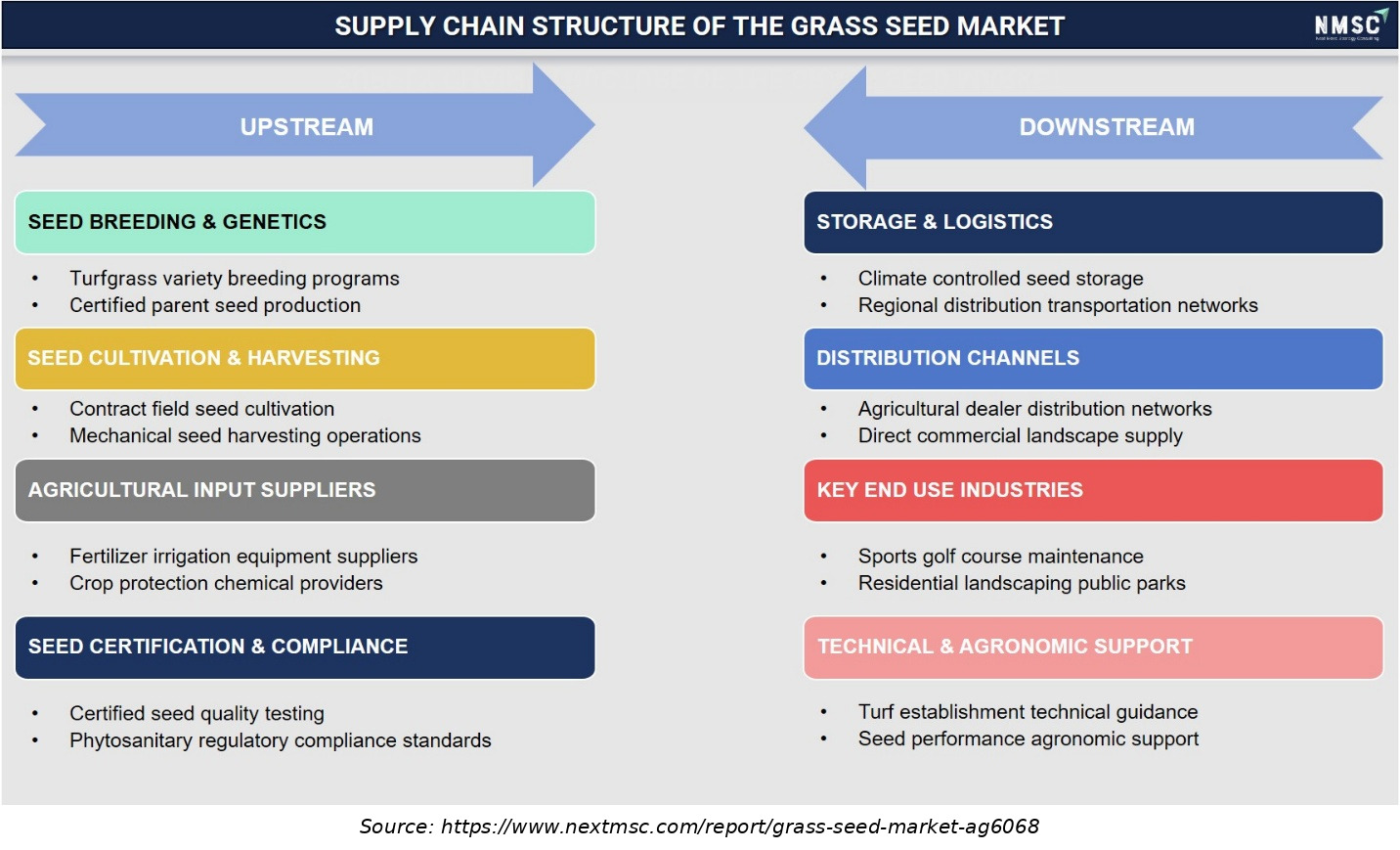
Supply Chain Structure of the Grass Seed Market

Based on NMSC's research, we found that the supply chain structure of the Grass Seed Market connects upstream breeding, cultivation, and phytosanitary certification with downstream logistics. Controlled storage and agricultural dealer networks efficiently supply seeds for sports golf courses, parks, and residential landscaping. Ultimately, ongoing agronomic support and turf establishment guidance ensure optimal seed performance and long-term grass quality across commercial and public applications.

Market Drivers & Dynamics

Interactive Dataset
Rising residential lawn renovation spending driver +1.4% North America, Europe 2026–2031
Expansion of sports and recreational turf infrastructure driver +1.1% Global 2026–2033
Demand for drought-tolerant and low-input cultivars driver +1.2% North America, MEA 2026–2035
Growth in forage seed demand from livestock expansion driver +0.9% Latin America, Asia Pacific 2026–2032
Municipal erosion control and land reclamation programs driver +0.7% Asia Pacific, MEA 2028–2035
Golf course and turf facility development driver +0.6% Asia Pacific, Middle East 2026–2030
Water-use restrictions limiting new lawn installation restraint −0.8% North America, MEA 2026–2030
Weather variability affecting seed production yields restraint −0.5% Europe, North America 2026–2029
Competition from artificial turf in commercial applications restraint −0.4% Global 2026–2035
Source: Next Move Strategy Consulting

Growth Drivers

What Is the Primary Growth Driver for the Grass Seed Market?

Rising residential lawn renovation and new-construction landscaping spending remains the largest single driver of grass seed demand across mature markets. The U.S. Department of Agriculture's data on turfgrass acreage underscores the scale of the established lawn base requiring periodic reseeding, a dynamic our analysis shows sustains steady replacement demand even without new housing growth.

How Is Sports and Recreational Turf Infrastructure Driving Market Growth?

Continued investment in sports fields, golf courses, and public recreational turf is expanding demand for premium, high-performance cultivars that command higher per-pound pricing than commodity forage seed. This extends grass seed demand beyond residential replacement cycles into capital infrastructure budgets, widening the addressable market considerably as municipalities and private sports operators expand facility counts.

Growth Inhibitors

What Is Restraining the Grass Seed Market?

Water-use restrictions in drought-prone regions are limiting new lawn installation and pushing some property owners toward artificial turf or xeriscaping alternatives. This regulatory pressure is documented in municipal water authority guidance across the southwestern United States, and our assessment indicates it remains the most significant restraint on new-installation demand, even as replacement seeding for existing lawns continues alongside broader lawn care service adoption.

Segmentation Analysis

2025 (USD Billion)
2035 (USD Billion)
Cool-Season Grass Seed 2025: $2.91 Billion | 2035: $4.81 Billion
Cool-Season
Warm-Season Grass Seed 2025: $1.74 Billion | 2035: $3.37 Billion
Warm-Season
Cool-Season Grass Seed $2.91 Billion $4.81 Billion 4.85%
Warm-Season Grass Seed $1.74 Billion $3.37 Billion 6.93%

Which Type Leads the Grass Seed Market?

Type segmentation splits the market between cool-season and warm-season grass species suited to different climate zones. Our analysis shows that Cool-Season Grass Seed held the dominant share in 2025 at USD 2.91 billion, reflecting the large temperate lawn and pasture base across North America and Europe. Warm-Season Grass Seed is projected as the fastest-growing type through 2035 at a 6.93% CAGR, as warmer climate regions expand turf installation.

2025 (USD Billion)
2035 (USD Billion)
Lawn & Turf
Sports & Rec
Forage & Pas
Erosion Cont
Segment Item 2025 (USD Billion) 2035 (USD Billion) CAGR
Lawn & Turf $10.0 USD Billion $40.0 USD Billion 25.0%
Sports & Recreational Turf $17.1 USD Billion $51.1 USD Billion 11.0%
Forage & Pasture $24.2 USD Billion $62.2 USD Billion 25.0%
Erosion Control & Reclamation $31.3 USD Billion $73.3 USD Billion 11.0%

Segment-wise data is locked

Unlock complete segment-wise numbers for By Application.

Unlock Full Data

Which Application Dominates Grass Seed Demand?

Application segmentation captures how grass seed is ultimately used across residential, commercial, and agricultural end markets. We found that Lawn & Turf dominated in 2025 at USD 2.06 billion, driven by ongoing residential lawn replacement and new landscaping demand. Sports & Recreational Turf is the fastest-growing application at a 6.75% CAGR from 2026 to 2035, supported by expanding sports facility construction.

2025 (USD Billion)
2035 (USD Billion)
Residential
Commercial &
Agricultural
Municipal &
Segment Item 2025 (USD Billion) 2035 (USD Billion) CAGR
Residential $10.0 USD Billion $40.0 USD Billion 27.0%
Commercial & Institutional $17.1 USD Billion $51.1 USD Billion 9.0%
Agricultural & Livestock $24.2 USD Billion $62.2 USD Billion 19.0%
Municipal & Government $31.3 USD Billion $73.3 USD Billion 17.0%

Segment-wise data is locked

Unlock complete segment-wise numbers for By End User.

Unlock Full Data

Which End User Generates the Most Grass Seed Revenue?

End-user segmentation distinguishes buyers by scale and purchasing behavior. Our assessment indicates Residential generated the largest revenue share in 2025 at USD 1.72 billion, reflecting the sheer number of individual homeowners purchasing seed for lawn maintenance. Commercial & Institutional is the fastest-growing end-user category at a 6.62% CAGR from 2026 to 2035, as commercial landscaping contracts expand.

Growth Opportunities

Beyond the core growth drivers, three forward-looking opportunities stand out for stakeholders positioning within the grass seed market over the 2026–2035 forecast period.

How Can Drought-Tolerant Cultivar Licensing Generate Long-Term Revenue Streams?

Drought-tolerant grass cultivars present a whitespace opportunity for breeding companies seeking to commercialize patented, low-input seed varieties across water-constrained regions. Seed developers that license climate-resilient cultivars to regional distributors and turf specialists can establish recurring royalty revenue while enabling municipal authorities, commercial landscapers, and recreational facility operators to comply with tightening water conservation regulations without compromising turf performance.

Where Do Premium Seed Coating Technologies Create New Consumer Value?

Residential lawn care represents an underpenetrated opportunity for seed companies offering proprietary seed coating technologies that improve germination, moisture retention, and early establishment. Producers that commercialize value-added coated grass seed products can differentiate their retail portfolios while capturing premium pricing from homeowners seeking faster, more reliable lawn establishment with reduced maintenance requirements.

How Can Strategic Sports Turf Partnerships Strengthen Commercial Market Position?

Professional sports venues, golf course developers, and large recreational facilities create a significant opportunity for grass seed breeders specializing in high-performance turf cultivars. Companies that establish long-term supply partnerships with premium sports infrastructure projects can strengthen product credibility while accelerating adoption among commercial landscaping contractors and institutional buyers seeking proven turf performance across demanding recreational environments.

Regional Outlook

2025 (USD Billion)
2035 (USD Billion)
North Americ
Europe
Asia Pacific
Middle East
Latin Americ
Region 2025 (USD Billion) 2035 (USD Billion) CAGR (%)
North America $10.0 USD Billion $40.0 USD Billion 9.0%
Europe $17.1 USD Billion $51.1 USD Billion 27.0%
Asia Pacific $24.2 USD Billion $62.2 USD Billion 25.0%
Middle East & Africa $31.3 USD Billion $73.3 USD Billion 23.0%
Latin America $38.4 USD Billion $84.4 USD Billion 12.0%

Regional data is locked

Unlock complete regional numbers for this market.

Unlock Full Data

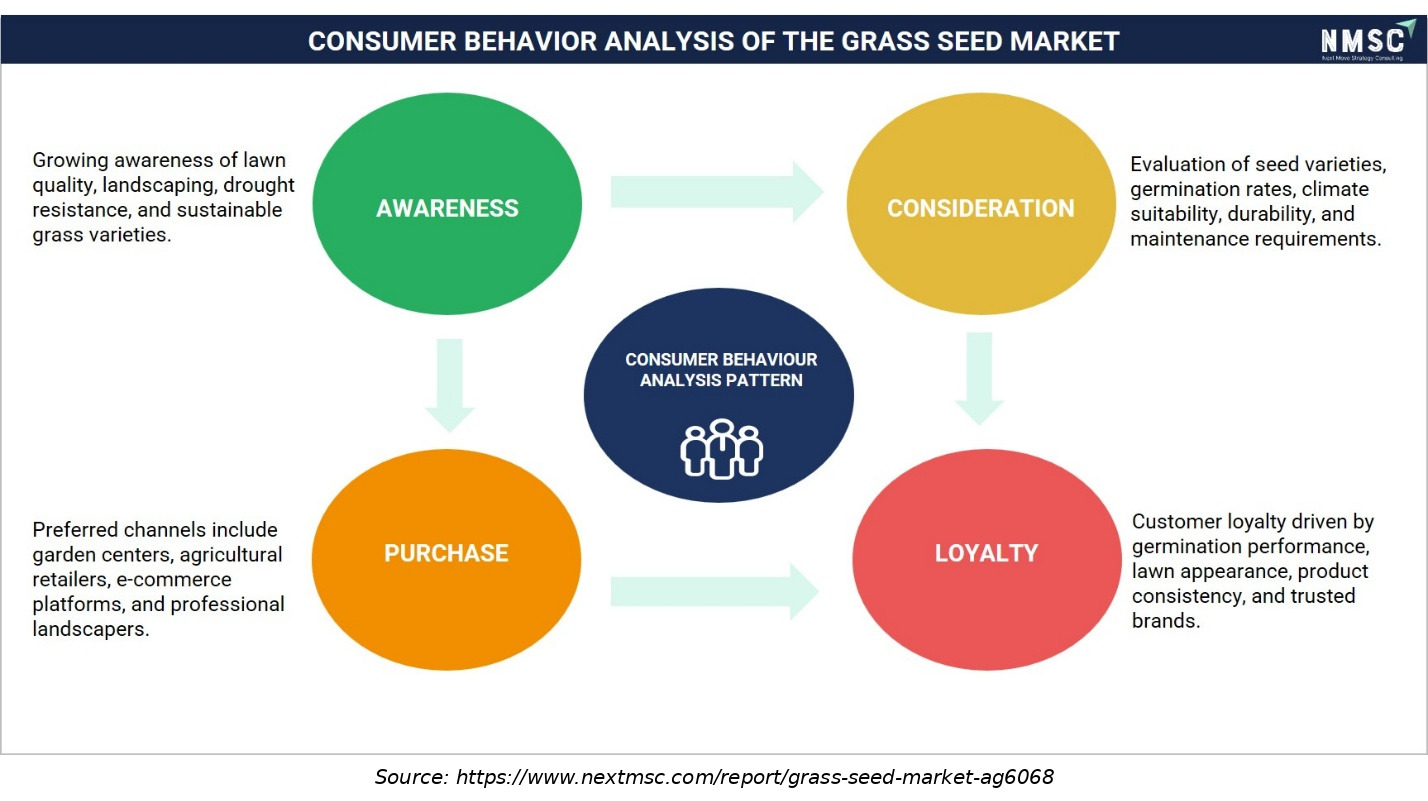
Consumer Behavior Analysis of the Grass Seed Market

Our assessment indicates that consumer engagement in the Grass Seed Market begins with awareness of drought-resistant, sustainable varieties. Consequently, buyers evaluate germination rates, climate suitability, and maintenance needs during consideration. Purchases are driven through garden centers, agricultural retailers, and digital channels, while long-term brand loyalty is maintained by consistent germination performance, vibrant lawn appearance, and trusted agronomic product quality.

Competitive Landscape

We found that competitive dynamics in the grass seed market center on breeding differentiation and distribution reach rather than price alone.

Dimension Description
Category Details
Market Structure Moderately consolidated, led by a small group of global breeding cooperatives and diversified agricultural seed companies alongside regional and consumer retail brands.
Innovation Focus Drought-tolerant and disease-resistant cultivar breeding, seed coating technology, and low-input turf genetics.
M&A Activity Joint ventures and acquisitions among established breeders expanding regional distribution and germplasm access.

How Do Companies Compete in the Grass Seed Market?

Competition centers on proprietary cultivar performance and distribution reach, since seed buyers favor varieties with proven germination rates, disease resistance, and climate suitability over unbranded commodity seed. Our analysis shows that vendors differentiate through breeding investment, retail shelf presence, and agricultural cooperative relationships rather than through price competition alone.

Which Competitive Archetypes Dominate the Market?

Three archetypes define the landscape: global breeding cooperatives with vertically integrated production such as DLF and Barenbrug, diversified agricultural seed companies serving both forage and turf markets, and consumer retail brands such as Scotts and Pennington that compete primarily on branded packaging and distribution. We found that breeding cooperatives hold the strongest position in premium professional turf and forage genetics.

What Innovation and Differentiation Strategies Are Companies Pursuing?

Vendors are investing in marker-assisted breeding to accelerate development of drought-tolerant and disease-resistant cultivars, and in seed coating technology that improves germination reliability for retail consumers. We observed that companies with strong professional sports turf reference customers use that credibility to support premium positioning in adjacent commercial and residential segments.

Key Market Players

The following companies represent the verified set of active grass seed market participants profiled in this report, ranked by scale of operations and documented market activity.

DLF Seeds A/S Royal Barenbrug Group Groupe Limagrain (Vilmorin & Cie) The Scotts Miracle-Gro Company Central Garden & Pet Company Land O'Lakes, Inc. Corteva, Inc. KWS SAAT SE & Co. KGaA DSV (Deutsche Saatveredelung AG) Germinal Holdings Limited Lantmännen ek för S&W Seed Company PGG Wrightson Limited L. Stroetmann Saat GmbH & Co. KG

Latest Developments

We found that leading breeders are expanding joint ventures and product lines, with the following developments reflecting the most recent verifiable activity in the market.

Date Event
July 2026 The Scotts Miracle-Gro Company released its 2026 Corporate Responsibility Report, highlighting the rollout of its GroForward 2030 strategy focused on sustainably produced lawn and garden solutions, expanded organic soil offerings, and improved supply chain efficiencies.
June 2025 DLF Seeds A/S launched its global corporate strategy, "Connecting to Grow," to standardize operations across 22 countries, prioritize high-value turf and forage seed portfolios, and accelerate climate-resilient breeding innovations through 2028.

Investment Opportunities

Where Are Capital Inflows Concentrated?

Capital inflows favor breeders with proprietary, patent-protected cultivar portfolios over commodity seed producers, since patented genetics support licensing royalty revenue with stronger margins than undifferentiated forage seed. Our assessment indicates that investors increasingly value breeding program depth and germplasm libraries as durable competitive moats.

What Infrastructure Investment Trends Are Emerging?

Seed producers are investing in expanded seed cleaning, coating, and processing infrastructure to support premium product lines that command higher retail margins than raw commodity seed. This infrastructure investment lowers per-unit processing cost at scale, making expanded capacity increasingly attractive for producers serving both retail and professional turf channels.

How Do ESG Considerations Factor Into Investment Decisions?

Grass seed breeding for reduced water and fertilizer input aligns directly with environmental, social, and governance priorities around water conservation and sustainable landscaping. We observed that institutional investors increasingly favor breeders with documented low-input cultivar pipelines as water scarcity regulation expands across drought-affected agricultural and urban markets.

Key Benefits for Stakeholders

How Does This Report Benefit Industry Leaders?

Industry leaders overseeing breeding and product portfolio decisions gain a segmentation view across type, application, and end user that clarifies where demand growth is concentrated. The regional outlook helps leaders benchmark market maturity against peer regions before committing to new breeding program investment.

How Does This Report Benefit Investors and Financial Analysts?

Investors evaluating exposure to agricultural and lawn care markets gain a validated market-size trajectory from 2025 through 2035, alongside a competitive landscape identifying which company archetypes are consolidating share through breeding investment and distribution partnerships. The Investment Opportunities section further clarifies where capital inflows are concentrated.

How Does This Report Benefit Seed Producers and Distributors?

Seed producers and distributors gain segmentation data identifying which applications and end-user categories are growing fastest, informing product portfolio prioritization. The Key Emerging Trends and Growth Drivers sections identify the specific regulatory and climate pressures currently shaping purchasing decisions across target customer segments.

Key Market Segments Evaluated

By Type

  • Cool-Season Grass Seed
  • Warm-Season Grass Seed

By Application

  • Lawn & Turf
  • Sports & Recreational Turf
  • Forage & Pasture
  • Erosion Control & Reclamation

By End User

  • Residential
  • Commercial & Institutional
  • Agricultural & Livestock
  • Municipal & Government

Conclusion & Recommendations

The grass seed market is set to expand from USD 4.98 billion in 2026 to USD 8.18 billion by 2035, registering a 5.67% CAGR as demand shifts from commodity forage seed toward higher-value, trait-differentiated turf cultivars. Long-term growth rests on continued residential lawn replacement demand, expanding sports and recreational turf infrastructure, and rising forage seed consumption tied to livestock production growth.

What Strategic Positioning Should Grass Seed Producers Pursue?

Producers should prioritize breeding investment in drought-tolerant and disease-resistant cultivars over commodity seed expansion, since patent-protected genetics support stronger margins and licensing revenue. Positioning around water-efficient turf varieties is particularly critical for producers targeting drought-affected North American and Middle Eastern markets.

How Attractive Is the Grass Seed Market for New Investment?

Investment attractiveness is highest among breeders with proprietary, patent-protected cultivar portfolios and diversified distribution across retail, professional turf, and agricultural cooperative channels, since these characteristics correlate with durable margin protection. Producers with sports turf reference customers represent a particularly attractive segment for premium positioning investment.

What Market Shifts and Key Risks Should Stakeholders Monitor?

The most significant structural shift is the move from commodity forage seed toward premium, trait-differentiated turf cultivars commanding higher per-pound pricing. Key risks include continued water-use restrictions limiting new lawn installation, weather variability affecting seed production yields, and growing artificial turf competition in commercial applications.

What Are the Key Growth Pathways for the Grass Seed Market?

The clearest growth pathway runs through drought-tolerant cultivar licensing, where patented low-input genetics extend producer revenue beyond commodity seed sales. Secondary growth pathways include expanding sports and recreational turf infrastructure investment across Asia Pacific and the Middle East, and continued forage seed volume growth tied to livestock production expansion in Latin America.

FAQs

About the Author

Saista Faiyaz

Saista Faiyaz

Saista Faiyaz is Research Associate at Next Move Strategy Consulting, where she has covered consumer markets and healthcare technologies for 3 years. Her work includes primary interview review, secondary-source validation, market sizing, and structured analysis of company and industry data. She supports research by comparing evidence across sources, organizing findings into market narratives, and documenting assumptions used in analysis. Her scope includes cross-market benchmarking, and reports.

About the Reviewer

Supradip Baul

Supradip Baul

Supradip Baul is an accomplished business consultant and strategist with over a decade of rich experience in market intelligence, strategy, technology, and business transformation. His work has included rigorous qualitative and quantitative analysis across multiple industries, helping clients shape investment decisions and long-term roadmaps. Earlier in his career, he was associated with Gartner, where he contributed to industry-leading reports and market share analyses. He has worked with leading global companies and holds an MBA with a dual specialization in Marketing and Finance.

Download Free Sample

Semih Kavaklioglu

SEMIH KAVAKLIOGLU

Co-Founder & Sales Manager

Decortie

I work a lot in the marketing industry and I know that research is an essential part of any campaign. I have used Market research reports for my own products and I found them to be very informative and well-researched. The team here produces insightful reports for a good price

Amos Chang

AMOS CHANG

Strategy Consultant

Kardex Group

I have bought the intralogistics market reports from NMSC two times so far. Joseph and his team are always very helpful and flexible in responding to any customization requirements on the report. Their expertise in market reports really helps us steer the day-to-day business. I will definitely recommend and come back myself whenever there is a need.

Henri Knyphausen

HENRI KNYPHAUSEN

Partner at Singulier [Ex-BCG]

Singulier

I recently engaged NEXTMSC.com for a commercial due diligence project within the intralogistics sector, and I am pleased to provide a reference based on my experience. In utilizing NEXTMSC.com's services, I found their report to offer valuable insights into market dynamics and key industry players. The initial report provided a solid foundation for our analysis. However, as we were investigating a smaller target in the market, and I had specific customization requests requiring additional research. These requests included detailed information on product portfolios of various players and sub-market sizes, both inclusive and exclusive of certain product categories. NEXTMSC.com demonstrated commendable responsiveness and agility in accommodating these customization requests. Within a timeframe of 1-2 weeks, they delivered a revised report that met our specific needs. Furthermore, they were receptive to my follow-up inquiries, ensuring clarity and understanding of the data provided. The final deliverable significantly contributed to our due diligence efforts. One of NEXTMSC.com's notable strengths lies in their qualitative research capabilities. However, for future engagements, I would recommend the inclusion of a quantified market model in Excel format. Such a model would offer the ability to conduct in-depth analyses and explore various market segments, including country-specific data and subcomponent breakdowns. Based on my positive experience, I would not hesitate to work with NEXTMSC.com again. Their responsiveness, willingness to accommodate customization requests, and commitment to delivering actionable insights make them a reliable partner for commercial research projects.

Kishu Kanda

KISHU KANDA

Strategy Analyst

Accenture

We purchased the AI Consumer Market Report from this company. Not only did they customize the report to meet our specific requirements, but they also showed great flexibility in accommodating our budget. The report we received fully met our expectations. Additionally, they provided prompt and thorough responses to both our pre-purchase and follow-up questions. We look forward to working with this company again in the future.

Ross J Mckenzie

ROSS J MCKENZIE

Business Insight Manager

Staysure Group

“Next MSC have been incredibly helpful in providing detailed & robust information on our market, alongside quantifying growth by different segments. The process to procure was simple and easy, with sample reports and regular contact to ensure we had what we needed. Succinct detail on their sources & methodologies is also greatly received, allowing transparency in this respect helps build trust in the detail you pay for. Joseph in particular was fantastic, and helped ensure efficient provision of the insight pack – thank you NMSC!”.

Custom Market Research Services

We will customize the research for you if the listed report does not fully match your requirements.

Get 30% Free Customization

Select License

This website uses cookies to ensure you get the best experience on our website. Learn more

✖