Green Marine Fuel Bunkering Market By Fuel Type (Liquid Biofuels, Renewable Methane, Methanol, Green Ammonia, and Other Green Fuels), By Bunkering Mode (Ship to Ship, Truck to Ship, Terminal to Ship, Pipeline to Ship, and Other Mode), By Vessel Class (Container, Tanker, Bulk Carrier, General Cargo, Passenger Ferry, Offshore and Service, and Other Vessel), By Buyer Type (Shipowner Operator, Charterer, Public Sector, and Other Buyer) – Global Analysis & Forecast, 2026–2035
Industry: Energy & Power | Publishing Date: June 26, 2026 | Last Updated: September 30, 2026 | No of Pages: N/A | No. of Tables: N/A | No. of Figures: N/A | Format: PDF | Report Code: EP4807
Green Marine Fuel Bunkering Market
Industry Outlook
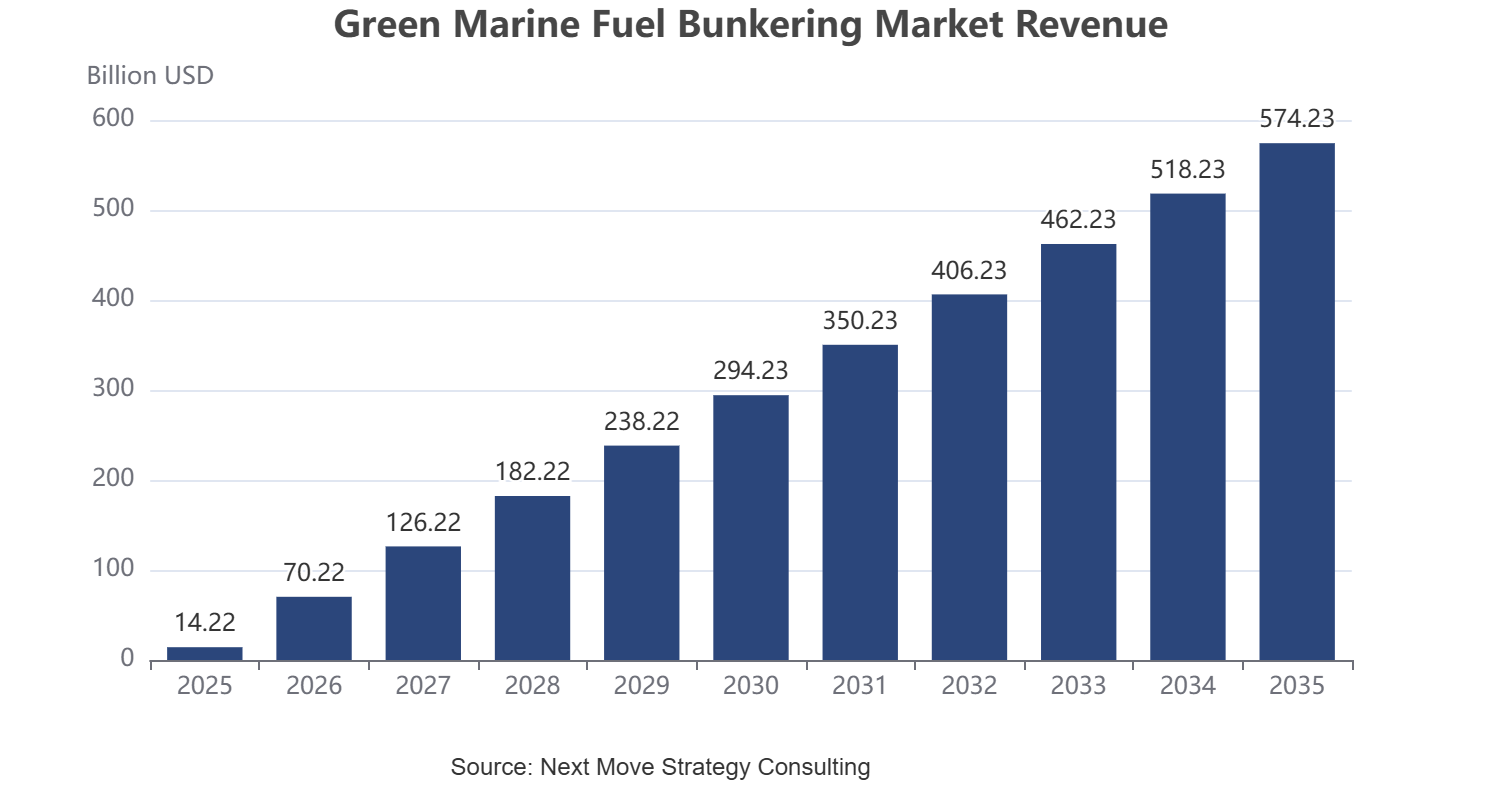
The Green Marine Fuel Bunkering Market size was valued at USD 14.22 billion in 2025 and is expected to be valued at USD 20.58 billion by the end of 2026. The industry is projected to grow, hitting USD 574.23 billion by 2035, with a CAGR of 44.75% between 2026 and 2035.
Green Marine Fuel Bunkering Market Size & Forecast
|
Parameters |
Details |
|
Market Size in 2026 |
USD 20.58 billion |
|
Revenue Forecast in 2035 |
USD 574.23 billion |
|
Growth Rate |
CAGR of 44.75% from 2026 to 2035 |
|
Analysis Period |
2025–2035 |
|
Base Year Considered |
2025 |
|
Forecast Period |
2026–2035 |
|
Market Size Estimation |
Billion (USD) |
|
Companies Profiled |
20 |
|
Countries Covered |
33 |
|
Market Share |
Available for 10 companies |
NMSC’s assessment indicates that the Green Marine Fuel Bunkering market is undergoing a structured transition driven by decarbonization targets, regulatory pressure, and evolving fuel technologies. LNG continues to play a critical role as a transitional marine fuel due to its lower emissions profile and expanding global bunkering infrastructure, enabling shipping operators to achieve short- to mid-term compliance goals. At the same time, methanol and ammonia are gaining strong momentum as scalable zero- and near-zero carbon fuel options. Their growth is supported by early pilot projects, demonstration vessels, and increasing investments in fuel production capacity and bunkering infrastructure. Moreover, these developments indicate a phased fuel transition strategy where transitional and alternative fuels coexist as the industry progresses toward long-term net-zero emissions objectives.
In addition, the market is witnessing significant digital and operational transformation across the green marine fuel bunkering market value chain. Fuel traceability systems, including blockchain-enabled tracking, electronic bunker delivery notes, and automated emissions reporting, are becoming increasingly important for ensuring transparency and regulatory compliance. Furthermore, we also analysed that digital integration is reshaping procurement structures through online trading platforms, direct supplier agreements, and real-time pricing mechanisms, reducing dependency on traditional intermediaries. This shift is improving supply chain efficiency, enhancing fuel authentication, and enabling better carbon accountability across global shipping operations. Consequently, the market is becoming more transparent, data-driven, and structurally efficient, supporting the accelerated adoption and commercialization of certified green marine fuels worldwide while strengthening long-term sustainability and compliance frameworks across the maritime sector.
What Are the Key Trends in the Green Marine Fuel Bunkering Market?
Why Is There Growing Interest in Methanol and Ammonia as Scalable Zero-Carbon Marine Fuel Options?
Our evaluation indicates that the market is witnessing growing interest in methanol and ammonia as scalable zero-carbon marine fuel options, driven by tightening emission regulations and global decarbonization targets in the shipping industry. Methanol is gaining early adoption due to its ease of handling, compatibility with dual-fuel engines, and a developing global supply infrastructure. Meanwhile, ammonia is emerging as a promising zero-carbon fuel for deep-sea shipping, supported by its carbon-free combustion at the point of use. Moreover, increasing pilot projects and demonstration vessels are validating their operational feasibility and safety performance under real-world conditions. In addition, rising investment in bunkering infrastructure and green fuel production capacity is strengthening long-term commercialisation prospects. However, large-scale adoption is still evolving and will depend on improvements in cost competitiveness, regulatory alignment, and the development of safe, standardized handling and storage systems across global ports.
Why Is LNG Being Increasingly Adopted as a Transitional Marine Fuel Across Global Shipping Fleets?
The increasing adoption of LNG as a transitional marine fuel across global shipping fleets is primarily driven by tightening emission regulations and the maritime industry’s gradual shift toward decarbonization. LNG is widely considered a bridge fuel because it offers lower CO₂, SOx, and NOx emissions compared to conventional marine fuels. Moreover, its growing acceptance is supported by expanding global bunkering infrastructure, which is improving accessibility across major shipping routes and ports. In addition, LNG enables smoother fleet transition as it is compatible with dual-fuel engine technologies, allowing operators to reduce emissions without immediate full fleet replacement. Furthermore, our assessment reveals that shipping companies are leveraging LNG to comply with short- to mid-term environmental targets while long-term zero-carbon fuels are still under development. However, despite its advantages, LNG remains a transitional solution as the industry progressively moves toward greener alternatives such as methanol, ammonia, and hydrogen-based fuels for long-term sustainability goals.
Why Is Fuel Traceability and Digital Verification Becoming Central to Marine Fuel Trust Systems?
Fuel traceability is becoming a core requirement in the Green Marine Fuel Bunkering Market as stakeholders prioritise verified fuel integrity and emissions accountability. Blockchain-based tracking systems, electronic bunker delivery documentation, and automated emissions reporting tools are increasingly deployed across major shipping corridors to strengthen transparency. Regulatory frameworks are accelerating the adoption of measurement, reporting, and verification systems, ensuring audit-ready fuel data across global shipping operations. Our scrutiny reveals that these digital technologies are improving accuracy in carbon intensity reporting while reducing discrepancies in fuel authentication processes. Additionally, traceability systems are enabling differentiated valuation of certified low-emission fuels in commercial transactions, strengthening trust between suppliers and ship operators. As compliance expectations intensify, digital verification is becoming an essential component of fuel procurement and regulatory adherence. Overall, fuel traceability frameworks are reinforcing market transparency, improving operational reliability, and supporting scalable adoption of certified green marine fuels globally.
How Is Digital Integration and Direct Fuel Procurement Reshaping Global Bunkering Market Structures?
NMSC’s market analysis suggests that digital transformation is fundamentally altering transaction structures within the Green Marine Fuel Bunkering Market. Moreover, the emergence of digital trading platforms, automated fuel procurement systems, and real-time pricing networks is improving efficiency and visibility across global bunkering operations. In addition, shipping companies are increasingly bypassing traditional intermediaries by entering direct supply agreements and long-term fuel contracts with producers. Our monitoring indicates that digital ecosystems are enabling faster coordination between fuel suppliers, traders, and fleet operators while reducing transactional complexity. Furthermore, smaller and emerging fuel producers are gaining improved access to international buyers through platform-based distribution models. Consequently, conventional brokerage-driven supply chains are gradually being replaced by integrated digital procurement networks. Overall, this shift is enhancing market liquidity, improving supply accessibility, and accelerating the commercial scaling of green marine fuels worldwide.
Strategic Framework of the Green Marine Fuel Bunkering Market
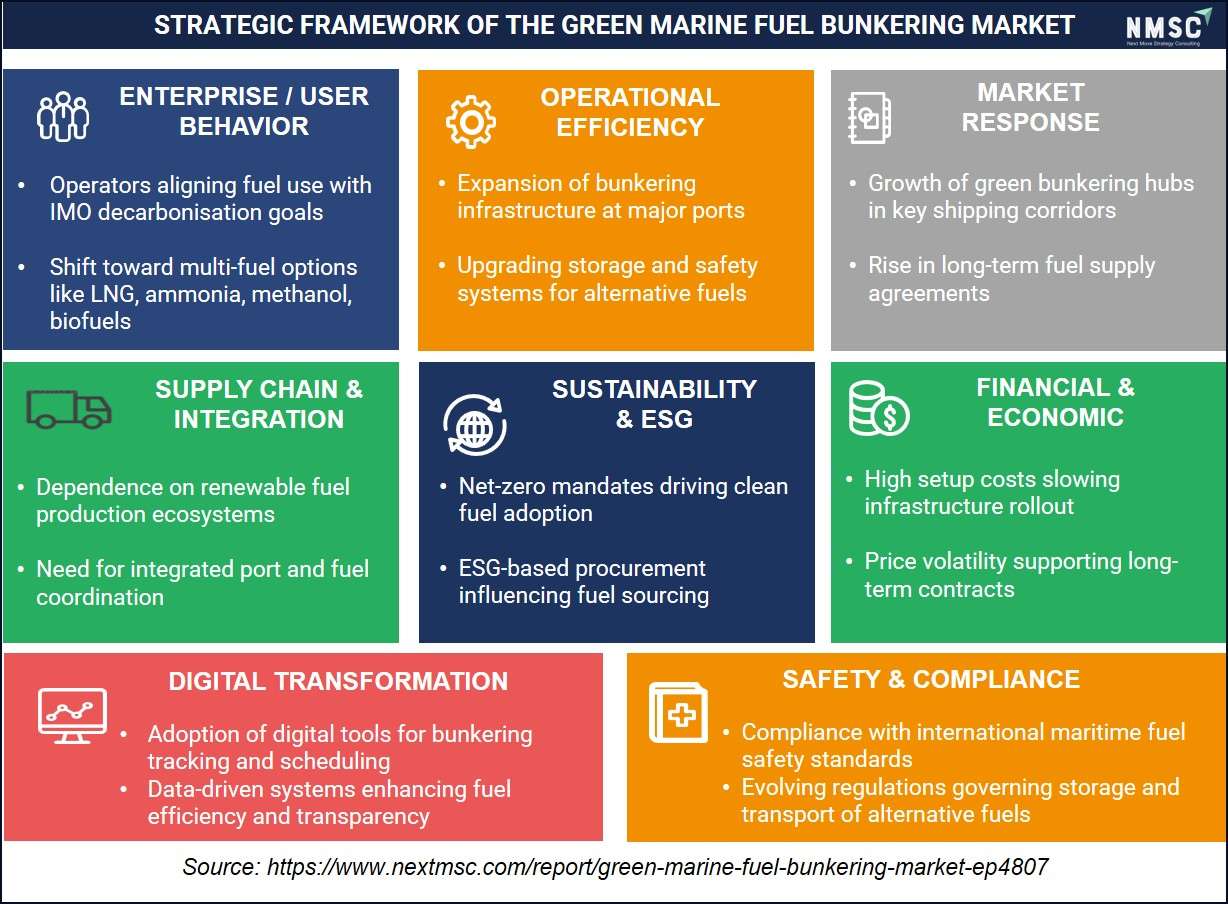
NMSC’s analysis indicates that the Green marine fuel bunkering market is evolving through shifts in enterprise behavior, with shipping operators aligning strategies with IMO decarbonisation targets and adopting multi-fuel options such as LNG, ammonia, methanol, and biofuels. Operational efficiency improves through the expansion of port bunkering infrastructure and upgraded storage and safety systems. Moreover, robust market response includes development of bunkering hubs and long-term offtake agreements. Supply chains depend on renewable fuel ecosystems and coordination, while ESG mandates shape procurement. High infrastructure costs and fuel volatility drive contracting models, alongside digital platforms enhancing efficiency and compliance with standards.
What are the Key Market Drivers, Breakthroughs, and Investment Opportunities that will Shape the Green Marine Fuel Bunkering Market in the Next Decade?
Growth Catalyst & Risk Assessment Matrix
|
DRIVERS / RESTRAINTS / OPPORTUNITY |
(+/-) % IMPACT ON CAGR FORECAST |
GEOGRAPHIC RELEVANCE |
IMPACT TIMELINE |
|
Tightening global maritime decarbonisation regulations are accelerating the adoption of green marine fuels like ammonia, hydrogen, and methanol across fleets |
+3.0% |
Europe, North America, East Asia, Global |
Long term (4–8 years) |
|
Expansion of port infrastructure for multi-fuel bunkering is improving fuel availability and supporting fleet transition decisions |
+2.5% |
Europe, Asia-Pacific, Middle East, North America |
Medium–Long term (3–7 years) |
|
High production costs of green hydrogen, ammonia, and biofuels are limiting large-scale commercial adoption |
-2.6% |
Emerging economies, Global South |
Medium term (2–6 years) |
|
The development of green shipping corridors is enabling structured demand and coordinated alternative fuel deployment |
+2.3% |
Europe–Asia routes, Asia-Pacific, North Sea, Transatlantic routes |
Medium–Long term (3–6 years) |
The Green Marine Fuel Bunkering Market is being strongly shaped by a combination of regulatory, infrastructural, cost-related, and ecosystem development factors. Increasing global regulatory pressure on maritime decarbonisation is accelerating the shift toward low-emission fuels such as ammonia, hydrogen, methanol, and advanced biofuels, as compliance frameworks become more binding. At the same time, our research indicates that expansion of port infrastructure investments is enhancing multi-fuel bunkering capabilities, improving fuel accessibility and supporting long-term fleet transition planning. However, high production and supply costs of green marine fuels remain a key restraint, limiting large-scale adoption despite policy momentum. These fuels, particularly hydrogen and ammonia, still face significant cost disadvantages compared to conventional alternatives. On the opportunity side, the development of green shipping corridors is enabling structured demand creation and coordinated infrastructure deployment across major trade routes. Overall, these dynamics collectively indicate a transitional phase toward scalable and commercially viable maritime fuel decarbonisation globally.
Growth Drivers:
How is Increasing Global Regulatory Pressure to Decarbonise Maritime Transport Accelerating the Adoption of Green Marine Fuels?
Our assessment confirms that increasing global regulatory pressure to decarbonise maritime transport is accelerating the adoption of green marine fuels across international shipping networks. Moreover, regulatory bodies are shifting from advisory guidance to binding compliance mechanisms, compelling shipowners and operators to align with global climate objectives. Consequently, alternative fuels such as ammonia, hydrogen, methanol, and advanced biofuels are gaining stronger attention in investment and procurement decisions. In addition, the European Commission’s FuelEU Maritime regulation mandates a 2% reduction in greenhouse gas intensity of energy used onboard ships in 2025, increasing progressively to 80% by 2050, directly reshaping fuel strategies. Regulatory clarity is reducing uncertainty and encouraging long-term fleet planning and infrastructure investment. As a result, ports and fuel suppliers are expanding readiness across major trade routes. Thus, policy enforcement is acting as a structural catalyst for decarbonization across the maritime fuel ecosystem globally in the long term.
Why Is the Expansion of Port Infrastructure Investments Supporting Alternative Fuel Bunkering Capabilities Globally A Key Market Driver?
Expansion of port infrastructure investments supporting alternative fuel bunkering capabilities is a key driver of sustainable maritime transition. Furthermore, our evaluation shows that ports are evolving into integrated energy hubs capable of handling LNG, methanol, ammonia, and hydrogen, thereby improving operational flexibility for shipping companies. Consequently, infrastructure readiness is reducing uncertainty in fuel procurement and vessel deployment decisions. In addition, the European Commission allocated USD 1.08 billion in 2024 under the Connecting Europe Facility for hydrogen supply and ammonia and methanol bunkering infrastructure, followed by over USD 648 million in 2025, supporting 70 projects with 24 ports upgraded. These investments are strengthening supply chain efficiency and enhancing port competitiveness across regions. As a result, fleet operators are aligning route planning with available fuel infrastructure, enabling coordinated public and private investment to support scalable deployment of alternative marine fuels across global trade routes.
Growth Inhibitor:
Why Are the High Production and Supply Costs of Green Marine Fuels Limiting Large-Scale Adoption?
Our review of the data suggests that high production and supply costs of green marine fuels are significantly limiting large-scale adoption across the maritime sector. Moreover, advanced fuels such as green hydrogen, ammonia, and biofuels require energy-intensive production processes, resulting in substantially higher costs compared to conventional marine fuels. Alternative fuels remain economically uncompetitive for many shipping operators despite regulatory pressure. In addition, the International Energy Agency reports that in 2025, low-emission hydrogen accounts for less than 1% of global production due to high costs and limited scale. Furthermore, OECD analysis indicates alternative marine fuels can cost up to 300% more, with green methanol priced between $900 and $2,500 per tonne, while global maritime decarbonization may require USD 1.2 to USD 1.6 trillion investment. Overall, we found that cost disparities continue to act as a major constraint on market scalability, leading shipping companies to remain cautious in transitioning to alternative fuels.
Growth Opportunity:
How Is the Development of Green Shipping Corridors Creating Opportunity for Structured Demand and Scalable Deployment of Alternative Marine Fuels?
Based on our assessment, we found that the development of green shipping corridors is emerging as a key opportunity for structured demand creation and scalable deployment of alternative marine fuels across global trade routes. These corridors integrate fuel infrastructure, regulatory alignment, and stakeholder coordination, thereby improving supply chain visibility and reducing fragmentation in marine fuel availability. From an infrastructure enablement perspective, corridors are strengthening bunkering readiness by concentrating investments in strategic ports and trade hubs. For instance, initiatives such as the Singapore–Rotterdam Green and Digital Shipping Corridor have supported early bio-methane bunkering pilots, demonstrating operational feasibility for alternative fuels at scale. In addition, European funding programs such as the Connecting Europe Facility are accelerating the development of hydrogen, ammonia, and methanol bunkering infrastructure across key maritime gateways. From a demand formation perspective, these corridors are creating predictable fuel consumption pathways, supporting long-term investment planning. According to the International Energy Agency, maritime decarbonisation could generate around 0.4 EJ of renewable fuel demand by 2030, rising to 2.5–3.5 EJ by 2035, reinforcing structured green marine fuel bunkering market growth globally.
How is the Green Marine Fuel Bunkering Market Segmented in this Report, and What are the Key Insights from the Segmentation Analysis?
Market Highlights & Strategic Insights - Green Marine Fuel Bunkering Market:
|
Segments |
Key Takeaways |
|
Fuel Type |
The Fuel Type segment includes Liquid Biofuels, Renewable Methane, Methanol, Green Ammonia, and Other Green Fuels. Liquid Biofuels dominate due to compatibility with existing marine engines and minimal infrastructure requirements. Renewable Methane and Methanol act as transition fuels supported by improving supply chains. Green Ammonia is a long-term zero-emission option but faces infrastructure and safety constraints, while Other Green Fuels remain at pilot stage. |
|
Bunkering Mode |
The Bunkering Mode segment covers Ship to Ship, Truck to Ship, Terminal to Ship, Pipeline to Ship, and Other Mode. Ship to Ship dominates due to high operational flexibility and suitability for offshore locations and congested ports, making it widely preferred across global bunkering operations. Terminal to Ship is also prominent due to strong port infrastructure and efficiency for large-scale supply. Truck to Ship supports smaller ports and early adoption markets. Pipeline to Ship is limited to advanced port clusters, while Other Modes remain niche. |
|
Vessel Class |
The Vessel Class segment includes Container, Tanker, Bulk Carrier, General Cargo, Passenger Ferry, Offshore and Service, and Other Vessel types. Container vessels dominate due to high trade volumes and decarbonization pressure. Tankers and Bulk Carriers also contribute significant demand from long-haul shipping. Passenger Ferries adopt cleaner fuels faster due to regulations, while Offshore and Service and Other Vessel types remain fragmented. |
|
Buyer Type |
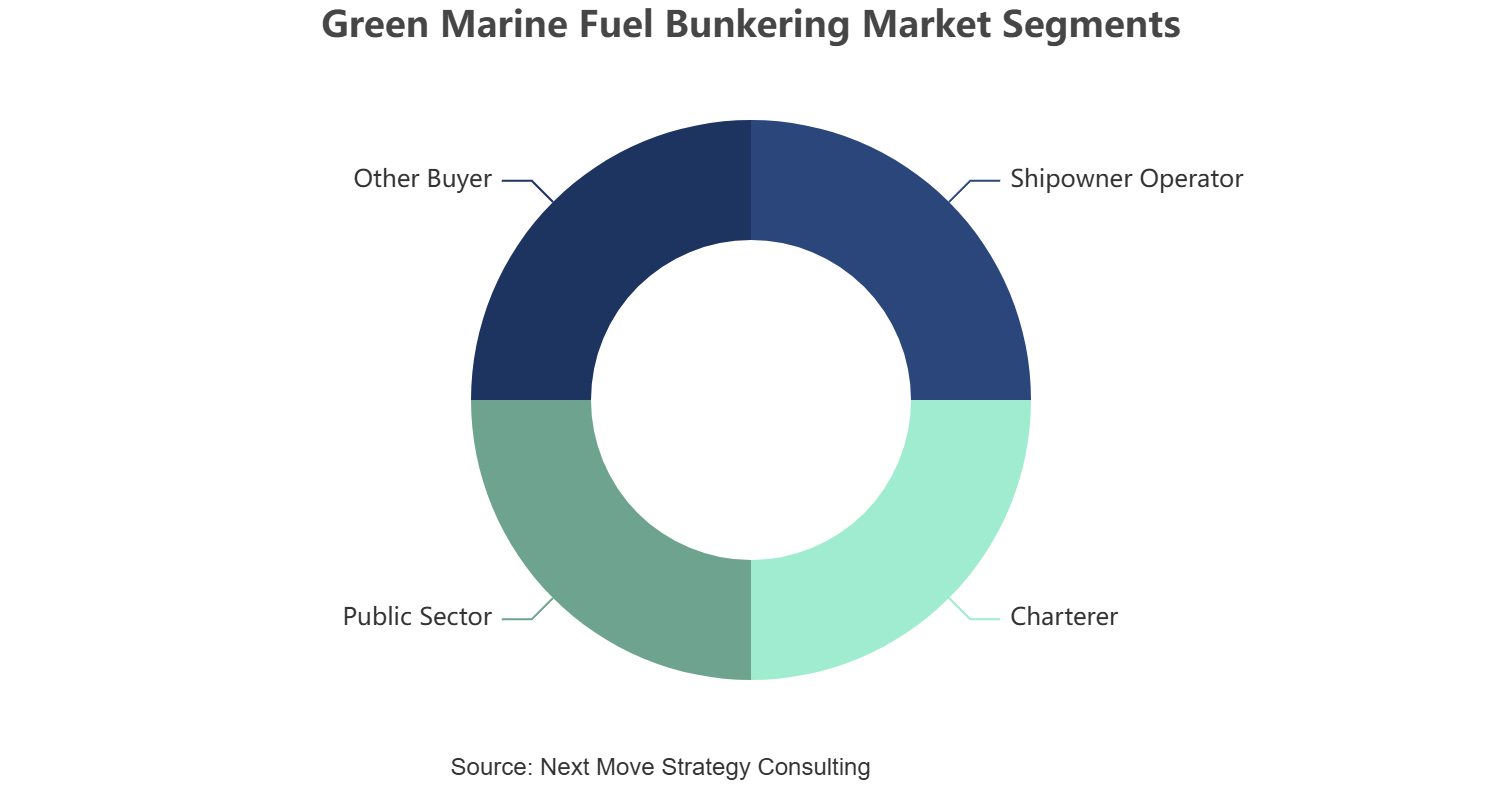
The Buyer Type segment includes Shipowner Operators, Charterers, Public Sector, and Other Buyers. Shipowner Operators dominate as they directly control fleet operations and fuel procurement. Charterers influence fuel decisions through contractual arrangements. Public Sector supports growth via policy, infrastructure investment, and green corridor initiatives. Other Buyers, including energy firms and consortium groups, contribute through pilot projects and early-stage collaborative procurement. |
By Fuel Type
How is Fuel Type Segmentation Influencing Fuel Adoption Patterns in The Green Marine Fuel Bunkering Market?
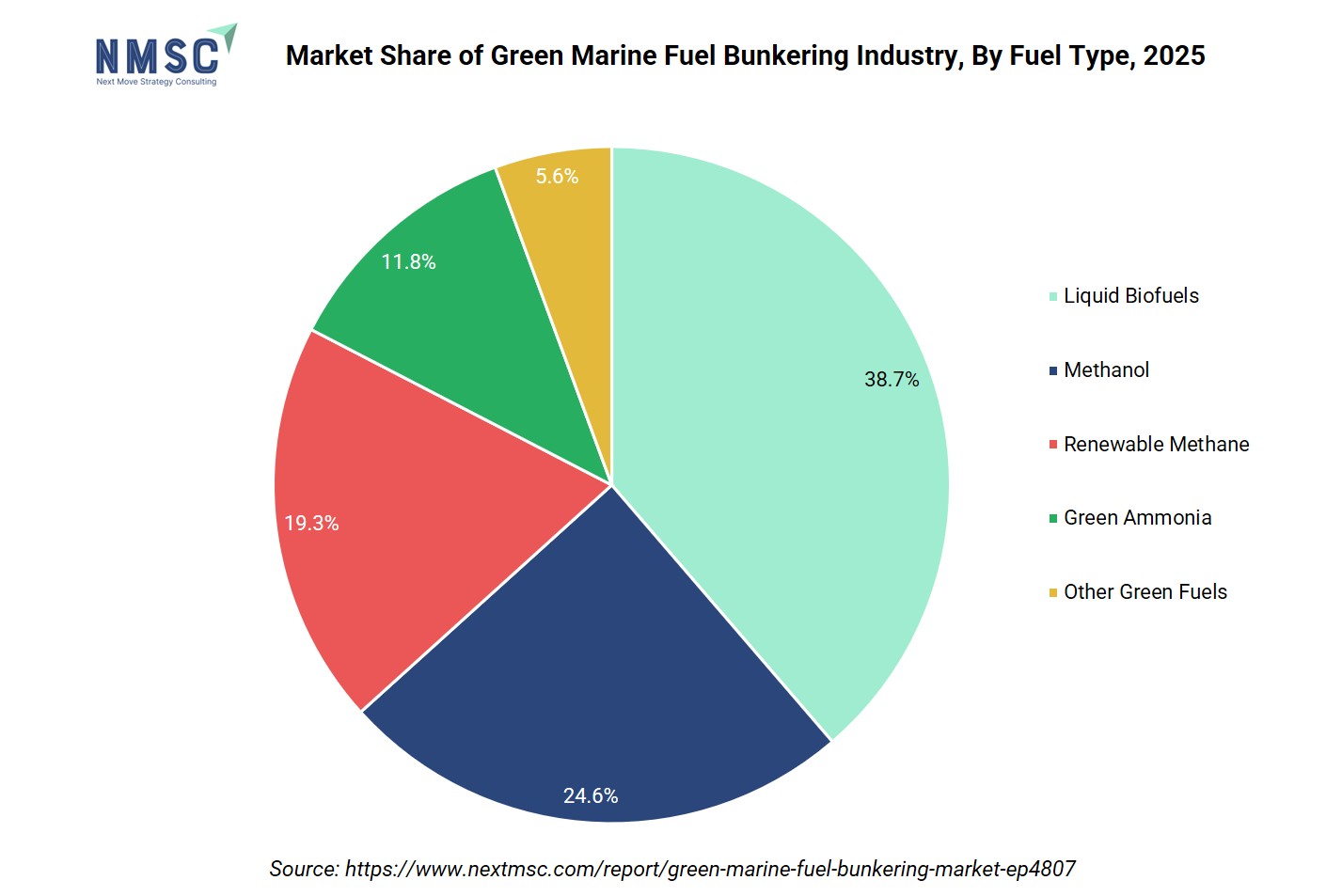
On the basis of fuel type, the Green Marine Fuel Bunkering market is segmented into liquid biofuels, renewable methane, methanol, green ammonia, and other green fuels. These segments collectively represent the core alternative fuel categories being adopted across maritime bunkering infrastructure.
From our evaluation, we found that the market is primarily driven by liquid biofuels due to their compatibility with existing marine engines and bunkering infrastructure, making them the dominant segment in the short to medium term. Furthermore, methanol is witnessing strong adoption as shipping operators transition toward lower-emission fuels supported by regulatory compliance and fuel flexibility. Renewable methane, particularly bio-LNG, is gaining momentum due to its ease of integration with LNG-powered fleets and existing supply chains. Green ammonia, although still in early commercialization, is expected to play a crucial role in deep-sea decarbonization in the long run. Overall, our market analysis suggests that other green fuels remain limited but contribute to regional experimentation and specialized marine applications across select ports globally.
By Bunkering Mode
How Does Bunkering Mode Structure Influence Operational Deployment in the Green Marine Fuel Bunkering Market?
Based on bunkering mode, the Green Marine Fuel Bunkering market is segmented into Ship to Ship, Truck to Ship, Terminal to Ship, Pipeline to Ship, and Other Mode.
Our analysis reveals that Ship to Ship bunkering dominates due to operational flexibility and suitability for large-scale offshore refuelling operations, while Truck to Ship remains widely used in smaller ports with limited infrastructure. Terminal to Ship supports centralized fuel distribution through established port facilities, improving handling efficiency and storage control. Pipeline to Ship is gradually developing in regions with advanced port connectivity, enabling continuous and cost-efficient fuel transfer, whereas Other Mode covers emerging hybrid and localized bunkering solutions. In addition, increasing demand for scalable and low-emission fuel logistics is encouraging investments across all bunkering modes. Consequently, these modes collectively enhance supply chain efficiency and support global green marine fuel distribution networks.
By Vessel Class
How Does Vessel Class Influence Adoption in the Green Marine Fuel Bunkering Market?
Based on the vessel class, the Green Marine Fuel Bunkering market is segmented into Container, Tanker, Bulk Carrier, General Cargo, Passenger Ferry, Offshore and Service, and Other Vessel.
Our analysis indicates that Container vessels dominate demand due to high international trade activity and frequent port calls requiring consistent bunkering operations, while Tankers follow as energy transportation fleets increasingly comply with emission reduction standards. Bulk Carriers and General Cargo vessels show steady adoption as global cargo movement gradually shifts toward cleaner marine fuel alternatives. Passenger Ferries are integrating green fuels to support coastal decarbonization efforts, whereas Offshore and Service vessels adopt alternative fuels to meet operational compliance needs in marine support roles. Other Vessel categories represent early-stage but expanding adoption across specialized maritime operations. Moreover, our evaluation shows that tightening regulatory frameworks and fleet modernization programs are accelerating fuel transition across all vessel classes, thereby reinforcing sustainable maritime operations and long-term green marine fuel bunkering market expansion.
By Buyer Type
How Does Buyer Type Influence Demand Dynamics in the Green Marine Fuel Bunkering Market?
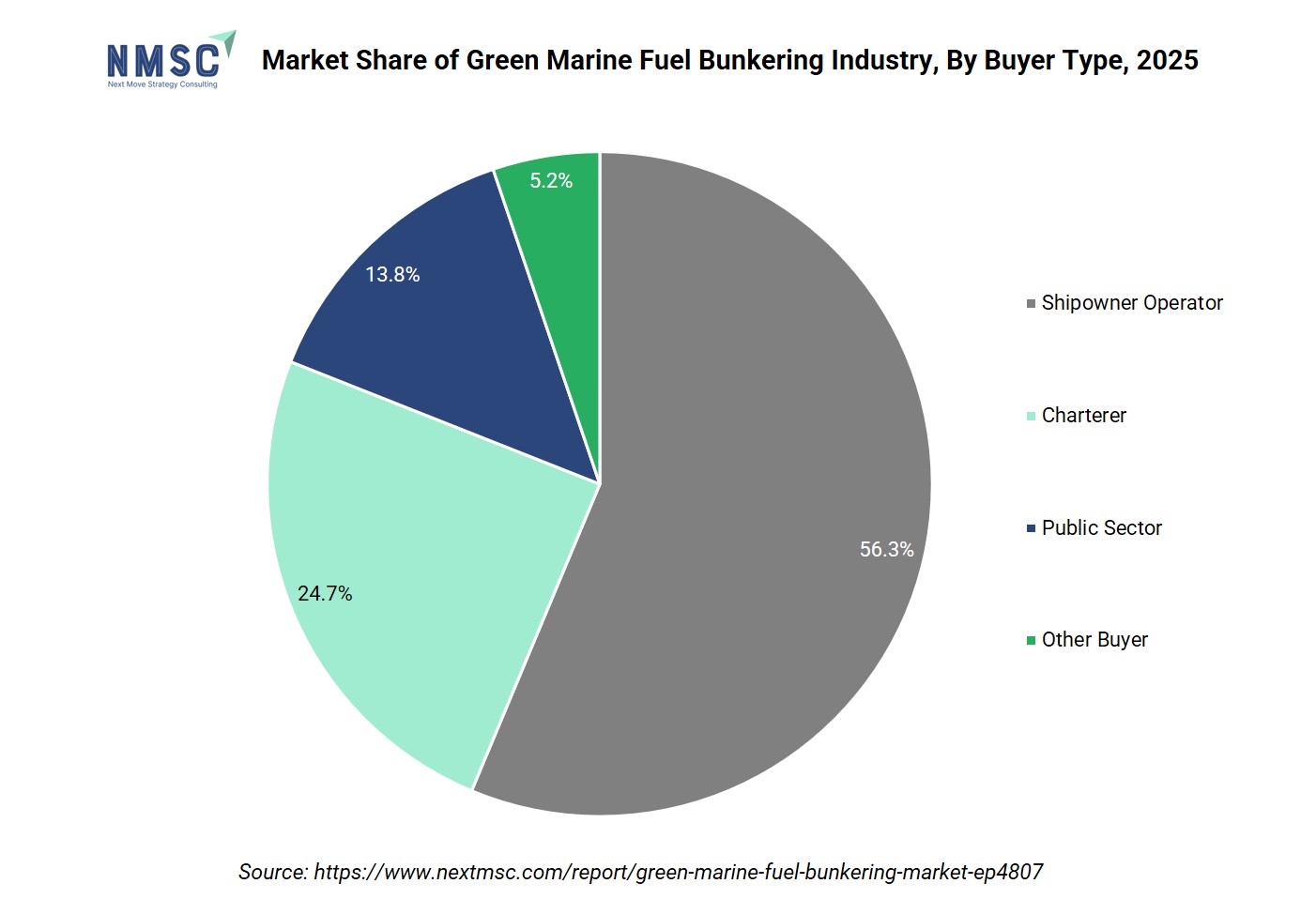
On the basis of buyer type, the Green Marine Fuel Bunkering market is segmented into Shipowner Operator, Charterer, Public Sector, and Other Buyer.
We found that Shipowner Operators dominate demand as they directly control vessel fuel procurement and long-term decarbonization strategies, while Charterers influence fuel choice through contractual sustainability requirements and emission-linked shipping agreements. We observed that the Public Sector plays a growing role through policy-driven procurement, infrastructure funding, and regulatory enforcement, supporting clean fuel adoption. Other Buyer categories include emerging stakeholders such as integrated energy providers and consortium-based purchasers involved in pilot bunkering projects. Increasing regulatory pressure and sustainability commitments across global shipping networks are driving coordinated investment decisions across all buyer types. Consequently, these factors collectively strengthen structured demand formation and accelerate the adoption of green marine fuels in the bunkering ecosystem.
Regional Outlook
Geographic Performance Snapshot:
|
Geography |
Key Takeaways |
|
North America |
The North American Green Marine Fuel Bunkering Market is evolving through a structured transition supported by tightening emission regulations, gradual port modernization, and expanding maritime decarbonization initiatives. Our market analysis suggests that the United States leads the regional market due to its larger port infrastructure, stronger shipping activity, and increasing pilot-scale deployment of renewable methane, methanol, and biofuel bunkering solutions. Canada is progressing steadily through infrastructure upgrades, coastal sustainability initiatives, and growing integration of digital fuel monitoring and operational safety systems across maritime networks. |
|
Europe |
Our assessment shows that the European market represents a comparatively advanced commercialization landscape supported by stringent climate regulations, coordinated port modernization, and expanding deployment of alternative marine fuels. The United Kingdom is progressing through policy-driven infrastructure development, while Germany benefits from industrial coordination and scalable fuel distribution systems. France and Italy are advancing through gradual capability-building and regulatory alignment, whereas Spain is strengthening sustainable maritime logistics through infrastructure upgrades and operational modernization. The Nordics continue to lead the region with advanced infrastructure readiness, higher commercialization maturity, and strong integration of renewable marine fuels across bunkering operations. |
|
Asia‑Pacific |
Asia Pacific is advancing through uneven but accelerating adoption supported by trade expansion, port modernization, and strengthening decarbonization initiatives. Our findings reveal that China leads the region through large-scale port infrastructure and faster commercialization of alternative fuels, while Japan and South Korea are progressing through technology-driven and industrially coordinated transition models. India, Taiwan, and Indonesia remain in capability-building phases focused on infrastructure expansion and operational modernization. Meanwhile, Australia reflects a comparatively mature market environment supported by established sustainability frameworks and stable infrastructure readiness. |
|
Latin America |
Latin America’s Green Marine Fuel Bunkering Market is advancing gradually within an uneven infrastructure landscape influenced by port modernization constraints and fiscal limitations across maritime economies. Our market analysis suggests that expanding regional trade activity and increasingly stringent global emission regulations are strengthening interest in cleaner marine fuel alternatives throughout coastal shipping networks. Pilot-scale biofuel initiatives, selective infrastructure modernization, and rising digital integration across port operations are supporting transition efforts. However, inconsistent regulatory frameworks and limited infrastructure preparedness continue to constrain large-scale commercialization and broader alternative fuel deployment. |
|
Middle East & Africa |
The Middle East & Africa region is developing gradually, supported by the region’s strategic position within global shipping and transhipment corridors. Our research demonstrates that port expansion projects, storage modernization, and improving bunkering infrastructure are strengthening operational capacity across major maritime hubs. Alternative fuel adoption remains at an experimental stage, primarily through biofuel and blended renewable fuel trials, while digital port technologies are improving logistics coordination and fuel management efficiency. However, uneven regulatory frameworks and varying infrastructure maturity continue to influence the pace of regional commercialization. |
The Green Marine Fuel Bunkering Market is geographically studied across North America, Europe, Asia Pacific, the Middle East & Africa, and Latin America, and each region is further studied across countries.
Green Marine Fuel Bunkering Market in North America
The North American Green Marine Fuel Bunkering Market is in a structured transition phase, shaped by evolving emission regulations, gradual port infrastructure upgrades, and increasing alignment of shipping operations with decarbonization frameworks. Our market analysis suggests that demand is primarily driven by tightening environmental compliance requirements, rising adoption of alternative fuel strategies in maritime logistics, and growing investment in port modernization programs. Moreover, renewable methane, methanol, and biofuels are being gradually introduced through pilot-scale bunkering projects, indicating a measured yet clear transition away from conventional marine fuels. In addition, infrastructure development is concentrated on storage retrofitting, bunkering safety enhancements, and digitalization of fuel management systems to improve operational transparency. Furthermore, supply-chain integration between energy providers and port authorities is gradually strengthening, supporting long-term scalability. Consequently, the region is progressing toward structured commercialization with phased adoption dynamics. The United States remains the leading market in North America, supported by extensive port infrastructure, higher shipping volumes, and comparatively advanced deployment of alternative fuel initiatives, according to our assessment.
Green Marine Fuel Bunkering Market in the United States
NMSC’s analysis indicates that the regulatory tightening across federal and coastal maritime corridors is steadily transforming the United States green marine fuel bunkering market, where transition activity is increasingly moving from pilot experimentation toward structured implementation. Shipping emission compliance requirements, evolving fuel procurement strategies, and stronger integration of decarbonization goals within port operations are collectively driving adoption momentum. Rather than rapid fuel replacement, renewable methane, methanol, and bio-based marine fuels are being introduced through phased pilot deployments across selected ports. Infrastructure development is primarily focused on retrofitting existing storage facilities, strengthening fuel handling interoperability, and improving operational compatibility within large maritime networks. Meanwhile, digital emissions tracking and fuel management systems are enhancing transparency and reducing inefficiencies across bunkering operations. Consequently, the United States is advancing through a compliance-driven transition model where scalable infrastructure and regulatory alignment continue to define long-term commercialization potential.
Green Marine Fuel Bunkering Market in Canada
Canada’s green marine fuel bunkering market is evolving under the influence of coastal sustainability priorities and long-term maritime decarbonization strategies integrated across regional trade networks. Our industry analysis highlights that the market is gradually benefiting from emission reduction commitments, modernization of port infrastructure, and growing policy support for low-carbon shipping operations. Biofuels and renewable methane are currently being tested through selective pilot projects within key maritime hubs, reflecting measured experimentation instead of broad commercial deployment. Infrastructure investments remain concentrated on improving storage systems, enhancing bunkering safety frameworks, and strengthening logistical efficiency across coastal ports. In parallel, digital fuel monitoring technologies are improving supply-chain visibility and operational coordination throughout maritime activities. Regulatory continuity is also increasing confidence among port authorities and energy stakeholders regarding future fuel transition investments. As a result, Canada is progressing through a foundational capability-building phase where infrastructure preparedness and policy consistency remain central to long-term market development.
Green Marine Fuel Bunkering Market in Europe
NMSC’s research indicates that the European green marine fuel bunkering market represents one of the most advanced transition ecosystems globally, supported by integrated climate regulations, extensive port modernization initiatives, and accelerating commercialization of alternative marine fuels. The region’s growth trajectory is strongly reinforced by stringent emission reduction mandates, carbon pricing mechanisms, and coordinated decarbonization frameworks implemented across maritime trade corridors. Unlike emerging markets, renewable methane, methanol, and ammonia-based fuels are increasingly embedded within operational bunkering systems through standardized handling infrastructure and multi-port deployment capabilities. Continuous investment in storage expansion, digital fuel traceability platforms, and lifecycle emissions monitoring is further strengthening operational efficiency and compliance accuracy across regional shipping networks. Cross-border regulatory harmonization is also improving supply-chain coordination and infrastructure scalability among maritime stakeholders. Consequently, Europe is evolving as a mature commercialization landscape, with the Nordics maintaining leadership through advanced infrastructure readiness and early adoption of alternative fuel technologies.
Green Marine Fuel Bunkering Market in the United Kingdom
From our review of the market, we observe that the Green Marine Fuel Bunkering Market in the United Kingdom is progressing steadily, supported by a structured regulatory framework centered on maritime decarbonization. Demand is primarily driven by net-zero shipping commitments, increasingly stringent emission standards, and the growing adoption of sustainability-linked fuel procurement strategies. Furthermore, renewable methane and methanol are being deployed through pilot bunkering initiatives across key ports, indicating a gradual and controlled transition toward alternative marine fuels. In addition, infrastructure development is centered on storage modernization, safety compliance systems, and incremental port upgrade programs, indicating foundational ecosystem building. Consequently, the market is progressing toward early-stage commercialization supported by policy-driven investment signals. Our research reveals that port modernization initiatives and government-backed incentives are accelerating infrastructure readiness across strategic maritime corridors. Additionally, digitalization of bunkering operations is improving fuel tracking efficiency and reducing logistical inefficiencies. As a result, the United Kingdom is moving toward scalable adoption, with regulatory alignment and infrastructure preparedness acting as the primary growth enablers for long-term market expansion.
Green Marine Fuel Bunkering Market in Germany
Germany’s green marine fuel bunkering market is progressing within a highly coordinated industrial and regulatory environment shaped by strong decarbonization commitments and export-driven shipping activity. Our market assessment indicates that alternative fuel adoption is being supported by carbon neutrality mandates, modernization of industrial maritime logistics, and increasing integration of sustainability frameworks across port operations. Methanol and renewable methane pilots are gradually expanding within major bunkering hubs, reflecting a phased transition toward diversified fuel systems rather than immediate replacement of conventional fuels. Infrastructure spending is largely concentrated on storage expansion, optimized fuel distribution networks, and advanced safety-compliant handling systems. At the same time, collaboration between port authorities, logistics operators, and energy suppliers is improving ecosystem-level efficiency and investment coordination. Digital automation and emissions monitoring technologies are also strengthening operational precision. Consequently, Germany is advancing toward structured commercialization supported by policy consistency and scalable infrastructure capabilities.
Green Marine Fuel Bunkering Market in France
We observed that France’s marine fuel transition is evolving through a sustainability-focused maritime strategy influenced by broader European climate objectives and changing shipping compliance standards. Fuel transition activity is increasingly linked to emission reduction targets, restructuring of coastal logistics systems, and growing incorporation of environmental accountability within port management frameworks in the green marine fuel bunkering market. Rather than large-scale deployment, biofuels and renewable methane are currently being introduced through selective pilot initiatives across key maritime terminals. Infrastructure modernization efforts remain centered on adapting storage facilities, strengthening bunkering safety systems, and improving operational reliability throughout port networks. Meanwhile, alignment with European climate regulations is gradually improving long-term investment visibility for alternative marine fuel projects. Digital tracking platforms are further enhancing fuel traceability and logistical coordination across maritime operations. As a result, France is moving through a measured transition phase where regulatory direction and infrastructure preparedness jointly determine commercialization progress.
Green Marine Fuel Bunkering Market in Italy
Italy’s green marine fuel bunkering market is developing gradually as Mediterranean shipping corridors increasingly align with European decarbonization priorities and maritime sustainability requirements. Our research highlights that market momentum is being shaped by evolving compliance obligations, continued modernization of port infrastructure, and growing integration of sustainability-linked operational practices across shipping activities. Early adoption of biofuels and renewable methane remains largely confined to pilot-scale bunkering initiatives, indicating an exploratory market environment rather than broad commercial penetration. Infrastructure enhancement programs are primarily focused on expanding storage capacity, reinforcing fuel handling safety mechanisms, and improving efficiency within port logistics systems. In parallel, regulatory convergence with wider EU climate policies is strengthening institutional support for cleaner marine fuel deployment. Incremental adoption of digital operational systems is also improving coordination across maritime facilities. Overall, Italy is advancing through a capability-building phase where infrastructure modernization and regulatory alignment continue to shape long-term market development.
Green Marine Fuel Bunkering Market in Spain
NMSC’s analysis indicates that expansion of sustainable maritime logistics and regulatory emission controls is steadily reshaping fuel transition trends in Spain’s port network. Increasing trade activity, regional climate commitments, and stronger alignment with European sustainability policies are collectively reinforcing interest in alternative marine fuels. Methanol and biofuel integration is beginning to emerge within selected bunkering operations, reflecting early-stage experimentation supported by gradual operational adaptation. Infrastructure development in the green marine fuel bunkering market is directed toward strengthening storage systems, improving bunkering efficiency, and upgrading fuel handling capabilities within port terminals. Simultaneously, supportive policy frameworks are enhancing investment confidence among maritime and logistics stakeholders. Digital fuel management technologies are also contributing to stronger operational transparency and improved coordination across shipping networks. Consequently, Spain is progressing through a structured transition pathway where infrastructure readiness and policy-backed modernization continue to influence future commercialization potential.
Green Marine Fuel Bunkering Market in the Nordics
Strong climate governance and advanced maritime sustainability frameworks are driving early leadership in fuel transition across the Nordics. Our research demonstrates that demand is primarily influenced by stringent emission reduction policies, early adoption of carbon-neutral shipping strategies, and well-established port decarbonization programs. Moreover, renewable methane and methanol are increasingly integrated into operational bunkering systems, indicating higher commercialization maturity compared to other regions in the green marine fuel bunkering market. In addition, infrastructure readiness is advanced, supported by established storage networks, safety systems, and coordinated port operations. Consequently, the market reflects structured and accelerated adoption rather than experimental deployment. Cross-border regulatory alignment is enhancing supply-chain efficiency and investment coordination across maritime hubs. Furthermore, digital fuel monitoring and lifecycle emission tracking systems are improving operational transparency. As a result, the Nordics remain a benchmark region, where policy strength and infrastructure maturity jointly sustain long-term green marine fuel expansion.
Green Marine Fuel Bunkering Market in the Asia-Pacific
Based on our regional assessment, we observed that the Asia Pacific region is undergoing a structurally uneven but accelerating transition in marine fuel bunkering, shaped by rapid trade expansion, port infrastructure upgrades, and strengthening decarbonization commitments across key coastal economies. Adoption is highly heterogeneous, with mature maritime hubs advancing faster due to stronger regulatory enforcement and integrated fuel infrastructure, while emerging economies remain in early-stage development. Moreover, alternative fuels such as methanol, renewable methane, and biofuels are being introduced through selective pilot programs, reflecting a phased and risk-managed transition approach in the green marine fuel bunkering market. In addition, ports across the region are increasingly investing in storage expansion, bunkering safety systems, and digital fuel management platforms to improve operational efficiency and supply-chain visibility. Furthermore, cross-border shipping corridors are driving the gradual standardization of fuel handling practices. Consequently, the region is shifting from fragmented experimentation toward structured adoption pathways. Among all countries, China is emerging as the dominant market in the Asia Pacific, supported by its large-scale port infrastructure, high maritime throughput, and accelerated alternative fuel deployment, as our evaluation indicates.
Green Marine Fuel Bunkering Market in China
China’s green marine fuel bunkering market is developing through a large-scale industrial transition supported by expanding port modernization programs and national decarbonization objectives. Our market analysis indicates that the country’s high cargo throughput, extensive coastal shipping activity, and tightening maritime emission regulations are accelerating interest in alternative marine fuels across major trade corridors. Pilot deployment of methanol and biofuel blends is increasingly visible within selected port ecosystems, signaling a phased transition approach rather than immediate large-scale replacement of conventional fuels. Infrastructure investments are heavily concentrated on expanding storage terminals, strengthening bunkering safety standards, and improving integration between fuel distribution networks and maritime logistics systems. Meanwhile, digital port management technologies are enhancing fuel traceability, operational coordination, and emissions monitoring efficiency. Consequently, China is progressing through a structured commercialization phase where industrial scale, policy direction, and integrated port infrastructure collectively reinforce long-term market expansion.
Green Marine Fuel Bunkering Market in Japan
Japan’s transition toward green marine fuel bunkering market is being guided by a technology-oriented maritime strategy focused on decarbonization, operational safety, and long-term energy resilience. Our industry insights suggest that fuel transition efforts are gaining momentum through fleet modernization initiatives, international emission reduction commitments, and continuous investment in next-generation bunkering capabilities. Rather than emphasizing rapid scale expansion, the market is prioritizing precision-driven development supported by ammonia and methanol pilot programs across strategically important ports. Infrastructure advancement is centered on highly secure storage systems, sophisticated fuel handling frameworks, and resilient port energy integration networks capable of supporting alternative fuel operations. At the same time, digital monitoring platforms and predictive fuel management systems are improving compliance visibility and operational efficiency throughout maritime logistics activities. As a result, Japan is advancing through a carefully regulated innovation-led model where technological sophistication and coordinated policy execution define commercialization progress.
Green Marine Fuel Bunkering Market in India
India’s green marine fuel bunkering market is developing in a foundational stage, driven by rising maritime trade, port modernization and alignment with decarbonization goals. Our analysis indicates that demand is supported by coastal shipping expansion, emission reduction pressure and long-term energy transition strategies embedded in port authorities. Pilot-level biofuel adoption is visible in selected operations, indicating experimentation not full-scale commercialization. Infrastructure efforts prioritize expansion of port capacity, storage systems and optimization of logistics across key corridors. Digital solutions are introduced to improve fuel tracking, coordination and operational transparency across port ecosystems. Moreover, policy and institutional frameworks are improving investor confidence in alternative fuels. Collaboration between port authorities and energy stakeholders is still evolving to ensure ecosystem readiness. Digitalization and automation are expected to strengthen supply chain efficiency. Consequently, India is moving toward a structured long-term transition shaped by infrastructure development, regulatory clarity and technology integration.
Green Marine Fuel Bunkering Market in South Korea
NMSC’s regional analysis suggests that South Korea’s green marine fuel bunkering market is evolving in alignment with its shipbuilding dominance and export-led maritime infrastructure base. Demand is primarily influenced by international shipping compliance requirements, decarbonization pressures across global logistics corridors, and the systematic integration of alternative fuel readiness within port ecosystems. Moreover, pilot-scale activity in methanol and ammonia bunkering is expanding across key industrial ports, reflecting a controlled but increasingly structured transition phase. In addition, infrastructure development is being prioritized through terminal capacity expansion, enhancement of fuel storage safety systems, and stronger linkage between port logistics and industrial supply chains. Furthermore, digitalization initiatives across port operations are improving emissions monitoring accuracy and fuel allocation efficiency. Meanwhile, collaboration among shipbuilders, energy providers, and port authorities is further strengthening ecosystem-level coordination. Consequently, South Korea is moving toward early commercialization where industrial capability and infrastructure scalability jointly define the growth trajectory.
Green Marine Fuel Bunkering Market in Taiwan
Taiwan’s marine fuel bunkering sector is developing under an export-oriented maritime framework influenced by evolving international environmental compliance standards. According to our market evaluation, we found that transition activity is being supported by rising operational efficiency requirements in coastal logistics and the gradual incorporation of sustainability priorities into port management systems. Early-stage biofuel experimentation is emerging within selected bunkering operations, although deployment remains limited in scale. Infrastructure enhancement programs are concentrating on storage modernization, reinforcement of fuel safety systems, and improved operational reliability across maritime facilities. At the same time, digital fuel tracking solutions are strengthening traceability and logistics coordination within port ecosystems. Regulatory alignment with global emissions frameworks is further supporting interest in cleaner fuel infrastructure investments. As a result, Taiwan is advancing through a measured development phase where compliance readiness and operational modernization remain central growth factors.
Green Marine Fuel Bunkering Market in Indonesia
Indonesia’s green marine fuel bunkering market remains in an early development stage, shaped by strong inter-island trade activity and a highly fragmented archipelagic geography that creates structural complexity in fuel distribution. Our observation shows that maritime demand is relatively broad across regional shipping routes, but bunkering operations remain concentrated in a limited number of major ports, while smaller ports face infrastructure and logistics constraints. This uneven port ecosystem limits standardized fuel handling, storage capacity, and efficient bunkering coordination across the country. Although environmental awareness and early sustainability initiatives are gradually emerging within port operations, green fuel adoption remains largely experimental, with small-scale biofuel trials in select locations rather than commercial deployment. Infrastructure development efforts are focused on improving port connectivity, expanding storage facilities, and enhancing operational efficiency, while digital tools are being introduced to improve coordination. However, fragmented logistics networks continue to restrict scalability. Consequently, long-term growth will depend on integrated port modernization, stronger supply chain connectivity, and improved infrastructure alignment across key maritime corridors.
Green Marine Fuel Bunkering Market in Australia
NMSC’s evaluation indicates that Australia’s green marine fuel bunkering market is developing within a resource-driven maritime economy supported by strong export-oriented shipping activity and ongoing port modernization initiatives. The country’s large-scale exports of commodities such as iron ore, LNG, and agricultural products continue to sustain high marine fuel demand across key international trade routes, while increasing decarbonization pressures from global shipping operators are encouraging gradual adoption of alternative marine fuels. Pilot projects involving biofuels and low-carbon bunker blends are emerging at selected ports to assess operational feasibility, storage safety, and fuel compatibility within existing infrastructure. In parallel, long-term planning for green ammonia and renewable hydrogen is gaining attention as part of Australia’s broader energy transition strategy. Infrastructure upgrades are focused on improving storage capacity, bunkering safety systems, and digital monitoring capabilities. Overall, the market remains in an early transition phase, driven by regulatory alignment, export demand, and incremental infrastructure development toward low-emission maritime fuel adoption.
Green Marine Fuel Bunkering Market in Latin America
Our regional analysis indicates that Latin America’s Green Marine Fuel Bunkering market is evolving within a structurally uneven port infrastructure landscape, where the pace of transition varies significantly between major maritime hubs and smaller regional ports. Key export-oriented and transhipment ports are gradually upgrading storage systems and introducing basic bunkering capabilities to support cleaner marine fuel adoption, while secondary ports continue to face operational limitations that restrict standardized fuel handling and infrastructure readiness. High capital expenditure requirements, combined with fiscal constraints in several economies, are slowing large-scale investments in biofuel blending facilities, LNG bunkering infrastructure, and future-ready ammonia terminals. Although pilot-scale biofuel usage is emerging in select ports, commercialization remains limited due to fragmented logistics networks and insufficient integrated supply systems. Digital technologies are being introduced in some port operations to improve coordination and fuel tracking; however, adoption remains inconsistent. Consequently, market development is progressing cautiously, with infrastructure disparity and investment constraints shaping the overall trajectory of green marine fuel adoption.
Green Marine Fuel Bunkering Market in the Middle East & Africa
The Green Marine Fuel Bunkering market in the Middle East & Africa is shaped by a highly segmented regional structure, where development levels differ significantly between the Middle East and Africa. In the Middle East, major Gulf economies and strategic corridors such as the Suez-linked shipping routes support strong transit-driven bunkering demand, backed by advanced port infrastructure, large-scale terminal capacity, and ongoing investments in LNG-ready and future alternative fuel facilities. Our research shows that these hubs benefit from high vessel throughput and established logistics ecosystems, enabling early-stage trials of cleaner fuels alongside conventional bunkering operations. In contrast, Africa represents a more emerging and infrastructure-constrained segment, where limited storage capacity, underdeveloped port facilities, and fragmented logistics networks restrict large-scale adoption of green marine fuels. Although select coastal ports are upgrading bunkering and storage systems, progress remains uneven. Overall, regional growth is defined by corridor-based demand strength in the Middle East and capacity-building challenges across African ports.
PESTEL Analysis of the Green Marine Fuel Bunkering Market
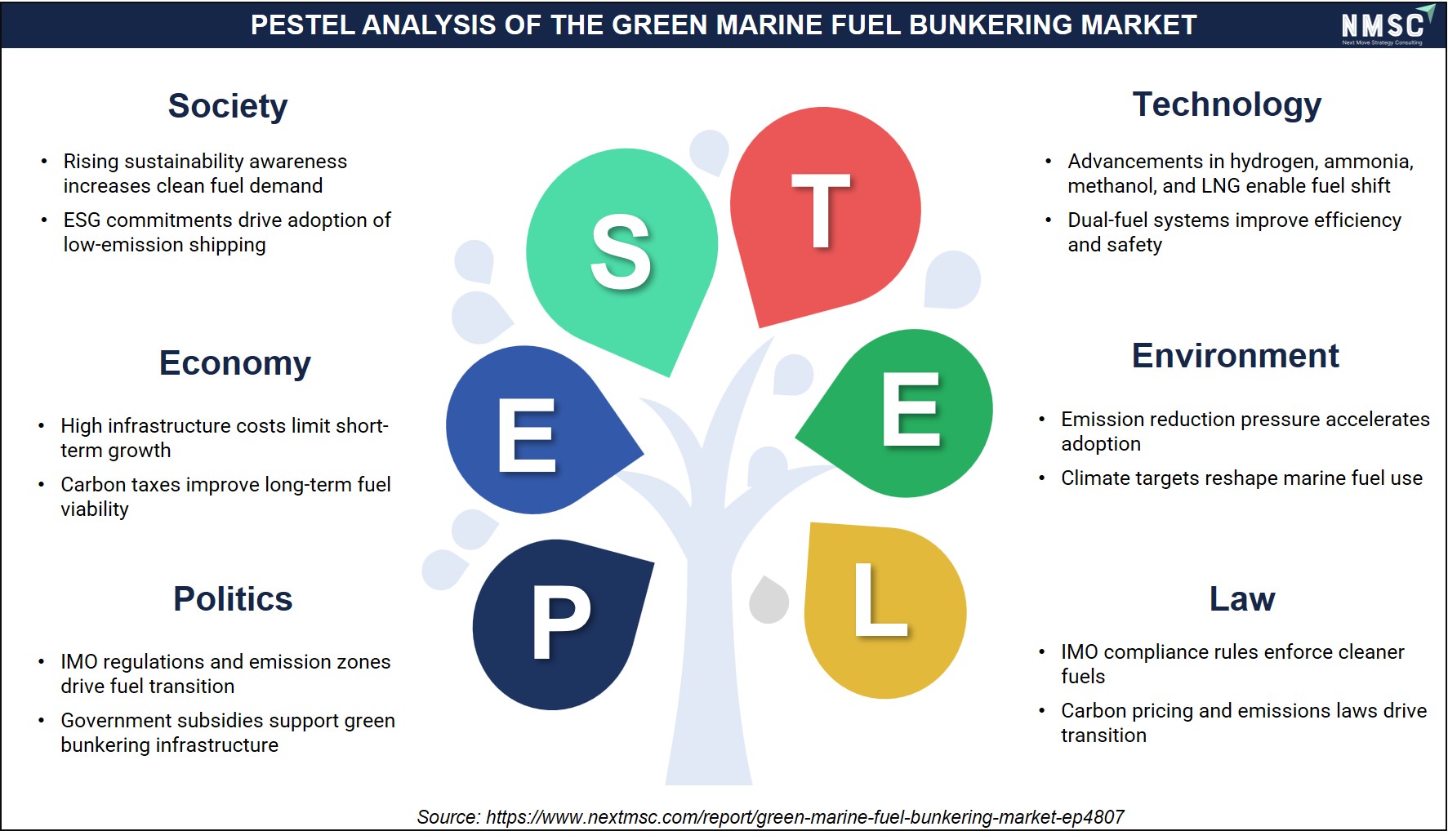
The Green Marine Fuel Bunkering Market is being shaped by multiple macroeconomic and regulatory forces influencing long-term maritime fuel transition strategies. Our analysis indicates that political support through emission reduction policies and environmental regulations is accelerating adoption of alternative marine fuels across global shipping corridors. Economic expansion in maritime trade and rising infrastructure investments are further strengthening market development. Meanwhile, technological advancements in fuel storage, digital monitoring, and bunkering safety systems are improving operational efficiency. Social awareness regarding sustainability and evolving legal compliance frameworks are also contributing to gradual commercialization and infrastructure modernization across port ecosystems.
Competitive Landscape
Competitive Dynamics & M&A Landscape:
|
Key Takeaways |
|
Our analysis indicates that the Green Marine Fuel Bunkering Market is primarily structured around a dual competitive layer, where major energy conglomerates such as Shell plc, bp p.l.c., TotalEnergies SE, and ExxonMobil Corporation dominate large-scale supply through integrated global trading networks and extensive port infrastructure. Additionally, specialized players like Titan Clean Fuels B.V., Gasum Oy, Neste Corporation, and TFG Marine Pte Ltd are strengthening their positions by focusing on low-carbon fuel specialization and regional bunkering flexibility. Furthermore, this structure highlights that scale advantages and fuel diversification capabilities are becoming central determinants of leadership across global marine fuel corridors. |
|
Based on our assessment, we found that companies are increasingly competing through innovation-led strategies, particularly by expanding access to alternative fuels such as methanol, LNG, biofuels, and renewable methane. Moreover, leading firms including Shell plc, TotalEnergies SE, bp p.l.c., and ExxonMobil Corporation are investing in integrated supply chains and digital fuel traceability systems, while specialist firms are leveraging emissions monitoring tools and agile deployment models. In addition, partnerships with ports and shipping operators are accelerating infrastructure readiness, thereby strengthening long-term competitiveness in the Green Marine Fuel Bunkering Market. |
|
Our market analysis suggests that merger and acquisition activity is emerging as a key consolidation strategy, as global players seek to enhance geographic reach and secure alternative fuel supply capabilities. Furthermore, companies such as Bunker Holding A/S, Monjasa Holding A/S, and TFG Marine Pte Ltd are expanding through regional integration and distribution network strengthening, while major energy firms pursue strategic acquisitions and joint ventures. Additionally, this consolidation trend is improving operational scalability, supply security, and commercialization speed across the evolving green marine fuel ecosystem. |
Which Companies Dominate the Green Marine Fuel Bunkering Market and How Do They Compete?
NMSC’s assessment indicates that the Green Marine Fuel Bunkering Market is dominated by major energy suppliers, global bunker traders, and alternative fuel specialists including Shell plc, TotalEnergies SE, bp p.l.c., ExxonMobil Corporation, and Bunker Holding A/S. These companies compete through expansion of global bunkering networks, investment in alternative marine fuels such as methanol, LNG, biofuels, and renewable methane, and strategic partnerships with ports and shipping operators. Meanwhile, companies such as TFG Marine Pte Ltd, Titan Clean Fuels B.V., Gasum Oy, and Neste Corporation are strengthening their market position through low-carbon fuel innovation and infrastructure development. Furthermore, operational digitalization, fuel traceability systems, storage modernization, and long-term supply agreements remain key competitive strategies shaping market differentiation and commercialization expansion.
Market Dominated by Green Marine Fuel Bunkering Giants and Specialists
The Green Marine Fuel Bunkering market structure is characterized by a dual dominance pattern involving global energy giants and independent bunkering specialists. Based on our assessment, we observed that major oil companies such as Shell, bp, TotalEnergies, and ExxonMobil maintain leadership through integrated fuel production, storage assets, and long-term shipping contracts across major ports. At the same time, firms like Vitol, Bunker Holding, Minerva Bunkering, and Peninsula Petroleum dominate operational bunkering services through flexible sourcing and strong regional networks. This combination creates a semi-consolidated market where a limited number of players control a large share of global marine fuel supply. In parallel, emerging renewable fuel suppliers such as Gasum, Neste, and Titan Clean Fuels are reshaping the market by focusing on low-carbon alternatives, particularly in Europe and Asia, where regulatory pressure is accelerating clean fuel adoption.
Innovation and Adaptability Drive Market Success
Innovation and adaptability are central to competitiveness in the Green Marine Fuel Bunkering market as companies shift toward low-carbon fuel solutions. Our analysis indicates that leading players are investing in LNG bunkering vessels, biofuel blending infrastructure, and ammonia-ready terminals to support future fuel demand. Shell, bp, and TotalEnergies are actively developing renewable fuel supply chains, while trading firms are enhancing operational efficiency through digital fuel management systems and emissions tracking platforms. Furthermore, companies such as Neste, Methanex, and Gasum are advancing biomethanol and renewable LNG production, supporting regulatory compliance in key maritime regions. Digitalization, including lifecycle carbon monitoring and automated bunkering systems, is also becoming essential. As a result, firms that combine fuel innovation with operational flexibility are better positioned to meet evolving IMO regulations and sustainability expectations.
Market Players to Opt for Merger & Acquisition Strategies to Expand Their Presence
Mergers, acquisitions, and strategic alliances are increasingly shaping competitive dynamics in the Green Marine Fuel Bunkering market. Major trading companies such as Vitol, Bunker Holding, Minerva Bunkering, and World Kinect Corporation are expanding their global footprint by acquiring regional bunkering firms and strengthening port-based logistics assets. Similarly, integrated energy companies are forming joint ventures to accelerate development of LNG, biofuel, and ammonia bunkering infrastructure across strategic maritime corridors. This consolidation trend is driven by the need for scale, cost efficiency, and secure access to high-demand ports. Additionally, we analysed that niche renewable fuel providers like FincoEnergies and Titan Clean Fuels are becoming attractive acquisition targets due to their expertise in sustainable fuel supply chains. Consequently, the market is gradually shifting toward fewer but larger integrated players with diversified fuel portfolios.
List of Key Green Marine Fuel Bunkering Companies
-
TotalEnergies SE
-
Bunker Holding A/S
-
Vitol S.A.
-
Peninsula Petroleum Limited
-
World Kinect Corporation
-
TFG Marine Pte Ltd
-
Minerva Bunkering LLC
-
Monjasa Holding A/S
-
bp p.l.c.
-
Gasum Oy
-
Methanex Corporation
-
Titan Clean Fuels B.V.
-
Golden Island Pte Ltd
-
Fratelli Cosulich S.p.A.
-
Moeve
-
FincoEnergies B.V.
-
Chimbusco Pan Nation Petro-chemical Co., Ltd. (CPN)
-
Neste Corporation
What are the Latest Key Industry Developments?
-
January 2026 – Petrovietnam Gas signed its first long-term LNG supply contract with Shell plc for deliveries to the Thi Vai terminal (2027–2031), marking a key step in strengthening Vietnam’s LNG import infrastructure and supporting future LNG bunkering development.
-
September 2025 – Shell plc signed a multi-year liquefied biomethane (Bio-LNG) supply deal with Hapag-Lloyd, expanding renewable LNG bunkering across its global network. The agreement supports low-carbon marine fuel adoption and strengthens green marine fuel bunkering infrastructure.
-
July 2025 – TotalEnergies SE and CMA CGM launched an LNG bunkering logistics joint venture to develop and operate LNG supply and bunkering infrastructure in Rotterdam. The project includes the deployment of a dedicated LNG bunker vessel to strengthen marine fuel supply chains. It supports the expansion of low-carbon LNG bunkering for global shipping decarbonization.
-
July 2025 – Titan Clean Fuels completed its first LNG bunkering at Amsterdam Cruise Terminal for a cruise vessel via ship-to-ship operation. The development expands LNG bunkering into the cruise sector and supports low-carbon marine fuel adoption in European ports.
-
February 2025 – TotalEnergies Marine Fuels completed the first LNG bunkering for cruise passenger ships in Asia-Pacific at Singapore Cruise Centre. The operation expands LNG bunkering into the cruise segment and supports low-emission marine fuel adoption.
Expert Insights
 “Collaborating with ports globally to build green fuel bunkering infrastructures is necessary to service methanol vessels. It is an important step as Maersk strives to lead the decarbonization of end-to-end supply chains and make a meaningful environmental impact in this decade. We are very pleased to form the partnership with SIPG, leveraging its strong capabilities in bunkering service and port operation. Through joint efforts, we can provide low-carbon logistics service for our customers, also contributing to China’s pledge to be carbon neutral by 2060. Meanwhile, we also endeavor to cultivate synergies with SIPG and fuel manufacturers to optimize fuel infrastructure efficiencies.”
- Mr. Vincent Clerc, CEO of A.P. Moller-Maersk
This statement was made during Maersk’s official press communication on its strategic cooperation with Shanghai International Port Group for the development of green methanol bunkering infrastructure.
Market Interpretation:
This insight underscores the foundational role of port-side bunkering infrastructure development in enabling the global adoption of green marine fuels. It highlights that the transition to methanol-powered fleets is not only a vessel-level transformation but also a supply-chain ecosystem shift, requiring coordinated investments across ports, fuel producers, and logistics operators. The statement reflects the accelerating industry-wide push toward decarbonized shipping corridors, where bunkering availability becomes a critical enabler of fleet conversion decisions.
Supply Chain Analysis of the Green Marine Fuel Bunkering Market
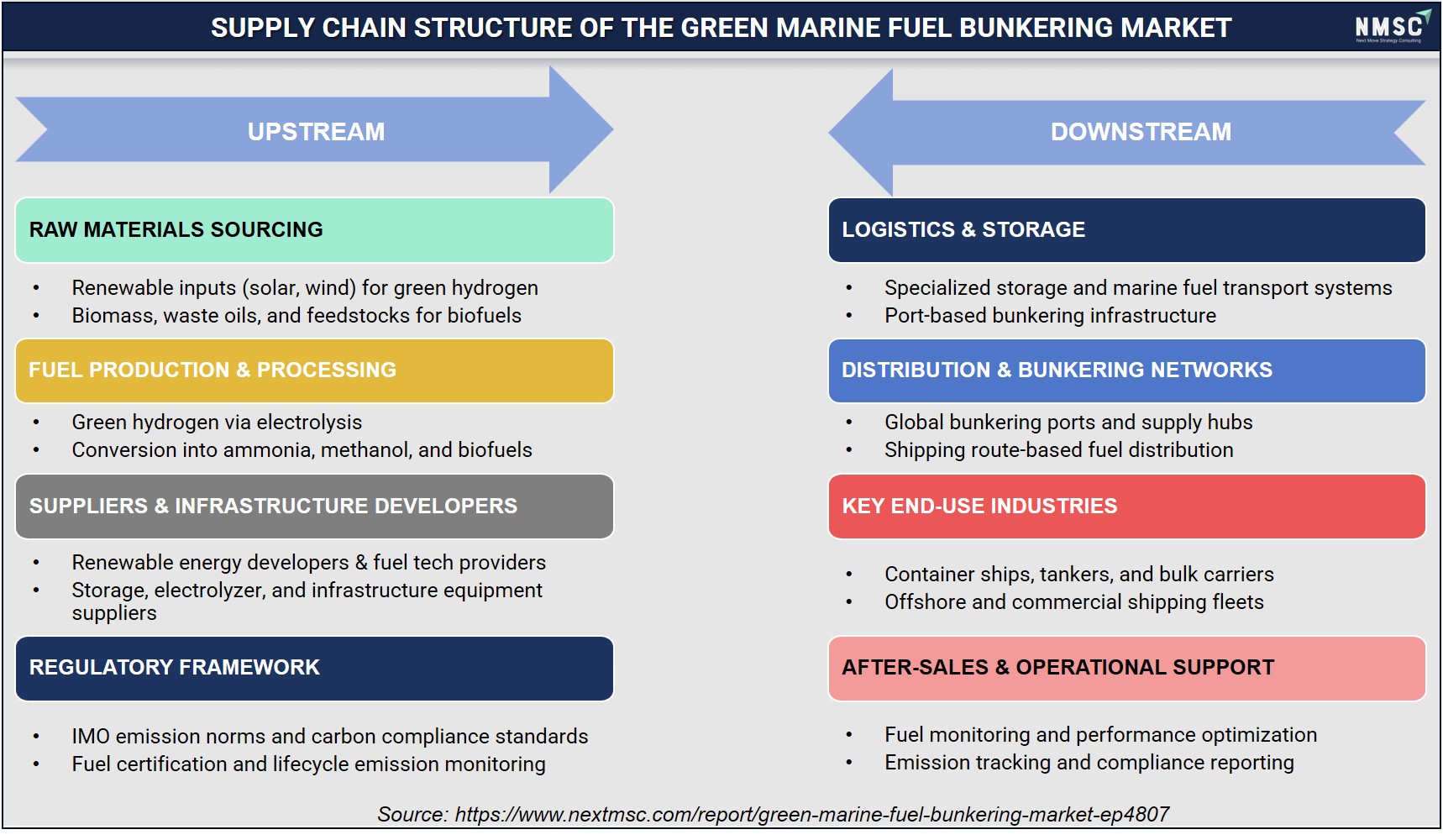
The Green Marine Fuel Bunkering Market supply chain is evolving through integrated upstream fuel production and downstream maritime distribution networks supported by expanding renewable fuel ecosystems. Investments in green hydrogen production, alternative fuel processing, specialized storage systems, and port-based bunkering infrastructure are improving operational scalability across global shipping corridors. Moreover, our assessment confirms that regulatory compliance frameworks, lifecycle emissions monitoring, and digital fuel management technologies are strengthening market standardization and operational transparency. Meanwhile, fuel monitoring systems, emissions tracking platforms, and performance optimization solutions are enhancing efficiency across maritime bunkering and logistics operations.
What are the Key Factors Influencing Investment Analysis & Opportunities in the Green Marine Fuel Bunkering Market?
Rising global decarbonization commitments, tightening maritime emission regulations, and increasing pressure to lower carbon intensity across shipping networks are significantly shaping investment dynamics in the Green Marine Fuel Bunkering market. Governments, port authorities, and energy companies are progressively channeling capital toward alternative marine fuel ecosystems to comply with evolving environmental frameworks. In parallel, the expanding adoption of methanol, biofuels, renewable methane, and ammonia is generating diversified opportunities across fuel production, distribution, storage, and bunkering infrastructure. Our analysis suggests that this growth is further supported by increasing maritime trade volumes, modernization of coastal logistics networks, and the integration of sustainability-linked strategies across commercial fleets, which collectively strengthen long-term green marine fuel bunkering market demand visibility.
At the same time, our assessment reveals that investment potential in the Green Marine Fuel Bunkering Market is increasingly dependent on infrastructure readiness and technological advancement across the value chain. Capital deployment is concentrating on storage capacity upgrades, port-side bunkering infrastructure, and advanced safety systems to enhance operational reliability. In addition, digital fuel monitoring platforms and emissions tracking technologies are gaining importance as regulatory transparency requirements intensify. Strategic collaboration among shipping operators, fuel suppliers, and port authorities is also accelerating ecosystem development and improving supply chain coordination. Consequently, investment opportunities are shifting toward integrated low-carbon fuel hubs, digitally enabled maritime systems, and scalable bunkering networks across key global shipping corridors, where commercialization potential is comparatively stronger.
Key Benefits for Stakeholders:
Next Move Strategy Consulting (NMSC) provides a comprehensive and evidence-based analysis of the Green Marine Fuel Bunkering Market, covering historical developments from 2020 to 2025 and offering forward-looking forecasts through 2035. Our study assesses the market at global, regional, and country levels, combining quantitative outlooks with qualitative insights into fuel transition trends, infrastructure development, regulatory evolution, technology adoption, and investment opportunities across the market.
The Green Marine Fuel Bunkering Market creates differentiated value across investors, shipping operators, fuel suppliers, and port authorities through the accelerating shift toward low-carbon maritime operations. From our assessment, we noticed that investors benefit from increasing infrastructure investment opportunities, ESG-aligned business expansion, and growing demand for alternative marine fuels such as methanol, renewable methane, biofuels, and ammonia-based fuels. Additionally, companies with integrated bunkering networks, scalable storage infrastructure, and advanced digital fuel management systems are strengthening operational efficiency, fuel traceability, and long-term competitive positioning across major global shipping corridors.
For shipping companies and maritime operators, the market delivers advantages through improved emissions transparency, regulatory compliance readiness, and operational efficiency within marine logistics systems. From a regulatory standpoint, evolving international decarbonization frameworks and maritime sustainability initiatives are strengthening investment confidence and supporting infrastructure modernization. Overall, value creation is increasingly shared across stakeholders through fuel innovation, digitalization, supply-chain coordination, and expansion of alternative marine fuel ecosystems.
|
Parameters |
Details |
|
Customization Scope |
Free customization (equivalent to up to 80 analyst-working hours) after purchase. Addition or alteration to country, regional & segment scope. |
|
Pricing and Purchase Options |
Avail customized purchase options to meet your exact research needs. |
|
Approach |
In-depth primary and secondary research; proprietary databases; rigorous quality control and validation measures. |
|
Analytical Tools |
Porter's Five Forces, SWOT, value chain, and Harvey ball analysis to assess competitive intensity, stakeholder roles, and relative impact of key factors. |
Key Market Segments
By Fuel Type
-
Liquid Biofuels
-
FAME Blends
-
HVO Blends
-
Bio-FT Blends
-
Neat Liquid Biofuels
-
Other Biofuels
-
-
Renewable Methane
-
Bio-LNG
-
E-Methane
-
Other Renewable Methane
-
-
Methanol
-
Bio-Methanol
-
E-Methanol
-
Other Green Methanol
-
-
Green Ammonia
-
Other Green Fuels
By Bunkering Mode
-
Ship to Ship
-
Truck to Ship
-
Terminal to Ship
-
Pipeline to Ship
-
Other Mode
By Vessel Class
-
Container
-
Tanker
-
Bulk Carrier
-
General Cargo
-
Passenger Ferry
-
Offshore and Service
-
Other Vessel
By Buyer Type
-
Shipowner Operator
-
Charterer
-
Public Sector
-
Other Buyer
Geographical Breakdown
-
North America: U.S., Canada, and Mexico.
-
Europe: UK, Germany, France, Italy, Spain, Sweden, Denmark, Finland, the Netherlands, and the rest of Europe.
-
Asia Pacific: China, India, Japan, South Korea, Taiwan, Indonesia, Vietnam, Australia, Philippines, Malaysia and the rest of APAC.
-
Middle East & Africa (MEA): Saudi Arabia, UAE, Egypt, Israel, Turkey, Nigeria, South Africa, and the rest of MEA.
-
Latin America: Brazil, Argentina, Chile, Colombia, and the rest of LATAM.
Conclusion & Recommendations
Based on our evaluation, we analysed that the Green Marine Fuel Bunkering market is transitioning from an early experimental phase toward structured commercialization, driven by tightening IMO emission regulations, expansion of alternative fuel infrastructure, and increasing pressure on global shipping operators to reduce lifecycle carbon emissions. Moreover, methanol, biofuels, renewable methane, and ammonia are emerging as leading transition fuels, with stronger adoption observed in Europe, Singapore, China, and selected North American ports where infrastructure readiness is comparatively advanced. However, uneven market development continues due to fragmented regulatory frameworks, high capital expenditure requirements, limited fuel availability, and insufficient port infrastructure across several developing maritime regions. Consequently, competitive positioning is strengthening among integrated players with end-to-end fuel supply chains, scalable bunkering assets, and established port partnerships.
Coordinated investment across fuel production capacity, storage modernization, port infrastructure upgrades, digital fuel tracking systems, and harmonized cross-border bunkering standards will be critical for market expansion of the Green Marine Fuel Bunkering market. Phased infrastructure development along high-traffic maritime corridors offers greater efficiency compared to broad, dispersed expansion in early stages. Additionally, our market analysis suggests that collaboration among energy suppliers, shipowners, port authorities, and regulatory bodies remains essential to improve standardization and commercial scalability. Investment in emissions monitoring technologies, lifecycle fuel certification systems, and operational automation will further enhance compliance readiness amid tightening regulatory scrutiny. Therefore, firms that align infrastructure scalability with regulatory adaptability and diversify across multiple low-carbon fuel pathways are expected to achieve stronger long-term positioning in the evolving market landscape.
About the Author
 Tushmi Dutta
— Tushmi Dutta is a focused researcher specializing in detailed analysis and insight-driven research across diverse business landscapes. She supports strategic initiatives through structured data interpretation, thorough validation, and clear communication of findings that aid informed decision-making. With a strong interest in writing, she enjoys presenting research insights in an engaging and accessible manner. Beyond work, she enjoys traveling, reading, painting, and continuously learning new skills that contribute to her creative and professional growth.
Tushmi Dutta
— Tushmi Dutta is a focused researcher specializing in detailed analysis and insight-driven research across diverse business landscapes. She supports strategic initiatives through structured data interpretation, thorough validation, and clear communication of findings that aid informed decision-making. With a strong interest in writing, she enjoys presenting research insights in an engaging and accessible manner. Beyond work, she enjoys traveling, reading, painting, and continuously learning new skills that contribute to her creative and professional growth.
About the Reviewer
 Supradip Baul
— Supradip Baul is an accomplished business consultant and strategist with over a decade of rich experience in market intelligence, strategy, technology, and business transformation. His work has included rigorous qualitative and quantitative analysis across multiple industries, helping clients shape investment decisions and long-term roadmaps. Earlier in his career, he was associated with Gartner, where he contributed to industry-leading reports and market share analyses. He has worked with leading global companies and holds an MBA with a dual specialization in Marketing and Finance.
Supradip Baul
— Supradip Baul is an accomplished business consultant and strategist with over a decade of rich experience in market intelligence, strategy, technology, and business transformation. His work has included rigorous qualitative and quantitative analysis across multiple industries, helping clients shape investment decisions and long-term roadmaps. Earlier in his career, he was associated with Gartner, where he contributed to industry-leading reports and market share analyses. He has worked with leading global companies and holds an MBA with a dual specialization in Marketing and Finance.
At Next Move Strategy Consulting, we understand that insightful market research is the cornerstone of successful business decisions. That's why we employ a robust and multifaceted approach, combining various methodologies to deliver the most accurate and actionable data for our clients.

Research Landscape
We navigate the world of research with two primary approaches:
Qualitative Approach
Our qualitative research methodologies involve immersive techniques such as in-depth interviews, focus groups, and observational studies. By engaging directly with individuals and stakeholders, we uncover valuable insights that quantitative data alone may overlook.

Quantitative Research
In tandem with qualitative methodologies, NMSC leverages the power of Quantitative Research to provide a robust foundation of numerical insights. Through systematic data collection and analysis, we quantify patterns, preferences, and market trends, offering a comprehensive view of the business landscape.
Our quantitative research approach employs diverse tools, including surveys, experiments, and statistical modelling. These methodologies enable us to gather data from a large and representative sample, ensuring the statistical significance of our findings. By employing structured questionnaires and standardized data collection methods, we guarantee the reliability and validity of the information we present to our clients.
Quantitative research is particularly effective in measuring the prevalence of trends, assessing market size, and gauging the impact of various factors on consumer behavior. The numerical precision attained through this approach equips our clients with actionable insights, facilitating data-driven decision-making and strategy formulation.


Our Specialized Toolbox for Industry-Specific Market Research
We deploy a specialized arsenal of techniques tailored to meet your unique requirements. Here's a glimpse into our comprehensive toolbox:

Information Procurement
The stage entails acquiring market data or relevant information through various sources and methodologies.


Market Research Approach
We utilize both top-down and bottom-up approaches in market research analysis to achieve a comprehensive understanding of the market dynamics, leveraging the broad perspective of industry trends and macroeconomic factors alongside detailed insights from specific segments and individual companies.

Porters Five Forces Analysis
We conduct Porter's Five Forces analysis to evaluate the competitive landscape of an industry, providing us with insights into factors that affect profitability and strategic positioning.

SWOT Analysis

Forecasting
We utilize a forecasting model to predict future consumption by considering parameters like population, economics, regulations, market competition, drivers, constraints, technology, and pricing. We also employ statistical techniques such as multilinear regression, exponential smoothing, moving average, ARIMA, and Monte Carlo simulations for accurate predictions. In econometric forecasting, we analyzed short-term and long-term event impacts, attributing values based on regulatory frameworks, economic factors, and market events.





 Speak to Our Analyst