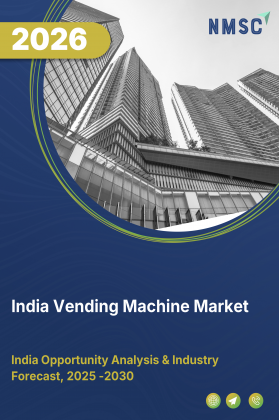
India Vending Machine Market By Product Type (Food & Beverage, Games/Amusement, Tobacco, Candy & Confectionery Vending Machines, and Others), By Technology (Automatic, Semi-Automatic, and Smart Machine), By Payment Mode {Cash, Cashless (Mobile, and Card Payments), and Hybrid (AI Powered, IoT Integrated, and Others)}, By Sales Channel (Online, and Offline), By End-User (Offices and Workplaces, Educational Institutions, and Others) – Opportunity Analysis & Forecast, 2025–2030
Industry: Retail and Consumer | Lastest Edition: May 27, 2026 | No of Pages: 195 | No. of Tables: 154 | No. of Figures: 99 | Format: PDF | Report Code : RC4149
Industry Outlook
The India Vending Machine Market size was valued at USD 825.5 million in 2024 and is projected to reach USD 970.5 million by 2025. Furthermore, the market is expected to grow significantly, reaching USD 1623.5 million by 2030, with a CAGR of 10.84% from 2025 to 2030. In terms of volume, the market recorded 289 thousand units in 2024, with forecasts indicating growth to 358 thousand units by 2025 and further to 736 thousand units by 2030, reflecting a CAGR 15.53% over the same period.
The market is growing rapidly, driven by FMCG partnerships, direct-to-consumer strategies, and the expansion into non-food and utility products. Leading brands like Coca-Cola, Nestlé, and ITC are collaborating with operators to enhance brand visibility, test new products, and provide convenient access to snacks, beverages, hygiene items, and electronic accessories in high-traffic locations such as airports, metro stations, and offices. Despite strong demand, high installation, maintenance, and operational costs, especially for AI-enabled, IoT-connected machines, pose challenges for smaller operators and limit large-scale deployment in tier-2 and tier-3 cities. Sustainability-focused solutions, including solar-powered and energy-efficient vending systems, are creating new growth opportunities, aligning with India’s renewable energy goals and promoting environmentally responsible, cost-efficient automated retail.
FMCG Partnerships and Direct-to-Consumer Strategies Boost Vending Machine Adoption
In India, leading FMCG brands such as Coca-Cola, ITC, and Nestlé are increasingly partnering with vending machine operators to strengthen direct-to-consumer engagement and expand retail access. These collaborations allow brands to test new product launches, gather real-time consumption insights, and provide convenient purchase options without incurring additional staffing or retail space costs. Co-branded vending machines are being strategically deployed across high-footfall locations, including airports, metro stations, office complexes, and educational institutions, enhancing brand visibility and consumer interaction. Such partnerships also facilitate targeted marketing and promotional campaigns while aligning with the growing trend of automated, on-demand retail. This synergy between FMCG companies and vending operators is accelerating adoption, driving revenue growth, and reinforcing the convenience-driven value proposition of vending machines in India.
Expansion into Non-Food and Utility Vending Drives India Vending Machine Market Growth
India vending machine market is evolving beyond traditional food and beverage offerings, with a growing focus on non-food and utility-based solutions. Automated dispensers for hygiene products, over-the-counter medicines, and electronic accessories, such as masks, hand sanitisers, menstrual hygiene items, and mobile chargers, are increasingly being deployed in high-traffic locations like airports, shopping malls, metro stations, and office complexes. This trend reflects the country’s rising demand for convenient, on-demand access to essential goods and daily-use products, particularly in urban and semi-urban areas. By expanding into these categories, vending operators are not only diversifying revenue streams but also addressing gaps in accessibility for time-sensitive and essential items. The emergence of utility-based vending reinforces the role of automated retail as a versatile solution in India’s rapidly modernising convenience retail landscape.
High Initial Investment and Maintenance Costs Restraints the India Vending Machine Market Expansion
Despite the market’s promising outlook, high installation and maintenance costs remain key challenges limiting the widespread adoption of advanced vending systems. Smart Vending Machine with AI-based interfaces, digital touchscreens, and IoT capabilities require substantial upfront investment, which be prohibitive for small and mid-sized operators. In addition, recurring costs related to machine maintenance, software updates, internet connectivity, and electricity consumption increase operational expenses. The challenges are further amplified in tier-2 and tier-3 cities where power fluctuations and inconsistent internet access impact machine performance and profitability. Furthermore, the need for frequent servicing and temperature control, particularly in hot climates, adds to the complexity of operations. These financial and logistical constraints collectively restrict rapid market expansion and large-scale deployment of advanced vending machines in India.
Sustainability-Focused Vending Solutions Create New Growth Opportunities for the Market
Sustainability-focused vending solutions are emerging as a key growth driver in the vending machine market in India as businesses and consumers increasingly embrace eco-friendly and energy-efficient technologies. Manufacturers are adopting low-power refrigeration systems, motion-sensor LED lighting, and recyclable materials to minimize energy consumption and environmental impact. The introduction of solar-powered and hybrid vending machines is gaining traction, particularly in public spaces, railway stations, universities, and outdoor commercial areas where power efficiency and reliability are crucial. These machines not only help operators reduce long-term operating costs but also align with India’s growing commitment to renewable energy and sustainable development goals. Furthermore, the integration of green vending infrastructure supports corporate ESG initiatives and government programs promoting energy conservation and smart city projects. Companies investing early in these eco-conscious vending technologies are likely to strengthen their market presence, attract environmentally aware consumers, and play a pivotal role in shaping India’s sustainable automated retail future.
Competitive Landscape
The India vending machine industry comprises various market players, such as FUJI ELECTRIC CO., LTD, Sanden Corporation, Crane Payment Innovations (CPI), FAS International S.p.A., Seaga Manufacturing Inc, U-Select -It, TOMRA Systems ASA, Vendekin Technologies, Automated Merchandising Systems Pty Ltd, Godrej Vending, Vendolite, Vendstop, Future Techniks India Private Limited, Purelo, Penguin Engineering, and others.
India Vending Machine Market Key Segments
By Product Type
-
Food & Beverage Vending Machines
-
Games/Amusement Vending Machines
-
Tobacco Vending Machines
-
Candy & Confectionery Vending Machines
-
Beauty & Personal Care Vending Machines
-
Stationery Vending Machines
-
Ticket Vending Machines
-
Other Vending Machines
By Technology
-
Automatic Machine
-
Semi-Automatic Machine
-
Smart Machine
By Payment Mode
-
Cash
-
Cashless
-
Mobile Payments
-
Card Payments
-
-
Hybrid
-
AI Powered
-
IoT Integrated
-
Others
-
By Sales Channel
-
Online
-
Offline
By End-User
-
Offices and Workplaces
-
Educational Institutions
-
Retail and Malls
-
Transportation Hubs
-
Healthcare Facilities
-
Others
Key Players
-
FUJI ELECTRIC CO., LTD
-
Sanden Corporation
-
FAS International S.p.A.
-
Seaga Manufacturing Inc
-
U-Select -It
-
TOMRA Systems ASA
-
Vendekin Technologies
-
Automated Merchandising Systems Pty Ltd
-
Godrej Vending
-
Vendolite
-
Vendstop
-
Future Techniks India Private Limited
-
Purelo
-
Penguin Engineering
Report Scope and Segmentation
|
Parameters |
Details |
|
Market Size in 2025 |
USD 970.5 Million |
|
Revenue Forecast in 2030 |
USD 1623.5 Million |
|
Growth Rate |
CAGR of 10.84% from 2025 to 2030 |
|
Market Volume in 2025 |
832 thousand units |
|
Market Volume in Forecast in 2030 |
1194 thousand units |
|
Volume Growth Rate |
CAGR of 15.53% from 2025 to 2030 |
|
Analysis Period |
2024–2030 |
|
Base Year Considered |
2024 |
|
Forecast Period |
2025–2030 |
|
Market Size Estimation |
Million (USD) |
|
Growth Factors |
|
|
Companies Profiled |
15 |
|
Market Share |
Available for 10 companies |
|
Customization Scope |
Free customization (equivalent to up to 80 working hours of analysts) after purchase. Addition or alteration to country, regional, and segment scope. |
|
Pricing and Purchase Options |
Avail customized purchase options to meet your exact research needs. |


About the Author
 Ridip Gogoi is a research associate recognized for his strong analytical thinking and meticulous attention to detail. He specializes in transforming complex datasets into meaningful insights that support informed business decisions and strategic planning. With a proactive mindset and strong commitment to accuracy, he contributes effectively to market analysis, data validation, and insight generation. Ridip is driven by continuous learning and consistently works to enhance research quality, analytical depth, and reporting clarity across projects.
About the Reviewer
 Supradip Baul is an accomplished business consultant and strategist with over a decade of rich experience in market intelligence, strategy, technology, and business transformation. His work has included rigorous qualitative and quantitative analysis across multiple industries, helping clients shape investment decisions and long-term roadmaps. Earlier in his career, he was associated with Gartner, where he contributed to industry-leading reports and market share analyses. He has worked with leading global companies and holds an MBA with a dual specialization in Marketing and Finance.
At Next Move Strategy Consulting, we understand that insightful market research is the cornerstone of successful business decisions. That's why we employ a robust and multifaceted approach, combining various methodologies to deliver the most accurate and actionable data for our clients.

Research Landscape
We navigate the world of research with two primary approaches:
Qualitative Approach
Our qualitative research methodologies involve immersive techniques such as in-depth interviews, focus groups, and observational studies. By engaging directly with individuals and stakeholders, we uncover valuable insights that quantitative data alone may overlook.

Quantitative Research
In tandem with qualitative methodologies, NMSC leverages the power of Quantitative Research to provide a robust foundation of numerical insights. Through systematic data collection and analysis, we quantify patterns, preferences, and market trends, offering a comprehensive view of the business landscape.
Our quantitative research approach employs diverse tools, including surveys, experiments, and statistical modelling. These methodologies enable us to gather data from a large and representative sample, ensuring the statistical significance of our findings. By employing structured questionnaires and standardized data collection methods, we guarantee the reliability and validity of the information we present to our clients.
Quantitative research is particularly effective in measuring the prevalence of trends, assessing market size, and gauging the impact of various factors on consumer behavior. The numerical precision attained through this approach equips our clients with actionable insights, facilitating data-driven decision-making and strategy formulation.


Our Specialized Toolbox for Industry-Specific Market Research
We deploy a specialized arsenal of techniques tailored to meet your unique requirements. Here's a glimpse into our comprehensive toolbox:

Information Procurement
The stage entails acquiring market data or relevant information through various sources and methodologies.


Market Research Approach
We utilize both top-down and bottom-up approaches in market research analysis to achieve a comprehensive understanding of the market dynamics, leveraging the broad perspective of industry trends and macroeconomic factors alongside detailed insights from specific segments and individual companies.

Porters Five Forces Analysis
We conduct Porter's Five Forces analysis to evaluate the competitive landscape of an industry, providing us with insights into factors that affect profitability and strategic positioning.

SWOT Analysis

Forecasting
We utilize a forecasting model to predict future consumption by considering parameters like population, economics, regulations, market competition, drivers, constraints, technology, and pricing. We also employ statistical techniques such as multilinear regression, exponential smoothing, moving average, ARIMA, and Monte Carlo simulations for accurate predictions. In econometric forecasting, we analyzed short-term and long-term event impacts, attributing values based on regulatory frameworks, economic factors, and market events.





 Speak to Our Analyst