Indonesia Gypsum Board Market By Board Type (Standard Board, Fire Rated Board, Moisture Resistant Board, Acoustic Board, Impact Resistant Board, Exterior Sheathing, Liner Board, Prefinished Board, Specialty Board), By Facer Material (Paper Faced, Glass Mat Faced, Vinyl Faced, Other Facer), By End Use (Residential, Commercial, Institutional and Industrial), By Distribution Channel (Direct Project, Wholesale Distributor, Retail DIY, OEM Prefab): Opportunity Analysis & Industry Forecast, 2025-2035
Industry: Materials and Chemical | Latest Edition: September 30, 2026 | No of Pages: N/A | No. of Tables: N/A | No. of Figures: N/A | Format: PDF | Report Code: MC5879
Market Size & Forecast
|
Parameters |
Details |
|
Market Size in 2025 |
USD 569.45 Million |
|
Market Size in 2026 |
USD 664.42 Million |
|
Revenue Forecast in 2035 |
USD 1,407.54 Million |
|
Growth Rate |
CAGR of 8.70% from 2026 to 2035 |
|
Market Volume in 2025 |
217 Million Sq. Meters |
|
Market Volume in 2026 |
257 Million Sq. Meters |
|
Volume Forecast in 2035 |
575 Million Sq. Meters |
|
Growth Rate |
CAGR of 9.36% from 2026 to 2035 |
|
Analysis Period |
2025–2035 |
|
Base Year Considered |
2025 |
|
Forecast Period |
2026–2035 |
|
Market Size Estimation |
Million (USD) |
|
Companies Profiled |
9 |
|
Market Share |
Available for 9 Companies |
Industry Outlook
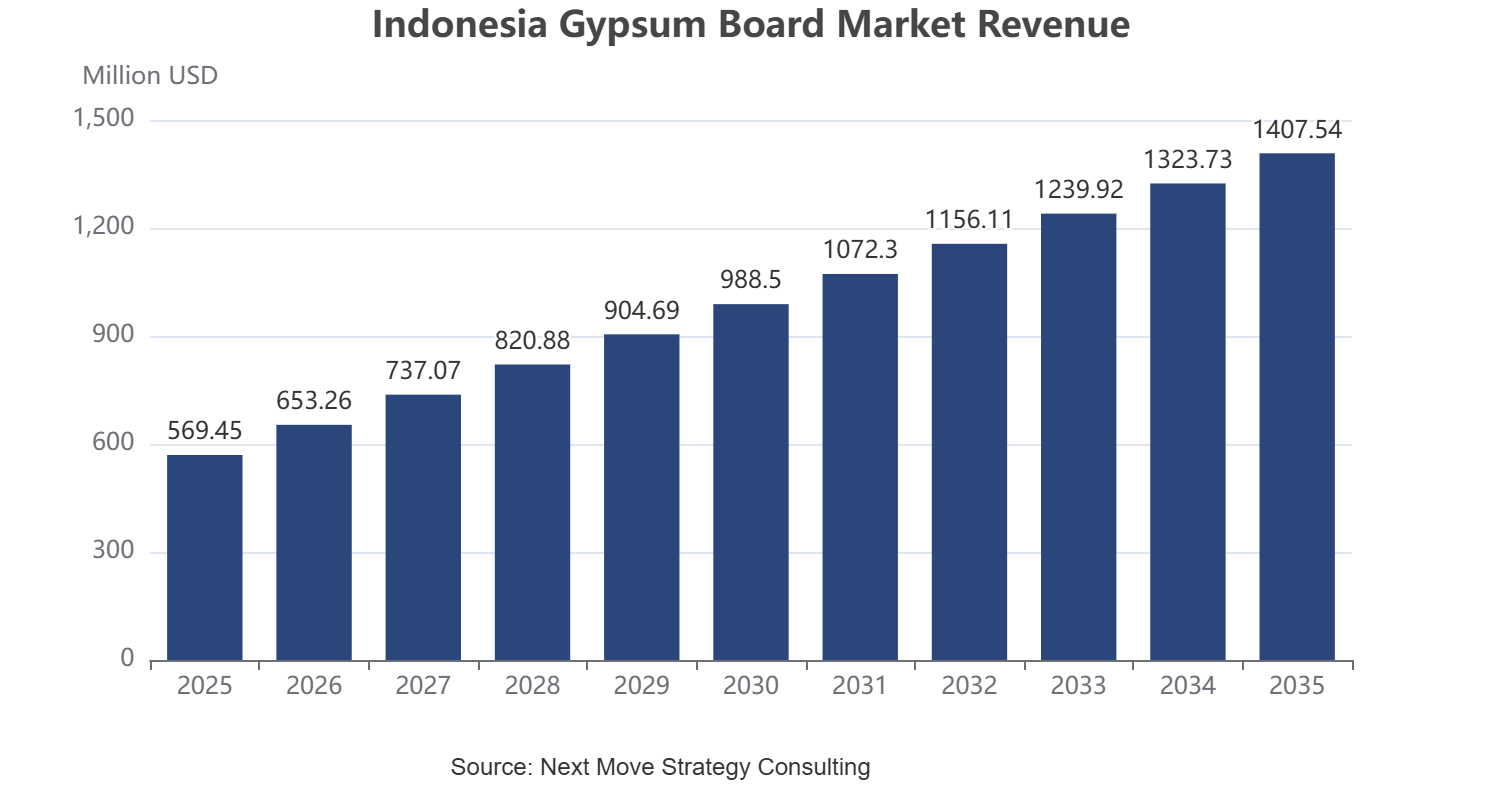
The Indonesia Gypsum Board Market was valued at USD 569.45 million in 2025 and is expected to reach USD 664.42 million in 2026. Driven by large-scale national infrastructure projects, rising urbanization supporting residential housing demand, and a growing shift toward modern lightweight construction materials, the market is projected to reach USD 1,407.54 million by 2035, advancing at a CAGR of 8.70% from 2026 to 2035. In volume terms, the market was estimated at 217 million square meters in 2025 and is projected to increase from 257 million square meters in 2026 to 575 million square meters by 2035, registering a CAGR of 9.36% during the forecast period.
What Are the Key Growth Catalysts, Inhibitors, and Opportunities Shaping the Indonesia Gypsum Board Industry?
|
Drivers / Trends / Restraints |
(+/-) % Impact on CAGR Forecast |
Geographic Relevance |
Impact Timeline |
|
National infrastructure projects are boosting overall construction activity across Indonesia. |
+2.20% |
Indonesia |
Short to medium term (1-4 years) |
|
Rising urbanization is supporting residential housing demand across major cities. |
+1.80% |
Indonesia |
Medium term (2-5 years) |
|
Growing shift toward modern lightweight construction materials is increasing gypsum board adoption. |
+1.50% |
Indonesia |
Medium to long term (3-7 years) |
|
Logistics challenges across the archipelago are increasing overall distribution costs. |
-1.10% |
Indonesia |
Short to medium term (1-4 years) |
|
Smart city developments are expanding drywall applications nationwide. |
+1.40% |
Indonesia |
Medium term (2-5 years) |
The Indonesia Gypsum Board Industry is shaped by a dynamic interplay of growth drivers, restraints, and opportunities that collectively define its competitive trajectory. Large-scale national infrastructure projects, rising urbanization, and a growing shift toward modern lightweight construction materials are primary forces driving market expansion. However, logistics challenges across the archipelago continue to constrain distribution efficiency and elevate overall costs. Simultaneously, expanding smart city developments present meaningful opportunities for broader drywall application growth across residential and commercial construction segments throughout the forecast period.
Growth Driver:
How Are National Infrastructure Projects Boosting Construction Activity in the Indonesia Gypsum Board Market?
Ongoing national infrastructure development remains a primary near-term demand catalyst for the Indonesia Gypsum Board Market throughout the forecast period. Government-backed toll road, airport, transit, and public facility projects are generating substantial demand for interior partitioning and ceiling systems across new construction sites. Expanding industrial parks and special economic zones further accelerate consumption of standard and fire-rated board products. This sustained infrastructure pipeline, supported by continued public capital expenditure, reinforces steady gypsum board demand across commercial and institutional construction nationwide.
How Is Rising Urbanization Supporting Residential Housing Demand in Indonesia?
Rapid urbanization across Indonesia's major cities and secondary metros is fundamentally reshaping residential construction demand patterns within the gypsum board industry. Growing middle-class populations are driving vertical housing development, including apartments and mixed-use residential towers, each requiring substantial interior wallboard volumes. Government-backed affordable housing initiatives are further accelerating construction of new residential units across urban peripheries. This sustained urban housing pipeline continues to reinforce consistent demand for standard and moisture-resistant gypsum board products across residential applications nationwide.
How Is the Shift toward Modern Lightweight Construction Materials Driving Gypsum Board Adoption in Indonesia?
Builders and developers across Indonesia are increasingly favoring lightweight gypsum-based partition and ceiling systems over conventional brick and plaster construction methods. This shift is driven by faster installation timelines, reduced structural loads, and lower overall project costs compared to traditional masonry techniques. Growing awareness of interior design flexibility and finishing quality among contractors and homeowners is further supporting adoption. This transition toward modern construction materials is creating new demand channels for gypsum board across residential, commercial, and institutional projects nationwide.
Growth Inhibitor:
How Do Logistics Challenges Increase Distribution Costs in the Indonesia Gypsum Board Market?
Indonesia's expansive archipelago geography creates persistent logistics challenges that increase distribution costs across the gypsum board supply chain. Transporting bulky, moisture-sensitive board products between manufacturing hubs on Java and demand centers across outer islands requires extensive sea freight and inland trucking, adding significant landed cost. Inconsistent port infrastructure and inter-island shipping schedules further complicate timely delivery to remote construction sites. These distribution constraints disproportionately affect regional contractors, creating cost pressures that can dampen near-term volume realization across multiple end-use segments.
Growth Opportunity:
How Do Smart City Developments Expand Drywall Applications across Indonesia?
Indonesia's growing pipeline of smart city developments, including planned urban centers and technology-integrated townships, is creating substantial opportunities for expanded drywall applications. These projects increasingly specify fire-rated, acoustic, and moisture-resistant board systems to meet modern building performance and safety standards. Developers investing in sustainable, energy-efficient interior construction are increasingly turning to advanced gypsum board formats. Manufacturers positioned to supply performance-engineered products are well placed to capture premium demand across Indonesia's evolving smart city construction landscape through 2035.
Regulatory Framework Impacting the Indonesia Gypsum Board Market
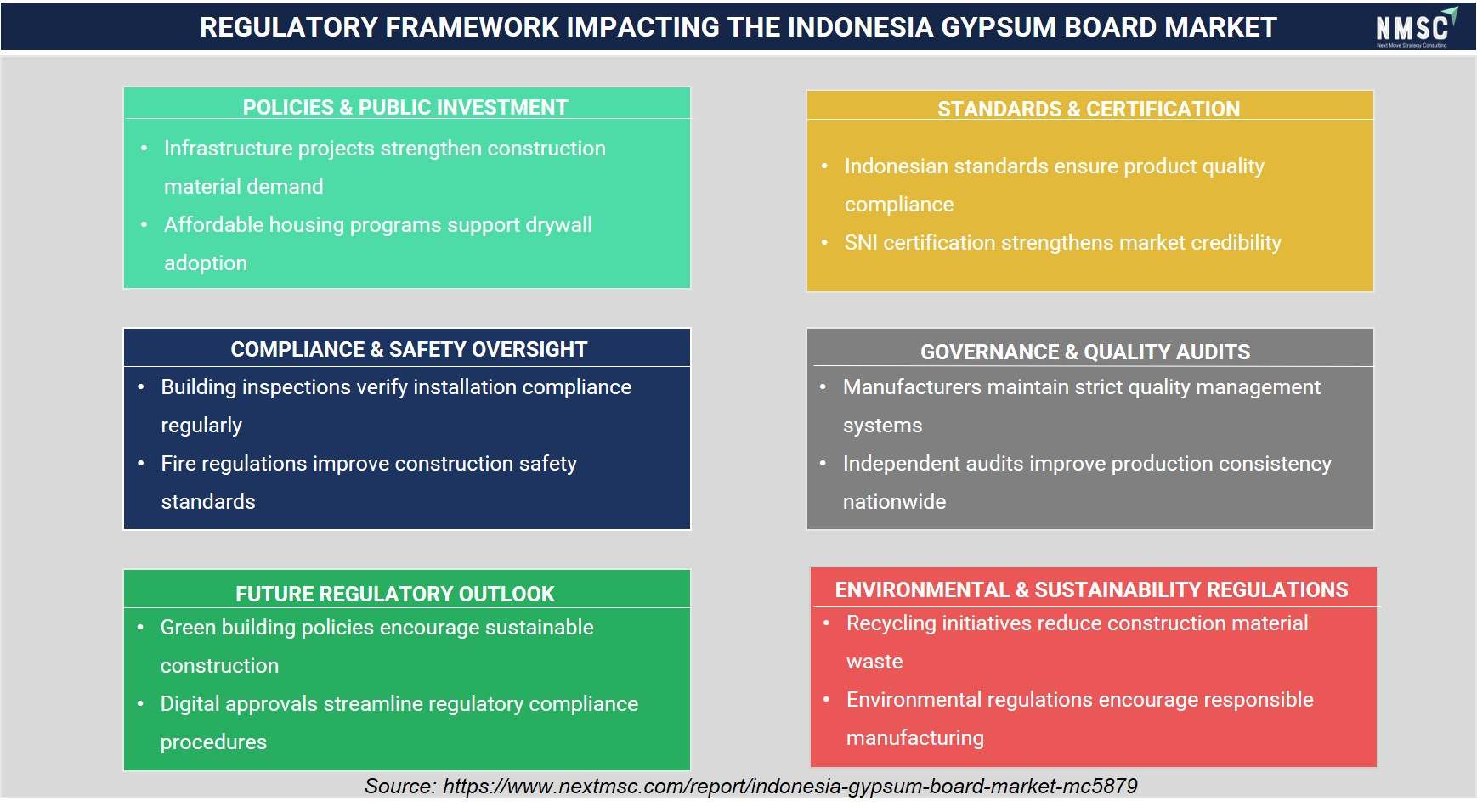
The regulatory framework governing the Indonesia gypsum board market promotes product quality, construction safety, and sustainable manufacturing through standardized certifications, compliance monitoring, and environmental regulations. Public infrastructure investments, affordable housing initiatives, and green building policies support market expansion, while quality audits, digital regulatory processes, and evolving sustainability requirements enhance industry competitiveness and long-term market resilience.
How Is the Indonesia Gypsum Board Industry Segmented in This Report, and What Are the Key Insights from the Segmentation Analysis?
By Board Type
Which Board Type Is Driving the Greatest Revenue Growth across the Indonesia Gypsum Board Market?
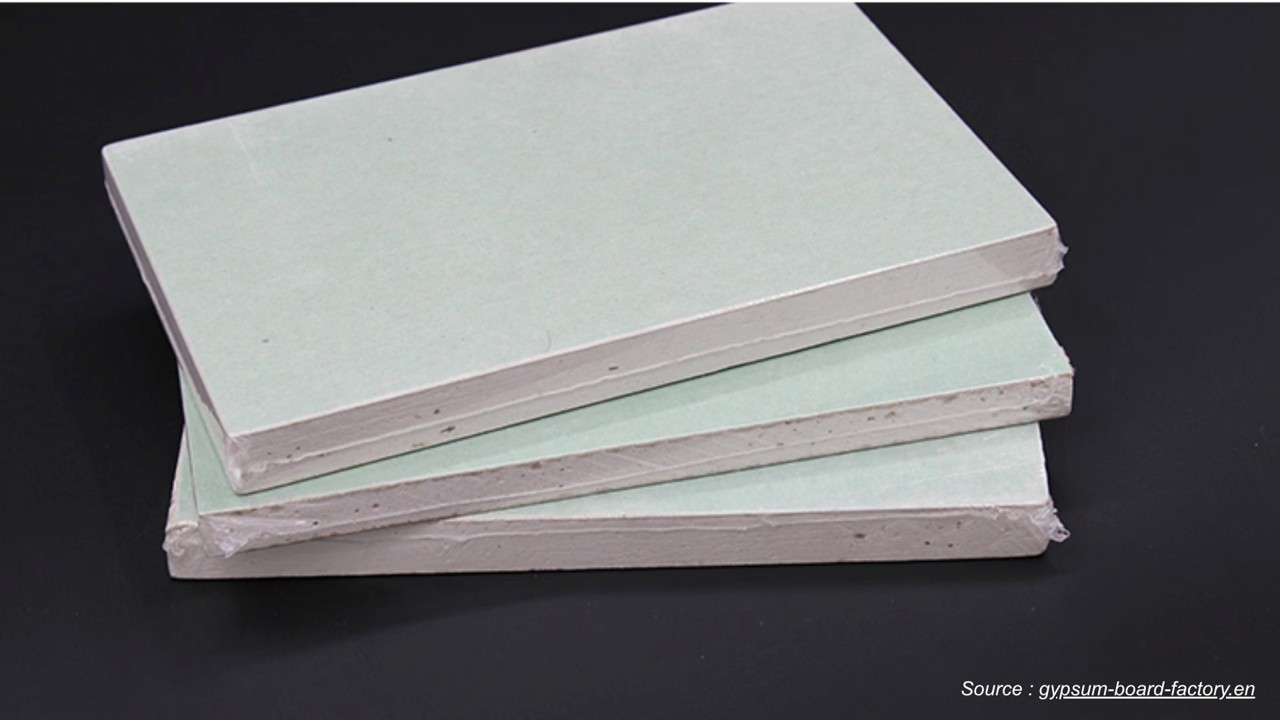
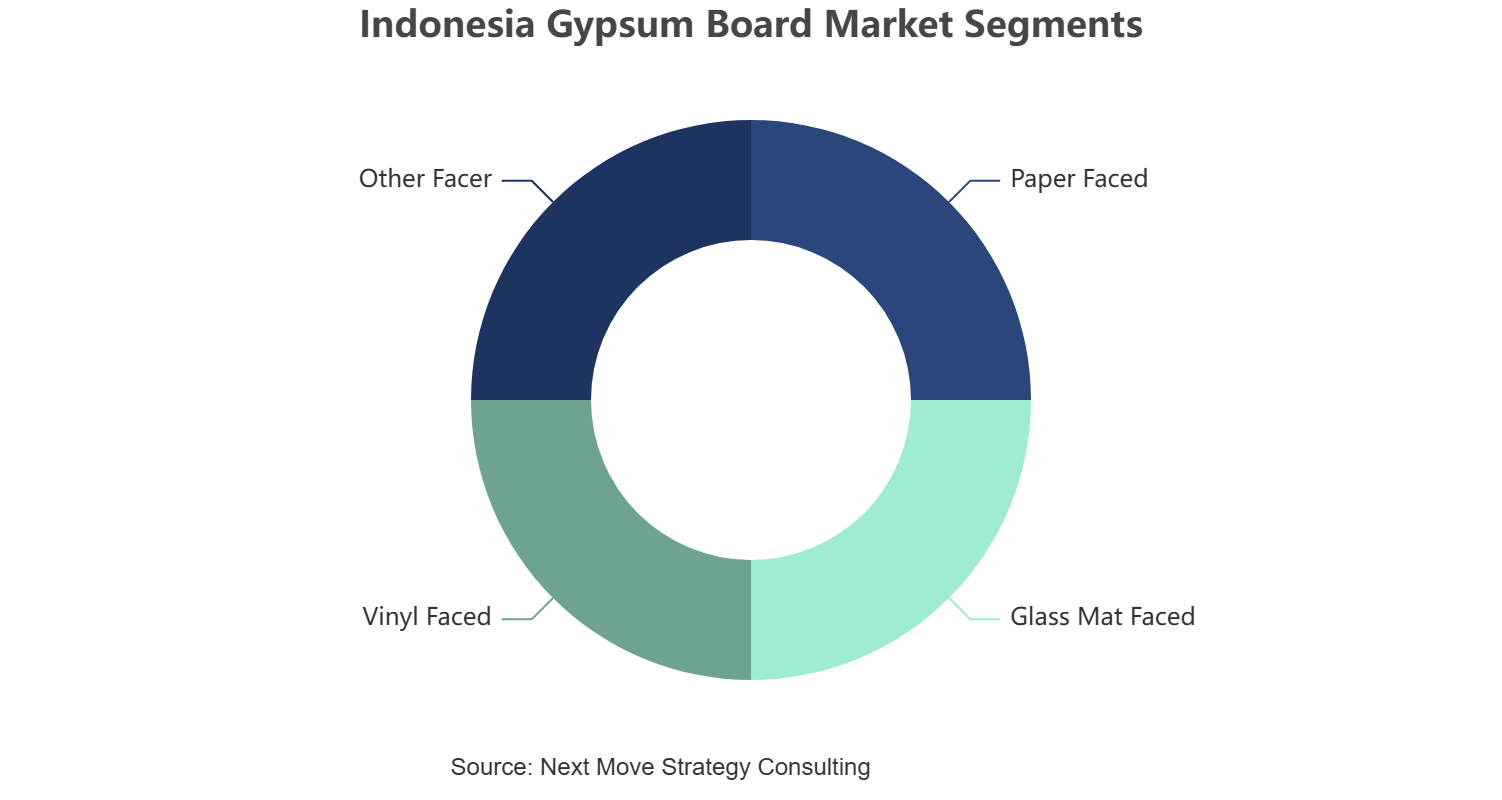
The Indonesia Gypsum Board Market by board type is segmented into Standard Board, Fire Rated Board, Moisture Resistant Board, Acoustic Board, Impact Resistant Board, Exterior Sheathing, Liner Board, Prefinished Board, and Specialty Board.
Standard Board maintains the largest revenue contribution given its broad applicability across general residential and commercial framing projects nationwide. Fire Rated Board and Moisture Resistant Board are emerging as fast-growing categories, driven by stringent building code requirements in institutional and multifamily construction across major cities. Acoustic and Impact Resistant Board variants continue gaining share in healthcare and education projects, while Specialty Board adoption is expanding as performance requirements diversify across the forecast period nationwide.
By End Use
Which End-Use Segment Holds the Largest Share of the Indonesia Gypsum Board Market Revenue?
By end use, the Indonesia Gypsum Board Market is segmented into Residential, Commercial, Institutional, and Industrial applications.
Residential applications represent the dominant end-use segment, supported by rapid urbanization and sustained new housing construction across Indonesia's major cities. Commercial construction is also experiencing strong growth, driven by retail, hospitality, and office developments requiring fire-rated and acoustic board systems. Institutional end use is emerging as a high-priority segment as healthcare and education capital spending intensifies nationwide, while Industrial applications continue to exhibit steady, more modest growth supported by expanding manufacturing and logistics facility construction.
Key Segments
By Board Type
-
Standard Board
-
Regular Board
-
Lightweight Board
-
-
Fire Rated Board
-
Type X Board
-
Type C Board
-
Fire Core Board
-
-
Moisture Resistant Board
-
Green Board
-
Mold Resistant Board
-
Wet Area Board
-
-
Acoustic Board
-
Perforated Board
-
Sound Control Board
-
-
Impact Resistant Board
-
Abuse Resistant Board
-
High Density Board
-
-
Exterior Sheathing
-
Glass Mat Sheathing
-
Soffit Board
-
-
Liner Board
-
Shaftliner Board
-
Area Separation Liner
-
-
Prefinished Board
-
Vinyl Faced Board
-
Laminated Board
-
Decorative Board
-
-
Specialty Board
-
Flexible Board
-
Radiation Shielding Board
-
Foil Backed Board
-
Other Specialty Board
-
By Facer Material
-
Paper Faced
-
Glass Mat Faced
-
Vinyl Faced
-
Other Facer
By End Use
-
Residential
-
Commercial
-
Institutional
-
Industrial
By Distribution Channel
-
Direct Project
-
Wholesale Distributor
-
Retail DIY
-
OEM Prefab
Competitive Landscape Overview
The Indonesia Gypsum Board Market features a moderately consolidated competitive landscape characterized by a mix of multinational manufacturers, regional producers, and specialty board suppliers. Market participants are actively investing in capacity expansion, product diversification, and distribution network strengthening to reinforce their competitive positioning across the archipelago. The convergence of infrastructure development, urbanization, and evolving building code requirements is driving rapid product evolution, with companies competing on the basis of performance attributes, cost efficiency, and distributor relationships nationwide.
Key Players
-
PT Knauf Plasterboard Indonesia
-
PT Saint-Gobain Construction Products Indonesia
-
PT Etex Building Performance Indonesia
-
Yoshino Gypsum Co., Ltd.
-
KCC Corporation
-
PT SCG Indonesia
-
PT Siam-Indo Gypsum Industry
-
PT Aplus Pacific
-
PT Yoshino Indonesia International
The competitive landscape includes leading manufacturers such as PT Knauf Plasterboard Indonesia, PT Saint-Gobain Construction Products Indonesia, and PT Etex Building Performance Indonesia, which dominate standard and fire-rated board production. Yoshino Gypsum Co., Ltd., KCC Corporation, and PT SCG Indonesia continue expanding specialty and moisture-resistant board portfolios, while PT Siam-Indo Gypsum Industry and PT Aplus Pacific compete through regional distribution strength. PT Yoshino Indonesia International is reinforcing competitive positioning through wholesale and prefab supply channel expansion across Indonesia's growing construction sector.
Consumer Behavior Analysis of the Indonesia Gypsum Board Market
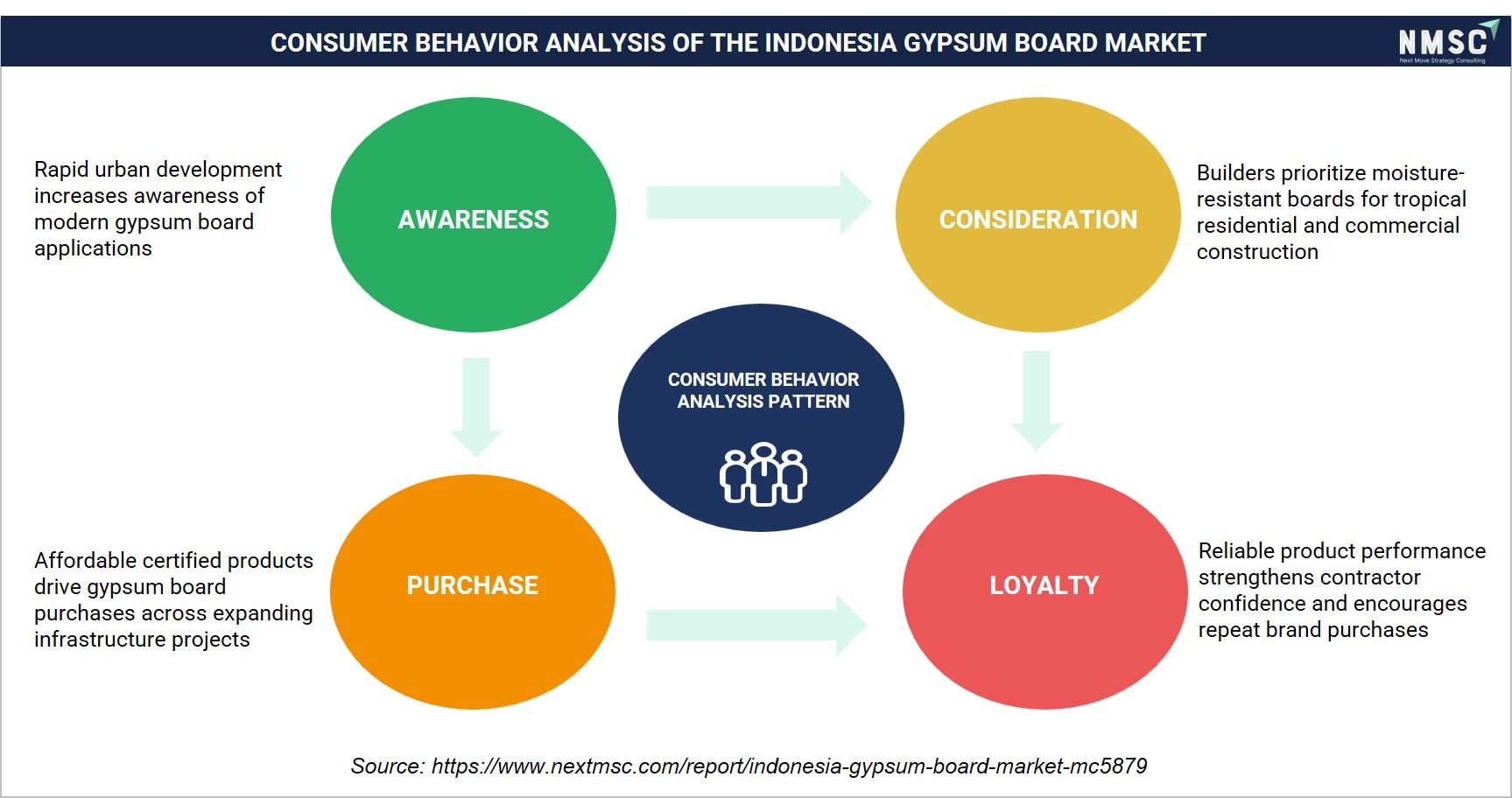
Consumer behaviour in the Indonesia gypsum board market is shaped by rising awareness of modern construction materials, demand for moisture-resistant and certified products, and confidence in reliable product performance. Urbanization, expanding infrastructure projects, and increasing emphasis on quality and durability encourage purchase decisions, while consistent product performance and brand trust foster customer loyalty and repeat procurement.
Key Benefits for Stakeholders
This report delivers comprehensive market intelligence for stakeholders across the Indonesia Gypsum Board Market, enabling informed strategic decision-making. Industry participants, including manufacturers, distributors, and building product developers, benefit from detailed segmentation analysis, competitive benchmarking, and growth opportunity identification. Investors and financial institutions gain access to rigorous market sizing and revenue forecasting data spanning the 2026-2035 forecast period, facilitating accurate investment evaluation and portfolio management decisions across Indonesia's expanding wallboard industry.
Building product specifiers and regulatory bodies can leverage the report's insights to evaluate evolving fire safety, moisture resistance, and acoustic performance requirements shaping product development nationwide. Research institutions and academic organizations benefit from comprehensive analysis of market trends, material innovation trajectories, and distribution channel dynamics across the archipelago. The customizable nature of the report's segmentation structure enables stakeholders to tailor analytical outputs to specific regional, product, or end-use requirements, enhancing relevance across diverse organizational contexts.
|
Parameters |
Details |
|
Customization Scope |
Free customization (equivalent to up to 80 analyst-working hours) after purchase. |
|
Pricing and Purchase Options |
Avail customized purchase options to meet your exact research needs. |
|
Approach |
In-depth primary and secondary research; proprietary databases; rigorous quality control and validation measures. |
|
Analytical Tools |
Porter's Five Forces, SWOT, value chain, and Harvey ball analysis to assess competitive intensity, stakeholder roles, and relative impact of key factors. |
Conclusion
The Indonesia Gypsum Board Market is poised for steady growth, underpinned by large-scale national infrastructure projects, rising urbanization, and growing adoption of modern lightweight construction materials nationwide. With revenue projected to grow from USD 664.42 million in 2026 to USD 1,407.54 million by 2035 at a CAGR of 8.70%, the market presents meaningful opportunities across specialty board categories and smart city developments. Competitive dynamics continue to intensify as multinational manufacturers and regional producers expand capacity to meet evolving performance and distribution requirements across the archipelago.
About the Author
 Mihul Sharma
— Mihul Sharma is Research Associate at Next Move Strategy Consulting, where he has covered technology, industrial, and healthcare markets for 3 years. His work applies structured business research, market analysis, and secondary-source review to assess market trends, competitive developments, and growth opportunities. He supports report development by fully synthesizing industry data, company information, and market signals into concise findings for strategy and investment-focused research teams.
Mihul Sharma
— Mihul Sharma is Research Associate at Next Move Strategy Consulting, where he has covered technology, industrial, and healthcare markets for 3 years. His work applies structured business research, market analysis, and secondary-source review to assess market trends, competitive developments, and growth opportunities. He supports report development by fully synthesizing industry data, company information, and market signals into concise findings for strategy and investment-focused research teams.
About the Reviewer
 Supradip Baul
— Supradip Baul is an accomplished business consultant and strategist with over a decade of rich experience in market intelligence, strategy, technology, and business transformation. His work has included rigorous qualitative and quantitative analysis across multiple industries, helping clients shape investment decisions and long-term roadmaps. Earlier in his career, he was associated with Gartner, where he contributed to industry-leading reports and market share analyses. He has worked with leading global companies and holds an MBA with a dual specialization in Marketing and Finance.
Supradip Baul
— Supradip Baul is an accomplished business consultant and strategist with over a decade of rich experience in market intelligence, strategy, technology, and business transformation. His work has included rigorous qualitative and quantitative analysis across multiple industries, helping clients shape investment decisions and long-term roadmaps. Earlier in his career, he was associated with Gartner, where he contributed to industry-leading reports and market share analyses. He has worked with leading global companies and holds an MBA with a dual specialization in Marketing and Finance.
At Next Move Strategy Consulting, we understand that insightful market research is the cornerstone of successful business decisions. That's why we employ a robust and multifaceted approach, combining various methodologies to deliver the most accurate and actionable data for our clients.

Research Landscape
We navigate the world of research with two primary approaches:
Qualitative Approach
Our qualitative research methodologies involve immersive techniques such as in-depth interviews, focus groups, and observational studies. By engaging directly with individuals and stakeholders, we uncover valuable insights that quantitative data alone may overlook.

Quantitative Research
In tandem with qualitative methodologies, NMSC leverages the power of Quantitative Research to provide a robust foundation of numerical insights. Through systematic data collection and analysis, we quantify patterns, preferences, and market trends, offering a comprehensive view of the business landscape.
Our quantitative research approach employs diverse tools, including surveys, experiments, and statistical modelling. These methodologies enable us to gather data from a large and representative sample, ensuring the statistical significance of our findings. By employing structured questionnaires and standardized data collection methods, we guarantee the reliability and validity of the information we present to our clients.
Quantitative research is particularly effective in measuring the prevalence of trends, assessing market size, and gauging the impact of various factors on consumer behavior. The numerical precision attained through this approach equips our clients with actionable insights, facilitating data-driven decision-making and strategy formulation.


Our Specialized Toolbox for Industry-Specific Market Research
We deploy a specialized arsenal of techniques tailored to meet your unique requirements. Here's a glimpse into our comprehensive toolbox:

Information Procurement
The stage entails acquiring market data or relevant information through various sources and methodologies.


Market Research Approach
We utilize both top-down and bottom-up approaches in market research analysis to achieve a comprehensive understanding of the market dynamics, leveraging the broad perspective of industry trends and macroeconomic factors alongside detailed insights from specific segments and individual companies.

Porters Five Forces Analysis
We conduct Porter's Five Forces analysis to evaluate the competitive landscape of an industry, providing us with insights into factors that affect profitability and strategic positioning.

SWOT Analysis

Forecasting
We utilize a forecasting model to predict future consumption by considering parameters like population, economics, regulations, market competition, drivers, constraints, technology, and pricing. We also employ statistical techniques such as multilinear regression, exponential smoothing, moving average, ARIMA, and Monte Carlo simulations for accurate predictions. In econometric forecasting, we analyzed short-term and long-term event impacts, attributing values based on regulatory frameworks, economic factors, and market events.





 Speak to Our Analyst