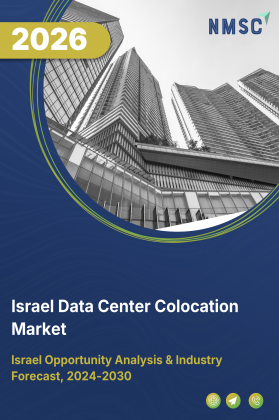
Israel Data Center Colocation Market By Type {Retail (Single, Half & Full Cabinets, Caged Space, Custom Suites), Wholesale (Private Suites, Dedicated Space, Large-Scale)}, By Infrastructure (Hardware, Software, Services), By Data Center Rating (Tier I, Tier II, Tier III, Tier IV), By Server Rack Density (<10kW, 10–19kW, 20–29kW, 30–39kW, 40–49kW, >50kW), By End User (Cloud Service Providers, Network Providers, Managed Service Providers, Enterprises – Analysis & Forecast, 2025–2035
Industry: ICT & Media | Latest Edition: September 30, 2026 | No of Pages: N/A | No. of Tables: N/A | No. of Figures: N/A | Format: PDF | Report Code: IC4386
Industry Outlook
The Israel Data Center Colocation Market size was valued at USD 621.5 million in 2025 and is expected to reach USD 722.7 million by 2026. Looking ahead, the industry is projected to expand significantly, reaching USD 1184.2 million by 2035, registering a CAGR of 5.64% from 2026 to 2035.
The Israel data center colocation market is evolving as the country’s technology-driven economy increases demand for secure, high-performance digital infrastructure. Growth is supported by a strong concentration of technology firms, startups, and multinational R&D centers that require reliable and scalable hosting environments. Colocation activity is primarily centered around Tel Aviv and nearby metropolitan areas, where connectivity, enterprise density, and access to skilled talent are strongest. Organizations are increasingly turning to colocation providers to support cloud integration, disaster recovery, and data-intensive applications while meeting stringent security and compliance standards. At the same time, operators are adapting facilities to handle higher power densities and improved cooling efficiency for the Israel’s colocation market. Although land availability and power constraints influence expansion strategies, continued investment reflects confidence in Israel’s long-term role as a regional hub for innovation-driven data infrastructure.
Advanced Cyber and AI Ecosystem Demand Drives the Israel Data Center Colocation Market Growth
The data center colocation market in Israel is strongly influenced by the country’s advanced cyber, AI, and deep-tech ecosystem. Israel hosts a dense concentration of cybersecurity firms, AI startups, defense technology developers, and global R&D centers that generate complex, security-sensitive workloads. These organizations require highly resilient infrastructure capable of supporting real-time analytics, AI model development, and continuous testing environments. Unlike consumer-scale cloud demand, workloads are innovation-driven and mission-critical, prioritizing security, performance, and control. Colocation facilities provide a neutral, enterprise-grade platform that supports private infrastructure while enabling selective cloud connectivity. As AI and cyber capabilities become more embedded in defense, finance, healthcare, and national infrastructure, compute demand grows steadily and structurally. This innovation-led demand anchors Israel’s colocation market around quality, specialization, and technical sophistication rather than sheer capacity volume.
Dense Enterprise and Multinational R&D Presence Boosts the Israel Data Center Colocation Market Demand
Enterprise demand in Israel is unusually dense relative to market size due to the concentration of multinational R&D centers and technology-driven enterprises. Global firms in semiconductors, software, automotive technology, and life sciences operate critical development and testing workloads locally. These activities require low-latency access, high uptime, and strong data protection, making colocation preferable to self-built facilities. R&D workloads often involve sensitive intellectual property, reinforcing demand for secure, locally controlled infrastructure. Israel data center colocation market providers serve as trusted environments where enterprises can combine private compute with cloud resources while maintaining strict governance. This creates consistent utilization even without mass-market cloud adoption. Demand is stable, long-term, and less cyclical, driven by continuous innovation cycles rather than transactional IT spending. As R&D investment remains central to Israel’s economy, enterprise-driven colocation demand continues to provide a resilient market foundation.
Limited Domestic Scale Limiting the Market Growth
Despite strong technical demand, small domestic market inherently limits large-scale Israel data center colocation market expansion. Population size and enterprise volume do not support hyperscale-style campuses designed for mass cloud consumption. As a result, capacity growth is measured and highly selective. Operators focus on right-sized facilities optimized for reliability, security, and performance rather than pursuing aggressive footprint expansion. This constraint caps total market scale but also reduces oversupply risk and price volatility. Infrastructure investment decisions are closely aligned with confirmed enterprise demand rather than speculative growth. While this limits Israel’s role as a regional cloud hub, it reinforces a disciplined market structure centered on utilization quality. The result is a colocation market that grows through specialization and depth rather than breadth, reflecting Israel’s innovation-driven but compact economic profile.
High-Security Edge Deployments Unlock Israel Data Center Colocation Market Opportunities
The most compelling opportunity in the Israel data center colocation market lies in niche, high-security facilities and edge deployments tailored to sensitive workloads. Defense-linked organizations, cybersecurity firms, financial institutions, and critical infrastructure operators require environments with enhanced physical security, segmented access, and compliance-ready architectures. Edge colocation near enterprise clusters supports low-latency processing for AI inference, cyber monitoring, and real-time decision systems. These deployments prioritize resilience and control over scale. As geopolitical risk, cyber threats, and data sensitivity increase globally, demand for secure, localized infrastructure is strengthening. Israel’s expertise in security and cyber operations positions it well to deliver premium colocation offerings focused on trust and performance. This niche-driven expansion path enables sustainable growth while aligning with the country’s strategic strengths.
Competitive Landscape
The Israel data center colocation industry comprises various key players, such as MedOne Data Centers, Compass Datacenters, EdgeConneX, Inc., Bynet Data Communications, Digital Realty Mivne, Global Technical Realty, Anan Data Centers, Serverfarm LLC, Adgar Data Center, Techtonic Ltd., ONE Technologies, Mega Data Centers and others.
Israel Data Center Colocation Market Key Segments
By Type
-
Retail Colocation
-
Single Cabinets
-
Half Cabinets
-
Full Cabinets
-
Caged Space
-
Custom Suites
-
Wholesale Colocation
-
Private Data Center Suites
-
Dedicated Data Center Space
-
Large-Scale Colocation
By Infrastructure
-
Hardware
-
IT Hardware
-
Servers
-
Storage Systems
-
Networking Equipment
-
-
Power Infrastructure Hardware
-
Uninterruptible Power Supplies (UPS)
-
Generators
-
Automatic Transfer Switches
-
Power Distribution Units (PDUs)
-
-
Mechanical Infrastructure Hardware
-
Computer-Room Air Conditioners (CRAC/CRA Units)
-
Chillers
-
Racks
-
Cable Management Systems
-
-
Safety & Security Hardware
-
Fire Suppression Systems
-
Physical Security Systems (CCTV, access controls)
-
-
-
Software
-
DCIM & Monitoring
-
Automation & Orchestration
-
Backup & Disaster Recovery
-
Security Software
-
Virtualization Software
-
Analytics & Reporting Software
-
Other Software
-
-
Services
-
Planning & Professional Services
-
Site & Building Design
-
System/Infrastructure Engineering
-
Professional Advisory (compliance, energy audits)
-
-
Integration & Deployment Services
-
Electrical & Mechanical Installation
-
Commissioning & Acceptance Testing
-
-
Operation & Support Services
-
Preventive & Corrective Maintenance
-
Facilities Management / Remote Monitoring
-
Support Services (helpdesk, onsite SLA support)
-
-
Hosting & Managed Services
-
Colocation & Cloud Hosting Services
-
Virtual/Private Hosting Platforms
-
-
By Data Center Rating
-
Tier I
-
Tier II
-
Tier III
-
Tier IV
By Server Rack Density
-
<10kW
-
10–19kW
-
20–29kW
-
30–39kW
-
40–49kW
-
50kW
By End User
-
Cloud Service Provider
-
Network Provider
-
Managed Service Provider
-
Enterprises
-
IT and Telecommunication
-
Healthcare
-
BFSI
-
Retail & E-commerce
-
Media and Entertainment
-
Government
-
Energy
-
Other Enterprises
Key Players
-
MedOne Data Centers
-
Compass Datacenters
-
Bynet Data Communications
-
Digital Realty Mivne
-
Global Technical Realty
-
Anan Data Centers
-
Serverfarm LLC
-
Adgar Data Center
-
Techtonic Ltd.
-
ONE Technologies
-
Mega Data Centers
Report Scope and Segmentation:
|
Parameters |
Details |
|
Market Size in 2026 |
USD 722.7 Million |
|
Revenue Forecast in 2035 |
USD 1184.2 Million |
|
Growth Rate |
CAGR of 5.64% from 2026 to 2035 |
|
Analysis Period |
2025–2035 |
|
Base Year Considered |
2025 |
|
Forecast Period |
2026–2035 |
|
Market Size Estimation |
Million (USD) |
|
Growth Factors |
|
|
Companies Profiled |
12 |
|
Market Share |
Available for 10 companies |
|
Customization Scope |
Free customization (equivalent to up to 80 analyst-working hours) after purchase. Addition or alteration to country, regional & segment scope. |
|
Pricing and Purchase Options |
Avail customized purchase options to meet your exact research needs. |
|
Approach |
In-depth primary and secondary research; proprietary databases; rigorous quality control and validation measures. |
|
Analytical Tools |
Porter's Five Forces, SWOT, value chain, and Harvey ball analysis to assess competitive intensity, stakeholder roles, and relative impact of key factors. |


About the Author
 Saista Faiyaz
— Saista Faiyaz is Research Associate at Next Move Strategy Consulting, where she has covered consumer markets and healthcare technologies for 3 years. Her work includes primary interview review, secondary-source validation, market sizing, and structured analysis of company and industry data. She supports research by comparing evidence across sources, organizing findings into market narratives, and documenting assumptions used in analysis. Her scope includes cross-market benchmarking, and reports.
Saista Faiyaz
— Saista Faiyaz is Research Associate at Next Move Strategy Consulting, where she has covered consumer markets and healthcare technologies for 3 years. Her work includes primary interview review, secondary-source validation, market sizing, and structured analysis of company and industry data. She supports research by comparing evidence across sources, organizing findings into market narratives, and documenting assumptions used in analysis. Her scope includes cross-market benchmarking, and reports.
About the Reviewer
 Supradip Baul
— Supradip Baul is an accomplished business consultant and strategist with over a decade of rich experience in market intelligence, strategy, technology, and business transformation. His work has included rigorous qualitative and quantitative analysis across multiple industries, helping clients shape investment decisions and long-term roadmaps. Earlier in his career, he was associated with Gartner, where he contributed to industry-leading reports and market share analyses. He has worked with leading global companies and holds an MBA with a dual specialization in Marketing and Finance.
Supradip Baul
— Supradip Baul is an accomplished business consultant and strategist with over a decade of rich experience in market intelligence, strategy, technology, and business transformation. His work has included rigorous qualitative and quantitative analysis across multiple industries, helping clients shape investment decisions and long-term roadmaps. Earlier in his career, he was associated with Gartner, where he contributed to industry-leading reports and market share analyses. He has worked with leading global companies and holds an MBA with a dual specialization in Marketing and Finance.
At Next Move Strategy Consulting, we understand that insightful market research is the cornerstone of successful business decisions. That's why we employ a robust and multifaceted approach, combining various methodologies to deliver the most accurate and actionable data for our clients.

Research Landscape
We navigate the world of research with two primary approaches:
Qualitative Approach
Our qualitative research methodologies involve immersive techniques such as in-depth interviews, focus groups, and observational studies. By engaging directly with individuals and stakeholders, we uncover valuable insights that quantitative data alone may overlook.

Quantitative Research
In tandem with qualitative methodologies, NMSC leverages the power of Quantitative Research to provide a robust foundation of numerical insights. Through systematic data collection and analysis, we quantify patterns, preferences, and market trends, offering a comprehensive view of the business landscape.
Our quantitative research approach employs diverse tools, including surveys, experiments, and statistical modelling. These methodologies enable us to gather data from a large and representative sample, ensuring the statistical significance of our findings. By employing structured questionnaires and standardized data collection methods, we guarantee the reliability and validity of the information we present to our clients.
Quantitative research is particularly effective in measuring the prevalence of trends, assessing market size, and gauging the impact of various factors on consumer behavior. The numerical precision attained through this approach equips our clients with actionable insights, facilitating data-driven decision-making and strategy formulation.


Our Specialized Toolbox for Industry-Specific Market Research
We deploy a specialized arsenal of techniques tailored to meet your unique requirements. Here's a glimpse into our comprehensive toolbox:

Information Procurement
The stage entails acquiring market data or relevant information through various sources and methodologies.


Market Research Approach
We utilize both top-down and bottom-up approaches in market research analysis to achieve a comprehensive understanding of the market dynamics, leveraging the broad perspective of industry trends and macroeconomic factors alongside detailed insights from specific segments and individual companies.

Porters Five Forces Analysis
We conduct Porter's Five Forces analysis to evaluate the competitive landscape of an industry, providing us with insights into factors that affect profitability and strategic positioning.

SWOT Analysis

Forecasting
We utilize a forecasting model to predict future consumption by considering parameters like population, economics, regulations, market competition, drivers, constraints, technology, and pricing. We also employ statistical techniques such as multilinear regression, exponential smoothing, moving average, ARIMA, and Monte Carlo simulations for accurate predictions. In econometric forecasting, we analyzed short-term and long-term event impacts, attributing values based on regulatory frameworks, economic factors, and market events.





 Speak to Our Analyst