Jewelry Market By Type (Fine Jewelry [Gold Jewelry (Plain Gold Jewelry and Others), By Product Category (Rings, Earrings, Necklaces and Pendants, Bracelets and Others), By Sales Channel (Retail [Organized and Unorganized], and Others), By Price Tier (Luxury and High Jewelry, and Others), By Purchase Occasion (Everyday Wear, Wedding and Bridal, and Others), By Purchase Role (Self-Purchase, Gift Buyers, and Others), and By End User (Women, Men, and Children) – Global Analysis & Forecast, 2026–2035
Industry: Retail and Consumer | Publishing Date: December 16, 2025 | Last Updated: September 21, 2026 | No of Pages: N/A | No. of Tables: N/A | No. of Figures: N/A | Format: PDF | Report Code: RC3882
Industry Outlook
The global Jewelry Market size is valued at USD 409.27 billion in 2025 and is expected to reach USD 432.60 billion by 2026. Looking ahead, the industry is projected to expand significantly, reaching USD 713.10 billion by 2035, registering a CAGR of 5.71% from 2026 to 2035.
The market is experiencing steady, diversified growth, driven by rising consumer interest in premium fashion, personalised accessories, and high-quality craftsmanship across global regions. Demand spans luxury fine jewelry, branded collections, and affordable fashion pieces, supported by growing disposable incomes, cultural gifting traditions, and evolving lifestyle aspirations. Innovations in design, sustainable sourcing, and lab-grown materials are reshaping product offerings, while digital commerce, virtual try-ons, and influencer-led trends continue to enhance consumer engagement. Precious metals such as gold, silver, and platinum remain core materials, complemented by diamonds, gemstones, and contemporary alloys. Manufacturers and retailers are investing in traceability, ethical sourcing, and omnichannel retail strategies to build trust and create differentiated experiences. By combining heritage craftsmanship, modern aesthetics, and responsible practices, the market is capturing diverse consumer segments and driving long-term global expansion.
What Are the Key Trends in the Jewelry Industry?
How are the Rising Urban Population Reshaping Jewelry Demand and Channel Strategy?
According to the World Bank, more than half of the world’s population, over 4 billion people, lives in cities, this shift is set to continue, with the urban population expected to more than double by 2050. This shift boosts demand for affordable, trend-led jewelry, especially sterling silver and plated lines, as urban consumers follow micro-trends, make more frequent purchases, and buy for lifestyle and gifting occasions rather than wealth storage. Dense cities also enhance omnichannel economics through shorter last-mile routes, stronger click-and-collect adoption, and increased social commerce, thereby accelerating SKU rotation and capsule-drop cycles. Brands are deploying city-first assortments, faster design-to-shelf cycles, small-batch urban capsules, and strengthened last-mile and returns infrastructure to convert frequent discovery into repeat purchases and higher lifetime value.
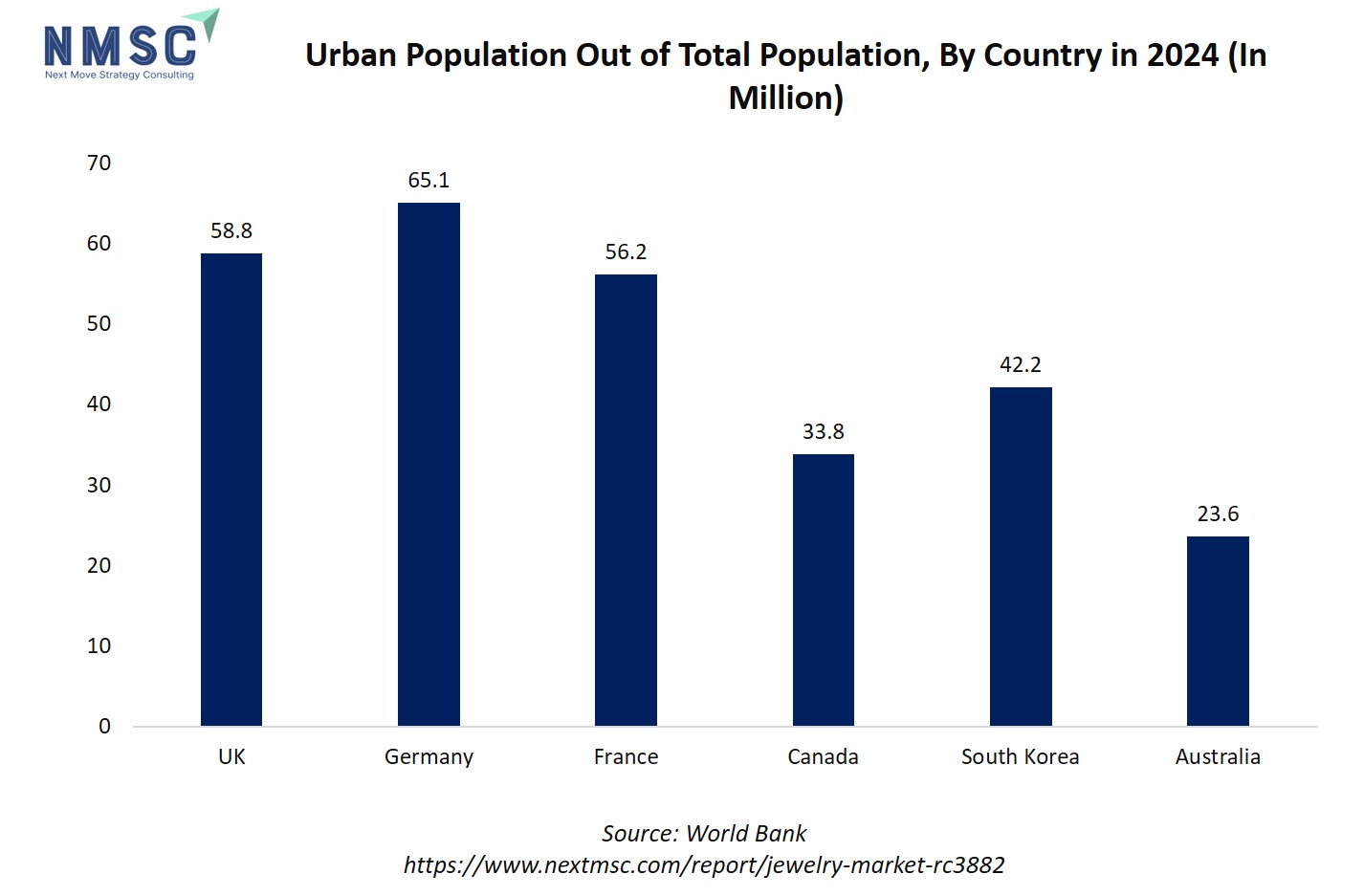
The chart displays urban population counts by country in 2024, with Germany, the UK, and France having the largest urban populations among the listed nations. High urbanisation is closely linked to greater consumer exposure to fashion, luxury, and lifestyle trends, fueling demand for all types of market. As urban populations grow, the market benefits from increased access to retail outlets, online channels, and higher disposable income, particularly in metropolitan areas. This urban concentration fosters demand for diverse, contemporary, and high-value jewelry products, supporting robust market growth and continuous product innovation for brands and retailers.
How is Digital Commerce and Omnichannel Adoption Reshaping Jewelry Market Growth?
E-commerce and digital discovery expanded rapidly and continued reshaping jewelry distribution into 2025, significantly widening market access for independent designers and established brands alike. World Bank digital economy insights show that online channels reduce distribution friction and enable niche labels to scale efficiently, particularly in jewelry, where visual discovery, social commerce, and influencer-driven demand strongly influence purchasing. As a result, brands are prioritising virtual try-ons, high-fidelity photography, and streamlined returns to lower conversion barriers. For executives, this shift redirects CAPEX toward fulfilment, CX, and data infrastructure rather than physical store expansion. Incumbents are integrating online assortment analytics with in-store merchandising to minimise markdowns, optimise stock, and strengthen repeat purchasing.
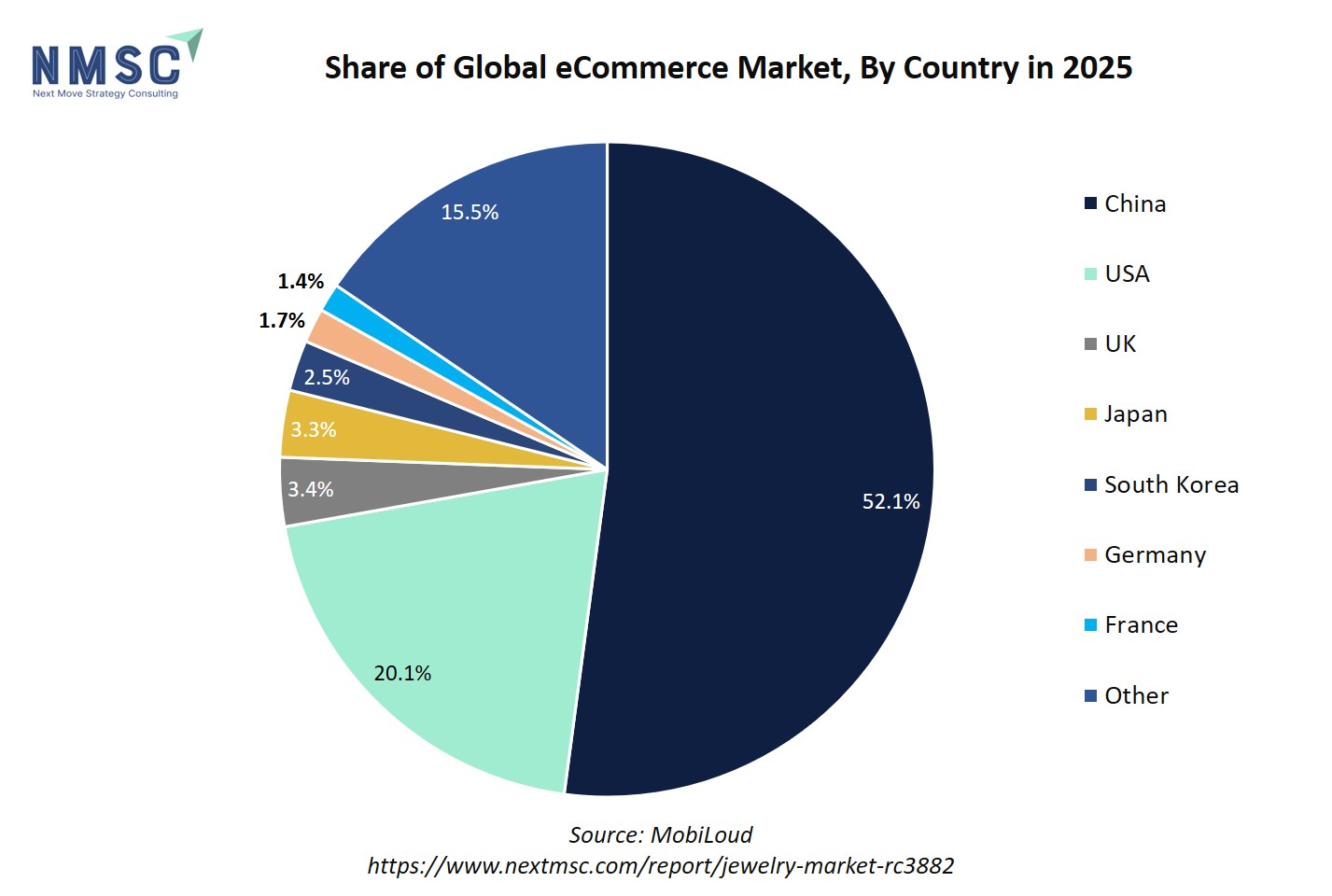
The chart illustrates that China and the USA dominate the global E-Commerce market in 2025, while countries like the UK, Japan, and others capture much smaller segments. With over two-thirds of global E-Commerce concentrated in just two countries, the market is heavily influenced by the digital retail landscape shaped by these markets. High e-commerce penetration makes online channels the primary arena for fashion jewelry discovery, comparison, and purchase, accelerating trends, customisation, and consumer access to global jewelry brands. The shift to E-Commerce drives jewelry market growth by unlocking new customer bases, enabling direct-to-consumer models, and supporting a wider variety of product offerings, including designer, fine, and fashion jewelry.
How are Regional Demand Shifts Altering Category Strategy?
As global jewelry consumption patterns diverge, regional demand dynamics are reshaping how brands design and position their product portfolios. Understanding these shifts is becoming essential for companies seeking to optimise category strategy across markets. APAC continues to anchor global volume growth, supported by festival-driven, wedding-related, and gifting-led demand. In contrast, North America and parts of Europe are experiencing selective premiumisation, where consumers increasingly value provenance, craftsmanship, and distinctive design. Recent filings from major APAC jewelry players indicate continued investments in store expansion, particularly across tier-2 and tier-3 cities, to capture the spending power of the rising middle class. As a result, brands simultaneously offer high-frequency, lower-ASP everyday assortments for APAC mass markets while developing limited, premium, and traceable collections for Western consumers.
What Are the Key Market Drivers, Breakthroughs, and Investment Opportunities that will Shape the Jewelry Industry in the Next Decade?
The jewelry market near-term dynamics are driven by consumer segmentation, elevated provenance/sustainability requirements and the structural rise of digital commerce. Large branded players are consolidating supply-chain controls and sustainability credentials, while regional players scale through retail expansion and digital channels. Inflationary and commodity pressures like precious metals, present margin risk, prompting operational responses such as design optimisation and hedging.
Growth Drivers:
How is Rising Disposable Income and Cultural Demand in Emerging Markets Driving Volume Growth?
Rising disposable incomes across India, Southeast Asia, and Latin America are expanding every day and ceremonial jewelry purchasing, particularly for weddings, festivals, and family milestones. Industry disclosures and retail data show jewelry’s dual role as adornment and culturally rooted value preservation, sustaining demand even in price-sensitive markets. As urbanisation spreads into tier-2 and tier-3 cities, organised retailers gain access to new customer cohorts that shop frequently and increasingly prefer branded, design-led silver lines. For brands, growth requires scaling affordable assortments, localising motifs, and strengthening regional logistics to ensure timely availability. Maintaining margin discipline depends on sourcing efficiency, calibrated price ladders, and assortment architectures aligned with local purchasing power.
The chart displays gross disposable per capita income for major developed countries in 2024, with the U.S. leading at USD 62,722 PPP, followed by Luxembourg, Switzerland, Germany, and Australia. High disposable incomes empower consumers to purchase more discretionary and luxury items, which drives the jewelry market demand. In countries where disposable income is elevated, consumers are more likely to buy fine jewelry, experiment with premium and designer pieces, and seek out branded or custom collections, both in-store and online. This strong purchasing power provides a solid foundation for jewelry market growth, encourages product innovation, and supports higher average transaction values for retailers targeting affluent populations.
How is the Precious-Yet-Affordable Fashion Trend Creating New Sterling and Fashion Jewelry Strategies?
Growing consumer appetite for precious yet affordable pieces, especially among younger buyers, has accelerated demand for sterling silver and fashion jewelry that delivers premium aesthetics without gold-level pricing. This trend reshapes brand strategies toward rapid design cycles, capsule drops, and influencer-driven collaborations that emphasise novelty and accessibility. To compete, brands are deploying modular design systems, increasing SKU turnover, and relying on digital analytics to track and monetise micro-trends emerging from social commerce. Operationally, success requires agile manufacturing, shorter replenishment windows, and tighter inventory control to avoid overstocks. By balancing speed with quality, brands expand reach while maintaining healthy economics in fast-fashion-adjacent jewelry segments.
Growth Inhibitors:
How does Precious-Metal Price Volatility Constrain Discretionary Demand and Margins?
Volatility in gold, silver, and other precious metals introduces procurement uncertainty that pressures retail pricing and compresses margins, particularly in mid-market jewelry where consumers are highly price-sensitive. Market commentary and corporate disclosures show that firms lacking hedging programs, metal-surcharge mechanisms, or flexible pricing clauses absorb cost shocks or resort to discounting, which erodes profitability. During price spikes, discretionary purchases decline, and basket sizes shrink as shoppers shift to lighter-weight pieces or alternative metals. To mitigate these constraints, brands are adopting structured hedging, diversifying material mixes, securing allocation-based supplier contracts, and redesigning pieces to optimise metal usage, all while maintaining transparent communication with customers to preserve trust.
Where Should Investors Consider Deploying Capital in the Jewelry Value Chain?
The most attractive near-term opportunities lie in certified recycled-metal refining, digital provenance infrastructure, and fulfilment technologies that improve unit economics for online jewelry sales. As branded players accelerate commitments to recycled silver and gold, investors who fund refinery certification, traceability platforms, or shared recycled-metal pools gain access to growing, supply-constrained segments. Parallel investment in virtual try-on technologies, CX automation, and return-reduction tooling materially lowers logistics costs and strengthens e-commerce profitability. Capital prioritises assets that reduce procurement risk, enhance supply chain transparency, or sustainably lower CAC and return rates. These investments align with regulatory trends and offer defensible competitive advantages as the jewelry sector digitises.
How Is the Jewelry Market Segmented in this Report, and What are the Key Insights from the Segmentation Analysis?
By Product Type Insights
Are Necklaces, Rings and Earrings Dominating the Market?
Based on product type, the market includes necklaces and pendants, rings, earrings, bracelets and bangles, watches and timepieces, anklets, brooches and pins, and other accessories.
Necklaces, rings and earrings captured the largest share of retail volume due to frequent purchase cycles, gifting occasions and wedding markets in APAC. Company disclosures show these categories sustain higher SKU turnover and benefit disproportionately from capsule and influencer campaigns. Rings and necklaces combined with gemstone accents lift ASPs, while earrings drive repeat purchase frequency. Prioritising modular and stackable designs in these subsegments to increase purchase frequency and enable higher lifetime value per customer.
By Material Type Insights
Is Gold Still the Dominant Value Driver While Silver and Plated Materials Drive Volume?
Based on material type, the market is segmented into gold, silver, platinum, diamond, and other materials.
Gold remains the dominant contributor to industry revenue because of its intrinsic store-of-value role, while silver and plated materials account for the high-volume, trend-led segments. Luxury filings emphasise gold and gem-led lines for ASP and gross margin. Mass market filings and regional players show silver and plated assortments driving footfall and frequency. Companies hedge exposure by offering a laddered merchandise strategy, gold and fine jewelry for margin, silver and plated for frequency and new customer acquisition.
By Category Insights
Are Fashion and Fine Jewelry Pursuing Different Growth Levers?
Based on category, the market is divided into luxury, fine jewelry, and fashion jewelry.
Fashion jewelry grows through fast cycles, influencer marketing and social commerce, fine and luxury jewelry relies on branding, craftsmanship and store experience. Post-2024 filings show luxury groups investing in retail renovation and experiential retail to maintain ASPs while fashion players scale via digital channels. For management teams, they separate operating KPI, inventory days and SKU churn for fashion lines, store conversion and high-touch service metrics for fine jewelry. Cross-channel learnings are applied across categories to reduce friction.
By Distribution Channel Insights
Is Omnichannel Dominating Market Expansion in 2025?
Based on the distribution channel, the market comprises online, multi-brand jewelry stores, independent jewellers, and chain retailers.
Omnichannel strategies dominate growth because consumers research online and buy either online or in-store. UNCTAD and World Bank digital economy materials document the structural shift. Retailers that integrate inventory visibility, click-and-collect, and easy returns reduce cart abandonment and lower return-driven losses. For incumbents, the priority is to harmonise pricing and assortment across channels and invest in fulfilment nodes that improve last-mile economics. Digital channels broaden reach for small designers but raise the importance of logistics and return cost control.
By End User Insights
Are Women Still the Largest End-User Segment?
On the basis of end user, the market is segmented into men, women, and children.
On the basis of end user, the market is segmented into men, women, and children. Among these, women continue to represent the largest end-user segment, driven by higher product adoption, stronger purchasing power, and a wider preference for premium and personalized offerings. Their consistent demand across categories positions them as the dominant consumer group, influencing brand strategies and market trends.
Regional Outlook
The jewelry market share is geographically studied across North America, Europe, Asia Pacific, the Middle East & Africa, and Latin America, and each region is further studied across countries.
Jewelry Market in North America
North America demonstrated resilient branded jewelry demand in 2024, underpinned by strong consumer engagement with digital channels, social commerce and experiential retail. Major global houses accelerated omnichannel investment, enhancing store renovation, service design, and online-to-offline pathways that lifted premium conversion. Affordable luxury and mid-priced jewelry benefited from influencer-driven discovery, while high-income segments responded to elevated in-store experiences and refreshed premium assortments. Inventory efficiency improved as brands used digital analytics to optimise SKU depth and reduce markdowns. Overall, the region remains one of the strongest global markets due to robust consumer confidence in key metropolitan areas and the continued evolution of omnichannel ecosystems.
Jewelry Market in the United States
The U.S. jewelry market maintained solid momentum through 2024, supported by strong performance in designer and branded segments. Enhanced online customer experience, faster delivery, simplified returns and loyalty benefits, improved conversion and encouraged multi-category purchasing. Premium players emphasised store remodelling, curated assortments and targeted marketing to strengthen customer acquisition in key metropolitan hubs. Social commerce and influencer-driven discovery also increased traction in younger cohorts, pushing higher engagement in sterling, gold-plated and accessible luxury lines. With stable macro conditions in affluent consumer segments, the U.S. continues to serve as a core growth driver for global brands expanding their premium footprints.
Jewelry Market in Canada
Canada mirrors broader U.S. market dynamics but at a more moderate scale, with concentrated growth in urban centres such as Toronto, Vancouver and Montreal. Premium jewelry performs well among affluent consumers, whereas the mass market benefits from stable gifting and seasonal demand. Retailers navigate longer assortment lead times due to logistics constraints, import tariffs and currency considerations, which modestly influence product availability and pricing architecture. Digital penetration continues to rise, enabling independent designers and global brands to expand regional reach. Sustainability messaging resonates with younger consumers, creating opportunities for recycled metal lines and traceable collections.
Jewelry Market in Europe
Europe remains highly heterogeneous in jewelry preferences, where Northern Europe prioritises sustainability, traceability and certified recycled metals, making provenance a powerful differentiator. Southern Europe remains more price sensitive, with promotions, gifting seasons and tourism flows influencing sales cycles. Luxury demand varies significantly by country, with tourism-intensive markets benefiting from recovering travel inflows. Retailers deploy localisation strategies, adjusting designs, pricing tiers and marketing to maintain share. Digital channels complement store-based purchasing, but store experience remains central in premium segments. Overall, growth in 2024 was uneven, with stronger momentum in countries with healthier consumer confidence and resilient tourism.
Jewelry Market in the United Kingdom
The UK jewelry market proved resilient for designer and branded products, though persistent macro headwinds, higher living costs and cautious discretionary spending created uneven category performance. Premium customers continued to value brand heritage, craftsmanship and design-led offerings, while the mass market relied more heavily on promotions, loyalty programs and seasonal campaigns. Retailers invested in omnichannel upgrading, including improved online CX and flexible fulfilment, to stabilise conversion. Despite macro challenges, the UK remains an influential market, particularly for brands with strong high-street visibility and differentiated storytelling.
Jewelry Market in Germany
Germany’s jewelry market prioritises quality, durability and sustainability credentials, making certified recycled metals and traceable sourcing increasingly important in premium categories. Consumers favour understated design, long product lifecycles and strong brand trust, enabling players with rigorous ESG claims to outperform. Digital channels complement retail stores, but physical experience, fit, finish and after-sales service remain a purchase driver. Retailers report consistent interest in responsibly sourced silver and gold, and mid-market lines perform well when supported by authenticity guarantees. Germany’s stable consumer base makes it one of Europe’s more predictable demand centres.
Jewelry Market in France
France maintains strong momentum in heritage, luxury and maison-driven jewelry, supported by Paris’s position as a global fashion capital. Brand storytelling, atelier craftsmanship and premium in-store experiences remain central to customer acquisition and retention. While mass-market silver and fashion jewelry face competition from promotional channels, premium houses continue to benefit from tourism recovery and high-end consumer resilience. French consumers value design authenticity, artistic identity and brand lineage, reinforcing the strength of maisons with deep cultural equity.
Jewelry Market in Italy
Italy’s jewelry market is anchored in artisanal craftsmanship, regional heritage and strong tourist-driven demand. Italian ateliers maintain relevance through detailed workmanship, handmade techniques and distinctive local aesthetics, supporting premium pricing. Tourist inflows into Milan, Rome and Florence bolster demand for both gold and high-end silver lines. Domestic consumers show steady interest in artisanal and design-led pieces, while fashion-forward segments respond well to contemporary silver and mixed-metal collections. Italy remains a key global jewelry hub due to its craftsmanship ecosystem and export-oriented production.
Jewelry Market in Spain
Spain’s jewelry market blends vibrant local designer ecosystems with strong mass-market consumption. Tourism plays a critical role, particularly in coastal and cultural centres, driving seasonal surges in gifting and premium purchases. Domestic consumers remain value-conscious, favouring promotions and accessible luxury lines. Local artisans and contemporary designers gain traction via social commerce and independent boutiques. While economic sensitivity moderates premium growth, stable gifting occasions and tourist flows underpin volume demand.
Jewelry Market in the Nordics
Nordic consumers consistently prioritise sustainability, transparency and minimalist design, making the region one of the strongest adopters of certified recycled metals and provenance-enabled collections. Brands that provide ESG documentation, carbon reporting and chain-of-custody traceability perform well in premium categories. Digital channels are highly penetrated, with strong uptake of omnichannel features and subscription-based jewelry services. The market’s emphasis on ethical sourcing and long-lasting craftsmanship supports stable premium demand.
Jewelry Market in the Asia-Pacific
Asia-Pacific remains the jewelry industry’s largest volume engine, driven by festival, wedding and gifting cycles across India, China and Southeast Asia. Expanding middle classes, rising disposable incomes, and culturally embedded purchase rituals create frequent buying occasions. Brands increasingly penetrate tier-2 and tier-3 cities, supported by rapid retail rollout, mobile commerce and platform-based discovery. Mass-market silver and gold-plated lines see strong uptake, while premium products grow selectively in affluent urban centres. E-commerce and livestreaming remain powerful growth levers, shaping assortment strategy and SKU velocity.
Jewelry Market in China
China’s jewelry market is recovering unevenly, with premium segments showing cautious behaviour amid softer consumer sentiment. Domestic brands adapt quickly to local trend cycles, offering design-led silver and gold-plated pieces with strong value positioning. Younger consumers favour fashion-forward collections discovered through livestreaming and social platforms, while older segments maintain interest in premium and heritage jewelry. Retailers continue expanding into lower-tier cities and enhancing omnichannel fulfilment to capture incremental volume.
Jewelry Market in Japan
Japan’s jewelry market is anchored in high standards of finish, craftsmanship and brand provenance. Consumers value precision, subtle design and long product lifespan, making quality assurance a key determinant of purchase. Premium segments perform steadily, with international maisons benefiting from strong brand trust and consistent footfall in flagship retail districts. Silver and design-driven accessories remain popular among younger demographics seeking refined, minimalist aesthetics.
Jewelry Market in India
India remains one of the world’s highest-volume markets, driven by weddings, festivals and culturally anchored gifting traditions. Strong rural income pockets and expanding urban middle classes supported 2024 demand, with silver and gold-plated lines gaining traction for everyday wear. Organised retailers continue expanding nationwide store networks, supported by digital strategy, omnichannel integration and regional assortment tailoring. Tier-2 and tier-3 cities are key demand centres.
Jewelry Market in South Korea
South Korea’s market is shaped heavily by K-fashion cycles, fast trend turnover and a digitally native consumer base. Livestream commerce, influencer-led product drops and highly visual social platforms accelerate discovery and SKU rotation, particularly for silver and fashion-forward designs. Younger buyers gravitate toward accessible luxury pieces that complement K-style aesthetics, while premium jewelry performs primarily in affluent Seoul districts. Brands increasingly depend on micro-trend analytics, rapid design refreshes and limited-edition collaborations to sustain momentum. Although discretionary demand is cyclical, the country’s advanced digital ecosystem and cultural emphasis on self-expression create a dynamic environment for both domestic designers and international brands.
Jewelry Market in Taiwan
Taiwan’s market remains niche but highly design-forward, appealing to consumers with strong preferences for contemporary aesthetics, clean lines and artisanal detailing. Local designers gain visibility through social commerce and craft-focused communities, while cross-border e-commerce gives shoppers easy access to global brands and premium collections. Demand is concentrated in urban centres, where consumers value modern styling, quality assurance and ethical sourcing. Although price sensitivity exists in mass segments, premium buyers prioritise craftsmanship and provenance transparency. The market’s relatively small size is offset by high engagement among design-led consumers, creating opportunities for curated assortments, limited editions and hybrid online-offline retail strategies.
Jewelry Market in Indonesia
Indonesia’s market is expanding alongside a rapidly growing urban middle class and rising digital participation. Mobile commerce adoption is among the highest in the region, enabling continuous product discovery and impulse purchasing through social platforms, live selling and app-based marketplaces. Younger consumers favour silver, gold-plated and trend-driven collections that align with contemporary fashion and gifting behaviour. Religious festivals, life-stage celebrations and rising disposable incomes support consistent volume growth. However, logistics complexity across the archipelago encourages brands to optimise fulfilment models and regional inventory hubs. As digital influence deepens, brands that maintain affordability, design freshness and strong online engagement see the strongest traction.
Jewelry Market in Australia
Australia’s market reflects a strong combination of branded, artisanal and sustainability-oriented demand. Urban consumers increasingly seek ethically sourced materials, recycled metals and transparent provenance, with premium buyers paying close attention to craftsmanship and quality assurance. Designer and contemporary brands perform well in Sydney and Melbourne, supported by robust omnichannel behaviour and a high willingness to research online before purchasing in-store. Local artisans benefit from a growing appreciation for handcrafted styles and limited-edition pieces. The market also shows steady adoption of digital tools such as virtual try-ons and detailed product metadata. Sustainability, authenticity and premium craftsmanship remain the defining value drivers across segments.
Jewelry Market in Latin America
Latin America’s market continues to benefit from deep-rooted cultural demand tied to weddings, festivals, religious ceremonies and gifting occasions. Despite structural drivers, growth is tempered by currency volatility, high import costs and uneven purchasing power across countries. Domestic designers leverage regional motifs and artisanal craftsmanship to differentiate, while global brands face challenges around pricing, architecture and supply-chain consistency. Social commerce adoption is accelerating, especially in Mexico and Brazil, boosting demand for mid-priced silver, gold-plated and fashion jewelry. Retailers increasingly balance curated assortments with affordability, while logistical constraints and macroeconomic risk require disciplined inventory planning to protect margins.
Jewelry Market in the Middle East & Africa
The Middle East remains dominated by gold jewelry, supported by cultural preferences, gifting rituals and strong luxury demand among affluent consumers. Premium international brands perform well in major hubs, while silver and fashion jewelry occupy niche but gradually expanding segments among younger shoppers. In Africa, the market is highly fragmented, driven by artisanal mining, local craftsmanship and informal trade channels. Urbanisation and rising digital access support growing interest in contemporary designs, though affordability considerations shape product mix. Formal retail expansion is gradual, with logistics and regulatory diversity presenting challenges. Opportunities lie in curated assortments, transparent sourcing and partnerships with local artisan networks.
Competitive Landscape
Which Companies Dominate the Jewelry Industry and How do they Compete?
The jewelry industry combines global luxury groups LVMH, Richemont, large accessible luxury players like Pandora, regional heavyweights such as Chow Tai Fook, Titan and a long tail of specialist designers. Public filings show different strategic priorities, luxury houses invest in brand desirability and store experience, mass and midmarket players scale by distribution and supply-chain efficiency. Digital natives and DTC brands increase competition on social commerce and trend responsiveness. Competitive advantage increasingly depends on supply-chain transparency, certified recycled sourcing and digital CX rather than simple scale alone.
Market Dominated by Jewelry Giants and Specialists
The global jewelry industry is shaped by a clear dual structure in which large multinational groups and niche specialists compete through distinct capabilities. Giants leverage scale, global distribution networks and powerful brand equity to dominate premium and accessible luxury segments, while specialists differentiate through craftsmanship, heritage narratives and tightly curated assortments. This creates three competitive arenas, which are global luxury houses with high ASPs and experience-led retail, accessible branded jewelry players that drive repeat purchases, and regional mass-market leaders such as Titan or Chow Tai Fook. Giants more easily fund sustainability initiatives and vertical integration, whereas specialists protect margins through exclusivity, bespoke services and selective partnerships or licensing to gain scale without diluting brand identity.
Innovation and Adaptability Drive Market Success
Jewelry brands increasingly compete on innovation, particularly in traceability, circularity and digital customer experience. Chain-of-custody platforms, recycled metal processing and authenticated sourcing allow companies to secure consumer trust and command premium pricing. Digital UX improvements, AR, virtual try-on, enhanced product imagery, lift conversion rates across omnichannel environments. Pandora’s 2024 transition toward fully recycled silver and gold illustrates how sustainability is incorporated at an operational scale. Adaptability is equally important, where flexible manufacturing, short production runs and region-specific collections enable rapid trend response and frequent capsule drops. Firms combining provenance assurance, digital excellence and agile supply chains are best positioned to capture incremental market share.
Market Players to Opt for Merger & Acquisition Strategies to Expand their Presence
M&A strategies in the jewelry sector are increasingly selective, prioritising acquisitions that strengthen brand equity, enhance digital capabilities or reinforce supply-chain security. Luxury groups focus on targeted deals that expand artisanal capacity, secure certified metal supply and preserve quality control, while regional players in India and APAC pursue consolidation to gain distribution scale and manage bullion requirements more efficiently. Digital marketplace acquisitions and investments in traceability or recycling infrastructure are expected to rise as incumbents seek defensible advantages. Public filings and market analysis indicate that 2025 deal flow will remain tactical rather than broad-based, centred on capabilities that accelerate sustainability, control input volatility and deepen omnichannel engagement.
List of Key Jewelry Companies
-
Richemont
-
Chow Tai Fook Jewellery Group
-
LVMH
-
Malabar Gold & Diamonds
-
Signet Jewelers Limited
-
China National Gold
-
Lao Feng Xiang
-
Titan Company Limited
-
Shanghai Yuyuan Tourist Mart
-
Pandora A/S
-
Joyalukkas India Limited
-
Kalyan Jewellers India Limited
-
Luk Fook Holdings
-
Chow Sang Sang Holdings
-
Chow Tai Seng Jewellery Co.
-
Swarovski
-
Kering
-
Chanel
-
Chopard & Cie SA
-
Graff Diamonds Ltd.
What Are the Latest Key Industry Developments?
-
June 2025- Chow Tai Fook Jewelry launched a new high jewelry collection honouring a century of craft and cultural legacy.
-
November 2024- Pandora partnered with popular brands, including Netflix, for exclusive collections inspired by shows like Stranger Things.
What Are the Key Factors Influencing Investment Analysis & Opportunities in the Jewelry Market?
Investment analysis in the jewelry sector increasingly hinges on three factors such as, raw-material volatility, digital performance metrics, and access to certified, traceable metal supply. Capital continues to flow toward tech-enabled retail models, including virtual try-on, AR tools, last-mile logistics, and toward sustainability infrastructure such as recycled-metal refining and chain-of-custody platforms. Valuation premiums favour companies with strong omnichannel KPIs, recurring revenue logic, and demonstrable supply-chain control. Growth-capital hotspots include APAC retail expansion, provenance technologies and circular-economy processing assets. Investors are advised to model 10–20% commodity-price shock scenarios and prioritise targets with hedging mechanisms, long-term supplier agreements and scalable digital acquisition economics that protect margins while enabling predictable growth.
Key Benefits for Stakeholders:
Next Move Strategy Consulting (NMSC) presents a comprehensive analysis of the jewelry market trends, covering historical trends from 2020 through 2025 and offering detailed forecasts through 2035. Our study examines the market at regional and country levels, providing quantitative projections and insights into key growth drivers, challenges, and investment opportunities across all major jewelry segments.
Investors gain exposure to both the stability of precious-metal store-of-value demand and the velocity of fashion jewelry cycles, with certified recycled supply reducing regulatory and reputational risk while supporting ASP premiums. Consumers benefit from wider affordable-luxury assortments and clearer provenance information, reinforcing trust and repeat purchasing. Retailers enhance margins through omnichannel efficiency, curated sustainable lines and improved conversion from transparency initiatives. Suppliers that achieve certification secure longer-tenor, higher-value contracts tied to sustainability commitments. SMEs and artisans access broader markets through digital channels but manage certification and logistics costs, making cooperative sourcing and shared-service models attractive. Overall, stakeholders integrating sustainability, digital CX and metal-risk management capture disproportionate competitive advantage.
Report Scope
|
Parameters |
Details |
|
Market Size in 2026 |
USD 432.6 Billion |
|
Revenue Forecast in 2035 |
USD 713.1 Billion |
|
Growth Rate |
CAGR of 5.71% from 2026 to 2035 |
|
Analysis Period |
2025–2035 |
|
Base Year Considered |
2025 |
|
Forecast Period |
2026–2035 |
|
Market Size Estimation |
Billion (USD) |
|
Growth Factors |
|
|
Companies Profiled |
15 |
|
Countries Covered |
33 |
|
Market Share |
Available for 10 companies |
|
Customization Scope |
Free customization (equivalent to up to 80 analyst-working hours) after purchase. Addition or alteration to country, regional & segment scope. |
|
Pricing and Purchase Options |
Avail customized purchase options to meet your exact research needs. |
|
Approach |
In-depth primary and secondary research; proprietary databases; rigorous quality control and validation measures. |
|
Analytical Tools |
Porter's Five Forces, SWOT, value chain, and Harvey ball analysis to assess competitive intensity, stakeholder roles, and relative impact of key factors. |
Key Market Segments
By Type
-
Fine Jewelry
-
Gold Jewelry
-
Plain Gold Jewelry
-
Studded Gold Jewelry
-
Diamond Studded Gold Jewelry
-
Gemstone Studded Gold Jewelry
-
-
-
Diamond Jewelry
-
Natural Diamond Jewelry
-
Lab Grown Diamond Jewelry
-
-
Silver Jewelry
-
Sterling Silver Jewelry
-
Artisan or Oxidized Silver Jewelry
-
-
Platinum Jewelry
-
Plain Platinum
-
Gem-set Platinum
-
-
Precious Gemstone Jewelry
-
Pearl Jewelry
-
-
Fashion Jewelry
-
Costume & Imitation Jewelry
-
Designer Fashion Jewelry
-
Artisan & Handmade Jewelry
-
By Product Category
-
Rings
-
Earrings
-
Necklaces and Pendants
-
Bracelets and Bangles
-
Chains
-
Sets and Ensembles
-
Traditional & Ceremonial Forms
-
Other Accessories
-
Anklets & Toe Rings
-
Brooches & Pins
-
Hair Ornaments
-
Men Specific Items
-
Children Specific Items
-
By Sales Channel
-
Retail
-
Organized
-
Unorganized
-
-
Online
-
Online Direct to Consumer (D2C)
-
Online Marketplaces
-
Vertical Jewelry Portals
-
-
Social Commerce and Micro Sellers
-
Wholesale and B2B
-
Export and Institutional Sales
-
Other Channels
By Price Tier
-
Luxury and High Jewelry
-
Premium
-
Mid Market
-
Mass Market
-
Budget Fashion
By Purchase Occasion
-
Everyday Wear
-
Wedding and Bridal
-
Festive and Ceremonial
-
Gifting
-
Other Special Occasions
By Purchase Role
-
Self-Purchase
-
Gift Buyers
-
Institutional Buyers
By End user
-
Women
-
Men
-
Children
Geographical Breakdown
-
North America: U.S., Canada, and Mexico.
-
Europe: UK, Germany, France, Italy, Spain, Sweden, Denmark, Finland, Netherlands, and rest of Europe.
-
Asia Pacific: China, India, Japan, South Korea, Taiwan, Indonesia, Vietnam, Australia, Philippines, Malaysia and rest of APAC.
-
Middle East & Africa (MEA): Saudi Arabia, UAE, Egypt, Israel, Turkey, Nigeria, South Africa, and rest of MEA.
-
Latin America: Brazil, Argentina, Chile, Colombia, and rest of LATAM
Conclusion & Recommendations
Our report equips stakeholders, industry participants, investors, and consultants with actionable intelligence to capitalise on jewelry’s transformative potential. By combining robust data-driven analysis with strategic frameworks, NMSC’s Jewelry Market Report serves as an indispensable resource for navigating the evolving landscape. The market is structurally robust, though bifurcated. APAC volume growth contrasts with selective premiumization in Western markets. Supply-chain transformation toward certified recycled metals and the acceleration of omnichannel commerce are the two structural forces that determine winners. Firms that integrate certified supply, maintain pricing agility for commodity swings, and invest in digital CX retain margins and grow share.
For executives and investors, the key to capitalising on these trends lies in identifying high-potential segments, investing in R&D for innovative jewelry solutions, and fostering strategic partnerships to expand market reach. Prioritising omnichannel fulfilment and returns economics to reduce CAC and improve LTV. Investing in provenance platforms and digital try-on to command ASP premiums and lower return rates


About the Author
 Ridip Gogoi
— Ridip Gogoi is a Research Associate at Next Move Strategy Consulting, where he supports cross-vertical market research and analysis across multiple industry sectors, with four years of experience. His work includes market analysis, data validation, secondary research, and insight development, helping structure evidence into clear findings for business and strategy decisions. He contributes to research quality checks and reporting, with a focus on consistency, source review, and clarity accuracy.
Ridip Gogoi
— Ridip Gogoi is a Research Associate at Next Move Strategy Consulting, where he supports cross-vertical market research and analysis across multiple industry sectors, with four years of experience. His work includes market analysis, data validation, secondary research, and insight development, helping structure evidence into clear findings for business and strategy decisions. He contributes to research quality checks and reporting, with a focus on consistency, source review, and clarity accuracy.
About the Reviewer
 Supradip Baul
— Supradip Baul is an accomplished business consultant and strategist with over a decade of rich experience in market intelligence, strategy, technology, and business transformation. His work has included rigorous qualitative and quantitative analysis across multiple industries, helping clients shape investment decisions and long-term roadmaps. Earlier in his career, he was associated with Gartner, where he contributed to industry-leading reports and market share analyses. He has worked with leading global companies and holds an MBA with a dual specialization in Marketing and Finance.
Supradip Baul
— Supradip Baul is an accomplished business consultant and strategist with over a decade of rich experience in market intelligence, strategy, technology, and business transformation. His work has included rigorous qualitative and quantitative analysis across multiple industries, helping clients shape investment decisions and long-term roadmaps. Earlier in his career, he was associated with Gartner, where he contributed to industry-leading reports and market share analyses. He has worked with leading global companies and holds an MBA with a dual specialization in Marketing and Finance.
At Next Move Strategy Consulting, we understand that insightful market research is the cornerstone of successful business decisions. That's why we employ a robust and multifaceted approach, combining various methodologies to deliver the most accurate and actionable data for our clients.

Research Landscape
We navigate the world of research with two primary approaches:
Qualitative Approach
Our qualitative research methodologies involve immersive techniques such as in-depth interviews, focus groups, and observational studies. By engaging directly with individuals and stakeholders, we uncover valuable insights that quantitative data alone may overlook.

Quantitative Research
In tandem with qualitative methodologies, NMSC leverages the power of Quantitative Research to provide a robust foundation of numerical insights. Through systematic data collection and analysis, we quantify patterns, preferences, and market trends, offering a comprehensive view of the business landscape.
Our quantitative research approach employs diverse tools, including surveys, experiments, and statistical modelling. These methodologies enable us to gather data from a large and representative sample, ensuring the statistical significance of our findings. By employing structured questionnaires and standardized data collection methods, we guarantee the reliability and validity of the information we present to our clients.
Quantitative research is particularly effective in measuring the prevalence of trends, assessing market size, and gauging the impact of various factors on consumer behavior. The numerical precision attained through this approach equips our clients with actionable insights, facilitating data-driven decision-making and strategy formulation.


Our Specialized Toolbox for Industry-Specific Market Research
We deploy a specialized arsenal of techniques tailored to meet your unique requirements. Here's a glimpse into our comprehensive toolbox:

Information Procurement
The stage entails acquiring market data or relevant information through various sources and methodologies.


Market Research Approach
We utilize both top-down and bottom-up approaches in market research analysis to achieve a comprehensive understanding of the market dynamics, leveraging the broad perspective of industry trends and macroeconomic factors alongside detailed insights from specific segments and individual companies.

Porters Five Forces Analysis
We conduct Porter's Five Forces analysis to evaluate the competitive landscape of an industry, providing us with insights into factors that affect profitability and strategic positioning.

SWOT Analysis

Forecasting
We utilize a forecasting model to predict future consumption by considering parameters like population, economics, regulations, market competition, drivers, constraints, technology, and pricing. We also employ statistical techniques such as multilinear regression, exponential smoothing, moving average, ARIMA, and Monte Carlo simulations for accurate predictions. In econometric forecasting, we analyzed short-term and long-term event impacts, attributing values based on regulatory frameworks, economic factors, and market events.





 Speak to Our Analyst