What’s Shaping the Gold Jewelry Market in Late 2025?
Introduction
The global gold jewelry market is navigating one of its most structurally consequential periods in recent memory — one defined not by a collapse in consumer commitment to gold, but by a fundamental reordering of how, why, and in what form that commitment is expressed. Record-breaking gold prices, geopolitical volatility, and a decisive shift in consumer behavior from gram-heavy ceremonial purchases toward lighter, design-led, and investment-adjacent formats are collectively reshaping the competitive landscape for every participant in the value chain.
According to Next Move Strategy Consulting's Gold Jewelry Market report, the global gold jewelry market was valued at USD 208.89 billion in 2025 and is projected to reach USD 224.31 billion in 2026, expanding further to USD 425.75 billion by 2035, registering a CAGR of 7.38% from 2026 to 2035. This trajectory reflects the market's structural resilience — anchored in cultural indispensability, dual utility as adornment and store of value, and accelerating retail transformation — even as near-term volume headwinds from elevated gold prices compress fabrication tonnage across major consuming regions.
For C-level executives, institutional investors, and strategic planners, the critical insight is this: the gold jewelry market's value story and its volume story are diverging sharply, and the brands and business models that understand this divergence will define the next decade of competitive advantage.
For More Information: Download FREE Sample on Gold Jewelry Market Report
When the Price of Gold Rewrites the Rules of Jewelry Retail
Record Prices, Record Value — But Volumes Tell a Different Story
The most globally impactful development reshaping the gold jewelry market in 2026 is the sustained elevation of gold prices to historically unprecedented levels. Gold hit an all-time high of USD 5,595 per troy ounce in January 2026, driven by a convergence of central bank reserve diversification, geopolitical uncertainty, and retail investor momentum, before correcting to an average of USD 4,506.29 per ounce in Q2 2026 — still 37% higher than the Q2 2025 average, according to the World Gold Council's Gold Demand Trends: Q2 2026 report published on July 30, 2026.
The consequence for jewelry fabrication has been direct and measurable. Global gold jewelry demand in Q1 2026 fell to 299.7 tonnes — the lowest quarterly volume since Q2 2020 — while the value of that demand simultaneously reached USD 47 billion, the highest first-quarter spend on record, per the World Gold Council's Gold Demand Trends: Q1 2026 report. In Q2 2026, jewelry consumption fell further to 278 tonnes — the lowest quarterly volume since the pandemic — yet spending on gold jewelry rose 14% year-on-year to USD 40 billion, confirming that consumer attachment to gold as a category remains intact even as fine-weight purchases contract.
This volume-value divergence is not uniform across geographies. China's mainland jewelry demand fell 32% year-on-year in Q1 2026 to 85.2 tonnes, compounded by a VAT reform on gold jewelry introduced in Q4 2025 that redirected some demand toward lower-premium investment products. India's Q1 2026 demand declined 19% year-on-year to 66.1 tonnes against an 81% year-on-year rise in local gold prices, yet demand in value terms reached a record USD 10 billion for a first quarter, reflecting the resilience of India's culturally embedded gold consumption. The United States registered one of the sharpest contractions globally, with Q1 2026 demand falling 44% year-on-year to 13.1 tonnes, as the combined effect of record gold prices and import tariffs created significant affordability barriers.
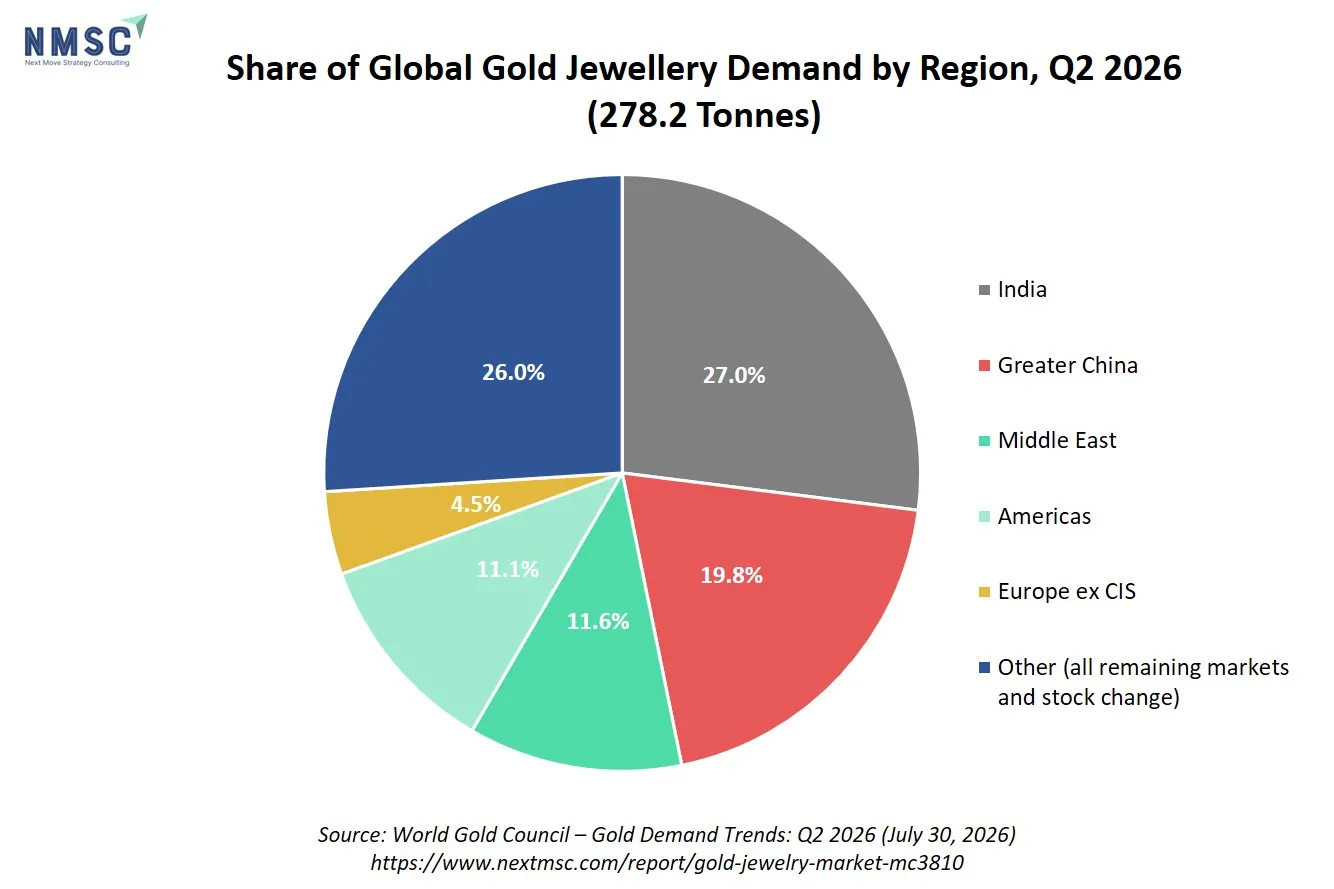
The structural implication, confirmed by Metals Focus in its annual report published via Reuters on June 4, 2026, is that physical investment is set to replace jewelry as the largest component of gold demand for the first time in recorded data, with jewelry fabrication forecast to decline 11% to 1,459 tonnes in 2026. Metals Focus projects the 2026 average gold price at USD 4,920 per ounce — a 43% increase over 2025.
NMSC Strategic Perspective: The Divergence Is a Structural Opportunity, Not a Crisis
NextMSC primary research and analysis indicates that the volume-value divergence currently characterizing the gold jewelry market is not a signal of structural decline — it is a market in the process of premiumization. When consumers purchase fewer but higher-value pieces, the addressable market for certified, design-differentiated, and brand-backed jewelry expands relative to commodity-weight gold. Brands that have historically competed on gram weight and purity alone face the greatest margin compression; those that have invested in design equity, omnichannel discovery, and transparent provenance are capturing a disproportionate share of the value being created.
The shift also accelerates the bifurcation between mass-market and premium segments that NMSC's analysis identifies as a defining structural feature of the 2026–2035 forecast period. High-income consumers in India, the Gulf, and East Asia continued purchasing heavier, higher-purity pieces regardless of price, while middle-income buyers shifted to lighter-weight, lower-carat, or studded alternatives. This bifurcation creates two distinct growth corridors — ultra-premium and accessible luxury — each requiring a differentiated product, retail, and communication strategy.
Section Summary: The gold jewelry market in 2026 is defined by a historic divergence between volume contraction and value expansion, driven by gold prices averaging USD 4,506/oz in Q2 2026 — 37% above year-prior levels.
Key Takeaways:
-
Global Q1 2026 jewelry demand hit a post-pandemic low of 299.7 tonnes, while value reached a record USD 47 billion.
-
China's mainland demand fell 32% y/y in Q1 2026; India's fell 19% y/y but reached a record USD 10 billion in value.
-
Metals Focus projects physical investment will surpass jewelry as the top gold demand category for the first time in 2026.
-
NMSC's analysis identifies this divergence as a premiumization signal, not a structural decline — brands with design equity and certified provenance are best positioned to capture the value being created.
Industry Impact Analysis
Titan's USD 283 Million Damas Acquisition: M&A as the Fastest Route to Market Reach
The most consequential corporate development in the gold jewelry market in the past twelve months is Titan Company Limited's acquisition of a 67% stake in Dubai-based Damas Jewellery for an enterprise value of USD 283 million, completed in February 2026. The transaction, announced in July 2025 and reported by Reuters on July 21, 2025, gives Titan — a Tata Group company and the operator of India's leading jewelry brand Tanishq — direct control of 146 Damas stores across the UAE, Saudi Arabia, Qatar, Kuwait, Bahrain, and Oman.
The strategic logic is precise: the GCC gold jewelry market is one of the highest per-capita gold consumption regions globally, with strong cultural demand for bridal and gifting purchases and a large South Asian diaspora that maintains deep purchasing ties to Indian jewelry aesthetics. By acquiring an established retail network rather than building organically, Titan compresses a decade of market-entry effort into a single transaction, immediately accessing Damas's brand recognition, store infrastructure, and customer relationships across six high-value markets.
This acquisition signals a broader M&A trend in the gold jewelry sector, where vertically integrated players with strong domestic brand equity are using cross-border acquisitions to diversify revenue geographically and reduce dependence on single-market demand cycles.
India's BIS Hallmarking Expansion: Regulatory Standardization as a Market Catalyst
India's Bureau of Indian Standards (BIS) expanded mandatory hallmarking for gold jewelry and artefacts to 392 districts in August 2026, adding 12 districts across nine states, as reported by Business Standard on August 10, 2026. This expansion, combined with the BIS's revision of the hallmarking fee from ₹45 to ₹75 per article, represents a deliberate policy effort to formalize India's gold jewelry trade — the world's second-largest by volume — and reduce the prevalence of under-carated or fraudulently marked jewelry that has historically undermined consumer trust and suppressed organized retail penetration.
For branded jewelry chains and organized retailers, mandatory hallmarking is a structural tailwind: it levels the competitive playing field against unorganized local jewelers who have historically competed on lower making charges enabled by lower compliance costs. As hallmarking coverage expands, the price premium commanded by certified, branded jewelry narrows relative to the trust premium it delivers, accelerating consumer migration from unorganized to organized retail formats.
Chinese Luxury Houses and the Laopu Gold Phenomenon
The emergence of Laopu Gold as a breakout force in China's jewelry market — attracting the attention of LVMH's Bernard Arnault — and Borland's receipt of investment from Kering Ventures, as reported by WWD, signal that global luxury conglomerates are repositioning to capture the cultural narrative being built by Chinese jewelry brands around 24-karat gold, traditional craftsmanship, and younger consumer identity. This is not merely a China-domestic story: if Chinese brands successfully internationalize their craftsmanship narrative — as Mario Ortelli, managing partner of advisory firm Ortelli & Co., noted in WWD — they become competitive threats to Western luxury houses in markets where Chinese diaspora communities and cultural influence are significant.
J.P. Morgan's Gold Price Outlook: The Affordability Constraint Is Not Temporary
Natasha Kaneva, head of global commodities strategy at J.P. Morgan, stated in a report cited by WWD that "the long-term trend of official reserve and investor diversification into gold has further to run," with J.P. Morgan forecasting gold prices to average USD 5,055 per ounce by Q4 2026 and rise toward USD 5,400 per ounce by end-2027. For jewelry manufacturers and retailers, this outlook means that the affordability constraint on volume is not a transient disruption — it is a multi-year structural condition that requires permanent adaptation in product design, pricing architecture, and consumer communication.
Section Summary: The gold jewelry industry in 2026 is being reshaped by three concurrent forces: M&A-driven geographic consolidation (Titan-Damas), regulatory formalization (BIS hallmarking expansion), and the emergence of Chinese luxury brands as credible global competitors.
Key Takeaways:
-
Titan's USD 283 million acquisition of Damas Jewellery gives it immediate access to 146 GCC stores, compressing years of organic market-entry effort.
-
India's BIS mandatory hallmarking expansion to 392 districts structurally advantages organized, certified retailers over unorganized competitors.
-
J.P. Morgan forecasts gold prices averaging USD 5,055/oz in Q4 2026 — confirming that volume pressure on jewelry is a multi-year condition, not a temporary disruption.
-
Laopu Gold and Borland's backing from LVMH and Kering Ventures respectively signal that global luxury groups are repositioning around Chinese craftsmanship narratives.
Global Gold Jewelry Demand by Key Market — Q1 2026 vs. Q1 2025 (Tonnes)
|
Market |
Q1 2025 (Tonnes) |
Q1 2026 (Tonnes) |
Y/Y Change |
|
World Total |
391.2 |
299.7 |
-23% |
|
China (Mainland) |
124.9 |
85.2 |
-32% |
|
India |
81.6 |
66.1 |
-19% |
|
United States |
23.3 |
13.1 |
-44% |
|
Middle East (Total) |
45.1 |
34.5 |
-23% |
|
Europe (ex-CIS) |
10.0 |
8.3 |
-16% |
|
Japan |
3.0 |
3.0 |
0% |
|
South Korea |
4.1 |
3.9 |
-5% |
Future Outlook & Forecast
The Long Arc: From Volume Recovery to Value Leadership
NextMSC primary research and analysis projects the global gold jewelry market to reach USD 425.75 billion by 2035, growing at a CAGR of 7.38% from 2026 to 2035. This trajectory is underpinned by four structural forces that operate independently of near-term gold price cycles.
1. Rising Disposable Incomes in Emerging Markets
The expansion of middle-class populations across Asia-Pacific, the Middle East, and urbanizing African economies is creating a new cohort of first-time and aspirational gold jewelry buyers. As households move into higher income brackets, spending on culturally significant categories — including gold jewelry for weddings, festivals, and gifting — increases at a rate that outpaces general consumption growth. NMSC's analysis of household disposable income data for 2025 identifies Japan, Germany, and the United Kingdom — with household disposable incomes above USD 47,000 — as markets positioned for robust premium jewelry demand, while Tier 2 and Tier 3 cities in India and Southeast Asia represent the highest-volume growth corridors for accessible gold jewelry formats.
2. Omnichannel Retail Transformation
The World Gold Council's Q2 2026 data confirms that jewelry demand is stabilizing in value terms even as volumes remain under pressure, with H1 2026 total gold demand reaching a record value of USD 380 billion. The brands capturing disproportionate share of this value are those that have invested in omnichannel infrastructure — AR try-on capabilities, synchronized inventory management, digital certification access, and seamless post-purchase services. NMSC's analysis identifies omnichannel as the most future-proof distribution model, blending online transparency with offline assurance in a format that reduces purchase friction for high-value items.
3. Design Innovation and Gram-Saving Engineering
As J.P. Morgan's commodity strategy team projects gold prices to average USD 5,055/oz in Q4 2026 and trend toward USD 5,400/oz by end-2027, the structural response from manufacturers — lighter constructions, hollow-core techniques, mixed-metal alloys, and lower-karat fashion lines — is not a temporary workaround but a permanent product evolution. CAD-enabled precision manufacturing and innovative alloy technologies are enabling brands to deliver aspirational aesthetics at accessible price points, widening the customer funnel without diluting brand equity.
4. Sustainability and Ethical Sourcing as Competitive Differentiators
Younger consumers — particularly in North America, Northern Europe, and urban India — are increasingly willing to pay a premium for jewelry that carries verifiable provenance, recycled gold certification, and transparent supply chain documentation. NMSC's analysis identifies this as an emerging but rapidly accelerating demand driver that will become a baseline expectation rather than a differentiator by the early 2030s. Brands that invest now in traceability systems, third-party certification, and supplier audit frameworks are building a competitive moat that will be difficult to replicate at scale.
Section Summary: The gold jewelry market's long-term growth trajectory to USD 425.75 billion by 2035 is supported by rising emerging-market incomes, omnichannel retail transformation, design innovation, and sustainability-driven consumer preferences — all of which operate independently of near-term gold price volatility.
Key Takeaways:
-
NMSC projects the global gold jewelry market to reach USD 425.75 billion by 2035 at a 7.38% CAGR, driven by structural demand from emerging markets and retail transformation.
-
Omnichannel formats are emerging as the dominant distribution model, combining digital discovery with in-store trust for high-value purchases.
-
J.P. Morgan's forecast of USD 5,055/oz gold in Q4 2026 makes gram-saving design innovation a permanent strategic imperative, not a temporary response.
-
Sustainability and ethical sourcing are transitioning from brand differentiators to baseline consumer expectations, particularly among millennial and Gen Z buyers.
Next Steps for Stakeholders
For C-Level Executives and Brand Leaders:
-
Rebalance the product portfolio toward design-led, lower-gram formats without abandoning the high-purity ceremonial segment. The bifurcation between mass-market and premium buyers is structural; a dual-track product strategy is not optional — it is the minimum viable response to the current price environment.
-
Accelerate omnichannel investment with specific focus on AR try-on capabilities, digital certification delivery, and synchronized inventory management. Brands that treat digital touchpoints as experiential layers — not transaction portals — convert browsing into buying more effectively and reduce return rates on high-value items.
-
Evaluate M&A opportunities in high-growth geographies where organic market entry would require a decade of brand-building. Titan's Damas acquisition is the clearest recent proof of concept: a single transaction delivered 146 stores and an established customer base across six GCC markets.
-
Build traceability infrastructure now. Recycled gold certification, supplier audit documentation, and digital product passports are becoming procurement requirements for institutional buyers and consumer expectations for younger demographics. The cost of building this infrastructure is lower today than it will be when it becomes a regulatory mandate.
For Institutional Investors:
-
Prioritize businesses with strong unit economics and omnichannel scalability over those with large gold inventory positions. In a sustained high-price environment, working capital efficiency and brand equity — not commodity exposure — are the primary valuation drivers.
-
Focus on markets where cultural demand and digital adoption intersect: India's organized jewelry retail sector, the GCC's premium bridal market, and Southeast Asia's rapidly urbanizing middle class represent the highest-conviction growth corridors for the 2026–2035 period.
-
Monitor the physical investment vs. jewelry demand ratio as a leading indicator of consumer sentiment. When this ratio normalizes — as gold prices stabilize or consumer confidence recovers — jewelry volumes will recover faster in markets with strong cultural demand anchors (India, Middle East) than in purely discretionary markets (US, Europe).
Conclusion
The global gold jewelry market is not in retreat — it is in transformation. The volume contraction visible in 2026 demand data is the surface expression of a deeper structural shift: consumers are not abandoning gold, they are redefining their relationship with it. They are buying lighter, buying smarter, buying with greater attention to provenance and design, and in some markets, redirecting gold spending from jewelry to investment products as price levels make gram-heavy purchases prohibitive.
According to NextMSC primary research and analysis, the market's trajectory to USD 425.75 billion by 2035 at a 7.38% CAGR reflects the enduring strength of gold's dual role as adornment and store of value — a combination that no other material category can replicate. The brands, retailers, and investors that will capture the most value from this trajectory are those that understand the divergence between volume and value, invest in the capabilities that serve the premium and accessible luxury segments simultaneously, and build the trust infrastructure — certification, traceability, omnichannel service — that converts gold's cultural significance into long-term commercial advantage.
About the Author
 Sanyukta Deb
— Sanyukta Deb is Digital Marketing Team Lead at Next Move Strategy Consulting, where she has led content strategy and technical SEO for the firm's B2B market research publications for over 2 years. Her editorial process translates NextMSC's primary and secondary research — spanning technology, industrial, and consumer sectors — into commercial narratives, backed by search-intent, keyword, and competitive analysis. She brings 5 years of overall experience in digital marketing and content strategy.
About the Reviewer
 Debashree Dey
— Debashree Dey is Assistant Manager at Next Move Strategy Consulting, where she supports cross-vertical market content and communications across diverse industries for 6 years. Her professional background includes senior content writing, communications, and published manuscript authorship, with experience developing audience-focused business narratives and maintaining clear, consistent messaging. Her role supports research-led content development and editorial quality across NextMSC publications.












Add Comment