Latin America Warehouse Robotics Market by Type (Automated Guided Vehicles (AGVs) [Laser Guidance, Magnetic Guidance], Autonomous Mobile Robots (AMRs) [Tow Vehicle, Tug Vehicle, Unit Load Vehicle]), by Offering (Hardware), by Payload Capacity (≤100 KG, 101–200 KG, 201–500 KG, 501–1000 KG, 1001–2000 KG, 2001–5000 KG, More than 5000 KG), by Application (Palletizing and Depalletizing), by End User (E-commerce, Automotive, Food & Beverages): Analysis & Forecast, 2025–2035
Industry: ICT & Media | Latest Edition: September 30, 2026 | No of Pages: 266 | No. of Tables: 210 | No. of Figures: 155 | Format: PDF | Report Code: IC3155
Latin America Warehouse Robotics Market Size & Forecast, 2025–2035
|
Parameters |
Details |
|
Market Size in 2025 |
USD 346.18 Million |
|
Market Estimate in 2026 |
USD 501.25 Million |
|
Revenue Forecast in 2035 |
USD 1,258.85 Million |
|
Revenue Growth Rate |
CAGR of 10.77% from 2026 to 2035 |
|
Market Volume in 2025 |
25 Thousand Units |
|
Market Volume Estimate in 2026 |
37 Thousand Units |
|
Volume Forecast in 2035 |
99 Thousand Units |
|
Volume Growth Rate |
CAGR of 11.63% from 2026 to 2035 |
|
Analysis Period |
2025–2035 |
|
Historical / Base Year |
2025 |
|
Forecast Period |
2026–2035 |
|
Market Size Estimation |
USD Million |
|
Key Players Profiled |
22 Companies |
Industry Outlook
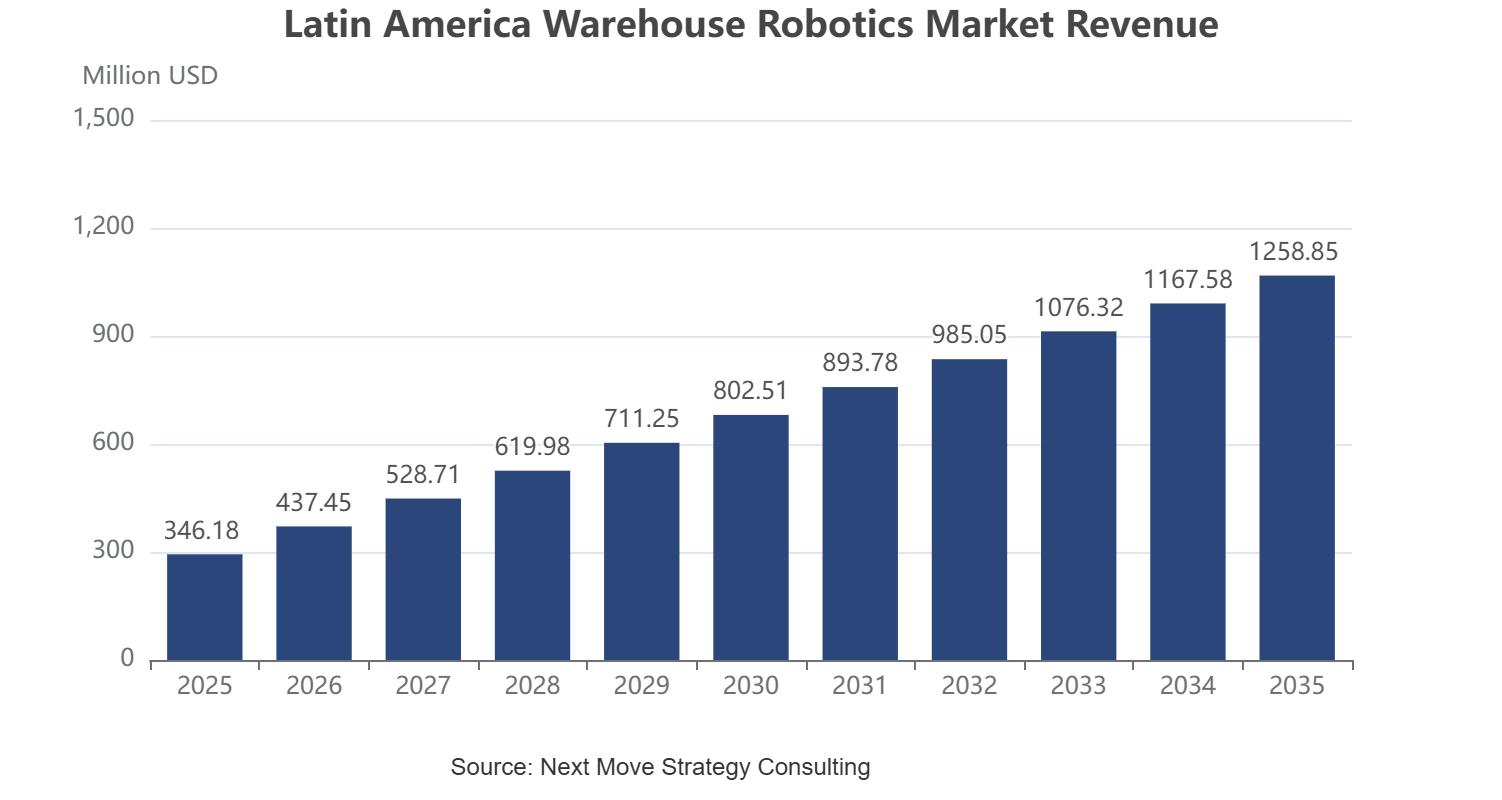
The Latin America Warehouse Robotics Market was valued at USD 346.18 million in 2025 and is estimated to reach USD 501.25 million in 2026. Over the forecast period, the market is expected to witness steady growth, reaching USD 1,258.85 million by 2035, registering a CAGR of 10.77% from 2026 to 2035. In terms of shipment volume, the market accounted for 25 thousand units in 2025 and is projected to increase to 37 thousand units in 2026, before reaching 99 thousand units by 2035, reflecting a volume CAGR of 11.63% during the forecast period.
What Are the Key Market Drivers, Restraints, and Opportunities Shaping the Latin America Warehouse Robotics Market Through 2035?
|
Drivers / Restraints / Opportunities |
(+/–) % Impact on CAGR |
Geographic Relevance |
Impact Timeline |
|
Rapid expansion of e-commerce and omnichannel retail across Brazil, Mexico, and Argentina increasing demand for warehouse automation and robotics solutions. |
+1.8% |
Brazil, Mexico, Argentina |
Short to Medium Term (1–5 Years) |
|
Rising labor cost pressures and growing workforce availability challenges across Latin American warehousing operations accelerating adoption of autonomous mobile robots and automated guided vehicles. |
+1.5% |
Latin America-Wide |
Short to Medium Term (1–5 Years) |
|
Increasing government initiatives supporting Industry 4.0 adoption, smart logistics infrastructure, and digital transformation programs supporting market expansion. |
+1.2% |
Brazil, Mexico, Chile, Colombia |
Medium to Long Term (3–8 Years) |
|
High initial deployment costs and underdeveloped technical infrastructure in emerging LATAM economies limiting warehouse robotics adoption among small and mid-sized enterprises. |
–1.1% |
Latin America-Wide |
Short to Medium Term (1–5 Years) |
|
Growing adoption of autonomous mobile robots (AMRs) and AI-driven fulfillment solutions in emerging Latin American economies creating substantial long-term growth opportunities. |
+1.0% |
Brazil, Mexico, Colombia, Chile |
Long Term (4–10 Years) |
Through our market assessment, we observed that the market is experiencing steady growth driven by rapid e-commerce expansion, increasing labor cost pressures, and growing investments in smart warehouse automation technologies. Demand for faster order fulfillment, improved inventory management, and enhanced operational efficiency is encouraging organizations to deploy advanced robotics solutions across warehouses and distribution centers. Government-backed Industry 4.0 initiatives and AMR adoption trends are generating significant long-term opportunities, while high implementation costs remain a key barrier to wider market penetration across the region.
Growth Drivers:
How Is the Expansion of Digital Commerce Fulfilment Networks Supporting Warehouse Robotics Growth Across Latin America?
Through our market assessment, we observed that the rapid expansion of e-commerce and omnichannel retail operations across Latin America, particularly in Brazil, Mexico, and Argentina, is a major factor driving demand for warehouse robotics. Increasing online shopping activity has significantly raised order volumes, prompting retailers and logistics providers to automate fulfillment operations. Warehouse robots improve order accuracy, increase throughput, and reduce processing times, enabling businesses to meet consumer expectations for faster deliveries. As e-commerce networks expand further, demand for advanced robotics solutions is expected to accelerate consistently throughout the region.
How Are Warehouse Workforce Constraints Encouraging Greater Automation Investments Across Latin America?
Labor cost pressures and workforce availability challenges across warehousing and logistics operations in Latin America are significantly contributing to market growth. Based on our market evaluation, warehouse operators are increasingly adopting autonomous mobile robots (AMRs), automated guided vehicles (AGVs), and robotic picking systems to address workforce constraints and improve productivity. Robotics solutions reduce dependency on manual labor while enabling continuous operations, enhancing workplace safety, and lowering long-term operating costs. These operational advantages are encouraging widespread automation investments across Brazil, Mexico, Colombia, and other key markets throughout the region.
How Are Government Initiatives and Industry 4.0 Investments Supporting Warehouse Robotics Market Expansion in Latin America?
Based on research conducted by NMSC, increasing government-backed initiatives supporting Industry 4.0 adoption, digital transformation programs, and smart logistics infrastructure investments are strengthening market growth across Latin America. Policies promoting manufacturing modernization and supply chain resilience are encouraging organizations to invest in automated warehouse technologies. Integration of warehouse management systems (WMS), warehouse execution systems (WES), and robotics platforms with smart logistics infrastructure is improving operational efficiency and scalability. As governments continue to prioritize economic modernization, demand for warehouse robotics solutions is expected to grow steadily throughout the forecast period.
Growth Inhibitor:
How Are Capital Investment Barriers and Technology Readiness Gaps Limiting Warehouse Robotics Adoption Across Latin America?
High initial capital investment requirements continue to act as a significant constraint on the Latin America Warehouse Robotics Market. Through our market analysis, we observed that deploying robotic hardware, software platforms, and supporting infrastructure often requires substantial upfront expenditure, which limits affordability for many regional organizations. Moreover, underdeveloped technical infrastructure, limited skilled workforce availability, and inadequate digital connectivity in several Latin American markets further complicate robotics deployment and integration. These combined challenges may discourage adoption among small and medium-sized enterprises, thereby slowing market penetration despite the compelling long-term benefits of warehouse automation technologies.
Growth Opportunity:
How Is the Emergence of Intelligent Warehouse Automation Creating New Growth Potential Across Latin America?
Through NMSC's assessment, we found that increasing adoption of autonomous mobile robots (AMRs) and artificial intelligence-driven fulfillment solutions is creating significant growth opportunities across Latin America. Organizations in Brazil, Mexico, Colombia, and Chile are investing in smart warehouses to improve operational efficiency, scalability, and supply chain resilience. The growing implementation of AI-powered warehouse management platforms, collaborative robots (cobots), and autonomous navigation technologies is enabling more flexible and intelligent warehouse operations. Continued regional investments in digital transformation and logistics modernization are expected to unlock substantial long-term growth opportunities for warehouse robotics providers throughout Latin America.
Which Country is Dominating the Latin America Warehouse Robotics Market?
Our comprehensive market assessment indicates that Brazil holds the dominant share in the market, accounting for the largest regional market revenue. The country's leadership is supported by its expanding logistics infrastructure, rapid adoption of warehouse automation technologies, and increasing investments in modern distribution and fulfillment centers. Strong growth in e-commerce, rising demand for efficient inventory management, and the presence of major retail, manufacturing, and third-party logistics (3PL) companies continue to accelerate warehouse robotics deployment across the country. In addition, increasing adoption of autonomous mobile robots (AMRs), automated guided vehicles (AGVs), warehouse management systems (WMS), and AI-enabled automation solutions further reinforces Brazil's leading position in the regional market.
Which Country is Set to Witness the Fastest Growth?
Based on our review of automation investments, warehouse modernization initiatives, and market growth projections, Brazil is also positioned to witness the fastest growth in the market during the forecast period. The country's accelerating investment in smart warehousing, rapid expansion of e-commerce fulfillment networks, and increasing adoption of advanced warehouse automation technologies are driving market expansion. Growing demand for operational efficiency, rising labor costs, and continuous investments in digital supply chain transformation are further supporting the deployment of robotic solutions across logistics and manufacturing facilities. With a projected CAGR of 12.59% during 2026–2035, Brazil is expected to remain the fastest-growing market in the region, strengthening its role as the leading warehouse automation hub in Latin America.
Supply Chain Structure Of The Latin America Warehouse Robotics Market
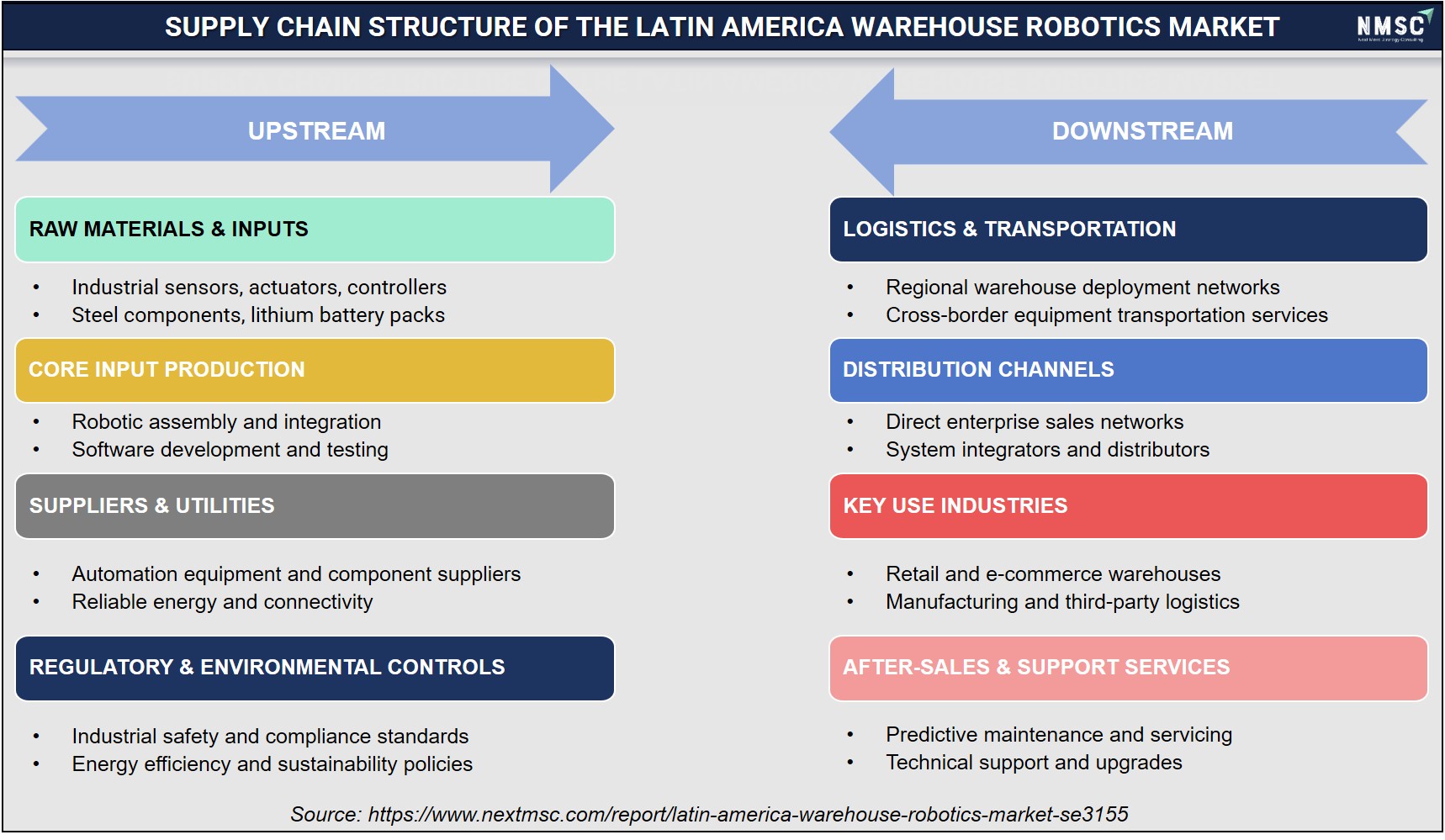
The supply chain structure of the Latin America warehouse robotics market spans the complete value chain, from sourcing automation components and robotic system integration to distribution, deployment, and after-sales support. Upstream activities include raw materials, software development, component suppliers, and regulatory compliance, while downstream operations focus on logistics, distribution channels, and end-use industries such as retail, e-commerce, manufacturing, and third-party logistics. Continuous maintenance, technical support, and system upgrades play a vital role in ensuring efficient and reliable warehouse automation across the region.
How Is the Latin America Warehouse Robotics Market Segmented in This Report, and What Are the Key Insights from the Segmentation Analysis?
By Type Insights
Based on type, the market is segmented into Automated Guided Vehicles (AGVs), Autonomous Mobile Robots (AMRs), Articulated Robots, Collaborative Robots (Cobots), Scara Robots and Cylindrical Robots, and Others. AGVs are further classified into Laser Guidance, Magnetic Guidance, Optical Tape Guidance, Vision Guidance, and Others, while AMRs are categorized into Tow Vehicles, Tug Vehicles, Unit Load Vehicles, Pallet Trucks, Forklift Vehicles, and Other Types.
Based on our analysis, the adoption of warehouse robotics across Latin America is influenced by operational requirements, warehouse layouts, and labor availability. Automated Guided Vehicles (AGVs) continue to play a vital role in material transportation due to their reliability and cost-effectiveness. Autonomous Mobile Robots (AMRs) are gaining traction due to their flexibility and advanced navigation capabilities. Articulated robots, cobots, and Scara robots are increasingly utilized for picking, palletizing, sorting, and packaging operations across modern warehouse facilities throughout the region.
By Offering Insights
Based on offering, the market is segmented into Hardware, Software, and Services. The software segment is further classified into Warehouse Management Systems (WMS), Warehouse Execution Systems (WES), and Warehouse Control Systems (WCS), each addressing distinct operational requirements across Latin American warehouse environments.
Based on our evaluation, demand for warehouse robotics solutions across Latin America is increasingly shaped by the integration of hardware, software, and service capabilities. Hardware components, including robotic platforms, sensors, and controllers, account for significant market adoption. Software solutions such as WMS, WES, and WCS are essential for optimizing inventory management and workflow coordination. Meanwhile, services including system integration, maintenance, and consulting are gaining importance as companies seek to maximize automation efficiency and long-term operational performance throughout Latin America.
Competitive Landscape
The market is characterized by a moderately competitive and innovation-driven landscape, supported by the presence of leading robotics manufacturers, automation technology providers, software developers, and warehouse solutions companies. Market growth is driven by expanding e-commerce operations, increasing labor cost pressures, rising demand for warehouse automation, and growing investments in smart logistics infrastructure. The adoption of autonomous mobile robots (AMRs), automated guided vehicles (AGVs), collaborative robots (cobots), and AI-powered warehouse management solutions is enhancing operational efficiency and optimizing warehouse productivity throughout Latin America.
Key Players of the Latin America Warehouse Robotics Market
-
Jungheinrich Lift Truck Comércio de Empilhadeiras Ltda.
-
Körber Supply Chain do Brasil Ltda.
-
OMRON Eletrônica do Brasil Ltda.
-
Zebra Technologies do Brasil Ltda.
-
Rockwell Automation do Brasil Ltda.
-
FANUC South America Equipamentos de Automação e Serviços Ltda.
-
Daifuku Co., Ltd.
-
Toyota Material Handling Argentina S.A.
-
SSI SCHAEFER S.A.
-
Honeywell S.A.I.C.
-
Mecalux Argentina S.A.
-
ABB S.A.
-
FANUC Argentina S.A.
-
Omron Argentina S.A.
-
Rockwell Automation S.A.
-
Zebra Technologies Argentina S.A.
-
Jungheinrich AG
-
KUKA Roboter Argentina S.A.
-
Kardex Argentina S.A.
-
KNAPP Argentina S.A.
NMSC's analysis indicates that the competitive dynamics of the Latin America Warehouse Robotics Market are increasingly shaped by advancements in autonomous mobile robots, AI-driven warehouse automation, and warehouse management software integration. Key companies, including Jungheinrich Lift Truck Comércio de Empilhadeiras Ltda., Körber Supply Chain do Brasil Ltda., OMRON Eletrônica do Brasil Ltda., Zebra Technologies do Brasil Ltda., Rockwell Automation do Brasil Ltda., ABB Automação Ltda., FANUC South America Equipamentos de Automação e Serviços Ltda., Daifuku Co., Ltd., Dematic S.A., Toyota Material Handling Argentina S.A., SSI SCHAEFER S.A., Honeywell S.A.I.C., Mecalux Argentina S.A., ABB S.A., FANUC Argentina S.A., Omron Argentina S.A., Rockwell Automation S.A., Zebra Technologies Argentina S.A., Jungheinrich AG, KUKA Roboter Argentina S.A., Kardex Argentina S.A., and KNAPP Argentina S.A., are strengthening their market positions through strategic partnerships, product innovations, and warehouse automation deployments across the region.
Key Segments of the Latin America Warehouse Robotics Market
By Types
-
Automated Guided Vehicles (AGVs)
-
Laser Guidance
-
Magnetic Guidance
-
Optical Tape Guidance
-
Vision Guidance
-
Others
-
-
Autonomous Mobile Robots (AMRs)
-
Tow Vehicle
-
Tug Vehicle
-
Unit Load Vehicle
-
Pallet Truck
-
Forklift Vehicle
-
Other Type
-
-
Articulated Robots
-
Collaborative Robots (Cobot)
-
Scara Robots and Cylindrical Robot
-
Others
By Offerings
-
Hardware
-
Software
-
Warehouse Management System (WMS)
-
Warehouse Execution System (WES)
-
Warehouse Control System (WCS)
-
-
Services
By Payload Capacity
-
≤ 100 KG
-
101-200 KG
-
201-500 KG
-
501-1000 KG
-
1001-2000 KG
-
2001-5000KG
-
More than 5000 KG
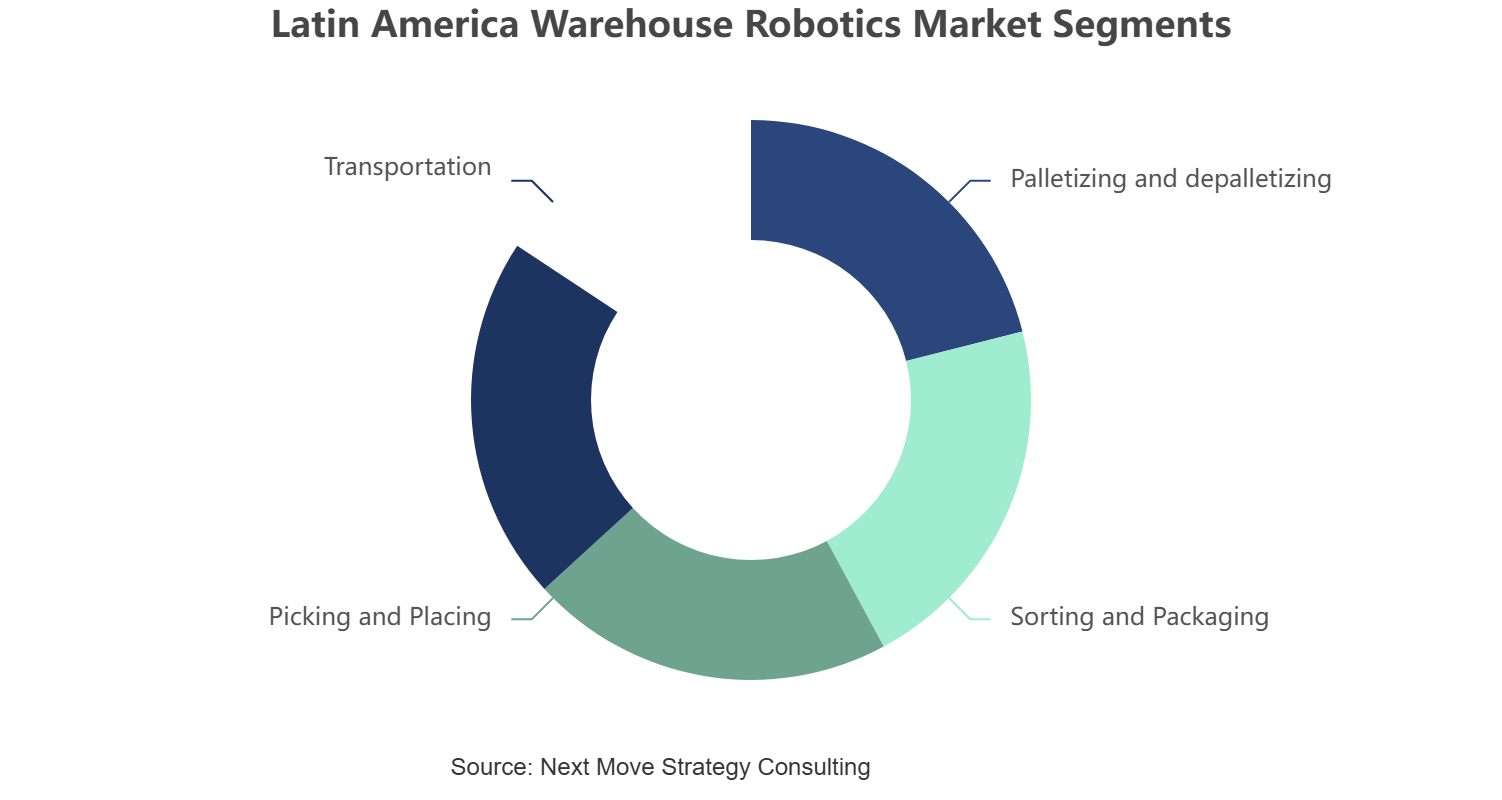
By Application
-
Palletizing and depalletizing
-
Sorting and Packaging
-
Picking and Placing
-
Transportation
By End User
-
E-commerce
-
Automotive
-
Food & Beverages
-
Pharmaceutical
-
Chemical and Materials
-
Semiconductor and Electronics
-
Others
Swot Analysis Of The Latin America Warehouse Robotics Market
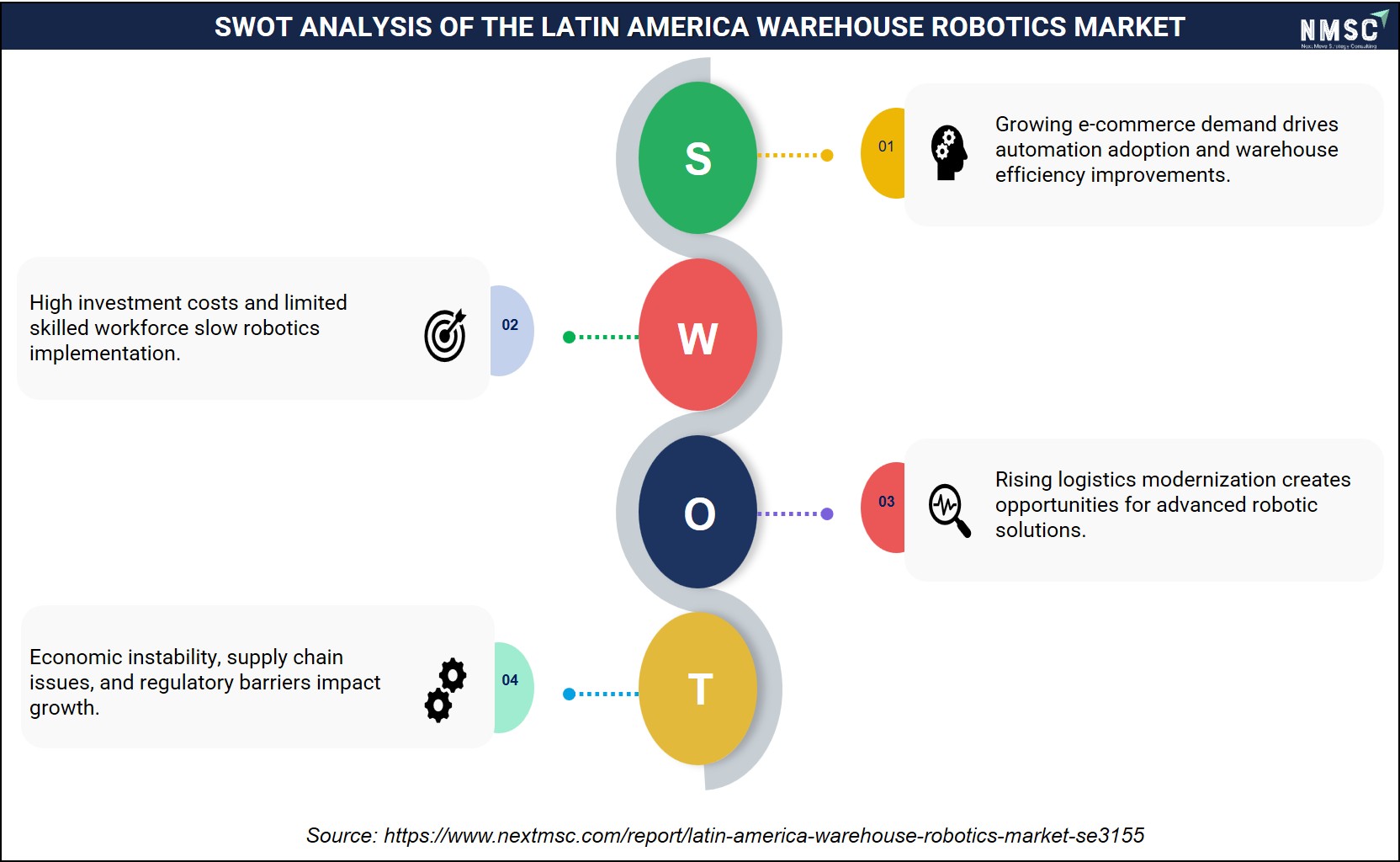
The SWOT analysis of the Latin America warehouse robotics market highlights strong growth opportunities driven by expanding e-commerce, increasing warehouse automation, and logistics modernization across the region. However, high implementation costs and a shortage of skilled professionals remain key challenges to adoption. Rising investments in smart logistics and advanced robotic technologies create significant market opportunities, while economic uncertainty, supply chain disruptions, and evolving regulatory requirements continue to pose potential risks to sustained market growth.
Key Benefits for Stakeholders
Next Move Strategy Consulting (NMSC) presents a comprehensive analysis of the Latin America Warehouse Robotics Market, covering historical developments from 2020 to 2025 and providing detailed forecasts through 2035. Our study evaluates the market across Brazil, Mexico, Argentina, Colombia, Chile, and other key LATAM countries, delivering quantitative outlooks alongside qualitative insights into warehouse automation adoption, autonomous mobile robot deployment trends, robotic picking and sorting technologies, artificial intelligence integration, fulfillment center modernization, and advancements in warehouse management systems across the region.
Investors benefit from growing opportunities in robotics-enabled logistics and smart warehousing solutions across Latin America, while warehouse robotics manufacturers, automation solution providers, system integrators, logistics companies, e-commerce retailers, third-party logistics (3PL) providers, distribution center operators, software developers, and end-use industries benefit from increasing demand for efficient, scalable, and intelligent warehouse operations. The study provides actionable insights for stakeholders seeking to navigate competitive dynamics, evaluate technology adoption trends, and identify high-growth segments within the evolving Latin American warehouse automation landscape.
Report Customization
|
Parameters |
Details |
|
Customization Scope |
Free customization (equivalent to up to 80 analyst-working hours) after purchase. |
|
Pricing and Purchase Options |
Avail customized purchase options to meet your exact research needs. |
|
Approach |
In-depth primary and secondary research; proprietary databases; rigorous quality control and validation measures. |
|
Analytical Tools |
Porter's Five Forces, SWOT, value chain, and Harvey ball analysis to assess competitive intensity, stakeholder roles, and relative impact of key factors. |
Conclusion
The Latin America Warehouse Robotics Market is positioned for sustained growth over the forecast period, driven by expanding e-commerce operations, rising labor cost pressures, and increasing investments in smart logistics and Industry 4.0 initiatives. Autonomous mobile robots (AMRs), automated guided vehicles (AGVs), and collaborative robots (cobots) are expected to remain at the forefront of market adoption. Competitive dynamics will be shaped by AI integration, software innovation, and strategic expansion by leading robotics providers. The long-term market outlook remains favorable as regional organizations prioritize operational efficiency, supply chain resilience, and digital transformation throughout Latin America.
About the Author
 Liza Phukan
— Liza Phukan is Research Associate at Next Move Strategy Consulting, where she has covered emerging industries and market research across sectors for 3.5 years. Her work includes analyzing industry developments, validating market data, and developing structured business content from research findings. She uses secondary research and data-validation practices to turn complex market information into clear decision-useful market analysis for business audiences and support report development and B2B.
Liza Phukan
— Liza Phukan is Research Associate at Next Move Strategy Consulting, where she has covered emerging industries and market research across sectors for 3.5 years. Her work includes analyzing industry developments, validating market data, and developing structured business content from research findings. She uses secondary research and data-validation practices to turn complex market information into clear decision-useful market analysis for business audiences and support report development and B2B.
About the Reviewer
 Supradip Baul
— Supradip Baul is an accomplished business consultant and strategist with over a decade of rich experience in market intelligence, strategy, technology, and business transformation. His work has included rigorous qualitative and quantitative analysis across multiple industries, helping clients shape investment decisions and long-term roadmaps. Earlier in his career, he was associated with Gartner, where he contributed to industry-leading reports and market share analyses. He has worked with leading global companies and holds an MBA with a dual specialization in Marketing and Finance.
Supradip Baul
— Supradip Baul is an accomplished business consultant and strategist with over a decade of rich experience in market intelligence, strategy, technology, and business transformation. His work has included rigorous qualitative and quantitative analysis across multiple industries, helping clients shape investment decisions and long-term roadmaps. Earlier in his career, he was associated with Gartner, where he contributed to industry-leading reports and market share analyses. He has worked with leading global companies and holds an MBA with a dual specialization in Marketing and Finance.
At Next Move Strategy Consulting, we understand that insightful market research is the cornerstone of successful business decisions. That's why we employ a robust and multifaceted approach, combining various methodologies to deliver the most accurate and actionable data for our clients.

Research Landscape
We navigate the world of research with two primary approaches:
Qualitative Approach
Our qualitative research methodologies involve immersive techniques such as in-depth interviews, focus groups, and observational studies. By engaging directly with individuals and stakeholders, we uncover valuable insights that quantitative data alone may overlook.

Quantitative Research
In tandem with qualitative methodologies, NMSC leverages the power of Quantitative Research to provide a robust foundation of numerical insights. Through systematic data collection and analysis, we quantify patterns, preferences, and market trends, offering a comprehensive view of the business landscape.
Our quantitative research approach employs diverse tools, including surveys, experiments, and statistical modelling. These methodologies enable us to gather data from a large and representative sample, ensuring the statistical significance of our findings. By employing structured questionnaires and standardized data collection methods, we guarantee the reliability and validity of the information we present to our clients.
Quantitative research is particularly effective in measuring the prevalence of trends, assessing market size, and gauging the impact of various factors on consumer behavior. The numerical precision attained through this approach equips our clients with actionable insights, facilitating data-driven decision-making and strategy formulation.


Our Specialized Toolbox for Industry-Specific Market Research
We deploy a specialized arsenal of techniques tailored to meet your unique requirements. Here's a glimpse into our comprehensive toolbox:

Information Procurement
The stage entails acquiring market data or relevant information through various sources and methodologies.


Market Research Approach
We utilize both top-down and bottom-up approaches in market research analysis to achieve a comprehensive understanding of the market dynamics, leveraging the broad perspective of industry trends and macroeconomic factors alongside detailed insights from specific segments and individual companies.

Porters Five Forces Analysis
We conduct Porter's Five Forces analysis to evaluate the competitive landscape of an industry, providing us with insights into factors that affect profitability and strategic positioning.

SWOT Analysis

Forecasting
We utilize a forecasting model to predict future consumption by considering parameters like population, economics, regulations, market competition, drivers, constraints, technology, and pricing. We also employ statistical techniques such as multilinear regression, exponential smoothing, moving average, ARIMA, and Monte Carlo simulations for accurate predictions. In econometric forecasting, we analyzed short-term and long-term event impacts, attributing values based on regulatory frameworks, economic factors, and market events.





 Speak to Our Analyst