Law Enforcement Drone Market Global Industry Analysis and Forecast (2026–2035)

The global Law Enforcement Drone Market size was valued at USD 2.86 billion in 2025 and is estimated at USD 3.21 billion in 2026, forecast to reach USD 10.12 billion by 2035, expanding at a 13.6% CAGR between 2026 and 2035. North America leads with approximately 38% share, while Multi-Rotor Drones dominate all other platform types with approximately 60% share.

Download Free Sample PDF
Base Year (2025)
$2.86 Billion
Forecast (2035)
$10.12 Billion
CAGR (2026-2035)
13.6%
Top Region
North America

What Is the Law Enforcement Drone Market Size?

The global law enforcement drone industry size was valued at USD 2.86 billion in 2025 and is estimated at USD 3.21 billion in 2026, forecast to reach USD 10.12 billion by 2035, expanding at a 13.6% CAGR between 2026 and 2035. North America leads with approximately 38% share, while multi-rotor drones dominate all other platform types with approximately 60% share.

We observed that growth is broad-based across every segmentation axis, with drone-as-first-responder programs and hybrid VTOL platform adoption driving the dominant structural shifts through 2035.

Law Enforcement Drone Market Global Industry Analysis and Forecast (2026–2035) Revenue Forecast

Values in USD Billion

2025 $2.86 Billion
2025
2026 $3.21 Billion
2026
2027 $3.65 Billion
2027
2028 $4.14 Billion
2028
2029 $4.71 Billion
2029
2030 $5.35 Billion
2030
2031 $6.07 Billion
2031
2032 $6.90 Billion
2032
2033 $7.84 Billion
2033
2034 $8.90 Billion
2034
2035 $10.12 Billion
2035

Key Takeaways

By Platform Type: Multi-Rotor Drones held the largest share of approximately 60% (USD 1.71 billion) in 2025; Hybrid VTOL Drones is the fastest-growing sub-segment at 19.8% CAGR from 2026–2035.

By Application: Patrol and Surveillance held the largest share of approximately 34% (USD 0.96 billion) in 2025; Border and Perimeter Security is the fastest-growing sub-segment at 17.4% CAGR from 2026–2035.

By Payload Type: Electro-Optical Camera Payloads held the largest share of approximately 38% (USD 1.09 billion) in 2025; Multi-Sensor Payloads is the fastest-growing sub-segment at 18.4% CAGR from 2026–2035.

By Range: Short Range (Below 5 km) held the largest share of approximately 46% (USD 1.32 billion) in 2025; Long Range (Above 25 km) is the fastest-growing sub-segment at 18.0% CAGR from 2026–2035.

By End User: Municipal and Local Police Departments held the largest share of approximately 52% (USD 1.48 billion) in 2025; Correctional Facilities is the fastest-growing sub-segment at 18.0% CAGR from 2026–2035.

Dominant Region: North America dominated with approximately 38% revenue share (USD 1.08 billion) in 2025.

Fastest-Growing Region: Asia-Pacific is expected to register the highest CAGR of 18.2% during 2026–2035.

Dominant Country: U.S. led with approximately USD 0.78 billion in 2025.

Fastest-Growing Country: India is the fastest-growing country at approximately 19.7% CAGR from 2026–2035.

Market Opportunity: The law enforcement drone industry is expected to create an absolute dollar opportunity of USD 6.91 billion between 2026 and 2035, presenting significant investment potential across the drone-as-first-responder and tactical UAS value chain.

According to Next Move Strategy Consulting analysis, municipal police departments are increasingly consolidating drone procurement with fewer, NDAA-compliant platform vendors to simplify federal grant compliance, a shift that favors U.S.-manufactured autonomous drone suppliers over foreign-made platforms as procurement scrutiny intensifies through 2035.

What Does the Law Enforcement Drone Market Encompass?
The law enforcement drone market encompasses unmanned aerial platforms, payload sensors, and fleet-management software procured by municipal, state, and federal police agencies to perform patrol, investigative, and tactical missions. Our assessment indicates that the scope spans multi-rotor, fixed-wing, and hybrid vertical take-off and landing platforms equipped with electro-optical, thermal, and multi-sensor payloads, supplied to police departments, sheriff's offices, and correctional facilities across developed and emerging economies. The category has evolved from isolated SWAT and bomb-squad tools into a mainstream patrol asset, driven by drone-as-first-responder (DFR) programs that dispatch autonomous aircraft to emergency calls ahead of ground units.
Regulatory frameworks such as the U.S. Federal Aviation Administration's Part 107 waiver process and the anticipated Part 108 beyond-visual-line-of-sight rulemaking shape how agencies scale DFR coverage, while the Department of Justice and Department of Homeland Security's Interim Final Rule separately expands agencies' counter-drone detection and mitigation authority, a distinct function from agencies' own use of UAS for patrol, investigative, and DFR missions. We observed that technology adoption is shifting toward dock-based autonomous launch systems and cellular-connected drones that remove the need for on-site visual observers. Next Move Strategy Consulting's analysis indicates that this structural shift, combined with rising NDAA-compliance requirements tied to specific federal funding streams, is redefining vendor selection criteria across the law enforcement drone market.

Ecosystem Analysis of the Law Enforcement Drone Market
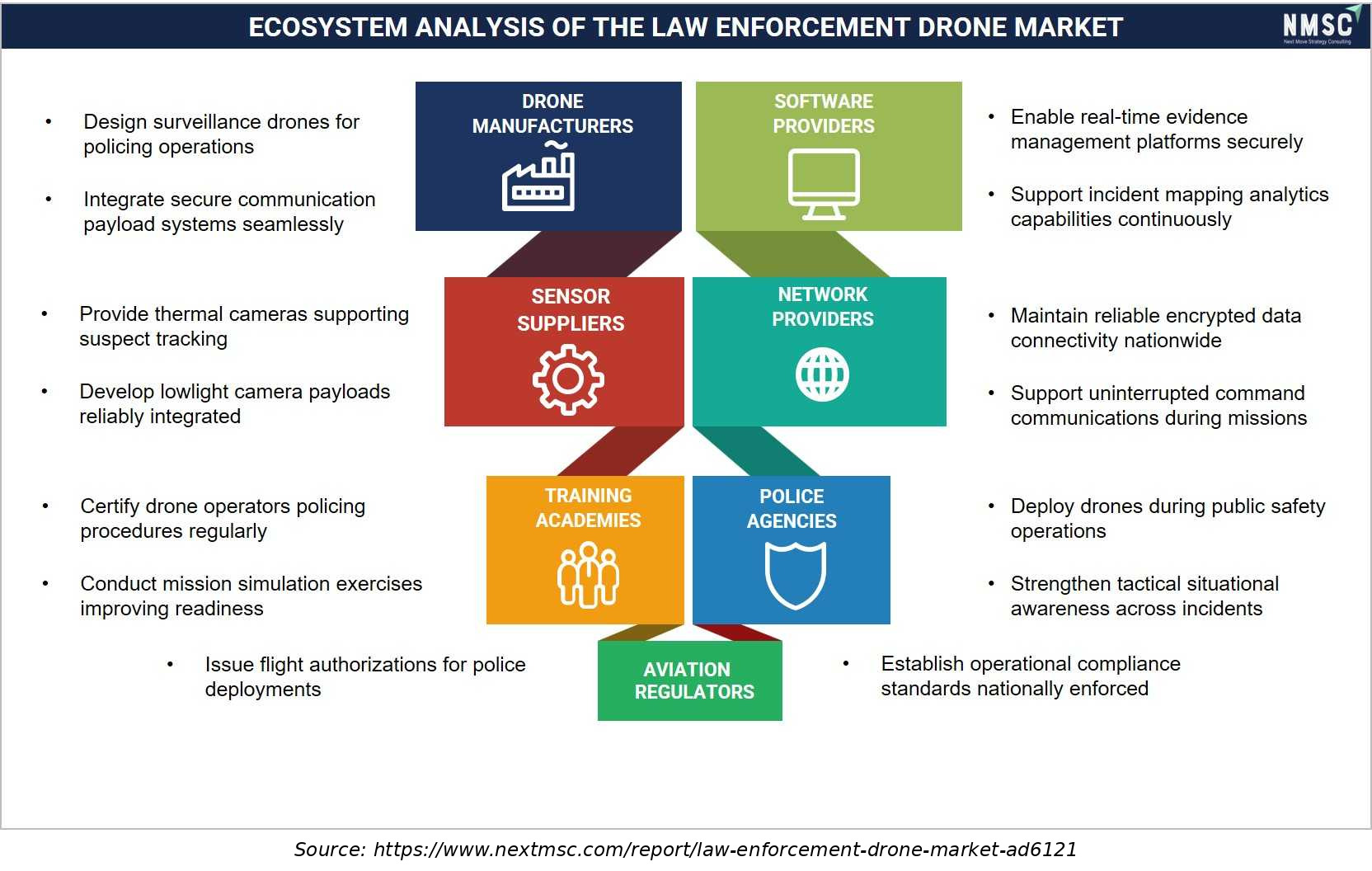
The ecosystem analysis of the Law Enforcement Drone Market highlights the collaborative network connecting drone manufacturers, software providers, sensor suppliers, network providers, training academies, police agencies, and aviation regulators. These stakeholders collectively enable secure deployments, operational readiness, regulatory compliance, and advanced aerial surveillance capabilities, supporting the growing adoption of drones across modern public safety and law enforcement operations.
Market Drivers & Dynamics

Interactive Dataset
Expansion of Drone as First Responder programs across U.S. municipal police departments driver +2.4% North America 2026-2035
Rising integration of AI-enabled video analytics and real-time crime mapping driver +1.9% Global 2026-2035
Progress toward FAA beyond-visual-line-of-sight rulemaking that could enable broader routine BVLOS police drone operations driver +1.6% North America 2026-2030
Expanding smart-city and public-safety infrastructure investment driver +1.7% Asia-Pacific 2026-2035
Increasing use of drones for search-and-rescue and disaster-response coordination driver +1.2% Global 2026-2035
Federal and state grant funding for public-safety UAS programs driver +1.5% North America 2026-2032
Data-privacy and civil-liberties concerns limiting persistent aerial surveillance restraint -1.1% North America, Europe 2026-2035
Budget constraints among smaller municipal and county law enforcement agencies restraint -0.9% Global 2026-2032
Restrictions on Chinese-manufactured drone procurement under U.S. federal security rules restraint -1.3% North America 2026-2035
Source: Next Move Strategy Consulting

Growth Drivers

What Is the Primary Growth Driver of the Law Enforcement Drone Market?

Expansion of Drone as First Responder programs across U.S. municipal police departments is the primary driver of the market. The U.S. Department of Justice and Department of Homeland Security finalized an Interim Final Rule in July 2026 establishing an Authorized Technologies List that expands the counter-UAS detection and mitigation authority available to state, local, tribal, and territorial agencies, a distinct but complementary framework alongside agencies' own DFR and patrol UAS procurement decisions. We observed that this regulatory clarity, combined with agency-reported reductions in response time, continues to anchor baseline procurement of dock-based autonomous drone fleets across large and mid-sized metropolitan police departments.

How Is FAA Regulation Driving Law Enforcement Drone Market Growth?
Federal Aviation Administration progress toward beyond-visual-line-of-sight rulemaking is expected to accelerate market growth by eventually reducing the visual-observer requirement that has historically limited DFR coverage area. Our assessment indicates that this regulatory progress, combined with Dedrone-enabled airspace deconfliction technology integrated into platforms such as Axon Air, is compressing adoption timelines for multi-drone, city-wide coverage models across North America and parts of Europe.

Growth Inhibitors

What Is Restraining Law Enforcement Drone Market Expansion?
Data-privacy and civil-liberties concerns tied to persistent aerial surveillance restrain expansion in several jurisdictions. State and municipal governments continue to debate ordinances governing drone flight logging, data retention, and public transparency reporting requirements. We found that smaller municipal and county agencies face particular exposure, as limited budgets and community-oversight requirements slow program approval compared with larger, better-resourced metropolitan departments.

What Are the Growth Opportunities?

How Can BVLOS-Enabled City-Wide Coverage Unlock Value for Software Vendors?

Beyond-visual-line-of-sight rulemaking presents a whitespace opportunity for fleet-management and airspace-deconfliction software vendors able to certify multi-drone, city-wide coverage models. Suppliers that commercialize BVLOS-ready platforms stand to capture recurring software subscription revenue as municipal police departments scale Drone as First Responder programs beyond single-precinct pilot deployments toward jurisdiction-wide operations.

Where Do Correctional Facility Perimeter Programs Create New Demand?

Correctional facilities represent an underpenetrated opportunity for manufacturers offering ruggedized, high-cycle drones engineered for continuous perimeter monitoring. Vendors that develop validated contraband-detection and fence-line patrol systems can secure long-term state-agency procurement contracts, benefiting from recurring replacement-cycle revenue tied to correctional-security modernization budgets.

How Can Domestic Manufacturing Benefit U.S. Platform Suppliers?

NDAA-compliance requirements create an opportunity for U.S.-based manufacturers capable of scaling domestic production to replace foreign-made fleets. Early movers that expand U.S. assembly capacity, such as Skydio and Flock Safety, can differentiate with federally funded municipal agencies pursuing compliant platform transitions under programs like Axon's SkySwap.

Segmentation Analysis

2025 (USD Billion)
2035 (USD Billion)
Multi-Rotor Drones 2025: $1.71 Billion | 2035: $5.57 Billion
Multi-Rotor
Fixed-Wing Drones 2025: $0.52 Billion | 2035: $1.52 Billion
Fixed-Wing D
Hybrid VTOL Drones 2025: $0.40 Billion | 2035: $2.02 Billion
Hybrid VTOL
Nano/Tactical Micro Drones 2025: $0.23 Billion | 2035: $1.01 Billion
Nano/Tactica
Multi-Rotor Drones $1.71 Billion $5.57 Billion 14.0%
Fixed-Wing Drones $0.52 Billion $1.52 Billion 12.8%
Hybrid VTOL Drones $0.40 Billion $2.02 Billion 19.8%
Nano/Tactical Micro Drones $0.23 Billion $1.01 Billion 18.0%

Which Platform Type Segment Dominates the Law Enforcement Drone Market?

Multi-Rotor Drones led the market with USD 1.71 billion in 2025, supported by their vertical take-off capability, hovering stability, and compatibility with dock-based autonomous launch stations used in Drone as First Responder programs. We observed that Hybrid VTOL Drones are the fastest-growing platform type, expanding at a 19.8% CAGR from 2026 to 2035, as agencies seek extended-range aircraft capable of covering larger patrol jurisdictions without sacrificing vertical launch flexibility.

2025 (USD Billion)
2035 (USD Billion)
Patrol and S
Search and R
Traffic Acci
Crime Scene
Crowd and Ev
Segment Item 2025 (USD Billion) 2035 (USD Billion) CAGR
Patrol and Surveillance $10.0 USD Billion $40.0 USD Billion 18.0%
Search and Rescue $17.1 USD Billion $51.1 USD Billion 16.0%
Traffic Accident Investigation $24.2 USD Billion $62.2 USD Billion 22.0%
Crime Scene and Forensic Mapping $31.3 USD Billion $73.3 USD Billion 12.0%
Crowd and Event Monitoring $38.4 USD Billion $84.4 USD Billion 19.0%

Segment-wise data is locked

Unlock complete segment-wise numbers for By Application.

Unlock Full Data

Which Application Segment Leads Law Enforcement Drone Market Demand?
Patrol and Surveillance remained the leading application within the market, valued at USD 0.96 billion in 2025 on sustained Drone as First Responder deployment for routine calls for service. Our findings suggest that Border and Perimeter Security is the fastest-growing application, registering a 17.4% CAGR from 2026 to 2035, as federal and state law enforcement agencies expand fixed-wing and long-endurance platform procurement for agency-operated border-monitoring missions, distinct from broader homeland-security border-surveillance programs outside this report's scope.

2025 (USD Billion)
2035 (USD Billion)
Electro-Opti
Thermal and
LiDAR and Ma
Multi-Sensor
Communicatio
Segment Item 2025 (USD Billion) 2035 (USD Billion) CAGR
Electro-Optical Camera $10.0 USD Billion $40.0 USD Billion 17.0%
Thermal and Infrared Imaging $17.1 USD Billion $51.1 USD Billion 15.0%
LiDAR and Mapping Sensors $24.2 USD Billion $62.2 USD Billion 9.0%
Multi-Sensor Payloads $31.3 USD Billion $73.3 USD Billion 27.0%
Communication and Loudspeaker Payloads $38.4 USD Billion $84.4 USD Billion 16.0%

Segment-wise data is locked

Unlock complete segment-wise numbers for By Payload Type.

Unlock Full Data
2025 (USD Billion)
2035 (USD Billion)
Short Range
Medium Range
Long Range (
Segment Item 2025 (USD Billion) 2035 (USD Billion) CAGR
Short Range (Below 5 km) $10.0 USD Billion $40.0 USD Billion 19.0%
Medium Range (5 km to 25 km) $17.1 USD Billion $51.1 USD Billion 9.0%
Long Range (Above 25 km) $24.2 USD Billion $62.2 USD Billion 19.0%

Segment-wise data is locked

Unlock complete segment-wise numbers for By Range.

Unlock Full Data
2025 (USD Billion)
2035 (USD Billion)
Municipal an
State and Re
Federal and
Correctional
Segment Item 2025 (USD Billion) 2035 (USD Billion) CAGR
Municipal and Local Police Departments $10.0 USD Billion $40.0 USD Billion 26.0%
State and Regional Police Agencies $17.1 USD Billion $51.1 USD Billion 16.0%
Federal and Border Security Agencies $24.2 USD Billion $62.2 USD Billion 18.0%
Correctional Facilities $31.3 USD Billion $73.3 USD Billion 8.0%

Segment-wise data is locked

Unlock complete segment-wise numbers for By End User.

Unlock Full Data

Which End User Segment Leads the Law Enforcement Drone Market?

Municipal and Local Police Departments remained the dominant end user, valued at USD 1.48 billion in 2025 due to the sheer number of city and county agencies adopting Drone as First Responder programs nationwide. Based on research conducted by Next Move Strategy Consulting, we found that Correctional Facilities represent the fastest-growing end user category, expanding at an 18.0% CAGR from 2026 to 2035, as prisons adopt aerial perimeter monitoring to reduce contraband smuggling and staffing costs.

Growth Opportunities

Our analysis shows that three forward-looking opportunities stand out for stakeholders positioning within the law enforcement drone market over the 2026-2035 forecast period.

How Can BVLOS-Enabled City-Wide Coverage Unlock Value for Software Vendors?

Beyond-visual-line-of-sight rulemaking presents a whitespace opportunity for fleet-management and airspace-deconfliction software vendors able to certify multi-drone, city-wide coverage models. Suppliers that commercialize BVLOS-ready platforms stand to capture recurring software subscription revenue as municipal police departments scale Drone as First Responder programs beyond single-precinct pilot deployments toward jurisdiction-wide operations.

Where Do Correctional Facility Perimeter Programs Create New Demand?

Correctional facilities represent an underpenetrated opportunity for manufacturers offering ruggedized, high-cycle drones engineered for continuous perimeter monitoring. Vendors that develop validated contraband-detection and fence-line patrol systems can secure long-term state-agency procurement contracts, benefiting from recurring replacement-cycle revenue tied to correctional-security modernization budgets.

How Can Domestic Manufacturing Benefit U.S. Platform Suppliers?

NDAA-compliance requirements create an opportunity for U.S.-based manufacturers capable of scaling domestic production to replace foreign-made fleets. Early movers that expand U.S. assembly capacity, such as Skydio and Flock Safety, can differentiate with federally funded municipal agencies pursuing compliant platform transitions under programs like Axon's SkySwap.

Regional Outlook

2025 (USD Billion)
2035 (USD Billion)
North Americ
Europe
Asia-Pacific
Middle East
Latin Americ
Region 2025 (USD Billion) 2035 (USD Billion) CAGR (%)
North America $10.0 USD Billion $40.0 USD Billion 9.0%
Europe $17.1 USD Billion $51.1 USD Billion 27.0%
Asia-Pacific $24.2 USD Billion $62.2 USD Billion 25.0%
Middle East & Africa $31.3 USD Billion $73.3 USD Billion 23.0%
Latin America $38.4 USD Billion $84.4 USD Billion 12.0%

Regional data is locked

Unlock complete regional numbers for this market.

Unlock Full Data

Competitive Landscape

We observed that the law enforcement drone market features a moderately fragmented competitive landscape, with public-safety technology platforms competing alongside specialized tactical-drone manufacturers on autonomy, integration depth, and regulatory compliance. Key Takeaways

Dimension Description
Market Structure The market remains moderately fragmented, with established public-safety technology providers competing alongside specialized tactical-drone manufacturers, while numerous regional integrators serve smaller agency contracts.
Innovation Focus Autonomous dock-based launch systems, AI-enabled video analytics, and BVLOS-capable flight software dominate current innovation pipelines across leading suppliers.
M&A Activity Selective consolidation through platform and software acquisitions, exemplified by Axon's 2023 acquisition of Sky-Hero and Flock Safety's 2024 acquisition of the Aerodome drone-as-first-responder platform.

How Do Companies Compete in the Law Enforcement Drone Market?

Companies compete primarily on autonomy depth, software integration, and regulatory compliance across the Industry. Public-safety technology leaders such as Axon Enterprise and Skydio leverage end-to-end ecosystem partnerships to serve large municipal police departments, while specialized tactical manufacturers such as BRINC Drones compete on indoor-breach and hostage-scenario capability for SWAT teams and smaller agencies.

Which Competitive Archetypes Dominate the Law Enforcement Drone Market?

Two archetypes dominate the market: diversified public-safety technology platforms offering integrated hardware, software, and evidence-management ecosystems, and specialized tactical-drone manufacturers focused on indoor, breach, and reconnaissance missions. Axon Enterprise and Flock Safety exemplify the diversified archetype through end-to-end DFR ecosystems, while BRINC Drones and Teledyne FLIR exemplify the specialized archetype serving tactical and thermal-imaging use cases.

How Are Companies Differentiating Through Innovation in Law Enforcement Drones?

Innovation and differentiation strategy increasingly center on autonomous, cellular-connected flight and BVLOS-ready airspace deconfliction. Skydio's X10 platform integrates onboard AI-powered autonomy with rapid dock-based charging, while Flock Safety's Alpha drone combines dual battery-swapping and contact-charging dock technology to reduce launch latency. Our analysis shows that suppliers unable to demonstrate NDAA-compliant domestic manufacturing risk exclusion from federally funded agency procurement shortlists.

What M&A and Expansion Activity Is Shaping the Law Enforcement Drone Market?

Mergers, acquisitions, and platform partnerships continue to consolidate capability within the Industry. Axon's acquisition of Sky-Hero broadened its tactical UAV and ground-robot portfolio, while its 2024 partnership with Skydio integrated autonomous flight, docking, and evidence-management into a single Drone as First Responder offering. Flock Safety's acquisition of the Aerodome platform similarly illustrates how software-hardware integration is driving competitive consolidation.

Key Market Players

Our assessment indicates that the following 15 companies are actively shaping platform innovation, autonomy development, and procurement strategy within the global law enforcement drone market.

SZ DJI Technology Co., Ltd. Axon Enterprise, Inc. Skydio, Inc. BRINC Drones, Inc. Flock Group, Inc. Teledyne Technologies Incorporated Anduril Industries, Inc. AeroVironment, Inc. Parrot SA Autel Robotics Co., Ltd. Percepto Ltd. Easy Aerial, Inc. Draganfly Inc. Quantum-Systems GmbH DroneSense, Inc.

Latest Developments

We found that recent product and partnership launches within the law enforcement drone market are concentrated on Drone as First Responder platform expansion, reflecting the Industry's shift toward autonomous, dock-based operations.

Date Event
Jul 2026 Draganfly partnered with the State and Regional Law Enforcement Executive Association (SRLEEA) to launch the Drone Implementation & Readiness Program, helping small, rural, and tribal law enforcement agencies establish and sustain professional drone operations.
Jul 2026 BRINC raised USD 125 million, led by Motorola Solutions, to expand U.S. manufacturing and accelerate deployment of 911 response drones for police and fire departments.
Jun 2026 Draganfly partnered with the International Association of Campus Law Enforcement Administrators (IACLEA) to launch a national drone readiness program for campus law enforcement agencies.
May 2026 Axon partnered with Echodyne to enhance radar-enabled airspace awareness for law enforcement, homeland security, and Drone as First Responder (DFR) operations.
Oct 2025 Flock Safety introduced major upgrades to its Drone as First Responder platform, including Mobile Ops, Vehicle Follow, Inflight LPR, and Multi-Drone Operations.

Expert Insights

Chad Karlewicz

Commander of Special Operations | Renton Police Department

"It didn’t take long for us to realize the value of drones. Now we use them for everything. After the traffic division, detectives started using drones for crime scene documentation. Then SWAT started using them. And now, every patrol crew has a drone and pilot."

Analyst Interpretation

The quote highlights the evolution of drones from specialized tactical assets to standard operational tools across law enforcement agencies. Initially deployed for traffic operations, drone usage has expanded to crime scene documentation, SWAT missions, and routine patrol activities, demonstrating increasing institutional acceptance and cross-departmental integration. This reflects a broader market trend toward enterprise-wide drone adoption, driving demand for scalable drone fleets, pilot training, fleet management software, and AI-enabled public safety solutions that support everyday policing rather than limited tactical deployments.

Investment Opportunities

What Capital Inflows Are Targeting the Law Enforcement Drone Market?

Capital inflows into the law enforcement drone market are increasingly directed toward autonomous flight software and domestic manufacturing capacity. Strategic acquirers continue to fund platform consolidation, as seen in Axon's integration of Sky-Hero and its expanded partnership with Skydio. We observed that investors favor suppliers demonstrating NDAA-compliant manufacturing, viewing federal-grant eligibility as a proxy for long-term contract retention with municipal agencies.

How Is Infrastructure Investment Supporting Law Enforcement Drone Manufacturing?

Infrastructure investment is expanding U.S.-based assembly and docking-station production capacity to serve rising domestic procurement demand. Our findings suggest that manufacturers are investing in automated production lines to scale delivery of cellular-connected, dock-based aircraft, supporting the throughput required for multi-precinct Drone as First Responder rollouts.

What ESG Considerations Are Shaping Law Enforcement Drone Investment Decisions?

Environmental, social, and governance considerations are increasingly relevant to investment decisions, with data-privacy governance and community-transparency reporting as key criteria. The U.S. Department of Justice's Interim Final Rule on authorized counter-drone technology continues to inform agency accountability frameworks. We found that investors increasingly favor manufacturers with transparent flight-logging and public-reporting capabilities, treating them as governance indicators alongside safety compliance.

Regulatory Framework Impacting the Law Enforcement Drone Market

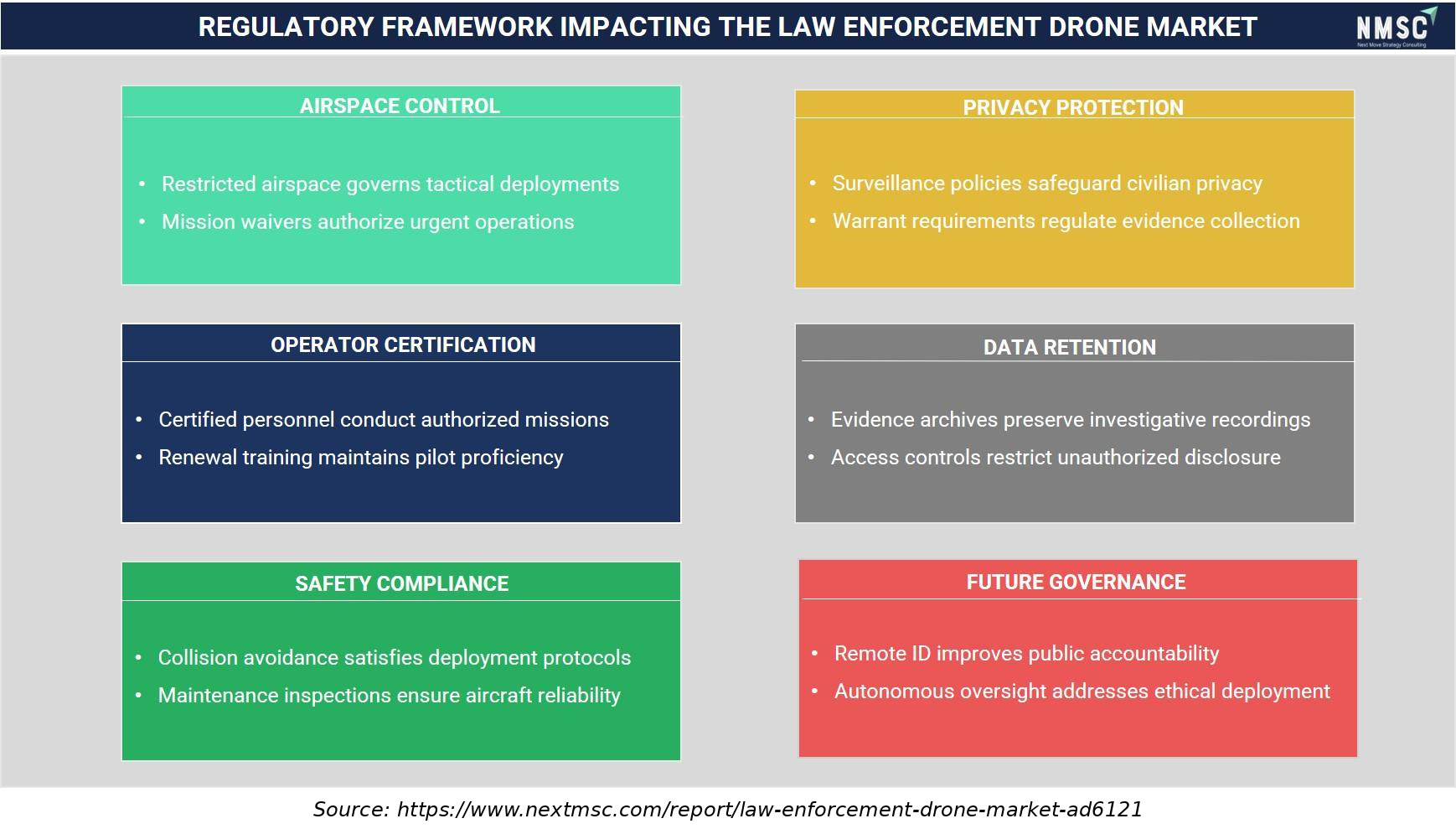
The regulatory framework analysis outlines the policies governing law enforcement drone operations, including airspace control, operator certification, privacy protection, data retention, safety compliance, and future governance standards. These regulations establish the legal and operational foundation for secure drone deployment, ensuring public accountability, evidence integrity, aviation safety, and responsible adoption across policing and emergency response agencies.

Key Benefits for Stakeholders

How Does This Report Benefit Enterprise and Industry Leaders?

Enterprise and industry leaders gain access to validated segmentation, competitive benchmarking, and regional demand forecasts that support platform-sourcing and product-portfolio decisions across the law enforcement drone Industry. Our analysis shows that detailed platform-type, application, and end-user breakdowns help procurement teams align specifications with regulatory and interoperability requirements while identifying underserved application segments for portfolio expansion.

How Does This Report Benefit Investors and Financial Analysts?

Investors and financial analysts benefit from consistent, single-point market size and CAGR estimates that support valuation and capital-allocation decisions across the law enforcement drone market supply chain. We observed that the report's regional and segment-level growth differentials help identify which platform manufacturers and software vendors are best positioned to capture above-market growth in BVLOS and tactical categories through 2035.

How Does This Report Benefit Technology Vendors and Product Teams?

Technology vendors and product teams gain insight into emerging design requirements, including autonomous docking, multi-sensor payload integration, and NDAA-compliant manufacturing, that are reshaping the Industry. Our findings suggest that this analysis helps R&D teams prioritize development roadmaps around BVLOS certification and evidence-management integration increasingly required by agency procurement processes.

Key Market Segments Evaluated

By Platform Type

  • Multi-Rotor Drones
  • Fixed-Wing Drones
  • Hybrid VTOL Drones
  • Nano/Tactical Micro Drones

By Application

  • Patrol and Surveillance
  • Search and Rescue
  • Traffic Accident Investigation
  • Crime Scene and Forensic Mapping
  • Crowd and Event Monitoring
  • Tactical and SWAT Operations
  • Border and Perimeter Security
  • Other Applications

By Payload Type

  • Electro-Optical Camera
  • Thermal and Infrared Imaging
  • LiDAR and Mapping Sensors
  • Multi-Sensor Payloads
  • Communication and Loudspeaker Payloads

By Range

  • Short Range (Below 5 km)
  • Medium Range (5 km to 25 km)
  • Long Range (Above 25 km)

By End User

  • Municipal and Local Police Departments
  • State and Regional Police Agencies
  • Federal and Border Security Agencies
  • Correctional Facilities

Conclusion & Recommendations

The long-term outlook for the market remains positive, with global revenue projected to more than triple from USD 2.86 billion in 2025 to USD 10.12 billion by 2035 at a 13.6% CAGR. We observed that sustained Drone as First Responder expansion, BVLOS regulatory progress, and NDAA-compliant domestic manufacturing will continue underpinning demand across patrol, tactical, and border-security applications through the forecast period.

What Strategic Positioning Should Law Enforcement Drone Suppliers Pursue?

Suppliers should prioritize autonomous, dock-based platforms while pursuing NDAA-compliant domestic manufacturing to secure long-term agency contracts. Our assessment indicates that manufacturers investing early in BVLOS certification and evidence-management software integration will be best positioned to capture premium pricing within the law enforcement drone market.

How Attractive Is the Law Enforcement Drone Market for New Investment?

The law enforcement drone Industry presents an attractive investment case, supported by a USD 6.91 billion absolute dollar opportunity between 2026 and 2035 and above-average growth in Asia-Pacific and tactical product categories. We found that investment attractiveness is highest for suppliers combining domestic manufacturing credentials with scaled autonomous-flight software, positioning them to serve both large metropolitan and smaller county agencies simultaneously.

What Market Shifts and Key Risks Should Stakeholders Monitor?

Stakeholders should monitor data-privacy regulation, tightening federal procurement compliance rules, and competitive pressure from foreign-manufactured platform restrictions as key risks to the law enforcement drone market. Our analysis shows that suppliers unable to adapt to NDAA-compliance specifications risk losing agency contracts to competitors with certified domestic manufacturing, particularly within North America's increasingly regulated procurement environment.

What Are the Key Growth Pathways for the Law Enforcement Drone Market?

Key growth pathways include expanding BVLOS-certified fleet coverage, scaling domestic manufacturing capacity, and deepening penetration into correctional-facility and border-security channels. Next Move Strategy Consulting's analysis indicates that suppliers pursuing these pathways while maintaining software-integration depth will be best positioned to capture the law enforcement drone market's projected growth through 2035.

FAQs

About the Author

Mihul Sharma

Mihul Sharma

Mihul Sharma is Research Associate at Next Move Strategy Consulting, where he has covered technology, industrial, and healthcare markets for 3 years. His work applies structured business research, market analysis, and secondary-source review to assess market trends, competitive developments, and growth opportunities. He supports report development by fully synthesizing industry data, company information, and market signals into concise findings for strategy and investment-focused research teams.

About the Reviewer

Supradip Baul

Supradip Baul

Supradip Baul is an accomplished business consultant and strategist with over a decade of rich experience in market intelligence, strategy, technology, and business transformation. His work has included rigorous qualitative and quantitative analysis across multiple industries, helping clients shape investment decisions and long-term roadmaps. Earlier in his career, he was associated with Gartner, where he contributed to industry-leading reports and market share analyses. He has worked with leading global companies and holds an MBA with a dual specialization in Marketing and Finance.

Download Free Sample

Kishu Kanda

KISHU KANDA

Strategy Analyst

Accenture

We purchased the AI Consumer Market Report from this company. Not only did they customize the report to meet our specific requirements, but they also showed great flexibility in accommodating our budget. The report we received fully met our expectations. Additionally, they provided prompt and thorough responses to both our pre-purchase and follow-up questions. We look forward to working with this company again in the future.

Pratyush Kumar Das

PRATYUSH KUMAR DAS

Assistant Manager

Polycab India Limited

We would like to express our appreciation for the data and insights provided by nextmsc. We are very pleased with the quality and depth of the information, which has proven to be highly valuable and beneficial for our business decision-making.

Gaurav Jaiswal

GAURAV JAISWAL

Founder & CEO

Yano Charge Private Limited

The EV Charging market research report provided by the NextMSC was exceptionally detailed and insightful. It offered a comprehensive analysis that proved to be a game-changer for our strategic planning. Truly a testament to the NextMSC’s expertise and thoroughness in EV market landscape & analysis.

Nishant Awate

NISHANT AWATE

Business Development Global Sales

Zehnder Group Deutschland GmbH

Our experience working with Next Move Strategy Consulting was positive. The team was responsive, professional, and open to incorporating our specific requirements throughout the project. The India AHU market study was comprehensive and well structured, covering market value and volume forecasts, product and application segments, and key industry trends. The inclusion of both AHU and residential MVHR market insights made the study particularly relevant for our strategic market assessment. Overall, the report provides a solid foundation for evaluating market potential, identifying priority segments, and supporting business-development decisions in India.

Ross J Mckenzie

ROSS J MCKENZIE

Business Insight Manager

Staysure Group

“Next MSC have been incredibly helpful in providing detailed & robust information on our market, alongside quantifying growth by different segments. The process to procure was simple and easy, with sample reports and regular contact to ensure we had what we needed. Succinct detail on their sources & methodologies is also greatly received, allowing transparency in this respect helps build trust in the detail you pay for. Joseph in particular was fantastic, and helped ensure efficient provision of the insight pack – thank you NMSC!”.

Custom Market Research Services

We will customize the research for you if the listed report does not fully match your requirements.

Get 30% Free Customization

Select License

This website uses cookies to ensure you get the best experience on our website. Learn more

✖