Agriculture Drone Market Size, Share, Trends and Growth Analysis, By Type (Rotary Wing / Multirotor, Fixed Wing, and Hybrid VTOL), By Component (Hardware, Software, and Services), By Farming Environment, By Farm Size, By Application (Crop Spraying and Protection, Crop Monitoring and Scouting, Field Mapping and Soil Analysis, Seeding and Planting, Livestock Monitoring, and Other Applications), By End User, and Region — Global Industry Report and Forecast, 2026–2035
Industry: Aerospace & Defense | Publishing Date: August 1, 2026 | Last Updated: September 7, 2026 | No of Pages: N/A | No. of Tables: N/A | No. of Figures: N/A | Format: PDF | Report Code: AD5512
What Is the Agriculture Drone Market Size?
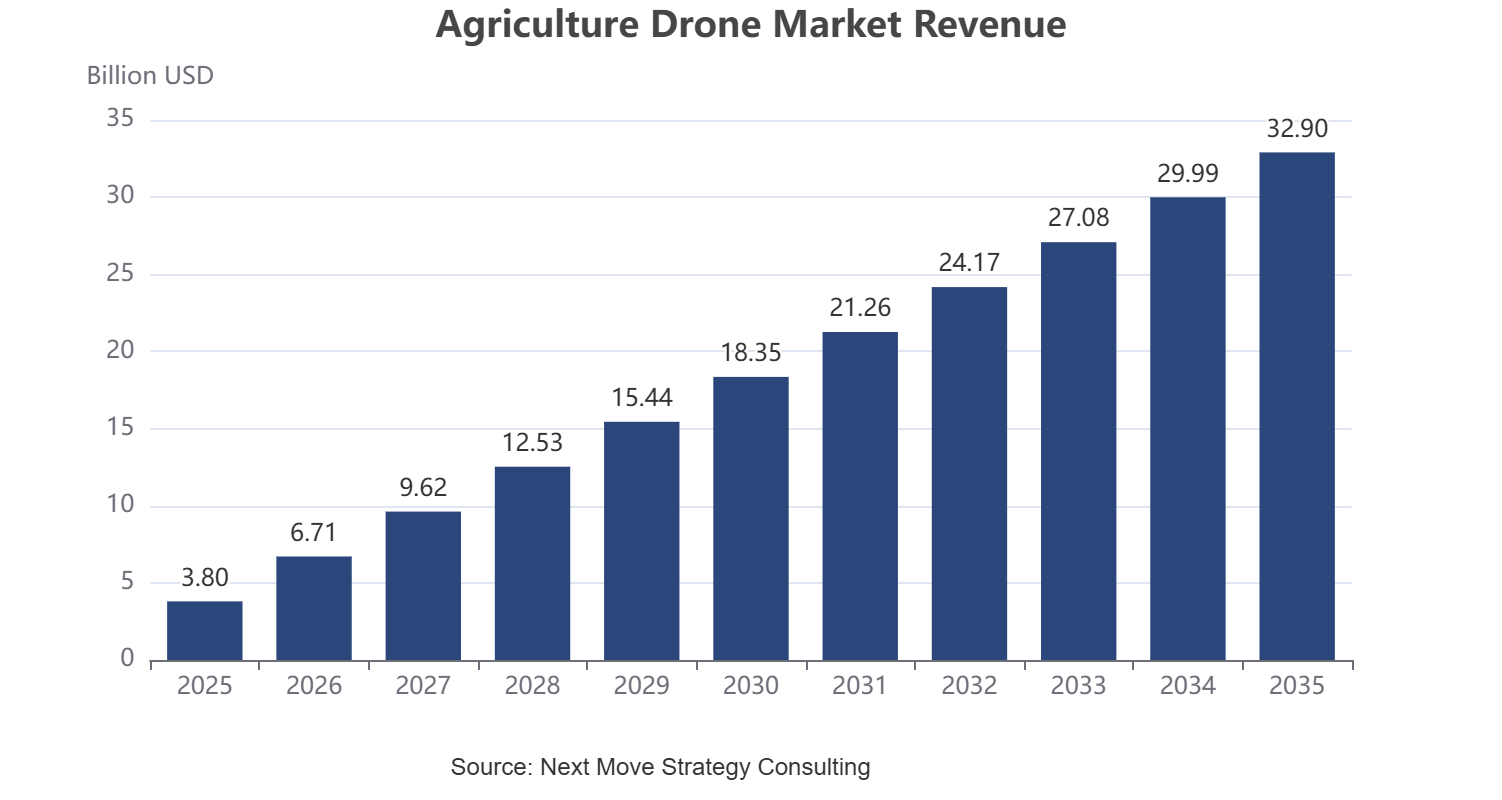
The global agriculture drone sector's size was valued at USD 3.80 billion in 2025 and is estimated at USD 4.75 billion in 2026, forecast to reach USD 32.90 billion by 2035, expanding at a 24.0% CAGR between 2026 and 2035. North America leads with approximately 33% share, while rotary wing and multirotor platforms dominate all other drone types with approximately 62% share.
We observed that the growth is broad-based across every segmentation axis, with drone-service-provider adoption and hybrid VTOL platform demand driving the dominant structural shifts through 2035.
|
Key Takeaways |
|
|
By Type: Rotary Wing / Multirotor held the largest share of approximately 62% (USD 2.36 billion) in 2025; Hybrid (VTOL) is the fastest-growing sub-segment at 29.7% CAGR from 2026–2035. |
By Component: Hardware held the largest share of approximately 68% (USD 2.58 billion) in 2025; Services is the fastest-growing sub-segment at 31.0% CAGR from 2026–2035. |
|
By Farming Environment: Outdoor Farming held the largest share of approximately 82% (USD 3.13 billion) in 2025; Indoor Farming is the fastest-growing sub-segment at 27.0% CAGR from 2026–2035. |
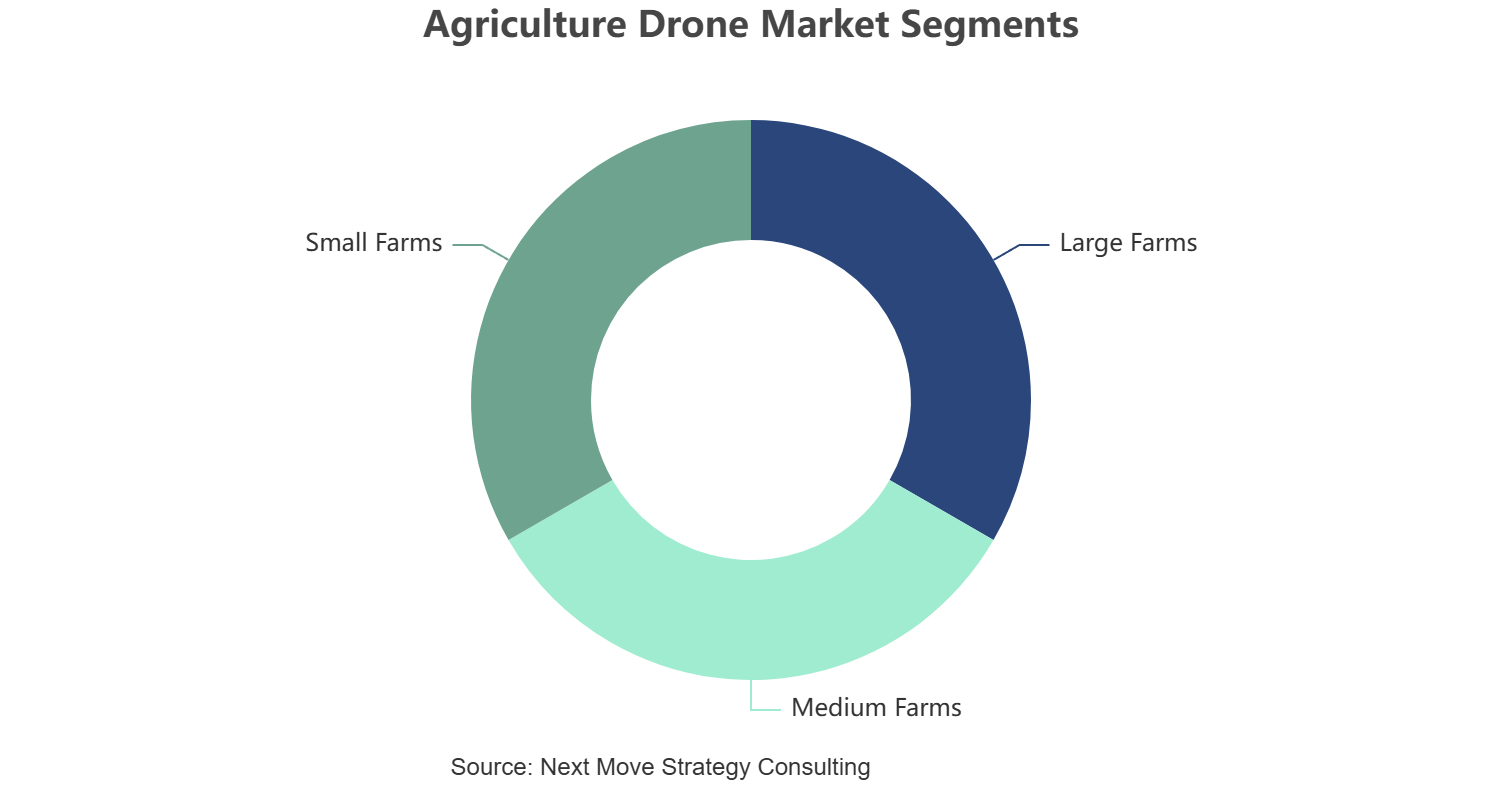
By Farm Size: Large Farms held the largest share of approximately 48% (USD 1.82 billion) in 2025; Small Farms is the fastest-growing sub-segment at 27.7% CAGR from 2026–2035. |
|
By Application: Crop Spraying and Protection held the largest share of approximately 38% (USD 1.44 billion) in 2025; Seeding and Planting is the fastest-growing sub-segment at 27.6% CAGR from 2026–2035. |
By End User: Drone Service Providers held the largest share of approximately 42% (USD 1.60 billion) in 2025; Farming Cooperatives and Agribusiness is the fastest-growing sub-segment at 28.8% CAGR from 2026–2035. |
|
Dominant Region: North America dominated with approximately 33% revenue share (USD 1.25 billion) in 2025. |
Fastest-Growing Region: Asia-Pacific is expected to register the highest CAGR of 25.8% during 2026–2035. |
|
Dominant Country: U.S. led with approximately USD 900 million in 2025. |
Fastest-Growing Country: India is the fastest-growing country at approximately 28.7% CAGR from 2026–2035. |
Market Opportunity: The agriculture drone industry is expected to create an absolute dollar opportunity of USD 28.15 billion between 2026 and 2035, presenting significant investment potential across the precision farming and drone-as-a-service value chain.
According to NMSC analysis, agribusiness cooperatives are increasingly consolidating drone fleet ownership rather than relying solely on per-acre service contracts, a shift that favors manufacturers offering fleet-management software and financing alongside hardware as regulatory clarity improves through 2035.
What Does the Agriculture Drone Market Encompass?
The agriculture drone ecosystem encompasses unmanned aerial systems engineered for crop spraying, crop monitoring, field mapping, seeding, and livestock surveillance, spanning rotary wing, fixed wing, and hybrid VTOL airframes paired with multispectral sensors, RTK positioning, and fleet-management software. Our assessment indicates that the scope covers hardware, software, and drone-as-a-service offerings supplied to individual farmers, drone service providers, agribusiness cooperatives, and government extension programs across outdoor and indoor farming environments worldwide.
Regulatory frameworks such as the U.S. Federal Aviation Administration's 14 CFR Part 137 agricultural aircraft operator certification and Section 44807 exemption process shape heavy-lift spray drone deployment in the United States, while the European Union's pending aerial spray reform and India's Namo Drone Didi scheme are reshaping adoption pathways elsewhere. We observed that technology adoption is shifting toward autonomous, swarm-capable spraying systems that reduce per-acre operating cost. NMSC's analysis indicates that this structural shift, combined with tightening import restrictions on foreign-made drones in select markets, is redefining sourcing criteria across the agriculture drone market.
|
Parameter |
Details |
|
Market Size in 2025 |
USD 3.80 Billion |
|
Market Size in 2026 |
USD 4.75 Billion |
|
Revenue Forecast in 2035 |
USD 32.90 Billion |
|
Growth Rate |
CAGR of 24.0% from 2026 to 2035 |
|
Analysis Period |
2025–2035 |
|
Base Year Considered |
2025 |
|
Forecast Period |
2026–2035 |
|
Market Size Estimation |
Revenue (USD Billion) |
|
Companies Profiled |
14 |
|
Countries Covered |
33 |
|
Market Share |
Available for Top 10 Companies |
Key Emerging Trends
Based on research conducted by NMSC, we found that four structural trends are reshaping product development, sourcing, and stakeholder engagement across the industry.
How Is Autonomous Swarm Spraying Transforming Large-Scale Field Operations?
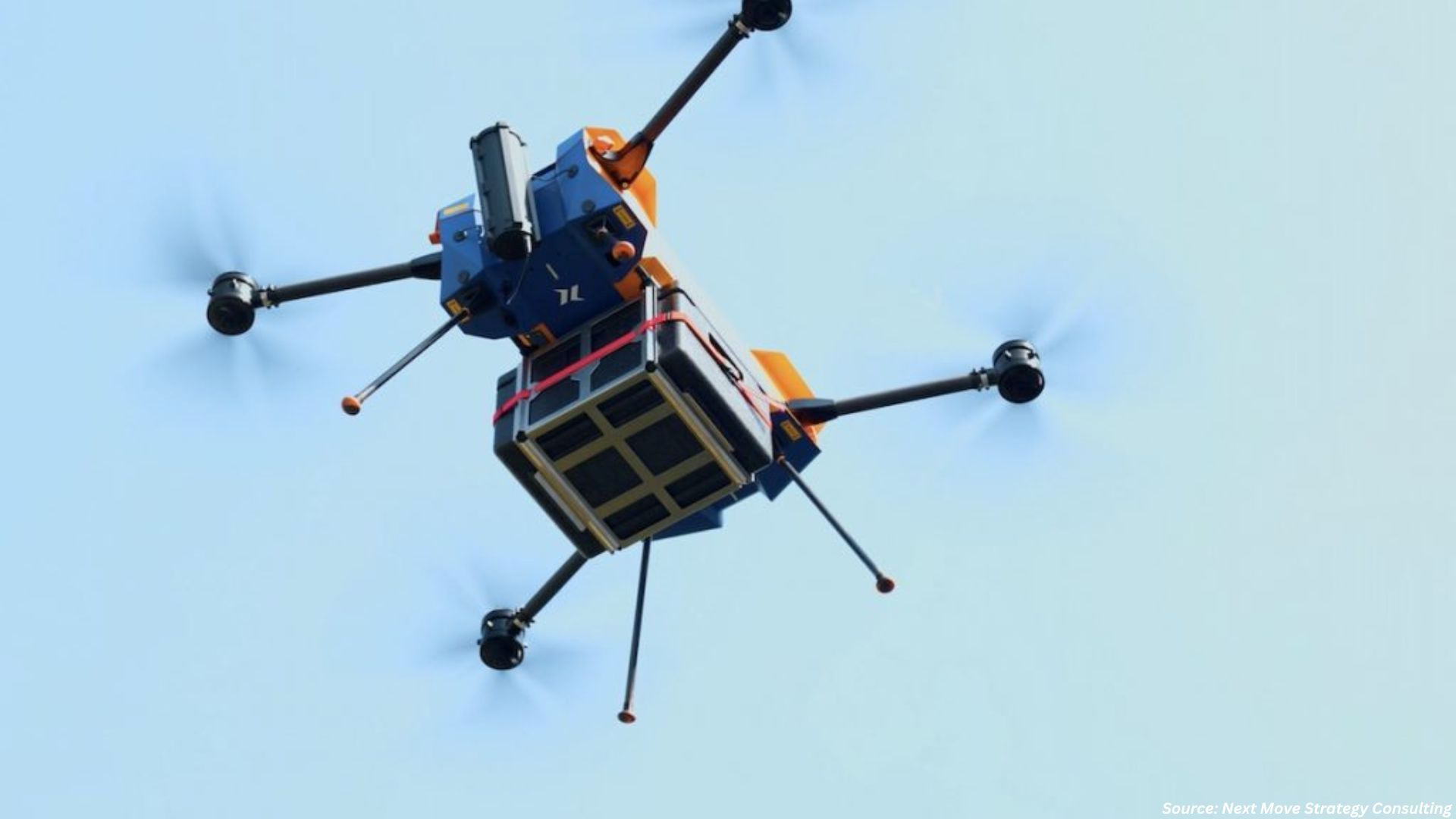
Autonomous swarm-capable spray drones are replacing single-unit operations to cover large-scale row-crop acreage more efficiently. We observed that Hylio's FAA-approved swarm exemption, granted in March 2024 for 55-pound-plus agricultural drones under a single operator, allows several aircraft to spray simultaneously from one control station. Agribusiness operators are adopting these systems to cut labor requirements, while service providers retool fleets to accommodate multi-drone missions across corn, soybean, and cotton acreage.
Why Are Import Restrictions Reshaping Regional Sourcing Patterns?
Tightening restrictions on foreign-made drone hardware are prompting regional sourcing shifts across major markets. Our findings suggest that the addition of leading Chinese agricultural drone brands to the U.S. Federal Communications Commission's Covered List in December 2025 is accelerating demand for domestically manufactured alternatives among American growers. Manufacturers such as Hylio are expanding U.S.-based production capacity, positioning NDAA-compliant sourcing as a differentiator within the broader market structure.
How Is E-Commerce-Style Drone-as-a-Service Reshaping Farmer Access?
Drone-as-a-service platforms are lowering the capital barrier for smallholder and mid-size farmers who cannot justify outright ownership. We observed that India's Namo Drone Didi scheme, which supports women-led self-help groups with subsidized agricultural drones for rental-based spraying services, is expanding rural access to aerial application. This trend is elevating demand for service-provider fleets among cost-sensitive growers, while distributors redesign financing models to minimize upfront ownership burden.
What Role Does Aerial Seeding Play in Agriculture Drone Innovation?
Aerial seeding and pasture-renewal applications are emerging as a fast-growing use case beyond traditional spraying and monitoring. Our analysis shows that operators in Brazil are deploying multirotor platforms for full-cycle forage management, combining seeding and spot-spraying to lift pasture productivity while reducing soil compaction from ground equipment. DJI Agriculture's 2025/2026 Agricultural Drone Industry Insight Report, presented at Agrishow 2026, documents this shift toward seeding-capable platforms across livestock-heavy farming regions.
Growth Drivers and Restraints
Growth Catalyst and Risk Assessment Matrix
|
Factors |
Type |
(+/-) % Impact on CAGR |
Geographic Relevance |
Impact Timeline |
|
Rising global food demand and farm labor shortages |
Driver |
+3.2% |
Global |
2026-2035 |
|
Government subsidy and pilot programs (Namo Drone Didi, USDA Direct Conservation loans) |
Driver |
+2.6% |
Asia-Pacific, North America |
2026-2035 |
|
Streamlined FAA Part 137 and Section 44807 exemption process |
Driver |
+2.1% |
North America |
2026-2032 |
|
EU aerial spray regulatory liberalization |
Driver |
+1.7% |
Europe |
2027-2035 |
|
Expansion of drone-as-a-service business models |
Driver |
+2.4% |
Global |
2026-2035 |
|
Advances in autonomous swarm and AI-driven spraying |
Driver |
+1.9% |
Global |
2026-2035 |
|
Import restrictions on foreign-made drone hardware |
Restraint |
-1.6% |
North America |
2026-2032 |
|
High upfront cost of heavy-lift spray drones for smallholders |
Restraint |
-1.1% |
Latin America, Middle East & Africa |
2026-2033 |
|
Fragmented and evolving airspace regulation across regions |
Restraint |
-0.9% |
Europe, Latin America |
2026-2030 |
What Is the Primary Growth Driver of the Agriculture Drone Market?
Rising global food demand combined with a persistent shortage of agricultural labor is the primary driver of the market. The U.S. Department of Agriculture's Economic Research Service reports that drone adoption reached 12% of large-scale, crop-producing family farms, reflecting sustained interest in labor-saving aerial technology. We observed that this labor-substitution motivation, reinforced by rising input costs, continues to anchor baseline demand for spraying and monitoring drones across developed and emerging economies alike.
How Are Government Subsidy Programs Driving Agriculture Drone Market Growth?
Government subsidy and pilot programs are accelerating market growth by lowering the effective cost of drone adoption for smallholder and mid-size farmers. India's Ministry of Agriculture and Farmers Welfare operates the Namo Drone Didi scheme, allocating funding to thousands of women-led self-help groups to provide rental drone services to farmers. Our assessment indicates that this public-private model, combined with the USDA's Direct Conservation loan program prioritizing aerial platforms, is compressing adoption timelines across cost-sensitive farming segments.
What Is Restraining Agriculture Drone Market Expansion?
Tightening import restrictions on foreign-made drone hardware in the United States restrain near-term hardware availability and raise effective costs for growers. The Federal Communications Commission added leading Chinese agricultural drone brands to its Covered List in December 2025, blocking new equipment authorizations for those manufacturers. We found that this restriction disproportionately affects growers reliant on imported hardware, as domestic alternatives remain limited in production scale compared with established Asian manufacturers.
Segmentation Analysis
Segment Sizing: By Type
|
Segment |
2025 (USD) |
2035 (USD) |
CAGR% (2026–2035) |
|
Rotary Wing / Multirotor |
USD 2.36 Billion |
USD 18.59 Billion |
22.7% |
|
Fixed Wing |
USD 0.99 Billion |
USD 8.39 Billion |
23.7% |
|
Hybrid (VTOL) |
USD 0.46 Billion |
USD 5.92 Billion |
29.7% |
|
Total |
USD 3.80 Billion |
USD 32.90 Billion |
24.0% |
Which Type Segment Dominates the Agriculture Drone Market?
Rotary wing and multirotor platforms, encompassing quadcopter and hexacopter spray configurations, led the market with USD 2.36 billion in 2025, supported by vertical takeoff flexibility and compatibility with small and irregular field geometries. We observed that Hybrid (VTOL) platforms are the fastest-growing type, expanding at a 29.7% CAGR from 2026 to 2035, as large-acreage operators seek the combined range of fixed-wing flight with the takeoff convenience of rotary systems for mapping and monitoring missions.
Segment Sizing: By Application
|
Segment |
2025 (USD) |
2035 (USD) |
CAGR% (2026–2035) |
|
Crop Spraying and Protection |
USD 1.44 Billion |
USD 11.68 Billion |
23.1% |
|
Crop Monitoring and Scouting |
USD 0.91 Billion |
USD 7.73 Billion |
23.7% |
|
Field Mapping and Soil Analysis |
USD 0.61 Billion |
USD 4.93 Billion |
23.1% |
|
Seeding and Planting |
USD 0.46 Billion |
USD 5.10 Billion |
27.6% |
|
Livestock Monitoring |
USD 0.23 Billion |
USD 2.14 Billion |
25.1% |
|
Other Applications |
USD 0.15 Billion |
USD 1.32 Billion |
24.0% |
|
Total |
USD 3.80 Billion |
USD 32.90 Billion |
24.0% |
Which Application Segment Leads Agriculture Drone Market Demand?
Crop Spraying and Protection remained the leading application within the market, valued at USD 1.44 billion in 2025 on sustained pesticide, herbicide, and fertilizer application demand across row-crop and orchard operations. Our findings suggest that Seeding and Planting is the fastest-growing application, registering a 27.6% CAGR from 2026 to 2035, as pasture-renewal and aerial seeding use cases expand across livestock-heavy farming regions in Latin America and Asia-Pacific.
Segment Sizing: By End User
|
Segment |
2025 (USD) |
2035 (USD) |
CAGR% (2026–2035) |
|
Drone Service Providers (DaaS) |
USD 1.60 Billion |
USD 12.34 Billion |
22.4% |
|
Individual Farmers / Owner-Operators |
USD 1.14 Billion |
USD 8.39 Billion |
21.8% |
|
Farming Cooperatives and Agribusiness |
USD 0.84 Billion |
USD 10.20 Billion |
28.8% |
|
Government and Research Institutions |
USD 0.23 Billion |
USD 1.97 Billion |
24.0% |
|
Total |
USD 3.80 Billion |
USD 32.90 Billion |
24.0% |
Which End User Segment Is Most Attractive in the Agriculture Drone Market?
Drone Service Providers offering per-acre rental spraying and mapping contracts led the market with USD 1.60 billion in 2025, reflecting the high upfront cost of ownership relative to typical farm income. Based on research conducted by NMSC, we found that Farming Cooperatives and Agribusiness enterprises represent the fastest-growing end user category, at a 28.8% CAGR from 2026 to 2035, as larger operators transition from per-acre contracts to owned fleets to capture recurring cost savings at scale.
Supply Chain Structure of the Agriculture Drone Market
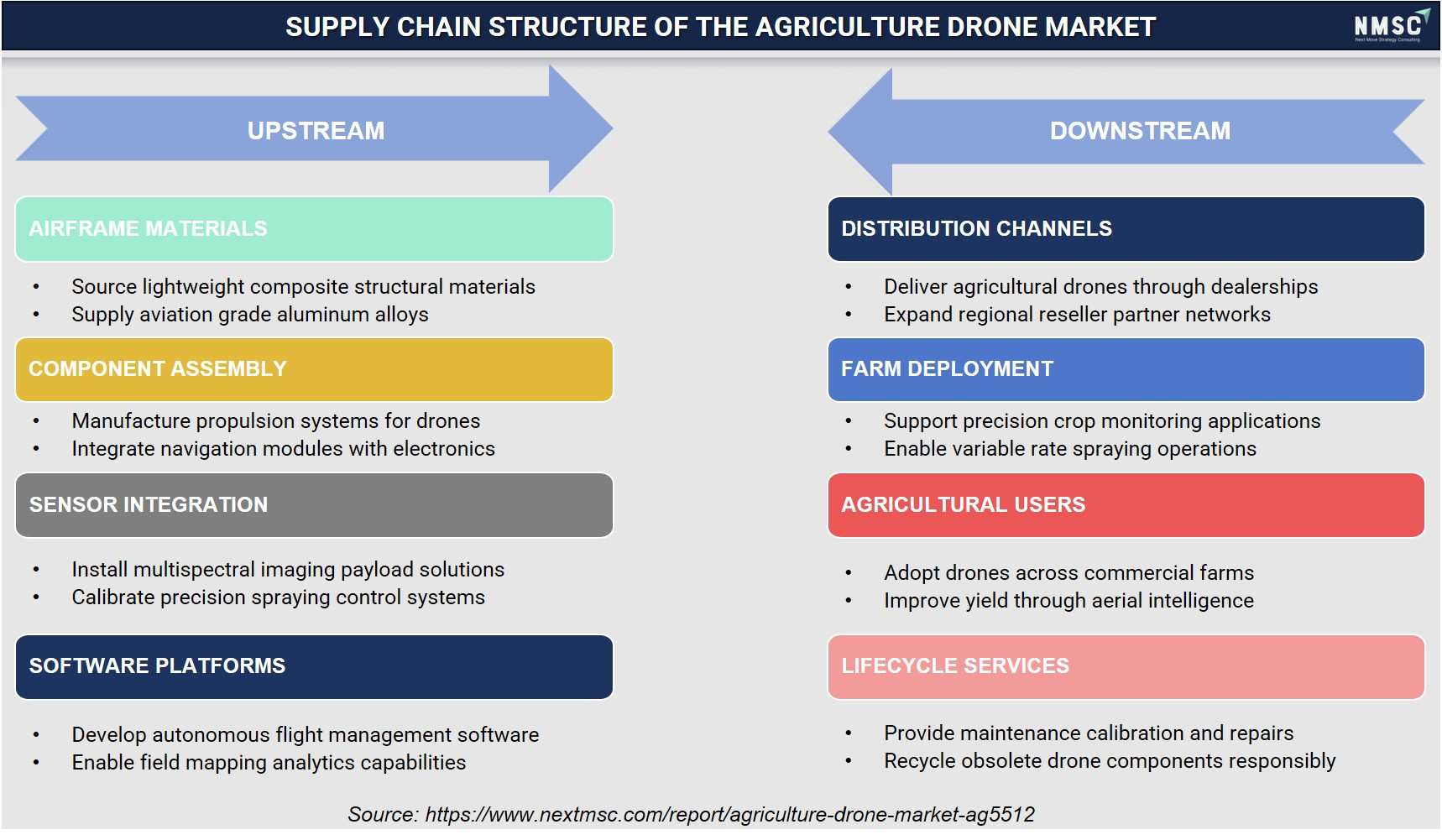
The agriculture drone industry's supply chain integrates specialized material suppliers, component manufacturers, sensor providers, and software developers with distributors, dealers, and end users. Efficient coordination across sourcing, assembly, deployment, and after-sales services ensures reliable product performance, timely delivery, and lifecycle support, enabling wider adoption of precision agriculture technologies and long-term operational value for farmers.
Growth Opportunities
Our analysis shows that three forward-looking opportunities stand out for stakeholders positioning within the agriculture drone sector over the 2026-2035 forecast period.
How Can Fleet Financing Unlock Value for Drone Service Providers?
Fleet financing and leasing platforms present a whitespace opportunity for drone service providers seeking to scale operations without large upfront capital outlays. Suppliers that offer bundled hardware-financing-training packages stand to capture recurring revenue as service providers expand fleets to meet growing per-acre spraying demand across cost-sensitive farming regions.
Where Do Indoor and Controlled-Environment Farms Create New Demand?
Indoor and greenhouse farming operations represent an underpenetrated opportunity for compact, precision-hover drones engineered for confined-space crop monitoring. Manufacturers that develop validated, low-noise platforms for controlled-environment agriculture can secure long-term contracts with vertical-farming operators, benefiting from a smaller but faster-growing indoor farming segment.
How Can AI-Driven Analytics Benefit Smallholder Cooperatives?
Smallholder farming cooperatives seeking affordable crop-health analytics create an opportunity for software vendors offering AI-driven pest and disease detection bundled with rental drone access. Early movers that combine low-cost hardware access with subscription analytics can differentiate with cooperative and government extension buyers pursuing productivity gains across smallholder-dominated regions.
Regional Outlook
Geographic Performance Snapshot
|
Region |
2025 (USD) |
2035 (USD) |
CAGR% (2026–2035) |
Key Driver |
|
North America |
USD 1.25 Billion |
USD 9.54 Billion |
22.2% |
FAA Part 137 streamlining and USDA conservation-loan support |
|
Europe |
USD 0.76 Billion |
USD 6.09 Billion |
22.9% |
EU aerial spray regulatory reform and REACH-aligned adoption |
|
Asia-Pacific |
USD 1.22 Billion |
USD 12.01 Billion |
25.8% |
Namo Drone Didi scheme and expanding manufacturing base |
|
Middle East & Africa |
USD 0.33 Billion |
USD 3.13 Billion |
25.1% |
Vision 2030-linked agri-diversification and export hub growth |
|
Latin America |
USD 0.24 Billion |
USD 2.14 Billion |
24.6% |
Large-scale row-crop and pasture management adoption |
|
Total |
USD 3.80 Billion |
USD 32.90 Billion |
24.0% |
-- |
North America Agriculture Drone Market Outlook
North America leads the agriculture drone industry, supported by an established precision agriculture infrastructure and streamlined federal exemption processes. We observed that the FAA's Section 44807 process and Part 137 certification pathway sustain demand for heavy-lift spray drones, while USDA Direct Conservation loans prioritize aerial platform financing. Technology adoption remains advanced, though import restrictions on foreign-made hardware are reshaping regional sourcing toward domestic manufacturers.
Europe Agriculture Drone Market Outlook
Europe's agriculture drone sector reflects a regulation-intensive landscape shaped by the European Union's pending aerial spray reform and member-state implementation timelines. Our findings suggest that Italy's delayed implementing decree illustrates the pace at which national frameworks are catching up to EU-level liberalization. Technology adoption favors compliance-ready platforms, supported by growers across Germany, France, and the UK preparing for expanded spraying authorization.
Asia-Pacific Agriculture Drone Market Outlook
Asia-Pacific is the fastest-growing agriculture drone industry region, propelled by China's dense manufacturing base and India's subsidized rural adoption programs. We found that regulatory frameworks remain less harmonized than in Europe, giving manufacturers flexibility to scale rotary wing spray drone production rapidly. Technology adoption is accelerating as China-based suppliers expand export capacity to serve global crop-spraying and monitoring demand.
Middle East & Africa Agriculture Drone Market Outlook
The agriculture drone market in Middle East & Africa is expanding as Gulf Cooperation Council economies diversify into agri-technology and food-security programs. Our analysis shows that Saudi Arabia and the UAE are attracting drone-technology investment tied to domestic agricultural diversification. Regulatory influence remains developing, while technology adoption is gradually shifting toward imported spray and mapping platforms as regional distributors align with global suppliers.
Latin America Agriculture Drone Market Outlook
Latin America's agriculture drone market is supported by large-scale row-crop and pasture operations in Brazil and Argentina. We observed that Brazil's Agrishow trade event has become a global showcase for aerial seeding and spraying technology, with DJI, EAVISION, and regional distributors demonstrating full-cycle forage management systems. Technology adoption remains centered on rotary wing platforms, with competitive intensity increasing as global manufacturers expand distribution partnerships.
U.S. Agriculture Drone Market
Based on our estimates, the U.S. market was valued at approximately USD 900 million in 2025 and is projected to reach USD 6.35 billion by 2035, growing at a 21.2% CAGR. Demand is anchored by large-scale row-crop operations, streamlined FAA exemption processing, and USDA conservation-loan support. Technology penetration favors domestically manufactured, NDAA-compliant platforms, and competitive intensity is rising among U.S.-based manufacturers following import restrictions on foreign hardware.
Canada Agriculture Drone Market
The market in Canada reached roughly USD 200 million in 2025 and is forecast to hit USD 1.42 billion by 2035 at a 21.3% CAGR. Demand structure mirrors U.S. row-crop and orchard spraying patterns, while Transport Canada's remotely piloted aircraft rules shape certification requirements. Technology penetration is rising as agribusiness operators request fleet-scale spraying solutions, with competitive intensity moderate given reliance on cross-border equipment supply.
UK Agriculture Drone Market
As per our estimate, the UK market stood at about USD 145 million in 2025, advancing toward USD 980 million by 2035 at a 20.6% CAGR. Demand is driven by arable farming operations navigating post-Brexit agricultural technology grant schemes. Regulatory influence from the UK Civil Aviation Authority's drone framework is notable, and competitive intensity remains moderate given a concentrated base of specialist agricultural drone distributors.
Germany Agriculture Drone Market
According to our analysis, Germany's market reached close to USD 165 million in 2025 and is expected to hit USD 1.12 billion by 2035, growing at a 20.7% CAGR. Demand is supported by Germany's precision farming cooperative structure and EU Common Agricultural Policy digitalization incentives. Regulatory influence is well established, technology penetration is advanced, and competitive intensity remains high among established European distributors.
France Agriculture Drone Market
Based on our estimates, France's market reached approximately USD 135 million in 2025, projected to climb to USD 930 million by 2035 at a 20.9% CAGR. Demand is supported by France's viticulture and arable farming sectors, which shape specialty spraying and vineyard mapping adoption. Regulatory influence from French civil aviation rules is notable, and competitive intensity remains moderate given a mix of domestic and imported platforms.
China Agriculture Drone Market
The market in China stood at roughly USD 440 million in 2025 and is forecast to reach USD 3.55 billion by 2035, registering a 23.0% CAGR. Demand is fueled by an expansive domestic manufacturing base and government-supported rural mechanization programs. Regulatory influence is well established, technology penetration is advanced through export-oriented production scale-up, and competitive intensity remains elevated among numerous China-based suppliers.
India Agriculture Drone Market
As per our estimate, India's market was valued at about USD 235 million in 2025, projected to reach USD 2.85 billion by 2035 at a 28.7% CAGR, the fastest among covered countries. Demand structure reflects the Namo Drone Didi scheme's subsidized rental model and rising labor costs in rural agriculture. Regulatory influence is developing under India's Directorate General of Civil Aviation drone rules, while technology penetration is rising quickly through public-private rental networks.
Japan Agriculture Drone Market
According to our analysis, Japan's market reached close to USD 155 million in 2025 and is expected to hit USD 1.02 billion by 2035, growing at a 20.3% CAGR. Demand is supported by Japan's long-standing unmanned helicopter spraying heritage, led by domestic supplier Yamaha Motor. Regulatory influence is well established, technology penetration is advanced, and competitive intensity remains high among long-standing domestic manufacturers.
South Korea Agriculture Drone Market
Based on our estimates, South Korea's market stood at approximately USD 95 million in 2025, forecast to reach USD 700 million by 2035 at a 21.8% CAGR. Demand structure benefits from government-supported rice-paddy mechanization programs. Technology penetration is high, with imported and domestic platforms both active, and competitive intensity remains pronounced amid rapid product turnover.
Australia Agriculture Drone Market
The agriculture drone market in Australia reached about USD 75 million in 2025 and is projected to reach USD 520 million by 2035, expanding at a 21.0% CAGR. Demand is supported by large-scale broadacre farming and growing interest in variable-rate spraying. Regulatory influence stems from the Civil Aviation Safety Authority's drone rules, while technology penetration favors imported rotary wing spray systems amid moderate competitive intensity.
UAE Agriculture Drone Market
As per our estimate, the UAE market was valued near USD 52 million in 2025, projected to reach USD 440 million by 2035 at a 23.7% CAGR. Demand structure is shaped by the UAE's role as a regional agri-technology distribution hub. Regulatory influence remains moderate, technology penetration is improving through imported platforms, and competitive intensity is rising as distributors expand product portfolios to serve Gulf markets.
Saudi Arabia Agriculture Drone Market
According to our analysis, Saudi Arabia's market reached roughly USD 68 million in 2025 and is expected to hit USD 600 million by 2035, growing at a 24.3% CAGR. Demand is driven by Vision 2030-linked agricultural diversification and food-security investment. Regulatory influence is developing under Saudi civil aviation guidelines, and technology penetration is advancing as domestic distributors scale operations.
South Africa Agriculture Drone Market
Based on our estimates, South Africa's market stood at about USD 41 million in 2025, forecast to reach USD 290 million by 2035 at a 21.2% CAGR. Demand structure reflects a developing commercial farming base serving regional Southern African markets. Regulatory influence remains moderate, technology penetration is gradually improving, and competitive intensity is limited given reliance on imported platforms from Asia.
Brazil Agriculture Drone Market
The market in Brazil reached approximately USD 128 million in 2025 and is projected to reach USD 1.20 billion by 2035, registering a 25.1% CAGR. Demand is underpinned by Brazil's large-scale soybean, corn, and pasture operations showcased annually at Agrishow. Regulatory influence stems from Brazil's National Civil Aviation Agency drone rules, technology penetration favors rotary wing seeding and spraying platforms, and competitive intensity remains high among global and regional suppliers.
Argentina Agriculture Drone Market
As per our estimate, Argentina's market was valued near USD 52 million in 2025, projected to reach USD 440 million by 2035 at a 23.7% CAGR. Demand structure is supported by steady row-crop and cattle-ranching consumption despite macroeconomic volatility. Regulatory influence remains limited, technology penetration is modest, and competitive intensity is centered on a small number of regional distributors serving domestic agribusiness.
Consumer Behavior Analysis of the Agriculture Drone Market
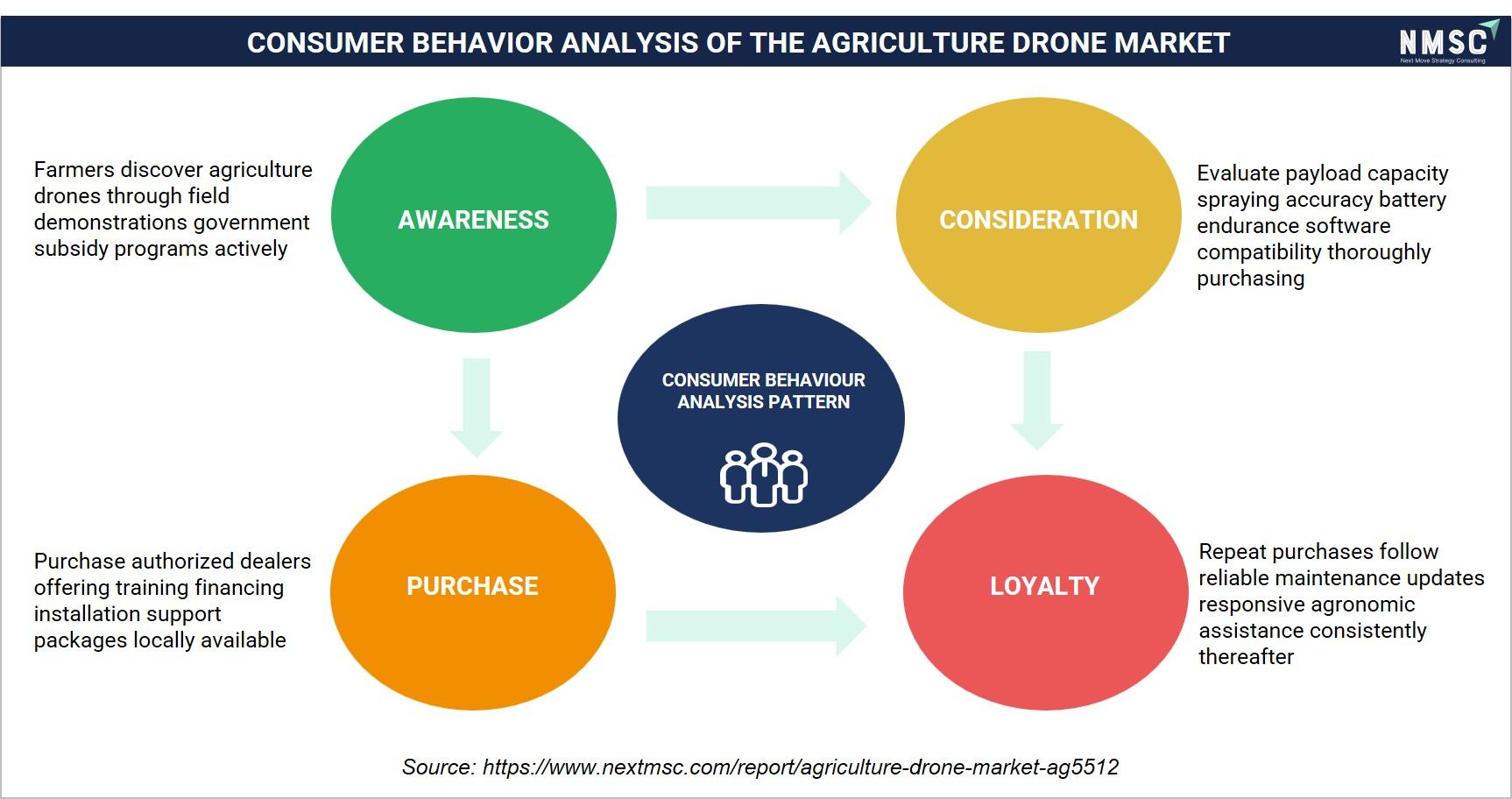
The consumer journey in the agriculture drone market progresses from awareness through evaluation, purchase, and long-term loyalty. Farmers typically discover solutions via demonstrations and government programs, assess technical performance and operational benefits, purchase through authorized dealers, and remain loyal to brands offering dependable maintenance, software updates, training, and agronomic support, encouraging repeat purchases and sustained adoption.
Competitive Landscape
We observed that the agriculture drone market features a moderately consolidated competitive landscape, with China-based hardware leaders competing alongside regional and Western specialists on cost, autonomy, and regulatory compliance.
|
Key Takeaways |
|
Market Structure: Moderately consolidated; DJI and XAG collectively account for a majority of global hardware unit volume, while numerous regional manufacturers across India, Ukraine, and Latin America serve cost-sensitive local demand. |
|
Innovation Focus: Autonomous swarm spraying, hybrid VTOL platform development, and NDAA-compliant domestic manufacturing dominate current innovation pipelines across leading suppliers. |
|
M&A Activity: Selective consolidation and diversification, exemplified by AgEagle Aerial Systems' rebrand and strategic pivot toward defense and commercial markets alongside its continuing agriculture-linked sensor and airframe lines. |
How Do Companies Compete in the Agriculture Drone Market?
Companies compete primarily on payload capacity, autonomy, and regulatory-compliance credentials across the industry. Global players such as DJI and XAG leverage vertically integrated manufacturing to serve cost-sensitive volume demand, while regional manufacturers including Hylio and Garuda Aerospace compete on domestic-compliance sourcing and localized service networks supplied to smaller agribusiness and cooperative buyers.
Which Competitive Archetypes Dominate the Agriculture Drone Market?
Two archetypes dominate the market: large-scale Asian hardware manufacturers offering vertically integrated, cost-competitive spray platforms, and regional or Western specialists focused on compliance-driven, service-oriented deployment. DJI and XAG exemplify the volume manufacturing archetype, while Hylio and Terra Drone exemplify the compliance and service-oriented archetype serving markets with import restrictions or specialized regulatory requirements.
How Are Companies Differentiating Through Innovation in Agriculture Drones?
Innovation and differentiation strategy increasingly center on autonomous swarm operation and full-cycle mission automation. XAG's X-Series platform and DJI's Agras T100 Dual Battery Spraying System both extend autonomous execution from flight control to refilling and self-cleaning cycles. Our analysis shows that suppliers unable to demonstrate credible autonomy and compliance pathways risk exclusion from large agribusiness procurement shortlists in North America and Europe.
What M&A and Expansion Activity Is Shaping the Agriculture Drone Market?
Diversification and geographic expansion continue to reshape supplier portfolios within the industry. AgEagle Aerial Systems' 2025 rebrand to EagleNXT reflects a broader strategic pivot toward defense and commercial markets alongside its continuing agricultural sensor and airframe business, while Hylio's new Texas manufacturing facility illustrates how domestic suppliers are scaling capacity to capture demand shifting away from restricted foreign hardware.
Key Market Players
Our assessment indicates that the following 14 companies are actively shaping product innovation, capacity expansion, and regulatory strategy within the global agriculture drone market.
-
SZ DJI Technology Co., Ltd.
-
Guangzhou Jifei Technology Co., Ltd
-
Yamaha Motor Co., Ltd.
-
Hylio, Inc.
-
AgEagle Aerial Systems Inc.
-
Garuda Aerospace Private Limited
-
Terra Drone Corporation
-
Kray Technologies LLC
-
Marut Dronetech Private Limited
-
Indowings Private Limited
-
American Autonomy, Inc.
-
EAVISION Robotic Technologies Co., Ltd.
-
Jiangsu Quanfeng Aviation Plant Protection Technology Co., Ltd.
Latest Developments
We found that recent product launches within the agriculture drone market are concentrated on autonomous full-cycle spraying platforms, reflecting the industry's broader shift toward reduced-labor field operations.
|
Date |
Event |
|
July 2026 |
DJI Agriculture announced the global launch of the Agras T55 and Agras T100 Dual Battery Spraying System, extending its agricultural drone lineup for orchards, small plots, and large-scale field operations. |
|
Aug 2025 |
Terra Drone signed a sales partnership with Yanmar Diesel Indonesia to expand deployment of agricultural drones for rice cultivation and precision farming. |
Investment Opportunities
What Capital Inflows Are Targeting the Agriculture Drone Market?
Capital inflows into the agriculture drone market are increasingly directed toward domestic manufacturing capacity and autonomous flight software. Private investors and strategic acquirers continue to fund U.S.-based production expansion, as seen in Hylio's new Texas manufacturing facility. We observed that investors favor suppliers demonstrating NDAA-compliant sourcing, viewing regulatory alignment as a proxy for long-term contract retention with North American agribusiness buyers.
How Is Infrastructure Investment Supporting Agriculture Drone Manufacturing?
Infrastructure investment is expanding assembly and testing capacity across Asia-Pacific and North America to serve rising domestic and export demand. Our findings suggest that manufacturers are investing in automated assembly lines to improve consistency for spray, spreading, and mapping payloads ranging from light multirotor units to heavy-lift hybrid VTOL systems, supporting the precision required for large-scale field operations.
What ESG Considerations Are Shaping Agriculture Drone Investment Decisions?
Environmental, social, and governance considerations are central to investment decisions across the industry, with reduced pesticide drift and lower water and carbon intensity cited as key criteria. DJI Agriculture's own reporting credits its agricultural drone fleet with meaningful reductions in water use and carbon emissions relative to conventional application methods. We found that investors increasingly favor manufacturers that can document verifiable input-reduction outcomes, treating this data as a governance indicator alongside labor and safety compliance.
Key Benefits for Stakeholders
How Does This Report Benefit Enterprise and Industry Leaders?
Enterprise and industry leaders gain access to validated segmentation, competitive benchmarking, and regional demand forecasts that support fleet-sourcing and product-portfolio decisions across the agriculture drone industry. Our analysis shows that detailed type, application, and end-user breakdowns help procurement teams align specifications with regulatory and compliance requirements while identifying underserved application segments for portfolio expansion.
How Does This Report Benefit Investors and Financial Analysts?
Investors and financial analysts benefit from consistent, single-point market size and CAGR estimates that support valuation and capital-allocation decisions across the agriculture drone supply chain. We observed that the report's regional and segment-level growth differentials help identify which manufacturers and service providers are best positioned to capture above-market growth in hybrid VTOL and drone-as-a-service categories through 2035.
How Does This Report Benefit Technology Vendors and Product Teams?
Technology vendors and product teams gain insight into emerging design requirements, including autonomous swarm control, domestic-compliance manufacturing, and fleet-financing models, that are reshaping the industry. Our findings suggest that this analysis helps R&D teams prioritize development roadmaps around autonomy and regulatory-compliance credentials increasingly required by agribusiness and government procurement processes.
Key Market Segments
By Type
-
Rotary Wing / Multirotor
-
Fixed Wing
-
Hybrid (VTOL)
By Component
-
Hardware
-
Software
-
Services
By Farming Environment
-
Outdoor Farming
-
Indoor Farming
By Farm Size
-
Large Farms
-
Medium Farms
-
Small Farms
By Application
-
Crop Spraying and Protection
-
Crop Monitoring and Scouting
-
Field Mapping and Soil Analysis
-
Seeding and Planting
-
Livestock Monitoring
-
Other Applications
By End User
-
Drone Service Providers
-
Individual Farmers / Owner-Operators
-
Farming Cooperatives and Agribusiness
-
Government and Research Institutions
By Region
-
North America: U.S., Canada, Mexico
-
Europe: UK, Germany, France, Italy, Spain, Sweden, Denmark, Finland, Netherlands, Rest of Europe
-
Asia-Pacific: China, India, Japan, South Korea, Taiwan, Indonesia, Vietnam, Australia, Philippines,, Malaysia, Rest of APAC
-
Middle East & Africa: Saudi Arabia, UAE, Egypt, Israel, Turkey, Nigeria, South Africa, Rest of MEA
-
Latin America: Brazil, Argentina, Chile, Colombia, Rest of LATAM
Conclusion and Recommendations
What Is the Long-Term Outlook for the Agriculture Drone Market?
The long-term outlook for the market remains strongly positive, with global revenue projected to grow more than eight-fold from USD 3.80 billion in 2025 to USD 32.90 billion by 2035 at a 24.0% CAGR. We observed that sustained labor shortages, government subsidy programs, and autonomous flight innovation will continue underpinning demand across crop spraying, monitoring, and seeding applications through the forecast period.
What Strategic Positioning Should Agriculture Drone Suppliers Pursue?
Suppliers should prioritize autonomous swarm-capable platforms while pursuing domestic-compliance manufacturing credentials to secure long-term agribusiness and government contracts. Our assessment indicates that manufacturers investing early in NDAA-compliant production and drone-as-a-service financing models will be best positioned to capture premium procurement within the agriculture drone market.
How Attractive Is the Agriculture Drone Market for New Investment?
The agriculture drone industry presents an attractive investment case, supported by a USD 28.15 billion absolute dollar opportunity between 2026 and 2035 and above-average growth in Asia-Pacific and hybrid VTOL categories. We found that investment attractiveness is highest for manufacturers combining regulatory-compliance credentials with scaled production capacity, positioning them to serve both cost-sensitive and premium agribusiness segments simultaneously.
What Market Shifts and Key Risks Should Stakeholders Monitor?
Stakeholders should monitor import-restriction escalation, fragmented regional airspace regulation, and competitive pressure from ground-based autonomous sprayers as key risks to the agriculture drone market. Our analysis shows that suppliers unable to adapt to domestic-compliance sourcing requirements risk losing market access to competitors with certified NDAA-compliant platforms, particularly within North America's increasingly restricted import environment.
What Are the Key Growth Pathways for the Agriculture Drone Market?
Key growth pathways include expanding drone-as-a-service fleet financing, scaling domestic manufacturing capacity, and deepening penetration into smallholder and indoor farming channels. NMSC's analysis indicates that suppliers pursuing these pathways while maintaining cost competitiveness in rotary wing categories will be best positioned to capture the agriculture drone market's projected growth through 2035.
About the Author
 Mihul Sharma
— Mihul Sharma is Research Associate at Next Move Strategy Consulting, where he has covered technology, industrial, and healthcare markets for 3 years. His work applies structured business research, market analysis, and secondary-source review to assess market trends, competitive developments, and growth opportunities. He supports report development by fully synthesizing industry data, company information, and market signals into concise findings for strategy and investment-focused research teams.
Mihul Sharma
— Mihul Sharma is Research Associate at Next Move Strategy Consulting, where he has covered technology, industrial, and healthcare markets for 3 years. His work applies structured business research, market analysis, and secondary-source review to assess market trends, competitive developments, and growth opportunities. He supports report development by fully synthesizing industry data, company information, and market signals into concise findings for strategy and investment-focused research teams.
About the Reviewer
 Supradip Baul
— Supradip Baul is an accomplished business consultant and strategist with over a decade of rich experience in market intelligence, strategy, technology, and business transformation. His work has included rigorous qualitative and quantitative analysis across multiple industries, helping clients shape investment decisions and long-term roadmaps. Earlier in his career, he was associated with Gartner, where he contributed to industry-leading reports and market share analyses. He has worked with leading global companies and holds an MBA with a dual specialization in Marketing and Finance.
Supradip Baul
— Supradip Baul is an accomplished business consultant and strategist with over a decade of rich experience in market intelligence, strategy, technology, and business transformation. His work has included rigorous qualitative and quantitative analysis across multiple industries, helping clients shape investment decisions and long-term roadmaps. Earlier in his career, he was associated with Gartner, where he contributed to industry-leading reports and market share analyses. He has worked with leading global companies and holds an MBA with a dual specialization in Marketing and Finance.
At Next Move Strategy Consulting, we understand that insightful market research is the cornerstone of successful business decisions. That's why we employ a robust and multifaceted approach, combining various methodologies to deliver the most accurate and actionable data for our clients.

Research Landscape
We navigate the world of research with two primary approaches:
Qualitative Approach
Our qualitative research methodologies involve immersive techniques such as in-depth interviews, focus groups, and observational studies. By engaging directly with individuals and stakeholders, we uncover valuable insights that quantitative data alone may overlook.

Quantitative Research
In tandem with qualitative methodologies, NMSC leverages the power of Quantitative Research to provide a robust foundation of numerical insights. Through systematic data collection and analysis, we quantify patterns, preferences, and market trends, offering a comprehensive view of the business landscape.
Our quantitative research approach employs diverse tools, including surveys, experiments, and statistical modelling. These methodologies enable us to gather data from a large and representative sample, ensuring the statistical significance of our findings. By employing structured questionnaires and standardized data collection methods, we guarantee the reliability and validity of the information we present to our clients.
Quantitative research is particularly effective in measuring the prevalence of trends, assessing market size, and gauging the impact of various factors on consumer behavior. The numerical precision attained through this approach equips our clients with actionable insights, facilitating data-driven decision-making and strategy formulation.


Our Specialized Toolbox for Industry-Specific Market Research
We deploy a specialized arsenal of techniques tailored to meet your unique requirements. Here's a glimpse into our comprehensive toolbox:

Information Procurement
The stage entails acquiring market data or relevant information through various sources and methodologies.


Market Research Approach
We utilize both top-down and bottom-up approaches in market research analysis to achieve a comprehensive understanding of the market dynamics, leveraging the broad perspective of industry trends and macroeconomic factors alongside detailed insights from specific segments and individual companies.

Porters Five Forces Analysis
We conduct Porter's Five Forces analysis to evaluate the competitive landscape of an industry, providing us with insights into factors that affect profitability and strategic positioning.

SWOT Analysis

Forecasting
We utilize a forecasting model to predict future consumption by considering parameters like population, economics, regulations, market competition, drivers, constraints, technology, and pricing. We also employ statistical techniques such as multilinear regression, exponential smoothing, moving average, ARIMA, and Monte Carlo simulations for accurate predictions. In econometric forecasting, we analyzed short-term and long-term event impacts, attributing values based on regulatory frameworks, economic factors, and market events.





 Speak to Our Analyst