Logistics & Delivery Drone Market Size, Share, Trends and Growth Analysis, By Drone Type (Fixed-Wing Drones, Multi-Rotor Drones, Hybrid VTOL Drones), By Component (Hardware, Software, Services), By Payload Capacity, By Range, By Application (E-Commerce and Retail Delivery, Food and Beverage Delivery, Healthcare and Pharmaceutical Delivery, Postal and Parcel Delivery, Industrial and Warehouse Logistics), By End User, By Operation Mode, and Region — Global Industry Report and Forecast, 2026–2035
Industry: Aerospace & Defense | Publishing Date: August 3, 2026 | Last Updated: September 3, 2026 | No of Pages: N/A | No. of Tables: N/A | No. of Figures: N/A | Format: PDF | Report Code: AD5528
What Is the Logistics & Delivery Drone Market Size?
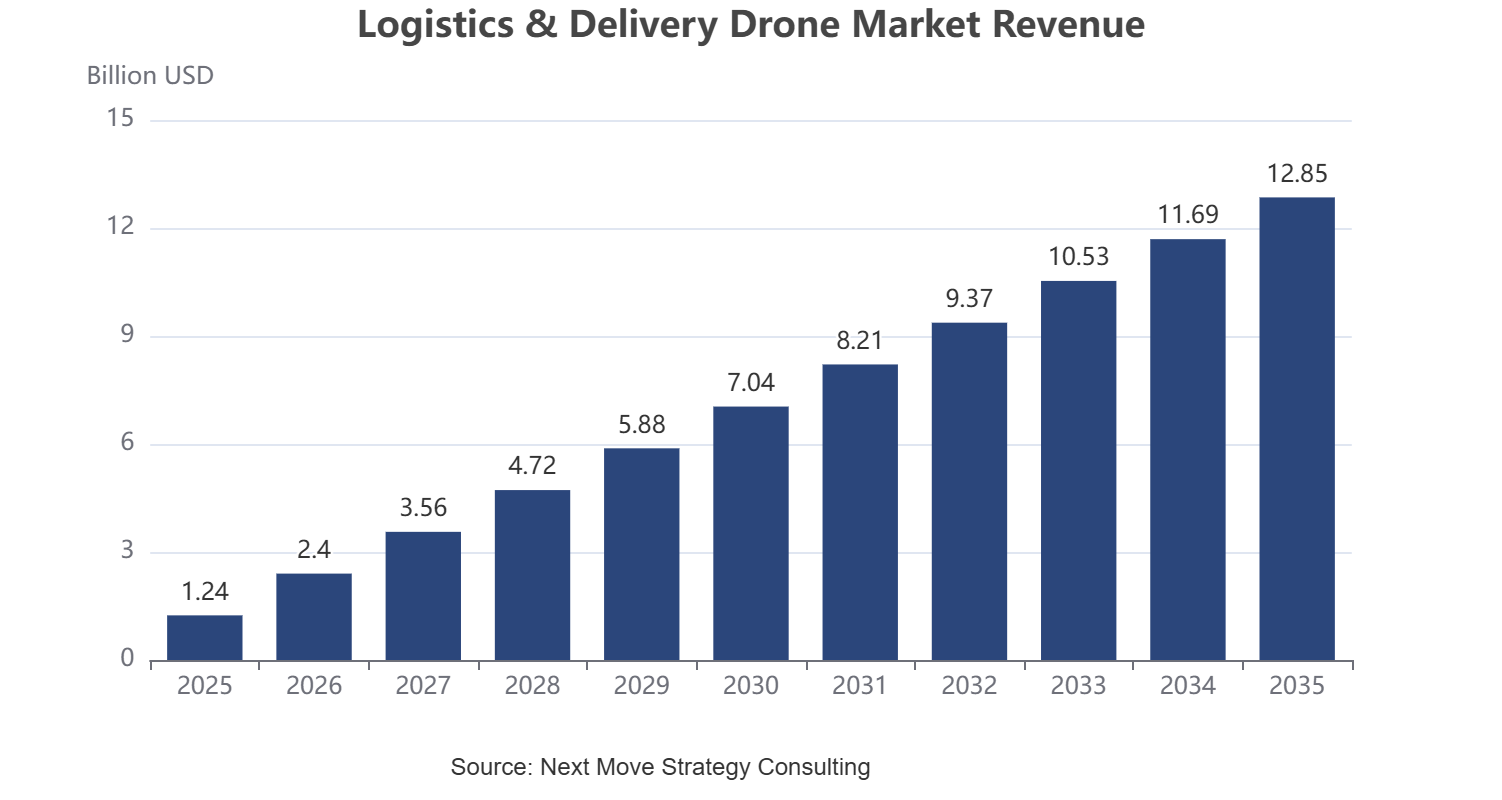
The global logistics & delivery drone market was valued at USD 1.24 billion in 2025 and is estimated at USD 1.58 billion in 2026, forecast to reach USD 12.85 billion by 2035, expanding at a 26.2% CAGR between 2026 and 2035. North America leads with approximately 35% share, while multi-rotor drones dominate all other drone types with approximately 47% share.
We observed that growth is broad-based across every segmentation axis, with software-driven fleet management platforms and healthcare delivery applications recording the steepest structural gains through the forecast window.
|
Key Takeaways |
|
By Drone Type: Multi- Rotor Drones held the largest share of approximately 47% (USD 0.58 billion) in 2025; Hybrid VTOL Drones is the fastest-growing sub-segment at 28.0% CAGR from 2026–2035. |
|
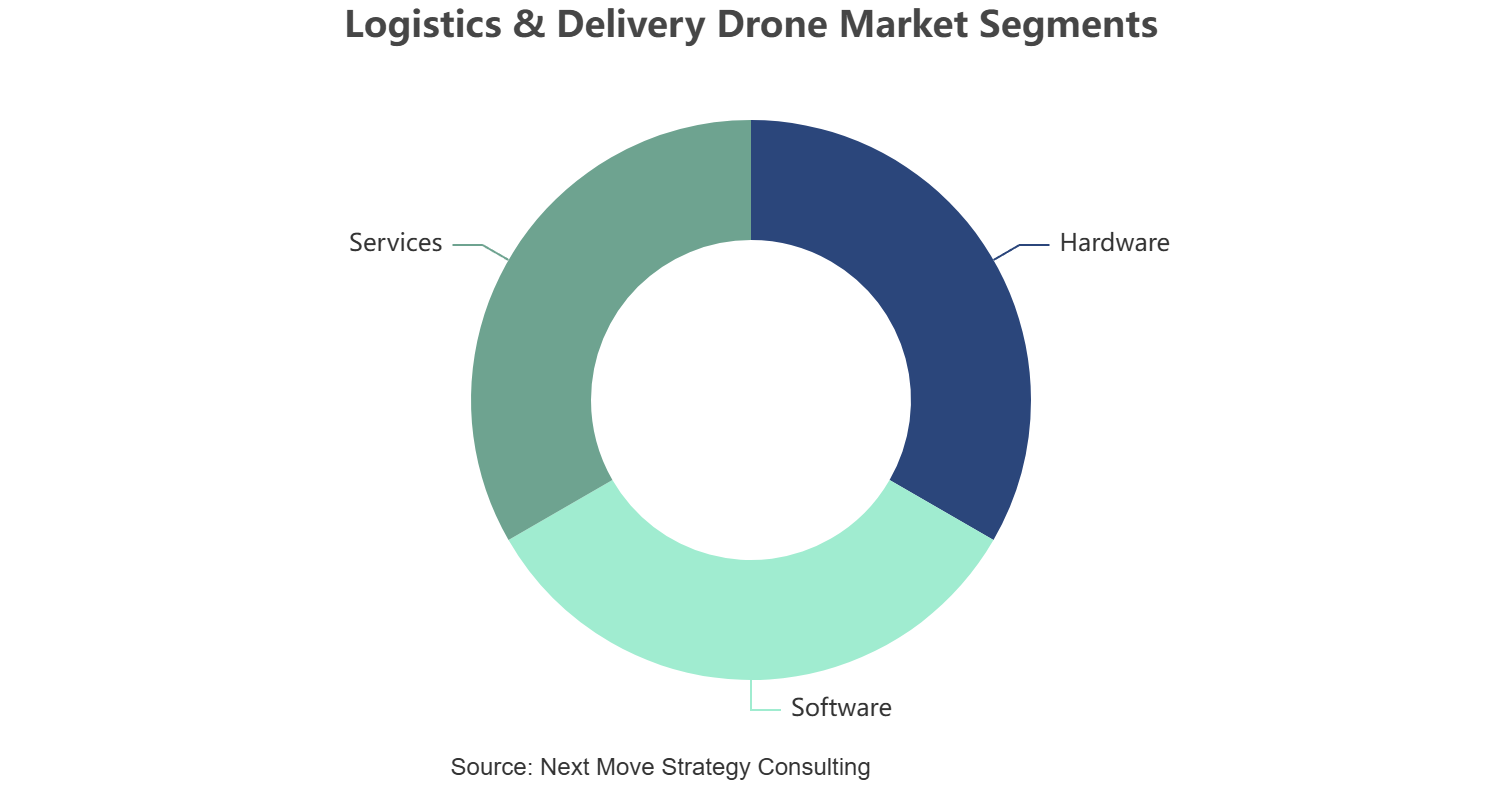
By Component: Hardware held the largest share of approximately 50% (USD 0.62 billion) in 2025; Software is the fastest-growing sub-segment at 29.0% CAGR from 2026–2035. |
|
By Payload Capacity: Up to 2 Kg held the largest share of approximately 44% (USD 0.55 billion) in 2025; Above 10 Kg is the fastest-growing sub-segment at 27.5% CAGR from 2026–2035. |
|
By Range: Short Range held the largest share of approximately 48% (USD 0.60 billion) in 2025; Long Range is the fastest-growing sub-segment at 28.0% CAGR from 2026–2035. |
|
By Application: E-Commerce and Retail Delivery held the largest share of approximately 37% (USD 0.46 billion) in 2025; Healthcare and Pharmaceutical Delivery is the fastest-growing sub-segment at 29.0% CAGR from 2026–2035. |
|
By End User: Logistics and Courier Service Providers held the largest share of approximately 39% (USD 0.48 billion) in 2025; Healthcare Providers is the fastest-growing sub-segment at 28.5% CAGR from 2026–2035. |
|
By Operation Mode: Semi-Autonomous held the largest share of approximately 42% (USD 0.52 billion) in 2025; Fully Autonomous is the fastest-growing sub-segment at 30.0% CAGR from 2026–2035. |
|
Dominant Region: North America dominated with approximately 35% revenue share (USD 0.43 billion) in 2025. |
|
Fastest-Growing Region: Asia-Pacific is expected to register the highest CAGR of 29.0% during 2026–2035. |
|
Dominant Country: U.S. led with approximately USD 0.36 billion in 2025. |
|
Fastest-Growing Country: India is the fastest-growing country at approximately 32.0% CAGR from 2026–2035. |
Market Opportunity: The logistics & delivery drone market is expected to create an absolute dollar opportunity of USD 11.27 billion between 2026 and 2035, presenting significant investment potential across the autonomous last-mile and middle-mile delivery value chain.
According to NMSC analysis, e-commerce retailers and food delivery platforms are increasingly co-investing in dedicated drone infrastructure alongside courier partners rather than relying solely on third-party operators, a shift that is compressing time-to-scale for regional delivery networks and reshaping vendor selection criteria across the industry through 2035.
What Does the Logistics & Delivery Drone Market Encompass?
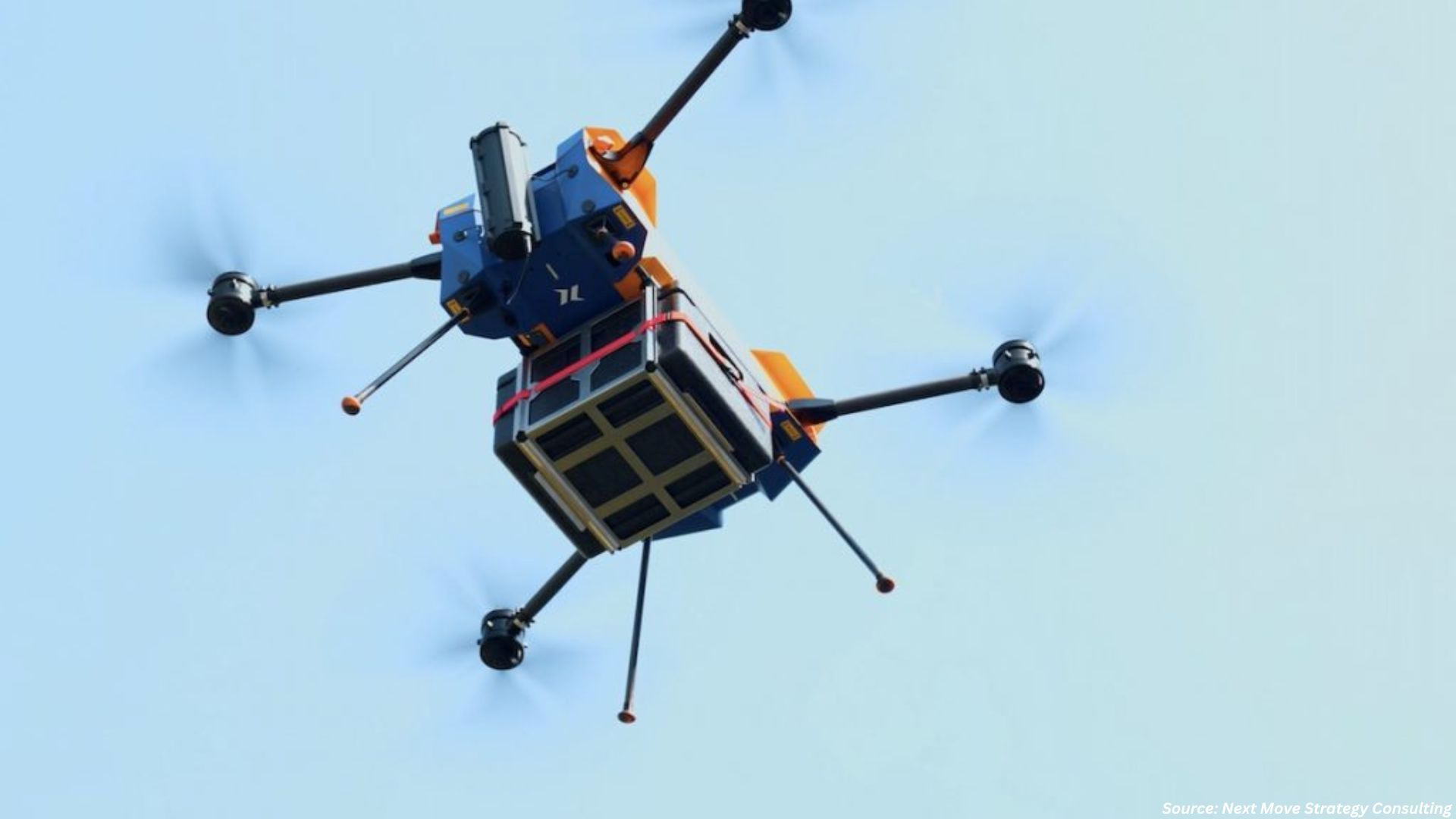
The logistics & delivery drone market encompasses hardware, software, and service offerings built around unmanned aerial vehicle platforms designed to transport parcels, food, and medical supplies without onboard human pilots. Our assessment indicates that the scope spans fixed-wing, multi-rotor, and hybrid VTOL airframes paired with fleet management, route optimization, and air traffic coordination software supplied to e-commerce companies, courier providers, retail chains, healthcare providers, and food delivery platforms across short, medium, and long-range missions. The category has evolved from experimental humanitarian medical delivery into a commercial, regulator-sanctioned discipline as urban e-commerce volumes and healthcare logistics demand accelerate.
Regulatory frameworks such as the U.S. Federal Aviation Administration's proposed Part 108 rule for beyond visual line of sight operations and the European Union Aviation Safety Agency's U-space framework shape inspection cadence, operating altitude, and detect-and-avoid requirements for commercial fleets. We observed that technology adoption is shifting toward autonomous, fully self-piloted delivery missions that reduce dependency on individual remote pilot certification. NMSC's analysis indicates that this structural shift, combined with retailer-backed infrastructure investment, is redefining procurement criteria across the logistics & delivery drone market.
|
Parameter |
Details |
|
Market Size in 2025 |
USD 1.24 Billion |
|
Market Size in 2026 |
USD 1.58 Billion |
|
Revenue Forecast in 2035 |
USD 12.85 Billion |
|
Growth Rate |
CAGR of 26.2% from 2026 to 2035 |
|
Analysis Period |
2025–2035 |
|
Base Year Considered |
2025 |
|
Forecast Period |
2026–2035 |
|
Market Size Estimation |
Revenue (USD Billion) |
|
Companies Profiled |
20 |
|
Countries Covered |
38 |
|
Market Share |
Available for Top 10 Companies |
Key Emerging Trends
Based on research conducted by NMSC, we found that four structural trends are reshaping product development, regulatory strategy, and stakeholder engagement across the industry.
How Is BVLOS Regulatory Approval Expanding Delivery Drone Operating Range?
Beyond visual line of sight approval is unlocking longer, unsupervised delivery routes that were previously limited by waiver-based oversight. We observed that the FAA's proposed Part 108 rule, published as a Notice of Proposed Rulemaking on August 7, 2025, would allow drones weighing up to 1,320 pounds to operate beyond visual line of sight under a standardized risk-based framework. Operators such as Zipline, Inc. and Wing Aviation LLC are positioning fleets to transition from case-by-case waivers into this scalable regulatory structure as the final rule advances toward publication.
How Are E-Commerce Platforms Integrating Drone Delivery into Last-Mile Networks?
Retailers are embedding drone delivery directly into last-mile delivery fulfillment rather than treating it as a pilot program. Our findings suggest that Wing Aviation LLC's expansion with Walmart to an additional 150 stores, targeting 270 total locations by 2027, illustrates how national retail chains are scaling drone delivery as a mainstream fulfillment channel. This trend is elevating demand for curbside autoloading infrastructure and dense urban vertiport networks among logistics and courier service providers.
Why Is Middle-Mile Cargo Drone Delivery Gaining Commercial Traction?
Middle-mile cargo drones are emerging as a distinct category alongside last-mile delivery, targeting regional distribution routes between warehouses and fulfillment hubs. We found that Dronamics Ltd. is commercializing fixed-wing cargo drone flights designed to replace short-haul trucking and light aircraft on regional freight corridors. Postal operators and EPC-linked logistics providers are piloting middle-mile drone corridors to reduce transit time on routes underserved by conventional freight infrastructure.
How Is AI-Based Autonomous Navigation Reducing Delivery Drone Operating Costs?
AI-based autonomous navigation is reducing the operator-to-drone ratio required for commercial fleets, directly lowering per-delivery operating costs. Our analysis shows that Matternet, Inc.'s autonomous flight software enables single operators to monitor multiple simultaneous missions across healthcare and retail delivery corridors. This trend is accelerating adoption among cost-sensitive courier providers seeking to scale delivery volume without proportionally scaling remote pilot headcount.
Growth Drivers and Restraints
Growth Catalyst and Risk Assessment Matrix
|
Factors |
Type |
(+/-) % Impact on CAGR |
Geographic Relevance |
Impact Timeline |
|
Rising e-commerce last-mile delivery volumes requiring faster fulfillment |
Driver |
+2.6% |
Global |
2026–2035 |
|
Regulatory approval of BVLOS drone delivery operations |
Driver |
+2.2% |
North America, Europe |
2026–2035 |
|
Expanding healthcare and pharmaceutical drone delivery corridors |
Driver |
+1.8% |
Global |
2028–2035 |
|
Falling cost of autonomous flight and battery technology |
Driver |
+1.6% |
Global |
2026–2032 |
|
Urban congestion driving demand for aerial logistics alternatives |
Driver |
+1.3% |
Asia-Pacific, Europe |
2026–2035 |
|
Growing food delivery platform investment in drone fleets |
Driver |
+1.1% |
Global |
2026–2033 |
|
Airspace integration and air traffic management complexity |
Restraint |
-1.2% |
Global |
2026–2032 |
|
Public acceptance and noise concerns limiting urban deployment |
Restraint |
-0.8% |
North America, Europe |
2026–2035 |
|
High infrastructure cost for vertiport and charging networks |
Restraint |
-0.6% |
Global |
2026–2030 |
What Is the Primary Growth Driver of the Logistics & Delivery Drone Market?
Rising e-commerce last-mile delivery volumes requiring faster fulfillment is the primary driver of the market. The U.S. Census Bureau continues to report sustained growth in e-commerce retail sales, a trend that directly increases demand for expedited, low-cost last-mile options. We observed that this expansion, reinforced by rising supply chain management digitization among retailers, continues to anchor baseline demand for delivery drone hardware and fleet software across developed and emerging markets alike.
How Is BVLOS Rulemaking Driving Logistics & Delivery Drone Market Growth?
Regulatory progress on beyond visual line of sight operations is accelerating commercial deployment by replacing costly, case-by-case waivers with a standardized framework. The FAA's Notice of Proposed Rulemaking for Part 108, published in August 2025, drew more than 3,000 public comments during its 60-day comment period. Our assessment indicates that this regulatory clarity, combined with similar U-space developments in Europe, is compressing adoption timelines for autonomous delivery fleets across North America and the European Union.
What Is Restraining Logistics & Delivery Drone Market Expansion?
Airspace integration and air traffic management complexity restrains adoption among smaller courier operators and regional logistics providers lacking dedicated detect-and-avoid infrastructure. The U.S. Federal Aviation Administration's ongoing rulemaking process continues to document integration requirements between manned and unmanned aircraft. We found that operators without established regulatory relationships face particular exposure, as certification timelines reduce the near-term return on investment compared with early-mover national retail partnerships.
Segmentation Analysis
Segment Sizing: By Drone Type
|
Segment |
2025 (USD) |
2035 (USD) |
CAGR% (2026–2035) |
|
Fixed-Wing Drones |
USD 0.38 Billion |
USD 4.00 Billion |
26.6% |
|
Multi-Rotor Drones |
USD 0.58 Billion |
USD 5.44 Billion |
25.0% |
|
Hybrid VTOL Drones |
USD 0.28 Billion |
USD 3.42 Billion |
28.0% |
|
Total |
USD 1.24 Billion |
USD 12.85 Billion |
26.2% |
Which Drone Type Dominates the Logistics & Delivery Drone Market?
Multi-Rotor Drones led the market with USD 0.58 billion in 2025, supported by their vertical takeoff capability and suitability for dense urban last-mile delivery routes that do not require runway infrastructure. We observed that Hybrid VTOL Drones are the fastest-growing drone type, expanding at a 28.0% CAGR from 2026 to 2035, as operators increasingly value the combination of vertical launch flexibility with fixed-wing-level range for suburban and semi-rural delivery corridors.
Segment Sizing: By Component
|
Segment |
2025 (USD) |
2035 (USD) |
CAGR% (2026–2035) |
|
Hardware |
USD 0.62 Billion |
USD 5.52 Billion |
24.5% |
|
Software |
USD 0.34 Billion |
USD 4.45 Billion |
29.0% |
|
Services |
USD 0.28 Billion |
USD 2.88 Billion |
26.0% |
|
Total |
USD 1.24 Billion |
USD 12.85 Billion |
26.2% |
Which Component Segment Leads Logistics & Delivery Drone Market Demand?
Hardware remained the leading component within the market, valued at USD 0.62 billion in 2025 on the strength of airframe, propulsion, and GPS tracking sensor demand across every deployed fleet. Our findings suggest that Software is the fastest-growing component, registering a 29.0% CAGR from 2026 to 2035, as fleet management, route optimization, and air traffic coordination platforms increasingly capture recurring subscription revenue from logistics and courier service providers.
Segment Sizing: By ApplicationSegment
|
Segment |
2025 (USD) |
2035 (USD) |
CAGR% (2026–2035) |
|
E-Commerce and Retail Delivery |
USD 0.46 Billion |
USD 4.64 Billion |
26.0% |
|
Food and Beverage Delivery |
USD 0.28 Billion |
USD 3.09 Billion |
27.0% |
|
Healthcare and Pharmaceutical Delivery |
USD 0.24 Billion |
USD 3.06 Billion |
29.0% |
|
Postal and Parcel Delivery |
USD 0.16 Billion |
USD 1.15 Billion |
21.5% |
|
Industrial and Warehouse Logistics |
USD 0.10 Billion |
USD 0.90 Billion |
24.0% |
|
Total |
USD 1.24 Billion |
USD 12.85 Billion |
26.2% |
Which Application Leads Logistics & Delivery Drone Market Demand?
E-Commerce and Retail Delivery remained the leading application, valued at USD 0.46 billion in 2025, reflecting large retail chains' direct investment in dedicated drone infrastructure. Our analysis shows that Healthcare and Pharmaceutical Delivery is the fastest-growing application, registering a 29.0% CAGR from 2026 to 2035, as regulatory bodies increasingly approve medical drone corridors for time-sensitive diagnostic and pharmaceutical logistics.
Ecosystem Analysis of the Logistics & Delivery Drone Market
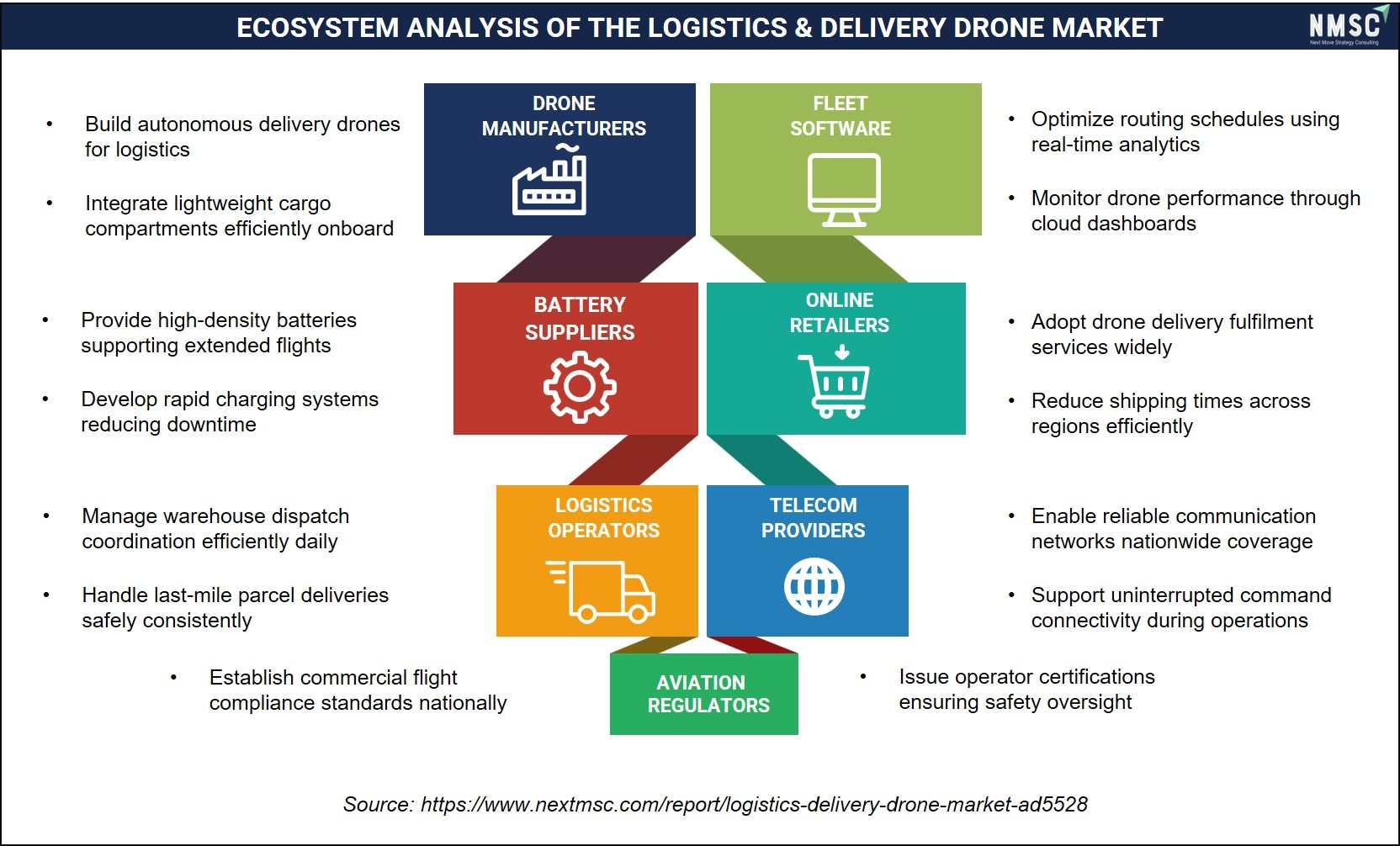
The logistics and delivery drone market ecosystem comprises drone manufacturers, battery suppliers, fleet software providers, telecom operators, logistics companies, online retailers, and aviation regulators. Collaboration among these stakeholders supports drone development, connectivity, fleet management, regulatory compliance, and last-mile delivery operations, creating an integrated ecosystem that accelerates commercial adoption and operational efficiency.
Growth Opportunities
Our analysis shows that three forward-looking opportunities stand out for stakeholders positioning within the logistics & delivery drone market over the 2026–2035 forecast period.
How Can Middle-Mile Cargo Drone Networks Unlock New Revenue?
Middle-mile cargo drone networks present a whitespace opportunity for fixed-wing manufacturers serving regional distribution routes underserved by conventional freight. Suppliers that commercialize scheduled cargo drone service between fulfillment hubs stand to capture recurring contract revenue from postal operators and EPC-linked logistics providers seeking faster inter-city transit than ground freight.
Where Do Fleet Management Software Platforms Create Recurring Revenue?
Fleet management and route optimization software represent an underpenetrated opportunity for software vendors serving multi-operator delivery networks. Vendors that integrate drone fleet management with air traffic coordination can secure long-term subscription contracts with e-commerce companies and courier providers managing large regional operating footprints.
How Can Vertiport Infrastructure Partnerships Reduce Deployment Costs?
Shared vertiport and charging infrastructure partnerships create an opportunity for logistics providers seeking to reduce individual deployment capital costs. Early movers that co-invest in shared urban launch and recovery infrastructure with retail chains and food delivery platforms can differentiate on speed to market while distributing fixed infrastructure costs across multiple operators.
Regional Outlook
Geographic Performance Snapshot
|
Region |
2025 (USD) |
2035 (USD) |
CAGR% (2026–2035) |
Key Driver |
|
North America |
USD 0.43 Billion |
USD 3.76 Billion |
23.8% |
BVLOS regulatory clarity and national retail chain adoption |
|
Asia-Pacific |
USD 0.35 Billion |
USD 4.55 Billion |
29.0% |
Rapid e-commerce growth and dense urban delivery demand |
|
Europe |
USD 0.27 Billion |
USD 2.72 Billion |
26.0% |
U-space airspace integration and healthcare delivery pilots |
|
Middle East & Africa |
USD 0.11 Billion |
USD 1.20 Billion |
27.0% |
Government-backed smart logistics and Vision 2030-linked investment |
|
Latin America |
USD 0.08 Billion |
USD 0.62 Billion |
24.0% |
Expanding e-commerce logistics infrastructure in Brazil and Argentina |
|
Total |
USD 1.24 Billion |
USD 12.85 Billion |
26.2% |
– |
North America Logistics & Delivery Drone Market Outlook
North America leads the logistics & delivery drone market on the strength of advancing BVLOS regulatory clarity and large-scale national retail partnerships. We observed that the FAA's proposed Part 108 framework is accelerating fleet expansion among established operators serving major grocery and retail chains. Technology adoption remains advanced, with autonomous flight software and curbside autoloading infrastructure gaining traction among the region's largest delivery networks.
Asia-Pacific Logistics & Delivery Drone Market Outlook
Asia-Pacific is the fastest-growing logistics & delivery drone market region, propelled by dense urban e-commerce volumes and large domestic courier networks in China and India. Our findings suggest that regional aviation authorities are gradually formalizing commercial drone corridors to support growing delivery volume. Technology adoption is accelerating as regional manufacturers scale hardware production to serve both domestic and export delivery markets.
Europe Logistics & Delivery Drone Market Outlook
Europe's logistics & delivery drone market reflects steady growth under the European Union Aviation Safety Agency's U-space airspace integration framework. We found that healthcare and pharmaceutical delivery pilots are expanding across several member states alongside retail delivery trials. Technology adoption favors software-driven air traffic coordination, supported by regional manufacturers and software vendors serving courier providers and healthcare systems.
Middle East & Africa Logistics & Delivery Drone Market Outlook
The logistics & delivery drone market in Middle East & Africa is expanding as Gulf Cooperation Council economies invest in smart logistics infrastructure. Our analysis shows that Saudi Arabia and the UAE are attracting delivery drone technology investment tied to national digital logistics strategies. Regulatory influence remains developing, while technology adoption is gradually shifting toward imported autonomous delivery hardware and software.
Latin America Logistics & Delivery Drone Market Outlook
Latin America's logistics & delivery drone market is supported by expanding e-commerce logistics infrastructure in Brazil and Argentina and growing multinational courier presence. We observed that regulatory frameworks are less stringent than in North America or Europe, though multinational e-commerce companies operating locally are introducing drone delivery pilots. Technology adoption remains centered on short-range parcel delivery, with competitive intensity increasing as global providers expand regional service networks.
U.S. Logistics & Delivery Drone Market
Based on our estimates, the U.S. market was valued at approximately USD 0.36 billion in 2025 and is projected to reach USD 3.10 billion by 2035, growing at a 23.6% CAGR. Demand is anchored by national retail chain drone delivery partnerships and Federal Aviation Administration BVLOS regulatory progress. Technology penetration favors autonomous fleet software, and competitive intensity remains high among established operators serving national e-commerce and food delivery brands.
Canada Logistics & Delivery Drone Market
The market in Canada reached roughly USD 0.06 billion in 2025 and is forecast to hit USD 0.58 billion by 2035 at a 24.6% CAGR. Demand structure mirrors U.S. suburban delivery patterns, while Canadian aviation regulation shapes drone corridor specifications. Technology penetration is rising as national retailers request autonomous delivery pilots, with competitive intensity moderate given reliance on cross-border operator partnerships.
UK Logistics & Delivery Drone Market
As per our estimate, the UK market stood at about USD 0.07 billion in 2025, advancing toward USD 0.74 billion by 2035 at a 26.4% CAGR. Demand is driven by healthcare delivery pilots navigating Civil Aviation Authority drone rules. Regulatory influence is significant, technology penetration favors autonomous urban delivery platforms, and competitive intensity remains steady among domestic and European operators.
Germany Logistics & Delivery Drone Market
According to our analysis, Germany's market was valued near USD 0.06 billion in 2025 and is set to reach USD 0.62 billion by 2035, expanding at a 26.5% CAGR. Demand structure benefits from a strong domestic e-commerce logistics base. Germany's U-space airspace integration requirements drive regulatory influence, while technology penetration favors autonomous fleet coordination among leading suppliers.
France Logistics & Delivery Drone Market
Based on our estimates, France's market reached approximately USD 0.04 billion in 2025, projected to climb to USD 0.40 billion by 2035 at a 26.0% CAGR. Demand is supported by France's expanding retail delivery pilots, which shape autonomous drone adoption. Regulatory influence from French aviation authorities is notable, and competitive intensity remains high given the concentration of European delivery specialists.
China Logistics & Delivery Drone Market
The market in China stood at roughly USD 0.15 billion in 2025 and is forecast to reach USD 2.35 billion by 2035, registering a 31.5% CAGR. Demand is fueled by the world's largest e-commerce delivery volumes and a dense base of regional drone manufacturers. Regulatory influence is increasing gradually, technology penetration is accelerating through domestic production, and competitive intensity remains elevated among numerous China-based operators.
India Logistics & Delivery Drone Market
As per our estimate, India's market was valued at about USD 0.045 billion in 2025, projected to reach USD 0.75 billion by 2035 at a 32.0% CAGR, the fastest among covered countries. Demand structure reflects rapid e-commerce and food delivery expansion alongside rising adoption of automated logistics. Regulatory influence remains developing, while technology penetration is rising quickly as domestic and multinational operators localize drone delivery services to serve India's growing consumer base.
Japan Logistics & Delivery Drone Market
According to our analysis, Japan's market reached close to USD 0.05 billion in 2025 and is expected to hit USD 0.55 billion by 2035, growing at a 27.0% CAGR. Demand is supported by Japan's aging rural population and government-backed delivery drone pilots. Regulatory influence is well established, technology penetration is advanced, and competitive intensity remains high among long-standing domestic and international operators.
South Korea Logistics & Delivery Drone Market
Based on our estimates, South Korea's market stood at approximately USD 0.035 billion in 2025, forecast to reach USD 0.40 billion by 2035 at a 27.5% CAGR. Demand structure benefits from the country's dense urban delivery demand and government-backed smart logistics targets. Technology penetration is rising, with domestic suppliers partnering with global delivery platforms, and competitive intensity remains pronounced amid rapid volume growth.
Australia Logistics & Delivery Drone Market
The logistics & delivery drone market in Australia reached about USD 0.03 billion in 2025 and is projected to reach USD 0.32 billion by 2035, expanding at a 26.7% CAGR. Demand is supported by growing suburban and regional delivery demand and increasing retailer focus on automated fulfillment. Regulatory influence stems from the Civil Aviation Safety Authority's drone rules, while technology penetration favors imported autonomous delivery systems amid moderate competitive intensity.
UAE Logistics & Delivery Drone Market
As per our estimate, the UAE market was valued near USD 0.025 billion in 2025, projected to reach USD 0.29 billion by 2035 at a 27.8% CAGR. Demand structure is shaped by the UAE's role as a regional smart logistics investment hub. Regulatory influence remains moderate, technology penetration is improving through imported delivery platforms, and competitive intensity is rising as providers expand service portfolios to serve Gulf markets.
Saudi Arabia Logistics & Delivery Drone Market
According to our analysis, Saudi Arabia's market reached roughly USD 0.03 billion in 2025 and is expected to hit USD 0.34 billion by 2035, growing at a 27.6% CAGR. Demand is driven by Vision 2030-linked digital logistics investment and rising e-commerce delivery volume. Regulatory influence is developing, and technology penetration is advancing as domestic operators partner with international delivery technology providers.
South Africa Logistics & Delivery Drone Market
Based on our estimates, South Africa's market stood at about USD 0.015 billion in 2025, forecast to reach USD 0.15 billion by 2035 at a 25.8% CAGR. Demand structure reflects a developing e-commerce logistics base serving regional Southern African markets. Regulatory influence remains moderate, technology penetration is gradually improving, and competitive intensity is limited given reliance on imported delivery drone technology.
Brazil Logistics & Delivery Drone Market
The market in Brazil reached approximately USD 0.04 billion in 2025 and is projected to reach USD 0.33 billion by 2035, registering a 24.8% CAGR. Demand is underpinned by Brazil's large domestic e-commerce base and expanding courier service presence. Regulatory influence stems from national civil aviation drone rules, technology penetration favors short-range parcel delivery, and competitive intensity remains moderate among regional providers.
Argentina Logistics & Delivery Drone Market
As per our estimate, Argentina's market was valued near USD 0.013 billion in 2025, projected to reach USD 0.10 billion by 2035 at a 23.5% CAGR. Demand structure is supported by steady e-commerce growth despite macroeconomic volatility. Regulatory influence remains limited, technology penetration is modest, and competitive intensity is centered on a small number of regional distributors serving domestic courier operators.
Regulatory Framework Impacting the Logistics & Delivery Drone Market
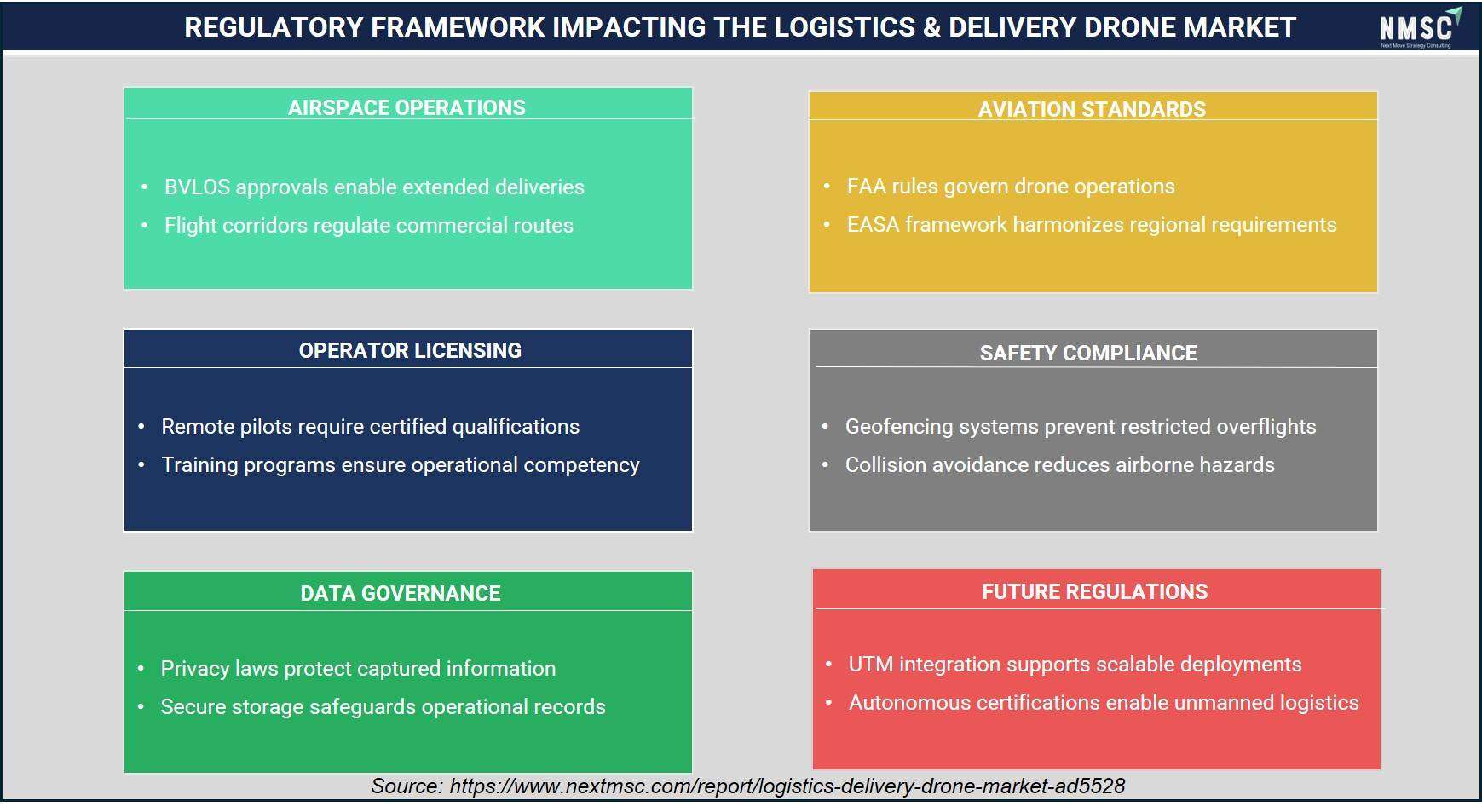
The regulatory framework for the logistics and delivery drone market establishes the standards required for safe, scalable, and compliant operations. Airspace management, aviation regulations, operator certification, safety requirements, data governance, and evolving autonomous flight policies collectively enable commercial deployment while ensuring operational reliability, public safety, regulatory compliance, and sustainable market expansion.
Competitive Landscape
We observed that the logistics & delivery drone market features a moderately fragmented competitive landscape, with global autonomous delivery specialists competing alongside regional and e-commerce-affiliated operators on range, payload, and regulatory approval scale.
|
Key Takeaways |
|
Market Structure: Moderately fragmented; a handful of established autonomous delivery operators profiled in this report collectively serve a majority of large retail and healthcare delivery contracts, while numerous regional and e-commerce-affiliated operators serve localized delivery demand. |
|
Innovation Focus: Autonomous flight software, curbside autoloading infrastructure, and BVLOS certification dominate current innovation pipelines across leading operators. |
|
M&A Activity: Selective consolidation and capital raises, exemplified by Zipline, Inc.'s USD 600 million funding round to scale U.S. delivery operations across additional metro markets. |
How Do Companies Compete in the Logistics & Delivery Drone Market?
Companies compete primarily on delivery speed, regulatory approval scale, and breadth of retail and healthcare partnerships across the industry. Global players such as Zipline, Inc. and Wing Aviation LLC leverage large-scale BVLOS operating authority to serve multinational retail chains, while regional providers compete on cost efficiency and rapid deployment for localized short-range delivery supplied to smaller courier operators.
Which Competitive Archetypes Dominate the Logistics & Delivery Drone Market?
Two archetypes dominate the market: retail-integrated autonomous delivery platform operators offering end-to-end fulfillment services, and specialized hardware and software manufacturers focused on airframes, fleet management, or navigation systems. Zipline, Inc. and Wing Aviation LLC exemplify the retail-integrated archetype through direct national partnerships, while Matternet, Inc. and Dronamics Ltd. exemplify the specialized hardware and software archetype serving niche medical and cargo delivery demand.
How Are Companies Differentiating Through Innovation in Logistics & Delivery Drone Operations?
Innovation and differentiation strategy increasingly center on autonomous flight software and infrastructure that reduces per-delivery operating cost. Wing Aviation LLC's curbside Autoloader technology and Zipline, Inc.'s Platform 2 home delivery system both aim to shorten order-to-delivery time while minimizing manual handling. Our analysis shows that operators unable to demonstrate credible BVLOS operating scale risk exclusion from large national retail vendor shortlists.
What M&A and Expansion Activity Is Shaping the Logistics & Delivery Drone Market?
Capital raises, partnerships, and geographic expansion continue to consolidate delivery capabilities within the industry. Zipline, Inc.'s USD 600 million funding round supported expansion into Houston and Phoenix, while Wing Aviation LLC's national expansion with Walmart to 270 total locations by 2027 illustrates how retail-integrated operators pursue rapid geographic scale-up across the United States.
Key Market Players
Our assessment indicates that the following 20 companies are actively shaping fleet expansion, regulatory strategy, and autonomous flight capability development within the global logistics & delivery drone market.
-
Zipline International Inc.
-
Wing Aviation LLC
-
Amazon.com, Inc.
-
Matternet, Inc.
-
Flytrex Inc.
-
Manna Aero Limited
-
DroneUp, LLC
-
Wingcopter GmbH
-
Skyports Limited
-
Meituan
-
SF Holding Co., Ltd.
-
JD.com, Inc.
-
EHang Holdings Limited
-
Antwork Technology (Hangzhou) Co., Ltd.
-
Volatus Aerospace Corp.
-
Elroy Air, Inc.
-
Rakuten Group, Inc.
-
Terra Drone Corporation
-
Dronamics Global Limited
Latest Developments
We found that recent expansion announcements and regulatory milestones within the logistics & delivery drone market are concentrated on national retail scale-up and BVLOS rulemaking progress, reflecting the industry's broader shift toward mainstream commercial deployment.
|
Date |
Event |
|
Jul 2026 |
Zipline partnered with BayCare to establish a drone delivery network across West Central Florida for healthcare logistics and medical deliveries, with commercial operations planned from late 2027. |
|
Mar 2026 |
Wing announced expansion of its commercial drone delivery service into the San Francisco Bay Area, extending its U.S. last-mile delivery network. |
|
Sept 2025 |
Uber announced a strategic partnership and investment in Flytrex to launch Uber Eats drone delivery services in selected U.S. markets. |
|
Jun 2025 |
DoorDash and Flytrex officially launched commercial drone delivery services across the Dallas–Fort Worth metropolitan area. |
Expert Insights
 “We have built the closest thing to teleportation ever created—a smooth, ultrafast, convenient, and truly magical autonomous logistics system that serves all people equally, wherever they are.”
— Keller Rinaudo Cliffton, Co-founder & CEO, Zipline
Statement made during the official launch of Zipline's Platform 2 autonomous home delivery system (March 2023), introducing the company's next-generation autonomous drone delivery platform for scalable last-mile logistics.
Market Interpretation
The quote reflects the logistics and delivery drone industry's vision of transforming last-mile delivery through autonomous aerial logistics. It emphasizes the growing shift toward faster, highly automated, and customer-centric delivery networks capable of reducing delivery times, improving accessibility, and lowering dependence on conventional ground transportation. The statement also highlights the market's long-term trajectory toward scalable autonomous logistics infrastructure that can support expanding e-commerce, healthcare, and retail delivery applications.
Investment Opportunities
What Capital Inflows Are Targeting the Logistics & Delivery Drone Market?
Capital inflows into the logistics & delivery drone market are increasingly directed toward fleet expansion and autonomous flight software development. Venture and strategic investors continue to fund scale-up, as seen in Zipline, Inc.'s USD 600 million funding round supporting new U.S. metro launches. We observed that investors favor operators demonstrating validated BVLOS operating scale, viewing regulatory approval history as a durable competitive moat.
How Is Infrastructure Investment Supporting Logistics & Delivery Drone Deployment?
Infrastructure investment is expanding vertiport networks and curbside autoloading systems to serve rising delivery volumes across major U.S. and European metros. Our findings suggest that operators are investing in dedicated launch and recovery infrastructure at partner retail locations to reduce per-delivery turnaround time, supporting the throughput required for national-scale drone delivery networks.
What ESG Considerations Are Shaping Logistics & Delivery Drone Investment Decisions?
Environmental, social, and governance considerations are central to investment decisions across the industry, with emissions reduction and community noise management as key criteria. Regulatory bodies including the FAA continue to evaluate noise and airspace safety standards for urban drone operations. We found that investors increasingly favor operators that demonstrate lower per-delivery carbon emissions compared with ground vehicle fulfillment, treating this efficiency as a governance and sustainability indicator.
Key Benefits for Stakeholders
How Does This Report Benefit Enterprise and Industry Leaders?
Enterprise and industry leaders gain access to validated segmentation, competitive benchmarking, and regional demand forecasts that support sourcing and technology-partnership decisions across the logistics & delivery drone industry. Our analysis shows that detailed drone type, component, and application breakdowns help procurement teams align specifications with regulatory and operational requirements while identifying underserved application segments for network expansion.
How Does This Report Benefit Investors and Financial Analysts?
Investors and financial analysts benefit from consistent, single-point market size and CAGR estimates that support valuation and capital-allocation decisions across the logistics & delivery drone market supply chain. We observed that the report's regional and segment-level growth differentials help identify which hardware, software, and service providers are best positioned to capture above-market growth through 2035.
How Does This Report Benefit Technology Vendors and Product Teams?
Technology vendors and product teams gain insight into emerging design requirements, including BVLOS-compliant detect-and-avoid systems and fleet coordination software, that are reshaping the industry. Our findings suggest that this analysis helps R&D teams prioritize development roadmaps around autonomous navigation and payload flexibility increasingly required by retail and healthcare delivery partner procurement processes.
Key Market Segments
By Drone Type
-
Fixed-Wing Drones
-
Multi-Rotor Drones
-
Hybrid VTOL Drones
By Component
-
Hardware
-
Airframe
-
Propulsion System
-
Battery and Power System
-
Camera and Sensors
-
Flight Controller
-
-
Software
-
Fleet Management Software
-
Route Optimization Software
-
Air Traffic Management Software
-
-
Services
-
Maintenance and Repair Services
-
Training and Certification Services
-
Insurance Services
-
By Payload Capacity
-
Up to 2 Kg
-
2 to 10 Kg
-
Above 10 Kg
By Range
-
Short Range (Up to 10 Km)
-
Medium Range (10 to 30 Km)
-
Long Range (Above 30 Km)
By Application
-
E-Commerce and Retail Delivery
-
Food and Beverage Delivery
-
Healthcare and Pharmaceutical Delivery
-
Postal and Parcel Delivery
-
Industrial and Warehouse Logistics
By End User
-
E-Commerce Companies
-
Logistics and Courier Service Providers
-
Retail Chains
-
Healthcare Providers
-
Food Delivery Platforms
By Operation Mode
-
Remotely Piloted
-
Semi-Autonomous
-
Fully Autonomous
By Region
-
North America: U.S., Canada, Mexico
-
Europe: UK, Germany, France, Italy, Spain, Sweden, Denmark, Finland, Netherlands, Rest of Europe
-
Asia-Pacific: China, India, Japan, South Korea, Taiwan, Indonesia, Vietnam,Australia, Philippines, Malaysia, Rest of APAC
-
Middle East & Africa: Saudi Arabia, UAE, Egypt, Israel, Turkey, Nigeria, South Africa, Rest of MEA
-
Latin America: Brazil, Argentina, Chile, Colombia, Rest of LATAM
Conclusion and Recommendations
What Is the Long-Term Outlook for the Logistics & Delivery Drone Market?
The long-term outlook for the market remains highly positive, with global revenue projected to expand more than tenfold from USD 1.24 billion in 2025 to USD 12.85 billion by 2035 at a 26.2% CAGR. We observed that sustained e-commerce growth, advancing BVLOS regulation, and accelerating healthcare delivery adoption will continue underpinning demand across hardware, software, and services applications through the forecast period.
What Strategic Positioning Should Logistics & Delivery Drone Suppliers Pursue?
Suppliers should prioritize integrated hardware-to-software platforms while pursuing BVLOS certification scale to secure long-term national retail and healthcare contracts. Our assessment indicates that providers investing early in autonomous fleet software and curbside infrastructure will be best positioned to capture premium pricing within the logistics & delivery drone market.
How Attractive Is the Logistics & Delivery Drone Market for New Investment?
The logistics & delivery drone industry presents an attractive investment case, supported by a USD 11.27 billion absolute dollar opportunity between 2026 and 2035 and above-average growth in Asia-Pacific and software categories. We found that investment attractiveness is highest for operators combining regulatory approval scale with national retail partnerships, positioning them to serve both cost-sensitive short-range and premium healthcare delivery segments simultaneously.
What Market Shifts and Key Risks Should Stakeholders Monitor?
Stakeholders should monitor airspace integration complexity, public acceptance of urban drone noise, and high vertiport infrastructure costs as key risks to the logistics & delivery drone market. Our analysis shows that operators unable to demonstrate validated BVLOS operating scale risk losing procurement shortlists to competitors with larger proprietary regulatory track records, particularly within North America's increasingly certification-driven delivery environment.
What Are the Key Growth Pathways for the Logistics & Delivery Drone Market?
Key growth pathways include expanding BVLOS-certified fleet capacity, scaling autonomous fleet management subscription revenue, and deepening penetration into healthcare and middle-mile cargo channels. NMSC's analysis indicates that suppliers pursuing these pathways while maintaining cost competitiveness in standard short-range hardware categories will be best positioned to capture the logistics & delivery drone market's projected growth through 2035.
About the Author

About the Reviewer

At Next Move Strategy Consulting, we understand that insightful market research is the cornerstone of successful business decisions. That's why we employ a robust and multifaceted approach, combining various methodologies to deliver the most accurate and actionable data for our clients.

Research Landscape
We navigate the world of research with two primary approaches:
Qualitative Approach
Our qualitative research methodologies involve immersive techniques such as in-depth interviews, focus groups, and observational studies. By engaging directly with individuals and stakeholders, we uncover valuable insights that quantitative data alone may overlook.

Quantitative Research
In tandem with qualitative methodologies, NMSC leverages the power of Quantitative Research to provide a robust foundation of numerical insights. Through systematic data collection and analysis, we quantify patterns, preferences, and market trends, offering a comprehensive view of the business landscape.
Our quantitative research approach employs diverse tools, including surveys, experiments, and statistical modelling. These methodologies enable us to gather data from a large and representative sample, ensuring the statistical significance of our findings. By employing structured questionnaires and standardized data collection methods, we guarantee the reliability and validity of the information we present to our clients.
Quantitative research is particularly effective in measuring the prevalence of trends, assessing market size, and gauging the impact of various factors on consumer behavior. The numerical precision attained through this approach equips our clients with actionable insights, facilitating data-driven decision-making and strategy formulation.


Our Specialized Toolbox for Industry-Specific Market Research
We deploy a specialized arsenal of techniques tailored to meet your unique requirements. Here's a glimpse into our comprehensive toolbox:

Information Procurement
The stage entails acquiring market data or relevant information through various sources and methodologies.


Market Research Approach
We utilize both top-down and bottom-up approaches in market research analysis to achieve a comprehensive understanding of the market dynamics, leveraging the broad perspective of industry trends and macroeconomic factors alongside detailed insights from specific segments and individual companies.

Porters Five Forces Analysis
We conduct Porter's Five Forces analysis to evaluate the competitive landscape of an industry, providing us with insights into factors that affect profitability and strategic positioning.

SWOT Analysis

Forecasting
We utilize a forecasting model to predict future consumption by considering parameters like population, economics, regulations, market competition, drivers, constraints, technology, and pricing. We also employ statistical techniques such as multilinear regression, exponential smoothing, moving average, ARIMA, and Monte Carlo simulations for accurate predictions. In econometric forecasting, we analyzed short-term and long-term event impacts, attributing values based on regulatory frameworks, economic factors, and market events.





 Speak to Our Analyst