Logistics Insurance Market Global Industry Analysis and Forecast (2026–2035)

The global Logistics Insurance Market size was valued at USD 41.6 billion in 2025 and is estimated at USD 45.0 billion in 2026, forecast to reach USD 93.1 billion by 2035, expanding at an 8.4% CAGR between 2026 and 2035. North America leads with approximately 33% share, while Cargo and Freight Insurance dominates all other insurance types with approximately 44% share.

Download Free Sample PDF
Base Year (2025)
$41.60 Billion
Forecast (2035)
$93.10 Billion
CAGR (2026-2035)
8.4%
Top Region
North America

What Is the Logistics Insurance Market Size?

The global Logistics Insurance market was valued at USD 41.6 billion in 2025 and is estimated at USD 45.0 billion in 2026, forecast to reach USD 93.1 billion by 2035, growing at an 8.4% CAGR from 2026 to 2035. North America leads with approximately 33% revenue share, while Cargo and Freight Insurance commands approximately 44% of total market value in 2025.

NMSC's analysis indicates that growth is broad-based, driven by e-commerce cargo expansion, rising cyber exposures in digitally connected logistics networks, and the rapid adoption of InsurTech-enabled digital insurance distribution channels across SME logistics operators globally.

Logistics Insurance Market Global Industry Analysis and Forecast (2026–2035) Revenue Forecast

Values in USD Billion

2025 $41.60 Billion
2025
2026 $45.00 Billion
2026
2027 $48.78 Billion
2027
2028 $52.88 Billion
2028
2029 $57.32 Billion
2029
2030 $62.13 Billion
2030
2031 $67.35 Billion
2031
2032 $73.01 Billion
2032
2033 $79.14 Billion
2033
2034 $85.79 Billion
2034
2035 $93.10 Billion
2035

Key Takeaways

By Insurance Type: Cargo and Freight Insurance held the largest share of approximately 44% (USD 18.2 Billion) in 2025; Supply Chain Risk Insurance is the fastest-growing sub-segment at 13.8% CAGR from 2026–2035.

By Distribution Channel: Insurance Brokers and Agents held the largest share of approximately 50% (USD 21.0 Billion) in 2025; Digital Platforms and InsurTech is the fastest-growing sub-segment at 16.3% CAGR from 2026–2035.

By Enterprise Size: Large Enterprises held the largest share of approximately 62% (USD 25.8 Billion) in 2025; Small and Medium Enterprises is the fastest-growing segment at approximately 11.0% CAGR from 2026–2035.

By End User: Freight Forwarders and Customs Brokers held the largest share of approximately 28% (USD 11.8 Billion) in 2025; E-Commerce Logistics Operators is the fastest-growing sub-segment at 12.3% CAGR from 2026–2035.

Dominant Region: North America dominated with approximately 33% revenue share (USD 13.7 Billion) in 2025.

Fastest-Growing Region: Asia-Pacific is expected to register the highest regional CAGR of approximately 11.2% during 2026–2035.

Dominant Country: U.S. led with approximately USD 11.2 Billion in 2025.

Fastest-Growing Country: Vietnam is the fastest-growing country at approximately 14.3% CAGR from 2026–2035.

Market Opportunity: The Logistics Insurance market is expected to create an absolute dollar opportunity of USD 48.1 billion between 2026 and 2035, representing a compelling investment case across cargo underwriting, digital distribution infrastructure, and supply chain risk product development.

According to NMSC analysis, the rapid digitalization of global supply chains is creating a structural mismatch between the scale of new logistics risk exposures — including cyber-physical cargo theft and real-time transit disruption — and the coverage capacity of traditional brokered insurance policies, a gap that digital InsurTech platforms and parametric products are positioned to fill through the forecast period.

What Does the Logistics Insurance Market Encompass?
The Logistics Insurance market encompasses all insurance products and risk management services designed to protect against financial losses arising from logistics and supply chain operations, including cargo transit across sea, air, road, and rail; third-party liability for freight forwarders, carriers, and logistics service providers; property coverage for warehouses, ports, and cold chain facilities; commercial fleet and vehicle insurance; and supply chain disruption and cyber risk coverage for logistics operators. The market spans primary insurance underwriting and associated brokerage, digital distribution, and risk consulting services, excluding general commercial and personal lines insurance not specifically underwritten for logistics exposures.
Regulatory frameworks including the International Maritime Organization's cargo liability conventions, the CIM and CMR conventions governing international rail and road freight liability, and country-specific financial services regulations mandate minimum insurance coverage levels for licensed logistics operators, sustaining baseline demand across all regions. NMSC's analysis indicates that technology adoption is accelerating rapidly through IoT-based track-and-trace cargo monitoring, satellite imagery for real-time risk assessment, and AI-driven underwriting platforms that dynamically price policies based on route risk, cargo value, and operator claims history, enabling insurers to extend coverage to previously uninsurable SME logistics operators while improving loss ratios.

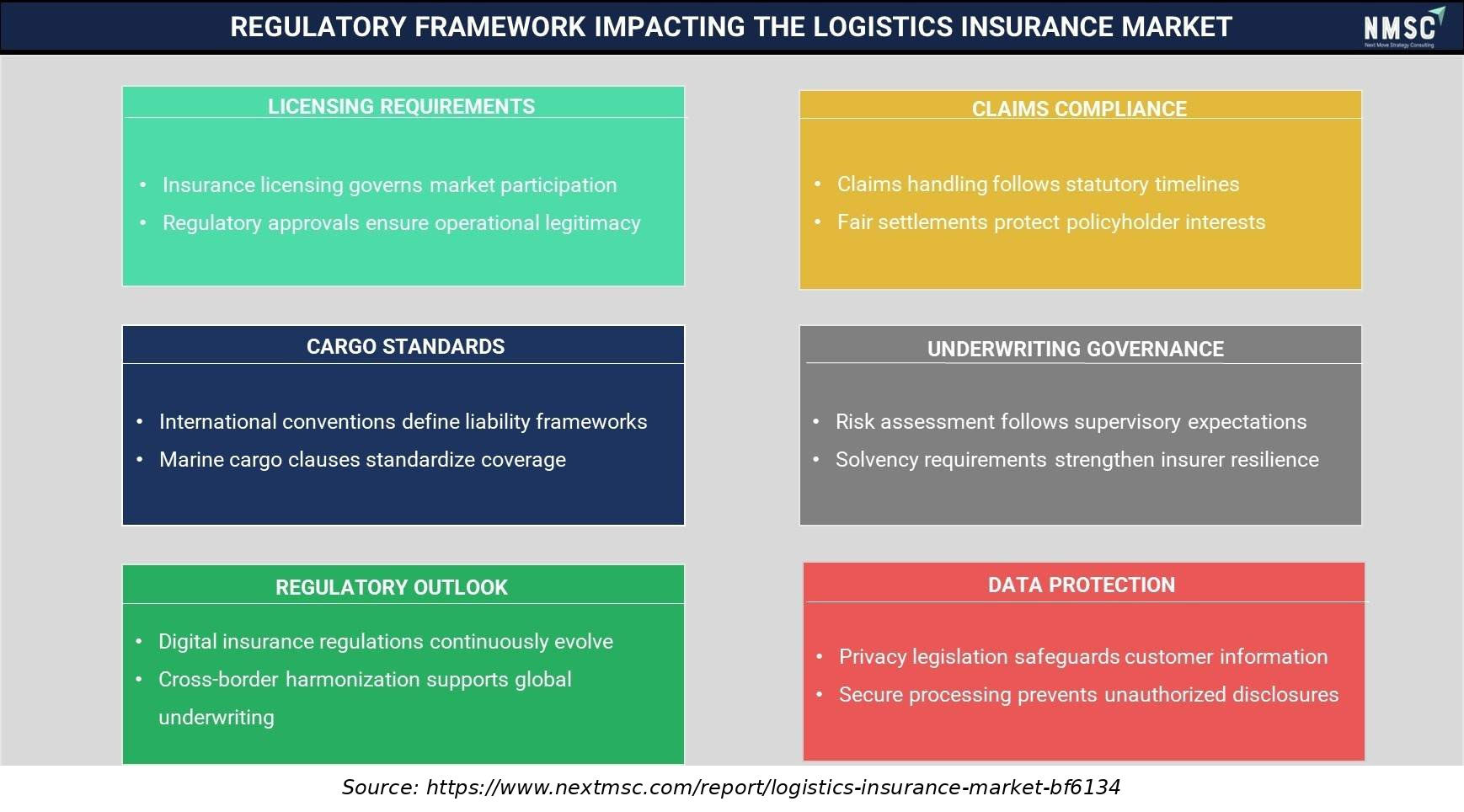
Regulatory Framework Impacting the Logistics Insurance Market
The regulatory framework for the logistics insurance market establishes the legal and operational standards governing insurer licensing, cargo coverage, underwriting, claims management, and data protection. Compliance with evolving domestic and international regulations enhances policyholder confidence, supports fair risk assessment, ensures financial stability, and enables insurers to provide secure, transparent, and cross-border insurance services

Market Drivers & Dynamics

Interactive Dataset
E-commerce expansion driving surge in cargo insurance demand driver +2.1% Global 2026–2035
Rising global trade volumes and supply chain complexity driver +1.8% Global 2026–2035
Growing cyber risk exposure in connected logistics networks driver +1.5% North America, Europe 2026–2035
Regulatory mandates requiring cargo and liability insurance for licensed operators driver +1.2% Global 2026–2035
Climate change increasing catastrophic cargo loss frequency driver +1.0% Global, esp. Asia-Pacific 2026–2032
InsurTech innovation expanding access for SME logistics operators driver +0.9% Global 2026–2035
Regulatory fragmentation across jurisdictions raising compliance costs restraint −1.0% Global 2026–2035
Cargo theft and fraud inflating claims costs for marine and inland underwriters restraint −0.7% Global 2026–2030
Insurance capacity constraints on high-risk emerging trade routes restraint −0.5% MEA, Latin America 2026–2030
Source: Next Move Strategy Consulting

Growth Drivers

What Is the Primary Growth Driver of the Logistics Insurance Market?

E-commerce expansion is the most structurally significant demand catalyst for the Logistics Insurance market. The World Trade Organization's merchandise trade data confirms that global goods trade volumes have sustained multi-year growth, generating an expanding pool of shipments each requiring cargo insurance obligations at the shipper, forwarder, or carrier level. Cross-border e-commerce logistics have multiplied the number of individual consignments requiring cargo coverage, since each consumer parcel crossing an international border creates a fresh insurance event. We observed that this disaggregation of cargo from bulk shipments into millions of small consignments is the structural demand driver that InsurTech platforms are uniquely positioned to serve, materially expanding the premium pool.

How Is Global Trade Complexity Driving Logistics Insurance Market Growth?

Increasing supply chain complexity, driven by multi-modal transport networks, longer trade routes, and growing volumes of high-value electronics and pharmaceutical cargo, is expanding both the frequency and severity of insured logistics losses. We found that multimodal cargo movements involving multiple carriers, handlers, and customs jurisdictions in a single shipment journey generate multiple points of liability handoff, each requiring documented insurance coverage under carrier agreements and trade finance documentation requirements. The United Nations Conference on Trade and Development (UNCTAD) reports that seaborne trade volumes have continued to reach new highs, with container shipping volumes growing consistently, each container representing premium income for the Logistics Insurance market.

Growth Inhibitors

What Is Restraining the Logistics Insurance Market?

Regulatory fragmentation across the 38 countries covered in this report is the primary structural restraint on Logistics Insurance market expansion. The International Maritime Organization's cargo liability conventions, the CMR Convention governing international road freight, and country-specific financial services licensing and solvency requirements impose overlapping and often inconsistent insurance obligations that raise compliance costs for multinational insurers operating cross-border logistics insurance programs. The International Air Transport Association (IATA) guidelines and national aviation authority insurance mandates create parallel requirements for air cargo, further fragmenting the regulatory landscape. Our assessment indicates that this fragmentation particularly penalizes mid-size insurers and InsurTech entrants seeking to offer pan-regional digital logistics insurance products without jurisdiction-by-jurisdiction regulatory approvals.

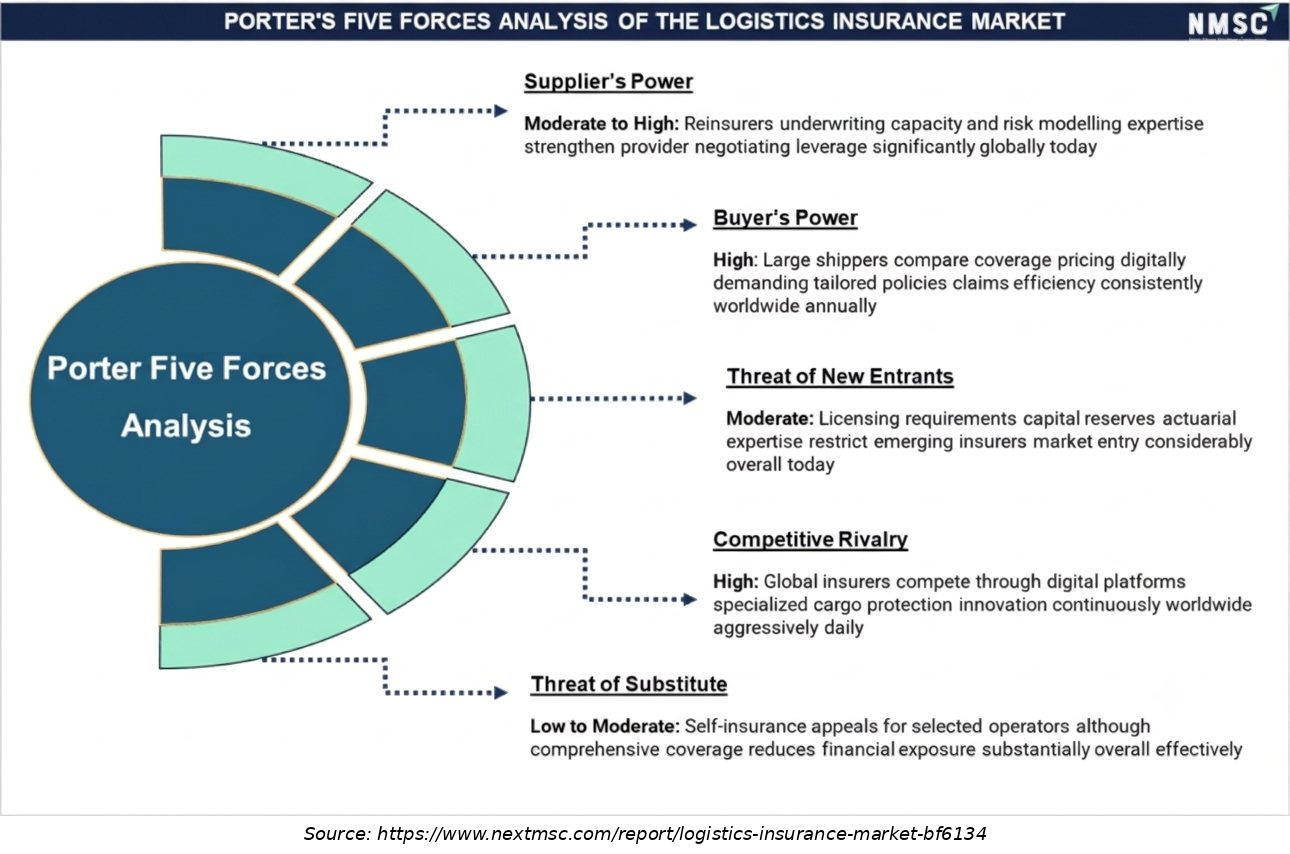
Porter’s Five Forces Analysis of the Logistics Insurance Market

Porter’s Five Forces analysis evaluates the competitive dynamics of the logistics insurance market by examining competitive rivalry, supplier bargaining power, buyer bargaining power, the threat of new entrants, and substitute solutions. This framework provides insights into market attractiveness, pricing pressure, competitive positioning, and strategic opportunities, helping stakeholders make informed business and investment decisions.

Segmentation Analysis

2025 (USD Billion)
2035 (USD Billion)
Cargo and Freight Insurance 2025: $18.20 Billion | 2035: $40.90 Billion
Cargo and Fr
Liability Insurance 2025: $9.40 Billion | 2035: $21.20 Billion
Liability In
Property Insurance 2025: $5.70 Billion | 2035: $11.40 Billion
Property Ins
Fleet and Vehicle Insurance 2025: $5.80 Billion | 2035: $11.60 Billion
Fleet and Ve
Supply Chain Risk Insurance 2025: $2.50 Billion | 2035: $8.00 Billion
Supply Chain
Cargo and Freight Insurance $18.20 Billion $40.90 Billion 9.4%
Liability Insurance $9.40 Billion $21.20 Billion 9.5%
Property Insurance $5.70 Billion $11.40 Billion 8.0%
Fleet and Vehicle Insurance $5.80 Billion $11.60 Billion 8.0%
Supply Chain Risk Insurance $2.50 Billion $8.00 Billion 13.8%

Which Insurance Type Segment Dominates the Logistics Insurance Market?

Cargo and Freight Insurance commanded the largest revenue share, reaching USD 18.2 billion in 2025, underpinned by the non-deferrable insurance obligations of the global maritime, inland transit, and air cargo industries and the legal requirements embedded in letters of credit and trade finance documentation. Our analysis shows that Supply Chain Risk Insurance is the fastest-growing insurance type segment at a 13.8% CAGR from 2026 to 2035, as multinational shippers recovering from COVID-19-era supply chain disruptions and Red Sea routing diversions are investing in proactive disruption coverage that traditional cargo policies do not provide.

2025 (USD Billion)
2035 (USD Billion)
Insurance Br
Direct Sales
Digital Plat
Bancassuranc
Other Distri
Segment Item 2025 (USD Billion) 2035 (USD Billion) CAGR
Insurance Brokers and Agents $10.0 USD Billion $40.0 USD Billion 25.0%
Direct Sales $17.1 USD Billion $51.1 USD Billion 11.0%
Digital Platforms and InsurTech $24.2 USD Billion $62.2 USD Billion 25.0%
Bancassurance $31.3 USD Billion $73.3 USD Billion 11.0%
Other Distribution Channels $38.4 USD Billion $84.4 USD Billion 16.0%

Segment-wise data is locked

Unlock complete segment-wise numbers for By Distribution Channel.

Unlock Full Data

Which Distribution Channel Dominates the Logistics Insurance Market?

Insurance Brokers and Agents retained the dominant distribution position, generating USD 21.0 billion in 2025, as the complexity of open cover policies, multimodal liability coverage, and large cargo program structuring continues to require specialist broker expertise that digital platforms have not yet replicated for large-account logistics clients. Digital Platforms and InsurTech is the fastest-growing distribution channel at a 16.3% CAGR from 2026 to 2035, as digital supply chain operators and e-commerce logistics platforms embed insurance APIs directly into freight booking workflows, enabling per-shipment coverage that removes friction from the cargo insurance purchase process for SME shippers and freight forwarders.

2025 (USD Billion)
2035 (USD Billion)
Large Enterp
Small and Me
Segment Item 2025 (USD Billion) 2035 (USD Billion) CAGR
Large Enterprises $10.0 USD Billion $40.0 USD Billion 27.0%
Small and Medium Enterprises $17.1 USD Billion $51.1 USD Billion 9.0%

Segment-wise data is locked

Unlock complete segment-wise numbers for By Enterprise Size.

Unlock Full Data
2025 (USD Billion)
2035 (USD Billion)
Freight Forw
Shipping and
Road and Rai
Air Cargo Ca
Third-Party
Segment Item 2025 (USD Billion) 2035 (USD Billion) CAGR
Freight Forwarders and Customs Brokers $10.0 USD Billion $40.0 USD Billion 14.0%
Shipping and Maritime Carriers $17.1 USD Billion $51.1 USD Billion 24.0%
Road and Rail Carriers $24.2 USD Billion $62.2 USD Billion 22.0%
Air Cargo Carriers $31.3 USD Billion $73.3 USD Billion 12.0%
Third-Party Logistics Providers $38.4 USD Billion $84.4 USD Billion 27.0%

Segment-wise data is locked

Unlock complete segment-wise numbers for By End User.

Unlock Full Data

Which End User Segment Leads the Logistics Insurance Market?

Freight Forwarders and Customs Brokers generated the highest end-user revenue at USD 11.8 billion in 2025, reflecting their central role as cargo insurance buyers under open cover and annual cargo policy structures covering goods movements across their entire client portfolios. E-Commerce Logistics Operators are the fastest-growing end-user segment at a 12.3% CAGR from 2026 to 2035, as the proliferation of marketplace platforms requiring integrated cargo insurance for high-velocity, low-value consumer parcel shipments creates an entirely new and structurally growing premium source that traditional freight forwarder-focused underwriting programs are not designed to capture efficiently.

2025 (USD Billion)
2035 (USD Billion)
North Americ
Canada
Mexico
Europe: UK
Germany
Segment Item 2025 (USD Billion) 2035 (USD Billion) CAGR
North America: U.S. $10.0 USD Billion $40.0 USD Billion 24.0%
Canada $17.1 USD Billion $51.1 USD Billion 22.0%
Mexico $24.2 USD Billion $62.2 USD Billion 20.0%
Europe: UK $31.3 USD Billion $73.3 USD Billion 22.0%
Germany $38.4 USD Billion $84.4 USD Billion 13.0%

Segment-wise data is locked

Unlock complete segment-wise numbers for By Region.

Unlock Full Data

Growth Opportunities

We observed that three forward-looking growth opportunities stand out for insurers, InsurTech investors, and logistics operators positioning within the Logistics Insurance market over the 2026–2035 forecast period.

How Can On-Demand Micro-Insurance Unlock the SME Logistics Segment?

The majority of the world's logistics operators are SMEs that purchase cargo insurance inconsistently due to complexity, cost, and the mismatch between annual open cover policies and their variable shipment volumes. On-demand micro-insurance products — distributed via APIs embedded in connected logistics platforms and freight booking systems — can address this gap by enabling single-transit coverage at premiums as low as a few dollars per consignment. InsurTech operators and traditional insurers with digital distribution capabilities are the primary beneficiaries of this structural SME market expansion opportunity, which could add meaningful premium volume to a currently underinsured segment.

What Opportunity Does Electric Commercial Vehicle Proliferation Create for Fleet Insurance?

The rapid deployment of electric commercial vehicles across last-mile delivery and regional freight operations is creating a nascent but fast-growing insurance sub-market within the Fleet and Vehicle Insurance segment. Electric vehicle fleets carry unique risk profiles — including battery degradation, charging infrastructure dependency, and higher repair costs from complex battery management systems — that standard commercial motor policies are not designed to underwrite accurately. Our findings suggest that insurers developing specialized EV fleet logistics insurance products with accurate risk classification, OEM battery warranty coordination, and dedicated EV claims handling infrastructure can achieve early market positioning in a fleet insurance sub-market that will grow rapidly as electric commercial vehicle adoption accelerates globally through 2035.

How Can Parametric Products Expand Supply Chain Disruption Coverage Penetration?

Supply chain disruption insurance has historically been purchased only by large multinational corporations with the sophistication to negotiate complex business interruption policy wordings and the premium budgets to support expensive underwriting requirements. Parametric products triggered by objective data feeds — such as port closure advisories from the IMO, satellite-measured vessel congestion indices, or weather catastrophe declarations — eliminate the claims assessment process and make supply chain disruption coverage accessible to mid-market logistics operators and manufacturing companies for the first time. Supply Chain Risk Insurance buyers, currently the smallest segment at USD 2.5 billion in 2025, represent the most structurally underpenetrated opportunity within the Logistics Insurance market.

Regional Outlook

2025 (USD Billion)
2035 (USD Billion)
North Americ
Europe
Asia-Pacific
Middle East
Latin Americ
Region 2025 (USD Billion) 2035 (USD Billion) CAGR (%)
North America $10.0 USD Billion $40.0 USD Billion 9.0%
Europe $17.1 USD Billion $51.1 USD Billion 27.0%
Asia-Pacific $24.2 USD Billion $62.2 USD Billion 25.0%
Middle East & Africa $31.3 USD Billion $73.3 USD Billion 23.0%
Latin America $38.4 USD Billion $84.4 USD Billion 12.0%

Regional data is locked

Unlock complete regional numbers for this market.

Unlock Full Data

Competitive Landscape

During our market evaluation, we noticed that the Logistics Insurance market features a moderately consolidated competitive structure dominated by large multinational insurance groups with diversified marine, cargo, and logistics specialty capabilities, alongside specialist underwriters operating through the Lloyd's of London market and a growing cohort of InsurTech platforms challenging traditional distribution models.

Dimension Description
Market Structure Moderately consolidated; Allianz AGCS, AXA XL, Chubb, Zurich, and QBE collectively command a significant share of global marine and logistics insurance premiums; Lloyd's syndicates including Beazley and Hiscox serve specialty high-risk logistics risks; InsurTech entrants are capturing a growing share of SME and per-shipment cargo insurance digital distribution.
Innovation Focus AI-driven underwriting platforms using telematics and cargo tracking data for dynamic pricing; parametric supply chain disruption insurance products with satellite event triggers; on-demand per-shipment cargo insurance APIs embedded within freight management and booking platforms.
M&A Activity Acquisitions of InsurTech startups specializing in on-demand cargo and fleet insurance; strategic reinsurance partnerships supporting parametric supply chain risk product launches; consolidation among mid-size specialty marine underwriters to achieve scale in digital logistics insurance distribution.

How Do Companies Compete in the Logistics Insurance Market?

Competition is structured around four primary vectors: breadth of coverage spanning all logistics risk categories, network reach enabling claims handling in all key trade corridors, digital distribution infrastructure for SME and per-shipment coverage, and underwriting expertise in specialty risks such as dangerous goods, cold chain cargo, and multi-modal high-value electronics shipments. We observed that global insurers with dedicated marine and logistics divisions — including Allianz AGCS, AXA XL, and Chubb — compete primarily on coverage breadth, global claims networks, and financial strength ratings, while Lloyd's market syndicates compete on underwriting flexibility and appetite for non-standard logistics risks.

Which Competitive Archetypes Dominate the Logistics Insurance Market?

Two archetypes define market leadership: full-spectrum global insurance groups offering integrated cargo, liability, fleet, property, and supply chain risk products through combined direct and broker distribution networks, and specialty marine underwriters with concentrated expertise in complex cargo and maritime risks. Allianz SE and AXA S.A. exemplify the full-spectrum global archetype, while Beazley plc and Hiscox Ltd. represent Lloyd's-market specialty underwriting leadership. A third emerging archetype — fleet management integrated insurance platforms offering telematics-linked fleet insurance to logistics operators — is gaining commercial traction as transportation technology and insurance distribution converge.

How Are Companies Differentiating Through Innovation in the Logistics Insurance Market?

Innovation investment is concentrated in AI-driven underwriting tools that incorporate satellite cargo tracking, route risk data, and claims prediction models; parametric product development for supply chain disruption risks; and digital API distribution platforms enabling freight management software vendors to offer embedded cargo insurance as a value-added service. Our analysis shows that insurers investing in data partnerships with port operators, track-and-trace platforms, and freight marketplaces are achieving structural pricing advantages through real-time loss exposure measurement unavailable to competitors relying on historical claims data alone.

What M&A and Expansion Activity Is Shaping the Logistics Insurance Market?

Strategic acquisitions are targeting InsurTech companies with proprietary cargo risk data platforms, digital claims processing capabilities, and SME distribution reach. NMSC's analysis indicates that Tokio Marine Holdings has pursued a deliberate international acquisition strategy to expand its logistics and specialty insurance capabilities outside Japan, while Chubb Limited has invested in digital distribution infrastructure to serve the rapidly growing small-business cargo insurance segment. Geographic expansion into Asia-Pacific logistics corridors — particularly in Vietnam, Indonesia, and India — and the Gulf GCC logistics hub cluster represents the primary organic growth investment priority for globally active logistics insurers.

Key Market Players

Our findings suggest that the following 20 companies are the leading providers of logistics insurance products and services globally, ranked by logistics-specific revenue, underwriting capacity, and market presence across cargo, liability, fleet, property, and supply chain risk segments.

Allianz SE AXA SA American International Group, Inc. Chubb Limited Zurich Insurance Group AG QBE Insurance Group Limited Tokio Marine Holdings, Inc. Liberty Mutual Holding Company Inc. Münchener Rückversicherungs-Gesellschaft Aktiengesellschaft in München (Munich Re) Berkshire Hathaway Inc. Sompo Holdings, Inc. Swiss Re Ltd MAPFRE, S.A. Markel Group Inc. Intact Financial Corporation CNA Financial Corporation Beazley plc W. R. Berkley Corporation Everest Group, Ltd. Hiscox Ltd

Latest Developments

We found that 2025–2026 developments in the Logistics Insurance market are concentrated on digital product launches, parametric insurance innovation, cybersecurity coverage expansion, and strategic acquisitions of specialty logistics underwriting capabilities.

Date Event
Mar 2026 Chubb detailed the structure of the Gulf Maritime Insurance Facility with the U.S. International Development Finance Corporation (DFC). The facility provides war-risk insurance covering hull, cargo, and marine liabilities for vessels operating through the Strait of Hormuz.
Mar 2026 DFC appointed Chubb as the lead insurance partner for its Maritime Reinsurance Plan, initially covering cargo as well as hull and machinery risks for eligible commercial vessels.

Investment Opportunities

What Capital Inflows Are Targeting the Logistics Insurance Market?

Capital inflows into the Logistics Insurance market are accelerating across venture and private equity investment in InsurTech logistics platforms, strategic acquisition activity by global insurance groups targeting specialty logistics underwriting capabilities, and reinsurance capacity expansion for supply chain catastrophe programs. We observed that digital cargo insurance platforms are attracting venture funding from both insurance-focused and logistics technology investors, as the intersection of freight management software and on-demand insurance creates a recurring revenue model with high retention characteristics. The Insurance Information Institute (III) identifies insurtech investment as one of the fastest-growing categories within global insurance capital deployment. Additionally, fraud detection and prevention technology investment within logistics insurance claim operations is attracting dedicated insurance technology capital, as cargo theft and fraudulent claims represent a material margin compression challenge for underwriters globally.

How Is Infrastructure Investment Supporting Logistics Insurance Growth?

Infrastructure investment in global trade facilitation — including port expansion, smart customs platforms, and digital freight documentation standards under the IMO's FAL Convention on Facilitation of International Maritime Traffic — is indirectly expanding the addressable logistics insurance market by formalizing previously informal freight movements into documented, insured trade flows. We found that government investments in national logistics competitiveness, particularly India's PM Gati Shakti infrastructure program and Gulf state logistics city development, are creating new cargo flows that generate insurance premium demand. Reinsurance capital from Swiss Re, Munich Re, and Everest Group is supporting primary insurers expanding into emerging market logistics risk programs where local insurance capacity is insufficient.

What ESG Considerations Are Shaping Logistics Insurance Investment Decisions?

ESG considerations are reshaping logistics insurance underwriting in two dimensions. First, cargo insurers are developing green shipping endorsements and reduced-premium incentives for logistics operators using low-emission vessels, electric delivery fleets, or sustainable packaging that reduces damage claims. The IMO's 2050 net-zero greenhouse gas strategy and EU Emissions Trading System requirements for maritime shipping are creating measurable underwriting criteria for sustainability-linked logistics insurance products. Second, social governance concerns around cargo theft and human trafficking in logistics containers are driving investors to favor insurers with robust cargo risk management consulting capabilities that extend beyond premium collection into active loss prevention.

Key Benefits for Stakeholders

How Does This Report Benefit Insurance Underwriters and Risk Managers?

Insurance underwriters and risk managers gain validated segmentation across all insurance type, distribution channel, enterprise size, and end-user axes, enabling product development, pricing strategy, and portfolio mix decisions calibrated to where logistics insurance demand is growing fastest. Our analysis shows that the report's detailed breakdown of Supply Chain Risk Insurance (13.8% CAGR) and Digital Platforms and InsurTech distribution (16.3% CAGR) trajectories — against an overall market CAGR of 8.4% — helps underwriters prioritize innovation investment in the highest-growth product and distribution categories through the 2026 to 2035 forecast horizon.

How Does This Report Benefit Investors and Financial Analysts in the Logistics Insurance Market?

Investors and financial analysts benefit from consistent, single-point market size and CAGR estimates — USD 41.6 billion in 2025 to USD 93.1 billion by 2035 at an 8.4% CAGR — supporting valuation, comparables analysis, and capital allocation decisions across the Logistics Insurance market ecosystem. We observed that the report's regional differentiation identifies Asia-Pacific as the fastest-growing region at 11.2% CAGR and the SME end-user segment as a priority investment target, helping investors identify above-market growth exposure among insurers, InsurTech platforms, and logistics risk technology companies with disproportionate positioning in these segments.

How Does This Report Benefit Logistics Operators and Enterprise Buyers?

Logistics operators and enterprise buyers gain strategic intelligence on insurance product availability, pricing trends, and coverage innovation across cargo, liability, fleet, and supply chain risk categories, enabling informed procurement and risk management decisions. Our findings suggest that the report's analysis of parametric insurance product development, digital distribution platform growth, and ESG-linked coverage innovation helps corporate risk managers identify which insurance providers are developing the next generation of logistics coverage that addresses cyber-enabled cargo theft, supply chain disruption, and EV fleet insurance gaps that current annual policies inadequately cover.

Key Market Segments Evaluated

By Insurance Type

  • Cargo and Freight Insurance
  • Liability Insurance
  • Property Insurance
  • Fleet and Vehicle Insurance
  • Supply Chain Risk Insurance

By Distribution Channel

  • Insurance Brokers and Agents
  • Direct Sales
  • Digital Platforms and InsurTech
  • Bancassurance
  • Other Distribution Channels

By Enterprise Size

  • Large Enterprises
  • Small and Medium Enterprises

By End User

  • Freight Forwarders and Customs Brokers
  • Shipping and Maritime Carriers
  • Road and Rail Carriers
  • Air Cargo Carriers
  • Third-Party Logistics Providers
  • E-Commerce Logistics Operators
  • Warehouse Operators
  • Other End Users

By Region

  • North America: U.S.
  • Canada
  • Mexico
  • Europe: UK
  • Germany
  • France
  • Italy
  • Spain
  • Sweden
  • Denmark
  • Finland
  • Netherlands
  • Rest of Europe
  • Asia-Pacific: China
  • India
  • Japan
  • South Korea
  • Taiwan
  • Indonesia
  • Vietnam
  • Australia
  • Philippines
  • Malaysia
  • Rest of APAC
  • Middle East & Africa: Saudi Arabia
  • UAE
  • Egypt
  • Israel
  • Turkey
  • Nigeria
  • South Africa
  • Rest of MEA
  • Latin America: Brazil
  • Argentina
  • Chile
  • Colombia
  • Rest of LATAM

Conclusion & Recommendations

The Logistics Insurance market is on a sustained growth trajectory through 2035, underpinned by the structural expansion of global trade volumes, the proliferation of e-commerce logistics generating new per-shipment cargo insurance demand, and the rapid deployment of InsurTech digital distribution platforms extending coverage access to the SME logistics segment. NMSC's analysis indicates that the market will grow from USD 45.0 billion in 2026 to USD 93.1 billion by 2035 at an 8.4% CAGR, with Asia-Pacific consolidating its position as the fastest-growing region and Supply Chain Risk Insurance and Digital Platforms emerging as the highest-growth product and distribution segments respectively.

What Strategic Positioning Should Market Participants Pursue?

Insurance underwriters should prioritize investment in real-time cargo risk data platforms, parametric product development for supply chain disruption, and digital API distribution to capture the structurally underinsured SME logistics segment. Our assessment indicates that geographic expansion into Asia-Pacific logistics corridors — particularly Vietnam, India, and Indonesia — represents the highest-priority organic growth investment for global logistics insurers, while strategic acquisitions of InsurTech digital distribution platforms and specialty marine underwriting MGAs represent the fastest path to SME market penetration in North America and Europe.

How Attractive Is the Logistics Insurance Market for New Investment?

The Logistics Insurance market presents an attractive investment profile through 2035, combining an 8.4% CAGR with structural demand anchored by legally mandated insurance obligations for freight carriers in all major markets and growing non-mandatory demand from supply chain risk-aware multinational logistics operators. We found that Digital Platforms and InsurTech (16.3% CAGR) and Supply Chain Risk Insurance (13.8% CAGR) represent the highest-growth sub-categories within the market, offering above-market growth profiles for investors positioned in technology-driven insurance distribution and parametric logistics risk products.

What Market Shifts and Key Risks Should Stakeholders Monitor?

The primary structural shift is the migration of cargo insurance distribution from traditional broker placement to digital per-shipment platforms, compressing broker fee revenue while expanding total premium volume through improved SME market penetration. Key risks include concentration of cargo losses on specific disrupted trade routes (Red Sea, Taiwan Strait) creating correlated loss spikes that challenge traditional actuarial pricing models, increasing cargo theft rates in Latin America and Africa compressing underwriting margins, and regulatory divergence across jurisdictions slowing pan-regional digital logistics insurance product rollout timelines. Based on our estimates, insurers without proprietary real-time risk data capabilities face the greatest competitive displacement risk.

What Are the Key Growth Pathways for the Logistics Insurance Market?

Three principal growth pathways exist through 2035: first, capturing the structurally underinsured SME logistics market through digital per-shipment and on-demand cargo insurance APIs embedded in freight booking platforms, where the addressable premium pool is large but penetrated only by a nascent InsurTech cohort; second, developing commercially viable parametric supply chain disruption products using satellite and maritime data that make disruption coverage accessible to mid-market shippers at affordable premium levels; and third, building specialized EV commercial fleet insurance capabilities before the electric vehicle logistics transition creates a large and complex underwriting requirement that commodity motor insurance policies cannot serve adequately through the 2030s.

FAQs

About the Author

Mihul Sharma

Mihul Sharma

Mihul Sharma is Research Associate at Next Move Strategy Consulting, where he has covered technology, industrial, and healthcare markets for 3 years. His work applies structured business research, market analysis, and secondary-source review to assess market trends, competitive developments, and growth opportunities. He supports report development by fully synthesizing industry data, company information, and market signals into concise findings for strategy and investment-focused research teams.

About the Reviewer

Supradip Baul

Supradip Baul

Supradip Baul is an accomplished business consultant and strategist with over a decade of rich experience in market intelligence, strategy, technology, and business transformation. His work has included rigorous qualitative and quantitative analysis across multiple industries, helping clients shape investment decisions and long-term roadmaps. Earlier in his career, he was associated with Gartner, where he contributed to industry-leading reports and market share analyses. He has worked with leading global companies and holds an MBA with a dual specialization in Marketing and Finance.

Download Free Sample

Robert Sean Trevino

ROBERT SEAN TREVINO

Sr. Director, Head of Strategic Insights & Analytics

Foundation Medicine

I realized that it was a reliable source of information. These days, there are many people who are looking for authentic data, and this is one of the only sources that can offer them with what they need;

Kishu Kanda

KISHU KANDA

Strategy Analyst

Accenture

We purchased the AI Consumer Market Report from this company. Not only did they customize the report to meet our specific requirements, but they also showed great flexibility in accommodating our budget. The report we received fully met our expectations. Additionally, they provided prompt and thorough responses to both our pre-purchase and follow-up questions. We look forward to working with this company again in the future.

Diana Trejo

DIANA TREJO

Assistant Manager

Sumitomo Corporation de Mexico, S.A. de C.V.

Recently, we purchased a report on the Mexico Data Center Market from Next Move Strategy Consulting. The service has been excellent, with support that is always timely and thoroughly professional. The information provided is interesting, highly useful, and delivered with clarity. I would highly recommend NextMSC for anyone seeking insightful and dependable analysis.

Gustaf Hummel Burstrom

GUSTAF HUMMEL BURSTROM

Founder

Revline Tools AB

Joseph and the team at Next Move Strategy Consulting have been excellent to work with, in supplying us with relevant market data and forecasts for our specific category. We had some special requirements and they were able to do a custom package to suit our needs. We would definitely recommend them to any other company needing market data and forecasts

Kevin Coker

KEVIN COKER

Founder, CEO and Board Diector

Proxima Clinical Research

I have been using Next MSC reports for product positioning in a new geography for a long time. They have by far the best reports I have found and the price is reasonable too!

Custom Market Research Services

We will customize the research for you if the listed report does not fully match your requirements.

Get 30% Free Customization

Select License

This website uses cookies to ensure you get the best experience on our website. Learn more

✖