Mass Spectrometry Market by Product Category [Instruments (Mass Analyzer, System Type, and Others), Consumables and others], By Form Factor (Benchtop, Floor-Standing, Portable, Handheld), By Application Area (Pharmaceutical & Biotechnology, Clinical Diagnostics, Food Testing, Environmental Testing, and Others), and By End User (Pharmaceutical & Biotechnology Companies, Academic & Research Institutes, and Others) – Global Analysis & Forecast, 2025–2035
Industry: Healthcare | Publishing Date: June 5, 2026 | Last Updated: September 30, 2026 | No of Pages: N/A | No. of Tables: N/A | No. of Figures: N/A | Format: PDF | Report Code: HC4606
Industry Outlook
The global Mass Spectrometry Market size was valued at USD 8.40 billion in 2025 and is expected to be valued at USD 9.03 billion by the end of 2026. The industry is projected to grow, hitting USD 17.41 billion by 2035, with a CAGR of 7.56% between 2026 and 2035.
Mass Spectrometry Market Size & Forecast
|
Parameters |
Details |
|
Market Size in 2026 |
USD 9.03 Billion |
|
Revenue Forecast in 2035 |
USD 17.41 Billion |
|
Growth Rate |
CAGR of 7.56% from 2026 to 2035 |
|
Analysis Period |
2025–2035 |
|
Base Year Considered |
2025 |
|
Forecast Period |
2026–2035 |
|
Market Size Estimation |
Billion (USD) |
|
Companies Profiled |
20 |
|
Countries Covered |
33 |
|
Market Share |
Available for 10 companies |
Based on NMSC’s primary research, we observed that the global mass spectrometry market is witnessing steady and innovation-driven growth, primarily driven by the rising need for highly precise analytical techniques across pharmaceuticals, biotechnology, environmental testing, and food safety. In particular, advancements in high-resolution mass spectrometry, hybrid systems, and automation technologies are significantly enhancing sensitivity, accuracy, and throughput. As a result, techniques such as LC-MS, GC-MS, and ICP-MS are increasingly adopted to support applications including molecular analysis, biomarker discovery, and trace-level detection. Furthermore, our field assessments and in-depth interactions with laboratory professionals indicates that the integration of advanced software, real-time analytics, and cloud-enabled platforms is improving workflow efficiency and enabling faster, more reliable data interpretation. While instruments continue to dominate overall market revenue, software and services are gradually emerging as critical enablers of scalability and operational optimisation. Geographically, North America leads adoption due to its strong research infrastructure and high pharmaceutical investments, whereas Asia-Pacific is experiencing accelerated growth supported by expanding healthcare infrastructure and increasing R&D activities.
Moreover, through direct evaluation of laboratory deployments across North America, Europe, and Asia-Pacific, we identified that market adoption is shaped by regulatory requirements, research intensity, and funding availability. North America benefits from strong regulatory frameworks and early technology adoption, while Europe emphasises quality standards, environmental monitoring, and food safety. Meanwhile, emerging markets such as India and Southeast Asia are witnessing rapid uptake driven by expanding pharmaceutical manufacturing and academic research.
In this competitive landscape, key players including Thermo Fisher Scientific, Agilent Technologies, Waters Corporation, Bruker Corporation, Shimadzu Corporation, and PerkinElmer compete through continuous innovation in high-resolution systems, automation, and integrated software. Notably, advancements in orbitrap and time-of-flight technologies, along with compact and user-friendly systems, reflect strong industry momentum, while service-based and leasing models are lowering entry barriers and improving cost efficiency. Overall, the mass spectrometry market is progressing in a highly interconnected manner, where advancements in instrumentation, software integration, and application diversity are collectively driving growth. As demand for accuracy, speed, and data-driven insights continues to rise, the market is expected to maintain strong momentum, ultimately reinforcing its critical role across healthcare, life sciences, and industrial testing environments.
What Are the Key Mass Spectrometry Market Trends?
How Is AI-Driven Data Interpretation Transforming Analytical Workflows in the Mass Spectrometry Market?
Based on our market analysis, we observed that AI-driven data interpretation is increasingly transforming mass spectrometry workflows, particularly in high-throughput proteomics and metabolomics applications. This shift reflects a transition from traditional peak-calling methods toward more automated and intelligence-driven analytical processes. Moreover, advanced machine learning algorithms are enabling more efficient protein identification, spectral deconvolution, and metabolic pathway analysis, while still operating within semi-supervised frameworks. Our evaluation of laboratory environments indicates that these systems improve over time by learning from historical datasets and experimental variability, thereby enhancing accuracy and consistency. As a result, AI-assisted workflows are reducing analysis time and minimizing manual intervention, while improving reproducibility. This evolution allows researchers to focus more on data interpretation and scientific discovery, ultimately enhancing overall research productivity.
How Is Miniaturization Enabling Point-of-Need Testing Applications?
Through our evaluation of ongoing product innovations, we noticed that miniaturization is significantly expanding the scope of mass spectrometry applications. This shift is enabling the transition from centralized laboratories to point-of-need environments. Furthermore, increasing adoption of compact, portable systems designed for real-time analysis is evident across industries. These units are deployed across diverse use cases, including narcotics detection, bedside clinical diagnostics, and on-site food safety testing. Our analysis of recent implementations indicates that these systems provide immediate results without requiring complex laboratory infrastructure, thereby significantly improving response time. In addition, portability combined with simplified interfaces enhances usability across non-specialist operators. Consequently, this trend supports decentralised testing models, enabling faster decision-making and expanding access to high-quality analytical capabilities across remote and resource-constrained settings.
How Is Multi-Omics System Integration Advancing Spatial Biology Research?
Based on our market evaluation, we assessed that multi-omics system integration is emerging as a critical trend in mass spectrometry. This trend is reshaping advanced biological research and analytical workflows. It is driven by the growing need to combine mass spectrometry data with transcriptomics and imaging datasets within unified platforms. Moreover, this integration is enabling a shift toward spatial biology, where molecular distributions are mapped directly within intact tissues. Our analysis of advanced research environments indicates that such interconnected systems provide deeper insights into cellular functions, disease mechanisms, and biomarker discovery. Furthermore, unified software ecosystems streamline data interpretation and reduce fragmentation across analytical tools. Additionally, this convergence of technologies enhances both accuracy and scalability, thereby supporting more comprehensive and high-resolution biological investigations while accelerating innovation in life sciences research.
Ecosystem Analysis of the Mass Spectrometry Market
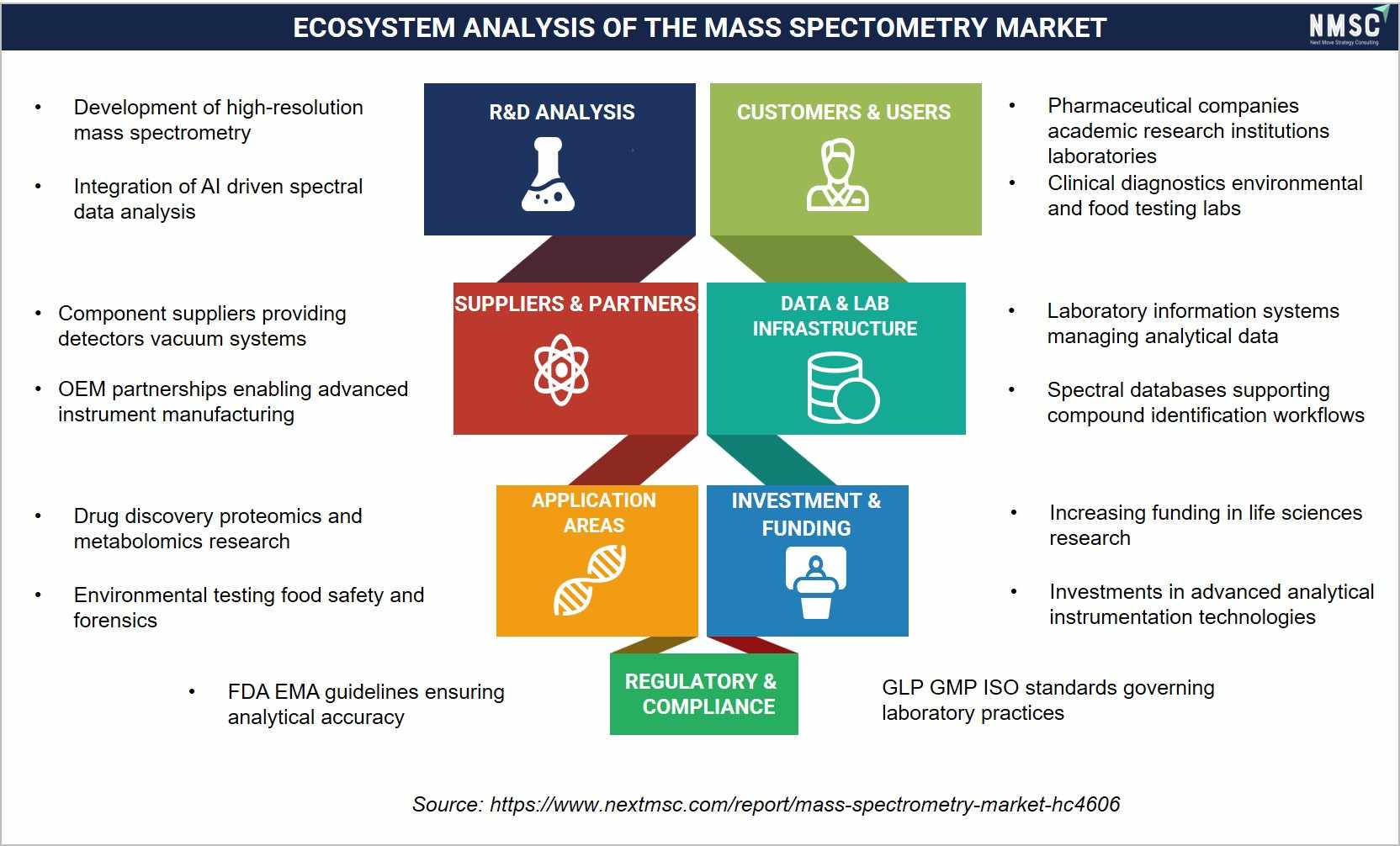
Based on our evaluation of laboratory workflows and stakeholder interactions, we assessed that the mass spectrometry market ecosystem is structured around tightly integrated components spanning R&D, suppliers, data infrastructure, and end users. In particular, advancements in high-resolution systems and AI-driven spectral analysis continue to enhance analytical capabilities. Moreover, collaboration between OEMs and component suppliers ensures system reliability, while laboratory information systems streamline data management. At the same time, regulatory frameworks and growing investments in life sciences research further support adoption, thereby strengthening the overall ecosystem efficiency and scalability.
What Are the Key Market Drivers, Breakthroughs, and Investment Opportunities That Will Shape the Mass Spectrometry Industry in the Next Decade?
Growth Catalyst & Risk Assessment Matrix
|
DRIVERS / TRENDS / RESTRAINTS |
(+/–) % IMPACT ON CAGR FORECAST |
GEOGRAPHIC RELEVANCE |
IMPACT TIMELINE |
|
Rapid expansion of biopharmaceutical pipelines and biologics development requiring high-resolution analysis |
+1.2% |
North America, Europe, Asia-Pacific |
Medium to long term (3–7 years) |
|
Stricter environmental regulations (PFAS, contaminants) driving demand for ultra-trace detection systems |
+1.0% |
North America, Europe |
Short to medium term (1–3 years) |
|
Increasing adoption of AI-driven data interpretation and workflow automation in analytical laboratories |
+0.9% |
Global |
Medium term (2–4 years) |
|
Miniaturization enabling point-of-need and field-based testing applications |
+0.7% |
Global |
Medium term (2–5 years) |
|
High total cost of ownership including gases, maintenance, and software licensing limiting adoption |
–0.8% |
Global, especially emerging markets |
Medium term (2–4 years) |
Based on our evaluation of global analytical instrumentation trends, we observed that the mass spectrometry market is experiencing steady growth, driven primarily by the expansion of biopharmaceutical pipelines and increasingly stringent environmental regulations. Our interactions with laboratory scientists and regulatory compliance officers indicate that advanced mass spectrometry systems are being adopted as essential tools for precise molecular characterization and ultra-trace level detection. Furthermore, advancements in high-resolution and hybrid systems enhance analytical accuracy and throughput, enabling reliable performance across complex applications. However, our assessment also indicates that the high total cost of ownership, including recurring expenses related to gases, maintenance, and software licensing, constrains broader adoption, particularly among cost-sensitive laboratories. At the same time, the development of sustainable and energy-efficient mass spectrometry technologies creates new opportunities by aligning with evolving laboratory sustainability goals and improving long-term operational efficiency.
Growth Drivers:
How Is the Expansion of Biopharmaceutical Pipelines Driving Mass Spectrometry Market Demand?
Based on our interactions with laboratory scientists and biopharmaceutical researchers, we assessed that the rapid expansion of biopharmaceutical pipelines drives strong demand for advanced mass spectrometry solutions. In particular, the increasing development of biosimilars and antibody-drug conjugates requires high-resolution mass spectrometry for precise molecular characterisation and quality control. According to the U.S. Food and Drug Administration (FDA) data for 2025, the agency approved 46 new drugs, including 12 new biologics. This includes high-complexity molecules such as nine monoclonal antibodies and two antibody-drug conjugates (ADCs). The analytical characterisation of these NBEs (New Biological Entities) is the leading application for high-resolution mass spectrometry. Through our evaluation of drug development workflows, we found that complex biologics require highly sensitive analytical techniques to meet regulatory standards. Furthermore, HRMS systems enable accurate structural elucidation and impurity profiling, thereby supporting efficient validation processes. As a result, mass spectrometry becomes a core analytical tool across biopharmaceutical research and manufacturing, strengthening its role in ensuring product quality and regulatory compliance.
How Are Stricter PFAS Regulations Driving Adoption of High-Sensitivity Systems?
From our assessment of environmental monitoring requirements, we found that stricter PFAS regulations accelerate the adoption of high-sensitivity mass spectrometry systems. Recent mandates from regulatory bodies in the United States and Europe require ultra-trace level detection of persistent chemicals in water systems. According to the U.S. Environmental Protection Agency, the agency finalised legally enforceable drinking water standards for multiple PFAS compounds under the National Primary Drinking Water Regulation in 2024, and reaffirmed in 2025 that public water systems must comply with these limits, with full implementation timelines extending toward 2029. Through our interactions with environmental testing laboratories and regulatory compliance officers, we noticed increased reliance on triple quadrupole systems for accurate quantification. These systems deliver the sensitivity and selectivity required for detecting contaminants at extremely low concentrations. Consequently, laboratories upgrade their analytical infrastructure. to meet compliance requirements, thereby driving demand for advanced mass spectrometry technologies.
Growth Inhibitor:
How is High Total Cost of Ownership Limiting Mass Spectrometry Market Growth?
Based on our analysis of procurement practices, we observed that the high total cost of ownership acts as a significant barrier to mass spectrometry adoption. Beyond the initial capital investment, recurring expenses associated with high-purity gases such as helium and nitrogen, specialized vacuum systems, and annual software licensing substantially increase operational burden. According to the National Institutes of Health, under the 2025–2027 High-End Instrumentation (HEI) Grant Program, the agency states that the minimum award is USD 750,001 and the maximum award is USD 2,000,000, with mass spectrometers explicitly listed among eligible instruments, highlighting that the acquisition cost of advanced high-end mass spectrometry systems typically falls within this substantial capital investment range and thereby contributes significantly to the high total cost of ownership across research laboratories and analytical institutions. Through our interactions with laboratory managers and procurement heads, we identified that these ongoing costs constrain budget flexibility and delay purchasing decisions. Additionally, proprietary AI-based software modules further intensify financial pressure through continuous licensing requirements. As a result, many laboratories restrict system upgrades or defer new investments, particularly in cost-sensitive and mid-sized facilities, thereby directly limiting market expansion.
Growth Opportunity:
How Is Sustainable “Green” Mass Spectrometry Creating New Mass Spectrometry Market Opportunities?
Based on our market evaluation, we identified that sustainable mass spectrometry technologies present strong opportunities for innovation and adoption. As environmental priorities strengthen across laboratory operations, the demand for energy-efficient and low-emission systems increases. According to 2025 research on green analytical chemistry, modern analytical approaches focus on minimising toxic reagents, lowering energy consumption, and reducing waste generation, aligning laboratory practices, including mass spectrometry with global sustainability objectives. Through our interactions with laboratory directors and sustainability leads, we found a growing focus on reducing energy consumption and operational carbon footprint. Moreover, innovations such as energy-efficient vacuum systems and gas-free ionisation sources align with these objectives. Furthermore, these technologies improve operational efficiency while supporting corporate sustainability commitments. Consequently, sustainable mass spectrometry solutions gain traction, driving new product development and long-term market expansion.
Strategic Framework Impacting the Mass Spectrometry Market
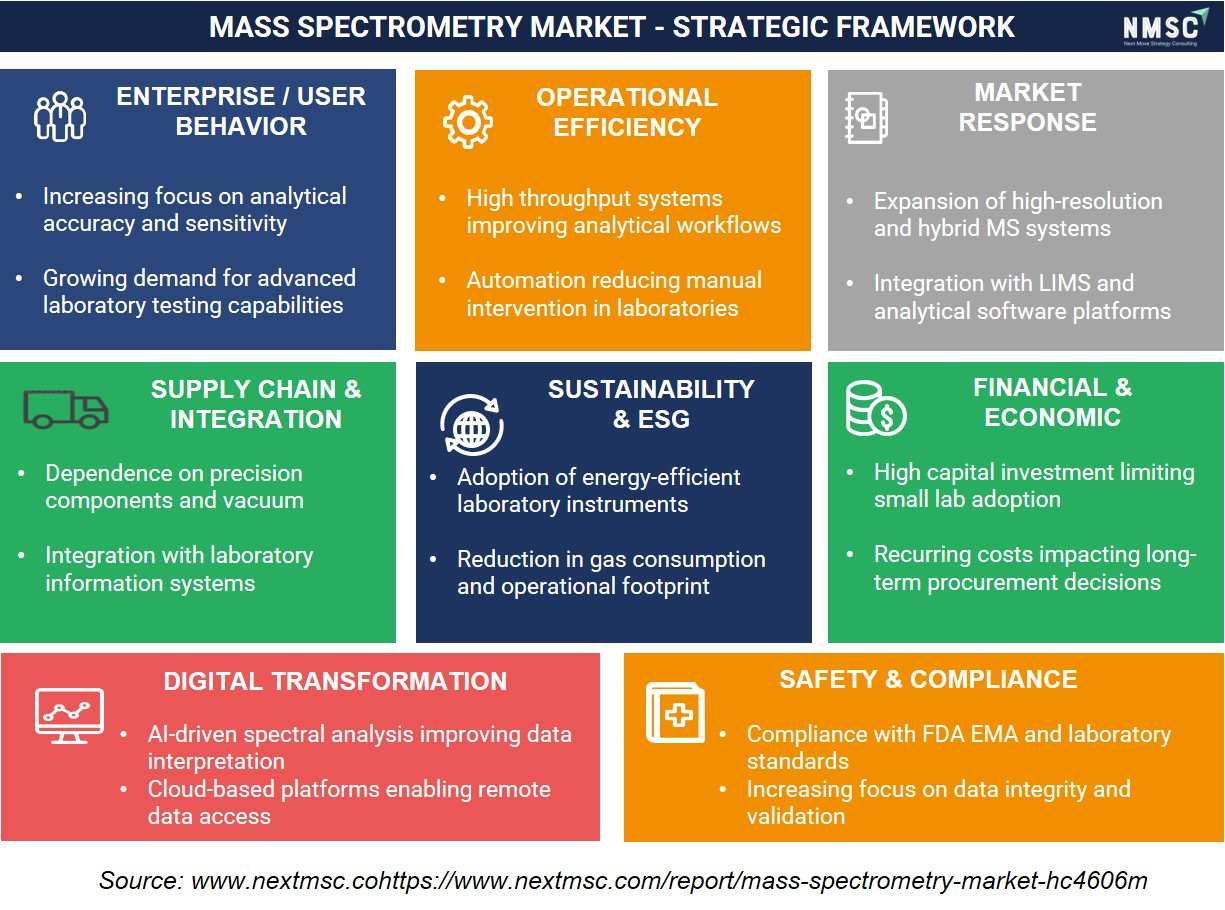
From our analysis of market dynamics and operational trends, we noticed that the mass spectrometry market is driven by increasing demand for analytical accuracy, efficiency, and advanced laboratory capabilities. Furthermore, automation and high-throughput systems are improving workflow productivity, while integration with LIMS and analytical software enhances operational control. In addition, sustainability initiatives and digital transformation, including AI-driven data interpretation, are reshaping laboratory operations. However, high capital investment and recurring costs continue to influence procurement decisions, thereby creating a balanced landscape between technological advancement and financial considerations.
How Is the Mass Spectrometry Market Segmented in This Report, And What Are the Key Insights from the Segmentation Analysis?
Market Highlights & Strategic Insights – Mass Spectrometry Market:
|
SEGMENTS |
KEY TAKEAWAYS |
|
Product Category |
Instruments dominate the market, driven by continuous demand for advanced analytical systems across research and testing laboratories. Consumables generate recurring revenue streams, while software and services gain importance through workflow integration, automation, and lifecycle support. |
|
Instruments – System Type |
Chromatography-coupled MS systems (LC-MS and GC-MS) lead adoption due to versatility across pharmaceutical and environmental applications. Plasma-based and laser desorption systems serve specialized use cases, while process MS systems gain traction in industrial monitoring environments. |
|
Instruments – Mass Analyzer |
Quadrupole systems, particularly triple quadrupole, dominate routine quantitative analysis. High-resolution analyzers such as TOF, Orbitrap, and FT-ICR are increasingly adopted for complex biomolecular characterization and advanced research applications. |
|
Consumables |
Consumables represent a stable revenue stream, driven by frequent replacement of ion source parts, sample introduction components, and chromatography-related materials. Growing testing, volumes further support consistent demand across laboratories. |
|
Software |
Software is gaining strategic importance as laboratories adopt advanced data processing, spectral libraries, and automation tools. Integration with cloud platforms and AI-driven analytics enhances efficiency and data interpretation capabilities. |
|
Services |
Services are expanding steadily, supported by demand for installation, maintenance, training, and application support. Long-term service contracts and system upgrades contribute to recurring revenue and customer retention. |
|
Form Factor |
Benchtop and floor-standing systems dominate due to high-performance requirements, while portable and handheld systems are gaining traction for field-based and point-of-need applications. |
|
Sales Channel |
Direct sales lead due to technical complexity and customization requirements, while distributors and value-added resellers support broader market reach. OEM and integration sales are growing with embedded and platform-based solutions. |
|
Application Area |
Pharmaceutical and biotechnology applications dominate, driven by drug discovery, development, and biologics analysis. Environmental, food testing, and clinical diagnostics represent strong secondary demand segments. |
|
End User |
Pharmaceutical companies and research institutes account for the largest share, supported by intensive analytical requirements. CROs, testing laboratories, and government institutions contribute to steady demand across regulatory and applied testing environments. |
By Product Category Insights
How Does Product Category Shape the Mass Spectrometry Market?
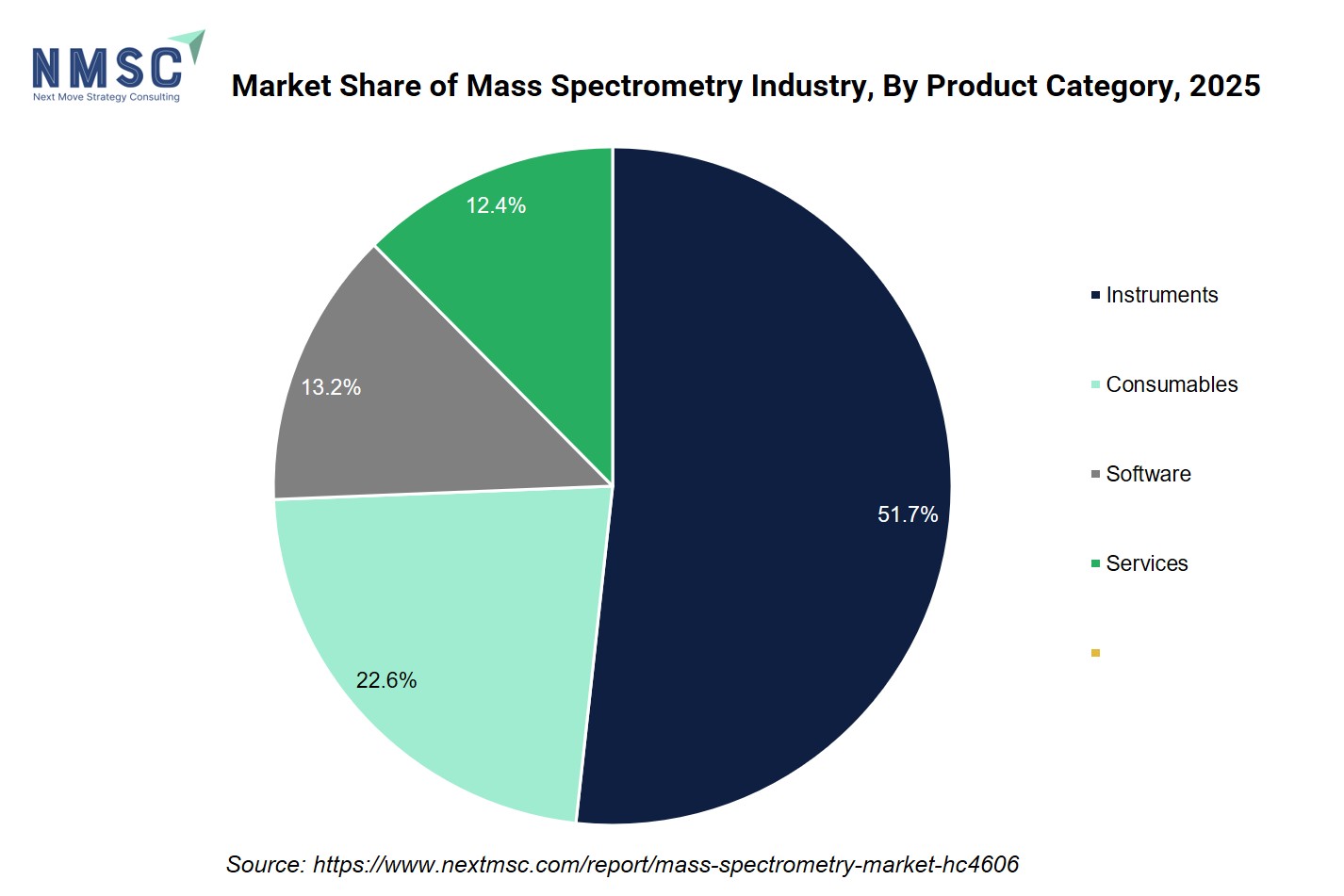
Based on our analysis of mass spectrometry deployment and procurement patterns, we evaluated that the mass spectrometry market is segmented into instruments, consumables, software, and services. From our evaluation of laboratory workflows, we found that these product categories collectively support analytical operations across research, clinical, and industrial testing environments.From our assessment of demand distribution, we found that instruments account for the largest share, driven by continuous investment in high-resolution and hybrid systems across pharmaceutical and research applications. At the same time, consumables generate stable recurring demand due to frequent replacement cycles in routine analytical workflows, ensuring consistent revenue streams. In addition, our interactions with laboratory managers indicated that software adoption is increasing as laboratories prioritise advanced data processing, spectral libraries, and workflow automation to enhance efficiency. Furthermore, services including maintenance, training, and system upgrades play a critical role in ensuring system reliability and long-term usability, thereby strengthening overall market adoption.
By Application Area Insights
How Do Application Areas Drive Demand in the Mass Spectrometry Market?
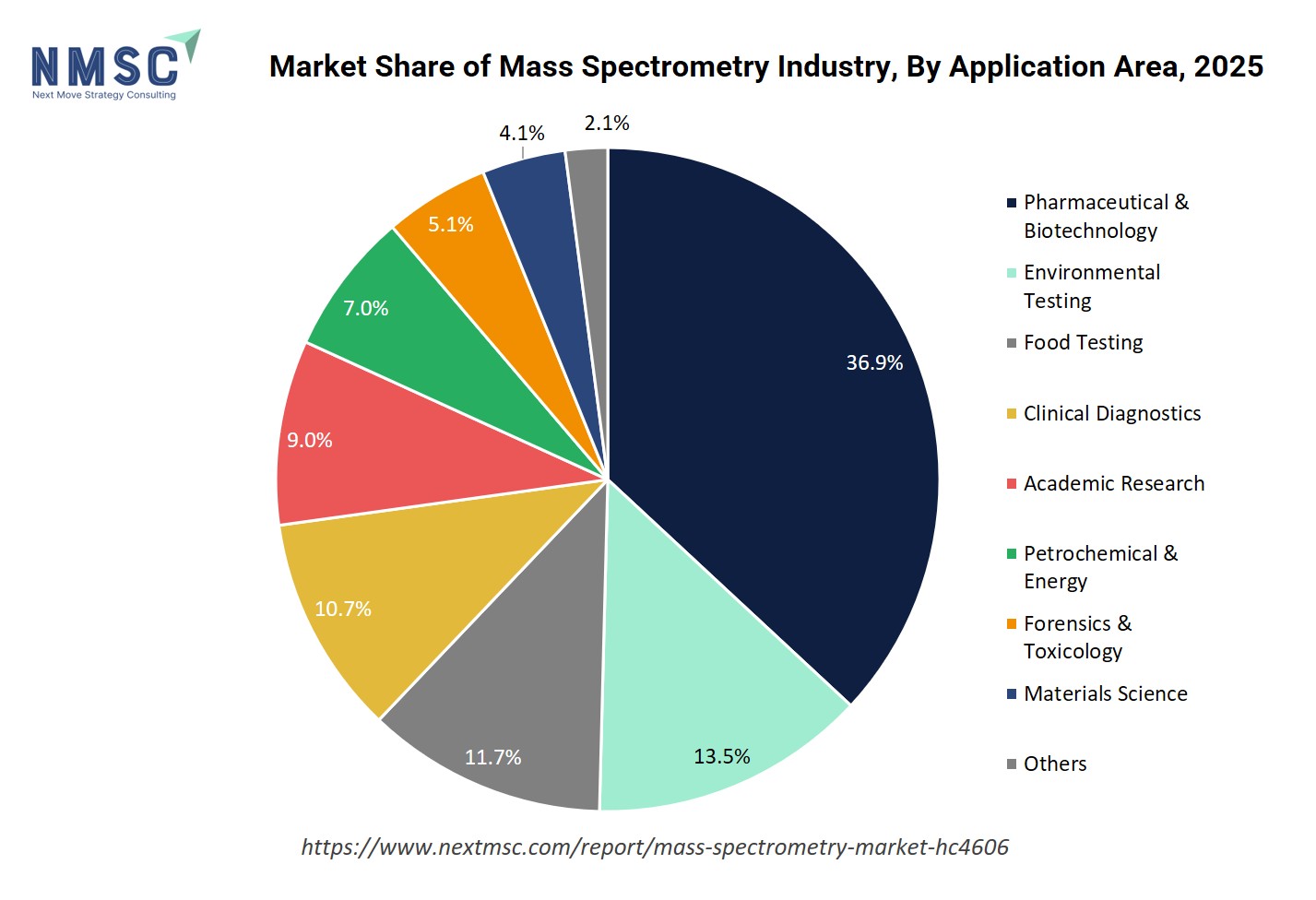
Based on our application-level analysis, we observed that the mass spectrometry market is segmented into pharmaceutical and biotechnology, clinical diagnostics, food testing, environmental testing, forensics and toxicology, petrochemical and energy, materials science, academic research, and others. From our evaluation of industry usage patterns, we found that these applications define the breadth of mass spectrometry adoption across multiple end-use sectors.
From our assessment of demand trends, we found that pharmaceutical and biotechnology applications account for the largest share, driven by strong requirements for drug discovery, development, and biologics analysis. Moreover, our interactions with laboratory scientists indicated that environmental and food testing applications are expanding steadily due to increasing regulatory scrutiny and safety standards. In addition, clinical diagnostics is gaining traction as mass spectrometry supports biomarker detection and therapeutic monitoring. Furthermore, applications across forensics, materials science, and petrochemical testing contribute to diversified demand, thereby reinforcing the technology’s role across both regulated and research-driven environments.
By End-User Industry Insights
How Do End Users Influence Adoption in the Mass Spectrometry Market??
Based on our analysis of end-user demand patterns, we evaluated that the mass spectrometry market is segmented into pharmaceutical and biotechnology companies, academic and research institutes, contract research organizations, contract development and manufacturing organizations, environmental testing laboratories, food and beverage testing laboratories, clinical and diagnostic laboratories, industrial laboratories, government and forensic laboratories, and others. From our evaluation, we found that these end users collectively drive demand across research, regulatory, and industrial applications.
From our assessment of consumption trends, we found that pharmaceutical and biotechnology companies account for the largest share, driven by extensive use in drug development, quality control, and regulatory compliance processes. At the same time, academic and research institutes contribute significantly through innovation-driven studies and advanced analytical research. Furthermore, our interactions with laboratory operators indicated that CROs, CDMOs, and testing laboratories are expanding adoption due to increasing outsourcing of analytical services. In addition, government and forensic laboratories support demand through regulatory enforcement and public safety applications, thereby sustaining consistent utilisation across sectors.
Regional Outlook:
Geographic Performance Snapshot:
|
Region |
Key Takeaways |
|
North America |
North America holds a leading position in the global mass spectrometry market, supported by strong pharmaceutical R&D investments, advanced healthcare infrastructure, and early adoption of high-resolution analytical technologies. High demand from biopharmaceutical companies and clinical research organisations drives the adoption of HRMS and triple quadrupole systems for drug development and diagnostics. |
|
Europe |
Europe represents a significant market, driven by stringent regulatory frameworks related to environmental monitoring, food safety, and pharmaceutical quality standards. Strong emphasis on PFAS detection, increasing adoption in academic research, and laboratory automation initiatives support steady demand for advanced mass spectrometry systems across the region. |
|
Asia-Pacific |
Asia-Pacific is a high-growth region in the mass spectrometry market, reflecting rapid expansion of pharmaceutical manufacturing, growing contract research activities, and increasing government investments in life sciences. Rising adoption across China, Japan, and India, combined with expanding environmental testing and food safety requirements, accelerates demand for both high-performance and cost-efficient systems. |
|
Latin America |
Latin America shows moderate growth, supported by improving healthcare infrastructure and gradual expansion of pharmaceutical and environmental testing capabilities. Increasing regulatory awareness and adoption of advanced analytical techniques contribute to steady demand across key economies such as Brazil and Mexico. |
|
Middle East & Africa |
The Middle East & Africa region demonstrates emerging growth, driven by investments in healthcare infrastructure, environmental monitoring, and food safety initiatives. Gradual adoption of advanced laboratory technologies, supported by government-led programs and international collaborations, contributes to expanding market presence. |
The mass spectrometry market is geographically studied across North America, Europe, Asia Pacific, Latin America and Middle East & Africa and each region is further studied across countries.
Mass Spectrometry Market in North America
The mass spectrometry market in North America reflects a mature and research-intensive landscape, where demand is firmly anchored in pharmaceutical innovation and regulatory-driven testing requirements. Based on our regional evaluation, we observed that well-established laboratory infrastructure, combined with widespread integration of advanced analytical technologies, continues to support consistent system adoption. At the same time, increasing emphasis on drug safety validation and expanding environmental monitoring requirements strengthens demand for high-resolution and high-sensitivity instruments. Our interactions with laboratory scientists and regulatory compliance officers further highlight that standardised workflows and validated methodologies play a decisive role in system selection and upgrade cycles. Alongside this, sustained investment in life sciences research reinforces utilisation levels, ultimately creating a market where analytical precision and compliance readiness remain central to procurement decisions.
Mass Spectrometry Market in the United States
Based on our analysis and interactions with laboratory scientists and biopharmaceutical researchers, we found that the United States drives regional demand through its strong pharmaceutical R&D ecosystem and structured regulatory framework. In particular, mass spectrometry adoption is closely associated with drug development processes, where precise molecular characterisation and impurity detection remain essential. Furthermore, environmental testing requirements, including trace-level contaminant detection, continue to expand the scope of system utilisation across laboratories. In addition, our evaluation indicates that high-resolution and triple quadrupole systems are widely implemented across pharmaceutical companies, contract research organisations, and clinical laboratories. At the same time, continuous investments in research infrastructure and analytical capabilities support stable system demand, thereby reinforcing consistent adoption patterns.
Mass Spectrometry Market in Canada
In comparison, Canada demonstrates a steadily progressing mass spectrometry market, supported by research-focused institutions and regulatory-driven analytical requirements. From our evaluation, we found that adoption is primarily concentrated in academic laboratories, government research centres, and healthcare institutions. Moreover, environmental monitoring and food safety testing continue to drive consistent demand for reliable analytical systems across applications. In addition, our interactions with laboratory managers and research scientists indicate that purchasing decisions prioritise system accuracy, operational stability, and long-term usability. At the same time, public funding initiatives and collaborative research programs contribute to the gradual expansion of analytical infrastructure. Consequently, adoption remains closely aligned with application-specific needs and institutional capabilities.
Mass Spectrometry Market in Europe
The mass spectrometry market in Europe demonstrates a regulation-intensive and quality-driven adoption profile, where demand aligns closely with stringent standards in environmental monitoring, food safety, and pharmaceutical analysis. Based on our evaluation, we identified that compliance requirements related to chemical testing and public health continue to shape purchasing behaviour across laboratories. Moreover, increasing focus on PFAS detection and trace-level contaminant analysis strengthens the role of high-sensitivity systems. In addition, our interactions with laboratory scientists and regulatory authorities indicate that method validation, certification, and data reliability remain central to system selection. Adoption patterns vary across the region, with Northern Europe emphasising sustainability and precision, while Southern Europe prioritises flexibility and cost control. As a result, regulatory compliance and analytical accuracy remain the primary forces guiding vendor selection across the region.
Mass Spectrometry Market in the United Kingdom
Based on our analysis and interactions with laboratory scientists and regulatory compliance officers, we identified that the United Kingdom market is driven by strong pharmaceutical research activity and structured regulatory oversight. In particular, demand is closely linked to drug development workflows requiring precise molecular characterisation and validation. Furthermore, environmental and food safety testing expands system utilisation across public and private laboratories. Our evaluation indicates that laboratories prioritise workflow standardisation, data accuracy, and compliance readiness. In addition, established research infrastructure and testing capabilities support consistent system demand. Consequently, the market continues to be shaped by regulatory-driven precision and sustained research activity.
Mass Spectrometry Market in Germany
Germany demonstrates a precision-driven mass spectrometry market shaped by strong industrial research capabilities and stringent quality expectations. From our evaluation, we found that demand is closely tied to pharmaceutical production, industrial testing, and regulatory compliance across environmental applications. Laboratories consistently emphasise analytical accuracy, reproducibility, and adherence to certified methodologies, particularly in complex testing environments. Our interactions with laboratory managers and research scientists indicate that high-performance systems are preferred where consistency and validation are critical. In parallel, integration within industrial and research workflows ensures sustained system utilisation across applications. Rather than rapid technology turnover, purchasing behaviour remains focused on long-term performance reliability, thereby reinforcing a market structure where engineering standards and operational consistency define competitive positioning.
Mass Spectrometry Market in France
In France, the mass spectrometry market evolves through steady demand across pharmaceutical research, food safety testing, and environmental monitoring. Based on our observations, we noticed that laboratories increasingly adopt advanced systems to meet compliance requirements and improve analytical outcomes. Furthermore, national focus on public health and chemical safety strengthens system deployment across research institutions. Our interactions with laboratory professionals indicate that data transparency, system reliability, and integration capabilities influence procurement decisions. In addition, collaborative research environments support broader adoption. Accordingly, institutional research needs and compliance requirements continue to guide market expansion.
Mass Spectrometry Market in Italy
Based on our evaluation and interactions with laboratory managers and research scientists, we noticed that Italy’s mass spectrometry market develops through gradual and application-driven adoption. In particular, demand is supported by pharmaceutical production, food quality testing, and academic research activities. Moreover, laboratories increasingly adopt systems for routine analysis and compliance-focused applications. In addition, government initiatives aimed at industrial modernization and research expansion strengthen analytical capabilities across institutions. Our analysis indicates that purchasing decisions prioritise flexibility, ease of operation, and cost efficiency. Furthermore, fragmented laboratory infrastructure encourages demand for adaptable and modular solutions. Here, practical usability and cost-aligned deployment remain key factors influencing adoption.
Mass Spectrometry Market in Spain
The mass spectrometry market in Spain is characterised by expanding demand across environmental testing, food safety analysis, and pharmaceutical research. From our assessment, we observed that regulatory requirements related to chemical monitoring and public health continue to support system adoption. Moreover, laboratories enhance analytical capabilities to improve testing efficiency and compliance readiness. In addition, our interactions with laboratory professionals indicate that cost efficiency and ease of deployment remain key considerations. Furthermore, growing investment in laboratory infrastructure strengthens system accessibility. At the same time, broader adoption depends on solutions that balance affordability with operational efficiency.
Mass Spectrometry Market in the Nordics
The mass spectrometry market in the Nordic countries, including Sweden, Finland, and Norway, reflects a quality-focused adoption environment supported by strong regulatory frameworks and advanced laboratory standards. From our observations, we noticed that laboratories consistently prioritise analytical accuracy, data reliability, and stable system performance across research and testing applications. In parallel, environmental monitoring requirements and public health testing continue to support demand for high-sensitivity analytical instruments. Well-developed digital infrastructure also enables integration of analytical workflows with data management platforms, improving operational efficiency. In addition, procurement decisions increasingly consider lifecycle performance and energy efficiency. Taken together, demand remains concentrated on systems that meet strict regulatory requirements while delivering consistent analytical output across a wide range of laboratory environments.
Mass Spectrometry Market in Asia-Pacific
Based on our evaluation and interactions with laboratory operators and biopharmaceutical researchers, we identified that Asia-Pacific represents a rapidly expanding mass spectrometry market. Growth is supported by increasing pharmaceutical manufacturing activity, expansion of contract research services, and a rising focus on regulatory compliance across laboratory testing practices. Across the region, adoption patterns vary by country, reflecting differences in infrastructure, research intensity, and application needs. In addition, environmental testing and food safety analysis continue to broaden system utilisation across industries. Government-backed investments in laboratory infrastructure and research capabilities further support adoption. At the same time, laboratories balance performance requirements with practical deployment considerations. Overall, the market reflects a mix of advanced system demand and application-specific adoption driven by evolving testing requirements.
Mass Spectrometry Market in China
China represents a large and steadily expanding market for mass spectrometry, supported by growth in pharmaceutical production, environmental testing, and food safety analysis. Based on our research, we observed that laboratories adopt analytical systems to meet evolving compliance requirements and testing standards across multiple applications. In addition, domestic manufacturing capabilities contribute to wider system availability across different laboratory segments. Regulatory focus on chemical monitoring and product quality testing continues to support consistent demand for analytical instrumentation. Our interactions with laboratory scientists and regulatory authorities indicate that system adoption is closely aligned with application needs and operational requirements. In this context, purchasing decisions are primarily guided by suitability for testing workflows and the ability to deliver reliable analytical results.
Mass Spectrometry Market in Japan
Based on our evaluation and interactions with laboratory managers and research scientists, we noticed that Japan demonstrates a stable and quality-focused mass spectrometry market. Demand is supported by pharmaceutical research, clinical diagnostics, and industrial quality testing activities. Laboratories place strong emphasis on analytical precision, reproducibility, and adherence to established testing standards. In addition, structured laboratory environments and defined workflows support consistent system utilisation across applications. Regulatory expectations and quality requirements continue to influence procurement decisions, particularly in research and clinical settings. Over time, laboratories maintain a preference for systems that deliver consistent and dependable analytical performance. As a result, demand remains centred on reliability and accuracy across a wide range of scientific and industrial use cases.
Mass Spectrometry Market in India
India represents an emerging and structurally expanding mass spectrometry market, supported by growth in pharmaceutical manufacturing, contract research, and clinical testing activities. Based on our interactions with laboratory managers and biopharmaceutical researchers, we observed that adoption is driven by increasing requirements for drug development, quality testing, and regulatory compliance. In particular, expanding generics and biosimilar production strengthens the need for dependable analytical systems. At the same time, environmental monitoring and food safety testing continue to broaden application scope across laboratories. Our evaluation indicates that purchasing decisions are guided by cost efficiency, scalability, and ease of operation rather than advanced system complexity. As adoption evolves, demand remains closely aligned with practical laboratory workflows, highlighting a market where accessibility and application fit shape long-term expansion.
Mass Spectrometry Market in South Korea
Based on our evaluation and engagements with laboratory scientists and research institutions, we found that South Korea demonstrates a technologically advanced mass spectrometry market. Demand is closely associated with pharmaceutical research, semiconductor-related testing, and clinical diagnostics. Moreover, laboratories increasingly utilise analytical systems to support precision testing and quality validation across industries. Strong digital infrastructure enables efficient data handling and integration within laboratory workflows. In addition, research-focused environments and structured testing practices support consistent system utilisation. Our observations indicate that procurement decisions emphasise performance reliability, analytical accuracy, and compatibility with existing systems. Over time, the market continues to reflect a preference for advanced analytical capabilities aligned with high-quality research and industrial standards.
Mass Spectrometry Market in Taiwan
Taiwan presents a technology-oriented mass spectrometry market supported by its strong electronics manufacturing and research ecosystem. From our assessment, we observed that demand is closely linked to industrial testing, semiconductor analysis, and academic research activities. Laboratories adopt analytical systems to support material analysis, quality control, and precision measurement requirements. In addition, integration capabilities and system reliability remain key considerations in procurement decisions. Our interactions with laboratory professionals indicate that systems are selected based on their ability to align with existing workflows and deliver consistent analytical outcomes. Research collaborations and industrial applications further support system utilisation across sectors. In this environment, adoption remains closely tied to technical requirements and application-specific analytical needs.
Mass Spectrometry Market in Indonesia
Based on our evaluation and interactions with laboratory operators and regulatory authorities, we identified that Indonesia represents an early-stage but selectively expanding mass spectrometry market. Demand is primarily concentrated in environmental monitoring, food safety testing, and healthcare-related analytical applications, where regulatory requirements create clear use cases. At the same time, growth remains uneven, as laboratory capabilities and infrastructure vary across regions. Our assessment indicates that system adoption is typically driven by immediate testing needs rather than long-term capacity building. In addition, procurement decisions emphasise affordability, operational simplicity, and alignment with specific workflows. While infrastructure improvements continue to support gradual expansion, adoption remains confined to targeted applications, shaping a market where necessity-driven deployment outweighs broad-based technology penetration.
Mass Spectrometry Market in Australia
In Australia, the mass spectrometry market reflects a stable and application-driven adoption environment supported by research institutions and regulatory testing requirements. From our evaluation, we found that demand is closely associated with environmental analysis, pharmaceutical research, and food safety testing. Laboratories utilise analytical systems to support compliance, quality assurance, and scientific research activities. In addition, structured laboratory practices and defined workflows support consistent system usage. Our interactions with laboratory managers indicate that procurement decisions prioritise reliability, analytical performance, and long-term usability. Geographic factors and distributed laboratory networks also influence system selection and deployment strategies. As a result, demand remains aligned with practical application needs and regulatory testing requirements.
Mass Spectrometry Market in Latin America
The mass spectrometry market in Latin America reflects a developing but selectively advancing landscape, where adoption is closely tied to regulatory enforcement and application-specific demand. Based on our evaluation, we observed that pharmaceutical production, environmental monitoring, and food safety testing continue to support system utilisation across key economies such as Brazil and Mexico. However, adoption does not expand uniformly, as budget constraints and infrastructure gaps influence procurement decisions. Our interactions with laboratory managers and regulatory authorities indicate that investments are prioritised for compliance-critical applications rather than exploratory research. In parallel, improvements in institutional capacity and partnerships are gradually enhancing access to analytical technologies. This creates a market dynamic where demand strengthens in regulated segments, while broader adoption remains dependent on funding stability and infrastructure development.
Mass Spectrometry Market in the Middle East & Africa
From our research and interactions with laboratory operators and regulatory agencies, we identified that the Middle East & Africa market presents a dual-structure adoption pattern. In the Middle East, demand is supported by established laboratory networks focused on environmental testing, healthcare diagnostics, and industrial quality analysis. In contrast, parts of Africa reflect a more nascent stage, where adoption is limited by infrastructure constraints but supported by gradual improvements in regulatory focus and laboratory capacity. Our evaluation indicates that system deployment is closely linked to institutional readiness and clearly defined testing requirements. In addition, laboratories prioritise cost-effective solutions that align with operational needs and available resources. As a result, the region evolves unevenly, with adoption advancing in pockets where infrastructure and regulatory alignment converge.
SWOT Analysis of the Mass Spectrometry Market
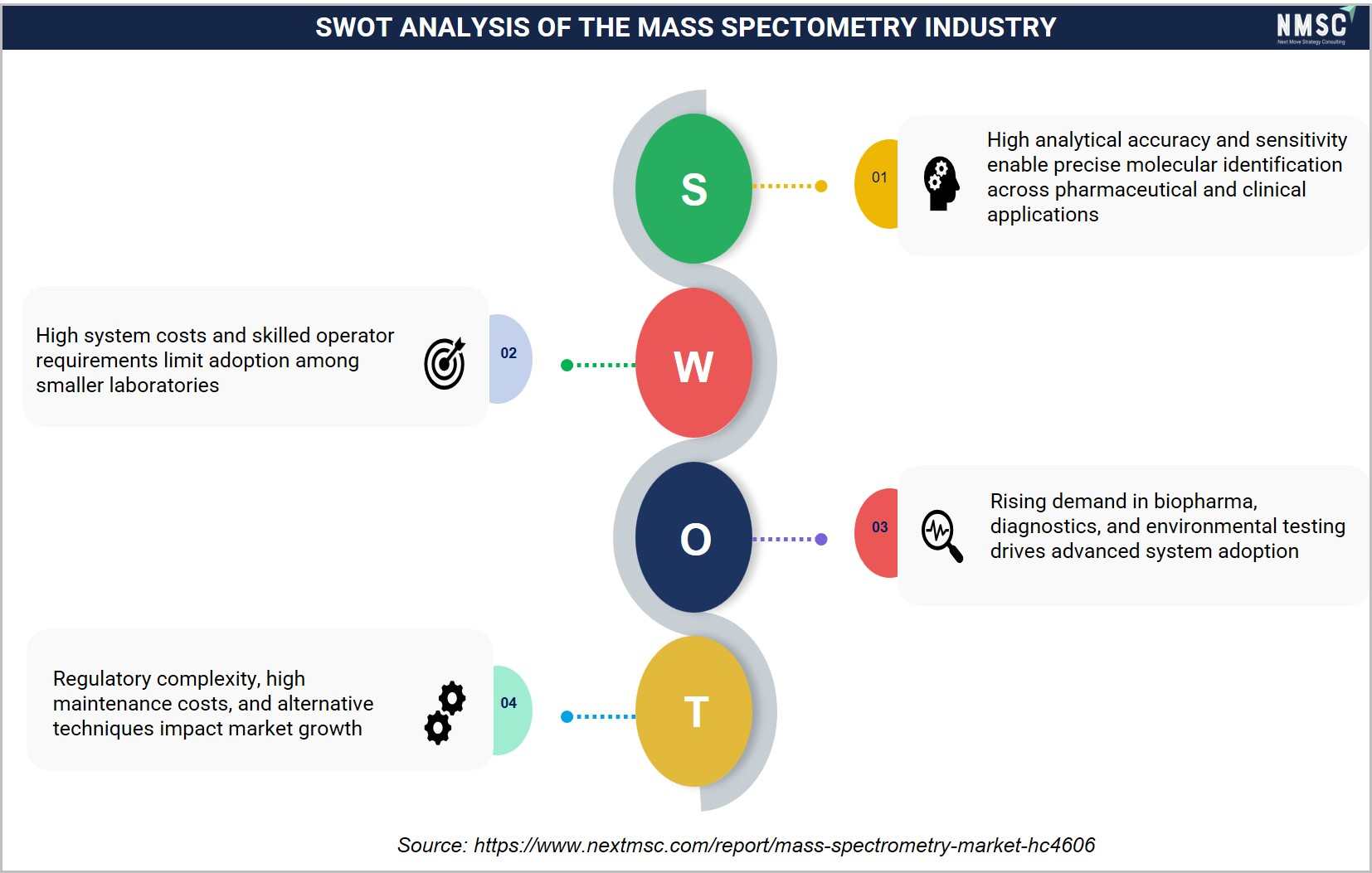
Based on our assessment of competitive positioning and industry developments, we noticed that mass spectrometry demonstrates strong analytical performance and precision, supporting its widespread adoption across pharmaceutical and clinical applications. However, high system costs and the requirement for skilled operators limit accessibility, particularly for smaller laboratories. Meanwhile, growing demand in biopharma, diagnostics, and environmental testing presents significant growth opportunities. At the same time, regulatory complexity, maintenance costs, and competition from alternative analytical techniques continue to pose challenges, thereby shaping a dynamic and evolving market landscape.
Competitive Landscape
Competitive Dynamics & M&A Landscape:
|
Key Takeaways |
|
The global mass spectrometry market is led by major players such as Thermo Fisher Scientific, Agilent Technologies, SCIEX, Waters Corporation, Bruker Corporation, and Shimadzu Corporation, supported by strong portfolios and global reach. Meanwhile, companies like JEOL, LECO, Revvity, MKS Instruments, AMETEK, and Teledyne strengthen application-specific capabilities, while niche firms including IONICON, TOFWERK, Advion, Kore Technology, Hiden Analytical, Extrel, IONOPTIKA, and 1st Detect drive specialized innovation. |
|
From our assessment, we observed that companies focus on high-resolution systems, software-driven analytics, and expanding applications across biopharma, environmental, and clinical testing. In addition, AI integration, automation, and multi-omics capabilities are shaping product development. |
|
Furthermore, competitive dynamics reflect a growing emphasis on portfolio expansion, strategic partnerships, and service-based models to strengthen customer retention and recurring revenue streams. Companies continue to enhance software ecosystems, service offerings, and workflow integration capabilities to improve long-term value delivery. These developments collectively position the market toward more integrated, performance-driven, and application-focused analytical solutions. |
Which Companies Dominate the Mass Spectrometry Industry and How Do They Compete?
Based on our analysis, we observed that the mass spectrometry market is led by established analytical instrumentation companies alongside specialized technology providers. Thermo Fisher Scientific, Agilent Technologies, SCIEX, Waters Corporation, Bruker Corporation, and Shimadzu Corporation consistently lead high-value deployments where analytical accuracy, system sensitivity, and regulatory compliance are critical decision factors. From our evaluation of laboratory workflows, we found that these vendors are widely selected for applications requiring high-resolution analysis, robust performance, and seamless integration with laboratory information systems. Companies such as JEOL, LECO, Revvity, MKS Instruments, AMETEK, and Teledyne strengthen their positions through application-specific solutions across industrial, environmental, and life sciences testing. At this level, competition is driven by system performance, portfolio breadth, and global service capabilities.
Market Dominated by Mass Spectrometry Giants and Specialists
From our observation, we noticed that the competitive landscape is further defined by niche and emerging players such as IONICON Analytik, TOFWERK, Advion Interchim Scientific, Kore Technology, Hiden Analytical, Extrel CMS, IONOPTIKA, and 1st Detect. Our interactions with laboratory operators indicate that these companies gain traction by offering specialized technologies, compact systems, and targeted analytical capabilities. In particular, they are preferred in applications requiring real-time analysis, portability, or highly specific measurement techniques. While leading companies set performance benchmarks and standardization, these innovators contribute through flexibility, faster innovation cycles, and application-focused solutions, collectively expanding the adoption of mass spectrometry across diverse use cases.
Innovation and Adaptability Drive Market Success
Innovation remains a key differentiator in the mass spectrometry market, as observed through our evaluation of laboratory deployments and research environments. Leading vendors such as Thermo Fisher Scientific, Bruker, Agilent, and Shimadzu continue to advance capabilities in high-resolution analysis, hybrid systems, and software-driven data interpretation. From our assessment, we observed that improvements in sensitivity, throughput, and automation enable laboratories to handle complex analytical workflows more efficiently. In addition, integration of advanced software platforms supports data processing, workflow optimization, and analytical consistency. Vendors that invest in system reliability, usability, and analytical depth are better positioned to meet evolving laboratory requirements and sustain long-term adoption.
Market Players to Opt for Merger & Acquisition Strategies to Expand Their Presence
Based on our research, we observed that mergers and acquisitions play a selective but strategic role in shaping the mass spectrometry market, particularly among leading players expanding beyond core instrumentation. For instance, Thermo Fisher Scientific announced the acquisition of Clario Holdings in October 2025, aimed at strengthening its clinical trial and data capabilities and expanding its role across the broader life sciences value chain. This reflects a clear shift toward integrating analytical instruments with clinical research, data platforms, and end-to-end workflow solutions. At the same time, other market participants continue to prioritise partnerships, portfolio expansion, and application-driven collaborations to enhance system capabilities and workflow integration. Our evaluation indicates that these strategies improve analytical efficiency, strengthen customer engagement, and support long-term value creation. As competition evolves, the market increasingly moves toward integrated, software-enabled, and solution-oriented analytical ecosystems.
List of Key Mass Spectrometry Companies
-
SCIEX
-
Waters Corporation
-
Bruker Corporation
-
Shimadzu Corporation
-
JEOL Ltd.
-
LECO Corporation
-
Revvity
-
MKS Instruments, Inc.
-
AMETEK Process Instruments
-
Teledyne Labs
-
IONICON Analytik GmbH
-
TOFWERK AG
-
Advion Interchim Scientific
-
Kore Technology Ltd.
-
Hiden Analytical Ltd.
-
Extrel CMS, LLC
-
IONOPTIKA Ltd.
-
1st Detect Corporation
What Are the Latest Key Industry Developments?
-
February 2026 – Bruker Corporation launched timsOmni™ mass spectrometer, designed to advance "Functional Proteomics 2.0." The system integrates new machine learning software (ProteoScape™ and GlycoScape™) to enable deeper characterisation of proteoforms and glycoproteomics, moving beyond simple protein lists to pathologically functional protein discovery.
-
August 2025 – Shimadzu Corporation released the LCMS-8065XE, a new triple-quadrupole mass spectrometer. The system features "Evolved, Efficient, and Exact" capabilities designed to enhance sensitivity and speed for high-throughput laboratory environments.
Expert Insights
 “Proteomics at population scale represents one of the most powerful opportunities to understand disease in real time across the full continuum of health.”
- Marc N. Casper, CEO, Thermo Fisher Scientific
Statement made during: Investor relations communication/strategic industry commentary highlighting advancements in population-scale proteomics and precision medicine-enabled analytical technologies.
Market Interpretation
The statement highlights the growing importance of population-scale proteomics in advancing real-time disease understanding across the full continuum of health. It reflects increasing demand for advanced analytical technologies, particularly mass spectrometry-based proteomics, as life sciences and healthcare shift toward precision medicine. This trend is driving adoption of high-throughput, high-resolution MS systems to support large-scale biomarker discovery, disease profiling, and personalised treatment development.
What Are the Key Factors Influencing Investment Analysis & Opportunities in the Mass Spectrometry Market?
Investment analysis in the mass spectrometry market is increasingly shaped by a shift in capital allocation toward integrated platforms and service-led models, rather than standalone instrument providers. Based on our evaluation of recent funding activity, strategic partnerships, and product innovations, we noticed that investors favour companies with recurring revenue streams derived from consumables, software platforms, and long-term service contracts. Vendors offering advanced data analytics, AI-enabled interpretation, and cloud-integrated workflows demonstrate stronger differentiation and attract higher strategic interest. Companies that combine high-performance instrumentation with scalable software ecosystems and application-specific solutions consistently secure premium positioning in the market.
We also identified investment concentration around high-resolution systems, miniaturised platforms, and AI-driven data processing capabilities, particularly in applications such as biopharmaceutical analysis, environmental monitoring, and clinical diagnostics. Strategic investments increasingly outweigh purely financial funding, as pharmaceutical companies, research institutions, and instrument manufacturers pursue deeper collaboration, faster innovation cycles, and expanded application capabilities. For investors, the most compelling opportunities emerge in companies that integrate technological innovation with proven application performance, scalable business models, and strong alignment with evolving regulatory and research requirements.
Key Benefits for Stakeholders:
Next Move Strategy Consulting (NMSC) presents a comprehensive analysis of the Mass Spectrometry market, covering historical developments from 2020 to 2025 and providing forward-looking forecasts through 2035. Our study evaluates the market at global, regional, and country levels, delivering quantitative outlooks alongside qualitative insights into key growth drivers, adoption barriers, technology shifts, and investment trends across all major mass spectrometry segments.
From our observation, we noticed the mass spectrometry industry delivers measurable value across a diverse ecosystem of participants. Investors benefit from recurring revenue streams supported by service contracts, consumables, and software-led analytical platforms. Laboratory scientists and biopharmaceutical researchers gain enhanced analytical precision, faster data interpretation, and improved regulatory compliance through advanced mass spectrometry systems. In parallel, instrument manufacturers and technology partners benefit from continuous demand for high-resolution systems, software upgrades, and application-specific innovations. By aligning analytical advancements with accuracy, efficiency, and scalability, the market creates sustained value across research, clinical, and industrial environments while supporting long-term scientific progress and operational excellence.
|
Parameters |
Details |
|
Customization Scope |
Free customization (equivalent to up to 80 analyst-working hours) after purchase. Addition or alteration to country, regional & segment scope. |
|
Pricing and Purchase Options |
Avail customized purchase options to meet your exact research needs. |
|
Approach |
In-depth primary and secondary research; proprietary databases; rigorous quality control and validation measures. |
|
Analytical Tools |
Porter's Five Forces, SWOT, value chain, and Harvey ball analysis to assess competitive intensity, stakeholder roles, and relative impact of key factors. |
Key Market Segments
By Product Category
-
Instruments
-
System Type
-
Chromatography-coupled MS
-
LC-MS
-
GC-MS
-
CE-MS
-
SFC-MS
-
-
Plasma-based MS
-
Laser desorption MS
-
Isotope ratio MS
-
Standalone MS systems
-
Process MS systems
-
Online MS
-
Residual gas analyzers
-
Membrane inlet MS
-
-
-
Mass Analyzer
-
Quadrupole
-
Single quadrupole
-
Triple quadrupole
-
-
Time of flight
-
TOF
-
Q-TOF
-
-
Ion trap
-
Orbitrap
-
FT-ICR
-
Magnetic sector
-
-
-
Consumables
-
Ion source components
-
Sample introduction components
-
Interface components
-
Calibration standards
-
Chromatography-related consumables
-
Other consumables
-
-
Software
-
Instrument control software
-
Data acquisition software
-
Data processing and analysis software
-
Spectral libraries and databases
-
Workflow and automation software
-
Cloud-based analytics platforms
-
-
Services
-
Installation and qualification
-
Preventive maintenance
-
Corrective maintenance and repairs
-
Service contracts
-
Training and certification
-
Application support
-
System upgrades
-
By Form Factor
-
Benchtop
-
Floor-standing
-
Portable
-
Transportable
-
Handheld
By Sales Channel
-
Direct sales
-
Indirect Sales
-
Distributors
-
Value-added resellers
-
-
OEM & Integration Sales
-
Embedded systems
-
Integrated analytical platforms
-
By Application Area
-
Pharmaceutical and biotechnology
-
Drug discovery
-
Drug development
-
Biologics analysis
-
-
Clinical diagnostics
-
Food testing
-
Environmental testing
-
Forensics and toxicology
-
Petrochemical & energy
-
Materials science
-
Academic research
-
Others
By End User
-
Pharmaceutical and Biotechnology Companies
-
Academic and Research Institutes
-
Contract Research Organizations
-
Contract Development and Manufacturing Organizations
-
Environmental Testing Laboratories
-
Food and Beverage Testing Laboratories
-
Clinical and Diagnostic Laboratories
-
Industrial Laboratories
-
Government and Forensic Laboratories
-
Others
Geographical Breakdown
-
North America: U.S., Canada, and Mexico.
-
Europe: UK, Germany, France, Italy, Spain, Sweden, Denmark, Finland, the Netherlands, and the Rest of Europe.
-
Asia Pacific: China, India, Japan, South Korea, Taiwan, Indonesia, Vietnam, Australia, Philippines, Malaysia and the rest of APAC.
-
Middle East & Africa (MEA): Saudi Arabia, UAE, Egypt, Israel, Turkey, Nigeria, South Africa, and the rest of MEA.
-
Latin America: Brazil, Argentina, Chile, Colombia, and the rest of LATAM.
Conclusion & Recommendations
This report provides stakeholders, service providers, investors, and consultants with actionable insights to capitalise on the structural transformation underway in the Mass Spectrometry market. By combining rigorous data-driven analysis with proven strategic frameworks, NMSC’s Mass Spectrometry Market Report serves as a critical decision-support resource for navigating an increasingly complex analytical landscape. The mass spectrometry market is positioned for sustained expansion, supported by the rapid growth of biopharmaceutical pipelines, tightening environmental regulations, and rising demand for high-precision analytical capabilities across healthcare and industrial applications. Key strategic insights highlight the increasing importance of high-resolution systems, AI-enabled data interpretation, and integrated software platforms, as these capabilities strengthen analytical accuracy, workflow efficiency, and long-term operational value. Vendors that prioritise advanced instrumentation, intelligent data processing, and flexible deployment models consistently strengthen customer retention and expand recurring service revenues.
For executives and investors, capturing value requires focusing on high-growth application areas such as biologics characterization, environmental testing, and clinical diagnostics, while continuing investments in R&D, system innovation, and software integration capabilities. Expanding presence in high-growth regions, particularly Asia-Pacific and emerging research hubs, unlocks new demand opportunities. Furthermore, advancements in system efficiency, sustainability, and ease of use enhance vendor credibility and accelerate adoption, thereby creating durable value across the global mass spectrometry ecosystem.


About the Author
 Saista Faiyaz
— Saista Faiyaz is Research Associate at Next Move Strategy Consulting, where she has covered consumer markets and healthcare technologies for 3 years. Her work includes primary interview review, secondary-source validation, market sizing, and structured analysis of company and industry data. She supports research by comparing evidence across sources, organizing findings into market narratives, and documenting assumptions used in analysis. Her scope includes cross-market benchmarking, and reports.
Saista Faiyaz
— Saista Faiyaz is Research Associate at Next Move Strategy Consulting, where she has covered consumer markets and healthcare technologies for 3 years. Her work includes primary interview review, secondary-source validation, market sizing, and structured analysis of company and industry data. She supports research by comparing evidence across sources, organizing findings into market narratives, and documenting assumptions used in analysis. Her scope includes cross-market benchmarking, and reports.
About the Reviewer
 Supradip Baul
— Supradip Baul is an accomplished business consultant and strategist with over a decade of rich experience in market intelligence, strategy, technology, and business transformation. His work has included rigorous qualitative and quantitative analysis across multiple industries, helping clients shape investment decisions and long-term roadmaps. Earlier in his career, he was associated with Gartner, where he contributed to industry-leading reports and market share analyses. He has worked with leading global companies and holds an MBA with a dual specialization in Marketing and Finance.
Supradip Baul
— Supradip Baul is an accomplished business consultant and strategist with over a decade of rich experience in market intelligence, strategy, technology, and business transformation. His work has included rigorous qualitative and quantitative analysis across multiple industries, helping clients shape investment decisions and long-term roadmaps. Earlier in his career, he was associated with Gartner, where he contributed to industry-leading reports and market share analyses. He has worked with leading global companies and holds an MBA with a dual specialization in Marketing and Finance.
At Next Move Strategy Consulting, we understand that insightful market research is the cornerstone of successful business decisions. That's why we employ a robust and multifaceted approach, combining various methodologies to deliver the most accurate and actionable data for our clients.

Research Landscape
We navigate the world of research with two primary approaches:
Qualitative Approach
Our qualitative research methodologies involve immersive techniques such as in-depth interviews, focus groups, and observational studies. By engaging directly with individuals and stakeholders, we uncover valuable insights that quantitative data alone may overlook.

Quantitative Research
In tandem with qualitative methodologies, NMSC leverages the power of Quantitative Research to provide a robust foundation of numerical insights. Through systematic data collection and analysis, we quantify patterns, preferences, and market trends, offering a comprehensive view of the business landscape.
Our quantitative research approach employs diverse tools, including surveys, experiments, and statistical modelling. These methodologies enable us to gather data from a large and representative sample, ensuring the statistical significance of our findings. By employing structured questionnaires and standardized data collection methods, we guarantee the reliability and validity of the information we present to our clients.
Quantitative research is particularly effective in measuring the prevalence of trends, assessing market size, and gauging the impact of various factors on consumer behavior. The numerical precision attained through this approach equips our clients with actionable insights, facilitating data-driven decision-making and strategy formulation.


Our Specialized Toolbox for Industry-Specific Market Research
We deploy a specialized arsenal of techniques tailored to meet your unique requirements. Here's a glimpse into our comprehensive toolbox:

Information Procurement
The stage entails acquiring market data or relevant information through various sources and methodologies.


Market Research Approach
We utilize both top-down and bottom-up approaches in market research analysis to achieve a comprehensive understanding of the market dynamics, leveraging the broad perspective of industry trends and macroeconomic factors alongside detailed insights from specific segments and individual companies.

Porters Five Forces Analysis
We conduct Porter's Five Forces analysis to evaluate the competitive landscape of an industry, providing us with insights into factors that affect profitability and strategic positioning.

SWOT Analysis

Forecasting
We utilize a forecasting model to predict future consumption by considering parameters like population, economics, regulations, market competition, drivers, constraints, technology, and pricing. We also employ statistical techniques such as multilinear regression, exponential smoothing, moving average, ARIMA, and Monte Carlo simulations for accurate predictions. In econometric forecasting, we analyzed short-term and long-term event impacts, attributing values based on regulatory frameworks, economic factors, and market events.





 Speak to Our Analyst