Memory Foam Mattress Market By Product Type (Gel-Infused Memory Foam, Plant-Based/Eco-Friendly Memory Foam, Hybrid Memory Foam Mattresses, Memory Foam Pillows and Accessories), By Thickness (Below 10 cm, 10–30 cm), By Firmness Level (Soft, Medium-Firm, Firm), By Price Range (Budget, Mid-Range, Premium), By Distribution Channel (Online Retailers, Specialty Stores), By End-User (Residential, Commercial) – Global Analysis & Forecast, 2025–2030
Industry: Retail and Consumer | Publishing Date: July 6, 2026 | Last Updated: October 16, 2026 | No of Pages: N/A | No. of Tables: N/A | No. of Figures: N/A | Format: PDF | Report Code: RC3808
Industry Outlook
The global Memory Foam Mattress Market size was valued at USD 5.74 billion in 2024, and is expected to be valued at USD 6.17 billion by the end of 2025. The industry is projected to grow, hitting USD 8.86 billion by 2030, with a CAGR of 7.50% between 2025 and 2030.
The market is experiencing rapid transformation, driven by urbanization, rising disposable incomes, increasing awareness of sleep health and wellness, and the growing shift toward personalized comfort solutions. Globally, demand for ergonomic, durable, and technologically advanced mattresses is accelerating, fuelled by expansion in organized retail, e-commerce platforms, hospitality sectors, and health-conscious consumer groups. The rise of online retail channels, direct-to-consumer (D2C) brands, and subscription-based sleep solutions is further amplifying the need for innovative product designs, material diversification, and targeted marketing strategies. Advancements in temperature regulation technologies, pressure-relief materials, motion isolation systems, and eco-friendly manufacturing are redefining product development, enhancing sleep quality, and strengthening consumer trust and brand loyalty across global markets.
What Are the Key Trends in the Market?
What are the Major Technological Trends Shaping the Market?
Technological advancements are significantly influencing the market. Innovations in viscoelastic materials, cooling gel infusions, and open-cell foam structures are improving breathability, durability, and pressure relief. AI and smart sensor integration in mattresses and sleep-tracking devices enable personalized sleep analytics and adaptive comfort settings. Automated and robotic production systems enhance precision, scalability, and quality consistency. Meanwhile, sustainable technologies, such as bio-based foams, recyclable components, and energy-efficient manufacturing, are gaining traction as brands respond to environmental standards. Continuous R&D in foam density optimization, motion isolation, and ergonomic design is redefining comfort engineering, enhancing user experience, and driving brand loyalty.
How is Demographic Change Influencing the Market?
Demographic and societal shifts are key growth drivers in the Market. Rising urbanization, growing middle-class populations, and increased disposable incomes are boosting mattress adoption, particularly in emerging economies. Younger, tech-savvy, and health-focused consumers are seeking innovative, customizable, and eco-friendly sleep solutions. In contrast, older consumers in developed regions prefer orthopedic, supportive, and temperature-neutral mattresses that address back pain and mobility concerns. These demographic trends are prompting manufacturers to diversify product portfolios, develop targeted marketing strategies, and create age- and lifestyle-specific designs that meet evolving consumer needs worldwide.
What Role does Government Support Play in Driving Industry Growth?
Government policies and initiatives play a vital role in shaping the Market. Regulations surrounding product safety, chemical emissions (like CertiPUR-US and OEKO-TEX standards), and environmental compliance enhance consumer trust and adoption. Incentives for domestic manufacturing, MSME development, and sustainable innovation encourage competitiveness and production efficiency. Additionally, government-backed public health campaigns promoting quality sleep and ergonomic furniture adoption indirectly support industry growth. Evolving regulatory frameworks in both emerging and developed markets are establishing quality benchmarks, encouraging eco-friendly practices, and fostering sustainable industrial expansion.
How is Consumer Preference Changing in the Market?
Consumer preferences in the Market are rapidly evolving toward personalized, premium, and multifunctional sleep solutions that deliver tangible health and wellness benefits. There is a strong shift toward eco-conscious, hypoallergenic, and temperature-regulating mattresses, along with rising interest in organic fabrics and natural foams. Modern consumers value transparent product information, ethical sourcing, and long-term durability, aligning purchases with their lifestyle and sustainability beliefs. Traditional, one-size-fits-all mattresses are being replaced by innovative, smart, and eco-responsible models, emphasizing custom comfort, convenience, and environmental stewardship as core differentiators in the market.
What are the Key Market Drivers, Breakthroughs, and Investment Opportunities that will Shape the Industry in the Next Decade?
The industry is witnessing robust growth, driven by urbanization, rising disposable incomes, and evolving lifestyles that prioritize comfort, convenience, and ergonomic sleep solutions. Rapid urban development and smaller living spaces are fueling demand for compact, multifunctional mattresses that enhance rest and well-being. The expansion of e-commerce and direct-to-consumer (D2C) channels further accelerates market adoption by providing convenience, wider accessibility, and personalized shopping experiences. However, high product costs and affordability challenges restrain growth in price-sensitive regions. Meanwhile, the increasing demand for smart, customizable, and IoT-enabled sleep solutions offers significant opportunities for innovation and differentiation, positioning the market for sustained expansion globally.
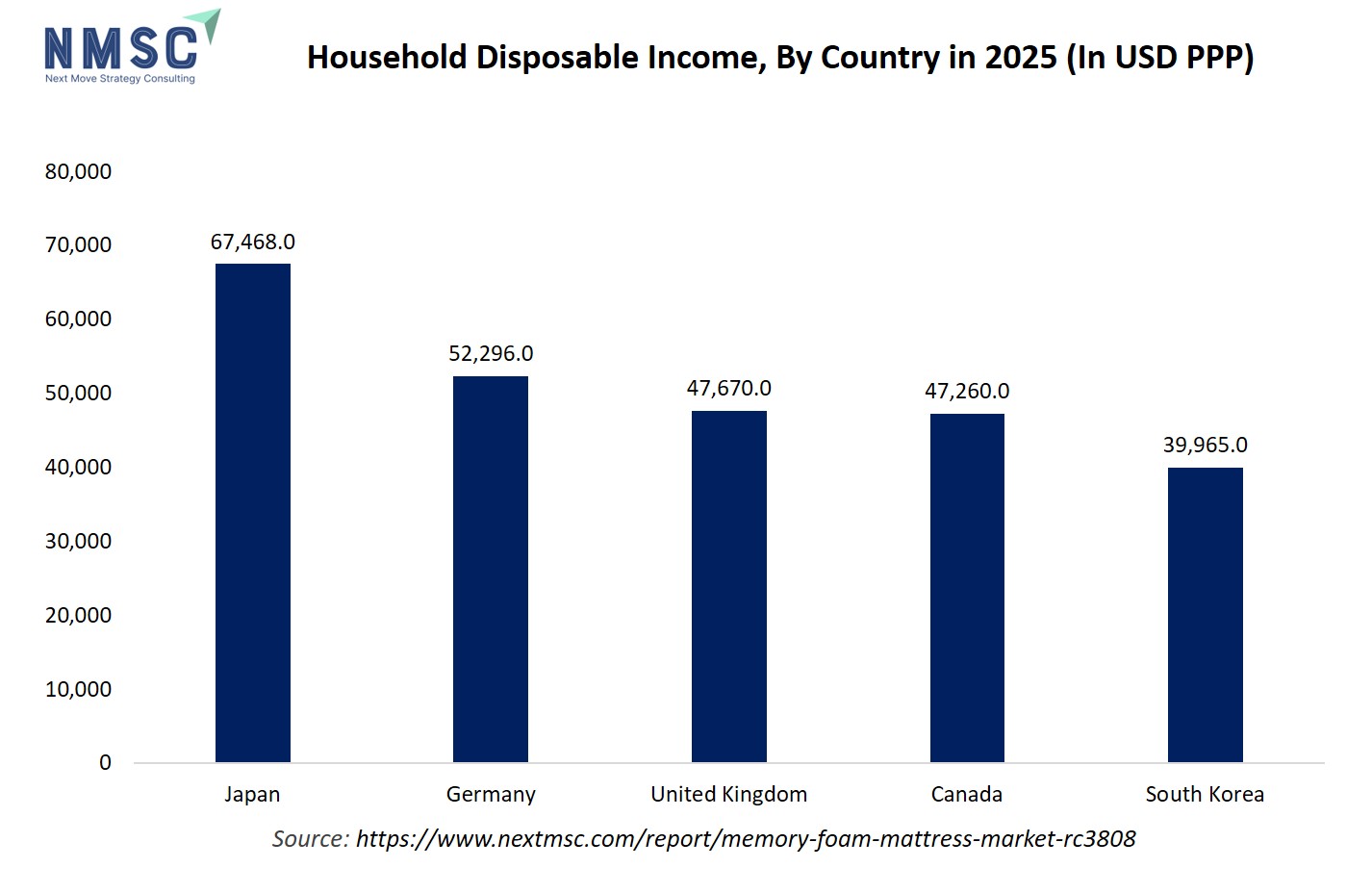
The household disposable income levels in 2024–2025 directly influence the market, as higher income enables consumers to invest in premium sleep solutions. Countries like Japan (USD 67,468), Germany (USD 52,296), the UK (USD 47,670), Canada (USD 47,260), and South Korea (USD 39,965) exhibit strong purchasing power, which supports demand for high-quality, ergonomic, and feature-rich viscoelastic foam mattresse. Elevated disposable incomes allow consumers to prioritize comfort, health, and sleep quality, making mid-range and premium memory foam products increasingly attractive. Thus, markets with higher disposable income are likely to see faster adoption and contribute significantly to global market growth.
Growth Drivers:
How is Urbanization Driving the Market Demand?
Urbanization and evolving lifestyles are significant drivers of the Market. As more people migrate to urban areas, there is a growing emphasis on comfort, convenience, and premium home furnishings. Rapid urban development has led to smaller living spaces and a fast-paced lifestyle, prompting consumers to seek products that enhance rest and well-being. Rising disposable incomes among urban populations are encouraging investments in high-quality, ergonomic, and stylish sleep solutions. The modern urban consumer increasingly values aesthetic appeal, space optimization, and multifunctionality, which aligns perfectly with memory foam mattresses’ compact design and superior comfort. Additionally, busy work schedules and stress associated with city life are heightening awareness of the importance of adequate sleep and posture support, further driving demand for advanced memory foam products. Together, these factors position urbanization and lifestyle shifts as powerful forces fueling sustained market growth.
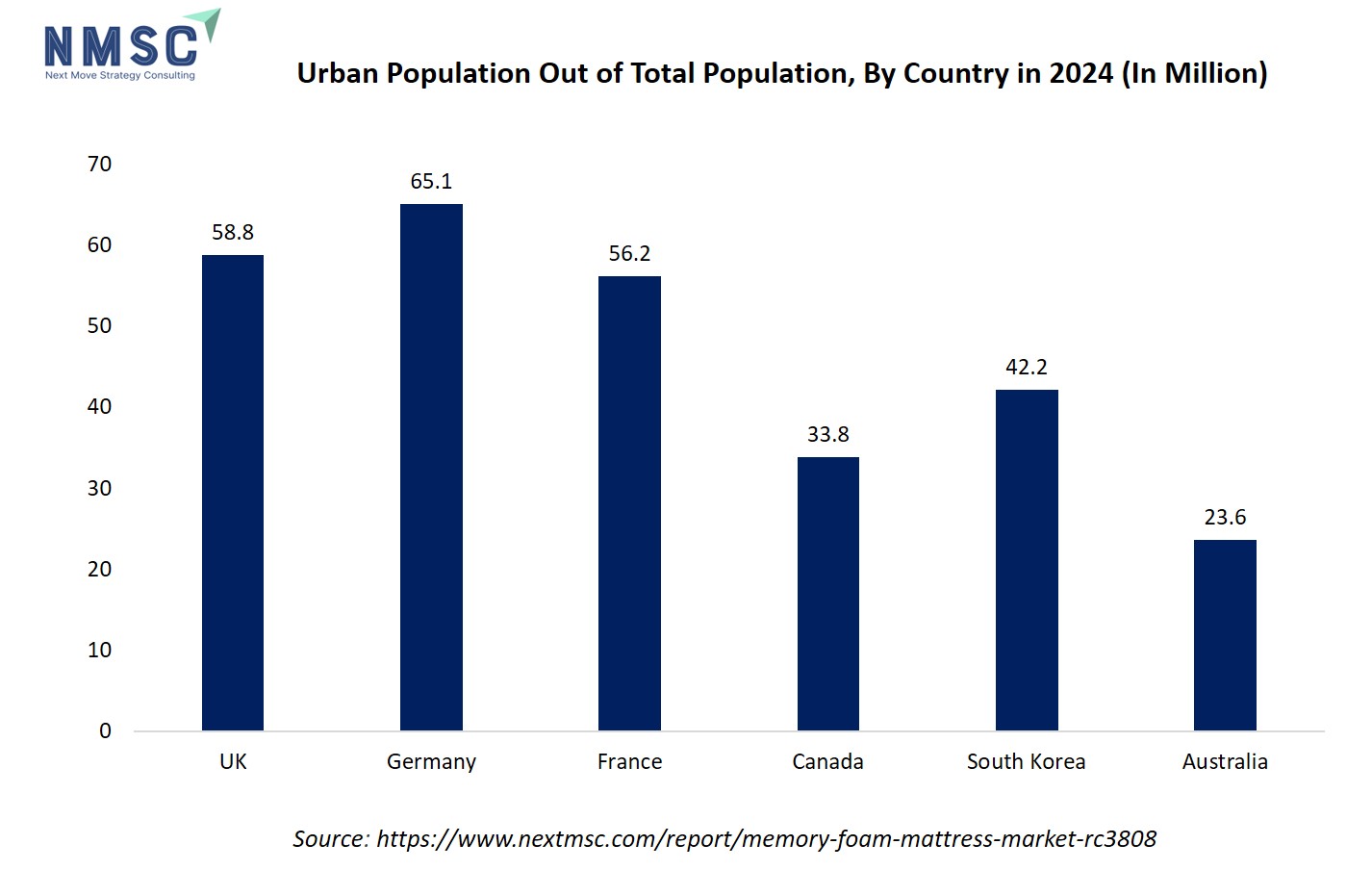
The urban population growth in 2024 across key countries is closely linked to the expanding demand for orthopedic mattress technology. Higher urban populations, such as Germany (65.05 million), the UK (58.76 million), and France (56.21 million), reflect densely populated cities where consumers prioritize comfort, convenience, and space-efficient home furnishings. Urban dwellers face smaller living spaces and fast-paced lifestyles, which drives preference for ergonomic, multifunctional, and premium sleep solutions like memory foam mattresses. Similarly, in South Korea (42.17 million), Canada (33.84 million), and Australia (23.60 million), rising urbanization is boosting awareness of sleep quality and health, further fueling adoption of memory foam products. Overall, urban concentration directly correlates with market growth.
Is Growth of E-commerce and D2C Channels Boosting the Market Expansion?
The growth of e-commerce and direct-to-consumer (D2C) channels is a major driver of the memory foam mattress market trends. The rise of online retail platforms has transformed how consumers research, compare, and purchase mattresses, offering greater convenience, transparency, and accessibility. E-commerce enables brands to reach a wider audience without relying solely on physical showrooms, reducing distribution costs and allowing for competitive pricing. D2C brands, in particular, are reshaping the market through personalized shopping experiences, home delivery models, and hassle-free return policies. Many leading mattress companies are leveraging digital marketing, virtual product demos, and customer reviews to build trust and enhance brand engagement.
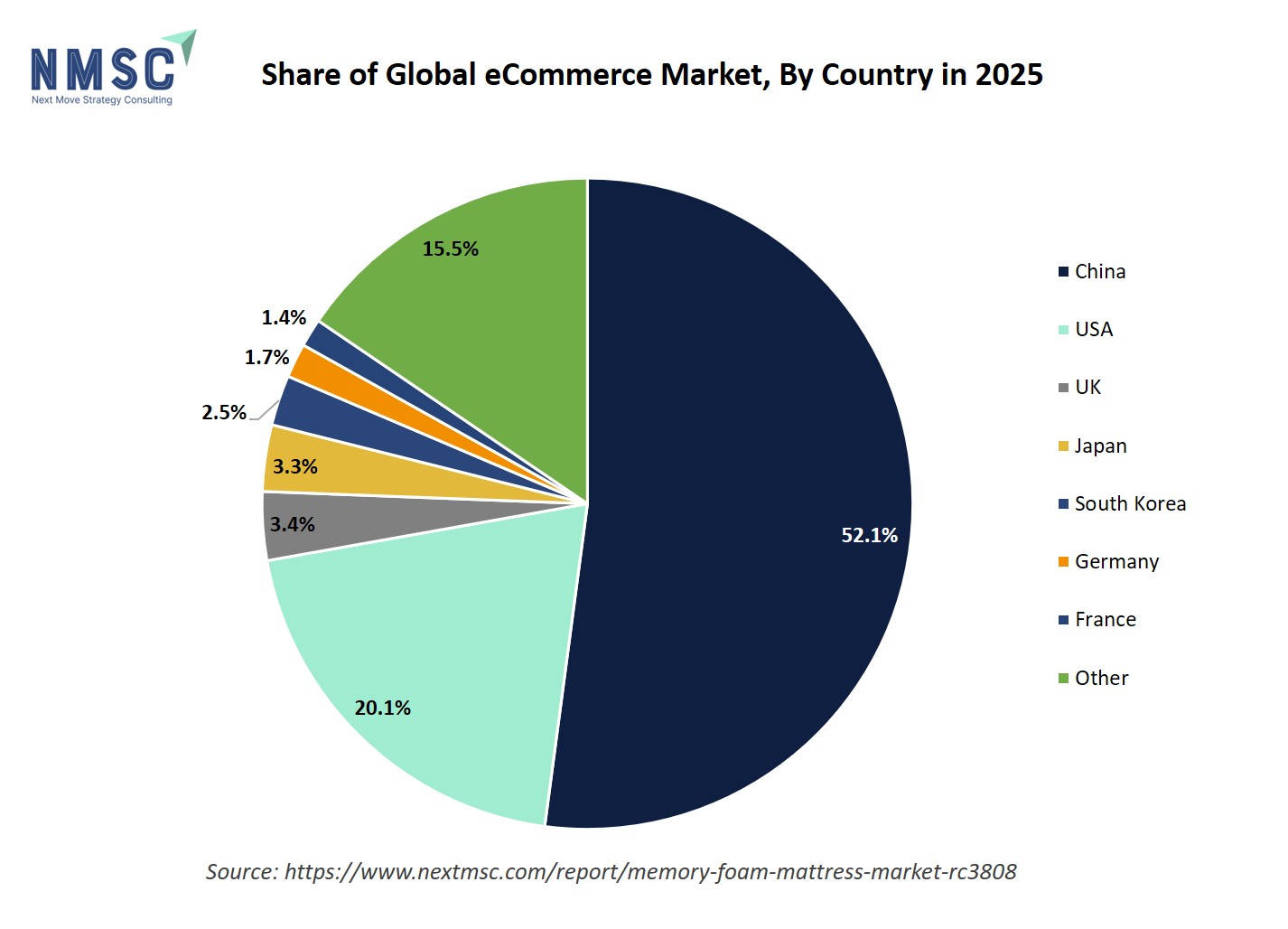
The global e-commerce landscape in 2025 is a significant driver for the memory foam mattress market share. With China leading at 52.1% and the USA at 20.1%, online retail platforms are becoming the preferred channel for mattress purchases due to convenience, wider product selection, and competitive pricing. Countries like the UK, Japan, South Korea, Germany, and France, although smaller in share, are seeing steady growth in digital mattress sales as consumers increasingly research products online, read reviews, and opt for home delivery. The rise of e-commerce and direct-to-consumer (D2C) models enables temperature-regulating mattresses brands to reach urban and tech-savvy buyers efficiently, enhancing market penetration and fuelling overall expansion globally.
Growth Inhibitors:
How does High Product Costs and Affordability Issues Limit the Growth of the Market?
Memory foam mattresses are priced higher than traditional spring or foam mattresses due to advanced materials, ergonomic designs, and technological features. This price premium limit adoption among price-sensitive consumers, particularly in emerging markets, and slow overall market growth. Additionally, frequent upgrades or replacements be seen as a significant investment, which restrain widespread penetration.
How is Rising Demand for Smart and Personalized Sleep Solutions Creating Opportunity for the Market?
The growing interest in smart mattresses, sleep-tracking technologies, and customizable comfort levels presents a significant growth opportunity. Consumers increasingly seek products that monitor sleep patterns, adjust firmness, or integrate with health apps to improve sleep quality. Brands that innovate in IoT-enabled mattresses, temperature regulation, and personalized ergonomic designs capture this trend, driving differentiation and higher market adoption globally.
How Is the Memory Foam Mattress Market Segmented in this Report, and What are the Key Insights from the Segmentation Analysis?
By Product Type Insights
Which Product Type is Expected to Drive the Memory Foam Mattress Market in 2025?
On the basis of product type, the memory foam mattress market segmentation is into Traditional/Standard Memory Foam, Gel-Infused Memory Foam, Plant-Based/Eco-Friendly Memory Foam, Hybrid Memory Foam Mattresses, and Memory Foam Pillows and Accessories. The market in 2025 is expected to be primarily driven by Gel-Infused Memory Foam mattresses. These mattresses are increasingly preferred for their superior cooling properties, pressure relief, and comfort. While traditional memory foam maintains strong demand, eco-friendly options appeal to environmentally conscious consumers, and hybrid mattresses and accessories cater to niche needs. Overall, gel-infused memory foam leads due to its balance of comfort, functionality, and temperature regulation.
By Thickness Insights
Which Thickness Segment is Expected to Drive the Memory Foam Mattress Market in 2025?
On the basis of thickness, the memory foam mattress market forecast is segmented into Below 10 cm, 10–30 cm, and Above 30 cm. The market in 2025 is expected to be primarily driven by the 10–30 cm segment, as it offers an optimal balance of comfort, support, and adaptability for most residential and commercial applications. Mattresses in this range cater to a wide variety of consumer preferences and bedroom sizes, making them the most popular choice. While below 10 cm products are used as toppers and above 30 cm options cater to luxury or specialty segments, the 10–30 cm thickness remains the mainstream driver of market growth.
By Firmness Level Insights
Which Firmness Level Is Expected to Drive the Memory Foam Mattress Market Expansion in 2025?
On the basis of firmness level, the memory foam mattress market share is segmented into Soft, Medium-Firm, and Firm. The market in 2025 is expected to be primarily driven by the Medium-Firm segment, as it provides the ideal combination of comfort and support suitable for the majority of sleepers. Medium-firm mattresses help maintain proper spinal alignment while offering pressure relief, making them highly preferred across residential and commercial applications. Soft mattresses cater to users seeking plush comfort, and firm mattresses target niche needs such as orthopedic support, but medium-firm remains the dominant driver of market growth.
By Price Range Insights
Which Price Range Is Expected to Drive the Memory Foam Mattress Market in 2025?
On the basis of price range, the memory foam mattress market challenges is segmented into Budget, Mid-Range, and Premium. The market in 2025 is expected to be primarily driven by the Mid-Range segment, as it offers an optimal balance between affordability and quality. Mid-range mattresses appeal to a broad consumer base seeking durable, comfortable, and feature-rich sleep solutions without paying the high premiums of luxury products. While budget mattresses attract price-sensitive buyers and premium mattresses target niche luxury segments, the mid-range category is the key growth driver due to its wide accessibility and value proposition.
By Distribution Channel Insights
Which Distribution Channel is Expected to Drive the Market in 2025?
On the basis of distribution channel, the memory foam mattress market industry is segmented into Online Retailers, Specialty Stores, and Department Stores. The market in 2025 is expected to be primarily driven by Online Retailers, as e-commerce platforms provide convenience, wider reach, and competitive pricing. Online channels enable consumers to compare products, read reviews, and access home delivery and easy return options, which significantly enhances the purchasing experience. While specialty and department stores continue to serve customers seeking in-person shopping and trials, the growing preference for digital shopping is making online retail the dominant channel for market growth.
By End User Insights
Which End User is Expected to Drive the Market in 2025?
On the basis of end-user, the memory foam mattress market report is segmented into Residential and Commercial. The market in 2025 is expected to be primarily driven by the Residential segment, as increasing urbanization, rising disposable incomes, and growing awareness of sleep quality are prompting consumers to invest in high-quality, comfortable mattresses for home use. While the commercial segment, including hotels, hospitals, and institutions, contributes to demand, the residential segment dominates due to the larger consumer base and preference for ergonomic, compact, and multifunctional sleep solutions.
Regional Outlook
The market is geographically studied across North America, Europe, Asia Pacific, and the Middle East & Africa, and each region is further studied across countries.
Memory Foam Mattress Market in North America
The North American Market is driven by rising awareness of sleep health, ergonomics, and wellness, along with growing preference for premium, eco-friendly, and multifunctional mattresses. Urbanization and increasing disposable incomes are enabling more consumers to invest in advanced memory foam and hybrid mattresses. Expanding retail networks, including supermarkets, specialty stores, and e-commerce platforms, are enhancing accessibility and visibility. Consumers are seeking products with customizable firmness, temperature regulation, and sustainable materials, while trends toward eco-conscious and chemical-free solutions are fostering innovation and supporting steady market growth across the region.
Memory Foam Mattress Market in the United States
The U.S. market is driven by the adoption of natural, organic, and premium memory foam mattresses. Health-conscious consumers seek products with orthopedic support, cooling technology, and ergonomic designs. Expansion of organized retail and e-commerce channels improves accessibility, while innovations in smart sleep tracking, hybrid designs, and sustainable materials support brand differentiation and customer loyalty.
Memory Foam Mattress Market in Canada
In Canada, demand is fueled by urbanization, higher disposable incomes, and increasing awareness of sleep health. Consumers are opting for multifunctional, eco-friendly, and ergonomic mattresses. Modern retail outlets and online platforms improve accessibility, while growing interest in sustainable, hypoallergenic, and chemical-free mattresses encourages manufacturers to innovate in materials, design, and packaging, creating opportunities for growth and differentiation.
Memory Foam Mattress Market in Europe
The European’s market is driven by rising health consciousness, wellness-focused lifestyles, and demand for premium sleep solutions. Urban populations with higher disposable incomes are increasingly adopting memory foam and hybrid mattresses. Retail modernization, expansion of online channels, and targeted marketing enhance product visibility and accessibility. Innovation in materials, smart mattress technologies, and sustainable manufacturing creates opportunities for brands to cater to diverse consumer preferences while adhering to strict European quality and environmental standards.
Memory Foam Mattress Market in the United Kingdom
In the U.K., the market is driven by growing consumer focus on wellness, ergonomic sleep, and premium mattress products. Urban populations with higher disposable incomes are increasingly seeking memory foam, hybrid, and adjustable mattresses. Expansion of modern retail outlets and e-commerce platforms enhances accessibility, allowing consumers to explore customizable firmness, cooling features, and smart sleep technologies. Government initiatives promoting health and safety standards support adoption, fostering steady market growth.
Memory Foam Mattress Market in Germany
Germany’s market is driven by health-conscious consumers and rising preference for premium, eco-friendly sleep solutions. Urban populations with higher disposable incomes are increasingly adopting memory foam and hybrid mattresses. Expansion of modern retail and e-commerce platforms improves accessibility, while regulatory compliance, sustainability trends, and focus on product quality support steady market growth.
Memory Foam Mattress Market in France
In France, market growth is fueled by increasing wellness awareness, urbanization, and preference for quality sleep solutions. Consumers are adopting ergonomic, hypoallergenic, and eco-friendly memory foam mattresses. Modern retail channels, including specialty stores, supermarkets, and online platforms, improve visibility and availability. Growing focus on sustainable and multifunctional products further supports steady demand.
Memory Foam Mattress Market in Spain
Spain’s market is influenced by urbanization, rising disposable incomes, and increasing health awareness. Urban consumers are showing strong interest in premium, ergonomic, and hybrid mattresses. Expansion of modern retail and online channels enhances accessibility, while trends toward sustainable materials, eco-conscious production, and advanced sleep technologies create opportunities for differentiation and market growth.
Memory Foam Mattress Market in Italy
Italy’s market is driven by increasing awareness of sleep health and preference for high-quality, innovative mattresses. Consumers are seeking ergonomic, multifunctional, and eco-friendly memory foam mattresses. Expansion of retail and e-commerce platforms enhances accessibility, while sustainability initiatives, advanced foam technologies, and compliance with safety standards provide opportunities for brand differentiation and loyalty.
Memory Foam Mattress Market in the Nordics
In the Nordic countries, the market is driven by high consumer awareness of wellness, sleep health, and sustainable products. Urban populations with higher disposable incomes are adopting premium memory foam and hybrid mattresses. Strong trends toward sustainability, product quality, and smart sleep technologies, combined with availability through modern retail chains and e-commerce platforms, support steady growth. Consumers prefer mattresses that combine comfort, ergonomic support, and environmentally responsible design.
Memory Foam Mattress Market in Asia Pacific
The Asia Pacific’s market is driven by rapid urbanization, rising disposable incomes, and growing health consciousness. Countries such as India, China, South Korea, Japan, Taiwan, and Australia are witnessing strong demand for premium, innovative, and ergonomically advanced memory foam mattresses. Expansion of modern retail outlets and e-commerce platforms is improving accessibility, while consumers increasingly seek high-quality, safe, and environmentally friendly products. Rising awareness of sleep wellness, sustainability, and personalized comfort solutions is creating significant opportunities for product innovation and market expansion across the region.
Memory Foam Mattress Market in China
China’s market growth is fueled by urbanization, increasing disposable incomes, and rising focus on sleep health. Consumers are seeking premium and innovative memory foam and hybrid mattresses that provide ergonomic support, durability, and customizable comfort. Expansion of modern retail chains and e-commerce platforms enhances product accessibility, while rising interest in eco-friendly, hypoallergenic, and sustainable mattresses supports brand differentiation and market development.
Memory Foam Mattress Market in Japan
Japan’s market is influenced by an aging population, high health consciousness, and strong demand for premium wellness products. Consumers increasingly prefer high-quality, ergonomic, and smart memory foam mattresses that support posture correction and sleep tracking. Accessibility through specialty stores, supermarkets, and online platforms facilitates growth, while sustainability trends and adherence to strict quality and safety standards encourage product innovation and differentiation.
Memory Foam Mattress Market in India
In India, the market is significantly driven by rapid urbanization, rising disposable incomes, and growing awareness of sleep wellness. India’s large urban population (~534.91 million) provides a concentrated consumer base in cities. Increasing health consciousness is boosting demand for premium, multifunctional, and eco-friendly memory foam mattresses. Expansion of modern retail outlets and e-commerce platforms, coupled with growing interest in sustainable and high-quality products, is creating strong opportunities for market growth and product innovation.
Memory Foam Mattress Market in South Korea
South Korea’s market is primarily driven by urbanization, rising disposable incomes, and increasing focus on health and wellness. Urban consumers are adopting premium memory foam and hybrid mattresses that offer comfort, durability, and eco-conscious features. Wide availability through modern retail chains and online platforms, along with demand for safe, high-quality, and innovative sleep solutions, supports consistent market growth and encourages continuous product innovation.
Memory Foam Mattress Market in Taiwan
Taiwan’s market is fueled by health-conscious and wellness-oriented consumers seeking premium, safe, and innovative memory foam mattresses. Urbanization, rising disposable incomes, and exposure to global lifestyle trends are driving adoption. Retail modernization and e-commerce platforms improve product accessibility, while trends toward sustainability, ergonomic design, and smart mattress technologies create opportunities for differentiation and regional market expansion.
Memory Foam Mattress Market in Indonesia
In Indonesia, the market is driven by rapid urbanization, a growing middle-class population, and increasing awareness of sleep health and comfort solutions. Consumers are showing strong demand for premium, ergonomic, and multifunctional memory foam mattresses. Expansion of modern retail channels and e-commerce platforms improves accessibility and variety, while rising interest in high-quality, sustainable, and safe products encourages brands to innovate in mattress design, materials, and features, creating significant growth prospects across urban and semi-urban markets.
Memory Foam Mattress Market in Australia
Australia’s market is supported by urbanization, rising disposable incomes, and increasing preference for premium, high-quality mattresses. Urban consumers are adopting ergonomic memory foam, hybrid, and smart mattresses that emphasize comfort, durability, and wellness benefits. Expansion of modern retail outlets and online platforms enhances product visibility, while sustainability trends and eco-conscious practices drive demand for environmentally responsible, safe, and innovative products, fostering steady market growth.
Memory Foam Mattress Market in Latin America
In Latin America, the market is primarily driven by rapid urbanization, rising disposable incomes, and growing health and wellness awareness. Countries such as Brazil, Mexico, and Argentina are witnessing increasing demand for premium, ergonomic, and multifunctional mattresses. Expansion of modern retail outlets and e-commerce platforms improves accessibility and visibility, while consumer preference for safe, high-quality, and sustainable sleep solutions encourages innovation and supports growth across metropolitan and semi-urban areas.
Memory Foam Mattress Market in the Middle East & Africa
In the Middle East and Africa, market growth is supported by urbanization, rising health consciousness, and increasing adoption of premium wellness products. Consumers are seeking ergonomic, durable, and high-quality memory foam mattresses with features like temperature regulation, pressure relief, and sustainable materials. Expansion of retail channels, including specialty stores and online platforms, enhances product availability, while growing demand for eco-friendly and high-performance sleep solutions presents opportunities for differentiation, innovation, and steady market growth across the region.
Competitive Landscape
Which Companies Dominate the Memory Foam Mattress Market and How do they Compete?
The global memory foam mattress industry is dominated by multinational manufacturers and prominent regional players such as Tempur Sealy International, Inc., Serta Simmons Bedding, LLC (Serta), Sleep Number Corporation, Casper Sleep Inc., Leesa Sleep, Nectar, Emma, IKEA, Saatva, LLC, Brooklyn Bedding, Nolah Mattress, Sikoala, Indifoam Private Limited, Siddharth Poly Foam Private Limited, and Refresh Mattress. These companies compete through a combination of innovation, material quality, and consumer-centric design to capture diverse consumer segments across premium, mid-range, and budget categories. Global leaders like Tempur Sealy, Serta, and Sleep Number leverage brand heritage, advanced sleep technology, and large-scale retail networks to maintain dominance. They focus on proprietary foam formulations, smart mattress integration, and ergonomic support systems to offer superior comfort and durability.
Casper, Leesa, Nectar, Emma, and Saatva emphasize direct-to-consumer (D2C) models, online marketing, and personalized sleep solutions to attract younger, tech-savvy buyers. Their competitive edge lies in affordable pricing, easy delivery (bed-in-a-box concept), and sustainability-focused materials such as plant-based foams and recycled fabrics. Regional and emerging manufacturers such as Brooklyn Bedding, Nolah Mattress, Sikoala, Indifoam Private Limited, Siddharth Poly Foam Private Limited, and Refresh Mattress compete by customizing offerings for local markets, providing value-driven products, and focusing on orthopedic designs and climate-adapted foams suited for specific regional conditions. Overall, competition in the memory foam mattress industry is driven by technological innovation in foam chemistry and sleep monitoring systems, sustainability initiatives, customer experience enhancement, and omnichannel retail expansion. Companies that integrate comfort innovation, eco-conscious production, and personalized sleep technologies are gaining greater market share, building strong customer loyalty, and expanding their global and regional footprints.
Market Dominated by Memory Foam Mattress Market Giants and Specialists
The memory foam mattress industry is divided between large multinational manufacturers and regional or niche players. Large companies compete on scale, brand recognition, extensive distribution networks, and broad product portfolios, offering a wide range of mattresses from mass-market to premium and specialty variants. Smaller or specialist providers focus on innovative, ergonomic, or customizable sleep solutions, catering to specific consumer preferences, local markets, or premium segments. This dual structure allows consumers to either choose well-established brands for reliability and variety or opt for specialized mattresses that meet unique comfort, health, or sustainability needs.
Innovation and Adaptability Drive Market Success
Market leaders are investing in product innovation, advanced materials, and sustainable manufacturing to enhance comfort, durability, and consumer appeal. Companies are developing premium memory foam, hybrid, and smart mattresses with features such as customizable firmness, temperature regulation, pressure relief, ergonomic designs, and eco-friendly materials. Brands that adapt to trends like personalized comfort, wellness-focused sleep solutions, and environmentally responsible production are securing stronger market presence and consumer loyalty. Continuous innovation in mattress design, materials, functionality, packaging, and user experience is key to maintaining a competitive advantage.
Market Players to Opt for Merger & Acquisition Strategies to Expand Their Presence
Mergers and acquisitions have become a key strategy for memory foam mattress companies to expand product portfolios, enter new geographic markets, and acquire innovative technologies. Leading manufacturers are acquiring regional or niche mattress brands to strengthen market share, diversify offerings, and integrate advanced production capabilities. These M&A activities enable companies to reach new consumer segments, scale operations, and respond effectively to growing demand for premium, ergonomic, and sustainable sleep solutions, while enhancing competitive positioning in both mass-market and specialty categories.
List of Key Memory Foam Mattress Companies
-
Tempur Sealy International, Inc.
-
Serta Simmons Bedding, LLC (Serta)
-
Sleep Number Corporation
-
Casper Sleep Inc.
-
Leesa Sleep
-
Nectar
-
Emma
-
IKEA
-
Saatva, LLC
-
Brooklyn Bedding
-
Nolah Mattress
-
Sikoala
-
Indifoam Private Limited
-
Siddharth Poly Foam Private Limited
-
Refresh Mattress
What Are the Latest Key Industry Developments?
-
February 2025 - Tempur Sealy completed the acquisition of Mattress Firm and announced it will re-name to Somnigroup International Inc.
-
July 2024 - The Federal Trade Commission (FTC) sued to block Tempur Sealy’s planned USD 4 billion acquisition of Mattress Firm Group Inc., citing competitive concerns.
-
May 2024 - Serta Simmons Bedding, LLC launched the new all-foam “iComfort” collection featuring 1″-4.5″ of memory-foam and zoned support (“5 ZoneResponse™”) under the Serta brand.
What Are the Key Factors Influencing Investment Analysis & Opportunities in the Vapor Products Market?
The memory foam mattress market share is attracting strong investor interest due to rising global demand for premium, ergonomic, and technologically advanced sleep solutions. Companies offering innovative materials, customizable firmness, smart sleep technologies, and sustainable manufacturing are particularly appealing, with investments focused on R&D, scalable production, and product differentiation. Market growth is driven by urbanization, rising disposable incomes, and increasing health and wellness awareness, especially in North America, Europe, and Asia-Pacific. Strategic mergers, acquisitions, and partnerships are facilitating consolidation, while companies that combine diverse product portfolios, technological innovation, operational efficiency, and responsiveness to consumer preferences, including eco-friendly and wellness-focused designs, present the most promising opportunities for long-term investor value.
Key Benefits for Stakeholders:
Next Move Strategy Consulting (NMSC) presents a comprehensive analysis of the memory foam mattress market, covering historical trends from 2020 to 2024 and providing detailed forecasts through 2030. The report examines the market at both regional and country levels, offering quantitative insights into key growth drivers, challenges, and investment opportunities across all major product type, distribution channel, and end-user segments of the memory foam mattress industry.
The industry’s growth delivers significant advantages to diverse stakeholders by meeting the increasing global demand for comfort, improved sleep quality, and health-focused bedding solutions. Investors benefit from strong growth potential driven by increasing consumer spending on home and lifestyle products, expanding e-commerce penetration, and growing awareness of ergonomic health benefits. Consumers gain from improved sleep comfort, pressure relief, and spinal support provided by advanced memory foam technologies that enhance overall well-being. Manufacturers and suppliers enjoy opportunities for innovation in foam density, temperature regulation, and sustainable materials, alongside expansion into emerging markets with rising disposable incomes. Additionally, retailers and online platforms benefit from the increasing preference for direct-to-consumer sales models and customizable product offerings. This collaborative ecosystem fosters shared value creation, where innovation, comfort, and sustainability drive long-term growth and competitiveness for all stakeholders in the memory foam mattress market report.
Report Scope
|
Parameters |
Details |
|
Market Size in 2025 |
USD 6.17 Billion |
|
Revenue Forecast in 2030 |
USD 8.86 Billion |
|
Growth Rate |
CAGR of 7.50% from 2025 to 2030 |
|
Analysis Period |
2024–2030 |
|
Base Year Considered |
2024 |
|
Forecast Period |
2025–2030 |
|
Market Size Estimation |
Billion (USD) |
|
Growth Factors |
|
|
Companies Profiled |
15 |
|
Countries Covered |
33 |
|
Market Share |
Available for 10 companies |
|
Customization Scope |
Free customization (equivalent to up to 80 analyst-working hours) after purchase. Addition or alteration to country, regional & segment scope. |
|
Pricing and Purchase Options |
Avail customized purchase options to meet your exact research needs. |
|
Approach |
In-depth primary and secondary research; proprietary databases; rigorous quality control and validation measures. |
|
Analytical Tools |
Porter's Five Forces, SWOT, value chain, and Harvey ball analysis to assess competitive intensity, stakeholder roles, and relative impact of key factors. |
Key Market Segments
By Product Type
-
Traditional/Standard Memory Foam
-
Gel-Infused Memory Foam
-
Plant-Based / Eco-Friendly Memory Foam
-
Hybrid Memory Foam Mattresses
-
Memory Foam Pillows and Accessories
By Thickness
-
Below 10 cm
-
10–30 cm
-
Above 30 cm
By Firmness Level
-
Soft
-
Medium-Firm
-
Firm
By Price Range
-
Budget
-
Mid-Range
-
Premium
By Distribution Channel
-
Online Retailers
-
Specialty Stores
-
Department Stores
By End-User
-
Residential
-
Commercial
Geographical Breakdown
-
North America: U.S., Canada, and Mexico.
-
Europe: U.K., Germany, France, Italy, Spain, Sweden, Denmark, Finland, Netherlands, and rest of Europe.
-
Asia Pacific: China, India, Japan, South Korea, Taiwan, Indonesia, Vietnam, Australia, Philippines, Malaysia, and rest of APAC.
-
Middle East & Africa (MENA): Saudi Arabia, UAE, Egypt, Israel, Turkey, Nigeria, South Africa, and rest of MENA.
-
Latin America: Brazil, Argentina, Chile, Colombia, and rest of LATAM
Conclusion & Recommendations
The memory foam mattress market share is set for consistent growth as consumer demand for comfort, wellness, and quality sleep continues to rise globally. This report provides stakeholders, investors, and manufacturers with actionable insights to capitalize on emerging opportunities in the bedding and home comfort industry. Increasing awareness of sleep health, expanding urbanization, and the rising preference for premium and ergonomic mattresses are key factors driving market expansion across both developed and emerging regions. NMSC’s report combines comprehensive data analysis with strategic frameworks to help organizations navigate evolving consumer preferences, technological advancements, and competitive market dynamics.
Strategic priorities for market participants include investing in advanced foam technologies to improve durability, temperature regulation, and support, while incorporating sustainable and eco-friendly materials to meet growing environmental expectations. Companies that focus on product differentiation, affordability, and seamless distribution, both online and offline, will strengthen brand visibility and customer loyalty. For executives and investors, success lies in targeting high-growth regions with expanding middle-class populations and increasing awareness of sleep wellness. Building partnerships with retailers, e-commerce platforms, and hospitality chains can accelerate market penetration and enhance accessibility. Furthermore, emphasizing customization, superior after-sales service, and transparent marketing practices enhances consumer trust and satisfaction. By prioritizing innovation, sustainability, and user experience, organizations can unlock long-term growth opportunities and establish leadership in the evolving memory foam mattress market demand.


About the Author
 Tushmi Dutta
— Tushmi Dutta is a focused researcher specializing in detailed analysis and insight-driven research across diverse business landscapes. She supports strategic initiatives through structured data interpretation, thorough validation, and clear communication of findings that aid informed decision-making. With a strong interest in writing, she enjoys presenting research insights in an engaging and accessible manner. Beyond work, she enjoys traveling, reading, painting, and continuously learning new skills that contribute to her creative and professional growth.
Tushmi Dutta
— Tushmi Dutta is a focused researcher specializing in detailed analysis and insight-driven research across diverse business landscapes. She supports strategic initiatives through structured data interpretation, thorough validation, and clear communication of findings that aid informed decision-making. With a strong interest in writing, she enjoys presenting research insights in an engaging and accessible manner. Beyond work, she enjoys traveling, reading, painting, and continuously learning new skills that contribute to her creative and professional growth.
About the Reviewer
 Supradip Baul
— Supradip Baul is an accomplished business consultant and strategist with over a decade of rich experience in market intelligence, strategy, technology, and business transformation. His work has included rigorous qualitative and quantitative analysis across multiple industries, helping clients shape investment decisions and long-term roadmaps. Earlier in his career, he was associated with Gartner, where he contributed to industry-leading reports and market share analyses. He has worked with leading global companies and holds an MBA with a dual specialization in Marketing and Finance.
Supradip Baul
— Supradip Baul is an accomplished business consultant and strategist with over a decade of rich experience in market intelligence, strategy, technology, and business transformation. His work has included rigorous qualitative and quantitative analysis across multiple industries, helping clients shape investment decisions and long-term roadmaps. Earlier in his career, he was associated with Gartner, where he contributed to industry-leading reports and market share analyses. He has worked with leading global companies and holds an MBA with a dual specialization in Marketing and Finance.
At Next Move Strategy Consulting, we understand that insightful market research is the cornerstone of successful business decisions. That's why we employ a robust and multifaceted approach, combining various methodologies to deliver the most accurate and actionable data for our clients.

Research Landscape
We navigate the world of research with two primary approaches:
Qualitative Approach
Our qualitative research methodologies involve immersive techniques such as in-depth interviews, focus groups, and observational studies. By engaging directly with individuals and stakeholders, we uncover valuable insights that quantitative data alone may overlook.

Quantitative Research
In tandem with qualitative methodologies, NMSC leverages the power of Quantitative Research to provide a robust foundation of numerical insights. Through systematic data collection and analysis, we quantify patterns, preferences, and market trends, offering a comprehensive view of the business landscape.
Our quantitative research approach employs diverse tools, including surveys, experiments, and statistical modelling. These methodologies enable us to gather data from a large and representative sample, ensuring the statistical significance of our findings. By employing structured questionnaires and standardized data collection methods, we guarantee the reliability and validity of the information we present to our clients.
Quantitative research is particularly effective in measuring the prevalence of trends, assessing market size, and gauging the impact of various factors on consumer behavior. The numerical precision attained through this approach equips our clients with actionable insights, facilitating data-driven decision-making and strategy formulation.


Our Specialized Toolbox for Industry-Specific Market Research
We deploy a specialized arsenal of techniques tailored to meet your unique requirements. Here's a glimpse into our comprehensive toolbox:

Information Procurement
The stage entails acquiring market data or relevant information through various sources and methodologies.


Market Research Approach
We utilize both top-down and bottom-up approaches in market research analysis to achieve a comprehensive understanding of the market dynamics, leveraging the broad perspective of industry trends and macroeconomic factors alongside detailed insights from specific segments and individual companies.

Porters Five Forces Analysis
We conduct Porter's Five Forces analysis to evaluate the competitive landscape of an industry, providing us with insights into factors that affect profitability and strategic positioning.

SWOT Analysis

Forecasting
We utilize a forecasting model to predict future consumption by considering parameters like population, economics, regulations, market competition, drivers, constraints, technology, and pricing. We also employ statistical techniques such as multilinear regression, exponential smoothing, moving average, ARIMA, and Monte Carlo simulations for accurate predictions. In econometric forecasting, we analyzed short-term and long-term event impacts, attributing values based on regulatory frameworks, economic factors, and market events.





 Speak to Our Analyst