Mexico Autonomous Mobile Robot (AMR) Market By Product Type (Autonomous Transport Robots, Autonomous Picking Robots, & Others), By Navigation Technology (LiDAR, Vision Navigation, & Others), By Payload Capacity (<100 KG, 100–1000 KG, & Others), By Deployment Environment (Indoor & Outdoor), By Commercial Model (Direct Sales, System Integrator Sales, & Others), By End-User Industry (Warehousing and Distribution, Manufacturing, & Others) – Opportunity Analysis & Forecast, 2025–2035
Industry: Semiconductor & Electronics | Lastest Edition: August 22, 2026 | No of Pages: 344 | No. of Tables: 194 | No. of Figures: 180 | Format: PDF | Report Code : SE5820
What Is the Mexico Autonomous Mobile Robot (AMR) Market Size?
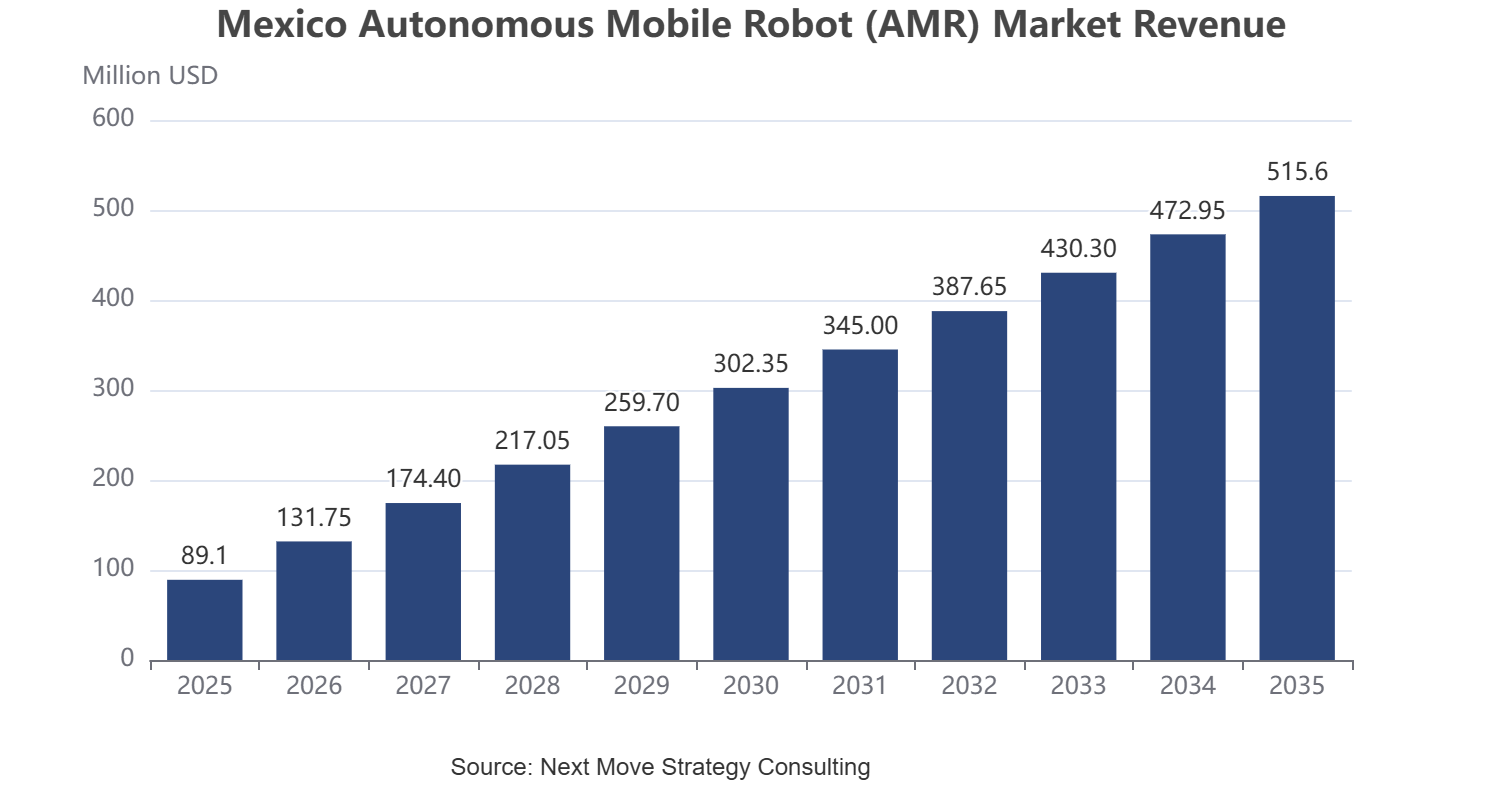
The Mexico Autonomous Mobile Robot (AMR) Market size was valued at USD 89 million in 2025 and is estimated at USD 111.8 million in 2026, forecast to reach USD 515.6 million by 2035, expanding at an 18.52% CAGR between 2026 and 2035. Autonomous Transport Robots dominate the market by product type, driven by strong demand for pallet and tugger units across nearshoring-driven manufacturing plants. In terms of volume, the Mexico AMR market recorded 3 thousand units in 2025, with forecasts indicating growth to 4 thousand units by 2026 and further to 28 thousand units by 2035, reflecting a CAGR of 22.57% over the forecast period.
|
Key Takeaways |
|
By Product Type: Autonomous Transport Robots is the dominant segment, while Autonomous Mobile Manipulators is the fastest-growing segment. |
|
By Navigation Technology: LiDAR is the dominant segment, while Sensor Fusion Navigation is the fastest-growing segment. |
|
By Payload Capacity: 100 Kgs to 1000 Kgs is the dominant segment, while 1001 Kgs to 5000 Kgs is the fastest-growing segment. |
|
By Deployment Environment: Indoor Autonomous Mobile Robots is the dominant segment, while Outdoor Autonomous Mobile Robots is the fastest-growing segment. |
|
By Commercial Model: Direct Sales is the dominant segment, while Robotics as a Service is the fastest-growing segment. |
|
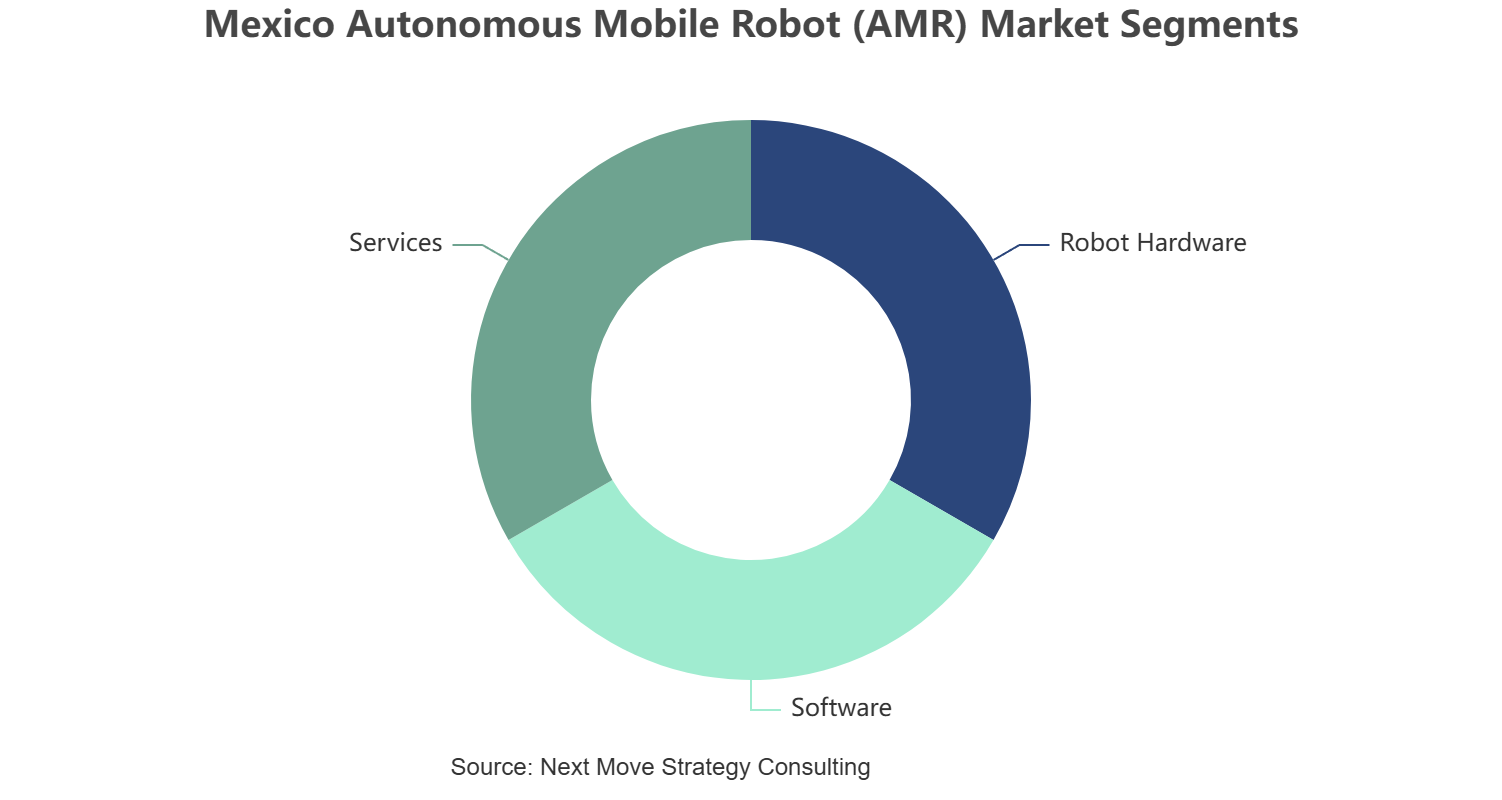
By Revenue Stream: Robot Hardware is the dominant segment, while Software is the fastest-growing segment. |
|
By End User Industry: Warehousing and Distribution is the dominant segment, while Healthcare is the fastest-growing segment. |
Market Opportunity: The Mexico Autonomous Mobile Robot (AMR) market is expected to create an absolute dollar opportunity of USD 403.8 million between 2026 and 2035, presenting significant investment potential across nearshoring-driven manufacturing automation, e-commerce fulfillment, and robotics-as-a-service deployments.
According to NMSC's analysis, accelerating nearshoring investment across the Bajio and northern border manufacturing corridors is prompting automotive and electronics suppliers in Mexico to prioritize autonomous transport robots over traditional conveyor systems to shorten deployment timelines through 2035.
What does the Mexico Autonomous Mobile Robot (AMR) Market Encompass?
The Mexico Autonomous Mobile Robot (AMR) market encompasses self-navigating transport, picking, manipulation, and forklift robots deployed across warehousing, manufacturing, healthcare, and retail facilities nationwide. We observed that the market spans indoor and outdoor deployment environments, supported by LiDAR, vision, sensor fusion, and magnetic navigation technologies, and is delivered through direct sales, system integrator, and robotics-as-a-service commercial models across hardware, software, and services revenue streams.
The market has evolved rapidly as nearshoring investment relocates automotive, electronics, and appliance manufacturing capacity into Mexico, prompting operators to adopt flexible automation that scales without extensive civil works. Regulatory oversight from the Secretaría del Trabajo y Previsión Social governs workplace safety standards applicable to mobile robot deployment, while NOM occupational safety norms shape integration practices. Our assessment indicates that growing adoption of fleet management software and sensor fusion navigation is reshaping procurement decisions across Mexican manufacturing and logistics operators.
|
Parameters |
Details |
|
Market Size in 2025 |
USD 89 Million |
|
Market Size in 2026 |
USD 111.8 Million |
|
Revenue Forecast in 2035 |
USD 515.6 Million |
|
Market Size Growth Rate |
CAGR of 18.52% from 2026 to 2035 |
|
Market Volume in 2025 |
3 Thousand Units |
|
Market Volume in 2026 |
4 Thousand Units |
|
Volume Forecast in 2035 |
28 Thousand Units |
|
Market Volume Growth Rate |
CAGR of 22.57% from 2026 to 2035 |
|
Analysis Period |
2025–2035 |
|
Base Year Considered |
2025 |
|
Forecast Period |
2026–2035 |
|
Market Size Estimation |
Million (USD) |
|
Companies Profiled |
15 |
|
Market Share |
Available for 10 companies |
Key Emerging Trends
Based on research conducted by NMSC, we found that four structural trends are reshaping deployment models, navigation architecture, and competitive dynamics across the Mexico Autonomous Mobile Robot (AMR) market.
How Is Nearshoring Investment Transforming AMR Deployment Volumes?
Accelerating nearshoring of automotive and electronics manufacturing into Mexico is transforming the scale and pace of AMR deployment across new production facilities. We observed that operators establishing greenfield plants in the Bajio region are specifying autonomous transport and forklift robots at the design stage rather than retrofitting later. This shift is enabling manufacturers such as new automotive parts suppliers to compress facility commissioning timelines while avoiding costly conveyor infrastructure.
Why Is Sensor Fusion Navigation Gaining Preference Over Single-Sensor Systems?
Facility operators are increasingly favoring sensor fusion navigation that combines LiDAR, vision, and inertial data over single-sensor systems for reliability in dust-heavy manufacturing environments. Our findings suggest that this approach reduces false-stop events across mixed indoor-outdoor yard transitions common at Mexican industrial parks. This transition is improving uptime for operators running multi-shift production lines with variable lighting and floor conditions.
How Is Robotics as a Service Reshaping Adoption Among Mid-Sized Operators?
Robotics-as-a-service commercial models are lowering the capital barrier for mid-sized Mexican manufacturers and logistics operators to adopt AMR fleets. We observed that vendors bundling hardware, fleet software, and maintenance into a subscription fee are accelerating adoption among operators previously deterred by high upfront capital requirements. This model is expanding the addressable customer base beyond large multinational plants into domestic contract manufacturers.
What Role Do Autonomous Mobile Manipulators Play in Expanding Use Cases?
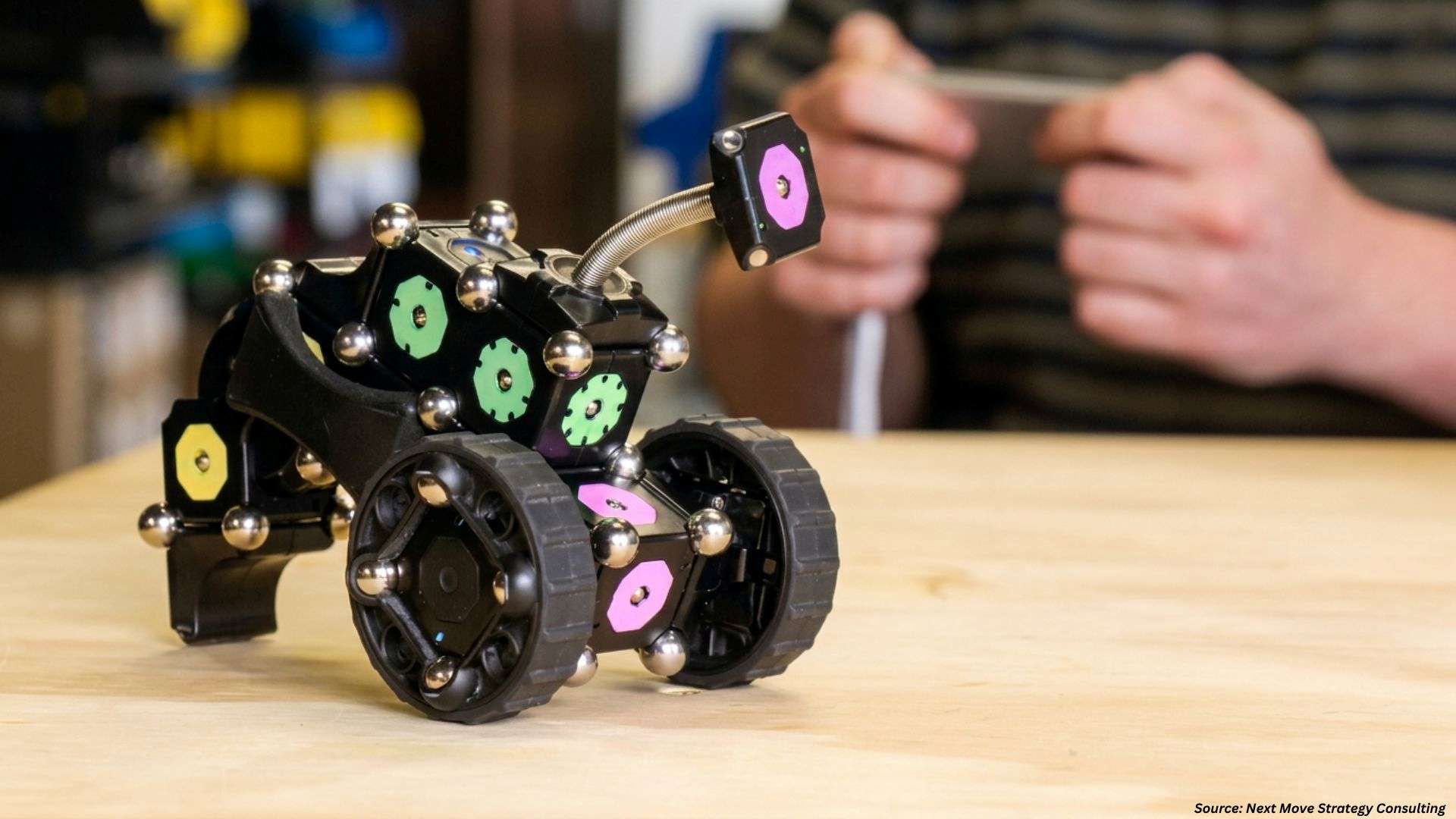
Autonomous mobile manipulators combining robotic arms with mobile bases are expanding AMR use cases beyond simple transport into inspection and light assembly tasks. Our analysis indicates that manufacturers are piloting these units for machine tending and quality inspection roles previously requiring fixed robotic cells. This trend is enabling operators to redeploy automation capital across changing production lines without reengineering plant layouts.
Strategic Framework of the Mexico Autonomous Mobile Robot (AMR) Market
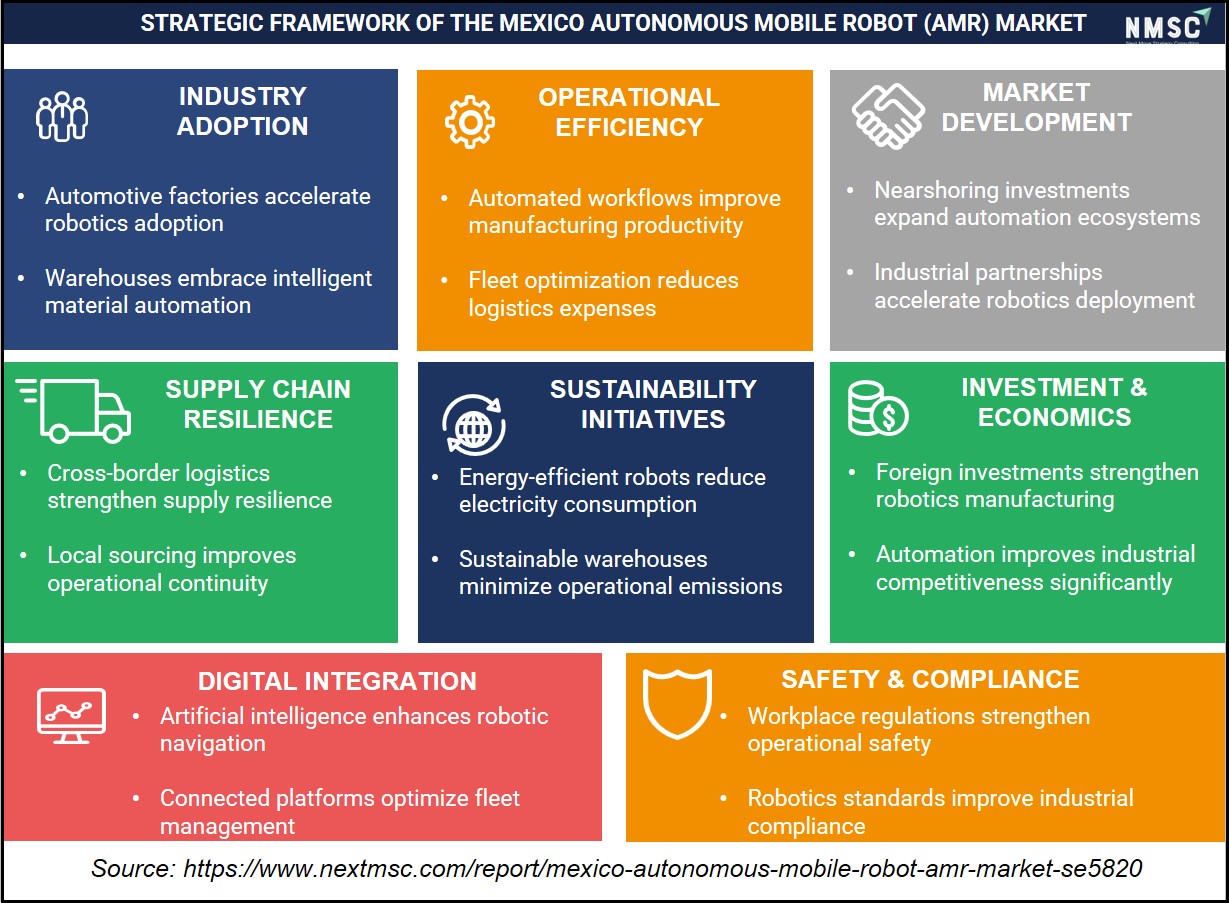
The above strategic framework analysis maps the key strategic components, such as industry adoption, operational efficiency, market development, supply chain resilience, sustainability initiatives, investment and economics, digital integration, and safety and compliance, shaping the Mexico AMR market. From our analysis, we observed that automotive factories and warehouses accelerate robotics adoption, while automated workflows improve productivity and fleet optimization reduces expenses. Nearshoring investments expand automation ecosystems, and artificial intelligence enhances robotic navigation, whereas workplace regulations strengthen safety and robotics standards improve industrial compliance.
Growth Drivers and Restraints
|
FACTORS |
TYPE |
(+/-) % IMPACT ON CAGR |
GEOGRAPHIC RELEVANCE |
IMPACT TIMELINE |
|
Accelerating nearshoring investment expanding automotive and electronics manufacturing capacity |
Driver |
+4.10% |
Mexico (strongest in Bajio, Nuevo Leon, and border states) |
Medium to Long term (2–7 years) |
|
Persistent manufacturing labor shortages increasing automation investment |
Driver |
+3.35% |
Mexico (nationwide; strongest in industrial parks) |
Short to Long term (1–7 years) |
|
Expanding e-commerce fulfillment infrastructure increasing warehouse automation demand |
Driver |
+2.80% |
Mexico (strongest in Mexico City and Guadalajara metro areas) |
Medium term (2–6 years) |
|
Declining sensor and navigation hardware costs improving AMR affordability |
Driver |
+2.15% |
Mexico (nationwide) |
Medium term (2–5 years) |
|
Growing adoption of robotics-as-a-service financing among mid-sized operators |
Driver |
+1.70% |
Mexico (nationwide; strongest among domestic manufacturers) |
Short to Medium term (1–4 years) |
|
High upfront integration costs and facility-retrofit requirements limiting adoption among small operators |
Restraint |
-1.60% |
Mexico (nationwide; strongest among small manufacturers) |
Short to Medium term (1–4 years) |
|
Shortage of skilled technicians for AMR fleet maintenance and integration |
Restraint |
-1.35% |
Mexico (nationwide; strongest outside major industrial hubs) |
Medium term (2–5 years) |
|
Peso currency volatility increasing imported hardware procurement costs |
Restraint |
-1.05% |
Mexico (nationwide) |
Short to Medium term (1–4 years) |
What Is the Primary Growth Driver of the Mexico Autonomous Mobile Robot (AMR) Market?
Accelerating nearshoring investment across Mexico's automotive and electronics manufacturing corridors is the primary growth driver of the Mexico Autonomous Mobile Robot (AMR) market. Secretaría de Economía data has tracked continued growth in foreign direct investment into Mexican manufacturing in recent years, with a large share directed toward the Bajio and northern border states. We observed that new production facilities are specifying industrial robotics and mobile automation at the design stage, sustaining demand for autonomous transport and forklift robots across greenfield plants.
How Is E-Commerce Growth Driving Market Growth Mexico Autonomous Mobile Robot (AMR) Market?
Expanding e-commerce penetration across Mexico is accelerating AMR adoption within fulfillment and distribution facilities. The Instituto Nacional de Estadística y Geografía reported continued growth in retail e-commerce transaction volumes in recent years, sustaining pressure on operators to compress order processing times. Our assessment indicates that retailers and logistics providers are deploying goods-to-person picking robots to handle rising parcel volumes while maintaining delivery commitments across Mexico City, Guadalajara, and Monterrey distribution hubs.
What Is Restraining Mexico Autonomous Mobile Robot (AMR) Market Expansion?
High upfront integration costs and a shortage of skilled technicians continue to restrain market expansion, particularly among small and mid-sized manufacturers. Operators face additional expenses related to facility retrofitting, workforce retraining, and imported hardware procurement subject to currency fluctuation. We found that smaller facilities with constrained capital budgets are more likely to delay automation investment until robotics-as-a-service financing models and local technician training programs further reduce entry costs.
Segmentation Analysis
By Navigation Technology Insights
How Is the Mexico Autonomous Mobile Robot (AMR) Market Segmented by Navigation Technology?
Based on navigation technology, the Mexico Autonomous Mobile Robot (AMR) market is segmented into LiDAR, vision navigation, sensor fusion navigation, magnetic and marker navigation, and other navigation technology. LiDAR systems use laser-based ranging to map facility layouts, vision navigation relies on camera-based perception, and sensor fusion combines multiple input types for greater reliability across variable operating conditions.
We found that LiDAR-based systems remain widely specified across new manufacturing facility deployments due to mature integration practices and reliable performance in structured indoor layouts common to automotive supplier plants. Sensor fusion navigation is gaining relevance as operators expand AMR use into mixed indoor-outdoor yard environments where lighting and surface conditions vary, encouraging vendors to combine LiDAR, vision, and inertial inputs to maintain consistent navigation accuracy across Mexican industrial parks.
By Revenue Stream Insights
How Is the Mexico Autonomous Mobile Robot (AMR) Market Segmented by Revenue Stream?
Based on revenue stream, the Mexico Autonomous Mobile Robot (AMR) market is segmented into robot hardware, software, and services. Software further comprises fleet management, navigation, robot operating, analytics, and AI software, while services span installation and deployment, integration, maintenance, and robotics-as-a-service offerings supporting ongoing fleet operation.
Robot hardware continues to represent the largest share of spend as operators purchase physical transport, picking, and forklift units to build initial fleets across new manufacturing plants. Services revenue is expanding at a faster pace as operators increasingly rely on integration and maintenance support to manage multi-vendor fleets, with robotics-as-a-service offerings gaining particular traction among mid-sized manufacturers seeking predictable operating expenditure over large upfront capital commitments.
Growth Opportunities
We observed that three forward-looking whitespace opportunities are emerging across the Mexico Autonomous Mobile Robot (AMR) market as nearshoring investment accelerates facility automation.
Where Does Nearshoring-Driven Greenfield Construction Create New Demand?
Expanding greenfield automotive and electronics manufacturing construction across the Bajio region is creating new demand for autonomous transport and forklift robots specified at the facility design stage, benefiting hardware vendors offering rapid deployment and minimal civil works integration.
How Can Robotics as a Service Expand Reach Among Domestic Manufacturers?
Robotics-as-a-service financing structures create opportunity for vendors to capture domestic mid-sized manufacturers previously priced out of automation, benefiting integrators that bundle hardware, software, and maintenance into predictable subscription pricing tailored to Mexican peso-denominated budgets.
What Opportunity Exists in Cross-Border Logistics Terminal Automation?
Rising cross-border freight volumes at Mexican logistics terminals are creating opportunity for outdoor-rated AMR platforms engineered for industrial yard conditions, benefiting hardware manufacturers that adapt navigation and durability packages for sustained outdoor terminal operation.
Competitive Landscape
We observed that the Mexico Autonomous Mobile Robot (AMR) market features a competitive landscape spanning multinational industrial automation subsidiaries, dedicated AMR specialists, and material handling equipment manufacturers expanding into mobile robotics.
|
Dimension |
Description |
|
Market Structure |
Competitive with multinational industrial automation subsidiaries operating alongside dedicated AMR specialists and material handling equipment manufacturers. Large multinational players account for a significant share of hardware supply, while system integrators continue to expand their local deployment footprint. |
|
Innovation Focus |
Sensor fusion navigation, fleet management software, payload-flexible forklift platforms, and robotics-as-a-service financing dominate current product development strategies across leading manufacturers. |
|
M&A Activity |
Strategic partnerships, local integration capability expansion, and distribution network investment continue to shape the competitive landscape as companies strengthen their presence in nearshoring-driven manufacturing automation. |
How Do Companies Compete in the Mexico Autonomous Mobile Robot (AMR) Market?
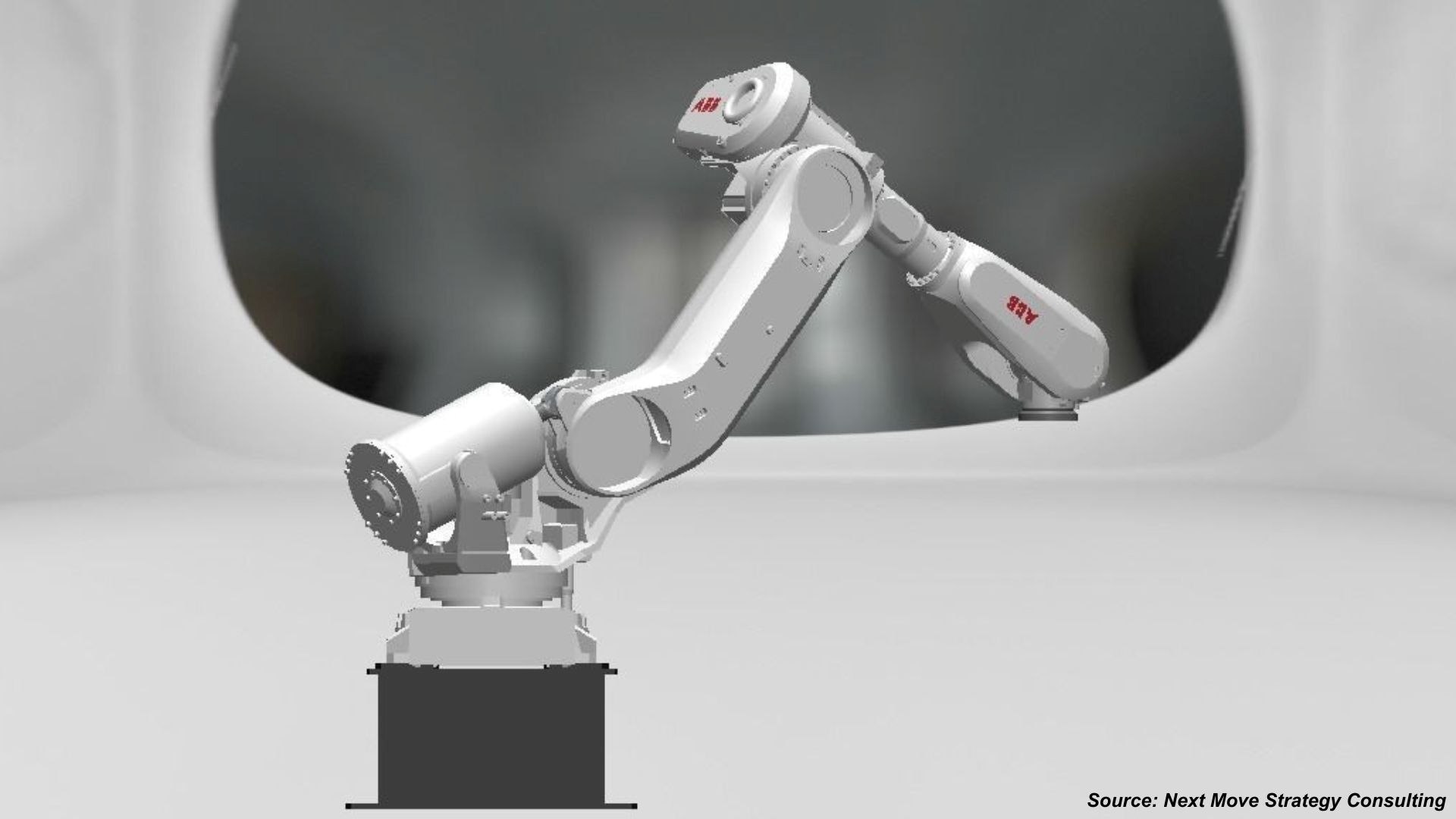
Companies compete primarily through local integration capability, navigation software sophistication, and service network breadth supporting Mexican manufacturing plants. Leading manufacturers such as Daifuku de Mexico, S.A. de C.V., KUKA Robotics Mexico, S. de R.L. de C.V., and ABB México, S.A. de C.V. leverage extensive research capabilities, established distribution networks, and broad industrial automation portfolios to maintain market leadership across manufacturing and logistics facilities.
Which Competitive Archetypes Dominate the Mexico Autonomous Mobile Robot (AMR) Market?
Two primary competitive archetypes characterize the market. The first comprises multinational industrial automation subsidiaries offering AMR platforms alongside broader conveyor, forklift, and warehouse execution portfolios serving large automotive and electronics plants. The second includes dedicated AMR and system integrator specialists that focus on fleet software, rapid deployment, and localized service support tailored to mid-sized Mexican manufacturers.
How Are Companies Differentiating Through Innovation?
Innovation strategies increasingly focus on sensor fusion navigation, payload-flexible forklift design, and cloud-connected fleet management. Companies are investing in localized software configuration and predictive maintenance analytics tailored to Mexican facility conditions. Our analysis indicates that manufacturers combining strong navigation software with durable outdoor-rated hardware platforms are strengthening their competitive positioning across Mexican manufacturing and logistics operators.
What M&A and Expansion Activity Is Shaping the Market?
Strategic partnerships, local distribution expansion, and service network investment continue to shape competition across the market. Leading companies are strengthening positions through partnerships with regional system integrators, expanding local technician training programs, and increasing service center investment to broaden coverage across the Bajio and northern border manufacturing corridors.
Key Players
Our assessment indicates that the following 15 companies are actively shaping hardware innovation, software development, and competitive dynamics within the Mexico Autonomous Mobile Robot (AMR) market.
-
Zebra Technologies Mexico, S. de R.L. de C.V.
-
KUKA Robotics Mexico, S. de R.L. de C.V.
-
Daifuku de Mexico, S.A. de C.V.
-
Dematic S. de R.L. de C.V.
-
Toyota Industries Commercial Finance de México, S.A. de C.V.
-
Agilox Services Mexico, S. de R.L. de C.V.
-
SSI SCHAEFER Sistemas Internacionales de Almacenaje, S. de R.L. de C.V.
-
Stäubli Mexicana, S. de R.L. de C.V.
-
Mobile Industrial Robots Mexico, S. de R.L. de C.V.
-
ABB México, S.A. de C.V.
-
Rockwell Automation de México, S.A. de C.V.
-
OMRON Manufacturing of Mexico, S.A. de C.V.
-
Jungheinrich de México, S.A. de C.V.
-
Mecalux México, S.A. de C.V.
Latest Developments
We found that recent partnerships and expansion activity within the Mexico Autonomous Mobile Robot (AMR) market are concentrated on local integration capacity, fleet software rollout, and nearshoring-driven manufacturing plant automation.
|
Date |
Event (short description) |
|
February 2026 |
Mecalux México showcased the AMR 1500 Pallet Conveyor and AMR 100 Box robots at Summit & Expo 2026, promoting advanced warehouse automation and AMR adoption in Mexico. |
|
May 2025 |
OMRON partnered with SEI Automation to expand AMR integration in Mexico, strengthening automation capabilities across manufacturing and warehouse applications. |
Investment Opportunities
What Capital Inflows Are Targeting the Mexico Autonomous Mobile Robot (AMR) Market?
Capital inflows into the Mexico Autonomous Mobile Robot (AMR) market are increasingly directed toward local integration capability, fleet software development, and manufacturing capacity expansion tied to nearshoring investment. Leading industrial automation subsidiaries continue to invest in navigation software and payload-flexible hardware to strengthen competitive positioning. We observed that investors favor companies demonstrating strong local service networks and recurring software revenue as indicators of long-term growth potential.
How Is Infrastructure Investment Supporting the Market?
Infrastructure investment is expanding local service centers, technician training programs, and integration capabilities across the Mexican AMR industry. Our findings suggest that companies are investing in regional distribution networks to reduce deployment lead times for nearshoring manufacturers. Manufacturers are also strengthening partnerships with local system integrators to enhance market penetration among mid-sized industrial park operators.
What ESG Considerations Are Shaping Investment Decisions?
Environmental, social, and governance considerations are becoming integral to investment decisions across the Mexico Autonomous Mobile Robot (AMR) market, with energy-efficient battery systems and worker safety outcomes emerging as priorities. We found that investors increasingly favor companies demonstrating measurable progress in energy efficiency, local workforce development, and transparent supply chain governance, strengthening long-term value creation within the industry.
Key Benefits for Stakeholders
How Does This Report Benefit Enterprise and Industry Leaders?
Enterprise and industry leaders gain access to validated market segmentation, competitive benchmarking, and demand forecasts that support strategic planning and product development across the Mexico Autonomous Mobile Robot (AMR) market. Our analysis shows that detailed assessments of product type, navigation technology, and end user industry trends help companies identify high-growth opportunities and strengthen market positioning.
How Does This Report Benefit Investors and Financial Analysts?
Investors and financial analysts benefit from consistent market size estimates, growth forecasts, and competitive assessments that support investment evaluation across the Mexico Autonomous Mobile Robot (AMR) market. We observed that detailed analysis of hardware, software, and services revenue streams enables stakeholders to identify companies with the strongest long-term growth potential through 2035.
How Does This Report Benefit Technology Vendors and Product Teams?
Technology vendors and product development teams gain insights into emerging innovation trends, including sensor fusion navigation, fleet orchestration software, and robotics-as-a-service financing models transforming the industry. Our findings suggest that this analysis helps research and development teams prioritize future product pipelines and align offerings with evolving operator requirements across Mexico.
Supply Chain Structure of the Mexico Autonomous Mobile Robot (AMR) Market
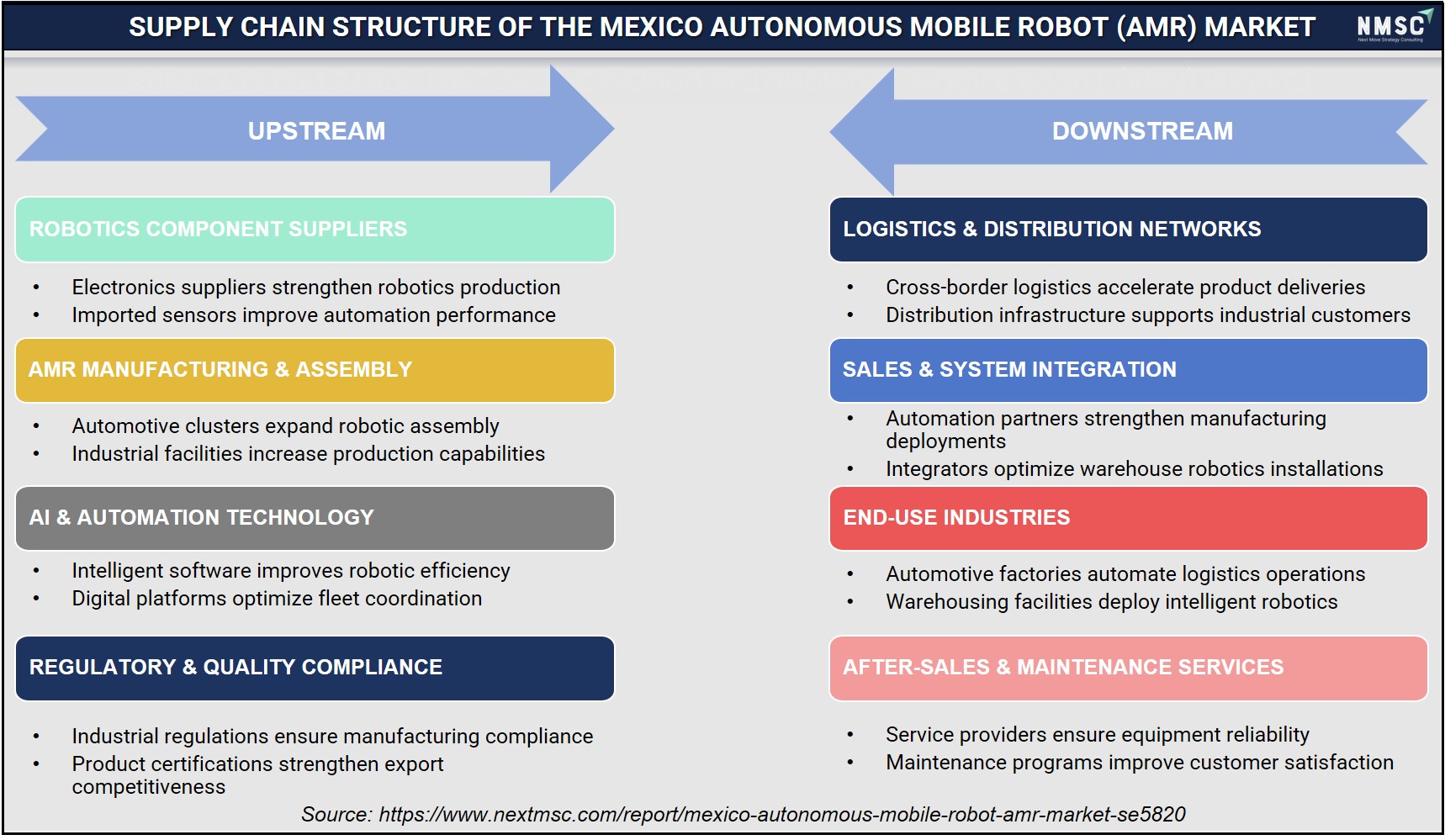
The above supply chain analysis maps the key operational stages, such as upstream and downstream, shaping the Mexico AMR market. From our analysis, we observed that upstream activities include electronics suppliers, imported sensors, automotive clusters, industrial facilities, intelligent software, digital platforms, and industrial regulations, while downstream activities encompass cross-border logistics, automation partners, integrators, automotive factories, warehousing facilities, and service providers, reflecting a well-integrated supply chain across the market.
Key Market Segments
By Product Type
-
Autonomous Transport Robots
-
Tugger
-
Cart
-
Pallet
-
Shelf and Rack
-
Conveyor
-
Other Transport Robots
-
-
Autonomous Picking Robots
-
Goods to Person
-
Person to Goods
-
Piece Picking
-
Case Picking
-
Other Picking Robots
-
-
Autonomous Mobile Manipulators
-
Robotic Arm
-
Inspection Manipulators
-
Maintenance Manipulators
-
Other Mobile Manipulators
-
-
Autonomous Forklift Robots
-
Counterbalance Forklift
-
Reach Forklift
-
Stacker Forklift
-
Pallet Truck
-
Other Forklift Robots
-
-
Specialized AMRs
-
Healthcare Robots
-
Laboratory Robots
-
Retail Robots
-
Security Robots
-
Other Specialized Robots
-
By Navigation Technology
-
LiDAR
-
Vision Navigation
-
Sensor Fusion Navigation
-
Magnetic and Marker Navigation
-
Other Navigation Technology
By Payload Capacity
-
< 100 Kgs
-
100 Kgs to 1000 Kgs
-
1001 Kgs to 5000 Kgs
-
> 5000 Kgs
By Deployment Environment
-
Indoor Autonomous Mobile Robots
-
Warehouse Environment
-
Manufacturing Environment
-
Healthcare Environment
-
Retail Environment
-
Laboratory Environment
-
-
Outdoor Autonomous Mobile Robots
-
Industrial Yard Environment
-
Logistics Terminal Environment
-
Other Outdoor Environment
-
By Commercial Model
-
Direct Sales
-
System Integrator Sales
-
Robotics as a Service
By Revenue Stream
-
Robot Hardware
-
Software
-
Fleet Management Software
-
Navigation Software
-
Robot Operating Software
-
Analytics Software
-
AI Software
-
-
Services
-
Installation and Deployment
-
Integration Services
-
Maintenance Services
-
Robotics as a Service
-
By End User Industry
-
Warehousing and Distribution
-
E-commerce Fulfillment
-
Third Party Logistics
-
Retail Distribution
-
-
Manufacturing
-
Automotive
-
Electronics and Semiconductors
-
Machinery and Equipment
-
Food and Beverage Manufacturing
-
Other Manufacturing
-
-
Healthcare
-
Hospitals
-
Laboratories
-
Pharmaceutical Facilities
-
-
Retail
-
Other Industries
Conclusion and Recommendations
What Is the Long-Term Outlook for the Mexico Autonomous Mobile Robot (AMR) Market?
The long-term outlook for the Mexico Autonomous Mobile Robot (AMR) market remains positive, supported by accelerating nearshoring investment, persistent manufacturing labor shortages, and expanding e-commerce fulfillment infrastructure. We observed that growing adoption of sensor fusion navigation and robotics-as-a-service financing will continue to drive market expansion across automotive, electronics, and logistics segments through 2035.
What Strategic Positioning Should AMR Companies Pursue?
Manufacturers should prioritize investments in local integration capability, sensor fusion navigation, and robotics-as-a-service financing while strengthening service networks across the Bajio and northern border corridors. Our assessment indicates that companies expanding technician training programs and local distribution partnerships will be well positioned to capture nearshoring-driven demand within the Mexico Autonomous Mobile Robot (AMR) market.
How Attractive Is the Market for New Investment?
The Mexico Autonomous Mobile Robot (AMR) market presents an attractive investment opportunity, supported by rising capital expenditure on manufacturing automation and continued innovation in navigation and fleet software. We found that investment potential is particularly strong for companies focused on outdoor-rated hardware, robotics-as-a-service models, and local technician training initiatives.
What Market Shifts and Key Risks Should Stakeholders Monitor?
Stakeholders should closely monitor evolving currency risk affecting imported hardware costs, shortage of skilled technicians, and shifting nearshoring investment patterns across Mexican manufacturing regions. Our analysis shows that companies unable to continuously expand local service capacity or demonstrate integration reliability may face increasing competitive pressure within the Mexico AMR industry.
What Are the Key Growth Pathways for the Market?
Key growth pathways include expanding local integration and service networks, accelerating sensor fusion navigation adoption, and strengthening robotics-as-a-service financing models. NMSC's analysis indicates that companies successfully combining hardware durability, software sophistication, and local support will be best positioned to capture the Mexico Autonomous Mobile Robot (AMR) market's projected growth through 2035.
About the Author
 Mayurima Roy is a research analyst delivering data-driven insights that support strategic planning and market understanding. She combines analytical rigor with strong content development skills, translating complex information into clear, actionable narratives for diverse audiences. Her work includes structured research, trend tracking, competitive assessment, and insight-led content creation that supports informed decision-making. Curious and detail-oriented by nature, she continually deepens her understanding of evolving markets while pursuing creative interests such as crafting and video creation.
About the Reviewer
 Supradip Baul is an accomplished business consultant and strategist with over a decade of rich experience in market intelligence, strategy, technology, and business transformation. His work has included rigorous qualitative and quantitative analysis across multiple industries, helping clients shape investment decisions and long-term roadmaps. Earlier in his career, he was associated with Gartner, where he contributed to industry-leading reports and market share analyses. He has worked with leading global companies and holds an MBA with a dual specialization in Marketing and Finance.
At Next Move Strategy Consulting, we understand that insightful market research is the cornerstone of successful business decisions. That's why we employ a robust and multifaceted approach, combining various methodologies to deliver the most accurate and actionable data for our clients.

Research Landscape
We navigate the world of research with two primary approaches:
Qualitative Approach
Our qualitative research methodologies involve immersive techniques such as in-depth interviews, focus groups, and observational studies. By engaging directly with individuals and stakeholders, we uncover valuable insights that quantitative data alone may overlook.

Quantitative Research
In tandem with qualitative methodologies, NMSC leverages the power of Quantitative Research to provide a robust foundation of numerical insights. Through systematic data collection and analysis, we quantify patterns, preferences, and market trends, offering a comprehensive view of the business landscape.
Our quantitative research approach employs diverse tools, including surveys, experiments, and statistical modelling. These methodologies enable us to gather data from a large and representative sample, ensuring the statistical significance of our findings. By employing structured questionnaires and standardized data collection methods, we guarantee the reliability and validity of the information we present to our clients.
Quantitative research is particularly effective in measuring the prevalence of trends, assessing market size, and gauging the impact of various factors on consumer behavior. The numerical precision attained through this approach equips our clients with actionable insights, facilitating data-driven decision-making and strategy formulation.


Our Specialized Toolbox for Industry-Specific Market Research
We deploy a specialized arsenal of techniques tailored to meet your unique requirements. Here's a glimpse into our comprehensive toolbox:

Information Procurement
The stage entails acquiring market data or relevant information through various sources and methodologies.


Market Research Approach
We utilize both top-down and bottom-up approaches in market research analysis to achieve a comprehensive understanding of the market dynamics, leveraging the broad perspective of industry trends and macroeconomic factors alongside detailed insights from specific segments and individual companies.

Porters Five Forces Analysis
We conduct Porter's Five Forces analysis to evaluate the competitive landscape of an industry, providing us with insights into factors that affect profitability and strategic positioning.

SWOT Analysis

Forecasting
We utilize a forecasting model to predict future consumption by considering parameters like population, economics, regulations, market competition, drivers, constraints, technology, and pricing. We also employ statistical techniques such as multilinear regression, exponential smoothing, moving average, ARIMA, and Monte Carlo simulations for accurate predictions. In econometric forecasting, we analyzed short-term and long-term event impacts, attributing values based on regulatory frameworks, economic factors, and market events.





 Speak to Our Analyst