Mexico Drone Market By Component (Hardware, Software, and Services), By Platform Type (Multi-Rotor, Fixed-Wing, Hybrid VTOL, and Others), By Autonomy Level (Remotely Piloted, Assisted, Advanced, and Fully Autonomous), By Maximum Take-off Weight {Nano (<250 g), Micro (250 g–2 kg), Small (>2 kg–25 kg), and Others}, By End-User (Consumer Drone, Commercial & Industrial Drone, Government & Public Safety Drone, and Military Drone) – Analysis & Forecast, 2025–2035
Industry: Aerospace & Defense | Latest Edition: August 11, 2026 | No of Pages: 261 | No. of Tables: 140 | No. of Figures: 128 | Format: PDF | Report Code: AD3985
Mexico Drone Market Size & Forecast
|
Parameters |
Details |
|
Market Size in 2025 |
USD 1.31 billion |
|
Market Size in 2026 |
USD 1.63 billion |
|
Revenue Forecast in 2035 |
USD 6.34 billion |
|
Market Size Growth Rate |
CAGR of 16.27% from 2026 to 2035 |
|
Market Volume in 2025 |
51 thousand units |
|
Market Volume in 2026 |
66 thousand units |
|
Volume Forecast in 2035 |
345 thousand units |
|
Market Volume Growth Rate |
CAGR of 20.25% from 2026 to 2035 |
|
Analysis Period |
2025–2035 |
|
Base Year Considered |
2025 |
|
Forecast Period |
2026–2035 |
|
Market Size Estimation |
Billion (USD) |
|
Companies Profiled |
15 |
|
Market Share |
Available for 10 companies |
Industry Outlook
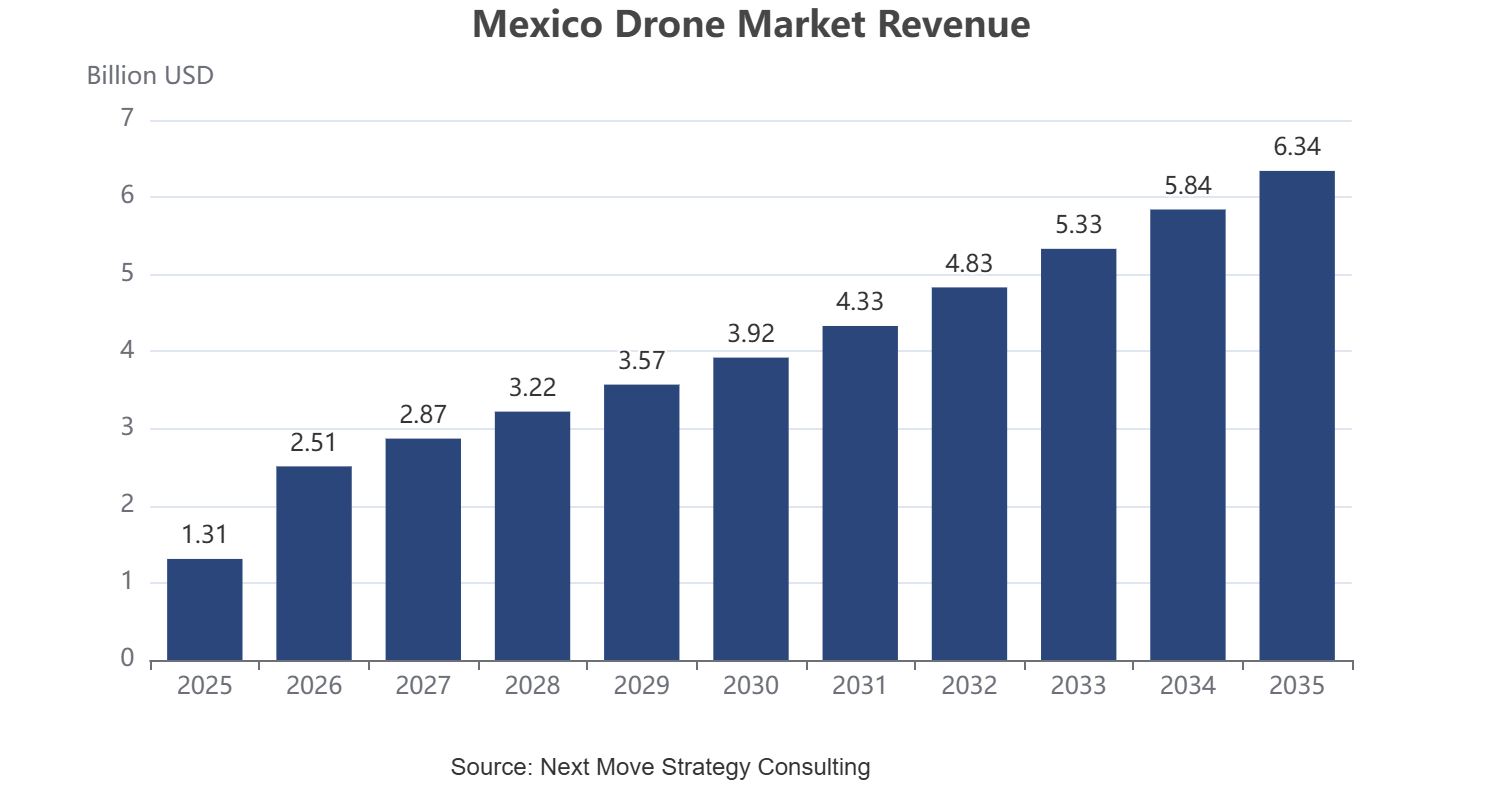
The Mexico Drone Market was valued at USD 1.31 billion in 2025 and is estimated to reach USD 1.63 billion in 2026, advancing to USD 6.34 billion by 2035 at a revenue CAGR of 16.27% during 2026–2035. In volume terms, the market stood at approximately 51 thousand units in 2025, with the 2026 estimate placed at 66 thousand units and volume projected to reach 345 thousand units by 2035 at a unit CAGR of 20.25%, underpinned by robust commercial, agricultural, and public safety drone adoption across Mexico.
What Are the Key Growth Drivers, Restraints, and Opportunities Shaping the Mexico Drone Market Through 2035?
Growth Catalyst & Risk Assessment Matrix
|
DRIVERS / TRENDS / RESTRAINTS |
(+/–) % IMPACT ON CAGR FORECAST |
GEOGRAPHIC RELEVANCE |
IMPACT TIMELINE |
|
Precision agriculture demand from Mexico’s export-oriented agribusiness sector in avocado, tomato, and berry production regions driving commercial drone adoption |
+2.8% |
Jalisco, Michoacán, Sinaloa, and Sonora agricultural states |
Short to Medium term (1–4 years) |
|
Government and public safety procurement for law enforcement surveillance, border security, and disaster response creating recurring institutional demand |
+2.2% |
Border states, urban centers, and ecologically sensitive regions |
Medium term (2–5 years) |
|
Nearshoring-driven industrial expansion generating new commercial drone demand for inspection, logistics, and facility monitoring across manufacturing corridors |
+1.8% |
Monterrey, Guadalajara, Bajío region, and northern border industrial parks |
Medium to Long term (3–6 years) |
|
Fragmented AFAC airspace regulation and security-related operational risks constraining commercial fleet deployment beyond urban and peri-urban zones |
–1.5% |
Agricultural interior and security-affected states |
Short term (1–3 years) |
Mexico's drone market is emerging as one of Latin America's highest-growth unmanned systems ecosystems, driven by a convergence of large-scale agricultural modernization needs, expanding government and public safety procurement, and the strategic proximity of a deep technology supply chain and manufacturing ecosystem linked to the United States market. From our analysis, we observed that Mexico's market is structurally positioned for above-regional-average growth, supported by both domestic demand across agriculture and infrastructure verticals and increasing nearshoring-linked industrial activity that is creating new commercial drone service requirements across manufacturing and logistics corridors.
Growth Drivers:
How Is Mexico’s Export-Oriented Agribusiness Sector Driving Structural Demand for Commercial Drone Applications?
Mexico's agricultural sector, encompassing one of the world's largest avocado, tomato, chili, and berry production bases concentrated in Jalisco, Michoacán, and Sinaloa states, represents a large and structurally underserved market for drone-enabled precision agriculture. Variable-rate fertilizer application, fungicide spraying, and multispectral crop health monitoring are generating demand for both agricultural spray drone platforms and fixed-wing survey configurations capable of covering the large commercial farming operations that characterize Mexico's export-oriented agribusiness segment, with growing DaaS models extending reach to smallholder cooperative producers.
How Is Government and Public Safety Procurement Providing a Stable Revenue Base for the Mexico Drone Market?
Mexico's federal and state governments are progressively deploying drones for law enforcement surveillance, border security, cartel activity monitoring, disaster response coordination, and wildfire management in ecologically sensitive forest regions including the Sierra Madre Occidental. The government's stated modernization agenda for the National Guard and state police forces includes explicit provisions for unmanned aerial systems as force-multiplier tools, generating recurring institutional procurement cycles that provide a stable revenue base for drone suppliers with established in-country distribution and service support capabilities.
How Is Mexico’s Nearshoring Industrial Expansion Creating New Commercial Drone Demand Across Manufacturing Corridors?
Mexico's rapid emergence as a nearshoring manufacturing destination for electronics, automotive, and aerospace components is creating a new class of commercial drone demand tied to industrial inspection, inventory management, and logistics optimization across newly established manufacturing corridors in Monterrey, Guadalajara, and the Bajío region. Industrial parks and logistics operators managing complex multi-site operations are increasingly evaluating autonomous drone-based inspection and delivery platforms to reduce operational costs, improve safety compliance monitoring, and support the operational scale requirements of Mexico's expanding export manufacturing base.
Growth Inhibitor:
How Are Regulatory Fragmentation and Security-Related Risks Constraining Commercial Drone Operations in Mexico?
Mexico's drone market expansion is materially constrained by fragmented airspace regulation under AFAC, limited BVLOS operational frameworks, and persistent public security concerns that create operational complexity for commercial drone operators attempting to scale beyond urban and peri-urban areas. The risk of drone theft, signal jamming by criminal organizations in certain regions, and inconsistent enforcement of airspace regulations across states creates operational unpredictability that discourages enterprise investment in large-scale fleet deployment, particularly in the agricultural interior regions where commercial demand is theoretically strongest.
Growth Opportunity:
What Opportunity Do DaaS Models and AFAC Regulatory Progress Present for Drone Service Providers in Mexico?
Mexico's expanding AFAC regulatory framework for commercial RPAS operations, combined with the country's geographic proximity to the United States and deep integration into North American supply chains, creates a compelling environment for drone-as-a-service providers targeting the agribusiness, energy infrastructure, and logistics sectors. Local companies including Hydra Technologies de México and VAK, and emerging entrants Flytek Innovations, are well positioned to capture DaaS market share by combining local regulatory expertise with competitively priced service delivery, particularly as multinational enterprises establishing Mexican manufacturing operations seek locally managed drone inspection and monitoring solutions.
How Is the Mexico Drone Market Segmented in This Report, and What Are the Key Insights from the Segmentation Analysis?
By End-User Insights
How Does End-User Segmentation Reveal Demand Diversity Across the Mexico Drone Market?
Based on end-user, the Mexico Drone Market is segmented into consumer drone, commercial and industrial drone, government and public safety drone, and military drone categories.
The market reflects diverse adoption patterns across consumer, commercial, government, and defense applications, with each end-user group driving demand for specific operational requirements. According to our analysis, we found that commercial and industrial users are expanding drone deployment across agriculture, surveying, infrastructure inspection, logistics, and environmental monitoring, while government agencies are strengthening adoption for public safety, disaster response, and security operations. Military and consumer segments continue to evolve through specialized mission requirements, technological advancements, and increasing accessibility of drone platforms.
By Price/Performance Grade Insights
How Does Price/Performance Grade Segmentation Reflect Adoption Patterns Across the Mexico Drone Market?
Based on price/performance grade, the Mexico Drone Market is segmented into consumer grade (<$1,000), prosumer grade ($1,000–$10,000), enterprise grade ($10,000–$100,000), and military grade (>$100,000) platforms.
The market encompasses a broad range of drone solutions designed to meet varying performance requirements, operational complexities, and investment capacities across consumer, commercial, government, and defense applications. According to our analysis, we found that consumer and prosumer-grade platforms support recreational, aerial imaging, and entry-level professional activities, while enterprise-grade systems enable advanced agriculture, surveying, mapping, logistics, and infrastructure inspection through enhanced payload capabilities and operational reliability. Military-grade platforms address specialized defense missions requiring advanced endurance, autonomy, and mission-specific technologies, contributing significant value within high-performance drone applications.
Pestel Analysis of the Mexico Drone Market:
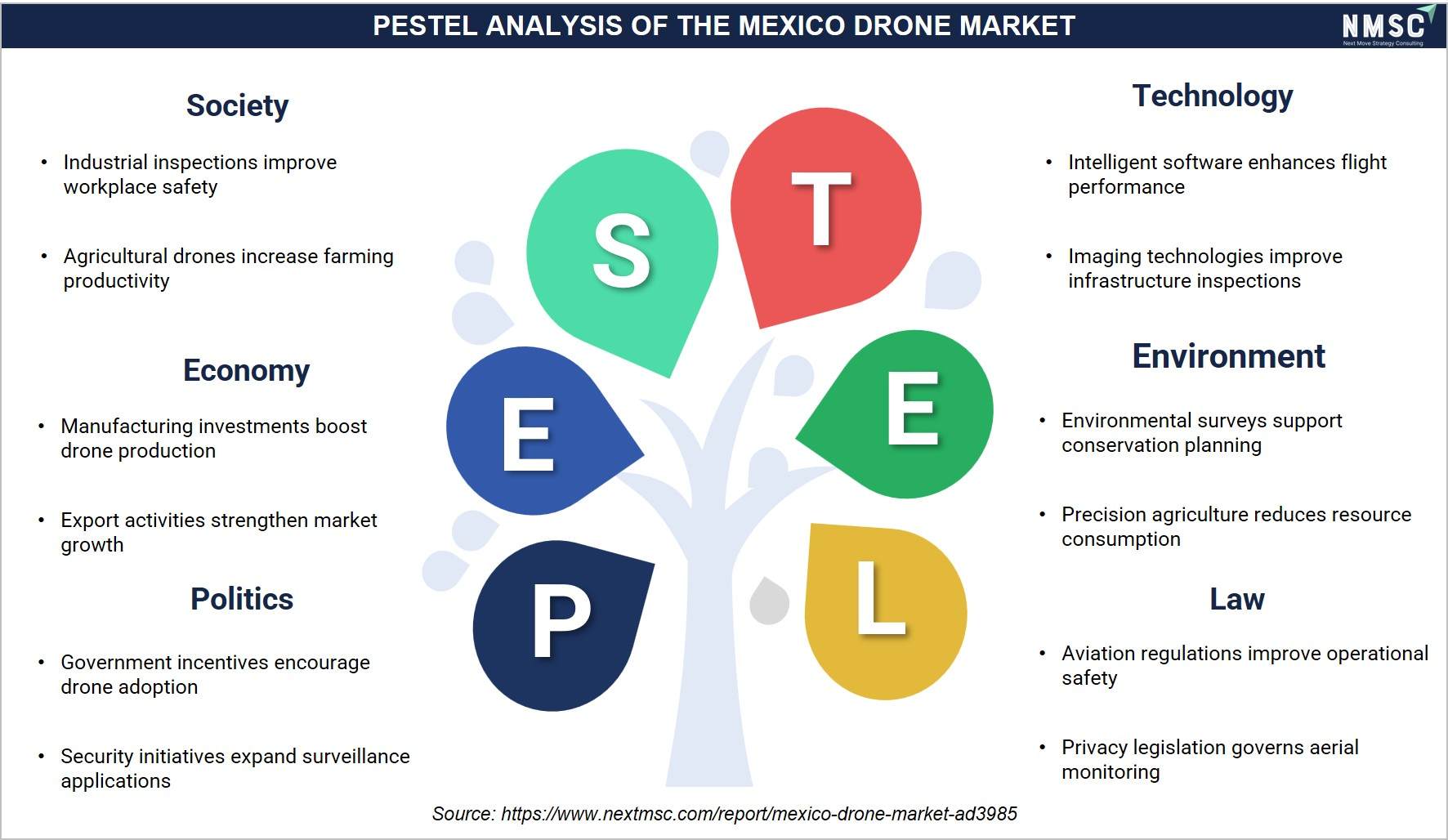
The above PESTEL analysis maps the key macro-environmental factors, such as political, economic, social, technological, environmental, and legal, shaping the Mexico drone market. From our analysis, we observed that political stability and government initiatives support drone adoption, while economic factors influence investment and operational costs. Social acceptance and technological advancements drive innovation, whereas environmental regulations promote sustainable operations. Legal frameworks, including aviation laws and data privacy standards, ensure compliance and safety, reflecting a comprehensive PESTEL landscape across the Mexico drone market.
Key Segments
By Component
-
Hardware
-
Airframe
-
Avionics & Core Systems
-
Payloads & Sensors (Cameras, LiDAR, Multispectral, etc.)
-
Communication Systems (C2 Links)
-
-
Software
-
Flight Control & Autonomy
-
Data Processing & Analytics
-
Fleet Management
-
-
Services
-
Drone-as-a-Service (DaaS)
-
Training & Certification
-
Maintenance, Repair & Overhaul (MRO)
-
Data Processing Services
-
By Platform Type
-
Multi-Rotor
-
Fixed-Wing
-
Hybrid VTOL (Vertical Take-Off and Landing)
-
Single-Rotor (Helicopter)
-
Tethered UAV
-
Loitering Munition
-
MALE/HALE/UCAV
By Autonomy Level
-
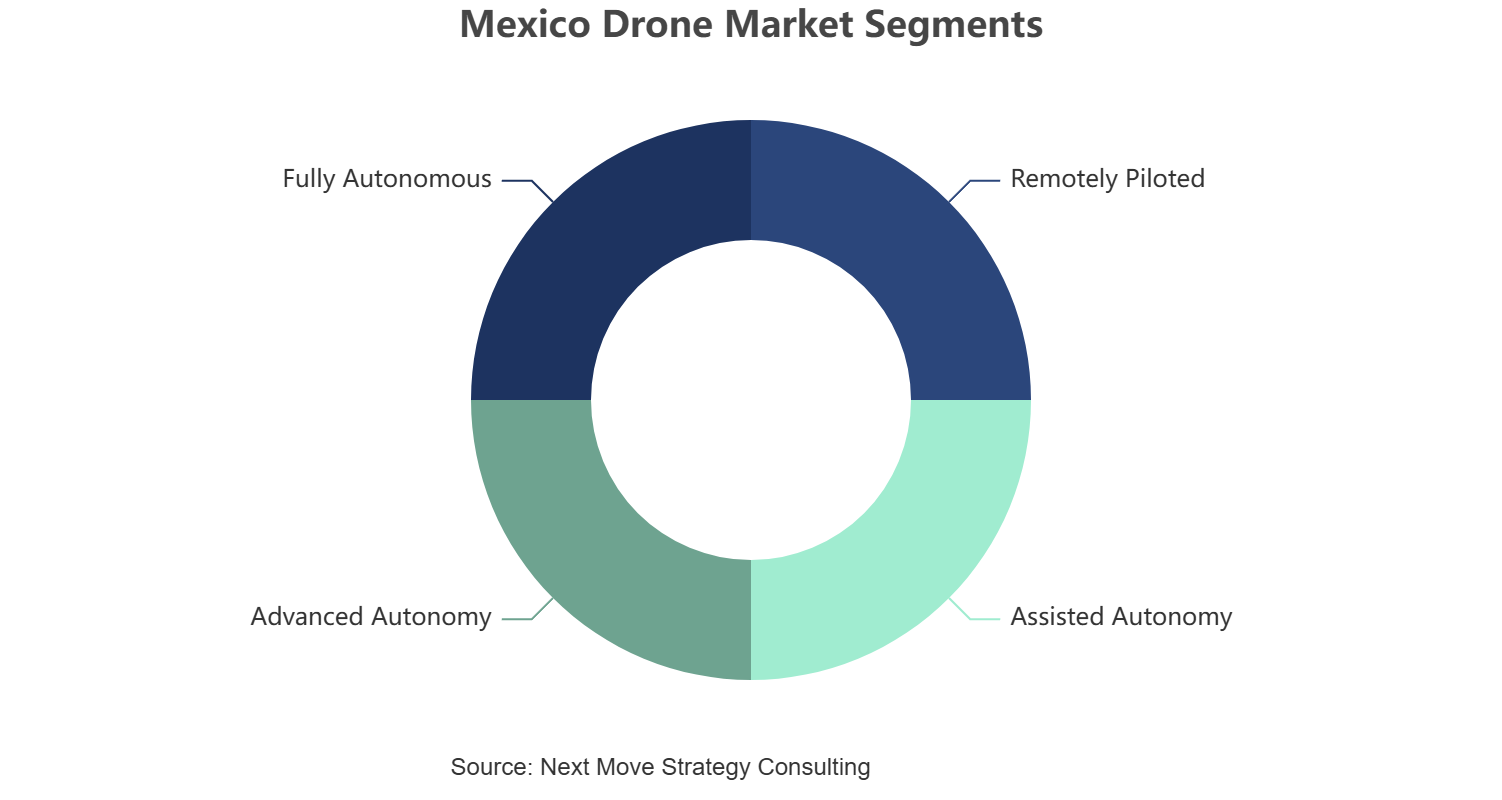
Remotely Piloted
-
Assisted Autonomy
-
Advanced Autonomy
-
Fully Autonomous
By Maximum Takeoff Weight (MTOW)
-
Nano: < 250 g
-
Micro: 250 g – 2 kg
-
Small: > 2 kg – 25 kg
-
Medium: > 25 kg – 150 kg
-
Large: > 150 kg – 600 kg
-
Very Large/Tactical: > 600 kg
By Price/Performance Grade
-
Consumer Grade (< $1,000)
-
Prosumer Grade ($1,000 – $10,000)
-
Enterprise Grade ($10,000 – $100,000)
-
Military Grade (> $100,000)
By End-User
-
Consumer Drone
-
Commercial & Industrial Drone
-
Aerial Imaging & Cinematography
-
Surveying & Mapping (Geomatics)
-
Agricultural Applications (spraying, crop monitoring)
-
Infrastructure Inspection (energy, utilities, transport)
-
Logistics & Delivery (package transport)
-
Environmental & Scientific Monitoring
-
-
Government & Public Safety Drone
-
Emergency Response & Disaster Management
-
Law Enforcement & Security
-
Firefighting & Public Safety
-
Smart City Management
-
-
Military Drone
-
Intelligence, Surveillance & Reconnaissance (ISR)
-
Combat Operations
-
Electronic Warfare (EW)
-
Target Acquisition & Designation
-
Logistics & Resupply
-
Decoy & Countermeasure Systems
-
Competitive Landscape
The Mexico Drone Market features a competitive landscape shaped by international hardware manufacturers, specialized defense and government systems providers, and a growing cohort of domestically incorporated drone developers and DaaS operators. Our analysis indicates that competitive positioning in Mexico's market is increasingly determined by local regulatory expertise, after-sales service infrastructure, and the ability to adapt global platforms to Mexico's specific agricultural, security, and industrial inspection use cases. Domestic players are building differentiated positions through proximity to end-users and localized service delivery models that international exporters find difficult to replicate at comparable cost.
Strategic Developments:
-
August 2025 – SZ DJI Technology Co., Ltd. (DJI Agriculture) launched its next-generation agricultural drones, including the Agras T100, Agras T70P, and Agras T25P, in Mexico through authorized dealers. The company highlighted rapid market expansion, with spray drone sales in Mexico increasing 56 times since 2019.
Key Players
-
SZ DJI Technology Co., Ltd.
-
Draganfly Innovations USA, Inc.
-
Flyability, Inc.
-
Parrot, Inc.
-
Guangzhou EHang Intelligent Technology Co., Ltd.
-
Hydra Technologies de México S.A.P.I. de C.V.
-
DroneTech UAV Corp.
-
Wingtra AG
-
Autel Robotics USA LLC
-
Quantum-Systems Inc.
-
Alpi Aviation S.r.l.
-
Delair S.A.S.
-
Geoscan LLC
-
VAK, S.A. de C.V.
-
Flytek Innovations S. de R.L. de C.V.
Global platform leaders SZ DJI Technology and Autel Robotics USA anchor Mexico's multi-rotor commercial and consumer segments, while Wingtra and Quantum-Systems serve fixed-wing and hybrid VTOL professional survey applications. Parrot and Flyability address commercial inspection and confined-space survey niches, while Draganfly Innovations contributes public safety and emergency response platform capabilities. Domestically incorporated players Hydra Technologies de México, VAK, and Flytek Innovations are expanding their presence in government, agricultural, and industrial segments, complemented by Guangzhou EHang, DroneTech UAV, Alpi Aviation, Delair, and Geoscan across specialized commercial and industrial verticals.
Supply Chain Structure of the Mexico Drone Market:
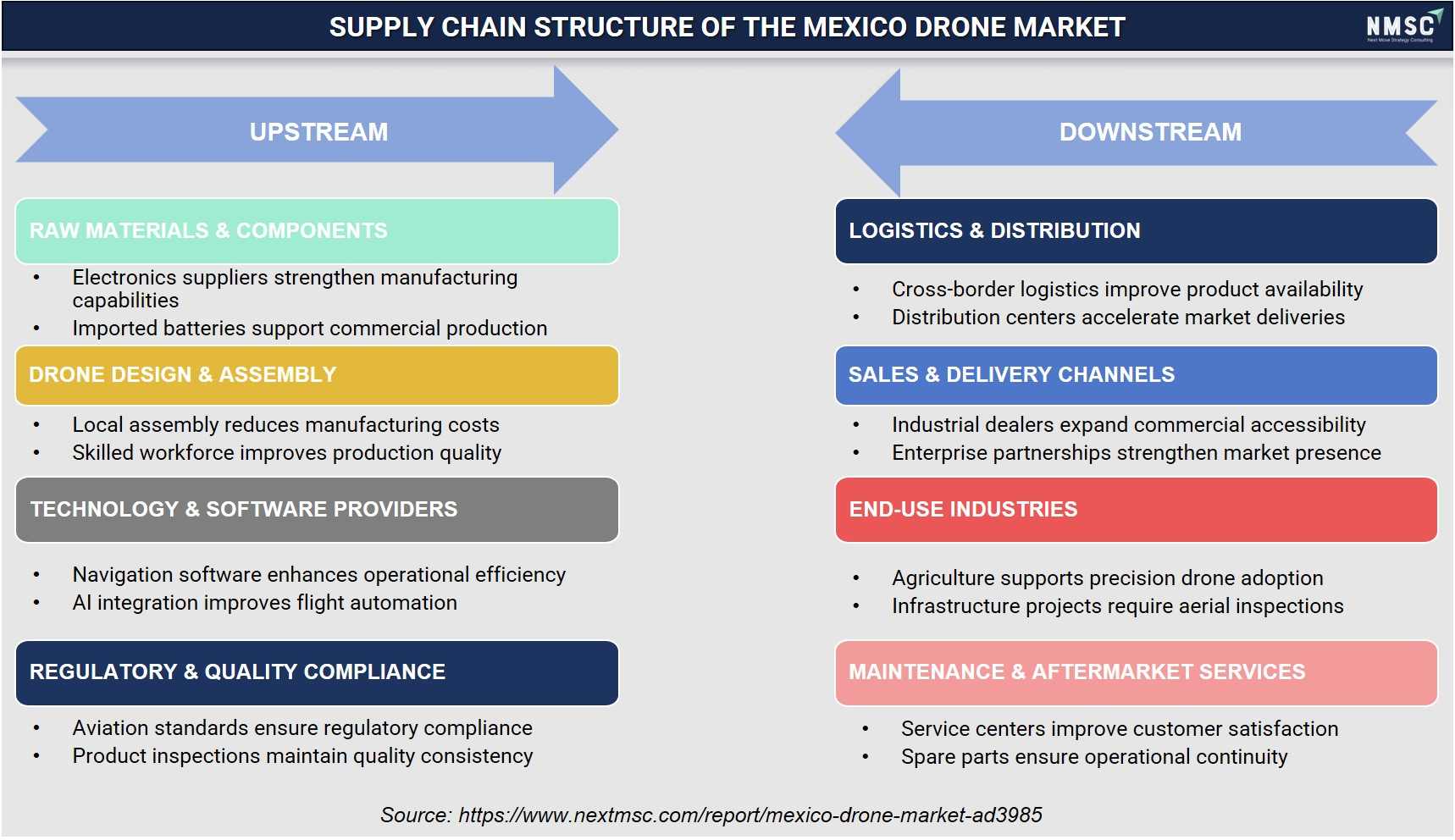
The above supply chain analysis maps the key operational stages, such as upstream and downstream, shaping the Mexico drone market. From our analysis, we observed that upstream activities include electronics suppliers, imported batteries, local assembly, skilled workforce, navigation software, AI integration, and aviation standards, while downstream activities encompass cross-border logistics, industrial dealers, enterprise partnerships, agriculture and infrastructure end-users, and service centers, reflecting a well-integrated supply chain across the market.
Key Benefits for Stakeholders
Next Move Strategy Consulting's study of the Mexico Drone Market delivers a structured, quantified view of revenue and volume trends from 2025 through 2035 across all major segments including component, platform type, autonomy level, MTOW, price grade, and end-user. Investors, manufacturers, and commercial operators gain segment-level growth trajectories and an evidence-based assessment of the forces shaping Mexico's fast-growing commercial, government, and defense drone ecosystem.
Agribusiness operators, government agencies, and industrial enterprises gain actionable intelligence on which drone platform types and service delivery models are best suited to Mexico's regulatory, geographic, and security context. Competitive profiling supports partnership evaluation and market entry strategy, while transparent revenue and volume projections grounded in Mexico-specific demand drivers provide financial stakeholders with a reliable, decision-ready analytical foundation.
|
Parameters |
Details |
|
Customization Scope |
Free customization (equivalent to up to 80 analyst-working hours) after purchase. |
|
Pricing and Purchase Options |
Avail customized purchase options to meet your exact research needs. |
|
Approach |
In-depth primary and secondary research; proprietary databases; rigorous quality control and validation measures. |
|
Analytical Tools |
Porter’s Five Forces, SWOT, value chain, and Harvey ball analysis to assess competitive intensity, stakeholder roles, and relative impact of key factors. |
Conclusion
The Mexico Drone Market is positioned for high-trajectory growth, advancing from USD 1.31 billion in 2025 to USD 6.34 billion by 2035 at a revenue CAGR of 16.27%, while unit volumes expand from 51 thousand to 345 thousand units at 20.25% CAGR. Precision agriculture, government and public safety procurement, and nearshoring-linked industrial demand are the primary growth catalysts, while AFAC regulatory fragmentation and security-related operational constraints represent key structural risks. Locally incorporated DaaS operators and drone service providers are the most differentiated opportunity in a competitive landscape anchored by global hardware manufacturers.
About the Author
 Mayurima Roy
— Mayurima Roy is Research Analyst at Next Move Strategy Consulting, where she has spent 4 years working across the firm's full industry coverage rather than a single fixed vertical. Her work centers on structured research, ongoing trend tracking, competitive assessment, and insight-led content development, translating complex market data into clear, decision-ready narratives that support informed client decision-making across diverse global industries, market sectors, and world regions every day.
Mayurima Roy
— Mayurima Roy is Research Analyst at Next Move Strategy Consulting, where she has spent 4 years working across the firm's full industry coverage rather than a single fixed vertical. Her work centers on structured research, ongoing trend tracking, competitive assessment, and insight-led content development, translating complex market data into clear, decision-ready narratives that support informed client decision-making across diverse global industries, market sectors, and world regions every day.
About the Reviewer
 Supradip Baul
— Supradip Baul is an accomplished business consultant and strategist with over a decade of rich experience in market intelligence, strategy, technology, and business transformation. His work has included rigorous qualitative and quantitative analysis across multiple industries, helping clients shape investment decisions and long-term roadmaps. Earlier in his career, he was associated with Gartner, where he contributed to industry-leading reports and market share analyses. He has worked with leading global companies and holds an MBA with a dual specialization in Marketing and Finance.
Supradip Baul
— Supradip Baul is an accomplished business consultant and strategist with over a decade of rich experience in market intelligence, strategy, technology, and business transformation. His work has included rigorous qualitative and quantitative analysis across multiple industries, helping clients shape investment decisions and long-term roadmaps. Earlier in his career, he was associated with Gartner, where he contributed to industry-leading reports and market share analyses. He has worked with leading global companies and holds an MBA with a dual specialization in Marketing and Finance.
At Next Move Strategy Consulting, we understand that insightful market research is the cornerstone of successful business decisions. That's why we employ a robust and multifaceted approach, combining various methodologies to deliver the most accurate and actionable data for our clients.

Research Landscape
We navigate the world of research with two primary approaches:
Qualitative Approach
Our qualitative research methodologies involve immersive techniques such as in-depth interviews, focus groups, and observational studies. By engaging directly with individuals and stakeholders, we uncover valuable insights that quantitative data alone may overlook.

Quantitative Research
In tandem with qualitative methodologies, NMSC leverages the power of Quantitative Research to provide a robust foundation of numerical insights. Through systematic data collection and analysis, we quantify patterns, preferences, and market trends, offering a comprehensive view of the business landscape.
Our quantitative research approach employs diverse tools, including surveys, experiments, and statistical modelling. These methodologies enable us to gather data from a large and representative sample, ensuring the statistical significance of our findings. By employing structured questionnaires and standardized data collection methods, we guarantee the reliability and validity of the information we present to our clients.
Quantitative research is particularly effective in measuring the prevalence of trends, assessing market size, and gauging the impact of various factors on consumer behavior. The numerical precision attained through this approach equips our clients with actionable insights, facilitating data-driven decision-making and strategy formulation.


Our Specialized Toolbox for Industry-Specific Market Research
We deploy a specialized arsenal of techniques tailored to meet your unique requirements. Here's a glimpse into our comprehensive toolbox:

Information Procurement
The stage entails acquiring market data or relevant information through various sources and methodologies.


Market Research Approach
We utilize both top-down and bottom-up approaches in market research analysis to achieve a comprehensive understanding of the market dynamics, leveraging the broad perspective of industry trends and macroeconomic factors alongside detailed insights from specific segments and individual companies.

Porters Five Forces Analysis
We conduct Porter's Five Forces analysis to evaluate the competitive landscape of an industry, providing us with insights into factors that affect profitability and strategic positioning.

SWOT Analysis

Forecasting
We utilize a forecasting model to predict future consumption by considering parameters like population, economics, regulations, market competition, drivers, constraints, technology, and pricing. We also employ statistical techniques such as multilinear regression, exponential smoothing, moving average, ARIMA, and Monte Carlo simulations for accurate predictions. In econometric forecasting, we analyzed short-term and long-term event impacts, attributing values based on regulatory frameworks, economic factors, and market events.





 Speak to Our Analyst