Middle East & Africa Gypsum Powder Market By Product Form (Raw Gypsum Powder, Beta Hemihydrate, Alpha Hemihydrate, and Anhydrite), By Source (Natural Gypsum, Synthetic Gypsum, and Recycled Gypsum), By Particle Size (Standard Powder, Fine Powder, Ultra Fine Powder, and Granulated Powder), By Sales Channel (Direct Sales, Distributor Sales, and Retail Sales), and By Application (Construction, Cement, Agriculture and Industrial) – Opportunity Analysis and Industry Forecast, 2025–2035
Industry: Materials and Chemical | Latest Edition: September 30, 2026 | No of Pages: 518 | No. of Tables: 242 | No. of Figures: 230 | Format: PDF | Report Code: MC4896
Middle East & Africa Gypsum Powder Market Size & Forecast
|
Parameters |
Details |
|
Market Size in 2026 |
USD 523.8 Million |
|
Revenue Forecast in 2035 |
USD 780.4 Million |
|
Growth Rate |
CAGR of 4.53% from 2026 to 2035 |
|
Market Volume in 2026 |
10 Megatons |
|
Volume Forecast in 2035 |
11 Megatons |
|
Growth Rate |
CAGR of 4.30% from 2026 to 2035 |
|
Analysis Period |
2025–2035 |
|
Base Year Considered |
2025 |
|
Forecast Period |
2026–2035 |
|
Market Size Estimation |
Million (USD) |
|
Companies Profiled |
15 |
|
Market Share |
Available for 10 companies |
Industry Outlook
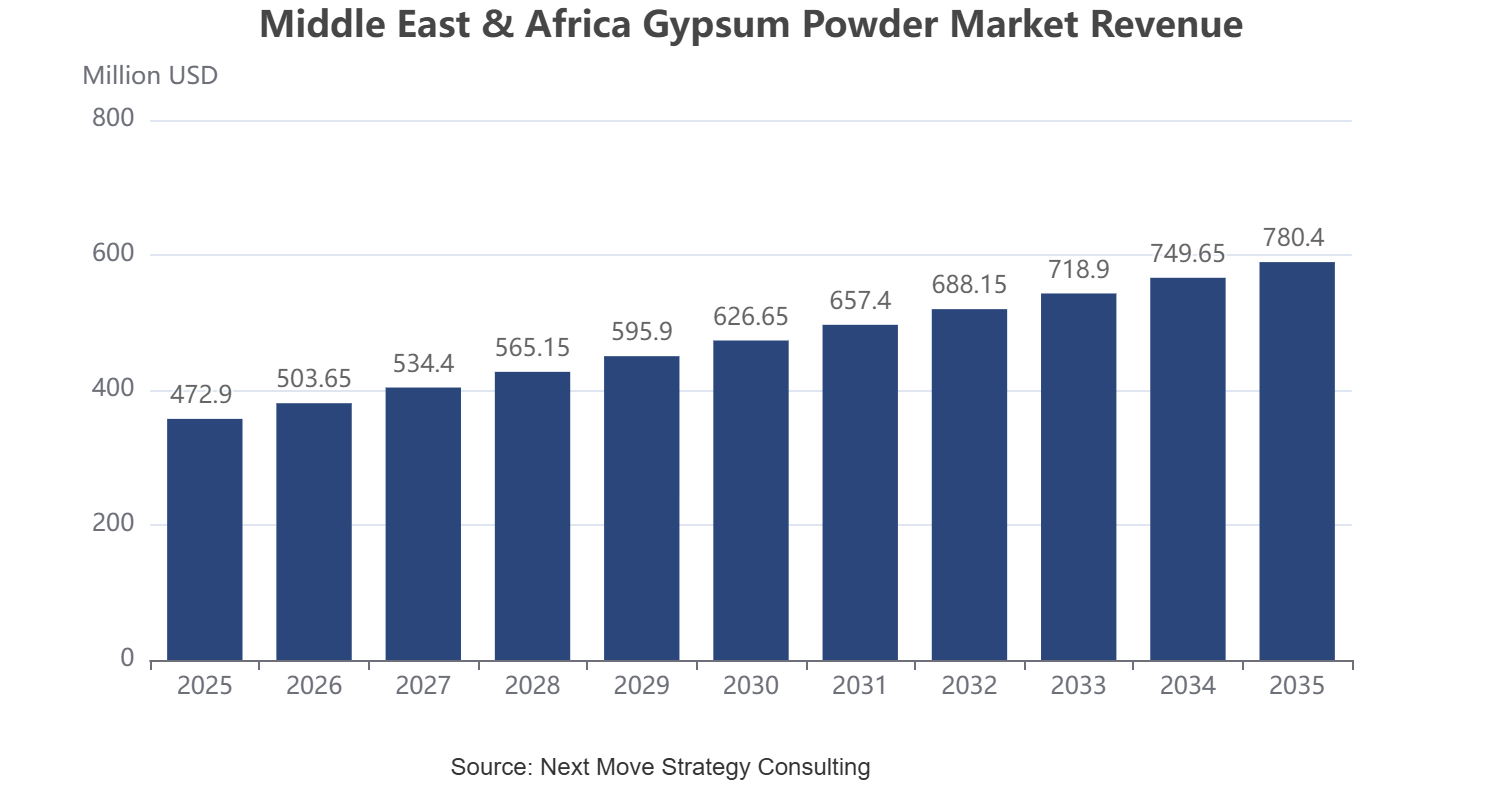
The Middle East & Africa Gypsum Powder Market size was valued at USD 472.9 Million in 2025 and reached USD 523.8 Million by 2026. Looking ahead, the industry is projected to expand significantly, reaching USD 780.4 Million by 2035, registering a CAGR of 4.53% from 2026 to 2035. In terms of volume, the market recorded 9 Megatons in 2025, with forecasts indicating growth to 10 Megatons by 2026 and further to 11 Megatons by 2035, reflecting a CAGR of 4.30% over the same period.
Supply Chain Structure of the Middle East & Africa Gypsum Powder Industry
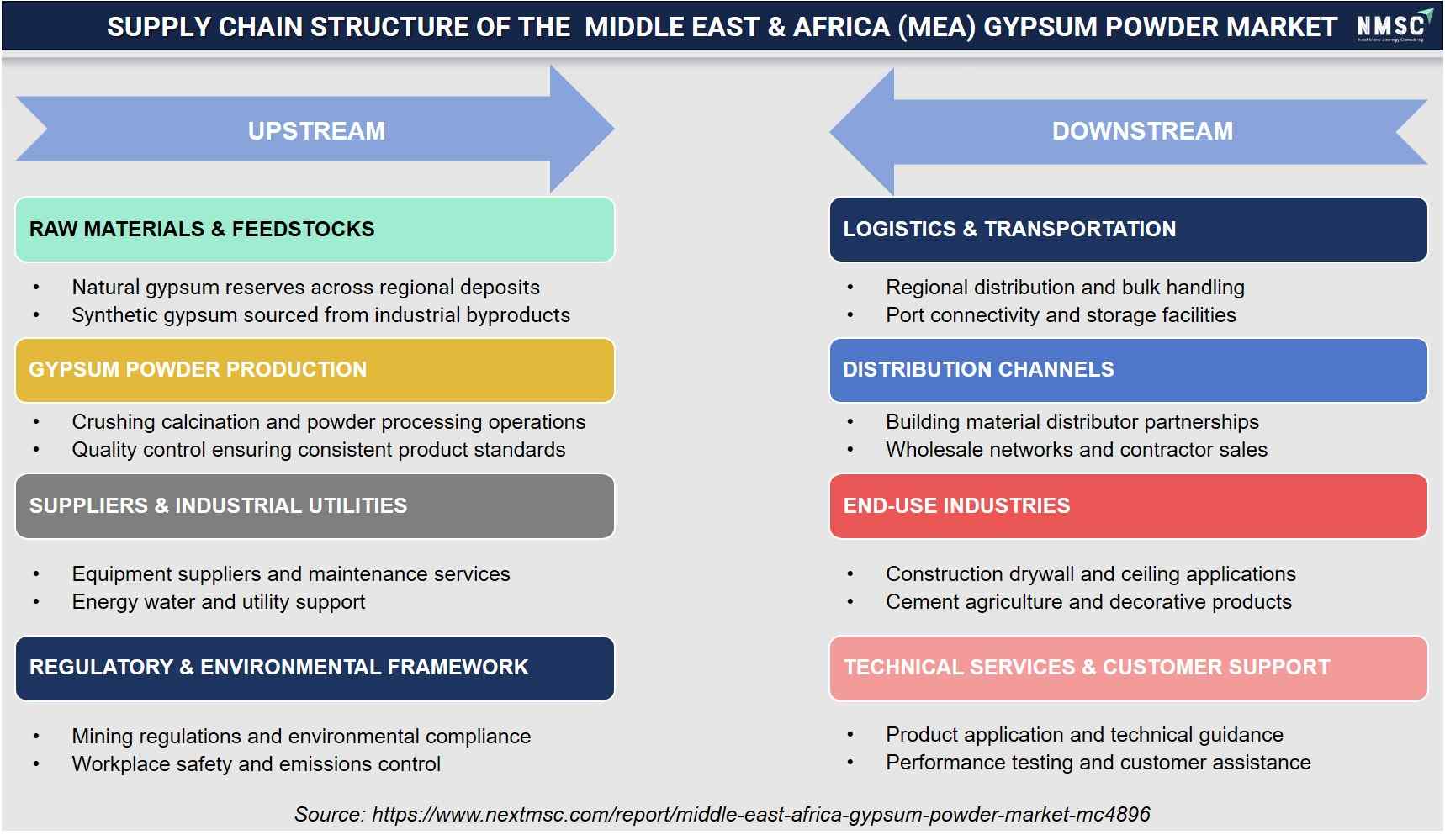
We observe that the MEA gypsum powder market maintains a diversified supply chain supported by natural gypsum reserves, synthetic gypsum sources, and regional processing facilities. Production activities include crushing, calcination, and quality control operations, while logistics networks leverage ports, storage facilities, and regional distribution channels. Equipment suppliers, utility providers, regulatory compliance systems, and technical support services ensure efficient product movement and reliable supply to end-use industries.
What Are the Key Market Drivers, Breakthroughs, and Investment Opportunities That Will Shape the Middle East & Africa Gypsum Powder Market in the Next Decade?
Growth Catalyst & Risk Assessment Matrix
|
Drivers / Trends / Restraints |
(+/–) % Impact on CAGR Forecast |
Geographic Relevance |
Impact Timeline |
|
Rapid urbanization and large-scale construction activity across MEA driven by Saudi Vision 2030 and UAE infrastructure programs are accelerating demand for gypsum powder in board feedstock and site-applied plaster applications across expanding residential and commercial development projects |
+1.2% |
Saudi Arabia, UAE, Egypt |
Medium to long term (2–6 years) |
|
Growing cement production capacity across MEA is increasing consumption of synthetic gypsum as a retarder additive and set-time regulator across large-scale cement manufacturing facilities throughout major producing economies |
+0.9% |
Saudi Arabia, Turkey, South Africa |
Medium term (2–5 years) |
|
Expanding agricultural sector in Sub-Saharan Africa and North Africa is increasing demand for gypsum as a soil amendment and fertilizer input across large-scale cultivation and crop productivity improvement operations |
+0.8% |
Egypt, Nigeria, South Africa, Kenya |
Short to medium term (1–4 years) |
|
Environmental and regulatory constraints surrounding phosphogypsum disposal and synthetic gypsum classification are creating compliance complexity and operational cost pressures for industrial gypsum producers across MEA jurisdictions |
–0.7% |
Turkey, South Africa, Egypt |
Medium term (2–5 years) |
|
Rising adoption of recycled gypsum within circular economy construction frameworks is creating long-term growth opportunities for sustainable gypsum powder supply networks across MEA building material markets |
+0.9% |
UAE, Saudi Arabia, South Africa |
Medium to long term (3–7 years) |
Through our market assessment, we observed that the Middle East & Africa Gypsum Powder Market is experiencing steady growth driven by accelerating construction activities across urban centres, rising cement production, and expanding agricultural applications throughout the region. Increasing infrastructure development investments, government-led housing initiatives, and growing industrial applications are strengthening gypsum powder consumption across major MEA economies. Meanwhile, environmental compliance challenges surrounding synthetic gypsum disposal continue creating operational constraints for producers. Furthermore, rising adoption of recycled gypsum within sustainable construction frameworks is creating new long-term growth opportunities across regional supply chains.
Growth Drivers:
How Are Saudi Vision 2030 and MEA Urbanization Initiatives Driving the Middle East & Africa Gypsum Powder Market Growth?
Through our MEA construction materials assessment, we observed that rapid urbanization and large-scale construction activity driven by Saudi Vision 2030, UAE infrastructure programs, and Egyptian housing initiatives are significantly accelerating demand for gypsum powder across the region. Rising residential, commercial, and industrial construction investments are strengthening consumption of gypsum board feedstock, joint compounds, and site-applied plasters. Gypsum powder improves surface finish quality, workability, and setting performance across construction environments. Consequently, construction sector expansion is reinforcing consistent demand growth for gypsum powder across regional building material supply chains throughout MEA.
How Is Expanding Cement Production Capacity Across MEA Fueling the Middle East & Africa Gypsum Powder Market Expansion?
Expanding cement production capacity across MEA is fueling market expansion as rising industrial manufacturing activities increase gypsum powder consumption. Our findings suggest that growing investments in cement plants across Saudi Arabia, Turkey, Egypt, and South Africa are increasing procurement of gypsum as a set-time regulator and retarder additive in manufacturing operations. Additionally, development of new integrated cement facilities is accelerating gypsum powder offtake across regional industrial distribution networks. This expansion is supporting consistent volume growth throughout regional supply chains, reinforcing broader integration of gypsum powder into cement manufacturing processes across MEA.
How Is Growth in Agricultural Applications Driving the Middle East & Africa Gypsum Powder Market Expansion?
Based on NMSC's research, we found that expansion of agricultural activities across Sub-Saharan Africa and North Africa is substantially driving demand for gypsum powder in soil amendment and fertilizer input applications. Rising cultivation activities across Nigeria, Kenya, South Africa, and Egypt are encouraging large-scale adoption of gypsum as a soil conditioning agent to improve crop productivity and soil structure. Furthermore, growing awareness of gypsum's agronomic benefits is strengthening adoption across regional farming operations, supporting steady volume growth in agricultural application segments throughout the Middle East & Africa Gypsum Powder Market.
Growth Inhibitor:
How Are Environmental Compliance Challenges Acting as a Constraint for the Middle East & Africa Gypsum Powder Market?
Environmental and regulatory constraints surrounding phosphogypsum disposal and synthetic gypsum classification continue acting as constraints for the market across MEA industrial operations. In our observation, we found that several producers managing phosphogypsum byproducts face stringent waste classification requirements and disposal restrictions that increase operational complexity. Fluctuating regulatory frameworks across different national jurisdictions create uneven compliance landscapes for gypsum powder producers operating across multiple MEA markets. Consequently, environmental compliance costs and regulatory uncertainty continue restricting broader utilization of synthetic and recycled gypsum sources throughout regional manufacturing operations.
Growth Opportunity:
How Is Rising Adoption of Recycled Gypsum Within Circular Economy Frameworks Unlocking New Growth Opportunities for the Middle East & Africa Gypsum Powder Market?
Through NMSC's assessment, we found that rising adoption of recycled gypsum within circular economy construction frameworks is unlocking new growth opportunities for the market across MEA's building materials sector. Increasing regulatory support for sustainable construction practices and growing waste gypsum recovery from demolished construction materials are strengthening recycled gypsum supply networks. Additionally, construction operators are accelerating integration of recycled gypsum powder across board manufacturing and plaster applications to reduce environmental impact. Consequently, circular economy adoption is creating long-term implementation opportunities for sustainable gypsum supply models across MEA markets.
Which Country is Dominating the Middle East & Africa Gypsum Powder Market?
Our comprehensive market evaluation indicates that Turkey holds the dominant share in the Middle East & Africa Gypsum Powder Market, supported by its strong construction materials industry, abundant gypsum reserves, and well-established manufacturing capabilities. The country benefits from extensive demand for gypsum powder across residential construction, commercial developments, cement production, and industrial applications. Further, ongoing investments in infrastructure projects, urban redevelopment initiatives, and industrial expansion activities are accelerating gypsum powder consumption across major end-use sectors. The presence of large-scale gypsum processing facilities and an established export network is also strengthening market growth throughout the country.
Additionally, Turkey continues to witness substantial adoption of gypsum-based products driven by increasing construction activity and growing demand for efficient building materials. The expansion of infrastructure developments, housing projects, and industrial facilities further supports market demand. Consequently, Turkey continues to serve as the leading hub for gypsum powder production, distribution, and industry development across the Middle East & Africa region.
Which Country is Set to Witness the Fastest Growth?
The United Arab Emirates is witnessing the fastest growth in the Middle East & Africa Gypsum Powder Market, supported by expanding construction activities, large-scale infrastructure investments, and increasing demand for modern building materials. We found that the growth of residential communities, commercial developments, hospitality projects, and mixed-use infrastructure is significantly driving demand for gypsum powder across the country. Moreover, government-led economic diversification initiatives and continuous investments in real estate development are encouraging the adoption of gypsum-based materials in a wide range of construction applications. The increasing focus on high-quality interior finishing solutions is also contributing to market expansion.
Further, rising investments in smart city projects, tourism infrastructure, and commercial facilities are strengthening gypsum powder utilization across key end-use sectors. The increasing presence of international construction firms and building material suppliers is further supporting market growth. Consequently, as construction modernization and infrastructure development continue to accelerate, the United Arab Emirates is emerging as the fastest-growing Gypsum Powder Market in the Middle East & Africa region.
How Is the Middle East & Africa Gypsum Powder Market Segmented in This Report, and What Are the Key Insights from the Segmentation Analysis?
By Product Form Insights
Is Product Form Segmentation Shaping Application Diversity in the Middle East & Africa Gypsum Powder Market?
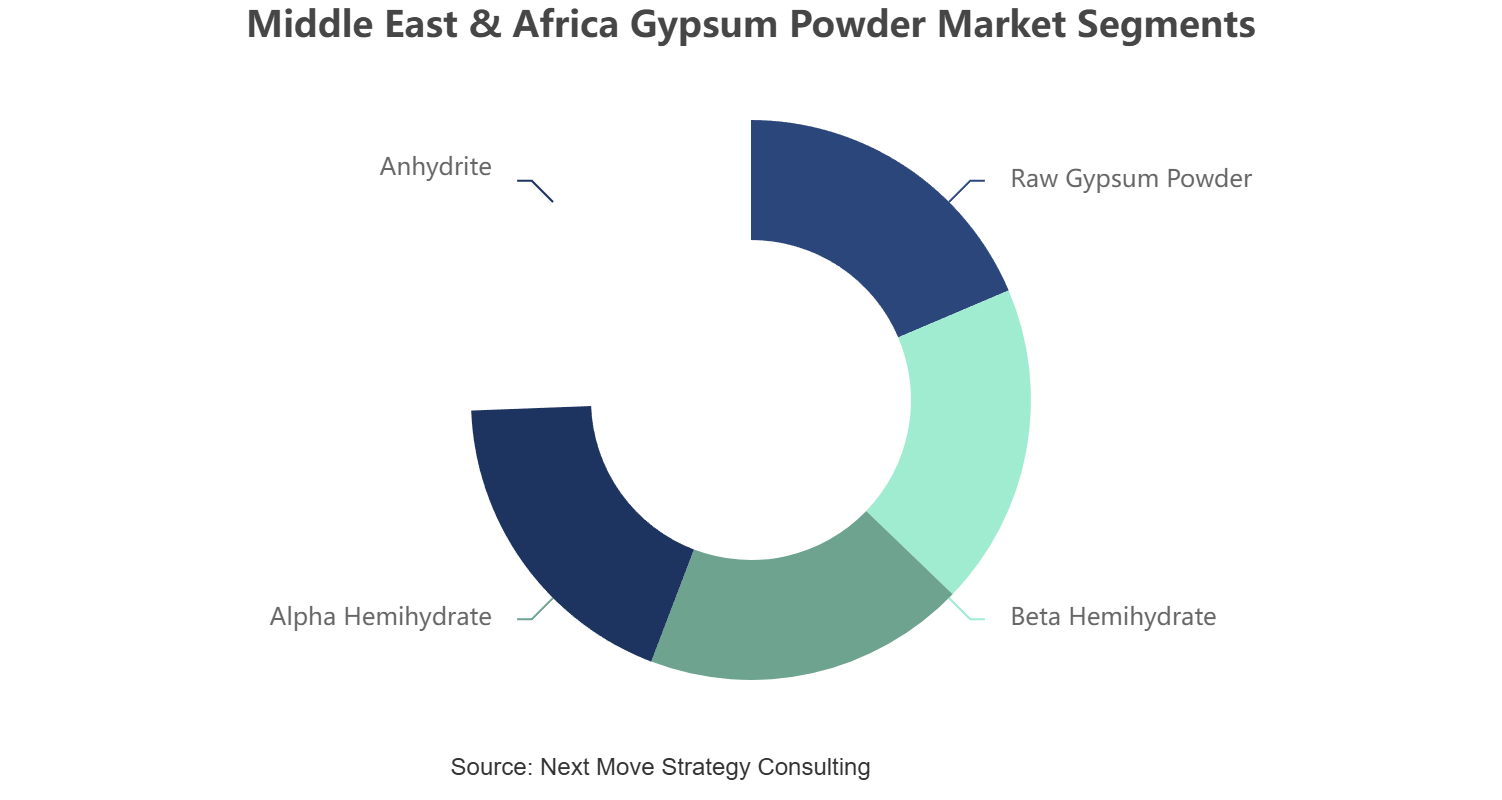
Based on product form, the market is segmented into raw gypsum powder, beta hemihydrate, alpha hemihydrate, and anhydrite.
Based on our analysis, we observed that raw gypsum powder supports processing activities across construction and cement manufacturing operations, providing fundamental feedstock for downstream board and plaster production throughout the region. Beta hemihydrate products are utilized across interior plaster, joint compound, and screeding applications within residential and commercial construction environments. Alpha hemihydrate products continue supporting industrial moulding, casting, and dental applications where high-strength characteristics are required. Anhydrite variants are also being integrated into industrial filler and flooring screed applications across MEA manufacturing facilities.
By Application Insights
Is Application Segmentation Supporting Market Penetration Across MEA Industries in the Middle East & Africa Gypsum Powder Market?
Based on application, the market is segmented into construction, cement, agriculture, and industrial.
Based on our evaluation, we identified that construction applications continue supporting significant volumes of gypsum powder consumption across board feedstock, joint compounds, site-applied plasters, and screeds within residential and infrastructure development projects throughout MEA. Cement manufacturing operations continue integrating gypsum powder as a set-time additive across large-scale industrial production facilities. Agricultural applications are also being strengthened across soil amendment, fertilizer input, and animal bedding categories in farming regions. Furthermore, industrial applications encompassing moulding, ceramics, dental, and food-grade uses are supporting diversified demand across MEA economies.
Competitive Landscape
The Middle East & Africa Gypsum Powder industry is characterised by a competitive and regionally diverse structure, supported by the presence of mining companies, manufacturing operations, and specialty building material producers. Market growth is being driven by accelerating construction activity, rising cement production investments, expanding agricultural applications, and increasing industrial demand across MEA economies. In addition, growing focus on product quality enhancement, sustainable sourcing practices, and distribution network expansion is strengthening operational efficiency and supporting broader market penetration across regional end-use application segments.
Strategic Developments:
-
January 2026 – Knauf announced the acquisition of a 63.2% majority stake in United Mining Industries (UMI) for approximately USD 134.5 million. The transaction strengthens Knauf’s gypsum mining, manufacturing, and distribution capabilities across Saudi Arabia and the wider Middle East, supporting the company's long-term regional expansion strategy.
Key Players of the Middle East & Africa Gypsum Powder Market
-
Knauf LLC
-
Saint-Gobain Gyproc Middle East FZE
-
Mada Gypsum Company Limited
-
United Mining Industries Company Limited
-
Tambour Gypsum Products Ltd.
-
ONPO Madencilik Insaat Sanayi ve Ticaret A.S.
-
Entegre Harc Sanayi ve Ticaret A.S.
-
BUA Gypsum Plaster Limited
-
Atiskan Alci Sanayi ve Ticaret A.S.
-
Al Watania Gypsum Company
-
Kuwait Gypsum Manufacturing and Trading Company K.P.S.C.
-
Global Gypsum Board Co. LLC
-
Qatari Saudi Gypsum Industries Co. W.L.L.
-
AGF Gypsum and Manufacturing and Trading Company
-
Al Jazeerah Gypsum Factory
Based on NMSC's research, competitive dynamics are increasingly shaped by product quality capabilities, distribution network reach, and sustainable sourcing strategies. Key companies, including Knauf LLC, Saint-Gobain Gyproc Middle East FZE, Mada Gypsum Company Limited, United Mining Industries Company Limited, Tambour Gypsum Products Ltd., ONPO Madencilik Insaat Sanayi ve Ticaret A.S., Entegre Harc Sanayi ve Ticaret A.S., BUA Gypsum Plaster Limited, Atiskan Alci Sanayi ve Ticaret A.S., Al Watania Gypsum Company, Kuwait Gypsum Manufacturing and Trading Company K.P.S.C., Global Gypsum Board Co. LLC, Qatari Saudi Gypsum Industries Co. W.L.L., AGF Gypsum and Manufacturing and Trading Company, and Al Jazeerah Gypsum Factory, are strengthening market presence through mining integration, manufacturing capacity expansion, and distribution network development. Consequently, the competitive landscape is advancing toward a more consolidated and sustainability-focused structure in the Middle East & Africa Gypsum Powder Market.
Strategic Framework of the Middle East & Africa (MEA) Gypsum Powder Market
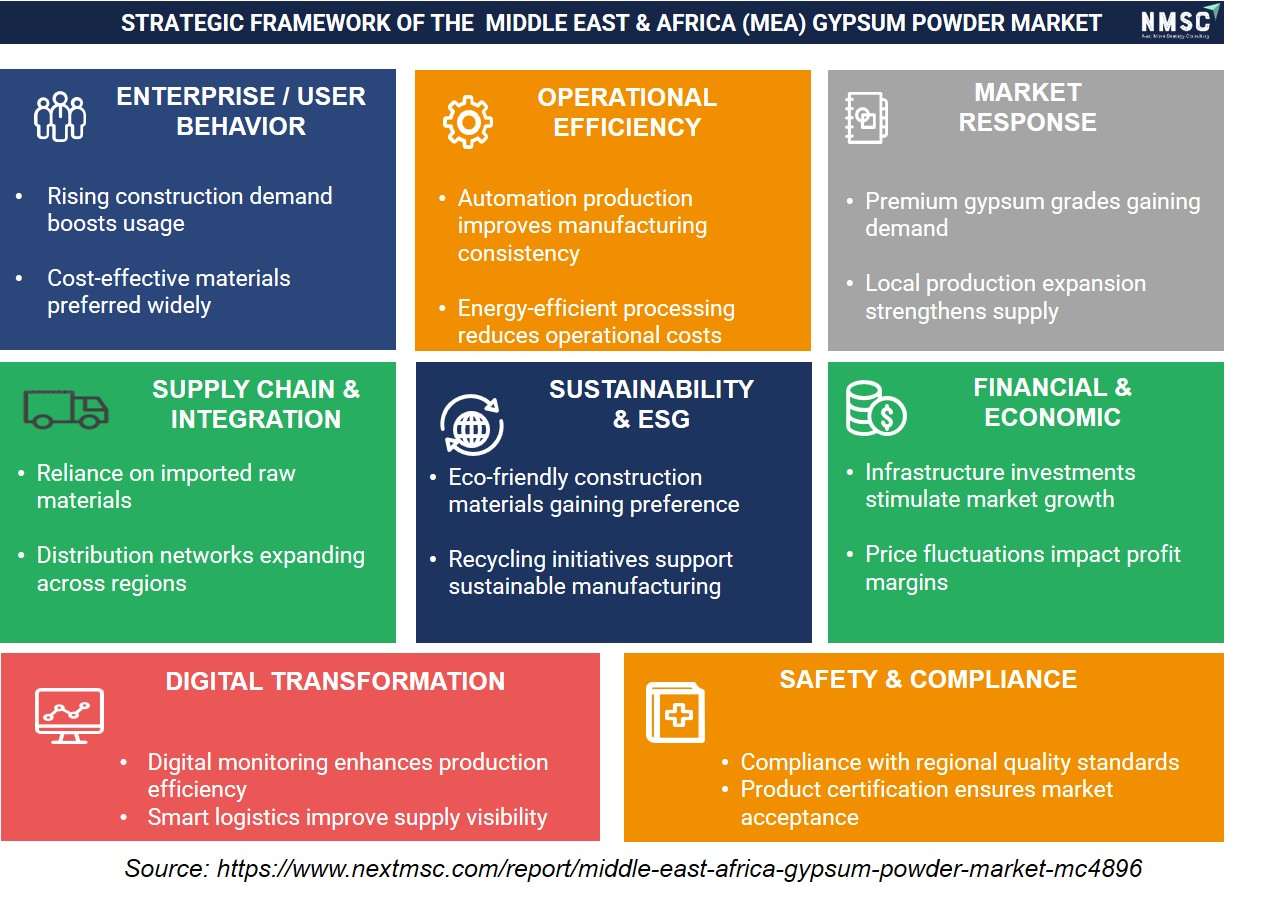
Our analysis indicates that the Middle East & Africa gypsum powder market is shaped by rising construction activities, infrastructure investments, and increasing demand for cost-effective building materials. Manufacturers are improving operational efficiency through automation and energy-efficient processing technologies. Expanding distribution networks, digital logistics solutions, sustainability initiatives, and compliance with regional quality standards are strengthening supply chains, enhancing product availability, and supporting long-term market growth across the region.
Middle East & Africa Gypsum Powder Market Key Segments
By Product Form
-
Raw Gypsum Powder
-
Beta Hemihydrate
-
Alpha Hemihydrate
-
Anhydrite
By Source
-
Natural Gypsum
-
Synthetic Gypsum
-
FGD Gypsum
-
Phosphogypsum
-
Other Synthetic Gypsum
-
-
Recycled Gypsum
By Particle Size
-
Standard Powder
-
Fine Powder
-
Ultra Fine Powder
-
Granulated Powder
By Sales Channel
-
Direct Sales
-
Distributor Sales
-
Retail Sales
By Application
-
Construction
-
Board Feedstock
-
Joint Compounds
-
Site-Applied Plaster
-
Screeds
-
-
Cement
-
Agriculture
-
Soil Amendment
-
Fertilizer Input
-
Animal Bedding
-
-
Industrial
-
Moulding and Casting
-
Ceramics
-
Fillers
-
Dental and Medical
-
Food and Pharma
-
Other Industrial
-
Key Benefits for Stakeholders:
Next Move Strategy Consulting (NMSC) provides a comprehensive analysis of the Middle East & Africa Gypsum Powder Market trends, covering historical trends from 2020–2025 and forecasts through 2035. The study evaluates market performance across key segments, highlighting construction sector adoption, cement manufacturing integration, agricultural application expansion, and industrial utilization growth. Investors benefit from growing infrastructure investment opportunities, while gypsum producers gain insights into regional demand trends, competitive positioning strategies, and distribution channel expansion. Technology providers benefit from increasing demand for advanced gypsum processing and specialty powder manufacturing technologies across the region.
The report supports stakeholders in identifying high-growth opportunities across product forms, source categories, particle size segments, sales channels, and end-use applications. Detailed competitive profiling, supply chain analysis, and regulatory trend assessment provide actionable intelligence for market entry strategies, portfolio diversification, and investment planning. Furthermore, volume and revenue forecasts across the 2025–2035 period enable stakeholders to align production capacity planning, distribution network expansion, and go-to-market strategies with evolving demand patterns across the Middle East & Africa Gypsum Powder Market.
|
Parameters |
Details |
|
Customization Scope |
Free customization (equivalent to up to 80 analyst-working hours) after purchase. |
|
Pricing and Purchase Options |
Avail customized purchase options to meet your exact research needs. |
|
Approach |
In-depth primary and secondary research; proprietary databases; rigorous quality control and validation measures. |
|
Analytical Tools |
Porter's Five Forces, SWOT, value chain, and Harvey ball analysis to assess competitive intensity, stakeholder roles, and relative impact of key factors. |
Conclusion
The Middle East & Africa Gypsum Powder Market is poised for steady growth across the 2025–2035 forecast period, supported by expanding construction activities, rising cement production investments, growing agricultural applications, and diversifying industrial demand throughout the region. Increasing urbanization, government infrastructure initiatives, and circular economy adoption are creating sustained long-term opportunities for gypsum powder producers and distributors. Key market participants are strengthening capabilities through production capacity expansion, sustainable sourcing strategies, and multi-channel distribution development to capitalize on evolving regional demand patterns across MEA economies.
About the Author
 Saista Faiyaz
— Saista Faiyaz is Research Associate at Next Move Strategy Consulting, where she has covered consumer markets and healthcare technologies for 3 years. Her work includes primary interview review, secondary-source validation, market sizing, and structured analysis of company and industry data. She supports research by comparing evidence across sources, organizing findings into market narratives, and documenting assumptions used in analysis. Her scope includes cross-market benchmarking, and reports.
Saista Faiyaz
— Saista Faiyaz is Research Associate at Next Move Strategy Consulting, where she has covered consumer markets and healthcare technologies for 3 years. Her work includes primary interview review, secondary-source validation, market sizing, and structured analysis of company and industry data. She supports research by comparing evidence across sources, organizing findings into market narratives, and documenting assumptions used in analysis. Her scope includes cross-market benchmarking, and reports.
About the Reviewer
 Supradip Baul
— Supradip Baul is an accomplished business consultant and strategist with over a decade of rich experience in market intelligence, strategy, technology, and business transformation. His work has included rigorous qualitative and quantitative analysis across multiple industries, helping clients shape investment decisions and long-term roadmaps. Earlier in his career, he was associated with Gartner, where he contributed to industry-leading reports and market share analyses. He has worked with leading global companies and holds an MBA with a dual specialization in Marketing and Finance.
Supradip Baul
— Supradip Baul is an accomplished business consultant and strategist with over a decade of rich experience in market intelligence, strategy, technology, and business transformation. His work has included rigorous qualitative and quantitative analysis across multiple industries, helping clients shape investment decisions and long-term roadmaps. Earlier in his career, he was associated with Gartner, where he contributed to industry-leading reports and market share analyses. He has worked with leading global companies and holds an MBA with a dual specialization in Marketing and Finance.
At Next Move Strategy Consulting, we understand that insightful market research is the cornerstone of successful business decisions. That's why we employ a robust and multifaceted approach, combining various methodologies to deliver the most accurate and actionable data for our clients.

Research Landscape
We navigate the world of research with two primary approaches:
Qualitative Approach
Our qualitative research methodologies involve immersive techniques such as in-depth interviews, focus groups, and observational studies. By engaging directly with individuals and stakeholders, we uncover valuable insights that quantitative data alone may overlook.

Quantitative Research
In tandem with qualitative methodologies, NMSC leverages the power of Quantitative Research to provide a robust foundation of numerical insights. Through systematic data collection and analysis, we quantify patterns, preferences, and market trends, offering a comprehensive view of the business landscape.
Our quantitative research approach employs diverse tools, including surveys, experiments, and statistical modelling. These methodologies enable us to gather data from a large and representative sample, ensuring the statistical significance of our findings. By employing structured questionnaires and standardized data collection methods, we guarantee the reliability and validity of the information we present to our clients.
Quantitative research is particularly effective in measuring the prevalence of trends, assessing market size, and gauging the impact of various factors on consumer behavior. The numerical precision attained through this approach equips our clients with actionable insights, facilitating data-driven decision-making and strategy formulation.


Our Specialized Toolbox for Industry-Specific Market Research
We deploy a specialized arsenal of techniques tailored to meet your unique requirements. Here's a glimpse into our comprehensive toolbox:

Information Procurement
The stage entails acquiring market data or relevant information through various sources and methodologies.


Market Research Approach
We utilize both top-down and bottom-up approaches in market research analysis to achieve a comprehensive understanding of the market dynamics, leveraging the broad perspective of industry trends and macroeconomic factors alongside detailed insights from specific segments and individual companies.

Porters Five Forces Analysis
We conduct Porter's Five Forces analysis to evaluate the competitive landscape of an industry, providing us with insights into factors that affect profitability and strategic positioning.

SWOT Analysis

Forecasting
We utilize a forecasting model to predict future consumption by considering parameters like population, economics, regulations, market competition, drivers, constraints, technology, and pricing. We also employ statistical techniques such as multilinear regression, exponential smoothing, moving average, ARIMA, and Monte Carlo simulations for accurate predictions. In econometric forecasting, we analyzed short-term and long-term event impacts, attributing values based on regulatory frameworks, economic factors, and market events.





 Speak to Our Analyst