
Miso Paste Market Size, Share, Growth & Forecast by Product Type (White Miso Paste, Red Miso Paste, Mixed Miso Paste, Specialty Miso Paste), Packaging Format (Retail Packaged, Industrial Bulk), Customer Type (Household Consumers, Foodservice Operators, Food Manufacturers), Distribution Channel (Modern Grocery, Specialty Retail, Convenience Retail, Online Retail, Foodservice Distribution, Industrial Distribution) - Global Analysis 2025–2035
Industry: Retail and Consumer | Publishing Date: June 9, 2026 | Last Updated: September 30, 2026 | No of Pages: N/A | No. of Tables: N/A | No. of Figures: N/A | Format: PDF | Report Code: RC4630
What Is the Miso Paste Market Size?
The global Miso Paste Market was valued at USD 1.80 Billion in 2025 and is expected to reach USD 1.85 Billion in 2026. Sustained consumer demand for fermented and functional foods, expanding international cuisine adoption, and growing health-conscious food purchasing behavior are projected to propel the Miso Paste Market to USD 2.35 Billion by 2035, advancing at a CAGR of 2.7% from 2026 to 2035. Key growth drivers include the rising global appetite for umami-rich condiments, mainstream foodservice integration of Japanese culinary ingredients, increasing organic and non-GMO product premiumization, and expanding e-commerce distribution enabling cross-border consumer access to specialty miso varieties.
|
Parameters |
Details |
|
Market Size in 2025 |
USD 1.80 Billion |
|
Market Size in 2026 |
USD 1.85 Billion |
|
Revenue Forecast in 2035 |
USD 2.35 Billion |
|
Growth Rate |
CAGR of 2.7% from 2026 to 2035 |
|
Analysis Period |
2025–2035 |
|
Base Year Considered |
2025 |
|
Forecast Period |
2026–2035 |
|
Market Size Estimation |
Billion USD |
|
Companies Profiled |
20 |
|
Countries Covered |
33 |
|
Market Share |
Top 10 |
Miso Paste Market Overview
What Is the Miso Paste Market?
The Miso Paste Market encompasses the global production, distribution, and commercial trade of fermented soybean-based paste products manufactured through controlled koji fermentation and aging processes. Miso paste serves as a foundational seasoning ingredient in soups, marinades, dressings, sauces, and ready-to-cook formulations across household, foodservice, and industrial food manufacturing applications. The market spans a diverse product spectrum ranging from traditional short-fermented white miso to long-aged artisanal hatcho varieties, with growing premium and functional wellness positioning reinforcing the market's structural evolution beyond its Japanese culinary origins.
How Has the Miso Paste Market Evolved?
The Miso Paste Market has evolved through several transformative phases over the past three decades. The initial phase was characterized by domestic Japanese production meeting local household and foodservice demand, with limited international exports. The second phase saw Japanese diaspora communities and Asian grocery retail networks introduce miso paste to North America, Europe, and Oceania. NMSC's analysis indicates that the current phase is defined by mainstream Western foodservice adoption, clean-label premiumization, and the functional wellness positioning of miso paste as a probiotic-rich, gut-health-supporting superfood ingredient driving incremental international consumer demand.
How Do Regulations Influence the Miso Paste Market?
Regulatory frameworks governing food labeling, organic certification, fermentation standards, and import protocols significantly influence the structure and commercial dynamics of the Miso Paste Market. In the United States, the USDA National Organic Program (NOP) and the Food and Drug Administration (FDA) Good Manufacturing Practice (GMP) standards govern production and labeling. In the European Union, Regulation (EC) No 852/2004 on food hygiene and EU organic certification standards shape sourcing and labeling requirements for miso paste imports. Japan's JAS (Japanese Agricultural Standards) certification system provides a recognized quality benchmark that premium miso brands leverage for international market differentiation.
How Is Technology Adoption Expanding Across the Miso Paste Market?
Technology adoption across the Miso Paste Market is accelerating across fermentation process management, quality control, and supply chain optimization. Advanced temperature-controlled fermentation chambers, automated koji cultivation systems, and real-time microbiome monitoring tools are enabling producers to consistently replicate traditional fermentation outcomes at industrial scale. Precision fermentation research is expanding the ingredient base to include alternative legumes and grains, broadening product portfolio potential. Digital traceability platforms and blockchain-based ingredient provenance systems are also being adopted by premium and organic miso producers to validate sourcing claims and support e-commerce consumer transparency requirements.
|
Key Takeaway |
|
By Product Type, White Miso Paste held the largest share of the Miso Paste Market, estimated at USD 560.7 Million in 2025, driven by its mild flavor profile, broad culinary versatility, and widespread adoption across both household and foodservice segments globally. Specialty Miso Paste is the fastest-growing product sub-segment, advancing at a CAGR of 4.2% from 2026 to 2035, propelled by rising artisanal production, hatcho and regional variety premiumization, and growing consumer interest in authentic fermentation heritage. |
|
By Packaging Format, Retail Packaged miso dominated the Miso Paste Market at an estimated USD 899.4 Million in 2025, reflecting strong household consumption patterns across Japan, North America, and Western Europe. Foodservice Pack is the fastest-growing packaging sub-segment at a CAGR of 3.4% from 2026 to 2035, driven by expanding Japanese restaurant chains and fusion cuisine adoption among global foodservice operators. |
|
By Customer Type, Household Consumers constituted the largest customer segment in the Miso Paste Market, accounting for an estimated USD 845.7 Million in 2025, underpinned by Japan's deep domestic consumption tradition and growing international household adoption. Food Manufacturers are the fastest-growing customer segment at a CAGR of 3.6% from 2026 to 2035, as miso is increasingly incorporated as a flavor base and fermentation-derived functional ingredient in packaged soups, sauces, and seasoning blends. |
|
By Distribution Channel, Modern Grocery led the Miso Paste Market, estimated at USD 540.1 Million in 2025, supported by wide supermarket shelf presence across Japan, the United States, and Europe. Online Retail is the fastest-growing distribution channel at a CAGR of 5.8% from 2026 to 2035, enabled by expanding direct-to-consumer specialty food e-commerce platforms and international cross-border retail accessibility. |
|
By Fermentation Profile, Short Fermented miso dominated the Miso Paste Market at an estimated USD 627.3 Million in 2025, aligned with white miso's widespread preference. Barrel Aged miso is the fastest-growing fermentation sub-segment at a CAGR of 4.6% from 2026 to 2035, reflecting growing premium artisanal and culinary enthusiast demand for complex flavor profiles and traditional fermentation heritage. |
|
By Ingredient Base, Soybean-Based miso commanded the largest share of the Miso Paste Market at an estimated USD 392.5 Million in 2025, consistent with traditional production methods and consumer familiarity. Alternative Legume-Based miso is the fastest-growing ingredient segment at a CAGR of 6.1% from 2026 to 2035, driven by allergen-free, chickpea-based, and lentil miso product innovation targeting non-soy consumers. |
|
By Product Positioning, Conventional miso held the dominant share of the Miso Paste Market at an estimated USD 326.1 Million in 2025. Organic miso is the fastest-growing positioning sub-segment at a CAGR of 4.5% from 2026 to 2035, propelled by expanding USDA Organic and EU Organic-certified product offerings and consumer willingness to pay premium prices for certified clean-label miso varieties. |
|
Asia Pacific dominated the Miso Paste Market with an estimated USD 425.2 Million in 2025, anchored by Japan's deeply entrenched domestic consumption culture and growing demand from China, South Korea, and Australia. |
|
North America is the fastest-growing major region in the Miso Paste Market at a CAGR of 4.1% from 2026 to 2035, propelled by mainstream foodservice adoption, health-conscious consumer demand, and expanding specialty and online retail distribution. |
|
Japan is the single largest national market in the Miso Paste Market, accounting for an estimated USD 0.85 Billion in 2025, supported by multi-generational household consumption habits and a deeply integrated foodservice culture. |
|
The United States is the fastest-growing major national market in the Miso Paste Market at a CAGR of 4.4% from 2026 to 2035, driven by growing Asian cuisine influence, expanding plant-based dietary trends, and a robust natural food retail distribution network. |
Key Emerging Trends in the Miso Paste Market
How Is the Global Functional Food Movement Transforming Demand in the Miso Paste Market?
The global functional food movement is catalyzing a structural reposition of miso paste from a regional seasoning to a mainstream gut-health ingredient. From our research, we found that consumer awareness of the role of fermented foods in supporting microbiome health and immune function has materially expanded the addressable market for miso paste across North America and Europe. Brands such as Clearspring and Miso Master are explicitly marketing miso as a probiotic-rich wellness product. This wellness repositioning is enabling premium pricing, broadening retail shelf placement into health and natural food categories, and attracting new consumer cohorts beyond traditional Asian food buyers.
How Are Plant-Based and Vegan Dietary Trends Reshaping the Miso Paste Market?
Plant-based and vegan dietary adoption is generating sustained incremental demand within the Miso Paste Market, as miso paste provides a potent umami flavor base that substitutes animal-derived seasonings in vegan cooking. Through our market assessment, we observed that professional chefs and food manufacturers are incorporating miso into plant-based meat analogues, dairy-free sauces, and vegan ready-meal formulations to deliver savory depth and clean-label fermentation credentials. Miso's classification as a minimally processed, whole-food fermented ingredient aligns directly with clean-label and minimally processed product development priorities across food and beverage manufacturers.
How Is the Rise of Japanese and Asian Cuisine Globally Expanding the Miso Paste Market?
The sustained global expansion of Japanese cuisine, driven by the proliferation of ramen, sushi, izakaya, and fusion restaurants across North America, Europe, and the Middle East, is materially expanding commercial miso paste consumption. NMSC's analysis indicates that the number of Japanese restaurants outside Japan has grown significantly over the past decade, creating consistent bulk demand for miso paste in foodservice distribution channels. Additionally, mainstream Western home cooking adoption of Japanese recipes, amplified by food media, social platforms, and meal kit services, is driving household retail consumption of miso paste in non-traditional markets.
How Is E-Commerce and Direct-to-Consumer Retail Disrupting the Miso Paste Market?
E-commerce and direct-to-consumer retail are fundamentally disrupting traditional distribution models in the Miso Paste Market, enabling small-batch artisanal producers to access global consumers without requiring traditional retail or foodservice distribution infrastructure. Our findings suggest that online specialty food platforms, including Amazon, Thrive Market, and regional equivalents, now carry an expanded assortment of miso varieties, including barrel-aged, hatcho, and alternative legume-based products that were previously inaccessible outside Japan or specialty import stores. This channel shift is democratizing consumer access to premium miso and enabling niche producers to build direct brand relationships with wellness-conscious international buyers.
What Are the Key Market Drivers, Breakthroughs, and Investment Opportunities that Will Shape the Miso Paste Market Industry in the Next Decade?
|
Drivers / Trends / Restraints |
(+/-) % Impact on CAGR Forecast |
Geographic Relevance |
Impact Timeline |
|
Global Functional Food and Gut Health Demand |
+0.6% |
North America, Europe, Australia |
2025–2035 |
|
Plant-Based and Vegan Dietary Adoption |
+0.4% |
North America, Europe |
2025–2032 |
|
Japanese and Asian Cuisine Global Expansion |
+0.5% |
Global (all regions) |
2025–2030 |
|
E-Commerce and Direct-to-Consumer Growth |
+0.5% |
North America, Europe, APAC |
2025–2035 |
|
Organic and Premium Product Premiumization |
+0.3% |
North America, Europe |
2026–2035 |
|
Soybean Supply Chain Volatility |
-0.4% |
Global |
Ongoing |
|
Consumer Unfamiliarity in Emerging Markets |
-0.3% |
MEA, Latin America |
2025–2030 |
|
Alternative Legume Miso Innovation |
+0.3% |
North America, Europe |
2026–2035 |
|
Foodservice Recovery and Expansion |
+0.4% |
Global (all regions) |
2025–2030 |
|
Regulatory Compliance and Labeling Cost |
-0.2% |
EU, North America |
Ongoing |
What Are the Growth Drivers of the Miso Paste Market?
How Is Rising Consumer Demand for Fermented and Probiotic Foods Driving the Miso Paste Market?
Growing scientific and consumer recognition of fermented foods' role in supporting digestive health, immune function, and microbiome diversity is a primary structural driver of the Miso Paste Market. Based on NMSC's research, we found that government dietary guidance organizations in Japan, the United States, and Europe have increasingly acknowledged the nutritional benefits of traditionally fermented foods. The U.S. Dietary Guidelines Advisory Committee has incorporated fermented food consumption within broader healthy dietary pattern recommendations, lending institutional credibility to miso paste's functional wellness positioning and supporting premium retail pricing and new product development investment across the market.
How Is the Global Expansion of Japanese and Asian Foodservice Generating Demand in the Miso Paste Market?
The accelerating international expansion of Japanese restaurant chains and broader Asian cuisine foodservice operations is generating consistent commercial-scale demand for miso paste outside Japan. Our assessment indicates that foodservice operators across North America, Europe, and the Middle East are incorporating miso-based soups, glazes, marinades, and dressings into mainstream menu offerings, creating durable bulk purchasing demand through foodservice distribution channels. The Japan External Trade Organization (JETRO) actively supports the global promotion of Japanese food products, including miso paste, through trade missions, food fair participation, and foodservice operator education programs that accelerate adoption across international hospitality markets.
How Is Plant-Based Protein and Clean-Label Ingredient Demand Expanding the Miso Paste Market?
The structural shift toward plant-based proteins and clean-label ingredient formulations within the packaged food and beverage sector is expanding the total addressable market for miso paste as an industrial ingredient. Through NMSC's assessment, we found that food manufacturers are increasingly incorporating miso as a natural umami booster, flavor enhancer, and fermentation-derived functional ingredient in plant-based ready meals, soups, sauces, and seasoning blends. The Non-GMO Project verification and USDA Organic certification have become important commercial differentiators for miso paste suppliers targeting natural and specialty food manufacturers who require certified, traceable, and minimally processed ingredient inputs for premium product formulations.
What Are the Growth Inhibitors of the Miso Paste Market?
How Does Soybean Supply Chain Volatility and Agricultural Input Cost Inflation Constrain the Miso Paste Market?
Soybean supply chain volatility represents one of the most significant operational constraints on the Miso Paste Market, as soybeans constitute the primary raw material input for traditional miso production. Based on our market evaluation, we noticed that soybean price fluctuations driven by climate events, geopolitical trade disruptions, and competing demand from biofuel, livestock feed, and protein processing sectors directly compress manufacturer margins and create retail price instability. The U.S. Department of Agriculture (USDA) Economic Research Service publishes regular data confirming soybean price sensitivity to weather conditions, export demand shifts, and production cost dynamics, all of which directly impact miso paste production economics globally.
How Does Limited Consumer Awareness in Non-Traditional Markets Restrict the Miso Paste Market?
Consumer unfamiliarity with miso paste's culinary applications outside traditional Asian markets remains a structural adoption barrier in the Miso Paste Market, particularly across Latin America, the Middle East, and Sub-Saharan Africa. Our analysis shows that without strong culinary education, recipe content marketing, and cooking demonstration exposure, consumers in non-traditional markets tend to perceive miso paste as a niche or unfamiliar ingredient with unclear utility beyond miso soup. This awareness gap limits distribution expansion, constrains foodservice menu adoption rates, and requires sustained marketing investment by brands and importers to convert initial trial into repeat purchasing behavior across emerging international consumer markets.
What Are the Growth Opportunities in the Miso Paste Market?
How Does the Alternative Legume Miso Category Create a High-Growth Opportunity in the Miso Paste Market?
The development and commercialization of alternative legume-based miso pastes, including chickpea, lentil, and adzuki bean varieties, represents one of the highest-growth emerging opportunities in the Miso Paste Market. Our findings suggest that soy-free miso products directly address growing consumer demand from individuals with soy allergies or dietary preferences that exclude soy-based products. South River Miso Company and Miso Master, Inc. have both expanded their product portfolios to include chickpea and other legume-based miso varieties, demonstrating proven commercial demand. The USDA Agricultural Marketing Service data indicates growing market infrastructure supporting certified organic legume ingredient supply chains that enable scalable soy-free miso production.
How Does Functional Wellness Product Innovation Present a Structural Opportunity in the Miso Paste Market?
Functional wellness product positioning, encompassing probiotic claims, gut microbiome support, and immune health marketing, represents a significant commercial opportunity for premium and artisanal miso paste producers targeting health-conscious consumer segments. Through our analysis, we observed that brands incorporating validated scientific messaging around fermented food benefits, live cultures, and microbiome diversity are capturing premium retail price points in natural food channels. The U.S. Food and Drug Administration's regulatory framework for probiotic labeling, while requiring substantiation, provides a structured pathway for miso brands to differentiate through science-backed wellness communication, expanding the market's appeal well beyond traditional culinary ingredient positioning.
How Is E-Commerce Infrastructure Creating a Global Distribution Opportunity for the Miso Paste Market?
The maturation of ambient temperature-tolerant e-commerce packaging solutions and the expansion of international specialty food logistics networks is creating a structural global distribution opportunity for miso paste producers of all scales. NMSC's analysis indicates that online retail platforms have significantly lowered the minimum viable scale for international miso distribution, enabling small-batch Japanese artisanal producers to ship barrel-aged hatcho varieties directly to consumers in North America and Europe. Additionally, subscription-based meal kit services including HelloFresh and Blue Apron regularly feature miso-based recipes, providing high-frequency consumer trial events that drive subsequent retail repurchase and brand awareness at minimal acquisition cost to miso suppliers.
How Is the Miso Paste Market Segmented in This Report, and What Are the Key Insights from the Segmentation Analysis?
How Does Product Type Segmentation Reveal the Flavor and Positioning Diversity of the Miso Paste Market?
|
Product Type Segment |
2025 (USD Mn) |
2035 (USD Mn) |
CAGR (%) |
|
White Miso Paste |
560.7 |
682.0 |
2.0% |
|
Red Miso Paste |
450.2 |
558.9 |
2.2% |
|
Mixed Miso Paste |
540.3 |
675.6 |
2.3% |
|
Specialty Miso Paste |
248.8 |
374.7 |
4.2% |
Based on our analysis of consumer purchasing behavior and culinary application trends, the Miso Paste Market is segmented by product type into White Miso Paste, Red Miso Paste, Mixed Miso Paste, and Specialty Miso Paste. White Miso Paste dominates the segment, driven by its mild sweetness, short fermentation period, and broad versatility across dressings, marinades, and light soups, making it the preferred entry-point miso for international consumers. Red Miso Paste commands a loyal household base in Japan and among flavor-forward foodservice operators seeking deeper umami intensity. Mixed Miso, blending the characteristics of white and red varieties, is gaining traction as a balanced all-purpose product. Specialty Miso, including hatcho, aka, and regional single-origin varieties, is the fastest-growing segment, fueled by premiumization, artisanal storytelling, and gourmet foodservice demand.
How Does Packaging Format Reflect the Commercial and Consumer Consumption Structure of the Miso Paste Market?
|
Packaging Format Segment |
2025 (USD Mn) |
2035 (USD Mn) |
CAGR (%) |
|
Retail Packaged |
899.4 |
1,097.0 |
2.0% |
|
Foodservice Pack |
540.1 |
750.8 |
3.4% |
|
Industrial Bulk |
360.5 |
443.2 |
2.1% |
From our market assessment, the Miso Paste Market is segmented by packaging format into Retail Packaged, Foodservice Pack, and Industrial Bulk configurations. Retail Packaged miso dominates, supported by Japan's deep household consumption tradition and the expanding Western natural food retail channel distribution of branded miso products in 200g to 1kg pouches and tubs. Foodservice Pack is the fastest-growing format, driven by the proliferation of Japanese restaurants, ramen chains, and Asian fusion operators globally, which require larger-format packs optimized for commercial kitchen use. Industrial Bulk packaging serves food manufacturers incorporating miso as a flavor ingredient at scale in soups, seasoning blends, and processed food formulations.
How Does Customer Type Segmentation Illuminate the Demand Structure of the Miso Paste Market?
|
Customer Type Segment |
2025 (USD Mn) |
2035 (USD Mn) |
CAGR (%) |
|
Household Consumers |
845.7 |
1,029.4 |
2.0% |
|
Foodservice Operators |
593.2 |
802.0 |
3.1% |
|
Food Manufacturers |
361.1 |
459.8 |
3.6% |
Our analysis of miso paste consumption patterns indicates that the Miso Paste Market is segmented by customer type into Household Consumers, Foodservice Operators, and Food Manufacturers. Household Consumers constitute the largest customer segment, anchored by Japan's per-capita miso consumption of approximately 13 to 15 grams per day and growing international household adoption in North America and Western Europe. Foodservice Operators represent a high-growth segment driven by the global expansion of ramen, Japanese, and Asian fusion restaurants. Food Manufacturers are the fastest-growing customer segment as industrial miso adoption expands into plant-based foods, instant soups, seasoning sachets, and fermented ingredient applications within the broader packaged food industry.
How Do Distribution Channels Shape Consumer Access and Revenue Flows in the Miso Paste Market?
|
Distribution Channel Segment |
2025 (USD Mn) |
2035 (USD Mn) |
CAGR (%) |
|
Modern Grocery |
540.1 |
659.0 |
2.0% |
|
Specialty Retail |
360.0 |
474.0 |
2.8% |
|
Convenience Retail |
180.0 |
211.1 |
1.6% |
|
Online Retail |
216.0 |
383.0 |
5.8% |
|
Foodservice Distribution |
326.0 |
409.7 |
2.3% |
|
Industrial Distribution |
177.9 |
154.5 |
-1.4% |
Based on our market evaluation, the Miso Paste Market is distributed through Modern Grocery, Specialty Retail, Convenience Retail, Online Retail, Foodservice Distribution, and Industrial Distribution channels. Modern Grocery holds the largest share, supported by wide supermarket chain distribution across Japan, the United States, and Western Europe. Specialty Retail, encompassing Asian grocery stores and health food retailers, serves important discovery and loyalty functions for both traditional and premium miso consumers. Online Retail is the fastest-growing channel at a CAGR of 5.8% from 2026 to 2035, driven by the ability to offer an expanded assortment of specialty and artisanal miso varieties that traditional bricks-and-mortar retail cannot economically stock.
How Does Fermentation Profile Influence Product Diversity and Consumer Segmentation in the Miso Paste Market?
|
Fermentation Profile Segment |
2025 (USD Mn) |
2035 (USD Mn) |
CAGR (%) |
|
Short Fermented |
627.3 |
760.0 |
1.9% |
|
Medium Fermented |
540.1 |
670.8 |
2.2% |
|
Long Fermented |
449.9 |
562.4 |
2.3% |
|
Barrel Aged |
182.7 |
297.9 |
4.6% |
Through NMSC's assessment, we found that the Miso Paste Market is segmented by fermentation profile into Short Fermented, Medium Fermented, Long Fermented, and Barrel Aged miso varieties. Short Fermented miso dominates, representing the white miso production model with fermentation periods of days to weeks, delivering mild flavor and a sweet profile highly appealing to mainstream international consumers. Medium Fermented miso, including many commercial all-purpose varieties, offers balanced flavor suitable for broad household and foodservice applications. Long Fermented miso, characteristic of deep red hatcho and red miso styles, commands premium retail positioning. Barrel Aged miso is the fastest-growing fermentation sub-segment, driven by craft food movements and gourmet culinary media elevating aged miso as a premium flavor ingredient.
How Does Ingredient Base Differentiation Drive Product Innovation in the Miso Paste Market?
|
Ingredient Base Segment |
2025 (USD Mn) |
2035 (USD Mn) |
CAGR (%) |
|
Soybean Based |
392.5 |
483.3 |
2.1% |
|
Rice Koji Based |
104.7 |
128.4 |
2.1% |
|
Barley Koji Based |
78.5 |
97.3 |
2.2% |
|
Mixed Grain Based |
39.2 |
47.9 |
2.0% |
|
Alternative Legume Based |
39.3 |
75.8 |
6.1% |
Our analysis of ingredient sourcing and product innovation trends indicates that the Miso Paste Market is segmented by ingredient base into Soybean Based, Rice Koji Based, Barley Koji Based, Mixed Grain Based, and Alternative Legume Based varieties. Soybean Based miso commands the dominant share of the Miso Paste Market, consistent with traditional mugi, kome, and mame miso production conventions that form the foundation of Japanese miso culture. Rice Koji and Barley Koji based misos represent established sub-categories serving distinct regional culinary traditions. Alternative Legume Based miso, encompassing chickpea, lentil, and adzuki varieties, is the fastest-growing ingredient segment at a CAGR of 6.1% from 2026 to 2035, driven by soy allergy prevalence, vegan ingredient diversification, and the broader pulse protein adoption trend.
How Does Product Positioning Strategy Shape Value Capture in the Miso Paste Market?
|
Product Positioning Segment |
2025 (USD Mn) |
2035 (USD Mn) |
CAGR (%) |
|
Conventional |
326.1 |
380.5 |
1.6% |
|
Organic |
98.1 |
152.9 |
4.5% |
|
Non-GMO |
78.5 |
107.5 |
3.2% |
|
Premium |
78.5 |
104.8 |
2.9% |
|
Artisanal |
39.2 |
55.6 |
3.5% |
|
Functional Wellness |
33.8 |
31.4 |
-0.7% |
Based on NMSC's research, we found that the Miso Paste Market is segmented by product positioning into Conventional, Organic, Non-GMO, Premium, Artisanal, and Functional Wellness categories. Conventional miso maintains the largest revenue share due to its established household affordability positioning and broad retail distribution infrastructure. Organic miso is the fastest-growing positioning sub-segment at a CAGR of 4.5% from 2026 to 2035, as consumers in North America and Europe increasingly prioritize certified organic fermented food products. Non-GMO positioning is gaining traction, particularly in the United States, where Non-GMO Project verification has become a significant purchase driver in natural food retail. Artisanal miso positioning leverages craft fermentation narratives and terroir storytelling to command premium price points in specialty retail and direct-to-consumer channels.
Regional Outlook
Geographic Performance Snapshot
|
Region |
2025 (USD Mn) |
2035 (USD Mn) |
CAGR (%) |
Key Driver |
|
Asia Pacific |
425.2 |
521.8 |
2.1% |
Japanese domestic consumption, regional foodservice expansion |
|
North America |
130.8 |
196.2 |
4.1% |
Functional food demand, plant-based trends |
|
Europe |
65.4 |
92.3 |
3.5% |
Asian cuisine adoption, organic premiumization |
|
Latin America |
19.6 |
13.8 |
-3.5% |
Limited awareness, nascent specialty imports |
|
Middle East and Africa |
13.2 |
8.6 |
-4.2% |
Early-stage market, limited distribution infrastructure |
Asia Pacific Miso Paste Market
Asia Pacific dominates the global Miso Paste Market, accounting for an estimated USD 425.2 Million in 2025 and projected to reach USD 521.8 Million by 2035 at a CAGR of 2.1%. Japan constitutes the overwhelming majority of regional revenue, with deeply embedded household miso consumption culture and a mature domestic production industry. China, South Korea, and Taiwan represent secondary regional demand centers with growing consumer awareness of miso as a health-supportive fermented ingredient. Australia is the fastest-growing Asia Pacific market outside Northeast Asia, driven by strong health food retail infrastructure and multicultural culinary adoption trends across its urban population.
Japan Miso Paste Market
Based on our engagements with production industry data and agricultural statistical sources, Japan is the world's largest national miso paste market, accounting for the substantial majority of global miso paste consumption. The Ministry of Agriculture, Forestry and Fisheries of Japan (MAFF) regularly publishes production volume and consumption data confirming miso's status as a fundamental staple in Japanese dietary culture, with average household consumption deeply embedded across all demographic segments. Regulatory oversight under the JAS system ensures production quality standards. Foodservice, including traditional Japanese restaurant chains and institutional catering, constitutes a significant commercial demand channel alongside the dominant household consumption segment.
China Miso Paste Market
Through our analysis, China represents a high-potential emerging market for miso paste, driven by growing urban consumer interest in Japanese cuisine, the expansion of Japanese restaurant chains across major cities, and rising consumer awareness of fermented food health benefits. Regulatory oversight under China's National Food Safety Standard framework governs fermented condiment imports and domestic production. Japanese restaurant penetration in Shanghai, Beijing, and Shenzhen is creating commercial-scale foodservice demand. Domestic miso production remains limited relative to Japan, creating sustained import demand from Japanese manufacturers with established distribution agreements with Chinese food import distributors.
India Miso Paste Market
From our assessment, India represents a nascent but growing market for miso paste, primarily concentrated in metropolitan areas with significant Japanese expatriate communities and premium international cuisine restaurant presence. Mumbai, Bangalore, and Delhi host the highest concentration of Japanese restaurants and specialty food importers. India's FSSAI (Food Safety and Standards Authority of India) regulates fermented food imports and labeling. Health-conscious urban consumers are increasingly exploring fermented foods through specialty retail and online platforms. Long-term market development will require sustained consumer education and culinary exposure initiatives.
South Korea Miso Paste Market
According to our evaluation, South Korea occupies a unique position in the Miso Paste Market due to the cultural proximity of doenjang, a traditional Korean fermented soybean paste sharing similar production principles with Japanese miso. This domestic fermented soybean paste tradition creates a well-primed consumer base for miso paste adoption. Japanese miso products are gaining shelf presence in premium Korean supermarkets and specialty retailers. Regulatory oversight under the Ministry of Food and Drug Safety (MFDS) governs fermented condiment standards. The Korea-Japan cultural exchange in culinary trends supports gradual market expansion.
Taiwan Miso Paste Market
Based on our market evaluation, Taiwan has a long-standing cultural familiarity with miso paste, reflecting historical Japanese culinary influence. Miso soup is commonly served in Taiwanese breakfast establishments and Japanese restaurant chains operating across the country. Local distribution is well-established through modern supermarket chains and specialty retailers. Taiwan's Food and Drug Administration (TFDA) regulates food safety and labeling standards for imported miso products. Premium and organic miso varieties are gaining traction among health-conscious urban consumers in Taipei and other major Taiwanese cities.
Indonesia Miso Paste Market
Through our analysis, Indonesia represents an early-stage but growing market for miso paste, driven by an expanding urban middle class, growing Japanese restaurant presence in Jakarta, Surabaya, and Bali, and rising consumer interest in fermented health foods. The National Agency of Drug and Food Control (BPOM) regulates food imports and labeling. Distribution is primarily concentrated in modern grocery chains and specialty Japanese importers in major urban centers. Consumer awareness of miso's culinary versatility outside Japanese restaurant contexts remains limited, presenting both a challenge and a long-term opportunity for market development.
Vietnam Miso Paste Market
From our assessment, Vietnam is a developing market for miso paste, with demand concentrated in Ho Chi Minh City and Hanoi's growing Japanese restaurant and expatriate communities. Vietnam's Ministry of Health oversees food safety and import standards for fermented condiment products. Japanese food culture has strong influence in Vietnam's urban dining scene, supporting gradual miso paste adoption among local consumers and foodservice operators. The broader functional food and health supplement awareness trend among young Vietnamese urban consumers is creating incremental household demand for miso and other fermented ingredient imports through specialty retail channels.
Australia Miso Paste Market
Based on our engagements with market data and consumer trend indicators, Australia is the fastest-growing miso paste market in Asia Pacific outside Northeast Asia, driven by a highly health-conscious consumer culture, a mature natural and organic food retail sector, and a diverse multicultural population with strong Japanese culinary familiarity. Australian retailers including Woolworths, Coles, and specialty health food chains stock a range of miso varieties. Food Standards Australia New Zealand (FSANZ) governs food safety and labeling requirements. The growing plant-based dietary movement and fermented food wellness trend are reinforcing sustained demand growth in both retail and foodservice channels.
Philippines Miso Paste Market
Through our analysis, the Philippines represents an emerging market for miso paste with demand anchored by the growing urban Japanese restaurant sector and an increasing young consumer base interested in health foods and Japanese culinary culture. The Food and Drug Administration Philippines (FDA PH) regulates imported fermented condiment products. Specialty Asian grocery retailers in Metro Manila and Cebu serve as the primary distribution channels for imported Japanese miso brands. Awareness remains limited among general consumers, and the market is predominantly driven by Japanese expatriate households and foodservice operators in major urban centers.
Malaysia Miso Paste Market
According to our evaluation, Malaysia is a mid-tier Southeast Asian market for miso paste, supported by a growing urban health food consumer base, a well-established Japanese restaurant sector, and a multicultural food culture receptive to Asian fermented ingredient diversity. The Ministry of Health Malaysia and the Malaysian Food Regulations 1985 govern food safety and labeling for imported fermented condiments. Premium Japanese miso brands are available through major supermarket chains and online retail platforms. The growing halal-certified miso segment, while still niche, represents a strategic opportunity for Japanese producers targeting Malaysia's predominantly Muslim consumer market.
Rest of Asia Pacific Miso Paste Market
The Rest of Asia Pacific, encompassing Thailand, Singapore, Bangladesh, Sri Lanka, New Zealand, and other markets, collectively contributes a growing share of regional Miso Paste Market revenue. Singapore serves as a critical regional import and distribution hub for premium Japanese miso brands targeting Southeast Asia. New Zealand's mature health food retail infrastructure mirrors Australia's functional food demand trends. Thailand's growing Japanese foodservice sector in Bangkok and Pattaya creates consistent commercial miso demand. Bangladesh and Sri Lanka represent very early-stage markets with negligible current demand but long-term potential aligned with urbanization and middle-class dietary diversification trajectories.
North America Miso Paste Market
North America is the fastest-growing major region in the Miso Paste Market, advancing from an estimated USD 130.8 Million in 2025 to USD 196.2 Million by 2035 at a CAGR of 4.1%. The region benefits from strong natural and organic food retail infrastructure, a health-conscious consumer culture with high receptivity to fermented and probiotic-rich foods, and the influence of Japanese and Asian cuisine across mainstream foodservice channels. The United States dominates North American revenue, supported by a growing domestic craft miso production sector led by companies such as South River Miso Company, Miso Master, and Eden Foods alongside established Japanese import brands.
U.S. Miso Paste Market
Based on our engagements with trade and industry data, the United States is the largest and fastest-growing national market within North America for miso paste, advancing at an estimated CAGR of 4.4% from 2026 to 2035. The USDA's National Organic Program (NOP) certification infrastructure supports a robust organic miso product market. The FDA's food labeling regulations govern miso product claims in retail. Natural and specialty food retailers including Whole Foods Market, Sprouts, and online platforms are primary distribution channels for both imported Japanese miso and domestically crafted products. Growing consumer interest in gut health, fermented foods, and clean-label condiments positions the U.S. as the leading international miso growth market.
Canada Miso Paste Market
Through our analysis, Canada is a well-developed secondary miso market within North America, supported by a health-conscious consumer culture, a multicultural urban population with strong Japanese culinary familiarity, and a mature natural food retail sector. Canadian food safety regulations under the Canadian Food Inspection Agency (CFIA) and the Safe Food for Canadians Act govern miso imports and labeling. Major urban centers including Toronto, Vancouver, and Montreal have established Japanese restaurant ecosystems driving foodservice miso demand. Canadian consumers' high engagement with organic and functional foods supports premium miso product category development across natural food retail channels.
Mexico Miso Paste Market
From our assessment, Mexico represents an early-stage and gradually developing miso paste market, with demand concentrated in Mexico City's growing international cuisine restaurant sector and among health-conscious urban consumers in major metropolitan areas. The Federal Commission for Protection against Sanitary Risks (COFEPRIS) governs food imports and labeling. Japanese restaurant penetration in Mexico City and Guadalajara is supporting gradual miso paste awareness among local foodservice operators. Consumer adoption in household segments remains nascent, and market growth is primarily driven by the expanding specialty and gourmet grocery retail infrastructure serving Mexico's upper-income urban consumer demographic.
Europe Miso Paste Market
Europe is the third-largest region in the Miso Paste Market, estimated at USD 65.4 Million in 2025 and projected to reach USD 92.3 Million by 2035 at a CAGR of 3.5%. The region's growth is driven by the rapid expansion of Japanese and Asian restaurants, strong consumer appetite for organic and clean-label fermented foods, and a mature natural food retail ecosystem. The United Kingdom, Germany, and France represent the largest European national markets. EU organic certification standards and GDPR-analogous food labeling regulations under Regulation (EU) 1169/2011 shape commercial miso positioning and labeling requirements across member states.
U.K. Miso Paste Market
Based on our engagements with market data and consumer insight indicators, the United Kingdom is the largest European national miso paste market, driven by London's status as a global Japanese and Asian cuisine capital, a highly developed natural food retail sector, and strong consumer familiarity with Japanese fermented ingredients. The Food Standards Agency (FSA) governs food safety and labeling. Retailers including Waitrose, Tesco, and Holland and Barrett stock established miso brands including Clearspring and Yutaka. The UK's strong organic and health food retail culture provides a favorable commercial environment for premium and organic miso product line extensions targeting wellness-oriented British consumers.
Germany Miso Paste Market
Through our analysis, Germany is the second-largest European miso paste market, supported by a highly health-conscious consumer base, one of Europe's strongest organic food retail sectors, and a growing Japanese restaurant presence in Berlin, Munich, and Hamburg. The German Federal Office of Consumer Protection and Food Safety (BVL) governs food safety and labeling compliance. German organic certification under the EU Organic Regulation is a significant commercial driver for premium miso products. Clearspring and domestic specialty importers serve as key distributors. The German natural food retail and health food store infrastructure provides an effective channel for premium miso varieties targeting organic and clean-label conscious German consumers.
France Miso Paste Market
From our assessment, France is the third-largest European miso paste market, characterized by a strong gourmet food culture that creates favorable conditions for premium Japanese ingredient adoption. The Agence nationale de sécurité sanitaire de l'alimentation (ANSES) and EU food regulations govern miso product standards and labeling. Organic miso brands are well distributed through France's extensive bio (organic) retail network including Naturalia and La Vie Claire. French chefs' enthusiasm for Japanese umami ingredients has accelerated miso's adoption in fine dining and casual dining restaurant menus, creating incremental foodservice demand that complements growing household retail consumption.
Italy Miso Paste Market
According to our evaluation, Italy is a mid-tier European miso paste market with growing consumer interest driven by the expanding Japanese restaurant sector in Rome and Milan and the Italian food culture's inherent appreciation for artisanal and traditionally fermented ingredients. The Italian Ministry of Health and EU food safety regulations govern fermented condiment imports. Italian consumers' strong affinity for aged and traditionally fermented food products creates cultural receptivity to premium long-fermented and barrel-aged miso varieties. Specialty food importers and organic grocery chains serve as the primary distribution channels for imported miso brands across Italian urban markets.
Spain Miso Paste Market
Based on our market evaluation, Spain represents a developing European miso paste market with growing momentum driven by an expanding Japanese restaurant sector in Madrid and Barcelona, a young health-conscious consumer demographic, and growing online retail accessibility of specialty food imports. The Spanish Agency of Food Safety and Nutrition (AESAN) oversees food safety and labeling requirements. Spain's Mediterranean food culture shows growing openness to fermented and umami-rich condiments as culinary crossover between traditional Spanish fermentation heritage and global food trends accelerates miso adoption across both professional and home cooking contexts.
Sweden Miso Paste Market
Through our analysis, Sweden is a high-per-capita health food consumer market where miso paste benefits from strong consumer familiarity with fermented foods and a well-developed natural food retail infrastructure. The Swedish Food Agency (Livsmedelsverket) governs food safety and labeling. Swedish consumers' longstanding tradition of consuming fermented dairy, fish, and grain products creates cultural receptivity for miso as an additional fermented ingredient category. Health food retailers and online specialty platforms serve as primary miso distribution channels. Sweden's progressive food culture supports premium, organic, and artisanal miso positioning at above-average European retail price points.
Denmark Miso Paste Market
From our assessment, Denmark is an advanced health food market where miso paste aligns well with the Nordic food culture's emphasis on fermented and natural ingredients. The Danish Veterinary and Food Administration (DVFA) governs food imports and labeling. Copenhagen's status as a global culinary capital, anchored by the New Nordic cuisine movement's celebration of fermented and naturally preserved ingredients, has elevated consumer awareness of miso and umami-forward condiments. Specialty food retailers and Japanese-concept restaurants in Copenhagen are primary demand drivers, supplemented by growing health food retail and online channel distribution.
Finland Miso Paste Market
Based on our market evaluation, Finland represents a developing miso paste market with a consumer culture predisposed to fermented foods through traditional Finnish rye bread, sauerkraut, and dairy fermentation heritage. The Finnish Food Authority (Ruokavirasto) governs food safety and labeling. Health food and organic retailers in Helsinki serve as primary distribution channels for imported miso brands. Growing consumer awareness of gut health benefits and a young urban demographic engaged with international cuisine trends are gradually expanding household adoption of miso paste beyond the existing Japanese restaurant foodservice demand base in Finnish urban centers.
Netherlands Miso Paste Market
Through our analysis, the Netherlands is a well-positioned European miso paste market, benefiting from Amsterdam's status as a global food and hospitality hub, a highly international urban consumer base, and a mature health food retail sector. The Netherlands Food and Consumer Product Safety Authority (NVWA) governs food safety and labeling compliance. Dutch consumers' strong engagement with organic and sustainably sourced food products creates favorable conditions for premium and certified organic miso brands. Rotterdam's role as Europe's largest port provides efficient logistics for miso imports from Japan. Online specialty food retail is an important and growing distribution channel for premium miso varieties.
Rest of Europe Miso Paste Market
The Rest of Europe, encompassing Poland, Belgium, Switzerland, Austria, Portugal, Czech Republic, and other markets, collectively contributes a growing portion of European Miso Paste Market revenue. Switzerland's affluent consumer base and strong health food retail infrastructure support premium miso adoption. Belgium, as the home of EU institutions and a highly international population, shows growing miso awareness in Brussels. Poland's rapidly modernizing food retail sector and growing urban health-consciousness are creating new distribution opportunities. Austria and the Czech Republic are early-stage markets where miso remains primarily concentrated in Japanese restaurant foodservice channels.
Latin America Miso Paste Market
Latin America represents the smallest regional miso paste market, estimated at USD 19.6 million in 2025, with current demand concentrated in Japanese-Brazilian communities in Brazil and a small premium import-dependent sector in Argentina and Chile. The region lacks an established miso distribution infrastructure outside major metropolitan centers with Japanese diaspora presence, and consumer awareness remains very limited across the general population. Long-term market development potential exists in Brazil and Mexico aligned with growing middle-class health food interest, but sustained investment in distribution infrastructure and consumer education will be required to activate meaningful growth in the Miso Paste Market across the region.
Brazil Miso Paste Market
Based on our engagements with regional food market indicators, Brazil is the largest Latin American miso paste market, uniquely anchored by the world's largest Japanese diaspora community of approximately 1.5 million people, primarily concentrated in Sao Paulo. This community maintains traditional miso consumption habits supporting established domestic distribution through Japanese specialty grocery stores and foodservice suppliers. The Brazilian Health Regulatory Agency (ANVISA) governs food imports and labeling. Beyond the Japanese community, broader Brazilian consumer awareness of miso remains limited, but growing urban health food retail and expanding Japanese restaurant chains are gradually extending the miso consumer base.
Argentina Miso Paste Market
Through our analysis, Argentina is a minor and developing miso paste market with demand anchored by a small Japanese diaspora community in Buenos Aires and a limited premium import sector serving health food and gourmet retail consumers. Argentina's SENASA (National Service of Agri-Food Health and Quality) governs food imports. Economic volatility and import cost pressures resulting from currency instability present structural challenges for sustained miso market development. Premium specialty importers serve the primary distribution function, and market development is expected to remain modest relative to broader Latin American markets with more stable economic and regulatory conditions.
Chile Miso Paste Market
From our assessment, Chile represents a small but stable miso paste market supported by Santiago's growing international cuisine restaurant scene and a health-conscious urban consumer demographic receptive to premium Asian food imports. Chile's Agricultural and Livestock Service (SAG) and the Public Health Institute (ISP) govern food safety and import standards. Premium supermarket chains and specialty Asian grocery retailers serve as primary miso distribution channels. Chile's high per-capita income by regional standards and its stable macroeconomic environment provide a favorable backdrop for gradual premium miso market development among health-focused urban consumers.
Colombia Miso Paste Market
According to our evaluation, Colombia is an early-stage miso paste market with demand concentrated in Bogota and Medellin's growing Japanese and pan-Asian restaurant sectors and a small specialty food import market serving premium grocery retail. The Instituto Nacional de Vigilancia de Medicamentos y Alimentos (INVIMA) governs food safety and imports. Consumer awareness of miso paste remains very low among the general population, and market development depends primarily on continued Japanese restaurant expansion and the growing urban middle class's exposure to international food culture through travel, social media, and premium grocery retail expansion.
Rest of LATAM Miso Paste Market
The Rest of Latin America, encompassing Peru, Ecuador, Venezuela, Uruguay, Paraguay, and other markets, represents a negligible current market for miso paste with very limited distribution infrastructure and minimal consumer awareness outside small Japanese diaspora communities. Peru's growing Japanese-Peruvian culinary fusion tradition, known as Nikkei cuisine, represents an interesting cultural entry point for miso adoption through the professional chef community. Long-term regional development will require sustainable improvement in import logistics, regulatory harmonization, and consumer education investments to realize the modest growth potential that exists across the broader Latin American Miso Paste Market.
Middle East and Africa Miso Paste Market
The Middle East and Africa is the smallest revenue region in the Miso Paste Market, estimated at USD 13.2 million in 2025, with demand heavily concentrated in UAE and Saudi Arabia's premium hospitality and Japanese restaurant sectors. The region lacks developed miso distribution infrastructure, and consumer awareness remains extremely limited across the general population. Long-term market development opportunity is associated with the continued expansion of Japanese and Asian cuisine restaurants in GCC hospitality hubs, growing health-conscious premium consumer segments in South Africa, and the gradual development of specialty food import retail infrastructure across the region.
Saudi Arabia Miso Paste Market
Based on our engagements with regional food market data, Saudi Arabia is the largest MEA miso paste market, driven by the premium hospitality sector in Riyadh and Jeddah, the growing Japanese restaurant segment supported by Vision 2030's tourism and entertainment development, and a small but growing health-conscious urban consumer base. The Saudi Food and Drug Authority (SFDA) governs food imports and labeling. Halal certification compatibility is an important commercial requirement for miso products targeting Saudi retail channels. Premium hotel foodservice and Japanese restaurant operators are the primary current commercial demand drivers.
UAE Miso Paste Market
Through our analysis, UAE is the second-largest MEA miso paste market, supported by Dubai and Abu Dhabi's status as global hospitality hubs with extensive Japanese restaurant presence and a highly international consumer population receptive to premium Asian food products. The UAE Ministry of Climate Change and Environment and the Abu Dhabi Agriculture and Food Safety Authority (ADAFSA) govern food safety and labeling. Premium supermarket chains including Waitrose UAE and Spinneys stock imported Japanese miso brands. The DIFC and Dubai Marina areas host concentrations of Japanese restaurant operators that constitute the primary commercial foodservice demand segment.
Egypt Miso Paste Market
From our assessment, Egypt represents a very early-stage miso paste market with negligible commercial scale, demand limited to a small number of Japanese restaurants in Cairo and a narrow premium import retail segment. The Egyptian Food Safety Authority governs food imports and safety standards. Consumer awareness of miso paste is extremely limited across the general Egyptian population, and market development is expected to remain very gradual over the forecast period, primarily tracking the pace of Japanese restaurant sector expansion in Cairo and Alexandria rather than household retail adoption.
Israel Miso Paste Market
According to our evaluation, Israel represents a small but commercially interesting miso paste market, supported by a health-conscious consumer culture, a well-developed natural food retail sector, and a growing Japanese and Asian cuisine restaurant presence in Tel Aviv. The Israel Ministry of Health governs food safety and import standards. Israeli consumers' strong engagement with organic, fermented, and functional foods creates cultural receptivity to miso paste as a wellness-aligned ingredient. Specialty food importers and organic grocery retailers serve as primary distribution channels. The market is expected to grow modestly but steadily in alignment with Israel's dynamic health food retail sector.
Turkey Miso Paste Market
Based on our market evaluation, Turkey is a developing miso paste market with demand concentrated in Istanbul's growing international cuisine restaurant sector and a limited premium specialty food import market. The Turkish Food Codex and the Ministry of Agriculture and Forestry govern food safety and import regulations. Turkey's own deep fermented food culture, encompassing tarhana, boza, and fermented dairy products, creates cultural familiarity with fermented ingredient concepts. Growing consumer engagement with Japanese cuisine through restaurant and media exposure is creating gradual awareness of miso paste in Istanbul's health-conscious urban consumer segment.
Nigeria Miso Paste Market
Through our analysis, Nigeria represents a negligible current miso paste market with demand limited to a very small number of Japanese restaurant establishments in Lagos and Abuja and specialty food importers serving the expatriate community. The National Agency for Food and Drug Administration and Control (NAFDAC) governs food imports. Consumer awareness of miso paste is minimal across the Nigerian population, and infrastructure challenges including cold chain logistics, limited specialty retail, and import cost barriers present significant obstacles to near-term market development. Long-term potential is associated with Nigeria's large urban middle class, which is gradually expanding its exposure to international food culture.
South Africa Miso Paste Market
From our assessment, South Africa is the most developed miso paste market in Sub-Saharan Africa, supported by Johannesburg and Cape Town's growing Japanese and Asian cuisine restaurant sectors, a mature premium specialty food retail infrastructure, and a health-conscious urban consumer base with experience purchasing Asian food imports. The Department of Agriculture, Land Reform and Rural Development (DALRRD) governs food imports and labeling. Retailers including Woolworths South Africa and specialty importers stock select miso brands. South Africa's well-developed cold chain and logistics infrastructure relative to other Sub-Saharan markets supports continued gradual miso market development.
Rest of MEA Miso Paste Market
The Rest of MEA, encompassing Qatar, Kuwait, Bahrain, Oman, Morocco, Kenya, Ethiopia, and other markets, collectively represents a minimal current miso paste market with very limited commercial scale. Qatar and Kuwait, driven by premium hospitality development in Doha and Kuwait City, host small but growing Japanese restaurant sectors that generate incremental commercial miso demand. Morocco and Kenya represent very early-stage household markets where Japanese cuisine familiarity is extremely limited. Long-term market development across the Rest of MEA is expected to remain heavily dependent on continued Japanese restaurant sector expansion in GCC hospitality markets and the gradual development of specialty food import retail infrastructure.
Competitive Landscape
Competitive Dynamics and M&A Landscape
|
Key Takeaways |
Details |
|
Market Structure |
The Miso Paste Market is highly fragmented, with Japan-based domestic producers commanding the largest aggregate revenue share through deep household brand loyalty and established foodservice distribution networks. The top 10 companies collectively account for an estimated 55% to 60% of global market revenue, led by Marukome Co., Ltd., Hikari Miso Co., Ltd., and Hanamaruki Foods Inc. International market share is distributed across Japanese exporters, specialty Western producers, and regional importers. |
|
Innovation Focus |
Product innovation in the Miso Paste Market is concentrated in organic certification, alternative legume ingredient bases, reduced-sodium formulations, functional wellness claims, artisanal regional variety development, and convenient ready-to-use packaging formats targeting international consumer markets outside Japan. |
|
M&A Activity |
The Miso Paste Market has witnessed limited major M&A activity due to its predominance of family-owned Japanese producers with multi-generational production heritage. Strategic activity has been concentrated in distribution partnerships, co-branding arrangements with natural food retailers, and international export joint ventures enabling Japanese producers to access North American and European natural food retail channels. |
How Do Companies Compete in the Miso Paste Market?
Competition in the Miso Paste Market is structured around production heritage, fermentation expertise, ingredient sourcing quality, and brand trust accumulated over generations of consumer engagement. From our research, we found that established Japanese producers including Marukome, Hikari Miso, and Hanamaruki compete primarily on scale, distribution breadth, and brand recognition within Japan's domestic market, where consumer loyalty to established miso brands is exceptionally high. International market competition involves both premium Japanese import brands and specialty Western producers who compete on organic certification, alternative ingredient bases, and direct-to-consumer brand storytelling targeting health-conscious North American and European consumers.
Which Kind of Companies Dominate the Miso Paste Market?
The Miso Paste Market is dominated by vertically integrated Japanese miso producers with deep expertise in koji fermentation, soybean sourcing, and traditional aging processes. Companies including Marukome Co., Ltd., Hikari Miso Co., Ltd., and Hanamaruki Foods Inc. have built dominant domestic market positions through decades of product consistency, distribution infrastructure investment, and consumer brand equity. Internationally, specialty wellness-positioned brands including Clearspring Ltd. and Miso Master, Inc. have established strong foothold positions in natural food retail channels in the U.K. and North America respectively, competing on organic certification, clean-label credentials, and authentic artisanal production storytelling.
Market Players to Opt for Partnership and Distribution Strategies to Expand Their Presence in the Miso Paste Market
Strategic partnerships between Japanese miso producers and international food distributors represent the dominant market entry and expansion strategy in the Miso Paste Market, reflecting the logistical complexity of global fermented food distribution and the importance of established cold chain and retail distribution relationships. Our assessment indicates that companies including Muso Co., Ltd. and Clearspring Ltd. have built their international market presence through long-term exclusive distribution agreements with natural food importers across Europe and North America. These distribution partnerships enable Japanese producers to access premium international retail channels without establishing dedicated international sales infrastructure, balancing market reach with operational efficiency.
Porter’s Five Forces Analysis of the Miso Paste Market
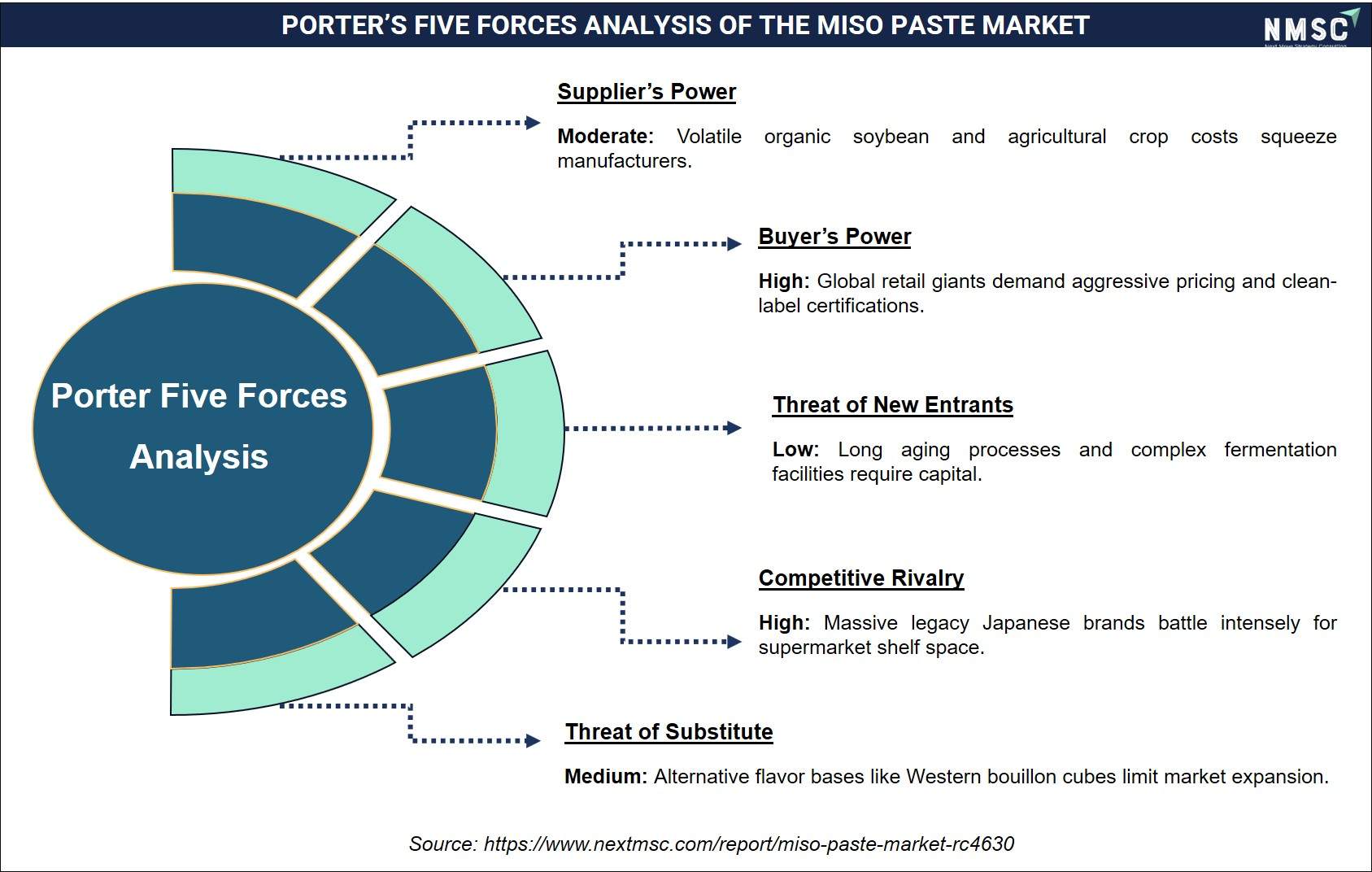
Porter’s Five Forces analysis indicates that the Miso Paste Market is characterized by moderate competitive rivalry, driven by the presence of established regional brands and growing international participants. Buyer power is increasing as consumers seek premium, organic, and clean-label products, while supplier influence remains moderate due to dependence on soybeans and other raw materials. The threat of substitutes from alternative seasonings and fermented food products is notable, whereas barriers related to traditional production expertise, brand reputation, and distribution networks moderate the threat of new entrants. Overall, the market remains competitive with opportunities for differentiation through innovation, quality, and authenticity.
Key Market Players in the Miso Paste Market
-
Marukome Co., Ltd.
-
Hikari Miso Co., Ltd.
-
Hanamaruki Foods Inc.
-
Miyasaka Jozo Co., Ltd.
-
Marusan-Ai Co., Ltd.
-
Yamagen Jozo Co., Ltd.
-
Saikyo-Miso Co., Ltd.
-
Hatcho Miso Kakukyu Co., Ltd.
-
Masuzuka Miso Co., Ltd.
-
Yamato Soysauce and Miso Co., Ltd.
-
Muso Co., Ltd.
-
Clearspring Ltd.
-
South River Miso Company
-
Miso Master, Inc.
-
Miyako Oriental Foods, Inc.
-
Eden Foods, Inc.
-
Adachi Jozo Co., Ltd.
-
Spiral Foods Pty Ltd
-
Carwari International Pty Ltd
-
Kanemitsu Miso Co., Ltd.
What Are the Latest Developments in the Miso Paste Market Industry?
|
Date |
Event |
|
May 2026
|
Hikari Miso Co., Ltd. Announced “CRAFT MISO NAMA-KOJI Precious”, a limited-edition annual release under its Craft Miso portfolio, targeting premium fermented miso consumers. |
|
March 2025 |
Adopted 100% recycled PET resin for both tubs and lids of selected organic miso products, strengthening sustainability initiatives and packaging innovation. |
What Are the Investment Opportunities in the Miso Paste Market?
Capital Inflows and Premium Category Development
The Miso Paste Market is attracting capital inflows concentrated in premium brand development, organic certification infrastructure, and specialty retail distribution expansion. Our findings suggest that investment in organic-certified miso production capacity, alternative legume miso product development, and artisanal brand building represents the highest-return-on-investment opportunity within the market's evolving commercial landscape. Private equity interest in natural food platform companies that include miso as part of a broader fermented and probiotic food portfolio is creating M&A activity in the Western specialty food segment, where brands such as Miso Master and Eden Foods represent established platform acquisition targets.
Infrastructure Investments in Distribution and Cold Chain
Sustainable market expansion in the Miso Paste Market across North America, Europe, and Southeast Asia requires continued investment in ambient temperature-tolerant packaging innovation, international cold chain logistics infrastructure, and specialty food distribution network development. Our assessment indicates that miso producers investing in modified atmosphere packaging, extended shelf-life fermentation stability, and e-commerce-compatible packaging formats are gaining structural distribution advantages. Investment in regional distribution hubs enabling faster replenishment cycles for online retail and specialty food channel partners is a critical infrastructure priority for producers seeking to expand beyond established Japanese domestic and diaspora market distribution networks.
ESG and Sustainability Considerations
Environmental, social, and governance considerations are increasingly relevant to investment decisions within the Miso Paste Market, as consumers and institutional buyers scrutinize the sustainability credentials of fermented food supply chains. Through our analysis, we observed that soybean sourcing practices, water consumption in fermentation facilities, packaging material recyclability, and carbon footprint reduction in international logistics represent the primary ESG dimensions of commercial relevance. Producers achieving recognized sustainability certifications, including RSPO soy sourcing standards, ISO 14001 environmental management certification, and B Corp designation, are gaining competitive advantages in premium retail and institutional foodservice procurement processes.
Digital Transformation and E-Commerce Growth
Digital transformation is creating significant investment opportunities in the Miso Paste Market through the development of direct-to-consumer e-commerce channels, subscription box inclusion, social commerce marketing, and digital recipe content strategies that drive consumer education and trial conversion. NMSC's analysis indicates that miso producers investing in compelling digital content ecosystems, including recipe video content, nutrition education, and Japanese culinary storytelling, are achieving disproportionate organic consumer acquisition and brand loyalty in international markets. Online retail platforms also enable producers to test and validate new product formats, fermentation profiles, and ingredient bases at lower commercial risk than traditional retail channel product launches.
Private Equity and Venture Capital Activity
The broader fermented and probiotic food sector is attracting growing PE and VC investment interest, creating halo effects that benefit premium miso paste brand investment activity. Our assessment indicates that investment theses centered on the functional food, gut health, and clean-label ingredient market tailwinds are increasingly incorporating specialty miso brands as compelling portfolio components with differentiated product positioning, loyal consumer bases, and sustainable competitive moats derived from fermentation expertise and heritage production credentials that are difficult to replicate at scale. Investors with Japanese food and beverage sector networks are particularly well-positioned to identify acquisition or growth equity opportunities among family-owned Japanese miso producers seeking international expansion capital.
Key Benefits for Stakeholders
This Miso Paste Market report delivers comprehensive, research-backed intelligence for a diverse range of industry stakeholders, enabling data-driven decision-making across investment, commercial strategy, regulatory compliance, and product development functions.
For Food Manufacturers and Ingredient Buyers
Food manufacturers, ingredient procurement teams, and foodservice operators gain comprehensive, vendor-neutral insights into the Miso Paste Market, including quantitative sizing across product types, packaging formats, distribution channels, and end-use applications. This intelligence supports sourcing strategies, supplier evaluation, product development planning, and long-term procurement decisions. Our competitive landscape analysis enables buyers to benchmark leading producers, assess supply chain reliability, and evaluate sourcing diversification opportunities with confidence and analytical rigor.
For Investors and Financial Analysts
Investors and financial analysts gain access to a structured, data-driven assessment of the Miso Paste Market’s growth outlook, competitive environment, consolidation activity, and segment-level revenue forecasts through 2035. CAGR analysis across product categories, regions, and distribution channels supports accurate valuation modeling and investment decision-making. Detailed profiles of the leading market participants, combined with tracking of capacity expansions, product launches, and strategic partnerships, provide valuable insights for identifying growth opportunities, emerging brands, and potential acquisition targets within the global miso industry.
For Miso Paste Manufacturers and Brands
Miso paste manufacturers, fermented food producers, and branded food companies gain actionable intelligence on market gaps, competitive positioning opportunities, and the fastest-growing demand segments within the Miso Paste Market. Product type analysis highlights high-growth categories such as organic, clean-label, and specialty miso variants. Regional outlook assessments identify attractive expansion opportunities based on consumer adoption trends, dietary preferences, and retail development. Distribution channel and end-use analysis help manufacturers refine go-to-market strategies, optimize product portfolios, strengthen retail partnerships, and expand penetration across foodservice and industrial food processing applications.
For Government Agencies and Industry Organizations
Government agencies, agricultural bodies, and food industry associations gain a structured understanding of how food safety regulations, labeling requirements, organic certification standards, and sustainable agriculture initiatives influence the Miso Paste Market’s development and competitive dynamics. Country-level insights provide policymakers with evidence-based perspectives on the role of fermented food products in supporting domestic food manufacturing, agricultural value chains, and export growth. Sustainability and ingredient sourcing analysis offer relevant guidance for promoting food security, supporting local producers, and encouraging innovation in traditional and functional food categories.
PESTEL Analysis of the Miso Paste Market
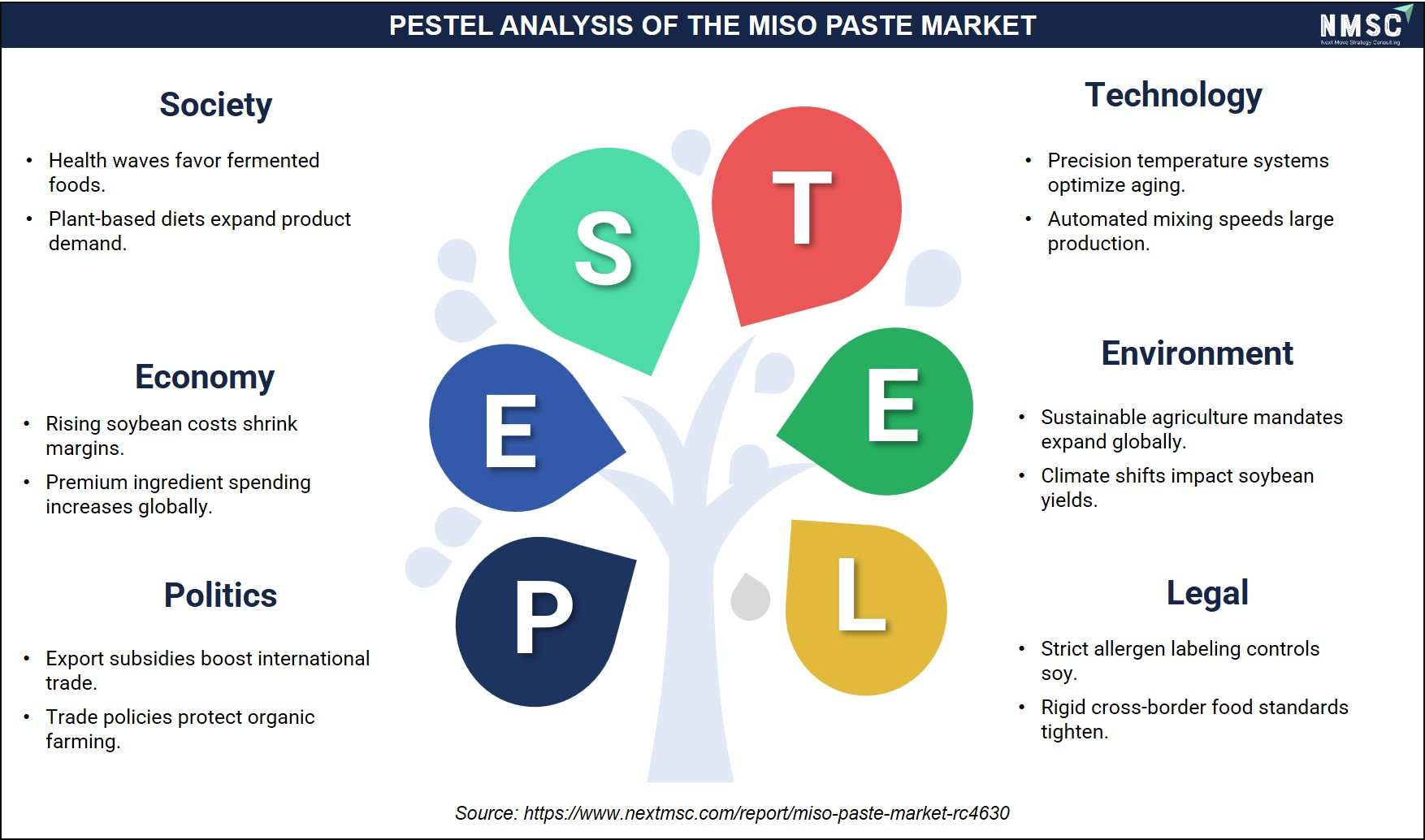
The Miso Paste Market is shaped by evolving consumer preferences for healthy and fermented foods, supportive food safety regulations, and increasing global acceptance of Japanese cuisine. Technological advancements in fermentation and packaging enhance product quality and shelf life, while sustainability initiatives influence sourcing and production practices. Economic growth, trade policies, and regulatory compliance continue to impact market expansion, creating opportunities for both traditional and innovative miso manufacturers worldwide
Key Market Segments
By Product Type
-
White Miso Paste
-
Red Miso Paste
-
Mixed Miso Paste
-
Specialty Miso Paste
By Packaging Format
-
Retail Packaged
-
Foodservice Pack
-
Industrial Bulk
By Customer Type
-
Household Consumers
-
Foodservice Operators
-
Food Manufacturers
By Distribution Channel
-
Modern Grocery
-
Specialty Retail
-
Convenience Retail
-
Online Retail
-
Foodservice Distribution
-
Industrial Distribution
By Fermentation Profile
-
Short Fermented
-
Medium Fermented
-
Long Fermented
-
Barrel Aged
By Ingredient Base
-
Soybean Based
-
Rice Koji Based
-
Barley Koji Based
-
Mixed Grain Based
-
Alternative Legume Based
By Product Positioning
-
Conventional
-
Organic
-
Non-GMO
-
Premium
-
Artisanal
-
Functional Wellness
By Region
-
North America: U.S., Canada, and Mexico.
-
Europe: UK, Germany, France, Italy, Spain, Sweden, Denmark, Finland, the Netherlands, and the rest of Europe.
-
Asia Pacific: China, India, Japan, South Korea, Taiwan, Indonesia, Vietnam, Australia, Philippines, Malaysia and the rest of APAC.
-
Middle East & Africa (MEA): Saudi Arabia, UAE, Egypt, Israel, Turkey, Nigeria, South Africa, and the rest of MEA.
-
Latin America: Brazil, Argentina, Chile, Colombia, and the rest of LATAM.
Conclusion and Recommendations
Long-Term Outlook
The Miso Paste Market is entering a decade of sustained, structurally supported growth driven by the convergence of global functional food demand, Japanese cuisine internationalization, and the premiumization of traditional fermented ingredients. The market is forecast to advance from USD 1.85 Billion in 2026 to USD 2.35 Billion by 2035 at a CAGR of 2.7%. NMSC's analysis indicates that this growth reflects both the secular expansion of international miso consumption and the structural evolution of the product portfolio from commodity seasoning toward premium, organic, and functional wellness-aligned categories commanding higher per-unit revenue and more durable consumer loyalty.
Strategic Positioning Recommendations
Japanese miso producers seeking international market expansion should prioritize organic certification, alternative ingredient base development, and e-commerce distribution partnerships with established natural food retail platforms in North America and Europe. Western specialty producers should invest in authentic fermentation heritage storytelling, science-backed wellness communication, and culinary content marketing that drives consumer education and trial conversion at scale. Both categories of producers should evaluate subscription box and meal kit service partnerships as high-frequency consumer trial channels that generate sustained repurchase behavior among international health-conscious food consumers.
Investment Attractiveness
The Miso Paste Market represents an attractive investment environment for patient capital strategies focused on premium and artisanal food brand acquisition and organic revenue growth. Our assessment identifies the highest-conviction investment themes as alternative legume miso (CAGR 6.1%), online retail distribution expansion (CAGR 5.8%), organic product positioning (CAGR 4.5%), barrel-aged fermentation profile (CAGR 4.6%), and North American regional growth (CAGR 4.1%). Investors with a five-to-ten year horizon should target premium miso brands with established natural food retail distribution, certified organic credentials, and direct-to-consumer digital channel capabilities as the optimal entry points within the Miso Paste Market.
Market Shifts and Key Risks
The most significant market shift underway is the migration of miso paste from the ethnic and specialty food category to the mainstream health and wellness condiment category in North American and European retail. This shift benefits producers with established organic certifications, clean-label credentials, and cross-cultural recipe marketing capabilities. Key risks in the Miso Paste Market include soybean supply chain volatility, regulatory labeling complexity in multiple export markets, consumer adoption plateaus in non-traditional markets without sustained education investment, and competitive pressure from alternative umami-rich fermented condiments including gochujang and doenjang competing for the same health-conscious consumer occasion.
Growth Pathways
Organizations seeking to maximize value from the Miso Paste Market should pursue a three-horizon strategy. In the near term from 2025 to 2027, prioritize organic and non-GMO certification of existing product ranges and online retail channel development to capture the fastest-growing consumer segments and distribution channels. In the mid-term from 2027 to 2031, invest in alternative legume miso product innovation, functional wellness claim substantiation, and foodservice distribution partnerships in North America and Europe to accelerate commercial-scale international market penetration. In the long term from 2031 to 2035, build artisanal and premium brand platforms that can command sustainable price premiums and distribution exclusivity in the most valuable natural and specialty food retail channels globally.
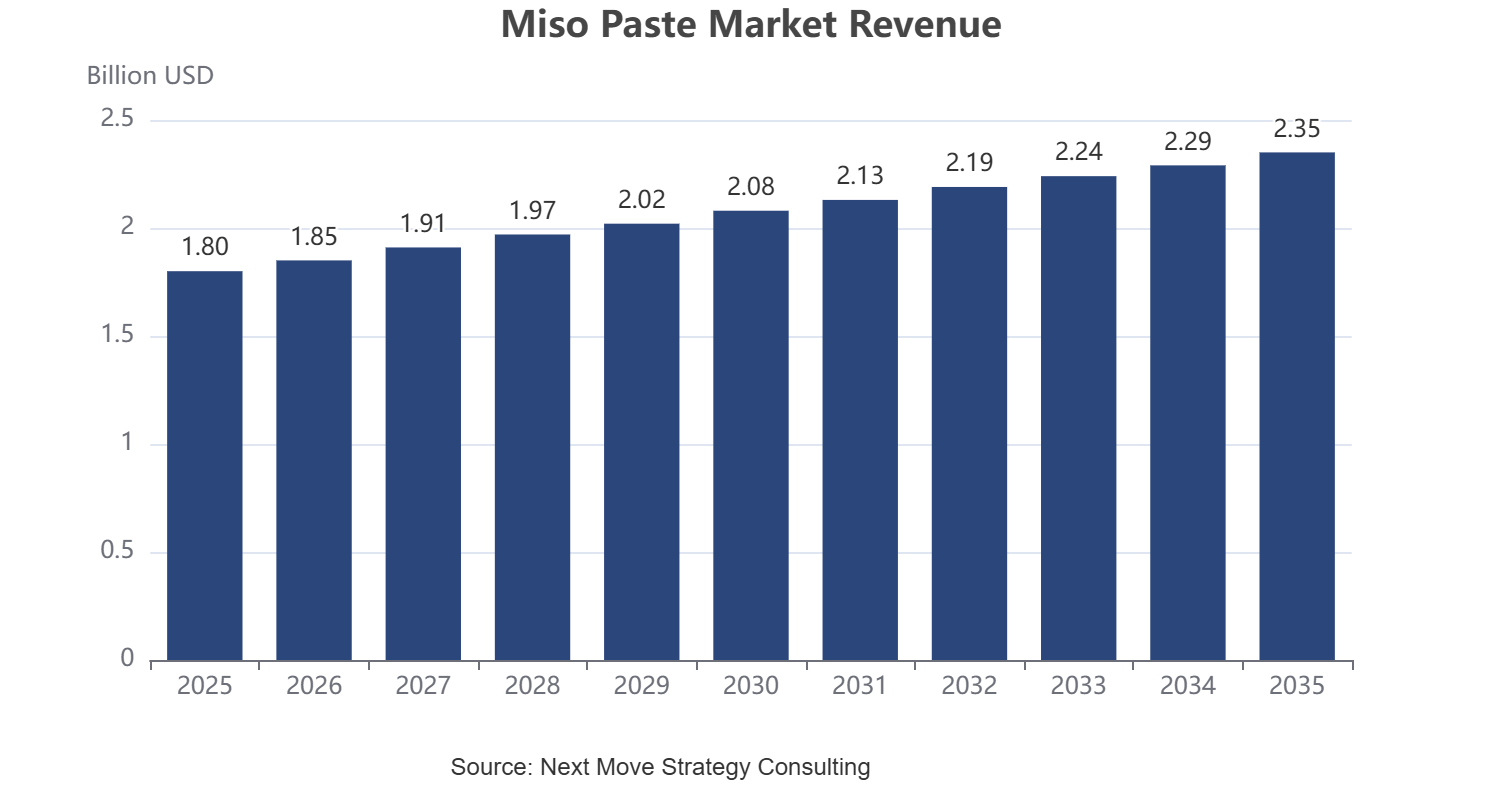
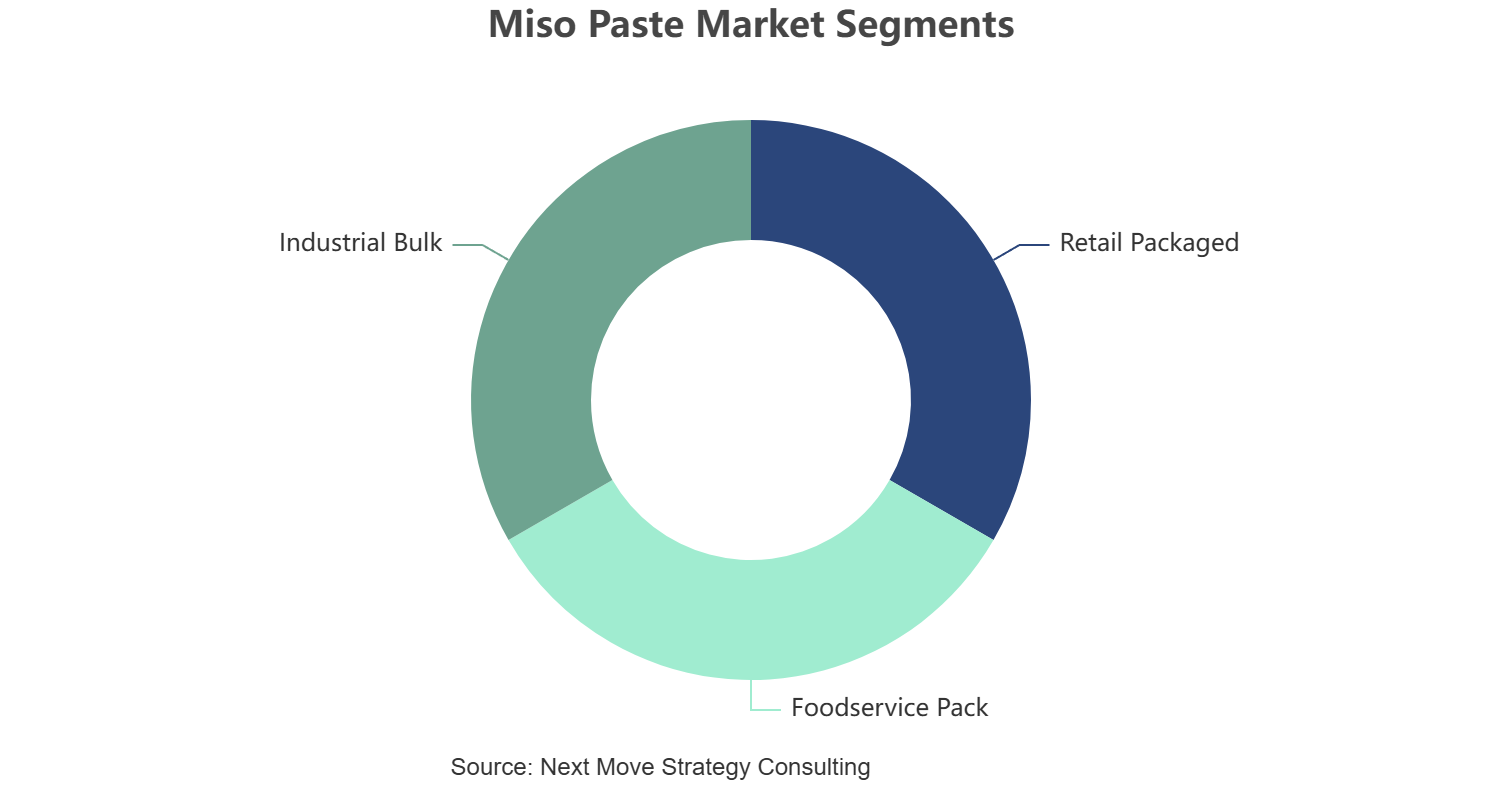
About the Author
 Tushmi Dutta
— Tushmi Dutta is a focused researcher specializing in detailed analysis and insight-driven research across diverse business landscapes. She supports strategic initiatives through structured data interpretation, thorough validation, and clear communication of findings that aid informed decision-making. With a strong interest in writing, she enjoys presenting research insights in an engaging and accessible manner. Beyond work, she enjoys traveling, reading, painting, and continuously learning new skills that contribute to her creative and professional growth.
Tushmi Dutta
— Tushmi Dutta is a focused researcher specializing in detailed analysis and insight-driven research across diverse business landscapes. She supports strategic initiatives through structured data interpretation, thorough validation, and clear communication of findings that aid informed decision-making. With a strong interest in writing, she enjoys presenting research insights in an engaging and accessible manner. Beyond work, she enjoys traveling, reading, painting, and continuously learning new skills that contribute to her creative and professional growth.
About the Reviewer
 Supradip Baul
— Supradip Baul is an accomplished business consultant and strategist with over a decade of rich experience in market intelligence, strategy, technology, and business transformation. His work has included rigorous qualitative and quantitative analysis across multiple industries, helping clients shape investment decisions and long-term roadmaps. Earlier in his career, he was associated with Gartner, where he contributed to industry-leading reports and market share analyses. He has worked with leading global companies and holds an MBA with a dual specialization in Marketing and Finance.
Supradip Baul
— Supradip Baul is an accomplished business consultant and strategist with over a decade of rich experience in market intelligence, strategy, technology, and business transformation. His work has included rigorous qualitative and quantitative analysis across multiple industries, helping clients shape investment decisions and long-term roadmaps. Earlier in his career, he was associated with Gartner, where he contributed to industry-leading reports and market share analyses. He has worked with leading global companies and holds an MBA with a dual specialization in Marketing and Finance.
At Next Move Strategy Consulting, we understand that insightful market research is the cornerstone of successful business decisions. That's why we employ a robust and multifaceted approach, combining various methodologies to deliver the most accurate and actionable data for our clients.

Research Landscape
We navigate the world of research with two primary approaches:
Qualitative Approach
Our qualitative research methodologies involve immersive techniques such as in-depth interviews, focus groups, and observational studies. By engaging directly with individuals and stakeholders, we uncover valuable insights that quantitative data alone may overlook.

Quantitative Research
In tandem with qualitative methodologies, NMSC leverages the power of Quantitative Research to provide a robust foundation of numerical insights. Through systematic data collection and analysis, we quantify patterns, preferences, and market trends, offering a comprehensive view of the business landscape.
Our quantitative research approach employs diverse tools, including surveys, experiments, and statistical modelling. These methodologies enable us to gather data from a large and representative sample, ensuring the statistical significance of our findings. By employing structured questionnaires and standardized data collection methods, we guarantee the reliability and validity of the information we present to our clients.
Quantitative research is particularly effective in measuring the prevalence of trends, assessing market size, and gauging the impact of various factors on consumer behavior. The numerical precision attained through this approach equips our clients with actionable insights, facilitating data-driven decision-making and strategy formulation.


Our Specialized Toolbox for Industry-Specific Market Research
We deploy a specialized arsenal of techniques tailored to meet your unique requirements. Here's a glimpse into our comprehensive toolbox:

Information Procurement
The stage entails acquiring market data or relevant information through various sources and methodologies.


Market Research Approach
We utilize both top-down and bottom-up approaches in market research analysis to achieve a comprehensive understanding of the market dynamics, leveraging the broad perspective of industry trends and macroeconomic factors alongside detailed insights from specific segments and individual companies.

Porters Five Forces Analysis
We conduct Porter's Five Forces analysis to evaluate the competitive landscape of an industry, providing us with insights into factors that affect profitability and strategic positioning.

SWOT Analysis

Forecasting
We utilize a forecasting model to predict future consumption by considering parameters like population, economics, regulations, market competition, drivers, constraints, technology, and pricing. We also employ statistical techniques such as multilinear regression, exponential smoothing, moving average, ARIMA, and Monte Carlo simulations for accurate predictions. In econometric forecasting, we analyzed short-term and long-term event impacts, attributing values based on regulatory frameworks, economic factors, and market events.





 Speak to Our Analyst