
Motion Energy Harvesting Market By Component (Energy Harvester Device, Power Management Circuit, Energy Storage, and Sensors), By Technology (Piezoelectric, Electromagnetic, Electrostatic, and Others), By Motion Source (Human, Vibrational, and Others), By Application (Wearables, Industrial, Consumer Electronics, and Others), By End-User (Healthcare, Manufacturing and Industrial, Automotive, Smart Homes and Buildings, and Others) – Global Analysis & Forecast, 2025–2030
Industry: Energy & Power | Publishing Date: June 17, 2026 | Last Updated: October 16, 2026 | No of Pages: N/A | No. of Tables: N/A | No. of Figures: N/A | Format: PDF | Report Code: EP3763
Industry Outlook
The global Motion Energy Harvesting Market size was valued at USD 600.1 million in 2024, and is expected to be valued at USD 674.9 million by the end of 2025. The industry is projected to grow, hitting USD 1216.3 million by 2030, with a CAGR of 12.5% between 2025 and 2030.
The motion energy-harvesting industry sits at a transitional point between research-driven prototypes and practical commercial deployments. Recent product demonstrations and component releases have shifted perceptions from experimental curiosities toward viable power sources for low-power electronics, especially where battery replacement is costly or impractical. Today, the technology is being integrated into compact modules and ICs that pair harvesters with power-management electronics, enabling self-powered sensors and augmenting battery life in wearables, asset tags, and remote monitoring nodes. This maturation is driving stronger collaboration between component makers, system integrators, and IoT platform vendors.
Applications and use cases are broadening beyond consumer wearables into industrial monitoring, smart buildings, transportation infrastructure, and security/defence systems, where maintenance-free or long-life sensing is valuable. Practically, motion harvesters are used to supply energy to condition-monitoring sensors, door and occupancy switches, asset trackers, and microcontroller wake-up circuits, often as part of hybrid systems that combine light, thermal, and vibrational sources. Looking ahead, advances in multi-source harvesters, smarter power-management algorithms, and tighter integration with edge AI expand adoption, unlocking new autonomous IoT deployments and reducing reliance on disposable batteries.
What Are the Key Trends in the Motion Energy Harvesting Industry?
How Is the Motion Energy-Harvesting Market Moving Toward Hybrid, Multi-Source Harvesters?
Researchers and designers are increasingly combining piezoelectric, triboelectric and electromagnetic mechanisms into hybrid harvesters to capture motion over broader frequency and amplitude, noting hybrid architectures as the fastest route to useful, real-world power levels for wearables and small sensors. This shift matters because single-mode harvesters typically perform well only at narrow resonance conditions; hybrid designs smooth that sensitivity and raise usable energy per event. Practically, companies are treating hybrid integration as a systems problem: co-design materials, mechanical architecture and the power-management IC so that intermittent kinetic pulses are buffered and converted into reliable micro-power for sensing and communications. Piloting hybrid modules with one or two target use cases, for example, smart shoes or industrial asset tags reveals where costs and durability need improvement before broader rollouts.
How Is Energy Harvesting Scaling from Gadgets into Infrastructure and Industrial IoT?
Motion harvesters are crossing the laboratory threshold into infrastructure pilots, bridges, railways, road studs, and industrial machinery, where ambient motion is abundant and battery maintenance is costly. Recent engineering studies document growing trials that capture bridge vibrations, axle-induced rail motion, and vehicle-traffic kinetic energy to power condition-monitoring sensors and off-grid beacons. Infrastructure offers larger, more consistent kinetic budgets than wearables but demands ruggedization, predictable lifetime, and demonstrable ROI.
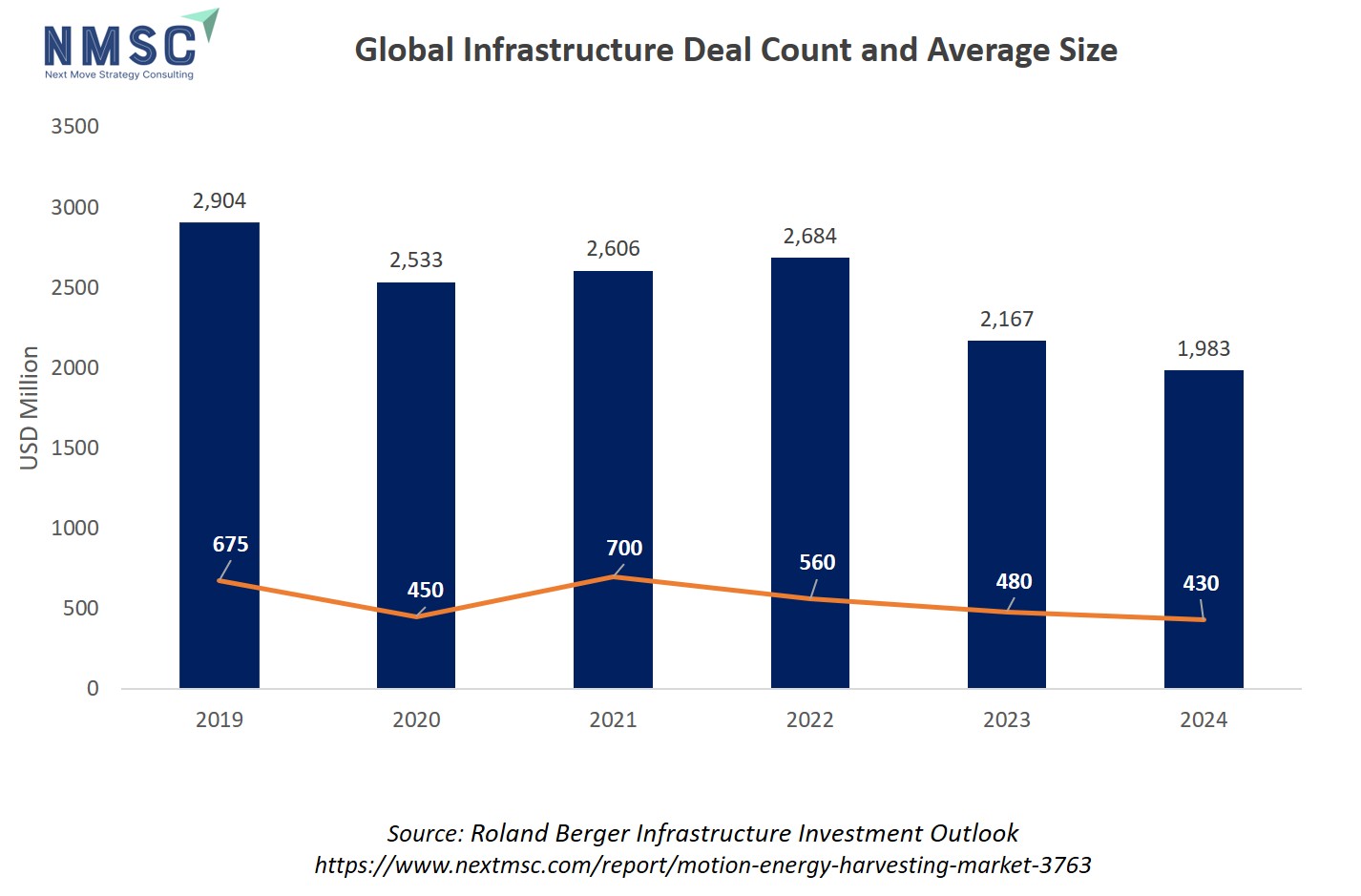
The above chart displays global infrastructure deal activity from 2019 to 2024, highlighting both the number of deals and their average size. Reduced deal activity and shrinking deal sizes indicate more cautious investment behavior and increased cost control in infrastructure markets, which encourages adoption of innovative, cost-effective technologies. As a result, infrastructure operators increasingly favor motion energy-harvesting solutions for powering distributed sensors and devices, seeking maintenance-free, self-sustaining systems that reduce operational expenses and enhance asset management efficiency, thus driving the motion energy-harvesting market growth of the motion energy-harvesting market.
How Will Smarter Power Management and Edge AI Accelerate Autonomous Sensor Adoption?
As the installed base of connected IoT devices grows, motion harvesters become more valuable when combined with ultra-low-loss power management and local intelligence that duty-cycle sensing and radios based on harvested energy availability. Recent technical reviews highlight advances in MPPT-style (maximum power point) algorithms, ultra-low quiescent regulators, and energy-aware firmware that together convert sporadic kinetic bursts into useful sensing cycles. With global IoT deployments expanding rapidly, conversion of harvested micro-joules into meaningful telemetry requires both firmware that adapts sampling/ML inference to energy budget and firmware/hardware co-validation. Companies are therefore prioritizing building or licensing energy-aware edge stacks and tools that simulate harvested energy profiles for target sites; doing so reduces field failures and shortens time to first customer-visible ROI.
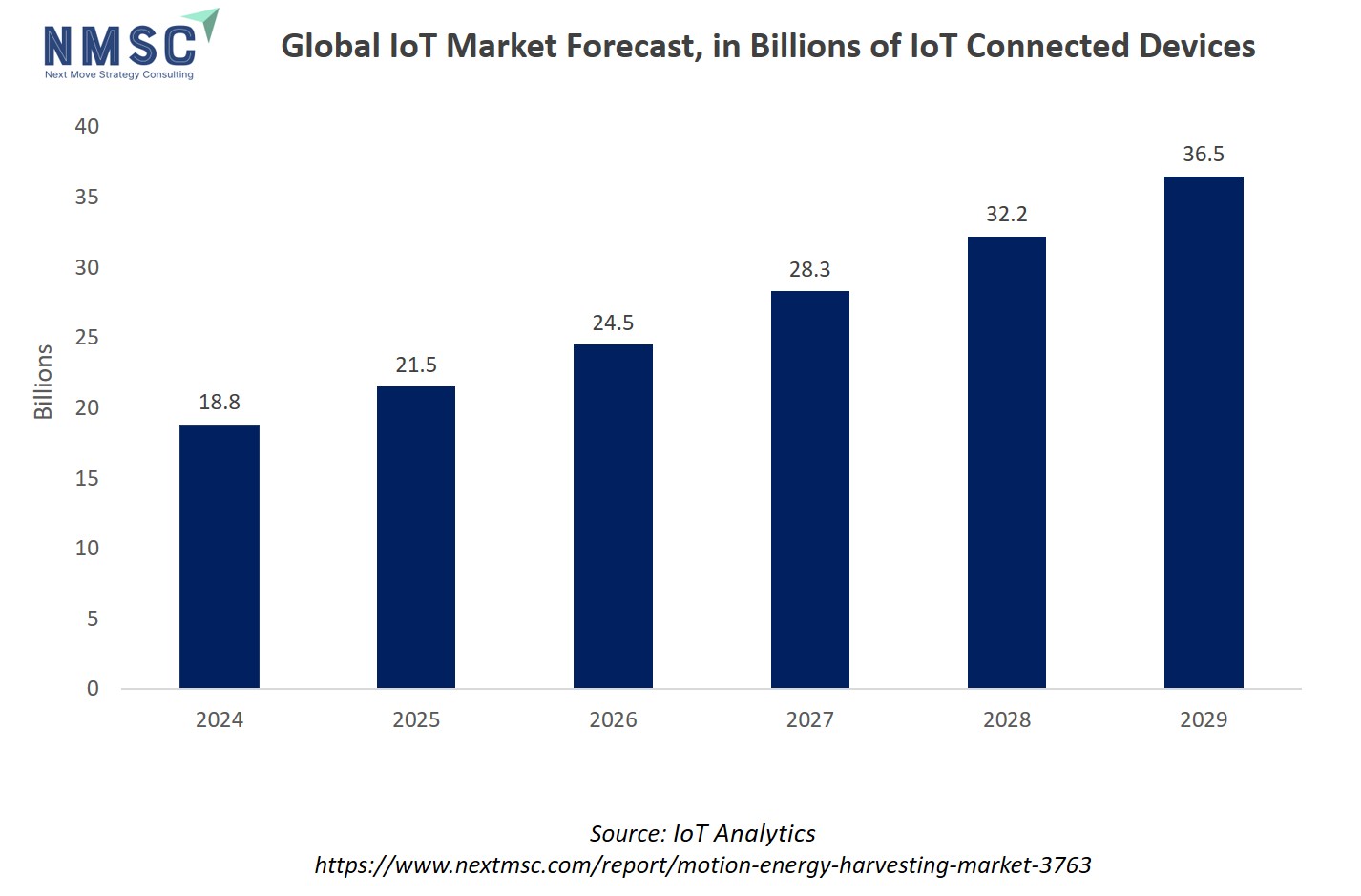
The chart illustrates the rapid growth of the global IoT market, with the number of connected IoT devices projected to nearly double from 18.8 billion in 2024 to 36.5 billion by 2029. This significant expansion directly impacts the motion energy-harvesting market by driving demand for sustainable, self-powered IoT devices, especially in remote or hard-to-access locations. As IoT devices proliferate, reliance on traditional batteries becomes less practical due to maintenance costs and environmental concerns. Kinetic energy harvesting, which captures ambient kinetic or vibrational energy, enables IoT devices to operate autonomously by converting motion into electrical power, thus lowering operational costs and increasing device longevity.
What Are the Key Market Drivers, Breakthroughs, And Investment Opportunities That Will Shape the Motion Energy Harvesting Industry in the Next Decade?
Motion energy harvesting is moving from lab prototypes into practical deployments as research and EU/US-funded projects push hybrid harvesters and integrated modules toward real-world use. Advances in piezoelectric and triboelectric materials, plus tighter mechanical-electrical co-design, are making harvesters more tolerant of variable motion and better suited to wearables, asset tags, and remote sensors.
Simultaneously, power-management ICs and reference designs from established semiconductor vendors are lowering integration risk, while infrastructure pilots (rail, bridges, road studs) show where predictable motion budgets can justify rugged, maintenance-saving sensors.
Growth Drivers:
How Are Hybrid, Multi-Mechanism Harvesters Improving Usable Power from Motion?
Hybrid designs that combine piezoelectric, triboelectric, and electromagnetic elements are increasingly reported, because they capture energy across broader frequency and amplitude ranges than single-mode devices. For example, recent academic reviews and EU projects highlight hybrid nanogenerators as a key route to raising real-world energy output for wearables and small sensors. That means product teams are stopping evaluating transducers in isolation and starting to test multi-mechanism modules with realistic motion profiles; piloting a hybrid harvester in a target use case, for example, footwear or industrial tag, that rapidly reveals conversion efficiency, durability, and BOM trade-offs to optimize.
How Is the Motion-Harvesting Market Scaling into Infrastructure and Industrial IoT?
It has been seen that vibration-based harvesters are viable for structural-health and condition-monitoring in bridges, railways, and heavy machinery, where motion is abundant and battery servicing is costly. Reviews of rail and bridge harvesting document that consistent, larger kinetic budgets in infrastructure produce much higher net energy than wearable sources, but they also demand rugged mounting and predictable lifetime validation. Companies are focusing on engineering for environmental sealing, repeatable mounting interfaces, and 1-to-2-year field reliability proofs that quantify maintenance savings; partnering with infrastructure owners early is also converting pilots into procurement opportunities.
Growth Inhibitors:
Why Does Inconsistent Energy Output Remain the Biggest Restraint for Motion Harvesters?
The primary constraint remains intermittent, low energy density, and the lack of clear standards for performance and procurement. While materials and architectures advance, many harvesters still produce only micro- to milli-joules per event and their output depends strongly on mounting and motion spectrum. This variability complicates procurement and ROI calculations for buyers. Standards work and system-level test protocols are emerging but not yet widespread, so vendors are investing in repeatable site profiling tools, standardized test reports, and energy-profile simulations to reduce buyer uncertainty; aligning with EU/standards initiatives also improves procurement acceptance.
How Can Integrated System Solutions Create the Next Big Investment Opportunity in Motion Energy Harvesting?
Investing in integrated system solutions, such as a harvester with ultra-low-loss power-management and energy-aware firmware, offers a high upside because semiconductor PMICs and reference designs are finally mature enough to make harvested energy practical for autonomous sensors. Leading PMICs and design ecosystems, for example, TI’s BQ25570, Analog Devices’ ADP5091 family, show how system vendors are delivering turn-key modules and developer kits that shorten time-to-pilot. Investors are also prioritizing companies that provide validated solution stacks (mechanical + electronics + firmware) and vertical pilots (infrastructure or medical wearables) because these reduce buyer risk and accelerate procurement.
How Is the Motion Energy Harvesting Market Segmented in This Report, and What Are the Key Insights from the Segmentation Analysis?
By Component Insights
Are Energy Harvester Devices Leading the Motion Energy Harvesting Market as Power Management Circuits, Energy Storage, and Sensors Grow?
Based component, the market is segmented into energy harvester devices, power management circuits, energy storage, and sensors.
Energy harvester devices are responsible for capturing ambient energy from sources such as motion, vibration, thermal gradients, or light. Technologies in this segment include piezoelectric, thermoelectric, and electromagnetic generators. These devices convert mechanical or thermal energy into electrical energy, making them suitable for applications in wearable electronics, industrial monitoring, and environmental sensing. The versatility and efficiency of these devices have led to their widespread adoption, driving the growth of the market. They currently dominate the motion energy harvesting market. This dominance is primarily due to the increasing demand for self-powered systems in applications such as wearable electronics, industrial monitoring, and environmental sensing.
Power management circuits, on the other hand, regulate and condition the harvested energy to ensure a stable and usable power output. These circuits include rectifiers, voltage regulators, and maximum power point tracking (MPPT) controllers. They are essential for handling the variability and intermittency of harvested energy, providing stable power to connected devices.
Energy storage systems store the harvested energy for later use, providing continuous power even when the energy source is not actively generating energy. The choice between batteries and supercapacitors depends on the application's specific needs. Batteries are suitable for applications requiring long-term energy storage, while supercapacitors are ideal for applications needing rapid charge/discharge cycles. Whereas, sensors are the primary beneficiaries of energy harvesting technologies, especially in remote or inaccessible locations where traditional power sources are impractical. By integrating energy harvesting components, sensors can operate autonomously, reducing maintenance costs and increasing deployment flexibility.
By Technology Insights
How Is the Motion Energy Harvesting Market Segmented by Technology?
Based on technology, the market is segmented into piezoelectric, electromagnetic, electrostatic, triboelectric nanogenerator, and hybrid systems.
Piezoelectric energy harvesting utilizes materials that generate an electrical charge in response to mechanical stress. This technology is particularly effective in capturing energy from vibrations and mechanical deformations, making it suitable for applications in wearable devices, structural health monitoring, and industrial machinery. Electromagnetic energy harvesting operates on Faraday's law of induction, where relative motion between a magnet and coil generates an electrical current. This technology is well-suited for applications involving high-frequency vibrations, such as in automotive systems, aerospace, and industrial equipment. The robustness and reliability of electromagnetic harvesters make them ideal for environments where durability is crucial. Piezoelectric and electromagnetic energy harvesting systems currently dominate the market due to their established performance and reliability in various applications. However, the growing demand for flexible, lightweight, and efficient energy harvesting solutions has led to increased interest in TENGs and hybrid systems.
Electrostatic energy harvesting leverages the triboelectric effect, where contact and separation between two materials generate an electric charge. This technology is advantageous in low-frequency applications and is often used in sensor networks and microelectromechanical systems (MEMS). The simplicity and low cost of electrostatic harvesters make them attractive for small-scale, low-power applications.
By Motion Source Insights
Which Motion Sources Are Driving the Growth of Energy Harvesting Today?
Based on motion source, the market is segmented into human motion harvesting, vibrational motion harvesting, rotational mechanical motion harvesting, and impact or pressure motion harvesting.
Human motion harvesting captures energy from activities such as walking, running, or limb movement. Piezoelectric and triboelectric systems are commonly used to convert mechanical energy from body motion into electrical energy. This segment is particularly important for wearable electronics, smart shoes, medical devices, and health monitoring sensors. Vibrational motion harvesting, however, exploits oscillatory or ambient vibrations in industrial machinery, bridges, and vehicles. Electromagnetic and piezoelectric harvesters are widely used for these applications. The U.S. Department of Energy highlights that industrial machinery and structural vibration monitoring are key use cases, enabling condition monitoring without frequent battery replacements. This segment dominates infrastructure and industrial IoT applications due to consistent energy availability from mechanical vibrations.
Rotational motion harvesting converts energy from rotating shafts, gears, and wheels into electrical power. Electromagnetic induction is the most common mechanism in this segment. Applications include automotive systems, turbines, and industrial equipment, where continuous rotational motion is abundant. Impact or pressure motion harvesting generates power from sudden mechanical shocks, such as footsteps, machinery impacts, or door movements. Piezoelectric and triboelectric materials are widely used for these short-duration, high-energy events. This segment finds applications in security systems, smart floors, and interactive surfaces.
By Output Power Range Insights
Which Output Power Ranges Are Shaping the Motion Energy Harvesting Market?
Based on Output Power Range, the market is segmented into Low Power (< 1 mW), Medium Power (1 mW to 100 mW), and High Power (> 100 mW).
Low-power harvesters generate less than 1 mW of energy and are mainly used for microelectronics, wearable sensors, and small IoT devices. Piezoelectric and triboelectric nanogenerators are commonly employed in this segment to capture ambient motion or vibrations. Medium-power harvesters, however, generating between 1 mW and 100 mW, are suitable for wireless sensor nodes, industrial monitoring systems, and wearable electronics with moderate energy demands. Electromagnetic and hybrid systems are often used to achieve this output range. It currently dominates the market because it offers the most practical balance between output and applicability across diverse IoT, wearable, and industrial sensor applications.
High-power harvesters, on the other hand, produce over 100 mW of energy, sufficient to power larger devices such as industrial actuators, lighting systems, or communication modules. Rotational and vibrational mechanical sources are typically employed for such applications.
By Application Insights
Which Applications Are Driving Growth in the Motion Energy Harvesting Market?
Based on application, the motion energy harvesting market segments are broken into wearables, industrial, building automation, transportation, consumer electronics, and IoT and smart systems.
Wearable devices such as smartwatches, fitness trackers, and medical monitoring devices increasingly use motion-powered energy systems to extend battery life or enable self-powered operation. Piezoelectric and triboelectric systems are commonly used to capture energy from body movements. In industrial environments, vibration and rotational motion from machinery are harvested to power condition monitoring and predictive maintenance sensors. Electromagnetic and hybrid harvesters are widely employed in this segment.
In transportation, motion energy harvesting captures vibrations, rotational energy, and impact forces from vehicles and traffic systems. Applications include powering tire pressure sensors, road studs, and onboard monitoring systems. Small electronic devices, such as remote controls, gaming controllers, and portable gadgets, can use motion energy harvesters to extend battery life or support energy-neutral operation. The U.S. Department of Energy emphasizes that consumer electronics benefit from compact, low-power harvesters, particularly in portable and mobile applications.
By End-User Insights
Which End-Users Are Driving Adoption of Motion Energy Harvesting Technologies?
The end-user segmentation includes healthcare, manufacturing and industrial, automotive, smart homes and buildings, consumer electronics, energy and utilities, and others.
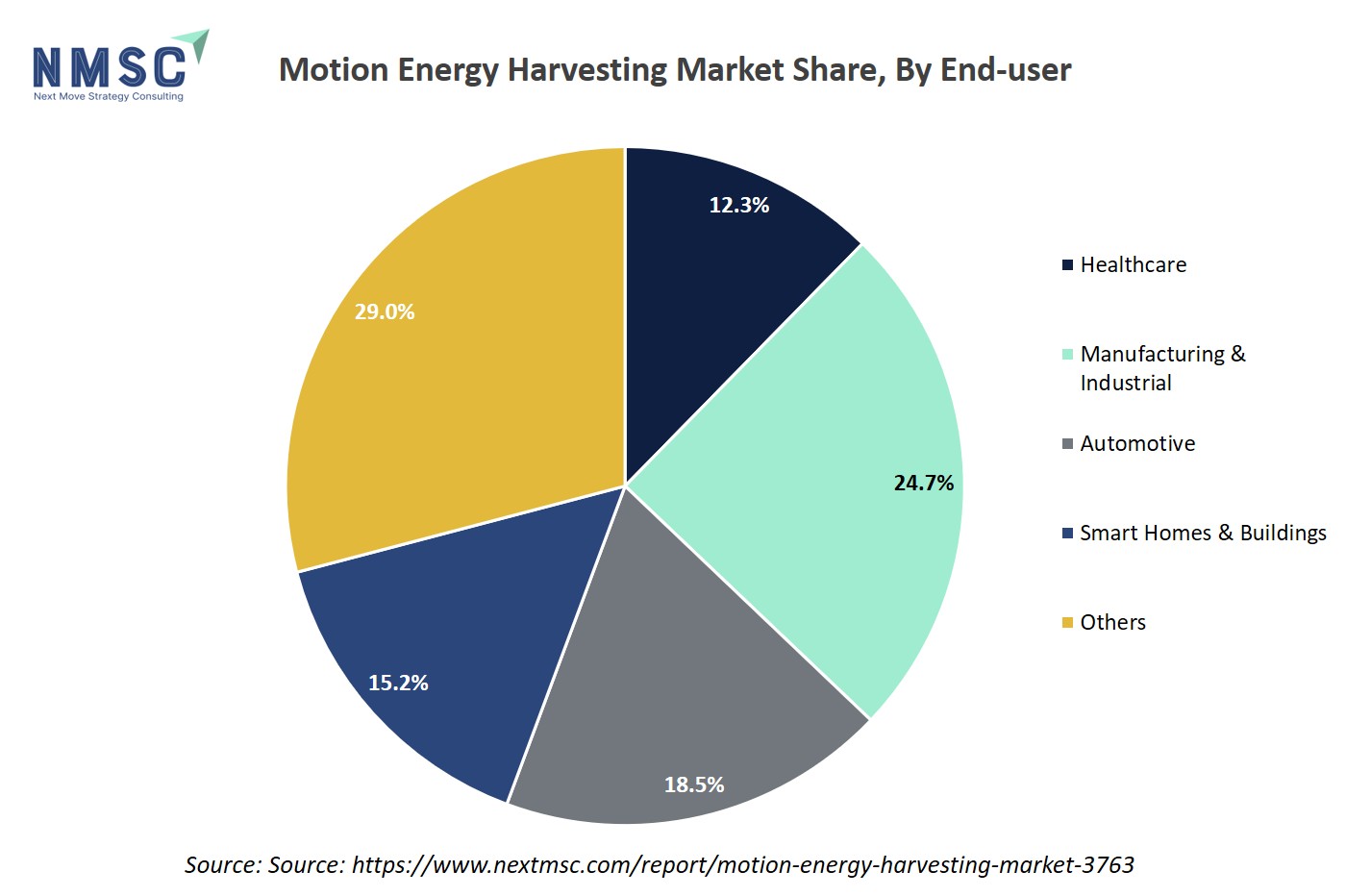
Healthcare applications utilize vibration energy harvesting in wearable health monitors, implantable devices, and portable diagnostic tools. Piezoelectric and triboelectric systems capture energy from body movements, reducing the need for frequent battery replacement. In manufacturing and industrial settings, energy harvesters power condition-monitoring sensors, predictive maintenance systems, and factory automation equipment. Vibrational and rotational motion sources are abundant in machinery, allowing electromagnetic and hybrid harvesters to generate reliable energy.
Smart homes and buildings integrate motion energy harvesters into occupancy sensors, lighting controls, and security systems. Low- to medium-power harvesters capture mechanical energy from doors, elevators, and structural vibrations. Energy and utility applications involve using motion energy harvesting to power distributed sensors for smart grids, pipeline monitoring, and renewable energy systems. These systems help reduce operational costs and enable autonomous monitoring in hard-to-reach locations.
Regional Outlook
The market is geographically studied across North America, Europe, the Middle East & Africa, and Asia Pacific, and each region is further studied across countries.
Government Initiatives Supporting Motion Energy Harvesting Market Growth:
|
Region/Country |
Initiative / Policy |
Focus Area |
|
India |
National Energy Policy |
Aims to increase locally produced energy and reduce energy poverty |
|
United States |
Energy Policy Act |
Addresses energy production, including energy efficiency, renewable energy |
|
European Union |
Climate and Energy Policies |
Focuses on combating climate change, promoting energy efficiency, and developing new and renewable forms of energy, which can encompass energy harvesting solutions |
Source: NITI Aayog, EPA, IPOL
Motion Energy Harvesting Market in North America
North America stands at the forefront of the motion energy harvesting market, driven by rapid technological advancements and a strong emphasis on sustainability. The integration of artificial intelligence into energy harvesting systems has significantly enhanced efficiency by optimizing power management and real-time energy capture strategies. Additionally, the region's commitment to smart infrastructure and green technologies has spurred investments in energy-efficient solutions across industrial, healthcare, and consumer electronics sectors. These developments underscore North America's leadership in adopting and advancing motion energy harvesting technologies.
Motion Energy Harvesting Market in the United States
The U.S’ growth is fueled by the country's robust industrial base, early adoption of smart technologies, and significant investments in sustainable energy solutions. The U.S. government's support for renewable energy initiatives and the increasing demand for autonomous, battery-free devices across various sectors further contribute to the motion energy harvesting market ‘s expansion.
Motion Energy Harvesting Market in Canada
Canada's motion energy harvesting market is experiencing steady growth, driven by a strong focus on environmental sustainability and technological innovation. The country's commitment to reducing greenhouse gas emissions and promoting clean energy solutions has led to increased adoption of energy-efficient technologies in sectors such as transportation, healthcare, and building automation. Government incentives and policies supporting renewable energy initiatives play a crucial role in accelerating the deployment of motion energy harvesting systems across the nation.
Motion Energy Harvesting Market in Europe
Europe is witnessing significant advancements in motion energy harvesting technologies, propelled by supportive policies and a strong emphasis on sustainability. The European Union's commitment to achieving carbon neutrality by 2050 has spurred investments in energy-efficient solutions across various sectors. Countries like Germany, France, and Italy are leading the way in integrating motion energy harvesting systems into industrial applications, building automation, and transportation infrastructure. The region's focus on renewable energy sources and smart technologies continues to drive the growth of the motion energy harvesting market.
Motion Energy Harvesting Market in the United Kingdom
The United Kingdom is actively exploring motion energy harvesting technologies to enhance energy efficiency and reduce reliance on traditional power sources. The government's commitment to achieving net-zero carbon emissions by 2050 has led to increased investments in sustainable energy solutions. Research institutions and startups in the UK are developing innovative energy harvesting systems, particularly for applications in transportation, healthcare, and consumer electronics, contributing to the market's growth.
Motion Energy Harvesting Market in Germany
Germany's motion energy harvesting market is expanding rapidly, driven by the country's strong industrial base and commitment to renewable energy. The integration of AI and machine learning into energy harvesting systems has optimized power management and energy capture strategies. German manufacturers are adopting motion energy harvesting technologies in sectors such as automotive, manufacturing, and building automation, aligning with the nation's Industry 4.0 initiatives and sustainability goals.
Motion Energy Harvesting Market in France
France is embracing motion energy harvesting technologies as part of its broader strategy to promote energy efficiency and sustainability. The government's support for renewable energy projects and smart infrastructure development has facilitated the adoption of energy harvesting systems in sectors like transportation, healthcare, and consumer electronics. Collaborative efforts between public and private sectors are driving innovation and accelerating the deployment of motion energy harvesting solutions across the country.
Motion Energy Harvesting Market in Spain
Spain is actively investing in motion energy harvesting technologies to enhance energy efficiency and reduce environmental impact. The country's commitment to achieving renewable energy targets and promoting sustainable infrastructure has led to increased adoption of energy harvesting systems in sectors such as transportation, healthcare, and smart cities. Collaborative initiatives between research institutions and industry stakeholders are driving advancements in motion energy harvesting solutions.
Motion Energy Harvesting Market in Italy
Italy's motion energy harvesting market is growing, fueled by the country's focus on renewable energy and energy efficiency. The integration of motion energy harvesting systems into building automation and industrial applications is gaining traction, supported by government incentives and policies promoting sustainable technologies. Italian manufacturers are exploring innovative solutions to harness ambient energy sources, contributing to the market's expansion.
Motion Energy Harvesting Market in Asia-Pacific
The Asia-Pacific region is experiencing rapid growth in the motion energy harvesting market, fueled by industrialization, urbanization, and increasing energy demands. Countries like China, Japan, and India are investing heavily in renewable energy and smart technologies, driving the adoption of energy harvesting systems across sectors such as manufacturing, transportation, and building automation. The region's focus on sustainable development and technological innovation is accelerating the deployment of motion energy harvesting solutions.
Motion Energy Harvesting Market in China
China's motion energy harvesting market is expanding rapidly, driven by the country's industrial growth and commitment to renewable energy. The integration of AI and machine learning into energy harvesting systems has optimized power management and energy capture strategies. Chinese manufacturers are adopting motion energy harvesting technologies in sectors such as automotive, manufacturing, and building automation, aligning with the nation's sustainability goals and smart city initiatives.
Motion Energy Harvesting Market in Japan
Japan is actively exploring motion energy harvesting technologies to enhance energy efficiency and reduce reliance on traditional power sources. The government's support for renewable energy projects and smart infrastructure development has facilitated the adoption of energy harvesting systems in sectors like transportation, healthcare, and consumer electronics. Collaborative efforts between public and private sectors are driving innovation and accelerating the deployment of motion energy harvesting solutions across the country.
Motion Energy Harvesting Market in India
India's motion energy harvesting market is witnessing significant growth, driven by the country's focus on renewable energy and energy efficiency. The integration of motion energy harvesting systems into building automation and industrial applications is gaining traction, supported by government incentives and policies promoting sustainable technologies. Indian manufacturers are exploring innovative solutions to harness ambient energy sources, contributing to the market's expansion.
Motion Energy Harvesting Market in South Korea
South Korea is embracing motion energy harvesting technologies as part of its broader strategy to promote energy efficiency and sustainability. The government's support for renewable energy projects and smart infrastructure development has facilitated the adoption of energy harvesting systems in sectors like transportation, healthcare, and consumer electronics. Collaborative efforts between research institutions and industry stakeholders are driving advancements in motion energy harvesting solutions.
Motion Energy Harvesting Market in Taiwan
Taiwan's motion energy harvesting market is growing, fueled by the country's emphasis on technological innovation and renewable energy. The integration of motion energy harvesting systems into industrial applications and smart infrastructure is gaining momentum, supported by government policies promoting sustainable technologies. Taiwanese manufacturers are developing advanced energy harvesting solutions to meet the increasing demand for energy-efficient devices.
Motion Energy Harvesting Market in Australia
Australia's motion energy harvesting market is expanding, driven by the country's commitment to renewable energy and energy efficiency. The integration of motion energy harvesting systems into building automation and industrial applications is gaining momentum, supported by government policies promoting sustainable technologies. Australian manufacturers are exploring innovative solutions to harness ambient energy sources, contributing to the market's growth.
Motion Energy Harvesting Market in Latin America
Latin America is experiencing steady growth in the motion energy harvesting market, fueled by increasing demand for sustainable energy solutions and the adoption of smart technologies. Countries like Brazil, Mexico, and Argentina are investing in renewable energy projects and smart infrastructure, driving the deployment of energy harvesting systems across various sectors. The region's focus on environmental sustainability and technological innovation is accelerating the adoption of motion energy harvesting technologies.
Motion Energy Harvesting Market in the Middle East & Africa
The Middle East and Africa region is witnessing a growing interest in motion energy harvesting technologies, driven by the need for sustainable energy solutions and the adoption of smart technologies. Countries like Saudi Arabia, the United Arab Emirates, and South Africa are investing in renewable energy projects and smart infrastructure, facilitating the deployment of energy harvesting systems across sectors such as transportation, healthcare, and building automation. The region's commitment to innovation and sustainability continues to propel the growth of the motion energy harvesting market.
Competitive Landscape
What Are the Top Companies in the Motion Energy Harvesting Market and How Are They Competing Against One Another?
The motion energy harvesting market is characterized by the presence of several key players who are actively competing to capture market share through technological advancements and strategic initiatives. Leading companies include STMicroelectronics, Microchip Technology Inc., Texas Instruments, Analog Devices, and Infineon Technologies. These industry giants leverage their extensive product portfolios, global presence, and strong research and development capabilities to stay ahead in the competitive landscape. They continually strive to enhance their market positions through strategic partnerships, mergers and acquisitions, and product innovations. For instance, STMicroelectronics has been instrumental in advancing IoT and Micro-Electro-Mechanical Systems (MEMS) sensors, focusing on energy-efficient semiconductor solutions.
Market Dominated by Major Players and Specialists
The motion energy harvesting market is dominated by a combination of established giants and specialized innovators. Companies like STMicroelectronics, Texas Instruments, and Analog Devices lead the market with their comprehensive product offerings and technological expertise. These giants focus on integrating energy harvesting solutions into various applications, including industrial automation, consumer electronics, and building automation. On the other hand, specialized companies such as EnOcean GmbH and Powercast Corporation focus on niche applications, offering tailored solutions that address specific energy harvesting needs. This dual approach ensures a balanced market where both broad and specialized solutions coexist, catering to diverse customer requirements.
Innovation and Adaptability Drive Market Success
Innovation and adaptability are crucial drivers of success in the motion energy harvesting market. Leading companies are investing heavily in research and development to create advanced energy harvesting technologies that can efficiently capture and convert ambient energy sources. For example, companies are exploring the integration of piezoelectric, thermoelectric, and photovoltaic technologies to develop versatile energy harvesting solutions. Additionally, the adaptability of these technologies to various applications, such as wireless sensor networks and autonomous devices, enhances their market appeal. By continuously innovating and adapting to emerging trends, companies can maintain a competitive edge and meet the evolving energy needs of their customers.
Market Players to Opt for Merger & Acquisition Strategies to Expand their Presence
Merger and acquisition strategies are increasingly being adopted by market players to expand their presence and enhance their technological capabilities in the motion energy harvesting market. For instance, in January 2024, EnOcean was a strategic partner at the Smart Buildings and Sustainability Leaders Forum 2024, held in Birmingham, UK, where it joined forces with industry leaders to promote sustainable smart building technologies to expand its energy harvesting solutions. Similarly, in February 2024, e-peas SA acquired a small IoT energy harvesting startup to enhance its self-powered sensor technology. These strategic moves enable companies to access new markets, integrate complementary technologies, and strengthen their competitive positions in the rapidly evolving energy harvesting landscape.
List of Key Motion Energy Harvesting Companies
-
Texas Instruments
-
Infineon Technologies
-
Murata Manufacturing
-
Analog Devices
-
Microchip Technology
-
Powercast Corporation
-
EnOcean GmbH
-
Kinergizer
-
Mide Technology Corp.
-
Pavegen
-
Renesas Electronics
-
ONiO AS
-
e-peas
What are the Latest Key Industry Developments?
-
September 2025 – Pavegen, a London-based company specializing in energy-generating floor tiles, secured an additional USD 1.6 million in funding, bringing its total to over USD 11.3 million. The company plans to expand its operations in the Middle East and Asia, with recent projects including installations in Riyadh's Sports Boulevard, demonstrating the scalability and global interest in kinetic energy harvesting solutions.
-
October 2024 - At the Industrial Transformation Asia Pacific 2024 event in Singapore, STMicroelectronics exhibited a wide range of solutions enabling industrial automation and IoT segments. Their participation highlighted the company's commitment to advancing energy harvesting technologies for smart infrastructure and sustainable industrial applications.
-
June 2024 – TDK showcased its advanced sensor solutions at Sensors Converge 2024 in Santa Clara, California. The company highlighted innovations in MEMS, automotive, and industrial sensor technologies, underscoring its role in the development of energy harvesting systems for various applications.
-
June 2024 – At PCIM 2024 in Germany, Texas Instruments unveiled what it claims to be the industry's first 650 V three-phase GaN intelligent power module (IPM) designed for 250 W motor drive applications. This innovation addresses challenges engineers face when developing high-voltage motors for major home appliances and HVAC systems, enhancing energy efficiency and compactness.
-
April 2024 - Infineon Technologies introduced NFC energy-harvesting technology aimed at achieving battery-free applications. The company showcased development kits and live demonstrations, emphasizing the optimization of energy harvesting to support sustainable and efficient IoT solutions.
What Are the Key Factors Influencing Investment Analysis & Opportunities In Motion Energy Harvesting Market?
The motion energy harvesting market is witnessing robust investment momentum, propelled by technological advancements and a growing emphasis on sustainable, energy-efficient solutions. This expansion is driven by the rapid proliferation of IoT devices, innovations in low-power electronics, and the increasing demand for autonomous, battery-free systems across applications such as smart buildings, industrial automation, wearable devices, and consumer electronics. Investors are closely monitoring regions with strong technology adoption and supportive regulatory frameworks.
Investment opportunities are particularly attractive in North America and Europe, where established infrastructure and advanced technological ecosystems provide stable growth environments. Meanwhile, Asia-Pacific and Latin America are emerging hotspots, fueled by industrialization, smart city initiatives, and growing awareness of energy-efficient solutions. Funding trends are increasingly focused on next-generation sensors, hybrid energy harvesters, and scalable deployment models, offering both startups and established players avenues to innovate, expand their footprint, and capture new market segments. These dynamics position the motion energy harvesting market as a compelling space for strategic, long-term investments.
Key Benefits for Stakeholders:
Next Move Strategy Consulting (NMSC) presents a comprehensive analysis of the global motion energy harvesting market, covering historical trends from 2020 through 2024 and offering detailed forecasts through 2030. Our study examines the market at global, regional, and country levels, providing quantitative projections and insights into key growth drivers, challenges, and investment opportunities across all major motion energy harvesting segments.
The motion energy harvesting industry delivers significant benefits to a diverse range of stakeholders, including investors, customers, and technology developers. Investors gain from the sector’s strong growth potential, driven by increasing demand for energy-efficient, battery-free systems across industrial, consumer, and smart infrastructure applications, which offers attractive returns and opportunities for portfolio diversification. Customers, including enterprises and end-users, benefit from reduced operational costs, enhanced device autonomy, and sustainable energy solutions that minimize reliance on conventional power sources. Additionally, technology providers and startups can leverage the growing market to innovate, collaborate, and scale solutions, creating a synergistic ecosystem where stakeholders share in both financial gains and technological advancement.
Report Scope
|
Parameters |
Details |
|
Market Size in 2025 |
USD 674.9 Million |
|
Revenue Forecast in 2030 |
USD 1216.3 Million |
|
Growth Rate |
CAGR of 12.5% from 2025 to 2030 |
|
Analysis Period |
2024–2030 |
|
Base Year Considered |
2024 |
|
Forecast Period |
2025–2030 |
|
Market Size Estimation |
Million (USD) |
|
Growth Factors |
|
|
Countries Covered |
28 |
|
Companies Profiled |
15 |
|
Market Share |
Available for 10 companies |
|
Customization Scope |
Free customization (equivalent up to 80 analyst-working hours) after purchase. Addition or alteration to country, regional & segment scope. |
|
Pricing and Purchase Options |
Avail customized purchase options to meet your exact research needs. |
|
Approach |
In-depth primary and secondary research; proprietary databases; rigorous quality control and validation measures. |
|
Analytical Tools |
Porter's Five Forces, SWOT, value chain, and Harvey ball analysis to assess competitive intensity, stakeholder roles, and relative impact of key factors. |
Key Market Segments
By Component
-
Energy Harvester Device
-
Power Management Circuit
-
Energy Storage (Battery or Supercapacitor)
-
Sensors (Integrated with Energy Harvesters)
By Technology
-
Piezoelectric
-
Electromagnetic
-
Electrostatic
-
Triboelectric Nanogenerator
-
Hybrid Systems
By Motion Source
-
Human Motion Harvesting
-
Vibrational Motion Harvesting
-
Rotational Mechanical Motion Harvesting
-
Impact or Pressure Motion Harvesting
By Output Power Range
-
Low Power (< 1 mW)
-
Medium Power (1 mW to 100 mW)
-
High Power (> 100 mW)
By Application
-
Wearables
-
Industrial
-
Building Automation
-
Transportation
-
Consumer Electronics
-
IoT and Smart Systems
By End-User
-
Healthcare
-
Manufacturing and Industrial
-
Automotive
-
Smart Homes and Buildings
-
Consumer Electronics
-
Energy and Utilities
-
Others
Geographical Breakdown
-
North America: U.S., Canada, and Mexico.
-
Europe: U.K., Germany, France, Italy, Spain, Sweden, Denmark, Finland, Netherlands, and rest of Europe.
-
Asia Pacific: China, India, Japan, South Korea, Taiwan, Indonesia, Vietnam, Australia, Philippines, and rest of APAC.
-
Middle East & Africa (MENA): Saudi Arabia, UAE, Egypt, Israel, Turkey, Nigeria, South Africa, and rest of MENA.
-
Latin America: Brazil, Argentina, Chile, Colombia, and rest of LATAM.
Conclusion & Recommendations
Our report equips stakeholders, recyclers, manufacturers, policymakers, investors, and sustainability consultants with actionable intelligence to harness the growing potential of the global motion energy harvesting market. By combining credible government-backed data, regional insights, and strategic analysis across key growth drivers, from closed-loop production and energy savings to policy innovation and cross-sector collaboration, NMSC’s Motion Energy Harvesting Market Report serves as an indispensable resource for navigating the evolving circular economy landscape and accelerating sustainable motion energy harvesting recovery efforts worldwide.
The motion energy harvesting market is poised for sustained growth, underpinned by technological innovation, rising demand for energy-efficient solutions, and expanding applications across IoT, industrial automation, wearables, and smart infrastructure. Strategic takeaways highlight the importance of innovation, regional diversification, and collaboration between startups and established players to capture emerging opportunities. Investors and companies that focus on next-generation energy harvesters, hybrid technologies, and scalable deployment models are well-positioned to lead the market. Looking ahead, the continued integration of AI, advanced materials, and low-power electronics will further accelerate adoption, making motion energy harvesting a critical component of sustainable and autonomous energy solutions worldwide.


About the Author
 Mayurima Roy
— Mayurima Roy is Research Analyst at Next Move Strategy Consulting, where she has spent 4 years working across the firm's full industry coverage rather than a single fixed vertical. Her work centers on structured research, ongoing trend tracking, competitive assessment, and insight-led content development, translating complex market data into clear, decision-ready narratives that support informed client decision-making across diverse global industries, market sectors, and world regions every day.
Mayurima Roy
— Mayurima Roy is Research Analyst at Next Move Strategy Consulting, where she has spent 4 years working across the firm's full industry coverage rather than a single fixed vertical. Her work centers on structured research, ongoing trend tracking, competitive assessment, and insight-led content development, translating complex market data into clear, decision-ready narratives that support informed client decision-making across diverse global industries, market sectors, and world regions every day.
About the Reviewer
 Supradip Baul
— Supradip Baul is an accomplished business consultant and strategist with over a decade of rich experience in market intelligence, strategy, technology, and business transformation. His work has included rigorous qualitative and quantitative analysis across multiple industries, helping clients shape investment decisions and long-term roadmaps. Earlier in his career, he was associated with Gartner, where he contributed to industry-leading reports and market share analyses. He has worked with leading global companies and holds an MBA with a dual specialization in Marketing and Finance.
Supradip Baul
— Supradip Baul is an accomplished business consultant and strategist with over a decade of rich experience in market intelligence, strategy, technology, and business transformation. His work has included rigorous qualitative and quantitative analysis across multiple industries, helping clients shape investment decisions and long-term roadmaps. Earlier in his career, he was associated with Gartner, where he contributed to industry-leading reports and market share analyses. He has worked with leading global companies and holds an MBA with a dual specialization in Marketing and Finance.
At Next Move Strategy Consulting, we understand that insightful market research is the cornerstone of successful business decisions. That's why we employ a robust and multifaceted approach, combining various methodologies to deliver the most accurate and actionable data for our clients.

Research Landscape
We navigate the world of research with two primary approaches:
Qualitative Approach
Our qualitative research methodologies involve immersive techniques such as in-depth interviews, focus groups, and observational studies. By engaging directly with individuals and stakeholders, we uncover valuable insights that quantitative data alone may overlook.

Quantitative Research
In tandem with qualitative methodologies, NMSC leverages the power of Quantitative Research to provide a robust foundation of numerical insights. Through systematic data collection and analysis, we quantify patterns, preferences, and market trends, offering a comprehensive view of the business landscape.
Our quantitative research approach employs diverse tools, including surveys, experiments, and statistical modelling. These methodologies enable us to gather data from a large and representative sample, ensuring the statistical significance of our findings. By employing structured questionnaires and standardized data collection methods, we guarantee the reliability and validity of the information we present to our clients.
Quantitative research is particularly effective in measuring the prevalence of trends, assessing market size, and gauging the impact of various factors on consumer behavior. The numerical precision attained through this approach equips our clients with actionable insights, facilitating data-driven decision-making and strategy formulation.


Our Specialized Toolbox for Industry-Specific Market Research
We deploy a specialized arsenal of techniques tailored to meet your unique requirements. Here's a glimpse into our comprehensive toolbox:

Information Procurement
The stage entails acquiring market data or relevant information through various sources and methodologies.


Market Research Approach
We utilize both top-down and bottom-up approaches in market research analysis to achieve a comprehensive understanding of the market dynamics, leveraging the broad perspective of industry trends and macroeconomic factors alongside detailed insights from specific segments and individual companies.

Porters Five Forces Analysis
We conduct Porter's Five Forces analysis to evaluate the competitive landscape of an industry, providing us with insights into factors that affect profitability and strategic positioning.

SWOT Analysis

Forecasting
We utilize a forecasting model to predict future consumption by considering parameters like population, economics, regulations, market competition, drivers, constraints, technology, and pricing. We also employ statistical techniques such as multilinear regression, exponential smoothing, moving average, ARIMA, and Monte Carlo simulations for accurate predictions. In econometric forecasting, we analyzed short-term and long-term event impacts, attributing values based on regulatory frameworks, economic factors, and market events.





 Speak to Our Analyst