Mulch Film Market Global Industry Analysis and Forecast (2026-2035)

Mulch Film Market size was USD 4.98 billion in 2026, projected to reach USD 9.15 billion by 2035, growing at a CAGR of 7.0% from 2026 to 2035. Key drivers include rising global food security demand, intensifying water scarcity, expanding agricultural modernization programs, and growing adoption of biodegradable film formulations, with Asia-Pacific leading the market.

Download Free Sample PDF
Base Year (2025)
$4.65 Billion
Forecast (2035)
$9.15 Billion
CAGR (2026-2035)
7.0%
Top Region
Asia-Pacific

What Is the Mulch Film Market Size?

The global mulch film industry size was valued at USD 4.65 billion in 2025 and is estimated at USD 4.98 billion in 2026, forecast to reach USD 9.15 billion by 2035, expanding at a 7.0% CAGR between 2026 and 2035. Asia-Pacific leads with approximately 68% share, while LDPE Film dominates all other material types with approximately 34% share.

We observed that growth is broad-based across every segmentation axis, with biodegradable film substitution and water-scarcity-driven adoption in row crop farming shaping the dominant structural shifts through 2035.

Mulch Film Market Global Industry Analysis and Forecast (2026-2035) Revenue Forecast

Values in USD Billion

2025 $4.65 Billion
2025
2026 $4.98 Billion
2026
2027 $5.33 Billion
2027
2028 $5.70 Billion
2028
2029 $6.10 Billion
2029
2030 $6.53 Billion
2030
2031 $6.98 Billion
2031
2032 $7.47 Billion
2032
2033 $8.00 Billion
2033
2034 $8.56 Billion
2034
2035 $9.15 Billion
2035

Key Takeaways

By Material Type: LDPE Film held the largest share of approximately 34% (USD 1.57 billion) in 2025; Paper-Based Film is the fastest-growing sub-segment at 19.0% CAGR from 2026–2035.

By Crop Type: Fruits and Vegetables held the largest share of approximately 42% (USD 1.96 billion) in 2025; Ornamentals and Turf is the fastest-growing sub-segment at 9.8% CAGR from 2026–2035.

By Thickness: Up to 25 Microns held the largest share of approximately 55% (USD 2.56 billion) in 2025; Above 50 Microns is the fastest-growing sub-segment at 11.9% CAGR from 2026–2035.

By Color: Black Mulch Film held the largest share of approximately 62% (USD 2.88 billion) in 2025; Silver/Reflective Mulch Film is the fastest-growing sub-segment at 12.6% CAGR from 2026–2035.

By Sales Channel: Distributors and Retailers held the largest share of approximately 68% (USD 3.16 billion) in 2025; Direct/Institutional Sales is the fastest-growing sub-segment at 10.2% CAGR from 2026–2035.

Dominant Region: Asia-Pacific dominated with approximately 68% revenue share (USD 3.15 billion) in 2025.

Fastest-Growing Region: Middle East & Africa is expected to register the highest CAGR of 13.6% during 2026–2035.

Dominant Country: China led with approximately USD 1.35 billion in 2025.

Fastest-Growing Country: UAE is the fastest-growing country at approximately 14.7% CAGR from 2026–2035.

Market Opportunity: The mulch film sector is expected to create an absolute dollar opportunity of USD 4.17 billion between 2026 and 2035, presenting significant investment potential across the biodegradable film substitution and precision farming value chain.

According to NMSC analysis, farmers across water-stressed geographies are increasingly favoring thicker, reusable mulch film formats over single-season disposable films, a shift that favors manufacturers with durable, multi-cycle product lines over commodity thin-film suppliers as water scarcity concerns intensify through 2035.

What Does the Mulch Film Market Encompass?

The mulch film ecosystem encompasses thin polymer and paper-based sheets that farmers lay over soil to regulate temperature, retain moisture, achieve weed suppression, and improve crop yields across row crop, horticulture, and plantation farming. We observed that the scope spans conventional polyethylene films, biodegradable starch and polylactic acid-based films, and emerging paper-based alternatives procured by commercial farms, greenhouse operators, and agricultural cooperatives. The category has evolved from single-purpose weed-barrier sheeting into a differentiated product line spanning reflective, colored, and extended-durability formats suited to specific crop and climate requirements.
Regulatory frameworks such as the EU's Extended Producer Responsibility rules and Regulation 2019/1009 on soil-biodegradable inputs increasingly shape film composition standards in Europe, while national agricultural modernization programs across Asia-Pacific continue to subsidize mulch film adoption among smallholder farmers. We observed that technology adoption is shifting toward biodegradable and soil-compostable film formulations that eliminate post-harvest film retrieval and disposal costs. NMSC's analysis indicates that this structural shift, combined with intensifying water scarcity, is redefining raw material selection criteria across the mulch film industry.

Market Drivers & Dynamics

Interactive Dataset
Rising global food security demand and yield intensification needs driver +1.8% Global 2026-2035
Intensifying water scarcity accelerating mulch film adoption driver +1.6% Middle East & Africa, Asia-Pacific 2026-2035
Expanding government-backed agricultural modernization programs driver +1.3% Asia-Pacific, Latin America 2026-2035
Growing shift toward biodegradable and soil-compostable film formulations driver +1.2% Europe, North America 2026-2033
Rising export horticulture investment in developing regions driver +1.0% Middle East & Africa, Latin America 2026-2035
EU Extended Producer Responsibility co-funding for film recycling driver +0.8% Europe 2026-2032
Environmental concerns over conventional plastic film disposal restraint -1.1% Europe, North America 2026-2035
Price volatility of polyethylene and biopolymer feedstocks restraint -0.8% Global 2026-2032
Limited farmer awareness of biodegradable film handling in developing markets restraint -0.6% Asia-Pacific, Latin America 2026-2030
Source: Next Move Strategy Consulting

Growth Drivers

What Is the Primary Growth Driver of the Mulch Film Industry?

Rising global food security demand is the primary driver of the market. According to UNICEF projections, severe water scarcity could displace approximately 700 million people worldwide by 2030, a dynamic that is pushing farmers toward moisture-conserving field inputs. We observed that mulch film applications supporting a documented 15% to 50% crop yield increase continue to anchor baseline demand for conventional and biodegradable film formats across row crop and horticulture farming.

How Is Water Scarcity Driving Mulch Film Industry’s Growth?

Water scarcity is accelerating market growth as farmers in constrained geographies adopt mulch film to reduce irrigation dependency. Mulch films are documented to reduce per-cycle water use by a meaningful margin through limiting soil moisture evaporation, a benefit that is driving adoption across Middle Eastern and North African agricultural modernization programs. NMSC's analysis indicates that this water-conservation trajectory, combined with rising export horticulture investment, is compressing adoption timelines for reflective and extended-durability film formats.

Growth Inhibitors

What Is Restraining Mulch Film Industry’s Expansion?

Environmental concerns over conventional plastic film disposal restrain broader deployment across regions lacking organized collection infrastructure. The European Union's Extended Producer Responsibility frameworks document recurring compliance costs tied to agricultural film collection and recycling obligations. We found that limited farmer awareness of proper biodegradable film handling particularly constrains adoption across smallholder farming communities in developing markets, which have fewer resources than large commercial operations for training and field trials.

Segmentation Analysis

2025 (USD Billion)
2035 (USD Billion)
LDPE Film 2025: $1.57 Billion | 2035: $2.37 Billion
LDPE Film
LLDPE Film 2025: $1.40 Billion | 2035: $2.20 Billion
LLDPE Film
HDPE Film 2025: $0.65 Billion | 2035: $1.01 Billion
HDPE Film
Starch-Based Film 2025: $0.47 Billion | 2035: $1.28 Billion
Starch-Based
PLA Film 2025: $0.28 Billion | 2035: $1.10 Billion
PLA Film
PBS Film 2025: $0.19 Billion | 2035: $0.73 Billion
PBS Film
Paper-Based Film 2025: $0.09 Billion | 2035: $0.46 Billion
Paper-Based
LDPE Film $1.57 Billion $2.37 Billion 3.9%
LLDPE Film $1.40 Billion $2.20 Billion 4.3%
HDPE Film $0.65 Billion $1.01 Billion 4.2%
Starch-Based Film $0.47 Billion $1.28 Billion 10.9%
PLA Film $0.28 Billion $1.10 Billion 15.5%
PBS Film $0.19 Billion $0.73 Billion 15.3%
Paper-Based Film $0.09 Billion $0.46 Billion 19.0%

Which Material Type Segment Dominates the Mulch Film Market?

LDPE Film led the market with USD 1.57 billion in 2025, supported by its established position as the cost-effective standard for row crop and horticulture applications across developing agricultural economies. We observed that Paper-Based Film is the fastest-growing material type, expanding at a 19.0% CAGR from 2026 to 2035, as compostable paper alternatives such as those introduced through the Mondi-Cotesi partnership gain traction among growers seeking to eliminate plastic waste entirely from field operations.

2025 (USD Billion)
2035 (USD Billion)
Fruits and V
Row Crops
Plantation C
Ornamentals
Other Crops
Segment Item 2025 (USD Billion) 2035 (USD Billion) CAGR
Fruits and Vegetables $10.0 USD Billion $40.0 USD Billion 25.0%
Row Crops $17.1 USD Billion $51.1 USD Billion 11.0%
Plantation Crops $24.2 USD Billion $62.2 USD Billion 25.0%
Ornamentals and Turf $31.3 USD Billion $73.3 USD Billion 11.0%
Other Crops $38.4 USD Billion $84.4 USD Billion 16.0%

Segment-wise data is locked

Unlock complete segment-wise numbers for By Crop Type.

Unlock Full Data

Which Crop Type Segment Leads Mulch Film Market Demand?

Fruits and Vegetables remained the leading crop type within the market, valued at USD 1.96 billion in 2025 on sustained horticulture intensification and export-oriented produce farming worldwide. Our findings suggest that Ornamentals and Turf is the fastest-growing crop type, registering a 9.8% CAGR from 2026 to 2035, as urban landscaping and precision turf management programs increasingly specify colored and reflective mulch films for aesthetic and moisture-retention purposes.

2025 (USD Billion)
2035 (USD Billion)
Up to 25 Mic
25 to 50 Mic
Above 50 Mic
Segment Item 2025 (USD Billion) 2035 (USD Billion) CAGR
Up to 25 Microns $10.0 USD Billion $40.0 USD Billion 27.0%
25 to 50 Microns $17.1 USD Billion $51.1 USD Billion 9.0%
Above 50 Microns $24.2 USD Billion $62.2 USD Billion 19.0%

Segment-wise data is locked

Unlock complete segment-wise numbers for By Thickness.

Unlock Full Data

Which Thickness Segment Dominates the Mulch Film Sector?

Up to 25 Microns films led the market with USD 2.56 billion in 2025, reflecting cost-driven preference for thin, single-season disposable films among smallholder farmers across Asia-Pacific and Latin America. Our assessment indicates that Above 50 Microns is the fastest-growing thickness segment, expanding at an 11.9% CAGR from 2026 to 2035, as commercial farms increasingly specify durable, multi-season reusable HDPE Film that reduces per-cycle replacement costs despite higher upfront pricing.

2025 (USD Billion)
2035 (USD Billion)
Black Mulch
Clear/Transp
Silver/Refle
Colored Mulc
Segment Item 2025 (USD Billion) 2035 (USD Billion) CAGR
Black Mulch Film $10.0 USD Billion $40.0 USD Billion 14.0%
Clear/Transparent Mulch Film $17.1 USD Billion $51.1 USD Billion 24.0%
Silver/Reflective Mulch Film $24.2 USD Billion $62.2 USD Billion 22.0%
Colored Mulch Film (Other) $31.3 USD Billion $73.3 USD Billion 12.0%

Segment-wise data is locked

Unlock complete segment-wise numbers for By Color.

Unlock Full Data
2025 (USD Billion)
2035 (USD Billion)
Direct/Insti
Distributors
Segment Item 2025 (USD Billion) 2035 (USD Billion) CAGR
Direct/Institutional Sales $10.0 USD Billion $40.0 USD Billion 24.0%
Distributors and Retailers $17.1 USD Billion $51.1 USD Billion 22.0%

Segment-wise data is locked

Unlock complete segment-wise numbers for By Sales Channel.

Unlock Full Data

Regulatory Framework Analysis Impacting the Mulch Film Market

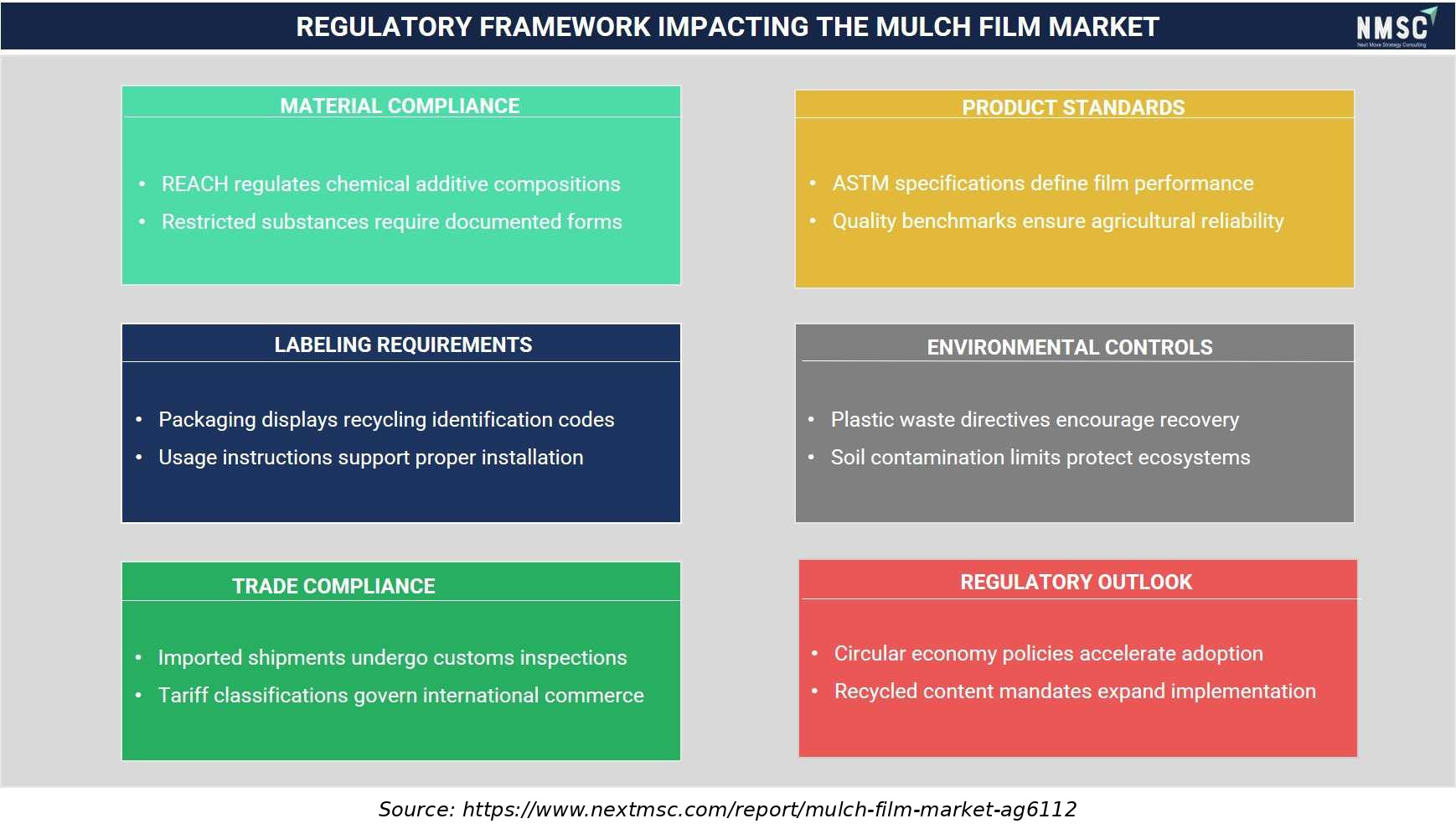
The mulch film market is increasingly shaped by regulations governing material composition, product performance, labeling, environmental impact, and trade compliance. Regulatory frameworks such as REACH and applicable ASTM standards influence material selection and quality requirements, while recycling, waste-management, and circular-economy policies are encouraging manufacturers to adopt more sustainable film solutions and strengthen end-of-life management practices.

Growth Opportunities

Our analysis shows that three forward-looking opportunities stand out for stakeholders positioning within the mulch film market over the 2026-2035 forecast period.

How Can Certified Biodegradable Films Unlock Value for European Converters?

Certified soil-biodegradable film formulations present a whitespace opportunity for converters positioned to meet EU Fertilizer Regulation 2019/1009 compliance ahead of competitors. Vendors that commercialize validated starch and polylactic acid-based films stand to capture premium pricing among European horticulture operators seeking regulatory certainty, particularly across organic-certified fruit and vegetable farming segments.

Where Does Reflective Film Technology Create New Plantation Demand?

Reflective and silver-toned mulch films represent an underpenetrated opportunity for manufacturers serving export horticulture and plantation crop operations in water-stressed geographies. Vendors that develop validated, pest-deterrent reflective formulations can secure long-term supply contracts with commercial farms seeking measurable yield uplift alongside water conservation benefits. Manufacturers that pair reflective films with drip-irrigation-compatible thickness specifications stand to capture premium positioning among export-oriented growers.

How Can Direct Institutional Sales Benefit Large-Scale Commercial Farms?

Rising consolidation among large-scale commercial farms creates an opportunity for manufacturers offering direct, institutional-scale supply agreements bypassing fragmented distributor networks. Early movers that secure multi-year, volume-based contracts can differentiate with commercial farm operators pursuing predictable film costs alongside customized thickness and durability specifications. Manufacturers that build dedicated key-account teams stand to capture recurring, multi-season procurement relationships with large agricultural enterprises.

Regional Outlook

2025 (USD Billion)
2035 (USD Billion)
Asia-Pacific
Europe
North Americ
Middle East
Latin Americ
Region 2025 (USD Billion) 2035 (USD Billion) CAGR (%)
Asia-Pacific $10.0 USD Billion $40.0 USD Billion 9.0%
Europe $17.1 USD Billion $51.1 USD Billion 27.0%
North America $24.2 USD Billion $62.2 USD Billion 25.0%
Middle East & Africa $31.3 USD Billion $73.3 USD Billion 23.0%
Latin America $38.4 USD Billion $84.4 USD Billion 12.0%

Regional data is locked

Unlock complete regional numbers for this market.

Unlock Full Data

Competitive Landscape

We observed that the mulch film market features a moderately fragmented competitive landscape, with diversified polymer and packaging groups competing alongside specialized agricultural film converters on material innovation, certification, and regional distribution depth.

Dimension Description
Market Structure Moderately fragmented; the top companies profiled in this report collectively account for a significant share of global mulch film market revenue, while numerous regional converters serve fragmented smallholder farming demand across Asia-Pacific.
Innovation Focus Soil-biodegradable film certification, reflective and extended-durability formats, and paper-based alternatives dominate current innovation pipelines across leading manufacturers.
M&A Activity Selective consolidation through capacity and capability acquisitions, exemplified by Amcor plc's completed acquisition of Berry Global Group Inc. in November 2024, consolidating agricultural film manufacturing capacity.

How Do Companies Compete in the Mulch Film Market?

Companies compete primarily on material certification, film durability, and regional distribution reach across the industry. Diversified polymer groups such as Dow Inc. and LyondellBasell Industries N.V. leverage broad resin portfolios to supply converters globally, while specialized manufacturers such as Novamont S.p.A. and RKW SE compete on certified biodegradable formulations and application-specific film engineering for horticulture and row crop customers.

Which Competitive Archetypes Dominate the Mulch Film Market?

Two archetypes dominate the market: diversified petrochemical and resin suppliers providing feedstock across multiple end uses, and specialized agricultural film converters focused exclusively on farming applications. BASF SE and Mitsubishi Chemical Group Corporation exemplify the diversified archetype through integrated biopolymer and resin manufacturing, while Trioplast Industrier AB and Armando Álvarez Group, S.A. exemplify the specialized archetype through purpose-built mulch and greenhouse film production.

How Are Companies Differentiating Through Innovation in Mulch Films?

Innovation and differentiation strategy increasingly center on soil-biodegradable certification and reflective film technology validated for measurable agronomic performance. Novamont's Mater-Bi certification under EU Fertilizer Regulation 2019/1009 and BASF's ecovio platform both target compliance-ready, soil-biodegradable positioning. Our analysis shows that manufacturers unable to demonstrate credible biodegradability certification risk exclusion from European converter specifications amid tightening Extended Producer Responsibility requirements.

What M&A and Expansion Activity Is Shaping the Mulch Film Market?

Mergers, acquisitions, and geographic expansion continue to consolidate agricultural film manufacturing capabilities within the industry. Amcor plc's completed acquisition of Berry Global Group Inc. broadened its agricultural film manufacturing footprint, while RKW Group's expansion of distribution networks into Turkey and Saudi Arabia illustrates how specialized converters pursue geographic expansion across water-stressed, high-growth agricultural markets.

Key Market Players

Our assessment indicates that the following 20 companies are actively shaping material innovation, manufacturing capacity, and regional distribution strategy within the global mulch film market.

BASF SE Dow Inc. LyondellBasell Industries N.V. RKW SE Trioplast Industrier AB Armando Álvarez Group, S.A. Novamont S.p.A. Mitsubishi Chemical Group Corporation Corbion N.V. Plastika Kritis S.A. Beaulieu International Group NV Klerks Plastic Products Beheer B.V. Coveris Holdings S.à r.l. Ginegar Plastic Products Ltd. Sotrafa S.A. FKuR Kunststoff GmbH Symphony Environmental Technologies plc NatureWorks LLC Silon s.r.o.

Supply Chain Structure of the Mulch Film Market

Supply Chain Structure of the Mulch Film Market
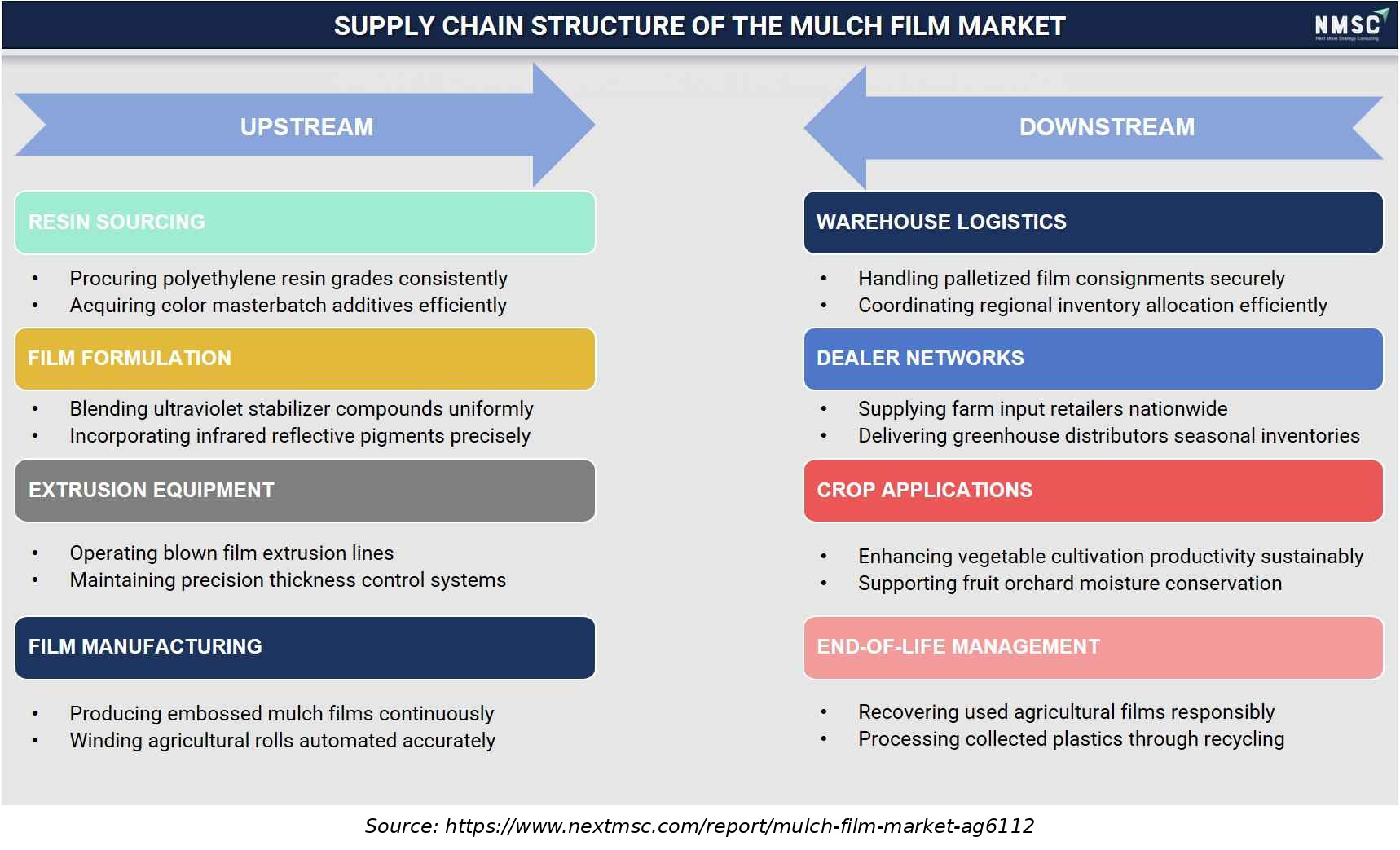
The mulch film supply chain spans resin and additive sourcing, film formulation, extrusion, manufacturing, logistics, distribution, agricultural application, and end-of-life management. Reliable access to polyethylene resins and specialized additives supports consistent production, while efficient dealer networks enable seasonal supply. Increasing emphasis on recycling and responsible recovery is also strengthening downstream sustainability across agricultural applications.

Latest Developments

We found that recent certifications and product launches within the mulch film market are concentrated on soil-biodegradable film compliance and manufacturing capacity consolidation, reflecting the industry's broader sustainability transition.

Date Event
November 2025 Novamont announced that its soil-biodegradable Mater-Bi mulch film obtained conformity certification under EU Fertilizer Regulation 2019/1009. The certification allows the film to be classified as an inorganic soil improver and confirms compliance with biodegradability, soil accumulation and ecotoxicity requirements.
October 2025 At K 2025, FKuR presented its Bio-Flex N portfolio of soil-biodegradable materials for agricultural applications. The company highlighted blown-film grades N 21310 and N 31310 for mulch films, with N 31310 offering higher puncture resistance and toughness for demanding agricultural-film applications.

Investment Opportunities

What Capital Inflows Are Targeting the Mulch Film Market?

Capital inflows into the mulch film market are increasingly directed toward biopolymer compounding capacity and certified biodegradable film development. Versalis-owned Novamont continues to fund Mater-Bi production expansion, as seen in its November 2025 EU Fertilizer Regulation certification milestone. We observed that investors favor manufacturers demonstrating validated biodegradability certification, viewing regulatory alignment as a proxy for long-term converter contract retention across European markets.

How Is Infrastructure Investment Supporting Mulch Film Deployment?

Infrastructure investment is expanding film manufacturing and distribution capacity across Asia-Pacific, the Middle East, and Latin America to serve rising water-scarcity-driven demand. Our findings suggest that manufacturers are investing in regional distribution networks, exemplified by RKW Group's 2026 expansion into Turkey and Saudi Arabia, supporting water-constrained agricultural markets that require reliable, locally accessible film supply.

What ESG Considerations Are Shaping Mulch Film Investment Decisions?

Environmental, social, and governance considerations are increasingly relevant to investment decisions across the industry, with biodegradability certification and water conservation cited as key criteria under frameworks such as the EU's Extended Producer Responsibility rules. We found that investors increasingly favor manufacturers with demonstrated soil-biodegradability credentials and reduced plastic waste footprints, treating certification as a proxy indicator alongside environmental performance in vendor selection.

Key Benefits for Stakeholders

How Does This Report Benefit Enterprise and Industry Leaders?

Enterprise and industry leaders gain access to validated segmentation, competitive benchmarking, and regional demand forecasts that support procurement and product-portfolio decisions across the mulch film industry. Our analysis shows that detailed material type, crop type, and thickness breakdowns help product managers align specifications with regulatory and water-conservation requirements while identifying underserved segments for portfolio expansion.

How Does This Report Benefit Investors and Financial Analysts?

Investors and financial analysts benefit from consistent, single-point market size and CAGR estimates that support valuation and capital-allocation decisions across the mulch film market supply chain. We observed that the report's regional and segment-level growth differentials help identify which manufacturers are best positioned to capture above-market growth in biodegradable film and Middle East & Africa categories through 2035.

How Does This Report Benefit Technology Vendors and Product Teams?

Technology vendors and product teams gain insight into emerging design requirements, including soil-biodegradability certification, reflective film engineering, and extended-durability formats, that are reshaping the industry. Our findings suggest that this analysis helps R&D teams prioritize development roadmaps around compliance-ready formulations and water-conservation performance increasingly required by converter and farmer purchasing decisions.

Key Market Segments Evaluated

By Material Type

  • Conventional Mulch Film 
    • LDPE Film
    • LLDPE Film
    • HDPE Film
  • Biodegradable Mulch Film 
    • Starch-Based Film
    • PLA Film
    • PBS Film
  • Paper-Based Film

By Crop Type

  • Fruits and Vegetables
  • Row Crops
  • Plantation Crops
  • Ornamentals and Turf
  • Other Crops

By Thickness

  • Up to 25 Microns
  • 25 to 50 Microns
  • Above 50 Microns

By Color

  • Black Mulch Film
  • Clear/Transparent Mulch Film
  • Silver/Reflective Mulch Film
  • Colored Mulch Film (Other)

By Sales Channel

  • Direct/Institutional Sales
  • Distributors and Retailers

By Region

  • North America 
    • U.S.
    • Canada
    • Mexico
  • Europe 
    • UK
    • Germany
    • France
    • Italy
    • Spain
    • Sweden
    • Denmark
    • Finland
    • Netherlands
    • Rest of Europe
  • Asia-Pacific 
    • China
    • India
    • Japan
    • South Korea
    • Taiwan
    • Indonesia
    • Vietnam
    • Australia
    • Philippines
    • Malaysia
    • Rest of APAC
  • Middle East & Africa 
    • Saudi Arabia
    • UAE
    • Egypt
    • Israel
    • Turkey
    • Nigeria
    • South Africa
    • Rest of MEA
  • Latin America 
    • Brazil
    • Argentina
    • Chile
    • Colombia
    • Rest of LATAM

Conclusion & Recommendations

The long-term outlook for the market remains positive, with global revenue projected to nearly double from USD 4.65 billion in 2025 to USD 9.15 billion by 2035 at a 7.0% CAGR. We observed that sustained food security demand, water-scarcity-driven adoption, and biodegradable film substitution will continue underpinning demand across row crop, horticulture, and plantation farming segments through the forecast period.

What Strategic Positioning Should Mulch Film Manufacturers Pursue?

Manufacturers should prioritize certified soil-biodegradable formulations while pursuing durable, multi-season film engineering to secure long-term converter and farmer contracts. Our assessment indicates that manufacturers investing early in reflective film technology and regional distribution capacity will be best positioned to capture premium pricing within the mulch film market. Manufacturers should also deepen partnerships with biopolymer feedstock suppliers to secure cost-competitive access to starch and polylactic acid-based compounds as demand scales.

How Attractive Is the Mulch Film Market for New Investment?

The mulch film industry presents an attractive investment case, supported by a USD 4.17 billion absolute dollar opportunity between 2026 and 2035 and above-average growth in Middle East & Africa and biodegradable film categories. We found that investment attractiveness is highest for manufacturers combining certification credentials with scaled regional distribution capacity, positioning them to serve both smallholder and large commercial farming segments simultaneously.

What Market Shifts and Key Risks Should Stakeholders Monitor?

Stakeholders should monitor polyethylene and biopolymer feedstock price volatility, tightening Extended Producer Responsibility requirements, and competitive pressure from low-cost regional converters as key risks to the mulch film market. Our analysis shows that manufacturers unable to adapt to biodegradability certification specifications risk losing contract eligibility to competitors with certified, compliance-ready film platforms, particularly within Europe's increasingly regulated procurement environment.

What Are the Key Growth Pathways for the Mulch Film Market?

Key growth pathways include expanding certified biodegradable film portfolios, scaling reflective and extended-durability formats, and deepening penetration into export-oriented horticulture and plantation crop categories. NMSC's analysis indicates that manufacturers pursuing these pathways while maintaining cost competitiveness in conventional film categories will be best positioned to capture the mulch film market's projected growth through 2035.

FAQs

About the Author

Mihul Sharma

Mihul Sharma

Mihul Sharma is Research Associate at Next Move Strategy Consulting, where he has covered technology, industrial, and healthcare markets for 3 years. His work applies structured business research, market analysis, and secondary-source review to assess market trends, competitive developments, and growth opportunities. He supports report development by fully synthesizing industry data, company information, and market signals into concise findings for strategy and investment-focused research teams.

About the Reviewer

Supradip Baul

Supradip Baul

Supradip Baul is an accomplished business consultant and strategist with over a decade of rich experience in market intelligence, strategy, technology, and business transformation. His work has included rigorous qualitative and quantitative analysis across multiple industries, helping clients shape investment decisions and long-term roadmaps. Earlier in his career, he was associated with Gartner, where he contributed to industry-leading reports and market share analyses. He has worked with leading global companies and holds an MBA with a dual specialization in Marketing and Finance.

Download Free Sample

Amos Chang

AMOS CHANG

Strategy Consultant

Kardex Group

I have bought the intralogistics market reports from NMSC two times so far. Joseph and his team are always very helpful and flexible in responding to any customization requirements on the report. Their expertise in market reports really helps us steer the day-to-day business. I will definitely recommend and come back myself whenever there is a need.

Nishant Awate

NISHANT AWATE

Business Development Global Sales

Zehnder Group Deutschland GmbH

Our experience working with Next Move Strategy Consulting was positive. The team was responsive, professional, and open to incorporating our specific requirements throughout the project. The India AHU market study was comprehensive and well structured, covering market value and volume forecasts, product and application segments, and key industry trends. The inclusion of both AHU and residential MVHR market insights made the study particularly relevant for our strategic market assessment. Overall, the report provides a solid foundation for evaluating market potential, identifying priority segments, and supporting business-development decisions in India.

Melanie Samko

MELANIE SAMKO

Director of Marketing

TOSOH BIOSCIENCE, INC.

The information provided by NMSC is incredibly valuable, thank you so much for such a excellent work. I really appreciate it. I will make sure to reference all of it, in my summary document.

Rishabh Jogani

RISHABH JOGANI

Strategy Analyst

Accenture Japan

We are incredibly impressed with the market report on the real estate market in India provided by Next Move Strategy Consulting. The report was thorough, insightful, and well-structured, offering deep analysis and actionable recommendations. It not only captured the current trends and dynamics but also provided a forward-looking perspective that has been invaluable for our strategic planning. Their team demonstrated exceptional professionalism, attention to detail, and a profound understanding of the industry. The data-driven insights and clarity of presentation exceeded our expectations, making complex market trends easy to understand. We highly recommend Next Move Strategy Consulting to anyone looking for reliable and comprehensive market research services. Their expertise has given us the confidence to navigate the complexities of the Indian real estate market with clarity and foresight.

Robert Sean Trevino

ROBERT SEAN TREVINO

Sr. Director, Head of Strategic Insights & Analytics

Foundation Medicine

I realized that it was a reliable source of information. These days, there are many people who are looking for authentic data, and this is one of the only sources that can offer them with what they need;

Custom Market Research Services

We will customize the research for you if the listed report does not fully match your requirements.

Get 30% Free Customization

Select License

This website uses cookies to ensure you get the best experience on our website. Learn more

✖