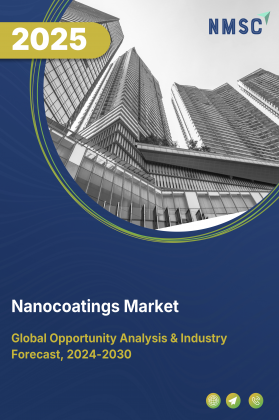
Nanocoatings Market by Function (Protection, Surface Property, Biological & Safety, Electrical, Optical & Thermal, and Specialty Functions), by Material Type (Inorganic, Organic, Carbon-Based, and Hybrid & Composite), by Deposition Technology (Vapor Deposition, Liquid/Wet Processes, Thermal & Particle Processes, Printing & Roll-to-Roll (R2R), Self-Assembly & SAMs, and Other Methods), and Others – Global Opportunity Analysis and Industry Forecast, 2025–2030
Industry Overview
The global Nanocoatings Market size was valued at USD 18.24 billion in 2024 and is predicted to reach USD 22.40 billion by the end of 2025. The industry is predicted to reach USD 62.69 billion by 2030 with a CAGR of 22.85% from 2025 to 2030.
The market is experiencing robust growth, driven by technological advancements, sustainability trends, and expanding industrial applications. Continuous innovations in nanotechnology have enabled the creation of coatings with superior properties such as enhanced durability, corrosion resistance, antimicrobial effects, and UV protection, meeting the evolving needs of industries like automotive, healthcare, electronics, and construction.
The rising demand for eco-friendly solutions with low VOC emissions and longer product lifespans aligns with global sustainability goals, further boosting adoption. Additionally, rapid growth in end-use sectors and emerging opportunities in renewable energy, where nanocoatings improve efficiency and protection of solar panels and wind turbines, are fueling the market expansion.
However, high production and application costs, due to specialized materials and processes, remain a challenge, particularly for cost-sensitive industries. Overall, the market shows strong potential as innovation broadens its applications and performance capabilities.
Advancements in Nanotechnology Drives the Market Growth
Continuous innovations in nanotechnology have significantly propelled the growth of the market. These advancements enable the development of coatings at the nanoscale, which exhibit superior properties such as enhanced strength, durability, corrosion resistance, and improved chemical stability compared to conventional coatings. The ability to manipulate materials at the molecular or atomic level allows manufacturers to create coatings with tailored functionalities, like self-cleaning surfaces, antimicrobial effects, and UV protection, that meet the evolving demands of various industries.
As research progresses, these cutting-edge nanocoatings become more efficient, cost-effective, and versatile, encouraging widespread adoption across automotive, healthcare, electronics, and construction sectors. Thus, breakthroughs in nanotechnology serve as a critical driver by expanding the application possibilities and performance capabilities of nanocoatings.
Demand for Sustainable and Eco-Friendly Solutions Fuel the Market Expansion
Growing global awareness about environmental conservation and the shift towards greener technologies are driving the demand for sustainable nanocoating solutions. Industries and consumers increasingly prefer coatings that are low in volatile organic compounds (VOCs), energy-efficient in application, and compliant with stringent environmental regulations.
Nanocoatings offer eco-friendly benefits such as longer product life, reduced material wastage, and enhanced performance without relying on hazardous chemicals. This aligns with corporate sustainability goals and government policies promoting cleaner production methods, making eco-friendly nanocoatings an attractive choice across sectors like automotive, construction, electronics, and healthcare.
Growth in End-Use Industries Boost the Market Demand
The rapid expansion of key end-use industries is a major driver of the nanocoatings market demand. In the automotive sector, nanocoatings enhance scratch resistance, UV protection, and self-cleaning capabilities, improving both the lifespan and appearance of vehicle components.
In healthcare, these coatings are applied to medical devices and high-touch surfaces to inhibit microbial growth, lowering infection risks in clinical environments. The electronics industry benefits from nanocoatings that shield devices against moisture, dust, and scratches, thereby boosting durability and performance.
In construction, nanocoatings protect materials from UV radiation, moisture, and environmental wear, extending the structural integrity and service life of buildings. This broad applicability across multiple high-growth industries significantly fuels market demand.
High Production and Application Cost Limits the Market Growth
The high cost of producing and applying nanocoatings remains a significant restraint on the nanocoatings market growth. Manufacturing these advanced coatings requires specialized raw materials, precision equipment, and sophisticated fabrication processes, which is expensive and resource-intensive.
Additionally, application demands skilled labor and controlled environments to ensure performance quality. These factors increase overall costs, making nanocoatings less accessible for cost-sensitive industries or small-scale users, and potentially slowing adoption despite their superior benefits.
Rising Demand in Renewable Energy Applications Unlock New Growth Opportunities
The growing global shift towards renewable energy presents a significant opportunity for the market. Nanocoatings is applied to solar panels to enhance light absorption, improve self-cleaning properties, and protect against environmental degradation, thereby increasing energy conversion efficiency and lifespan.
In wind energy, they reduce wear and corrosion on turbine blades and components. As governments and industries invest heavily in clean energy infrastructure, the need for high-performance protective solutions positions nanocoatings as a critical enabler of efficiency and durability in renewable energy systems.
Market Segmentations and Scope of the Study
The nanocoatings market report is segmented by function, material type, deposition technology, substrate, product form, sales channel, application location, end-use industry, and regions. Based on function, the market includes protection, surface properties, biological & safety, electrical/optical & thermal, and specialty functions, covering features such as anti-corrosion, self-cleaning, antimicrobial, conductive, and sensing-enabled coatings.
Based on material type, the market is classified into inorganic, organic, carbon-based, and hybrid & composite nanocoatings, including metal oxides, fluoropolymers, graphene, carbon nanotubes, and nanocomposites. Based on deposition technology, the market comprises vapor deposition, liquid/wet processes, thermal & particle processes, printing & roll-to-roll, self-assembly, and other methods.
Based on substrate, the market spans metals & alloys, glass & ceramics, polymers & plastics, composites, concrete & masonry, textiles & leather, paper & board, wood & panels, and other substrates. Based on product form, the market includes liquid coatings, powder coatings, functional inks & pastes, pre-formed films & laminates, aerosols, and sealants & adhesives.
Based on sales channel, the market is segmented into OEM (factory/in-line), aftermarket/MRO/retrofit, distributors & wholesalers, contract coaters & applicators, and retail. Based on application location, the market includes factory/in-line, field/on-site, and lab/controlled environments.
Based on end-use industry, the market covers automotive & transportation, electronics & semiconductors, healthcare & medical, building & construction, energy, aerospace & defense, marine & offshore, industrial machinery, consumer goods & packaging, textiles & apparel, and other industries. Geographically, the market is analysed across North America, Europe, Asia-Pacific, and the Rest of the World.
Geographical Analysis
In North America, the presence of a robust research and development ecosystem is a key driver of the nanocoatings market share. The region hosts numerous universities, research institutions, and industry leaders that actively invest in developing advanced nanocoating technologies with enhanced durability, antimicrobial properties, and environmental sustainability.
Supportive government funding programs and collaborative industry–academia partnerships accelerate innovation and commercialization. This strong technological base enables the rapid introduction of high-performance nanocoatings across sectors such as automotive, aerospace, healthcare, and electronics, fueling market growth in the region.
In Europe, strict environmental regulations and ambitious sustainability targets are a major driver for the adoption of nanocoatings. The European Union’s directives on reducing volatile organic compounds (VOCs) and promoting eco-friendly materials push industries to seek advanced coating solutions with minimal environmental impact.
Nanocoatings, which offer durability, corrosion resistance, and self-cleaning properties without relying on harmful chemicals, align well with these requirements. Additionally, strong public and corporate commitment to sustainable manufacturing practices accelerates their integration into automotive, construction, healthcare, and consumer goods sectors across the region.
The Asia-Pacific region’s accelerating industrial expansion and robust infrastructure growth are major factors driving the market. Expanding automotive manufacturing hubs, booming electronics production, and massive construction projects in countries like China, India, Japan, and South Korea are fuelling demand for high-performance protective coatings.
Nanocoatings provide enhanced durability, corrosion resistance, and environmental protection, making them ideal for the region’s fast-growing industries. Additionally, rising consumer awareness of product quality and longevity, along with increasing government investments in advanced manufacturing technologies, further boost market adoption.
In regions outside the major markets, such as Latin America, the Middle East, and Africa, growing adoption of nanocoatings in niche and emerging industries is driving market growth. Applications in sectors like oil and gas, marine, mining, and energy infrastructure are expanding as these industries seek advanced solutions for corrosion protection, extreme weather resistance, and performance enhancement. Additionally, increasing awareness of nanotechnology’s benefits, coupled with gradual industrial modernization and foreign investment in manufacturing and infrastructure, is encouraging the use of nanocoatings across diverse applications.
Strategic Innovations Adopted by Key Players
Key players in the nanocoatings industry are actively advancing product innovation, forging high-profile collaborations, and targeting specialized applications to strengthen their competitive position and address diverse industry needs.
-
In April 2026, Forge Nano announced a major milestone and planned NASDAQ listing following a strategic merger, backed by large-scale investments and expansion of its Atomic Layer Deposition (ALD) nanocoating platform for semiconductors and battery technologies.
-
In September 2025, PPG Industries, Inc. introduced advanced nano-coatings for automotive applications, enhancing durability and scratch resistance, reflecting the increasing adoption of high-performance coatings in the automotive sector.
-
In July 2025, Tesla NanoCoatings, Inc. partnered with U.S.-based nanotech firms to develop nano-coatings for electric vehicle batteries, improving thermal resistance and lifecycle performance in next-generation energy systems.
Key Benefits
-
The report provides quantitative analysis and estimations of the market from 2025 to 2030, which assists in identifying the prevailing industry opportunities.
-
The study comprises a deep-dive analysis of the current and future nanocoatings market trends to depict prevalent investment pockets in the sector.
-
Information related to key drivers, restraints, and opportunities and their impact on the market is provided in the report.
-
Competitive analysis of the key players, along with their market share is provided in the report.
-
SWOT analysis and Porters Five Forces model is elaborated in the study.
-
Value chain analysis in the market study provides a clear picture of roles of stakeholders.
Nanocoatings Market Key Segments
By Function
-
Protection
-
Anti-corrosion & Barrier
-
Anti-wear, Abrasion & Scratch Resistance
-
UV & Thermal Protection
-
Chemical Resistance
-
-
Surface Property
-
Hydrophobic & Oleophobic
-
Self-cleaning
-
Anti-icing & De-icing
-
Anti-fouling & Anti-graffiti
-
-
Biological & Safety
-
Antimicrobial & Antiviral
-
Flame Retardant
-
-
Electrical, Optical & Thermal
-
Conductive, Antistatic & EMI Shielding
-
Anti-reflective & Optical Control
-
Thermal Control & Insulation
-
-
Specialty Functions
-
Anti-biofilm
-
Sensing-enabled
-
By Material Type
-
Inorganic
-
Metal Oxides
-
Ceramics (Non-oxide)
-
Metal NPs
-
-
Organic
-
Fluoropolymers
-
Silicones
-
Other Polymers
-
-
Carbon-Based
-
Graphene
-
Carbon Nanotubes (CNTs)
-
Carbon Blacks
-
-
Hybrid & Composite
-
Organic-Inorganic Hybrids
-
Nanocomposites
-
By Deposition Technology
-
Vapor Deposition
-
Chemical Vapor Deposition (CVD)
-
Physical Vapor Deposition (PVD)
-
Atomic Layer Deposition (ALD)
-
-
Liquid / Wet Processes
-
Sol-gel
-
Spray Coating
-
Dip, Spin & Roll Coating
-
Electrodeposition
-
-
Thermal & Particle Processes
-
Thermal Spray
-
Plasma Spray
-
-
Printing & Roll-to-Roll (R2R)
-
Inkjet Printing
-
Slot-die
-
Roll-to-Roll
-
-
Self-Assembly & SAMs
-
Other Methods
By Substrate
-
Metals & Alloys
-
Glass & Ceramics
-
Polymers & Plastics
-
Composites
-
Concrete & Masonry
-
Textiles & Leather
-
Paper & Board
-
Wood & Panels
-
Other Substrates
By Product Form
-
Liquid Coatings
-
Water-based
-
Solvent-based
-
-
Powder Coatings
-
Functional Inks & Pastes
-
Pre-formed Films & Laminates
-
Aerosols & Spray Cans
-
Sealants & Adhesives
By Sales Channel
-
OEM (Factory / In-line)
-
Aftermarket / MRO / Retrofit
-
Distributors & Wholesalers
-
Contract Coaters & Applicators
-
Retail (Consumer)
By Application Location
-
Factory/In-line
-
Field/On-site
-
Lab / Controlled Environment
By End Use Industry
-
Automotive & Transportation
-
Exteriors
-
Interiors
-
Powertrain & Components
-
-
Electronics & Semiconductors
-
Consumer Electronics
-
Displays & Touchscreens
-
PCBs & Components
-
-
Healthcare & Medical
-
Medical Devices
-
Implants
-
Healthcare Facilities & Surfaces
-
-
Building & Construction
-
Architectural Glass & Facades
-
Interior Finishes & Sanitary
-
Concrete & Structural
-
-
Energy
-
Solar
-
Wind
-
Oil & Gas
-
-
Aerospace & Defense
-
Marine & Offshore
-
Industrial Machinery & Equipment
-
Consumer Goods & Packaging
-
Textiles & Apparel
-
Other Industries
By Region
-
North America
-
The U.S.
-
Canada
-
Mexico
-
-
Europe
-
The UK
-
Germany
-
France
-
Italy
-
Spain
-
Denmark
-
Netherlands
-
Finland
-
Sweden
-
Norway
-
Russia
-
Rest of Europe
-
-
Asia-Pacific
-
China
-
Japan
-
India
-
South Korea
-
Australia
-
Indonesia
-
Singapore
-
Taiwan
-
Thailand
-
Rest of Asia-Pacific
-
-
RoW
-
Latin America
-
Middle East
-
Africa
-
Key Players
-
PPG Industries, Inc.
-
PURETi Group, LLC
-
Forge Nano
-
P2i Ltd (P2i plc)
-
Tesla NanoCoatings, Inc.
-
HZO, Inc.
-
Nanofilm Technologies International Limited
-
actnano, Inc.
-
Aculon, Inc.
-
Nanovere Technologies, LLC
-
NANOPROTECH
-
Bio-Gate AG
-
Nano-Care Deutschland AG
-
Nasiol
-
Element 119 Coatings
Report Scope and Segmentation:
|
Parameters |
Details |
|
Market Size in 2025 |
USD 22.40 Billion |
|
Revenue Forecast in 2030 |
USD 62.69 Billion |
|
Growth Rate |
CAGR of 22.85% from 2025 to 2030 |
|
Analysis Period |
2024–2030 |
|
Base Year Considered |
2024 |
|
Forecast Period |
2025–2030 |
|
Market Size Estimation |
Billion (USD) |
|
Growth Factors |
|
|
Countries Covered |
28 |
|
Companies Profiled |
15 |
|
Market Share |
Available for 10 companies |
|
Customization Scope |
Free customization (equivalent up to 80 working hours of analysts) after purchase. Addition or alteration to country, regional, and segment scope. |
|
Pricing and Purchase Options |
Avail customized purchase options to meet your exact research needs. |


About the Author
 Sikha Haritwal is an assistant manager with strong expertise in market research, data analysis, and cross-functional coordination. She plays a key role in leading complex research initiatives, strengthening analytical rigor, and enabling data-driven decision-making across teams. Known for her leadership mindset and structured problem-solving approach, she supports process improvement, enhances operational efficiency, and contributes to building scalable frameworks that drive long-term strategic outcomes and organizational effectiveness.
About the Reviewer
 Supradip Baul is an accomplished business consultant and strategist with over a decade of rich experience in market intelligence, strategy, technology, and business transformation. His work has included rigorous qualitative and quantitative analysis across multiple industries, helping clients shape investment decisions and long-term roadmaps. Earlier in his career, he was associated with Gartner, where he contributed to industry-leading reports and market share analyses. He has worked with leading global companies and holds an MBA with a dual specialization in Marketing and Finance.
At Next Move Strategy Consulting, we understand that insightful market research is the cornerstone of successful business decisions. That's why we employ a robust and multifaceted approach, combining various methodologies to deliver the most accurate and actionable data for our clients.

Research Landscape
We navigate the world of research with two primary approaches:
Qualitative Approach
Our qualitative research methodologies involve immersive techniques such as in-depth interviews, focus groups, and observational studies. By engaging directly with individuals and stakeholders, we uncover valuable insights that quantitative data alone may overlook.

Quantitative Research
In tandem with qualitative methodologies, NMSC leverages the power of Quantitative Research to provide a robust foundation of numerical insights. Through systematic data collection and analysis, we quantify patterns, preferences, and market trends, offering a comprehensive view of the business landscape.
Our quantitative research approach employs diverse tools, including surveys, experiments, and statistical modelling. These methodologies enable us to gather data from a large and representative sample, ensuring the statistical significance of our findings. By employing structured questionnaires and standardized data collection methods, we guarantee the reliability and validity of the information we present to our clients.
Quantitative research is particularly effective in measuring the prevalence of trends, assessing market size, and gauging the impact of various factors on consumer behavior. The numerical precision attained through this approach equips our clients with actionable insights, facilitating data-driven decision-making and strategy formulation.


Our Specialized Toolbox for Industry-Specific Market Research
We deploy a specialized arsenal of techniques tailored to meet your unique requirements. Here's a glimpse into our comprehensive toolbox:

Information Procurement
The stage entails acquiring market data or relevant information through various sources and methodologies.


Market Research Approach
We utilize both top-down and bottom-up approaches in market research analysis to achieve a comprehensive understanding of the market dynamics, leveraging the broad perspective of industry trends and macroeconomic factors alongside detailed insights from specific segments and individual companies.

Porters Five Forces Analysis
We conduct Porter's Five Forces analysis to evaluate the competitive landscape of an industry, providing us with insights into factors that affect profitability and strategic positioning.

SWOT Analysis

Forecasting
We utilize a forecasting model to predict future consumption by considering parameters like population, economics, regulations, market competition, drivers, constraints, technology, and pricing. We also employ statistical techniques such as multilinear regression, exponential smoothing, moving average, ARIMA, and Monte Carlo simulations for accurate predictions. In econometric forecasting, we analyzed short-term and long-term event impacts, attributing values based on regulatory frameworks, economic factors, and market events.





 Speak to Our Analyst