Synthetic Data Generation Market Global Industry Analysis and Forecast (2026–2035)

Synthetic Data Generation Market size was USD 690.00 Million in 2026, projected to reach USD 5,900.00 Million by 2035, growing at a CAGR of 26.9% from 2026 to 2035. Key drivers include rising AI training data requirements, privacy and data governance regulations, and growing demand for physical AI and robotics simulation, with North America leading the market.

Download Free Sample PDF
Base Year (2025)
$520.0 Million
Forecast (2035)
$5,900.0 Million
CAGR (2026-2035)
26.9%
Top Region
North America

What Is the Synthetic Data Generation Market Size?

The global Synthetic Data Generation Market reached USD 520.00 Million in 2025 and is estimated at USD 690.00 Million in 2026. It is forecast to reach USD 5,900.00 Million by 2035, growing at a 26.9% CAGR from 2026 to 2035. North America leads with about 37.5% share, while tabular data is the dominant data type at about 33.7%.

We observed that the market splits cleanly along data type, application and industry lines, and the takeaways below show where value concentrates and where growth accelerates.

Synthetic Data Generation Market Global Industry Analysis and Forecast (2026–2035) Revenue Forecast

Values in USD Million

2025 $520.0 Million
2025
2026 $690.0 Million
2026
2027 $875.6 Million
2027
2028 $1,111.1 Million
2028
2029 $1,410.0 Million
2029
2030 $1,789.4 Million
2030
2031 $2,270.7 Million
2031
2032 $2,881.5 Million
2032
2033 $3,656.6 Million
2033
2034 $4,640.3 Million
2034
2035 $5,900.0 Million
2035

Key Takeaways

By Data Type: Tabular data held the largest share, expanding from USD 175.00 Million in 2025 to USD 1,250.00 Million by 2035; Text data is the fastest growing at 30.5% CAGR from 2026–2035.

By Application: AI model training held the largest share, expanding from USD 215.00 Million in 2025 to USD 3,100.00 Million by 2035; Simulation and safety validation is the fastest growing at 31.3% CAGR from 2026–2035.

By End User Industry: IT and telecom held the largest share, expanding from USD 135.00 Million in 2025 to USD 1,250.00 Million by 2035 (24.1% CAGR from 2026); Manufacturing and robotics is the fastest-growing sector at 32.0% CAGR from 2026–2035.

Dominant Region: North America held the largest share at about 37.5%, growing from USD 195.00 Million in 2025 to USD 1,950.00 Million by 2035.

Fastest-Growing Region: Asia-Pacific is the fastest growing at 31.1% CAGR from 2026–2035, rising from USD 125.00 Million in 2025 to USD 2,000.00 Million by 2035.

Dominant Country: The U.S. held the largest national share, expanding from USD 170.00 Million in 2025 to USD 1,700.00 Million by 2035.

Fastest-Growing Country: India is the fastest growing at 35.7% CAGR from 2026–2035, rising from USD 18.00 Million in 2025 to USD 420.00 Million by 2035.

Between 2026 and 2035, the market adds an absolute opportunity of USD 5,210.00 Million. This provides a clear signal for investors that synthetic data is transitioning into core AI infrastructure.

According to NMSC analysis, the sharpest shift is the move of budgets from test data masking toward model training and simulation workloads, which together account for most incremental revenue across the forecast window.

What Does the Synthetic Data Generation Market Encompass?

The Synthetic Data Generation Market covers software platforms, models, simulation engines and managed services that create artificial datasets which mimic the statistical structure or physical behaviour of real data. Output spans tabular records, text, images, video and sensor streams, and buyers range from banks and hospitals to robotics and autonomous vehicle developers. This market report counts licensed software, subscriptions and usage based platform revenue, and excludes labelling services and raw data brokerage.

The regulatory environment is increasingly supportive. Article 10 of the EU Artificial Intelligence Act governs data and data governance. It requires providers of high-risk systems to demonstrate that bias correction cannot be achieved with synthetic or anonymized data before processing special category personal data. Technology adoption is shifting from standalone generators toward integrated suites inside AI and data platforms, as seen in the offerings of NVIDIA, IBM and SAS.

Competitive Landscape

Our assessment indicates that the Synthetic Data Generation Market industry is moderately concentrated at the platform level, with large suite vendors and focused specialists competing on different terms.
How Do Companies Compete in the Synthetic Data Generation Market?

Companies compete on data modality coverage, fidelity of output, privacy evidence, integration with existing data platforms and deployment flexibility. Suite vendors lean on installed bases and bundled licensing, while specialists compete on speed to value and developer experience. Pricing ranges from free open source kits to enterprise subscriptions, and geographic expansion usually follows cloud marketplace listings and partner programmes.

Which Competitive Archetypes Dominate the Synthetic Data Generation Market?

Three archetypes stand out. Simulation and world model platforms, led by NVIDIA, differentiate on physical realism. Enterprise AI and analytics suites from IBM and SAS differentiate on governance and integration. Specialist data synthesis providers, namely Tonic.ai and Syntho with the MOSTLY AI brand, differentiate on test data workflows, privacy tooling and relational fidelity.

What Innovation and Differentiation Strategies Are Companies Pursuing?

We observed that innovation centres on widening modality coverage and automating setup. Tonic.ai launched a data agent that generates relational datasets from natural language prompts. Meanwhile, IBM added unstructured generation through API integration, and NVIDIA released open world foundation models alongside simulation blueprints for robotics and autonomous vehicles. Each move reduces the expertise a buyer needs before producing usable data.

What M&A and Partnership Activity Is Shaping the Market?

Our findings suggest that acquisitions are the main route to capability. SAS bought the principal software assets of Hazy in November 2024, Tonic.ai acquired Fabricate in April 2025, and Syntho acquired the MOSTLY AI trademark and related assets in June 2026. Cloud collaboration agreements, such as the one Tonic.ai signed with AWS, extend reach without ownership changes.

Key Market Players

Based on research conducted by NMSC, the following five companies represent the validated leadership set in the Synthetic Data Generation Market, listed in ranked order from official company sources.

NVIDIA Corporation International Business Machines Corporation SAS Institute Inc. Tonic.ai Syntho

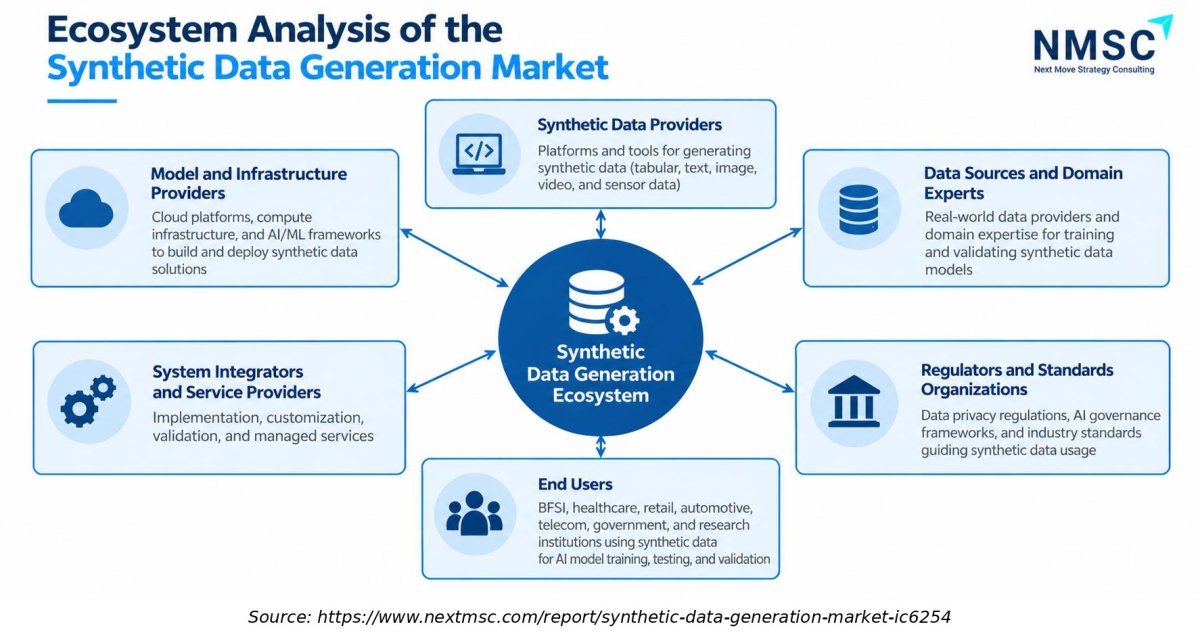
Ecosystem Analysis of the Synthetic Data Generation Market
The synthetic data generation market ecosystem comprises software providers, model and infrastructure vendors, data providers, system integrators, regulatory bodies, and end users. Technology providers supply AI models, cloud computing, and generation tools, while domain experts contribute real-world data and validation expertise. System integrators support implementation and customisation. Organisations across BFSI, healthcare, automotive, retail, telecommunications, and research use synthetic data for AI training, testing, and model validation.

Market Drivers & Dynamics

Interactive Dataset
Demand for scalable AI training data as real data runs short driver +3.4% Global 2026–2035
Privacy and data governance rules, including EU AI Act Article 10 driver +2.6% Europe, North America 2026–2032
Physical AI, robotics and autonomous system simulation needs driver +2.9% North America, Asia-Pacific 2026–2035
Enterprise test data modernisation and shift left testing driver +1.4% North America, Europe 2026–2030
Fidelity, bias and privacy leakage validation burden restraint −2.1% Global 2026–2033
Quality degradation risk when synthetic share of training data rises restraint −1.6% Global 2027–2035
Platform consolidation and open source substitution pressure on pricing restraint −1.2% Global 2026–2031
Source: Next Move Strategy Consulting

Growth Drivers

What Is the Primary Growth Driver in the Synthetic Data Generation Market?

Demand for scalable training data is the primary driver of the Synthetic Data Generation Market. Frontier model developers and enterprises alike need datasets that are larger, safer and more targeted than what they can collect or license. Our estimates place AI model training at USD 215.00 Million in 2025, about 41.3% of revenue, which makes it the single largest application.

How Is Regulation Driving Market Growth?

Data protection and AI governance rules push organisations to replace live personal data with artificial equivalents wherever possible. Article 10 of Regulation (EU) 2024/1689, published by the European Commission, lets providers process special category data for bias correction only when synthetic or anonymised data cannot do the job. We observed that this wording gives compliance teams a documented reason to try synthetic data first.

Growth Inhibitors

What Is Restraining the Synthetic Data Generation Market?

The main restraint is proof of quality. Buyers must show that artificial data preserves useful statistical signal, avoids reproducing individuals and does not amplify bias, and that evidence is costly to produce. IBM documentation still labels its unstructured generation API as beta and limits it to the Sydney and Toronto regions, which illustrates how some capabilities remain early. Industry-derived estimates suggest validation effort trims forecast growth by roughly 2 percentage points.

What Are the Growth Opportunities?

Can Healthcare Data Sharing Become a Premium Synthetic Data Vertical?

Hospitals and life science firms hold valuable records they cannot freely share. Artificial cohorts let researchers and vendors collaborate without exposing patients. Healthcare and life sciences grows at 31.8% CAGR in our model, and vendors with audit ready privacy reports can charge premium subscriptions. Early programmes at research hospitals show that shared artificial cohorts shorten collaboration agreements, which is the commercial lever vendors should price against.

Does Robotics Simulation Create a New Volume Segment?

Humanoid and warehouse robot developers need millions of varied scenes for manipulation and navigation. Sensor and simulation data is projected to rise from USD 125.00 Million in 2026 to USD 1,300.00 Million by 2035. Platforms linking cloud robotics pipelines with automated scene generation stand to benefit most from this expansion. Because scene generation consumes heavy compute, vendors with GPU optimised pipelines and open scene formats can price per generated hour and keep customers through ongoing retraining cycles.

Is Agent and Language Model Evaluation an Untapped Software Layer?

Teams building AI agents need repeatable test conversations, tool calls and edge cases before launch. Generators that produce validated scenarios on demand fit directly into evaluation workflows, and the buyer is the AI engineering team, not the privacy office, which widens the addressable budget. Revenue here is usage based, so growth tracks the number of agent releases each customer ships per quarter.

Segmentation Analysis

2025 (USD Million)
2035 (USD Million)
Tabular data 2025: $175.0 Million | 2035: $1,250.0 Million
Tabular data
Text data 2025: $105.0 Million | 2035: $1,650.0 Million
Text data
Image and video data 2025: $145.0 Million | 2035: $1,700.0 Million
Image and vi
Sensor and simulation data 2025: $95.0 Million | 2035: $1,300.0 Million
Sensor and s
Tabular data $175.0 Million $1,250.0 Million 21.0%
Text data $105.0 Million $1,650.0 Million 30.5%
Image and video data $145.0 Million $1,700.0 Million 27.6%
Sensor and simulation data $95.0 Million $1,300.0 Million 29.7%

Which Data Type Leads the Synthetic Data Generation Market?

Tabular data leads the market with USD 175.00 Million in 2025, representing approximately 33.7% of revenue. This dominance is driven by banks, insurers, and software teams that require safe synthetic copies of relational records for testing and analytics. Text data grows fastest, at 30.5% CAGR over 2026 to 2035, driven by language model tuning and agent evaluation. Image and video data follows at 27.6%, supported by perception training for robots and vehicles.

2025 (USD Million)
2035 (USD Million)
Category A
Category B
Category C
Category D
Segment Item 2025 (USD Million) 2035 (USD Million) CAGR
Category A $10.0 USD Million $40.0 USD Million 25.0%
Category B $17.1 USD Million $51.1 USD Million 11.0%
Category C $24.2 USD Million $62.2 USD Million 25.0%
Category D $31.3 USD Million $73.3 USD Million 11.0%

Segment-wise data is locked

Unlock complete segment-wise numbers for By Application.

Unlock Full Data
2025 (USD Million)
2035 (USD Million)
Category A
Category B
Category C
Category D
Segment Item 2025 (USD Million) 2035 (USD Million) CAGR
Category A $10.0 USD Million $40.0 USD Million 27.0%
Category B $17.1 USD Million $51.1 USD Million 9.0%
Category C $24.2 USD Million $62.2 USD Million 19.0%
Category D $31.3 USD Million $73.3 USD Million 17.0%

Segment-wise data is locked

Unlock complete segment-wise numbers for By End User Industry.

Unlock Full Data
2025 (USD Million)
2035 (USD Million)
Category A
Category B
Category C
Category D
Segment Item 2025 (USD Million) 2035 (USD Million) CAGR
Category A $10.0 USD Million $40.0 USD Million 14.0%
Category B $17.1 USD Million $51.1 USD Million 24.0%
Category C $24.2 USD Million $62.2 USD Million 22.0%
Category D $31.3 USD Million $73.3 USD Million 12.0%

Segment-wise data is locked

Unlock complete segment-wise numbers for By Region.

Unlock Full Data

Growth Opportunities

We found that three whitespace opportunities are positioned to capture disproportionate revenue between 2026 and 2035.

Can Healthcare Data Sharing Become a Premium Synthetic Data Vertical?

Hospitals and life science firms hold valuable records they cannot freely share. Artificial cohorts let researchers and vendors collaborate without exposing patients. Healthcare and life sciences grows at 31.8% CAGR in our model, and vendors with audit ready privacy reports can charge premium subscriptions. Early programmes at research hospitals show that shared artificial cohorts shorten collaboration agreements, which is the commercial lever vendors should price against.

Does Robotics Simulation Create a New Volume Segment?

Humanoid and warehouse robot developers need millions of varied scenes for manipulation and navigation. Sensor and simulation data is projected to rise from USD 125.00 Million in 2026 to USD 1,300.00 Million by 2035. Platforms linking cloud robotics pipelines with automated scene generation stand to benefit most from this expansion. Because scene generation consumes heavy compute, vendors with GPU optimised pipelines and open scene formats can price per generated hour and keep customers through ongoing retraining cycles.

Is Agent and Language Model Evaluation an Untapped Software Layer?

Teams building AI agents need repeatable test conversations, tool calls and edge cases before launch. Generators that produce validated scenarios on demand fit directly into evaluation workflows, and the buyer is the AI engineering team, not the privacy office, which widens the addressable budget. Revenue here is usage based, so growth tracks the number of agent releases each customer ships per quarter.

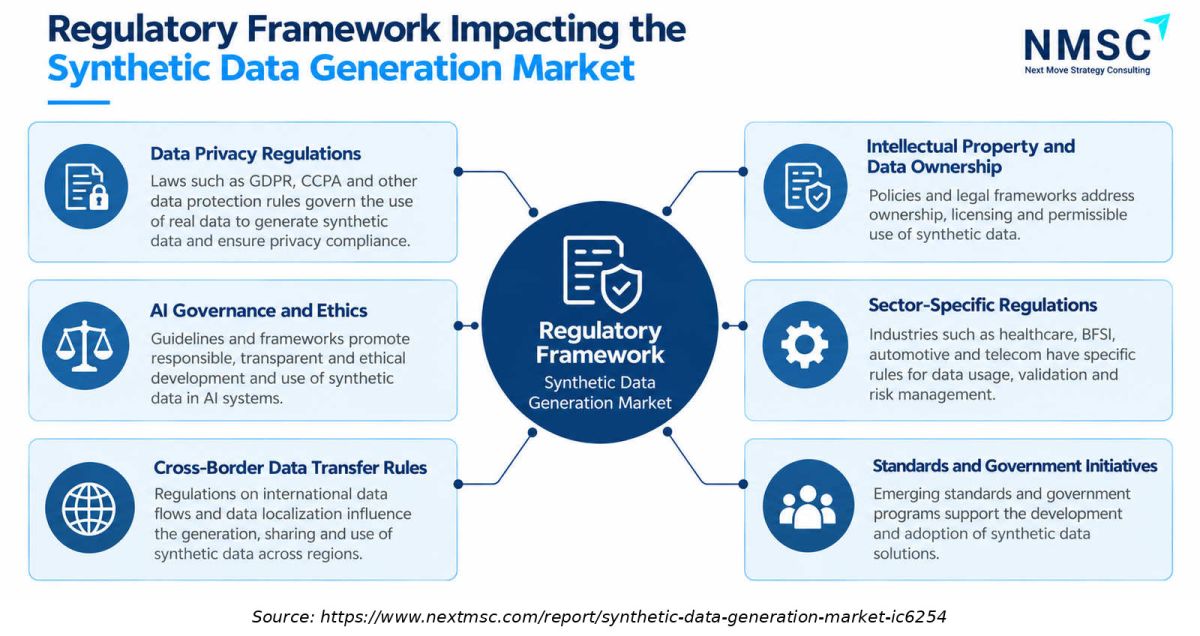
Regulatory Framework Impacting the Synthetic Data Generation Market
The synthetic data generation market is shaped by data privacy laws, AI governance frameworks, cross-border data transfer rules, intellectual property requirements, and sector-specific regulations. Laws such as GDPR and other applicable privacy frameworks influence how source data is collected, processed, and transformed. AI governance guidelines encourage transparency, fairness, and accountability. Industry regulations affect the use of synthetic data in healthcare and financial services, while emerging standards and government initiatives support responsible adoption and innovation.

Regional Outlook

2025 (USD Million)
2035 (USD Million)
North Americ
Europe
Asia-Pacific
Middle East
Latin Americ
Region 2025 (USD Million) 2035 (USD Million) CAGR (%)
North America $10.0 USD Million $40.0 USD Million 9.0%
Europe $17.1 USD Million $51.1 USD Million 27.0%
Asia-Pacific $24.2 USD Million $62.2 USD Million 25.0%
Middle East & Africa $31.3 USD Million $73.3 USD Million 23.0%
Latin America $38.4 USD Million $84.4 USD Million 12.0%

Regional data is locked

Unlock complete regional numbers for this market.

Unlock Full Data

Latest Developments

During our market evaluation, we noticed that recent activity combines acquisitions of specialist assets with product launches aimed at agents, text data and physical AI.

Date Event
July 2026 Tonic.ai introduced the Fabricate MCP server, allowing MCP-compatible clients such as Claude, Cursor and VS Code to request synthetic datasets through natural-language prompts without leaving their development environment. Fabricate can model live sources, generate data from scratch or combine both, while preserving referential integrity and validating output.
June 2026 IBM’s watsonx.ai v2.4 added an API for programmatic structured synthetic-data generation, enabling teams to submit scripts and integrate generation into existing workflows. The release also lets users select an LLM for unstructured-data generation, strengthening customization across enterprise data pipelines and model-training tasks.

Expert Insights

Amit Adarkar

Amit Adarkar

CEO | Ipsos India

"“We can accelerate product development with synthetic consumers, and it is revolutionizing industries from consumer goods, healthcare to financial services, automotive etc., enabling simulations and data augmentation, without compromising on rigor.”"

Analyst Interpretation

Adarkar’s statement highlights the growing application of synthetic data generation beyond AI model training, particularly in consumer research, product testing and market simulation. By creating synthetic consumer profiles and simulating potential responses to products, businesses can explore market scenarios, evaluate product concepts and accelerate decision-making. These applications may reduce dependence on repeated conventional research activities while enabling faster experimentation across industries such as consumer goods, healthcare, financial services and automotive. However, the effectiveness of synthetic consumer data depends on the quality of the underlying real-world data and rigorous validation against actual consumer behaviour.

Market Interpretation

Adarkar’s statement highlights the growing application of synthetic data generation beyond AI model training, particularly in consumer research, product testing and market simulation. By creating synthetic consumer profiles and simulating potential responses to products, businesses can explore market scenarios, evaluate product concepts and accelerate decision-making. These applications may reduce dependence on repeated conventional research activities while enabling faster experimentation across industries such as consumer goods, healthcare, financial services and automotive. However, the effectiveness of synthetic consumer data depends on the quality of the underlying real-world data and rigorous validation against actual consumer behaviour.

Where Are Capital Inflows Concentrating in the Synthetic Data Generation Market?

Capital is concentrating in platforms that serve model training and simulation, the two applications that add the most revenue by 2035. Strategic buyers are paying for capability through acquisitions of Hazy assets, Fabricate and the MOSTLY AI trademark, which signals that scarce specialist technology is being consolidated into larger portfolios.

How Is Infrastructure Investment Shaping Market Capacity?

Infrastructure spending is moving toward GPU accelerated generation, simulation clusters and regional cloud capacity close to regulated data. NVIDIA ties its Omniverse and Cosmos software to Blackwell class servers for synthetic data work, and edge AI deployments create a need for compact generators that can run near the data source.

What ESG Considerations Are Influencing Market Investment?

Governance and social factors dominate. Artificial data reduces exposure of personal information and can help detect and correct bias, which supports responsible AI commitments. Environmental questions centre on the energy cost of large generative models, so vendors that publish efficiency data and offer smaller models can improve their standing with institutional investors.

Key Benefits for Stakeholders

How Does This Report Benefit Enterprise and Industry Leaders?

Data, engineering and compliance leaders gain a segment level view from USD 520.00 Million in 2025 to USD 5,900.00 Million by 2035, which helps them judge which data types, applications and vendors fit their roadmaps. The analysis also clarifies how regulation shapes buying criteria and where internal build versus buy decisions are shifting. Procurement teams can also use the competitive profiles to shortlist vendors by modality, deployment model and regulatory evidence.

How Does This Report Benefit Investors and Financial Analysts?

Investors receive a reconciled model in which every segment and region sums to the global figure, plus a 26.9% CAGR and an absolute opportunity of USD 5,210.00 Million. The competitive analysis highlights consolidation patterns and identifies the capabilities that acquirers have paid for. Regional and country detail helps allocate capital between mature North American demand and faster growing Asia-Pacific markets.

How Does This Report Benefit Technology Vendors and Product Teams?

Vendors and product teams see which modalities, industries and countries grow fastest, including India at 35.7% CAGR. That evidence supports roadmap choices on text and agent datasets, simulation integrations, governance reporting and regional hosting. Competitive analysis also shows where acquisitions have already filled capability gaps, so teams can decide whether to partner, build or differentiate.

Key Market Segments Evaluated

By Data Type

  • Tabular data
  • Text data
  • Image and video data
  • Sensor and simulation data

By Application

  • Test data management
  • AI model training
  • Privacy preserving data sharing
  • Simulation and safety validation

By End User Industry

  • BFSI
  • Healthcare and life sciences
  • Automotive and transportation
  • IT and telecom
  • Manufacturing and robotics
  • Other industries

By Region

  • North America 
    • U.S.
    • Canada
    • Mexico
  • Europe 
    • UK
    • Germany
    • France
    • Italy
    • Spain
    • Sweden
    • Denmark
    • Finland
    • Netherlands
    • Rest of Europe
  • Asia-Pacific 
    • China
    • India
    • Japan
    • South Korea
    • Taiwan
    • Indonesia
    • Vietnam
    • Australia
    • Philippines
    • Malaysia
    • Rest of APAC
  • Middle East & Africa 
    • Saudi Arabia
    • UAE
    • Egypt
    • Israel
    • Turkey
    • Nigeria
    • South Africa
    • Rest of MEA
  • Latin America 
    • Brazil
    • Argentina
    • Chile
    • Colombia
    • Rest of LATAM

Conclusion & Recommendations

The long term outlook is strongly positive, with revenue expanding from USD 690.00 Million in 2026 to USD 5,900.00 Million by 2035. Every region grows at about 25% a year or faster because training data needs keep rising faster than real data supply. Maturing tools will shift competition from raw generation toward trust, evidence and integration.

What Strategic Positioning Recommendations Does NMSC Offer?

Vendors should prioritise multi modal coverage, publish independent quality and privacy evidence, and integrate with major data and AI platforms. Specialists can defend share through developer experience and regulated industry templates, while suite vendors should expose open interfaces so enterprises can mix tools. Partnerships with cloud providers and data platforms will matter as much as model quality.

How Strong Is Investment Attractiveness in the Synthetic Data Generation Market?

Investment attractiveness is high, supported by an absolute growth opportunity of USD 5,210.00 Million between 2026 and 2035. Asia-Pacific and healthcare offer the fastest expansion, while North America offers scale and the deepest buyer base. Diligence should focus on proprietary models, regulatory credentials and customer retention. Entry valuations should be tested against the consolidation pace seen since 2024.

What Are the Market Shifts and Key Risks in the Synthetic Data Generation Market?

Key shifts include movement from test data masking to model training workloads, bundling of generators into larger suites and growth of text and agent data. Risks include unproven quality at scale, rising validation cost, open source price pressure and regulatory interpretation that could tighten acceptance of artificial data. Vendors that invest early in validation tooling should limit these risks.

What Are the Primary Growth Pathways Through 2035?

Primary pathways include physical AI simulation, healthcare data sharing, agent evaluation and regional expansion in India, China and South Korea. Together these routes underpin the move from USD 690.00 Million to USD 5,900.00 Million and give vendors several independent ways to outgrow the 26.9% market CAGR. Execution quality, rather than market demand, is likely to decide who captures that growth.

FAQs

Sources & References

1.

NVIDIA Corporation, Cosmos platform page

nvidia.com/en-us/ai/cosmos
2.

NVIDIA Corporation, Omniverse synthetic data perspective

perspectives.nvidia.com
3.

IBM, Synthetic Data Generator service documentation

ibm.com
4.

IBM Newsroom, watsonx update with synthetic data generator, 7 September 2023

newsroom.ibm.com
5.

IBM, Generating synthetic unstructured data (beta) documentation

jp-tok.dataplatform.cloud.ibm.com
6.

IBM Community, Unstructured synthetic data generation with watsonx.ai, 30 April 2026

community.ibm.com
7.

SAS Institute, press release on the acquisition of Hazy software assets, November 2024

sas.com
8.

Tonic.ai, press release on the acquisition of Fabricate, 22 April 2025

tonic.ai
9.

Tonic.ai, press release on the Fabricate Data Agent, 25 November 2025

tonic.ai
10.

MOSTLY AI, powered by Syntho, company website

mostly.ai
11.

Numeum, directory listing of the Syntho release of 9 June 2026

iagenerative.numeum.fr
12.

European Commission AI Act Service Desk, Article 10 Data and data governance

ai-act-service-desk.ec.europa.eu

Where Are Capital Inflows Concentrating in the Synthetic Data Generation Market?

Where Are Capital Inflows Concentrating in the Synthetic Data Generation Market?

Capital is concentrating in platforms that serve model training and simulation, the two applications that add the most revenue by 2035. Strategic buyers are paying for capability through acquisitions of Hazy assets, Fabricate and the MOSTLY AI trademark, which signals that scarce specialist technology is being consolidated into larger portfolios.

How Is Infrastructure Investment Shaping Market Capacity?

Infrastructure spending is moving toward GPU accelerated generation, simulation clusters and regional cloud capacity close to regulated data. NVIDIA ties its Omniverse and Cosmos software to Blackwell class servers for synthetic data work, and edge AI deployments create a need for compact generators that can run near the data source.

What ESG Considerations Are Influencing Market Investment?

Governance and social factors dominate. Artificial data reduces exposure of personal information and can help detect and correct bias, which supports responsible AI commitments. Environmental questions centre on the energy cost of large generative models, so vendors that publish efficiency data and offer smaller models can improve their standing with institutional investors.

About the Author

Liza Phukan

Liza Phukan

Liza Phukan is Research Associate at Next Move Strategy Consulting, where she has covered emerging industries and market research across sectors for 3.5 years. Her work includes analyzing industry developments, validating market data, and developing structured business content from research findings. She uses secondary research and data-validation practices to turn complex market information into clear decision-useful market analysis for business audiences and support report development and B2B.

About the Reviewer

Supradip Baul

Supradip Baul

Supradip Baul is an accomplished business consultant and strategist with over a decade of rich experience in market intelligence, strategy, technology, and business transformation. His work has included rigorous qualitative and quantitative analysis across multiple industries, helping clients shape investment decisions and long-term roadmaps. Earlier in his career, he was associated with Gartner, where he contributed to industry-leading reports and market share analyses. He has worked with leading global companies and holds an MBA with a dual specialization in Marketing and Finance.

Download Free Sample

Kishu Kanda

KISHU KANDA

Strategy Analyst

Accenture

We purchased the AI Consumer Market Report from this company. Not only did they customize the report to meet our specific requirements, but they also showed great flexibility in accommodating our budget. The report we received fully met our expectations. Additionally, they provided prompt and thorough responses to both our pre-purchase and follow-up questions. We look forward to working with this company again in the future.

Ross J Mckenzie

ROSS J MCKENZIE

Business Insight Manager

Staysure Group

“Next MSC have been incredibly helpful in providing detailed & robust information on our market, alongside quantifying growth by different segments. The process to procure was simple and easy, with sample reports and regular contact to ensure we had what we needed. Succinct detail on their sources & methodologies is also greatly received, allowing transparency in this respect helps build trust in the detail you pay for. Joseph in particular was fantastic, and helped ensure efficient provision of the insight pack – thank you NMSC!”.

Amos Chang

AMOS CHANG

Strategy Consultant

Kardex Group

I have bought the intralogistics market reports from NMSC two times so far. Joseph and his team are always very helpful and flexible in responding to any customization requirements on the report. Their expertise in market reports really helps us steer the day-to-day business. I will definitely recommend and come back myself whenever there is a need.

Rishabh Jogani

RISHABH JOGANI

Strategy Analyst

Accenture Japan

We are incredibly impressed with the market report on the real estate market in India provided by Next Move Strategy Consulting. The report was thorough, insightful, and well-structured, offering deep analysis and actionable recommendations. It not only captured the current trends and dynamics but also provided a forward-looking perspective that has been invaluable for our strategic planning. Their team demonstrated exceptional professionalism, attention to detail, and a profound understanding of the industry. The data-driven insights and clarity of presentation exceeded our expectations, making complex market trends easy to understand. We highly recommend Next Move Strategy Consulting to anyone looking for reliable and comprehensive market research services. Their expertise has given us the confidence to navigate the complexities of the Indian real estate market with clarity and foresight.

Henri Knyphausen

HENRI KNYPHAUSEN

Partner at Singulier [Ex-BCG]

Singulier

I recently engaged NEXTMSC.com for a commercial due diligence project within the intralogistics sector, and I am pleased to provide a reference based on my experience. In utilizing NEXTMSC.com's services, I found their report to offer valuable insights into market dynamics and key industry players. The initial report provided a solid foundation for our analysis. However, as we were investigating a smaller target in the market, and I had specific customization requests requiring additional research. These requests included detailed information on product portfolios of various players and sub-market sizes, both inclusive and exclusive of certain product categories. NEXTMSC.com demonstrated commendable responsiveness and agility in accommodating these customization requests. Within a timeframe of 1-2 weeks, they delivered a revised report that met our specific needs. Furthermore, they were receptive to my follow-up inquiries, ensuring clarity and understanding of the data provided. The final deliverable significantly contributed to our due diligence efforts. One of NEXTMSC.com's notable strengths lies in their qualitative research capabilities. However, for future engagements, I would recommend the inclusion of a quantified market model in Excel format. Such a model would offer the ability to conduct in-depth analyses and explore various market segments, including country-specific data and subcomponent breakdowns. Based on my positive experience, I would not hesitate to work with NEXTMSC.com again. Their responsiveness, willingness to accommodate customization requests, and commitment to delivering actionable insights make them a reliable partner for commercial research projects.

Custom Market Research Services

We will customize the research for you if the listed report does not fully match your requirements.

Get 30% Free Customization

Select License

This website uses cookies to ensure you get the best experience on our website. Learn more

✖