Pyrometallurgical Battery Recycling Market Size, Share, and Trends Analysis by Battery Chemistry (Lead-Acid, Lithium Ion, Nickel Based, Others), Feedstock Source, Pyrometallurgical Process (Thermal Pretreatment, Pyrolysis, Calcination), Revenue Model (Recycling Service Fees, Toll Processing), Customer Type (Battery Manufacturers, Automotive OEMs), End Use Industry (Automotive, Energy Storage, Consumer Electronics, Industrial), and Region – Global Industry Report and Forecast, 2026–2035
Industry: Energy & Power | Publishing Date: July 22, 2026 | Last Updated: September 30, 2026 | No of Pages: N/A | No. of Tables: N/A | No. of Figures: N/A | Format: PDF | Report Code: EP5318
What Is the Pyrometallurgical Battery Recycling Market Size?
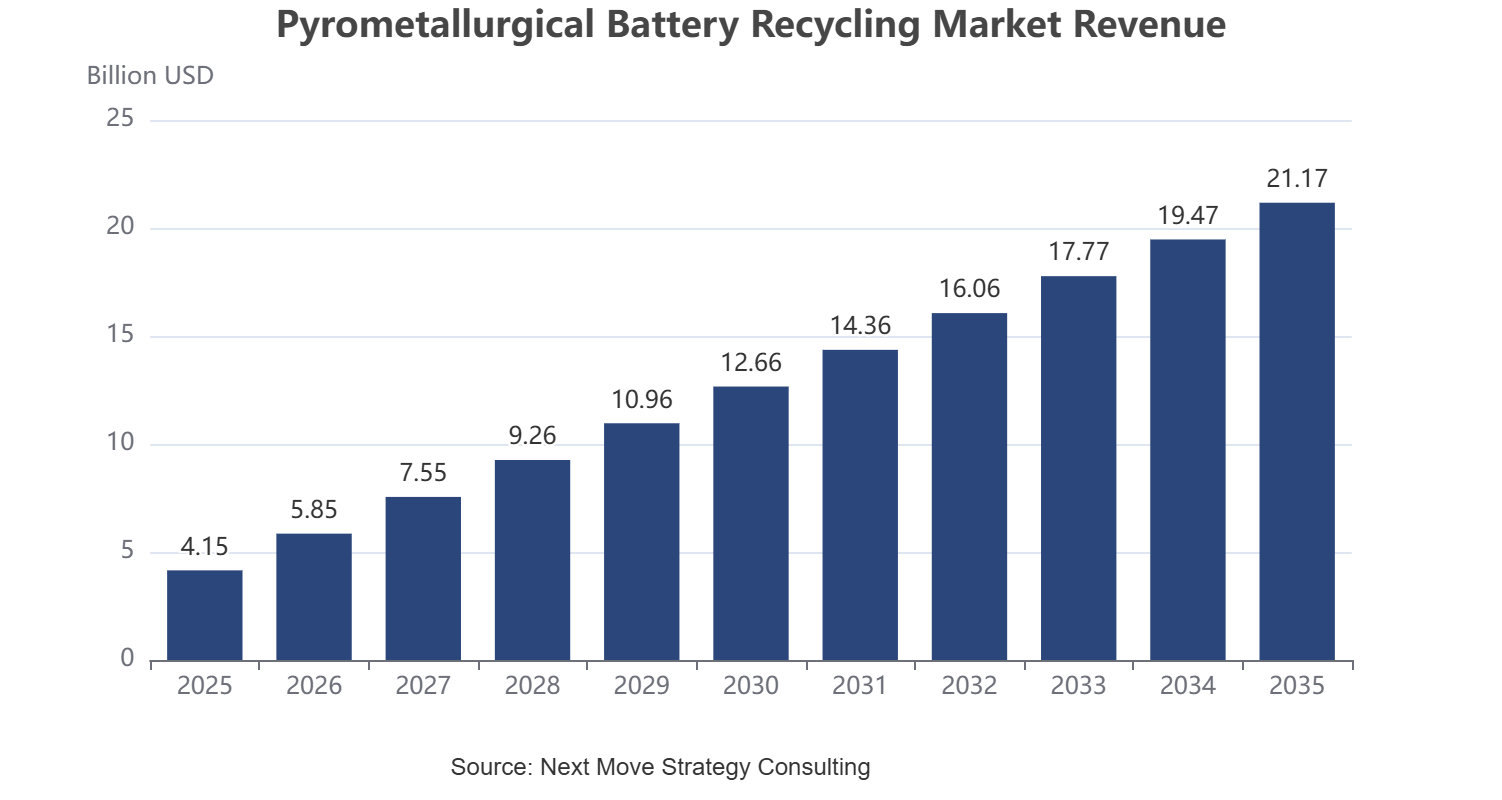
The global Pyrometallurgical Battery Recycling Market size reached USD 4.15 Billion in 2025 and is estimated at USD 4.88 Billion in 2026, forecast to reach USD 21.17 Billion by 2035 at a CAGR of 17.7% between 2026 and 2035. Asia-Pacific leads with an approximate 44% share, while Lithium-Ion chemistry dominates feedstock at approximately 46% share in 2025.
We observed that the smelting-led value chain remains foundational to large-format battery recovery even as hydrometallurgical routes gain share in Europe, giving pyrometallurgical operators a durable role in high-volume, mixed-chemistry feedstock processing.
|
Key Takeaways |
|
By Battery Chemistry: Lithium-Ion held the largest share of approximately 46% (USD 1.91 billion) in 2025; Lithium-Ion is the fastest-growing sub-segment at 21.7% CAGR from 2026–2035. |
|
By Pyrometallurgical Process: Smelting held the largest share of approximately 34% (USD 1.41 billion) in 2025; Pyrolysis is the fastest-growing sub-segment at 22.8% CAGR from 2026–2035. |
|
By End Use Industry: Automotive held the largest share of approximately 48% (USD 1.99 billion) in 2025; Energy Storage is the fastest-growing sub-segment at 23.1% CAGR from 2026–2035. |
|
Dominant Region: Asia-Pacific dominated with approximately 44% revenue share (USD 1.82 billion) in 2025. |
|
Fastest-Growing Region: Latin America is expected to register the highest CAGR of 20.3% during 2026–2035. |
|
Dominant Country: China led with approximately USD 1.01 billion in 2025. |
|
Fastest-Growing Country: Brazil is the fastest-growing country at approximately 21.5% CAGR from 2026–2035. |
Market Opportunity: The market presents an absolute investment opportunity of approximately USD 16.29 Billion between 2026 and 2035, calculated as the difference between the 2035 forecast of USD 21.17 Billion and the 2026 base of USD 4.88 Billion, positioning pyrometallurgical recovery capacity as a high-conviction infrastructure bet for metal traders and industrial recyclers.
According to NMSC analysis, the segment's resilience stems from its ability to process mixed and contaminated feedstock streams that hydrometallurgical circuits cannot economically handle, which keeps smelting-based recovery structurally embedded in the battery circularity value chain even as newer extraction technologies scale.
Ecosystem Analysis of the Pyrometallurgical Battery Recycling Industry
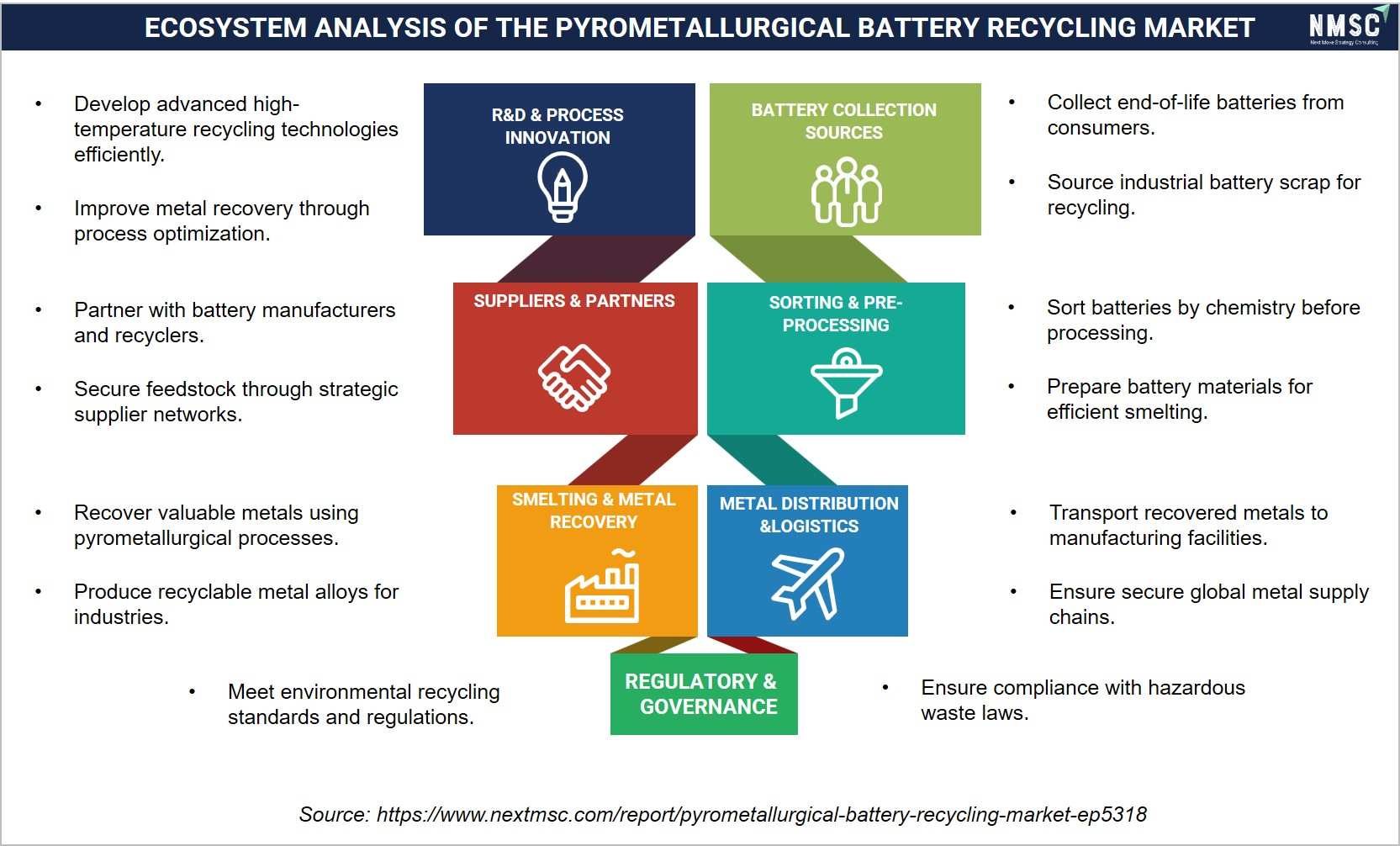
The above infographic presents an ecosystem analysis of the pyrometallurgical battery recycling market, covering R&D, suppliers, collection, sorting, smelting, logistics, and regulation. Advanced high-temperature technologies are improving metal recovery, supported by strategic partnerships with battery manufacturers and recyclers. End-of-life batteries and industrial scrap are collected, sorted by chemistry, and processed through smelting to recover valuable metals for industrial use. Regulatory compliance with environmental standards ensures responsible operations, while secure logistics enable global distribution of recovered materials. Looking ahead, we observed that these interconnected elements collectively shape the market's evolution across the sector.
What does the Pyrometallurgical Battery Recycling Market Encompass?
The Pyrometallurgical Battery Recycling Market covers the thermal processing of spent and scrap batteries through pretreatment, smelting, matte and alloy production, and metal refining to recover cobalt, nickel, lithium, lead, and copper for reuse in battery and industrial supply chains. We observed that the market has evolved from a lead-acid-centric recovery base into a multi-chemistry system as lithium-ion and nickel-based waste volumes accelerate alongside electric-vehicle adoption.
Our findings suggest that regulatory frameworks such as the EU Battery Regulation and U.S. hazardous-waste rules under RCRA are structurally reshaping collection, recovery efficiency, and recycled-content obligations, compelling smelter operators to raise metal-recovery yields and integrate downstream refining. Parallel technology adoption trends, including gas-cleaning upgrades and energy-recovery retrofits, are improving the environmental and economic profile of pyrometallurgical routes relative to purely mechanical shredding operations.
|
Parameter |
Details |
|
Market Size in 2025 |
USD 4.15 Billion |
|
Market Size in 2026 |
USD 4.88 Billion |
|
Revenue Forecast in 2035 |
USD 21.17 Billion |
|
Growth Rate |
CAGR of 17.7% from 2026 to 2035 |
|
Analysis Period |
2025–2035 |
|
Base Year Considered |
2025 |
|
Forecast Period |
2026–2035 |
|
Market Size Estimation |
USD Billion |
|
Companies Profiled |
20 |
|
Countries Covered |
38 |
|
Market Share |
Available for Top 10 Companies |
Key Emerging Trends
Based on research conducted by NMSC, we found that four structural trends are redefining how pyrometallurgical operators compete, source feedstock, and deploy capital through 2035.
How is Feedstock Diversification Transforming Smelter Economics?
Smelters historically tuned for lead-acid batteries are retrofitting furnace chemistry to accept mixed lithium-ion and nickel-based scrap. We found that this transformation improves capacity utilization and reduces dependency on any single chemistry, though it requires investment in slag management and off-gas treatment. Glencore's Sudbury smelter, for example, now processes gigafactory manufacturing scrap alongside end-of-life EV and energy-storage batteries within the same integrated nickel circuit.
What Role Does Hybrid Pyro-Hydro Integration Play in the Pyrometallurgical Battery Recycling Market Adoption?
Our assessment indicates that pure pyrometallurgical processing is increasingly paired with downstream hydrometallurgical refining to lift lithium and cobalt recovery beyond what smelting alone achieves. Umicore's battery recycling process illustrates this shift, converting end-of-life material into a cobalt-nickel-lithium-copper alloy in the pyro stage before hydrometallurgical separation restores battery-grade purity, a design increasingly copied across the industry.
How Are Stakeholders Responding to Recycled-Content Mandates?
We observed that battery manufacturers and automotive OEMs are locking in take-or-pay offtake agreements with pyrometallurgical recyclers to secure recycled cobalt, nickel, and lithium ahead of binding EU minimum-content thresholds. This stakeholder response is accelerating long-term supply contracts and reshaping recyclers from waste-management vendors into strategic materials suppliers within battery value chains.
Why Is Superalloy and Cross-Sector Scrap Blending Gaining Traction?
During our market evaluation, we noticed that operators are blending aerospace superalloy scrap and electronics e-waste with battery feed to balance furnace metallurgy and improve nickel-cobalt yield. Glencore's Sudbury operation, which channels aerospace turbine scrap alongside battery-derived feed, exemplifies how cross-sector blending diversifies revenue and smooths feedstock-price volatility for smelter operators.
Growth Drivers & Restraints
|
Factors |
Type |
(+/−) % Impact on CAGR |
Geographic Relevance |
Impact Timeline |
|
Rising end-of-life EV and ESS battery volumes |
Driver |
+4.8% |
Global |
2026–2035 |
|
EU recycled-content and recovery-efficiency mandates |
Driver |
+3.2% |
Europe |
2026–2032 |
|
Expansion of integrated smelter-refinery capacity |
Driver |
+2.6% |
Asia-Pacific, Europe |
2026–2035 |
|
Take-or-pay offtake contracts with OEMs |
Driver |
+2.1% |
Global |
2026–2030 |
|
Cross-sector scrap blending (superalloy, e-waste) |
Driver |
+1.4% |
North America, Europe |
2026–2033 |
|
High energy intensity and emissions of smelting |
Restraint |
−2.3% |
Global |
2026–2035 |
|
Competition from hydrometallurgical and direct recycling |
Restraint |
−2.0% |
Europe, North America |
2027–2035 |
|
Lithium loss to slag in conventional smelting |
Restraint |
−1.5% |
Global |
2026–2032 |
|
Volatile base-metal and battery-grade metal pricing |
Restraint |
−1.1% |
Global |
2026–2035 |
What is the Primary Growth Driver in the Pyrometallurgical Battery Recycling Market?
The primary growth driver is the accelerating volume of end-of-life lithium-ion and lead-acid batteries entering the waste stream as first-generation EV and grid-storage packs retire. Under the EU Battery Regulation, recycling-efficiency targets of 65% for lithium-based batteries and 75% for lead-acid batteries, applicable by December 31, 2025, are compelling collectors to route higher volumes into certified pyrometallurgical facilities, directly lifting throughput.
How is Regulatory Alignment Driving the Market Growth?
Our analysis shows that binding recycled-content thresholds, set at 16% cobalt, 6% lithium, 6% nickel, and 85% lead for relevant battery categories from August 18, 2031, under the EU framework, are forcing manufacturers to pre-secure recycled feedstock years in advance. In the United States, RCRA and Universal Waste Rule provisions already support a lead-acid battery recycling rate near 99% annually, reinforcing a durable collection base for smelter operators.
What is Restraining the Pyrometallurgical Battery Recycling Market?
We found that the primary restraint is the high energy intensity of smelting relative to hydrometallurgical and emerging direct-recycling routes, which recover lithium at lower yields due to slag losses. Industry-derived estimates place typical pyrometallurgical lithium recovery well below cobalt and nickel recovery rates exceeding 92%, pushing some European operators toward hybrid or fully hydrometallurgical investment instead.
Segmentation Analysis
Segment Sizing: By Battery Chemistry
|
Segment |
2025 (USD Bn) |
2035 (USD Bn) |
CAGR% (2026–2035) |
|
Lead Acid |
1.74 |
5.72 |
12.1% |
|
Lithium-Ion |
1.91 |
13.12 |
21.7% |
|
Nickel Based |
0.33 |
1.48 |
16.0% |
|
Other Batteries |
0.17 |
0.85 |
17.4% |
|
Total |
4.15 |
21.17 |
17.7% |
Which Battery Chemistry Segment Dominates the Market?
Lithium-Ion leads with USD 1.91 Billion in 2025, expanding to USD 13.12 Billion by 2035 at a 21.7% CAGR, driven by surging lithium-ion battery retirements from EVs and consumer electronics. Lead-acid remains the second-largest segment on the strength of automotive SLI collection infrastructure, though its slower 12.1% CAGR reflects a maturing, already highly circular sub-market compared with the still-scaling lithium-ion recovery chain.
Segment Sizing: By Pyrometallurgical Process
|
Segment |
2025 (USD Bn) |
2035 (USD Bn) |
CAGR% (2026–2035) |
|
Smelting |
1.41 |
6.35 |
16.1% |
|
Metal Refining |
0.66 |
3.81 |
19.3% |
|
Thermal Pretreatment |
0.58 |
2.75 |
16.8% |
|
Slag Processing |
0.42 |
1.91 |
16.3% |
|
Calcination |
0.33 |
1.69 |
17.7% |
|
Alloy Production |
0.33 |
1.91 |
19.3% |
|
Matte Production |
0.25 |
1.48 |
19.9% |
|
Pyrolysis |
0.17 |
1.27 |
22.8% |
|
Total |
4.15 |
21.17 |
17.7% |
Which Process Segment Leads and Which Grows Fastest?
Smelting remains dominant at USD 1.41 Billion in 2025, rising to USD 6.35 Billion by 2035, reflecting its role as the core thermal step across nearly all pyrometallurgical routes. Pyrolysis is the fastest-growing sub-segment at a 22.8% CAGR, as operators adopt pyrolysis-based pretreatment to safely deactivate lithium-ion cells and recover electrolyte solvents ahead of smelting, improving downstream metal purity and furnace safety.
Segment Sizing: By End Use Industry
|
Segment |
2025 (USD Bn) |
2035 (USD Bn) |
CAGR% (2026–2035) |
|
Automotive |
1.99 |
9.32 |
16.7% |
|
Energy Storage |
0.83 |
6.35 |
23.1% |
|
Consumer Electronics |
0.58 |
2.54 |
15.8% |
|
Industrial |
0.42 |
1.69 |
14.7% |
|
Mining and Metallurgy |
0.17 |
0.64 |
13.8% |
|
Aerospace and Defense |
0.12 |
0.42 |
12.1% |
|
Marine |
0.04 |
0.21 |
17.3% |
|
Total |
4.15 |
21.17 |
17.7% |
Which End Use Industry Dominates and Which is Fastest-Growing?
Automotive leads end-use demand at USD 1.99 Billion in 2025, growing to USD 9.32 Billion by 2035, underpinned by SLI and electric vehicle battery retirements. Energy Storage is the fastest-growing end use at a 23.1% CAGR as grid-scale and behind-the-meter battery deployments installed over the past five years begin reaching end-of-life volumes that require dedicated smelter capacity.
Supply Chain Analysis of the Pyrometallurgical Battery Recycling Market
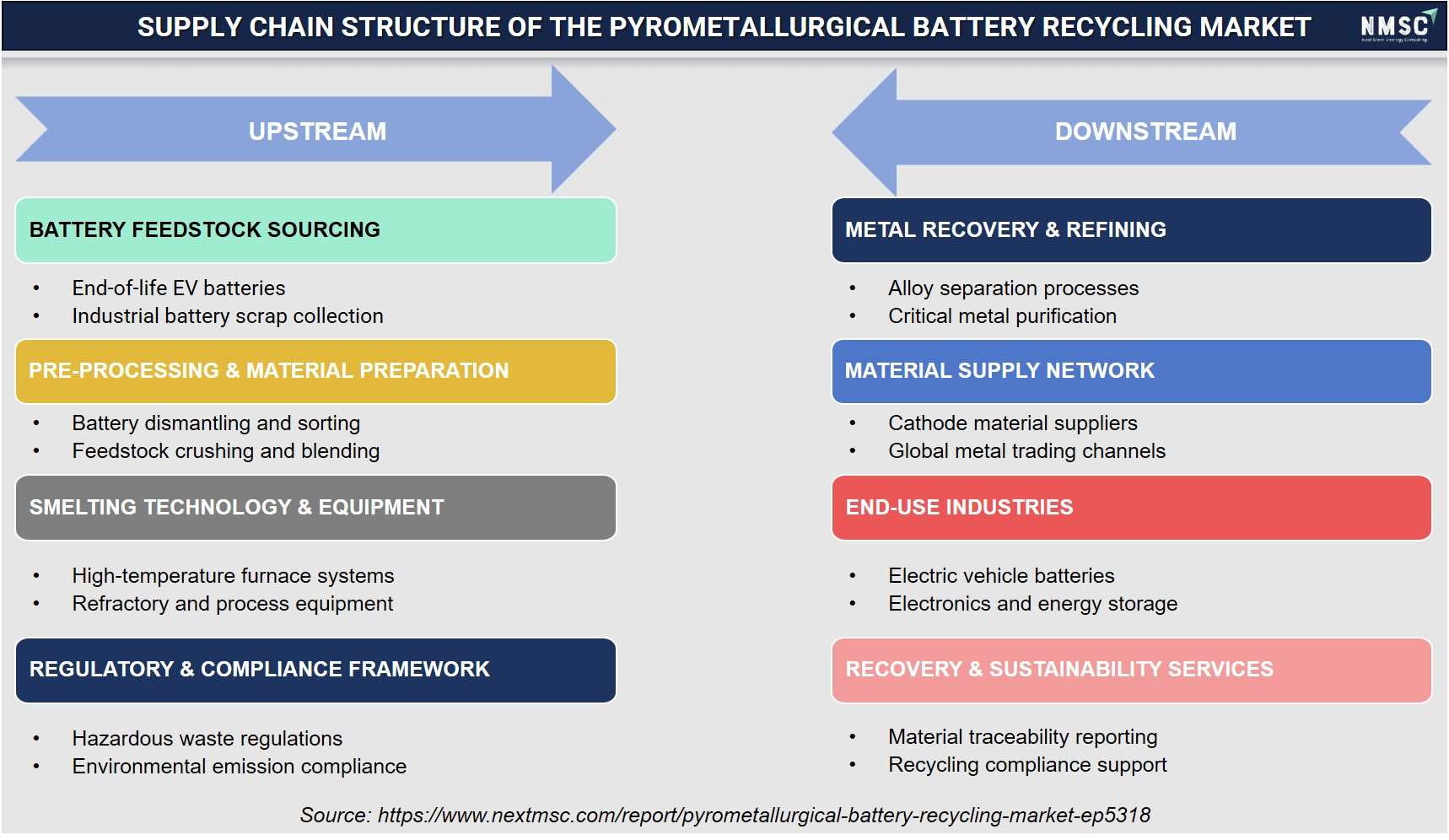
The above infographic presents the supply chain structure of the pyrometallurgical battery recycling market, segmented into upstream and downstream activities. Upstream begins with sourcing end-of-life EV batteries and industrial scrap, which are moved into dismantling, sorting, and crushing to prepare feedstock for high-temperature smelting. Furnace systems and process equipment support metal recovery, while hazardous waste and emission regulations ensure compliance. Moving downstream, alloy separation and purification recover critical metals for supply to cathode manufacturers and end-use industries such as electric vehicles and energy storage. Looking ahead, we observed that material traceability and recycling compliance services continue to strengthen sustainability efforts across the market.
Growth Opportunities
Our analysis shows that three whitespace opportunities stand out for operators positioning ahead of 2035 demand.
Can Recycled-Content Offtake Contracts Unlock Long-Term Revenue Visibility?
Battery manufacturers seeking compliance with EU recycled-content thresholds can lock in multi-year offtake agreements with pyrometallurgical recyclers, converting a compliance obligation into a predictable revenue stream for smelter operators and a secured supply chain for cathode-material producers.
Does Retrofitting Legacy Lead-Acid Smelters for Multi-Chemistry Feed Create Value in the Pyrometallurgical Battery Recycling Market?
Owners of established lead-acid smelting assets can retrofit furnace and off-gas systems to accept lithium-ion and nickel-based feed, unlocking incremental capacity without full greenfield capital outlay, benefiting metal traders and industrial recyclers with existing permitted infrastructure.
Can Regional Smelter Hubs Near Gigafactories Reduce Logistics Cost for OEMs?
Locating pyrometallurgical capacity near gigafactory clusters allows automotive OEMs and battery manufacturers to shorten scrap-return logistics and lower transport-related emissions, an opportunity increasingly captured by recyclers co-locating with battery manufacturing corridors in North America and Europe.
Regional Outlook
|
Region |
2025 (USD Bn) |
2035 (USD Bn) |
CAGR% (2026–2035) |
Key Driver |
|
Asia-Pacific |
1.82 |
10.16 |
18.9% |
Integrated smelter capacity and battery manufacturing scale |
|
Europe |
1.12 |
5.29 |
16.7% |
EU Battery Regulation recycled-content mandates |
|
North America |
0.83 |
3.60 |
15.6% |
Gigafactory scrap volumes and RCRA collection base |
|
Latin America |
0.21 |
1.27 |
20.3% |
Expanding automotive fleet electrification |
|
Middle East & Africa |
0.17 |
0.85 |
17.4% |
Emerging industrial metal-recovery investment |
|
Total |
4.15 |
21.17 |
17.7% |
|
Asia-Pacific Pyrometallurgical Battery Recycling Market
Asia-Pacific holds the largest regional share, supported by China's, Japan's, and South Korea's integrated cathode-material and smelting capacity. We observed that regional operators benefit from proximity to battery-cell manufacturing, favorable industrial-metal demand, and government-backed circular-economy programs, positioning the region as both the largest feedstock source and the largest processing hub through 2035.
Europe Pyrometallurgical Battery Recycling Market
Europe's market is shaped directly by the EU Battery Regulation, which sets binding recycling-efficiency and recycled-content targets. Our findings suggest that Belgian, German, and Nordic smelter operators are the most advanced in hybrid pyro-hydro integration, giving the region technology leadership even as its overall volume growth trails Asia-Pacific.
North America Pyrometallurgical Battery Recycling Market
North America's growth is tied to gigafactory manufacturing-scrap volumes and a mature RCRA-governed lead-acid collection network. We found that Canadian nickel-smelter capacity, particularly in Ontario, is increasingly allocated to battery-derived feed alongside traditional ore-based nickel production, reflecting a structural shift in regional smelter utilization.
Middle East & Africa Pyrometallurgical Battery Recycling Market
The Middle East & Africa region remains an early-stage market, with South Africa's established base-metal smelting sector positioned to absorb growing lead-acid and industrial battery scrap. Industry-derived estimates suggest regional growth will track broader industrial-metals investment rather than battery-specific policy, given the comparatively limited regulatory mandates in the region.
Latin America Pyrometallurgical Battery Recycling Market
Latin America is the fastest-growing region at a 20.3% CAGR, led by Brazil's expanding automotive fleet and growing lead-acid collection formalization. We observed that Argentina's mineral-processing base offers latent smelting capacity that could be redirected toward battery-scrap recovery as regional collection networks mature over the forecast period.
U.S. Pyrometallurgical Battery Recycling Market
Based on our estimates, the U.S. market was valued at approximately USD 0.62 Billion in 2025 and is projected to reach USD 2.71 Billion by 2035 at a CAGR near 17.8%. Demand structure is anchored by a mature RCRA-regulated lead-acid collection network and rising gigafactory manufacturing scrap, with strong smelter-refinery integration in the Midwest and Southeast supporting high technology penetration and moderate competitive intensity among established recyclers.
Canada Pyrometallurgical Battery Recycling Market
The market in Canada was estimated at around USD 0.13 Billion in 2025, forecast to reach USD 0.56 Billion by 2035 at roughly 17.5% CAGR. Ontario's integrated nickel smelting base gives Canada disproportionate processing capacity relative to its domestic battery-scrap generation, supporting a strategic role as a regional recycling hub with strong regulatory alignment under federal hazardous-waste rules.
UK Pyrometallurgical Battery Recycling Market
As per our estimate, the UK market stood near USD 0.15 Billion in 2025 and is expected to reach USD 0.63 Billion by 2035 at approximately 17.2% CAGR. Post-Brexit alignment with EU-style battery-waste standards, combined with growing EV-fleet retirements, is lifting demand structure, though technology penetration in hydrometallurgical alternatives keeps competitive intensity elevated.
Germany Pyrometallurgical Battery Recycling Market
According to our analysis, Germany's market was valued at about USD 0.29 Billion in 2025, projected to reach USD 1.28 Billion by 2035 at a CAGR near 17.6%. As the EU's largest automotive manufacturing base, Germany combines strong regulatory enforcement of the EU Battery Regulation with advanced smelter-refinery technology adoption, supporting a strategic outlook centered on recycled-content compliance for domestic OEMs.
France Pyrometallurgical Battery Recycling Market
Based on our estimates, France's market reached approximately USD 0.16 Billion in 2025 and is forecast to grow to USD 0.68 Billion by 2035 at around 17.3% CAGR. Demand is supported by national battery-gigafactory investment and EU-aligned collection targets, with moderate competitive intensity as domestic recyclers scale capacity to match rising feedstock volumes.
China Pyrometallurgical Battery Recycling Market
The market in China was valued at nearly USD 1.01 Billion in 2025 and is projected to reach USD 5.68 Billion by 2035 at approximately 19.2% CAGR. China's dominance reflects its unmatched scale in cathode-material production and integrated smelter-refinery capacity, with high technology penetration and intense competitive rivalry among domestic recycling conglomerates.
India Pyrometallurgical Battery Recycling Market
As per our estimate, India's market was close to USD 0.16 Billion in 2025, expected to reach USD 1.02 Billion by 2035 at roughly 20.6% CAGR. Rising two-wheeler and automotive electrification is expanding feedstock availability, while regulatory frameworks under domestic battery-waste rules are still maturing relative to more established Asia-Pacific peers, keeping technology penetration moderate.
Japan Pyrometallurgical Battery Recycling Market
According to our analysis, Japan's market stood at about USD 0.22 Billion in 2025 and is forecast to reach USD 1.09 Billion by 2035 at approximately 17.9% CAGR. Japan's demand structure benefits from decades of precious- and base-metal smelting expertise redirected toward battery-grade cobalt and nickel recovery, supporting high technology penetration and strong strategic positioning in premium metal recovery.
South Korea Pyrometallurgical Battery Recycling Market
Based on our estimates, South Korea's market was valued near USD 0.20 Billion in 2025, projected to reach USD 1.06 Billion by 2035 at around 18.5% CAGR. Deep integration between domestic battery-cell manufacturers and smelter-refinery operators supports high technology adoption, while competitive intensity remains elevated among a small number of vertically integrated players.
Australia Pyrometallurgical Battery Recycling Market
As per our estimate, Australia's market reached approximately USD 0.08 Billion in 2025 and is expected to grow to USD 0.38 Billion by 2035 at roughly 18.1% CAGR. Australia's strong mining and metallurgy base supports strategic positioning as a future feedstock and processing hub, though current technology penetration in battery-specific smelting remains behind established Asian peers.
UAE Pyrometallurgical Battery Recycling Market
Based on our estimates, the UAE market was valued at about USD 0.03 Billion in 2025 and is forecast to reach USD 0.15 Billion by 2035 at approximately 19.3% CAGR. Growing industrial diversification and logistics infrastructure support the UAE's emerging role as a regional metal-recovery gateway, though regulatory frameworks specific to battery recycling remain in early development.
Saudi Arabia Pyrometallurgical Battery Recycling Market
According to our analysis, Saudi Arabia's market stood near USD 0.03 Billion in 2025, projected to reach USD 0.14 Billion by 2035 at around 18.8% CAGR. Vision 2030-linked industrial diversification is supporting early-stage investment in metal-recovery infrastructure, with competitive intensity currently limited to a small number of industrial-metals participants.
South Africa Pyrometallurgical Battery Recycling Market
As per our estimate, South Africa's market was close to USD 0.05 Billion in 2025 and is expected to reach USD 0.22 Billion by 2035 at roughly 17.6% CAGR. An established base-metal smelting sector gives South Africa the strongest technology penetration in the MEA region, supporting a strategic outlook centered on absorbing rising lead-acid battery volumes from the domestic automotive fleet.
Brazil Pyrometallurgical Battery Recycling Market
Based on our estimates, Brazil's market reached approximately USD 0.11 Billion in 2025 and is projected to reach USD 0.71 Billion by 2035 at around 21.5% CAGR. Rapid automotive-fleet expansion and formalizing collection networks are driving demand structure, with regulatory alignment on hazardous-waste handling gradually strengthening technology penetration and strategic investment appeal.
Argentina Pyrometallurgical Battery Recycling Market
According to our analysis, Argentina's market was valued at about USD 0.04 Billion in 2025, forecast to reach USD 0.23 Billion by 2035 at approximately 21.0% CAGR. Existing mineral-processing infrastructure offers latent capacity for battery-scrap absorption, though competitive intensity remains low given the still-developing formal collection base for end-of-life batteries.
Competitive Landscape
Our assessment indicates that the competitive landscape spans diversified mining and smelting conglomerates, pure-play battery recyclers, and regional specialists, each competing on recovery yield, feedstock access, and downstream refining integration.
|
Dimension |
Assessment |
|
Market Structure |
Moderately consolidated; top 10 companies hold the majority of Market Share, led by diversified mining conglomerates with integrated smelter-refinery assets |
|
Innovation Focus |
Hybrid pyro-hydro process integration, lithium recovery from slag, and furnace retrofits for multi-chemistry feed |
|
M&A Activity |
Selective partnerships and joint ventures with OEMs and technology developers rather than large-scale consolidation |
How Do Companies Compete in the Pyrometallurgical Battery Recycling Industry?
Companies compete primarily on metal-recovery yield, feedstock-sourcing agreements, and the ability to deliver battery-grade output through downstream refining. Our findings suggest that operators with existing base-metal smelting infrastructure hold a structural cost advantage over new entrants, since furnace and off-gas assets can be retrofitted rather than built from scratch.
Which Competitive Archetypes Dominate the Pyrometallurgical Battery Recycling Market?
Diversified mining and smelting conglomerates with integrated nickel, cobalt, and lead circuits dominate volume share, while specialist battery recyclers differentiate through proprietary hydrometallurgical add-ons that lift lithium recovery. Regional players in Japan and South Korea compete on precision refining expertise, and emerging-market recyclers compete primarily on feedstock-cost advantage.
What Innovation and Differentiation Strategies Are Companies Pursuing?
We observed that leading operators are investing in gas-cleaning upgrades, energy-recovery retrofits, and hybrid pyro-hydro circuits to raise cobalt and nickel recovery above 95% while narrowing the lithium-recovery gap. Differentiation increasingly rests on the ability to guarantee battery-grade output purity under long-term OEM offtake contracts rather than on smelting capacity alone.
What M&A and Partnership Activity Is Shaping the Pyrometallurgical Battery Recycling Market?
Recent activity favors targeted partnerships over outright acquisitions, exemplified by Umicore's strategic partnership with automotive cell maker ACC and Glencore's equity investment in Lifezone Metals' precious-metals recycling project. Our analysis shows that such structures let incumbents access new recovery technology and feedstock without the balance-sheet risk of full-scale M&A amid volatile EV-demand signals.
Key Market Players
Based on research conducted by NMSC, the following companies represent the validated set of leading participants across mining-integrated, pure-play, and regional pyrometallurgical battery recycling operations.
-
Glencore plc
-
Ecobat
-
Clarios LLC
-
Boliden AB
-
East Penn Manufacturing Company
-
Gopher Resource LLC
-
RSR Corporation
-
Campine NV
-
Gravita India Ltd.
-
DOWA Holdings Co., Ltd.
-
Korea Zinc Co., Ltd.
-
JX Advanced Metals Corporation
-
Mitsubishi Materials Corporation
-
Accurec Recycling GmbH
-
SNAM
-
Batrec Industrie AG
-
GEM Co., Ltd.
-
Guangdong Brunp Recycling Technology Co., Ltd.
-
Nickelhütte Aue GmbH
Latest Developments
The pyrometallurgical battery recycling market is evolving alongside advancements in battery recycling, critical metal recovery, and high-temperature processing technologies. Industry participants are strengthening recycling capabilities, optimizing resource recovery processes, and exploring innovative approaches to handle complex battery feedstocks. These developments are supporting the broader transition toward efficient circular battery value chains and creating opportunities for enhanced recovery of valuable metals from end-of-life batteries.
Investment Opportunities
Where Are Capital Inflows Concentrating in the Pyrometallurgical Battery Recycling Market?
Capital is concentrating on furnace retrofits and off-gas upgrades that allow existing lead-acid smelters to accept lithium-ion and nickel-based feed. Glencore's more than USD 100 Million furnace investment at its Sudbury operations illustrates the scale of capital being redirected toward multi-chemistry smelting capacity across established industrial-metals operators.
How Is Infrastructure Investment Shaping Long-Term Capacity in the Pyrometallurgical Battery Recycling Market?
Our findings suggest that infrastructure investment is shifting toward integrated smelter-to-refinery campuses that pair thermal processing with hydrometallurgical finishing on a single site, reducing intermediate transport and improving overall metal recovery. This integrated-campus model is becoming the preferred template for greenfield capacity in Asia-Pacific and Europe.
What ESG Considerations Are Influencing Investment Decisions?
Environmental, Social, and Governance considerations increasingly favor recyclers that can document verified recovery yields and reduced landfill diversion, both of which support compliance with EU recycled-content disclosure requirements. We found that investors are placing a premium on operators with third-party-verified emissions data from smelter modernization projects, such as Glencore's reported 22% emissions reduction at its retrofitted Sudbury facility.
Key Benefits for Stakeholders
How Does This Report Benefit Industry Leaders?
Industry leaders gain segment-level revenue forecasts and CAGR benchmarks across battery chemistry, process, and end-use axes, enabling capacity-planning decisions grounded in the same 2025–2035 figures used consistently throughout this analysis. Our findings on regional growth differentials further support facility-siting and feedstock-sourcing decisions.
How Does This Report Benefit Investors and Financial Analysts?
Investors and financial analysts gain a reconciled market-sizing model, competitive-landscape assessment, and named-company development tracking that supports valuation and capital-allocation decisions. The report's Growth Catalyst & Risk Assessment Matrix quantifies driver and restraint impact on CAGR, aiding scenario analysis for portfolio positioning.
How Does This Report Benefit Technology Vendors and Product Teams?
Technology vendors and product teams serving furnace design, off-gas treatment, and hydrometallurgical finishing gain visibility into which process segments, such as Pyrolysis and Metal Refining, are growing fastest, informing where to prioritize R&D and commercial deployment through 2035.
Key Market Segments
By Battery Chemistry
-
Lead-Acid
-
Automotive Starting Lighting Ignition
-
Motive Power
-
Stationary Power
-
-
Lithium Ion
-
Nickel Cobalt Aluminum
-
Nickel Cobalt Manganese
-
Lithium Cobalt Oxide
-
Lithium Iron Phosphate
-
Lithium Manganese Oxide
-
Lithium Titanate
-
Mixed Lithium Ion
-
-
Nickel Based
-
Nickel Cadmium
-
Nickel Metal Hydride
-
-
Other Batteries
By Feedstock Source
-
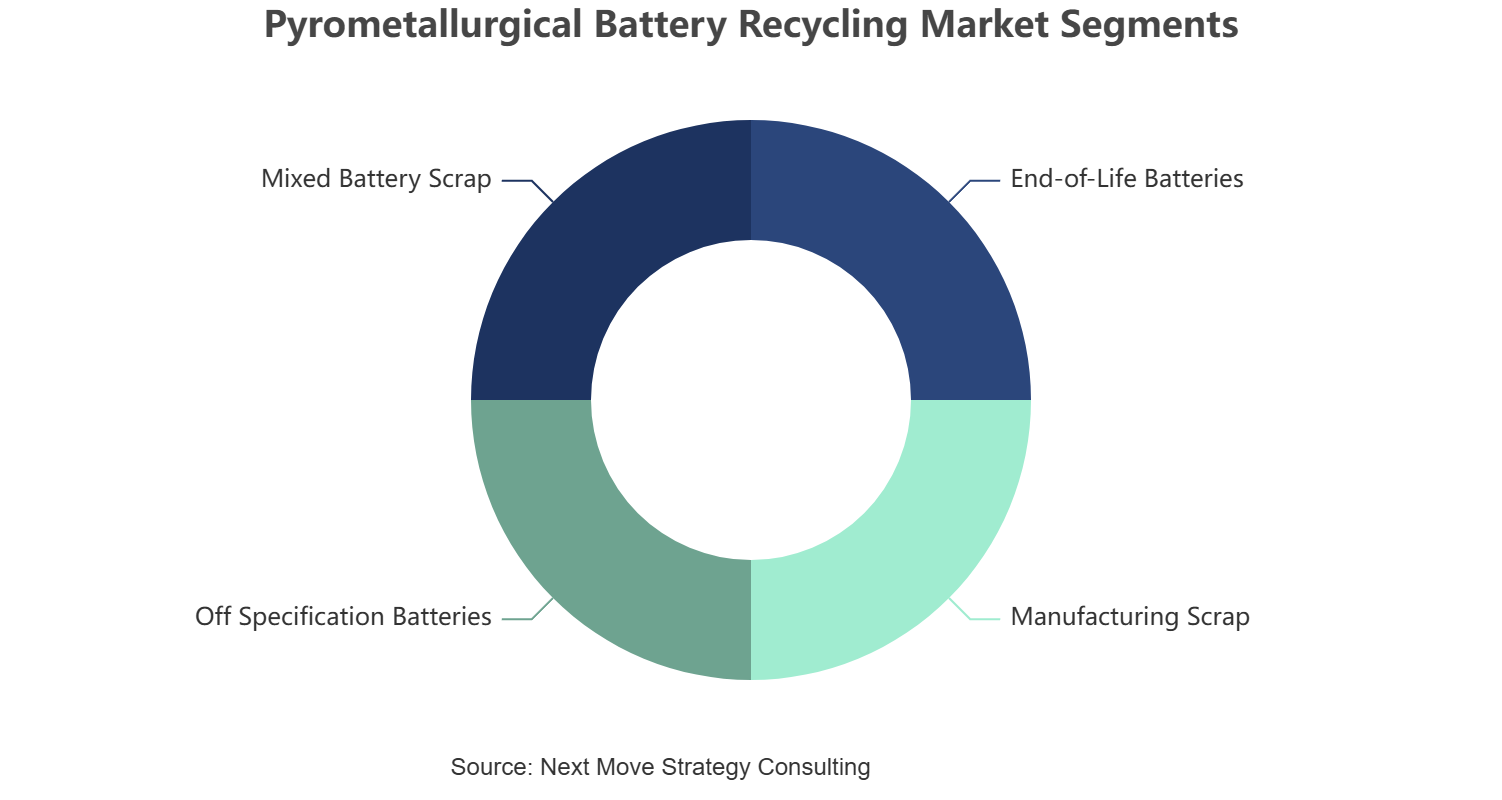
End-of-Life Batteries
-
Manufacturing Scrap
-
Off Specification Batteries
-
Mixed Battery Scrap
By Pyrometallurgical Process
-
Thermal Pretreatment
-
Pyrolysis
-
Calcination
-
Smelting
-
Alloy Production
-
Matte Production
-
Metal Refining
-
Slag Processing
By Revenue Model
-
Recycling Service Fees
-
Toll Processing
-
Gate Fees
-
Recovered Metal Sales
-
Alloy Sales
-
Matte Sales
-
Slag and By-product Sales
By Customer Type
-
Battery Manufacturers
-
Automotive OEMs
-
Electronics Manufacturers
-
Industrial Companies
-
Waste Management Companies
-
Metal Traders
By End Use Industry
-
Automotive
-
Energy Storage
-
Consumer Electronics
-
Industrial
-
Aerospace and Defense
-
Marine
-
Mining and Metallurgy
By Region
-
North America: U.S., Canada, Mexico
-
Europe: UK, Germany, France, Italy, Spain, Sweden, Denmark, Finland, Netherlands, Rest of Europe
-
Asia-Pacific: China, India, Japan, South Korea, Taiwan, Indonesia, Vietnam, Australia, Philippines, Malaysia, Rest of APAC
-
Middle East & Africa: Saudi Arabia, UAE, Egypt, Israel, Turkey, Nigeria, South Africa, Rest of MEA
-
Latin America: Brazil, Argentina, Chile, Colombia, Rest of LATAM
Conclusion & Recommendations
What Is the Long-Term Outlook for the Pyrometallurgical Battery Recycling Market?
The long-term outlook remains structurally positive, with the market expanding from USD 4.88 Billion in 2026 to USD 21.17 Billion by 2035 at a 17.7% CAGR, driven by rising end-of-life battery volumes and tightening recycled-content mandates. We observed that this growth trajectory is underpinned by multi-year feedstock visibility rather than speculative demand, supporting sustained capital deployment.
What Strategic Positioning Do We Recommend?
Our assessment indicates that operators should prioritize furnace flexibility across multiple battery chemistries and pursue hybrid pyro-hydro integration to capture the fastest-growing Lithium-Ion and Energy Storage segments. Companies without existing smelter assets should pursue toll-processing or joint-venture partnerships rather than greenfield capital commitments, given the capital intensity of furnace infrastructure.
How Attractive Is the Market for Investment?
Investment attractiveness is high in Asia-Pacific and Latin America, given superior CAGR profiles of 18.9% and 20.3%, respectively, while Europe offers regulatory-driven revenue certainty despite comparatively moderate growth. We found that recycled-metal offtake contracts materially de-risk capital deployment relative to spot-market metal-price exposure.
What Are the Key Market Shifts and Risks?
Key risks include competitive displacement from hydrometallurgical and direct-recycling technologies that achieve superior lithium recovery, alongside continued volatility in base-metal and battery-grade metal pricing. Our analysis shows that operators unable to lift lithium-recovery yields risk ceding share in the fastest-growing chemistry segment to hybrid or fully hydrometallurgical competitors.
What Are the Primary Growth Pathways Through 2035?
Primary growth pathways include capacity expansion near gigafactory clusters, deeper integration with OEM recycled-content offtake programs, and technology upgrades that narrow the lithium-recovery gap versus hydrometallurgical routes. We observed that companies combining all three pathways are best positioned to capture a disproportionate share of the USD 16.29 Billion absolute opportunity created between 2026 and 2035.
About the Author
 Mayurima Roy
— Mayurima Roy is Research Analyst at Next Move Strategy Consulting, where she has spent 4 years working across the firm's full industry coverage rather than a single fixed vertical. Her work centers on structured research, ongoing trend tracking, competitive assessment, and insight-led content development, translating complex market data into clear, decision-ready narratives that support informed client decision-making across diverse global industries, market sectors, and world regions every day.
Mayurima Roy
— Mayurima Roy is Research Analyst at Next Move Strategy Consulting, where she has spent 4 years working across the firm's full industry coverage rather than a single fixed vertical. Her work centers on structured research, ongoing trend tracking, competitive assessment, and insight-led content development, translating complex market data into clear, decision-ready narratives that support informed client decision-making across diverse global industries, market sectors, and world regions every day.
About the Reviewer
 Supradip Baul
— Supradip Baul is an accomplished business consultant and strategist with over a decade of rich experience in market intelligence, strategy, technology, and business transformation. His work has included rigorous qualitative and quantitative analysis across multiple industries, helping clients shape investment decisions and long-term roadmaps. Earlier in his career, he was associated with Gartner, where he contributed to industry-leading reports and market share analyses. He has worked with leading global companies and holds an MBA with a dual specialization in Marketing and Finance.
Supradip Baul
— Supradip Baul is an accomplished business consultant and strategist with over a decade of rich experience in market intelligence, strategy, technology, and business transformation. His work has included rigorous qualitative and quantitative analysis across multiple industries, helping clients shape investment decisions and long-term roadmaps. Earlier in his career, he was associated with Gartner, where he contributed to industry-leading reports and market share analyses. He has worked with leading global companies and holds an MBA with a dual specialization in Marketing and Finance.
At Next Move Strategy Consulting, we understand that insightful market research is the cornerstone of successful business decisions. That's why we employ a robust and multifaceted approach, combining various methodologies to deliver the most accurate and actionable data for our clients.

Research Landscape
We navigate the world of research with two primary approaches:
Qualitative Approach
Our qualitative research methodologies involve immersive techniques such as in-depth interviews, focus groups, and observational studies. By engaging directly with individuals and stakeholders, we uncover valuable insights that quantitative data alone may overlook.

Quantitative Research
In tandem with qualitative methodologies, NMSC leverages the power of Quantitative Research to provide a robust foundation of numerical insights. Through systematic data collection and analysis, we quantify patterns, preferences, and market trends, offering a comprehensive view of the business landscape.
Our quantitative research approach employs diverse tools, including surveys, experiments, and statistical modelling. These methodologies enable us to gather data from a large and representative sample, ensuring the statistical significance of our findings. By employing structured questionnaires and standardized data collection methods, we guarantee the reliability and validity of the information we present to our clients.
Quantitative research is particularly effective in measuring the prevalence of trends, assessing market size, and gauging the impact of various factors on consumer behavior. The numerical precision attained through this approach equips our clients with actionable insights, facilitating data-driven decision-making and strategy formulation.


Our Specialized Toolbox for Industry-Specific Market Research
We deploy a specialized arsenal of techniques tailored to meet your unique requirements. Here's a glimpse into our comprehensive toolbox:

Information Procurement
The stage entails acquiring market data or relevant information through various sources and methodologies.


Market Research Approach
We utilize both top-down and bottom-up approaches in market research analysis to achieve a comprehensive understanding of the market dynamics, leveraging the broad perspective of industry trends and macroeconomic factors alongside detailed insights from specific segments and individual companies.

Porters Five Forces Analysis
We conduct Porter's Five Forces analysis to evaluate the competitive landscape of an industry, providing us with insights into factors that affect profitability and strategic positioning.

SWOT Analysis

Forecasting
We utilize a forecasting model to predict future consumption by considering parameters like population, economics, regulations, market competition, drivers, constraints, technology, and pricing. We also employ statistical techniques such as multilinear regression, exponential smoothing, moving average, ARIMA, and Monte Carlo simulations for accurate predictions. In econometric forecasting, we analyzed short-term and long-term event impacts, attributing values based on regulatory frameworks, economic factors, and market events.





 Speak to Our Analyst