Real-Time 3D Collaboration Platform Market By Offering [{Software (SaaS Subscriptions, Platform Subscriptions, and Others), Developer Tools (Engine Licenses, and Others), Consumption Services (Rendering & Streaming, Data Processing, and Others), and Others}], By Buyer Type (Enterprise, Mid-Market, Small Business, Micro Business, Public Sector & Education, Individual Professionals), and By Deployment Model (Public Cloud, Private Cloud, and Others) – Global Analysis & Forecast, 2025–2035
Industry: ICT & Media | Publishing Date: April 24, 2026 | Last Updated: September 30, 2026 | No of Pages: N/A | No. of Tables: N/A | No. of Figures: N/A | Format: PDF | Report Code: IC4520
Industry Outlook
The global Real-Time 3D Collaboration Platform Market size was valued at USD 12.47 billion in 2025, and is expected to be valued at USD 14.44 billion by the end of 2026. The industry is projected to grow, hitting USD 54.25 billion by 2035, with a CAGR of 15.80% between 2026 and 2035.
Real-Time 3D Collaboration Platform Market Size & Forecast
|
Parameters |
Details |
|
Market Size in 2026 |
USD 14.44 Billion |
|
Revenue Forecast in 2035 |
USD 54.25 Billion |
|
Growth Rate |
CAGR of 15.80% from 2026 to 2035 |
|
Analysis Period |
2025–2035 |
|
Base Year Considered |
2025 |
|
Forecast Period |
2026–2035 |
|
Market Size Estimation |
Billion (USD) |
|
Companies Profiled |
20 |
|
Countries Covered |
33 |
|
Market Share |
Available for 10 companies |
Based on NMSC’s primary research, we found that the real-time 3D collaboration platform market growth is experiencing steady expansion as enterprises increasingly adopt collaborative visualization tools to support distributed design, engineering, and digital content workflows. Industry analysis indicates that organizations across architecture, manufacturing, gaming, and media production are integrating 3D collaboration software platforms to enable real-time interaction with complex digital assets. As a result, cloud-based 3D collaboration environments and real-time 3D rendering technologies are becoming essential for interactive design reviews and collaborative scene development. Market evidence suggests that advances in GPU cloud infrastructure, spatial computing, and digital twin collaboration software are strengthening the capabilities of collaborative platforms. Consequently, enterprises are transitioning from static visualization tools toward dynamic spatial collaboration platforms, supporting faster decision-making and improved coordination across distributed teams.
Moreover, evaluation of enterprise deployments across North America, Europe, and Asia-Pacific indicates that adoption patterns vary according to industry digitalization maturity and technology ecosystems. North America benefits from strong cloud infrastructure and innovation in enterprise metaverse solutions, while Europe demonstrates growing integration of collaborative visualization tools within industrial engineering and digital twin initiatives. In Asia-Pacific, expanding gaming studios, animation production houses, and advanced manufacturing ecosystems are accelerating demand for collaborative real-time visualization environments. Industry patterns indicate that leading technology providers compete through scalable RT3D software platforms, immersive enterprise XR collaboration solutions, and integrated virtual production software environments. As collaborative digital ecosystems expand, these technologies are strengthening interactive design workflows and enabling organizations to coordinate complex digital projects across the evolving real-time 3d collaboration platform market.
What Are the Key Trends in the Real-Time 3D Collaboration Platform Industry?
How Are GPU Cloud Streaming Architectures Transforming the Real-Time 3D Collaboration Platform Market?
Our evaluation indicates that GPU cloud streaming architectures are redefining performance standards across the real-time 3D rendering market. As engineering models, digital environments, and simulation datasets continue to grow in complexity, enterprises increasingly rely on cloud-hosted GPU clusters to deliver high-fidelity visualization to distributed users. Market evidence suggests that this architecture allows teams to access immersive environments without depending on specialized local hardware. Consequently, cloud-based 3D collaboration platforms now support large-scale model visualization, interactive rendering, and distributed engineering reviews across global teams. Industry patterns indicate that scalable GPU streaming infrastructure is becoming a core enabling technology supporting the expansion of collaborative visualization ecosystems within the real-time 3d collaboration platform market.
How Are Digital Twin Collaboration Platforms Reshaping Engineering Coordination?
Our technical evaluation indicates that collaborative digital twin environments are becoming a central capability within the 3D digital twin market. As organizations integrate operational data with simulation models, digital twin collaboration software allows engineering teams, planners, and operational stakeholders to interact with complex systems in shared visualization environments. Moreover, our research suggests that this approach significantly improves design validation, scenario simulation, and operational planning across distributed teams. Furthermore, integrating digital twins with 3D collaboration software platforms enables real-time monitoring of performance conditions and infrastructure behaviour. Industry insights indicate that collaborative digital twin environments are strengthening engineering coordination and analytical decision-making across industries participating in the real-time 3D collaboration platform market.
How Are Enterprise XR Collaboration Platforms Expanding Immersive Engineering Workflows?
Operational assessment suggests that immersive technologies are increasingly reshaping collaborative engineering workflows within the Enterprise XR Collaboration Market. As immersive visualization becomes more accessible, organizations are deploying spatial collaboration platforms that allow teams to interact with complex digital assets inside shared virtual environments. Industry data indicates that immersive design reviews enable participants to explore components, validate spatial relationships, and communicate design intent more effectively than traditional screen-based workflows. In parallel, we noticed that enterprise metaverse solutions are integrating XR interfaces with collaborative engineering tools and simulation environments. Market indicators show that immersive interaction layers are expanding the capabilities of collaborative visualization technologies across the real-time 3D collaboration platform market.
Ecosystem Analysis of the Real-Time 3D Collaboration Platform Market
The image illustrates the key components and workflow of the real-time 3D collaboration platform market ecosystem, highlighting their interconnections and operational roles.
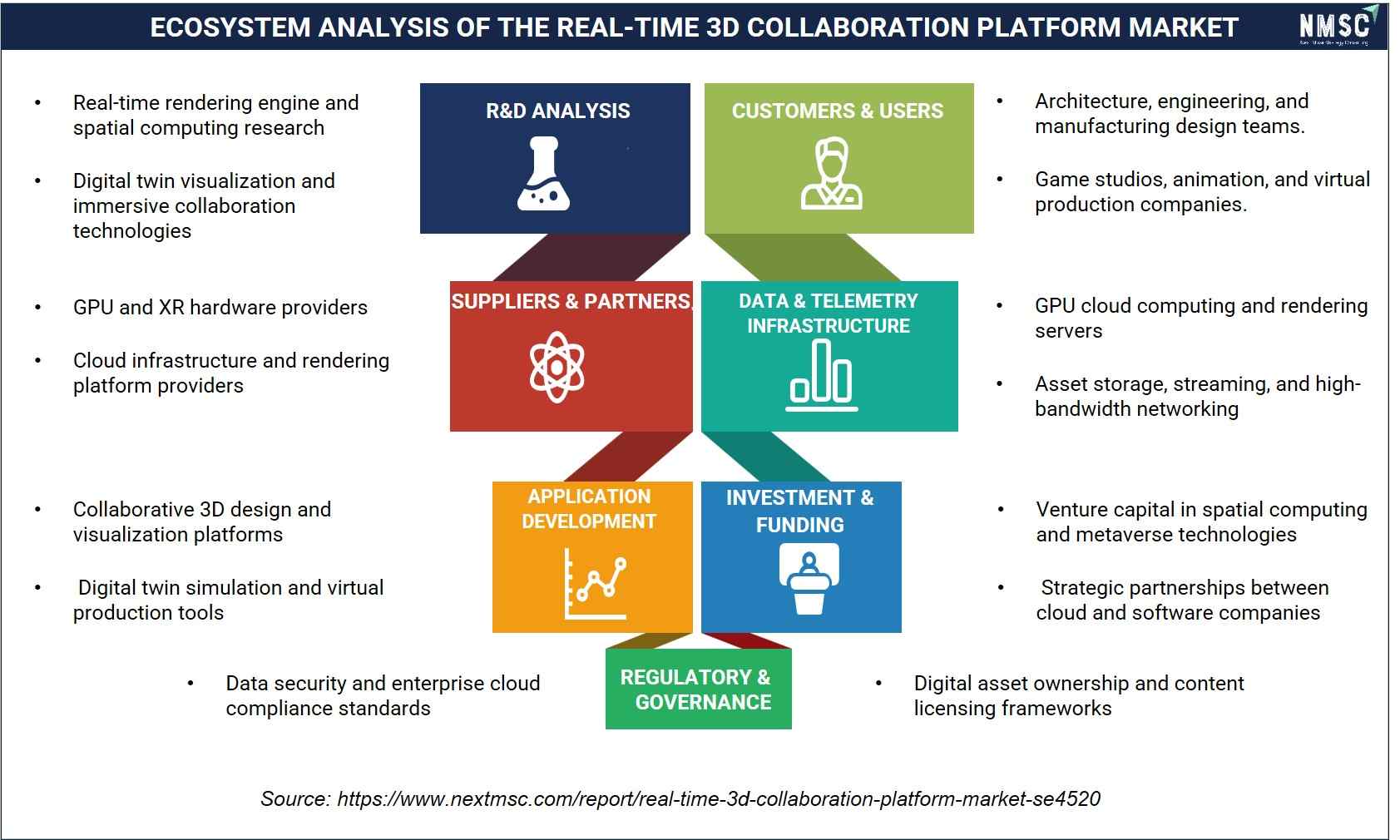
Based on our assessment of the ecosystem structure, we noticed the real-time 3D collaboration platform market operates through a tightly connected network of research innovation, technology suppliers, platform developers, and enterprise users. R&D initiatives drive advancements in real-time rendering, spatial computing, and collaborative visualization, while suppliers and cloud infrastructure partners enable scalable platform performance and data processing. In parallel, application developers and enterprise users expand adoption across engineering, media, and design workflows. Supported by ongoing investment activity and evolving regulatory frameworks, this ecosystem collectively accelerates platform innovation and strengthens the long-term growth trajectory of the market.
What are the Key Market Drivers, Breakthroughs, and Investment Opportunities that will Shape the Real-Time 3D Collaboration Platform Industry in the Next Decade?
Growth Catalyst & Risk Assessment Matrix
|
Drivers / Trends / Restraints |
(+/–) % Impact On CAGR Forecast |
Geographic Relevance |
Impact Timeline |
|
Rising adoption of digital twin environments across manufacturing, infrastructure, and engineering workflows increasing demand for collaborative 3D environments |
+1.2% |
North America, Europe; Asia-Pacific |
Medium term (2–4 years) |
|
Expansion of virtual production and real-time content creation workflows across gaming, film, and animation industries |
+1.0% |
North America, Asia-Pacific, Europe |
Short to medium term (1–3 years) |
|
Rise of Distributed Global Engineering Teams Accelerating Demand for Real-Time 3D Collaboration Platforms |
+1.1% |
North America, Europe, India, East Asia |
Short to medium term (1–3 years) |
|
Increasing enterprise investment in industrial metaverse environments supporting immersive engineering collaboration |
+0.8% |
North America, Europe, Asia-Pacific |
Medium term (2–4 years) |
|
High infrastructure requirements including GPU computing, cloud rendering, and high-bandwidth networks increasing deployment complexity |
-0.6% |
Global |
Medium term (2–4 years) |
Based on our evaluation of enterprise digital collaboration trends, we observed that the real-time 3D collaboration platform market demand is gaining strong momentum as organizations increasingly adopt immersive visualization and shared design environments to support distributed engineering and creative workflows. In particular, our interactions with software developers, design teams, and technology integrators indicates that cloud-based 3D collaboration platforms and RT3D software solutions are becoming essential for coordinating complex product development, virtual production, and simulation processes across multiple stakeholders and geographically distributed teams.
Building on this trend, advancements in GPU-accelerated rendering, spatial collaboration technologies, and real-time simulation capabilities are further expanding the scope of the 3D collaboration software market and real-time 3D rendering market, enabling teams to interact with complex digital assets simultaneously in shared environments. At the same time, our assessment indicates that infrastructure requirements and integration complexity slows adoption in smaller organizations. Nevertheless, growing investments in industrial metaverse platforms, enterprise XR collaboration solutions, and digital twin collaboration software are steadily opening new opportunities for scalable and immersive collaboration ecosystems across industries.
Growth Drivers:
How Is the Rise of Distributed Global Engineering Teams Driving Adoption in the Real-Time 3D Collaboration Platform Market?
Across engineering, design, and product development functions, organizations are increasingly operating with geographically distributed teams. From our interactions with enterprise design and engineering managers, we observed that traditional file-based workflows create delays, version conflicts, and coordination inefficiencies across locations. Market evidence suggests that real-time 3D design collaboration software enable teams to work simultaneously within shared digital environments, reducing dependency on sequential design processes. As organizations continue to adopt hybrid and remote working models, the need for synchronized, interactive collaboration tools becomes more critical. Consequently, the shift toward distributed engineering operations is driving the adoption of real-time 3D collaboration platforms to improve coordination, reduce development cycles, and enhance overall productivity.
How Is the Expansion of Virtual Production Workflows Accelerating Adoption in the Real-Time 3D Collaboration Platform Market?
Film, animation, and game production pipelines are rapidly moving toward real-time digital environments, enabling seamless collaboration, faster iteration cycles, and enhanced creative control across production stages. From our interaction with visual effects studios and game developers, we noticed that creative teams increasingly build scenes collaboratively rather than passing assets between departments. Market evidence suggests that real-time collaboration platforms enable artists, directors, and technical teams to adjust lighting, animation, and scene composition simultaneously, improving synchronization across production stages. As production teams operate across multiple locations, these platforms allow contributors to interact with the same digital scene in parallel, significantly enhancing coordination within modern virtual production workflows. Consequently, this shift toward real-time, collaborative content creation is accelerating the adoption of 3D content collaboration solutions across the media and entertainment industry.
Growth Inhibitor:
How Do High-Performance Infrastructure Requirements Limit Adoption in the Real-Time 3D Collaboration Platform Market?
Based on our assessment of enterprise technology architectures, we observed that high-performance infrastructure requirements act as a key limiting factor for the real-time 3D collaboration platform market expansion. Through our interactions with enterprise technology teams and visualization specialists, we found that real-time collaborative environments require advanced GPU computing, high-bandwidth networks, and scalable cloud rendering infrastructure to maintain stable performance. As organizations increasingly deploy complex digital twins and immersive design environments, the computing intensity required to render high-fidelity models across distributed teams rises significantly.
Consequently, many enterprises must invest in specialized workstations and GPU-accelerated cloud resources before deploying collaborative platforms. These infrastructure demands increase implementation complexity and extend deployment timelines, which slows broader adoption across the real-time 3D collaboration platform market, particularly among organizations with limited IT capacity.
Growth Opportunity:
How Is the Emergence of Industrial Metaverse Environments Creating New Market Opportunities?
Across manufacturing, infrastructure planning, and energy operations, companies are beginning to experiment with immersive digital environments that combine simulation, visualization, and operational data. From our observations of these initiatives, we identified that teams increasingly explore environments where engineers and operators interact directly with large-scale digital models rather than reviewing them through static dashboards. Industry patterns indicate that real-time collaboration platforms play a central role in these environments by allowing multiple stakeholders to explore simulations, review system behavior, and coordinate decisions inside the same digital space. As industrial metaverse projects expand, demand for shared real-time 3D collaboration environments continues to grow across engineering-intensive sectors.
Pain Point Analysis Impacting the Real-Time 3D Collaboration Platform Market
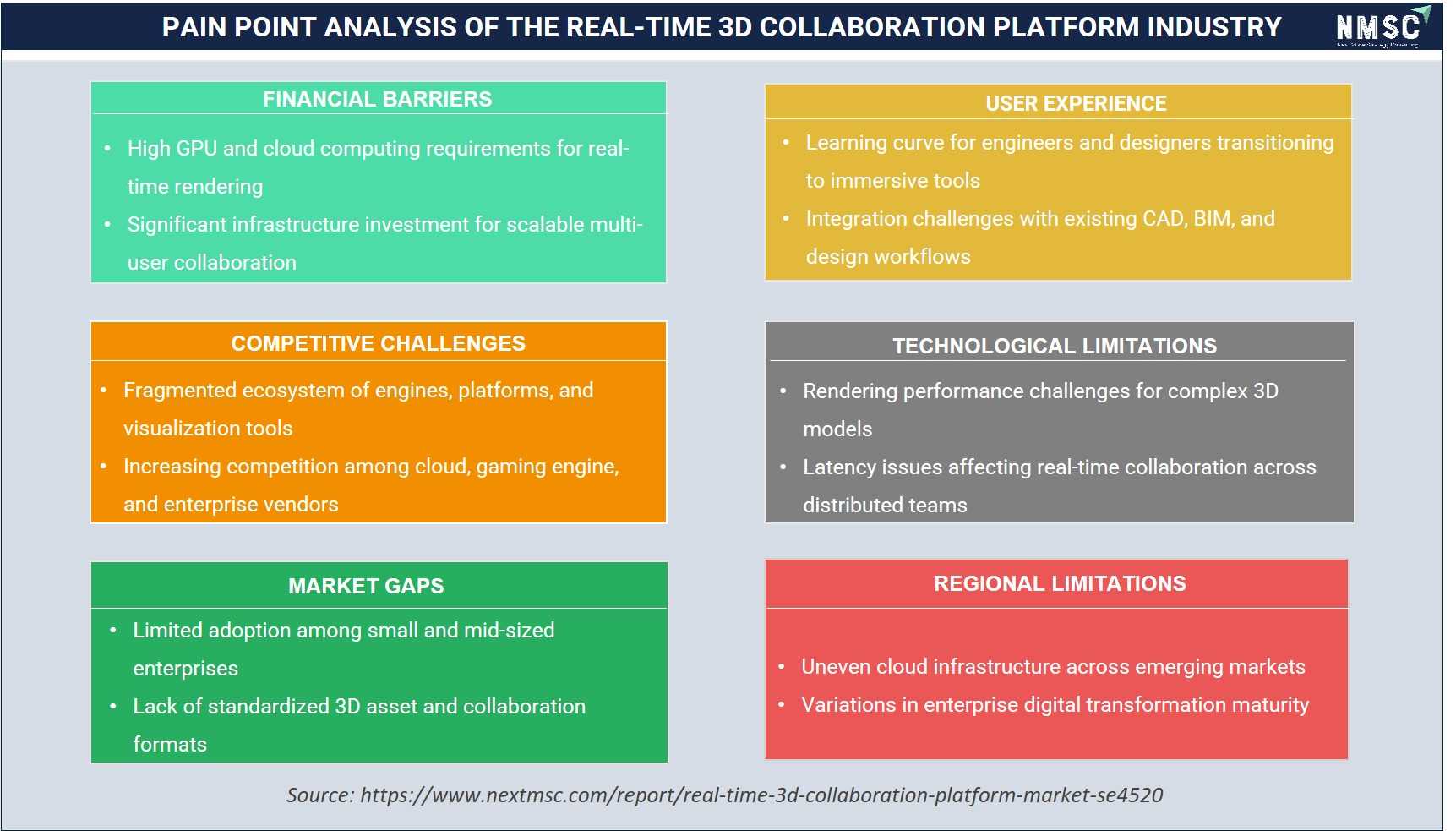
Based on our interactions with platform developers and enterprise users, we identified that high GPU infrastructure costs and integration with existing CAD and BIM workflows remain key challenges in the real-time 3D collaboration platform market. At the same time, fragmented platform ecosystems and rendering performance constraints affect adoption. However, industry trends indicate that improving cloud infrastructure and ongoing enterprise digital transformation are steadily supporting broader platform adoption.
How Is the Real-Time 3D Collaboration Platform Market Segmented in This Report, And What Are the Key Insights From the Segmentation Analysis?
Market Highlights & Strategic Insights – Real-Time 3D Collaboration Platform Market:
|
Segments |
Key Takeaways |
|
Offering |
Software led the real-time 3D collaboration platform market in 2025, driven by SaaS and platform subscription models. Consumption services such as rendering and streaming gained traction as real-time visualization workloads increased. Professional services supported platform integration, while XR hardware and capture devices enabled immersive collaboration environments. |
|
Buyer Type |
Enterprises held the largest share due to large-scale design collaboration and digital twin initiatives. Mid-market and small businesses adopted cloud-based platforms for cost efficiency. Public sector institutions and individual professionals increasingly used these tools for simulation, research, and design workflows. |
|
Deployment Model |
Public cloud dominated deployments as organizations prioritized scalable infrastructure and remote collaboration. Hybrid models gained traction for performance-intensive workloads, while private cloud and edge deployments supported secure and latency-sensitive applications. |
|
End-User Industry |
AEC led adoption due to digital twin and BIM workflows, enhancing design accuracy and project coordination. Automotive, aerospace, and manufacturing used platforms for product design and simulation, while media and entertainment leveraged them for virtual production and collaborative content creation. |
By Offering Insights
How Did Different Offerings Shape the Real-Time 3D Collaboration Platform Market in 2025?
Based on our detailed assessment of enterprise deployments and platform ecosystems, we recorded that the real-time 3D collaboration platform market is segmented into software, consumption services, professional services, content and capture solutions, hardware, marketplace revenue, and other revenue streams.
From our evaluation of platform adoption patterns, software accounted for the largest share, supported by strong demand for SaaS subscriptions, platform licenses, and developer tools that enable collaborative design and simulation workflows. As organizations increasingly relied on shared 3D environments, consumption services, including rendering, streaming, API calls, and data processing, gained traction due to their ability to provide scalable compute resources for high-fidelity visualization. In parallel, our discussions with enterprise users indicates that professional services, such as implementation, training, consulting, and custom development, played an important role in integrating these platforms with CAD, BIM, and digital twin systems. At the same time, hardware and content capture solutions, including XR devices and 3D scanning technologies, supported immersive collaboration and digital asset creation across design and engineering teams.

By Buyer Type Insights
Which Buyer Segments Drives Adoption in the Real-Time 3D Collaboration Platform Market?
Based on our evaluation of platform adoption across organizations of different sizes, we noticed that the real-time 3D collaboration platform market is segmented into enterprise organizations, mid-market companies, small businesses, micro businesses, public sector and education institutions, and individual professionals.
From our evaluation of deployment patterns, large enterprises (1000+ employees) represented the largest buyer segment, driven by complex engineering collaboration, digital twin initiatives, and distributed product development teams. As these organizations managed increasingly sophisticated design workflows, they relied on scalable collaboration platforms capable of supporting multiple departments and global teams. Alongside this trend, mid-market companies began adopting cloud-based 3D collaboration tools to streamline design reviews and reduce infrastructure costs. Our interactions with technology providers also indicates that small businesses and individual professionals, including designers and 3D artists, increasingly used browser-based platforms and subscription software to coordinate projects and create digital assets. Meanwhile, public sector organizations and educational institutions utilized these platforms for simulation, training, and research-based visualization environments.
By Deployment Model Insights
How Does Deployment Models Influence Platform Adoption in 2025?
Based on our evaluation of enterprise technology architectures, we recognized that the real-time 3D collaboration platform market is segmented into public cloud, private cloud, on-premises, hybrid, and edge deployment models.
From our assessment of platform deployments, public cloud environments accounted for the largest share, supported by enterprise demand for scalable infrastructure and remote collaboration capabilities. As distributed teams increasingly interacted with shared digital environments, cloud platforms enabled centralized access to rendering resources and collaborative design tools. In response to performance-intensive workloads, hybrid deployments gained traction as organizations combined on-premises computing infrastructure with cloud-based processing and storage. Our discussions with enterprise technology teams further indicates that private cloud and on-premises models remained relevant for industries requiring strict data governance and security controls. At the same time, edge deployment architectures began appearing in latency-sensitive environments where real-time visualization performance was critical.

By End-User Industry Insights
Which Industries Lead Adoption of Real-Time 3D Collaboration Platform Market?
Based on our analysis of industry adoption patterns, we noticed that the real-time 3D collaboration platform market is segmented across architecture, engineering and construction (AEC), automotive, aerospace and defense, industrial manufacturing, energy and utilities, media and entertainment, healthcare and life sciences, retail and consumer goods, education and research, government and public sector, real estate and property, financial services, telecommunications, and other industries.
From our evaluation of enterprise use cases, we identified the AEC sector represented one of the largest adopting industries, supported by growing use of collaborative BIM workflows, digital twins, and immersive design visualization tools. As infrastructure and construction projects became more complex, organizations increasingly relied on shared 3D environments to coordinate design reviews and planning activities. In parallel, automotive, aerospace, and industrial manufacturing companies integrated real-time collaboration platforms into product development workflows to improve engineering coordination and simulation processes. Our market interactions further indicates that media and entertainment companies used these platforms extensively for animation production, virtual production environments, and collaborative game development pipelines. Meanwhile, sectors such as education, healthcare, and government adopted collaborative 3D environments to support training, research, and visualization-based decision-making processes.
Regional Outlook:
Geographic Performance Snapshot:
|
Geography |
Key Takeaways |
|
North America |
North America held the largest share of the real-time 3D collaboration platform market in 2025, driven by strong adoption of cloud-based design platforms, digital twin technologies, and virtual production tools across technology, media, and manufacturing sectors. |
|
Europe |
Europe accounted for a significant market share in 2025, supported by Industry 4.0 initiatives, collaborative BIM adoption, and increasing use of real-time visualization tools across architecture, automotive, and engineering industries. |
|
Asia Pacific |
Asia Pacific emerged as the fastest-growing region, driven by expanding game development ecosystems, rapid digitalization of manufacturing, and rising adoption of collaborative 3D platforms in China, Japan, South Korea, and India. |
|
Latin America |
Latin America showed steady growth in 2025, supported by increasing use of cloud-based design tools and digital visualization platforms across architecture, engineering, and media production sectors. |
|
Middle East & Africa |
The Middle East & Africa region witnessed emerging adoption, supported by smart city projects, digital construction initiatives, and growing use of collaborative 3D visualization tools in infrastructure planning. |
The real-time 3D collaboration platform market is geographically studied across North America, Europe, Asia Pacific, Latin America and Middle East & Africa and each region is further studied across countries.
Real-Time 3D Collaboration Platform Market in North America
North America represents the most technologically mature environment for interactive 3D design platforms s, supported by strong cloud infrastructure and advanced digital engineering ecosystems. From our regional assessments, we identified that enterprises increasingly relied on collaborative 3D environments to coordinate complex design and simulation workflows across distributed teams. This shift was particularly visible in manufacturing, architecture, and media production, where real-time visualization significantly accelerated design validation cycles. Building on this trend, our analysis shows that major technology providers continued expanding cloud-based collaboration capabilities, enabling organizations to scale digital twin environments and shared simulation platforms. As these ecosystems mature, enterprise demand for integrated real-time collaboration solutions is expected to strengthen further across North America.
Real-Time 3D Collaboration Platform Market in the United States
The United States remained the central hub of Real-Time 3D Collaboration Platform adoption within North America. Based on our engagements with platform developers and enterprise technology teams, we found that organizations increasingly turned to real-time collaboration tools to manage complex digital design pipelines and multi-site engineering teams. This demand was particularly evident across automotive, aerospace, and media production, where teams relied on shared virtual environments to accelerate design reviews and creative workflows. As a result, our market analysis indicates that scalable cloud infrastructure and GPU-powered rendering platforms became critical enablers of enterprise collaboration. Consequently, the United States continues to serve as a key innovation center where real-time 3D technologies evolve alongside expanding digital engineering ecosystems.
Real-Time 3D Collaboration Platform Market in Canada
Canada’s real-time 3D collaboration platform market is expanding steadily as engineering firms, infrastructure developers, and digital media studios increasingly adopted collaborative visualization tools. Through our discussions with system integrators and design professionals, we identified that organizations were gradually integrating cloud-based 3D environments to support geographically distributed project teams. As these collaboration workflows expanded, companies increasingly prioritized platforms capable of delivering high-fidelity visualization and reliable multi-user interaction for distributed design teams. In line with these developments, our research found that Canadian enterprises emphasize long-term software partnerships and robust performance over rapid deployment scale. Consequently, the market is building a stable foundation for sustained adoption as digital engineering practices continue to expand across the country.
Real-Time 3D Collaboration Platform Market in Europe
The real-time 3D collaboration platform market in Europe reflects a structured and engineering-driven adoption environment supported by strong industrial digitalization and collaborative design practices. Our analysis indicates that enterprises across automotive, aerospace, and architecture increasingly rely on shared 3D environments to coordinate product development and simulation workflows. In parallel, strict data governance frameworks and operational transparency requirements have encouraged organizations to adopt enterprise-grade collaboration platforms with secure cloud infrastructure. Adoption patterns vary across the region, with Northern Europe emphasizing productivity and advanced visualization, while Southern markets prioritize flexible design collaboration. These industry patterns indicate that Europe will continue strengthening its position as a stable and innovation-oriented market for collaborative 3D engineering ecosystems.
Real-Time 3D Collaboration Platform Market in the United Kingdom
The United Kingdom has steadily emerged as a dynamic center for immersive design collaboration and real-time content production. Our market research suggests that organizations across gaming studios, architecture firms, and media production houses increasingly integrate collaborative 3D environments into design pipelines and virtual production workflows. Rising demand for remote project coordination and faster design iteration cycles has encouraged adoption of browser-based and cloud-enabled collaboration platforms. At the same time, a strong technology startup ecosystem and active investment in creative industries continue to stimulate experimentation with immersive collaboration tools. Consequently, industry trends indicate that the UK will remain a key innovation hub for real-time 3D collaboration technologies within Europe.
Real-Time 3D Collaboration Platform Market in Germany
Germany’s industrial ecosystem provides a strong foundation for the adoption of advanced real-time collaboration platforms. Based on our assessment of industrial digitalization initiatives and enterprise deployments, we observed that manufacturers and engineering companies increasingly deploy collaborative 3D environments to support digital twin simulations and complex product design reviews. These platforms enable globally distributed engineering teams to interact with high-fidelity models while maintaining consistent development workflows. Moreover, strong collaboration between enterprise software providers, industrial firms, and technology integrators supports seamless integration with CAD and PLM systems. Consequently, evidence from industrial deployments indicates that Germany continues to strengthen its position as a high-value market for engineering-centric real-time collaboration platforms.
Real-Time 3D Collaboration Platform Market in France
Across France, collaborative visualization technologies are gaining traction as organizations modernize engineering and creative production workflows. From our assssment of industry adoption patterns and national digital initiatives, we found that architecture studios, infrastructure developers, and animation producers increasingly rely on shared 3D environments to streamline project coordination and accelerate design approvals. These platforms allow teams to interact with digital models in real time while improving communication across geographically distributed stakeholders. In addition, government-supported digital innovation programs and investments in creative technology development are strengthening the ecosystem around immersive collaboration tools. As a result, France is well positioned to expand the adoption of real-time collaborative design platforms across both industrial and creative sectors.
Real-Time 3D Collaboration Platform Market in Italy
In Italy, modernization of design and engineering workflows is gradually driving interest in real-time collaborative visualization platforms. Based on our evaluation of infrastructure readiness and enterprise adoption trends, we found that engineering firms and construction companies increasingly incorporate collaborative 3D environments to support project visualization and digital design coordination. Flexible cloud-based platforms allow distributed teams to interact with detailed models without requiring high-end local computing infrastructure, which improves accessibility for mid-sized firms. Technology partners and system integrators also play an important role in enabling smooth implementation and workflow integration. These developments suggest that Italy’s market will continue evolving as organizations adopt more collaborative and digitally integrated design processes.
Real-Time 3D Collaboration Platform Market in Spain
Spain is gradually strengthening its role within Europe’s emerging real-time 3D collaboration ecosystem. Our data evaluation reveals that organizations in digital media, architecture, and gaming sectors increasingly adopt collaborative 3D environments to accelerate design cycles and support distributed creative teams. Growing investment in digital content production and virtual design tools has further encouraged the adoption of scalable, cloud-enabled collaboration platforms. At the same time, cost-efficient deployment models enable smaller studios and engineering firms to participate in collaborative 3D workflows. Market indicators therefore show that Spain is steadily building momentum as adoption of real-time collaborative design environments expands across the country.
Real-Time 3D Collaboration Platform Market in the Nordics
Across the Nordic countries -Sweden, Finland, and Norway digital maturity and strong trust in advanced technologies have created a favorable environment for real-time 3D collaboration Platforms. Our industry tracking indicates that engineering firms, construction companies, and product design teams increasingly depend on shared 3D environments to coordinate visualization, simulation, and design validation workflows. As organizations continue digitizing project collaboration, demand for reliable cloud-based platforms has steadily increased. Moreover, Nordic buyers consistently emphasize durability, open software ecosystems, and energy-efficient infrastructure when evaluating technology partners. Consequently, market evidence suggests that vendors offering long-term lifecycle support, interoperable architectures, and sustainability-focused solutions are well positioned to secure premium contracts across the region.
Real-Time 3D Collaboration Platform Market in Asia-Pacific
The Asia-Pacific region has emerged as the most dynamic environment for real-time 3D collaboration platforms, reflecting the rapid digital transformation of manufacturing, media production, and software development industries. Based on our assessment of regional adoption patterns and industry deployments, we observed thatcollaborative 3D environments are increasingly embedded within product design pipelines, game development workflows, and digital twin initiatives across China, Japan, and South Korea. At the same time, each major market demonstrates a distinct adoption trajectory. China prioritizes scale and cost efficiency, whereas Japan emphasizes engineering precision and reliability, while South Korea leads early adoption of immersive digital production technologies. As a result, industry trends indicate that the region will continue expanding its role as a global center for real-time collaborative design and visualization platforms.
Real-Time 3D Collaboration Platform Market in China
Within Asia-Pacific, China functions as the primary scale driver for real-time collaborative 3D environments. From our review of industry expansion trends and technology deployments, we found that rapid expansion in gaming, animation, and advanced manufacturing has significantly increased demand for real-time visualization platforms. At the same time, domestic software developers and platform providers continue shaping collaboration standards, asset management frameworks, and large-scale rendering infrastructures. These developments are further reinforced by government-supported digital transformation initiatives and highly integrated technology supply chains. Consequently, market indicators show that China will continue strengthening its position as a global scale leader in collaborative 3D development ecosystems.
Real-Time 3D Collaboration Platform Market in Japan
Japan’s adoption of Real-Time 3D Collaboration Platforms reflects the country’s long-standing emphasis on engineering excellence and operational precision. Based on our review of enterprise deployment practices and industry requirements, we observed that manufacturing companies, engineering firms, and animation studios increasingly deploy collaborative visualization tools to streamline complex design reviews and digital production workflows. As workforce shortages and productivity expectations continue shaping operational strategies, organizations are integrating real-time collaboration platforms to reduce development cycles and improve cross-team coordination. In addition, enterprises consistently prioritize reliability, data security, and long-term vendor partnerships when selecting collaboration technologies. Evidence from industry deployments therefore indicates that high-performance and enterprise-grade collaboration platforms are likely to maintain strong demand across Japan’s technology ecosystem.
Real-Time 3D Collaboration Platform Market in India
India is steadily emerging as an important growth market for Real-Time 3D Collaboration Platforms as digital production ecosystems expand across multiple industries. Our market research suggests that rapid growth in game development, animation studios, and engineering design services has created increasing demand for collaborative 3D visualization platforms. As organizations expand distributed project teams and global delivery models, cloud-based collaboration tools are becoming essential for coordinating complex digital workflows. At the same time, a large pool of skilled developers and competitive software ecosystems continues strengthening the country’s digital capabilities. Industry insights therefore indicate that India is well positioned to experience sustained growth as real-time collaborative design technologies become embedded in its expanding digital economy.
Real-Time 3D Collaboration Platform Market in South Korea
During our engagements with digital production studios and engineering teams, we found that South Korea has become one of the most proactive adopters of Real-Time 3D Collaboration Platforms in Asia. This momentum is largely supported by the country’s advanced broadband infrastructure and strong presence of electronics, gaming, and animation industries. As organizations increasingly manage complex design and content pipelines, collaborative 3D environments are being integrated into product development, visual effects production, and virtual design reviews. In parallel, domestic technology companies continue strengthening GPU computing capabilities and real-time rendering tools. Consequently, our market assessment indicates that South Korea will remain a leading hub for immersive collaboration technologies.
Real-Time 3D Collaboration Platform Market in Taiwan
Taiwan’s real-time 3D collaboration platform market reflects the country’s deep-rooted expertise in electronics manufacturing and precision engineering. Based on our assessment of semiconductor and product design ecosystems, we observed that product design teams and semiconductor manufacturers increasingly rely on collaborative 3D visualization environments to accelerate prototyping and engineering validation processes. As global supply chains demand closer coordination between distributed engineering teams, organizations are prioritizing platforms that support real-time model interaction and cross-team communication. Moreover, Taiwan’s strong OEM ecosystem encourages rapid integration of visualization technologies within manufacturing workflows. Consequently, these dynamics reinforce Taiwan’s role as a critical innovation node within Asia-Pacific’s collaborative digital engineering ecosystem.
Real-Time 3D Collaboration Platform Market in Indonesia
Indonesia is gradually positioning itself as an emerging participant in the regional real-time 3D collaboration ecosystem. From our review of digital adoption trends and creative industry developments, we found that expanding game development communities, digital media studios, and architecture firms are increasingly experimenting with collaborative visualization tools to support distributed workflows. As cloud infrastructure improves and digital skills continue to expand across the workforce, organizations are finding it easier to incorporate real-time 3D environments into project coordination and design processes. In parallel, regional technology startups are introducing browser-based collaboration platforms that lower entry barriers and improve accessibility. As a result, industry trends indicate that Indonesia’s collaborative 3D platform market will steadily strengthen alongside its growing digital economy.
Real-Time 3D Collaboration Platform Market in Australia
Australia demonstrates a mature and enterprise-oriented approach toward the adoption of Real-Time 3D Collaboration Platforms. Our assessment of industry installations indicates that engineering firms, infrastructure developers, and media production companies increasingly depend on collaborative visualization environments to manage complex design reviews across geographically dispersed teams. As projects involve stakeholders located in different cities or regions, organizations are prioritizing platforms capable of delivering reliable real-time interaction and high-fidelity rendering. In addition, strong professional services networks and experienced technology integrators support large-scale deployments. These operational dynamics indicate that Australia will continue sustaining steady demand for advanced collaborative visualization technologies.
Real-Time 3D Collaboration Platform Market in Latin America
Latin America is gradually strengthening its presence in the Real-Time 3D Collaboration Platform landscape as digital transformation accelerates across engineering and creative industries. Based on our evaluation of regional adoption patterns, we observed that Brazil continues to lead adoption, supported by expanding game development communities, architectural visualization firms, and digital media studios. As organizations increasingly coordinate projects across distributed teams, collaborative 3D environments are being deployed to streamline design reviews and visualization workflows. At the same time, affordability and ease of deployment remain key purchasing considerations for regional enterprises. Consequently, vendors offering scalable cloud-based platforms and flexible commercial models are likely to achieve stronger adoption across the region.
Real-Time 3D Collaboration Platform Market in the Middle East & Africa
The real-time 3D collaboration platform market in the Middle East & Africa reflects distinct adoption patterns shaped by infrastructure maturity and investment priorities. Based on our assessment of regional infrastructure development, we identified that Gulf economies such as the UAE and Saudi Arabia are rapidly integrating collaborative 3D environments into large-scale construction, infrastructure planning, and smart city initiatives. These projects require high-fidelity visualization platforms to support real-time coordination between architects, engineers, and project stakeholders. In contrast, several African markets remain at an early stage of adoption, where collaborative visualization tools are gradually entering architecture, media production, and engineering design workflows. Consequently, region-specific deployment strategies will be critical for capturing long-term growth opportunities across diverse market conditions.
Competitive Landscape
Competitive Dynamics & M&A Landscape:
|
Key Takeaways |
|
The Real-Time 3D Collaboration Platform market includes major technology providers such as Microsoft Corporation, NVIDIA Corporation, Dassault Systèmes SE, Siemens AG, Autodesk, Inc., Epic Games, Inc., and Unity Software Inc., alongside emerging specialists like Spatial Systems, Inc., Virbela, LLC, Arthur Technologies, Inc., Gravity Sketch Limited, Spline, Inc., and Vectary, Inc. Established vendors leverage strong cloud, simulation, and digital twin capabilities, while newer entrants focus on immersive VR collaboration and browser-based 3D design environments. |
|
Companies are increasingly prioritizing cloud-native 3D platforms, real-time rendering engines, and seamless integration with CAD, BIM, and PLM systems. Scalable GPU infrastructure, interoperability, and low-latency multi-user collaboration have emerged as key competitive differentiators. |
|
Recent partnerships and ecosystem developments indicate a growing focus on integrating spatial computing, simulation tools, and AI-assisted design workflows. Vendors are collaborating with cloud providers and hardware partners to enhance platform scalability and support complex industrial collaboration use cases. |
Which Companies Dominate the Real-Time 3D Collaboration Platform Industry and How Do They Compete?
Based on our tracking of platform deployments and enterprise adoption patterns, we observed that the real-time 3D collaboration platform market is led by major technology providers including Microsoft Corporation, NVIDIA Corporation, Dassault Systèmes SE, Siemens AG, Autodesk, Inc., Epic Games, Inc., and Unity Software Inc. From our review of enterprise implementation cases, we found that these companies consistently dominate large-scale deployments where digital twins, immersive design collaboration, and real-time simulation environments are required. In particular, we identified that enterprises operating in manufacturing, architecture, engineering, and media production increasingly prefer platforms capable of integrating seamlessly with CAD, BIM, and product lifecycle management (PLM) systems. As a result, competition at this level is largely driven by rendering performance, cloud infrastructure strength, ecosystem integration, and the ability to support complex multi-user collaboration environments at scale.
Market Dominated by Real-Time 3D Collaboration Platform Giants and Specialists
From our observation of emerging platform providers and collaboration ecosystems, we identified that the competitive landscape is supported by a mix of established players and fast-growing specialists such as Spatial Systems, Inc., Virbela, LLC, Arthur Technologies, Inc., Gravity Sketch Limited, Spline, Inc., and Vectary, Inc. Based on our platform capability assessments, we found that these companies are gaining traction through offerings such as immersive VR collaboration environments and browser-based 3D design tools. From our review of enterprise collaboration use cases, we observed that solutions vary based on application needs, with some platforms focusing on immersive workspaces while others prioritize web-based design accessibility. Consequently, we found that while large technology providers focus on building integrated platforms and broader ecosystems, specialist providers are driving adoption through simpler, more focused collaboration solutions.
Innovation and Adaptability Drive Market Success
Based on our assessments of platform capabilities and ongoing technology developments, we noticed that innovation remains a central determinant of competitive advantage in the real-time 3D collaboration platform market. In particular, from our analysis of vendor roadmaps and product updates, we identified that leading companies including NVIDIA, Epic Games, Unity, Autodesk, and Dassault Systèmes are continuously advancing capabilities in real-time rendering engines, spatial computing environments, digital twin simulations, and AI-assisted design workflows. Furthermore, from our platform performance evaluation, we found that vendors investing in GPU-accelerated rendering architectures, cloud-based streaming pipelines, and interoperable 3D asset frameworks are better positioned to support complex collaborative environments. As a result, these technological advancements enable distributed teams to interact with large-scale 3D models and simulations in real time, while maintaining performance, scalability, and workflow continuity across global teams.
Market Players to Opt for Merger & Acquisition Strategies to Expand Their Presence
Based on our research into recent industry developments, we observed that mergers and acquisitions are increasingly used by companies to expand platform capabilities and accelerate innovation in the real-time 3D collaboration platform market. In particular, from our assessment of strategic expansion activities, we identified that Epic Games strengthened its ecosystem through targeted acquisitions aimed at enhancing real-time 3D content management and creation capabilities. For instance, in 2025, Epic Games acquired Loci, an AI-powered platform specializing in automated 3D asset tagging and management, to improve content organization across complex virtual environments. As a result, we found that such acquisitions are enabling platform providers to strengthen developer ecosystems, enhance asset interoperability, and support more scalable collaborative 3D workflows across industries.
SWOT Analysis Impacting the Real-Time 3D Collaboration Platform Market:
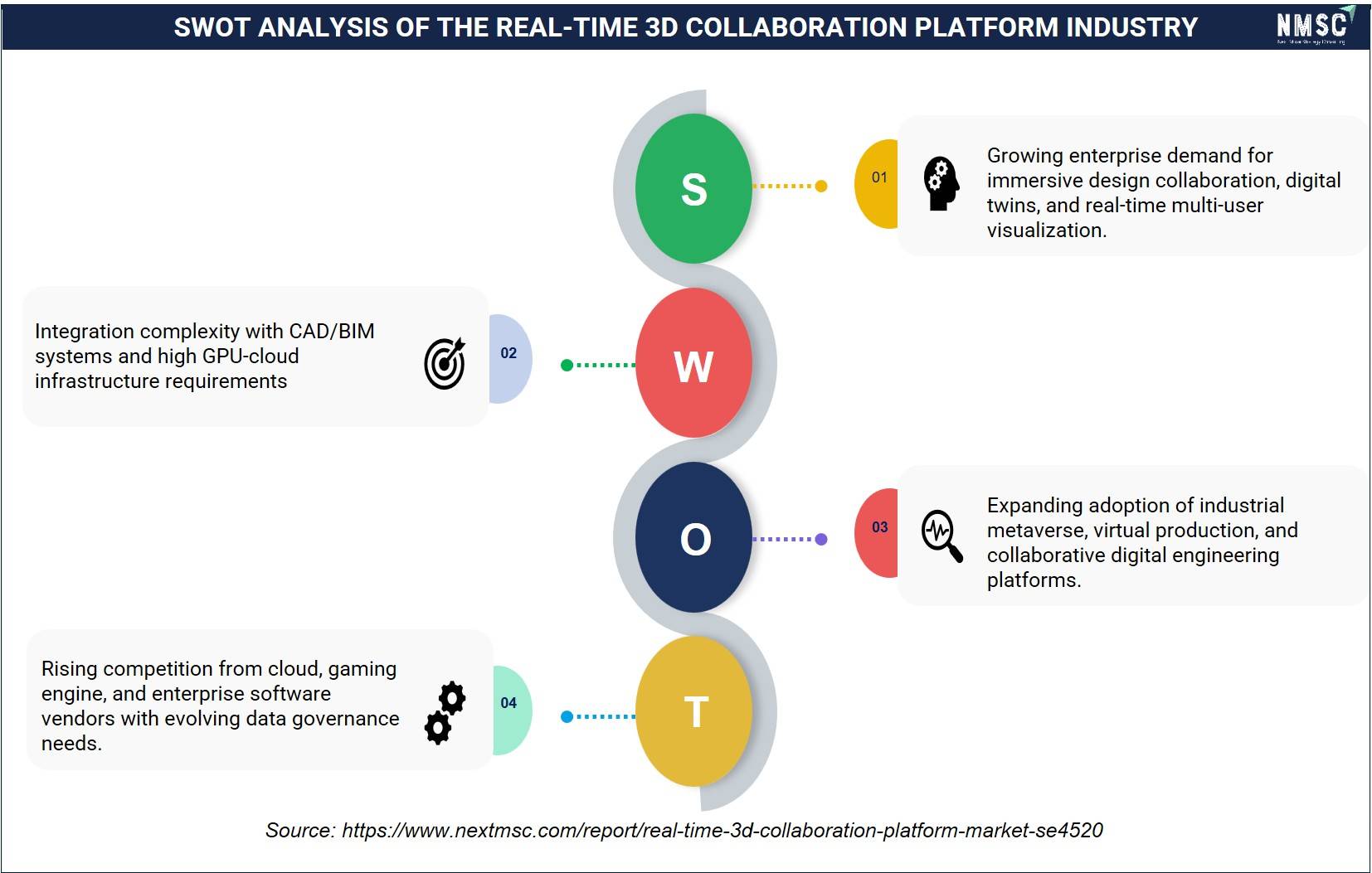
Based on our assessment of enterprise deployments and vendor strategies, we identified strong demand for immersive design collaboration and digital twin visualization driving the real-time 3D collaboration platform market. However, integration with CAD/BIM systems and high GPU-cloud infrastructure needs remain key challenges. At the same time, industrial metaverse and virtual production adoption are creating new opportunities while competition among cloud and engine providers continues to intensify.
List of Key Real-Time 3D Collaboration Platform Companies
-
Microsoft Corporation
-
Meta Platforms, Inc.
-
Dassault Systèmes SE
-
Siemens AG
-
Autodesk, Inc.
-
Unity Software Inc.
-
Hexagon AB
-
Trimble Inc.
-
PTC Inc.
-
Bentley Systems, Incorporated
-
Nemetschek SE
-
Chaos Software EOOD
-
Spatial Systems, Inc.
-
Virbela, LLC
-
Arthur Technologies, Inc.
-
Gravity Sketch Limited
-
Spline, Inc.
-
Vectary, Inc.
What Are The Latest Key Industry Developments?
-
November 2025 - Unity and Epic Games announced a landmark strategic partnership to advance interoperability. The deal allows developers to publish Unity-built games directly into the Fortnite ecosystem while expanding Unity’s cross-platform commerce tools to support Unreal Engine projects.
-
February 2025 - Microsoft retired its standalone Mesh applications and integrated the 3D collaboration technology directly into Microsoft Teams as "Immersive Events." This move streamlines real-time 3D meetings by making them accessible via standard corporate calendars and Teams Premium licenses.
What Are The Key Factors Influencing Investment Analysis & Opportunities In The Real-Time 3d Collaboration Platform Market?
Investment activity in the real-time 3D collaboration platform market has increasingly shifted toward platform-driven ecosystems and cloud-based collaboration infrastructures rather than standalone visualization tools. Based on our observations of recent funding activity, technology partnerships, and product ecosystem expansion, we analysed that investors consistently favored companies offering scalable software platforms, subscription-based revenue models, and integrated real-time rendering capabilities. Vendors demonstrating strong developer ecosystems, GPU-accelerated cloud infrastructure, and seamless interoperability with CAD, BIM, and digital twin platforms were more likely to attract strategic capital and long-term enterprise adoption.
Our evaluation also identified growing investment interest in enabling technologies such as spatial computing, AI-assisted design tools, and cloud streaming architectures that support high-fidelity multi-user collaboration. These technologies address increasing demand for distributed product development, immersive design reviews, and real-time simulation workflows across engineering and creative industries. Strategic investments are increasingly driven by technology firms, cloud providers, and enterprise software vendors seeking to strengthen ecosystem control and accelerate platform integration. For investors, the most attractive opportunities lie in companies combining scalable collaboration platforms with strong developer adoption, interoperable technology stacks, and the ability to support complex digital engineering and content creation environments.
Key Benefits for Stakeholders:
Next Move Strategy Consulting (NMSC) presents a comprehensive analysis of the real-time 3D collaboration platform market trends , covering historical developments from 2020 to 2025 and providing forward-looking forecasts through 2035. The study evaluates the real-time 3D collaboration platform market at global, regional, and country levels, delivering quantitative outlooks alongside qualitative insights into technology adoption patterns, collaboration workflows, platform innovation, and investment trends across major industry segments. Our evaluation further examines how advancements in cloud rendering, spatial computing, and digital twin environments are shaping enterprise collaboration strategies across engineering, design, and media production ecosystems.
From our observation, we found that the real-time 3D collaboration platform industry generates measurable value across a diverse stakeholder landscape. Investors benefit from scalable platform ecosystems, subscription-based software models, and expanding enterprise adoption across design-intensive industries. Engineering firms, product developers, and creative studios gain faster design iteration, improved visualization accuracy, and more efficient coordination across globally distributed teams. Platform developers, system integrators, and technology partners benefit from ecosystem expansion, developer engagement, and recurring software and cloud infrastructure revenues. By aligning immersive visualization capabilities with distributed collaboration needs, the market continues to create durable value while supporting the evolution of digital engineering and content production workflows.
|
Parameters |
Details |
|
Customization Scope |
Free customization (equivalent to up to 80 analyst-working hours) after purchase. Addition or alteration to country, regional & segment scope. |
|
Pricing and Purchase Options |
Avail customized purchase options to meet your exact research needs. |
|
Approach |
In-depth primary and secondary research; proprietary databases; rigorous quality control and validation measures. |
|
Analytical Tools |
Porter's Five Forces, SWOT, value chain, and Harvey ball analysis to assess competitive intensity, stakeholder roles, and relative impact of key factors. |
Key Market Segments
By Offering
-
Software
-
Subscription Licenses
-
SaaS Subscriptions
-
Platform Subscriptions
-
Term Licenses
-
-
Perpetual Licenses
-
Developer Tools
-
Engine Licenses
-
API Subscriptions
-
Dev Extensions
-
-
Maintenance & Support
-
-
Consumption Services
-
Rendering and Streaming
-
Data Processing
-
API Calls
-
Hosting and Storage
-
-
Professional Services
-
Implementation and Integration
-
Training and Enablement
-
Consulting and Strategy
-
Custom Development
-
-
Content & Capture
-
Scanning and Photogrammetry
-
Manual Asset Creation
-
Asset Conversion
-
Asset Libraries
-
-
Hardware
-
XR Headsets
-
VR Headsets
-
AR Glasses
-
MR Devices
-
-
Capture Devices
-
3D Scanners
-
360-Degree Cameras
-
-
Computing Hardware
-
Workstations
-
Rendering Servers
-
-
Peripherals and Accessories
-
-
Marketplace Revenue
-
Other Revenue
By Buyer Type
-
Enterprise (1000+ Employees)
-
Mid-Market (100-999 Employees)
-
Small Business (10-99 Employees)
-
Micro Business (1-9 Employees)
-
Public Sector and Education
-
Individual Professionals
By Deployment Model
-
Public Cloud (Multi-Tenant)
-
Private Cloud (Single-Tenant)
-
On-Premises
-
Hybrid Deployment
-
Edge Deployment
By End-User Industry
-
Architecture, Engineering, Construction (AEC)
-
Automotive
-
Aerospace and Defense
-
Industrial Manufacturing
-
Energy and Utilities
-
Media and Entertainment
-
Healthcare and Life Sciences
-
Retail and Consumer Goods
-
Education and Research
-
Government and Public Sector
-
Real Estate and Property
-
Financial Services
-
Telecommunications
-
Other Industries
Geographical Breakdown
-
North America: U.S., Canada, and Mexico.
-
Europe: UK, Germany, France, Italy, Spain, Sweden, Denmark, Finland, the Netherlands, and the Rest of Europe.
-
Asia Pacific: China, India, Japan, South Korea, Taiwan, Indonesia, Vietnam, Australia, Philippines, Malaysia and the rest of APAC.
-
Middle East & Africa (MEA): Saudi Arabia, UAE, Egypt, Israel, Turkey, Nigeria, South Africa, and the rest of MEA.
-
Latin America: Brazil, Argentina, Chile, Colombia, and the rest of LATAM.
Conclusion & Recommendations
This report equips stakeholders, industry participants, investors, and consultants with actionable intelligence to capitalize on the structural transformation underway in the market. By combining structured market intelligence with rigorous analytical frameworks, NMSC’s Real-Time 3D Collaboration Platform Market Report provides a strategic foundation for navigating an increasingly immersive and digitally connected design ecosystem. The market is positioned for sustained expansion, supported by rising adoption of digital twins, distributed engineering workflows, and the growing need for real-time visualization across product development and creative production environments. Industry analysis indicates that cloud-native rendering platforms, GPU-accelerated infrastructure, and seamless interoperability with CAD, BIM, and PLM systems are becoming central to enterprise collaboration strategies. Vendors prioritizing scalable architectures, high-fidelity visualization, and integrated developer ecosystems consistently strengthened platform adoption and long-term customer engagement.
For technology providers, investors, and enterprise decision-makers, capturing value increasingly requires focusing on high-impact use cases such as collaborative product design, immersive virtual production, and real-time digital twin environments. Strategic investments in cloud infrastructure, real-time simulation capabilities, and cross-platform interoperability will remain critical for maintaining competitive differentiation. Expanding presence in high-growth digital ecosystems particularly across Asia-Pacific’s gaming, manufacturing, and media sectors continues to unlock new adoption pathways. As enterprises prioritize faster innovation cycles, distributed collaboration, and immersive design workflows, real-time 3D collaboration platforms are positioned to become foundational tools within the global digital engineering and content creation landscape.
Expert Insights
 “Our ambition is clear, to lead the transformation powered by Industrial AI through 3D UNIV+RSES. This is a long-term commitment to further redefine how industries innovate, operate and compete in the Generative Economy”.
— Pascal Daloz, Dassault Systèmes’ Chairman of the Board and Chief Executive Officer
Statement made while highlighting the company’s long-term strategic vision to drive industrial transformation through Industrial AI and virtual environments.
Market Interpretation
The statement highlights the increasing role of Industrial AI and virtual twin technologies in reshaping industrial operations and innovation processes. As industries adopt AI-driven simulation and digital platforms, there is a shift toward more efficient, data-driven, and automated workflows across sectors such as manufacturing, automotive, and aerospace. Consequently, organizations are investing in advanced digital ecosystems to enhance productivity, accelerate innovation cycles, and strengthen long-term competitiveness in the evolving generative economy.


About the Author
 Saista Faiyaz
— Saista Faiyaz is Research Associate at Next Move Strategy Consulting, where she has covered consumer markets and healthcare technologies for 3 years. Her work includes primary interview review, secondary-source validation, market sizing, and structured analysis of company and industry data. She supports research by comparing evidence across sources, organizing findings into market narratives, and documenting assumptions used in analysis. Her scope includes cross-market benchmarking, and reports.
Saista Faiyaz
— Saista Faiyaz is Research Associate at Next Move Strategy Consulting, where she has covered consumer markets and healthcare technologies for 3 years. Her work includes primary interview review, secondary-source validation, market sizing, and structured analysis of company and industry data. She supports research by comparing evidence across sources, organizing findings into market narratives, and documenting assumptions used in analysis. Her scope includes cross-market benchmarking, and reports.
About the Reviewer
 Supradip Baul
— Supradip Baul is an accomplished business consultant and strategist with over a decade of rich experience in market intelligence, strategy, technology, and business transformation. His work has included rigorous qualitative and quantitative analysis across multiple industries, helping clients shape investment decisions and long-term roadmaps. Earlier in his career, he was associated with Gartner, where he contributed to industry-leading reports and market share analyses. He has worked with leading global companies and holds an MBA with a dual specialization in Marketing and Finance.
Supradip Baul
— Supradip Baul is an accomplished business consultant and strategist with over a decade of rich experience in market intelligence, strategy, technology, and business transformation. His work has included rigorous qualitative and quantitative analysis across multiple industries, helping clients shape investment decisions and long-term roadmaps. Earlier in his career, he was associated with Gartner, where he contributed to industry-leading reports and market share analyses. He has worked with leading global companies and holds an MBA with a dual specialization in Marketing and Finance.
At Next Move Strategy Consulting, we understand that insightful market research is the cornerstone of successful business decisions. That's why we employ a robust and multifaceted approach, combining various methodologies to deliver the most accurate and actionable data for our clients.

Research Landscape
We navigate the world of research with two primary approaches:
Qualitative Approach
Our qualitative research methodologies involve immersive techniques such as in-depth interviews, focus groups, and observational studies. By engaging directly with individuals and stakeholders, we uncover valuable insights that quantitative data alone may overlook.

Quantitative Research
In tandem with qualitative methodologies, NMSC leverages the power of Quantitative Research to provide a robust foundation of numerical insights. Through systematic data collection and analysis, we quantify patterns, preferences, and market trends, offering a comprehensive view of the business landscape.
Our quantitative research approach employs diverse tools, including surveys, experiments, and statistical modelling. These methodologies enable us to gather data from a large and representative sample, ensuring the statistical significance of our findings. By employing structured questionnaires and standardized data collection methods, we guarantee the reliability and validity of the information we present to our clients.
Quantitative research is particularly effective in measuring the prevalence of trends, assessing market size, and gauging the impact of various factors on consumer behavior. The numerical precision attained through this approach equips our clients with actionable insights, facilitating data-driven decision-making and strategy formulation.


Our Specialized Toolbox for Industry-Specific Market Research
We deploy a specialized arsenal of techniques tailored to meet your unique requirements. Here's a glimpse into our comprehensive toolbox:

Information Procurement
The stage entails acquiring market data or relevant information through various sources and methodologies.


Market Research Approach
We utilize both top-down and bottom-up approaches in market research analysis to achieve a comprehensive understanding of the market dynamics, leveraging the broad perspective of industry trends and macroeconomic factors alongside detailed insights from specific segments and individual companies.

Porters Five Forces Analysis
We conduct Porter's Five Forces analysis to evaluate the competitive landscape of an industry, providing us with insights into factors that affect profitability and strategic positioning.

SWOT Analysis

Forecasting
We utilize a forecasting model to predict future consumption by considering parameters like population, economics, regulations, market competition, drivers, constraints, technology, and pricing. We also employ statistical techniques such as multilinear regression, exponential smoothing, moving average, ARIMA, and Monte Carlo simulations for accurate predictions. In econometric forecasting, we analyzed short-term and long-term event impacts, attributing values based on regulatory frameworks, economic factors, and market events.





 Speak to Our Analyst