Residential Elevator Market Global Industry Analysis and Forecast (2026–2035)

The Residential Elevator Market is estimated at USD 23.50 Billion in 2025, rising to USD 36.90 Billion by 2035 at a 4.6% CAGR from 2026 to 2035, led by Asia-Pacific and driven by aging-in-place demand, residential retrofit modernization, shaftless elevator adoption, and smart home-integrated control systems.

Download Free Sample PDF
Base Year (2025)
$23.50 Billion
Forecast (2035)
$36.90 Billion
CAGR (2026-2035)
4.6%
Top Region
Asia-Pacific

What Is the Residential Elevator Market Size?

The global residential elevator market size was valued at USD 23.50 billion in 2025 and is estimated at USD 24.60 billion in 2026, forecast to reach USD 36.90 billion by 2035, expanding at a 4.6% CAGR between 2026 and 2035. Asia-Pacific leads with approximately 48% share, while hydraulic elevators dominate all other elevator types with approximately 34% share.

We observed that growth is broad-based across every segmentation axis, with retrofit demand and smart control adoption driving the dominant structural shifts through 2035.

Residential Elevator Market Global Industry Analysis and Forecast (2026–2035) Revenue Forecast
Values in USD Billion

2025 $23.50 Billion
2025
2026 $24.60 Billion
2026
2027 $25.73 Billion
2027
2028 $26.92 Billion
2028
2029 $28.15 Billion
2029
2030 $29.45 Billion
2030
2031 $30.80 Billion
2031
2032 $32.22 Billion
2032
2033 $33.70 Billion
2033
2034 $35.25 Billion
2034
2035 $36.90 Billion
2035

Key Takeaways

By Elevator Type: Hydraulic Elevators held the largest share of approximately 34% (USD 7.99 billion) in 2025; Gearless Traction Elevators is the fastest-growing sub-segment at 8.3% CAGR from 2026–2035.

By Installation Type: New Installation held the largest share of approximately 42% (USD 9.87 billion) in 2025; Retrofit and Modernization is the fastest-growing sub-segment at 6.4% CAGR from 2026–2035.

By End User: Homeowners held the largest share of approximately 29% (USD 6.82 billion) in 2025; Assisted Living Facility Developers is the fastest-growing sub-segment at 6.4% CAGR from 2026–2035.

By Drive Mechanism: Cable-Driven held the largest share of approximately 48% (USD 11.28 billion) in 2025; Screw-Driven is the fastest-growing sub-segment at 7.2% CAGR from 2026–2035.

By Capacity: 3 to 4 Persons held the largest share of approximately 46% (USD 10.81 billion) in 2025; Above 4 Persons is the fastest-growing sub-segment at 7.0% CAGR from 2026–2035.

By Shaft Type: Cased Shaft held the largest share of approximately 52% (USD 12.22 billion) in 2025; Shaftless is the fastest-growing sub-segment at 8.5% CAGR from 2026–2035.

By Control System: Standard Control held the largest share of approximately 55% (USD 12.93 billion) in 2025; Smart and IoT-Enabled Control is the fastest-growing sub-segment at 9.8% CAGR from 2026–2035.

By Distribution Channel: Authorized Dealers and Distributors held the largest share of approximately 58% (USD 13.63 billion) in 2025; Online Sales is the fastest-growing sub-segment at 10.5% CAGR from 2026–2035.

Dominant Region: Asia-Pacific dominated with approximately 48% revenue share (USD 11.28 billion) in 2025.

Fastest-Growing Region: Middle East & Africa is expected to register the highest CAGR of 6.9% during 2026–2035.

Dominant Country: China led with approximately USD 3.95 billion in 2025.

Fastest-Growing Country: India is the fastest-growing country at approximately 7.9% CAGR from 2026–2035.

Market Opportunity: The residential elevator market is expected to create an absolute dollar opportunity of USD 12.30 billion between 2026 and 2035, presenting significant investment potential across retrofit installation services, smart control technology, and aging-in-place accessibility solutions.

According to NMSC analysis, manufacturers are increasingly consolidating dealer and installation networks through acquisition to secure direct customer relationships in high-growth regional markets, a shift that favors vertically integrated companies with in-house installation capability over pure product manufacturers as retrofit demand accelerates through 2035.

What Does the Residential Elevator Market Encompass?

The residential elevator market encompasses hydraulic, traction, pneumatic vacuum, and winding drum elevator systems designed for installation in single-family homes, townhouses, and low-rise residential buildings to improve vertical mobility and accessibility. Our assessment indicates that the scope spans new installation, retrofit, and modernization projects supplied to homeowners, assisted living facility developers, real estate developers, and aging-in-place renovation contractors through direct sales, authorized dealer networks, and online channels worldwide.

The category has evolved from basic hydraulic lift mechanisms into space-efficient, shaftless, and smart-connected systems as homeowners increasingly view elevators as functional upgrades rather than luxury additions. Regulatory frameworks such as the European Union's Machinery Directive and CE marking requirements shape safety certification protocols for manufacturers exporting into European markets. We observed that technology adoption is shifting toward app-based remote controls and IoT-enabled diagnostics that improve convenience and predictive maintenance. NMSC's analysis indicates that this structural shift, combined with rising aging-in-place renovation demand, is redefining product design across the residential elevator market.

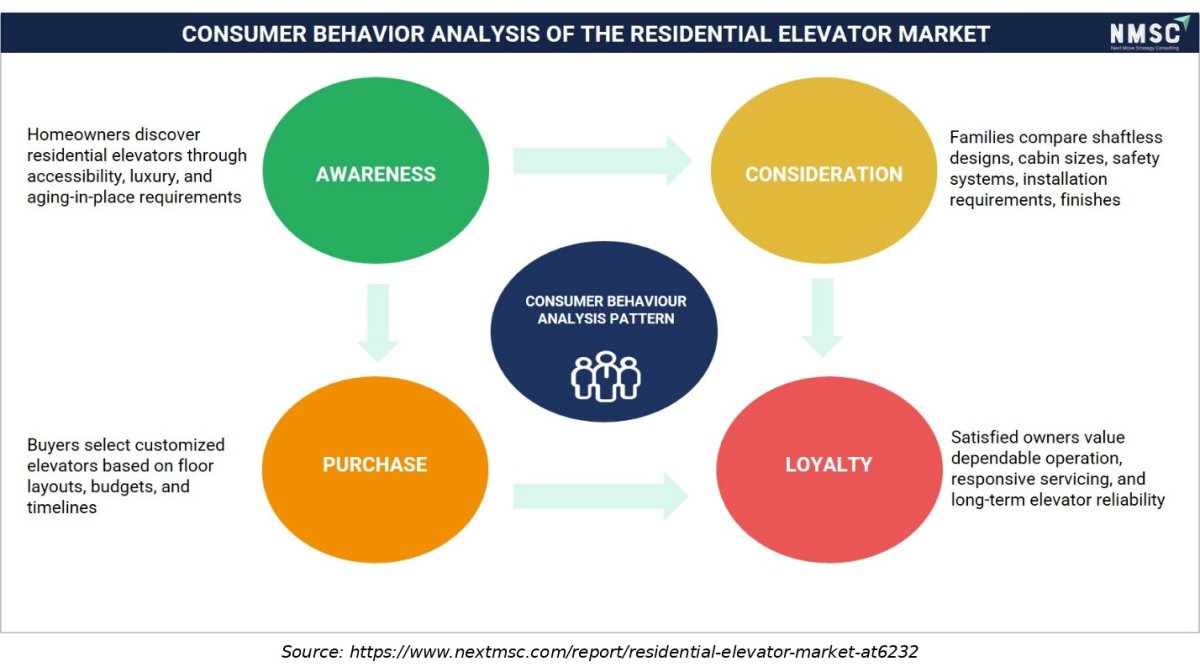
Consumer Behavior Analysis of the Residential Elevator Market

Consumer behavior in the residential elevator market progresses from awareness to consideration, purchase, and loyalty. Homeowners increasingly evaluate elevators based on accessibility, aging-in-place requirements, safety, customization, space utilization, and installation costs. Product reliability, cabin design, service responsiveness, and long-term performance strongly influence purchasing decisions and encourage customer loyalty.

Market Drivers & Dynamics

Interactive Dataset
Rising urbanization and demand for multilevel residential housing driver +1.4% Asia-Pacific, Middle East & Africa 2026-2035
Growing aging population requiring mobility and accessibility solutions driver +1.2% North America, Europe, Japan 2026-2035
Increasing retrofit and modernization demand in existing homes driver +1.0% North America, Europe 2026-2035
Rising adoption of smart and IoT-enabled elevator controls driver +0.7% Global 2026-2035
Expansion of luxury villa and high-net-worth residential construction driver +0.5% Middle East & Africa, North America 2026-2035
High installation and maintenance cost restraining broader adoption restraint -0.9% Global 2026-2035
Limited homeowner awareness of residential elevator options restraint -0.5% Asia-Pacific, Latin America, MEA 2026-2032
Structural and space constraints in older residential properties restraint -0.4% Europe, North America 2026-2032
Source: Next Move Strategy Consulting

Growth Drivers

What Is the Primary Growth Driver of the Residential Elevator Market?

Rising urbanization and demand for multilevel residential housing is the primary driver of the market. The United Nations Department of Economic and Social Affairs projects continued global urban population growth through 2035, with Asia-Pacific economies including India, China, and Indonesia experiencing substantial urban housing expansion. We observed that this urbanization trend, reinforced by rising high-rise and multilevel single-family home construction, continues to anchor baseline demand for residential elevator systems across developed and emerging economies alike.

How Is Aging-in-Place Demand Driving Residential Elevator Market Growth?

Growing aging populations requiring accessibility and mobility solutions is accelerating market growth as homeowners prioritize multilevel living without relocation. The U.S. Census Bureau projects a substantial increase in the population aged 65 and older through 2035, supporting sustained demand for home accessibility retrofits. Our assessment indicates that this demographic shift, combined with rising retrofit activity in suburban retirement corridors, is compressing adoption timelines for shaftless and space-efficient elevator designs.

Growth Inhibitors

What Is Restraining Residential Elevator Market Expansion?
High installation and maintenance cost restrains broader market adoption among price-sensitive homeowners, particularly in emerging economies with lower average household incomes. The European Union's Machinery Directive imposes extensive safety certification requirements that add compliance cost for manufacturers exporting into European markets. We found that these cost pressures, combined with limited homeowner awareness of residential elevator options, are moderating adoption pace outside premium and luxury residential segments.

What Are the Growth Opportunities?

How Can Shaftless Retrofit Solutions Unlock Existing Home Demand?

Expanding shaftless and pneumatic vacuum elevator product lines offers manufacturers a path to capture retrofit demand from homeowners unable to accommodate traditional cased-shaft installations. This opportunity benefits gearless traction and pneumatic vacuum elevator manufacturers and aging-in-place renovation contractors.

What Opportunity Does Smart Control Integration Present for Manufacturers?

Integrating app-based remote controls and predictive maintenance diagnostics creates opportunity for manufacturers to differentiate through smart home ecosystem compatibility. This mechanism benefits control system technology vendors and homeowners seeking connected, low-maintenance residential elevator systems.

How Can Dealer Network Expansion Strengthen Regional Market Reach?

Acquiring regional dealer and installation businesses creates opportunity for manufacturers to secure direct customer relationships and faster installation timelines in high-growth residential construction markets. This mechanism benefits vertically integrated manufacturers and real estate developers in expanding metropolitan regions.

Segmentation Analysis

2025 (USD Billion)
2035 (USD Billion)
Hydraulic Elevators 2025: $7.99 Billion | 2035: $11.07 Billion
Hydraulic El
Geared Traction Elevators 2025: $5.17 Billion | 2035: $7.38 Billion
Geared Tract
Gearless Traction Elevators 2025: $4.70 Billion | 2035: $9.59 Billion
Gearless Tra
Pneumatic Vacuum Elevators 2025: $3.29 Billion | 2035: $5.54 Billion
Pneumatic Va
Winding Drum Elevators 2025: $1.41 Billion | 2035: $2.21 Billion
Winding Drum
Other Elevator Types 2025: $0.94 Billion | 2035: $1.11 Billion
Other Elevat
Hydraulic Elevators $7.99 Billion $11.07 Billion 3.7%
Geared Traction Elevators $5.17 Billion $7.38 Billion 4.0%
Gearless Traction Elevators $4.70 Billion $9.59 Billion 8.3%
Pneumatic Vacuum Elevators $3.29 Billion $5.54 Billion 5.9%
Winding Drum Elevators $1.41 Billion $2.21 Billion 5.1%
Other Elevator Types $0.94 Billion $1.11 Billion 1.8%

Which Elevator Type Dominates the Residential Elevator Market?

Hydraulic elevators dominate the elevator type segmentation with approximately 34% share, reflecting their affordability, smooth ride quality, and ease of integration in low-rise residential buildings. We observed that gearless traction elevators are the fastest-growing sub-segment at 8.3% CAGR, as homeowners increasingly favor machine room-less designs that reduce installation space requirements while offering quieter operation and improved energy efficiency compared with conventional hydraulic systems.

2025 (USD Billion)
2035 (USD Billion)
New installa
Retrofit and
Replacement
Segment Item 2025 (USD Billion) 2035 (USD Billion) CAGR
New installation $10.0 USD Billion $40.0 USD Billion 8.0%
Retrofit and modernization $17.1 USD Billion $51.1 USD Billion 10.0%
Replacement $24.2 USD Billion $62.2 USD Billion 20.0%

Segment-wise data is locked

Unlock complete segment-wise numbers for By Installation Type.

Unlock Full Data

Which Installation Type Is Fastest-Growing in the Residential Elevator Market?

New installation held the largest share of the installation type segmentation in 2025 at approximately 42%, reflecting continued demand from new luxury and multilevel home construction. Our findings suggest that retrofit and modernization is the fastest-growing sub-segment at 6.4% CAGR, driven by aging-in-place renovation activity in suburban retirement corridors and rising demand for shaftless designs that enable elevator installation in existing homes without extensive structural modification.

2025 (USD Billion)
2035 (USD Billion)
Homeowners
Assisted liv
Real estate
Aging-in-pla
Other end us
Segment Item 2025 (USD Billion) 2035 (USD Billion) CAGR
Homeowners $10.0 USD Billion $40.0 USD Billion 26.0%
Assisted living facility developers $17.1 USD Billion $51.1 USD Billion 16.0%
Real estate developers $24.2 USD Billion $62.2 USD Billion 18.0%
Aging-in-place renovation contractors $31.3 USD Billion $73.3 USD Billion 8.0%
Other end users $38.4 USD Billion $84.4 USD Billion 23.0%

Segment-wise data is locked

Unlock complete segment-wise numbers for By End User.

Unlock Full Data

Which End User Leads the Residential Elevator Market?

Homeowners lead end user segmentation with approximately 29% share, reflecting direct purchase and retrofit decisions made by individual property owners seeking accessibility and property value improvements. We found that assisted living facility developers are the fastest-growing end user category at 6.4% CAGR, as expanding senior housing construction increasingly specifies residential-grade elevator systems to meet accessibility requirements across multilevel assisted living properties.

2025 (USD Billion)
2035 (USD Billion)
Cable-driven
Screw-driven
Pneumatic-dr
Chain-driven
Segment Item 2025 (USD Billion) 2035 (USD Billion) CAGR
Cable-driven $10.0 USD Billion $40.0 USD Billion 19.0%
Screw-driven $17.1 USD Billion $51.1 USD Billion 9.0%
Pneumatic-driven $24.2 USD Billion $62.2 USD Billion 15.0%
Chain-driven $31.3 USD Billion $73.3 USD Billion 13.0%

Segment-wise data is locked

Unlock complete segment-wise numbers for By Drive Mechanism.

Unlock Full Data
2025 (USD Billion)
2035 (USD Billion)
Up to 2 pers
3 to 4 perso
Above 4 pers
Segment Item 2025 (USD Billion) 2035 (USD Billion) CAGR
Up to 2 persons $10.0 USD Billion $40.0 USD Billion 14.0%
3 to 4 persons $17.1 USD Billion $51.1 USD Billion 24.0%
Above 4 persons $24.2 USD Billion $62.2 USD Billion 14.0%

Segment-wise data is locked

Unlock complete segment-wise numbers for By Capacity.

Unlock Full Data
2025 (USD Billion)
2035 (USD Billion)
Self-support
Cased shaft
Shaftless
Segment Item 2025 (USD Billion) 2035 (USD Billion) CAGR
Self-supporting shaft $10.0 USD Billion $40.0 USD Billion 21.0%
Cased shaft $17.1 USD Billion $51.1 USD Billion 19.0%
Shaftless $24.2 USD Billion $62.2 USD Billion 25.0%

Segment-wise data is locked

Unlock complete segment-wise numbers for By Shaft Type.

Unlock Full Data
2025 (USD Billion)
2035 (USD Billion)
Standard con
Smart and Io
App-based re
Segment Item 2025 (USD Billion) 2035 (USD Billion) CAGR
Standard control $10.0 USD Billion $40.0 USD Billion 12.0%
Smart and IoT-enabled control $17.1 USD Billion $51.1 USD Billion 14.0%
App-based remote control $24.2 USD Billion $62.2 USD Billion 24.0%

Segment-wise data is locked

Unlock complete segment-wise numbers for By Control System.

Unlock Full Data
2025 (USD Billion)
2035 (USD Billion)
Direct sales
Authorized d
Online sales
Segment Item 2025 (USD Billion) 2035 (USD Billion) CAGR
Direct sales $10.0 USD Billion $40.0 USD Billion 25.0%
Authorized dealers and distributors $17.1 USD Billion $51.1 USD Billion 19.0%
Online sales $24.2 USD Billion $62.2 USD Billion 25.0%

Segment-wise data is locked

Unlock complete segment-wise numbers for By Distribution Channel.

Unlock Full Data

Growth Opportunities

NMSC's analysis indicates that three whitespace opportunities stand out for manufacturers and technology vendors positioning for the next phase of market expansion.

How Can Shaftless Retrofit Solutions Unlock Existing Home Demand?

Expanding shaftless and pneumatic vacuum elevator product lines offers manufacturers a path to capture retrofit demand from homeowners unable to accommodate traditional cased-shaft installations. This opportunity benefits gearless traction and pneumatic vacuum elevator manufacturers and aging-in-place renovation contractors.

What Opportunity Does Smart Control Integration Present for Manufacturers?

Integrating app-based remote controls and predictive maintenance diagnostics creates opportunity for manufacturers to differentiate through smart home ecosystem compatibility. This mechanism benefits control system technology vendors and homeowners seeking connected, low-maintenance residential elevator systems.

How Can Dealer Network Expansion Strengthen Regional Market Reach?

Acquiring regional dealer and installation businesses creates opportunity for manufacturers to secure direct customer relationships and faster installation timelines in high-growth residential construction markets. This mechanism benefits vertically integrated manufacturers and real estate developers in expanding metropolitan regions.

Regional Outlook

2025 (USD Billion)
2035 (USD Billion)
Asia-Pacific
Europe
North Americ
Middle East
Latin Americ
Region 2025 (USD Billion) 2035 (USD Billion) CAGR (%)
Asia-Pacific $10.0 USD Billion $40.0 USD Billion 9.0%
Europe $17.1 USD Billion $51.1 USD Billion 27.0%
North America $24.2 USD Billion $62.2 USD Billion 25.0%
Middle East & Africa $31.3 USD Billion $73.3 USD Billion 23.0%
Latin America $38.4 USD Billion $84.4 USD Billion 12.0%

Regional data is locked

Unlock complete regional numbers for this market.

Unlock Full Data

Competitive Landscape

Our findings suggest that the residential elevator industry is moderately consolidated, with diversified global elevator manufacturers competing alongside specialized residential and home lift companies.

Dimension Description
Market Structure Moderately consolidated, with the top ten companies accounting for the majority share of global residential elevator revenue.
Innovation Focus Shaftless and space-efficient design, smart control integration, and predictive maintenance diagnostics.
M&A Activity Active, with manufacturers acquiring regional dealer and installation businesses to strengthen direct customer relationships.

How Do Companies Compete in the Residential Elevator Market?

Companies compete primarily on installation footprint efficiency, product customization, and dealer network breadth across hydraulic, traction, and pneumatic vacuum elevator categories. NMSC's analysis indicates that manufacturers differentiate through proprietary space-saving designs, smart control technology, and vertically integrated installation capability. Competitive rivalry is most intense in the hydraulic elevator category, where multiple established manufacturers offer comparable core mechanical systems, pushing differentiation toward aesthetics and smart features.

Which Competitive Archetypes Dominate the Residential Elevator Industry?

Two archetypes dominate: diversified global elevator manufacturers such as Otis Worldwide Corporation and KONE Corporation that combine commercial elevator engineering scale with residential product lines, and specialized residential and home lift companies such as Savaria Corporation and Cibes Lift Group AB that compete on purpose-built residential design expertise. Our analysis shows that scale advantages favor diversified manufacturers in premium new construction accounts, while specialists retain share in retrofit and shaftless product categories.

What Innovation and Differentiation Strategies Define Market Leadership?

Leading manufacturers are investing in shaftless design, smart home integration, and dealer network vertical integration to differentiate beyond conventional hydraulic systems alone. We observed that Savaria Corporation's continued acquisition of regional dealer and installation businesses illustrates how established players are securing direct customer access and installation capacity to support premium positioning and faster project turnaround.

How Active Is M&A Activity in the Residential Elevator Market?

M&A activity remains active, exemplified by Savaria Corporation's February 2026 acquisition of Baxter Residential Elevators, LLC in Texas, following its May 2025 acquisition of Western Elevator in British Columbia. We found that similar dealer network consolidation is likely to continue as manufacturers seek direct installation capacity and stronger regional service coverage across high-growth residential construction markets.

Key Market Players

Our assessment identifies the following companies as the leading participants shaping competitive dynamics in the residential elevator market.

Schindler Holding Ltd. KONE Corporation TK Elevator GmbH Mitsubishi Electric Corporation Hitachi, Ltd. Fujitec Co., Ltd. Toshiba Corporation Hyundai Elevator Co., Ltd. Savaria Corporation Cibes Lift Group AB Aritco Lift AB Stannah Lifts Holdings Ltd Stiltz Home Lifts Ltd. Nibav Home Elevators India Pvt. Ltd. RAM Manufacturing Company Terry Lifts Ltd Orona, S. Coop. Kleemann Hellas S.A. Yungtay Engineering Co., Ltd.

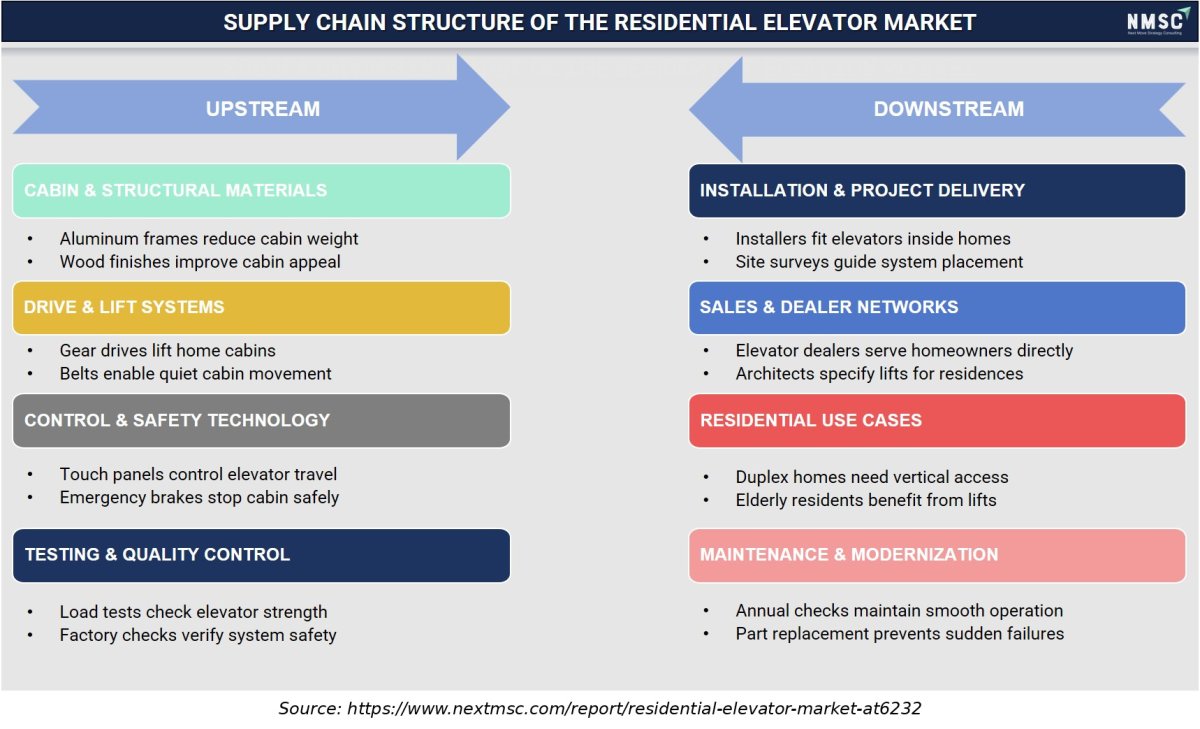
Supply Chain Structure of the Residential Elevator Market
Supply Chain Structure of the Residential Elevator Market

The residential elevator supply chain includes structural material suppliers, drive and lift system manufacturers, control technology providers, testing facilities, distributors, installers, and service providers. Upstream suppliers provide cabins, drives, controls, and safety components, while downstream participants manage project delivery, residential installation, maintenance, and modernization. Dealer networks and specialized contractors play an important role in connecting manufacturers with homeowners and developers.

Latest Developments

We observed the following recent developments shaping competitive positioning across the residential elevator industry.

Date Event
July 2, 2026 Savaria acquired Vipal S.p.A., an Italian manufacturer of residential lifts, elevators and related components. Vipal operates a 6,000m² vertically integrated factory producing shafts, cars, controllers and doors, expanding Savaria’s European manufacturing capabilities and residential-elevator portfolio while adding products compliant with European codes and standards.
June 18, 2026 Savaria introduced the Luma lift as a compact through-floor residential mobility solution requiring no shaft or pit. The self-supporting lift can serve two floors, uses battery operation with automatic charging and includes remote monitoring through Savaria Link, targeting homeowners seeking easier aging-in-place installations.

Investment Opportunities

Where Are Capital Inflows Concentrated in the Residential Elevator Market?

Capital inflows are concentrated in dealer network acquisition and shaftless product technology, as manufacturers seek to secure direct customer access and retrofit-friendly design capability. We observed that Savaria Corporation's continued acquisition-led expansion strategy, including its February 2026 Baxter Residential Elevators transaction, reflects sustained capital deployment toward vertical integration across the accessibility and residential elevator value chain.

How Significant Is Infrastructure Investment in Supporting Market Growth?

Manufacturing capacity investment, particularly across Asia-Pacific, is expanding the addressable production base for cost-competitive residential elevator systems. Our assessment indicates that domestic manufacturers in China, India, and Taiwan continue expanding production capacity to serve both domestic urbanization demand and export markets, directly supporting regional market growth over the forecast period.

What ESG Considerations Are Shaping Investment in Residential Elevators?

Environmental, social, and governance considerations increasingly favor manufacturers demonstrating energy-efficient design and accessibility-focused social impact. We found that investors are prioritizing companies showing measurable progress on regenerative drive technology and expanded accessibility for aging and mobility-impaired populations, aligning capital allocation with broader sustainability and social equity expectations across the value chain.

Key Benefits for Stakeholders

How Does This Report Benefit Industry Leaders and Enterprise Decision-Makers?

This report equips residential elevator manufacturer and dealer leadership with segmented demand data, competitive benchmarking, and regional growth projections to prioritize capital allocation across product portfolios. NMSC's analysis indicates that decision-makers can use the segmentation and driver-restraint analysis to align product development timing with retrofit and new construction demand shaping their specific geography focus.

How Does This Report Benefit Investors and Financial Analysts?

Investors and financial analysts gain access to independently derived market sizing, CAGR trajectories, and competitive landscape analysis supporting valuation and diligence work across diversified elevator manufacturers and specialized residential lift companies. Our assessment indicates that the regional and segment-level detail supports comparative analysis of growth exposure across public and private company portfolios.

How Does This Report Benefit Technology Vendors and Product Teams?

Technology vendors and product teams can use the segmentation by elevator type, control system, and installation type to identify underserved product categories and prioritize smart technology versus mechanical design investment. We observed that the driver-restraint and opportunity analysis directly informs go-to-market sequencing across regions with differing regulatory and adoption maturity.

Key Market Segments Evaluated

By Elevator Type

  • Hydraulic elevators
  • Geared traction elevators
  • Gearless traction elevators
  • Pneumatic vacuum elevators
  • Winding drum elevators
  • Other elevator types

By Installation Type

  • New installation
  • Retrofit and modernization
  • Replacement

By Drive Mechanism

  • Cable-driven
  • Screw-driven
  • Pneumatic-driven
  • Chain-driven

By Capacity

  • Up to 2 persons
  • 3 to 4 persons
  • Above 4 persons

By Shaft Type

  • Self-supporting shaft
  • Cased shaft
  • Shaftless

By Control System

  • Standard control
  • Smart and IoT-enabled control
  • App-based remote control

By End User

  • Homeowners
  • Assisted living facility developers
  • Real estate developers
  • Aging-in-place renovation contractors
  • Other end users

By Distribution Channel

  • Direct sales
  • Authorized dealers and distributors
  • Online sales

By Region

  • North America 
    • U.S.
    • Canada
    • Mexico.
  • Europe 
    • UK
    • Germany
    • France
    • Italy
    • Spain
    • Sweden
    • Denmark
    • Finland
    • Netherlands
    • Rest of Europe.
  • Asia-Pacific 
    • China
    • India
    • Japan
    • South Korea
    • Taiwan
    • Indonesia
    • Vietnam
    • Australia
    • Philippines
    • Malaysia
    • Rest of APAC.
  • Middle East & Africa 
    • Saudi Arabia
    • UAE
    • Egypt
    • Israel
    • Turkey
    • Nigeria
    • South Africa
    • Rest of MEA.
  • Latin America 
    • Brazil
    • Argentina
    • Chile
    • Colombia
    • Rest of LATAM.

Conclusion & Recommendations

The long-term outlook remains steadily positive, with the market expected to grow from USD 24.60 billion in 2026 to USD 36.90 billion by 2035 at a 4.6% CAGR. We observed that structural drivers, including urbanization and aging-in-place demand, are durable rather than cyclical, supporting sustained growth across gearless traction and shaftless elevator categories through the forecast period.

What Strategic Positioning Should Manufacturers Pursue?

Manufacturers should prioritize shaftless and space-efficient product lines that address retrofit demand, while pursuing dealer network acquisitions to strengthen direct installation capacity. Our assessment indicates that companies combining product innovation with vertically integrated distribution, following Savaria Corporation's acquisition model, will be best positioned to defend share as competitive intensity rises across commoditizing hydraulic elevator categories.

How Attractive Is the Market for New Investment?

The market presents steady investment characteristics given its durable demand base, expanding retrofit category, and exposure to demographic-driven accessibility needs. We found that smart and IoT-enabled control systems and online sales channels, growing at 9.8% and 10.5% CAGR respectively, represent the most attractive entry points for technology-focused investors and strategic acquirers.

What Market Shifts and Key Risks Should Stakeholders Monitor?

Stakeholders should monitor the shift toward dealer network consolidation and the shaftless product innovation reshaping competitive positioning industry-wide. Our analysis shows that high installation and maintenance cost remains a key risk to broader adoption, while structural constraints in older residential properties could continue limiting retrofit penetration in certain markets.

What Growth Pathways Should Companies Prioritize?

Companies should prioritize growth pathways centered on shaftless retrofit technology, smart control integration, and geographic expansion into Middle East & Africa and Asia-Pacific high-growth residential construction markets. NMSC's analysis indicates that these pathways offer the most direct route to capturing the USD 12.30 billion absolute dollar opportunity identified between 2026 and 2035.

FAQs

About the Author

Mihul Sharma

Mihul Sharma

Mihul Sharma is Research Associate at Next Move Strategy Consulting, where he has covered technology, industrial, and healthcare markets for 3 years. His work applies structured business research, market analysis, and secondary-source review to assess market trends, competitive developments, and growth opportunities. He supports report development by fully synthesizing industry data, company information, and market signals into concise findings for strategy and investment-focused research teams.

About the Reviewer

Supradip Baul

Supradip Baul

Supradip Baul is an accomplished business consultant and strategist with over a decade of rich experience in market intelligence, strategy, technology, and business transformation. His work has included rigorous qualitative and quantitative analysis across multiple industries, helping clients shape investment decisions and long-term roadmaps. Earlier in his career, he was associated with Gartner, where he contributed to industry-leading reports and market share analyses. He has worked with leading global companies and holds an MBA with a dual specialization in Marketing and Finance.

Download Free Sample

Kevin Coker

KEVIN COKER

Founder, CEO and Board Diector

Proxima Clinical Research

I have been using Next MSC reports for product positioning in a new geography for a long time. They have by far the best reports I have found and the price is reasonable too!

Mohit Agarwal

MOHIT AGARWAL

Chief Manager

DryChem India Pvt. Ltd.

Next Move Strategy Consulting is an amazing team of consultants. We required a market study report for our investors on top priority and the team went above and beyond our expectations to deliver the same with ample supporting data within a short time span enabling us to secure the investments and keep our project timeline maintained. Their professionalism, attention to detail, and timely delivery of actionable recommendations have left a lasting impression on our organization.

Ross J Mckenzie

ROSS J MCKENZIE

Business Insight Manager

Staysure Group

“Next MSC have been incredibly helpful in providing detailed & robust information on our market, alongside quantifying growth by different segments. The process to procure was simple and easy, with sample reports and regular contact to ensure we had what we needed. Succinct detail on their sources & methodologies is also greatly received, allowing transparency in this respect helps build trust in the detail you pay for. Joseph in particular was fantastic, and helped ensure efficient provision of the insight pack – thank you NMSC!”.

Gustaf Hummel Burstrom

GUSTAF HUMMEL BURSTROM

Founder

Revline Tools AB

Joseph and the team at Next Move Strategy Consulting have been excellent to work with, in supplying us with relevant market data and forecasts for our specific category. We had some special requirements and they were able to do a custom package to suit our needs. We would definitely recommend them to any other company needing market data and forecasts

Semih Kavaklioglu

SEMIH KAVAKLIOGLU

Co-Founder & Sales Manager

Decortie

I work a lot in the marketing industry and I know that research is an essential part of any campaign. I have used Market research reports for my own products and I found them to be very informative and well-researched. The team here produces insightful reports for a good price

Custom Market Research Services

We will customize the research for you if the listed report does not fully match your requirements.

Get 30% Free Customization

Select License

This website uses cookies to ensure you get the best experience on our website. Learn more

✖